


1 Toward the Iron Age in Anatolia and Syria: An Introduction
As we have seen in the preceding volume of this project, the political scene of western Asia and the eastern Mediterranean during the Late Bronze Age was monopolized by a restricted circle of great powers whereby Hittite Anatolia interacted and competed on a peer level with Egypt, Assyria, and Babylonia. In the next two chapters (and, in part, in Chapter 10), we will explore the crisis of this interregional system in the first decades of the 12th century BCE—combined with economic deterioration, environmental crisis and population movements—and the new local identities that emerged thereafter, reinterpreting various earlier traditions into new hybrid forms. This cultural dynamism was further fostered by a reorientation of interregional exchange networks in the Mediterranean, which for the first time was entirely involved in a deeply interconnected cosmos.1
For a long time, the dominant model for characterizing the political landscape emerging in the eastern Mediterranean after the collapse of the Late Bronze Age regional system has emphasized the role of ethno-linguistic boundaries in political negotiations. In his historical interpretations of the period, Liverani (2002, 2014:396–400) characterized the Iron Age political landscape of the eastern Mediterranean by drawing upon a typological distinction between city-states and ethnic states. According to this classification, city-states would be the heirs of the cantonal kingdoms that, especially in the Levant had emancipated themselves from the hegemony of the former regional powers. This category would comprise the central Levantine city-states composing the reality later known by the Greeks as Phoenicia, as well as the polities of southeastern Anatolia and northern Syria. These are labelled by modern scholars as Syro-Hittite or Neo-Hittite because they reappraised and reinterpreted Hittite cultural traits in new regional styles, chiefly the use of Hieroglyphic Luwian script and language.2 In Liverani’s model, ethnic states, or even nation states as they are alternatively called, would have emerged from the reorganization of local pastoral tribes that had hitherto eluded firm political control by the regional powers or, alternatively, by migrant groups that had recently appeared on the scene. Representative cases within this category would include Aramean kin-based formations of Syria and Mesopotamia and the Phrygian regional kingdom, which emerged in the 9th and 8th centuries around the site of Gordion, in northwestern Anatolia. In turn, Liverani’s model contrasts the ethnic and city-states of the eastern Mediterranean with areas east of the Euphrates, where the great regional powers of Assyria and Babylonia continued to exist along broadly the same modes of political, economic and social organization there in place during the Late Bronze Age.
Although the categorization proposed by Liverani was not immediately followed up in subsequent debates on the formation of Iron Age political landscapes,3 the underpinning equation between ethnicity and politics was deeply rooted as a standard model of interpretation.4 For example, central Levantine city-states such as Tyre, Sidon and Byblos have never been part of a coherent regional polity, and yet scholars are still reluctant to abandon the idea of an alleged Phoenician identity shared by these cities.5 Similarly, even in the best-informed scholarship, it is still customary to use the term Aramean in reference to those polities characterized by a widespread use of Aramaic language in epichoric inscriptions.6 In turn, the dialectics between supposed Aramean and Luwian ethnicities are often analyzed as a crucial component of political interactions on the Syro-Levantine scene, especially in those polities that used both corresponding languages.7 In a similar vein, artifacts from Iron Age Gordion and its environs characterized as Phrygian by virtue of their parallels have often been taken as proxies for Phrygian ethnicity and, thus, political domination.8
In a recent book, Osborne (2021) presented a critique of these ethno-centric interpretations with a case study on the Iron Age polities of Syria and southeastern Anatolia. The model advanced in this work stressed local strands of cultural hybridity from which the targeted political and cultural landscape emerged, which produced a continuum of shared traits crossing multiple linguistic boundaries. Consistent with this understanding, Osborne also rejects the ethnopolitical labels often employed for his studied context (e.g., Hittite, Luwian, Luwo-Aramean), preferring the more neutral Syro-Anatolian Cultural Complex (SACC). This novel framework successfully promotes a more mature conceptualization of the complex spatio-temporal interplay between political claims, linguistic landscapes and, more broadly, cultural expressions. However, the SACC model cannot be a satisfactory proxy for a cultural frontier per se, defined by a set of shared collective identities. For what matters here the emphasis on the common traits forming the SACC—pertaining mainly to means of power legitimation such as monuments and prestigious goods—downplays inner variance or even stark departures between different regional realities and socio-cultural matrices underlying the model. Major cultural frontiers existed within the SACC region, separating vastly different cultural milieus and modes of social organization.9 Additionally, the migratory approach offered by Osborne (2021:47–59) in an attempt to explain the apparent spread of the Luwian language from Anatolia to Syria during the Iron Age relies on limited evidence, as the author admits. Nonetheless, the problem of the Iron Age linguistic expansion of Luwian as posed by Osborne exists, and in this book we hope to provide some historical and linguistic tools that will enable future closer insights into it.
In this book, we follow Osborne in employing the term Syro-Anatolian as a neutral equivalent of Neo-Hittite vel sim., but we intend it in a strictly geographic sense, to define the area broadly encompassed between the Kızılırmak River, the Euphrates, and the Levantine coast down to the upper Orontes. Similarly, terms like “Phoenicia(n)” or “Phrygia(n)” will be used as geographic shortcuts for linguistic, cultural or political features (mainly) encountered in, or thought to originate from the respective regions. On the other hand, the term post-Hittite here has a temporal meaning to emphasize developments occurring in the former domains of the Hittite Empire after its fall. For the sake of clarity, due to the specific subject matter of this book, the geographical principle governing the organization of individual sections in the following two chapters is based on the main linguistic features characterizing each area, without presuming those features to have any geopolitical implications.
The present chapter is devoted to the Dark Age, here referring to the period immediately following the crisis of the 12th century BCE, when the cessation of cuneiform scribal culture in Anatolia and Syria caused a temporary documentary gap, or darkness, in most areas of the former Hittite domain.10 In these terms, the Dark Age is entirely subsumed within the archaeological period Early Iron Age but is not equivalent to it, due to the high variability of the documentary gap from area to area. For example, the Early Iron Age at Aleppo (or Iron I in the Syrian periodization) also includes the 11th century, when Taita engraved his Hieroglyphic Luwian inscription in the Storm God temple. Therefore, in a book such as this, which draws its data mainly from the textual evidence, Dark Age seems more fitting as a meaningful periodization, although we will also use the term Early Iron Age when referring to archaeological data or periods.
2 The Political Reorganization of the Ancient Near East during the Dark Age
Although the events of the 12th century are partly known, there is little data regarding the reorganization of the political landscape that ultimately led to the new geopolitical situation of the Early Iron Age, especially for the earlier phases. In general, comparing the cultural, linguistic and political geographies of the late 13th century with those of the early 10th immediately shows that nearly every area had been affected by more or less radical changes. Nevertheless, the significance of these changes varied across the individual areas on which a scholar might choose to concentrate. In the next sections, we will briefly introduce the main transformations in the cultural and linguistic geography of the areas of interest for the present study.
2.1 The Syrian Coast and the Levant
During the 12th and 11th centuries, the central and southern Levant underwent significant change (Fig. 2.1), not only from the perspective of political history, but also in terms of cultural and linguistic geography. The area appears rather inhomogeneous, with the central portions of the Levant exhibiting some degree of continuity. Local cultural elements, including a Canaanite dialect close to Iron Age Phoenician (which emerges, albeit indirectly and in terms of interference with Akkadian, in the Amarna Letters, cf. Albright and Moran 1948), persisted from the Late Bronze Age, since at least the 15th century BCE, but possibly even earlier (Markoe 2000:14–23). Trading relationships were maintained through the maritime routes in the eastern Mediterranean, involving immediate connections with Cyprus that foreshadowed the strong Cypro-Phoenician contacts of the full Iron Age.11

Fig. 2.1
Key sites and inscriptions in the Levantine coast during the Dark Age

It is not clear what exact role the Phoenician cities played in the crises that affected the eastern coasts of the Mediterranean during the 12th century BCE. Certainly, although they had clearly good relationships with Ugarit before its destruction (e.g., in the letter RS 18.31, Pardee 2002:93–94), they took advantage of its fall to expand their maritime activities; in a first phase during which the Tyro-Sidonian area appears to have been particularly active, Sidon prevailed over the rival city. It is conceivable that activity was more intense in the southern portions of Phoenician territory because the other centers were nearer to the crisis that invested the northern regions: although the stratigraphy of Byblos is largely unknown (and thus does not suggest the presence of a clear level of destruction), the site of Tell Sukas, some 130 km to the north on the Syrian coast, was clearly affected by the same catastrophic event that wiped Ugarit from the maps (Bretschneider and Van Lerberghe 2008:33).
Significantly, all the areas of northern Syria and central Anatolia that will show a penetration of the use of the Phoenician language by the time of the full Iron Age (Chapter 3) feature texts that employ the Tyro-Sidonian dialect, and no evidence indicates a significant expansion of the Phoenician cultural traits from south to north on the land.
Moving up toward the modern Bay of İskenderun, the coasts of northern Syria were arguably hardest hit by the raids of the so-called Sea Peoples. This highly problematic label will be better discussed in Chapter 10, due to its alleged Aegean characterization. However, regardless of any connection to the much-fabled groups of pirates devastating the eastern coasts of the Mediterranean, it is certain that for the northern Syrian coast, the first decades of the 12th century were a time of military unrest and generalized social, political and economic crisis. The warlike events that occurred in Ugarit are well known—even though some parts of the story, as it is often told by historians, are the result of interpretation and reconstruction, and the dates of specific events should be taken cum grano salis (Knapp and Manning 2016). For our limited purpose of contextualizing the changes in the cultural geography of the areas under study, we will limit ourselves to an overview of the safest pieces of information we possess. The letters that the last known ruler, Ammurapi, exchanged with the king of Hatti, refer to famine and impending war. RS 18.38 (PRU V no. 60) is the Ugaritic copy of a reply sent by the king of Hatti (certainly Šuppiluliuma II), who informs his vassal and ally that he is unable to provide support because the Hittite kingdom is experiencing famine as well (cf. also RS 20.212, possibly also dating to the reign of Ammurapi, for references to a similar crisis affecting the land of Ura, most likely somewhere on the Cilician coast). In RS 18.38, the Hittite king also complains that Ammurapi failed to pay a visit to him in Hatti, which may indicate that the Syrian ruler was struggling with serious internal problems that prevented him from traveling. Of course, other explanations exist: RS 16.78 (Villoreaud 1957: no. 18) is a letter addressed by Ammurapi to Egypt, in which he addresses the pharaoh as his own master. Evidently, the last king of Ugarit was in a difficult position, and he sought assistance and protection from all possible directions, including Karkemiš and Cyprus. In RS 20.238, the ruler writes to the king of Alašiya, reporting the raids perpetrated by an unnamed enemy (LÚnakri) and his inability to defend against them because his troops were deployed, for reasons left unmentioned in the letter, in Hatti, and his ships were stationed off the land of Lukka. Furthermore, RS 94.2169 (Lackenbacher and Malbran-Labat 2016:33–34) is a text from the so-called House of Urtenu in which the recipient is mentioned simply as LUGAL and the author as Ammurapi with no royal title. If the latter is indeed the king of Ugarit and not an otherwise unknown official, he appears to seek the help of a higher-ranking ruler, possibly King Talmi-Teššub of Karkemiš. Eventually, Ugarit fell, sometime around 1180 BCE, which may indicate that the requests for aid from the neighboring and traditionally more powerful kings were never answered. The city was never rebuilt, its archives went silent, and the local cuneiform writing system—one of the earliest proto-alphabetic ones developed in the Near East—ceased to be used, marking the end of the documentary history of the early West Semitic language known as Ugaritic.12
The city of Ugarit was gone, but the area featured other urban centers belonging to the small kingdom of which Ugarit had been the capital. For instance, the southernmost city of the kingdom, today the Tell Tweini archaeological site (probably corresponding to ancient Gibala), has Iron Age structures above the level of destruction of the early 12th century. Sites like Tell Tweini, or the previously mentioned Tell Sukas, not very far away, are mostly known archaeologically and left no archives. Consequently, a clear assessment of the nature of the political entity that followed the Bronze Age collapse at these two sites is difficult to attain. Most of the territory that formerly belonged to the kingdom of Ugarit will likely correspond to the coastal portions of the territory of later Aramaean or Syro-Anatolian kingdoms, such as Hama. As will emerge from the discussion of the geopolitical and cultural panorama of the full Iron Age, which will be described in Chapter 3, we know rather little of the maritime projection of the Aramaean and Luwian kingdoms; nonetheless, Hama appears to have been involved in Phoenician trades, as attested by the presence of weights inscribed with Phoenician characters and by the existence of a local measure evidently known to Phoenician traders: the Hamathite shekel (ŠQL ḤMT, see Heltzer 1995; Deutsch 2014).13 This may indicate that, with the disappearance of Ugarit, the northern Levantine coast would become a peripheral gateway of the eastern Phoenician trading network; however, to dwell any further on this hypothesis would be unproductive, given the lack of proper evidence. This would also provide indications that are highly significant for the main topic of the present work: although the Phoenicians were clearly a maritime power, they also maintained important relationships with the other peoples of the Levantine mainland, which explains why the Phoenician language was known, mentioned and occasionally used as a prestigious foreign language even in centers where there is no reason to assume a direct presence of Phoenician élites, such as in Karkemiš or Sam’al (see Chapter 3). The complex problem of the use of Phoenician in Cilicia, which likely involved Cypriot connections, will instead require a dedicated discussion, which will be offered below (Section 5) and in Chapter 4.
2.2 Not Just the Sea: The Syro-Mesopotamian Inland and Its Political Aramaization
Given the extraordinary importance of Ugarit during the final century of the Late Bronze Age, as well as the growing significance of sea routes at the transition between the Bronze and the Iron Age, it is no surprise that the coastal regions of the Levant have received considerable scholarly attention. Nevertheless, the same transition produced significant change inland as well (Fig. 2.2).
In Syria, the highly important site of Emar, a central political gateway during the Hittite domination at the end of the Bronze Age, collapsed. The date is uncertain (most likely, the end of Emar occurred at the beginning of the 12th century, as shown by the prosopographic analysis of the archives by Cohen and d’Alfonso 2009; cf. but also the discussion in Démare-Lafont and Fleming 2015), and in this case, the circumstances are almost completely unknown. Hurrian attacks are documented for the time of Pilsu-Dagan, one of the last rulers of the city, but we do not have conclusive evidence that the Hurrians were directly responsible for the final demise of Emar. Another potential cause may be the attacks by the mysterious tarwu peoples mentioned in AuOrS 1, 25:5,14 but of course we know nothing about them. Moreover, it should be stressed that because they are mentioned not in an official letter, but rather in a private contract, we must be cautious and ought not give the same credence to this information as we do with the evidence concerning the military crisis in Ugarit (which, as was just discussed, is much better documented). Alternatively, it has been speculated that the city was destroyed by nomadic peoples related to the Aramaeans,15 and this conjecture may be correct; however, it should be pointed out that resorting to the nomad threat in a region where nomadic peoples and city-states had coexisted for millennia is akin to playing a wildcard.
Fig. 2.2
Key sites and inscriptions in Anatolia and Syria during the Dark Age

If northern Syria underwent catastrophic change even far from the coast, the proper Mesopotamian regions appear, at a superficial glance, to be more stable (at least politically). Assyria maintained local power and enjoyed a first stage of regional projection with the campaigns of Tiglathpileser I in the final years of the 12th century—whereas Babylonia entered a long phase of political decline after the glorious years of Nebuchadnezzar I, but, in spite of the ill fortune of several short-lived dynasties (sometimes artificially labelled as such but composed by rulers of different origins), managed to survive as a kingdom until it was assimilated into Assyria during the mid-8th century BCE.
However, the survival of kingdoms (and, in general, complex polities) does not necessarily indicate that the cultural demography of an area remained the same; this, in turn, has obvious implications also for the linguistic geography of Syro-Mesopotamia. As the cultural and linguistic scenario begins to change, reorganization of the upper political layer may or may not be immediate, and the formation of new élites will—usually—occur gradually in the longue durée. Thus, the main change that will emerge in the Syro-Mesopotamian area (i.e., the political emergence of the Aramaeans, which partially matches the growth of the Phoenician world on the coasts), will affect the political geography of Syria in a visible way, because the previous formations either did not survive or underwent significant changes. The cultural change will become apparent in Assyria a few centuries later, when imperial officials, and even some rulers (e.g., Tiglathpileser III/Pulu in the 8th century), will begin to appear with Aramaic names. The language slowly became increasingly widespread in the territories of the new empire, with significant phenomena of language contact and contamination that emerge in the Neo-Assyrian dialect of Akkadian.16
In general, the very concept of an Aramaic culture or ethnicity remains elusive—and yet, seeking to define the phenomenon is paramount to our work, because the Aramaeans of Syria would become linguistic neighbors of the Iron Age Luwians, with some cases of coexistence of the two languages and elements in Osborne’s SACC (2021). Attempts to trace back the origin of the Aram element in both toponyms and anthroponyms during the Early, Middle and early Late Bronze Age, and to connect it to the presence of Aramaeans long before the times when the Aramaic language is attested, have been critically discussed by Lipiński (2000:26–35). Because most such attempts are highly uncertain or even formally or historically flawed, most of the works published in the past 20 years tended to concentrate on the history of the Aramaeans during the full Iron Age (see Chapter 3). Genealogical connections to the languages of the Bronze Age are not entirely clear.
As often highlighted in the literature (Lipiński 2000:35, with further references and discussion), the earliest references to the Aramaeans in Assyrian sources go back to the annals of King Tiglathpileser I,17 toward the end of the 12th century BCE, where the term is usually paired with the designation Ahlamu, which, during the Middle Assyrian age, was employed to refer to what we assume to be nomadic peoples with no clear ethnic characterization.18 Because the designation’s origin and etymology19 both remain elusive, the best way to briefly address the problem of the Aramaization of the Near East during the Dark Age is to shift toward simple synchronic historical geography, which emerges from the same sources in which the term is first used. In fact, occurrences of the adjective armayyu- are rather few in Tiglathpileser I, and, judging from the apparent mental map that is sketched in 2.28 and 4.31–34, there appears to be an opposition between the land called Ḫattu (which roughly corresponds with the area between Karkemiš and Malatya) and the land beyond the Euphrates, in which Aramaeans—or whatever the scribes of Tiglathpileser meant when they used this word—are found. These are associated with the region of Amurru (which included the city of Tadmar, i.e., Palmyra) and Sūhu, two ancient and traditional designations. To the south, a political boundary is mentioned, with the city of Rapiqu belonging to the territory of the kingdom of Babylon. These data appear to collocate Tiglathpileser’s Aramaeans somewhere to the west of the Middle Euphrates (cf. Lipiński 2000:35–36); but at the same time, the frontiers already appear quite blurry. Until the empire began to expand toward the end of the 10th century BCE, there was a long phase after Tiglathpileser’s reign during which the Assyrian sources are not generous in providing information about the political geography of central and northern Syria.
Of course, it is important to stress that we cannot and should not place too much trust in the consistency of the geographical designations contained in the ancient sources—a principle that is easily forgotten when dealing with obscure phases, for which even the smallest piece of documentary evidence may trigger over-enthusiastic attempts at identifications and reconstructions. This means that the fact that Tiglathpileser refers to Amurru as a specific political entity he raided does not imply that such a formation was in fact still the kingdom with the same name that existed during the final Bronze Age. Traditional designations easily survive in the archives of the cuneiform cultures, as evidenced by the very toponym Hattu, which was still employed by the Iron Age Assyrians to refer to areas entirely different from the former Hittite kingdom, even though the term appears to have completely disappeared from the political lexicon of the Iron Age Luwian sources.20 As a consequence, there is no need to consider the reign of Tiglathpileser as coinciding with a phase pre-dating the political reorganization of Syria and the Levant, and there is no way to discern the stage of Aramaization. It is worth noting a reference to the so-called houses (ÉMEŠ) of the land of Aram in a fragmentary Assyrian chronicle,21 which may hint at the subdivision of the Aramaean groups into clans or tribes; once again, however, some caution is in order, because the text was likely composed much later than the age it refers to and it may have anachronistically projected back in time a situation typical of the time in which it was written.
In general, in light of the sparse information we possess, it appears wise to use caution when characterizing the origin of the Aramaic world. The evidence for anthroponyms or toponyms containing the Aram element is limited and often questionable; nonetheless, it seems more likely that the Proto-Aramaic and Aramaic-speaking peoples already inhabited Syria during the Bronze Age, and that they later emerged as the main orchestrators of political reorganization in the Levant during the Dark Age.
3 The Fall of Hatti and Its Aftermath in Central Anatolia
After nearly half a millennium as the main seat of Hittite power, the city of Hattuša was abandoned at the onset of the 12th century BCE and forever lost any centrality in the Anatolian political and cultural landscape. Although the exact date of the city’s demise cannot be established with any confidence, it is conventionally set around 1190 BCE, or perhaps some years later upon crosschecking heterogeneous sources. Furthermore, the reasons for Hattuša’s abandonment defy straightforward explanation, but this event certainly owed to multiple converging factors, including climatic deterioration, natural disasters, economic decay, and a decline in the capacity of central institutions to cope with territorial instability across the vast Hittite Empire.22 In this negative conjuncture, the chronic factional strife that had long beleaguered the Hittite ruling family became a serious liability, especially after the establishment of a rival power base at Tarhuntašša endowed to a primary branch of the royal family.23
In his inscriptions, Pharaoh Ramses III includes Hatti among the countries invaded by the Sea Peoples. Older views that uncritically ascribed historical merit to this account have since been superseded, and seaborne population movements of the late second millennium BCE are now understood as phenomena whose impact was limited to the Mediterranean’s coastal areas. More generally, archaeological evaluations now tend to rule out foreign invasions from among the ultimate causes of Hattuša’s downfall. The ruins of official buildings are not covered by a uniform destruction layer suggestive of a violent takeover, whereas fires that seemingly affected individual buildings remain hitherto undated—and, in any case, do not appear to stem from a single catastrophic event. The burnt buildings were stripped of any furniture, down to the last ceramic vessel—yet no signs of urban warfare, such as weapons or the bodies of fallen victims, were found. The evidence would support a spontaneous abandonment of Hattuša by the inhabitants rather than a sudden assault by enemy forces.24 In fact, the city had already been experiencing a slow urban decline for some decades before its final downfall. Several quarters and religious buildings were deserted by the early 13th century BCE, possibly in connection with Muwattalli II’s short-lived relocation of the court to Tarhuntašša.25
So far, only a handful of cuneiform texts attributed to Šuppiluliuma II have been identified in the archives of Hattuša—and virtually none dating to his predecessor, Arnuwanda III. This peculiar chronological distribution is generally interpreted as evidence that the court and administrative apparatus was evacuated from the capital during its final days, carrying with them all tablets deemed important for current affairs.26 It is matter of speculation as to where the archives might have been relocated in this scenario, Tarhuntašša or Karkemiš seeming the two most viable possibilities. Wherever their final destination, the evacuation of Hittite scriptoria from Hattuša and elsewhere marked, in effect, the permanent demise of cuneiform writing traditions in central Anatolia.
After the institutions had quit the city, a residual population remained in Hattuša and continued, for a short while, to use the wheel-made plain ceramic wares typical of the Hittite period. Later in the 12th century, and through multiple subsequent phases up to the 10th century, new layers of modest dwellings and associated installations emerged on the ridges of Büyükkaya, on the northwestern tip of the former urban layout, while squatters occupied the abandoned ruins in other areas of the city. In the final phase of the Early Iron Age, habitation at Büyükkaya was replaced by a metalworking area.27 Ceramic inventories associated with these phases mark a dramatic rupture from the Hittite repertoire, chiefly evident in the almost complete cessation of wheel-made manufacture accompanied by the appearance of new shapes and wares. The most remarkable novelty was the introduction of geometric red-painted decoration applied to handmade vessels, having close parallels in the Pontic region to the north of Boğazköy.28 Moreover, a strikingly similar repertoire of red-painted decoration, but on wheel-made vessels, appeared in approximately the same region and has now been dated to the Late Bronze Age based on stratified finds from Oymağaç Höyük (the site of Hittite Nerik) near Merzifon.29 Given this peculiar spatial distribution, carriers of this red-painted ceramic horizon have often been identified with the Kaška attested by Hittite sources to have inhabited northern Anatolia.30 According to Hittite sources, the Kaška imposed constant pressure on Hattuša from the late 15th century onward, so it is possible that some of them eventually resettled the city after it had fallen into ruins.31 However, we should bear in mind that red-painted ceramics constitute only a small percentage of the total Early Iron Age assemblage at Boğazköy. An alternative hypothesis is that, a few generations after the centralized patronage over pottery industry was gone, the remaining population of Boğazköy carried on its own production under the influence of neighboring traditions that had hitherto resisted Hittite cultural pressure.32
Developments toward simpler forms of social organization similar to those observed at Hattuša affected other key Hittite sites in the Kızılırmak area (Fig. 2.2). The acropolis of Kuşaklı Höyük, Hittite Šarišša, was gradually abandoned toward the late 13th century BCE and would not be resettled until sometime before the 8th century BCE. Local paleoenvironmental records may nonetheless suggest the existence of an Early Iron Age occupation (albeit on a much-reduced scale) in the surrounding plateau.33 The main representative building of the Hittite period so far uncovered at Uşaklı Höyük experienced a violent conflagration after being abandoned during an event tentatively dated to the late 13th century on account of ceramic and 14C evidence.34 The next architectonic level on the site dates to the Middle Iron Age, but some sporadic finds of handmade Early Iron Age wares, including some red-painted specimens, may suggest the existence of an intermediate settlement starting from no later than the 11th century.35 Recent data from Çadır Höyük would point to a more marked cultural continuity, notwithstanding a reorientation in the local agropastoral production from a regional scale—possibly subservient to the Hittite administration—to a more cantonal subsistence economy.36
Regions west of the Kızılırmak show different patterns of transformation after the demise of Hittite imperial hegemony. Throughout the Late Bronze Age, Gordion/Yassıhöyük was within the sphere of Hittite cultural influence, best signaled by the standard Hittite repertoire of wheel-made plain wares and sealings of Hittite officials.37 This phase (YHSS 8) ended with no sign of major upheaval around the mid-12th century BCE—that is, perhaps decades after the abandonment of Hattuša.38 Reoccupation of the site with modest domestic structures appears to have resumed shortly thereafter, but it was characterized by a radical change in the material culture. An earlier phase of the Early Iron Age (YHSS 7B), lasting through the mid-11th century, attests to a technological transition toward handmade production of ceramics fired in an oxygen-reduced atmosphere, which gave a characteristic gray color range to surfaces and clays. In the subsequent phase (YHSS 7A), apparently lasting through the end of the 10th century, wheel-made ware reappears in a class of buff-colored vessels, attested in a repertoire of shapes anticipating Middle Iron Age traditions.39 This phase also yields the remains of a modest fortification system, likely built during the final decades of the 10th century.40 Such discontinuities in Early Iron Age ceramics are also paralleled by similar departures from Late Bronze Age traditions in house plans and building techniques. Because of these sudden changes, which affected virtually all aspects of material culture, scholars consider that at some point during the Late Bronze Age/Iron Age transition, Gordion was settled by a group of immigrants whose origins have been traced in the Balkans and Thrace.41 In these regions, horizons of handmade reduction wares similar to those found at Early Iron Age Gordion are indeed attested already in the late second millennium BCE, although direct comparisons are limited to a few features.42 In any case, a Balkan migration framework does not contradict what we know about Phrygian, the language attested at Gordion and its environs some centuries later, for which linguistic connections with the Balkans—and, more specifically, Greek—now appear well established (Chapter 8). In the late 8th century BCE, letters and royal inscriptions of Sargon II designated Phrygia with the term Muški (see Chapter 3); however, in Middle Assyrian documents of the 12th and 11th centuries, the same term appears associated with the region of Katmuhu, located in eastern Anatolia around the Tur Abdin mountains. The toponym Muški (rendered Mu/as(a)ka), also appears in a number of Iron Age hieroglyphic inscriptions, ranging from Karkemiš to the southern Anatolian plateau. It is unclear how all of these sparse references might fit into a coherent geographical picture—an issue further complicated by the uncertain historical contextualization of some of the hieroglyphic attestations (see below and in Chapter 3). In any case, scholars now agree that Muški or the like could hardly designate one and the same polity and/or people in all its attestations, and certainly the Middle Assyrian mentions of Muški referred to something that nothing had to do with the Phrygians of northwest Anatolia.43
As we have seen, wheel-made production of ceramics, a hallmark of the Hittite period, almost disappeared from Early Iron Age horizons of the northern Kızılırmak area, and did not resume until the Middle Iron Age. A less striking discontinuity is evident at Kaman Kalehöyük, on the middle Kızılırmak, where wheel-throwing of pots apparently continued or was reappraised in the 11th century. Stylistic traditions associated with this production are also very different from northern ones. They seem to belong, instead, to southern wheel-made horizons with bichrome band painted decoration, featuring at Porsuk and in survey collections from the surrounding region.44 The very strata yielding these assemblages at Kaman Kalehöyük also feature the remains of fortification walls, presumably indicating that the local population either maintained or quickly resumed some forms of complex social organization after the Hittite regional administration had left.
Recent data in part confirm the general impression that social reorganization was relatively precocious in the southern plateau in the aftermath of the Hittite Empire. Citadel walls broadly coeval to those discovered at Kaman Kalehöyük (11th century BCE) have been brought to light in the last decade at Niğde-Kınık Höyük, ca. 50 km to the north of Porsuk.45 Layers associated with these walls yielded the remains of two imposing underground silos intended for large-scale grain storage, which remained in use until the late 10th century BCE.46 Fortifications and administrative facilities would evidence a locally rapid reorganization of a complex economic system—one that prioritized the centralized accumulation of staple resources—in the early post-Hittite period.47 Notably, the Kınık Höyük silos, elliptical in shape, were abutting the inner side of the citadel walls, thus following a urban layout paralleled centuries earlier at Hattuša, Kuşaklı-Šarišša and other centers of Hittite Anatolia.48 The citadel wall, on the other hand, consisting of a stone socle with rubble filling and a mudbrick superstructure, shows a construction technique different from the casemate system typical of previous Hittite fortifications elsewhere, but reprises local Late Bronze Age traditions attested in earlier structures at Kınık Höyük itself as well as at nearby Porsuk.49 The evidence of Kınık Höyük, however, shows that these developments do not necessarily indicate a direct continuity from the Late Bronze Age. In fact, no citadel wall or other large-scale public structure in use during the 12th century BCE has been so far exposed on the site. On the other hand, deposits beneath the structure of the 11th century wall yielded a small assemblage of plain ceramic wares that, alongside examples continuing the Late Bronze Age wheel-made repertoire, also include a large proportion of handmade vessels crafted in a new set of shapes.50
Unfortunately, our complete lack of knowledge of 12th century developments in the southern plateau outside Kınık precludes an empirical evaluation of the above evidence within a broader picture. In principle, one would be tempted to see the signs of economic and cultural resilience visible in the 11th century BCE in connection with the 8th century local re-emergence of Hieroglyphic Luwian language and script and Hittite artistic traditions, in the region of Tuwana and the other polities forming the political constellation known by the Assyrians as Tabal (see Chapter 3). Summers (2017) recently advanced an opposing view, proposing that all forms of monumentality and complex urban organization typical of Tabal—and, most importantly, the use of Hieroglyphic Luwian—did not result from indigenous developments, but instead were reintroduced from Syria in the wake of the Assyrian expansion of the 9th and 8th centuries BCE. The recent data from Kınık Höyük and the new Gordion chronology, which attests to the emergence of an articulated urban layout and sophisticated artistic traditions already in the early 9th century (Chapter 3), would support the indigenist hypothesis and contradict Summers’s model of secondary diffusion (at least as far as the dynamics of social organization are concerned).51 Moreover, there is very little evidence of close contacts between central Anatolia and Syria during the Iron Age; on the contrary, the spatial patterning of material proxies such as ceramics, as well as the linguistic make-up of Syro-Anatolia in the Middle Iron Age, shows that cultural features in the two areas developed along different trajectories. Indeed, their only shared traits are those that could have been independently inherited from the Hittite period on both sides of the Taurus range.52
The mechanisms that drove the Iron Age reappearance of Hieroglyphic Luwian in central Anatolia—after a hiatus of some four centuries—remain obscure. Generally speaking, we cannot discount the possibility of transmission from the Elbistan-Malatya area, where hieroglyphic traditions have been attested since the very early post-Hittite period (see below, section 4.1). Contacts between central Anatolia and Malatya continued throughout the Iron Age and are attested by the material record.53 Moreover, Malatya was a regular station for Assyrian armies en route to Tabal.54 Otherwise, knowledge of hieroglyphics may have survived the Dark Age, still undetected somewhere in central Anatolia. The hypothesis of a Tabalian scribal tradition would in fact explain the emergence of unique styles, such as those of TOPADA and KULULU, in the 9th and 8th centuries.55
Any assessment of the survival of hieroglyphic script in central Anatolia must also consider the questions surrounding a group of hieroglyphic inscriptions on rocks scattered across the southern Anatolian plateau, which are attributed to a ruler named Hartapu. Six inscriptions of this subcorpus, KIZILDAĞ 1–4 and KARADAĞ 1–2, were discovered in the early 20th century CE on the eponymous paleo-volcanoes, clustered in the modern province of Karaman. The inscription of BURUNKAYA, discovered in 1971, is isolated from the others by its location in a rock cliff near present-day Aksaray, ca. 140 km to the northeast of the Kızıldağ-Karadağ cluster.56 All these inscriptions are dedicated by an individual named Hartapu (há+ra/i-tá-pu-sa),57 who claims the titles Great King and Hero. In three instances of this group, Hartapu also declares his filiation from a Mursili, likewise styled as Great King and Hero (KIZILDAĞ 3–4, BURUNKAYA). The fragmentary incipit of KIZILDAĞ 5 bears only the name and titulary of Mursili, who is presumably the author of the inscription. The predominant style and paleography of this group are most similar to those of imperial Hittite hieroglyphic compositions, such as YALBURT and EMİRGAZİ. The Great King titulary, enclosing the name of Hartapu in a royal aedicula (both with and without the winged sun), also harks back to imperial Hittite traditions, and the name of Hartapu’s father has clear links to the Hittite dynasty. On the other hand, there seems to be no way to fit Hartapu in the Hittite royal sequence. Therefore, most scholars have long maintained that this personage was a ruler, perhaps even a descendant of Urhi-Teššub/Muršili III, who carved out his own rump state in the southern plateau in the early 12th century BCE.58 In this context, it has also been proposed that Hartapu inherited the kingdom of Tarhuntašša, likely based in the Konya plain, not far from the main cluster of Hartapu inscriptions.59
A serious obstacle to this early dating of Hartapu has always been his inscription KIZILDAĞ 1, bearing only the aedicula excised in relief in close connection with the incised engraving of a seated royal figure, depicted in the Assyrianizing style typical of Syro-Anatolian art of the 9th–8th centuries BCE.60 Various solutions were proposed to explain this apparent discrepancy within a 12th century dating of Hartapu, but most scholars eventually came to agree that the relief was a later addition to the inscription. The debate surrounding Hartapu took a definitive turn in 2019, when surveys conducted in and around the large site of Türkmen-Karahöyük (ca. 13 km to the north of Kızıldağ) recovered a stone block with a hieroglyphic inscription recounting the deeds of Hartapu/Kartapu Great King (TÜRKMEN-KARAHÖYÜK 1).61 In fact, the inscription is a combination of at least two epigraphs that were likely engraved in two different stages. The first paragraph, half-excised in relief, reports the conquest of the country of Mus(a)ka (mu-sà-ka) by the Great King son of Mursili Hartapu, whose name is spelled here as Kartapu (ka+ra/i-tá-pu-sa).62 The historical narrative continues, detailing further events in two more paragraphs that have been incised and which use the more usual ha-spelling of the ruler’s name (há +ra/i-tá-pú), enclosed in the royal aedicula.
Notwithstanding the inconsistent name spellings, the editors of TÜRKMEN-KARAHÖYÜK 1 are certain that this inscription refers to the same person—who, in light of his titles and filiation, should also be identified with the author of the other inscriptions of Hartapu’s corpus. However, the editors also argued in favor of attributing the composition of TÜRKMEN-KARAHÖYÜK 1 to the 8th century BCE, thus lowering the chronology of Hartapu’s reign by at least four centuries. Despite a general archaizing style, the text appears to show—in both the excised and incised parts—a number of sign variants that are not attested before the Middle Iron Age, such as the hooked version of L. 439=wa/i.63 Moreover, the country of Mus(a)ka—allegedly conquered by Hartapu/Kartapu, presumably the same as the Assyrian Muški—is not attested as a political player active in central Anatolia before the campaigns of Sargon II against Mita (Midas, see Chapter 3); yet, given the location of TÜRKMEN-KARAHÖYÜK 1, Mus(a)ka could hardly be referring to the eastern Anatolian namesake appearing in Middle Assyrian sources of the 12th–11th centuries. The editors of TÜRKMEN-KARAHÖYÜK 1 also draw a parallel with KIZILDAĞ 4 § 2c, arguing that this passage, previously read “he conquered the land of Maša forever,”64 indeed refers to the same event as the conquest of Mus(a)ka mentioned in TÜRKMEN-KARAHÖYÜK 1, § 1. An 8th century dating of Hartapu would finally resolve the problems raised by KIZILDAĞ 1, leading to the conclusion that the inscription was carved at the same time as the figurative relief on its side, as part of a coherent composition.
As often happens in similar cases, the interpretations proposed by the scholars who first studied the new inscription were met with some criticism. Noting the scarce attention given by the first editors to the composite aspect of the inscription, Adiego (2021) argues that the part in relief was carved out later, modifying a previous inscription constituted by the incised part. This would explain the different spellings of Hartapu’s name between the two parts as well as the conspicuous differences in execution and style (for example, the lack of the royal aedicula in the excised incipit as opposed to its presence in the second, incised, paragraph). Accordingly, Adiego ascribes only the relief part of the inscription to the 8th century, and maintains the more traditional 12th century date for the incised part. However, this interpretation does not consider the clear diagnostics for a late date that are present in the incised part, namely the abovementioned L. 439=wa/i.
The chronological revision encouraged by TÜRKMEN-KARAHÖYÜK 1 clashes with the consistent imperial Hittite sign repertoire shown by Hartapu’s other inscriptions. Leaving aside shorter examples in the corpus, the most prominent obstacle for a generalized attribution of Hartapu’s reign to the 8th century is represented by KIZILDAĞ 4, an inscription of length comparable to TÜRKMEN-KARAHÖYÜK 1 but featuring only archaic signs, with close parallels in YALBURT and SÜDBURG. Drawing on this case, Hawkins and Weeden (2021) closely revised the paleography of the entire Hartapu’s corpus and on this basis they envisaged the existence of two Hartapu. An earlier ruler with this name (Hartapu I) would have reigned in the 12th century, dedicating KIZILDAĞ 4 and the other archaic-looking inscriptions, namely KARADAĞ 1–2. The later Hartapu (II) would have ruled in the 8th century BCE, being the author of TÜRKMEN-KARAHÖYÜK 1, KIZILDAĞ 1–3 and BURUNKAYA. In this case, Hawkins and Weeden observe, KIZILDAĞ 4 would attest a land of Mus(a)ka/Muški in central Anatolia already in the 12th century BCE, but without necessarily referring to a well-defined geopolitical entity. Accordingly, in the first paragraph of TÜRKMEN-KARAHÖYÜK 1, Hartapu II would have commemorated the deeds of his revered predecessor and namesake, modelling his account upon KIZILDAĞ 4. While solving the paleographic puzzle, the reconstruction proposed by Hawkins and Weeden imposes some historical twists that, although not implausible, can hardly be supported on independent bases.65 After all, on account of the contextual evidence, we should not discount the possibility that KIZILDAĞ 4 was in fact a Middle Iron Age archaizing text executed well enough to resist modern formal attempts to lower its date.66 In summary, the question of the number of Hartapu and the relative dating of their reigns seems far from finding a conclusive solution. For what matters here, we maintain the 8th century date for TÜRKMEN-KARAHÖYÜK 1 and BURUNKAYA based on Hawkins and Weeden’s observations, while leaving open the chronological ascription of the other representatives of the Hartapu’s corpus.
4 Luwian Syro-Anatolia
4.1 The Euphrates Area: Karkemiš and Malatya in the 12th and 11th Centuries BCE
During the late 14th and 13th centuries BCE, the city of Karkemiš was the seat of Hittite viceroys, whose dynastic line descended directly from the Great King Suppiluliuma I (Fig. 2.2). After their installation, the dynasts of Karkemiš, consistently designated as kings throughout the imperial phase, attained a prominent position within the Hittite power network, exerting a role of supervisors over Hittite dependencies in Syria on behalf of the Great Kings residing at Hattuša.67
In the famous inscription of Ramses III at Medinet Habu, Karkemiš appears among the countries defeated by the Sea Peoples.68 However, contrary to this claim, and unlike most other regions of the eastern Mediterranean, Karkemiš and its hinterland appears to have been only marginally affected by the upheavals of the Late Bronze Age/Iron Age transition. Excavations on the site, carried out first by the British Museum (1911–1914) and reappraised about a century later under the ongoing direction of Marchetti (since 2011), have so far revealed no trace of destruction at the end of the Late Bronze Age.69 On the contrary, the most recent findings show that, despite some renovations, the general layout of the main public buildings and the fortifications remained in place throughout the Early Iron Age. Material culture, chiefly ceramic frameworks, also continued to develop with no stark ruptures from the Late Bronze Age repertoire.70 Most importantly, Karkemiš did not yield any sherd of LH IIIC nor associated Aegaeanizing features that elsewhere in the vicinity represent the main diagnostic of material cultural change in the terminal Late Bronze Age and earliest Iron Age phases. Iconographic motifs of clear imperial Hittite tradition, accompanied by the continued, and exclusive, use of Hieroglyphic Luwian in monumental programs and seals through the Early and Middle Iron Ages complete the picture of Karkemiš as an archetypal Syro-Anatolian state strongly tied to its Hittite heritage.71
General cultural data resonates with the still scanty, but growing, historical information available for the period. The last king of Karkemiš known to have ruled under formal Hittite hegemony was Talmi-Teššub, who signed a treaty with Šuppiluliuma II (CTH 122).72 The main obstacle to a solid historical reconstruction of the following phases at Karkemiš is that this site yielded virtually no epigraphic evidence until the early 10th century.73 Fortunately, finds from other sites, in addition to information from external sources (primarily Assyrian) provide material for at least a tentative—albeit in many cases controversial—reconstruction.
A number of bullae discovered in the late 1980s at Lidar Höyük bear the impressions of a seal fashioned in a Hittite imperial style belonging to a king of Karkemiš named Kuzi-Teššub, claiming to be son and successor of Talmi-Teššub. There is little doubt, therefore, that this Kuzi-Teššub was a direct descendant of the viceroys of Karkemiš and that he ruled the country in years roughly coterminous with the collapse of the Hittite Empire and likely for some time after this event.74 The name Kuzi-Teššub is not attested at Karkemiš itself, but in the genealogies of Malizean rulers of the early 11th century it appears accompanied by the Hieroglyphic Luwian title of Great King, a prerogative that during the Hittite imperial phase was reserved to the royal house of Hattuša.75 Here the widespread view, that will soon be discussed more into detail, is that in the aftermath of the Hittite Empire, Kuzi-Teššub of Karkemiš gained some form of control over the Euphrates region up to Malatya, thus taking the hegemonic title of Great King, or at least being later remembered as such.76 A political inheritance and transfer of related symbols from Hattuša to Karkemiš in the post-Hittite period is more indirectly reflected in Neo-Assyrian sources, where Karkemiš and neighboring territories are often called the “land of Hatti,” thus applying to Euphratic Syria a geographic designation used in the second millennium to indicate central Anatolia.77
The virtual lack of epigraphic material from Karkemiš through to the early 10th century precludes confident reconstruction of the local dynastic sequence after Kuzi-Teššub and from assessing how far his line of succession may have persisted. The matter is further complicated by the above-mentioned Malizean evidence, where Kuzi-Teššub features as the forefather of a local line of Country Lords (REGIO.DOMINUS), with no apparent involvement of Karkemiš (see below). A growing consensus would now include among the sources on post-Hittite Karkemiš the famous Ankara Silver Bowl. This unprovenanced artefact, currently stored at the Ankara Museum of Anatolian Civilizations, bears a short inscription mentioning in a dating formula the conquest of the country of Tarwiza by a [Tu]thaliya Labarna.78 Previous proposals dated this inscription to the late 15th century based on the identification of Tarwiza with the western Anatolian Tarwiša, targeted by the campaigns of Tuthaliya I. However, this analysis is now superseded by compelling paleographic and orthographic considerations, that would conclusively assign the inscription to the 12th century BCE.79 Connections with Karkemiš would bear on the observation that one of the main Karkemišean deities, Karkuha, very rarely attested elsewhere, appears as a theophoric element in the name Mazi-Karkuha, another personage mentioned in the bowl, titled a King.80 Notwithstanding these widely accepted interpretations, an unresolved question concerns the identity of the rulers Tuthaliya Labarna and Mazi-Karhuha.81 A king named Mazi-Karhuha is not attested outside the Silver Bowl, and, if actually a king of Karkemiš, he could fit virtually anywhere among the successors of Kuzi-Teššub in the 12th century. An alternative view, perhaps more attractive, would see Tuthaliya Labarna as a king of Karkemiš, perhaps identical to the Great King Tuthaliya mentioned in the fragmentary inscription KARKAMIŠ 16c, or a predecessor thereof.82 If so, labarna would be yet another perquisite of the royal house of Hattuša transferred to Karkemiš in the early post-Hittite period. It must be stressed, however, that no ruler of Karkemiš otherwise attested ever claimed this title.
More secure evidence about a Karkemišean ruler derives from Assyrian royal inscriptions dating to around 1100 BCE. In those years, Tiglathpileser I reinvigorated Assyrian expansionist policies to the west of the Euphrates, leading campaigns against Karkemiš and receiving thereupon a tribute from Ini-Teššub, defined as king of the land of Hatti (e.g., RIMA 2 A.0.87.10:33–35). It is generally argued that Hatti in this particular passage stands as a geographic synonym of Karkemiš. Ini-Teššub would be the second individual with this name attested on the throne of Karkemiš, the first one having ruled around the mid-13th century BCE as a contemporary of Hattušili III and Tuthaliya IV. Scholars discuss whether to connect the Ini-Teššub encountered by Tiglathpileser I with epigraphic information gleaned from the stele of KARAHÖYÜK (Elbistan). This Hieroglyphic Luwian document, found in situ and dated on paleographic and stylistic ground to the 12th century BCE, attests a Great King Ir(i)-Teššub who inspected and restored the otherwise unknown city of POCULUM.PES2, probably rendering the ancient name of Karahöyük itself.83 The equation of Ir(i)-/ Ini-Teššub can be considered on supposing a scribal mistake in the hieroglyphic spelling and would imply some sort of hegemony of Karkemiš over the Elbistan area in the late 12th century, presumably including nearby Malatya. This scenario, however, would conflict with the information gleaned from other passages of the inscriptions of Tiglathpileser I, that present Malatya (Assyrian: Melid) as an independent polity under the authority of a ruler named Allumari (see below). Another possibility is that Ir(i)-Teššub was a successor of Kuzi-Teššub, active at a time when Karkemiš still had some form of authority in the Malatya area.84 Otherwise, yet another independent Great King might well have been active in southeastern Anatolia during the 12th century BCE, eventually leaving a trace only at Karahöyük-Elbistan.85
The earliest ruler known from inscriptions found at Karkemiš is Sapaziti, attested with the titles of Great King, Hero in the genealogical formulas of two stele inscriptions, dedicated to Sapaziti’s son, the Great King Ura-Tarhunza.86 The date of the inscriptions, suggested on paleographic and historical considerations, provides a terminus ante quem for Sapaziti reign in the early 10th century BCE. One of the stele is dedicated by Suhi I, the first of a line of Country Lords who, after ruling for some generations in tandem with Great Kings, later took power as a royal house de facto. With this gradual dynastic transition, the history of Karkemiš entered a new phase that will be dealt with in the next chapter.
The unresolved controversies concerning the dynastic sequence of Karkemiš in the early post-Hittite period offer only very shaky historical ground upon which to follow developmental trajectories of the Karkemiš state between the reigns of Kuzi-Teššup and Sapaziti. There is reason to suppose that, at least initially, Karkemiš may have taken advantage of the decline and demise of its central Anatolian overlords. Unpublished texts from Tell Sabi Abyad dated around 1190 BCE appear to imply that Karkemiš entered in a conflict with the last attested ruler of Emar, Ahī-Malik, with the support of Assyrian troops.87 From these circumstances we might cautiously deduce that, around the time Hattuša was being abandoned, Karkemiš was able to play its own cards, joining an alliance with a former rival of Hatti and trying to carve an independent domain out of its previous viceregal premises. A connection has also been proposed between the Tarwu-peoples who attacked Emar shortly before its destruction (ca. 1175 BCE; see above, Section 2.2) and the Tarwiza conquered by Tuthaliya Labarna, as claimed in the Silver Bowl.88 This name can indeed be analyzed as a Luwian ethnicon (‑iza) from a toponymic root Tarw‑, meaning the ‘Tarwean,’ but this is as far as we can go in seeking connections with the Emar evidence.89
As mentioned above, the urban layout of Karkemiš did not suffer major disruptions at the transition to the Early Iron Age, but more data are needed in order to evaluate how closely this picture of resilience matched surrounding areal frameworks. Regional surveys in Euphratic Syria and southeastern Anatolia consistently document a sharp increase in settlement numbers from the Late Bronze Age to the Iron Age, aligning with a general trend also observed elsewhere in neighboring regions.90 Explanations offered for this phenomenon vary greatly, involving such diverse models as sedentarization of semi-nomadic populations, ruralization of previously urban communities or, eventually, immigrations from other regions.91 Irrespective of its ultimate demographic causes, the Iron Age settlement expansion documented in the archaeological record may have been fostered by active policies of colonization of the landscape, including the founding of towns. Such practices are attested in inscribed claims of Syro-Anatolian rulers, especially from the 11th century on, but they may have been already in place during the otherwise less-documented 12th century BCE, as suggested by references to urban restorations and repopulation programs contained in the KARAHÖYÜK inscription. Survey data from the Karkemiš and surrounding regions are too coarse for evaluating urban trends specific to the early post-Hittite period in this area.92 More refined chronological data available from excavated sequences may offer useful hints; however, these remain too patchy for a coherent interpretation. At Tille Höyük, on the western Euphrates bank some 160 km upstream from Karkemiš, the construction of an imposing citadel gate redated around the mid-12th century testifies to a very early post-Hittite revitalization of the site after a long hiatus lasting through the Hittite imperial phase.93 Lidar Höyük, the findspot of the Kuzi-Teššub sealings, lies just ca. 35 km downstream from Tille Höyük, on the opposite bank of the river, and displays a continuous occupation from the Late Bronze Age.94 In summary, this scattered archaeological information suggests a broad resilience of habitation patterns, or even a thriving urbanization, in Euphratic Syria during the 12th century BCE. Activities in this framework involved the construction of public structures (Tille Höyük gateway) in areas that, judging from the whereabouts of Kuzi-Teššub’s sealings, might well have fallen within the bounds of Karkemišean political claims.
Following the Euphrates River northward, and then through mountain passageways across the Taurus, routes from Karkemiš could lead directly to Malatya. The best archaeological evidence for close contacts between the two areas along the Euphrates corridor is a continuous ceramic exchange lasting through the Early and Middle Iron Ages.95 In cuneiform sources of the Hittite imperial period, Malatya—there known as Militiya—appears as an outpost on the unstable frontier with Mittani and Assyria, run by Hittite officials interacting with local elders.96 On the site of ancient Militiya (present-day Arslantepe), the end of the Late Bronze Age is marked by the violent destruction of the city’s so-called Imperial Gate. However, the settlement recovered soon thereafter in two phases featuring monumental architecture and imposing fortifications, respectively dating to the final Late Bronze Age (ca. 1250–1200) and to the earlier Early Iron Age, between the 12th and the 11th centuries.97 Buildings belonging to this latter phase were embellished with sculpted orthostats with figurative scenes, some of which were later removed and reused in the decoration of the Lion’s Gate of the 8th century BCE.98 As with Karkemiš, the iconography of these reliefs, many of which accompanied by Hieroglyphic Luwian inscriptions, directly derives from imperial Hittite traditions.
Thanks to the epigraphic corpus from Arslantepe and other inscriptions found in its environs between Malatya and Elbistan, we understand that during the 12th and 11th centuries the area was occupied by the polity of Malatya, rendered in Hieroglyphic Luwian as MAx.LIx.ZI, corresponding to Assyrian Melid.99 As mentioned above, a lineage of rulers reconstructed from Malatya inscriptions consistently claims descent from Kuzi-Teššub in their genealogies, attributing to him the titles Great King and Hero as well as mentioning, in one case (GÜRÜN), his association with Karkemiš.100 There is little doubt, therefore, that this Kuzi-Teššub was the same person as the son of Talmi-Teššub who sealed the bullae found at Lidar, although he there appears with the status of king, as opposed to Great King, of Karkemiš. In turn, this secure connection would suggest that in the very early 12th century Karkemiš acquired at least a nominal hegemonic status over Malatya, which would be acknowledged by later rulers of this country. However, the modalities of this Karkemišean dominance are not clear; furthermore, there is no consensus about its possible duration after Kuzi-Teššub.
The first representative of the House of Kuzi-Teššub attested in his own inscriptions is Runtiya, who identifies himself as a son of a PUGNUS-mili (I) and grandson of Kuzi-Teššub.101 PUGNUS-mili (I) appears in other inscriptions as the father of another grandson of Kuzi-Teššub, Arnuwantis (I).102 On this basis, Arnuwantis (I) and Runtiya are identified as brothers, the one likely succeeding the other in the dynastic sequence. In fact, although no Runtiya is further attested in later genealogies, Arnuwantis (I) appears to have passed the throne to his son PUGNUS-mili (II), in turn followed by another Arnuwantis (II).103
As will often be the case with Syro-Anatolian dynasties documented later (see Chapter 3), the titulature claimed by Malatyan rulers,104 when attested at all, is not homogeneous but may nevertheless shed light on the political status of Malatya and its relationships with Karkemiš. PUGNUS-mili (I) is consistently attributed no title at all in the genealogies where he appears, possibly meaning that he never had a ruling position or, perhaps, acted as an officer with no sovereign authority under his father, Kuzi-Teššub.105 In his monumental inscriptions, Runtiya styled himself as a Country Lord (REGIO.DOMINUS), a title already in use within the Hittite imperial administration and broadly equivalent to cuneiform EN.KUR-TI. In the case of the Hittite Empire, Country Lord designated high-ranking administrative officers subordinated to the authority of the monarchs residing in Hattuša and possibly recruited from within the royal family.106 It is possible that a similar hierarchical—and perhaps even familial—relationship governed the cohabitation between Great Kings and Country Lords at Karkemiš until the advent of the House of Suhi in the 10th century BCE.107 In the ALEPPO 6 inscription, dating to the 11th century (section 4.2), Taita I of Palastin, organized offerings for the temple according to a sort of hierarchic chart that ranked the Country Lord in a position lower than the King (REX) but on par with the Prince.108 If so, we may assume that also at Malatya, the Country Lord was subordinate to some superior authority (whose identity, however, remains hitherto obscure and whose association with Karkemiš would be only conjectural).109
It has been argued that Malatya may have gained full independence from Karkemiš sometime between the reigns of Runtiya and Arnuwantis (I).110 This transition, again, may be reflected in the titulature: Arnuwantis (I) and his successors regularly claimed the status of King, which was nominally superior to Country Lord.111 This latter, anyway, continued to be used in combination with other titles as a sort of “dynastic title of Malatya,” according to a definition by Hawkins (CHLI I:286–287). The compound title REX.L. 462, borne by PUGNUS-mili (II) and recently read “king’s seed/kinsman,” has been interpreted as an attempt by this ruler to further disentangle his legitimation from Karkemiš, perhaps by emphasizing ancestral links with the royal house of Hattuša.112
Be that as it may with the above suggestions, Melid/Malatya is attested as a sovereign kingdom under the rule of a certain Allumari in the annals of Tiglathpileser I. It is noteworthy in this respect that the Assyrian king termed the region of Melid “Greater Hatti,” thus placing it in the same geographic sphere as Karkemiš, called “Hatti” without a modifier. This usage likely reflected persistent Middle Assyrian geographical conceptions, equating Hatti to virtually anything west of the Euphrates, and not necessarily those proper for the Neo-Assyrian period, when the term more specifically described Karkemiš and surrounding regions. The main problem with the interpretation of the Assyrian evidence concerns the name Allumari, which does not appear to match any of the rulers’ names attested in the Malatyan corpus. As we have seen, the hieroglyphic inscriptions permit the reconstruction of a complete genealogy of at least four generations from Kuzi-Teššub, whose lifetime should be placed in the first quarter of the 12th century BCE. In this scenario, the reign of Arnuwantis (II), the last known descendant of Kuzi-Teššub at Malatya, should be set toward the end of the 12th century or even in the early 11th—that is, at around the same time as the reported campaigns of Tiglathpileser I. Although attempts at linguistic comparisons of Allumari with Arnuwantis did not produce compelling results,113 PUGNUS-mili (II) offers more promising ground for an identification, which, however, has yet to attain widespread acceptance.114 The only viable alternative would be to consider a shorter duration for one or more generations in the attested genealogy, so as to allow space in the Malizean dynastic sequence for an Allumari otherwise unknown at Malatya itself.115
The fate of Karkemiš at this juncture and afterwards is largely unknown, due to the lack of local sources and the paucity of external references through the 11th century BCE. Furthermore, architectonic phases of the city corresponding to this period have come to light only very recently, and for limited portions of the site. The above overview shows that after the end of the 12th century, Karkemiš was no longer a prominent player to the north of the Taurus. The final destruction of the gateway of Tille Höyük, now dated to after 1090 BCE, and the ensuing hiatus, of unknown duration, might be seen in connection with the campaigns of Tiglathpileser I and perhaps, in turn, a crisis of local regional powers that may have hampered a swift recovery.116 A potential target of expansion for Karkemiš could have been the surroundings of Aleppo, but this trajectory was cut off in the 11th century BCE by the rise of the kingdom of Palastin (see section 4.2).117 Regardless of these speculations about regional developments, the city of Karkemiš itself does not appear to have suffered major setbacks during the 11th century. On the contrary, recent excavations have uncovered warehouses and a large granary dating to this period, showing that the central economic administration continued to function. This same impression is conveyed by the likely continuation of a local line of Great Kings, suggested by early 10th century inscriptions (see above).
We are in a better position in regard to 11th century developments at Malatya. Local inscriptions attest that during this period, the throne likely passed to another lineage of rulers without any apparent kinship ties with the House of Kuzi-Teššub. The first ruler of this new dynasty, Tara (CRUS+RA/I-sa), even employs the title Hero, thus reviving a Hittite imperial epithet reserved to the Great Kings. In the long inscription of IZGIN, in the Elbistan plain, Tara boasts about the refoundation of the city of Taita, already mentioned by Runtiya’s inscriptions, as well as an expansive policy at the frontiers that led to several annexations, including the city of Hilika/ Hirika, whose problematic localization will be addressed in Chapter 3. As suggested by recent radiocarbon determinations, toward the mid- to late 11th century, the fortified walls of Arslantepe-Malatya were destroyed. Whatever the causes of this event, life on the site soon resumed and, contrary to earlier pessimistic interpretations, possibly even thrived.118 In fact, the latest archaeological findings in the strata above the debris of the fortifications, dated to the 10th century, have brought to light portions of an imposing ceremonial building and six large granary silos indicative of a working centralized economy.119 It is nonetheless possible that the disruption was sufficient to cause a dynastic discontinuity; in the 10th century, power at Malatya appears to have passed to yet another family claiming no ties with earlier rulers, as we shall see in Chapter 3.
4.2 The Northern Levant and Cilicia
Excavations on the citadel of Aleppo between 1996 and 2005 brought to light a lengthy dedicatory inscription in Hieroglyphic Luwian, engraved in stone blocks making up the eastern wall of the main temple of the city, devoted to the Storm God.120 The author or sponsor of the inscription, now labeled ALEPPO 6, identifies himself as Taita, “Hero” and “King” and defines his ethnic affiliation with the adjective Pa-la-sà-ti-ní-za, the “Palastinean.”121 The same ethnic adjective and titles, likely referring again to Taita, occur in a fragmentary context of another inscription found in the temple of Aleppo (ALEPPO 7), incised on a sphinx statue.122 Palaeographically, ALEPPO 6 and 7 can be convincingly dated to the 11th century as they share several features with the earliest works from Karkemiš and Malatya, such as the ligature zi+a for za. This dating would align with radiocarbon dates obtained from timber beams found in the temple debris.123
Before the discoveries of the Aleppo inscriptions, the name Taita had already been known together with that of his wife, Kupapiya, from other two hieroglyphic documents found at Meharde and Sheizar, in the environs of Hama, ca. 120 km south of Aleppo.124 Here, the claimed ethnic affiliation is identical, with the only remarkable variants of initial Wa- instead of Pa- and the use of the determinative for country (REGIO). The alternation between p and w for the first consonant might reflect the sound /f/, perhaps resulting from a former /p/.125 As in Aleppo, both MEHARDE and SHEIZAR attribute to Taita the title “Hero,” with the addition of “King” in MEHARDE. None of the two compositions was found in situ, but their paleography and orthography, combined with historical evaluations, would suggest their date to be considerably later than the Aleppo inscriptions, within the 10th or even the early 9th century BCE. If so, there must have existed at least two kings Taita (I and II) active in the Iron Age northern Levant, separated from one another by some generations.126
The name W/Palastin, associated with other personal names, also appears in another three hieroglyphic inscriptions: a group of fragments found in 1936 at Tell Taynat, in the Amuq valley (TELL TAYNAT 1), and two stelae recently discovered at Arsuz, near modern İskenderun (ARSUZ 1 and 2).127 The text of TELL TAYNAT 1 is in very poor conditions, but one fragment mentions a personage Halparuntiya, with no associated title preserved. The Arsuz stelae, almost complete, were dedicated by Suppiluliuma, Hero and King, son and successor of Manana. Stylistic and paleographic considerations suggest a late 10th century date for the ARSUZ 1 and 2 inscriptions. On the same ground, TELL TAYNAT 1 would also date to the late 10th or the early 9th century. Finally, the excavations at Tell Taynat of 2012 have yielded a colossal statue featuring another inscription of a Suppiluliuma (TELL TAYNAT 4), with unmentioned titles and country. In any case, this Suppiluliuma must be different from the Suppiluliuma of Arsuz and a likely successor thereof, as the new Taynat inscription is palaeographically dated to within the 9th century.128
It is generally agreed that Hieroglyphic Luwian W/Palastin must correspond to the ethnicon Pa(t)tinayya and the related place name Pa(t)tinu, recurring in Neo-Assyrian cuneiform records.129 From these attestations, in fact, we understand that Patina was geographically connected with, if not a synonym of, the toponyms Unqi, referring to the Amuq, and the regional capital Kunulua, the ancient name of Tell Taynat.
On combining Hieroglyphic Luwian and Assyrian sources, we can therefore establish the existence between the 11th and early 9th centuries BCE of a kingdom named Palastin, centered in the Amuq valley (Assyrian Unqi) and having its capital at Tell Taynat (Kunulua) (Fig. 2.3). This identification has important implications for the understanding of Iron Age interactions in the eastern Mediterranean.
On account of a clear assonance, the emergence of the kingdom of Palastin is generally considered in connection with the phenomenon of the Philistines. The people(s) known as ‘Philistines’ in English, corresponding to Biblical PLŠT and Assyrian Pilištu, occupied the southern coast of Canaan in the Iron Age I–II (12th–7th c. BCE) and are deemed to descend from a group of Sea Peoples mentioned as Pelešet in Egyptian sources.130 Most scholars thus consider the possibility that, in the course of the Sea Peoples’ migrations, groups of Philistines settled the Amuq and gave rise therein to a northern Philistine kingdom.131
Fig. 2.3
The Syro-Anatolian region during the Iron Age, with key sites and main regional entities
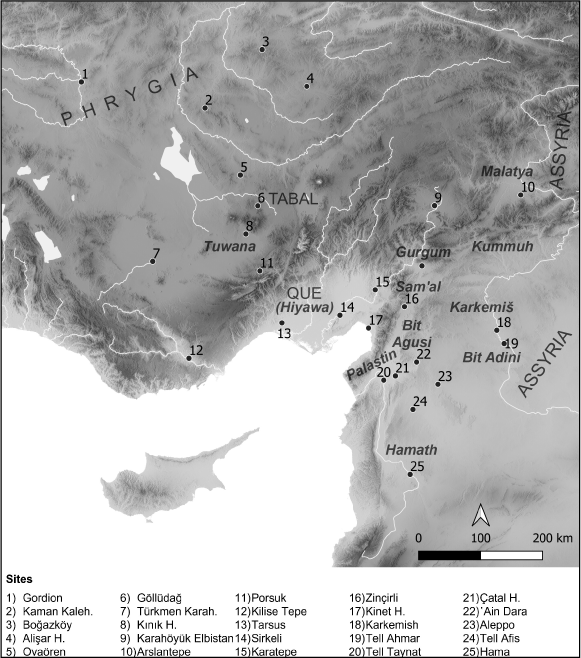
As we shall discuss in more detail in Chapter 10, the relationship between Palastin and Philistines, if any existed, was probably more nuanced and indirect than hitherto assumed. What is important to stress here is that the rulers of Palastin made no effort to emphasize a rupture with the cultural milieu we would expect to emerge in the region in continuity from the Hittite Empire period. Aside from the Palastin–Philistines question, the only piece of linguistic evidence that may be called upon to account for a possible foreign origin of the Palastinean dynasty is the name of the first attested ruler, Taita. This name is arguably not Anatolian nor Semitic, but has been interpreted as Hurrian, a language hardly foreign to northern Syria in the late second millennium BCE.132 Taita (II)’s wife was named Kupapiya, a Luwian derivative in ‑iya of the theonym Kubaba (lit. “she of Kubaba”). All other Palastinean rulers so far attested in native or Assyrian sources bore Anatolian names, two of which, Lu/abarna and Suppiluliuma, pay clear homage to Hittite royal onomastics.
Not a single document is known from Palastin that is written in Phoenician or Aramaic, which by the 9th and 8th centuries constituted the main linguistic novelty after the end of the Late Bronze Age on the northern Amanus region and in Cilicia, just to the north and west of the Amuq. The Hieroglyphic Luwian used at Palastin does not show remarkable peculiarities or recognizable traces of interference with other languages. With his inscription on the eastern wall of the Aleppo temple, Taita I celebrates the rebuilding of a sacred structure that had been in place since the Middle Bronze Age. In doing so, he reused sculpted orthostats that had been erected during the Hittite period and integrated them with new additions that reiterated the same iconographic style.133 Therefore, based on the available historical evidence alone, Palastin can be characterized as a Syro-Anatolian rump state that, on a par with the nearby kingdoms of Karkemiš and Malatya, emerged in the aftermath of the Hittite Empire and inherited its rhetoric of official representation.
A more remarkable admixture of innovative, and possibly foreign, features with traditions inherited from the previous period is seemingly reflected in the archaeological record of the northern Levant. A hallmark of the Late Bronze Age/Iron Age transition across the northern Levant is the appearance of locally manufactured painted ceramics, the so-called Late Helladic IIIC (LH IIIC) wares, derived from Aegean and Cypriot potting traditions of the Late Bronze Age. Alongside ceramics, Aegean or Cypriot influences are represented in other material cultural features occurring in IA I (ca. 1200–900 BCE) contexts across the Levant, relating to a range of activities, from food preparation and preservation to textile industry.134 In most cases, these artifacts, which scholars generally associate with groups of foreign migrants, occur together with local traditions inherited from the previous period. In particular, an increasing popularity of LH IIIC ceramics in the earliest phases of the Iron Age at Taynat, Tell Afis and other major centers of the northern Levant occurs alongside the continuation of both painted and plain ceramic wares derived from the local Late Bronze Age repertoire.135
The Late Bronze Age/Iron Age transition had varying effects on settlement histories, resulting in different areal patterns. On the coast, the continuity and even flourishing of major central Levantine centers (future Phoenicia), from Sarepta to Tell Arqa, contrasts with major destructions of Late Bronze Age sites in the north, followed by complete abandonment (Ugarit) or reoccupation on a much reduced scale (e.g., Tell Kazel, Ras Ibn Hani, Ras el Bassit).136 Farther inland, in and around the future land of Palastin proper, the scale of socio-cultural change varied from site to site, with continuities or swift recoveries, especially regarding religious buildings. We have already mentioned the broad resilience of templar architecture in Aleppo, determined by a superimposition through the second millennium BCE of several interventions until Taita’s restorations in the 11th century BCE. In a similar vein, the imposing temple of nearby ‘Ain Dara (Fig. 2.2), embellished with Hittite-style sculptures, was already in use during the 13th century and underwent renovations very early in the post-Hittite period—that is, around the 11th or even the 12th century BCE.137 At Tell Afis, imposing buildings and residential quarters dating to the Hittite imperial period were destroyed by a violent conflagration in the early 12th century.138 However, monumental architecture already resumed therein around the 11th century, as indicated by the remains of a temple structure and the associated materials found in a test-pit conducted on the acropolis.139 These patterns signal a broad resilience of religious institutions inherited from the Late Bronze Age that in turn may have functioned as catalysts for a quick political reorganization in post-Hittite Syria.140
In the Amuq valley, surveys document a rise in settlement numbers between the Late Bronze Age and Iron Age, coupled with a general reduction of their average size.141 The main settlement of the region throughout much of the second millennium, Alalah/Tell Açana, was largely abandoned by the end of the 13th century, but the twin site of Tell Taynat, located less than one kilometer to the north, was settled in the 12th century BCE and soon afterwards fully replaced Alalah as the regional capital.142 The earliest major architectonic phase of the Iron Age known at Taynat, labeled Building Period 1 by the Chicago Syro-Hittite Expedition that first excavated the site in the 1930s, has been dated by recent assessments to the 10th BCE.143 Most of the hieroglyphic fragments so far recovered, including TELL TAYNAT 1, and several pieces of Syro-Anatolian monumental art are associated with this phase that has its main architectonic feature in the massive Building XIV. By contrast, the occupation layers corresponding in date to the ruling period of Taita I and the formation of the kingdom of Palastin (11th century), i.e., phases 6a–5, have hitherto produced no monumental finds and very little architecture in general. Although a larger exposure of these phases is undoubtedly needed before reaching definitive conclusions, we may at least consider the possibility that the capital of Palastin was not at Taynat/Kunulua since the very beginning, but instead moved there only at a later stage, presumably in context with the foundation of Building Period 1. In this case, the power base of Taita I should be sought elsewhere, and the best candidate would be Aleppo, where building activities and inscriptions attributed to this ruler are actually attested. In this scenario, Palastin would share with Karkemiš similar roots in former Hittite political landscapes, as Aleppo during the Late Bronze Age was the seat of a viceregal kingdom that was governed, on par with Karkemiš, by a branch of the Hittite royal family.
Throughout the Bronze Age, the Amuq valley and the northern Levant have been deeply connected with Cilicia, reachable from the east by crossing the Amanus mountains. Interactions along this trajectory also continued during the Iron Age. The aforementioned twin inscriptions of ARSUZ 1 and 2, dated to the 10th century BCE, document a conflict between the king of Palastin and the lands of Hiyawa and Adana, seemingly presented as two separate city-states.144 As we shall see, in epichoric inscriptions from the 8th century BCE, the place names Hiyawa and Adanawa will converge in a quasi-synonymic pair to indicate a kingdom occupying Plain Cilicia, in turn corresponding to Assyrian Que, documented from the 9th century on. These circumstances would thus lead to the conclusion that during the Early Iron Age and initial Middle Iron Age, Plain Cilicia experienced a trend toward gradual political integration of the former territories of Kizzuwatna, which had evidently segregated from one another after the demise of Hittite imperial rule. Unfortunately, the historical developments that accompanied this process are immersed in a deep Dark Age due to the lack of relevant textual records.
The only data for the Late Bronze Age/Iron Age transition and the Early Iron Age in Cilicia up to the 10th century exclusively derive from archaeological research, chiefly the excavations at Kilise Tepe, Tarsus and Kinet Höyük, whereas the recently published results from Sirkeli Höyük provide some additional information.145 At Tarsus, the last Late Bronze Age stratum (LB IIa), featuring public architecture and residential quarters of the Hittite imperial age, ended with a violent conflagration, dated on historical criteria to the end of the 13th century and connected to the well-known events marking the collapse of the Hittite Empire. The subsequent stratum LB IIb was characterized by flimsier architecture that has been interpreted as a decline in the socio-economic conditions of the settlement. Recent re-evaluations of the stratigraphy of stratum LB IIb have identified a sequence of seven different architectonic phases, the first three of which can be dated to the 12th century based on the occurrence of LH III C wares.146 A similar development toward simpler habitation patterns following the demise of monumental public architecture is recorded in the Early Iron Age levels of Kinet Höyük and Kilise Tepe after the destruction of the last Late Bronze Age structures. Kilise Tepe bears evidence of two subsequent violent conflagrations intervaled by a partial restoration, at the end of the 13th century (Level IIc) and around the mid-12th century (Level IId), respectively. Flimsy domestic buildings occupy the earliest Iron Age phases, followed in later strata through the pre-Classical age by large open spaces and workshop installations and no architecture.147 At Kinet Höyük, on the other hand, architecture on a larger scale recovered in the Middle Iron Age.148 Recent results show quite different developments at Sirkeli Höyük. Here, in fact, following a transition whose contours remain unclear, substantial architecture (Building D1) appears to have resumed in the 11th century and, around the same time or perhaps somewhat later, a fortification wall was built to enclose the inner citadel.149
As in the northern Levant, plain wares of Hittite derivation continued to circulate and were produced through the 12th century in most excavated sites, albeit at lower quality standards and on a more domestic scale. Weakened Hittite centralized control over ceramic production also led to the appearance, alongside standard wares, of a new type of coarse handmade painted pottery, the so-called Cilician Red Painted, first at Kilise Tepe (14th century BCE), and then across the western Cilician plain, where it lasted through the Early Iron Age phases.150 Ceramic evidence also signals a contraction of interregional trade in Cilicia after the Late Bronze Age: Cypriot imports popular in the region during the Hittite imperial period ceased to circulate by the early 12th century, although their production at home apparently continued for somewhat longer.151 However, this fact does not mean complete cessation of contacts with Cyprus, whose influence is indeed perceivable in the LH IIIC wares from Tarsus, not only in the form of stylistic parallels but also in proper imports identified by chemical analysis.152 Cypro-Cilician connections began to intensify once more in the late 11th and 10th centuries and developed into a koiné that remained a hallmark of Cilician material culture over the Middle Iron Age.153
Due to the sudden appearance at Tarsus and elsewhere of LH IIIC Aegeanizing features, including cooking pots and other pieces of utilitarian ware, as well as the Greek influences deemed to transpire in Cilicia from later epichoric inscriptions (Chapter 10), the region lies at the core of migratory models proposed in relation to the Late Bronze Age/Iron Age transition.154 It must be stressed, however, that the LH IIIC influence is now understood to be much more limited than previously thought.155 A re-evaluation of early survey finds has circumscribed the area with LH IIIC ceramics to the western coastal strip between Tarsus and Soli, with the more recent addition of Kilise Tepe further inland to the west.156 Corroborating this western focus, relatively few LH IIIC materials have been excavated at Kinet Höyük and virtually none at Sirkeli Höyük.157 In any case, the proportion of LH IIIC ceramics and other Aegeanizing features appears to have been minimal wherever these are found, compared with local material frameworks.158 At Kinet Höyük, possible shifts in the population make-up after the end of the Late Bronze Age are inferred from swift changes in the functional pottery repertoire and bioarchaeological assemblages, which may, in turn, reflect a radical transition of dietary habits toward pastoralists’ behavioral patterns.159 Even if correctly interpreted, these data can hardly provide conclusive evidence for assessing the origin of suggested population movements.
5 The Linguistic Map of the Ancient Near East after the End of the Bronze Age
The change in the political geography reflects changes in the cultural one, which, in turn, has an impact on the geographical distribution of languages and epigraphic cultures both in Anatolia as well as in Syro-Mesopotamia and the Levant.
The fall of the Hittite Empire coincides with the end of the use of Hittite as a political, administrative and cultural written language, although a few observations are in order. First, we do not know how widespread Hittite was outside of Hattuša in the final century of the Bronze Age. It was certainly a living written language, and there are hints that a variety strongly influenced by Luwian was used (cf. Pisaniello and Giusfredi 2021; Pisaniello and Giusfredi 2023). Second, although it is obvious that Hittite died out at some point—for no indication of its use exists after the last quarter of the 13th century—we have no way to establish when it ceased to be used. The abandonment of Hattuša (Seeher 2001) implies that the court moved elsewhere; most likely it was relocated to a different city for a period of time we are unable to measure. It appears impossible to say whether, and for how long, Hittite as a language survived the final transfer of the court. Historical onomastics is particularly unhelpful: although a few personal names that are clearly Hittite emerge from the Hieroglyphic Luwian inscriptions of the Iron Age, the clear conservativity of anthroponomastic materials uncouples the survival of personal names from the final destiny of the language in which they originated.
At the same time, the diffusion of the imperial variety of Luwian as the most widespread language of central Anatolia had probably already begun during the 13th century, but we have only scant documentary traces of it during the Dark Ages, and most of the Luwian inscriptions from central Anatolia (the region called Tabal by the Assyrians, cf. Giusfredi et al. 2021) date to the full Iron Age.160
The relationship between the collapse of the Mittanian kingdom and the death of Hurrian is very much parallel to that of the Hittite Empire and its language. Mittani, as a political entity, was obliterated more than a century before the end of Hatti, but languages do not disappear as soon as the polities that use them collapse. However, because the survival of Hurrian onomastics in Hieroglyphic Luwian until the Iron Age (Giusfredi and Pisaniello 2022) was due to the crystalized use of Hurrian names by Luwian peoples, we cannot safely assume that Hurrian survived as a truly spoken language after the Bronze Age collapse. Its only known relative, Urartian, which is actually closer to Old Hurrian than to Mittani Hurrian, would emerge in areas similar to those in which Hurrian was spoken. But although it appeared in documents only much later, starting from the 9th century BCE, it certainly did not appear ‘out of the blue’ and was probably alive, as a non-written language, during the second millennium, so there is no reason to connect its diffusion to the disappearance of Hurrian in some sort of outdated model of language replacement by local migration.
The area where Hittite was spoken appears to have been divided in two separate linguistic regions at the end of the Dark Age. The southern part of the Kızılırmak River corresponded to what the Assyrians will call Tabal (on the identification of the core area this designation referred to, and for an etymology of the name, see Giusfredi et al. 2021). Here, Luwian appears to be the official language of the inscriptions and, because no evidence exists for the penetration of any of the other surrounding languages, it was probably spoken, too. To the north of the river, there are no real data to determine how large the Luwian-speaking area was, but neither is there a reason to assume that the river was a linguistic frontier (Simon 2017a).
The western portions of central Anatolia, however, were linguistically separated from the future Tabal region. Recent developments in the archaeology of the post-Hittite phase indicate that the Phrygian migration (or, to be more cautious, emergence), occurred much earlier than the age of the first inscriptions. More precisely, the Early Phrygian levels of Gordion should now be dated to the late 10th–9th centuries BCE (Kealhofer et al. 2019; D’Alfonso 2019), which may lead to assume that the Phrygian language was, in all likelihood, already endemic in west-central Anatolia—if not during the Dark Age, then at least immediately after it. However, this is as far back as we dare to go. The problem of when, how and from where Phrygian entered Anatolia is completely different. The migrationist model that is still employed in some very recent works (e.g., Kloekhorst 2017) probably has some merit, but the idea that the Phrygians migrated from the Balkans during the Dark Age—as soon as the fall of Hatti left a political vacuum—appears rather simplistic, historically, for at least two reasons. The first is that, in general, the “large migration” model has been successfully criticized in recent decades (cf. Anthony 2007, Giusfredi and Matessi 2021; see also Volume 1, Chapter 3), and likely ought to be replaced by a more fluid model in which large movements happen like slow waves by the combination and summation of smaller movements. The second reason is that although the influence of the Hittite Empire in western Anatolia is historically certain, its intensity remains a matter of debate, so one cannot simply assume that its collapse had immediately catastrophic implications for the political geography of the area.
Farther to the west, the transitional phase must have coincided with political changes, which would, in the longue durée, lead to the emergence of the Lydian, Carian and Lycian cultures. Unfortunately, a significant time gap exists between the Dark Age and the earliest written documents from the area, which renders the identification of the Lydians, Lycians and Carians with specific groups or polities of the Late Bronze Age conjectural. Discussing the specific problems of each of the possible—or even likely—matches (Lukka/Lycia, Karkiša/Caria, but also the problem of the alleged Lydian homeland) is well beyond the scope of the present chapter, so we limit ourselves to the discussion we provided elsewhere (Giusfredi and Matessi 2021:16–17, with references to further literature).
If the situation in western and west-central Anatolia (if not its genesis) is generally known, that of eastern Anatolia and of the extreme northern portions of Upper Mesopotamia—up to the sources of the Euphrates and to the region of the Armenian lakes—cannot be easily reconstructed before the 9th–8th centuries BCE. This is because the Late Bronze Age linguistic geography of this area is unknown, with the exception of the presence of Hurrian (possibly among other languages) in the surroundings of Malatya that can be assumed based on sparse onomastic data (Giusfredi and Matessi 2021:22). By the full Iron Age, with the formation and expansion of the Urartian kingdom, Urartian will become the written language employed, but—as usual—the date at which a language starts being written should not be confused with that at which said language became endemic, or even prevalent, in a given territory.
After discussing the center, the west and the east, it is time to move on to the north and the south. As for the former, very few areas in the Ancient Near East are as elusive and as nondescript as the Black Sea coasts of Anatolia during the Final Bronze Age and the Dark and Early Iron Ages, especially—but not only—from a linguistic point of view. If the collocation of the Palaic-speaking area somewhere between Paphlagonia and Bythinia, probably close to the boundaries of the Hattian-speaking world, is safely established, even for the Bronze Age we have very little information about the eastern parts of Paphlagonia and the Pontus. Arguably, the unknown languages of the Kaška and that of the peoples of Hayaša were endemic, but if, how and when they disappeared at the end of the Bronze Age, and what replaced them, is impossible to establish.
The southern regions of Anatolia, including the abovementioned Lycia, as well as the northern parts of Syria, are generally characterized by the presence of Luwic languages. This is easily explained as a case of continuity with respect to the situation of the Late Bronze Age; nevertheless, the eastern portions of the area—Cilicia and the Amuq and Middle Euphrates valleys—present clear multilingual features that likely originated during the Dark Age. Cilicia, which will receive a separate discussion in a dedicated chapter of this volume, was already a bilingual area during the second millennium BCE, when it was inhabited by Hurrians and Luwians for centuries. During the Iron Age, it would remain a multilingual area, but the languages involved (with the exception of Luwian) would have changed. Phoenician (more precisely, the Tyro-Sydonian dialect) was certainly used, or at least known, in the region, as quite famously testified by the presence of Luwo-Phoenician bilingual documents, and some scholars believe that a Greek presence must also be assumed (see Chapter 10 for further discussion). Yet again, however, any attempt to establish at which stage toward or after the end of the second millennium the penetration of new groups occurred would be speculative at best.
To complete the picture of the areas in which Anatolian languages were used, the northern Syrian region begins southeast of Cilicia. Although most of the data come, in this case as well, from the full Iron Age, there is no reason to doubt that from the Amanus to the Middle Euphrates, and to the future kingdom of Hama to the south, the survival of Luwian as an official monumental language was a result of the expansion of the Hittite polities during the 14th and 13th centuries BCE. Sociolinguistically, however, it is important to emphasize a few facts. First of all, it is impossible to discern the extent to which Luwian was used outside of the royal inscriptions of a number of Syro-Anatolian rulers. Still, the presence of contact phenomena (such as loanwords from Semitic and a few—albeit quite clear—traces of grammatical interference) appear to indicate that the language was not merely a written one. Second, Luwian coexisted with Aramaic all over the Syrian area: this is evident in cases such as Hama or Sam’al, but it is very likely that multilingualism was a general feature of the Syro-Anatolian cultural world. Furthermore, the origin of Aramaic from a linguistic perspective is as elusive as that of the Arameans in cultural and political terms. As observed by Golinets (2021), the first areas in which Aramaic appears to be attested, or can be reasonably assumed to have been spoken, roughly coincides with regions in which the presence of Amorrite can be reconstructed at least for the Late Bronze Age. The relationship between Aramaic and Amorrite is impossible to establish, with Amorrite seemingly close to the Canaanite languages. This means that we cannot possibly establish which languages of the West Semitic group Hittite and Luwian came into contact with during the final centuries of the second millennium. The safer assumption is that contact involved a spectrum of different languages that were all related and all spoken in northern Syria. From this perspective, the historically attested contact between Aramaic and Iron Age Luwian in specific portions of the area that left us epigraphic materials is likely a part of a wider phenomenon, which must have existed for a longer period and happens to be visible only for the full Iron Age.
In a similar but geographically different fashion, a special case contact of Semitic and Luwian represented by Phoenician does not seem to play a significant role outside of Cilicia. It will be used sporadically in Sam’al, and it is probably mentioned in an 8th century inscription from Karkemiš, but there is no reason to assume that it actually spread on the coasts of the Levant much farther than the Phoenician core area. This fact has important implications for the way it entered Cilicia: because the diffusion did not happen on the mainland, the best possible explanation is that it entered southern Anatolia via Cyprus.
All in all, the Dark Age resulted in a radical redefinition of the linguistic map of the Ancient Near East, producing several new multilingual and interface areas. The details of each of them will, of course, be discussed in the dedicated chapters of the present volume.
Hodos 2020.
Osborne 2021:5–7.
D’Alfonso 2023.
For a detailed synthesis and a comparison with similar approaches to the Iron Age in the Aegean, see Santini 2022:52–75.
Quinn 2018.
E.g., Younger 2016.
E.g., Harrison 2001; Herrmann et al. 2016. See the remarks by Osborne 2021:35–47.
E.g., Summers 2018a.
D’Alfonso 2023; Matessi (in press); Matessi and Lovejoy (in press).
Giusfredi 2010:37.
For the possibility of an involvement of Phoenicians in the Mesopotamian trading networks as well, see Markoe (2000:20). If true, this would grant Phoenicia the role of a gateway to eastern and western routes as early as the final centuries of the Bronze Age.
The discussion on the classification of Amorrite is an old one, and several studies with different hypotheses have appeared since Goetze (1941). We follow Golinets (2021:187, with references) and refrain from describing Amorrite as Canaanite (as per Tropper 1994) or Aramoid.
It was not uncommon for a unit of weight to be named after a city, and in the Syrian world there appears to have been a proliferation of local measures, such as the Karkemiš mina or the Qarqar shekel. Cf. Deutsch 2014 for further discussion.
We wish to emphasize that the attempts at analyzing the meaning and the Semitic or Hurrian etymology (cf. Pentiuc 2001:180 for discussion) of this ethnonym (if it is indeed an ethnonym) are unconvincing at best. In particular, the Semitic etymologies are phonologically unconvincing, and the connection to Hurrian tarwišša proposed by Pentiuc (2001:180) is semantically far-fetched (especially because the word does not mean ‘judge,’ but rather a kind of financial deposit or a similar legal category). Also unlikely is the connection to ta/urubi cautiously proposed by Richter 2012 (s.v. TAR-PI), as it would require a reading tar-pi, which is graphemically improbable.
Adamthwaite 2001 suggests identifying these nomads with the Aramaeans.
On the topic of the interference between Aramaic and Neo-Assyrian, see the article by Streck (2011), which, however, is limited to the analysis of loanwords. Cf. also Lang (2021:121–122) on indirect traces of Aramaic–Assyrian contact in texts from the Greek tradition, and Fales (2021) for a recent grammatical sketch and sociolinguistic discussion of Neo-Assyrian.
E.g., RIMA 2 A.0.87 3.30 (ah-la-mì-i-KUR.ar-ma-iaMEŠ); 2.28 (ah-la-mi-i-KUR.ar-ma-a-iaMEŠ), 4.34 (KUR.ah-la-me-e-KUR.ar-ma-a-iaMEŠ).
To be more precise, the stand-alone term Ahlamu is still used by the Neo-Assyrian kings (e.g., Sargon II, e.g., 74 vi 47, referring to nondescript peoples of the steppe who supported the claim of a Babylonian rebel), but it was already employed by Shalmaneser I (RIMA 1 A.0.77.1:61) and Tukulti Ninurta I (RIMA 1 A.0.78.23:70) during the Late Bronze Age, to refer to peoples we cannot identify in precise terms. On the problem of Ahlamu ethnicity, one should cite the recent contribution by Edmonds (2019), and especially the cogent remarks by Valk (2021:618).
The toponym Aramu likely predates the use of the adjective as an ethnicon, with some very early occurrences that may have occurred in Old Babylonian times, and possibly even earlier during the third millennium BCE. The survival of the linguistic sign, however, does not imply that there was a relationship between these early occurrences and the historical peoples called Aramaeans starting with the Iron Age. For further discussion see Lipiński 2000:26–33; more recently Fales and Grassi 2016:16–19.
Cf. the discussion in Bryce (2012:49–52). We may add that in later phases of the Assyrian documentation (well after Syria was assimilated into the Empire), the term Hattu still survived, referring to the regions of the Tabal (RINAP 4 1 iii 49; RINAP 4 4 i 7), which suggests that this exonymic designation referred to any foreign or unruly portions of eastern Anatolia and Syro-Anatolia; thus, the exact geographical referent changed over time.
Assyrian Chronicle Fragment 4 (TCS 5, 189–190 = AfO 17, 384–385).
De Martino 2018:23–24. On the crisis of the 12th century in an eastern Mediterranean perspective, see Knapp and Manning 2016.
Matessi 2025.
Seeher 2001.
Schachner 2020.
Bemporad 2006:74; Klinger 2015.
Seeher 2018.
Genz 2004.
Mielke 2022.
But see Mielke 2022:49–51 for a more cautious assessment, with previous literature.
Seeher 2010.
Genz 2003.
Dörfler et al. 2000; Müller-Karpe 2017:158.
D’Agostino 2020; Orsi 2020.
Orsi 2020.
Ross et al. 2019.
Kealhofer et al. 2022:86–135.
Kealhofer et al. 2019.
Henrickson 1993.
Kealhofer et al. 2022:175–176.
Voigt and Henrickson 2000; Voigt 2011:1077.
Sams 1988; Voigt and Henrickson 2000.
Wittke 2004; Weeden 2023:929–930; Santini forthcoming. For a different interpretation, see Kopanias 2015.
Dupré 1983:57–75; Matsumura 2008; Matsumura and Omori 2010; Mora and d’Alfonso 2012.
Dated by radiocarbon determinations and contextual stratigraphic data; see d’Alfonso et al. 2019–2020:35–43.
Castellano 2018.
D’Alfonso 2020a.
Castellano 2018.
Mantovan and d’Alfonso 2020.
D’Alfonso et al. 2019–2020:55–63.
D’Alfonso et al. 2019–2020:33–34.
Matessi (in press); Matessi and Lovejoy (in press).
Manuelli 2013.
Lovejoy and Matessi 2023.
D’Alfonso et al. 2020:52–54. On the Kululu style, see CHLI I:430. See also d’Alfonso 2019, who raises the dating of TOPADA to the late 10th–early 9th century BCE, which would reduce the Dark Age gap to about two centuries. Cf. now also the new discussion by Hawkins in CHLI III:298.
CHLI I:433–442.
KIZILDAĞ 3 has the variant spelling of the name há+ra/i-tá-L. 430(pú)-sa, for which see CHLI I:439–440. On the writing of Hartapu’s name in BUYRUNKAYA, see CHLI I:438 and the updated discussion in CHLI III:338.
E.g., d’Alfonso 2014, with references to previous literature.
E.g., Singer 2006. For the identification of Tarhuntašša with the mound of Türkmen Karahöyük, see Massa et al. 2020:64–66. Contra Hawkins and Weeden 2021:384–387.
D’Alfonso and Pedrinazzi 2021; Massa and Osborne 2022.
Finding and archaeological context: Massa et al. 2020; Osborne et al. 2020. Edition: Goedegebuure et al. 2020.
MAGNUS.REX ka+ra/i-tá-pu-sa HEROS URBS-li-si-sa FILIUS mu-sá-ka (REGIO).
D’Alfonso and Payne 2016.
ma-sà (REGIO) AQUILA‑na mu-wa-ta (CHLI I:338–441 after Poetto 1998) now read mu-sà-ka-na (REGIO) mu-wa-ta, as first proposed by Meriggi 1965:314 (cf. CHLI III:168). For a different perspective, still retaining the reading Maša in KIZILDAĞ 4 notwithstanding TÜRKMEN-KARAHÖYÜK 1, see Oreshko 2020.
For a discussion, see the response to Hawkins and Weeden’s proposal by Massa and Osborne 2022.
It is worth mentioning that KIZILDAĞ 4 is engraved on a rock surface joining a stepped altar, forming with it a coherent composition having close parallels in Phrygian monuments generally dated no earlier than the 9th century BCE (Berndt-Ersöz 2006:134–137). D’Alfonso 2020b:185–186 considers unlikely that the stepped monument was carved after the inscription, but, still maintaining the traditional date of KIZILDAĞ 4 to the 12th century, uses this evidence to raise the chronology of the stepped altar tradition altogether. Now, after the discovery of TÜRKMEN-KARAHÖYÜK 1, just lowering the date of KIZILDAĞ 4 might represent a more economical solution: see Massa and Osborne 2022:94–96.
De Martino 2014; Mora 2014.
Sandars 1987:119–120.
For the old excavations, see Hogarth 1914, Woolley 1921, Woolley & Barnett 1952. See also Benati 2014 and di Cristina 2014 for a recent re-evaluation. For an updated summary of Marchetti’s excavations, see Marchetti 2019–2020.
Giacosa in Marchetti 2019–2020:274–277.
Among the several studies devoted to monumentality at Karkemiš and its Hittite imperial models, see Pucci 2008; Gilibert 2011 and Aro 2013.
Lastly, Beckman 2019:36–40.
Peker 2016:14–17. Numerous sealings stylistically dating to the late 13th–early 12th century were found during the 2019 campaign, but none is reported as having royal seal impressions: see Peker 2023.
Hawkins 1988.
During the Hittite period, competing claims of Great Kingship within the Hittite domain were certainly raised by Kuruntiya of Tarhuntašša in his Hatip relief and in some sealings found at Hattuša: see Singer 1996; Mora 2003; Giorgieri and Mora 2010:143–145; Matessi 2025:165–175. On the possible evidence of a Great King at Mira, in western Anatolia, see Hawkins 1998:20, and Peschlow-Bindokat and Herbordt 2001. For the recent revision of the evidence relating to a Hartapu Great King in south-central Anatolia, see above, section 3.
E.g., Bryce 2012:83–85.
On the notion of land of Hatti in the Iron Age, see d’Alfonso 2012:176, with further references. On the changing geographic significance of the term during Neo Assyrian times, see Bagg 2011:19–40. The genesis and possible meaning(s) of the toponym Hattu in the second millennium BCE have been treated in Volume 1, especially Chapters 4 and 5.
Hawkins 1997, 2005.
On the related debate, see Mora 2007, Durnford 2010, Simon 2009, Giusfredi 2013, and Payne 2015:84–98. See also Hawkins and Weeden 2016:10.
Other arguments pointing in this direction are the writing of the sign KAR (L. 315), which, outside Karkemiš, is attested only at Tell Ahmar (TELL AHMAR 6). Giusfredi 2013; Payne 2015:93–94, and references to previous literature therein. But see Simon 2009:254 for a different interpretation.
A third individual, also unidentified, appears in the inscription with the name Asmaya and the obscure title REGIO.HATTI VIR2. Conflicting interpretations have been proposed by Mora (2007:518) and Simon (2009:259). Giusfredi (2013:672–673) argues for an alternative reading of the title as REGIO.DOMINUS, ‘Country Lord.’
Mora 2007; Giusfredi 2013:674–676; Weeden 2013:7; Payne 2015:86–87. An alternative view, now generally dismissed, has been advanced by Simon (2009:259–261), who postulates a Tuthaliya V ruling at Hattuša as a son and successor of Šuppiliuma II. For the inscription KARKAMIŠ 16c, see CHLI I:82.
CHLI I:288–295.
E.g., Weeden 2013:8.
Giusfredi 2010:41–42; Weeden 2023:930–931.
KARKAMIŠ A4b and KH.11.O.400. For the former, known from the old excavations, see CHLI I:80–82. The latter has been discovered by the new project in 2011 and is published in Peker 2016:14–17.
T96-1 and T98–119. See Akkermans and Wiggermans 2015:120.
Mora 2007:519.
Weeden 2013:7–8.
E.g., Yukich 2013; Lawrence and Ricci 2016:53–54. For similar patterns in the Amuq plain, see below, section 4.2.
Osborne 2021:35–42.
Lawrence and Ricci 2016:53–54.
On the reassessment of chronological data from Tille Höyük previously attributed to the Late Bronze Age (Summers 1993), see Summers 2013.
Müller 1999.
Manuelli 2013, 2020:118–120.
Manuelli 2013:413–423.
Frangipane et al. 2019–2020; Manuelli 2020.
Manuelli and Mori 2016.
CHLI I:282–288.
Hawkins 1995; CHLI I:286–287.
GÜRÜN and KÖTÜKALE. See CHLI I:295–301.
İSPEKÇÜR and DARENDE. See CHLI I:301–305.
This succession as established by Hawkins (CHLI I:286–287) has been followed since with minor alternative variations. See also Bryce 2012:101–104.
Giusfredi 2010:65–116.
As cautiously proposed by Bryce (2012:102). Notwithstanding the lack of titles, PUGUS-mili (I) is often included as the first ruler in the dynastic charts of Malatya. See, e.g., Hawkins and Peker 2014:110.
Singer 2000:70.
Payne 2014.
Hawkins 2011.
Simon 2020b:154–155.
Bryce 2012:99; Blanchard 2019:189.
Simon 2020b:154–156. Runtiya is also attested once as “King of Malatya” in the legend of a seal impression found at Arslantepe (MALATYA 15). See CHLI I:575–576.
Weeden 2023:933. On the interpretation of L. 462 as ‘seed,’ see Dinçol et al. 2014:150.
Jasink 1995:158–159, 201.
Giusfredi 2010:257 fn.564; Simon 2016c.
This is, for example, the solution eventually preferred by Bryce (2012:103–105).
On the revised chronology of the gateway and its broader implications, see Summers 2013.
Hawkins and Weeden 2016:11; Brown and Smith 2016:26–27. Karkemiš is explicitly mentioned, together with Egypt, in a fragmentary context of an inscription attributed to Taita I of W/Palastin in the Aleppo temple: see Hawkins 2011:53; Weeden 2013:17.
E.g., Hawkins and Weeden 2016:11.
Frangipane et al. 2019–2020:81.
Kohlmeyer 2009; Hawkins 2011.
This discovery came after the recognition that the hieroglyphic sign L. 172 formerly transliterated as TA5 was in fact to be read as la/i (Rieken and Yakubovich 2010). Moreover, it was also accepted that the sign sà represented the sound /s/ before other consonants (Rieken 2010).
1, § 1: [… pa-TA5-]s[à]‑ti-ní-za-sa (VIR2) HEROS REX. After Hawkins 2011:48.
Kohlmeyer 2008:122 fn.12.
CHLI I:415–419.
Singer 2012:463.
Hawkins 2011:51; Weeden 2013:13–15; Giusfredi 2018:164–165.
CHLI I:365–367; Dinçol et al. 2015.
CHLI III:148–149.
But see Simon 2020:162.
Hawkins 2009, Singer 2012; Weeden 2013.
Hawkins 2009:172; Emanuel 2015.
Steitler 2010, but based on a shaky identification with the Biblical personage To‘i, king of Hama. See the rebuttal by Simon 2014b:725.
Kohlmeyer 2009.
Venturi 2007; Lehman 2013; Janeway 2017; Pucci 2019. See also Chapter 10.
Venturi 2007; Welton et al. 2019:301–305 and 308–311.
For a synthesis, Venturi 2007:403–408; Knapp and Manning 2016:128–130.
Kohlmeyer 2008; Novák 2012.
Venturi 2007 and 2010.
Venturi 2010:10; Mazzoni 2010.
D’Alfonso and Lovejoy 2023.
Harrison 2009a.
Yener 2013:17–19.
Welton et al. 2019:300; Manning et al. 2020:22.
Dinçol et al. 2015.
For the oft-assumed Greek influences on the socio-cultural make-up of Hiyawa/Adanawa, see Chapters 4 and 10.
Yalçın 2013.
Postgate and Thomas 2007; Postgate 2008; Bouthillier et al. 2014.
Gates 2013.
Von Peschke in Novák et al. 2019:256, 293–295; Novák 2019–2020:157–161.
Postgate 2007; Bouthillier et al. 2014:145, 150–152; Jean 2022.
Lehmann 2017:234.
French 1975; Mommsen et al. 2011.
Novák 2010:408. D’Agata (2022) revisits the label koiné to stress the strong dependence of Cilician Iron Age ceramic traditions from Cypriot models.
See, most prominently, Yasur-Landau 2010:158–161.
For a recent general overview, see Lehmann 2017.
Salmeri and D’Agata 2003; French 2007.
Gates 2010. For 12th century BCE ceramics at Sirkeli Höyük, see Novák et al. 2019a.
Lehmann 2017:244.
Gates 2013:103.
See CHLI I:429–531 and CHLI III:336–348.