


As an essential point of departure, this chapter considers the origins of the taÊ¿ziyeh and its trajectory to the end of the Qajar period, also looking briefly at what followed. Our attention will then turn to those involved in the tradition, again focussing largely on the 13th/19th century and considering the connections between taÊ¿ziyeh and certain other types of performance. I will present the case for taÊ¿ziyeh-khÄnÄ« as a practice that emerged outside urban centres, the earliest plays evolving from re-enactments of the battle of Karbala staged amongst ordinary people â remembering the martyrs through replaying their narratives. I will demonstrate the important contribution made by women to the shaping of this devotional art form, through their mass participation as an active and demanding audience, and through their creation, sponsorship and delivering of performances. We will see the prevalence of storytelling traditions in the environment in which the taÊ¿ziyeh took shape and a societal connection between the tellers of religious stories and the taÊ¿ziyeh practitioners, catching fleeting glimpses of the networks that might have sustained the early performances. We will also see evidence that the impulse to bring the divine into the realm of the profane, through celebration of the ShiÊ¿a Holy Family in performance, had begun before the dawn of the Safavid period, and that this was sanctioned in devotional writings.
1 The Trajectory
1.1 Roots and Early Influences
Many scholars suggest that the origins of the Iranian taÊ¿ziyeh lie in pre-Islamic mourning cults. The most widely supported theory of this type is that ritual lament for Ḥusain is an evolution of the tradition of mourning for SiyÄvash. Whilst intriguing, this theory is somewhat problematic. Characterised by purity and virtue yet unjustly killed, SiyÄvash features in Ferdowsiâs ShÄh-nÄmeh but also in Zoroastrian tradition and older eastern Iranian paganism. There is evidence of an annual mourning cult for him in Sogdiana and KhwÄrazm (around the Oxus river and in Transoxiana).1 While the existence of this cult is fascinating no direct link between this and the rituals for Ḥusain has been convincingly established. To my knowledge, the latest evidence of an active cult of SiyÄvash is from the 5th/11th century.2 Meanwhile, annual Muḥarram rituals commemorating Ḥusain are not recorded on the Iranian plateau until the early 10th/16th century under the Safavid dynasty (r. 907/1501â1135/1722). This leaves a gap of around 400 years between the two traditions. Thus, to treat taÊ¿ziyeh as an evolution, or indeed transformation, of the mourning practice requires something of a leap.

Tekiyeh-ye ḤusainÄ«-ye Ê¿Äáºam, Armaghankhaneh, Zanjan Province, 8th Muḥarram 1439/2017. A modern tekiyeh: traditional staging conventions
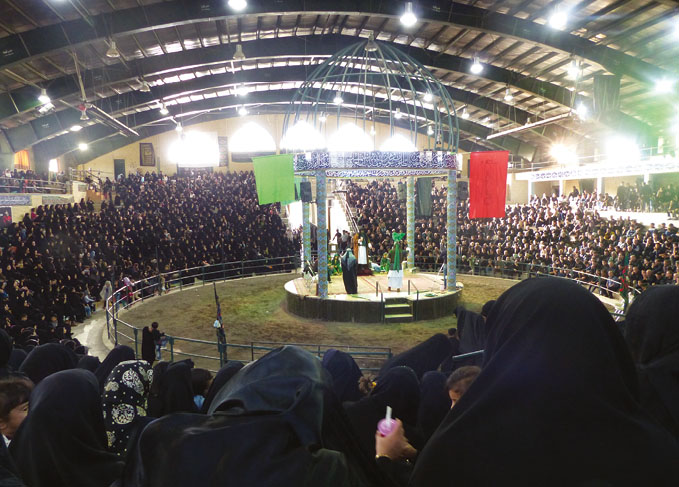
What is compelling is the idea of a connection between SiyÄvash and Ḥusain on the level of literary portrayal. Ehsan Yarshater has argued that the taÊ¿ziyeh treatment of the martyrdom of Ḥusain is parallel not only to the passion of SiyÄvash but also to the Memorial of ZarÄr, a religious epic with Parthian origins, again within the Zoroastrian tradition.3 In both cases, Yarshater deems highly significant the fact that the unjust killing of the righteous hero is foretold within the narrative, and that the hero himself is aware of his fate. Indeed, as the following chapters will show, the outcome of the tragedy being foretold by the protagonists themselves is a key feature of the taÊ¿ziyeh genre. Other scholars have also commented on the similarity in the literary treatment of SiyÄvash and Ḥusain, with particular reference to their foreknowledge of their deaths.4 It is highly probable that, through their presence in Zoroastrian and epic literature, the legends of SiyÄvash and ZarÄr influenced the way that the plight of Ḥusain was conceived on the Iranian plateau.
Pre-Islamic influences aside, in traditional historiography mourning rituals dedicated to Imam Ḥusain are believed to have evolved from the commemorations carried out by the Karbala survivors and their supporters. It is argued that the first public recitation of the Karbala narrative was a speech made by Zainab, eulogising Ḥusain whilst condemning his killers, when she visited his grave whilst returning from Damascus to Medina.5 Further to this, the practice of commemorating the anniversary of Ḥusainâs martyrdom is said to have begun in the first few years following the Karbala massacre with the commemorations observed at his tomb by the tawwÄbÄ«n (the repentant), remorseful Kufans and others.6 While this would locate the first instances of ritual mourning for Ḥusain as far back as the late 1st/ 7th century, in the early Umayyad period, it is not until the 4th/10th century, under the Buyid Dynasty in Baghdad, that the first public procession commemorating Ê¿ÄshÅ«rÄʾ is recorded. The account pertains to the year 352/963 and appears in al-BedÄyah waâl-nehÄyah (The Beginning and the End), a history of Islam by EsmÄÊ¿Ä«l b. Ê¿Umar b. KathÄ«r, âEbn KathÄ«râ (d. 774/1373). He reports that on the 10th of Muḥarram the ruler MuÊ¿ezz al-Dawlah Ebn BÅ«yah ordered the closing of the markets and that the women display public mourning for Ḥusain by going barefaced into the markets with their hair dishevelled, wearing rough woollen hair cloths, wailing and beating their faces. Over the next decade Ebn KathÄ«r records the phenomenon recurring annually and growing in size.7 This early documentation of public mourning for Ḥusain is significant, yet it is not until several centuries later that we have the first evidence of a theatrical tradition forming part of the lamentations.
1.2 Emergence and Survival of a Theatrical Tradition
In considering when and how the taÊ¿ziyeh tradition began, the definition of the tradition itself is important. TaÊ¿ziyeh-khanÄ« (or shabÄ«h-khÄnÄ«) is, in its essence, the practice of commemorating the martyrs of Karbala through scripted performances that re-enact the events (albeit in a stylised fashion). In the continuation of his chapter, we will see that a variety of performance forms celebrating the memory of the ahl-bait were present in Timurid Herat by the turn of the 16th century CE. This illuminates our understanding of the environment in which the taÊ¿ziyeh tradition emerged, a trend of commemoration of the Holy Family through public recitation of their virtues and tribulations being present in the Khurasan region before ShiÊ¿ism became Iranâs religion of state under the Safavid dynasty. However, these performances were largely oratory, and were not yet what we could call devotional drama. So, how did the transition from reciting the stories of the martyrs to playing their likeness and scripting their dialogues take place?
Until recently, the predominant scholarly theory regarding the emergence of this practice was that put forward by Peter Chelkowski. He argues that the first taÊ¿ziyeh plays were generated through a fusing of the tableaux vivant of the Karbala tragedy, staged atop wagons in the Muḥarram mourning processions, with the rawżeh-khÄnÄ« recitals of the tribulations of the martyrs, and that this took place during the mid-18th century CE.8 This would mean taÊ¿ziyeh having emerged during the reign of NÄder ShÄh AfshÄr (r. 1148â1160/ 1736â1747), or the early years of the Zand dynastyâs reign. However, historical scripts, recently edited and published, indicate the existence of the tradition during the Safavid period. The oldest of these is a rendition of GhÄrat-e khaimeh-hÄ (The Plunder of the Camp) dated 1136/1724.9 This is at the tail end of the Safavid period, two years after the fall of Isfahan to the Afghans and before a brief reinstatement of the Safavid dynasty. However, far from appearing to be an early attempt at scripting such a performance, this play shows a tradition well underway. As will be discussed in the following chapter, it includes compositional features that are standard in later episodes. Also, interestingly, its closing lines (belonging to the character Zainab) call for Godâs blessings and forgiveness upon all those who cry for Ḥusain, not only the women and men of the audience but also the âtaÊ¿ziyeh-khÄnâ and ânuskheh-gardÄnâ (taÊ¿ziyeh performer and script writer).10 Thus, these were recognized positions: this an established tradition.
The aforementioned Zand period script collection has also contributed greatly to our knowledge of the taÊ¿ziyehâs trajectory. These scripts show a dramatic tradition that had left its formative phase well behind.11 Of particular significance is the fact that, in addition to treating the events surrounding the Karbala tragedy, the composers were treating more diverse subject matter, which even included some comedic material.12 This degree of evolution, suggesting a significant period of time having elapsed since the inception of the tradition, is further evidence of it having undergone its early stages during the Safavid period.
Given these strong indications that the taÊ¿ziyeh emerged in a period earlier than previously suspected, the theory of how it emerged needs to be revisited. Chelkowskiâs hypothesis is based largely on traveller accounts, in particular that of Thomas Salmons and Matthias van Goch who give a vivid description of a Muḥarram procession from 1150/1737.13 Spectacular ambulatory rituals of lament are documented in the travelogues of visitors to Iran from the 10th/16th century onwards, and throughout the Safavid period. These included a wide variety of elements, from displays of self-mortification to riderless caparisoned horses carrying objects (such as turbans or weapons) representing the ahl-e bait and Karbala martyrs, and symbolic coffins that were paraded on lavishly decorated biers, displaying not only respect for the martyrs but also the wealth of the patrons.14 Chelkowski finds the account of Salmons and van Goch, during the early reign of NÄder ShÄh, particularly significant from a theatrical perspective; it features tableaux vivant and a float covered with sand representing the desert of Karbala, upon which lay performers simulating the mutilated martyrs.15
Chelkowski draws a parallel between this procession and a variety of taÊ¿ziyeh called taÊ¿ziyeh-ye kÄravÄnÄ« (also known as taÊ¿ziyeh-ye sayyÄr or taÊ¿ziyeh-ye dowreh) still performed in certain towns in modern-day Iran, with scenes from the Karbala tragedy played on flatbed trucks as they move through the streets. He argues that the first scripted taÊ¿ziyeh performances began this way, with the costumed performers in the parades playing out and reciting the text of the scenes as they stopped at crossroads.16 Indeed, such tableaux were witnessed elsewhere: the Dutch painter Cornelis de Bruin records seeing floats bearing static representations of the battle, including characters featured in the taÊ¿ziyeh, in Isfahan in 1116/1704, 30 years prior to the procession reported by Salmons and Van Goch.17 It is probable that this type of processional ritual did evolve into taÊ¿ziyeh-ye kÄravÄnÄ«. However, even when Salmons and van Goch witnessed this performance, the characters on the floats were still static and did not engage in dialogue. On the other hand, the recently discovered early scripts show that the taÊ¿ziyeh tradition existed well before this point. Thus, the question of how the theatrical tradition emerged remains unanswered. We are also left with the mystery of why, when a large number of travelogues record elaborate pageantry, put on at the behest of the shahs throughout the Safavid period, and an abundance of rawżeh-khÄnÄ« recitals, did no one report witnessing a taÊ¿ziyeh?18
I have argued elsewhere that in our search for the emergent taÊ¿ziyeh tradition we need to re-evaluate both where we are looking and indeed, what we are looking for.19 As for the where, we must consider the fact that the foreigners whose travelogues provide such valuable evidence were the guests of the Safavid elite, who were clearly keen for them to witness the most lavish processions. Their accounts recall both the grand and the grotesque, impressing their readers with details of the exotic riches and animals that they saw paraded, and rarely failing to mention what they found strange or shocking â such as the displays of self-mortification and the nudity of some penitents. But, could there have been other more modest mourning practices, observed amongst the lower classes, that escaped their attention? Furthermore, their accounts are predominantly from urban centres and we have little evidence of what was taking place in more rural areas.
It is indeed likely that the early taÊ¿ziyeh emerged from a tradition of the common people as opposed to something state sponsored. Were taÊ¿ziyeh to have received state patronage during the Safavid period, we would expect to find it not only more consistently mentioned in accounts of the grand spectacles put on by the shahs, but also in the records of their spending. In her study of commemorative rituals in Safavid Isfahan, Maryam Moazzen examines the royal allocation of funds for such activities held at the Madraseh-ye Sulá¹ÄnÄ« of Isfahan, as attested by the madrasaâs vaqf (religious endowment) records for 1123/1711, during the reign of ShÄh Sulá¹an Ḥusain.20 Close attention needs to be paid to the terminology when interpreting these records. Indeed, they do specify that monies should be allocated for the âtaÊ¿ziyeh of Imam Ḥusainâ and other important figures, but the word taÊ¿ziyeh in this context is not âtaÊ¿ziyeh-khÄnÄ«â in abbreviated form (as I use it throughout this book). Rather, it is the word in its original sense, a synonym for Ê¿azÄdÄrÄ« (mourning). Under the allocation for these âtaÊ¿ziyehâ expenses, the breakdown of what is to be covered includes the fees of the rawżeh-khÄn and his assistant, a tabarrÄʾī (performer of ritual cursing of the enemies of the ahl-e bait), and a marsiyeh-khÄn (elegist). Materials for decorating and lighting the venue, and sustenance for the attendees are also listed.21 However, there is nothing to suggest a theatrical performance, no mention of costumes, props, or fees for the taÊ¿ziyeh-khÄnÄn or any synonym thereof. These rituals were clearly mourning assemblies featuring recitations by orators, and not theatrical performances.22 In short, given the existence of taÊ¿ziyeh-khÄnÄ« during the Safavid period but its apparent absence from the large-scale Muḥarram rituals funded by the elite, in the search for the emergent tradition we should look for a commemorative ritual taking place amongst the common people, and possibly outside urban centres.
In terms of re-evaluating what we are looking for, the repertoire includes a play entitled HaftÄd-u-du tan (The Seventy-Two People) in which all of the most prominent Karbala martyrdoms are enacted one after the other. This is considered to be the earliest form of taÊ¿ziyeh, before the stories of the individual martyrs were expanded and the plays assumed episodic form.23 In such a performance the characters are recognisable by their distinctive attributes; their individual stories are shown through vignettes and short dialogues, as opposed to receiving extended treatment. The familial farewells are poignant, as they are in the episodes, but in this case, they are not protracted. And, since HaftÄd-u-du tan portrays a number of martyrdoms, it inevitably includes more battlefield action.24 Thus, in our search for the nascent taÊ¿ziyeh tradition, we should be looking for something more similar to HaftÄd-u-du tan than to the episodes of the developed repertoire â a battle re-enactment with some degree of character representation. Indeed, there is evidence to suggest that re-enactments of the battle of Karbala were staged amongst villagers and the urban lower classes and that these enactments came to include dialogue and the playing out of particular roles. I will go on to discuss a description of such a performance during the 11th/17th century and argue that it is highly plausible that the commemoration of Karbala by acting out the events began in this way and generated the earliest form of taÊ¿ziyeh play, the scripting of which became more elaborate through time.
Before examining the account of this proto-version of HaftÄd-u-du tan, it will be helpful to look at the earliest eyewitness account of a relatively fully- formed taÊ¿ziyeh performance that follows this same format. The performance in question took place on Kharg Island in 1179/1765 and is described in the travelogue of German cartographer Carsten Niebuhr.25 Kharg was then under the control of the Dutch Empire and according to Niebuhr the islandâs ShiÊ¿i and Sunni populations were equal in number. Far from receiving sponsorship, Niebuhr describes how (in order to avoid inter-religious tensions) public mourning in urban spaces during the first ten days of Muḥarram was prohibited, the ShiÊ¿a forced to carry out their observances outside of town. He claims that it was for his own benefit, as he had never witnessed this spectacle of mourning, that the governor made an exception on Ê¿ÄshÅ«rÄʾ of the year in question, allowing the ShiÊ¿a use of the main square to play what he (Niebuhr) describes as their âtragedyâ.26 The performance largely takes the form of a staged battle. Niebuhr recalls:
Those charged with playing the army of Yazid under their commander Shemr ran around the stage with their swords drawn as though they were searching for the enemy. Then Ḥusain and a small group of followers entered the stage and were soon subject to a ferocious attack. From the faces and actions of Ḥusainâs group their desperation was evident yet, not wanting to afford their enemy an easy victory, they defended themselves with all their might. One of the warriors who was called QÄsem was thrown down from his horse several times and when he wanted to remount, his daughters, weeping and wailing, begged him to withdraw from the battle. They cried from the bottom of their hearts in such a way that you would have said that their father was genuinely in danger of death.27 The role of Ê¿AbbÄs the brother of Ḥusain, who lost both of his arms whilst attempting to quench his thirst from a spring, was played in a very realistic fashion. He had concealed his arms inside the chest of his costume so that both sleeves hung empty from the shoulder ⦠Ḥusainâs small army triumphed over the large army of the enemy several times but later, one by one and finally Ḥusain himself, they were cast down from their horses and the others were taken prisoner.28
Niebuhr goes on to describe large pieces of wood being attached to the necks of the survivors who were paraded as captives to Damascus. He then describes a scene playing in YazÄ«dâs court where a European ambassador intervenes on Zain al-Ê¿ÄbedÄ«nâs behalf and is subsequently executed.29 The details of Niebuhrâs description make clear that this performance was staged on a low budget and by non-professional performers. Costuming was rudimentary and only a few horses featured, it appears very much a part of the cultural life of the masses.
This type of performance had been going on for at least a century before Niebuhrâs experience on Kharg. A letter by M. de Montheron, travel companion of the Bishop of Baghdad, describes Muḥarram in Isfahan of 1051/1641.30 He recalls that, at the order of the shah, the people of several different towns participated in the spectacle, and he notes that Muḥarram is commemorated in different styles depending on the location (unfortunately not giving further detail). He then describes a type of Karbala battle re-enactment that included some role-play and simple dialogue. This can be considered a proto-version of HaftÄd-u-du tan. De Montheron explains that in Isfahan the âspectacle of griefâ of the tenth of Muḥarram is referred to as âThahmachaa y Maaodisaâ.31 The Persian word tamÄshÄ denotes a performance (or watching); the second part of this expression may be the Arabic mÄ á¸¥adatha (what happened).32 This is a minor detail but is interesting in this context as the notion of âa performance ofâ, or âwatchingâ, âwhat happenedâ, suggests the replaying of the events in question for commemorative purposes.33 Added to which, there is a further possible interpretation of âMaaodisaâ. If we take into account De Montheronâs francophone pronunciation, this could be the Arabic mÄ á¸¥uditha, meaning âwhat was narrated.â Given that the spectacle he witnessed was more than a simple recital, this would again suggest a story being told by means of a performance â one that included the spoken word.
De Montheron first describes two rawżeh-khÄnÄ« recitals, one for the shah and nobility, and one for the commoners, at opposite ends of the enormous main square. Then:
These two predications being over, the first ones of this Tamasha enter the square to begin the spectacle. [First] there are the Arabs in great number, representing the Arabs of Medina screaming âheut sej nem Khou, heut sej neut jet uounam Khouâ [Ḥusainam ku? Ḥusain-e javÄnam ku?] ⦠which means âwhere is my Husain, where is my young Husain?â34
De Montheron then describes âa score of horses saddled, bridled and armed with arrows,â being released on to the square and running around wildly to represent the horses of Ḥusain and his companions after the massacre.35 Next there came around twenty camels âloaded with coffers and naked people who struggled and screamed as if [they were] in despair saying his [their] baggage [had been] plundered.â Then there entered a cavalcade featuring elements frequently described by other witnesses to the processional rituals: wagons displaying trophies and weapons, biers carrying symbolic coffins and live performers doused in animal blood and hides to simulate injuries, and displays of self-mortification. As these wagons rotated, a pitched battle was staged by âan apparently infinite number of persons armed with big sticksâ. A wretched-looking group of women riding black mules also featured in the procession.36
Whilst this performance does not seem to have included explicit portrayal of the deaths of the individual martyrs, what De Montheron witnessed was a static performance that re-enacted the Karbala tragedy, albeit partly through symbolism, including the parading of the women as captives. Chelkowskiâs theory is relevant here in that moving wagons were used to depict part of the narrative. However, as with the performance witnessed by Niebuhr on Kharg Island, it was not those on the wagons, but rather those entering the mock battlefield riding four-legged beasts and on foot, who both spoke and participated in roleplay. We lack evidence as to whether such battle re-enactments were widespread outside urban centres. In Niebuhrâs case (despite giving a particular explanation), he certainly states that the type of performance he saw usually went on outside town. It also merits comment that in modern-day Iran there still exists a variety of taÊ¿ziyeh known as taÊ¿ziyeh-ye maidÄnÄ« (battlefield taÊ¿ziyeh) which is usually played in wide open spaces, with the script taking the form of HaftÄd-u-du tan.37
To discuss further the emergence of the practice of taÊ¿ziyeh-khÄnÄ« would be to digress from the main concern of this book, the plays themselves. In brief summary, I suggest that the earliest taÊ¿ziyeh plays emerged from re-enactments of the battle of Karbala held in order to commemorate the events. The travelogues of most foreign visitors to Iran during the Safavid period do not, in their accounts of Muharram, describe such performances, because they were generally staged rurally, and were part of the culture of the common people as opposed to the urban elite.38 De Montheronâs account provides a glimpse of dramatic practice by 1051/1641, the best part of a century before our earliest extant example of a taÊ¿ziyeh script. How the telling of the narrative came to assume episodic form is a separate matter and will be considered in the continuation of this chapter when we look at the connection of the taÊ¿ziyeh to the tradition of naqqÄlÄ« (traditional storytelling). Of course, this theory does not elucidate how the tradition of script writing began, but it does explain the emergence of the practice of replaying the events of Karbala for commemorative purposes: remembering by re-enacting.
The theory that I have outlined here is my own and original, but it agrees with trends noted by other scholars. Many believe that the tradition of taÊ¿ziyeh-khÄnÄ« is likely to have emerged amongst the common people as opposed to originating from state or elite sponsorship. In terms of the time period that I delineate â the mid-to-late 17th century CE â for the rapid growth of the tradition, from a pitched battle featuring fragments of dialogue and limited characterisation to something scripted and much more emotive, Babak Rahimiâs observations regarding Safavid era Muḥarram rituals are particularly pertinent. Considering the commemorations more generally, as opposed to focussing on taÊ¿ziyeh-khÄnÄ«, Rahimi discusses the Muḥarram rituals as sites for both the demonstration and contestation of power. He makes a compelling case for the rituals of 17th century Isfahan (then newly established as the Safavid capital) steadily becoming more carnivalesque in nature. âCarnivalesqueâ here refers to the concept originating in the work of Mikhail Bakhtin, implying an ambience of public ritual in which participants are unshackled to a great extent from the norms and hierarchies usually governing social order, and where more risky forms of expression, even acts of transgression and misrule, become possible. What Rahimi describes is a broad and diverse range of actors contributing to the Muḥarram commemorations, assuming their places within them with growing confidence and agency, mourning and the carnivalesque being intertwined.39
I do not suggest that the scripting of taʿziyeh performances was in itself transgressive, or that the early plays had content that challenged the status quo in terms of rulership. However, what is important in the milieu depicted by Rahimi is the uninhibited confidence of the ritual participants. Few were awaiting orders from above before expressing their interpretation of the right way to mourn, the right way to remember. In this environment the conditions provided for the gradual shift from visual representation of the Karbala martyrs and recitation of their suffering, to scripting their dialogues and the whole-hearted playing of their likeness.
A further important point about the proximity of the early taÊ¿ziyeh to the common people is that the tradition survived the dynastic changes of the 12th/18th century. The elaborate procession witnessed by Salmons and Van Goch was at the beginning of the reign of NÄder ShÄh, who nonetheless went on to curtail the Muḥarram commemorations, prohibiting certain aspects altogether. As part of an effort at rapprochement with his Ottoman neighbours he suppressed ShiÊ¿i practices that were potentially offensive to Sunnis.40 Although there is no specific evidence of taÊ¿ziyeh performances being proscribed, their negative portrayal of the (Sunni) Umayyad armies cannot have been in keeping with this vision and, even if they were not censored, we certainly cannot imagine that they received sponsorship. Nonetheless, the tradition was kept alive and we find evidence of it flourishing in the early Zand period. This suggests that in the mid-12th/18th century it was the ShiÊ¿i populace themselves who were the patrons of taÊ¿ziyeh, and credit is due to them for conserving the tradition.
In addition to Niebuhrâs account and the aforementioned script collection, there are a number of sources that attest the existence of the taÊ¿ziyeh tradition (in a variety of forms) during the Zand period.41 With regards to the repertoireâs development, the most important source is the description given by William Francklin who witnessed the Muḥarram commemorations of 1202/1787, during the reign of JaÊ¿far KhÄn Zand (r. 1199â1203 /1785â89) in the dynastyâs capital, Shiraz. His account attests the fact that a different aspect of the Karbala narrative was represented each day and is, thus, a record of taÊ¿ziyeh in episodic form.42 He mentions finding the representation of the unconsummated marriage and martyrdom of QÄsem particularly moving, recalling the ardent lamentations of the crowd in response to the scene involving the parting of husband and wife. We know from the sophistication of the Zand period scripts that there are likely to have been some professional (or highly seasoned) taÊ¿ziyeh-khÄnÄn by this point, yet Francklinâs account gives the impression that the performers he witnessed were amateur. He describes the mass creative participation of the people of the city. The location of these commemorations â the Zand capital â suggests state permission, and their scale indicates at least some sponsorship from the wealthier elements of society, state or other. By the close of the Zand period, the taÊ¿ziyeh had begun a transformation from an element of popular piety into a practice espoused by the elite.
1.3 Qajar Period Patronage: Rapid Development of the Genre
The Qajar period was a hugely important phase for the development of taʿziyeh as a genre. During this period taʿziyeh remained popular with the masses but also came into vogue with the upper echelons of society and enjoyed not only royal but widespread elite patronage. Abundant sources describe the grand spectacles of this period, attended by rich and poor alike. The memoires of the Qajar royals and their entourage, together with the travelogues of foreign visitors to Iran, have been widely used by scholars to paint a vivid picture of these performances and the social culture surrounding them.43
Royal patronage began under Fatḥ-Ê¿AlÄ« ShÄh (r. 1212â1250/ 1797â1834), during the early 13th/19th century. He entrusted the overseeing of the Muḥarram mourning ceremonies and taÊ¿ziyeh performances to prominent members of his court and he himself attended the performances on TÄsÅ«Ê¿Äʾ and Ê¿ÄshÅ«rÄʾ (the 9th and 10th of Muḥarram). The nobility of his time followed suit and, whether through personal religious commitment or a desire to increase their public influence through the display of such commitment, they sponsored many performances during the first ten days of Muḥarram.44 Staging a performance could also be a way of making a religious offering and seeking divine intervention for a particular issue. For example, a programme of lavish performances staged in the courtyard of MÄ«rzÄ AbÅ« al-Ḥasan KhÄn ShÄ«rÄzÄ«, foreign minister to Fatḥ-Ê¿AlÄ« ShÄh, and attended by Chodzko in Muḥarram of 1249/1833, was dedicated to calling for the healing of his sick son.45
Sponsorship of taÊ¿ziyeh gave distinguished individuals the opportunity to show both their piety and their wealth; whilst initially many such performances took place in the internal courtyards of private houses, sometimes tented for the event, the newfound interest of the elite sparked a boom in patronage of architecture. Tekiyehs, spaces designed to house the art form (also called ḥusainiyahs), were constructed in cities across Iran.46 The establishment of a professional circuit went hand in hand with this development. Whilst in earlier periods some of those delivering (and indeed composing) the taÊ¿ziyeh plays may have been remunerated for their efforts, under Fatḥ-Ê¿AlÄ« ShÄh we begin to have accounts that explicitly attest the involvement of paid performers.47 Indeed, the two most important results of the patronage boom, those which facilitated the sophistication of the genre during the Qajar period, were the construction of tekiyehs to house the performances and the creation of a professional circuit.
A bustling professional circuit is already evident under Muḥammad ShÄh QÄjÄr (r. 1250â1264 /1835â1848). Russian orientalist Ilâya Nikolaevitch Berezin, who spent Muḥarram of 1259/1843 in Tehran, records as many as 58 tekiyehs (many of them temporary structures) across the city, and actors moving between them.48 A decade later, only a few years after the accession of NÄá¹£er al-DÄ«n ShÄh QÄjÄr (r. 1264â1313 /1848â1896), there were 54 purpose-built tekiyehs in Tehran alone. Indeed, NÄá¹£er al-DÄ«nâs reign of almost 50 years would see the peak of taÊ¿ziyehâs enjoyment of patronage and the construction of the most famous example of the architecture trend, Tekiyeh-ye Dawlat in Tehran. This was an elaborate arena style tekiyeh with a capacity of several thousand.49 It was commissioned by NÄá¹£er al-DÄ«n in 1283/1866â7, with the first taÊ¿ziyeh performance being staged there in 1291/1874â5.50
The account of Belgian traveller Carla Serena, a spectator at Tekiyeh-ye Dawlat in 1295/1878, provides a vivid description of the building and the performersâ creative use of its space. She also discusses engineering difficulties relating to the (unfulfilled) desire to build a roof over the arena, including the anecdote that NÄá¹£er al-DÄ«n wished his royal tekiyeh to resemble the Albert Hall that he had seen on a visit to London.51 This idea is much repeated in the literature but is problematic, not least because NÄá¹£er al-DÄ«n visited London in 1873, several years after commissioning his tekiyeh.
TaÊ¿ziyeh plays are delivered âin the roundâ, with the audience encircling the performance area. Although subject to some variation, the design of the tekiyehs that sprang up during this period reflects this â and was perhaps influential in consolidating this and other aspects of the playsâ delivery. Tekiyehs feature a central sakÅ« (platform) from which the majority of the dialogue is performed. Depending on the scale of the tekiyeh there is often a sandy track around the sakÅ«, used for equestrian scenes and to represent battle scenes and journeys (with the performers circling the stage to indicate travelling or the passage of time). Around the sakÅ« there is floor space for audience seating, in some cases encircled by graded stone benches, and surrounded by several levels of loggias, often for the use of the more affluent audience members.52 The circular configuration of the audience is important. It allows audience members to participate in representing a key aspect of the Karbala narrative: the siege. During the performance of the main episodes those playing the besieged party remain on the stage at all times. The tekiyeh does not have wings; inside there is no space that is âoffstageâ. The sakÅ« is the camp, with the audience representing the legions of the enemy. Beeman discusses how this is at once simple and sophisticated, situating the audience in two different time frames, that of the battle and of the performance; they are not only mourners for the injustice endured by the martyrs but are implicated in its infliction.53 While this is fascinating, and the audience configuration certainly lends itself effectively to the portrayal of the siege, it is difficult to be sure that the audience members were (or are) aware of representing the aggressors.
The taÊ¿ziyeh genre reached its maximum popularity during NÄá¹£er al-DÄ«nâs reign, surpassing its original commemorative purpose and taking on the function of entertainment. Performances were not confined to Muḥarram and the following month of á¹¢afar but took place throughout the year.54 Many talented taÊ¿ziyeh-khÄnÄn from the regions travelled to work at Tekiyeh-ye Dawlat and similar, newly built venues in cities such as Shiraz, Isfahan and Kashan. In the chapters that follow, as we look at the evolution of the central episodes, we will see a huge flurry of innovation during this period. From the reign of Fatḥ-Ê¿AlÄ« ShÄh, new demand had seen the number of plays in the repertoire steadily grow.55 The fixed and purpose-built venues allowed the performers to hone their stage craft, developing the stylistics of their delivery. The increased frequency of performances allowed some to dedicate themselves to this genre full time and afforded them ample opportunity to test new material, gauging its effectiveness with their audiences. The new venues and professional circuit also had implications for the dissemination of influences. When looking at the development of the main episodes we see the introduction of new characters and scenes; some of these are permanently incorporated and are found in renditions of the play from across Iran within a few decades. It is likely that the swapping and borrowing of dramatic material that took place between performers and composers from different regions as they rubbed shoulders in the new tekiyehs â hubs for exchange â was influential in this process.
NÄá¹£er al-DÄ«n ShÄh was assassinated in 1313/1896 and a taÊ¿ziyeh, composed in his honour, played in Tekiyeh-ye Dawlat to commemorate him.56 Royal patronage of taÊ¿ziyeh dwindled after this point, partly due to NÄá¹£er al-DÄ«nâs successors being burdened with financial challenges and growing calls for political reform. Nonetheless, state sponsored performances went on until the beginning of the Constitutional Revolution 1323â29/1905â11. Whilst taÊ¿ziyeh fell out of favour with the elite, and many of the large tekiyehs closed their doors, it remained popular with the masses.57
1.4 Restructuring of the Tradition: a Return to the Villages
The subsequent decades are often referred to as a period of decline for the taÊ¿ziyeh, and it is true that the tradition faced less favourable conditions; Iran passing from Qajar to Pahlavi rule ushered in half a century of restrictions and sporadic prohibitions. Despite having participated as a performer in Muḥarram processions as head of the Cossack Brigades, after taking the throne ReáºÄ ShÄh PahlavÄ« (r. 1304â20 SH/1925â41) steadily scaled back and curtailed the mourning rituals. Then, taÊ¿ziyeh performances and other Muḥarram observances were prohibited in the early 1930s, as part of the new shahâs programme of modernising reforms.58 Tekiyeh-ye Dawlat was demolished as part of this drive;59 but while this certainly represented a reversal of fortunes, what happened to the taÊ¿ziyeh tradition was much more nuanced than a simple decline. Rather, it was a restructuring â a restructuring that had implications for the further evolution of the repertoire: the content of the main episodes did not undergo any major development, but new types of episodes emerged.
During the last decades of the Qajar dynastyâs reign, given the drastically reduced market for taÊ¿ziyeh performances, many professional players who had been based at the large tekiyehs in the cities took to touring the villages. They began to compose new plays dedicated to the martyrdom narratives of the descendants of the Holy Family, the âemÄmzÄdeh-hÄâ, whose shrines were in the localities that they visited.60 Furthermore, after the prohibition, the professional groups touring the countryside found it easier to evade enforcement of the restrictions if they played outwith the Muḥarram period. To sustain this, and to avoid police shut-downs and the objections of local clerics (some of whom disapproved of their performances), they composed new plays treating more diverse subject matter. This included more treatment of historical figures and myth, with less focus on martyrdom narratives.61 It is said that many of the performances staged during the prohibition were dignified and powerful, perhaps even better than the extravagant performances of Tekiyeh-ye Dawlat.62
The approach of Muḥammad ReáºÄ ShÄh PahlavÄ« (r. 1320â57 SH/ 1941â79) to Muḥarram rituals was much more nuanced than that of his father, oscillating between strategic sponsorship of certain events, patchworks of restrictions, and sporadic outright prohibitions, depending on the political climate. The extent to which these restrictions were enforced, or, indeed, enforceable, is unclear, but implementation was the responsibility of local authorities and, thus, is unlikely to have been uniform.63 The strongholds of taÊ¿ziyeh during this period were certainly rural. TaÊ¿ziyeh proved particularly robust in places where the tradition was already longstanding, such as the areas surrounding Tafresh, Kashan and Qazvin. It was during the reign of the second Pahlavi monarch that Enrico Cerulli served as ambassador to Iran and began the project of gathering his extensive script collection. That HÄnÄ«bÄl and ShariyÊ¿atÄ« áºawq Ê¿AlÄ«-ShÄh, the local agents who worked on its assembly, were able to source such a vast amount of material, suggests that the tradition had resilient networks, despite the restrictions. The Cerulli Collection has the potential to offer a lens through which future studies could glimpse the tradition as it stood in the mid 1950s â a period in its history that is otherwise difficult to reconstruct.
It is noteworthy that, in terms of large urban spectacles, what were permitted were taÊ¿ziyeh plays staged as displays of an indigenous performance form. The performances at the Shiraz Arts festival in 1967 and 1976 are such examples: this festival, sponsored by the queen, ShÄhbÄnÅ« Faraḥ PahlavÄ« (r. 1338â57 SH/ 1959â79) presented taÊ¿ziyeh to an audience with a sizeable contingent of international theatre practitioners and scholars. The performances were not held during the months of Muḥarram and á¹¢afar, and were spectacles, packaging taÊ¿ziyeh as one of Iranâs national performance forms, as opposed to mourning rituals.64 The earlier efforts of anthropologists such as HÄnÄ«bÄl, who sought to record the traditionâs features, gathering its material artefacts for categorization as museum exhibits, may well have inspired the showcasing at Shiraz. Both are now part of the survival story of the taÊ¿ziyeh tradition and have influenced how it is conceived.
The era of the Islamic Republic has provided relatively favourable conditions for taʿziyeh, particularly for the performance of the martyrdom narratives. Such performances are widespread and well-attended during Muḥarram. It is noteworthy that the locations of the modern hubs of taʿziyeh reflect the restructuring that the tradition saw during the Pahlavi period; an inordinately large number of these performances take place in small rural villages, many of which boast large tekiyehs.65 As opposed to having entered a decline, the process that the tradition underwent from the late Qajar period onwards was a restructuring that included a return to its humble, and very probably rural, origins.
2 Those Involved: TaÊ¿ziyehâs Many Players and Their Cultural Milieu
Returning focus to the Qajar period, we will now consider those who contributed to the tradition and their societal connections. The discussion of performers and composers will largely concern men. However, Qajar women were important participants in the tradition as a whole, and I will begin by looking at their contribution. One of the major results of this study is that during the genreâs heyday, as the content of the main episodes developed, there was an expansion in the treatment of the female characters. As I will show in the following chapters, much more attention came to be given to their experience, including a significant increase in inter-female dialogues. This makes consideration of the contribution of women to the tradition all the more relevant.
2.1 Women as Audients, Patrons, Performers and Copyists
The women of Qajar Iran contributed to the taʿziyeh tradition in a variety of ways. Perhaps the most widely documented of these was their involvement as a highly engaged and vocal audience at the large-scale performances delivered by all-male casts. However, there were also performances delivered by women in private spaces for female-only audiences, and women contributed significantly as patrons.
The memoires of MÅ«nes al-Dawlah, maid servant to NÄá¹£er al-DÄ«nâs favourite wife AnÄ«s al-Dawlah, provide a colourful account of taÊ¿ziyeh-ye zanÄneh (womenâs taÊ¿ziyeh); she gives a general description of this tradition and appears to have witnessed some performances herself.66 Her account confirms that the tradition thrived during NÄá¹£er al-DÄ«n ShÄhâs reign, and suggests that it had started somewhat earlier. She explains that the performers were female rawżeh-khÄnÄn and professional storytellers or other entertainers. The women played all characters without veiling; their performances included use of weapons such as swords, and at times an equestrian element. Women also played the music for these performances, sometimes accompanied by eunuch musicians. Indeed, the performers were apparently taught their parts by eunuchs, who had first been instructed by MuÊ¿Ä«n al-BukÄʾ (director of the royal taÊ¿ziyeh performances). MÅ«nes al-Dawlah explains that, while some of the rawżeh-khÄnÄn could read, most women were illiterate and thus many recited their lines from memory as opposed to reading them during the performance,67 which was common practice amongst their male counterparts. One woman whom she describes as very literate (âkhailÄ« ba savÄd u ketÄb-khÄnâ) was a certain daughter of Fatḥ-Ê¿AlÄ« ShÄh who directed such female performances. She is described as a formidable figure, marching around the stage conducting the musicians and directing the performers with an ebony cane.68 MÅ«nes al-Dawlah does not give this directorâs name but other accounts say she was Qamar al-Salá¹anah.69 Indeed, Qamar al-Salá¹anah is mentioned by MÅ«nes al-Dawlah for having put on ten days of womenâs taÊ¿ziyeh every year at her residence. Large scale performances were also hosted by MunÄ«r al-Salá¹anah, wife of NÄá¹£er al-DÄ«n and mother of KÄmrÄn MÄ«rzÄ NÄyeb al-Salá¹anah. However, we are told that the very finest performances were those staged in the shahâs andarÅ«n (womenâs quarters), with the daughter of Fatḥ-Ê¿AlÄ« ShÄh coming to direct.70
In addition to the martyrdom narratives, performed by the women during Muḥarram, plays from amongst the wider taÊ¿ziyeh repertoire treating topics such as marriage (popular due to their focus on female characters) were put on at different times of year. Ê¿ArÅ«sÄ«-ye Belqais u SulaimÄn (The Wedding of Belqais and Soloman), YÅ«suf u ZulaikhÄ (Joseph and ZulaikhÄ), and Ê¿ArÅ«sÄ« raftan-e Ḥażrat-e FÄá¹emeh (FÄá¹emeh Goes to a Wedding) were some of the plays performed in the month of RabiyÊ¿ al-Awwal, after the mourning season was over. The last mentioned is a satirical piece, and something of a âCinderellaâ story. It sees the pagan women of the Quraish tribe convert to Islam, but first ridicules them by juxtaposing their absurdly opulent taste with the humble beauty of FÄá¹emeh-ye ZahrÄ. Initially reluctant to attend a wedding as she lacks the necessary finery, FÄá¹emeh is dressed by the houris of heaven. MÅ«nes al-Dawlah gives a detailed account of a performance of this episode, including farcical elements like some women of the Quraish wearing saddles on their backs and entering on bare-backed donkeys.71 Further to this, she gives a vivid account of the performance of another play, Ê¿ArÅ«s-e Ḥażrat-e FÄá¹emeh (FÄá¹emehâs Bride) staged every year at the house of MunÄ«r al-Salá¹anah to mark the date of FÄá¹emeh-ye ZahrÄâs birth.72
Despite their keen interest in these plays, it is not clear whether women were involved in the taÊ¿ziyeh tradition as composers. However, amongst the collections surveyed for this study we find evidence of at least one female copyist. Interestingly, it is from the Zand period. The play Zan-e ZuhrÄ« (ZuhrÄ«âs Wife), dated 1198/1784, bears the names of two copyists.73 One of these is a woman, the sister of a well-known taÊ¿ziyeh-khÄn of the time. Her name, KhÄnum Ê¿Ezzat NesÄ, is written on the bottom of Zainabâs script, both in disconnected letters and their respective numbers according to the Abjad system.74 The extent to which women were involved as copyists is not easy to ascertain, not least because many copyists did not sign their work; however, this is unlikely to be an isolated occurrence.
Furthermore, the women who contributed to the taÊ¿ziyeh as patrons were not only from among the royal family. Amongst the documents that are available on the wonderful digital archive Womenâs Worlds in Qajar Iran we find many examples of the wills, settlements and endowment deeds of Qajar women in which they make provisions for the âtaÊ¿ziyeh of Imam Ḥusainâ. In some cases the type of ritual to be conducted is not specified and the term could denote something other than devotional drama.75 However, the endowment deed of a certain ShÄh-Parvar KhÄnum from the village of Qalat near Shiraz, dated 1271/ 1854â5, states that the revenue of several of her properties in the village should be used to provide for taÊ¿ziyeh performers, stipulating how the ongoing administration of this provision should be organised over subsequent generations.76 A further entry in the archive dated 1321/1903â4 concerns a VÄliyah Ḥusn JahÄn KhÄnum endowing a village in Kurdistan named Jameh Shuran for the performance of mourning ceremonies including taÊ¿ziyeh-dÄrÄ« (sometimes used as a synonym of taÊ¿ziyeh-khÄnÄ«).77 Also, the will of a GawharÄ« KhÄnum, dated 1341/1922â3, charges her daughter as executor to sell a share of certain properties in the Hamadan area to pay for religious rites after her death, including ten nights of rawżeh-khÄnÄ« and taÊ¿ziyeh-dÄrÄ« for Imam Ḥusain.78 Of course, bequests to cover the costs of taÊ¿ziyeh performances was also made by Qajar men. Nonetheless, patronage stands out as an important way in which Qajar women helped to sustain the tradition.
It was by no means only propertied women who played an important role in the flourishing of the taÊ¿ziyeh. The role of the women of the lower classes was equally, if not more, important: they attended these performances in multitudes, outnumbering their male counterparts. Ê¿AbdullÄh MustawfÄ«, administrator to the Qajar royals, recalls that taÊ¿ziyeh was particularly in demand among women and that they made up the majority of its audience.79 The memoires of Ê¿Ain al-Salá¹anah, NÄá¹£er al-DÄ«nâs nephew, recall Tehranâs public places during Muḥarram thronging with women who moved from one performance venue to another throughout the day. He claims that they outnumbered the male audience members seven or eight to one. While this may be a slight exaggeration, many more such accounts from contemporary witnesses report women as the majority in the taÊ¿ziyeh audience.80
Womenâs keen participation in mourning ceremonies was certainly not new in the Qajar period. Numerous accounts from the Safavid period attest the active participation of women in public rituals. One example is the aforementioned letter by de Montheron, that tells of five or six hundred women crouching in front of the rawżeh-khÄnÄ« recital for the common people in Isfahanâs main square in Muḥarram of 1051/1641.81 In the Qajar period we hear many reports of such women not only crowding into the tekiyehs but being a very active and vocal audience. The aforementioned Berezin who spent Muḥarram of 1259/1843 in Tehran describes the seating arrangement of a traditional tekiyeh, explaining that the performances were open to all, but whilst the elite watched from richly decorated loggias, the common people sat on the floor around the sakÅ« segregated, of course, by gender. Women of the lower classes were therefore physically close to the players, constituting what we would think of in modern terms as the âfront row.â Berezin stresses the popularity of taÊ¿ziyeh with ordinary women, claiming that they were its most avid fans and that at least 1000 of them attended every performance. He comments on their enthusiastic engagement, their sobs at times rivalling the voices of the performers and being especially audible during scenes without dialogue. Giving the impression of overcrowding, he tells of the women in the pit, accompanied by their children, smoking qaliyÄns (water pipes) and squabbling amongst themselves to the extent that they sometimes came to blows.82 Such accounts show that because women of the lower classes attended in vast numbers, and sat close to the stage in the tekiyeh, they became the main audience to whom the taÊ¿ziyeh-khÄnÄn directly delivered their performances â an important contribution to the tradition indeed.
Accounts of densely packed and active female audiences are echoed in the reports of other witnesses. Chodzkoâs spectator account from the 1830s tells of the women in the tekiyeh revealing their dishevelled hair from beneath their veils to show their grief during a moment of great intensity in a speech by a rawżeh-khÄn. He also recalls the female audients quarrelling and not being shy to strike each other.83 Lady Mary Woulfe Sheil who spectated at the Prime Ministerâs tekiyeh in Tehran in Muḥarram of 1266/1849, recalls several thousand people being in attendance, with âwomen of humble conditionâ present in âgreat numbersâ and seated on the bare ground of the pit. She again reports physical fights breaking out between them as they jostled for space before the start of the performance, and explains that they were kept in check by âferrâches ⦠armed with long sticks.â She tells of the fervour of the audience being such that the Shemr-khÄn (performer playing Ḥusainâs killer) had trouble making his exit, in particular due to the fractious women.84 Gobineau also comments on the impassioned participation of the female audience, mentioning their joining in the sÄ«neh-zanÄ« (rhythmic chest beating) and chanting, as processions of bare-chested men circled the tekiyeh in a ritualised expression of mourning prior to the performance of the dayâs episode.85
Indeed, it has been argued that the Muḥarram commemorations and their associated narratives offered women, particularly those of humble economic means, a source of empowerment. In a practical sense, attendance at these events was an opportunity to socialise: particularly for those from conservative families, whose movement would have been limited, it provided a legitimate reason to be in public.86 But there was potentially more to it than that. The story of FÄá¹emeh at the Quraishi wedding showed that a womanâs real worth should be determined by her piety, not her worldly riches;87 the model of Zainab who raised her voice against the injustice of the enemy (in particular that of the caliph Yazid), showed that it was correct â a moral duty even â for a woman to challenge a manâs authority, regardless of his social status, if his behaviour were impious.88 A potential window of opportunity for transgression, albeit a small one, opened during Muḥarram.
Seated around the sakÅ«, opposite their male counterparts and greater than them in number, these emboldened women constituted the direct audience to whom the taÊ¿ziyeh-khÄnÄn delivered their performances. It is their reaction to the material on stage that would have been most apparent to the players, giving them the most immediate reflection of the effectiveness of this or that scene or innovation. Women of higher social standing were also present, but watching from the comfort of their loggias in which they were shielded from the eye by a gauze curtain. Their reactions would not have been discernible to the performers.89 Meanwhile, the response of the women of the lower classes allowed the players to hone their craft and develop their repertoire.
Interestingly, in the development of the main episodes during this period we witness not only an expansion of inter-female dialogues but also further focus being given to the experience of the women from amongst Ḥusainâs wider household. There is an increase in the treatment of individuals such as QÄsem and Akbarâs mothers, and Feżżeh (FÄá¹emeh-ye ZahrÄâs elderly maid servant) who are revered due to their connection to the ahl-e bait but unlike FÄá¹emeh and Zainab are not of Prophet Muḥammadâs bloodline. We also see new scenes added that involve female characters of lower social standing, and will explore these matters further in chapters 4 to 6.
2.2 Male Composers, Directors and Performers
While it is beyond the scope of this study to treat the topic of taÊ¿ziyeh- sarÄyandegÄn (composers), taÊ¿ziyeh-gardÄnÄn (directors) and taÊ¿ziyeh-khÄnÄn (performers) in any great depth, some preliminary information about them will facilitate the discussion of their works. An initial important point is that in many cases the same individuals have multiple roles within the tradition, composing and directing, directing and performing.90 We have already seen some examples of this; Ḥusain Ê¿AlÄ« KhÄn, the taÊ¿ziyeh-gardÄn from whom Chodzko purchased his scripts, was known both as a director and composer,91 and HÄshem FayyÄż who assembled a collection of works by the composer MÄ«r-e Ê¿AzÄ-ye KÄshÄnÄ« was himself both a taÊ¿ziyeh director and performer.92 Furthermore, like many vocations, this tradition runs in families. For example, MÄ«rzÄ Muḥammad TaqÄ«, a renowned taÊ¿ziyeh-gardÄn active under NÄá¹£er al-DÄ«n ShÄh, was the father of the aforementioned MuÊ¿Ä«n al-BukÄʾ, the famous director of performances at Tekiyeh-ye Dawlat. MuÊ¿Ä«n al-BukÄʾâs son, known as NÄáºem al-BukÄʾ, worked as his fatherâs assistant.93 The involvement of generations of a family in the tradition can be very long-standing. For example, ÄqÄ BÄbÄ, the composer of the Zand collection version of BÄzÄr-e ShÄm, is an ancestor of a present day taÊ¿ziyeh-khÄn whose family have participated generation after generation.94
The authorship of many (if not most) taÊ¿ziyeh plays is anonymous, but the tradition does have its famous composers. Some have been discovered by scholars because of a takhalluá¹£ (nom de plume) appearing in their works, while others were famous in their time. The copyist of the earliest extant taÊ¿ziyeh script (GhÄrat-e khaimeh-hÄ, dated 1136/1724) gives the composer as Aḥmad MullÄ Muḥammad Ê¿AlÄ« VÄÊ¿eẠKhÄnsÄrÄ«; his takhalluá¹£ is âFanÄʾīâ. The copyist states that the author was âlateâ by the time of writing.95 FanÄʾī was thus a Safavid era composer. A number of the scripts belonging to the Zand collection are composed by a Sayyed MÄ«r-Zain al-Ê¿ÄbedÄ«n, from the village of Gheynar in Markazi province, whose takhalluá¹£ is âNÄá¹eq.â96 Poet Muḥammad TaqÄ« NÅ«rÄ« (1201â1263/ 1785â1847) is known to have composed taÊ¿ziyeh plays, and other well-known composers include âMÄ«r-e Anjemâ, MÄ«r-e Ê¿AzÄ-ye KÄshÄnÄ«âs son âMÄ«r-e Ghamâ, and to a lesser extent his grandson, Muá¹£á¹afÄ.97 The Cerulli Collection features a number of manuscripts attributed to MÄ«r-e Ê¿AzÄ and his descendants.98 Works attributed to MÄ«r-e Ê¿AzÄ are included in my analysis of The Martyrdom of QÄsem and BÄzÄr-e ShÄm.
Muá¹£á¹afÄ-ye KÄshÄnÄ«, known as âMÄ«r-e Ê¿AzÄâ, was a prolific composer. Little is known about his life, but what is known speaks to the limitations of becoming a composer under the auspices of the royal family. Word of his talent having spread, he was invited to Tehran during NÄá¹£er al-DÄ«n ShÄhâs reign. However, he later fell out of favour with the shah because he wrote a taÊ¿ziyeh play, ZuvvÄr-e TurkmÄn (The Turkman Pilgrims), that featured a convoy of pilgrims being attacked and robbed by a group of bandits whilst on the road to the shrine of Imam ReÅ¼Ä in Mashhad. Apparently, NÄá¹£er al-DÄ«n took offence at the way the play highlighted the lack of security on Iranâs roads, and MÄ«r-e Ê¿AzÄ was dismissed after its performance.99
With regards to the identities and lives of the Qajar era taÊ¿ziyeh performers, a limited amount of information is available. They are known according to the roles that they played: emÄm-khÄn, Shemr-khÄn, zanÄneh-khÄn (player of female roles), Ê¿AbbÄs-khÄn, and so on. While there was a small amount of flexibility â for example, a performer who played Shemr could also play Ebn-e SaÊ¿d or an emÄm-khÄn play the Prophet Muḥammad â they were generally fixed in one role. This was due to the physical appearance and vocal skills required for that role but also the fact that their countenance came to be associated with a particular character. The performerâs voice will have always been significant in determining the type of character he could play. In the taÊ¿ziyeh the antagonists declaim their lines whilst the protagonists sing theirs according to the modes of classical Persian music.100 In the case of the zanÄneh-khÄnÄn the vocal requirements will have been of paramount importance, as their costume of flowing black garments covered them from head to toe (including face and hands);101 thus, besides stature, their physical appearance will have been of little concern.
The stories of some performers have been preserved in the memoirs of contemporary witnesses. Gobineau describes organised troops, each under the leadership of a director, that during Muḥarram would play from sunrise onwards, giving multiple performances each day in the different venues of a city. He recounts how a good looking 14- or 15-year-old boy with a good voice (a perfect Ê¿AlÄ« Akbar or QÄsem-khÄn) was the optimum taÊ¿ziyeh player. Such individuals were held in high esteem, earned what was considered a high wage, and were treated as âstarsâ.102 MustawfÄ« records that the aforementioned taÊ¿ziyeh-gardÄn MÄ«rzÄ Muḥammad TaqÄ« scoured the country looking for the best performers to bring to Tehran. He tells of a ḤÄjjÄ« MullÄ á¸¤usain zanÄneh-khÄn from a village near Saveh (Markazi Province), who left his farm every year for Tehran during the mourning season. He also mentions a Shemr-khÄn from Hamadan and a joke being made in the climactic play about Shemrâs knife and cutting leather, due to Hamadanâs fame as a leather centre. Some such performers became known to the king and received a stipend or perks such as reduction in taxes.103 Other contemporary sources attest an established culture of professional taÊ¿ziyeh performance around Qazvin and in the Taleqan area (Alborz), whose participants both performed locally and travelled to Tabriz and Tehran for work.104
MustawfÄ« gives the impression that everyone went home after the close of the mourning season. Gobineau on the other hand mentions off-season work for the performers being irregular but sufficient to maintain them.105 Furthermore, we know that by the end of NÄá¹£er al-DÄ«n ShÄhâs reign there were troops of performers in Tehran who relied on this profession full time. This is evident from the fact that, as patronage in the urban centres dwindled, they resorted to touring the countryside.
We should conclude that there were both full and part-time taÊ¿ziyeh professionals. There was clearly some movement of performers to the cities during the season of high demand.106 There will also have been those who stayed to perform in their home regions for a local audience, many of whom will have been amateur, giving the performance as an act of piety.107 Those coming from the regions to work in the cities will have contributed to the development of the genre by bringing with them local influences that may have resulted in innovations within the repertoire, and conversely by taking knowledge of the latest artistic developments home with them. However, we should also imagine that those dedicating themselves to the tradition full time, whether in rural or urban areas, will have been at the forefront of the art form, seeking to ensure the ongoing engagement of their audiences by continually renewing and refining their craft. Professional (or at least experienced) performers were involved in the composition of new verse to reinvigorate their parts and sometimes their improvisations during performances were so successful that they resulted in the editing of the script.108 To understand their pool of creative influences, it is essential to consider the societal connections of the taÊ¿ziyeh-khÄnÄn, and in particular their links to other performance traditions.
2.3 Connection to the Storytelling Traditions of NaqqÄlÄ« and Pardeh-dÄrÄ«
The taÊ¿ziyeh has undoubtedly been influenced by the other verbal performance forms that existed in the milieu in which it developed. I have already made much mention of rawżeh-khÄnÄ«, which existed alongside taÊ¿ziyeh in the programme of Muḥarram commemorations, with which it shares much narrative material, and that surely served as a source of inspiration to composers. However, to have a fuller picture of how the taÊ¿ziyeh repertoire evolved, we must also consider the influence of the storytelling traditions of naqqÄlÄ« and pardeh-dÄrÄ«. The importance of these traditions in shaping the taÊ¿ziyeh genre is recognised by other scholars,109 and indeed it is argued that professional storytellers became involved in the taÊ¿ziyeh as performers during its early stages.110 The contribution I make here is to give concrete examples of how these art forms (pardeh-dÄrÄ« in particular) left their mark on the taÊ¿ziyeh repertoire, and to identify a certain societal connection between their practitioners and the taÊ¿ziyeh performers. I argue that the influence of naqqÄlÄ« and pardeh-dÄrÄ« on the taÊ¿ziyeh genre was not only due to the parallel existence of these performance forms but also to the contact between those involved. Whilst the art of storytelling has a long history in Iran, the temporal focus here is from the Safavid period onwards.
NaqqÄlÄ« is a general term for storytelling but has come to denote a specific tradition. Although I discuss them separately, pardeh-dÄrÄ« (also known as pardeh-khÄnÄ« or shamÄyel-gardÄnÄ«) is essentially a branch of naqqÄlÄ«. There is some crossover between these art forms but certain distinctions â in terms of subject matter, delivery, and the identities of the practitioners â can be made between them. The stories told by the naqqÄlÄn are largely from the epic literature, from the most famous example, ShÄh-nÄmeh, through the later epics such as GarshÄsp-nÄmeh, FarÄmarz-nÄmeh, BÄnÅ«-Gushasp-nÄmeh, and prose works such as Samak-e Ê¿AyyÄr and Eskandar-nÄmeh.111 On special occasions the naqqÄlÄn may have made allusions to the Karbala tragedy at the end of their performances. Yet, although their repertoire included the exploits of religious heroes (as found in works such as AbÅ«-Muslem-nÄmeh or Mukhá¹ar-nÄmeh), the material that they performed was not devotional in nature.112 The pardeh-dÄrÄ« tradition, on the other hand, specifically tells religious stories.
Pardeh-dÄrÄ« emerged during the early Safavid period when dervish storytellers had a role in the propagation of ShiÊ¿ism.113 The performer used a painted canvas backdrop, a pardeh, from which the sufferings of Imam Ḥusain and his supporters, and other religious stories, were narrated. Such canvases were often hung on a wall behind the pardeh-dÄr (performer), and at times were covered by a curtain which was pulled back little by little as the story was told. At other times the image supporting the performance had a wooden frame and was carried on a standard by the performer.114 Whilst the use of a painted image generally distinguishes pardeh-dÄrÄ« from naqqÄlÄ«, the naqqÄlÄn also sometimes made use of a painted canvas when telling the stories of the epics. There is even evidence of some canvases used by storytellers in the late 13th/19th century featuring scenes from the martyrdoms of Ḥasan and Ḥusain together with the exploits of Rustam, the great hero of epic.115
The Battle of Karbala, a pardeh (storytellerâs canvas) painted by Ê¿AbdullÄh Muá¹£awwar, late 19thâearly 20th cent. CE
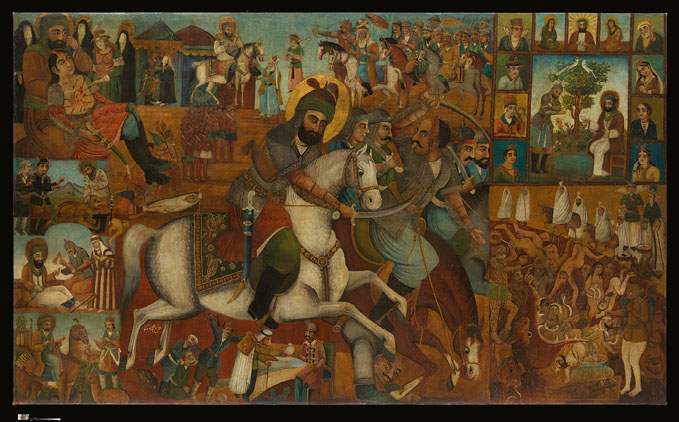
In the case of both art forms, the performances were given in market places and in coffeehouses, with the performers collecting money from their audiences. They were solo performances (although a helper may have been present).116 Because of the nature of their role in spreading the word of the ShiÊ¿ism, many pardeh-dÄrÄn were itinerant.117 In the case of the naqqÄlÄn they told their stories in instalments, returning to the same place every day to tell some more and seeking to extend their stories for as long as possible in order to keep their pitch (and thus their income!).118 If indeed the naqqÄlÄn became involved in taÊ¿ziyeh performance while the tradition was in its early stages, this may well have influenced the plays of the repertoire assuming episodic form. In both naqqÄlÄ« and pardeh-dÄrÄ« the stories were told in a combination of prose and verse, with the pardeh-dÄrÄn also using song. Both included improvisation.119 In the case of naqqÄlÄ«, the naqqÄl learned his craft from a seasoned performer and during his training would have recorded the plot structure and other details of the stories that would form his repertoire in his âá¹Å«mÄrâ (prompt book or scroll).120
In the Qajar period most professional storytellers were dervishes from Selseleh-ye Ê¿Ajam, a branch of the KhÄksÄr order, and descendants of the proselytising ShiÊ¿i ḤaidarÄ«s active during the Safavid period.121 They performed both religious and epic material. Discussing their peregrinations, French diplomat Eugène Aubin (in Iran from 1324/1906 to 1325/1907) describes the Ê¿Ajam dervishes as agents of both rural religious edification, and entertainment. Referring to them as the ârouzékhans des campagnesâ (rawżeh-khÄnÄ« reciters of the countryside) he tells of them giving impromptu narrations of the tribulations of the Karbala martyrs from the foot of the minbar (pulpit) in mosques, and eulogising Ê¿AlÄ« in the bazaars, as well as telling stories from works such as the Eskandar-nÄmeh and Ḥamzah-nÄmeh.122 Whilst pardeh-dÄrÄ« appears to have been an art form specific to dervishes, the wider naqqÄlÄ« tradition also drew practitioners from diverse backgrounds.123 With regards to their impact on the taÊ¿ziyeh tradition, the most important points about both of these oral art forms are that they were practised by skilled professional performers, they were prevalent in the environment in which the taÊ¿ziyeh emerged, and continued to exist alongside it.
The content of the taÊ¿ziyeh repertoire shows the influence of both naqqÄlÄ« and pardeh-dÄrÄ«. As will be discussed in the following chapter, naqqÄlÄ« had a significant impact upon the taÊ¿ziyehâs compositional features. Also, in the discussion of individual episodes we will see the influence of the epic genre, the stories recounted and embellished by the naqqÄlÄn, on the characterisation of the heroes of the ahl-e bait and their kin. In the case of pardeh-dÄrÄ«, we see narrative material originating from this tradition not only making its way into the taÊ¿ziyeh repertoire but integrated into the central episodes. This material may have made its way directly from the canvases and orations of the pardeh-dÄrÄn into the taÊ¿ziyeh plays, or, in the case of material appearing in the taÊ¿ziyeh post-1830s, it may have first passed through the lithographed books of the rawżeh-khÄnÄ«/maqtal genre that were used as sources by the taÊ¿ziyeh composers. In any case, that such material appears in the taÊ¿ziyeh shows the importance of pardeh-dÄrÄ« in conserving and transmitting popular religious narratives.
The aforementioned play Zan-e ZuhrÄ«, included in the Zand collection and signed by a female copyist, was a story told by the pardeh-dÄrÄn.124 Dated 1198/1784, before the advent of lithography in Iran, it is an example of material passing directly from pardeh-dÄrÄ« into the taÊ¿ziyeh. Furthermore, in the 13th/19th century two new scenes were added to the climactic play that feature stories traceable to the pardeh-dÄrÄn, their characters being depicted on a pardeh that has been dated to the Zand period.125 One of these is the story of SultÄn Qais-e HendÄ« and his vizier in India, who are attacked by a lion and call to Ḥusain for help: Ḥusain is in the midst of his final battle at Karbala but nonetheless hears their cry and instantaneously arrives to save them; he then returns to the battlefield to face his own martyrdom. The other new scene involves Ḥusain having a further encounter, shortly before his martyrdom, this time with a certain DarvÄ«sh-e KÄbulÄ« (Dervish of Kabul) who arrives on the battlefield offering the Imam water from his kashkÅ«l (beggars bowl).
This story is the founding myth of non-other than the aforementioned KhÄksÄr dervishes, with whom Selseleh-ye Ê¿Ajam â major participants in the pardeh-dÄrÄ« tradition â were closely associated, if not synonymous. The KhÄksÄr trace their lineage to a dervish from Kabul who had met Ḥusain at Karbala.126 They believe that during this encounter Ḥusain put his hand on the dervishâs shoulder and said a prayer for him.127
In chapter 5 I will examine the process by which these scenes came to be stable features of the climactic episode, noting the appearance of both stories in lithographs of the rawżeh-khÄnÄ«/maqtal genre. Despite its inclusion in such works, given its relevance to Selseleh-ye Ê¿Ajam, there is a strong possibility that the taÊ¿ziyeh-khÄnÄn knew the story of the Dervish of Kabul before it was committed to print. The incorporation of this story, of such importance to the KhÄksÄr, into the climactic taÊ¿ziyeh episode during the 13th/19th century is fascinating, not least because there is evidence of a connection between the taÊ¿ziyeh players and the Ê¿Ajam order during the same period, a matter to which we will now turn our attention.
2.4 TaÊ¿ziyeh-khÄnÄn and Futuvvat Circles: Futuvvat-nÄmeh-ye sulá¹ÄnÄ« and the Seeds of Devotional Drama
In addition to storytelling, the Ê¿Ajam were practitioners of an art form called sukhanvarÄ«, a contest in rhetoric between two contenders involving a lengthy duel in verse. Importantly, while the Ê¿Ajam and KhÄksÄr are best known for their activities during the Qajar period (and as descendants of the ḤaidarÄ«s), some argue that sukhanvarÄ«, and thus the KhÄksÄr order itself, existed under the Safavids.128 SukhanvarÄ« contests took place in coffeehouses and were normally staged after Muḥarram and á¹¢afar, often during RamażÄn.129
Selseleh-ye Ê¿Ajam had a futuvvat organisation, a working manâs association, only for the âgainfully employed.â130 Futuvvat can be broadly summarised as a type of spiritual chivalry practised amongst brotherhood organisations in the Islamic world who shared an ethical code based on loyalty, bravery and generosity. It is synonymous with the Persian javÄnmardÄ«. The creeds of these fraternities fused observance of scrupulously moral and orderly behaviour with a Sufi brand of religiosity seeking knowledge of, and reunion with, the Divine.131 Open to a wide variety of professions and to all social classes, futuvvat, it is argued, was an accessible form of Sufism, allowing working men to participate in mystical practices and discourse.132 In the Persian context, by the early 10th/16th century, futuvvat treatises had taken on an increasingly ShiÊ¿i flavour.133 They emphasised the combination of inner spirituality with outward sobriety and social involvement, placing importance on the honour of carrying out a profession. This preoccupation is demonstrated in Futuvvat-nÄmeh-ye sulá¹ÄnÄ«, composed by the same KÄshefÄ« whose Rawżat al-shuhadÄʾ was so important to the development of the taÊ¿ziyeh. Composed in Timurid Herat around the turn of the 16th century CE, this treatise dedicates a large section to categorisation of the professions, detailing the correct code of conduct and spiritual significance of each one.134
Selseleh-ye Ê¿Ajamâs Futuvvat organisation sought to draw affiliates from amongst 17 occupational groups whose trades correspond to those of their founding members. The nature of these 17 occupations differs somewhat according to the source. In a discussion not related to taÊ¿ziyeh Willem Floor provides and compares seven lists of these vocations from different sources.135 Of great interest to our current discussion is that three of the lists cite the membership of rawżeh-khÄnÄn, and one also specifically mentions taÊ¿ziyeh-khÄnÄn as members. This is concrete evidence of a connection between the taÊ¿ziyeh performers and the Ê¿Ajam. Furthermore, we have a specific example of that connection: the aforementioned taÊ¿ziyeh composer âNÄá¹eqâ, whose work forms part of the Zand collection, is said to have been a sukhanvarÄ« participant.136 As sukhanvarÄ« was peculiar to the Ê¿Ajam order,137 this would suggest that the composer himself was a member.
The taÊ¿ziyeh performersâ membership of the Ê¿Ajam futuvvat circle is interesting for three reasons. It shows that taÊ¿ziyeh performance was considered an established profession in its own right. It shows a societal connection between the taÊ¿ziyeh performers and professional storytellers (the Ê¿Ajam dervishes). Furthermore, in KÄshefÄ«âs aforementioned futuvvat treatise, in his categorisation of the professions, those that involve giving a performance are given a special status. In particular, performances that involve preserving the memory of the ahl-e bait are exalted as acts of devotion. This last point merits further discussion. It is of course speculative, but the presence of such ideas in the milieu in which the taÊ¿ziyeh emerged may well have given the early performers the pretext to go beyond the recitation of the tribulations of the Imams to embodying and playing out these stories as a devotional act.
Futuvvat-nÄmeh-ye sulá¹ÄnÄ« is composed of seven chapters; chapters six and seven discuss the merits of, and code of practice for, a wide range of occupations. Chapter six treats professions that involve giving a performance and chapter seven those that involve the use of a tool or implement (including weapons). KÄshefÄ« establishes giving a performance as a noble undertaking and provides practitioners in this field with a religiously sanctioned framework for their art. Some scholars go as far as to describe the âstrain of futuvvatâ treated in KÄshefÄ«âs work as, â⦠intimately connected with certain guilds whose occupations were ritual and theatrical.â138 He refers to performers collectively as maÊ¿rekeh-gÄ«rÄn. MaÊ¿rekeh means âbattleâ, but in KÄshefÄ«âs environment of Timurid Khurasan the word denoted a place of public entertainment where people gathered to watch any type of display, from wrestling to oratory performances.139 KÄshefÄ« details the proper rules of conduct to be observed when giving any kind of display.140 He divides the performers into three groups: ahl-e sukhan (the orators), ahl-e zÅ«r (the strongmen) and ahl-e bÄzÄ« (players). KÄshefÄ« devotes much attention to the ahl-e sukhan and indeed it is his treatment of a sub-group among them that is of interest to the current discussion.
This subgroup includes the maddÄḥÄn (eulogists), gharrÄ-khÄnÄn (master reciters), and saqqÄyÄn (water-carriers). KÄshefÄ«âs encouragement of the tradition of eulogy could not be stronger: he describes the eulogists as being closer than anyone to the example of the Prophet and his progeny.141 Of course, his point of view may have been influenced by the fact that he was himself a preacher.142 However, in addition to lauding eulogy, he explicitly encourages the activities that will be fundamental to the birth of the taÊ¿ziyeh tradition. For a devotional drama to emerge, three activities are necessary: scripts must be composed; their verse must be recited or sung by parties additional to the composer; and those giving voice to these lines must move past simple recitation to physical emulation of the martyrs, the playing out of the events at Karbala.
In Futuvvat-nÄmeh-ye sulá¹ÄnÄ« not only are the composition and recitation of narrative devotional poetry highly commended, but so are additional actions to ensure that the poetsâ message reaches the masses. The poets KÄshefÄ« celebrates are âThose who compose praises of the Prophet and his family with all their ability and string the gems of their narratives (revÄyÄt), stories (ḥekÄyÄt), virtues (manÄqeb) and dignity (marÄteb) in verse (naáºm).â143 This is the very type of verse from which the dialogues of the taÊ¿ziyeh scripts will be built. KÄshefÄ« praises those who perform this verse, the rÄviyÄn (narrators), and also the water-carriers. It is between the roles of these two groups that we see a space being created for the taÊ¿ziyeh players.
In the case of the rÄviyÄn the connection with those who will give voice to the verse of the taÊ¿ziyeh plays is clear. However, the attention KÄshefÄ« gives to the water-carriers is even more significant. Placing them amongst the highly esteemed eulogists, he commends the fact that in addition to eulogy they, âperform another task so that the blessings may reach the public.â144 He thus implies that rituals of remembrance for the martyrs should surpass the vocal and include acts of a physical nature. The action carried out by the performers of taÊ¿ziyeh, playing the likeness of the members of the ahl-e bait, their supporters and aggressors to provoke the shedding of redemptive tears, can indeed be considered the performance of just such a task â ensuring that blessings reach the public. Moreover, in the water-carriers we have an example of emulation as a devotional act.
In his engagement with the spiritual significance of the task of water- bearing, KÄshefÄ« gives special attention to Ê¿AbbÄs b. Ê¿AlÄ«. Recounting in detail his selfless struggle to reach the Euphrates at Karbala and his subsequent demise, KÄshefÄ« praises those acting as water-bearers for their emulation of Ê¿AbbÄs and invocation of his memory through repetition of his actions.145 This is again parallel with the task to be undertaken by the performers of taÊ¿ziyeh. Furthermore, it shows devotion by emulation as an accepted and encouraged element of liturgy, which helps us to understand the progression towards full-scale re-enactment as a religious act.146
Whilst it cannot be claimed that the emergence of the taÊ¿ziyeh tradition was a direct response to the message of KÄshefÄ«âs Futuvvat-nÄmeh-ye sulá¹ÄnÄ«, his particular attention to the art of performance, seeking to codify and ennoble it and encouraging a trend in the performance of religious stories, offered a source of inspiration for devotional re-enactments. In his concern for proper behaviour and societal organisation, built around the roles of different professions, he not only created a separate category for performers but brought them to the top of his list. He gave particular recognition to the importance of eulogy, the recital of religious poetry, and commended remembrance through emulation. His treatise turned a performance, such as those he witnessed at the maÊ¿rekeh, into a potential religious offering. This, since the eulogy was of a ShiÊ¿i nature, created conditions ripe for the emergence of a ShiÊ¿i devotional drama in the subsequent centuries.
3 Conclusion
Considering the emergence, development, and survival of the art of taÊ¿ziyeh- khÄnÄ« through the centuries we see a tradition inspired by the impulse to remember the lives and sacrifices of ShiÊ¿ismâs sacred figures through re-enactment. It is a tradition periodically embraced by the ruling classes, but that comes from, and is sustained by, the devotion of the common people. We see the giving of a performance to inspire remembrance of the ahl-e bait described as a valuable act of piety, and even the sanctioning of their emulation to this end, in an important treatise coinciding in date with the dawn of the Safavid period. Moreover, the treatise in question â KÄshefÄ«âs Futuvvat-nÄmeh-ye sulá¹ÄnÄ« â records a variety of performance forms present in Timurid Herat around 1500 CE that celebrate the ahl-e bait through performance. Thus, while it is beyond doubt that the establishment of ShiÊ¿ism as Iranâs religion of state under the Safavids facilitated the emergence of a ShiÊ¿i devotional drama, the seeds of that process had been sown significantly earlier.
Nonetheless, it took some time for these rituals of remembrance to become what we can call drama. The earliest taÊ¿ziyeh performances, those that evolved into the first scripted plays, in the form of HaftÄd-u-du tan, were re-enactments of the battle of Karbala staged amongst ordinary people, outside urban centres. This custom existed by the mid-11th/17th century at the latest. There may, of course, have been other early forms of enactment, but this was certainly prominent among them. The same sector of society, common people, mostly living rurally, safe-guarded the tradition during the reign of NÄder ShÄh, allowing for its re-emergence once conditions again become favourable (a process that we see repeated during the Pahlavi era). The boom in patronage enjoyed under the Qajars resulted in a surge in the traditionâs development due to the emergence of a professional circuit. The great demand not only gave taÊ¿ziyeh performers the opportunity to hone their craft but led to the exchange of influences, as performers from different regions travelled to the cities to work during the mourning season.
As for contributors to the tradition, we must note the importance of women, not least those of the lower classes who, due to the large numbers in which they flocked to the taÊ¿ziyeh and their seating position in the traditional tekiyeh, constituted the vast majority of the direct audience to whom the taÊ¿ziyeh-khÄnÄn performed. Those performers were influenced by the storytelling traditions of naqqÄlÄ« and pardeh-dÄrÄ«, and there is evidence of a societal connection between their practitioners.
BahrÄm BeyżÄʾī, NamÄyesh dar ĪrÄn (Tehran: EnteshÄrÄt-e RowshangarÄn va muá¹ÄlaÊ¿Ät-e zanÄn, [1344] 1383 SH), 56, 123; Ehsan Yarshater, âDevelopment of Persian Drama in The Context of Cultural Confrontation,â in Iran: Continuity and Variety, ed. Peter J. Chelkowski (New York: Center for Near Eastern Studies, 1971), 23; âTaâziyeh and Pre-Islamic Mourning Rites in Iran,â in Chelkowski ed. Taâziyeh: Ritual and Drama, 91â93; HumÄyÅ«nÄ«, TaÊ¿ziyeh dar ĪrÄn, 15â18; Jamshid Malekpour, The Islamic Drama (London; Portland Or.: Frank Cass Publishers, 2004), 38â49.
On this matter, the works of al-BÄ«rÅ«nÄ«, al-ThaÊ¿ÄlabÄ«, and al-KÄshgharÄ« (all pertaining to the 11th century CE) are cited by Ehsan Yarshater, âMourning Rites,â 90â91.
Yarshater, âMourning Rites,â 89â92. Also see Willem M. Floor, The History of Theater in Iran (Washington, D.C.: Mage Publishers, 2005), 82â83.
NÄá¹£erbakht, AdabiyÄt-e Ä«rÄnÄ«, 251.
This occasion is recorded by al-ṬabarÄ« and in Muḥammad BÄqer MajlesÄ«âs collection of ShiÊ¿i traditions BehÄr al-AnwÄr, among other sources. Ayoub, Redemptive Suffering, 152; Ali J. Hussain, âThe Mourning of History and the History of Mourning: The Evolution of Ritual Commemoration of the Battle of Karbala,â Comparative Studies of South Asia, Africa and the Middle East 25, no. 1 (2005): 80â81.
Ibid., 81. For the lamentation rituals of this period also see Babak Rahimi, Theater State and the Formation of Early Modern Public Sphere in Iran: Studies on Safavid Muharram Rituals, 1590â1641 CE (Leiden; Boston: Brill, 2012), 206.
EsmÄÊ¿Ä«l b. Ê¿Umar Ebn KathÄ«r, al-BedÄyah waâl-nehÄyah, 14 vols., vol. 11 (Beirut: Maktabat al-MaÊ¿Äref, [c.1367] 1990), 243; Hussain, âMourning of History,â 84.
Peter J. Chelkowski, âTaâziyeh: Indigenous Avant-Garde Theatre of Iran,â Performing Arts Journal 2, no. 1 (1977), 32â33; âShia Muslim Processional Performances,â TDR: The Drama Review 29, no. 3 (1985): 22; âNarrative Painting and Painting Recitation in Qajar Iran,â Muqarnas 6 (1989), 99â100; âPopular Entertainment, Media and Social Change in Twentieth- Century Iran,â in The Cambridge History of Iran from Nadir Shah to the Islamic Republic, ed. Peter Avery, Gavin Hambly, and Charles Peter Melville (Cambridge: Cambridge University Press, 1991), 771â72; âTaÊ¿zia,â Encyclopædia Iranica, online version (2009). Available at http:// www.iranicaonline.org/articles/tazia (accessed June 16th, 2024). Whilst this theory is much echoed in the literature, some scholars have maintained that taÊ¿ziyeh had existed in some form during the Safavid period. BeyżÄʾī, NamÄyesh, 117 and 21; Jean Calmard, âShiÊ¿i Rituals and Power II: The Consolidation of Safavid ShiÊ¿ism: Folklore and Popular Religion,â in Safavid Persia: The History and Politics of an Islamic Society, ed. C.P. Melville (London I.B. Tauris, 1996), 156â57; BulÅ«kbÄshÄ«, TaÊ¿ziyeh, 27â34.
For an edition and photographs of the script see DÄvÅ«d Fatḥ-Ê¿AlÄ« BaigÄ« and MehdÄ« DaryÄÄ«, Daftar-e taÊ¿ziyeh 13 (Tehran: EnteshÄrÄt-e NamÄyesh, 1394 SH), 19â81. This volume includes an edition of a further play, HengÄmeh qiyÄmat (The Resurrection), the script of which bears the date 1172 (1758â59).
Ibid., 62.
Daftar 11, 10.
Ibid., 10 and 89.
Thomas Salmons and Matthias Van Goch, Die heutige Historie und Geographie oder der gegenwärtige Staat vom Königreich Persien (Flensburg and Altona: Gebrüder Korte, 1739), 252â53.
For a highly useful bibliographical guide to the accounts of these rituals during the Safavid period given by foreign visitors to Iran, ordered by date, place and the type of ritual witnessed, see Calmard, âShiÊ¿i Rituals,â 178â84.
Salmons and Van Goch, Die heutige Historie, 252â53.
Chelkowski, âTaÊ¿ziaâ. For general discussion of taÊ¿ziyeh-ye sayyÄr see BeyżÄʾī, NamÄyesh, 126â27; Shahidi, TaÊ¿ziyeh-khÄnÄ«: dowreh-ye QÄjÄr, 235â41; Fatḥ-Ê¿AlÄ« BaigÄ«, MabÄnÄ«-ye shabÄ«h-khÄnÄ«, 26â28.
Cornelis De Bruin, Voyages de Corneille Le Brun par la Moscovie, en Perse, et aux Indes Orientales, 2 vols., vol. 1 (Amsterdam: Frères Wetstein, 1718), 219â20.
For an overview of such accounts see: Calmard, âShiÊ¿i Ritualsâ; and Rahimi, Theater State, 216â234.
E. Lucy Deacon, âRemembering Through Re-Enacting: Revisiting the Emergence of the Iranian TaÊ¿zia Tradition,â Medieval English Theatre 41 (2019).
Maryam Moazzen, âRituals of Commemoration, Rituals of Self-Invention: Safavid Religious Colleges and the Collective Memory of the Shiâa,â Iranian Studies 49, no. 4 (2016): 558â60.
Ibid., 558â59. For an edition of these deeds (and the sections in question) see Ê¿Abd al-Ḥusain SepantÄ, TÄrÄ«khcheh-ye awqÄf-e EsfahÄn (Isfahan: EnteshÄrÄt-e edÄreh-ye kull-e awqÄf-e maná¹aqeh-ye EsfahÄn, 1346 SH), 163â5 and 241.
Moazzen uses the term âpassion playâ a number of times in her discussion, citing this as one of the rituals funded. Based on the meaning of this term in Christian culture one would expect this to mean a theatrical representation and thus to indicate taÊ¿ziyeh-khaÌniÌ performances being staged. However, this is not so. The term in the vaqf documents translated as âpassion playâ is rawżeh-khÄnÄ« (I thank Professor Moazzen for the clarification on this matter).
Shahidi, TaÊ¿ziyeh-khÄnÄ«: dowreh-ye QÄjÄr, 74; Fatḥ-Ê¿AlÄ« BaigÄ«, MabÄnÄ«-ye shabÄ«h-khÄnÄ«, 28.
For versions of HaftÄd-u-du tan amongst the Cerulli Collection see MS 699 (Beg. 20th Cent., Shahrud); MS 703 (Beg. 20th Qom); MS 915 (Beg. 20th, Shiraz).
Carsten Niebuhr, Reisebeschreibung nach Arabien und andern umliegenden Ländern, 2 vols., vol. 2 (Copenhagen: Nicholaus Möller, 1778), 199â201. Niebuhr travelled widely, his work offering a valuable record of life in the pre-modern Middle East. See Lawrence J. Baack, Undying Curiosity: Carsten Niebuhr and the Royal Danish Expedition to Arabia (1761â1767) (Stuttgart: Franz Steiner Verlag, 2014).
Niebuhr, Reisebeschreibung, 2, 198â99.
Niebuhr misidentifies the female characters here. Qasem being a newly-wed adolescent, those beseeching him were most likely his bride FÄá¹emeh and his mother (or if, indeed, a second young girl, FÄá¹emehâs sister SakÄ«neh).
Niebuhr, Reisebeschreibung, 2, 199â200. Authorâs translation from German, Deacon, âRemembering Through Re-Enacting,â 72â73.
This scene is played in BÄzÄr-e ShÄm and will be discussed in chapter 6.
For de Montheronâs full account in French and an English translation see Calmard, âShiÊ¿i Rituals,â 171â75. Calmard himself sees this as a kind of dramatic performance and draws a parallel with the medieval European passion plays. Ibid., 157.
Ibid., 173â74.
Ibid., 176.
For further discussion see Deacon, âRemembering Through Re-Enacting,â 76.
Calmard, âShiÊ¿i Rituals,â 174.
Ibid.
Ibid., 175.
The word maidÄn denotes a field and also a town square. We have seen above that such performances could take place in town squares. But in the taÊ¿ziyeh plays this word denotes the field of battle, maidÄn-jang; the locations chosen for such performances reflect this. Examples of towns with an ongoing tradition of taÊ¿ziyeh-ye maidÄnÄ« include Shush and Behbahan (Khuzestan), Fasa (Fars), and in the villages of Mir Shams al-Din (Mazandaran) and Naniz (Kerman). For such a performance in Ardabil during the Pahlavi period see BeyżÄʾī, NamÄyesh, 126.
For further discussion, including examples of accounts of armed men not only indulging in combat during the Muḥarram commemorations but also acting out details of Ḥusainâs martyrdom narrative. See Deacon, âRemembering Through Re-Enacting.â.
Rahimi, Theater State. See, in particular, 216â234 and 321â327; and Mikhail Bakhtin, Rabelais and His World, trans. Hélène Iswolsky (Bloomington: Indiana University Press, 1984) 423.
For NÄder ShÄhâs wider efforts to this effect see Ernest Tucker, âNadir Shah and the Jaâfari Madhhab Reconsidered,â Iranian Studies 27, no. 1/4 (1994).
For further discussion see Shahidi, TaÊ¿ziyeh-khÄnÄ«: dowreh-ye QÄjÄr, 76â84; and Peter J. Chelkowski, âBibliographical Spectrum,â in Chelkowski ed. TaÊ¿ziyeh: Ritual and Drama, 258â59.
William Francklin, Observations Made on a Tour from Bengal to Persia, in the Years 1786â7 (Calcutta: Stuart and Cooper, 1788), 100â01. It merits comment that in Anglophone scholarship Francklinâs description of these performances is often cited as the oldest extant taÊ¿ziyeh spectator account, not mentioning Niebuhrâs evidence from 22 years earlier. A possible reason for this is that the English translation Niebuhrâs memoires have been abridged and his description of the taÊ¿ziyeh on Kharq omitted.
See for example HumÄyÅ«nÄ«, TaÊ¿ziyeh dar ĪrÄn, 76â141; Floor, Theater, 132â203.
BulÅ«kbÄshÄ«, TaÊ¿ziyeh, 93â94.
Chodzko, TheÌatre persan, xxi.
For this architectural trend see BulÅ«kbÄshÄ«, TaÊ¿ziyeh, 93â95; and Gobineau, Les religions, 381â403.
For example, in Chodzkoâs account of the performances staged by MÄ«rzÄ AbÅ« al-Ḥasan KhÄn ShÄ«rÄzÄ« he notes the patron being responsible for paying the actors. Chodzko, TheÌatre persan, xxii.
Ilya Nikolaevitch Bérézine, Voyage en Perse du Nord, trans. Jacqueline Calmard-Compa and Jean Calmard (Paris: Geuthner, 2011), 235.
It is argued that NÄá¹£er al-DÄ«nâs great interest in taÊ¿ziyeh was due to more than his personal religiosity and keen interest in the arts. It is said that his public embracing of this and other aspects of popular ShiÊ¿i devotional culture gave him a weapon with which he could triumph over the clerics, who otherwise had the monopoly on legalistic ShiÊ¿ism. Abbas Amanat, Pivot of the Universe: Nasir al-Din Shah Qajar and the Iranian Monarchy, 1831â1896 (London: New York: I.B. Tauris, 1997), 434â35. For further discussion of the wave of elite patronage see HumÄyÅ«nÄ«, TaÊ¿ziyeh dar ĪrÄn, 130â33; Chelkowski, âPopular Entertainment,â 772â73. For Tekiyeh-ye Dawlat, as a means of staging royal power, see Babak Rahimi, âTakkiyeh Dowlat: The Qajar Theater State,â in Performing the Iranian State: Visual Culture and Representations of Iranian Identity, ed. Staci Gem Scheiwiller (London: Anthem Press, 2013).
NÄá¹£erbakht, AdabiyÄt-e Ä«rÄnÄ«, 14.
Carla Serena, Hommes et choses en Perse (Paris: G. Charpentier et Compagnie, 1883), 172â76.
For more on traditional tekiyeh design see BeyżÄʾī, NamÄyesh, 124â26.
For further discussion see William Beeman, âCultural Dimensions of Performance Conventions in Iranian Taâziyeh,â in Chelkowski ed. Taâziyeh: Ritual and Drama, 26â28. Some tekiyehs (like Tekiyeh-ye Dawlat) have a separate smaller stage outside of the sand track and in front of one of the porticos. This is used largely for representing scenes external to the siege, such as YazÄ«dâs court in Damascus. For an account of such use in performance see Serena, Hommes et choses, 190â94.
Chelkowski, âPopular Entertainment,â 773. On how the repertoire reflects the shift towards entertainment see Fatḥ-Ê¿AlÄ« BaigÄ«, MabÄnÄ«-ye shabÄ«h-khÄnÄ«, 34.
MabÄnÄ«-ye shabÄ«h-khÄnÄ«, 33.
For the events surrounding NÄá¹£er al-DÄ«nâs assassination see Amanat, Pivot of the Universe, 440â44. For a translation of the Cerulli Collection version of this play see Peter J. Chelkowski, âMajlis-i Shâhinshâh-i Ãrân Nâsir al-Dîn Shah,â in Qajar Iran: Political, Social and Cultural Change, 1800â1925, ed. Edmund Bosworth and Carole Hillenbrand (Edinburgh: Edinburgh University Press, 1983).
Shahidi, TaÊ¿ziyeh-khÄnÄ«: dowreh-ye QÄjÄr, 195â96.
Kamran Scott Aghaie, The Martyrs of Karbala: ShiÊ¿i Symbols and Rituals in Modern Iran (Seattle; University of Washington Press, 2004) 49â53. For an account of how the reforms affected the performance landscape in the cities, with not only taÊ¿ziyeh but most types of storytelling being subject to restrictions, see Floor, Theater, 103â06.
Malekpour, The Islamic Drama, 15â18.
TaÊ¿ziyeh-ye ShÄh-cherÄgh is a prominent example of this trend. Fatḥ-Ê¿AlÄ« BaigÄ«, MabÄnÄ«-ye shabÄ«h-khÄnÄ«, 42.
Shahidi, TaÊ¿ziyeh-khÄnÄ«: dowreh-ye QÄjÄr, 119. For a historical study of the attitudes of ShiÊ¿i clerics towards the taÊ¿ziyeh tradition see Moslem NÄdÊ¿alÄ«zÄdeh, ShabÄ«h az negÄh-e faqÄ«h: taÊ¿ziyeh dar ÄrÄ-ye faqÄ«hÄn va Ê¿ÄlemÄn-e shÄ«Ê¿eh (Tehran: Khaimeh, 1391 SH).
Shahidi, TaÊ¿ziyeh-khÄnÄ«: dowreh-ye QÄjÄr, 118.
For further discussion see Aghaie, Martyrs of Karbala, 58â66; and Chelkowski, âPopular Entertainment,â 774â775.
Randle-Bent, ââIndigenous Avant-Gardesâ.â
The village of Baraghan in Alborz is an example of one of taÊ¿ziyehâs rural strongholds with a longstanding tradition. For accounts of two performances there during Muḥarram of 1439/2017 and further discussion of the modern-day tradition, including the distribution of performances see Deacon, âTaÊ¿ziyeh-khani in Iranian Communities.â
MÅ«nes al-Dawlah, KhÄterÄt-e MÅ«nes al-Dawlah nadÄ«meh-ye ḥaramserÄ-ye NÄá¹£er al-DÄ«n ShÄh, ed. SÄ«rÅ«s SaÊ¿dvandiyÄn (Tehran: ZarrÄ«n, [1345 SH] 1389 SH), 96â108. MÅ«nes al-Dawlah first published these memoires as a series of articles in the magazine Zan-e rÅ«z in 1345 SH/ 1966â67 CE, in which she states that she is 95 or 96 years old at the time of writing. Ibid., 3â5.
Ibid., 96â98.
Ibid., 104â05.
BeyżÄʾī, NamÄyesh, 151â52; Floor, Theater, 188; Negar Mottahedeh, âTaÊ¿ziyeh: A Twist of History in Everyday Life,â in The Women of KarbalaÌ: Ritual Performance and Symbolic Discourses in Modern Shiâi Islam, ed. Kamran Scott Aghaie (Austin: The University of Texas Press, 2005), 35.
MÅ«nes al-Dawlah, KhÄterÄt, 106â07. For more on women of the Qajar royal family as patrons of taÊ¿ziyeh see Kamran Scott Aghaie, âThe Gender Dynamics of Moharram Symbols and Rituals in the Latter Years of Qajar Rule,â in The Women of Karbala, ed. Aghaie, 57â58.
MÅ«nes al-Dawlah, KhÄterÄt, 99, 104. Also see Floor, Theater, 189.
MÅ«nes al-Dawlah, KhÄterÄt, 106â08. In modern Persian the word âÊ¿arÅ«sâ denotes the bride of oneâs son, broadly translating as âdaughter-in-law.â MÅ«nes al-Dawlah describes the performance of this play being accompanied by a ritual in which a local orphan girl was adorned as a bride and celebrated by the women. Then, after the performance, they organised for her to be wed and provided lodgings and other necesities for the young couple.
The playâs main theme is the merits of weeping for the tribulations of Ḥusain. It includes a miracle and some comedic dialogues. For the full script see Fatḥ-Ê¿AlÄ« BaigÄ« and DaryÄÄ«, Daftar 11, 91â118.
Ibid., 89â90.
Some of these documents indicate that womenâs interest in sponsoring such rituals predated taÊ¿ziyehâs rise to popularity amongst the elite during the reign of Fatḥ-Ê¿AlÄ« ShÄh QÄjÄr. For example, in 1208/1794 an Umm Salmah endowed properties in the Yazd area for purposes including mourning rituals during Muḥarram and á¹¢afar. See Harvard University, âUmm Salmahâs endowment, 1794,â Womenâs Worlds in Qajar Iran, available online at: http://www.qajarwomen.org/en/items/13122A28.html (accessed June 17th, 2024).
âShah Parvar Khanumâs endowment, 1855,â WWiQI, available online at: http://www.qajarwomen.org/en/items/14130A12.html (accessed June 17th, 2021).
âValiyah Husn Jahan Khanumâs endowment, 1903,â WWiQI, available online at: http://www.qajarwomen.org/en/items/13118A18.html (accessed June 17th, 2021).
âGawhari Khanumâs will, 1923,â WWiQI, available online at: http://www.qajarwomen.org/en/items/13106A11.html (accessed June 17th, 2021).
Ê¿AbdullÄh MustawfÄ«, Sharḥ-e zendegÄnÄ«-ye man: tÄrÄ«kh-e ejtemÄÊ¿iy va edÄrÄ«-ye dowreh-ye qÄjÄriyeh az ÄqÄ Muḥammad KhÄn ta Äkhar-e NÄá¹£er al-DÄ«n ShÄh, 3 vols., vol. 1 (Tehran: ZuvvÄr, [1341] 1343 SH), 288.
For Ê¿AÄ«n al- Salá¹anahâs comments and those of others see Floor, Theater, 187â88. Also see Aghaie, âGender Dynamics,â 55â56.
Calmard, âShiÊ¿i Rituals,â 174.
Bérézine, Voyage, 235â238.
Chodzko, TheÌatre persan, xxviâxxix.
Mary Leonora Woulfe Sheil, Glimpses of Life and Manners in Persia (London: John Murray, 1856), 126â28.
Gobineau, Les religions, 377. These women did not process around the tekiyeh, instead participating from their seated positions. Meanwhile, MÅ«nes al-Dawlah, gives a fascinating account of a female sÄ«neh-zanÄ« procession that took place in the seclusion of NÄá¹£er al-DÄ«nâs andarÅ«n. She describes the bare-headed and footed noble women and their servants led by Fatḥ-Ê¿AlÄ« ShÄhâs daughter, who scattered straw and sang dirges, processing between different quarters beating their chests and carrying a bejewelled Ê¿alam (a standard, bearing icons relating to Karbala). KhÄterÄt, 106.
Aghaie, âGender Dynamics,â 47, 60.
Aghaie, âGender Dynamics,â 54â55.
Illustrating this point, Aghaie presents a number of examples of women fighting not only each other for space in the tekiyeh, but their husbands or masters for the right to attend. Ibid., 55, 58â59.
Sheil, who spectated from such a loge described it as being covered by a âthick felt carpet, pierced with small holesâ in order that the women could see out but no one see in. Carla Serena who spectated from the loge of AnÄ«s al-Dawlah, described a similar curtain of brocaded gauze. Sheil, Glimpses, 127; Serena, Hommes et choses, 175.
For more on the different roles within the taÊ¿ziyeh tradition, their requirements, and the interplay between them see Fatḥ-Ê¿AlÄ« BaigÄ«, MabÄnÄ«-ye shabÄ«h-khÄnÄ«, 145â61.
BeyżÄʾī, NamÄyesh, 134.
For a fascinating interview with FayyÄż see KÄáºemÄ«, MÄ«r-e Ê¿AzÄ, 51â72.
Such was the legacy of these two figures, that after them the titles of MuÊ¿Ä«n al-BukÄʾ and NÄáºem al-BukÄʾ went into general usage to denote a taÊ¿ziyeh director and his assistant. BeyżÄʾī, NamÄyesh, 134â35.
Fatḥ-Ê¿AlÄ« BaigÄ« and DaryÄÄ«, Daftar 11, 15.
Fatḥ-Ê¿AlÄ« BaigÄ« and DaryÄÄ«, Daftar 13, 13â14.
For a collection of his works see MehdÄ« DaryÄÄ«, Daftar-e taÊ¿ziyeh 14 (Tehran: EnteshÄrÄt-e NamÄyesh, 1396 SH). Also see Fatḥ-Ê¿AlÄ« BaigÄ« and DaryÄÄ«, Daftar 11, 127â49.
For MÄ«r-e Anjemâs collected works see Muḥammad Ḥusain NÄá¹£erbakht, Daftar-e taÊ¿ziyeh 8 (Tehran: EnteshÄrÄt-e NamÄyesh, 1386 SH); Daftar-e taÊ¿ziyeh 9 (Tehran: EnteshÄrÄt-e NamÄyesh, 1388 SH). For more on taÊ¿ziyeh composers, including other well-known figures see HumÄyÅ«nÄ«, TaÊ¿ziyeh dar ĪrÄn, 266â68.
EsmÄÊ¿Ä«lÄ«, Fehrest-e dastnevÄ«s-hÄ, 26â27.
KÄáºemÄ«, MÄ«r-e Ê¿AzÄ, 9.
Beeman, Iranian Performance, 96â98.
MustawfÄ«, Sharḥ-e zendegÄnÄ«, 1, 289â90; BeyżÄʾī, NamÄyesh, 145â47.
Gobineau, Les religions, 372â74. Also see BeyżÄʾī, NamÄyesh, 143. Serena also reports the busy schedule of the taÊ¿ziyeh-khÄnÄn and their movement between venues in Tehran in the 1870s. She describes them as âplaying from sunrise to sundown and continuing after the evening meal.â Serena, Hommes et choses, 181.
MustawfÄ«, Sharḥ-e zendegÄnÄ«, 1, 290â91. For ḤÄjjÄ« MullÄ á¸¤usain, also see BeyżÄʾī, NamÄyesh, 143.
Floor, Theater, 165.
Gobineau, Les religions, 374.
HumÄyÅ«nÄ« provides a list of the well-known taÊ¿ziyeh-khÄnÄn attached to certain performance venues in Shiraz and surrounding areas, many of whom were born in the mid-13th/19th century. TaÊ¿ziyeh va taÊ¿ziyeh-khÄnÄ« (Tehran: ChapkhÄneh-ye BÄ«st u panjum-e shahrÄ«var, 1354 SH), 82, 85; and TaÊ¿ziyeh dar ĪrÄn, 458â69.
Chodzko, whilst mentioning paid actors in Tehran, notes that in the countryside the shepherds and peasants give the performances themselves. TheÌatre persan, xxii.
Shahidi, TaÊ¿ziyeh-khÄnÄ«: dowreh-ye QÄjÄr, 558â61.
BeyżÄʾī, NamÄyesh, 121 and 28; HumÄyÅ«nÄ«, TaÊ¿ziyeh-khÄnÄ«, 24â26 and 28; Floor, Theater, 125.
BeyżÄʾī, NamÄyesh, 121; Anayatullah Shahidi, âLiterary and Musical Developments in the Taâziyeh,â Chelkowski ed. Taâziyeh: Ritual and Drama, 42.
Most types of traditional storytelling performance were prohibited in the 1930s as part of ReÅ¼Ä ShÄhâs modernisation drive. However, narration of the ShÄh-nÄmeh continued to be tolerated due to its promotion of the concept of monarchy. Thus, the repertoire of the naqqÄls was reduced to ShÄh-nÄmeh-khÄnÄ«. For further discussion see Kumiko Yamamoto, âNaqqâli: Professional Iranian Storytelling,â in Oral Literature of Iranian Languages. Kurdish, Pashto, Balochi, Ossetic, Persian and Tajik: A History of Persian Literature, ed. Philip. G. Kreyenbroek, Ulrich Marzolph, and Ehsan Yarshater (London & New York: I.B. Tauris, 2010); Ulrich Marzolph, âProfessional Storytelling (NaqqÄlÄ«) in QÄjar Iran,â in Orality and Textuality in the Iranian World: Patterns of Interaction across the Centuries, ed. Julia Rubanovich (Leiden: Brill, 2015).
SuhailÄ Najm, Hunar-e naqqÄlÄ« dar ĪrÄn (Tehran: Muʾassaseh-ye taʾlÄ«f, tarjumeh va nashr-e Äsar-e hunarÄ« âMatnâ, 1390 SH), 23.
Yamamoto, âNaqqâli,â 245. For a comprehensive introduction to pardeh-dÄrÄ«, including the inception of picture narration in its ShiÊ¿i form and a study of the canvases see Najm, NaqqÄlÄ«, 169â206.
Floor, Theater, 119â121. For pardeh-dÄrÄ« as part of visual culture see Ingvild Flaskerud, Visualizing Belief and Piety in Iranian Shiism (London; New York: Continuum, 2010) 85â88.
A traveller records seeing such a canvas used by a storyteller in the cemetery of the shrine of Imam ReÅ¼Ä in Mashhad. Floor, Theater, 119â20.
Najm, NaqqÄlÄ«, 184.
Chelkowski, âKâshefiâs Rowzat,â 276.
Najm, NaqqÄlÄ«, 23; NÄá¹£erbakht, AdabiyÄt-e Ä«rÄnÄ«, 235.
For the skill of the pardeh-dÄrÄn in improvisation see Najm, NaqqÄlÄ«, 183â84. For improvisation in naqqÄlÄ« see Yamamoto, âNaqqâli,â 254â55; Marzolph, âProfessional Storytelling,â 272.
For the á¹Å«mÄr in the naqqÄlÄ« tradition see Yamamoto, âNaqqâli,â 252; Najm, NaqqÄlÄ«, 301â15. The pardeh-dÄrÄn may have also used á¹Å«mÄrs. Chelkowski, âKâshefiâs Rowzat,â 277.
Marzolph, âProfessional Storytelling,â 277. For the Ê¿Ajam and their origins see AbÅ« ṬÄleb MÄ«r-Ê¿ÄbedÄ«nÄ« and MehrÄn AfsharÄ«, ÄyÄ«n-e qalandarÄ«: mushtamel bar chahar resÄleh dar bÄb-e qalandarÄ«, KhÄksarÄ«, ferqeh-ye Ê¿Ajam va sukhanvarÄ« (Tehran: FarÄrvÄn, 1374 SH), 336â38. For the scholarly debate as to whether Selseleh-ye Ê¿Ajam and the KhÄksÄr order became completely assimilated see: Willem Floor, âGuilds and Futuvvat in Iran,â Zeitschrift der Deutschen MorgenlaÌndischen Gesellschaft 134, no. 1 (1984): 107â08.
Eugène Aubin, La Perse dâaujourdâhui (Paris: Colin, 1908), 241â42.
For discussion of such individuals see Yamamoto, âNaqqâli,â 248.
Fatḥ-Ê¿AlÄ« BaigÄ« and DaryÄÄ«, Daftar 11, 89.
For an image of the canvas in question see JÄber Ê¿AnÄá¹£erÄ«, Sulá¹Än-e KarbalÄ: sharḥ-e vÄqeÊ¿eh-ye Ê¿ÄshÅ«rÄʾ va ÄyÄ«n-hÄ-ye sÅ«gvÄrÄ«-ye AbÄ Ê¿AbdallÄh al-Ḥusain, Ê¿alaihe al-salÄm, dar ĪrÄn (Tehran: ZarrÄ«n va SÄ«mÄ«n, 1382 SH), 38â39; and Marzolph, âVisual Culture,â 147.
NÅ«r al-DÄ«n MudarresÄ« ChahÄrdehÄ«, KhÄksÄr va ahl-e al-ḥaqq (Tehran: ChÄpkhÄneh-ye KhÅ«sheh, 1353 SH), 7.
Ḥusain Partuv BeyżÄʾī KÄshÄnÄ«, TÄrÄ«kh-e varzesh-e bÄstÄnÄ«-ye ĪrÄn: zÅ«r-khÄneh (Tehran: ZuvvÄr, 1382 SH), 43.
Najm, NaqqÄlÄ«, 106â108. For a possible account of sukhanvarÄ« in Isfahan during the mid-17th century in the travelogue of French gem merchant Jean-Baptiste Tavernier see Partuv BeyżÄʾī KÄshÄnÄ«, TÄrÄ«kh-e varzesh, 41â43. For sukhanvarÄ« customs originating from events during the Safavid period see MÄ«r-Ê¿ÄbedÄ«nÄ« and AfsharÄ«, ÄyÄ«n-e qalandarÄ«, 337.
For sukhanvarÄ« contests and samples of the verse recited see: MÄ«r-Ê¿ÄbedÄ«nÄ« and AfsharÄ«, ÄyÄ«n-e qalandarÄ«, 338â47 and 348â450; MuhÌ£ammad JaÊ¿far MaḥjÅ«b, âSukhanvarÄ«,â Sukhan 9, no. 7 (1337 SH); and Najm, NaqqÄlÄ«, 107â21. Also see Partuv BeyżÄʾī KÄshÄnÄ«, TÄrÄ«kh-e varzesh, 44â45.
Floor, âGuilds and Futuvvat,â 107. For the connection between the rituals and customs of the KhÄksÄr and Futuvvat circles see: MudarresÄ« ChahÄrdehÄ«, KhÄksÄr, 180â83.
For a good introduction to this concept see: Lloyd Ridgeon, Jawanmardi: A Sufi Code of Honour (Edinburgh: Edinburgh University Press, 2011), 1â21.
Ridgeon, Jawanmardi, 5â15.
Riza Yildirim, âShÄ«âitisation of the Futuwwa Tradition in the Fifteenth Century,â British Journal of Middle Eastern Studies 40, no. 1 (2013).
For an edition see Ḥusain VÄÊ¿ez KÄshefÄ« SabzevÄrÄ«, Futuvvat-nÄmeh-ye sulá¹ÄnÄ«, ed. Muḥammad JaÊ¿far MaḥjÅ«b (Tehran: BunyÄd-e farhang-e Īran [c.1500 CE.] 1350 SH). For a translation see The Royal Book of Spiritual Chivalry (FutÅ«wat nÄmah-yi sultạÌnÄ«), trans. Jay R. Crook (Chicago: KAZI Publications, 2000).
Floor, âGuilds and Futuvvat,â 108â10.
DaryÄÄ«, Daftar 14, 9.
MÄ«r-Ê¿ÄbedÄ«nÄ« and AfsharÄ«, ÄyÄ«n-e qalandarÄ«, 335; Floor, Theater, 117â18.
Mojtaba Zarvani and Mohammad Mashhadi, âThe Rite of the Water-Carrier: From the Circles of Sufis to the Rituals of Muharram,â Journal of Shiâa Islamic Studies 4, no. 1 (2011): 26.
Arley Loewen, âProper Conduct (Adab) Is Everything: The Futuwwat-naÌmah-i SultÌ£aÌniÌ of Husayn Vaâiz-i Kashifi,â Iranian Studies 36, no. 4 (2003): 565.
KÄshefÄ«, Futuvvat-nÄmeh, 277â78. This includes the stipulation not to coincide with obligatory prayer times, a point carefully observed in the programming of taÊ¿ziyeh performances. A further instruction is that performers should call for blessings upon the prophet and his family. This is observed in the traditions of taÊ¿ziyeh and naqqÄlÄ« alike; the performers punctuate certain points in the narrative by calling for á¹£alavÄt, to which the audience obediently reply. Authorâs observations; Yamamoto, âNaqqâli,â 253â54.
KÄshefÄ«, Futuvvat-nÄmeh, 277â280. Qeṣṣeh khÄnÄn (storytellers) and afsÄneh gÅ«yÄn (fabulists) are also included amongst other subgroups of the ahl-e sukhan; whilst not exalted like the eulogists, KÄshefÄ« commends the didactic value of their craft.
Loewen, âProper Conduct,â 564.
KÄshefÄ« SabzevÄrÄ«, Spiritual Chivalry, 278.
Ibid., 282.
KÄshefÄ«, Futuvvat-nÄmeh, 295.
Partuv BeyżÄʾī KÄshÄnÄ« argues that it was the KhÄksÄr dervishes who made up the ranks of the water-bearers in the Safavid era Muḥarram processions. TÄrÄ«kh-e varzesh, 45â46.