


1 The âDiscoveriesâ
On 27Â August 1597 another stone casket was found in the caves of Mount ValparaÃso. It appeared to contain four Lead Books.
The first, LP10, appeared to be the second part (the first being LP8) of KitÄb MuntahÄ ÄlÄt al-qudra (The book of the Ultimate Instruments of Power, Clemency and Justice in Creation) by Cecilio ibn al-Riá¸Ä, disciple of James, as an expression, not of his own view, but of that of the Spirit of God and all twelve apostles (fol. 8a). Writing in the first person, the authorâvery likely Cecilioâsays that a word from God came over him (fol. 1b). Whereas the first part of this book had focused on the âTawrat,â in this second part the doctrinal interest shifts to the teachings of Jesus, who is called the âbest of Godâs creationâ (fol. 3a); but it then continues with a narrative beyond Jesus to a future âseal of the faith and of the envoysâ (a clear reference to Muḥammad, see also below). The book offers a discussion about Jesus and Mary as protected from sin, unlike earlier Prophets, and mentions Abraham, Hosea (?), Moses, Solomon, and Peter [sic] here. There is a special discussion of Jesus (against the ânation of unbelief,â fol. 2b), and of Mary. Mary is called the âsealâ (fol. 3a) and Jesus has one nature, not two, Cecilio tells us, clearly denying the doctrine of one nature in Christ. God, so the text tells us, is all-powerful and no star can counteract Him, which seems to be an argument by the author against astrology. The text again mentions the three most important matters (see LP5/9)âfaith, baptism and good deedsâ-, and includes a discussion of the importance of the Mass. We are told that God looks after all believers in all corners of the world, even those who are in ârejectionâ (fol. 5a). Martyrdom is meritorious, and heretics (khawÄrij, i.e., the Islamic term for the Kharijites) will be severely punished.
LP11 is KitÄb TawrÄ«kh KhÄtam SulaymÄn (The Book of the History of the Seal of Solomon), written by Cecilio ibn al-Riá¸Ä. It describes how Solomon received the sign from God on his ring, empowering him to rule over demons and spirits. Seduced by the Devil in the form of a woman of outstanding beauty, he loses the ring, but in the end can retrieve it and restore order in his realm.
LP12 is KitÄb Waá¹£f MunÄn DÄr al-SalÄm wa-Ê¿AdhÄb DÄr al-IntiqÄm (The Book of the Blessings of the Abode of Peace and the Punishments of the Abode of Revenge (i.e., heaven and hell)), by Cecilio ibn al-Riá¸Ä. It is a reflection on eternal bliss in Paradise, and the relation between knowledge and the vision of God in it, and the punishment of Hell. It makes clear that the author subscribes to the resurrection of the body.
LP13 is KitÄb fÄ« ṬabÄ«Ê¿at al-Malak wa-Qudratihi (The Book on the Nature and Power of the Angel). Written by Cecilio, this is a theological treatise which starts with God, then discusses the creation of Adam in the heavenly Paradise and his fall and his relationship with the Angels, both the obedient ones (âholy,â fol. 3b) and the disobedient, evil ones. The evil ones consist of two tribes, we read, AbÅ« Murra and Ibn ḤÄrith. The author explains that he is not an expert in the field, being knowledgeable in religious sciences (fiqh wa-diyÄna), but he refers for this to âThe Book of Unbinding and Enchanting of the Disasters of the Jinnâ by King Solomon and âThe Book of the Manners of the Jinnâ by Ezra. He also refers to a (lead) book by his Master James, the Book of Wisdoms (LP14), and to Holy Maryâs Book of her Intimate Conversations (LP16). In that book it is related that Gabriel speaks to Mary about very powerful angels, about whom she had never heard before, while he (Gabriel) has the most intimate knowledge of all these things. Gabriel is probably the angel referred to in the title of this book.
On 4 September 1597 was found the KitÄb al-ḤikÄm fÄ« al-DÄ«n (The Book of Wisdoms and Sayings [Hadith] for the End of Times), LP14.1 It is worth mentioning here that this Lead Book was, according to the reports, discovered by Juan Calvo Navarro, who was âescrivano de su Magestad,â i.e., secretary to His Majesty the King. We will come back to him below. The book is written as an eyewitness report in the first person by James. It is Cecilio ibn al-Riá¸Ä who, in Maryâs house in Jerusalem, witnesses a meeting between Mary and James and then receives from James a âlist of parchmentâ in Hebrew, which he, on Jamesâs order, translates into Arabic and inscribes on lead: the present Lead Book. Therefore James is the author, which is confirmed by a remark in LP13, fol. 4b, where reference is made to this book. The book mentions 101 maxims, referring to three marks: 1 plus 3 plus 97 (98). There are three parts. The first consists of one maxim, dealing with the fundamental significance of intention (niyya). The second is a doxology in three sections: One on the Oneness of God, belief in the last Day (very Islamic, and unique in the Lead Books) and the Divine precepts (shurÅ«á¹); the next on belief in Jesus; and the last on belief in the âMahÄ«â and in the Paraclete. Then follow 98 maxims, on Maryâs authority, sometimes in the form of questions by James. There is a clear focus on ethics (iḥsÄn) and strong mystical notions; we also read about life in the desert. There is a maxim on circumcision and one on the seclusion of women.
On 31Â December 15972 three more books were found: LP15, 16 and 17. They were kept in two caskets of stone, the first containing LP15 and 16, the second LP17.3 The three form a thematic unity, the Essence of the Gospel and its context.
LP15 is KitÄb TawrÄ«kh ḥaqÄ«qat al-injÄ«l, in 11 leaves (The Book of the History of the Essence of the Gospel). Written by James, speaking in the first person on the authority of Holy Virgin Mary, and recorded by TisÊ¿Å«n ibn Ê¿Aá¹á¹Är, it contains her answers to questions asked her by the Vicar Peter. The questions are not numbered, but they are ten in all. All questions relate to the events concerning the Essence of the Gospel: from its descent from God to the Virgin Mary around the time of Pentecost, the start of the narrative, when the apostles are gathered in Jerusalem in Maryâs house, how it is revealed to Mary and disappears in the Mount of Olives. It also tells how, after the original Tablets of the Essence had disappeared, Mary ordered James to take the copy in lead to a remote district of the earth and preserve it there in a sacred place, where God would protect it until that promised time, how he conceals it and performs a miracle: he resurrects a man called al-Ḥaqq (the Truth) from his grave. James encourages his disciples to visit it (ziyÄra) frequently (LP15, fol. 11b).

Figure 8
Mary with the Essence of the Gospel in her hands on the Mount of Olives (cf. LP15, fol. 8b and LP20, fol. 6b). Engraving by Francisco Heylan
Reproduced with permission of the Sacromonte Abbey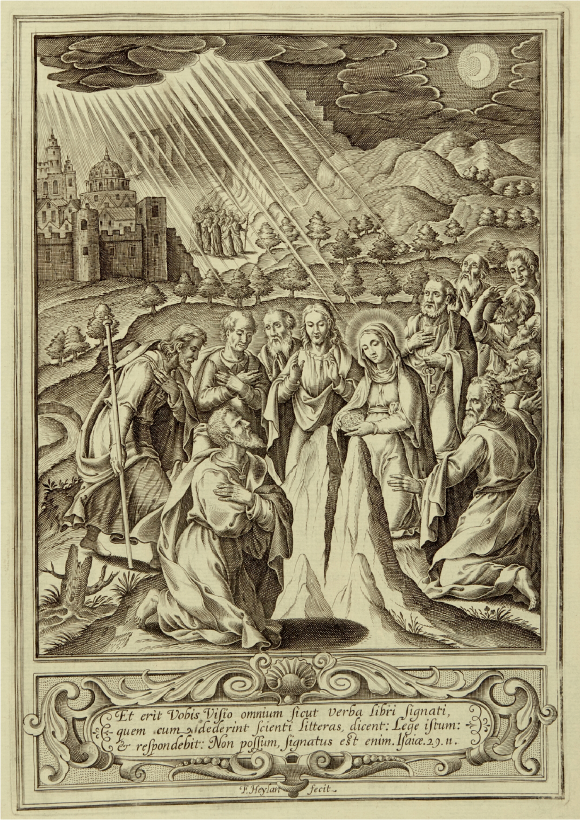
The questions deal with (1) the specific qualities of the Essence of the Gospel, (2) more information about it, (3) the end of time, when its secrets will be made known, (4) the reason that Jerusalem is called âRamat al-hamal,â (5) what shall be done with the Essence of the Gospel, (6) how God will support His religion in a corrupt time and will make his Gospel victorious, (7) who are the best of peoples who will do so, (8) who these will be (Priest, Protector, Council), (9) what the Great Council is, and (10) the venue of that Great Council. LPÂ 15 is the first time James is connected to Iberia. Until then he had been mentioned in particular as the master of his two disciples.
The second book in this casket was KitÄb MunÄjÄt al-á¹¢Äliḥa Maryam al-Ê¿Adhra, (The Book of the Intimate Conversations of the Virgin Mary), LP16. This is a record of conversations (munÄjÄt) between Mary and God, recorded by Cecilio ibn al-Riá¸Ä on the authority of James, who tells about a meeting in the house of Mary, 52 days after Jesusâs demise, i.e., at Pentecost. On that occasion Mary tells us about her spiritual journey to the Heavens, during which she âseesâ Paradise and Hell. Mary is told by Gabriel, who accompanies her on her journey, that she is the first woman to have been shown all these things. Mary is again called pure from sin (fol. 5a). She sees a small lamb with a crown on its head, on which a line is written in a brilliant light. The inscription on fol. 6a is written in the same unreadable script found in LP17 and LP18, fol. 14b, consisting of 22 letters, which are said to have a secret value that will be manifest on a day known to God only. Mary goes to Paradise and has a discussion with Gabriel about Adam. Gabriel explains that Adam was separated from God because of his disobedience, âso that he would reach the highest level of faith,â and was put in the terrestrial paradise below the lowest heaven, the White Pearl, called the abode of perdition (fol. 9bâ10a).4 The entire passage deals with Adamâs transgression, described as âintrigue.â5 Adamâs fall, the text tells us, implies loss of the vision of God (ruʾya).6 Those in punishment (in hell) will be withdrawn from his sight.7 Mary meets Adam. He tells her that their meeting had been prophesied by Jesus, her son, the Spirit of God. She is shown the light on Adamâs back, the light of the Blessed one in the TawrÄt (i.e., the NÅ«r MuḥammadÄ«). Gabriel takes Mary to Paradise and Hell. Paradise has eight gates, one more than Hell, the Gate of Repentance, âbecause of the fact that Godâs mercy has overcome his wrath.â Mary sees her son Jesus (fol. 20a) and the (Divine) Throne of God. She asks Jesus to take her to God (fol. 20b). He promises her that she will be a sign for mankind and a witness to the truth of the Gospel, while she will return to earth and then remain there for a while. She sees the Essence of the Gospel as writing on a cupola of light. She asks what it is. God explains that it is the Essence âwhich was brought by Jesus, the Spirit of God, to the world. It preceded in my [Godâs] knowledge that I would make it descend intentionally in order to assist religion and my Holy church after the dissension of the sects concerning itâ (fol. 20b). Then God promises to bring it down upon her. Gabriel tells her to assemble all the apostles in her house on the 52nd day of Jesusâs demise and to tell them about her intimate conversations, then write them down; the meaning of allegories contained in them will become clear only at the End of Time. Thereupon Mary awakes in her house, does what Gabriel asks, and tells the Apostles about it. Cecilio records everything (i.e., the intimate conversations) on lead.
The other casket contained Ḥaqīqat al-Injīl (The Essence of the Gospel). It was called at the time the dumb book (el libro mudo), because most of it proved impossible to decode (LP17).8 It contained the central message of the Lead Books, albeit for the most part in magical script. We will deal with it extensively below.
LP18 and 19 were found together on 11 May 1599.9 LP18, KitÄb MawÄhib ThawÄb ḤaqÄ«qat al-InjÄ«l (The Book of the Gifts of Reward to the Servants of God who believe in the Essence of the Gospel)10 contains eight questions written on the authority of the Virgin Mary by James. The setting of the scene is again Maryâs house, after the descent of the Essence of the Gospel. Mary tells those who are present about the special properties of the Essence of the Gospel, without revealing its mysteries, knowledge of which will be postponed until the Last Days. Thereupon, as in LP15, Peter the Vicar asks Mary eight questions about The Gifts of Reward to the Servants of God who believe in the Essence of the Gospel and the events at the end of time and the punishment of those who will disbelieve. These questions are followed by two further, uncounted ones. They are about (1) the Essence and the rewards for believers (in it) and punishment for disbelievers, (2) the role of the Arabs at the end of days, (3) the Pious priest, (4) the Protector, (5) those whose hearts will be reconciled at the Great Assembly, (6) the translators and their rewards, (7) the interpreter at the Great Assembly, and (8) the blessing of the place where the ashes and books are kept, and the reward for those who will visit it. Thereupon Mary prays, and a hand miraculously writes six lines of Solomonâs seal on the wall. Then James tells us in the first person that he is told to transmit these lines, and Peter asks two further questions to Mary, one about the meaning of the seal and the second about the time when the divulgation of the Essence of the Gospel will be seen, and after. Thereupon a grim picture of this time is given: a reversal of morals, the return of Jesus and the rise of the False Messiah, the sun rising in the West, very much identical to the signs of the Hour in the Islamic eschatological Tradition.
The next book, LP19, KitÄb al-asrÄr al-Ê¿azÄ«ma11 (The Book of the Enormous Secrets) tells us that it was revealed to James during a stay of forty days on the Holy Mountain, recorded by TisÊ¿Å«n ibn Ê¿Aá¹á¹Är. The book contains several talismanic seals and letters, and only a few lines of text.12 This is also, except for a brief reference in LP 13 (fol. 5b), the first Lead Book that mentions Jamesâs stay in Iberia on the Holy Mountain. Jamesâs travels will be narrated in detail only in the last three Lead Books, which appeared in 1606. One of these last three would also include another book entitled KitÄb al-asrÄr al-Ê¿azÄ«ma. We will compare these two books in more detail below.
The years 1597â1600 mark an intense activity in attempts to make transcriptions, translations and interpretations acceptable to the archbishop. Castro had gradually become an ardent defender of the authentic Christian character of the discoveries, and a debate between defenders on the one hand, and the opponents on the other started. Castro used several strategies to have the documents accepted as authentic. The first was to have them translated in such a way that his convictions about their Christian early origins were confirmed. He insisted that such translations be done in Granada itself, under his personal supervision. The second was a non-discursive strategy namely to exploit their symbolic and experiential meaning. He stressed, for example, that so many miracles had accompanied the appearance of the Lead Books and the Parchment that their authenticity could not be denied.13 He invited critics to come to the Sacromonte and inspect the surroundings, the caves, the remains, the ashes, the Parchment and the Lead Books as material objects.
And Castro had his successes. It was to a large extent the archbishop who took the initiative in recruiting possible translators. Factors that determined their suitability in his eyes were their knowledge of Arabic and also their Catholic orthodoxy. The ideal translator would be acceptable to Rome, would possess an excellent knowledge of theology and preferably a favorable attitude towards the doctrine of the Immaculate Conception of Mary. The Dominicans were opponents of the doctrine of the Immaculate Conception, which was thought to be an important doctrine of the Lead Books.14 But some of the translators who were involved by the archbishop and were initially supporters of the authenticity of the Lead Books became opponents later. We will meet those who worked on the original documents in the following pages. During the time of the second and last series of discoveries no mention is made of a committee again.
2 Ignacio de las Casas (1550â1608)
The first translator we must discuss here is a Granadan Morisco Jesuit, Ignacio de las Casas (1550â1608). Casas, summoned to Granada by Castro, worked on LP1 and LP2 from the summer of 1597, when he arrived in Granada, until June 1598, when he left the city. In this period he changed from being a supporter of the Lead Books into an opponent. When Ignacio de las Casas made this known, Castro told him told to leave at once. He was unable to take any transcriptions with him.15 Turning against the Lead Books, Ignacio de las Casas also became very critical about his predecessors.
In a letter dated 1Â July 1600, he wrote about their shortcomings with respect to their knowledge of classical Arabic (they merely knew the colloquial language, he said); they did not master the theological vocabulary, and their Latin was mediocre. He also clearly referred with his critical remarks to Urrea, who had occupied the chair of Arabic, but was according to Casas unable to read the documents well. He also seemed to refer Castillo and Luna.16 Casasâs criticism was of a theological nature: he objected to the doctrinal formula in LP2, which he considers to be Arian (see on this idea also below). From this quotation it appears that Castro did not consider the work of the committee as the final word about the Lead Books, and indeed we know that he continued the search for suitable translators.17 In his letter to the nuncio written in 1600, Casas expressed the view that the Parchment and the Lead Books were to be seen as examples of the Morisco prophetic tradition and evidence of their millenarian ideas.18 The Lead Books, he argued, served to reinforce the Moriscos in their beliefs in the political victory of the Arabs in Spain as well as in the spiritual victory of Islam.
3 Aḥmad b. QÄsim al-ḤajarÄ«/ Diego Bejarano (ca. 1570-after 1640)
The next person who studied the original Parchment and Lead Books in these years was a Morisco, Aḥmad b. QÄsim al-ḤajarÄ«/Diego Bejarano, a native of Hornachos in Extremadura. Diego/ Aḥmad b. QÄsim had been secretly raised as a Muslim in an Arabic-speaking Morisco family in Hornachos. He devoted himself to reading widely in contemporary Spanish learning. Later in life he also studied Arabic with al-Ukayḥil/Alonso del Castillo.19 In 1598 he fled from Spain to Morocco, where he became secretary and Spanish interpreter to Sultan MawlÄy ZaydÄn in Marrakesh. In 1611 he was entrusted with a mission to France of recovering goods stolen from fellow Moriscos who had been forced to leave Spain for Morocco, during the expulsion of the Moriscos on board French ships. He visited France and the Netherlands and returned to Marrakesh in 1613. He left Morocco in 1634 and, after performing the pilgrimage to Mecca, wrote in 1046/1637 in Egypt a travel account called Riḥlat al-shihÄb ilÄ liqÄ al-aḥbÄb (The Journey of the Meteor [his laqab was ShihÄb al-dÄ«n] to Meet his Beloved). In the same year he also composed a summary of thatânow lostâaccount, which he entitled Kitab nÄá¹£ir al-din Ê¿ala ʾl-qawm al-kafirÄ«n (The Supporter of Religion against the Infidels). In it he focused on his polemical encounters with Christians and Jews in Spain, the Netherlands and France. In about 1640 he was living with his family in Tunis and/or Testour, and it seems likely that he died in Tunisia as well.
Al-ḤajarÄ« relates in the first chapter of KitÄb NÄá¹£ir al-DÄ«n that at some moment he became personally acquainted with people close to Archbishop Pedro de Castro, who himself was also interested in learning the Arabic language.20 About his stay in Granada and his first involvement in the Lead Book affair, al-ḤajarÄ« tells us about a priest whom he refers to as Maldonado, probably to be identified as Pedro de Paz Maldonado, secretary to the Cabildo.21 Maldonado had taken Arabic lessons with the aforesaid Muḥammad ibn AbÄ« ʾl-Ê¿Äṣī, the grandson of al-Jabbis. Maldonado discovered that al-ḤajarÄ« knew Arabic and for this reason introduced him to the archbishop, who had the Parchment brought to him in order to study it. Al-ḤajarÄ« worked on the document in Granada in June 1598.22 It took him twenty-one days to complete his translation.23
Al-ḤajarÄ« considers the Parchment and Lead Books to be the literary products of a single group of authors. He describes the Parchment as very old and written in an eastern Arabic hand. His translation, he says, aims to correct the Trinitarian interpretations that had been made so far; he denies the validity of such interpretations, and suggests that the wording of the Arabic text of the Gospel of John deviates from the received Christian tradition. For al-ḤajarÄ«, these were the most important parts of the Parchment, next to the commentary which he claimed to have understood, and he devotes considerable attention to these passages in KitÄb NÄá¹£ir al-DÄ«n. However, he passes over in silence some other elements of the Parchment, such as the five crosses at the top and the Latin passage at the bottom, which contains the story of the priest Patricius.24 He interprets the Trinitarian passage in the Parchment as an erroneous reading of what in fact should be a Unitarian, that is Islamic, interpretation. Al-ḤajarÄ« claims to have understood the commentary better than those before him, and even though he is able to give a decent interpretation, a comparison with the interpretation that the committee delivered in October 1596 shows that his claim, namely that he did a better job than all those before him, cannot be substantiated. He interprets the commentary as predictions of the victory of Islam in both a military and a spiritual sense.
Al-ḤajarÄ« mentions three other Moriscos involved in the interpretation of the Parchment and the Lead Books by name: the faqÄ«h al-Ukayḥil al-AndalusÄ«, i.e., Alonso del Castillo, whom he refers to as an official translator, the faqÄ«h al-Jabbis, the aforesaid Granadan Morisco Lorenzo Hernández (el) Chapiz, and his grandson, Muḥammad ibn AbÄ« ʾl-Ê¿Äṣī. He states that they were not the only ones, but unfortunately he does not mention the names of the others.
It seems likely that al-ḤajarÄ« was aware of the existence of the transcriptions, translations and notes of the committee that we described above. He makes remarks about several expressions in the Parchment, one of which seems to refer to commentaries (escolios, no. 5) made by the committee as a collective, and perhaps by El Chapiz/Jabbis as an individual, namely on the point of the interpretation of al-jÄnÄ« as an active adjective.25 He also refers to discussions that had already occurred before his involvement, for example about the very beginning of the Parchment and the invocation of God, in particular the question of whether the beginning of the prophecy refers to the Trinity or not. Al-ḤajarÄ« reads multabÄ«ba, which he interprets as âthe plain and pure essence which was neither composite nor mixedâ, while the translation produced by the committee reads, along the same lines: Essencia divina lo que la una y gran fee nos enseña. However, the transcription by Castillo (al-Ukayḥil) of the Parchment reads muthallatha (threefold), which confirms that he interpreted the document in a Trinitarian way.26
Al-ḤajarÄ« tells us that the archbishop was very pleased with his work and that a copy of it was sent to Rome. We doubt that this actually happened. As we have seen, Castro promoted a Christian interpretation of the Parchment and the Lead Books, while al-ḤajarÄ« was convinced that the contents agreed with Islamic doctrine. He denies that the text of the Parchment contained Trinitarian formulas.27 How, then, should we understand al-ḤajarÄ«âs involvement in the interpretation of the Lead Books? He was apparently not asked to produce translations of the Lead Books after he had interpreted the Parchment, nor can we say that he produced a better interpretation of the Parchment (especially of the poetic commentary) than the members of the committee had done. Indeed, there is no evidence that al-ḤajarÄ« studied the texts of the Lead Books in Granada with the same intensity with which he studied the Parchment, even though he tells us in the appendix to NÄá¹£ir al-DÄ«n, which contains the complete text of LP18 and parts of another book, to which we will return below, that he had seen some of the books (or rather some leaves) with his own eyes and had read and translated them. When discussing the Lead Books he relies chiefly on the transcriptions made by al-Ukayḥil (Alonso del Castillo), which he found in Tunis in 1637. These transcriptions had been sent there by a man he calls YÅ«suf Qalbu al-AndalusÄ«, whom we can identify as Juan Calvo Navarro, the kingâs scribe, one of the discoverers of the Lead Books, and the notary who drew up such documents as the testament of Alonso de Castillo.28
In conclusion, al-Ḥajarī was not seen as a key figure by the Granadan church authorities, nor does it seem likely that he belonged to the circles of the authors. Al-Ḥajarī himself attached great religious significance to his experiences with the Parchment and the Lead Books. He considered them to be genuine and very old, dating from the time of Jesus and the first Christians. He believed their contents to agree with Islamic ideas about early Christianity, that is, as being witnesses of monotheist ideas and a rejection of the Trinity and the Crucifixion.29 He describes the overwhelming religious experience he had when holding the Parchment and Lead Plates in his own hands. Especially he tells us how his recognition of a difference in the wording of the beginning of the Gospel of John in the Parchment made him realize that Christians were mistaken and not sincere. In fact, he considered the canonical Gospel of John as the basis of their unbelief, that is, their belief in the incarnation. However, as we have discussed elsewhere, he chose to deny the existence of Trinitarian passages, not only in the Parchment but also in some of the Lead Books, such as LP2.30
Figure 9
The Regional Council of 1600 approving the veneration of the relics. Engraving by Francisco Heylan
Reproduced with permission of the Sacromonte Abbey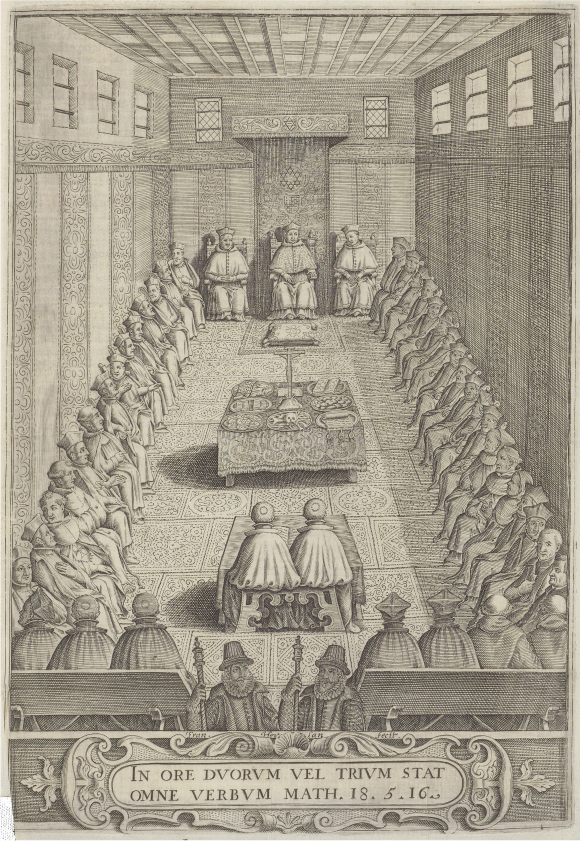
In Morocco, and later in Tunis, he continued to be interested in the Lead Books, as appears in many places in his writings. Perhaps influenced by him, other Moriscos in Tunis such as Ibrahim Taybili read the Lead Books and accused the Christians of misleading interpretations as well.31
While the discussions about the relics, the Parchment and the Lead Books continued, Castro succeeded in taking an important step. In 1600, the relics found in the Turpiana Tower and the caves were discussed in a regional council in Granada convened by the archbishop.32 The council was inaugurated on 16Â April. On Saturday 29Â April 1600, the archbishop pronounced the benediction Ut hanc praesentem synodum during the solemn procession in the Cathedral to the Virgen de la Antigua, patroness of Granada, to celebrate the declaration of cultic and historical dignity of the relics discovered in the Sacromonte and those found in the Torre Turpiana, namely the Parchment, the veil of Mary, and the bone of St. Stephen. All these relics are still preserved in the Granadan cathedral today. The Parchment is kept in the Sacromonte Abbey.33 The said ritual marked the beginning of a veneration of the relics and the initiation of pilgrimages and other festivities that have lasted until this very day.
âLibro de las Sentencias de Nuestra Señora.â Alonso, Los apócrifos, 110; Estepa, Información, fol. 40a. This is LP12 in the numbering of Estepa according to the Astarloa manuscript.
Estepa: âpostrero de diciembre.â
As is shown in MS Stamp Barb V.VI 30, Biblioteca Vaticana. This illustration is also found in Alonso, Apócrifos, 192.
For this: see Coppens, Vision, 158; it is a mystical stage.
This concept is chosen in order to solve the problem of Adamâs transgression in the light of his reaching the highest, mystical stage. See also LP1, about the first sin. This is also a central issue in Sufi commentaries, see Coppens, Vision, 162.
According to the mystics seeing God on earth is possible during an ecstatic experience, but sighting God will only truly be restored after the Day of Reckoning for those in Paradise.
LP14, fol. 16b.
Alonso, Los apócrifos, 111.
Estepa, Información, 46aâb.
âEl Libro de los Dones de los que creyeren la verdad del Evangelio.â
âLibro de misterios grandes que fueron revelados a Santiago.â
Alonso, Los apócrifos, 111, has only one treatise by this name, see also below. We have two, LP19 and LP22, Hagerty (1998, 14), 267â269. The treatise mentioned by Alonso as the one found on 11 May 1599 is our LP19.
ASMG, C 49, Calificación, includes numerous testimonies.
See on Western discussions: Mossman, âWestern Understandings of Islamic Theology in the later Middle Ages. Mendicant responses to Islam from Riccoldo da Monte di Croce to Marquard von Lindau,â Gay-Canton, âLorsque Muhammad Orne Les Autels. Sur lâutilisation de la théologie islamique dans la controverse autour de lâimmaculée conception de la fin du XIVe au début du XVIIIe Siècle,â Ben-Tov, âDer Blick nach Osten. Die Islamische Maria im Konfessionellen Zeitalter.â
On Ignacio de las Casas much has been written. See, for example, BenÃtez Sánchez-Blanco, âDe Pablo a Saulo,â 403â436, id., âMesianismo y milenarismo morisco: Los plomos del Sacromonte en la interpretación del Jesuita Ignacio de las Casas,â Barrios Aguilera, âIgnacio de las Casas y la polémica laminaria en la Historia authéntica de Viana y LaborarÃa. El texto (Documentos del Sacromonte de Granada, I),â Alonso, Apócrifos, 149. Caro Baroja, Las falsificaciones de la historia, 136 and n. 144, mentions a statement by de las Casas to the effect that Castro had offered him money to give a favorable opinion about the Lead Books. Many transcriptions of Lead Books texts by Casas can be found in ASMG and ARCG.
âÃltimamente se advierta que las ynterpretaciones hechas por los yntérpretes que hasta aquà ha avido, aunque ellos saben bien la lengua árabiga bulgar y algo de la que se enseña por arte y medianamente la castellana, y uno dellos medianamente la Latina, como no son Theólogos ni saben los términos de esta facultad, no se an hecho con la la verdad y seguridad devida. Y lo que es más de notar, que del que a leydo la Cátedra en Alcalá desta lengua dixo el Sr Arçobispo que no avÃa sabido leer la letra de los libros, y de otro de los de Granada tenia Su S.a poca satisfacción porque, según Su S.a dezÃa, no sabÃa la gramatica aráviga. Y del otro de la mesma ciudad certificava Su S.a que es tan ynepto que le harán dezir y desdeçir como quisieran y que a solas no es para ynterpretar cosa ninguna, y asà se decÃa deste que aunque es el que sabe más la lengua aráviga y el que sabe la latina, le hacÃan desmenuçar tanto las partes de la sentençia que en presençia del Sr Arçobispo y otros yva interpretando que aunque él deziese algún error o eregÃa que contenÃa la sentencia, le hacÃan con el menudear que la hiciesse correspondiese a la católica,â cited in BenÃtez Sánchez-Blanco, âDe Pablo a Saulo,â 418â419.
According to Coleman, Creating Christian Granada, 198, Castro himself was still restrained in these years. He cites Castroâs letter of 7Â April 1595 to the king: âThis is what has been done up to this point, and with all this I neither affirm nor approve anything, nor do I do more than simply relate the facts. Because there remain so many inquiries to be made.â
BenÃtez Sánchez-Blanco, âMesianismo y Mileniarismo morisco,â 641â642; GarcÃa-Arenal, âUn reconfort pour ceux qui son dans lâattenteâ; Green-Mercado, Visions of Deliverance; Wiegers, âHistory and the Study of Religion.â
MartÃnez Medina, Cristianos y musulmanes, 114, mentions one Diego López [our italics, K-W] Bejarano among the late-sixteenth-century Granadan families and their members who descended from Granadan Mudejars who converted to Christianity out of free will before the forced conversions at the end of the fifteenth century. However, we have been unable to trace this family in the sources or in the secondary literature referred to by the author.
Boyano Guerra and Sánchez GarcÃa, âUna biblioteca en los márgenes. Pedro de Castro aprende árabe.â
This is a correction of our earlier identification of this person as Diego de Maldonado, abbot of Santa Fe, in: KitÄb NÄá¹£ir al-DÄ«n, 88. Unlike him, the person we propose here was very much involved in the Lead Book affair.
Boyano, âAl-ḤajarÄ« y su traducción,â 146, âestante en Granada 3 de junio de 1598.â
KitÄb NÄá¹£ir al-DÄ«n, 102, n. 104.
That he passes over these crosses in silence is interesting, because when discussing a letter written by a monk to Moulay ZaydÄn in chapter twelve, he does mention the cross on top of it as a sign of the Christianâs polytheist beliefs.
See al-ḤajarÄ«, KitÄb NÄá¹£ir al-DÄ«n, Arabic text, 27â31/translation, 91â(Cairo MS, fol. 9aâa).
The said reading is found in the Escorial copy of the Parchment, dated 1588, our P3; the passage from the translation of the committee is found in P6, fol. 146a.
See Harvey and Wiegers, âThe translation from Arabic of the Sacromonte tablets and the Archbishop of Granada.â
ASMG, Legajo 14E. The testament starts with the words: âYo Juan Calvo, Escribano del Rey â¦.â. We will return Calvo Navarro below when we turn to the authorship of the Parchment and Lead Books.
This did not hold true for other Muslim interpreters. The Marquis of Estepa, whose role we will discuss below, mentions in his correspondence with the historian Luis Tribaldos de Toledo that Castro, when he consulted Muslim interpreters, discovered that they considered the Lead Books to be Christian, not Muslim, documents. Estepa considers this as evidence that Castro was correct in defending them as Christian doctrine. Among the Muslims consulted by Castro were persons in the entourage of the Moroccan prince Muley Xeque (Mulay as-Shaykh), who stayed for some time in Spain: see Harvey and Wiegers, âThe Translation from Arabic,â 69. An intriguing story is told by the Jesuit José de Tamayo y Velarde in his account of Muslim Life in âBarbaryâ (in fact, Tetouan) in about 1645. A Muslim interlocutor had told him that archbishop Pedro de Castro had converted to Islam and that the Spanish elite was in reality Muslim: âY esto lo tienen [the inhabitants of Tetouan, K-W] tan creÃdo, que piensan que en España la gente más docta y más exemplar profesan la falsa ley de los moros, y que los que el Tribunal de la Santa Inquisición quema son moros finos. Y esto es en tanto grado que vna persona de autoridad en esta ciudad [Tetouan, K-W] me dixo que entendiese que esto era mucha verdad. Porque el señor don Pedro de Castro y Quiñones arzobispo que fue primero de Granada y después de Seuilla, era moro y auÃa viuido y muerto como tal. Yo, con mucha rissa quanto pedÃa semejante desatino, le pregunté me dixese qué fundamento tenÃa para decir este tan manifiesto engaño. Respondióme que quando el dicho señor arzobispo descubrió el santo monte de Granada halló el Alcorán escrito en lengua arábiga en láminas de metal, y conociendo la verdad se auÃa buelto moro, y que los cuerpos que halló sepultados con aquellas láminas eran cuerpos de moros santos.â See Tamayo y Velarde, Memorias del cautiverio y Costumbres, ritos y gobiernos de BerberÃa según el relato de un jesuita del siglo XVII, 137â138.
See KitÄb NÄá¹£ir al-DÄ«n, n. 110, about the passage on fol. 17a.
See Ibrahim Taybili, MS Bologna D 565 (Túnez-Testour) ed. Norri, Edición y Estudio (with some modifications): âY el dÃa de asora, Alah aça guachala, le dio Gran potestad a su querido profeta Ãulayman alayhi al çalam, [fol. 234a] le hiço merçed de que le obedeçiesen los ayres y nubes y aves y animales y los espritus y Grandes afrites de los chines y demonios, y le dio el sello con que los sujeto y echava aprisionados en la mar y tierra y fue grande Señor y querido de Alah no como los malditos cristianos an dicho. Pues, después de aber escripto sin temor de Dios las mentiras que les pareçio como lo an hecho con otros profetas y queridos de Dios cuando fue servido y quiso descubrirles la berdad, y como an mentido en los libros que se descubrieron en el monte santo de Granada, se an hallado sellados con su sello para su firmeza, y algunos con cuatro y çinco sellos de que se an quedado [fol. 234b atónitos y espantados por aver sido tan antiguos, pues estuvieron debaxo de tierra mil y seisçientos años, y los an dado por buenos y verdaderos, y anssà luego mandaron que en todos los libros que el perro de Villegas avÃa escripto la mentira que le levantaron se quitase y borrasse, y annsà cuando sea llegado el tiempo en que se descubran los demás hierros en questán, se acabarán de desengañar.â Is Villegas Don Francisco Gómez de Villegas y Quevedo? Or Alonso de Villegas, author of Flos Sanctorum (1586)? We thank Gerdien Evertse for drawing our attention to this passage in the Bologna manuscript.
The details of the council, including the names of the delegates, are found in Heredia Barnuevo, MÃstico ramillete, 59â98; see also Alonso, Los apócrifos, 157â159.
MartÃnez Medina, AbadÃa, 270; Heredia Barnuevo, MÃstico ramillete, 81â83, and the detailed declaration on 83â84; MartÃnez Medina, Cristianos y musulmanes en la Granada del XVI, una ciudad intercultural, 125â126.