


1.1 Marriage and Divorce in Judaism and Christianity
1.1.1 Marriage and Divorce in Judaism
The institution of marriage as a permanent spiritual and physical union of a man and a woman appears many times in the Old Testament. We encounter it at the very beginning of the Book of Genesis – in both versions of the creation of the world and of humankind.
And the lord God said, It is not good that the man should be alone; I will make him an help meet for him. And the lord God caused a deep sleep to fall upon Adam, and he slept: and he took one of his ribs, and closed up the flesh instead thereof; And the rib, which the lord God had taken from man, made he a woman, and brought her unto the man. And Adam said, This is now bone of my bones, and flesh of my flesh: she shall be called Woman, because she was taken out of Man. Therefore shall a man leave his father and his mother, and shall cleave unto his wife: and they shall be one flesh.1
So God created man in his own image, in the image of God created he him; male and female created he them. And God blessed them, and God said unto them, Be fruitful, and multiply, and replenish the earth, and subdue it: and have dominion over the fish of the sea, and over the fowl of the air, and over every living thing that moveth upon the earth.2
When a man hath taken a wife, and married her, and it come to pass that she find no favour in his eyes, because he hath found some uncleanness in her: then let him write her a bill of divorcement, and give it in her hand, and send her out of his house.
And when she is departed out of his house, she may go and be another man’s wife.
And if the latter husband hate her, and write her a bill of divorcement, and giveth it in her hand, and sendeth her out of his house; or if the latter husband die, which took her to be his wife;
Her former husband, which sent her away, may not take her again to be his wife, after that she is defiled; for that is abomination before the lord: and thou shalt not cause the land to sin, which the lord thy God giveth thee for an inheritance.6
Thus, divorce takes place on the initiative of the husband who hands his wife a bill of divorce (get). In the course of the centuries, this document took on a very formalised form – deviation from the accepted formulas could render
1.1.2 Marriage and Divorce in Christianity
Jesus went unto the mount of Olives. And early in the morning he came again into the temple, and all the people came unto him; and he sat down, and taught them. And the scribes and Pharisees brought unto him a woman taken in adultery; and when they had set her in the midst, They say unto him, Master, this woman was taken in adultery, in the very act. Now Moses in the law commanded us, that such should be stoned: but what sayest thou? This they said, tempting him, that they might have to accuse him. But Jesus stooped down, and with his finger wrote on the ground, as though he heard them not. So when they continued asking him, he lifted up himself, and said unto them, He that is without sin among you, let him first cast a stone at her. And again he stooped down, and wrote on the ground. And they which heard it, being convicted by their own conscience, went out one by one, beginning at the eldest, even unto the last: and Jesus was left alone, and the woman standing in the
midst. When Jesus had lifted up himself, and saw none but the woman, he said unto her, Woman, where are those thine accusers? hath no man condemned thee? She said, No man, lord. And Jesus said unto her, Neither do I condemn thee: go, and sin no more.10
The Pharisees also came unto him, tempting him, and saying unto him, Is it lawful for a man to put away his wife for every cause? And he answered and said unto them, Have ye not read, that he which made them at the beginning made them male and female, And said, For this cause shall a man leave father and mother, and shall cleave to his wife: and they twain shall be one flesh? Wherefore they are no more twain, but one flesh. What therefore God hath joined together, let not man put asunder. They say unto him, Why did Moses then command to give a writing of divorcement, and to put her away? He saith unto them, Moses because of the hardness of your hearts suffered you to put away your wives: but from the beginning it was not so. And I say unto you, Whosoever shall put away his wife, except it be for fornication, and shall marry another, committeth adultery: and whoso marrieth her which is put away doth commit adultery.11
The foregoing passage, as well as the relevant passages from the Gospels of Mark and Luke, demonstrate that Jesus understood marriage as a permanent union of a man and a woman, and that his view on divorce was negative. Nevertheless, according to Matthew’s account, divorce is permissible in one case – when porneia (πορνεία) takes place. The meaning of this Greek word is still controversial today.12 In the most popular English translations it is rendered as fornication13 or sexual immorality.14 Modern Catholic theologians often link the meaning of the word with an invalid marriage,15 and even if they
And he arose from thence, and cometh into the coasts of Judaea by the farther side of Jordan: and the people resort unto him again; and, as he was wont, he taught them again. And the Pharisees came to him, and asked him, Is it lawful for a man to put away his wife? tempting him. And he answered and said unto them, What did Moses command you? And they said, Moses suffered to write a bill of divorcement, and to put her away. And Jesus answered and said unto them, For the hardness of your heart he wrote you this precept. But from the beginning of the creation God made them male and female. For this cause shall a man leave his father and mother, and cleave to his wife; And they twain shall be one flesh: so then they are no more twain, but one flesh. What therefore God hath joined together, let not man put asunder. And in the house his disciples asked him again of the same matter. And he saith unto them, Whosoever shall put away his wife, and marry another, committeth adultery against her. And if a woman shall put away her husband, and be married to another, she committeth adultery.18
Whosoever putteth away his wife, and marrieth another, committeth adultery: and whosoever marrieth her that is put away from her husband committeth adultery.19
Now concerning the things whereof ye wrote unto me: It is good for a man not to touch a woman. Nevertheless, to avoid fornication, let every man have his own wife, and let every woman have her own husband. Let the husband render unto the wife due benevolence: and likewise also the wife unto the husband. The wife hath not power of her own body, but the husband: and likewise also the husband hath not power of his own body, but the wife. Defraud ye not one the other, except it be with consent for a time, that ye may give yourselves to fasting and prayer; and come together again, that Satan tempt you not for your incontinency. But I speak this by permission, and not of commandment. For I would that all men were even as I myself. But every man hath his proper gift of God, one after this manner, and another after that. I say therefore to the unmarried and widows, It is good for them if they abide even as I. But if they cannot contain, let them marry: for it is better to marry than to burn. And unto the married I command, yet not I, but the lord, Let not the wife depart from her husband: But and if she depart, let her remain unmarried, or be reconciled to her husband: and let not the husband put away his wife. But to the rest speak I, not the lord: If any brother hath
a wife that believeth not, and she be pleased to dwell with him, let him not put her away. And the woman which hath an husband that believeth not, and if he be pleased to dwell with her, let her not leave him. For the unbelieving husband is sanctified by the wife, and the unbelieving wife is sanctified by the husband: else were your children unclean; but now are they holy. But if the unbelieving depart, let him depart. A brother or a sister is not under bondage in such cases: but God hath called us to peace.21
So Paul was in favour of the permanence of the marriage, but he regarded it as a less perfect state than celibacy. In his view, marriage has an essentially egalitarian character: the spouses belong to each other and have reciprocal rights and duties toward each other (in contrast to the patriarchal vision that appears in many passages of the Old Testament). His teaching mentions only one ground for divorce – namely, if a Christian wife or husband persists in paganism and wants to leave his or her believing spouse, this should be allowed (privilegium Paulinum).
Submitting yourselves one to another in the fear of God. Wives, submit yourselves unto your own husbands, as unto the lord. For the husband is the head of the wife, even as Christ is the head of the church: and he is the saviour of the body. Therefore as the church is subject unto Christ, so let the wives be to their own husbands in every thing. Husbands, love your wives, even as Christ also loved the church, and gave himself for it; That he might sanctify and cleanse it with the washing of water by the word, That he might present it to himself a glorious church, not having spot, or wrinkle, or any such thing; but that it should be holy and without blemish. So ought men to love their wives as their own bodies. He that loveth his wife loveth himself. For no man ever yet hated his own flesh; but nourisheth and cherisheth it, even as the lord the church: For we are members of his body, of his flesh, and of his bones. For this cause shall a man leave his father and mother, and shall be joined unto his wife, and they two shall be one flesh. This is a great mystery: but I speak concerning Christ and the church. Nevertheless let every one of you in particular so love his wife even as himself; and the wife see that she reverence her husband.22
∵
The teaching of the Fathers of the Church was generally opposed to divorce. The indissolubility of marriage was advocated by Hermas, Justin Martyr, Clement of Alexandria and Tertullian, among others, who held that Matthew’s clause allows a betrayed husband to dismiss his wife, but does not allow him to enter into another marriage. Thus, it is a basis for separation rather than divorce (it should be noted, however, that they often used legal terms quite freely). The view of Epiphanius of Salamis, who allowed for remarriage after the first one had broken down, should be regarded as rather exceptional. Nevertheless, the laws enacted by Christian emperors (e.g. Constantine, Theodosius and Justinian) allowed divorce and remarriage of divorcees, and bishops of those times generally accepted the existing legal state.24
In the 10th-century Byzantine Empire the Church obtained a monopoly on the registration of marriages. At the same time it was obliged to register divorces. Both were in accordance with the logic of Caesaropapism. Even though both the divorce and the penance that followed it were seen with increasing laxity in the East, even today, despite the fact that second marriages are religious in form, the liturgical setting tends to be much more modest than in the case of a first marriage.25
The unification of church law and the full extension of ecclesiastical jurisdiction over matrimonial matters were only possible after the reform of the Church in the West at the turn of the 11th and 12th centuries, which Harold Berman describes as the first great revolution in the history of the West.27 It was only after this, in the 12th century, that marriage was finally included among the sacraments, which sanctioned its indissoluble character. In the case of infidelity or physical violence, the wronged spouse could only apply to the ecclesiastical court for a declaration of separation. However, even after separation was declared, the marriage bond remained in force and neither of the separated spouses could enter into a new marriage during the lifetime of the separated wife or husband.28
If any one says, that the Church has erred, in that she hath taught, and doth teach, in accordance with the evangelical and apostolical doctrine, that the bond of matrimony cannot be dissolved on account of the adultery of one of the married parties; and that both, or even the innocent one who gave not occasion to the adultery, cannot contract another marriage, during the life-time of the other; and, that he is guilty of adultery, who, having put away the adulteress, shall take another wife, as also she, who, having put away the adulterer, shall take another husband; let him be anathema.29
Such an immutable position of the Catholic Church was connected with the spread of Protestant doctrines. Martin Luther rejected the sacramental character of marriage considering it to be an earthly institution. Consequently, in his opinion, marital conflicts should be examined by state courts, and not by church courts. Luther also allowed divorce – basically in those situations where the Roman Church allowed separation, that is, in cases of adultery, violence and malicious desertion of the spouse. The sacramental character of marriage was also rejected by the other main currents of Protestantism (Calvinism and Anglicanism). In Calvinist communities the approach to the problem of the severability of marriage was similar to Lutheranism (divorce and remarriage of divorcees were allowed). In contrast, the Church of England, until the mid-19th century, approached divorce and separation similarly to the Catholic Church (in principle, it prohibited separated spouses from marrying again).30
1.2 Laicization of Marriage Law in Austria, Prussia and France
In early modern Europe, it was standard for the more affluent social strata to conclude religious marriages. The less wealthy could also get married in church, yet often the representatives of this layer stopped short at simply moving in with each other, which oftentimes was accompanied by different types of secular celebrations and rites. Along with the advancement of the Reformation in Western and Central Europe, two opposing tendencies emerged: while in Protestant countries marriage law was usually shifting toward laicization, in Catholic ones efforts were made to extend the Church monopoly, which previously applied mostly to higher social strata, onto all inhabitants.
1.2.1 Austria
Laicization of marriage law in Habsburg countries was intimately connected with the process of codification of law. For this reason, this topic merits a brief mention here. Codification work began during the reign of Maria Theresa, but it advanced slowly. As regards civil law, it is also worth mentioning the laws on bills of exchange (1763) and on custody (1778). Joseph ii, Maria Theresa’s son and heir, issued in 1783 the Ehepatent, a law that comprehensively regulated personal marriage law. He also enacted a law on intestate inheritance (1786).31
Marriage in itself, considered as a civil contract, as well as the civil rights and obligations arising from this contract and the civil rights and obligations to which it gives rise against each other, receive their essence, force and purpose entirely and solely from the sovereign’s laws; the decision of the disputes arising in this connection therefore belongs to the sovereign’s courts.32
This civil contract could only be made in a religious form, before a Christian clergyman (parish priest, presbyter or pastor).33 As follows from the aforecited § 1, marital matters fell under the exclusive secular jurisdiction. Nevertheless, secular law had been adjusted to religious norms to a certain degree. First of all, divorce was only available to non-Catholic Christians.34 The admissible grounds for unilateral demand for divorce were an attempt against the spouse’s life, adultery, or malicious abandonment.35 Moreover, divorce was admissible
Despite the varying divorce regulations for Catholics and non-Catholics, the provisions of this law were often at odds with religious norms. For example, the Ehepatent accounted for an obstacle to marriage which was not recognized by the canon law, to wit: lack of consent of the parents or legal guardians.37

Das Ehepatent vom 16. Jenner 1783: mit allen hinnach ergangenen dahin gehörigen allerhöchsten Verordnungen, Gratz 1788

Joseph ii’s codification work did not stop at marriage law. In 1786, the emperor sanctioned the civil code named after him. It did not govern all civil law matters, but rather only the provisions concerning:
- 1)acts in general;
- 2)rights of subjects and foreigners;
- 3)relations between spouses;
- 4)relations between parents and children;
- 5)custody and guardianship.38
In respect of the matter of interest to us, the mixed religious-secular model was upheld. It combined the religious weddings with secular jurisdiction in marriage cases. The most significant modifications included expanding the application of codification to include followers of Judaism.39
Leopold ii, the successor of Joseph ii, dissolved the codification commission under the auspices of his predecessor and appointed another one. Karl Anton von Martini became its chairman. The comprehensive draft of the civil code, prepared under his direction, was put into effect by Francis ii, who ruled after Leopold ii. This code was initially only introduced in Galicia by two patents: by virtue of the first one, the emperor implemented it in Western Galicia (areas annexed as part of the Third Partition), and the second one made it effective in Eastern Galicia (areas annexed since the First Partition). In both cases, the law came into force on 1 January 1798.40
The Galician acts maintained a mixed model of marriage law, but the divorce regulations were constructed slightly differently than in the two acts discussed above. For Catholics, divorce was inadmissible.41 Only separation
The mixed model was subsequently employed in the Austrian Civil Code of 1811 (abgb). The exclusively religious form of nuptials was retained.44 Divorce was inadmissible for Catholics.45 The grounds for divorce for other Christians and Jews were regulated separately. For non-Catholic Christians, a kind of double regulation was adopted. A divorce was possible when one of the grounds stipulated by the code was present, provided that it was at the same time the basis for a divorce according to the regulations of a given religion. The abgb listed the following grounds:
- 1)adultery;
- 2)committing a crime;
- 3)malicious abandonment;
- 4)disappearance without news;
- 5)attempts against the life or health of the spouse;
- 6)repeated and severe injuries.
Divorce was also possible at the joint petition of both spouses.46 In the case of Jewish marriages, the abgb adopted the institution of the bill of divorce from the Mosaic Law, which the husband could present to the wife at her consent or unilaterally, if the court found her guilty of adultery.47
1.2.2
The codification process in Prussia was as lengthy as in Austria. Already at the turn of the 1750s, the Corpus Iuris Fridericianum, a draft for the codification of personal and property law was published.48 However, it was only partially implemented, and only in some provinces of the Kingdom of Prussia.49 This code captured marriage in a mixed way. The secular elements included divorce (admissible, among other things, at the joint petition of both spouses and due to adultery).50
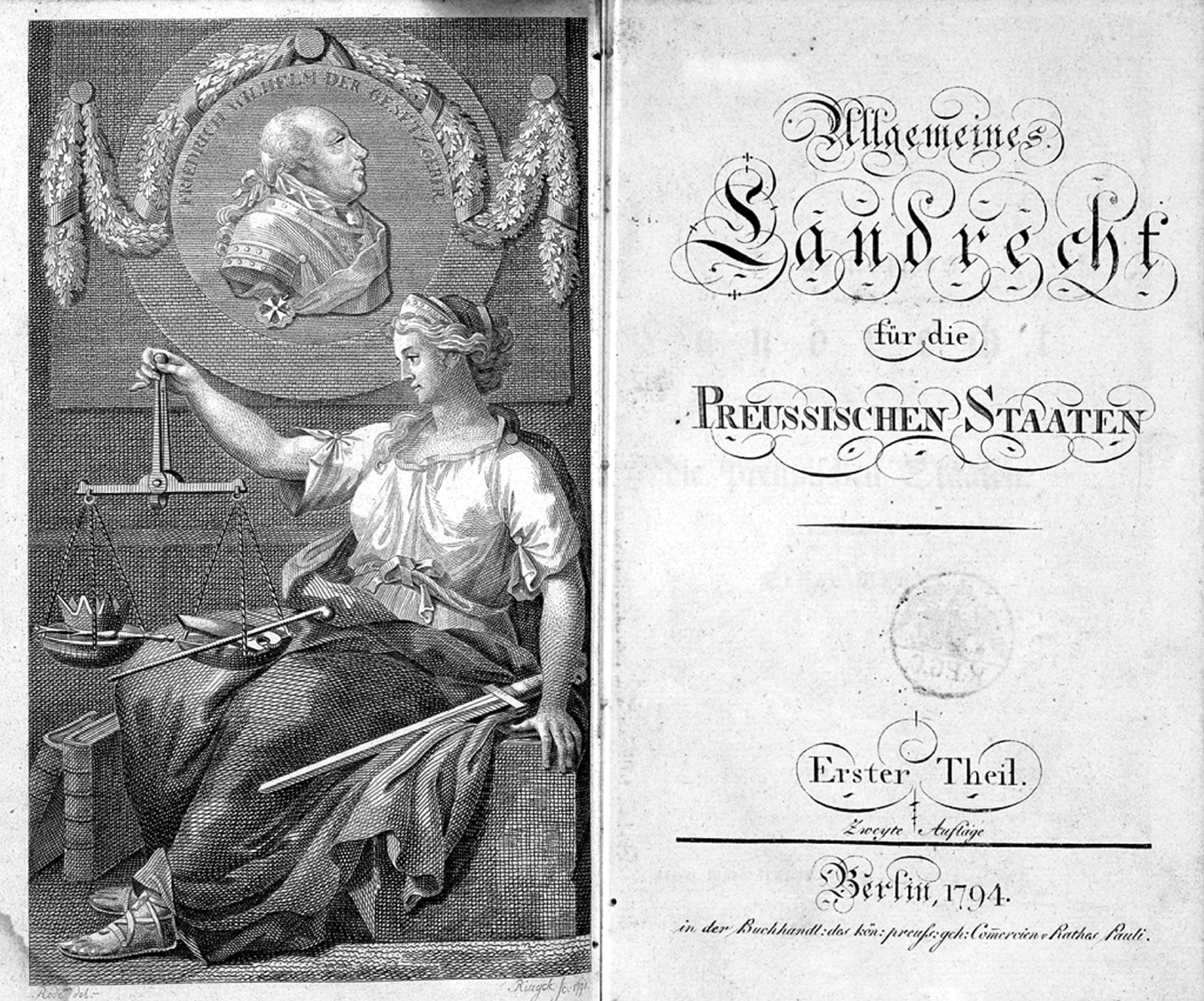
Ultimately, the work of the All-Prussian codification did not come to fruition until the 1890s. On 1 June 1794, the Allgemeines Landrecht für die Königlich Preussischen Staaten came into force. It was, however, subsidiary to the laws of individual provinces, at least formally.51 Marriage was regulated in a dual manner: the religious form of the nuptials was retained, but jurisdiction in matrimonial matters was to be left to the state courts. The provisions concerning divorce were based on models developed during the French Revolution and on Protestant religious norms.52 However, the grounds for divorce were covered in a much more casuistic way than in the decree of 20 September 1792. The Landrecht provided for 11 fundamental categories of divorce premises, of which many included a number of subcategories. These were:
- 1)adultery (p. ii, vol. i, § 670 et seq.);
- 2)malicious abandonment (p. ii, vol. i, § 677 et seq.);
- 3)refusal to perform marital duty (p. ii, vol. i, § 694 et seq.);
- 4)inability to perform marital duty (p. ii, vol. i, § 696 et seq.);
- 5)insanity and fury (p. ii, vol. i, § 698);
- 6)attempt against the life of the spouse (p. ii, vol. i, § 699 et seq.);
- 7)conviction for a harsh and infamous punishment (p. ii, vol. i, § 704 et seq.);
- 8)disorderly conduct: drunkenness, wastefulness, etc.(p. ii, vol. i, § 708 et seq.);
- 9)
the husband’s inability or refusal to maintain the wife (p. ii, vol. i, § 711 et seq.); - 10)husband’s change of the religion confessed (p. ii, vol. i, § 715);
- 11)invincible repugnance (p. ii, vol. i, § 716 et seq.).
While grounds up to and including number 10 only gave the wronged spouse the right to request divorce, the last one, that is invincible repugnance, was in principle a ground for granting divorce upon the joint petition of both parties. Yet there existed an exception to this rule: the judge shall be permitted to separate such an unhappy marriage in special cases where, according to the contents of the records, the repugnance is so strong and deep-rooted that there is no hope left at all for reconciliation and for the attainment of the purposes of marriage (p. ii, vol. i, § 718a). In such situations, the spouse who requested divorce against the will of the other was deemed the guilty party.53
Allgemeines Landrechts für die Preußischen Staaten, Berlin 1794
1.2.3 France
In pre-revolutionary France, state law governing the institution of marriage generally respected the principles of canon law, including the inseverability of the marriage bond.54 Matters concerning matrimonial conflicts were divided between the jurisdiction of the state and ecclesiastical courts. The nuptials, as well as decisions on personal law relations, both between the spouses and between parents and children, were handled by ecclesiastical authorities, although the sacrament had civil law effects.55 Property settlements, in turn, such as those related to invalidation of marriage, fell under the authority of royal courts.56
Already in the era of absolutism, many commentators criticized the marriage law in effect.57 In particular, they condemned the inseparability
a body that deals with its affairs on its own. Instead of the public courts and this army of greedy lawyers, prosecutors, lawyers, whom they drag along, a domestic tribunal, composed of four of the closest relatives, friends or neighbours, chosen as arbitrators by the parties, shall judge the disputes that arise between family members: spouses, children, relatives.63
The new constitutionally elected Legislative Assembly (Assemblée Legislative) was in no hurry to regulate the issue of interest here. As a result, supporters of divorce tried to put pressure on the Legislature. On 1 April 1792, a group of divorce supporters led by Etta Palm d’Aelders turned up in the plenary hall to remind the deputies of the need to regulate the possibility of dissolving marriage.66 At the same time, advocates of divorce sent all types of letters to the Legislative Assembly in order to convince the members of the chamber of the weight of this issue.67 Nevertheless, it was not until the last month of its functioning that the Legislative Assembly began to work on this matter in earnest.
It is time to recognize that the contract between the spouses is a common one; they must undoubtedly enjoy the same rights, and the woman must not be the slave of the man. Marriage can no longer be based on the enslavement of one of the parties. It seems that up to this point, women have not come to the attention of legislators.68
The quoted fragment of the speech reflects well the mood of the time. Work on the divorce law was undertaken in the interest of women. Mathurin Sédillez even called for divorce cases brought by men to be examined by judicial boards
The law of 20 September 1792 abolished separation altogether and replaced it with divorce.73 There were three ways to obtain divorce:
- 1)at the joint petition of both spouses;
- 2)at the petition of one of the spouses due to incompatibility of temperament (incompatibilité d’humeur)74;
- 3)at the petition of one of the spouses for a determined cause.75
These determined causes included:
- –evidence of dementia, insanity or fury of one of spouses;
- –condemnation of one of the spouses to a painful or infamous punishment;
- –condemnation for crimes, abuse or serious injury of one against the other;
- –outrageous conduct;
- –abandonment of the other spouse lasting at least two years;
- –absence of one spouse (without news) for at least five years;
- –emigration.76
Divorce meant the complete breaking of the conjugal knot, and therefore the ex-spouses were allowed to re-marry, but it was necessary to wait a year until concluding another marriage. The sole exception to this rule was made for
The Law of 20 September also contained procedural provisions. Depending on the grounds for divorce, proceedings could take place before the family tribunal (tribunal de famille) or before the family assembly (famille assemblée). It was also possible to obtain divorce by appearing before the public officer in charge of maintaining the civil status records, but only in specific situations, such as condemnation of one of the spouses to an infamous sentence,78 or absence lasting at least five years79 (in these situations, neither conciliation nor evidentiary proceedings took place). We will now take a closer look at the three magistracies to which divorce cases were brought.
The family tribunal consisted of four members (two nominated by each party). The arbitrators could be relatives or, in their absence, friends or neighbours.80 In practice, sometimes friends were appointed to the tribunal, even if there was no shortage of relatives. These “friends” were often professional lawyers.81 Where one of the parties did not want to nominate their arbitrators, they were appointed by a judge of the district tribunal.82 If the arbitrators could not come to an agreement because of tied votes, they chose a fifth arbitrator, whose vote was deciding.83 The judgement of the family tribunal could be appealed to the district tribunal,84 while uncontested verdicts were registered by that tribunal.85 The family tribunal examined divorce cases when evidentiary proceedings were needed. Naturally, they had to be conducted in the case of divorce petitions invoking the following determined causes86:
- 1)dementia, insanity or fury of one of spouses;
- 2)violence, cruelty and slander;
- 3)outrageous conduct;
- 4)abandonment of the other spouse lasting at least two years;
- 5)emigration.
Jean-Baptiste Lesueur, Le Divorce. Musee Carnavalet, Paris

The family assemblies consisted of six or eight members (each party appointed three or four of their relatives or friends).89 In the case of a divorce case, the assembly was convened by a public official (officier public). The family assemblies considered divorce cases initiated by joint petition of the spouses and those that were instigated due to incompatibility of temperament. In the event of divorce at the joint petition of the spouses, the assembly convened only once, not earlier than one month since being appointed by
In the case of a petition motivated by incompatibility of temperament, the procedure was slightly different, if only because the procedure was initiated by one of the spouses and not both. The spouse who requested divorce had to report to a public official, who set the date of the family assembly meeting.96 During the course of the proceedings, both parties nominated three assembly members each, but the absence of the respondent’s representatives did not prevent the proceedings from continuing.97 The purpose of the assembly meeting was, of course, to reconcile the spouses and to get the petitioner to withdraw his or her request for divorce. Three conciliation meetings were necessary (two months had to pass between the first and second, and three months between the second and third). Since the first meeting had to be convened one month in advance, the procedure lasted at least half a year.98 No sooner than a week and no later than half a year after the third meeting, the petitioner was able to apply to the civil registrar for a declaration of divorce with three documents attesting to the lack of reconciliation.99 This procedure was therefore much longer than in the case of a joint petition or a determined cause.
In addition, when neither evidentiary nor conciliation proceedings were needed, a divorce could be obtained without the appointment of a family tribunal or family assembly.101 This was the case when a divorce was requested on the grounds of the absence of the spouse,102 when he or she was sentenced to an infamous punishment, or owing to the fact that separation had been previously adjudicated103 (let us not forget that this institution was abolished by the Law of 20 September 1792). In these cases, the spouse seeking divorce reported directly to the civil registrar, who, on the basis of a convicting sentence, separation judgement or statement of the other spouse’s absence declared the divorce.
Of the five amendments to the Law of 20 September 1792, the first two were liberal in nature, and the three subsequent ones tightened the conditions under which divorce could be pronounced. The directions of the changes were of course in line with the stages of revolution. Under the rule of Robespierre, the intention was to make the French society fully lay and egalitarian, although it should be kept in mind that the Incorruptible was hardly an advocate for
The first amendment [of 8 nivôse of year ii (28 December 1793)] abolished the waiting period for men who wanted to re-marry, while for women it was shortened from one year to 10 months, unless the woman had been abandoned by her husband at least 10 months prior, in which case she did not have to wait. In addition, disputes between divorcees arising after the dissolution of marriage were transferred to the jurisdiction of family tribunals.105
Marriage becomes no more than a matter of mere speculation; one takes a woman as a commodity, calculating the benefits she may bring, and then dissolves the union as soon as she stops being profitable.110
The law of 20 September gave great latitude to divorce, but at least it opposed inconsistency and whims by way of formalities and waiting periods. The laws of 3 nivôse and 4 floréal of Year ii took down even these weak barriers […] How many families have had destruction and misery
brought upon them by these laws! […] Wives […] are seduced, their actual separation is abused; they are encouraged to file for divorce which meets no barriers, no obstacles. This stream of indecency, created by the catastrophic laws, must be stopped at once. Without a doubt, freedom in marriage is needed, but it must also be rid of the liberty to succumb to vices in order to make room for virtue.111
In response to Art. 2 of the Thermidorian amendment, which stipulated the need for a thorough reform of divorce law, a new draft was prepared which severely limited the options for obtaining divorce. Among other things, it abolished divorce on grounds of incompatibility of temperament. It never took effect, however.112 Such was also the fate of the civil code draft proposed by Jean-Jacques Regis de Cambaceres one year later, on 24 prairial of Year iv (13 June 1796). This draft, which naturally also governed divorce matters, was closely modelled on the provisions of the Law of 20 September 1792.113
This motive is put forward solely in order to justify and cover up a host of those that may allow for the dissolution of marriage, such as: adultery, impotence, infertility, stinginess of one of the spouses, who condemns his family to a life of poverty, the profligacy by which one squanders one’s wealth, the wickedness of one who persuades his wife to prostitute herself.114
It is to the advantage of the sex which has lost one of her main charms, […] to the advantage of the sex which sees every day the passing of her beauty, which loses fertility prematurely, which due to her weakness and sacrifice has the right to support and recognition, and to the constancy of her husband. Marriage is inseparable in the interest of children, who must be brought up […] Between man and woman and between their children there exist enduring feelings, moral obligations and interconnections. First are the needs of childhood, which is so prolonged for our species, then the needs of education, and finally of settling down and of mutual help. Just as children belong to the family that brought them into the world, so the family belongs to the children; they are its third essential part because of which it cannot fall apart.115
In discussing the Civil Code, we will examine whether this indissolubility, which has such ancient and profound foundations, is susceptible to a few exceptions, which would not destroy it. It is now clear that there will remain no shortage of determined causes for divorce, so we can easily suspend the ground consisting in the alleged incompatibility; we must therefore put an end to the abuses that result from this ground, which over three years produced more divorces than all of Europe has seen in three centuries.116
A year and a half prior to this, on 9 ventôse of Year iv (28 February 1796) another interesting change of procedural nature had been introduced.119 Divorce cases were transferred to common courts, and family tribunals were abolished as they had not fulfilled the hopes vested in them120: the proceedings conducted before them were neither cheap nor fast.121
Thus, the fundamental parts of the Law of 20 September 1792 remained in effect until the implementation of the Law of 21 March 1803. Although the changes adopted following the Thermidor Coup can hardly be labelled revolutionary, certainly the climate was worsening for divorces, which is attested to by the statistics provided below. One telling piece of evidence of this was Art. 83 of the Directorial Constitution, pursuant to which neither an unmarried man nor a divorcee could become a member of the Council of Elders.122
The more far-reaching changes in divorce regulations were not introduced until the Napoleonic era, when civil law was codified. This was foreshadowed already by the nomination of his four chief editors. Appointed on the 24 thermidor of Year viii (30 August 1800), they were: Francois Denis Tronchet (commission chairman), Jean-Etienne-Marie Portalis, Felix Julien Jean Bigot de
Courts were asked for their opinions on this matter in the course of work on the draft. Their views varied. The Court of Cassation, as well as the tribunals in Paris and Rouen postulated that divorce be maintained, also on grounds of incompatibility of temperament, although they admitted that this path be limited by way of tightening the formalities. Tribunals of Riom and Montpellier called for the complete abolition of divorce. The courts of Toulouse, Agen and Nîmes, on the other hand, demanded that separation be restored in addition to divorce.127
Ultimately, a law was drafted that both maintained the divorce and brought back separation. At the same time, the most controversial ground for divorce–the incompatibility of temperament–was abolished and the possibility of dissolving the marriage at joint petition was severely limited by the introduction of burdensome formalities. Only three grounds for unilateral request for divorce were left in place: adultery (Art. ccxxiii and ccxxiv), condemnation of a spouse to an infamous punishment (Art. ccxxvi), and outrageous conduct, ill-usage and grievous injuries (exces, sévices et injures graves; Art. ccxxv). The Tribunate passed the draft on 28 ventôse of the Year xi (19 March 1803), and two days later it was adopted by the Legislative Body.128 The law was published on 10 germinal (30 March)129 and entered into effect on 26 germinal (16 April).130 At the same time, the Law of 20 September 1792 was repealed.
Marriage does not only concern the contracting spouses; it forms a bond between two families, and it creates a new family within the society, one which can itself become the stem of several other families. A citizen who marries becomes a spouse, he will become a father; thus new relationships are established which the spouses are no longer free to break by their own free will: the question of divorce must therefore be examined with account for the relation between the husband and wife, between parents and their children, as well as between the spouses and the society.131
The issue of divorce should be considered independently of any religious ideas, it should be regulated in such a way as not to oppress anybody’s conscience, not to chain anyone’s freedom; it is unfair to force a citizen whose faith rejects divorce to use this measure; it is no less unfair to refuse it when it is in accordance with the faith of the spouse who seeks it.133
As in the case of illness a doctor is sometimes forced to sacrifice a member in order to save the whole body, the legislators too allow for the possibility of divorce in order to prevent greater misfortune. May we one day–with the help of good institutions–make divorce unnecessary! It is thanks to good law, but also thanks to great testimonies, that we may be able to reform and purify customs: it is not enough to purify the language itself, a sense of morality must be instilled. If the institution of marriage is respected; if the good name of the spouses and their rights are respected; if a reformed public opinion stigmatizes both the seducer and the unfaithful wife, we may no longer need a divorce: but for the time being, let us refrain from rejecting the medicine which, due to the state of our customs, is still too often necessary.135
One year after its adoption, the 1803 law on divorce was incorporated into the Civil Code as Title vi of Book One.136 It required a slight change in the numbering of articles. The editing units containing the individual grounds for divorce were given the following numbers at this time: 229 (wife’s adultery), 230 (husband’s adultery), 231 (violence, abuse and slander), 232 (sentencing a spouse to infamous punishment), 233 (mutual consent) and 310 (previous separation).

1.3
The legal system of the 18th century Polish-Lithuanian Commonwealth differed considerably from the systems of the neighbouring states as far as constitutional law was concerned. The Polish-Lithuanian state was a republic of the nobility, in which parliament played a very important role, while absolutism prevailed in neighbouring states. Polish kings were elected by the nobility. The system of the Polish-Lithuanian Commonwealth at that time bears many similarities to the system of Great Britain under the first Hanoverian monarchs. Both countries had comparable population potential (the Commonwealth before the first partition had a population of about 14 million people – probably a bit more than lived on the British Isles at that time). What distinguished the two countries drastically, however, was the efficiency of governance. Great Britain had an incomparably stronger central government, budget and army than the Commonwealth, which for most of the century was able to field an army of, at most, a dozen thousand professional soldiers or so.
While the constitutional system of the Commonwealth was unique in Europe, the law applied by the Polish courts was not so unique. Marriage in the Commonwealth – as in Prussia, Austria and Russia for most of the 18th century – was regulated primarily by the rules of individual denominations (Catholic, Orthodox, Greek-Catholic, Jewish, Lutheran and Calvinist).138 What distinguished the Polish-Lithuanian state from the neighbouring powers was the relatively high level of religious tolerance and the reluctance (lack of opportunities) of state authorities to interfere in the internal affairs of individual denominations – and marriage was considered such an issue. We do not have precise statistics, but it can be estimated that about half of the population of the Commonwealth before the first partition were Roman Catholics. About 10% of the inhabitants were followers of Judaism. The remaining population (about 40%) belonged mostly to the Greek-Catholic, Orthodox, Lutheran or Calvinist rites. The Commonwealth was heterogeneous not only in terms of religion, but also ethnicity. It is estimated that before the first partition only about half of the population spoke the Polish language at home. The second most spoken language was Ruthenian, which lexically resembled modern Polish more than modern Russian and had many regional variants. The use
The rules regulating the marriage and its dissolution by the followers of the above-mentioned denominations have been presented in Subchapter 1.1. What stands out among the differences is the approach to divorce understood as a dissolution of a validly contracted marriage. This institution was not available to Roman Catholics. However, it was allowed by Lutherans, Calvinists, Jews, Orthodox Christians and even Greek Catholics (Uniates), who recognised the authority of the Holy See.
A certain peculiarity of Polish Catholicism in the 17th and 18th centuries seems to have been the relatively frequent annulment of marriages by church courts, which could constitute a kind of substratum for divorce (especially for the wealthier nobility).140 Clauses concerning annulment were often included in the prenuptial agreements.141 Moreover, the mutual obligation to seek annulment was often protected by financial penalties. Such clauses were sometimes approved by ecclesiastical courts, which ordered the payment of fines.142 Some
The situation in Poland was one of the main reasons for the reform of the canonical procedure in matrimonial cases, carried out by Benedict xiv with the bull Dei miseratione issued in 1741.148 One of its most important provisions
There is a facility with which divorces are here obtained, as well as their frequency […] In any other European country, practices so repugnant to every principle of morals, as well as of policy, would soon be prevented. But in Poland, the restraints of law, as well as the ties of honour and decorum, are exceedingly weakened in their operation.151
The (rather superficial) knowledge of the Polish reality in the West is also evidenced by the fact that during the press debates on the secularization of marriage law, which began in France at the beginning of the revolution, the proponents of divorce invoked its functioning in the Catholic Poland.152
It is also true that there is a scandalous and ungodly ease in dissolving marriages for motives and reasons very different from those provided for by the Sacred Canons; and money often influences these decisions […].
In Warsaw i know a dozen divorced ladies who frequent the society and there are even examples of two divorces of a single person.153
The rules of marriage and dissolution of marriage were dependent on the religious affiliation of the spouses and independent of their estate (the estates of the realm, or three estates: nobility, burghers, peasants). This was not the case of other legal institutions. With regard to private law (obligations, family relations, inheritance and property law) and criminal law, there existed separate legal systems for each estate. For example, the rules of inheritance were different among the nobility, among the burghers and among the peasants. There were also regional particularisms within the legal systems of individual estates (in particular, the legal system of the Grand Duchy of Lithuania154 differed from that of the Kingdom of Poland – within the latter, there were also further regional variants, such as Prussian or Mazovian). The criminal law applicable to the nobility also differed significantly from that applicable to non-privileged classes (burghers and peasants). A nobleman was held criminally liable in an adversarial trial (this procedural model was derived, like the Anglo-Saxon criminal trial, from the medieval accusatorial procedure). Well-born criminals faced mainly financial penalties and, much less frequently, imprisonment. The death penalty was very rarely imposed on them. Representatives of the nobility were generally not subjected to torture. On the other hand, a burgher or peasant suspected of committing a crime was tried under the inquisitorial procedure (during which torture could be used, and the right to defence was very limited). The death penalty was applied much more frequently to representatives of the non-privileged estates than to the nobility. Flogging was also a popular form of punishment. Representatives of each state were subject to the jurisdiction of separate courts. The courts for the nobility, burghers and clergy
The sources of law applied in the courts were mainly custom and parliamentary acts. In Lithuania, a significant part of the institutions of civil law and criminal law were regulated by the Statute of Lithuania of 1588.
∵
For most of the 18th century, the Commonwealth remained in a de facto state of dependency on Russia. Tsarist troops repeatedly encroached on its territory and interfered in its internal affairs, including the election of the king. Russia also stymied attempts at political reform. However, it was not easy for Russia to maintain control over such a large and populous country (over 700,000 square kilometres and around 14,000,000 inhabitants), especially as an increasing part of the nobility looked unfavourably on Russian domination. Representatives of the nobility striving to make the Commonwealth independent from Russia formed the Bar Confederation in 1768. A several-year civil war began between the confederates and the Russian army and regiments loyal to the last king, Stanisław August Poniatowski. Prussia took advantage of the several years of complete destabilisation of the Commonwealth by persuading Russia and Austria – not without difficulty – to cut down the territory of the Commonwealth. Russia agreed to this very reluctantly, because it treated the whole territory of the Polish-Lithuanian state as its protectorate. In turn, Austria was at the time more interested in regaining Silesia than in the Polish lands. The Russians assumed that the occupation of parts of the Polish territory by the neighbouring powers in 1772 was not to be a prelude to the total liquidation of the Commonwealth, but was to give rise to a new, permanent order in the region. Poland was to remain a Russian protectorate. However, subsequent developments led to the territorial annexations of 1772 going down in history as the First Partition of Poland.
The First Partition resulted in the pacification of the Polish-Lithuanian Commonwealth, which again remained a Russian protectorate for several

The rulers of the partitioning powers mutually undertook that none of them would refer to himself or herself as the King or Queen of Poland. In the period lasting just over a decade between the collapse of the Polish state and the beginning of Napoleonic domination in Central Europe, the attitude of individual partitioning powers towards Polish society, its traditions and rights differed. Nevertheless, none of the partitioning powers conducted mass expropriations of landowners during this period. As a result, throughout the 19th century, the land in the former Commonwealth was usually owned by the Polish nobility, who as a rule did not succumb to either Germanisation or Russification tendencies. These tendencies intensified at different times in the individual annexed territories. One of their visible manifestations were changes in the legal system and the judiciary.
At the end of the 18th century, work on the codification of criminal and civil law was at an advanced stage in Prussia and Austria.156 Russia lagged far behind in this aspect. Both in Berlin and in Vienna, the annexation of Polish lands hastened the decisions to give binding force to subsequent drafts of laws.157
In Prussia, including in the annexed Polish territories, the Landrecht became effective on 1 June 1794. As already mentioned, it was formally a subsidiary law, i.e., it was to be applied in case of gaps in the legislation in force in a given province. In accordance with this principle, the old Polish legal order was, largely, to continue functioning. Nevertheless, subsequent provisions of the Prussian king quickly limited the scope of application of Polish laws.
The jurisdiction of ecclesiastical courts was at first upheld in marriage cases. Soon, however, Catholics were allowed to obtain divorce from secular courts.162 The Prussian legislator thus summed up the problem of the contradiction between the holy canons and the Landrecht regulations: It is left to the conscience of Catholics to decide the extent to which they seek dispensations from their clerical authorities in cases admitted by the laws.163
By contrast, in the 18th century there were no major changes in civil law in the Russian partition. Its primary source was still the Statute of Lithuania.
∵
The dissolution of their own state came as a great shock to the Polish nation, and was a personal tragedy for many Poles. Many people involved in the struggle for independence of the Commonwealth, now threatened with repression by the partitioning powers, emigrated to revolutionary France. It was also there that they saw their hope for the rebirth of the Polish state.
These hopes became real after King Frederick William iii of Prussia, after a long period of manoeuvring between Napoleon and his enemies, issued an ultimatum to the French Emperor on 26 September 1806, regarding the withdrawal of French troops from Germany. The fulfilment of this demand was hardly expected, but Berlin government circles apparently did not realise the disproportion of forces. Of course, Napoleon not only did not withdraw his troops from Germany – on the contrary, after concentrating his forces in Bavaria, he crossed the Frankenwald mountain range, after which, on 14 Octoober 1806, in two battles: at Jena and Auerstedt, the French crushed the Prussian army and soon occupied defenceless Berlin.
On 6 November 1806, on Napoleon’s orders, Jan Henryk Dąbrowski and Józef Wybicki arrived in Poznań (the capital of Greater Poland, or Wielkopolska, which remained under Prussian rule). Their aim was to organise an anti-Prussian uprising. The goal was achieved, and the Greater Poland Uprising of 1806 is regarded as one of the few successful Polish uprisings, unlike the many more than ended in defeat. In January 1807, Napoleon appointed a Polish Governing Commission to administer the Polish lands taken from the Prussian king.
The theatre of war moved ever further east. Despite the complete disintegration of the Prussian army, hostilities were prolonged, as the Russians came to Prussia’s support. On 7–8 February 1807, the battle of Eylau (East Prussia) took place, the result of which was inconclusive. It was not until 14 June 1807 that Napoleon defeated the Russians at the Battle of Friedland (also in East Prussia). This prompted the Russians to negotiate peace. Peace treaties were concluded in Tilsit (7 July 1807: France-Russia, and 9 July 1807: France-Prussia).
The Tilsit settlement should be regarded as a compromise. Napoleon counted on cooperation with Russia against England. Despite Prussia’s total defeat, thanks to Alexander’s appearance, the Hohenzollerns retained their crown and rule over a vast state – whose territory, however, was truncated. Prussia relinquished its lands west of the Elbe and most of the lands seized in
The name of the new state had no historical precedent. It was chosen because of the comfort of the courts in St. Petersburg and Vienna, which controlled the remaining Polish territories and feared the rebirth of Polish statehood. Both the name of the new state and its borders (no access to the sea, handing Białystok over to Russia) caused widespread disappointment among Poles. The ruler of Saxony, Frederick Augustus, became the Duke of Warsaw. He was the grandson and great-grandson of two successive Polish kings (Augustus ii the Strong and Augustus iii). Frederick Augustus was appointed to the throne by the Great Sejm in the Constitution of 3 May 1791. At the time, the Elector of Saxony, fearing Russia, took a wait-and-see attitude. During the Franco-Prussian War of 1806, he was initially allied with Prussia, but after the Battle of Jena he switched sides, and on 11 December 1806 concluded the separatist Peace of Poznań with France. When a limited option was adopted at Tilsit for the restoration of Polish statehood as a French satellite in the east, Frederick Augustus proved a good candidate for monarch in Warsaw, as he represented a compromise. He did not arouse the fears of St. Petersburg and Vienna, guaranteeing that the Duchy would retain its character as a subordinate state, not threatening the peace of its neighbours. The consequences would be different if Napoleon’s brother Jérôme, who for several months had been considered a candidate for the Polish monarch, were to be installed on the Warsaw throne.
On 22 July 1807, in the capital of Saxony, Dresden, Napoleon granted the Duchy of Warsaw a constitution. It was modelled on the French constitution of the time. Executive power in the Duchy was vested in the monarch together with the ministers appointed by him. Legislative power was to be vested in a parliament, whose members were chosen in limited elections. Here, too, the monarch had broad powers.
The constitution stipulated that Napoleon’s Civil Code would apply in the Duchy. The Napoleonic Commercial Code and the Code of Civil Procedure were also introduced there. However, the French Penal Code and the Code of Criminal Procedure were not adopted in the Duchy.164
The Duchy of Warsaw after the Peace of Tilsit
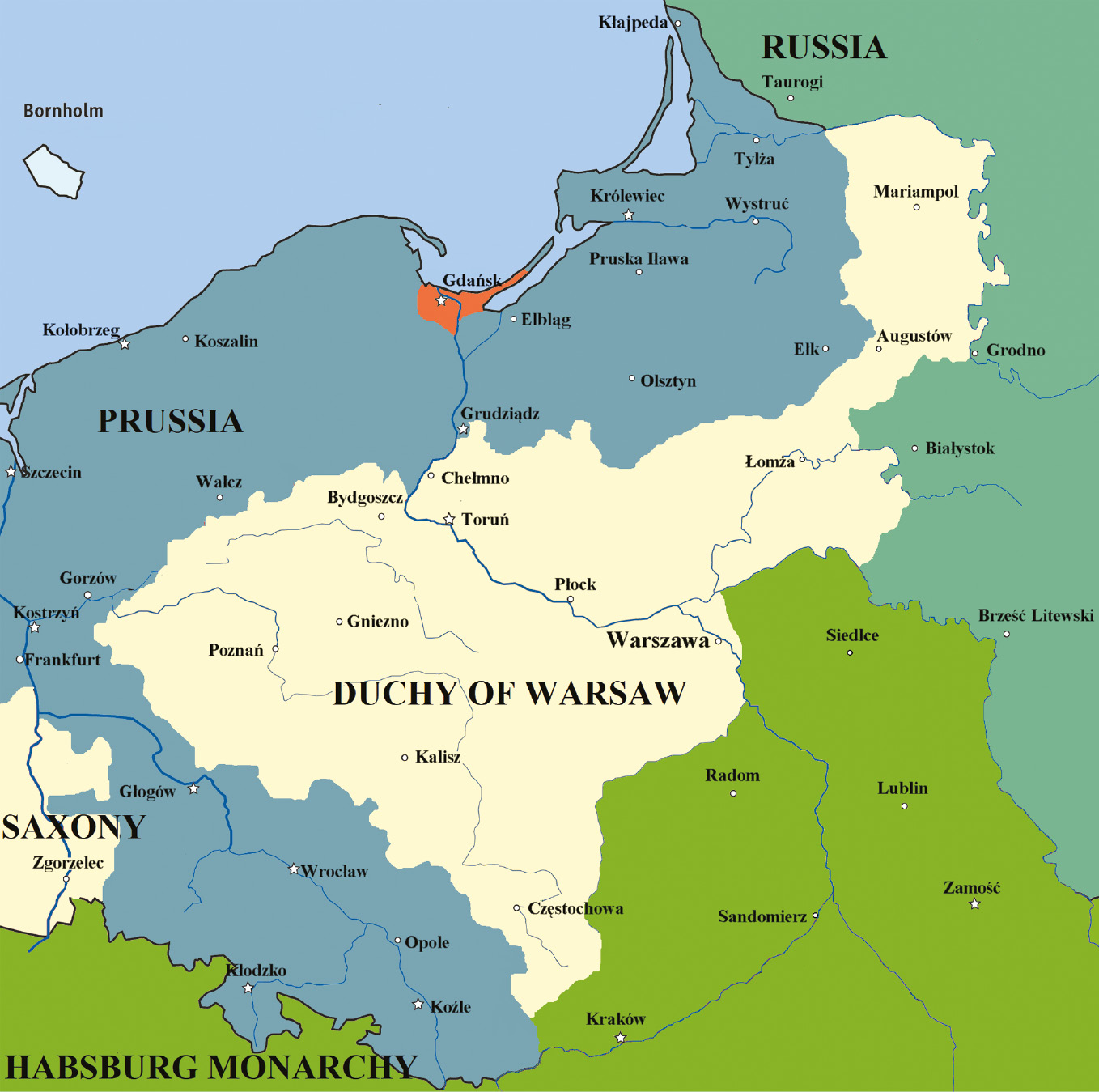
The French involvement in Spain was exploited by the Austrians and in April 1809 they attacked Napoleon’s subordinates: Bavaria, Italy and the Duchy of Warsaw. However, they were not very successful on any of the fronts. The struggle between the main Austrian forces and the main Napoleonic forces, first in Bavaria and then in Austria proper, ended with a decisive victory for the French. By virtue of the peace concluded at Schönbrunn, the lands seized by Austria in the third partition and some of those seized in the first partition
The Duchy of Warsaw after the Schönbrunn Peace Treaty

The division of the Polish lands agreed at Schönbrunn proved to be short-lived. In 1812 Napoleon marched on Russia, accompanied by the hopes of Poles for the restoration of the state within the pre-partition borders. However, these chances were dashed by the defeat of the French, which was the beginning of the end for their emperor. In 1813 the Duchy of Warsaw found itself under Russian occupation. Tsar Alexander decided to incorporate it permanently into his empire. He showed kindness to the Poles, including those who had
The territory of the former Duchy of Warsaw after the Congress of Vienna

Eventually, the Duchy of Warsaw was divided (the Fourth Partition of Poland). More than three quarters of the territory of the Duchy came under the rule of Alexander i. However, this area was not to become an integral part of Russia, but a separate Kingdom of Poland, whose ruler was to be the Tsar at all times. This small state – in contrast to the surrounding partitioning powers – was to be a constitutional monarchy. Because it was created at the Congress of Vienna it is often referred to in the literature as Congress Kingdom (to distinguish it from the Kingdom which existed in the years 1025–1795 and was annihilated during the partitions). Two western departments (Poznań and Bydgoszcz) were annexed back to Prussia. From most of these territories, the
∵
The division of the lands of the former Polish-Lithuanian Commonwealth established at the Congress of Vienna proved to be permanent – in principle it lasted until the First World War. Much less durable were the guarantees of rights that the partitioning powers made to the Polish nation at the congress. The Congress Kingdom maintained a constitutional system modelled on the constitutional charter of Louis xviii until the November Uprising (1830–1831). After the uprising was quashed, Tsar Nicholas i did not restore the constitution, but the Kingdom retained a considerable degree of autonomy. It was not until the second half of the 19th century that the Russian language was introduced into the administration, education and judiciary of the Kingdom. The unification was not complete, however, as a separate private law (with the Napoleonic Code) was maintained in the Kingdom. The Free City of Kraków was incorporated into Austria in 1846. Even earlier, Prussia withdrew from concessions in favour of the Polish language in the Grand Duchy of Posen (Poznań).166
1.4 Abrogation of the Napoleonic Family Law in the Polish Territories
The Catholic clergy criticized the regulations of interest to us throughout the entire time they remained in effect.167 An amendment of Code civil was also pondered a number of times. Nevertheless, as long as the Duchy of Warsaw was under the protectorate of Napoleon, any attempts to modify the civil law were unthinkable due to the Emperor’s attitude toward his eponymous code.
The frequent divorces in our country, by way of weakening familial ties, affect the upbringing of children and the fate of the future generations. They will be prevented, until new laws can be introduced, by way
of removing the officials without whom divorce judgements have no validity.174
Nevertheless, in the constitutional Kingdom of Poland, the clergy was only partially successful in 1825, when Book i of the Civil Code of the Polish Kingdom was adopted.175 The divorce of Catholics was banned at this time. (It was still possible for Protestants, Orthodox Christians and followers of Judaism). Marriage cases were left in the jurisdiction of state courts, which was a thorn in the clergy’s side. At the same time, lay civil status registrars stopped registering any events concerning Christians, and civil status records were combined with church records (Art. 71). As regarded followers of non-Christian religions and Christians whose place of residence does not have a parish, the Government Commission for Religious Denominations will appoint persons in charge of drafting civil register records (Art. 92). Thus, in this new legal order, the activity of lay civil status registrars was significantly reduced. From then on, they were to handle principally the registration of births, marriages and deaths of Jews residing in the individual synagogue districts (although it should be mentioned that frequently they took over this duty from Roman Catholic parish priests).176
Eighteen years after the introduction of secular law, at times inconsistent with the rules of the individual denominations, the state law was adjusted to the principles of all major religions practiced by the residents of the Congress Poland. Yet it should be kept in mind that the institution of divorce, heavily
In 1836, the Catholic authorities could finally celebrate a full triumph. Tsar Nicholas i issued an ukase that restored the exclusively religious system of marriage law in the Kingdom. Much earlier, in 1817, as a result of decisions made at the Congress of Vienna, the Landrecht was re-introduced in the territories “recovered” by Prussia.178 In Kraków and its district, on the other hand, the Napoleonic Code survived until the 1850s, when Franz Joseph issued a patent that replaced the Code civil with abgb.179
∵
The three French codes (civil, commercial and of civil procedure) introduced into the Duchy of Warsaw remained in force in the Congress Kingdom for many decades. The Napoleonic code of civil procedure was replaced by the Russian code of 1864, which was introduced to the Kingdom of Poland in 1876. However, the Napoleonic Code and the Code de commerce of 1807 remained in force on the territory of the former Congress Kingdom even after Poland regained its independence following World War i. In the interwar period, Poland (the Second Republic) was legally divided into 4 main districts. German law applied in the west, Austrian law in the south and Russian law in the east. In the so-called central district (the former Congress Kingdom), the French Civil Code and the Commercial Code were in force alongside Russian laws. In a few dozen villages on the southern borderland, Hungarian law was to some
Throughout this time, the original texts of the codes were formally in force. Of course, translations into Polish were made, but none of them was formally binding. Court records suggest that despite this, the reception of French law was generally successful. This was by no means due to the widespread knowledge of French among judges and attorneys at law. It is likely that translations were simply used, even though they were not of an official nature. In addition to translations into Polish, Latin editions were probably used, especially at the first stage of reception, when that language was known to many Polish lawyers
Jean-Baptiste Mauzaisse, Napoléon Ier couronné par le Temps, écrit le Code Civil. Musee national des chateaux de Malmaison et de Bois-Preau

Gen. 2.18–24.
Gen. 1.27–28.
I. Singer (ed.), The Jewish Encyclopedia: a Descriptive Record of the History, Religion, Literature, and Customs of the Jewish People from the Earliest Times to the Present Day, New York–London 1904, vol. viii, pp. 335–340.
J. Witte, From Sacrament to Contract: Marriage, Religion, and Law in the Western Tradition, Louisville 2012, pp. 31–45.
M. L. Satlow, Jewish Marriage in Antiquity, Princeton and Oxford 2001, pp. 68–89.
Deuteronomy 24.1–4.
B. Schlager, Żydowskie prawo małżeńskie, Kraków 1930; pp. 248–249: It must be written in pure black ink, with a reedpen or goose quill. The bill must be written with the right hand in continuo, with no temporal or spatial interruptions. It may only contain twelve verses with equal spacing, which has been deduced from the numerical meaning of the word “get”. The lines must be drawn with wood or bone, not with paint. The letters cannot touch the lines and there can be no markings above the letters.
B. Schlager, Żydowskie prawo małżeńskie …; J. Goldszmit, Wykład prawa rozwodowego podług ustaw mojżeszowo-talmudycznych z ogólnym poglądem na ich rozwój z uwzględnieniem przepisów obowiązujących, Warszawa 1871.
Such punishment for adultery was provided for in the Mosaic law: Leviticus 20:10; Deuteronomy 22:22–29.
John 8:1–11; Jesus treats similarly the sinful woman in the Gospel of Luke (7:36–50).
Matthew 19:3–9 (author’s emphasis); According to the Gospel of Matthew, Jesus is said to have formulated the same principle during the Sermon on the Mount (Matthew 5:31–32).
H. Crouzel, “Le sens de ‘porneia’ dans les incises matthéennes”, La nouvelle revue théologique vol. 110 (1990), pp. 903–10.
King James Version.
New International Version.
J. Bonsirven, Le divorce dans le Nouveau Testament, Paris 1948.
S. Świaczny, Nierozerwalność małżeństwa a rozwiązanie małżeństwa naturalnego w prawie kanonicznym, Katowice 2004, pp. 72–76; R. Karpiński, “Nierozerwalność małżeństwa w nowym testamencie Mt 5, 32 i 19, 9”, Ruch Biblijny i Liturgiczny, vol. 18/2 (1965) pp. 77–88.
W. Pabiasz, Małżeństwo i etyka seksualna w teologicznej refleksji Marcina Lutra, Częstochowa 1993, pp. 77–81.
Mark 10:1–12.
Luke 16:18.
D. Instone-Brewer, Divorce and Remarriage in the Bible: the Social and Literary Context, Grand Rapids, William B. Eerdmans Publishing Company, 2002, pp. 133–188; M. Pearl, The Bible on Divorce and Remarriage. Pleasantville 2016; S. J. Case, “Divorce and Remarriage in the Teaching of Jesus”, The Biblical World 45, vol. 1, pp. 18–22.
1 Cor, 7:1–15.
Eph, 5:21–33 (author’s emphasis).
J. Witte, From Sacrament to Contract: Marriage, Religion, and Law in the Western Tradition, Louisville 2012, pp. 48–51.
H. Crouzel, L’Église primitive face au divorce: du premier au cinquieme siecle, Paris 1971, p. 359 et seq.; J. Meyendorff, Marriage. An orthodox perspective, New York 2000, pp. 54–57; idem, “Christian marriage in Byzantium: The canonical and liturgical tradition”, Dumbarton Oaks Papers 1990, vol. 44, p. 101; D. G. Hunter, “Historical Theology and the Problem of Divorce and Remarriage Today”, Journal of Moral Theology, 2021; A. Młotek, “Nierozerwalność małżeństwa w nauczaniu Ojców Kościoła”, Colloquium Salutis. Wrocławskie Studia Teologiczne 1978, vol. 10, pp. 184–185; S. Świaczny, Nierozerwalność małżeństwa …, pp. 77–79.
J. Meyendorff, Marriage. An orthodox perspective …, pp. 44–47; idem, Byzantine Theology: Historical Trends and Doctrinal Themes, New York, 1974, pp. 191–200; T. Kałużny, “Nierozerwalność małżeństwa w Kościele prawosławnym”, Sympozjum 2010, no. 14/1, pp. 46–47.
R. Phillips, Putting Asunder: A History of Divorce in Western Society. New York: Cambridge University Press, 1988, pp. 15–30; J. Krajczyński, “Nierozerwalność małżeństwa w doktrynie i ustawodawstwie Kościoła”, Ius Matrimoniale 2004, no. 9(15), pp. 47–86. J. A. McNamara, S. Wemple, Marriage and Divorce in the Frankish Kingdom, [in:] Women in Medieval Society, ed. S. M. Stuard, Philadelphia 1976, pp. 95–124.
H. J. Berman, Law and Revolution. The Formation of the Western Legal Tradition, London 1983.
J. Gaudemet, Le mariage en Occident, Paris 1987, pp. 239–263, idem, Sociétés et Mariage, Strasbourg 1980, pp. 230–289.
The Canons and Decrees of the Sacred and Ecumenical Council of Trent, London 1848, p. 195.
W. Pabiasz, Małżeństwo i etyka seksualna …, pp. 77–84; J. Witte, From Sacrament …, pp. 113–285; L. Stone, Road to Divorce: England 1530–1987, Oxford 1990.
S. Grodziski, Studia galicyjskie: rozprawy i przyczynki do historii ustroju Galicji, Kraków 2007, p. 14.
Ehepatent § 1.
Ehepatent § 29.
Ehepatent § 49.
Ehepatent § 50–51.
Ehepatent § 52.
Ehepatent § 6; A. Dziadzio, “Osobowe prawo małżeńskie w Austrii na tle stosunków państwo – Kościół katolicki (XVIII–XIX w.)”, [in:] Krakowskie Studia z Historii Państwa i Prawa, Kraków 2004, p. 138.
K. Sójka-Zielińska, Wielkie kodyfikacje cywilne, Warszawa 2009, p. 88.
Grounds for divorce were regulated in § 105–107 Gesetze und Verordnungen im Justizfache (Wien 1786, p. 71 et seq.).
K. Sójka-Zielińska, Wielkie kodyfikacje …, pp. 89–93; S. Grodziski, Studia galicyjskie …, pp. 11–16.
§ 102: Bürgerliches Gesetzbuch von Westgalizien, Wien 1796.
Ibid § 103–108.
Ibid § 109.
Civil marriages were introduced on the basis of an act from 1868. J. Pelczar, Prawo małżeńskie katolickie z uwzględnieniem prawa cywilnego obowiązującego w Austryi, w Prusach i w Królestwie Polskiem, Kraków 1898, vol. 2, p. 192; A. Dziadzio, Osobowe prawo małżeńskie …, pp. 139 and 142.
abgb § 111.
abgb § 115.
abgb § 133–135; A. Duncker, Gleichheit und Ungleichheit in der Ehe. Persönliche Stellung von Frau und Mann im Recht der ehelichen Lebensgemeinschaft 1700–1914, Köln–Weimar–Wien, 2003, pp. 137–147; D. Beales, Joseph II, Against the world, 1780–1790, Cambridge 2009, pp. 477–525.
K. Sójka-Zielińska, Wielkie kodyfikacje …, p. 65.
K. Koranyi, Powszechna historia prawa, ed. K. Sójka-Zielińska, Warszawa 1976, p. 269.
Project des Corporis Iuris Fridericiani, Halle 1750, p. 1, Book ii, Title iii, § 35; E. J. Schuster, The History and Present Condition …, p. 231; M. Rheinstein, “Trends in Marriage and Divorce Law of Western Countries”, Law and Contemporary Problems 1953, vol. 18, no. 1, p. 12; P. Schön, Beziehungen zwischen Staat und Kirche auf dem Gebiet des Eherechts, [in:] Festgabe der Götinger Juristen-Fakultät für Ferdinand Regelsberger zum siebzigsten Geburtstage, Leipzig 1901.
K. Sójka-Zielińska, Wielkie kodyfikacje …, p. 69.
D. Blasius, Ehescheidung in Deutschland 1794–1945. Scheidung und Scheidungsrecht in historischer Perspektive, Gottingen 1987, pp. 28–29; R. Phillips, Untying the knot …, p. 121.
This liberal regulation was implemented at the efforts of Carl Gottlieb Svarez himself. For more about the controversies surrounding the introduction and maintenance of § 718a and 718b: D. Blasius, Ehescheidung in Deutschland …, pp. 27–31; A. Duncker, Gleichheit und Ungleichheit in der Ehe …, pp. 148–159.
Thus, divorce was inadmissible to Protestants as well (R. Phillips, Family breakdown …, p. 4). Lay marriages of non-Catholics were admitted by the 1787 decree (I. Malinowska-Kwiatkowska, “Małżeństwo przed urzędnikiem świeckim w przedrewolucyjnej Francji”, Acta Universitatis Nicolai Copernici. Nauki Humanistyczno-Społeczne. Prawo 1990, fasc. 30 (219), p. 181 et seq.).
J. F. Traer, “The French Family Court”, History 1974, vol. 59, no. 195, p. 211.
Nevertheless, in the 16th century, parliaments also began to accept appeals concerning the validity of the marriage. In the eighteenth century, most of the marital cases were already considered by the royal courts (A. Esmein, Le mariage en droit canonique, Paris 1891, vol. 1, p. 35–36).
I. Malinowska-Kwiatkowska, “Małżeństwo – sakrament czy kontrakt? Ze studiów nad francuską doktryną prawniczą XVII–XVIII w.”, Czasopismo Prawno-Historyczne 1989, vol. 41, fasc. 2, pp. 131–138.
J. F. Traer, The French Family Court …, p. 212.
H. Le Goasguen, Le divorce devant l’opinion, les chambres et les tribunaux, Rennes 1913, pp. 12–13; R. Butterwick, Polska rewolucja a Kościół katolicki: 1788–1792, Kraków 2012, p. 631. Opinions such as this can also be found: The epidemic of divorce, which was already raging during the time of King Stanislaw August, started to expand ever more (I. Adamski, “Krótki rzut oka na dzieje archidiecezji gnieźnieńskiej i poznańskiej od r. 1793” Unitas. Miesięcznik kościelny: pismo duchowieństwa Archidyecezyi Gnieźnieńskiej i Poznańskiej 1909, Y.1, vol. 1 (January/June), fasc. 1/6, p. 44).
Loi du 16–24 aout 1790 sur l’organisation judiciaire francaise, [in:] J. B. Duvergier, Collection complete des lois, décrets, ordonnances, réglements, avis du Conseil d’État, Paris 1824, t. 1, p. 361 et seq., Title x, Art. 12–16, [in:] J.-B. Duvergier, Collection complete des lois, décrets, ordonnances, réglements, avis du Conseil d’ État, Paris 1824, vol. 1, p. 361 et seq. Discussed in, among others: E. von Bone, “The Roman Family Court (Iudicium Domesticum) and its Historical Development in France and the Netherlands”, Osaka University Law Review 2001, no. 60, pp. 25–44.
J. F. Traer, The French Family Court …, p. 213.
R. Phillips, Family Breakdown …, pp. 17–18.
P. Sagnac, La législation civile de la révolution française (1789–1804), Paris 1898, pp. 305–306: La famille formera un corp réglant lui-meme ses affaires. Au lieu des tribunaux publics et de cette armée avide d’hommes de loi, procureurs, avocats, qu’ils traînent apres eux, un tribunal domestique, composé de quatre des plus proches parents, amis ou voisins, choisis pour arbitres par les parties, jugera les différends qui naîtront entre les membres de la famille: les époux, les enfants, les proches.
D. Dessertine, Divorcer a Lyon, Lyon 1981, p. 58.
J. B. Duvergier, Collection complete décrets, ordonnances, réglemens, avis du Conseil d’État, Paris 1834, vol. 7, p. 152, Art. 8.
D. Dessertine, Divorcer a Lyon …, Lyon 1981, p. 59.
Proces-verbaux de l’Assemblée Nationale, Paris 1792, vol. 6, p. 164 and 227; D. Dessertine, Divorcer a Lyon …, p. 59.
Moniteur 1792, no. 245, p. 578: Il est temps de le reconnaître, le contrat qui lie les époux est commun; ils doivent incontestablement jouir des memes droits, et la femme ne doit point etre l’esclave de l’homme. L’hymen n’admet point l’asservissement d’une seule des parties. Il semble que jusqu’a ce moment les femmes aient échoppé a l’attention des législateurs.
D. Dessertine, Divorcer a Lyon …, p. 65.
Ibid, p. 62.
Loi du 20 septembre 1792. Decret qui determine les causes, le mode et les effets du divorce, [in:] J. B. Duvergier, Collection complete des lois, décrets, ordonnances, réglements, avis du Conseil d’État, Paris 1825, vol. 4, p. 477 et seq.
G. Thibault-Laurent, La premiere introduction du divorce en France sous la Révolution et l’Empire (1792–1816), Clermont-Ferrand 1938, p. 188.
Loi du 20 septembre 1792, Title i, Art. 7.
Loi du 20 septembre 1792, Title ii, Art. 8–14.
Loi du 20 septembre 1792, Title ii, Art. 15–20.
In practice, the wives of emigrants often initiated divorce cases to protect their property and not to oppose the enemies of the revolution, as the authors of this regulation would have wished (J. F. Traer, The French Family Court …, p. 221; D. Dessertine, Divorcer a Lyon …, p. 69).
Loi du 20 septembre 1792, Title iii, Art. 2.
Loi du 20 septembre 1792, Title ii, Art. 16; D. Dessertine, Divorcer a Lyon …, p. 69.
Loi du 20 septembre 1792, Title ii, Art. 17.
Loi sur l’organisation judiciaire …, Title x, Art. 16.
J. F. Traer, The French Family Court …, p. 215–216.
R. Phillips, Family Breakdown …, p. 18.
Loi sur l’organisation judiciaire …, Title x, Art. 13; J. F. Traer, The French family court …,p. 213.
Loi sur l’organisation judiciaire …, Title x, Art. 14.
R. Phillips, Family Breakdown …, pp. 17–18. The district tribunal could modify the judgement when registering it.
Loi du 20 septembre 1792, Title ii, Art. 18.
Loi du 20 septembre 1792, Title iii, Art. 7–8; D. Dessertine, Divorcer a Lyon …, p. 71.
Loi du 20 septembre 1792, Title iv, Art. 9; D. Dessertine, Divorcer a Lyon …, p. 19; D. Dessertine, Divorcer a Lyon …, p. 71.
Loi du 20 septembre 1792, Title ii, Art. 1.
Loi du 20 septembre 1792, Title ii, Art. 2.
Loi du 20 septembre 1792, Title ii, Art. 3.
Loi du 20 septembre 1792, Title ii, Art. 4.
Loi du 20 septembre 1792, Title ii, Art. 5.
Loi du 20 septembre 1792, Title ii, Art. 6.
D. Dessertine, Divorcer a Lyon …, Lyon 1981, p. 68.
R. Phillips, Family Breakdown …, pp. 35–36; Loi du 20 septembre 1792, p. 478, footnote 4.
R. Phillips, Family Breakdown …, p. 36.
D. Dessertine, Divorcer a Lyon …, Lyon 1981, p. 70.
Loi du 20 septembre 1792, Title ii, Art. 14.
R. Phillips, Family Breakdown …, pp. 36–37.
Ibid, p. 18.
Loi du 20 septembre 1792, Title ii, Art. 17.
Loi du 20 septembre 1792, Title ii, Art. 16.
D. Dessertine, Divorcer a Lyon …, Lyon 1981, p. 72.
Collection complete …, vol. 6, p. 359; D. Dessertine, Divorcer a Lyon …, pp. 71–72.
Collection complete …, vol. 7, p.152, Art.; R. Phillips, Family Breakdown …, p. 12.
D. Dessertine, Divorcer a Lyon …, Lyon 1981, p. 72.
Collection complete …, vol. 7, p. 152, Art. 8.
Collection complete …, vol. 8, p. 254, Art. 1.
Moniteur iii, no. 307, p. 291: Le mariage n’est plus en ce moment qu’une affaire de spéculation; on prend une femme comme une marchandise, en calculant le profit don’t elle peut etre, et l’on s’en dirait sitôt qu’elle n’est plus d’aucun avantage.
Moniteur year iii, no. 321, p. 403: La loi du 20 septembre 1792 donna au divorce une latitude illimitée; mais du moins elle opposait a l’inconstance et au caprice des forms et des lenteurs qui laissaient a la raison le temps et la possibilité de reprendre son empire. Les lois des 3 nivôse et 4 floréal de l’an II rompirent ces faibles barrieres […] Dans combien de familles ces lois n’ont-elles pasporté la dissolution et le désespoir! […] On séduit […] femmes: on abuse de leur séparation de fait; on les précipite dans des demandes en divorce, qui ne rencontrent aucun obstacle, aucune difficulté. Vous ne sauriez arreter trop tôt le torrent d’immoralité que rouleut ces lois désastreuses. Il faut, sans doute, qu’on soit libre dans les liens du mariage, mais il faut en bannir la liberté du vice, pour y attacher la liberté de la vertu.
G. Thibault-Laurent, La premiere introduction …, p. 127.
La premiere introduction …, p. 130.
Moniteur year v, no. 120, pp. 479–480: Le motif d’incompatibilité d’humeur, sur lequel l’assemblée législative a fondé la de mande en divorce, n’a été mis en avant que pour couvrir la foule des motifs qui peuvent autoriser la dissolution du mariage, comme la adulteté, l’impuissance, la stérilité, une maladie honteuse; l’avarice d’un époux qui laine mau quer sa famille, la prodigalité qui dissipe son patrimoine, la lâcheté de celui qui livre sa femme a la prostitution.
Moniteur year v, no. 127, p. 508: Il l’est pour l’avantage du sexe qui déja a perdu un de ces principaux attraits, […] pour le sexe qui voit tous les jours sa beauté se faner, que sa fécondité vieillit prematurement, et qui, par sa faiblesse et par ses sacrifices, a des droits a l’appui, a la reconnaissance et a la constance de son époux. Le marriage est indissoluble pour l’avantage des enfants qu’il faut élever […] Il existe, au contraire, entre l’homme et la femme, et leurs enfans, des rapports perpétuels, des sentimens, des moralités, et presque des besoins. Aux besoins de l’enfance, ai prolongée dans notre espece, succedent ceux de l’éducation, ceux d’un établissement, d’un secours mutuel. Comme les enfans sont a la famille qui leur donna le jour, cette famille leur appartient; ils sont des tiers au préjudice de qui elle ne peut etre dissoute.
Moniteur year v, no. 128, p. 511: Lorsque nous discuterons le code civil, nous examinerons si cette indissolubilité, qui a des fondements si antiques et si profonds, est susceptible de quelques exceptions, ce qui ne la détruirait pas. Mais pour le présent, il doit etre certain qu’assez et trop de causes déterminées de divorce resteront encore pour qu’on puisse sans inconvénient suspendre celle qui est tirée de la simple allégation d’incompatibilité; pour qu’on doive arreter l’abus d’un moyen nui, en trois ans, a produit plus de divorces que l’Europe entiere n’en avait vu en trois siecles.
Collection complete …, vol. 10, p. 50.
G. Thibault-Laurent, La premiere introduction …, pp. 142–143.
Collection complete …, vol. 9, p. 61.
D. Dessertine, Divorcer a Lyon …, Lyon 1981, p. 70.
J. F. Traer, The French …, pp. 224–225. Arbitrators demanded reimbursement of travel expenses, and sometimes even remuneration (R. Phillips, Family Breakdown …, p. 19).
L. Duguit, Les constitutions et les principales lois politiques de la France depuis 1789, Paris 1925. p. 90.
J. Bouineau, J. Roux, 200 Ans de Code Civil, adpf-Publications, Paris 2004, pp. 45–53. A. Esmein, L ‘originalité du code civil [in:]; Le Code civil: 1804–1904: Livre du centenaire, Paris, ed. Jean-Louis Halpérin,. 2004, vol. 1, p. 5 et seq.
G. Thibault-Laurent, La premiere introduction …, p. 166.
H. Hayem, Polémiques de presse sur l’institution du divorce (an IX–an XI), Paris 1908, p. 30. Jacques de Maleville went as far as to publish a pamphlet entitled Du divorce et de la separation de corps (Paris 1801).
Although the divorce of Napoleon and Josephine that took place six years later was not conducted under the law of 1803, which was subsequently incorporated into the Civil Code.
G. Thibault-Laurent, La premiere introduction …, pp. 167–168.
Bulletin des lois de la Republique, vol. 231, no. 2524.
D. Dessertine, Divorcer a Lyon …, Lyon 1981, p. 75.
G. Thibault-Laurent, La premiere introduction …, p. 189.
J. B. Treilhard, Exposé des motifs de la loi sur le divorce, par le conseiller d’état Treilhard, [in:] Code civil des Français: suivi de l’exposé des motifs, sur chaque loi, présenté par les orateurs du gouvernement …, Paris 1804, vol. 2, p. 321: Le mariage n’intéresse pas seulement les époux qui contractent; il forme un lien entre deux familles, et il crée dans la société une famille nouvelle qui peut elle-meme devenir la tige de plusieurs autres familles: le citoyen qui se marie devient époux, il deviendra pere; ainsi s’établissent de nouveaux rapports que les époux ne sont plus libres de rompre par leur seule volonté: la question du divorce doit donc etre examinée dans les rapports des époux entre eux, dans leurs rapports avec les enfants, dans leurs rapports avec la société.
Ibid, p. 325.
Ibid, p. 319: La question du divorce doit donc etre discutée, abstraction faite de toute idée religieuse, et elle doit cependant etre décidée de maniere a ne gener aucune conscience, a n’enchaîner aucune liberté; il serait injuste de forcer le citoyen dont la croyance repousse le divorce, a user de ce remede; il ne le serait pas moins d’en refuser l’usage, quand il serait compatible avec la croyance de l’époux qui le sollicite.
Ibid, p. 322–325.
Ibid, p. 340–341: Dans les maux physiques, un artiste habile est forcé quelquefois de sacrifier un membre pour sauver le corps entier: ainsi des législateurs admettent le divorce pour arreter des maux plus grands. Puissions-nous un jour, par de bonnes institutions, en rendre l’usage inutile! C’est par de bonnes lois, mais c’est aussi par de grands exemples que les moeurs publiques se réforment et se purifient: ce n’est pas le langage seul qu’on doit épurer; c’est la morale qu’il faut mettre en action. Que le mariage soit honoré; que le nom et les droits d’époux soient respectés; que l’opinion publique régénérée flétrisse également le séducteur et l’infidele; et nous n’aurons peutetre plus besoin du divorce: mais jusque-la gardons-nous de repousser un remede que l’état actuel de nos moeurs rend encore et trop souvent nécessaire.
A. Sorel, Introduction [in:] Le Code civil: 1804–1904: Livre du centenaire, Paris, ed. Jean-Louis Halpérin, Paris 2004, vol. 1, p. xv et seq.
Loi sur l’abolition du divorce (8–10 mai 1816) [in:] J. B. Duvergier, Collection complete des lois, décrets, ordonnances, réglements, avis du Conseil d’État, Paris 1827, vol. 20, pp. 464–465; G. Thibault-Laurent, La premiere introduction …, p. 196; A. Duncker, Gleichheit und Ungleichheit in der Ehe …, pp. 160–168; J. F. Traer, Marriage and the family in eighteenth-century France, Ithaca–London 1980.
The internal regulations of the individual denominations concerning marriage are addressed in Subchapter 1.1.
C. Kuklo, Demografia Rzeczypospolitej Przedrozbiorowej, Warszawa 2009, pp. 222–223.
E. Bezzubik, “Konflikty małżeńskie w Polsce nowożytnej – na podstawie akt separacji i rozwiązań małżeństw z oficjalatów krakowskiego, poznańskiego i włocławskiego z lat 1597–1697”, Genealogia 17 (2005), pp. 7–74; Catholic peasants, for whom a church annulment was difficult to attain, often resorted to escape (T. Wiślicz, Upodobanie. Małżeństwo i związki nieformalne na wsi polskiej XVII–XVIII wieku, Warszawa 2012, pp. 172–175).
J. I. Kraszewski, Polska w czasie trzech rozbiorów 1772–1799: studya do historyi ducha i obyczaju, vol. 1: 1772–1787, Warszawa 1902, p. 147. T. Czacki, Dzieła …, vol. 2, p. 26, footnote 34: Distorted pre-nuptial transactions became known, in which the possibility of divorce was announced in order to maintain or repeal certain provisions. Yet the recently published research of Anna Penkała does not confirm these practices, at least not in the Kraków Voivodeship (A. Penkała, Panieńskie ochędóstwo: kwestie posagowe i wienne w małżeństwach szlachty województwa krakowskiego w czasach saskich, Kraków 2016; Idem, Przeciw prawu tradycji i obyczajowi. Sprawy procesowe szlacheckich małżeństw w księgach sądów grodzkich z terenu województwa krakowskiego, Kraków 2017).
S. Biskupski, Obrońca węzła w kanonicznym procesie …, pp. 83 and 84, footnote 31: Ingenti cum Pontificii cordis nostri dolore accepimus, istic novas fraudes adinventas, novaque effugia quesita, quibus Apostolicae salutares ordinationes eluderentur. Horret animus referre non solum pacta inter coniuges, matrimonii dissolutionem contendentes, vicissim conventa, ut alter eorum, post latam ab Ecclesiastico Iudice super matrimonii nullitate sententiam, ab eadem appellare audens, ad quandam certam pecuniae summam alteri de ipsa sententia acquiescenti solvendam teneatur, verum etiam ab ecclesiastico iudice, apud quem appellatio instituta fuerit, appellantem ad omnimodam summae huiusmodi solutionem damnari. [It is with great pain to our papal heart that we have learned of the invention of new deceptions and the search for new tricks through which the sacred Apostolic ordinances are being nullified. The Spirit shudders at the mention not only of the contracts between spouses who seek to break up the marriage, by virtue of which, following the judgement of the ecclesiastical judge declaring the marriage null and void, the party who dares to appeal it, is obliged to pay the other one, who agrees with the judgement, a certain sum of money, but also of ordering the appealing [spouse] to full payment of that sum by the ecclesiastical judge.]
I. Kulesza-Woroniecka, Rozwody w rodzinach magnackich w Polsce XVI–XVIII wieku, Poznań – Wrocław 2002, p. 126. For more on instrumental approaches to canonical impediments, see also: M. Liedke, Rodzina magnacka w Wielkim Księstwie Litewskim w XVI–XVIII wieku. Studium demograficzno-społeczne, Białystok 2016, pp. 325–336.
T. Pawluk, Prawo kanoniczne według Kodeksu Jana Pawła II, Olsztyn 1996, vol. 3, p. 175.
I. Kulesza-Woroniecka, Rozwody w rodzinach …, p. 128.
Ibid, p. 127.
T. Pawluk, Prawo kanoniczne …, vol. 3, p. 146.
S. Biskupski, Obrońca węzła w kanonicznym procesie …, pp. 98–99; T. Pawluk, “Reforma kanonicznego procesu małżeńskiego w świetle motu proprio «Causas Matrimoniales»”, Prawo Kanoniczne. Kwartalnik Prawno-Historyczny 1973, no. 16 (3–4), p. 246. To the contrary: J. Jaglarz, “Polska monografia o obrońcy węzła małżeńskiego”, Collectanea Theologica 1938, no. 19 (4), p. 520: If, therefore, the situation of marriage trials was worst off in Poland, the Holy See, according to the established tradition in similar cases, would have established the office of defender of the bond only in Poland and not in the entire world. Leaving aside the dispute as to whether the situation in Poland was the main reason for issuing the bull, or merely one of many, it is worth noting that Benedict xiv sent as many as four documents to the Polish Episcopate concerning the abuse of canonical matrimonial trials (W. Wenz, P. Wróblewski, Urząd obrońcy węzła i procesowe decyzje sędziego na etapie wyrokowania: zagadnienia wybrane z procesu o nieważność małżeństwa, Wrocław 2007, p. 24, footnote 22). Cf. also: A. S. Krasiński, Prawo kanoniczne krótko zebrane, Wilno 1861, p. 261.
S. Biskupski, Obrońca węzła w kanonicznym procesie …, p. 101. Ibid (pp. 73–84) more quotes attesting to the significant scale of the phenomenon.
T. Czacki, Dzieła …, vol. 2, p. 26, footnote 34. At the same time, he makes the following reservation: if we add the number of divorces processed by the commissions appointed by Rome, whose decrees have not been entered in the relevant records, there certainly have been at least 500 Catholic divorces.
N. W. Wraxall, Memoirs of the Courts Of Berlin, Dresden, Warsaw and Vienna in the years 1777, 1778, and 1779, London 1806, vol. i, p. 111–112.
H. Le Goasguen, Le divorce devant l’opinion … pp. 12–13; R. Butterwick, Polska rewolucja a Kościół katolicki …, p. 631.
E altresi verissimo che regna una scandalosa ed irreligiosa facilita di scioglere di Matrimoni per motivi, e su delle ragioni ben diverse da quelle, che prescrivono I S[ant] I Canoni; ed il denaro ha spesso influenza in queste Decisioni […] Io conosco in Varsavia una Dozzina di Dame divorziate, che vegono nella Societá, e vi sono esempj di due Divorzj nella med[issim]a Persona. quoted after: L. Wolf, The Vatican and Poland in the age of the partitions: diplomatic and cultural encounters at the Warsaw nunciature, New York 1988, p. 207; It must be pointed out that among the dissenters divorce was by no means a common occurrence. For example: the Uniate Metropolitan of Kiev Jason Junosza Smogorzewski was able to count only 11 divorces among his fellow believers in the years 1733–1783 (T. Czacki, Dzieła, Poznań 1844, vol. 2, p. 26, footnote 34). The same source asserts that divorces were more frequent among Protestants and Jews, but no numbers are given to support this claim.
A.B. Zakrzewski, Wielkie Księstwo Litewskie (XVI-XVIII w.): prawo, ustrój, społeczeństwo, Warszawa 2013.
T. Maciejewski, The history of Polish legal system from the 10th to the 20th century, Warszawa 2016; J. Bardach, Historia państwa i prawa Polski. Do połowy XV wieku, Warszawa 1965, Z. Kaczmarczyk, B. Leśnodorski, Historia państwa i prawa Polski. Od połowy XV wieku do roku 1795, Warszawa 1968; for more on the rules of land court procedures in English, see: Ł. Gołaszewski, “The Procedure at the Noble Courts of the Kingdom of Poland at the Turn of the 16th Century: the Ups and Downs”, Beiträge zur Rechtsgeschichte Österreichs, 10 (2020), pp. 186–193.
Partially discussed in Subchapter 1.2.
U. Augustyniak, History of the Polish-Lithuanian Commonwealth: state – society – culture, Frankfurt am Main 2015; M. Bogucka, The lost world of the “Sarmatians”: custom as the regulator of Polish social life in early modern times, Warszawa 1996; J.K. Fedorowicz, M. Bogucka, and H. Samsonowicz, eds., A Republic of Nobles: Studies in Polish History to 1864 (Cambridge and New York: Cambridge University Press, 1982); J. A. Gierowski, The Polish-Lithuanian Commonwealth in the XVIIIth century: from anarchy to well-organised state, Kraków 1996; J. Lukowski, Disorderly Liberty: the political culture of the Polish- Lithuanian Commonwealth in the eighteenth century; idem, Liberty’s Folly: The Polish–Lithuanian Commonwealth in the Eighteenth Century, 1697–1795, Routledge, 1991; idem, The Partitions of Poland 1772, 1793, 1795, Longman Publishing Group, 1999.
Zbiór Sądowy Powszechny dla Wszystkich Ustanowionych Sędziów w Królestwach Gallicyi y Lodomeryi tudzież Xięstwach Oświęcimskim y Zatorskim Ułożony, y Rozsciągniony, Wiedeń 1783; Ustawa w sprawach małżeństw co do kontraktu cywilnego, y onego wniosków dla wszystkich, którzy chrześcijańską wiarę wyznają na Królestwa także Gallicyi y Lodomeryi rozciągniona y ustanowiona, Wiedeń 1783; Zbiór cywilnego powszechnego prawa. Pierwsza część, Wiedeń 1786; Ustawa powszechna o występkach i ich karaniu, Wiedeń 1789; Powszechne kryminalnego Sądu Roz[po]rządzenie, Wiedeń 1788.
Zbiór ustaw o karach dla Galicji Zachodniej, Wiedeń 1796.
S. Grodziski, S. Salmonowicz, “Ustawa karna zachodniogalicyjska z roku 1796. Zarys dziejów i charakterystyka”, Czasopismo Prawno-Historyczne 1965, v. 17 fasc. 2.
Ustawy cywilne dla Galicji Zachodniej, Wiedeń 1797; Ustawy cywilne dla Galicji Wschodniej, Wiedeń 1797; S. Grodziski, Studia galicyjskie …, p. 15.
Z. Radwański, J. Wąsicki, Wprowadzenie pruskiego prawa krajowego na ziemiach polskich, Czasopismo Prawno-Historyczne 1954, vol. 6, fasc. 1, pp. 199 and 206. In a letter dated 18 March 1808, the Minister of Justice Feliks Łubieński informed the monarch that the Prussian courts often considered divorce cases between Catholics. agad (The Central Archives of Historical Records), Rada Stanu i Rada Ministrów Księstwa Warszawskiego, series 2, vol. 111, fol. 1.
Landrecht, p. 2, vol. 1, Title i (On Marriage), § 11.
A. Klimaszewska, M. Gałędek, “A Controversial Transplant? Debate over the Adaptation of the Napoleonic Code on the Polish Territories in the Early 19th Century”, Journal of Civil Law Studies 11:2 (2018), pp. 269–298; P. Pomianowski, “The Beginning of Secular Divorce in Poland. The Napoleonic Code in the Practice of Polish Courts” in (Wo)Men in Legal History, ed. Sebastiaan Vandenbogaerde et al., Lille 2016, pp. 171–187.
J. Czubaty, The Duchy of Warsaw, 1807–1815: A Napoleonic Outpost in Central Europe, London 2016; Willaume J., Fryderyk August jako Książę Warszawski (1807–1815), Oświęcim 2013; E. Halicz, Geneza Księstwa Warszawskiego, Warszawa 1962.
P. S. Wandycz, The lands of partitioned Poland: 1795–1918, Seattle-London 1996, pp. 43–102.
T. Królasik, Opór kleru wobec wprowadzenia Kodeksu Napoleona, [in:] M. Nocuń, J. Róg, Regnum et religio. Relacje państwo – religia na przestrzeni wieków, Warszawa 2011, pp. 71–83; H. Grynwaser, Kodeks Napoleona w Polsce, [in:] Idem, Kodeks Napoleona w Polsce. Demokracja szlachecka, 1795–1831, Wrocław 1951, p. 139.
Czartoryski Princes Library in Kraków, ref. no. 5236, fol. 10–13.
Czartoryski Princes Library in Kraków, ref. no. 5233, fol. 40–41.
Ibid, fol. 42.
Ibid, fol. 44.
agad, I Rada Stanu Krolestwa Polskiego (1810–1832) [fond: 1/ 184], series 2, vol. 221, p. 1 et seq.
agad, Rada Stanu i Rada Ministrów Księstwa Warszawskiego, series 2, vol. 76, p. 43. In France, allegedly the opposite occurred: some children were baptized without their birth being notified to the civil status registrar (G. Noiriel, “L’identification des citoyens. Naissance de l’état civil républicain”, Geneses. Sciences sociales et histoire 1993, no. 13, pp. 9 and 13).
agad, Rada Stanu i Rada Ministrów Księstwa Warszawskiego, series 2, vol. 76, p. 45.
Prawo cywilne obowiązujące w Królestwie Polskiem, ed. S. Zawadzki, Warszawa 1860, vol. 1, p. 21 et seq. Intertemporal issues were resolved by the Prawo przechodnie do Kodeksu Cywilnego Królstwa Polskiego z 1(13) czerwca 1825 r. [Prawo cywilne obowiązujące w Królestwie Polskiem, ed. S. Zawadzki, Warszawa 1860, vol. 1, p. 274 et seq., Arts. 4 and 5]. Pursuant to this, only those marriages that had been contracted prior to 1 January 1826 in civil form only, could be dissolved based on the rules that had been in force up to this point. Pending cases were to be discontinued. Thus, after 1 January 1826, divorces according to old rules were still theoretically possible in the Kingdom of Poland, but they were likely obtainable only by the select few, as the great majority of people probably had both civil and religious weddings. For this reason, it comes as no surprise that the material covered by my query did not render a single divorce trial governed by the Napoleonic Code after 1 January 1826 in the Kingdom.
For example: P. Sygowski, Żydzi Janowca w latach 1811–1864 w świetle Ksiąg Urzędu Stanu Cywilnego z Archiwum Państwowego w Lublinie i Dokumentów Centralnych Władz Wyznaniowych z Archiwum Głównego Akt Dawnych w Warszawie, [in:] Historia i kultura Żydów Janowca nad Wisłą, Kazimierza Dolnego i Puław. Fenomen kulturowy miasteczka – sztetl. Materiały z sesji naukowej „V Janowieckie Spotkania Historyczne”. Janowiec nad Wisłą, 28 June 2003, ed. F. Jaroszyński, Janowiec 2003, p. 53.
agad, Rada Stanu i Rada Ministrów Księstwa Warszawskiego, series 2, vol. 76, p. 52.
Historia państwa i prawa Polski, vol. 3: Od rozbiorów do uwłaszczenia, ed. J. Bardach, M. Senkowska-Gluck, Warszawa 1981, p. 592.
Imperial patent dated 23 March 1852, [in:] Powszechny Dziennik praw krajowych i rządowych dla kraju koronnego Galicyi i Lodomeryi z Księstwami Oświecimskiém i Zatorskiém, tudzież z Wielkiém Księstwem Krakowskiém (Allgemeines Landes-, Gesetz- und Regierungsblatt für das Kronland Galizien und Lodomerien mit den Herzogthümern Auschwitz und Zator und dem Großherzogthume Krakau), vol. 16, pp. 221–222. Austrian divorce law was implemented in Kraków in 1852, and the rest of abgb in 1855 (Z. Zarzycki, Rozwód w świetle akt …, p. 41, footnote 61).
A. Klimaszewska, “The Reception of the French Commercial Code in Nineteenth-Century Polish Territories: A Hollow Legal Shell” in Modernisation, National Identity and Legal Instrumentalism, ed. M. Gałędek, A. Klimaszewska, Leiden–Boston 2020, vol. i, pp. 143–163; eadem, “About the translations of the French Commercial Code of 1807 into Polish” in Czasopismo Prawno-Historyczne, vol. 72 fasc. 1 (2020), pp. 269–283; P. Pomianowski, “Application Problems of Foreign Language Legal Sources: Reception of the French Law in Poland”, History of Legal Sources: The Changing Structure of Law, eds. Andreja Katančević, Miloš Vukotić, Sebastiaan Vandenbogaerde and Valerio Massimo Minale, Belgrade 2018, pp. 143–151; K. Sójka-Zielińska, Kodeks Napoleona. Historia i współczesność, Warszawa 2008, pp. 195–247.