


The present study examines selected works by Rembrandt with respect to Italian imagery, and concludes with Italiansâ reception of Rembrandt with respect to the Ruffo commission.
Rembrandtâs references to other artistsâ inventions fall loosely into three categories: pragmatic adaptations, critical commentary, and conceptual rivalry. These categories are not mutually exclusive, but provide a strategy for discussion. The focus here is on invention, rather than technique and color. The affinity of Rembrandtâs later paintings to those of Titian has often been noted, with respect to broken brushstrokes, layered paint application, and muted tonalities, most recently by Jonathan Bikker.1 However, Rembrandtâs late paintings are varied in their painterly application, often built-up in pigment, and bespeak Rembrandtâs independence and experimentation.
Rembrandtâs approach to Italian art varied, from resolving a composition by turning to othersâ imagery, seeking alternative presentations of an established theme, and surpassing the achievements of others. Never imitating without commentary, he looked for new solutions for portraying popular subjects. Often taking cues from several images, he sought to convey more vivacity than his sources. He grasped how simple appropriation of a motif could lead to a greater visual power; he referenced exemplary artists, both living and past, in order to demonstrate his superiority; and in the broader arena of competition, he emulated illustrious artists and their works to arrive at his unique formulations.
Chapter 1 surveys the Italian experience for some Dutch artists, and how they benefited by going. The abundance of paper art that recorded Italian art and antiquities in the Netherlands obviated the need for first hand experience, should the expense and dangers of travel be unappealing. Some Italian paintings of stunning quality were in Amsterdam and offered a selection, rather than a survey, of what else lay in store in Italy for the traveler. For Rembrandt, travel clearly was not imperative, and he prowled the art market, viewed paintings in private collections, and amassed an extensive collection.
Chapter 2 discusses how Rembrandtâs Dutch contemporaries regarded his art with respect to Italy, both as the locus of classicism and as a measure of his reputation. According to Jeremias de Decker, Rembrandtâs art was famous in Italy and surpassed that of the Italians; and according to Wybrand de Geest, Rembrandt supplanted Titian. But this wholly positive view was not shared by Joachim von Sandrart, Gerard de Lairesse, Andries Pels and Arnold Houbraken. Rembrandtâs prints and paintings inspired both awe and puzzled derision from Sandrart onward. Rembrandtâs underlying knowledge of Italian art was unrecognized, as his avowed fidelity to observed nature prevailed.
Chapter 3 concerns Rembrandtâs collection and how he used it in his own work. From his own storeroom, Rembrandt was familiar with the full range of canonical imagery, as well as less well known images. He drew after paper art directly in front of him, he varied motifs recalled from memory, and he combined life study with recollections of othersâ art. Occasionally, prints and sculpture substituted for life study.
Chapter 4 discusses pragmatic adaptations, in which Rembrandt appropriated single and paired figures, and overall compositional organization. For the early Supper at Emmaus and Judas, Caravaggioâs Madonna of the Rosary provided a columnar solution for structuring the space (Figs. 67, 72, and 75). For several single and double portraits, Italian precedent provided guidance. In his search for vivacity in portraiture, he turned to Italian models that projected three-dimensionality, action, and forthrightness.
Chapter 5 involves appropriations for commentary, often ironic and laden with meaning. In his earliest reference to Titian, Rembrandt cast him in the role of chief money-changer, as avaricious and without salvation, in his Christ Driving the Money Changers from the Temple of 1626 (Fig. 87). In the Hundred Guilder Print, references to foremost and canonical imagery by Raphael, Michelangelo and Leonardo strengthen Rembrandtâs self-conscious creation of his own master print and enhance its nuanced associations (Fig. 94).
Rembrandt proposed alternatives for some of the grandest themes in art, the nude and the pastoral, as discussed in Chapter 6. In contrast to ubiquitous nudes with smoothed skin, Rembrandtâs bodies are textured and fleshy. In Diana and Actaeon with Callisto and Nymphs, Rembrandt sought novelty in narrative and expressiveness (Fig. 100). Subverting Titianâs pastoral, Rembrandt emphasized the overt erotic nature of the lovers in his etching Flute Player and Flower Girl (Fig. 105). For his late Bathsheba Holding Davidâs Letter, Rembrandt turned to an antique relief of Psyche, making formal and thematic parallels between the two women, both involved in tragically exploitative amorous situations (Figs. 119, 120). The prompts for Rembrandtâs nudes involved thematic kinship which fostered his commentary.
Finally, Chapter 7 discusses how Italian artists regarded Rembrandt, by reputation and from his works available in Italy. Don Antonio Ruffo acquired three Rembrandts, and requested companion paintings from Guercino, Mattia Preti, Salvator Rosa and Giacinto Brandi. These artists approached this explicit competition with attitudes ranging from agreeableness to resentment.
The Italian tradition did not shape Rembrandtâs aesthetic, but it contributed to his imagination and invention. Motivated primarily by claiming fidelity to the observed world, Rembrandt plundered art as he found it useful and worth his own commentary. By tracing the contribution of the Italian tradition to his art, we may further contextualize Rembrandt within the general development of European art.
Rhetoric provides the background and general parallel for the visual arts, as the artist may be substituted for the orator in service of persuasion, whether visual or verbal. The literature of art from Karel van Mander, Franciscus Junius, Philips Angel and Samuel van Hoogstraten supports the close relationship between rhetoric and the visual arts. The framework of rhetoric, as put forth in Julius Caesar Scaliger and as acquired by Rembrandt at Latin school, may be applied to his work.
Several recent studies examine Rembrandtâs art theoretical concerns in depth. Through the lens of Van Hoogstraten, Thijs Weststeijn has elucidated Rembrandt as a teacher, and clarified how pupils learned in the workshop.2 Weststeijn has demonstrated that rhetorical terms may be adapted to carry nuanced meaning in Van Hoogstratenâs treatise, but that persuasion provides an overall framework.3 However many years Rembrandt attended Latin school, he would have been exposed to the basic rules of speech and writing, and these applied to painting.
Eric Jan Sluijter has analyzed how Rembrandtâs purpose and practice of the visual arts related to rhetoric and art theory, with aemulation and competition foremost.4 Sluijter and H. Perry Chapman have demonstrated how Caravaggio provided a model for both behavior and art of the renegade artist, with the âfrom lifeâ ideology.5 Consistently, Rembrandtâs goal in art was to achieve a powerful effect upon the viewer. Rembrandtâs own phrase die meeste ende die naetuereelste beweechgelickheijt sums up his aim to depict intense observation from life and movement both physical and psychological.6 Rembrandtâs concern was to render figural motion and emotion with credibility. Vivid likeness, psychological presence, and immediacy of physical action mark his works to the Night Watch of 1642 (Fig. 17). Introspection, inner conflict, and stillness typify his works from the mid-1640s on. Subtlety and innovation in interpreting historical subjects are constants in his oeuvre. As he sought an expressive communication between image and viewer, his means of doing so varied and developed over the decades. Another constant is his intense rendering of the âmotions of the mind,â the phrase introduced into the art literature by Leonardo da Vinci, and often repeated in the seventeenth century.7

Rembrandt, Self Portrait, 1640, oil/canvas, 91 Ã 75 cm. London, National Gallery

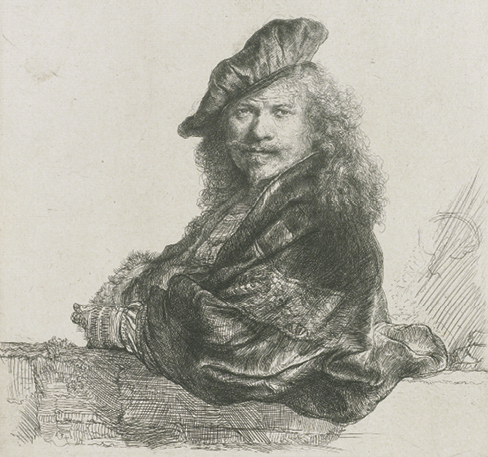
Rembrandt, Self Portrait, 1639, etching with drypoint, 20.6 Ã 16.4 cm. Amsterdam, Rijksmuseum
Raphael, Portrait of Baldassare Castiglione, c. 1515, oil/canvas, 82 Ã 67 cm. Paris, Musee du Louvre
Photo: Scala/Art Resource, NY
Titian, âAriostoâ: Portrait of Gerolamo (?) Barbarigo, c. 1515, oil/canvas, 81.2 Ã 66.3 cm. London, National Gallery

Rembrandt, Saskia as Glycera (Saskia with a Red Flower), 1641, oil/oak, 98.5 à 82.5 cm. Dresden, Gemäldegalerie Alte Meister
Photo: Erich Lessing/Art Resource, NY
Titian, Flora, c. 1515, oil/canvas, 79.7 Ã 63.5 cm. Florence, Uffizi
Photo: Erich Lessing/Art Resource, NY
Rembrandt, Flora, 1654â55, oil/canvas. 100 Ã 91.8 cm. New York, Metropolitan Museum of Art
Creative Commons
Eric Jan Sluijter has termed the immediacy in Rembrandtâs painting of the 1630s oogenblikkige beweeging, and demonstrated how it derives from studio discussion. The phrase is used by Van Hoogstraten, who entered Rembrandtâs workshop in 1642.8 Sluijter proposed that Joost van den Vondelâs own transition from violent Senecan to more introspective Aristotelian theatrical subjects and their staging may have prompted Rembrandtâs shift from extreme action to stillness after 1642.9
Another constant in his work is his interest in and reference to art by others. Artistic training involved the study of canonical ancient sculpture and select Renaissance and contemporary art. Rembrandtâs visual references are broader than those of most artists of his time. His many well-known copies after Mughal miniatures are unique for their quantity, although through trade, art and artifacts from Asia were not difficult to acquire in Amsterdam. Zirka Filipczak has analyzed these copies to demonstrate how the artist studied the static body language and restrained gestures of the originals. He, whether through conscious or implicit memory, adapted the Mughal poses for postures and lack of movement.10 These qualities in his late paintings emphasize the internalized emotions of the figures, whether portraits or history paintings.
As Gerard de Lairesse noted, Rembrandtâs art âis natural and has an eminent strength.â11 Rembrandtâs emphatic naturalism opposed the idealized figures of the academy, whose standards evolved during the century and became formulated by De Lairesse and others. Yet Rembrandtâs canny use of Italian and ancient precedent contributed to the inventive and visual power of his art. The âeminent strengthâ could be discussed by the biographers, who recognized that a portrait âprojected forward and appeared to speak.â12
But, most likely, they might not have noticed if an Italian model contributed to that vivacity or strength. The exceptions would be Rembrandtâs etched 1639 and painted 1640 self portraits, whose pose would have been recognizably indebted to Titianâs âAriostoâ and Raphaelâs Castiglione, and his Saskia as Glycera which responds to Titianâs Flora (Figs. 1-6). Because the âAriosto,â Castiglione, and Flora were in Amsterdam and published in print by Sandrart, they have been considered lynchpins of Rembrandtâs attention to the Italian Renaissance. Similarities have generally been emphasized; but in each case, the differences are more significant, and have been well analyzed by Eddy de Jongh, Stephanie Dickey, and others.13 As direct responses to the âAriostoâ and Castiglione, the etched and painted self portraits are each supremely distinct, with subtle adjustments in pose throughout and commandingly self-assured expressions. The etching shows Rembrandt as alert, taut, and sharp, in contrast to the Italian portraits which exude relaxed confidence and poise. The painted self portrait portrays Rembrandt as confidently appraising the viewer with a superior air. Saskia as Glycera, a direct response to Titianâs own self-contained and discreet Flora, offers an outgoing and immediate appeal to the viewer. The later Flora reprises Titianâs Flora, in gesture and self-contained reverie (Fig. 7). In its planar pose and stillness, this is among Rembrandtâs most serene paintings, and invokes the dignity associated with classical authority.
Rembrandtâs allusions similarly would most likely have eluded his audience, who, if we judge reception by contemporary authors discussed in the second chapter, were most taken with his inimitable and independent manner. Rembrandtâs contemporaries admired the Hundred Guilder Print, recognizing it as the narrative of Christâs healing and salvation, but there is little evidence they noticed the allusions to Raphael, Leonardo, and Michelangelo. And his least altered appropriations are taken from northern artists, as he appropriated from Albrecht Dürer in his 1635 etching Christ Driving the Money Changers from the Temple and repeatedly lifted the angel from Maarten van Heemskerckâs Angel taking Leave from Tobias and his Family (Figs. 92, 93).14 In Peter Paul Rubens and Antony van Dyck, Rembrandt found contemporary international standards against which to measure his own achievements, especially in portraiture and histories in his early career. Identifying emphatically with his northern heritage, Rembrandt exploited southern Mediterranean imagery when it suited him.
Bikker in London/Amsterdam 2014, 75â93.
Weststeijn 2008, passim.
Weststeijn 2008, 20.
Sluijter 2006, 251â65; Sluijter 2015, passim.
Sluijter 2006, 195; Chapman 2015.
Strauss 1639/2.
Van Mander 1604, 112v; Van Hoogstraten 1678, 109. See further Weststeijn 2008, 177.
Sluijter 2015, 50; Van Hoogstraten 1678, 112.
Sluijter 2010, 295.
Filipczak 2007â2008.
De Lairesse/De Vries 2011, 325.
Houbraken/Ford 2007, 87.
De Jongh 1969; Dickey 2004, 103; Dickey 2011.
For Heemskerckâs woodcut in Rembrandtâs art and in his studio, see Golahny 2007.