Limited hydrolysis combined with glycation modification of silkworm pupae (Bombyx mori) proteins: structure-function relationship
In: Journal of Insects as Food and FeedCollege of Food Science, Southwest University, Chongqing 400715, China P.R.
Search for other papers by S.Y. Xie in
Current site
Google Scholar
College of Food Science, Southwest University, Chongqing 400715, China P.R.
Search for other papers by X.L. Wang in
Current site
Google Scholar
College of Food Science, Southwest University, Chongqing 400715, China P.R.
Search for other papers by Y. Zhou in
Current site
Google Scholar
College of Food Science, Southwest University, Chongqing 400715, China P.R.
Search for other papers by L. Ma in
Current site
Google Scholar
Biological Science Research Center, Southwest University, Chongqing, China P.R.
Search for other papers by Y. Hou in
Current site
Google Scholar
Search for other papers by O.P. Soladoye in
Current site
Google Scholar
College of Food Science, Southwest University, Chongqing 400715, China P.R.
Search for other papers by Y.H. Zhang in
Current site
Google Scholar
College of Food Science, Southwest University, Chongqing 400715, China P.R.
Search for other papers by Y. Fu in
Current site
Google Scholar
Abstract
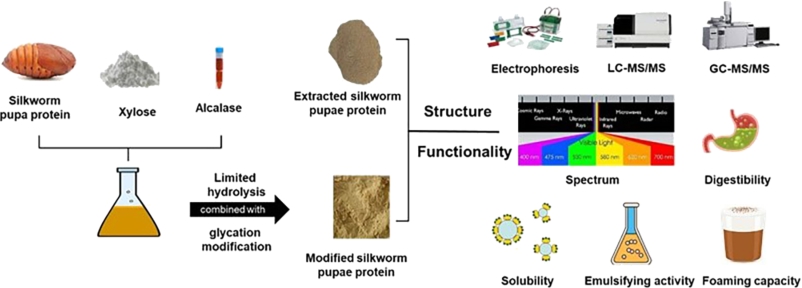
In order to explore the impacts of limited hydrolysis combined with glycation modification on the structure, functional properties, allergenicity, and volatile compounds of silkworm pupae protein, the crude silkworm pupae protein was firstly extracted by alkaline-solution method, followed by Alcalase-treated limited hydrolysis for 10-30 min. Xylose was subsequently added and reacted for 1 h at 95 °C. Afterwards, the structure, functionality, allergenicity, and volatile compounds before and after modification were analysed. The molecular weight of modified silkworm pupae protein was remarkably decreased. The solubility was improved from 4.7 to 28.6%. The foaming ability was elevated by 21%. The in vitro digestibility was elevated by 34.0-44.4%. Furthermore, the abundance of six potential allergic proteins was remarkably reduced. In addition, the contents of off-flavour compounds in modified silkworm pupae proteins substantially decreased. Overall, limited hydrolysis combined with glycation modification can improve the functionality and flavour of silkworm pupae protein, while reduce the allergenicity.

Purchase
Buy instant access (PDF download and unlimited online access):
Institutional Login
Log in with Open Athens, Shibboleth, or your institutional credentials
Personal login
Log in with your brill.com account
-
Altomare, A.A., Baron, G., Aldini, G., Carini, M. and D’Amato, A., 2020. Silkworm pupae as source of high-value edible proteins and of bioactive peptides. Food Science & Nutrition 8: 2652-2661. https://doi.org/10.1002/fsn3.1546
-
Chen, Y., Zhang, H., Zhang, C., Kong, X. and Hua, Y., 2021. Characterization of endogenous endopeptidases and exopeptidases and application for the limited hydrolysis of peanut proteins. Food Chemistry 345: 128764. https://doi.org/10.1016/j.foodchem.2020.128764
-
David-Birman, T., Moshe, H. and Lesmes, U., 2019. Impact of thermal processing on physicochemical properties of silk moth pupae (Bombyx mori) flour and in-vitro gastrointestinal proteolysis in adults and seniors. Food Research International 123: 11-19.
-
De Gier, S. and Verhoeckx, K., 2018. Insect (food) allergy and allergens. Molecular Immunology 100: 82-106. https://doi.org/10.1016/j.molimm.2018.03.015
-
Dominguez, R., Gomez, M., Fonseca, S. and Lorenzo, J.M., 2014. Effect of different cooking methods on lipid oxidation and formation of volatile compounds in foal meat. Meat Science 97: 223-230. https://doi.org/10.1016/j.meatsci.2014.01.023
-
Fu, Y., Bak, K.H., Liu, J., Gobba, C.D., Tostesen, M., Hansen, E.T., Petersen, M.A., Ruiz-Carrascal, J., Bredie, W. and Lametsch, R., 2019. Protein hydrolysates of porcine hemoglobin and blood: peptide characteristics in relation to taste attributes and formation of volatile compounds. Food Research International 121: 28-38. https://doi.org/10.1016/j.foodres.2019.03.017
-
Fu, Y., Zhang, Y., Soladoye, O.P. and Aluko, R.E., 2020. Maillard reaction products derived from food protein-derived peptides: insights into flavor and bioactivity. Critical Reviews in Food Science and Nutrition 60(20): 3429-3442.
-
Hall, F.G., Jones, O.G., O’Haire, M.E. and Liceaga, A.M., 2017. Functional properties of tropical banded cricket (Gryllodes sigillatus) protein hydrolysates. Food Chemistry 224: 414-422. https://doi.org/10.1016/j.foodchem.2016.11.138
-
Han, T., Wang, M., Wang, Y. and Tang, L., 2020. Effects of high-pressure homogenization and ultrasonic treatment on the structure and characteristics of casein. LWT 130: 109560. https://doi.org/10.1016/j.lwt.2020.109560
-
He, W., He, K., Sun, F., Mu, L., Liao, S., Li, Q., Yi, J., Liu, Z. and Wu, X., 2021. Effect of heat, enzymatic hydrolysis and acid-alkali treatment on the allergenicity of silkworm pupae protein extract. Food Chemistry 343: 128461. https://doi.org/10.1016/j.foodchem.2020.128461
-
Hofmann, T. and Schieberle, P., 2000. Formation of aroma-active strecker-aldehydes by a direct oxidative degradation of Amadori compounds. Journal of Agricultural & Food Chemistry 48: 4301-4305. https://doi.org/10.1021/jf000076e
-
Jeong, K.Y., Son, M., Lee, J.Y., Park, K.H., Lee, J.-H. and Park, J.-W., 2016. Allergenic characterization of 27-kDa glycoprotein, a novel heat stable allergen, from the pupae of silkworm, Bombyx mori. Journal of Korean Medical Science 31: 18-24. https://doi.org/10.3346/jkms.2016.31.1.18
-
Karbasi, M., Sánchez-Ferrer, A., Adamcik, J., Askari, G., Madadlou, A. and Mezzenga, R., 2021. Covalent β-lactoglobulin-maltodextrin amyloid fibril conjugate prepared by the Maillard reaction. Food Chemistry 342: 128388. https://doi.org/10.1016/j.foodchem.2020.128388
-
Kim, J.-S. and Lee, Y.-S., 2009. Study of Maillard reaction products derived from aqueous model systems with different peptide chain lengths. Food Chemistry 116: 846-853. https://doi.org/10.1016/j.foodchem.2009.03.033
-
Li, P., Gasmalla, M.A.A., Zhang, W., Liu, J., Bing, R. and Yang, R., 2016. Effects of roasting temperatures and grinding type on the yields of oil and protein obtained by aqueous extraction processing. Journal of Food Engineering 173: 15-24. https://doi.org/10.1016/j.jfoodeng.2015.10.031
-
Li, Z., Zhao, S., Xin, X., Zhang, B., Thomas, A., Charles, A., Lee, K.S., Jin, B.R. and Gui, Z., 2019. Purification and characterization of a novel immunomodulatory hexapeptide from alcalase hydrolysate of ultramicro-pretreated silkworm (Bombyx mori) pupae protein. Journal of Asia-Pacific Entomology 22: 633-637. https://doi.org/10.1016/j.aspen.2019.04.005
-
Lian, Z. and Liu, X., 2018. Extraction and functional properties of four proteins from reeling silkworm pupae (in Chinese). Food Science and Technology 43: 280-285.
-
Liu, J., Ma, Y., Xue, Q., Sun, X., Qian, K. and Li, S., 2019. Status quo and development of comprehensive development and utilization of tussah resource (in Chinese). North Sericulture 3: 1-2.
-
Liu, S., Fang, J., Liu, H., Du, J. and Sun, Z., 2014. Study on functional properties and antioxidant activity of different degree of hydrolysates of silkworm pupa polypeptide. Journal of Food Science and Technology 32(2): 32-38.
-
Liu, Z., Xia, L., Wu, Y., Xia, Q., Chen, J. and Roux, K.H., 2009. Identification and characterization of an arginine kinase as a major allergen from silkworm (Bombyx mori) larvae. International Archives of Allergy and Immunology 150: 8-14. https://doi.org/10.1159/000210375
-
Luo, F., Fu, Y., Ma, L., Dai, H., Wang, H., Chen, H., Zhu, H., Yu, Y., Hou, Y. and Zhang, Y., 2022. Exploration of dipeptidyl peptidase-iv (DPP-IV) inhibitory peptides from silkworm pupae (Bombyx mori) proteins based on in silico and in vitro assessments. Journal of Agricultural and Food Chemistry 70: 3862-3871. https://doi.org/10.1021/acs.jafc.1c08225
-
Ma, S., Li, X., Sun, Y., Mi, R., Li, Y., Wen, Z., Meng, N., Yi, L., Du, X. and Li, S., 2021. Enzymatic hydrolysis of defatted Antheraea pernyi (Lepidoptera: Saturniidae) pupae protein by combined neutral protease yield peptides with antioxidant activity. Journal of Insect Science 21: 1-10. https://doi.org/10.1093/jisesa/ieab013
-
Moon, S.Y. and Li-Chan, E.C.Y., 2007. Changes in aroma characteristics of simulated beef flavour by soy protein isolate assessed by descriptive sensory analysis and gas chromatography. Food Research International 40: 1239-1248. https://doi.org/10.1016/j.foodres.2007.08.003
-
Nishimura, K. and Saeki, H., 2018. Properties of ribose-conjugated chicken myofibrillar protein with the strongest hydroxyl radical scavenging activity prepared using random-centroid optimization. Food Science and Technology Research 24: 1083-1092. https://doi.org/10.3136/fstr.24.1083
-
Niu, M., Chen, J., Li, T., Li, J. and Li, Y., 2019. Evaluation of antioxidant activity of protein products from enzymatic hydrolysis of silkworm pupae by multiple lndicators (in Chinese). Food Research and Development 40: 105-109.
-
Nongonierma, A.B. and FitzGerald, R.J., 2017. Unlocking the biological potential of proteins from edible insects through enzymatic hydrolysis: a review. Innovative Food Science & Emerging Technologies 43: 239-252. https://doi.org/10.1016/j.ifset.2017.08.014
-
Sadat, A., Biswas, T., Cardoso, M.H., Mondal, R., Ghosh, A., Dam, P., Nesa, J., Chakraborty, J., Bhattacharjya, D. and Franco, O.L., 2022. Silkworm pupae as a future food with nutritional and medicinal benefits. Current Opinion in Food Science 44: 100818. https://doi.org/10.1016/j.cofs.2022.100818
-
Schmidt, T.F., Pavinatto, F.J., Caseli, L., Gonzaga, M.L., Soares, S.A., Ricardo, N.M. and Oliveira Jr, O.N., 2009. Interaction of polysaccharide-protein complex from Agaricus blazei with Langmuir and Langmuir-Blodgett films of phospholipids. Journal of Colloid and Interface Science 330: 84-89. https://doi.org/10.1016/j.jcis.2008.10.024
-
Serpen, A. and Gökmen, V., 2009. Evaluation of the Maillard reaction in potato crisps by acrylamide, antioxidant capacity and color. Journal of Food Composition and Analysis 22: 589-595. https://doi.org/10.1016/j.jfca.2008.11.003
-
Sosa, D.A.T. and Fogliano, V., 2017. Potential of insect-derived ingredients for food applications. In: Shields, V.D.C. (ed.) Insect physiology and ecology. IntechOpen, London, UK, pp. 215-231. https://doi.org/10.5772/67318
-
Sun, Y., Hayakawa, S., Puangmanee, S. and Izumori, K., 2006. Chemical properties and antioxidative activity of glycated α-lactalbumin with a rare sugar, D-allose, by Maillard reaction. Food Chemistry 95: 509-517. https://doi.org/10.1016/j.foodchem.2005.01.033
-
Tagliazucchi, D., Helal, A., Verzelloni, E., Bellesia, A. and Conte, A., 2016. Composition and properties of peptides that survive standardised in vitro gastro-pancreatic digestion of bovine milk. International Dairy Journal 61: 196-204. https://doi.org/10.1016/j.idairyj.2016.06.002
-
Turner, J.A., Sivasundaram, L.R., Ottenhof, M.-A., Farhat, I.A., Linforth, R.S. and Taylor, A.J., 2002. Monitoring chemical and physical changes during thermal flavor generation. Journal of Agricultural and Food Chemistry 50: 5406-5411. https://doi.org/10.1021/jf0203803
-
Wen, Q., Li, C., Xu, D., Cai, Q. and Pu, B., 2019. Physicochemical properties of Zanthoxylum armatum seed shell protein and kernel protein (in Chinese). China Oils and Fats 44: 50-55.
-
Wu, X., He, K., Velickovic, T.C. and Liu, Z., 2021. Nutritional, functional, and allergenic properties of silkworm pupae. Food Science & Nutrition 9: 4655-4665. https://doi.org/10.1002/fsn3.2428
-
Xie, S., Zhang, Y., Ma, L., Hou, Y., Dai, H., Zhou, H., Guo, T. and Yu, Y., 2020. Compositions of silkworm pupae oil and protein and potential allergen distribution (in Chinese). China Oils and Fats 45: 31-37.
-
Yhsa, B., Yao, Z., Mfza, B., Jla, B. and Zctab, C., 2020. Glycation of β-lactoglobulin combined by sonication pretreatment reduce its allergenic potential. International Journal of Biological Macromolecules 164: 1527-1535. https://doi.org/10.1016/j.ijbiomac.2020.07.223
-
Zhao, X., Li, L., Kuang, Z., Luo, G. and Li, B., 2015. Proteomic and immunological identification of two new allergens from silkworm (Bombyx mori L.) pupae. Central European Journal of Immunology 40: 30-34.
-
Zhao, Y., Ye, S., Wan, H., Zhang, X. and Sun, M., 2021. Characterization and functional properties of conjugates of rice protein with exopolysaccharides from Arthrobacter ps-5 by Maillard reaction. Food Science & Nutrition 9: 4745-4757. https://doi.org/10.1002/fsn3.2336
-
Zhou, Y., Zhou, S., Duan, H., Wang, J. and Yan, W., 2022. Silkworm pupae: a functional food with health benefits for humans. Foods 11: 1594. https://doi.org/10.3390/foods11111594
| All Time | Past 365 days | Past 30 Days | |
|---|---|---|---|
| Abstract Views | 626 | 113 | 19 |
| Full Text Views | 73 | 20 | 2 |
| PDF Views & Downloads | 104 | 28 | 6 |
Limited hydrolysis combined with glycation modification of silkworm pupae (Bombyx mori) proteins: structure-function relationship
In: Journal of Insects as Food and FeedCollege of Food Science, Southwest University, Chongqing 400715, China P.R.
Search for other papers by S.Y. Xie in
Current site
Google Scholar
PubMed
College of Food Science, Southwest University, Chongqing 400715, China P.R.
Search for other papers by X.L. Wang in
Current site
Google Scholar
PubMed
College of Food Science, Southwest University, Chongqing 400715, China P.R.
Search for other papers by Y. Zhou in
Current site
Google Scholar
PubMed
College of Food Science, Southwest University, Chongqing 400715, China P.R.
Search for other papers by L. Ma in
Current site
Google Scholar
PubMed
Biological Science Research Center, Southwest University, Chongqing, China P.R.
Search for other papers by Y. Hou in
Current site
Google Scholar
PubMed
Search for other papers by O.P. Soladoye in
Current site
Google Scholar
PubMed
College of Food Science, Southwest University, Chongqing 400715, China P.R.
Search for other papers by Y.H. Zhang in
Current site
Google Scholar
PubMed
College of Food Science, Southwest University, Chongqing 400715, China P.R.
Search for other papers by Y. Fu in
Current site
Google Scholar
PubMed
Abstract
In order to explore the impacts of limited hydrolysis combined with glycation modification on the structure, functional properties, allergenicity, and volatile compounds of silkworm pupae protein, the crude silkworm pupae protein was firstly extracted by alkaline-solution method, followed by Alcalase-treated limited hydrolysis for 10-30 min. Xylose was subsequently added and reacted for 1 h at 95 °C. Afterwards, the structure, functionality, allergenicity, and volatile compounds before and after modification were analysed. The molecular weight of modified silkworm pupae protein was remarkably decreased. The solubility was improved from 4.7 to 28.6%. The foaming ability was elevated by 21%. The in vitro digestibility was elevated by 34.0-44.4%. Furthermore, the abundance of six potential allergic proteins was remarkably reduced. In addition, the contents of off-flavour compounds in modified silkworm pupae proteins substantially decreased. Overall, limited hydrolysis combined with glycation modification can improve the functionality and flavour of silkworm pupae protein, while reduce the allergenicity.
| All Time | Past 365 days | Past 30 Days | |
|---|---|---|---|
| Abstract Views | 626 | 113 | 19 |
| Full Text Views | 73 | 20 | 2 |
| PDF Views & Downloads | 104 | 28 | 6 |