Möchten Sie über diese Zeitschrift informiert bleiben? Klicken Sie bitte auf die Buttons, um unsere Alerts zu abonnieren.
Möchten Sie über diese Zeitschrift informiert bleiben? Klicken Sie bitte auf die Buttons, um unsere Alerts zu abonnieren.
The effect of relative humidity on the survival and growth rate of the yellow mealworm larvae (Tenebrio molitor, Linnaeus 1758)
in Journal of Insects as Food and FeedSearch for other papers by N.S. Johnsen in
Current site
Google Scholar
Search for other papers by J.L. Andersen in
Current site
Google Scholar
Search for other papers by J. Offenberg in
Current site
Google Scholar
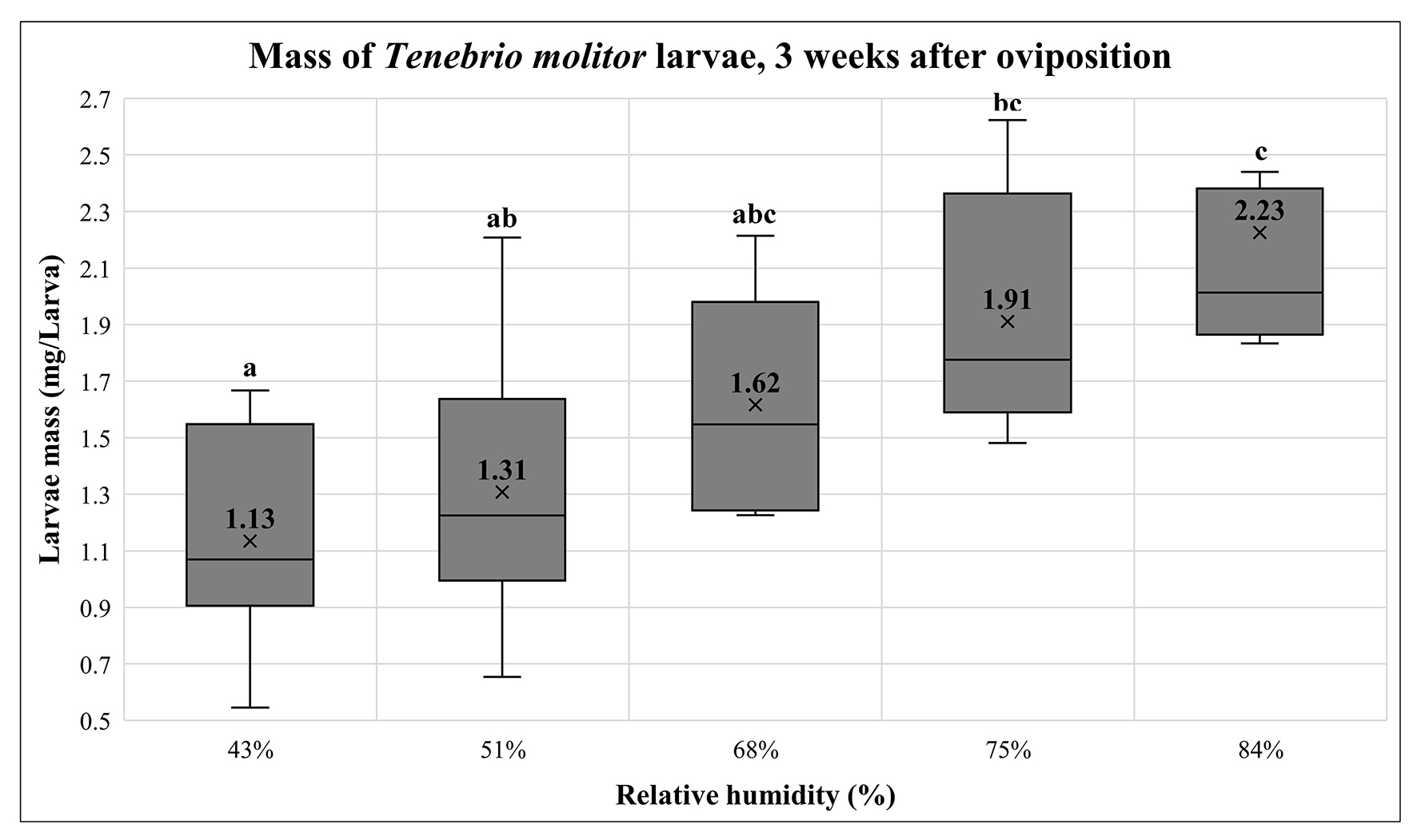
The current livestock sector is a large contributor to the environmental challenges facing the world. To reduce the environmental impact of food production, a change of the sector is necessary. Entomophagy could be a step towards a more sustainable protein production. However, the insect farming community has a short history compared to conventional livestock, thus, it lacks knowledge of how a profitable mass production of insects is established. In this study we aimed to find the optimal relative humidity (RH) for production of larvae of a popular species for insect farming; the yellow mealworm,Tenebrio molitor. More specifically we tested the effect of a RH of 43, 51, 68, 75 and 84% on the survival rate, mass and length ofT. molitor larvae, from hatching and two weeks forward. Control of RH was achieved using the saturated salt solution method, and the temperature was kept at 30 °C. Experiments were carried out over 12 weeks. The sample size was 100 larvae and eight replicates per treatment. Results showed that the RH had no effect on larval survival rate but had a significant effect on individual larvae mass and length after three weeks. Larval mass and length increased with humidity, and larvae reared at a RH of 84% were 1.96 times heavier and 1.31 times longer than larvae raised at 43%. Hence, for an industrial mass producer ofT. molitor larvae, applying close to the optimal RH of 84% would likely result in an increased larvae size at harvest and a faster growth rate, ultimately leading to a higher yield.
Kauf
Sofortzugang erwerben (PDF-Download und unbegrenzter Online-Zugang):
Institutszugang
Melden Sie sich mit Open Athens, Shibboleth oder Ihren institutionellen Anmeldedaten an.
Persönliche Anmeldung
Melden Sie sich mit Ihrem brill.com-Konto an
-
Andersen, J.L., Berggren, I.E. and Heckmann, L.H.L, 2018. Anbefalinger til opdræt og hold af almindelig melorm,Tenebrio molitor. Teknologisk Institut. INBIOM – Dansk Insekt Netværk og inVALUABLE: 1. udgave (2nd Ed.): pp. 4-11.
'Anbefalinger til opdræt og hold af almindelig melorm,Tenebrio molitor ', () 4 -11.
-
Buxton, P.A., 1930. Evaporation from the meal-worm (Tenebrio: Coleoptera) and atmospheric humidity. Proceedings of the Royal Society of London 106: 560-577.https://doi.org/10.1098/rspb.1930.0045
-
Carr, P.H., 2018. The wicked problem of climate change. Zygon 53(2): 443-461.https://doi.org/10.1111/zygo.12410
-
Food and Agriculture Organization of the United Nations (FAO), 2012. Assessing the potential of insects as food and feed in assuring food security. summary report. In: Vantomme, P., Van Huis, A. and Klunder, H. (eds.). Technical consultation meeting, 23-25 January 2012, FAO, Rome, Italy. Available at:http://www.fao.org/3/an233e/an233e00.pdf.
-
Fraenkel, G. and Blewett, M., 1944. The utilisation of metabolic water in insects. Bulletin of Entomological Research 85(2): 127-139.https://doi.org/10.1017/S0007485300017351
-
Greenspan, L., 1977. Humidity fixed points of binary saturated aqueous solutions. Journal of Research of the National Bureau of Standards Section A: Physics and Chemistry 81A(1): 89.https://doi.org/10.6028/jres.081A.011
-
Hansen, L.L., Ramløv, H. and Westh, P., 2004. Metabolic activity and water vapour absorption in the mealwormTenebrio molitor L. (Coleoptera, Tenebrionidae): real-time measurements by two-channel microcalorimetry. The Journal of Experimental Biology 207: 545-552.https://doi.org/10.1242/jeb.00762
-
Harbach, R.E. and Larsen, J.R., 1977. Humidity behavior and the identification of hygroreceptors in the adult mealworm,Tenebrio molitor. Journal of Insect Physiology 23(9): 1121-1134.https://doi.org/10.1016/0022-1910(77)90143-3
-
Jongema, Y., 2012. List of edible insect species of the world. Wageningen, Laboratory of Entomology, Wageningen University, the Netherlands, 100 pp. Available at:www.ent.wur.nl/UK/Edible+insects/Worldwide+species+list/.
-
Leclercq, J., 1948. Contribution a l.étude du métabolisme de l.eau chez la larve deTenebrio molitor L. Archives Internationales de Physiologie 55(4): 412-419.https://doi.org/10.3109/13813454809144865
-
Machin, J., 1975. Water balance inTenebrio molitor L. larvae; the effect of atmospheric water absorption. Journal of Comparative Physiology 101: 121-132.https://doi.org/10.1007/BF00694153
-
Miglietta, P.P., Leo, F.D., Ruberti, M. and Massari, S., 2015. Mealworms for food: a water footprint perspective. Water 7: 6190-6203.https://doi.org/10.3390/w7116190
-
Murray, D.R.P., 1968. The importance of water in the normal growth of larvae ofTenebrio molitor. Entomologia Experimentalis et Applicata 11: 149-168.
'The importance of water in the normal growth of larvae ofTenebrio molitor ' () 11 Entomologia Experimentalis et Applicata : 149 -168.
-
Nakagaki, B.J. and Defoliart, G.R., 1991. Comparison of diets for mass-rearingAcheta domesticus (Orthoptera: Gryllidae) as a novelty food, and comparison of food conversion efficiency with values reported for livestock. Journal of Economic Entomology 84(3): 891-896.https://doi.org/10.1093/jee/84.3.891
-
Oonincx, D.G.A.B. and De Boer, I.J.M., 2012. Environmental impact of the production of mealworms as a protein source for humans – a life cycle assessment. PLoS ONE 7(12): e51145.https://doi.org/10.1371/journal.pone.0051145
-
Oonincx, D.G.A.B., Van Itterbeeck, J., Heetkamp, M.J.W., Van den Brand, H., Van Loon, J.J.A. and Van Huis, A., 2010. An exploration on greenhouse gas and ammonia production by insect species suitable for animal or human consumption. PLoS ONE 5(12): e14445.https://doi.org/10.1371/journal.pone.0014445
-
Park, J.B., Choi, W.H., Kim, S.H., Jim, H.J., Han, Y.S., Lee, Y.S. and Kim, N.J., 2014. Developmental characteristics ofTenebrio molitor larvae (Coleoptera: Tenebrionidae) in different instars. International Journal of Industrial Entomology 28(1): 5-9.https://doi.org/10.7852/ijie.2014.28.1.5
-
Pielou, B.Y.D.P., 1940. The humidity behaviour of the mealworm beetle,Tenebrio molitor L. Journal of Experimental Biology 17: 307-316.
'The humidity behaviour of the mealworm beetle,Tenebrio molitor L ' () 17 Journal of Experimental Biology : 307 -316.
-
Punzo, F. and Huff, G., 1989. Comparative temperature and water relations and effects of thermal acclimation onTenebrio molitor andTenebrio obscurus (Coleoptera: Tenebrionidae). Comparative Biochemistry and Physiology 93A(3): 527-533.
'Comparative temperature and water relations and effects of thermal acclimation onTenebrio molitor andTenebrio obscurus (Coleoptera: Tenebrionidae) ' () 93A Comparative Biochemistry and Physiology : 527 -533.
-
Punzo, F. and Mutchmor, J.A., 1980. Effects of temperature, relative humidity and period of exposure on the survival capacity ofTenebrio molitor (Coleoptera: Tenebrionidae). Journal of the Kansas Entomological Society 53(2): 260-270. Available at:https://www.jstor.org/stable/25084029.
-
Ramsay, J.A., 1964. The rectal complex of the mealwormTenebrio molitor, L. (Coleoptera, Tenebrionidae). Philosophical Transactions of the Royal Society of London. Series B, Biological Sciences 248(748): 279-314.https://doi.org/10.1098/rstb.1964.0013
-
Ribeiro, N., Abelho, M. and Costa, R., 2018. A review of the scientific literature for optimal conditions for mass rearingTenebrio molitor (Coleoptera: Tenebrionidae). Journal of Entomological Science 53(4): 434-454.https://doi.org/10.18474/JES17-67.1
-
Schulz, N., 1930. Zur biologie des mehlwurms (Tenebrio molitor). i. Mitteilung. der Wasserhaushalt. Biochemische Zeitschrift 227: 340-353.
'Zur biologie des mehlwurms (Tenebrio molitor) ' () 227 Biochemische Zeitschrift : 340 -353.
-
Smil, V., 2002. Worldwide transformation of diets, burdens of meat production and opportunities for novel food proteins. Enzyme and Microbial Technology 30(3): 305-311.https://doi.org/10.1016/S0141-0229(01)00504-X
-
Steinfeld, H., 2006. Livestock’s long shadow: environmental issues and options. Food and Agriculture Organization of the United Nations, Rome, Italy. Available at:http://www.fao.org/3/a0701e/a0701e.pdf.
-
Tao, J. and Li, Y.O., 2018. Edible insects as a means to address global malnutrition and food insecurity issues. Food Quality and Safety 2(1): 17-26.https://doi.org/10.1093/fqsafe/fyy001
-
Urs, K.C.D. and Hopkins, T.L., 1973. Effect of moisture on growth rate and development of two strains ofTenebrio molitor L. (Coleoptera, Tenebrionidae). Journal of Stored Products Research 8: 291-291.https://doi.org/10.1016/0022-474X(73)90045-3
-
Van Broekhoven, S. Oonincx, D.G.A.B., Van Huis, A. and Van Loon, J.J.A., 2015. Growth performance and feed conversion efficiency of three edible mealworm species (Coleoptera: Tenebrionidae) on diets composed of organic by-products. Journal of Insect Physiology 73: 1-10.https://doi.org/10.1016/j.jinsphys.2014.12.005
-
Van Huis, A. Van Itterbeeck, J., Klunder, H., Mertens, E., Halloran, A., Muir, G. and Vantomme, P., 2013. Edible insects. Future prospects for food and feed security. Food and Agriculture Organization of the United Nations, Forestry Paper, Rome, Italy. Available at:http://www.fao.org/3/i3253e/i3253e.pdf.
-
Veldkamp, T., Van Duinkerken, G., Van Huis, A., Lakemond, C.M.M., Ottevanger, E., Bosch, G. and Van Boekel, M.A.J.S., 2012. Insects as a sustainable feed ingredient in pig and poultry diets – a feasibility study. Report 638. Wageningen UR Livestock research, Wageningen, the Netherlands, 48 pp. Available at:https://www.wur.nl/upload_mm/2/8/0/f26765b9-98b2-49a7-ae43-5251c5b694f6_234247%5B1%5D.
Supplementary Materials
| Insgesamt | Letzte 365 Tage | In den letzten 30 Tagen | |
|---|---|---|---|
| Aufrufe von Kurzbeschreibungen | 2674 | 943 | 89 |
| Gesamttextansichten | 78 | 21 | 1 |
| PDF-Downloads | 145 | 45 | 2 |
The effect of relative humidity on the survival and growth rate of the yellow mealworm larvae (Tenebrio molitor, Linnaeus 1758)
in Journal of Insects as Food and FeedSearch for other papers by N.S. Johnsen in
Current site
Google Scholar
PubMed
Search for other papers by J.L. Andersen in
Current site
Google Scholar
PubMed
Search for other papers by J. Offenberg in
Current site
Google Scholar
PubMed
The current livestock sector is a large contributor to the environmental challenges facing the world. To reduce the environmental impact of food production, a change of the sector is necessary. Entomophagy could be a step towards a more sustainable protein production. However, the insect farming community has a short history compared to conventional livestock, thus, it lacks knowledge of how a profitable mass production of insects is established. In this study we aimed to find the optimal relative humidity (RH) for production of larvae of a popular species for insect farming; the yellow mealworm,Tenebrio molitor. More specifically we tested the effect of a RH of 43, 51, 68, 75 and 84% on the survival rate, mass and length ofT. molitor larvae, from hatching and two weeks forward. Control of RH was achieved using the saturated salt solution method, and the temperature was kept at 30 °C. Experiments were carried out over 12 weeks. The sample size was 100 larvae and eight replicates per treatment. Results showed that the RH had no effect on larval survival rate but had a significant effect on individual larvae mass and length after three weeks. Larval mass and length increased with humidity, and larvae reared at a RH of 84% were 1.96 times heavier and 1.31 times longer than larvae raised at 43%. Hence, for an industrial mass producer ofT. molitor larvae, applying close to the optimal RH of 84% would likely result in an increased larvae size at harvest and a faster growth rate, ultimately leading to a higher yield.
| Insgesamt | Letzte 365 Tage | In den letzten 30 Tagen | |
|---|---|---|---|
| Aufrufe von Kurzbeschreibungen | 2674 | 943 | 89 |
| Gesamttextansichten | 78 | 21 | 1 |
| PDF-Downloads | 145 | 45 | 2 |