


1 Introduction
1.1 Location
Hateruma is spoken on Hateruma Island, which belongs to Taketomi Town in Yaeyama District, Okinawa Prefecture. Hateruma Island is the southernmost inhabited island in Japan, covering an area of 12.73 square kilometers (Geospatial Information Authority of Japan 2024). No definitive evidence is available regarding when and from where the ancestors of the people residing on Hateruma Island migrated there. However, historical linguistic studies are beginning to pinpoint the period when Ryukyuan languages spread to their current location. According to Pellard (2015), speakers of Ryukyuan languages expanded from Kyushu into the Ryukyu Islands around the 10th–12th centuries. Several ruins on Hateruma Island date back to the 13th–15th centuries (Toji 1998). This suggests an influx of population originating from the Kyushu region to Hateruma Island during the period when Ryukyuan languages were spreading.
1.2 Speakers
Accurately determining the number of native speakers of Hateruma is challenging. Based on the authors’ experience, individuals born around the mid-1940s can speak Hateruma fluently, but, if this observation is correct, the number of native speakers on Hateruma Island is estimated to be around 40 out of a total population of 435 (Taketomi-cho Nenrei-betsu Jinko Ichiran Hyo [Taketomi Town Age-specific Population List], March 2024 edition1). However, since some speakers have moved to islands such as Ishigaki or Okinawa, the actual number of native speakers is likely higher than 40.
1.3 Classification
Hateruma is a variety of the Yaeyama language. According to Pellard (2015), Yaeyama, together with Yonaguni (Dunan), forms the Macro-Yaeyama clade, which belongs to the Southern Ryukyuan branch of the Ryukyuan language family. Lawrence (2000) provides detailed information on the phylogenetic relationships within Macro-Yaeyama and the position of Hateruma. According to Lawrence (2000), Hateruma diverged from the other varieties of Yaeyama relatively early after Yonaguni first split from the proto-language. Observations suggest that speakers of Hateruma may fail to understand other varieties of Yaeyama, indicating a lack of mutual intelligibility among these varieties.
1.4 Previous Studies
Previous studies on the prosodic system of Hateruma include Akinaga (1960), Hirayama and Nakamoto (1964), Hirayama et al. (1967), Sakimura (1987), Hirayama (1988), Kuno (2002), Matsumori (2015), Aso and Ogawa (2016), and Celik et al. (2023). Aso and Ogawa (2016) focused on the prosodic system of speakers from the Kita district of Hateruma Island and concluded that there are three distinctive tonal patterns in Hateruma, contrary to previous claims of only two distinctive tonal patterns. Celik et al. (2023) reported a fourth tonal pattern for simplex nouns, although this is found in only a few words. Additionally, both Matsumori (2015) and Celik et al. (2023) suggested the possibility of a four-way tonal distinction in compound words. These reports on the possibility of more than three tonal patterns warrant further investigation in the future.
1.5 Data
The data used in this paper come from Aso and Ogawa (2016), Celik et al. (2023), and the authors’ surveys of a female speaker (born 1939) from the Naishi district, and currently residing in the Kita district and a male speaker (born 1935) from the Fuka district living off-island since his late teens.
1.6 Overview of the Segmental Phonology
The vowel and consonant phoneme inventories of present-day Hateruma, as proposed by Aso and Nakazawa (2023: 60), are shown in Tables 18.1 and 18.2, respectively. For a detailed description of the phonetic realization of each phoneme, see Aso (2020).
Table 18.1
Vowel phonemes in Hateruma
|
Front |
Central |
Back |
|
|---|---|---|---|
|
Close |
i, iː |
ï [ɨ], ïː |
u, uː |
|
Mid |
e, eː |
ëː [ɜː] |
o, oː |
|
Open |
a, aː |
The phoneme /c/ is realized as the voiceless alveolar affricate [ts]. The phoneme /z/ is phonemically an affricate but can be phonetically realized as either an affricate [dz] or a fricative [z]. For simplicity, the voiced fricative allophones of the phoneme /z/ are omitted from Table 18 2. Alveolar obstruents /c, z, s/ exhibit alveolo-palatal allophones when preceding /i/ or /j/, realized as [tɕ], [ʑ ~ dʑ], and [ɕ], respectively. The phoneme /r/ is typically realized as a tap [ɾ], though it can also be a trill [r]. The place of articulation of the phoneme /n/ is determined by the following consonant, resulting in conditioned allophones such as [m], [n], and [ŋ], except before vowels.
Table 18.2
Consonant phoneme inventory and typical allophones. (Phonemes are indicated by slashes, whereas typical allophones are listed in parentheses. Symbols in square brackets are used for phonemic transcriptions where the phonetic realization may not be immediately apparent.)
|
Bilabial |
Alveolar |
Alveolo-palatal |
Palatal |
Velar |
Glottal |
||
|---|---|---|---|---|---|---|---|
|
Plosive |
Voiceless aspirated |
/pʰ/ |
/tʰ/ |
/kʰ/ |
|||
|
Voiceless unaspirated |
/p/ |
/t/ |
/k/ |
||||
|
Voiced |
/b/ |
/d/ |
/g/ |
||||
|
Affricate |
Voiceless |
/c/ [ʦ] |
(ʨ) |
||||
|
Voiced |
/z/ [ʣ] |
(ʥ) |
|||||
|
Fricative |
Voiceless aspirated |
/fʰ/ |
/sʰ/ |
/hʰ/ |
|||
|
Voiceless unaspirated |
/f/ |
/s/ |
(ɕ) |
/h/ |
|||
|
Nasal |
/m/ |
/n/ |
(ŋ) |
||||
|
Trill |
(r) |
||||||
|
Tap |
/r/ [ɾ] |
||||||
|
Approximant |
/w/ |
/j/ |
Two notable phonetic characteristics of Hateruma are, first, the strong aspiration of initial voiceless obstruents and the subsequent devoicing of the following vowel, and, second, the instability of vowel length distinctions. In Yaeyama, strong aspiration of voiceless obstruents is common, with Hateruma being particularly notable for this feature (Uemura 1992). In Hateruma, vowels following aspirated consonants are devoiced, and if a sonorant follows, it is also devoiced (e.g., /pʰana/ [pḁn̥a] ‘flower’, /tʰuri/ [tu̥ɾ̥i] ‘bird’). The opposition between vowel lengths is often ambiguous, with instances where both pronunciations—whether with a short or long vowel—are considered well formed by speakers (e.g., /mami/ [mami] ~ [maːmi] ‘bean’, /barun/ [baɾuŋ] ~ [baːruŋ] ‘to laugh’). However, some words consistently exhibit long or short vowels, which indicates that vowel length opposition is not entirely absent. For words with variable vowel length, we follow Aso and Nakazawa (2023) in considering that some lexemes have both long and short vowel word forms.
Comparative and historical perspectives have suggested that the distinction between aspirated and unaspirated consonants was originally a phonetic phenomenon and vowel length opposition was originally consistent. However, the phonological system of present-day Hateruma is in a transitional phase characterized by “phonemicization of devoicing” (e.g., /kʰariː/ [kḁr̥iː] ‘auspicious precedent’ vs. /karijusi/ [kaɾijuɕi] ‘safe voyage’) and “loss of vowel length opposition”, resulting in a phoneme system showing complex characteristics. Following Aso and Nakazawa (2023), this chapter posits a three-way distinction for plosives—voiceless aspirated, voiceless unaspirated, and voiced—as well as a two-way distinction for fricatives—voiceless aspirated and voiceless unaspirated. While the contrast between aspirated and unaspirated voiceless fricatives may seem typologically marked, its presence in many Tibeto-Burman languages justifies the inclusion of the phonemes /fʰ, sʰ, hʰ/ for Hateruma (see Aso and Nakazawa 2023). Examples illustrating this contrast include /fʰuni/ [fu̥n̥i] ‘boat’ and /funaː/ [funaː] ‘does it rain?’ for /fʰ/ versus /f/, /sʰana/ [sḁn̥a] ‘umbrella’ and /sanu/ [sanu] ‘not do’ for /sʰ/ versus /s/, and /hʰakonacï/ [hḁkonaʦɨ] ‘nine’ and /hanu/ [hanu] ‘not eat’ for /hʰ/ versus /h/ (Aso and Nakazawa 2023).
The syllable structure of Hateruma is (C1(G))V1(V2)(C2) (Aso 2020). Here, C1 represents the onset, G the glide, V1 and V2 the nucleus, and C2 the coda. The C1 slot is filled by a consonant phoneme, G by either /w/ or /j/, and V1 and V2 typically by a vowel phoneme. The C2 slot is filled by /n/ or the same obstruent as the onset of the following syllable (e.g., /otta/ ‘frog’). In some instances, /n/ serves as the nucleus (e.g., /nta/ ‘soil’). Although rare, words with superheavy syllables (one syllable with three morae) do exist (e.g., /aboanda/ ‘mothers’). The rhyme slots, V1, V2, and C2, each have a length of one mora.
2 Word-Prosodic System
2.1 Classification Based on Uwano (1989, 1999)
According to the typological classification proposed by Uwano (1989, 1999), the prosodic system of Hateruma is classified as a three-pattern accent system (Aso and Ogawa 2016)—a subcategory of the N-pattern accent systems, defined as a system where the number of tonal contrasts remains fixed at N, regardless of word length (see § 2.4 of Chapter 1, this volume).
2.2 Number and Nature of Tonal Contrasts
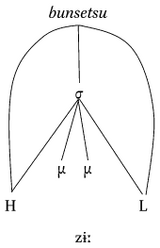
In Hateruma, there are three distinctive tonal patterns (Aso and Ogawa 2016), referred to as Falling Type, High Type, and Rising Type (abbreviated below as Type F, Type H, and Type R, respectively). Type F exhibits a pitch decrease toward the end of the syllable; Type H is pronounced with a constant high pitch without any substantial variation, and Type R shows a pitch increase toward the end of the syllable. Examples of words from one to four syllables demonstrating these patterns are listed in (1). The diacritics “⸢” and “⸣” indicate a pitch rise and fall, respectively, between morae, whereas “⸣⸣” denotes a pitch fall within a mora (see § 2.2 of Chapter 1, this volume). A minimal triplet for one-syllable words is illustrated with audio waveforms, pitch curves, and spectrograms in Figures 18.1–18.3.
|
Type F |
Type H |
Type R |
||
|---|---|---|---|---|
|
(1) |
Tonal patterns of Hateruma |
|||
|
1- |
⸢zïː⸣⸣ ‘blood’ |
⸢zïː ‘breast’ |
zï ⸢ː ‘ground’ |
|
|
2- |
⸢u⸣sï~usï⸣⸣ ‘cow’ |
⸢usï ‘mortar’ |
ba⸢sa~baː⸢sa ‘Musa basjoo’ |
|
|
3- |
⸢kʰi⸣pusï~⸢kʰipu⸣⸣sï ‘smoke’ |
⸢kʰatana ‘sword’ |
gara⸢sï ‘crow’ |
|
|
4- |
⸢pʰïsï⸣mari~pʰïsïma⸣⸣ri ‘noon’ |
⸢ujancu ‘mouse’ |
guciru⸢min~gucirumi⸢n ‘armpit’ |
|
The pitch curve is generally consistent with the auditory impression in Hateruma.
The distinctive feature of Type F is the presence of a pitch fall, the position of which, however, is not distinctive. An abrupt pitch fall may occur on the second syllable or around the second mora, or the pitch may gradually decline throughout the word. Thus, the location of the fall in pitch is not consistent.
The distinctive feature of Type H is the absence of substantial variation in pitch, be it rising or falling. Type H words are pronounced with a high pitch from the beginning, and the pitch remains consistently high throughout the word.
Type R pattern is characterized by an increase in pitch toward the end of the word, resulting in the final syllable having a high pitch. Variation in the locus and sharpness of the pitch rise has been observed such that, for instance, the rise may occur within heavy syllables. In some instances, the pitch rise is gradual, and other instances show a sharp pitch rise in the last syllable. Furthermore, in addition to the pitch rise toward the end of the word, sometimes a pitch fall at the beginning of the word is also observed. However, Aso and Ogawa (2016) analyzed the final pitch rise as the distinctive feature of Type R, while the initial pitch fall, when present, is considered non-distinctive.2

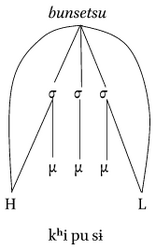
Based on these observations, the tonal patterns in Hateruma can be analyzed as involving tones associated with both the initial and final syllables. We present the three tonal patterns in the form of a prosodic hierarchy that includes the mora, syllable, and bunsetsu—a unit comprising a lexical word and any following particles (see § 2.6 of Chapter 1, this volume), along with their associated tones. This is demonstrated in the examples for one-syllable and three-syllable words pronounced in isolation (2–3). In this representation, “
|
(2) |
a. |
Type F |
b. |
Type H |
|
|
⸢zɨː⸣⸣ ‘blood’ |
⸢zɨː ‘breast’ |
||||
|
|
|

|
c. |
Type R |
|
|
zɨ⸢ː ‘ground’ |
||
|
|

|
(3) |
a. |
Type F |
b. |
Type H |
|
|
⸢kʰi⸣pusɨ~⸢kʰipu⸣⸣sɨ ‘smoke’ |
⸢kʰatana ‘sword’ |
||||
|
|
|

|
c. |
Type R |
|
|
gara⸢sɨ ‘crow’ |
||
|
|
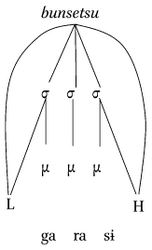


As will be further discussed in § 2.3, the domain of each tonal pattern is the bunsetsu rather than the lexical word, with tones assigned to the initial and final syllables of the bunsetsu. In this chapter, adopting the concept of primary and secondary associations introduced by Pierrehumbert and Beckman (1988) for Tokyo Japanese, we propose that these tones are primarily associated with the left and right edges of the bunsetsu, respectively, and secondarily associated with the initial and final syllables of the bunsetsu. The left- and right-edge tones are determined by the lexical specification of the word contained within the bunsetsu: H and L for Type F, H and H for Type H, and L and H for Type R. Through the secondary association of these tones, the designated pitch is consistently realized on the initial and final syllables of the bunsetsu. No specific tones are linked to the syllables in between, allowing for a variable pitch in these intermediate positions. Accordingly, a substantial portion of the observed variation can be ascribed to the theoretical linkages shown in (2–3). However, the specific conditions underlying word-initial variation within rising patterns remain insufficiently understood.
2.3 Domain of Lexical Tone Assignment
The domain of lexical tone assignment in Hateruma is the bunsetsu—a unit comprising a lexical word and any following particles (see § 2.6 of Chapter 1, this volume).
Examples are shown in Figures 18.4–18.6, which depict nouns of all three tonal patterns followed by the genitive particle =nu. As seen in Figure 18.4, which shows the Type F noun jumi ‘bride’ with the genitive particle, the pitch fall spans the entire bunsetsu, including the particle. Similarly, in Figure 18.5, which shows the Type H noun ami ‘rain’, the entire bunsetsu is pronounced with a constant high pitch. Last, in Figure 18.6, depicting the Type R noun jama ‘mountain’, the tonal pattern is realized across the entire bunsetsu, with the pitch rise beginning before the genitive particle =nu, which corresponds to the last syllable of the bunsetsu. Thus, the basic domain for lexical tones in Hateruma is the bunsetsu.
Although the basic domain for lexical tone assignment is the bunsetsu, some particles are specified for a tonal type and form their own domain. Consequently, a single bunsetsu may comprise two tonal domains. The particles =bagi (Type F) ‘until’ and =naga (Type R) ‘to’ are two representative examples. Below, examples are given in Figures 18.7 and 18.8. Figure 18.7 shows the Type R noun jamatu ‘Yamato’ with the particle =bagi ‘until’, which has a Falling tonal pattern. Unlike the example shown in Figures 18.4–18.6, the bunsetsu does not serve as the domain for realizing the tonal pattern of the noun; instead, the tonal patterns of both jamatu and =bagi are realized separately. This is evident from the fact that the pitch rise of jamatu is realized on the last syllable of the noun rather than on the bunsetsu. The same holds for the example shown in Figure 18.8, where the particle =naga ‘to’, which belongs to Type R, follows the Type R noun maːsu ‘salt’. As observed in Figure 18.8, there are two pitch rises in the bunsetsu maːsu=naga, one on the last syllable of the noun and the other on the last syllable of the particle, showing that the bunsetsu is divided into two domains, each assigned its own tonal pattern. This suggests that some particles, although not typical bunsetsus synchronically, can be the same kind of independent domain as the typical bunsetsu. Many of the morphemes that can become such a domain appear to be diachronically derived from free forms (e.g., naga ‘inside’).


Figure 18.6
R+nu ‘Let’s talk about the mountain.’


Figure 18.8
Attach (a price tag, etc.) to the salt.’

2.4 Tone-Bearing Units
The minimal tone-bearing unit (TBU) in Hateruma is the syllable, which also serves as the primary “counting unit” (McCawley 1978) for measuring phonological length or distance (see § 2.7 of Chapter 1, this volume).
As discussed in § 2.2, the tones are primarily associated with the bunsetsu and secondarily associated with the syllable. Specifically, tones primarily linked to the left edges of a bunsetsu are secondarily linked to the initial syllable of the bunsetsu, while tones primarily linked to the right edges of a bunsetsu are secondarily linked to the final syllable of the bunsetsu. In the proposed framework, therefore, both the bunsetsu and the syllable are TBU s. Based on secondary association, we regard the minimal TBU to be the syllable.
2.5 Directionality
Directionality is the direction in which the position of word-level prominence is calculated (see § 2.8 of Chapter 1, this volume). Assessing directionality in Hateruma is currently difficult.
As explained in § 2.2, tones are assigned to both the right and left edges of the domain, with no clear evidence favoring one over the other. Therefore, the directionality of tonal assignment may be left-to-right, right-to-left, or even a mix of both, as suggested for the Yuwan variety of Amami (Niinaga and Ogawa 2011).
2.6 Obligatoriness and Culminativity
The prosodic system of Hateruma satisfies culminativity but not obligatoriness.
Obligatoriness is satisfied if every lexical word has at least one syllable marked for the highest degree of metrical prominence (Hyman 2006; see § 2.5 of Chapter 1, this volume). However, Type H of Hateruma does not exhibit any such prominence and therefore does not satisfy obligatoriness. Culminativity, the principle that every lexical word has at most one syllable marked for the highest degree of metrical prominence (see § 2.4 of Chapter 1, this volume), is satisfied in Hateruma. Each word has at most one prominent syllable, as seen in the initial syllable of Type F and the final syllable of Type R.
2.7 Prosodic Compound Rules
The basic rule for compound prosody in Hateruma is left-dominant in that compounds inherit the tonal pattern of the first element, regardless of the tonal pattern of the second element. In the examples of compound words shown in (4), the second element is unified with Type H for clarity.
|
(4) |
Left-dominance in the prosodic patterns of compounds |
|||||
|
a. |
isi (F) ‘stone’ |
+ |
usï (H) ‘mortar’ |
→ |
isi+usï (F) ‘stone mortar’ |
|
|
b. |
ki (H) ‘tree’ |
+ |
usï (H) ‘mortar’ |
→ |
ki+usï (H) ‘wood mortar’ |
|
|
c. |
midumu (R) ‘woman’ |
+ |
uja (H) ‘parent’ |
→ |
midumu+uja (R) ‘female |
|
|
parent’ |
||||||
In some compounds, the tonal pattern of each constituent is realized (Celik et al. 2023), as shown in (5). Additionally, some compounds exhibit tonal patterns that cannot be interpreted as the realization of any of the three tonal classes or as the realization of the tonal class of both constituents (Celik et al. 2023; Matsumori 2015). In this light, the prosodic patterns observed in compounds warrant further investigation.
(5) Compounds where the tone class of both elements is realized (adopted from Celik et al. 2023, orthography modified)
|
a. |
kaara (H) ‘tile’ |
+ |
hii (R) ‘house’ |
→ |
⸢kaara⸣+hi⸢i ‘tiled house’ |
|
|
b. |
bata (R) ‘stomach’ |
+ |
jami (R) ‘pain’ |
→ |
ba⸢ta⸣+ja⸢mi ‘stomach pain’ |
2.8 Merger and Split of Historic Tonal Classes
Of the three tonal classes reconstructed for proto-Ryukyuan (pR) (see § 2.10 of Chapter 1, this volume), pR Class A corresponds to Type F in Hateruma, while Classes B and C correspond to Types H and R, as shown in Table 18.3.
Table 18.3
Correspondences in tonal Classes between pR and Hateruma
|
pR tone classes |
Hateruma tone classes |
|---|---|
|
pR Class A |
Type F |
|
pR Class B |
Type H ~ Type R |
|
pR Class C |
Type H ~ Type R |
As demonstrated by Aso and Ogawa (2016), a tonal split has occurred in Hateruma for words of Classes B and C (i.e., Types H and R). Table 18.4 shows the distribution of the minimal pairs of tonal patterns along with information about word-initial segments. Most Type H words begin with a voiceless consonant (e.g., kʰatana ‘sword’), while most Type R words begin with a voiced consonant (e.g., garasï ‘crow’). From this, the difference in the word-initial segment is thought to have caused the emergence of the distinction between Type H and Type R. Specifically, word-initial voiceless consonants led to a high pitch on the word-initial syllable, while word-initial voiced consonants led to a low pitch on the word-initial syllable, giving rise to the distinction between Type H and Type R. Words corresponding to Proto-Ryukyuan Classes B and C and beginning with a vowel (e.g., usï ‘mortar’) often belong in Hateruma to Type H. The reason for this may be that, historically, word-initial vowels were pronounced with a preceding glottal stop [ʔ], thus patterning with voiceless consonants.
Table 18.4
Distribution of minimal pairs in Hateruma (orthography modified from Aso 2020: 65 to match Aso and Nakazawa 2023)
|
Phoneme |
Type F |
Type H |
Type R |
||
|---|---|---|---|---|---|
|
sequence |
|||||
|
pR tone class |
A |
B |
C |
B |
C |
|
Word-initial |
Any segment |
Voiceless conso- |
Voiced |
– |
– |
|
segment |
nant or vowel |
consonant |
– |
– |
|
|
faː |
faː ‘saddle’ |
faː ‘storehouse’ |
– |
– |
– |
|
sʰumu |
sʰumu ‘under’ |
sʰumu ‘liver’ |
– |
– |
– |
|
keː |
keː ‘well’ |
– |
keː ‘egg’ |
– |
– |
|
kʰacï |
kʰacï ‘wind’ |
– |
kʰacï ‘sea urchin’ |
– |
– |
|
usï |
usï ‘cow’ |
– |
usï ‘mortar’ |
– |
– |
|
zïn |
zïn ‘tray’ |
– |
– |
zïn ‘money’ |
– |
|
nan |
nan ‘name’ |
– |
– |
nan ‘wave’ |
– |
|
juː |
juː ‘fish’ |
– |
– |
juː ‘hot water’ |
– |
|
meː |
meː ‘rice’ |
– |
– |
– |
meː ‘before’ |
3 Detailed Description of the Prosodic System
3.1 Prosodic Patterns of Verbs
Many Japonic languages have a system in which the tonal pattern of nouns is the most complex, and the patterns of verbs and adjectives are less complex than those of nouns. Against this background, we look at verbs and adjectives separately from nouns in § 3.
§ 2 primarily discussed the tonal patterns of nouns in Hateruma. § 3.1 provides an overview of the tonal patterns for verbs. As with nouns, verbs are classified into three distinct tonal patterns, as illustrated in (6). The three-way distinction for verbs is notable considering that other Ryukyuan languages—even those with a three-way distinction for nouns—generally distinguish only two tonal patterns for verbs.
(6) Examples of verbs classified into three tonal classes (orthography adjusted from Aso 2020: 92–93 to align with Aso and Nakazawa 2023):
a.Type F: jagun ‘to bake’, nagun ‘to cry’, kon ‘to buy’, sʰïkun ‘to listen’, sʰïkon ‘to use’, hon ‘to eat’
b.Type H: kun ‘to come’, mun ‘to think’, ucin ‘to fall’, hʰakun ‘to write’
c.Type R: mirun ‘to see’, nun ‘to sew’, jumun ‘to read’, niːrun ‘to knead’
As evident from the word-initial segments in (6), the distinction between Type H and Type R, similar to nouns, arose from the tonal split described in § 2.8. Only Type H verb mun ‘to think’ has a word-initial voiced consonant, unlike the other examples. This is presumably due to tonal split occurring before the diachronic change that led to the loss of word-initial vowels, as in *umun > mun (an asterisk indicates a reconstructed form) (Aso and Ogawa 2016: 106).
3.2 Prosodic Patterns of Adjectives
§ 3.2 explores the tonal patterns of adjectives.3 Adjectives consist of two elements: the first element, which carries the lexical meaning, and the second element, han, each exhibiting a distinct tonal pattern. In other words, adjectives are divided into two domains for lexical tonal assignment, unlike nouns and verbs, which fall into a single domain. Specifically, one of the three tonal patterns—Type F, Type H, or Type R—is lexically assigned to the first element, while the second element, han, is consistently realized with Type H.
(7) Tonal domains observed in adjectives (with pitch pattern notation adapted from Aso 2020: 59)
a.Type F + Type H: a⸣ga⸢han ‘red’, tu⸣ːsa⸢han ‘distant’, ni⸣ːsjaː⸢han ‘bitter’
b.Type H + Type H: ⸢mahan ‘delicious’, ⸢takahan ‘high’, ⸢isjagahan ‘small’
c.Type R + Type H: maro⸢han ‘low’, bjoː⸢han ‘itchy’, wassa⸢han ‘bad’
According to Aso (2020: 145), the observed phenomenon can be attributed to the historical development of adjectives, which are thought to originate from the combination of a noun and an existential verb. While this diachronic explanation is plausible, Aso (2020: 145) notes that in the synchronic system of Hateruma, the components of adjectives do not function independently enough to be considered a “phrase” with two sequential, independent words. The earlier combined form has fossilized, making it challenging to determine whether it should be analyzed as a single word or as a phrase within the synchronic system.
4 Phrase-Level Prosody
4.1 Interrogative Intonation
No detailed studies on the intonation patterns of Hateruma are currently available. Therefore, in this chapter, we limit ourselves to providing a basic description of the intonation patterns of interrogative sentences, as reported in Aso (2020).
In Hateruma, interrogative sentences are obligatorily marked by sentence-final particles. The sentence-final particles indicating a question are =naː for yes-no questions and =baː or =raː for typical wh-questions. All these particles are specified for tone class and belong to Type F. As a result, the final part of an interrogative sentence is always realized with a falling pitch. That is, intonation alone does not distinguish between interrogative and declarative sentences.
Examples (8) and (9) show declarative and interrogative sentences containing the verb mir‑ ‘to see’ belonging to Type R. The pitch contours and spectrograms for each example sentence are provided in Figure 18.9 and Figure 18.10. In the declarative sentence (8), depicted in Figure 18.9, the Rising tonal pattern is realized across the entire verbal form mirun, starting with a low pitch and exhibiting a pitch rise toward the right edge of the word. In the interrogative sentence (9), depicted in Figure 18.10, the initial word kuri ‘this’, belonging to Type F, starts with a high pitch and exhibits a pitch fall. Then, the verbal form miru, starting with a low pitch, exhibits a substantial pitch rise on its last syllable, while the following sentence-final interrogative particle =naː shows a sharp pitch fall.
(8)
mir-u-n. (R)
see-npst-ind1
‘(I) see.’
(9)
kʰuri (F)
mir-u (R)=naː (F)?
This
see-npst=q
‘Do you see this?’
If the sentence-final verb in a declarative sentence belongs to Type F, the sentence-final bunsetsu will exhibit a pitch fall. Figures 18.11 and 18.12 show the pitch contours and spectrograms for a declarative sentence (9) and an interrogative sentence (10) containing a sentence-final Type F verb.
Figure 18.9
Intonation of declarative sentence 1 ‘(I) see.’
Aso 2020: 67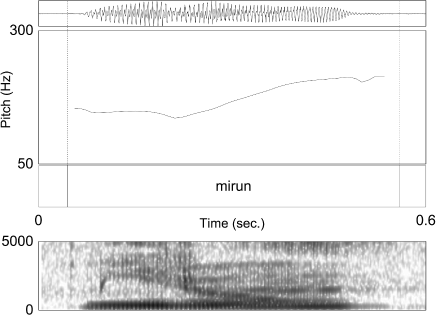
Figure 18.10
Intonation of interrogative sentence 1 ‘Do you see this?’
Aso 2020: 67
(9)
keː (H)
isjagahar-u (H)
pasokon=si=ru (H)
un
baː (R)
benkjoo+si (F)
bir-j
ar-oː (F)
such
small-npst
computer=ins=foc
intj
1sg
study+do.cvb
ipf2-cvb
ipf1-npst. ind2
‘I am studying with such a small computer.’
(10)
keː (H)
isjagahar-u (H)
pasokon=si=ndu (H)
benkjoo+si (F)
bir-j
aː (F)=naː (F)?
such
small-npst
computer=ins=foc
study+do. cvb
ipf2-cvb
ipf1.npst=q
‘Are you studying with such a small computer?’
Comparing Figures 18.11 and 18.12, both exhibit a pitch fall at the end of the sentence. Since the same pitch pattern is observed sentence-finally for both declarative and interrogative sentences, we must assume that the distinction between a declarative and an interrogative sentence is not determined by intonation but rather by the type of sentence-final particle used.
Figure 18.11
Intonation of declarative sentence 2 ‘I am studying with such a small computer.’
Aso 2020: 67
Figure 18.12
Intonation of interrogative sentence 2 ‘Are you studying with such a small computer?’
Aso 2020: 67
Acknowledgements
This work was supported by JSPS KAKENHI Grant Numbers JP23K12167, JP23K17503, 24K00070 and JP09J00800. We would like to express our heartfelt gratitude to Mrs. Yoshi Tamori and Mr. Shosei Honda. Their contributions were invaluable to this research. Any remaining errors or inaccuracies are, of course, solely the responsibility of the authors.
Similar examples can be found in the descriptions of other varieties of the Japonic language family by Kindaichi (1954) and Hirako (2015).
Aso (2020: 144) refers to these parts of speech as “property concept verbs” based on morphosyntactic criteria, categorizing them as a subclass of verbs. This chapter, while also considering these terms as a subclass of verbs, adopts the terminology from Aso and Ogawa (2016) for consistency with other varieties discussed in this volume and labels them as adjectives.
References
Akinaga, Kazue (1960) Yaeyama hōgen 1, 2 onsetsu meishi no akusento no keikō [Accent tendencies in Yaeyama dialect 1- and 2-syllable nouns]. Kokugogaku 41: 121–125.
Aso, Reiko (2020) Minami Ryūkyū Yaeyama-go Hateruma hōgen no bunpō [A grammar of Hateruma, a Southern Ryukyuan language]. Doctoral dissertation, Tokyo University of Foreign Studies.
Aso, Reiko and Kohei Nakazawa (2023) Minami Ryūkyū Yaeyama-go Hateruma hōgen ni okeru museika to boinchō no kaishaku: Jōken ion no on’inka wo megutte [Voice and vowel length contrasts in Hateruma Ryukyuan: A description of the transitional stage of phonologization and de-phonologization]. Onsei Kenkyu 27: 48–63.
Aso, Reiko and Shinji Ogawa (2016) Minami Ryūkyū Yaeyama-go Hateruma hōgen no san-kei akusento [A three-pattern accent system in Hateruma Ryukyuan]. Gengo Kenkyu 150: 87–115.
Celik, Kenan, Reiko Aso and Kohei Nakazawa (2023) Minami Ryūkyū Yaeyama-go Hateruma hōgen jiten ni kansuru chūkan hōkoku [Interim Report on a dictionary of the Hateruma dialect of Southern Ryukyuan Yaeyama]. Gengo Kijutsu Ronshu 15: 193–358.
Kokudo Kotsusho Kokudo Chiri-in (2017) Kokudo chiri-in gijutsu shiryō E2-No.84 Reiwa roku-nen zenkoku todōfuken kuchōson betsu menseki chō (shigatsu tsuitachi jiten) [Technical report of the Geospatial Information Authority of Japan, E2-No.84, the report of statistical reports on the land area by prefectures and municipalities in Japan in 2024 (as of April 1)]. Retrieved August 2024 from https://www.gsi.go.jp/KOKUJYOHO/MENCHO/backnumber/GSI-menseki20240401.pdf.
Hirako, Tatsuya (2015) Noto-jima shohōgen ni okeru akusento no henka: Gotō ryūki to sonogo [Accentual change in Notojima Japanese]. Nihongo no Kenkyu 11(1): 1–35.
Hirayama, Teruo (1988) Minami Ryūkyū no hōgen kiso goi [A basic vocabulary of Southern Ryukyuan]. Tokyo: Ofusha.
Hirayama, Teruo and Masachie Nakamoto (1964) Ryūkyū Yonaguni hōgen no kenkyū [A study of Yonaguni Ryukyuan]. Tokyo: Tokyo-do.
Hirayama, Teruo, Ichiro Oshima and Masachie Nakamoto (1967) Ryūkyū Sakishima hōgen no sōgōteki kenkyū [Comprehensive study of the Sakishima dialects of Ryukyuan]. Tokyo: Meiji-Shoin.
Hyman, Larry M. (2006) Word-prosodic typology. Phonology 23(2): 225–257.
Kindaichi, Haruhiko (1954) Tōzai ryō akusento no chigai ga dekiru made [Research on how the difference between East and West accents came about]. Bungaku 22(8): 63–84.
Kuno, Mariko (2002) Hateruma hōgen no akusento taikei saikō 1, 2 onsetsu meishi ni tsuite [Reconsidering the accent system of Hateruma dialect: 1- and 2-syllable nouns]. Kokugakuin zasshi 103(11): 1–17.
Lawrence, Wayne (2000) Yaeyama hōgen no kukaku ni tsuite [On the classification of the dialects of Yaeyama]. In Shigeru Ishigaki (ed.) Miyanaga Masamori kinen ronshū [Masamori Miyanaga Memorial Collection], 547–559. Ishigaki: Miyanaga Masamori Tanjo Hyakunen Kinen Jigyo Kiseikai.
Matsumori, Akiko (2015) Minami Ryūkyū no san-kei akusento taikei: Sono inritsu tan’ini kansuru kosatsu [The three-pattern accent system of Southern Ryukyuan: A study on its prosodic units]. Nihon Joshi Daigaku Kiyo Bungaku-bu 64: 55–92.
McCawley, James D. (1978) What is a tone language? In Victoria A. Fromkin (ed.) Tone: A linguistic survey, 113–131. New York: Academic Press.
Niinaga, Yuto and Shinji Ogawa (2011) Kita Ryūkyū Amami Yuwan hōgen no akusento taikei [A study of the accent system of the Amami Yuwan dialect of Northern Ryukyuan]. Proceedings of the 143rd Meeting of the Linguistic Society of Japan: 238–243.
Pellard, Thomas (2015) The linguistic archeology of the Ryukyu Islands. In Patrick Heinrich, Shinsho Miyara and Michinori Shimoji (eds.) Handbook of the Ryukyuan languages: History, structure, and use, 13–37. Berlin: De Gruyter Mouton.
Pierrehumbert, Janet B. and Mary E. Beckman (1988) Japanese tone structure. Cambridge: MIT Press.
Sakimura, Hirofumi (1987) Hateruma-jima hōgen no akusento taikei [A new view on the accentual systems of the Japanese dialects in Haterumajima]. Nankaiken Kiyo 8(1): 1–11.
Toji, Kosaku (1998) Yaeyama gun’yū kakkyo jidai no Hateruma-jima ni okeru sonraku to eiyū [A study of villages and heroes in Hateruma during a period on rivalry of local warlords in Yaeyama]. In Okinawa Kenritsu Hakubutsukan (ed.) Hateruma-jima sōgōchōsa hōkokusho: Shizen, rekishi, minzoku, kōko, bijutsu kōgei [Comprehensive Survey Report on Hateruma Island: Nature, History, Folklore, Archaeology, and Arts and Crafts], 147–168. Naha: Okinawa Kenritsu Hakubutsukan.
Uemura, Yukio (1992) Ryūkyū rettō no gengo: Sōsetsu [The languages of the Ryukyu archipelago: Overview]. In Takeshi Kamei, Rokurō Kōno and Ei’ichi Chino (eds.) Sanseidō Encyclopedia of Linguistics, Vol. 4 Languages of the World, 771–814. Tokyo: Sanseido.
Uwano, Zendo (1989) Nihongo no akusento [Accent in Japanese]. In Miyoko Sugito (ed.) Kōza Nihongo to Nihongo kyōiku 2: Nihongo no onsei on’in jō [Series on Japanese language and Japanese language education 2: Japanese phonetics and phonology volume 1], 178–205. Tokyo: Meiji Shoin.
Uwano, Zendo (1999) Classification of Japanese accent systems. In Shigeki Kaji (ed.) Proceedings of symposium cross-linguistic studies of tonal phenomena: Tonogenesis, typology, and related topics, 151–178. Tokyo: ILCAA.