


1 Introduction
This chapter analyses the patterns of circulation of humanist drama from the (northern) Netherlands. It does so via data about the places and dates where a work has been printed in the decades after its first publication. My cases are three of the most popular and widely circulated authors of the Latin school drama known as the biblical comedy or sacra comoedia: Guilielmus Gnapheus (1493–1568), teacher at The Hague, Elbing, Königsberg, and Emden; Cornelius Crocus (1500–1550), who taught in Amsterdam; and Georgius Macropedius (1487–1558), based in Den Bosch and Utrecht. They wrote their comedies during the 1510s to 1550s.
As pioneers of humanist teaching methods, they composed biblical comedies for their pupils, in order to complement the study and replace the performance of the classical Roman comedies by Plautus and Terence. These classical authors were school models for teaching a colloquial standard of Latin and the composition of comedy, but their low humour and depiction of scurrilous situations detracted from their usability for teaching good morals. The new genre of the biblical comedy combined the best of both worlds, focusing on edifying stories taken from Scripture, often parables, composing them in Terentian language and metrical style, in five acts, and sometimes with choruses.
I have collected all the available data for the cities and years where the works of these three authors were printed until 1600.1 The reason behind this cut-off date is that the data are most complete for this period, especially for the plays that were published earlier in the sixteenth century; limiting myself to the period before 1600 makes the comparison more stable. I classified works into dramatic and other publications, and analysed the data with Nodegoat, a software that enables the relational analysis of datasets with spatial and chronological contextualization.2
Naturally, these data and their visualisations give only a limited picture of the actual circulation of these texts. For one, they are texts that functioned as schoolbooks and would have been much used in class. We can suppose that many copies have been lost and many editions are unknown to us. More in general, the location where a book was printed is much more limited than where the book was sold. In the period under scrutiny, many printers in small towns had succumbed to competition from printers in bigger cities such as Antwerp, Cologne, and Lyon, who were able to sell their wares far and wide thanks to a strong network of booksellers.3 It is much more difficult to determine who were these booksellers and where they sold their books than to determine where a work was printed and by whom. On the other hand, around the mid-sixteenth century, humanist and Protestant schools, gymnasia, and academies were founded that provided a good income to local printers, and this makes it easier to link the place of printing with a certain reading public. As Paul Gehl has noted about the circulation of schoolbooks, “Beyond the first few printings, market success rested in the hands of more or less experienced booksellers and ultimately depended on curriculum choices made by teachers beyond the immediate circle of the author.”4
Moreover, Latin comedies did not only travel in print. Often, when a text was needed for a performance, it would be easier to just copy it by hand. The libraries of Jesuit colleges are full of manuscripts of plays. Jesuit teachers adopted the humanist practice of school drama. Most Jesuit colleges performed several plays per year and thus needed a varied repertoire of plays. Many teachers wrote their own plays, but only the most famous among them would see their work in print. In the first few decades of Jesuit school drama, teachers adapted not only the practice but also the repertoire from humanist schools. They played Plautus and Terence, often in redacted versions, as well as many comedies from the Low Countries. Lewin Brecht’s Euripus was an absolute favourite, but so were Acolastus, Joseph, and Macropedius’s plays.
For instance, a manuscript anthology from Munich, made in the seventeenth century, contains not only Euripus and plays about Job and Josaphat but also Acolastus, which was entered into the manuscript in 1587.5 In other manuscripts, we find an adaptation and conflation of the Joseph plays by Crocus and Macropedius. The adaptation, called Josippus, appears in two versions in manuscripts from Dillingen and Munich.6 The first version from Dillingen takes parts from Crocus’s Joseph, but adds the bulk of the story, which Crocus had left out. The second version from Munich adds complete scenes from Macropedius’s play. Pupils in Vienna played Hecastus in 1557, Acolastus three years later, and Macropedius’s Petriscus in 1568. Ingolstadt probably acquired a collection of Macropedius plays around 1558, because in that year they played not only his Hecastus (and repeated it a year later), but also Joseph and Lazarus.
2 Quick Circulation or a Local Start
One thing to note is how much in demand the new biblical comedies were, especially during the 1530s and 1540s, when school drama became a staple in many classrooms but very few play texts were yet available. This explains the very rapid succession of reprints, as represented on the following three maps of three comedies.
The comedy about the Prodigal Son Acolastus was first printed in Antwerp in 1529. The following year, we know of two reprints in Antwerp and prints in Paris and Cologne. Its author is Guilielmus Gnapheus, or Willem de Volder. He was a headmaster in The Hague before being forced to flee persecution on the grounds of his sympathy for the Protestant Reformation. This happened during the period when he first published Acolastus. He first fled to Elbing, near Danzig, where he again worked as a headmaster, then to Königsberg and Emden.

Figure 2.1
Locations where Gnapheus’s Acolastus had been printed 5 years after publication

The second author, Cornelius Crocus (Croock in Dutch), was born in Amsterdam around 1500.7 He studied in Leuven, was ordained as a priest, and became a teacher in his native city, where he taught Latin and Greek. He eventually became head of the school before 1531. He declined an invitation to take up a professorship at the new university of Coimbra in Portugal, and travelled to Rome in 1550 to enter the Jesuit Order, but died not long after arrival. Crocus was the author of a very popular humanist play about Joseph the patriarch. Like Acolastus, this play also circulated very quickly: first printed in Antwerp in 1536, the following year it was printed in Antwerp, Paris, Strasbourg, and Cologne.
Figure 2.2
Locations where Crocus’s Joseph had been printed 5 years after publication

The drama by Macropedius moved more slowly. He also wrote a larger number of plays. Whereas Gnapheus produced three plays, of which only Acolastus became famous, and Crocus only ever wrote his one play, Macropedius produced twelve plays. In the first five years after appearing on the market, we have evidence of thirteen editions of Gnapheus’s Acolastus, ten editions of Crocus’s Joseph, and eight editions of Hecastus, the most popular play by Macropedius.
In this early period, we see that the plays by Crocus and Macropedius often follow in the footsteps of Gnapheus’s Acolastus. Johann Gymnich in Cologne began printing Gnapheus’s Acolastus in 1530, Crocus’s Joseph in 1537, and Macropedius’s plays in 1539. Michael Hillenius in Antwerp also printed Acolastus from 1530, missed Joseph, but did print many plays by Macropedius starting from 1538. In Paris, Christian Wechel printed Acolastus in 1530 and Joseph in 1537, and in Strasbourg Jakob Frölich picked up the former in 1535 and the latter two years later.
Figure 2.3
Locations where Maropedius’s Hecastus had been printed 5 years after publication

Whereas the schoolbooks of Crocus immediately reached an international public, Macropedius at first only had his books printed by local printers for use in his own school. Of the three authors discussed here, he is also the one without a university degree and less engaged with humanist intellectual circles, although he could certainly keep up the standard in terms of learning. He was born in 1587 in Brabant and at the age of fifteen joined the Brothers of the Common Life in ‘s-Hertogenbosch.8 This religious community, who lived a communal life according to the ideals of the Modern Devotion, managed schools and boarding houses across Germany and the Netherlands. Macropedius taught Latin as a teacher in his hometown, then in Liège, again in Den Bosch, and eventually in Utrecht, where he became headmaster of the grammar school of St. Jerome in 1530. Under Macropedius, the school became the most famous grammar school in the Northern Netherlands. The headmaster wrote textbooks for the pupils and composed Latin plays for them to perform. Although he started writing comedies before 1510, they were printed only two decades later. Also, they were produced locally for a much longer time before they gained international fame.
His first printed works, in 1535, were a volume of two comical farces and a Greek grammar. These came out with a printer in Den Bosch, Geraert van der Hatart (Hatardus), who was closely associated with the Brothers of the Common Life. Hatart had learned the craft of printing at Cologne, where he had published Seneca’s Thyestes in 1525 and Plautus’s Curculio in 1526.9 Each year between 1535 and 1540, Hatart published a play by Macropedius, presumably the one that had been performed at the school of St. Jerome that year: the schoolboy farce Petriscus in 1536, Asotus about the prodigal son in 1537, the farce Andrisca in 1538, his Everyman-play Hecastus in 1539, and the farce Bassarus in 1540. He also printed other schoolbooks by the Utrecht headmaster, namely a basic grammar in Greek (Graecarum institutionum rudimenta), a book on dialectic (Simplex disserendi ratio), a Latin grammar (Institutiones grammaticae), and a book on Latin and Greek syntax (Syntaxeos praecepta). Although Hatart did not print Macropedius’s basic Latin grammar (Fundamentum scholasticorum), which appeared in Utrecht with Jan Berntsz, he did recommend the book in a poem prefacing one of his own editions.10
Geraert van der Hatart died in 1540 or at the beginning of 1541. From now on, Macropedius printed his work with various other printers in the Low Countries. The successor of Hatart in Den Bosch, Jan Scheffer, mainly reprinted Macropedius’s schoolbooks. One of his neighbours in the city, Jan van Turnhout, reprinted some of the schoolbooks and the play about Lazarus. The Antwerp printer Michael Hillenius, who had been a pupil of Macropedius, next to reprinting the dramas, published his guide to writing letters (Epistolica) and his metrical handbook (Prosoedia) in 1543, and his new drama Josephus in the next year. Herman van Borculo in Utrecht printed the school’s yearly songs composed by Macropedius (Cantilena, 1539), his guide on computing the calendar (Kalendarius, 1541), and three new dramas during the next decade: Adamus (1552) and Jesus scholasticus (1556). The third new drama, Hypomone, appeared in a collection of all the dramas by Macropedius printed by Herman van Borculo in 1553 and 1554. This collection was divided into two volumes: one containing the biblical plays and the other the farces. The first printings in Antwerp, with Hillenius, were the catalyst for a much broader circulation. Already in the next year, Macropedius’s plays were also printed in Cologne, and the year after in Basel, as part of Brylinger’s anthology of sacred drama.
3 School Drama and Other Schoolbooks
In a study of markets for schoolbooks in sixteenth-century Italy, Paul Gehl noted the fragmentariness of these markets, which depend on the choice of individual schoolmasters to use a certain textbook.11 Even for highly popular textbooks, this results in the concentration of many editions on separate local or regional markets. He notes that one could call this international circulation, “but only if we understand this to mean that they were manufactured over and over (in manuscript and again in print) in response to markets that consisted of one region or city, or even just one or two Latin schools.”12
The biblical comedies discussed here, although they are schoolbooks, do not seem to correspond to this pattern. Although it is certainly the case that they sometimes go through many local editions over a longer period because of the demand of a certain school or university, they were printed in all the major centres of printing with various printers. Acolastus appeared in seven cities, Joseph in eight, all of Macropedius’s plays combined in seventeen (and Hecastus alone in nine). The other schoolbooks of these authors circulated in the same way: Crocus’s handbooks were printed in fourteen different places, those of Macropedius in twelve.
A first question is whether the comedies by these schoolmasters followed the same trajectories through Europe as their other schoolbooks. For this purpose, we can look to Crocus and Macropedius, who both wrote other schoolbooks besides their comedies. Crocus, in fact, wrote only one drama, although it did become hugely popular. Also, it was a non-dramatic schoolbook that first gained him fame. The Farrago sordidorum verborum (Hodgepodge of Tainted Words) is a guide that promises to “cleanse out the Augias stables” of non-classical Latin. It enumerates wrong words and usages and offers the correct alternatives. This handbook is the chief contributor to the purple nodes in the visualization above of the printings of Crocus’s work, which represent the non-dramatic works.
Figure 2.4
Printings of the non-dramatic works of Crocus in purple; the dramatic work is in red

Crocus had taken up the work on this handbook on the advice of his former teacher and friend Alardus of Amsterdam, as the latter writes in a letter.13 Alardus then published the handbook, attaching it to an unpublished work by Erasmus, namely a paraphrase on the Elegantiae by Lorenzo Valla. Erasmus did not know about the edition and expressed his displeasure with it in the foreword to the corrected edition he felt forced to publish two years later (Freiburg, Johann Faber, 1531). By then, Alardus’s version had already been printed in Cologne (Johann Gymnich, 1529), in Lyon (Laurent Hilaire, 1530), and three times in Paris by Robert Estienne. Crocus’s work thus entered the European book market as an accompaniment to a text by Erasmus. This fact will have significantly added to its appeal. I have counted 73 printings over 48 years (1529–1577) in 12 different cities, mostly Antwerp, Cologne, Lyon, and Paris. During all this time, Erasmus’s paraphrase was never published apart from Crocus’s handbook, nor the other way around, although other texts were added in a few cases.14
Crocus wrote other schoolbooks as well. In 1532, he published a Latin grammar that honours the principles of humanist pedagogics, Grammaticae institutiones propaedeumata. In 1534 appeared his Colloquiorum puerilium formulae, a book of dialogues for learning Latin. Crocus also wrote devotional works and theological treatises against protestant ideas, namely a letter against an Amsterdam reformer called Joannes Sartorius (1531), a treatise against the Anabaptists (1535), and a treatise defending the authority of the Church (1536).
Crocus’s one school play Joseph was first put on stage in 1535 and was published the following year. It appeared in Antwerp with the printer Johannes Grapheus and the publisher Joannes Steels/Steelsius. Grapheus had printed Crocus’s Piae precationes in passionem Iesu Christi and the Farrago three years earlier and printed his theological treatise Ecclesia in the same year as Joseph, for Joannes Steelsius. They reprinted the play in 1537, 1538, and 1546. In 1547, a completely new edition came out, corrected by Crocus himself. The changes to the old edition, except for removing a note on the original context of performance, exemplify the change from a Christian, Erasmian humanist to a Catholic reformist frame of thought.15 In the dedication letter, classical references are eliminated, while the moral and religious content is expanded.
Three other printers who had already printed the Farrago (and in one case the book of dialogues) took up the drama as well: Johann Gymnich in Cologne, and in Paris Guillaume le Bret and Maurice de la Porte. Crocus’s previous fame as an author could thus certainly have contributed to the rapid circulation of his play, although other factors played a role as well. Eight other printers who printed Joseph did not have the Farrago or other books by Crocus in their catalogue.
The case is much clearer in the case of Macropedius. From 1540, five years after the first works were printed in Den Bosch, Macropedius’s schoolbooks reached more international book markets. But here an interesting division occurs: the dramas were printed and distributed in different places from the other schoolbooks. The map below clearly shows that the dark blue (drama) and light blue (other genres) nodes form two separate clusters, with a shared triangle in between that connects Utrecht, Den Bosch, Antwerp, and Cologne: the places where he lived and the major printing metropoles. Whereas the drama cluster extends towards the Rhine valley, Bayern, and Switzerland, the other cluster extends towards Dillingen, Paris, and London.
In Paris, two workshops (the successor of Jean Loys, Thomas Richard, and Maurice de La Porte) printed copies of Macropedius’s Greek grammar throughout the 1540s and 50s. The Epistolica was especially popular. It was printed by various printers in Antwerp, by Jan van Turnhout in Den Bosch, Sebald Mayer in Dillingen, Dierick Gerridt Horst in Leiden, and Arnold Birckmann in Cologne.
This handbook for writing letters was also printed in London for at least eighty years. It first appeared on the presses of H. Middleton as an accompaniment to a similar handbook, De Ratione Scribendi by Aurelius Brandolinus. Johann Oporinus in Basel was the first printer to combine the two works in 1565. Middleton did the same eight years later. After that, we have a succession of London printers regularly reprinting the handbook on its own: Thomas Vautrollier throughout the 1570s and 1580s, Richard Field from the end of the sixteenth century to 1621, and G. and A. Miller in the 1630s and 1640s.
When the two non-dramatic schoolbooks by Macropedius thus circulated beyond the Low Countries, they each traveled in a specific direction: Paris printers only printed the Greek grammar, and London printers only printed the handbook for letter writing. Added to this is the fact that, outside the immediate circle of printers with whom Macropedius would have been in contact, printers produced either his dramas or his other works. In Cologne, for instance, Johann Gymnicus, who had previously printed Crocus’s works, took up printing those of Macropedius, too, in 1539. He was only interested in his dramas, however, or only knew about his dramas. Another Cologne printer, Peter Horst, printed Lazarus and the bundle with Rebelles and Aluta during the 1550s. The Prosoedia (Maternus Cholinus, 1562) and Epistolica (Arnold Birckmann, 1568, 1570 and 1573) were also printed in the city, but in different workshops.
Figure 2.5
Printings of Macropedius’s drama (dark blue) and other books (light blue)
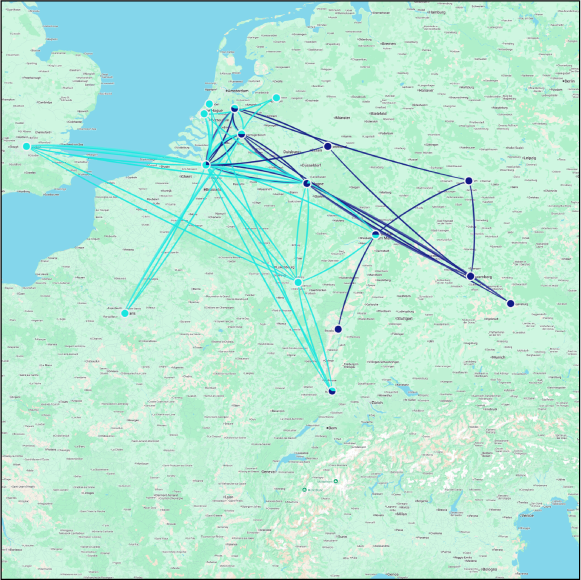
What is the explanation for this strong differentiation? Possibly, this is linked to the fact that Macropedius’s comedies began to circulate somewhat later than those of his two contemporaries. The difference is not big, but maybe it was enough. For instance, the first work by Macropedius to reach Paris, his Greek grammar in 1542, and his first work to be printed in Cologne, Hecastus in 1539, both followed more than a decade after the Farrago and Acolastus. They therefore might have missed the first period of great demand for humanist schoolbooks and especially play texts. Maybe a differentiation took place during these years, where printers would specifically target those subjects that were still lacking to their clients, although it is impossible to tell from these two examples. It is also the case that Latin biblical drama for schools was much less popular in France and Britain than in the Germanic lands.
4 Printers with a Preference for Drama
Four of the twelve printers who printed Crocus’s play had already printed schoolbooks by him, but the others seem to have no such record. In most cases, these were print shops with a specialization in classical and humanist drama. Often, they had already produced the Acolastus by Guilielmus Gnapheus. In many cases, these dramatic texts were meant for performance in a particular school and were probably made by commission of a teacher of rhetoric with an interest in Latin drama as a pedagogical tool. In other cases, the printings evince a general interest in classical drama, in the originals as well as the modern versions.
4.1 Antwerp
One of the great Antwerp printers, Michael Hillenius Hoochstratanus, began printing drama in 1514 with an edition of Plautus’s Aulularia. This play, one of the less indecent ones in the Roman playwright’s oeuvre, had been performed in Leuven by the students of Dorpius and Barlandus.16 After printing other comedies by Plautus, his presses produced a newly written school drama by Eligius Eucharius Houckaert in 1519. Houckaert was one of the first teachers in the Low Countries to experiment with Latin school plays, in Ghent, and his Grisellis is probably the first of its kind in this region. Hillenius followed up with the comedies of Terence, more Plautus, and Acolastus in 1530. He later also printed sacred comedies by Zovitius and Macropedius.
Two other Antwerp printers, Martin de Keyser and Johannes Steelsius, are atypical in that they first printed a recently written sacred drama from the Low Countries, before they turned to editions of Plautus or Terence. Martin de Keyser was the first to print the Acolastus in 1529. The comedies of Terence appeared two years later. His widow continued this tradition by reprinting Terence, but also included new sacred drama, namely Christus xilonicus in 1537 and Ovis perdita by Zovitius in 1539.
Johannes Steelsius, in turn, began printing drama with another play by Zovitius, Didascalus, in 1534, which was followed by Crocus’s Joseph two years later, before he printed Plautus. Terence was a staple in his printshop, but he and his heirs also continued printing new drama. An eclectic collection of drama thus came together: Homulus, the Elckerlijck-translation by Christian Ischyrius; two farces by Arnoldus Madirus; the comedy Anabion by Johannes Sapidus; a tragedy called Imber aureus by the Italian Antonio Telesio (which had previously appeared in Basel with Oporinus); two plays by Petrus Philicinus, deacon in Hainaut; and a Spanish allegorical comedy by Pedro Hurtado de la Vera, who was at that time staying in Antwerp.
4.2 Paris
Christian Wechel, a protestant printer based in Paris, printed the comedy Acolastus first in 1530 and Joseph seven years later. He also printed Terence’s comedies, the Greek comedies by Aristophanes, Prometheus Bound by Aeschylus, and the Greek text of the medieval Greek tragedy Paschon, which was attributed in the sixteenth century to Gregory of Nazianze and became a model for humanist tragedy.17 Wechel originally came from Brabant and maintained good relations there.18 He was a principal publisher of Erasmus and known for his parallel Greek and Latin editions of classical works.
Another early printer of Greek in Paris, Jean Loys, produced Euripides’s Orestes in 1536, later followed by Medea and Hecuba, and plays by Aristophanes in 1545. He regularly reprinted editions of Terence and Plautus, and also included the new comedy Acolastus among the classical drama. Loys was originally from Tielt in Flanders and had many connections with Flemish booksellers.19
Maurice de la Porte, a humanist printer who was famous as an author as well for his lexicographical work Les Épithetes, had printed Plautus’s Aulularia a decade before producing Joseph during the 1540s. His widow added Terence, Muret, and Acolastus during the 1550s. She also printed Macropedius’s Greek handbook but not his plays, as far as we know.
Someone with an earlier interest in vernacular instead of Latin drama is Guillaume le Bret, who had published both luxury editions with woodcut images of the Mystère du vieil Testament (1542) and the bilingual edition of Terence, Le grant Therence (1539), before he printed Joseph by Crocus.
4.3 Basel
In Basel, Acolastus equally made its appearance among classical Greek and Latin drama. Johannes Herwagen, who had married Maria Lachner, the widow of Johannes Froben, and collaborated with two of her sons, published a bilingual Latin and Greek edition of Sophocles’s Aiax in 1533, Acolastus in 1534, a huge volume of the collected works of Plautus in 1535, and an equally enormous volume of Euripides’s collected tragedies in Greek 1537. He reprinted Euripides and Plautus during the next two decades.
We also find many of our Latin comedies together in two anthologies of humanist drama published in the city: one by Nikolaus Brylinger from 1540 and one by Oporinus in 1547.20 In 1540, Nikolaus Brylinger included both Joseph by Crocus and no less than three of Macropedius’s plays in his anthology of biblical plays.21 Strikingly, none of these plays by Macropedius even has a biblical story: Hecastus is an Everyman play about a rich sinner who learns what is really of value in life and death, and the farcical comedies Andrisca and Bassarus were added for comic relief, and because they show so beautifully “how morally corrupt the current times are.”22 How did Brylinger get his hand on these three plays? Henk Giebels and Frans Slits have suggested that a former pupil of Macropedius played a role.23 During these years, the humanist scholar Arnoldus Arlenius Peraxylus gained a living in the Swiss city as a bookseller and middleman between publishers, authors, and clients, and so became acquainted with many printers.
The fact that three of Macropedius’s plays were included in the anthology despite the fact that their contents do not fit the intent of the volume says much about their appeal to people interested in the new Latin comedy. However, no play of Macropedius was included in the second Basel anthology by Johann Oporinus that came out seven years later. This anthology restricted itself to old-testament stories and, in contrast to the one by Brylinger, strictly kept to its design. It included Crocus’s Joseph but no other Netherlandish playwright. Like Macropedius, many Latin playwrights from the Low Countries preferred new-testament stories, particularly parables.
4.4 Leipzig and Lyon
Two other places where the Acolastus appears as the only representative of new sacred drama among classical drama are Leipzig and Lyon. In Leipzig, Nickel Schmidt printed Plautus in the 1520s and then the Acolastus throughout the next decade. A similar picture is found in Lyon, where Thibaud Payen printed Terence throughout the 1540s and 1550s and Acolastus in 1557.
4.5 Cologne
The Cologne Gymnich family, as well, specialising in theology and classics, had in the previous years published Seneca’s Octavia, Terence’s and Plautus’s comedies, Gnapheus’s Acolastus, Christus xilonicus by Nicolas Barthélemy (written in the vein of the Paschon), and two comedies by Joannes Reuchlin. They also printed Macropedius’s plays throughout the 1540s.
Peter Horst, one of the other big printers in Cologne, started his dramatic output with Macropedius’s Lazarus in 1550. In 1552, he printed the Studentes, comoedia de vita studiosorum by Christoph Stummel, which is a free adaptation of Acolastus. Only in 1563 did he produce the original Acolastus. Next to these new dramas, he printed many editions of Terence.
4.6 Augsburg
During the period that Alexander Weissenhorn printed Joseph, he also printed Terence’s comedies, and many other schoolbooks. In the same year 1539, he produced the anti-Catholic tragedy Pammachius by Thomas Naogeorgus, and in the following decades many plays by Hieronymus Ziegler.
4.7 Dortmund
Melchior Soter/Heyl printed schoolbooks for the Dortmund Catholic gymnasium between 1544 and 1551. The first and last of these are the two plays by the rhetoric teacher at the gymnasium, Jacob Schöpper: a tragedy about John the Baptist and a tragicomedy about David and Goliath. Schöpper must also have ordered the printing of Sergius by Johannes Reuchlin, Miles gloriosus by Plautus, Crocus’s Joseph and Macropedius’s Hecastus. Next to these, Soter printed various other schoolbooks for the gymnasium.
4.8 Strasbourg
Four hundred kilometers to the south, the case of Strasbourg is interesting because it is possible there to follow a full century of printing Latin drama and see how it interacts with the development of the gymnasium.24 The gymnasium founded by Johannes Sturm in 1538 is well known for its theatrical performances of classical drama, and at one time even had a permanent wooden theatre in the courtyard.25 But classical theatre bloomed in Strasbourg even before that time. Terence was printed there even before 1470 and Plautus from 1508. The schoolmaster and playwright Johannes Sapidus was rector of one of the Latin schools that later merged to form the new gymnasium. His play Anabion inaugurated the opening of the new school in 1538.
The Strasbourg schools also often performed plays in German translation, which is reflected in the frequency with which sacred comedies appear in translation. Acolastus first appeared with Jacob Jucundus/Frölich in 1535 in a German translation. It might have been printed for Johannes Sapidus, who admired the Netherlandish playwrights. When Jucundus printed Joseph in 1537 and 1546, however, it appeared in Latin. Apart from these Latin plays, Jucundus mainly printed German drama. He was the regular printer of many Fastnachtspiele by Jörg Wickram, from nearby Colmar. He printed Sixt Birck’s Judith and Thiebolt Gart’s popular German version of the Joseph comedy, which had been influenced by Crocus. Around 1550, he produced plays by the Reformers and theologians Heinrich Bullinger, Leonhard Culmann, and Thomas Sunnentag.
Another one of these early printers of Terence and Plautus was Johann Prüss. It seems as if he occasionally produced schoolbooks for the small Latin school in the city but it appears from his printing activities that he was not involved with the later gymnasium. In 1541, he printed two German plays: Pammachius and Acolastus in translation.
Christian Müller, whose father Krafft Müller had printed Sapidus’s Anabion and who after the death of Frölich took over his house at the Kornmarkt, his printer’s seal,26 and apparently also his stock, continued printing both the Latin and the German dramas. However, a change occurs after the year 1566, when the gymnasium of Strasbourg earned the status of an academy, which could bestow the same titles as a university except the doctorate. This institutional change went hand in hand with a changing taste in drama characteristic of late northern humanism. After this date, Müller did not print any of his Latin sacred comedies or tragedies anymore. Acolastus, which had only 1561 still appeared in Latin, was now published in a German translation (1578). Among his German Spile and Fastnachtspile, Müller now produced a Latin translation of Sophocles’s Oedipus tyrannos (1567). However, he soon got competition from Nicolas Wiriot. Instead of Plautus, Wiriot printed Latin translations of Euripides’s Medea, Phoenissae, and Troades (1576 and 1577). Instead of comedies by Reuchlin, Birck or Gart, he printed George Buchanan’s tragedies Jephtes and Baptistes (1569 and 1579). Apparently, the new semi-university status of the school required Greek tragedy instead of Latin comedy. With one exception: in 1583, Wiriot still printed Crocus’s biblical comedy about Joseph, together with the biblical comedy Tobaeus by Cornelius Schonaeus. Moreover, his successor Antoine Bertram, who married Wiriot’s widow in 1584,27 still printed Macropedius’s Hecastus in 1586 and 1589. The Netherlandish sacred comedies thus managed to remain popular amid the rise of Greek drama.
5 Who Are the Others?
We have seen that the drama of these humanist teachers generally follows a different trajectory from their other schoolbooks. This is the case for Crocus but more pronounced with Macropedius. In some cases, it is due to the fact that other teachers, printers, or booksellers were actively looking for humanist drama that could be performed next to and instead of the comedies by Plautus or Terence. Many printers, as we saw, specialized in Latin drama. But who are the other printers, those that I have not discussed yet? These are the printers that did not produce other plays besides one single edition of Gnapheus, Crocus, or Macropedius.
For Gnapheus and Crocus, this group is very small. Gnapheus’s Acolastus appeared with four printers who do not have any other drama in their catalogues: all of them are printers of schoolbooks in Antwerp. This makes sense, as Antwerp was one of the print capitals of Europe during these years, and many others were already printing Latin plays. Crocus’s Joseph was almost exclusively printed in workshops with a record of drama, except in the case of Christoph Lochner in Altdorf. This 1595 edition would have been meant for the protestant academy in Altdorf, near Nuremberg, which later became a university.
The case is different for Macropedius, whose drama does not only follow different trajectories from the other works by the same author, but also from the comedies by Gnapheus and Crocus. The visualization above of the cities where their dramas were printed between 1529 and 1580 demonstrates this.
Figure 2.6
Plays by Gnapheus in green, Crocus’s Joseph in red, Macropedius’s drama in blue

The only cities in common are Antwerp, Cologne, Basel (due to Brylinger’s anthology), and Dortmund (just one printer). The plays by Gnapheus and Crocus overlap to a great degree (although Acolastus travels further, namely to London, Lyon, Zürich, and Leipzig). The plays by Macropedius, in contrast, are printed in Regensburg (1546), Nuremberg (1552), Erfurt (1564), and Frankfurt (1571). Moreover, as we saw, the printers that Gnapheus and Crocus, and sometimes Macropedius, have in common a catalogue of Latin and Greek drama. However, this is not the case for Macropedius’s other printers. As far as we know, Hans Kohl, Hans Daubmann, and Georg Baumann did not print any other drama before or after they produced plays by Macropedius. Most of them only printed Hecastus, and only once. They did not even produce schoolbooks, which explains the divergence between the plays and the other schoolbooks at least on the side of the plays. Mostly, they printed protestant devotional material, news, catechisms, and Bibles and commentaries on the Bible.
This is not the case for the Frankfurt printer, Christian Egenolff. His workshop produced many schoolbooks, among which the comedies of Terence in 1562 and 1568, a few years before he printed Hecastus in 1571. Whereas with Egenolff, we can assume that Hecastus was produced for the same Latin schools as the other schoolbooks, this is not the case for the other printers. The cities where these printers were active did have Latin schools and even a university (Erfurt). It thus seems that the popularity and renown of Hecastus went beyond even the context of the schools.
Conclusion
In conclusion, the circulation of humanist biblical comedies in the sixteenth century reveals a complex interplay between educational demand, regional printing practices, and the networks of booksellers and printers across Europe. The rapid spread of plays by Gnapheus, Crocus, and Macropedius underscores the growing popularity of humanist school drama as an alternative to classical Roman comedies, driven by the educational reforms of the time. While these plays were printed in major centres like Antwerp, Paris, and Cologne, the paths they took were often distinct from the broader market for schoolbooks.
The distribution and production of biblical comedies in the sixteenth century offer a unique perspective on the broader dynamics of educational publishing, demonstrating several key patterns distinct from those of typical schoolbooks. First, rather than being limited to local markets, plays like Acolastus or Joseph were printed in a wide array of major European printing centres. This widespread publication indicates that the demand for these comedies was not constrained by local or regional markets, but reflected a broader European interest. These plays circulated widely across different centres of intellectual and religious life, transcending the typical patterns of schoolbook distribution that Gehl describes, and emphasising their significant role in the educational and cultural exchange of the period.
In most cases, these plays were printed in print shops specializing in classical and humanist drama. The enormously popular Acolastus by Guilielmus Gnapheus often opened the door to plays by other Dutch humanists. Many of these dramatic works were likely commissioned by teachers of rhetoric for performance in specific schools, reflecting an interest in using Latin drama as a pedagogical tool. In other cases, the publications indicate a broader enthusiasm for classical drama, encompassing both the ancient originals and their modern adaptations.
Second, the distinction between the dissemination of humanist drama and the other educational works of Gnapheus, Crocus, and Macropedius is striking. Their biblical comedies often followed a different trajectory on the international book markets. This difference is especially marked in the case of Macropedius, whose plays circulated in distinct ways compared to his other educational books. This divergence may be explained by a growing demand from teachers, printers, and booksellers seeking humanist dramas to perform in schools, often replacing or supplementing classical works like those of Plautus or Terence. The printers who specialized in such drama were often not the same ones who printed the authors’ other schoolbooks, indicating a specialization in the production of educational drama as a distinct genre. Some printers focusing primarily on religious or protestant material only produced a single edition of a play like Hecastus, suggesting that these plays reached an audience beyond mere educational use, tapping into the religious and intellectual movements of the time.
My dataset can be consulted on the online repository Zenodo via 10.5281/zenodo.15593515.
For Crocus, I have used Albertus Josefus Kölker, Alardus Aemstelredamus en Cornelius Crocus, twee Amsterdamse priester-humanisten; Hun leven, werken en theologische opvattingen: Bijdrage tot de kennis van het humanisme in Noord-Nederland in de eerste helft van de zestiende eeuw (Nijmegen: Dekker & Van de Vegt, 1963) PhD thesis Nijmegen. For Macropedius, Rudolphus Cornelis Engelberts, Georgius Macropedius, Bassarus: Tekst met inleiding en vertaling (Tilburg: Gianotten, 1968) PhD thesis Utrecht. For Schonaeus, Hans van de Venne, Cornelius Schonaeus (1540–1611): Leven en werk van de christelijke Terentius, vol. 3: Bibliographia Schonaeana (1569–1964), (Voorthuizen: Florivallis, 2003). I have added data from the Universal Short Title Catalogue, the Verzeichnis der im deutschen Sprachbereich erschienenen Drucke des 16. Jahrhunderts (VD 16) of the Bayerische Staatsbibliothek, and the catalogue of the BnF.
Pim van Bree and Geert Kessels, ‘Nodegoat: A Web-Based Data Management, Network Analysis & Visualisation Environment’ (LAB1100, 2013),
Malcolm Walsby, ‘The Vanishing Press: Printing in Provincial France in the Early Sixteenth Century’, in Malcolm Walsby and Graeme Kemp (eds), The Book Triumphant: Print in Transition in the Sixteenth and Seventeenth Centuries (Leiden and Boston: Brill, 2011), pp. 97–114.
Paul F. Gehl and Benito Rial Costas, ‘Advertising or Fama? Local Markets for Schoolbooks in Sixteenth-Century Italy: A Contribution to the History of Printing and the Book Trade in Small European and Spanish Cities’, in Benito Rial Costas (ed.), Print Culture and Peripheries in Early Modern Europe: A Contribution to the History of Printing and the Book Trade in Small European and Spanish Cities (Leiden and Boston: Brill, 2013), pp. 69–100 (p. 98).
Guilielmus Gnapheus, Acolastus, ed. by P. Minderaa (Zwolle: Tjeenk Willink, 1956) Zwolse drukken en herdrukken voor de Maatschappij der Nederlandse Letterkunde te Leiden, 15, p. 27.
Ruprecht Wimmer, Jesuitentheater: Didaktik und Fest: Das Exemplum des ägyptischen Joseph auf den deutschen Bühnen der Gesellschaft Jesu (Frankfurt am Main: Vittorio Klostermann, 1982), pp. 117–157.
See Kölker, Alardus Aemstelredamus en Cornelius Crocus, pp. 167–211.
Henk M.T.M. Giebels and Frans P.T. Slits, Georgius Macropedius, 1487–1558: Leven en werken van een Brabantse humanist (Stichting Zuidelijk Historisch Contact, 2005) Bijdragen tot de geschiedenis van het Zuiden van Nederland, 28.
Cornelis Johannes Antonius van den Oord, Twee eeuwen Bosch’ boekbedrijf: 1450–1650: Een onderzoek naar de betekenis van Bossche boekdrukkers, uitgevers en librariërs voor het regionale socio-culturele leven (Tilburg: Stichting Zuidelijk Historisch Contact, 1984), p. 101.
Van den Oord, o.c., pp. 109–110.
Gehl and Rial Costas, ‘Advertising or Fama?’
Gehl and Rial Costas, o.c., p. 70.
Kölker, o.c., pp. 47–55.
In 1532 and 1533, the Antwerp printers Johannes Grapheus and Michael Hillenius added Melanchthon’s Loci communes. In 1566, the Lutheran pedagogue and theologian Lucas Lossius excerpted from Erasmus and Crocus, as well as from De vocabulorum differentiis by Marcus Cornelius Fronto, and the De sermone Latino et modis Latine loquendi by Adriano Castellesi to compose a new textbook, printed by the heirs of the Frankfurt printer Christian Egenolff.
Marijke Spies, ‘A Chaste Joseph for Schoolboys: On the Edition of Cornelius Crocus’ Sancta Comoedia Joseph (1536–1548)’, in Koen Goudriaan, Jaap van Moolenbroek, and Ad L. Tervoort (eds), Education and Learning in the Netherlands, 1400–1600. Essays in Honour of Hilde de Ridder-Symoens (Leiden and Boston: Brill, 2004), pp. 223–233.
Jan Bloemendal, ‘Neo-Latin Drama in the Low Countries’, in Jan Bloemendal and Howard B. Norland (eds), Neo-Latin Drama and Theatre in Early Modern Europe (Leiden and Boston: Brill, 2013) Drama and Theatre in Early Modern Europe, 3, pp. 293–364 (p. 196).
James A. Parente, ‘The Development of Religious Tragedy: The Humanist Reception of the Christos Paschon in the Renaissance’, The Sixteenth Century Journal, 16 (1985), pp. 351–368.
Robert J.W. Evans, The Wechel Presses: Humanism and Calvinism in Central Europe, 1572–1627 (Oxford: Past and Present Society, 1975) Past and Present Supplement, 3, p. 2.
Philippe Renouard, Imprimeurs & libraires parisiens du XVIe siècle: Jean Loys (Paris: Paris-Musées, 1995).
Dramata sacra: comoediae atque tragoediae aliquot e Veteri Testamento desumptae (Johann Oporinus, 1547); Comoediae ac tragoediae aliquot ex novo et vetere testamento desumptae (Nikolaus Brylinger, 1540). On these collections, see: Parente, James A., ‘The Anthology as Site of Transnational Literary Exchange in the German Empire and the Low Countries’, Medievalia et Humanistica, 48 (2023), pp. 41–62.
Comoediae ac tragoediae aliquot.
Comoediae ac tragoediae aliquot. The title page says: “Adiunximus praeterea duas lepidissimas comoedias, mores corruptissimi seculi elegantissime depingentes.”
Giebels and Slits, Georgius Macropedius, p. 287.
Anton Schindling, Humanistische Hochschule und freie Reichsstadt: Gymnasium und Akademie in Strassburg 1538–1621 (Wiesbaden: Steiner, 1977).
August Jundt, ‘Die dramatischen Aufführungen im Gymnasium zu Strassburg: Ein Beitrag zur Geschichte des Schuldramas im XVI. und XVII. Jahrhundert’, in Protestantisches Gymnasium zu Strassburg: Programm auf das Schuljahr 1881–1882 (Strasbourg: J.H.E. Heitz, 1881), pp. 3–68; James A. Parente, ‘ “Tragoedia Politica”: Strasbourg School Drama and the Early Modern State, 1583–1621’, Colloquia Germanica, 291 (1996), pp. 1–11.
Paul Heitz and Karl August Barack, Elsässische Büchermarken bis Anfang des 18. Jahrhunderts (Strasbourg: Heitz, 1892), p. XII.
François Joseph Fuchs, ‘Bertram, Antoine’, in Christian Baechler and Jean-Pierre Kintz (eds), Nouveau dictionnaire de biographie alsacienne (Strasbourg: Fédération des Sociétés d’Histoire et d’Archéologie d’Alsace, 1982).