


Territory and Jurisdiction
Authority and Sovereignty over Territory
Statement of the Government of the People’s Republic of China on the Baselines of the Territorial Sea Adjacent to the North Part of the Beibu Gulf (1 March 2024) and Statement of the Government of the People’s Republic of China on the Baselines of the Territorial Sea Adjacent to Huangyan Dao (10 November 2024)
In 2024, the Chinese Government issued important statements on the baselines of the territorial sea in the northern part of the Beibu Gulf and on Huangyan Island, respectively, which not only clarified China’s sovereignty and maritime rights and interests in the relevant sea areas, but also reflected China’s firm determination to fulfil its international obligations as a State party to the United Nations Convention on the Law of the Sea.
Statement of the Government of the People’s Republic of China on the Baselines of the Territorial Sea Adjacent to the North Part of the Beibu Gulf
On 1 March 2024, the Chinese Government, in accordance with the Law of the People’s Republic of China on the Territorial Sea and Contiguous Zone promulgated on 25 February 1992, declared the baselines of the territorial sea in the northern part of Beibu Gulf. The baselines of the territorial sea adjacent to the north part of the Beibu Gulf are composed of the straight lines joining the adjacent base points as listed in Table 1 and Figure 1 below:

Base points constituting the straight baselines of northern part of the Beibu Gulf’s territorial sea
Source: https://www.un.org/Depts/los/LEGISLATIONANDTREATIES/STATEFILES/CHN.htm, last visited: 2025/04/10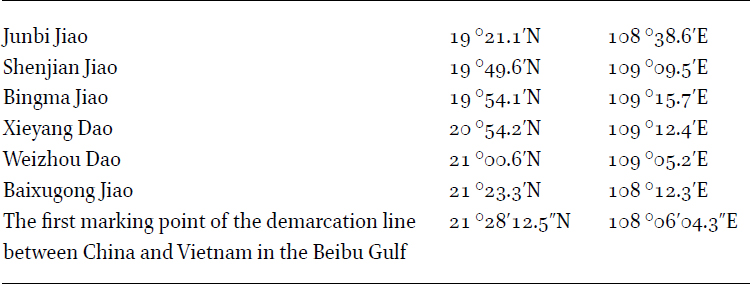
The chart of a part of baseline of the territorial sea of the mainland of the People’s Republic of China (northern part of the Beibu Gulf)
Source: https://www.un.org/Depts/los/LEGISLATIONANDTREATIES/STATEFILES/CHN.htm, last visited: 2025/04/10
This statement aims to clarify China’s maritime rights and interests and territorial sovereignty in the Beibu Gulf and to provide a legal basis for maritime management and resource development in the relevant waters.
Statement of the Government of the People’s Republic of China on the Baselines of the Territorial Sea Adjacent to Huangyan Dao
On 10 November 2024, the Chinese government announced the baselines of the territorial sea adjacent to Huangyan Dao of the People’s Republic of China in accordance with the Law of the People’s Republic of China on the Territorial Sea and the Contiguous Zone promulgated on 25 February 1992. Huangyan Island is an inherent territory of China, and this declaration aims to clarify China’s sovereignty over the island and its maritime rights and interests in the relevant waters. The baselines of the territorial sea adjacent to Huangyan Dao are composed of straight lines joining the adjacent base points as listed in Table 2 and Figure 2 below:
Base points constituting the straight baselines of Huangyan Dao’s territorial sea
Source: https://www.un.org/Depts/los/LEGISLATIONANDTREATIES/STATEFILES/CHN.htm, last visited: 2025/04/10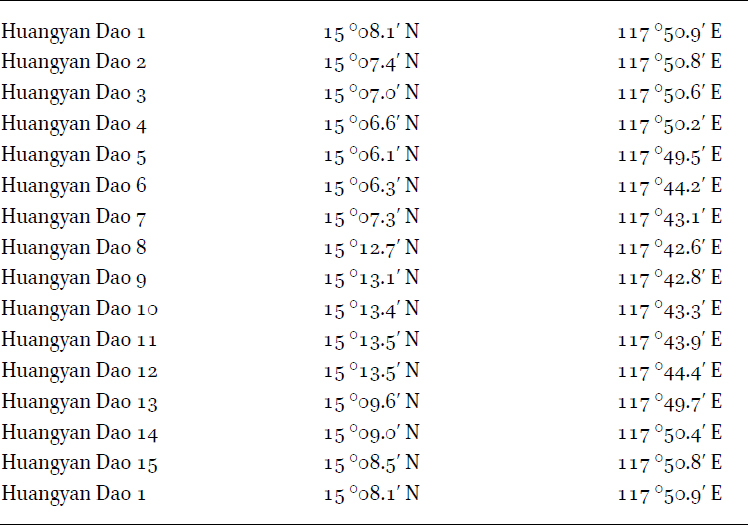
The chart of baseline of territorial sea of Huangyan Dao (Minzhu Jiao) of the People’s Republic of China
Source: https://www.un.org/Depts/los/LEGISLATIONANDTREATIES/STATEFILES/CHN.htm, last visited: 2025/04/10
This statement is a move by the Chinese Government to safeguard its territorial sovereignty and maritime rights and interests in accordance with the law, and is consistent with international and domestic law.
These statements by the Chinese Government not only provide a clear legal basis for safeguarding China’s territorial sovereignty and maritime rights and interests, but also provide the international community with a clear geographical and legal framework. By depositing the relevant statements and charts with the United Nations, China has demonstrated its respect for and compliance with international law. These statements also lay the foundation for future scientific research, marine spatial planning and resource development and utilization in the relevant waters. At the same time, it also shows that China will resolutely take necessary measures to respond to any infringement of China’s sovereignty and rights while exercising restraint in the South China Sea.
Sovereign/State Immunity
Immunity of States from Jurisdiction
Law of the People’s Republic of China on the Immunity of Foreign States
Document Number: Order No. 10 of the President of the People’s Republic of China, Date Issued: 1 September 2023; Effective Date: 1 January 2024
The Fifth Session of the Standing Committee of the Fourteenth National People’s Congress of the People’s Republic of China adopted the Law of the People’s Republic of China on State Immunity of Foreign States (State Immunity Law) on 1 September 2023, and the Law shall come into force on 1 January 2024. The State Immunity Law consists of 23 articles, which are mainly provisions revolving around the immunity of foreign States and their property in Chinese courts. The Law clarifies the basic principles of immunity from jurisdiction of foreign States and their property, while providing for six categories of exceptions to immunity; it also deals with immunity from measures of constraint for the property of foreign States and the exceptions thereto, as well as the scope of application of the Law, the role of the Ministry of Foreign Affairs in the relevant cases, and the special provisions on litigation procedures, and clarifies the relationship with other laws and international treaties.
Article 3 of the State Immunity Law provides that: “A foreign State and its property shall enjoy immunity from the jurisdiction of the courts of the People’s Republic of China, unless otherwise provided for in this Law”. This article clarifies, at the legislative level, the position of China in adopting the principle of limited immunity.
Article 4 of the State Immunity Law provides for the acceptance of China’s jurisdiction by foreign States, and the Law specifies the circumstances in which a foreign State accepts the jurisdiction of Chinese courts by express means, including through international treaties, written agreements, the submission of written documents to Chinese courts, diplomatic channels, and so on. Articles 5 and 6 of the State Immunity Law specify, respectively, the circumstances in which a foreign State is deemed to have accepted the jurisdiction of Chinese courts and the acts that are not deemed to have accepted the jurisdiction of Chinese courts.
Articles 7 to 12 of the State Immunity Law provide for exceptions to the immunity of foreign States and their property, including commercial activities, labour or service contracts, compensation for personal injury or property damage, specific property matters, intellectual property matters and arbitration-related matters, and in the event that a dispute arises between a foreign State and a relevant civil subject in China in respect of the above-mentioned matters, the foreign State does not enjoy immunity from jurisdiction in Chinese courts.
Articles 13 and 14 of the State Immunity Law distinguish between immunity from jurisdiction and immunity from judicial coercion; acceptance by a foreign State of immunity from the jurisdiction of a Chinese court does not amount to a waiver of immunity from judicial coercion, and waiver of immunity from judicial coercion must be expressly waived in a separate and effective manner.
Articles 16 to 19 of the State Immunity Law set out the procedures for the trial and execution of civil cases against the State and its property, and provide for service of process and trial in absentia in cases of immunity, in addition to stipulating that where procedural matters are not provided for in this Law, the Civil Procedure Law of the People’s Republic of China shall apply. Among the ways in which Chinese courts may serve summonses or other litigation documents on foreign States, service by means of a diplomatic note has been added. It also clarifies the role of the Ministry of Foreign Affairs of the People’s Republic of China in handling cases of foreign State immunity.
Articles 20 and 21 of the State Immunity Law reaffirm the privilege and immunity enjoyed by organizations and members of the diplomatic community in accordance with the laws of the State, the international treaties to which the State is a party or in which it is a party and international custom, while at the same time adopting the principle of reciprocity in respect of privilege and immunity.
Prior to the enactment of the State Immunity Law, Chinese courts had always adopted the principle of absolute immunity, whereas the enactment of specific legislation on foreign state immunity marks a shift from the principle of absolute immunity to the internationally mainstream principle of limited immunity. In cases where a foreign State is deemed to have accepted the jurisdiction of the courts of China, i.e., where “a foreign State participates as a defendant in a lawsuit before a Chinese court and defends the case on the merits or raises a counter-claim”, the Law stipulates in the corresponding provision that if the foreign State is able to prove that it could not have been aware of the fact that it had an immunity that could be claimed until it had made the defense. If the foreign State can prove that it could not have been aware of the fact that it could claim state immunity prior to making its plea, it may claim immunity from jurisdiction within a reasonable time after it knew or should have known of the fact. The relevant provisions provide a legal basis for the right of a foreign State to claim jurisdictional immunity from the courts of China, which is consistent with the content of Article 8 of the United Nations Convention on Jurisdictional Immunities of States and Their Property, and complies with the obligations of States parties. The State Immunity Law establishes China’s foreign State immunity system, which adopts the legislative style of “immunity is the principle, non-immunity is the exception”, which is fully in line with the prevailing international practice, and is another major milestone in China’s efforts to promote the rule of law at the domestic level as well as the rule of law in relation to foreign affairs.
Settlement of Disputes
Diplomatic Approaches and Peace Initiatives
China, Brazil on Political Settlement of Ukraine Crisis, 23 May 2024
Against the backdrop of the Ukrainian crisis, China and Brazil reached a consensus on the political settlement of the Ukrainian crisis on 23 May 2024, a consensus that reflects the two States’ shared commitment to international peace and security and their firm stance on resolving international disputes through dialogue and cooperation.
The parties call on all parties concerned to abide by the “three principles” of de-escalation, namely, no spillover from the battlefield, no escalation of fighting, and no fire from the parties. At the same time, the two sides believe that dialogue and negotiation are the only viable way to resolve the crisis in Ukraine, and that conditions should be created for the resumption of direct dialogue, with a view to cooling the situation and easing it until a comprehensive ceasefire is reached. China and Pakistan support the timely convening of an international peace conference recognized by the Russian and Ukrainian sides, with the equal participation of all parties, and with fair discussions on all peace options. In addition, the two sides emphasize the need to increase humanitarian assistance to the regions concerned, to prevent the emergence of a humanitarian crisis of a larger scale, to avoid attacks on civilians and civilian facilities, to protect civilians, including women and children, and prisoners of conflict, and to support the exchange of prisoners of conflict between the parties. The two sides also oppose the use of weapons of mass destruction, in particular nuclear, biological and chemical weapons, and do everything possible to prevent nuclear proliferation and avert nuclear crises, as well as attacks on peaceful nuclear facilities such as nuclear power plants, and all parties should abide by international law, including the Convention on Nuclear Safety, and resolutely avoid man-made nuclear accidents. Lastly, the two sides oppose the fragmentation of the world and the creation of closed political or economic blocs, and call for the strengthening of international cooperation on energy, currency, finance, trade, food security and the protection of the security of key infrastructure, such as oil and gas pipelines, undersea fiber-optic cables, electric power and energy facilities, and fiber-optic networks, so as to maintain the stability of the global industrial chain and supply chain.
This consensus not only demonstrates the ability of China and Brazil to cooperate in international affairs, but also further consolidates the bilateral relations between the two States, provides the international community with a framework for the peaceful resolution of the Ukrainian crisis, emphasizes the importance of dialogue and cooperation, and provides a useful reference for global governance and international dispute resolution.
International Economic Law
Implementation of International Economic Law – Tax Law
Tariff Law of the People’s Republic of China
Document Number: Order No. 23 of the President of the People’s Republic of China, Date Issued: 26 April 2024; Effective Date: 1 December 2024
The Tariff Law of the People’s Republic of China (the Tariff Law) was promulgated on the basis of the expired Regulations of the People’s Republic of China on Import and Export Tariffs (the Tariff Regulations). The Tariff Regulations were formulated against the historical background of China’s recent accession to the World Trade Organization (WTO) at the turn of the century, and they have been amended several times since then. Due to factors such as legal status, legislative technology and the context of the times, it is difficult for them to better serve the new environment of economic development and the new pattern of foreign trade. In order to further promote a high level of opening up to the outside world and create a market-oriented, rule of law-oriented and internationalized business environment, the Tariff Law came into being. The Tariff Law consists of seven chapters and 72 articles, including the general provisions, tariff items and rates, tax payable, tax preferences and special cases of tariff collection, collection management, legal liabilities, bylaws, and the import and export tariff rules of the People’s Republic of China. It substantially consolidates the former Tariff Regulations and many scattered documents and contains new contents, representing a major reform and improvement of China’s tariff system.
Paragraph 2 of Article 3 of the Tariff Law adds “e-commerce platform operators engaged in cross-border e-commerce retail imports, logistics enterprises and customs declaration enterprises, as well as units and individuals obliged by laws and administrative regulations to withhold and pay customs duties on behalf of others” as the withholding obligation for customs duties, which is based on the development of the business model of cross-border e-commerce and other present-day business models. This is a new addition based on the development of cross-border e-commerce and other current business models. Article 9 stipulates that “tariff lines are composed of tariff codes and catalog provisions” and “rules for the application of tariff lines include rules for classification.” This article is a new addition, which makes detailed provisions on the composition of tariff lines and rules for their application. Article 11 stipulates that the application of tariff rates shall be in accordance with the corresponding rules of origin, and adopts the international common standards of origin, which is also new. Article 41 of the Tariff Law stipulates that the administration of tariff collection can be carried out in a mode that separates the release of goods from the determination of the amount of tariff. The tariff collection management shall adapt to the needs of the development of new forms and modes of foreign trade, and enhance the level of informatization, intelligence, standardization and facilitation. This provision provides the system of separating the release of goods from the amount of duty can greatly improve the speed of customs clearance, reflecting the legislative purpose of promoting foreign trade and advancing a high level of opening to the outside world. Article 54 is a new anti-circumvention provision, which allows the State to take anti-circumvention measures such as adjusting tariffs for behavior that reduces the amount of tax payable without a reasonable commercial purpose. Chapter 6 of the Tariff Law regarding legal liability is a new chapter, as the original Tariff Regulations only set out principle provisions in the by-laws, but this time the Tariff Law sets out a separate chapter, which details the legal liability and specifies the corresponding penalties.
The Tariff Law clearly stipulates that China may take corresponding measures in accordance with the principle of reciprocity against States and regions that do not fulfill the most-favored-nation or tariff-preferential clauses in international treaties and agreements concluded with China or to which China is a party, and it also stipulates the statutory process of adjusting tariff rates, especially the adjustment of most-favored-nation tariff rates, tariff-quota tariff rates and export tariffs, which must be proposed by the Tariff Commission of the State Council and reviewed by the State Council before being submitted to the Standing Committee of the National People’s Congress for a decision. This is in line with the principle of most-favored-nation treatment of the World Trade Organization and the principle of transparency. The Tariff Law also integrates the three major technical elements of customs tariffs, namely pre-categorization of goods, origin and valuation, reflecting China’s compliance with the relevant international trade treaties and agreements of the WTO and the World Customs Organization. The introduction of the Tariff Law will enhance the internationalization of China’s tariff system while creating a fairer, more transparent and more convenient environment for international trade and investment.
Anti-money Laundering and Financial Regulation
Anti-money Laundering Law of the People’s Republic of China
Document Number: Order No. 38 of the President of the People’s Republic of China, Date Issued: 8 November2024; Effective Date: 1 January 2025
In 2006, China promulgated the first Anti-Money Laundering Law of the People’s Republic of China (the Anti-Money Laundering Law), and on 8 November 2024, the new Anti-Money Laundering Law was amended and passed by the Standing Committee of the Fourteenth National People’s Congress, and came into force on 1 January 2025. This is a systematic and large-scale revision of the Anti-Money Laundering Law after a lapse of 18 years. The new Anti-Money Laundering Law consists of seven chapters, namely, General Provisions, Supervision and Administration of Anti-Money Laundering, Obligations of Anti-Money Laundering, Investigation of Anti-Money Laundering, International Cooperation of Anti-Money Laundering, Legal Liability, and Supplementary Provisions. Though the setting of the chapters is the same as that of the old Anti-Money Laundering Law, the new Anti-Money Laundering Law has supplemented and perfected the relevant system by clarifying the scope of application of the law, strengthening the supervision and administration of Anti-Money Laundering, and perfecting the provisions of the obligations of Anti-money laundering, etc. The total number of provisions has been expanded from 37 to 65. This is of great significance to the maintenance of financial security, the improvement of the national financial risk prevention and control system, the expansion of high-level two-way financial liberalization, and the enhancement of the ability to participate in international financial governance.
Article 2 of the new Anti-Money Laundering Law expands the definition of Anti-money laundering on the basis of the original seven categories of predicate offenses by adding the expression “… and other crimes”, which leaves a certain amount of space for the increase or regulation of subsequent predicate offenses of money laundering, and broadens the scope of application of the Law. The scope of application of this Law has been broadened to better meet the challenges of new types of money-laundering methods and global financial crimes. Article 3 refers to “shall improve the risk prevention and control system” and Article 4 emphasizes “Anti-money-laundering measures shall be appropriate to the risk of money-laundering”, reflecting the concept of “risk-based”, which is consistent with the concept of Anti-money laundering regulation in the International Standards on Anti-Money Laundering, Counter-Terrorist Financing and Counter-Proliferation Financing: FATF Recommendations. Article 12 expands the jurisdiction of China’s Anti-money-laundering law to cover money-laundering and terrorist financing activities occurring outside China that endanger China’s sovereignty and security, infringe upon the lawful rights and interests of citizens, legal persons and other organizations, or disrupt the financial order in China. Article 46 emphasizes that China carries out international cooperation on Anti-money-laundering in accordance with international treaties concluded or participated in, or in accordance with the principle of equality and reciprocity, reflecting China’s active participation in international cooperation on Anti-money-laundering and its respect for international rules. Articles 47 to 50 set out in detail the specific measures for international cooperation in Anti-money-laundering, including mutual legal assistance, intelligence and information-sharing, and cooperation in Anti-money-laundering investigations, etc., which provide the legal basis and operational framework for China’s cooperation with other States in the field of Anti-money-laundering. Articles 49 and 50 establish a framework for cross-border Anti-money-laundering cooperation, clarifying the response of domestic financial institutions in the event that a foreign State directly requests information or control of assets in violation of the principles of reciprocity and consensus. It also emphasizes the need to comply with China’s data security and personal information protection regulations when providing data and information abroad.
The provisions of China’s new Anti-Money-Laundering Law have fully taken into account and absorbed the relevant provisions of international treaties, so as relevant State practice, providing a platform for international cooperation in Anti-money-laundering and joint efforts to combat money-laundering crimes.
International Environmental Law
Public Health and International Health Regulations
Frontier Health and Quarantine Law of the People’s Republic of China
Document Number: Order No. 27 of the President of the People’s Republic of China, Date Issued: 28 June 2024; Effective Date: 1 January 2025
The Frontier Health and Quarantine Law of the People’s Republic of China was adopted at the eighteenth meeting of the Standing Committee of the Sixth National People’s Congress on 2 December 1986, and came into force in 1987. Thereafter, the Law was amended for the first time on 29 December 2007, by the Thirty-first Meeting of the Standing Committee of the Tenth National People’s Congress; for the second time on 27 August 2009, by the Decision on Amending Some Laws adopted by the Tenth Meeting of the Standing Committee of the Eleventh National People’s Congress; and for the third time on 27 April 2018, by the Thirteenth Session of the National People’s Congress Standing Committee adopted the Decision on Amending the Law of the Frontier Health and Quarantine Law of the People’s Republic of China and Six Other Laws at its second meeting for the third amendment; and on 28 June 2024, the law was comprehensively amended by the Standing Committee of the Fourteenth National People’s Congress at its Tenth meeting, and the amended law came into force on 1 January 2025. The revision summarized the experience of preventing and controlling the Corona Virus Disease 2019 (COVID-2019), improved the system of sanitary and quarantine at the State borders, and enhanced the scientific and precise nature of the relevant measures. The revised Frontier Health and Quarantine Law further clarifies the responsibilities of the Customs in the areas of infectious disease surveillance, health supervision and emergency response, optimizes the process of quarantine and inspection, and strengthens the mechanism of synergy with the relevant departments, which is highly consistent with the spirit of the International Health Regulations (2005).
In terms of overall layout, the chapters of the new law have been increased from the six chapters of the 2018 Frontier Health and Quarantine Law to eight chapters, with two new chapters on emergency response and safeguards, and the overall number of provisions has been increased to fifty-seven. Content-wise, the 2024 Frontier Health and Quarantine Law has been improved. Article 3 of the new law provides a definition of infectious diseases, which covers a broader scope than the 2018 Frontier Health and Quarantine Law, while at the same time the new law increases the requirement for a catalog of infectious diseases, dividing it into a catalog of quarantine infectious diseases and a catalog of surveillance infectious diseases. Article 5 of the new law stipulates that the General Administration of Customs (GAC) shall unify the management of national state-border sanitary and quarantine work, and that health, disease prevention and control, and other relevant departments shall work closely together in State borders sanitary and quarantine work, in order to establish a departmental coordinating mechanism and strengthen information sharing and synergistic linkage. Compared to the previous general provision that the State borders sanitary and quarantine authorities deal with related matters, the 2024 Frontier Health and Quarantine Law stipulates the obligation of cooperation between the competent parts as well as related departments, with a greater focus on the coordinating role between the laws. The second, third and fourth chapters of the new law provide for quarantine and inspection, infectious disease surveillance and health supervision, respectively, fully integrating the important experience of the prevention and control of COVID-19 epidemics, and significantly expanding in both style and content compared to the 2018 Frontier Health and Quarantine Law. The newly added Chapter 5, namely, “Emergency Disposal” specifies the specific types of emergency disposal measures and requires prior announcement. Chapter 6, entitled, “Safeguards”, the responsibilities of various departments in safeguarding sanitary quarantine have been added, and it is stipulated that the State will incorporate the work of sanitary quarantine at national borders into the system of prevention and control of infectious diseases, thus connecting with the Law of the People’s Republic of China on Prevention and Control of Infectious Diseases. In the chapter regarding legal responsibility, 2024 Frontier Health and Quarantine Law also makes more specific provisions on the legal responsibility for various violations of Frontier Health and Quarantine Law, refining the law on penalties and increasing the level of punishment.
Article 25(2) of the Frontier Health and Quarantine Law of 2024 stipulates that the General Administration of Customs shall, within the framework of international public health cooperation, improve the layout of the infectious disease surveillance network and strengthen the surveillance of infectious disease outbreaks outside China, reflecting the spirit of international law on global public health cooperation, especially when dealing with the spread of cross-border infectious diseases, which requires the concerted action of all States. The newly added chapter concerning “Safeguards” contains clear provisions on public health capacity-building at border crossings, financial security and infrastructure development, which is in line with the requirements for “core capacity” building emphasized in the International Health Regulations (2005). The second paragraph of Article 28 of the new law stipulates that the relevant departments of the State Council shall, in accordance with the international treaties on sanitary and quarantine at national borders concluded by China or to which China is a party, notify the relevant States or regions and international organizations of information related to infectious diseases in accordance with their duties, which is in line with the requirements of sharing and notification of information on epidemics as stipulated in the International Health Regulations (2005), and reflects the requirements of international law on global public health cooperation, which helps to form a synergistic response to infectious diseases on an international level.
Environmental Protection through Law/Regulation
Marine Environmental Protection Law of the People’s Republic of China
Document Number: Order No. 12 of the President of the People’s Republic of China, Date Issued: 24 October 2023; Effective Date: 1 January 2024
The Marine Environmental Protection Law of the People’s Republic of China (Marine Environmental Protection Law), enacted in 1982, is a comprehensive piece of specialized legislation on marine environmental protection, which has been revised twice (in 1999 and 2023) and three times amended (in 2013, 2016, and 2017). The Marine Environmental Protection Law, as revised in 2023, came into force on 1 January 2024. This revision is based on the current situation and needs of China’s marine ecological environmental protection, and makes all-round adjustments to China’s marine environmental protection system, reflecting the fundamentals and the core essence of China’s ecological civilization construction, and is of great significance in accelerating the construction of a strong maritime power, safeguarding the rights and interests of the oceans and realizing ecological civilization as well as the harmonious coexistence of human beings and nature. The revised Marine Environmental Protection Law includes the General Principles, Supervision and Management of the Marine Environment, Marine Ecological Protection, Pollution Prevention and Control of Land-based Pollutants , Pollution Prevention and Control of Engineering and Construction Projects, Pollution Prevention and Control of Waste Dumping, Pollution by Vessels and Related Operational Activities, Legal Liability, and the Supplementary Provisions, and is revised from the original ten chapters totaling 97 provisions to nine chapters totaling 124 provisions, with an increase of 27 provisions.
Compared with the 2017 Marine Environmental Protection Law, the 2023 revised Marine Environmental Protection Law has many institutional innovations and pragmatic and practical initiatives.
The part of the General Provisions in Chapter 1 (Article 1–Article 11) emphasizes adherence to the systemic concept, land and sea integration, and regional coordination, clarifies the division of responsibilities, and improves the institutional mechanism for marine environmental protection. Article 1 improves the purpose of the legislation, increasing the protection of ecological security and public health, safeguarding national maritime rights and interests, building a strong maritime State, promoting the construction of ecological civilization, promoting sustainable economic and social development, and achieving harmonious coexistence of human beings and nature, etc., and Article 3 adds the principle of “protection priority, prevention and control at source, land and sea integration, integrated management, public participation, and damage to bear responsibility.”
Chapter 2 Supervision and Management of the Marine Environment (Article 12–Article 32) to “land and sea integration, regional linkage” as the basis of the system, pay more attention to global, comprehensive governance.
Chapter 3 Marine Ecological Protection (Articles 33–45) emphasizes the strengthening of marine ecological protection of key areas and fields, especially highlighting the protection of marine biodiversity.
Chapter 4 Prevention and Control of Pollution from Land-based Sources (Articles 46–60) strengthens the prevention and control of pollution in near-shore sea areas.
Chapter 5 Pollution Prevention and Control of Engineering Construction Projects (Articles 61–70) emphasizes the integration of the protection of the marine environment in coastal engineering projects and marine engineering construction projects.
Chapter 6 Prevention and Control of Pollution from Waste Dumping (Articles 71–78), requires the establishment of a sound system of authorization, management and supervision, adds a licensing system for waste dumping, strengthens supervision and clarifies related responsibility issues.
Chapter 7 on Pollution Prevention and Control from Ships and Related Operational Activities (Articles 79–92) retains the structure of Chapter 8 of the former Law on “Prevention and Control of Pollution and Damage to the Marine Environment from Ships and Related Operational Activities”, and fully absorbs the recommendations of the Maritime Administration on the prevention and control of pollution from ships and related operational activities, and has increased the number of provisions from 11 to 14, thus enhancing the efforts to prevent and control pollution from ships and related operational activities.
This amendment is the first time that the wording “marine biodiversity” is used in a provision. Article 36 of the Marine Environmental Protection Law clearly emphasizes that the State shall strengthen the protection of marine biodiversity, improve the system of investigation, monitoring, assessment and protection of marine biodiversity, and maintain and repair important marine ecological corridors; at the same time, the provision also stipulates that the exploitation of resources in the ocean and coastal zones shall effectively protect important marine ecosystems, biological species and biological genetic resources, and maintain marine biodiversity. This is consistent with the concept of conservation and sustainable use of marine biodiversity in the Agreement on the Conservation and Sustainable Use of Marine Biodiversity in Areas Beyond National Jurisdiction under the United Nations Convention on the Law of the Sea (BBNJ Agreement). Article 79 of the Marine Environmental Protection Law translates the requirements on the management of ships’ ballast water and sediments contained in the International Convention for the Control and Management of Ships’ Ballast Water and Sediments into domestic law, stipulating that ships shall take effective measures in accordance with the relevant national regulations to treat and dispose of ballast water and sediments and to strictly prevent and control the introduction of exotic harmful organisms. Articles 86 and 87 of the Marine Environment Protection Law implement the relevant provisions of the International Convention for the Safe and Environmentally Sound Recycling of Ships, strengthening environmental regulation of shipbreaking activities, standardizing the behavior of shipbreaking enterprises and reducing environmental pollution in the shipbreaking process.