


Ashikaga Yoshimitsu (1358â1408), Japanâs third shogun, was a powerful ruler who chose to memorialize important promotions, accolades, and rites through the construction of palaces and temples. He had much to celebrate. Yoshimitsu occupied a commanding position within both Japanâs second warrior government, the Ashikaga shogunate, and the imperial court. He served as a Barbarian Subduing General, a court commander, a grand minister, and was invested with the title of King of Japan. Well placed to intimidate, he cowed opposition, and displayed his power through magnificent rituals and splendid monuments. Yoshimitsu built several grand structures to commemorate important moments in his lifeâhis Muromachi palace, also known as the Palace of Flowers, which would give name to an age of Japanese history (1392â1573); ShÅkokuji, a temple compound with a three-hundred-foot-tall pagoda, rebuilt thrice; the Kitano Kingly Sutra Hall (Kitano KyÅ-ÅdÅ), nearly two hundred feet in length; and Kinkakuji.
These structures were impressive wonders of craftsmanship, but most did not long survive. The giant ShÅkokuji pagoda was vulnerable to lightning strikes, and it would be destroyed first in 1394, then 1403, and again in 1416, and never be rebuilt on a comparable scale.1 The Palace of Flowers, Yoshimitsuâs Muromachi residence, would survive for nearly a century, from 1378 and burned in the wars of Ånin 1476. It would be rebuilt in 1477 but burn again in 1479.2 A Kitano Kingly Sutra Hall, constructed in 1401, was torn down and rebuilt, in much smaller fashion, in 1671, and again, even smaller, in the nineteenth century.3 None of these structures remain unchanged from Yoshimitsuâs time. Kinkakuji, Yoshimitsuâs most famous monument, survived; it had an unmatched durability which caused it to be attributed with great historical significance. Nevertheless it was only one of several monuments built by Yoshimitsu to commemorate his life. Most of these structures have been forgotten; and even for the case of Kinkakuji itself, crucial details about its construction remain obscure.
Through his monuments, rituals, and successful military campaigns, Yoshimitsu projected an air of invincibility which masked a more precarious position. He was vulnerable to the growing power of provincial magnates, known as shugo, or protectors. These men had been delegated fiscal powers in the 1350s so that they could use half a provinceâs revenue for military provisions. This allowed them ultimately to mobilize their own armies. Yoshimitsu needed to cajole and overawe them, but had to be careful because a powerful shugo alliance could potentially topple him. Yoshimitsu goaded the most powerful rivals into rebelling, defeating two, the Yamana in 1392 and the Åuchi in 1399. Thereafter, none dared to oppose him.
Yoshimitsuâs power and cultural patronage has long attracted scholarly attention. Paul Varley has portrayed Yoshimitsu as desiring to become a complete ruler, who assumed the mantle of âsupreme patron of the arts.â According to this view, Yoshimitsu patronized new cultural forms, and oversaw a flowering in cultural history, promoting linked poetry, or the new art form of NÅ plays.4 This has led to Kitayama, site of his residences and most prominent monuments, as giving name to an era of Japanese cultural history, although to some scholars, the very characterization of âKitayama cultureâ is fundamentally flawed.5
Nevertheless, the energy expended into creating a series of monuments suggests that they were essential for his exercise of authority. Yoshimitsu erected these structures by requisitioning men and materials from the shugo, which enervated them, and he used these sites for rituals which overawed them, the reigning emperor, and the nobility, and enabled him to exercise authority as if he were Japanâs sovereign. His final structure, Kinkakuji, would survive for centuries, and its durability would give it fame that overshadowed his other monuments.
1 Early Life
Yoshimitsu was born in 1358, four months after the death of his charismatic grandfather Takauji (1305â1358), who founded the Ashikaga shogunate. His father, Yoshiakira (1330â1367), succeeded Takauji as shogun, while his mother Ki no Yoshiko (1336â1413), came from a family of shrine administrators (kengyÅ) staffing Iwashimizu Hachiman shrine. Her mother was the great-granddaughter of Emperor Juntoku (1197â1242, r. 1210â1221) through his sixth son, Prince Yoshimune, and so could claim to be of imperial descent. Nevertheless, all were barred from succession because of Juntokuâs participation in the JÅkyÅ« War of 1221. Yoshiko gave birth to Yoshimitsu, whose childhood name was HaruÅ, âThe King of Spring.â
Yoshikoâs younger sister Ki no Nakako (1339â1427), was an attendant to Emperor Go-KÅgon (1338â1374, r. 1352â1371), who only gained the throne because his father KÅgon (1313â1364, r. 1331â1333), uncle KÅmyÅ (1322â1380, r. 1336â1348) and brother SukÅ (1334â1398, r. 1348â1351) had been kidnapped in 1351 due to the incompetence of Yoshiakira.6 For the Ki sisters, the turmoil was a boon, however, and they gained greater influence than expected because of their close ties to the accidental emperor Go-KÅgon. In the following year, Nakako gave birth to a son who became the future Emperor Go-EnyÅ« (1359â1393, r. 1371â1382).
Being the maternal cousin to a crown prince, and later emperor would prove advantageous for HaruÅ (Yoshimitsu), but his earlier years were nevertheless difficult. The Ashikaga regime shakily survived under Yoshiakiraâs watch. Yoshiakira ruled over a coalition of magnates, known as shugo, who had been, as we have seen, granted powerful rights to the provinces. These shugo gained the ability to command their own armies.7 The Ashikaga had to repeatedly flee the capital when these shugo attacked, and HaruÅ, while only five, had to flee west, where he sought refuge with the Akamatsu, a trusted allied shugo family, in Harima.8 He returned shortly thereafter, but this turmoil undoubtedly influenced the young Ashikaga lord. HaruÅ was ten in 1367 when his father Yoshiakira died, of end-stage cirrhosis, at the age of thirty-eight.9
During the fourth month of 1368, at the age of eleven, HaruÅ had his coming-of-age ceremony, and adopted the name Yoshimitsu. Later that year he was officially appointed as Barbarian Subduing General or sei-i-tai-shÅgun. This position cemented his succession but little more and, as we shall see, Yoshimitsu gave far greater weight to other appointments. The young Yoshimitsu was looked after by Hosokawa Yoriyuki (1329â1392), a shogunal chancellor (kanrei) who governed ably on his behalf.
In 1373, at the age of sixteen, Yoshimitsu was appointed to the ranks of the Consultant (sangi). This office would allow him to take part in deliberations of the Council of State (daijÅkan) and gave him direct access to the imperial audience chamber, making him a fully functioning member of the highest echelons of the court and a maker of court governmental decisions.10 At eighteen (in 1375), he married the twenty-five-year-old Hino Nariko (1351â1405). Her family was powerful and its members staffed important administrative and monastic offices at the court. By 1378â1379, Ashikaga Yoshimitsu and his allies prospered greatly through their mutually beneficial relationships.11 With such support at the court, Yoshimitsu gained unprecedented privileges. In 1378, he could travel by ox cart with a dozen followers, which was a prerogative of the monarch.12
With his elaborate entourage, Yoshimitsu visited Hino Nobuko (?â1382), the aunt of his wife Nariko, at the old Saionji villa in Kitayama on 10.22.1378, to view the autumn leaves. He returned there to visit Nobuko again on 5.18.1380.13 This was the first time that he apparently spent time at Kitayama, a site that would become later very important to him, and the site of several of his most imposing monuments.
Yoshimitsu was witty, enjoying jokes and puns. At times he wrote poems that were so difficult that none could read them, and he enjoyed gauging their reactions. He was also a stickler for punctuality, and would punish those who were late to ceremonies, although at times he would just laugh at them.14 Yoshimitsu devoted himself to ritual affairs performed at the court.15 In contrast to his father and grandfather, he enjoyed taking part in rites. For example, he can be documented as playing the flute for Hokke SenbÅ kÅ Buddhist ceremonies.16
The young Yoshimitsu was a known philanderer. He fathered a child born to the wife of the courtier Nakayama Chikamasa, and his brother Ashikaga Mitsuakira suspected Yoshimitsu of having an affair with one of his favorites.17 In 1378, while he was nineteen, it was widely rumored that he fathered a child with SanjÅ Izuko (1351â1406), a consort of the reigning emperor Go-EnyÅ«. This affair was described as being an âunspeakable outrageâ in graffiti written anonymously on the walls a centrally-located temple.18 This child would be recognized by the emperor as his heir, becoming the future Go-Komatsu (1377â1433, r. 1382â1412), but later actions did not put these rumors to rest. To the contrary, Go-EnyÅ« later became so enraged with Izuko, who continued her affair with Yoshimitsu, that he slashed her with a sword. Yoshimitsu reprimanded him for his violent actions.19
2 Muromachi as Symbol for a New Age: Yoshimitsuâs Palace of Flowers
On 8.27.1378, Yoshimitsu was appointed to the office of Commander of the Right (udaishÅ). This promotion was meaningful, as it allowed Yoshimitsu to link himself to Minamoto Yoritomo (1147â1199), the first Kamakura shogun, who also held this office.20 As promotional ceremonies were fleeting things, Yoshimitsu decided to commemorate it with a palace, facing Muromachi street in Kyoto. He chose a site that his father had purchased, which had briefly served as a residence for the Retired Emperor SukÅ, who returned to Kyoto sometime after his 1351 kidnapping, but it fell into disuse and had burned down by 1377. Enamored with its name, âThe Palace of Flowersâ (hana no gosho), Yoshimitsu seized and transplanted trees and shrubs from throughout the capital to make this place redolent of flowers, and worthy of this name.21
Yoshimitsuâs promotion allowed him to establish, through a mimetic process, of being the âtrueâ founder of the Ashikaga shogunate, just like Yoritomo. Although all knew that he was the third Ashikaga shogun, by emphasizing this title so associated with Yoritomo, Yoshimitsu effectively severed the ties of his family to Kamakura and established himself as being ineluctably from Kyoto. By contrast, both his father and grandfather were referred to as Kamakura lords at the Kyoto court. Thus, by linking this crucial appointment to Yoritomo, Yoshimitsu suggested that this building symbolized his seat of power, a new locus of governance, and a new regime. Tellingly, Yoshimitsu moved to his new palace while the structure was still unfinished, so that he could associate it with this event.22 It is the site of this abode, Muromachi, which serves as a shorthand for many ensuing years of Ashikaga rule.23
By all accounts the completed structure was a marvel of workmanship, but no detailed descriptions of its architecture or appearance survive. Although located in the city proper, Yoshimitsu took pains to craft a beautiful garden to surround the structure. Hence the area around his Muromachi mansion was described as an area of greatest scenic beauty, with a pond the size of a city block, replete with a small stream meandering around a simulated mountain and into the pond.24 Despite the lavishness of the garden and the structure, the palace was finished quickly, and economically, which also earned Yoshimitsu praise.25
With its completion, Yoshimitsu decided to govern alone; once he had resided there, Yoshimitsu ousted the shogunal chancellor Hosokawa Yoriyuki, and from then on he governed in his name alone.26 After 1379, serious opposition from the Southern Court ceased, although these forces would linger until 1392. Likewise, by the turn of the 1380s, no one within the capital could thwart Yoshimitsu in his endeavors, although shugo remained a latent threat.27
Yoshimitsu also used his palace as the stage for important ritual and political events. He had his cousin, Emperor Go-EnyÅ«, visit here in 1381, which was unusual in terms of protocol, for usually people visited emperors and not the other way around. Even more remarkably, his cousin personally bestowed Yoshimitsu with a cup of sake, an honor which had only happened five times before, and removed the whiff of scandal of an earlier event in 1379, where Yoshimitsu had scandalously sipped his sake before the emperor, thereby implicitly suggesting his social superiority.28 Still this did not prevent Yoshimitsu from engineering Go-EnyÅ«âs abdication in favor of a crown prince, the child of Izuko whose father was rumored to be Yoshimitsu himself. Go-EnyÅ« refused to attend those ceremonies of 12.28.1382, which led to the enthronement of the child as Emperor Go-Komatsu.29 It was shortly after Go-Komatsu became emperor that Go-EnyÅ« slashed Izuko.
Yoshimitsu compared himself to Genji, the fictional protagonist of The Tale of Genji, which in the context of Go-Komatsuâs contested parentage was significant, as in the tale, Genji was the actual father of an emperor, due to an illicit affair with an empress. Yoshimitsu modeled himself and his actions on the protagonist of The Tale of Genji.30 And others compared him to that fictional character.31 This undoubtedly influenced Go-Komatsu into thinking that he was Yoshimitsuâs son, and this in turn made him, unlike the short-lived Go-EnyÅ«, an enabler of Yoshimitsuâs authority.
Yoshimitsu was rapidly promoted at the court. In 1380, he was appointed to the first rank lower, which âexceeded his statusâ and in 1382, he became the Minister of the Left, before ultimately gaining the position of jugÅ, with rites and prerogatives virtually identical to the emperor.32
3 The Initial Construction of ShÅkokuji
Yoshimitsu confiscated lands from the Saionji in 1382 to build ShÅkokuji, a great Zen temple, located just to the east of his Muromachi Palace of Flowers.33 According to the account of GidÅ ShÅ«shin (1325â1388), he wanted a hundred monks to reside there so that he could, whenever he wished, stop by and discuss Buddhist matters.34 Although Yoshimitsu received an edict from Go-Komatsu to establish this temple, the name ShÅkoku was an umbrella term for the top three court offices, one of which included his appointed office, Minister of the Left and this is what he was referred to by monks at the time.35 Still his efforts did not meet with universal acclaim. Some compared his confiscations to the despotism of Taira Kiyomori (1118â1181) who attempted to move the capital in 1180.36 In contrast to the rapid construction of the Palace of Flowers, it took time for the massive compound to be built. Three years after the initial construction, in 1385, a main hall housing a great Buddhist statue was completed, and it was designated as the second highest ranking temple of the Five Mountain system of Zen temples in 1386.37 Finally, in 1392, an extensive procession commemorated the completion of the ShÅkokuji complex.38
4 Travels and Campaigns against Shugo
ShÅkokuji was a massive temple, and it is difficult to know for certain that the ten years required to complete it were due to a lack of resources, or, to the contrary, difficulties in constructing a building of such size, particularly its huge pagoda. The late 1380s, when ShÅkokuji was under construction, represent a time when Yoshimitsu, his Hino in-laws, and others visited places increasingly distant from Kyoto. In 1385, Yoshimitsu traveled to Daigoji in southeastern Kyoto and then went to Kasuga shrine in Nara. In 1386, he visited the scenic spot of Amanohashidate, sixty-five miles to the northwest of Kyoto. In 1388, he traveled even further, viewed Mt. Fuji in the east, and in 1389, he visited Itsukushima shrine in the west. The last visit in particular allowed him to inspect the forces of the Yamana and the Åuchi, two powerful western shugo.39
During these years, Yoshimitsu perfected a means of dividing and destroying powerful shugo. In 1387, he took advantage of a succession dispute with the Toki to defeat them in battle and confiscate two of their three provinces; then in 1391, he did the same with the Yamana, confiscating nine of their eleven provinces after his victory.40 Shortly after this, he engineered the surrender of the Southern Court in 1392. Despite his successes, Yoshimitsu was not perceived as being strong enough to take on a concerted alliance of shugo, let alone powerful unified shugo. Åuchi Yoshihiro (1356â1399) described him as a kind of reverse Robin Hood, one who punished the weak but tolerated the strong, stating: âOur lordâs actions suggest that the weak, even when guilty of next to nothing, arouse his suspicion and end up disgraced; while everyone knows that he leaves the strong alone despite their opposition.â41
5 Pacifying the Yamana: ShÅkokuji and the Kitano KyÅ-ÅdÅ
Having triumphed over his Yamana rivals, and the Southern Court, Yoshimitsu oversaw grand rites at ShÅkokuji involving over a thousand monks to placate the souls of rebel shugo Yamana Ujikiyo (1344â1391), and the other battle dead. The year 1392 also marked the end of the civil war between the Northern and Southern Courts.42 Nevertheless, the desire to continue the 1392 rites caused Yoshimitsu to commission the construction of a Kitano Sutra Hall (Kitano KyÅ-ÅdÅ), which was dedicated to pacifying the Yamana dead.43
This structure, completed in 1401, was nearly 194 feet (59 meters) in length, making it among the very largest in the city, albeit half the length of RengeÅ-in, the longest building in Kyoto.44 Here, from 1412, a copy of the Buddhist canon was housed, and Kitano manbu kyÅ-e were performed, whereby 10,000 sutras were read by 1,100 monks.45 This building thereupon became the site for Ashikaga pacification rites. In 1480, Ashikaga Yoshimasa and his son Yoshihisa performed these rites in the aftermath of the Ånin War.46 The Sutra Hall was a major site in Kyoto and is depicted in the sixteenth century Uesugi hon RakuchÅ« rakugai ZubyÅbu as well as in a sixteenth century fan (Kitano kyÅ-ÅdÅzu senmen) owned by Tokiwayama bunko.47 Presumably it was commissioned after the 1392 rites at ShÅkokuji, but much about this important structure remains surprisingly obscure. Nevertheless Kioka Takao has reconstructed its original appearance (Fig. 2.1), and it also appears in sixteenth century screens of the capital (Fig. 2.2).

Kitano KyÅ-ÅdÅ reconstruction. Ame no Michi Design (Designing the Rainy Path)âKioka Takao no Ame ga Sodateta Nihon Kenchiku vol. 10, https://amenomichi.com/nihon/kioka10.html
Permission and image by Kioka Takao
Kitano KyÅ-ÅdÅ. Uesugi hon RakuchÅ« Rakugai ZubyÅbu
Permission and Image by Yonezawa-Shi Uesugi Hakubutsukan
6 Renouncing the World
Yoshimitsu, whose father Yoshiakira had died at the age of 38 by Japanese count, appears to have been quite conscious of this date, and prepared to renounce the world at the same age of his fatherâs death. Not all went according to plans. During the eighth month of 1394, his laboriously constructed ShÅkokuji, completed just two years before, was destroyed by fire.48
On 12.7.1394, Yoshimitsu resigned his position of Barbarian Subduing General or sei-i-tai-shÅgun, which he had held since the age of 11 (1368). Eight days later he received the highest formal court office of Grand Minister (daijÅ daijin).49 He outdid himself and had greater ceremonies celebrating this event than he had for his udaishÅ post in 1378. All members of the court, some 318 in all, took part in the procession, along with 608 lower ranking attendants. The procession extended for hundreds of yards, and as the first members entered the Imperial Palace, the last were still at Yoshimitsuâs Muromachi Palace of Flowers. The Regent even participated, which was unprecedented, as Regents were technically of the same if not higher office than the Grand Minister.50 At this time, Yoshimitsu also oversaw rites performed for the sake of the realm, a prerogative of rulers, rather than ministers of the state.51
7 Rebuilding ShÅkokuji
During the ninth month of 1395, aged thirty-eight, Yoshimitsu took Buddhist vows, adopting the name DÅyu (
Yoshimitsu initiated the reconstruction of ShÅkokuji immediately after the previous structure had burned down. Unlike the first version, which required a decade to complete, the complex was completed by the sixth month of 1396, in a period of under two years, although its looming pagoda would not be finished until 1399.53 At that time, a thousand monks participated in its celebratory rites commemorating its completion, which were ceremonies of the greatest order of magnitude.54 This pagoda and its constituent rites demonstrated Yoshimitsuâs ritual and political dominance. The pagoda, at 357 feet (109 meters tall) in height, was the greatest pagoda ever seen in Japan. It was 92 feet (28 meters) taller than the one at HosshÅji, an octagonal pagoda constructed in 1076 by the Retired Emperor Shirakawa (1053â1129, r. 1073â1087), but which had last burned in 1349 and was never rebuilt.55 By overseeing the creation of such a structure, Yoshimitsu envisioned himself as a sovereign. He compared himself to Dharma Kings, or Retired Emperors, who relied upon extensive Buddhist rituals to demonstrate their sovereign authority, even though they technically did not occupy the throne at the time.
The second ShÅkokuji pagoda did not survive long. Completed in 1399, it once again burned on 6.3.1403.56 Yoshimitsu immediately set about to rebuild the ShÅkokuji pagoda, and on 4.3.1404 ground-breaking ceremonies for it were held.57 And the third iteration of this seven-story pagoda stood at its full height at Kitayama by the spring of 1408.58 The recent discovery of fragments of a giant copper finial (sÅrin) that capped the pagoda confirm that this structure existed there.59 No roof tiles survive from the structure as compelling new research reveals that it was not covered in tiles, as most reconstructions suggest, but rather coated in cypress-bark roofing (hiwadabuki).60 It is also possible that the finial was made from melted down Chinese coins, which, as we shall see, Yoshimitsu would have possessed in abundance.61 This supports the notion that Yoshimitsu gained ample funds for the rebuilding of the seven story ShÅkokuji pagoda due to his trade with China.62 Alas, this structure did not survive for long, as it would burn again in 1416.
8 The Idea of Kinkakuji
In 1395, Yoshimitsu decided to move to Kitayama, the site of the Saionji mortuary temples and gardens, which were still owned by Saionji Sanenaga (1377â1431). Yoshimitsu most likely resided in a surviving Saionji mansion.63 Yoshimitsu favored Kitayama for several reasons. Among them was the connection with the place to The Tale of Genji, which mattered to Yoshimitsu, who compared himself to this imaginary, perfect character. It was also located near TÅji-in, the mortuary temple of the Ashikaga, and site of graves of his father and grandfather.64 Finally, the garden was beautiful and associated with a powerful figure, Saionji Kintsune (1171â1244), whose descendants had fallen on hard times.
Yoshimitsu hatched the idea of building Kinkakuji in the latter half of 1395, which was approximately a year after his ShÅkokuji pagoda had first burned. This can be known because he adopted the name DÅgi (
Yoshimitsu changed his name to DÅgi after he learned about Dà oyì, who founded a golden temple, JÄ«ngésì, during the Tang Dynasty (618â907). According to widely disseminated biographies of Song Dynasty monks, this Dà oyì (J. DÅgi) decided to build a three-story golden temple named JÄ«ngésì (
This temple served to legitimate the Tang rulers. The Tang monk Amoghavajra (705â774) (
This link between MañjuÅrÄ« and the concept of a cakravartin was known in Japan.71 Yoshimitsu, as DÅgi, promoted rites dedicated to MañjuÅrÄ«, including âeight-character ritesâ (Monju hachiji hoÌ) in the fourth month of 1401, and Ichiji kinrinhoÌ rites during the seventh month of that year, the very same rites that had been used to designate Daizong as a Ekaksara-usnisacakra (Ichiji buchoÌ rinhoÌ), or cakravartin of cakravartin.72 His adoption of the name suggests that he modeled himself after the officiant who founded JÄ«ngésì.73 He envisioned the structure, and its rites, to allow him to make claims of sovereignty.74 Significantly, Kinkakuji, was the name that Yoshimitsu intended for the structure, and was not a vulgarization, as has been commonly assumed for centuries. Likewise the building itself was not explicitly modeled on Tang, or Chinese architectural examples.
9 Yoshimitsu at Kitayama
Yoshimitsu completed his first new palace in Kitayama on 4.16.1397, right at the time when he gained formal possession of the Saionji Kitayama holdings.75 It was sanctified by the performance of groundbreaking rites (anchinhÅ) in 1398.76 They were thereafter performed there on a monthly basis.77 This palace apparently resembled the Nishi-in DaishidÅ of TÅji, built during the same era (Fig. 2.3).
TÅji Nishi-in DaishidÅ (1380)
Photograph by author (2008)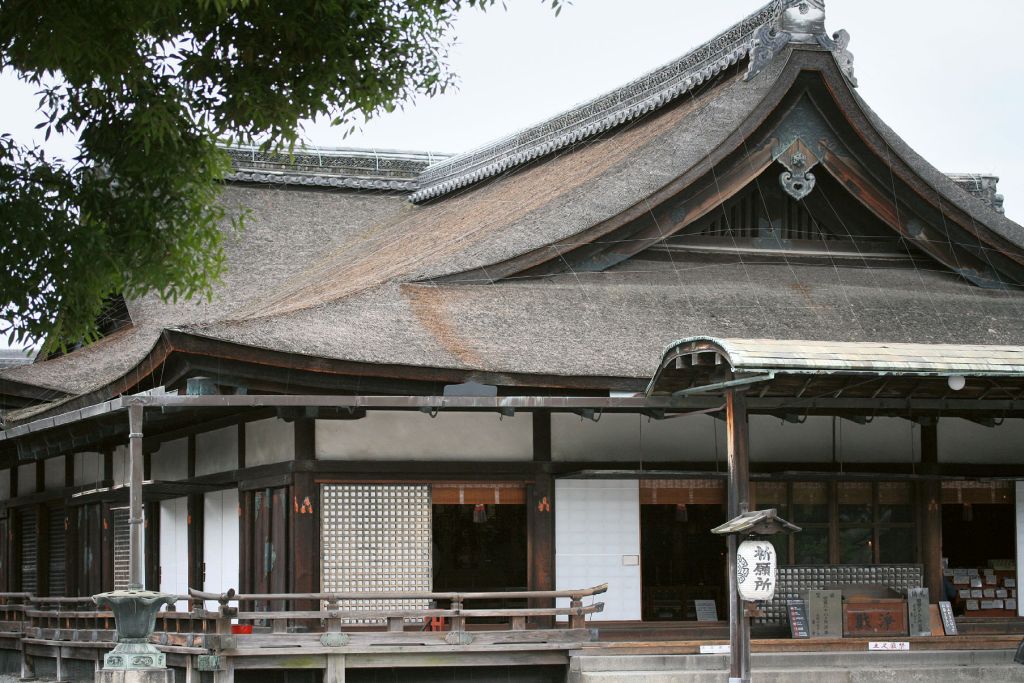
Despite populating the region with newer buildings, many older Saionji structuresâJÅjushin-in, SenbÅdÅ, TenkyÅkaku, Hosu-in and the FudÅdÅâremained there as well.78
Yoshimitsu oversaw the construction of three distinct palaces at Kitayama. One, the Southern Palace, became the residence of Yoshimitsuâs wife Hino Yasuko (1369â1419), as well as his son Yoshimochi (1386â1428).79 A second structure, the Sukenmon-in Palace, was located to the east of the Southern Palace, where Yoshimitsuâs aunt, the mother of Go-EnyÅ« resided.80 It was here, presumably, that Emperor Go-Komatsu briefly lived in 1408. Finally, north of this âsmall palaceâ (shogosho) of Go-Komatsu, Yoshimitsu and his favored son Yoshitsugu (1394â1418) resided in a larger Northern Palace.81 This structure was rebuilt late in Yoshimitsuâs life in a more expansive shinden style, as was typical for the high nobility.82 The fact that he and his son lived to the north of the reigning emperor suggested that, according to the principles of Chinese geomancy, that they were superior to Go-Komatsu, as the sovereign always was supposed to reside in the north.
10 Moving Mountains
The Saionji garden at Kitayama allowed for boating, and still had its famous cherry tree, and became a favored site for important meetings.83 In 1397, Yoshimitsu embarked on a major project to transform the gardens surrounding his new palace, just as he had constructed new gardens surrounding his Palace of Flowers in 1378. Kitayama was more expansive, however, and Yoshimitsuâs demands were commensurately grand, as he forced shugo to terraform the Saionji gardens by leveling a mountain. This caused tensions to arise, as Åuchi Yoshihiro, who, as we have seen, saw Yoshimitsu as a figure who tolerated the strong but punished the weak, did not appreciate these demands and balked at the request, stating that his men were practitioners of the way of the bow and arrow, rather than laborers hauling stones and dirt.84
Among the shugo lords, only Yoshihiro dared to refuse Yoshimitsu, and tellingly, he would rebel against him in 1399. Yoshihiroâs complaints notwithstanding, archaeological evidence reveals that other shugo complied, and tons of soil were moved to level a steep incline into a flat region and surrounded by a small dyke of a height of nearly one foot (0.30 meters). Despite the existence of raised mounds resembling small islands, no water was added to this region, which meant that Yoshimitsuâs pond never extended further to the south.85
The cost of this construction for this complex and gardens proved great, and one estimated that these efforts cost over one million kanmon, an astronomical amount, which is roughly equivalent to two billion dollars today.86 The area was praised as being superior to the Pure Land.87 The labor involved was great. Two discarded sleds (shura) made of the trunks of chestnut and elm (keyaki) trees, reveal that much lumber and many large stones were transported to Kitayama to build this compound.88
More than the cost per se, Yoshimitsuâs mobilization of corvée labor was the first time over half a millennium that such an immense project was undertaken, with comparable efforts occurring only in ancient Japan with the building of the great mounded tombs (kofun) or, to the contrary, the construction of moats around the city of Kyoto in the late sixteenth century, as well as the later creation of castles throughout Japan. Yoshimitsu used his power to have shugo move mountains, a feat that few others could accomplish during Japanâs middle years.89
11 Constructing Kinkakuji
HigashibÅjÅ Hidenaga (1338â1411) describes the existence of a Relic Hall (shariden) at Kitayama in 1399 that was covered in jewels and gold.90 His record has been taken by some as proof of the existence of Kinkakuji, but little is known about its structure, or whether it was an independent building or somehow otherwise linked to the Kitayama palace built in 1397.91 Other accounts suggest that the structure was in fact completed in 1403.92 Some sixteenth century accounts suggest that the ornate building was a freestanding structure called the Hosu-in (Ablution Hall), which was known in Saionji times to be colorful (see chapter 1). This structure continued to be described as being decorated with jewels and gold (kingyoku o shikitaru) in sixteenth-century accounts.93
Unfortunately, detailed descriptions of Kinkakuji and its construction do not survive. HigashibÅjÅ Hidenagaâs descriptions suggest a colorful building coated in gold, but what he means by this is not known and it is not certain if the shariden was Kinkakuji, or for that matter Hosu-in, and making matters more confusing, Hosu-in later become associated with the first floor of Kinkakuji after it collapsed sometime in the 1460s.94
After the end of the civil war in 1392, Yoshimitsu would have had access to gold from the north as he established good relations with the Kitabatake, who had long made payments in gold dust.95 By 1399, some sort impressive Relic Hall existed and was viewed by HigashibÅjÅ Hidenaga, but it is not clear whether this structure was a newly renovated Ablution Hall (Hosu-in), or, as most scholars have assumed, Kinkakuji. Regarding Kinkakuji itself, it is not clear if it was originally coated with a mixture of gold powder and liquid glue, supplemented with paint, or to the contrary, whether it would have been one of the first examples of a new technique, where gold foil was added to a coating of black lacquer (shippaku).96 Sixteenth-century accounts such as the Ashikaga chiranki describes how Kinkakujiâs exterior was originally lacquer covered in gold dust.97 Perhaps a gilded structure was created in 1399 coated in gold powder; in later years it would be redone, with black lacquer covered in places with gold foil. Nevertheless, the very notion of coating a building in lacquer alone was certainly seen as being âaudacious and attention seekingâ even in later centuries.98
A spike in the price of lacquer suggests that extensive lacquer coatings may have been added to Kinkakuji in 1406.99 Tax documents reveal that lacquer was sold at a sum of 16 kan 600 mon for 1 container (da) of lacquer in 1393.100 This price had long been stable, but in 1406, prices had risen to 24 kanmon per container (da), an increase of nearly 45% (44.58%). Courtiers who received lacquer as tax revenue exulted at this windfall, suggesting that the price increase was as sudden as it was pronounced.101 Other evidence suggesting an increase in lacquer demand dates from 1401, when temples with lacquer craftsmen demanded that they remain within temple compounds and close their stores (urushiya) outside of the temple precincts.102 Thus, it would seem that increased lacquer demand first arose around 1401, with higher prices being manifest in 1406, a period that most likely coincides with Kinkakuji being lacquered. Perhaps during these later years the gold dust was supplemented by gold leaf, but the exact timing of the change, as well as Kinkakujiâs actual construction, remains unknown.103
12 The Original Appearance of Kinkakuji
The Kinkakuji of Yoshimitsuâs day varied greatly from the present. The interior and exterior of the second floor was covered in black lacquer, with the third floor was, at some time, coated inside and out in gold leaf, something that was known to observers in 1703.104 As we have seen, whether the gold leaf was original, or rather replaced an earlier gold-dust painting deserves further research.
Kinkakuji was not a freestanding structure but was attached to the TenkyÅkaku, a Saionji-era structure to its north by a two-story bridge.105 With it, the compound resembled the Tang era JÄ«ngésì, which was connected to other structures by a two-story golden walkway.106 SaihÅji, a nearby Zen temple dating from the fourteenth century, provided a more immediate template for this design, as it originally possessed a two-story tower which was connected to the rest of the temple by a two-story bridge.107
Little is known about the appearance of the TenkyÅkaku, but most scholars assume that it served as a reception hall (kaisho) for informal gatherings. Yamashina Noritoki (1328â1411) described this building as being some fifteen mats in size, meaning that it was quite expansive.108 It was here that Sarugaku (NÅ) was performed by DÅâami (?â1413), a noted actor of an Åmi troop of performers.109 These performances established what had been a popular art form as an exalted genre, and was one of Yoshimitsuâs greatest cultural legacies.
Kinkakuji originally had a roof made from the bark of Japanese cypress (hinoki), the most prestigious roofing material (hiwadabuki), reserved for palaces and comparable buildings, rather than the less prestigious cedar wooden plank roofing (kokerabuki) that covers Kinkakuji today.110 The structure had a much smaller third floor that was not centered with the rest of the building, but rather looked over the western part of the second floor, with a hip and gable (irimoya) roof covering the eastern side of the structure, for it was inconceivable at the time to construct a building where one would walk directly over the area where a Kannon statue was placed on the floor below.111
According to Miyakami Shigetaka, the original Kinkakuji originally housed a statue of Amida from the Saionji MuryÅkÅ-in (Fig. 1.4).112 Likewise, old Saionji treasures that came into his possession, such as the Kasuga scrolls, as well as now lost images depicting his ritual activities, were stored there as well.113
From 1397 or so, a statue of a hÅÅ, which is usually translated as a phoenix, survives. Examples of this sculpture came to grace the roofs of major Japanese temples from 1053, when Fujiwara Yorimichiâs (992â1071) ByÅdÅ-in was created. Numerous meanings are attributed to the hÅÅ sculptureâimmortality, a protector deity, a god of wind, or as we shall see in the case of Kinkakuji, a sign of a universal ruler, a Buddhist wheel-turning monarch (cakravartin).
Kinkakuji reconstruction. View from the south. Miyakami Shigetaka
Permission and images from Kioka Takao. Chikurinsha Kenchiku Kenkyūjo
Kinkakuji reconstruction. View from the east. Miyakami Shigetaka
Permission and images from Kioka Takao. Chikurinsha Kenchiku Kenkyūjo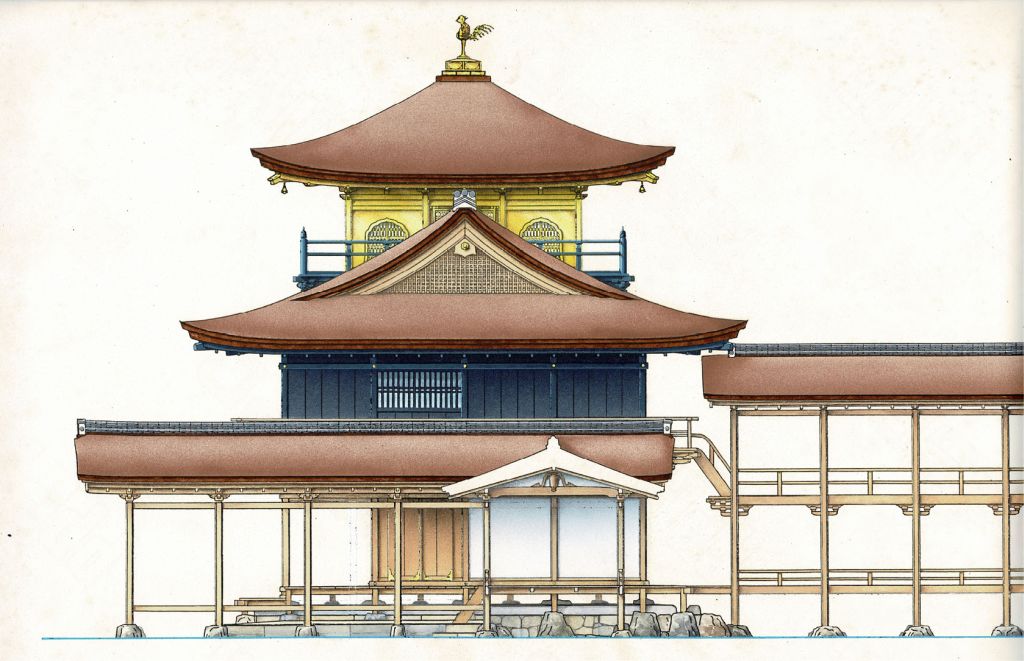
Kinkakuji from the south
Photograph by author (2017)
13 Populating Kitayama
The completion of a Kitayama palace, and the construction of Kinkakuji as a monument to Yoshimitsuâs authority, caused Kitayama to become an urban center.114 Many powerful monks lived there.115 Several nobles, Nakayama Masaie, TomikÅji Shigetsugu, and Hino Shigemitsu (1370â1413) moved there during the years 1399â1401, although their numbers were undoubtedly greater than these confirmed examples would suggest.116 Finally, an administrator linked to TÅji (TÅji betsu bugyÅsho), named SaitÅ KÅzuke nyÅ«dÅ, can also be documented as building a new home there in 1401, and undoubtedly many more officials resided there as well.117
Most, if not all, of the major warriors resided at Kitayama prior to 1402.118 Yoshimitsuâs son Yoshimochi, the shogun in name, but exercising no power, lived there along with shugo appointed from Ashikaga collateral warrior lineages, which included the Imagawa, Hosokawa, Shiba and Hatakeyama.119 The dwelling of Shiba Yoshimasa (1350â1410), a former shogunal chancellor (kanrei), can be confirmed as existing in Kitayama until 1409.120 Making this area more amenable to an extensive population of warriors, a broad 2.5 acre (one chÅ) riding grounds (baba), lined with cherry trees to the east and west (sakura nanmiki), was founded on the southern outskirts of Kitayama.121
Yoshimitsu transformed Kitayama into a distinct settlement, modeled on the great palace headquarters of Retired Emperors.122 The Kitayama complex functioned as a miniature city extending from IchijÅ, the northernmost street of the capital according to the old grid, to the mountains of the north.123 Kitayama thus became the center of Muromachi rituals and politics, albeit one that, as we have seen, still existed outside of the normal geographic and social boundaries of the court.124
Yoshimitsu also revitalized powerful religious institutions at Kitayama. In 1399, during the rebellion of the shugo Åuchi Yoshihiro, Yoshimitsu issued prayers to Japanâs twenty-two shrines, which reaffirmed the boundaries of Japan, as well as established his qualities as a Universal Golden Wheel-Turning Monarch (cakravartin).125 These rites would have been coordinated at the Tsuchimikado palace, in the capital. Shortly thereafter, Yoshimitsu defeated and killed Åuchi Yoshihiro.126 Yoshihiroâs brother Moriakira (1377â1431) continued to resist Yoshimitsu, however, and Yoshimitsuâs armies were defeated in the west, with one commander being killed in 1401.127 In 1402, Yoshimitsu ordered Japanâs most prominent monks at TÅji in the capital to offer curses (chÅbukuhÅ) against Moriakiraâs forces, but a second commander died in 1403.128 These travails caused Yoshimitsu to rehabilitate the Saionjiâs Comprehensive Shrine (sÅgen sÅja) at Kitayama in 1401, and yearly rites were performed there starting in 1403.129
14 Rebuilding Palaces and Pagodas
While his military campaign against Moriakira foundered, Yoshimitsu redoubled his construction efforts. He had to deal with the destruction of several major structures by fire while he was fighting Moriakira. The Tsuchimikado Imperial Palace, for example, burned down in 1401, and Yoshimitsu had it rapidly rebuilt. Yoshimitsu demanded both construction and celebratory rituals to be performed quickly. After the Imperial Palace was completed, Yoshimitsu had planned a ceremony for the emperor to return there in the eleventh month of 1402, but Saionji Sanenaga, the noble in charge, was late, causing Yoshimitsu to get exasperated and complain loudly and bitterly.130 Likewise, as we have seen, the mighty ShÅkokuji burned in 1403, and immediately Yoshimitsu started reconstruction efforts.
15 Greeting Ming Ambassadors
In 1401, Yoshimitsu established diplomatic relations with the Ming Dynasty and the newly enthroned Yongle Emperor (1360â1424, r. 1402â1424). Following the 1369 precedent of the Southern Court Prince Kaneyoshi (?â1381), he was invested with the title of King of Japan.131 This was the first time that an emissary from the Ming emperor Yongle invested Yoshimitsu with the title of King of Japan, a title that entailed nominal subservience to the Ming emperor, and promised considerable profits and rewards.132 Yoshimitsuâs title of King of Japan was not, as some scholars have assumed, designed for internal prestige, but rather to enhance his diplomatic position with the Ming Dynasty, and receive many Ming coins, and Chinese imported objects, or karamono.133
Surviving documents from the Ming emperor, dating from 1403, 1406 and 1407 make this clear, with Yongleâs surviving edicts of 5.25â26.1407 embossed with a dragon, revealing a myriad of Ming gifts, including fifteen million Yongle copper coins (15,000 kanmon).134 These coins would become so common that they were long referred to as akusen, or poor specie, and less valued than older Chinese coins, but still the windfall for Yoshimitsu was great; he kept the objects as well as original documents from the Yongle Emperor, which served as mementos of these exchanges. He also avidly traveled to harbors, including in 1407 visiting one at Obama with three of his daughters, where in the following year, a ship described as coming from âSouthern Barbariansâ of Palembang would land.135
Yoshimitsu, or âThe King of Japan Minamoto DÅgiâ as he styled himself, welcomed a Ming messenger to Kitayama first in 1402.136 As was consistent with earlier practice, he did not invite the foreign ambassador within the boundaries of the capital proper. Here, Kitayamaâs position as being very close to the capital, but not of it, proved to be significant. Yoshimitsu was able to create a magnificent region, appearing as if it were the central capital, when technically it was outside of it.137
Manzei (1378â1435), Yoshimitsuâs advisor, and a participant at the visit, later described how courtiers in their formal robes awaited the Ming ambassador at Kitayama. Yoshimitsu, dressed as a monk, and Manzei greeted the ambassador at the main gate to Kitayama and accompanied him into the compound. The ambassador held the Ming emperorâs document above his head and placed it on a special shelf in front of his shinden palace. Yoshimitsu bowed thrice and respectfully received the document.138 This exchange happened at Yoshimitsuâs Kitayama palace on 9.5.1402.139 The remaining exchanges occurred privately and were not well known at the court or the shogunate, but rather were confined to Yoshimitsuâs Kitayama palace. A relatively recently discovered record reveals that Yoshimitsu did not slavishly adhere to proper Ming diplomatic procedures; he should have waited to have the Ming edict read outload instead of picking it up with his hands, and by residing in the north, he showed superiority to the ambassador, and by extension the Ming emperor, which was a slight, reflecting either his lack of awareness of custom, or the fact that he did not feel obligated to abide by such diplomatic protocol.140
The audience for these exchanges was quite limited, confined to ten high ranking nobles, twelve lower ranking courtiers, and ten monks, including Manzei. Yoshimitsu, who otherwise was willing to engage in extensive court ceremonies, kept these exchanges private and outside the purview of members of the Japanese court or Japanâs shugo.141
The consequences of Yoshimitsuâs establishment of diplomatic relations with the Ming would be felt throughout Japan. As a precondition for these visits, for example, Yoshimitsu ordered the shugo of coastal provinces, such as the Shimazu of Southern Kyushu, to apprehend any troublesome pirates who had hindered the Ming.142 Furthermore, as a result of these ties, Ming Yongle (J. Eiraku) coins would flood the archipelago.
Scholars plausibly suggest that the impressive buildings of Kitayama were designed as much for impressing the Ming representatives as his own compatriots, particularly because of the limited nature of these exchanges.143 Certainly a steady stream of visitors from the continent made their way to Kitayama, with a Korean official visiting in 1403, and at least six Ming embassies arriving there in 1402, 1404, 1405, and 1407.144 Yoshimitsu himself took to greeting the Ming ambassadors while wearing Chinese clothes, although this was known to only a few. Some scholars have suggested that Yoshimitsu created an imaginary world at Kitayama, but this world, was to other foreign leaders, quite âreal,â as Shi Jinqing, ruler of the Southeast Asian state of Palembang, even presented Yoshimitsu with a Sumatran elephant, two Muntjac deer, two peacocks and two parrots, although this menagerie arrived after Yoshimitsuâs death.145
16 The Ritual Apogee of Yoshimitsu and Kitayama
In contrast to exchanges with Ming ambassadors, known to only a few, Yoshimitsuâs links to the court and his rituals were known to a larger audience. Rituals were important, for they could manipulate ârealityâ by channeling cosmic forces to alter events, or change relations, and in particular the ultimate authority of individuals to influence the cosmos, and by extension, enhance their supremacy. The rituals were not a smokescreen to hide power relations, or imaginary play-acting, but the essence of politics itself. Nevertheless, the significance of these rituals has been underappreciated by some scholars, who rely on a narrow notion of private and public to suggest that they were performed only for Yoshimitsuâs physical well-being without exploring the public significance of the rulerâs health.146
Kitayama served not as a retreat, or place of contemplation, but rather a ritual and political center, with monks, courtiers, emperors, and warriors either residing in its environs or visiting there frequently. Yoshimitsu engaged in ritual actions to show, through mimesis, that he was sovereign, and supplementing these rituals were several remarkable monuments, such as the palaces that he resided in, the massive pagoda that overshadowed all other structures in Kyoto, and Kinkakuji, with its links to Monju rites, which all served to express his ultimate, cosmic authority.
The rites and processions at Kitayama were seen and viewed by the major ministers of state, both courtiers and warriors.147 Other rituals were of considerable magnitude, and were expansive enough to denote state, rather than personal rites, for the health of the sovereign was a matter of state concern. Tellingly, Buddhist rites performed on 3.14.1408, when Go-Komatsu visited Kitayama, involved a thousand monks.148 These rites shaped the very reality of Japan, and were exercises in statecraft, rather than being for the simple wellbeing of any individual, even the magnificent Yoshimitsu.
17 The Spring of 1408 and Yoshimitsuâs End
One of the most remarkable ritual moments occurred shortly before Yoshimitsuâs death, when he invited Emperor Go-Komatsu to visit Kitayama.149 This has long been thought to represent an opportunity for Yoshimitsu to demonstrate his ritual and political superiority to the reigning emperor and ensconce his son as an imperial crown prince.150
Scholars have discounted the suggestion that Yoshimitsu tried to make his son a crown prince, with some arguing that Go-Komatsuâs visit was a âflower viewing excursionâ and not a visit from a reigning to a Retired Emperor (chÅkan gyÅko) and thus of little political or ritual significance.151 Other accounts suggest something more significant. The Chirizuka monogatari suggests that Go-Komatsu had agreed to adopt Yoshitsugu, Yoshimitsuâs son, as his own.152 The discovery of a hitherto unappreciated excerpt from the diary of the regent IchijÅ Tsunetsugu (1358â1418), written while Yoshimitsu lived, has proven important, for it shows that the regent treated Yoshitsuguâs coming-of-age ceremony as that of a crown prince, as it was based on the ceremonies of Emperor Go-EnyuÌ.153
Geographically, Yoshimitsu demonstrated his primacy as he lived in a large palace to the north of the smaller southern abode where Go-Komatsu, the reigning emperor, resided. That Yoshimitsu resided in the Northern Palace, while the palace that served as the dairi of the reigning emperor was smaller and located to the south in and of itself served, through principles of geomancy whereby the sovereign resided always to the north, to demonstrate Yoshimitsuâs supremacy in a way that was clear to all.154 This proved more salient than the fact that Emperor Go-Komatsu directly poured sake for Yoshimitsuâs son Yoshitsugu, which nevertheless does seem to provide ritual confirmation that Yoshitsugu was being groomed for the throne.155
The heyday of Yoshimitsuâs Kinkakuji complex lasted perhaps a year, for it was only in 1407 that Yoshimitsuâs larger palace and Kinkakuji were complete, and the seven-story pagoda was standing. During the spring of 1408, Yoshimitsu was at the peak of his powers, and dazzled the reigning emperor with lavish festivals, including poetry, dancing, NÅ plays, and music on boats for the Mifune festival. He impressed warriors and couriers alike, as well as Korean and Chinese officials with these monuments and ritual demonstrations of sovereignty. He also strove to make Kitayama, with its immense ShÅkokuji pagoda, three palaces, and Kinkakuji as beautiful, elegant, and opulent as one could imagine. Rather than making a retreat worthy of the hero of The Tale of Genji, he tried to recreate, or indeed surpass the glory that was Genji, the Shining Prince.
Although the Kitayama area witnessed some fifteen years of ongoing rites, processions, and rituals, not all of its constituent structures were fully completed during its heyday, with the finishing touches being applied to the pagoda and Yoshimitsuâs second palace in 1408, the year of his sudden death. Nevertheless, the spring of 1408 came to represent one glorious culmination, with ceremonies for the visit of Go-Komatsu, and the coming-of-age of Yoshitsugu, which concurrently highlighted Yoshimitsuâs primacy and his performative sovereignty.
Yoshimitsu remained active even until the month before his death, for on 4.6, for example, he had an audience with the emperor which resulted in âgreat drunkenness.â156 On 4.10, he departed for Ise, returning a week later on 4.17.1408.157 He visited the mansion of Isshiki Mitsunori with his son Yoshitsugu on 4.21, and met with the courtier Yamashina Noritoki, who praised his preparations.158 On 4.27.1408, Yoshitsugu completed his coming-of-age (genpuku) rites as an imperial prince.159 The following day, however, Yoshimitsu was taken with a cough, but he seemed to be improving on 5.3.1408, only to die eleven days after Yoshitsuguâs ceremonies, on 5.6.1408, at the age of 51, exhibiting classic symptoms of influenza.160
The suddenness of his death, when coupled with the brilliance of the rites, and the fact that Yoshitsuguâs all-important coming-of-age ceremonies were completed the day before Yoshimitsu fell ill, caused this moment to be remembered as a fleeting, but beautiful episode, and for some in later times, an epoch of cultural history. Yoshimitsuâs heyday at Kitayama proved so remarkable that for some scholars, Kitayama became a synecdoche for the culture of its time. Later scholars would highlight his exchanges with Ming ambassadors, construction of the remarkable Kinkakuji, and his interest in NÅ plays, and Chinese artifacts as constituting a distinct Kitayama culture.
18 Yoshimitsuâs Commemorative Monuments
From his ascension to power in 1378, Yoshimitsu oversaw the construction of a series of monuments that commemorated distinct moments in his life. His Palace of Flowers coincided with his seizing unfettered power by ousting Hosokawa Yoriyuki, and his appointment as udaishÅ; ShÅkokuji was named after his office of the time as Minister of the Left, but his rise was so meteoric that he rapidly outstripped this appointment (Minister of the Left aka ShÅkoku); by the time of its completion he was using ShÅkokuji for more encompassing pacification rites, first in 1392, and then, to commemorate the war dead more permanently at the Kingly Sutra Hall at Kitano. After ShÅkokuji burned in 1394, Yoshimitsu turned his attentions to rebuilding it and making palaces and other monuments to his kingly authority at Kitayama, which he confiscated from the Saionji. The magnificence of these efforts has led Kitayama to exercise inordinate influence on historical memory, but it was just the culmination of a long series of monuments.
In his innovative study, Åta SÅichirÅ has argued that all of Yoshimitsuâs rites were performed for him as a person, rather than for the state.161 When these rites are analyzed in context with his monuments, the link to elements of Yoshimitsuâs life should be clear. Yoshimitsuâs patronage of thousand-monk pacification rites at ShÅkokuji in 1392, coupled with grand pacification rites performed at the Kingly Sutra Hall, and Kinkakuji itself all suggest that these monuments, although intertwined with his life, made public and political claims of sovereignty manifest as well.
Kitayama was not a retreat, nor a region designed for Yoshimitsu to escape from the world; to the contrary it was an urban, political, and ritual center. Kinkakuji also served to demonstrate Yoshimitsuâs status as a cakravartin. This was not meant to be a site of quiet contemplation, but rather its very existence served, along with a massive pagoda and several palaces, to awe visitors and demonstrate his sovereign authority. The world of Kitayama proved so memorable and remarkable that two houses of the Hino family took the names Uramatsu and Hirohashi, naming themselves after prominent pine trees and a bridge from the Kitayama of Yoshimitsuâs time.162 Nevertheless, Kitayamaâs prominence would prove fleeting, as too would many of the monuments built by Yoshimitsu to commemorate his life. With Yoshimitsuâs passing the long process of the decay, dissolution, dismantling and destruction of Kitayama had begun.
It was rebuilt again in 1417 (Åei 24), surviving through 1470 (Bunmei 1). See Higashi YÅichi, âKitayama nanajÅ« daitÅ no shozai ni tsuite (ge),â KyÅto shi maizÅbuka kenkyÅ« kiyÅ 12 (10.2019), pp. 179â180 and chapter 3. The final ShÅkokuji pagoda was built in the vicinity of the original one, located in central Kyoto.
Sukigara Toshio, ChÅ«sei KyÅto no kiseki (Yuzankaku, 2008), 137. For its destruction on 7.1.1479 (Bunmei 11), see Sengoku ibun Åuchi shi hen, vol. 1, doc. 447, Mibu Harutomi shojÅ an, pp. 132â133.
https://ja.monumen.to/spots/10155 and https://daihoonji.jp/cultural-heritage/kyooudou, accessed April 5, 2023.
Paul Varley, âAshikaga Yoshimitsu and the World of Kitayama: Social Change and Shogunal Patronage in Early Muromachi Japan,â in John W. Hall and Toyoda Takeshi, eds., Japan in the Muromachi Age (Berkeley: University of California Press, 1977), pp. 183â204, and his Japan: A Cultural History (4th edition, Honolulu: University of Hawaii Press, 2000), pp. 111â120. See also Kenneth A. Grossberg, âThe Ashikaga Synthesis of Ashikaga Yoshimitsu,â Japanâs Renaissance: The Politics of the Muromachi Bakufu (Cambridge, MA: Harvard East Asian Monographs, 1981), pp. 27â39. For a classic formulation of Yoshimitsuâs cultural significance, see George Sansom, Japan: A Short Cultural History (Stanford: Stanford University Press, 1931), pp. 381, 398â399.
Momosaki YÅ«ichirÅ, Muromachi no hasha Ashikaga Yoshimitsu (Chikuma shoin, 2020), pp. 218â219.
For Yoshiakiraâs failure to rescue the Northern Emperors, see Conlan, From Sovereign to Symbol: An Age of Ritual Determinism in Fourteenth-Century Japan (New York: Oxford University Press, 2011), pp. 124, 135.
Conlan, State of War: The Violent Order of Fourteenth-Century Japan (Ann Arbor: University of Michigan Center for Japanese Studies, 2003), p. 98. For more on the significance of their taxation authority, see pp. 225â229.
Dai Nihon ShiryÅ (hereafter cited as DNSR), series 7, vol. 10 (1952), for an excerpt from the Kanrin goroshuÌ, p. 31 and Usui Nobuyoshi, Ashikaga Yoshimitsu (Yoshikawa kÅbunkan, 1960), pp. 15â16.
Gogumaiki (SanjÅ Kintada), 12.5â7.1367 (JÅji 12), located most conveniently in DNSR 6.28, pp. 560â561 recounts Yoshiakiraâs demise. He turned over governance to Yoshimitsu on 11.25 after a week of illness. See Ibid., pp. 544, 555. A nosebleed lasting for several days is a classic symptom of end-stage cirrhosis. Ages will be given according to Japanese practice, with the birth year counting as year one.
William McCullough, âThe capital and its society,â Cambridge History of Japan, vol. 2: Heian Japan (Cambridge: Cambridge University Press, 1999), pp. 131, 159. See also William H. and Helen Craig McCullough, A Tale of Flowering Fortunes: Annals of Japanese Aristocratic Life in the Heian Period (Stanford, CA: Stanford University Press, 1980), pp. 790â791. Stavros, âImperial Progress to the Muromachi Palace, 1381: A Study and Annotated Translation of Sakayuku hana,â Japan Review, no. 28 (2015), p. 4, argues for the importance of his 1378 appointment to the Provisional Grand Counselor as catapulting him to the ranks of senior nobility in 1381, but his sangi appointment was arguably more significant. For Yoshimitsuâs appointments, see DNSR 7.10, pp. 27â30.
Conlan, From Sovereign to Symbol, p. 168. See also Gogumaiki, vol. 3 (1988), 1.2.1379 (Eiwa 5), p. 2 and 4.28.1379 (KÅraku 1), p. 14.
Conlan, From Sovereign to Symbol, pp. 174â175 and Gogumaiki, vol. 4 (1992), 10.22.1378 (Eiwa 4), p. 198. Once, two of the cartâs giant wheels, nearly seven feet (shaku) in height, had to be abandoned, and it still survives. DNSR 7.10, p. 265. Viewed at Kitano by the author on May 2, 2008.
Goshinjin-in kanpakuki (Konoe Michitsugu), vol. 5 (2012), 10.22.1378 (Eiwa 4), p. 386 and KÅyÅki (HigashibÅjÅ Hidenaga), vol. 1 (2011), 5.18.1380 (KÅryaku 2), p. 61 for the visits. For more on Nobuko, see Momosaki YuÌichirÅ, Muromachi no hasha Ashikaga Yoshimitsu, pp. 222â223.
Momosaki YuÌichirÅ, Muromachi no hasha Ashikaga Yoshimitsu, pp. 208â211.
Conlan, From Sovereign to Symbol, pp. 161, 168, and Goshinjin-in kanpakuki, vol. 5, 10.4.1378 (Eiwa 4), p. 382.
Conlan, From Sovereign to Symbol, p. 173.
Momosaki YuÌichirÅ, Muromachi no hasha Ashikaga Yoshimitsu, pp. 132â134. Mitsuakira forced his favored consort Azechi no tsubone to become a nun on these suspicions, but here, Yoshimitsu was apparently blameless and signed an oath that he was not having an affair with her.
Conlan, From Sovereign to Symbol, pp. 167, 175â176. Gogumaiki, vol. 2 (1984), 8.3, 8.26â29.1376 (Eiwa 2), pp. 211â212, also recounts this affair and graffiti protesting it as an âunspeakable outrageâ and the fact that Go-EnyÅ« accepted the child as his own. See also 6.26.1377 (Eiwa 3), p. 240 for the birth of the prince.
For the incident with the sword, where the emperor threatened to kill himself after the unfortunate events, see Gogumaiki, vol. 3, 2.1.1383 (Eitoku 3), p. 110. See also Momosaki YuÌichirÅ, Muromachi no hasha Ashikaga Yoshimitsu, pp. 128â134.
Stavros, âImperial Progress to the Muromachi Palace, 1381,â pp. 4, 13. For Yoritomo favoring this position, see Jeffrey Mass, âYoritomo and Feudalism,â Antiquity and Anachronism in Japanese History (Stanford: Stanford University Press, 1992), pp. 74â75.
Gogumaiki, vol. 2, 2.18.1377 (Eiwa 3), p. 235 describes a palace that had burned down was known as the âPalace of Flowersâ well before Yoshimitsuâs time. See Kawakami Mitsugu, Shintei Nihon ChuÌsei jutaku no kenkyuÌ (ChuÌÅ kÅronsha 2002), pp. 335â337 and Yutani YuÌzÅ, âKinkakuji wa Kinkakuji to shite taterareta: âNihon kokuÅ Minamoto DÅgiâ koto Ashikaga Yoshimitsu to Godaisan (Wu-Tai-Shan) no BukkyÅ setsuwa,â Nagoya gaikokugo daigaku kokugo gakubu kiyÅ 42 (2.2012), p. 16.
Mass, âYoritomo and Feudalism,â pp. 74â75 points out how Yoritomo was remembered by this title, which was more significant that the more famous sei-i-tai shÅgun position. For the structure as serving as a memorialization of this appointment, see Momosaki, Muromachi no hasha Ashikaga Yoshimitsu, pp. 135â136. See also Ogawa Takeo, Ashikaga Yoshimitsu (ChÅ«kÅ shinsho, 2012), pp. 56â58.
Momosaki, Muromachi no hasha Ashikaga Yoshimitsu, pp. 145â156 for perceptive analysis of the shift from âKamakuraâ to âMuromachiâ to describe the Ashikaga leader and the significance of this moniker.
Stavros, âImperial Progress to the Muromachi Palace, 1381: A Study and Annotated Translation of Sakayuku hana,â p. 12 for a useful translation of the Sakayuku hana, written most likely by the regent and Yoshimitsu supporter NijÅ Yoshimoto. For an excellent overview of how this structure must have appeared, see Ebara Masaharu, Muromachi bakufu to chihÅ no shakai (Iwanami shinsho, 2016), pp. 80â82.
Stavros, âImperial Progress to the Muromachi Palace, 1381,â p. 12.
Conlan, From Sovereign to Symbol, p. 169 for Yoshimitsuâs ouster of Hosokawa Yoriyuki on the twenty-second day of the fourth intercalary month of 1379 (Eiwa 5).
This was first recognized by Usui Nobuyoshi, Ashikaga Yoshimitsu, pp. 56â58 and Hayashima Daisuke, Muromachi bakufuron (KÅdansha sensho, 2010), pp. 103.
For the earlier 1379 (Eiwa 5) incident, see Conlan, From Sovereign to Symbol, p. 168 and Stavros, âImperial Progress to the Muromachi Palace,â pp. 5, 34â37.
Momosaki YuÌichirÅ, Muromachi no hasha Ashikaga Yoshimitsu, pp. 126â128.
Mitamura Masako, âAshikaga Yoshimitsu no seigaihaââChuÌsei Genji monogatariâ no ryÅiki,â Monogatari kenkyuÌ 1 (2001), pp. 55â70. For more on this, see Akira Takagishi, âThe Collection and Production of Picture Scrolls by the Ashikaga Shoguns,â Elizabeth Lillehoj, ed., Archaism and Antiquarianism in Korean and Japanese Art (Chicago: Center for the Art of East Asia, University of Chicago and Art Media Resources, 2013), pp. 74â85, particularly pp. 79â82. See also Takagishi, Muromachi Åken to kaiga (Kyoto: Kyoto daigaku gakujutsu shuppankai, 2004), pp. 83â85 and Ogawa Takeo, Ashikaga Yoshimitsu, pp. 257â258.
DNSR 7.4, 9.15.1399 (Åei 6), p. 55, for HigashibÅjÅ Hidenagaâs comments that this procession at ShÅkokuji was the equal to anything that the Shining Genji might have done.
Conlan, From Sovereign to Symbol, p. 174, Stavros, âImperial Processions,â pp. 23, 37.
Momosaki YuÌichirÅ, âKÅryaku honyaku Eitoku 1, 2,â Mita ChuÌseishi kenkyuÌ, no. 12 (10.2005), 10.30.1382 (Eitoku 2), p. 129.
KÅ«ge nichiyÅ kufÅ« ryakushÅ« (GidÅ ShÅ«shin). Edited by Tsuji Zennosuke (Kyoto: TaiyÅsha, 1939), 9.29.1382 (Eitoku 2), p. 175 and 10.21.1382 (Eitoku 2), pp. 178â179.
KÅ«ge nichiyÅ kufÅ« ryakushÅ«, 10.3.1382 (Eitoku 2), p. 176 for this association of the name with Yoshimitsuâs office of the time.
Momosaki YuÌichirÅ, âKÅryaku honyaku Eitoku 1, 2,â Mita ChuÌseishi kenkyuÌ, no. 12, 11.2.1382 (Eitoku 2), p. 130.
Momosaki YuÌichirÅ, Muromachi no hasha Ashikaga Yoshimitsu, p. 173.
Nihon rekishi chimei taikei, accessed Japan Knowledge, October 12, 2015. For an extensive procession on 8.28.1392 (Meitoku 3) to celebrate its completion, see Yamada ShÅ, ed., âShiryÅ shÅkai · honkoku TÅhoku daigaku fuzuoku toshokan KanÅ bunko shozÅ âShÅkokuji kuyÅ nikkiâ,â Jinbunken kiyÅ 100 (ChÅ«Å daigaku jinbunkagaku kenkyÅ«jo 9.2021), pp. 153â189.
Usui Nobuyoshi, Ashikaga Yoshimitsu, pp. 59â60.
Royall Tyler, âIntroduction,â Iwashimizu Hachiman in War and Cult: Fourteenth-Century Voices III (Blue Tongue Books, 2017), pp. 11â15. This book has helpful translations of the chronicles depicting both the Meitoku disturbance and the 1399 (Åei 6) uprising of Åuchi Yoshihiro. For Yoshimitsuâs prayers against the Yamana, and reference to the Toki disturbance, see Kirita Takashi, âTenri daigaku fuzoku toshokan shozÅ âKyÅto gotaiji gokÅmonâ,â ShintÅshi kenkyuÌ 69.1 (2021), doc. 1, uruÌ 3.1.1390 (Meitoku 1), Ashikaga Yoshimitsu kÅmon utsushi, pp. 111â112.
Royall Tyler, trans., âNantaiheiki,â From BaishÅron to Nantaiheiki: Fourteenth-Century Voices II (Blue Tongue Books, 2016), pp. 257â258. For more on the Åuchi, see Conlan, Kings in All but Name: The Lost History of Åuchi Rule in Japan, 1350â1569 (New York: Oxford University Press, 2024).
Meitokuki, translated by Royall Tyler, Iwashimizu Hachiman in War and Cult: Fourteenth-Century Voices, vol. 3 (2017), pp. 103â104. Tellingly Yoshimitsu is described as being the sovereign in this passage.
ShiryÅ Kyoto no rekishi, vol. 1 (Kyoto: Heibonsha, 1991), pp. 341â342. See also Kyoto no rekishi, vol. 10 (Kyoto, 1976), p. 178 for 11.27.1401 (Åei 8) reference to the Daiho-onji engi.
RengeÅ-in is 388 feet (118.2 meters) in length.
Momosaki YÅ«ichirÅ. Muromachi no hasha Ashikaga Yoshimitsu, pp. 170â172 and https://daihoonji.jp/cultural-heritage/kyooudou. For the 5048 sutras dating from 1412 (Åei 19), see https://kunishitei.bunka.go.jp/heritage/detail/201/8871, accessed April 5, 2023.
Ninagawa ke monjo, vol. 1 (Compiled by TÅkyÅ daigaku shiryÅhen sanjo. TÅkyÅ daigaku shuppankai, 1981), doc. 109, Ashikaga Yoshimasa oyako Kitano ManbukyÅ-e sankei koshÅsha (
For the images, see Figure 2.2 and https://www.culture.city.taito.lg.jp/ja/reports/8148,âaccessed May 14, 2023, for the Tokiwayama fan.
For references to the first fire that destroyed ShÅkokuji, see DaijÅin jisha zÅjiroku (fukyuÌ ban), vol. 12 (Kyoto Rinsen shoten, 2003), 8.1.1394 (Meitoku 5), p. 296.
Momosaki YuÌichirÅ, Muromachi no hasha Ashikaga Yoshimitsu, pp. 173â174 makes the connection between Yoshimitsuâs actions and his fatherâs age of death. For his promotions, see DNSR 7.10, pp. 27â29.
Momosaki YuÌichirÅ, Muromachi no hasha Ashikaga Yoshimitsu, pp. 174â175.
Conlan, From Sovereign to Symbol, p. 178. See also Momosaki, Muromachi no hasha Ashikaga Yoshimitsu, pp. 176â177 for how Yoshimitsu was able to travel by oxcart within the palace compounds, an honor that had only previously been offered to regents.
For his name change, which happened sometime prior to 11.14.1395 (Åei 2), see Yutani YuÌzÅ, âKinkakuji wa Kinkakuji to shite taterareta,â pp. 3â10.
A shaku is 0.9942 feet in length, but will be converted directly to feet.
Imaeda Aishin, âAshikaga Yoshimitsu no ShÅkokuji sÅken,â ChuÌsei zenshuÌshi no kenkyuÌ (Tokyo daigaku shuppan, 1970), pp. 471â482, Harada Masatoshi, âMannen-san ShÅkoku JÅtenzen-ji EkÅ narabini sho to Ashikaga Yoshimitsu,â Kansai daigaku TÅzaigakujutsu kenkyuÌ, no. 46 (4.2013): 17â31 and Ogawa Takeo, Ashikaga Yoshimitsu, pp. 217â218 provide the best overviews. For the height of the pagoda, see Keijo ShuÌrin (1440â1518), Kanrin goroshuÌ, sansetsu, in Koji ruien, ShuÌkyÅbu, vol. 3, BukkyÅ 42 âShÅkokuji,â p. 387 and DNSR 7.4, 9.15.1399 (Åei 6), p. 37, for the NanpÅ kiden estimate of a height of 360 feet. See also Stavros, âShÅkokuji,â p. 138.
DNSR 7.4, 9.15.1399 (Åei 6), pp. 42, 48 for the ShÅkokuji kuyÅki comparison of ShÅkokuji to Shirakawaâs HosshÅji, which was 265 feet (81 meters) tall. See also Momosaki, Muromachi no hasha Ashikaga Yoshimitsu, p. 172 for precise measurements of these structures.
DaijÅin jisha zÅjiroku, vol. 12, 6.3.1403 (Åei 10), p. 301. According to the Kanmon gyÅki, this pagoda also burned down in 1400 (Åei 7), but this seems to be a mistake for 1403. See vol. 1, 1.9.1416 (Åei 23) (Zoku gunsho ruijuÌ kanseikai, hoi, 1930), vol. 1, p. 2.
DNSR 7.6, 4.3.1404 (Åei 11), p. 681 for Yoshimitsu commencing the reconstruction of the ShÅkokuji pagoda at Kitayama and DaijÅin jisha zÅjiki, vol. 12, p. 301. See also Matthew Stavros, âShÅkokuji.â
On 2.12.1408 (Åei 15), a mere three months before his death, Yoshimitsu can be documented as dispatching a master Buddhist statue carver, a certain Seikei of KÅfukuji, to TÅji so that he could examine the four statues in their pagoda and copy them for the Kitayama pagoda. DNSR 7.9, 2.12.1408 (Åei 15), pp. 761â763.
Asahi Digital, 7.8.2016, âKinkakuji maboroshi no kyodai buttÅ no ibutsu ka? SÅrin ichibu hahen hakken.â http://www.asahi.com/articles/ASJ766K46J76PLZB024.html. Accessed July 11, 2016. For more details on the discovery, see Rokuonji (Kinkakuji) teien, Tokubetsu shiseki Tokubetsu meishÅ (KyÅto maizÅ bunka kenkyuÌjo, 2016), pp. 71â73, 77â78. For a contrary view, see Higashi YÅichi, âKitayama nanajÅ« daitÅ (Tokubetsu shiseki · Tokubetsu meishÅ Kinkakuji teiennai) dodan (kamebara) kison mondai ni tsuite: Reiwa ninendo 25ji chÅsa no mondaiten,â KyÅto shi maizÅbuka kenkyÅ« kiyÅ 13 (3.2022), pp. 10â51.
Higashi YÅichi. âKitayama nanajÅ« daitÅ no shozai ni tsuite (ge),â pp. 170â173. Likewise see pp. 173â176 for the possibility of the pagoda being of a different shape and having fewer stories than commonly reconstructed.
Iinuma Kenji, âNihon ChÅ«sei ni shiyÅ sareta ChÅ«gokusen no mayÅ to idomu,â DaikÅkai no Nihon to kinzoku kÅeki (Kyoto: Shibunkaku, 2014), pp. 3â17, for how after the mid-twelfth century, most smelted copper used for temple artifacts came from melted Chinese coins. For the possibility that the finial was made from such coins, that Yoshimitsu imported in great numbers, see Higashi YÅichi, âKitayama nanajÅ« daitÅ no shozai ni tsuite (ge),â footnote 59, p. 184.
Hayashima Daisuke, Muromachi bakufuron, p. 148 believes that these funds were responsible for the reconstruction of the pagoda.
InryÅken nichiroku, Dainihon bukkyÅ zensho, vol. 2, 6.6.1485 (Bunmei 17), pp. 725â726. It was commonly assumed that he moved there in 1397 (Åei 4), but a search of the records by Ashikaga officials at that time suggest that he resided there from an earlier date of 1395 (Åei 2). Still, Hayashima Daisuke, Muromachi bakufuron, pp. 122â123 suggests that Yoshimitsu only lived there from 1398 (Åei 5).
Momosaki YÅ«ichirÅ, Muromachi no hasha Ashikaga Yoshimitsu, pp. 180â181.
This insight comes from the remarkable research of Yutani YuÌzÅ, âKinkakuji wa Kinkakuji to shite taterareta,â pp. 3â10. Yutani is the first to link this name to Yoshimitsu, although the idea that Kinkakuji was drawn in concept from China was long known. See for example, Tani Shinâichi, âKinden to Kinpeki,â Nihon no bunka 6 (10.1955), Kinkakuji Rakukei tokushuÌgÅ, p. 4.
See Yutani YuÌzÅ, âKinkakuji wa Kinkakuji to shite taterareta,â pp. 3â10. This happened sometime prior to 11.14.1395 (Åei 2). For more on the administration of Yoshimitsuâs vows, and the fact that the name change was of Yoshimitsuâs volition, see Harada Masatoshi, âShÅkokuji no sÅken to Ashikaga Yoshimitsu no butsuji hÅe,â in Momosaki YuÌichirÅ and Yamada Kunikazu, eds., Muromachi seiken no shufu kÅsÅ to KyÅto Muromachi Kitayama Higashiyama: HeiankyÅ KyÅto kenkyuÌ sÅsho (Bunrikaku, 2016), pp. 143â144.
Takagishi, Muromachi Åken to kaiga, p. 83 and âThe Collection and Production of Picture Scrolls by the Ashikaga Shoguns,â pp. 82â83.
Drawn from Yutani, âKinkakuji,â pp. 5â6. See also Wei-Cheng Lin, âReconfiguring the Center,â Building a Sacred Mountain: The Buddhist Architecture of Chinaâs Mount Wutai (Seattle, University of Washington Press, 2014), pp. 131â154. The most elaborate account of the monk DÅgi (
Ennin, NittoÌ guhoÌ junrei gyoÌki, edited by Adachi Kiroku and Shioiri RyoÌdoÌ (2 vols. Heibonsha, 1970â1985), vol. 2, pp. 63â64. See also Reischauer, Enninâs Diary: The Record of a Pilgrimage to China (New York: The Ronald Press Co, 1955), 4.23 and 7.2.840 (JÅwa 7), pp. 211â212 and 252â256. According to Ennin, this temple had a Monju statue on the first floor, and five bodhisattvas, through to be manifestations of Monju, and the Five Character Monju, on the second floor. He described too how Amoghavajra (Ch. Bukong) was responsible for this temple and explained how the tower had ânine bays and three stories.â For gilt bronze, see p. 252. He also praised the majesty of the gilt Monju statue as well (loc. cit.). Finally for an excellent overview, see Lin, Building a Sacred Mountain, particularly pp. 158â168.
Nakata Mie, âGodaisan (Ch. WÇtáishÄn) Monju shinkoÌ to Åken,â p. 47. See also p. 42 and for her conclusion, p. 52.
David Quinter has introduced Japanese texts that explain how MañjuÅrÄ« was a manifestation of a cakravartin. See his âInvoking the Mother of Awakening: An Investigation of JoÌkeiâs and Eisonâs Monju koÌshiki,â Japanese Journal of Religious Studies 38.2 (2011), pp. 284â285. For the text in translation, see Quinter, âJoÌkeiâs Monju koÌshiki in Five Parts (c. 1196),â Japanese Journal of Religious Studies 43.1 (Online supplement 1), p. 5 for Monju as a manifestation of a cakravartin, for AÅoka dispatching seven Monju statues, see p. 11. See also Reischauer, Enninâs Diary, pp. 254â255 for reference to an emissary from the Tang Emperors bringing back a rubbing of the Buddhaâs footprint from an old temple linked to AÅoka, installing one version in the palace and another in this temple.
This has been noted by Yutani YuÌzÅ, âKinkakuji wa Kinkakuji to shite taterareta,â p. 14.
Yutani YuÌzÅ, âKinkakuji wa Kinkakuji to shite taterareta.â For narratives and treatises that mistakenly suggests that Kinkakuji represented a âpopularâ name that was later adopted, see the 1552 (Tenbun 21) Chiritsuka monogatari, in KondÅ KeizÅ, ed., KÅtei shiseki shÅ«ran, vol. 10, Sanroku 38 (KondÅ shuppan, 1901), pp. 1â111, and the 1664 (Kanbun 4) Shoreki nikki in Murata Yasuhiko, et al., eds., ShiryÅ KyÅto kenbunki, vol. 1 (Kyoto: HÅzÅkan, 1991), p. 28.
For more on the notion of ritual mimesis and sovereign authority, see Conlan, âThe Ashikaga Emperor,â From Sovereign to Symbol, pp. 171â186.
DNSR 7.2, 4.16.1397 (Åei 4), pp. 778â779.
DNSR 7.4, 9.15.1399 (Åei 6), p. 47 for a reference from the ShÅkokuji kuyÅki of the importance of the anchinhÅ. See also DNSR 7.3, 4.22.1398 (Åei 5), p. 252.
Conlan, From Sovereign to Symbol, p. 182 and Imatani Akira, Muromachi no Åken (ChÅ«kÅ shinsho, 1990), pp. 77â86. They were conceived as being âgreat monthly ritesâ in the decades following Yoshimitsuâs death when the shogun Yoshinori tried to reinstate them. See Kennaiki, vol. 1 (1963), 5.19.1428 (ShÅchÅ 1), p. 143. The DNSR database shows in fact that the first rites began on 8.19.1399 (Åei 6), probably in the heightened tensions before the war with Åuchi Yoshihiro. See DNSR 7.4, p. 22. For other early rites at Kitayama see p. 459, 2.16.1400 (Åei 7) (Shichibutsu yakushihÅ), 3.9.1400 (Åei 7), p. 502, 4.27.1400, p. 552, 6.1.1400, p. 570, 7.4.1400, p. 590 (for five altar rituals), and 1.24.1401 (Åei 8), p. 866 for Sonjo ÅhÅ rites. The database reveals that these rituals continued through 1409.
Akamatsu, âKintsune, Yoshimitsu, Yoshimasa,â Kinkaku to Ginkaku (Kyoto: TankÅsha, 1964), pp. 30â31. According to the ShÅkokuji kuyÅki, DNSR 7.4, 9.15.1399 (Åei 6), pp. 46â47, the following Saionji temples existed at this time: MurÅkÅ-in, KotokuzÅ-in, JÅju-in, Hosu-in and MyÅondÅ, Chisei-in, and the FudÅdÅ.
InryÅken nichiroku, Dainihon bukkyÅ zensho, vol. 2, 6.6.1485 (Bunmei 17), p. 726. Yoshimochi is referred to by his office (Konoe sachuÌjÅ) in 1394 (Meitoku 5) while Hino Yasuko is referred to as the âinner placeâ (gonaisho).
For a summary in English, see Stavros, Kyoto: An Urban History of Japanâs Premodern Capital, p. 120.
Kawakami Mitsugu, âKitayama dono,â pp. 67â68 and Miyakami, âKinkakuji,â Kinkakuji, Ginkakuji Nihon meikenchiku shashin senshÅ« (ShinchÅsha, 1992), p. 96. Noritoki kÅki (Yamashina Noritoki), vol. 4 (2009), 5.25â26.1408 (Åei 15), pp. 249â250 refers to 3.10.1408 documents which refer to Yoshimitsu as the âgreat palace (daigosho)â and Yoshitsugu as the young lord (wakagimi) at the north. This source also reveals that Go-Komatsuâs regular residence ([tsune no gosho]) was a small palace (shogosho) to the south of Yoshimitsuâs abode. See also DNSR 7.9, 3.8.1408 (Åei 15), Kitayama dono miyuki, pp. 803, 806.
On 6.15.1407 (Åei 14), an anchinhÅ was performed for a new palace, a clear sign of its reconstruction. DNSR 7.8, 6.15.1407 (Åei 14), p. 937 for the rebuilding of the Kitayama palace.
Molly Vallor, âBlossoms before Moss: Medieval Views of MusÅ Sosekiâs SaihÅji,â Not Seeing Snow: MusÅ Soseki and Medieval Japanese Zen (Leiden: Brill, 2019), pp. 105â143.
DNSR 7.2, 4.16.1397 (Åei 4), pp. 780â781 for the Gaun nikken roku, 8.19.1448 (Bunan 5). See also Conlan, Kings in All but Name, pp. 87â89.
Conversation Hori Daisuke and Minami Takao, May 29, 2017, at the site of the southern boundary of the pond. Pottery discovered at this site on May 26, 2017 reveals that a large area was leveled during the time of Yoshimitsu, and yet, contrary to all expectations, the area never held water, suggesting that this great project was abandoned before the pond was ever expanded.
For the estimate of this price, see DNSR 7.2, Gaun nikken roku, 8.19.1448 (Bunan 5), p. 780. This estimate on purchasing power, with a kanmon roughly equating to two thousand dollars, was suggested by Maki Takayuki. Conversation, 12.17.2011.
Quoted by Ebara Masaharu, Muromachi bakufu to chihÅ no shakai, p. 79.
Rokuonji (Kinkakuji) teien, Tokubetsu shiseki tokubetsu meishÅ (Rokuonji, 1997), pp. 56â57. For more in shura, see Nagahara Keiji, âThe Process of Unification: Technological Progress in Sixteenth and Seventeenth Century Japan,â Journal of Japanese Studies, vol. 14, no. 1 (Winter 1988), p. 90.
Conversation, Hori Daisuke and Minami Takao, May 29, 2017.
ShÅkokuji kuyÅki, DNSR 7.4, 9.15.1399 (Åei 6), pp. 46â47. See also DNSR 7.2, 4.16.1397 (Åei 4), pp. 779â780. Scholars have taken this passage literally, but it is possible that HigashibÅjÅ Hidenaga was simply using stylized language to describe a magnificent structure.
Akamatsu suggests so in his âJishi,â Rokuon (Rokuonji, 1955), p. 22. For this rite being performed at the Kitayama dono, which would refer to Yoshimitsuâs residence, DNSR 7.4, 8.19.1399 (Åei 6), pp. 22â23. Hayashima Daisuke, Muromachi bakufuron, p. 123 see this structure as constituting Kinkakuji.
Tabi makura, Murata Yasuhiko, et al., eds., ShiryÅ KyÅto kenbunki, vol. 3 (Kyoto: HÅzÅkan, 1991), p. 197. See also chapter 4.
For the sixteenth-century TenshÅbon Taiheiki account, see Hasegawa Tadashi, ed., Taiheiki, vol. 4 (ShÅgakkan, 1999), maki 36, âMinamikata no Miyakata kuniguni ni haiboku su narabi ni JimyÅin shujÅ KÅshÅ« Musadera yori kankÅ,â pp. 260â261. By contrast, the fifteenth-century Seigen-in version of the Taiheiki (HyÅdo Hiromi, ed., Taiheiki, vol. 6 (Iwanami shoten, 2016), maki 37, âTÅkin KÅshÅ« yori kankÅ no koto,â p. 32 merely describes Hosu-in as being bejeweled. Whether these descriptions were literal descriptions or rather metaphors to describe an impressive building is not knowable.
Hisagaki Hideharu, âRokuonji no niwa,â in KyÅto meienki, by ShuÌji Hisatsune (SeibundÅ ShinkÅsha, 1968), vol. 2, p. 262; and Yoshinaga Yoshinobu, âKinkaku no niwa,â Nihon bukazai 6 Kinkaku rakkei tokushuÌgÅ, October 1955, p. 12 for the naming of the first floor of Kinkakuji.
For reference to the Kitabatake having access to gold during the time of Japanâs civil wars, see Shirakawa shishi vol. 5 shiryÅ hen 2 kodai chuÌsei (Fukushima, 1991), document 270, 5.25 [1343 (KÅkoku 4)], Uemon no jÅ Gon no shÅshÅ shojÅ, p. 258 for the dispatch seven ryÅ of gold dust to pay for provisions. See also State of War, p. 95.
For a helpful overview of these varying process see Kin to gin: Kagayaki no nihon bijutsu (Tokyo kokuritsu bijutsukan, 1999).
Ashikaga chiranki, found most conveniently in DNSR 7.2, p. 781 and DNSR 7.9, pp. 943â944. For more on this process of lacquering, and this sprinkling of gold, see Anton Schweizer, Åsaki Hachiman: Architecture, Materiality, and Samurai Power in Seventeenth-Century Japan (Berlin: Reimer, 2016), pp. 139â141, and, for brief reference to Kinkakuji, pp. 170â171. Finally, for a helpful overview, see Christine Guth, Craft Culture in early Modern Japan: Materials, Makers, and Mastery (Berkeley: University of California Press, 2021), pp. 20â23, and for the process of lacquering and its prestige, pp. 109â138.
Schweizer, Åsaki Hachiman, p. 313.
Layers of lacquer were frequently added for maximum effect. Schweizer, Åsaki Hachiman, pp. 324â326. For how quickly lacquer degraded when exposed to the elements, see pp. 191â198.
Yotsuyanagi KashÅ, Urushi no bunkashi (Iwanami shinsho, 2009), pp. 135â136. For the 3.1393 (Meitoku 4) sources mentioned by Yotsuyanagi, see TÅji monjo, box 7, ZÅeikata sanyÅjÅ, which was completed on 4.24.1398 (Åei 5). For the original, see https://hyakugo.pref.kyoto.lg.jp/contents/detail.php?id=24799. The price listed here is 4 kan 150 mon for one tÅ (
Noritoki kÅki, vol. 1 (1970), 10.1.1406 (Åei 13), pp. 237â238 for three masu of lacquer (urushi san masu dai sankan ni itaru nari medetashi medetashi) being worth three kanmon, which delighted Noritoki (one tÅ contains 6 masu). See also Yotsuyanagi, Urushi, p. 136. This means that one tÅ had increased to 6 kanmon, and one da was now worth 24 kanmon.
Monks from TÅji demanded that lacquer stores (urushiya) at KantÅchÅ outside the temple compound be destroyed. TÅji nijÅ«ikku kusÅkata hyÅjÅ hikitsuke (Kyoto: Shibunkaku, 2002), 4.13.1401 (Åei 8), p. 41.
When Kinkakuji was most recently covered in gilt foil, the process of lacquering was carefully documented. It involved over sixty steps and would have required immense amounts of lacquer. See âUrushi nuri no kaisetsu,â in Kinkaku (Rokuonji, Kyoto: KÅrinsha, 1987).
The Yamashiro meishÅshi written in 1703 (Genroku 15), states that only the top story of Kinkakuji was covered in gold leaf. DNSR 7.2, 797.
Gaun nikken roku, 8.19.1448 (Bunan 5), DNSR 7.2, p. 780. Maeda Yoshiakiâs âKinkakuji to Ashikaga Yoshimitsuâ (http://www.kyoto-arc.or.jp/News/s-kouza/kouza258.pdf) explains this passage in more depth. Shimao Arata persuasively described this structure in his lecture âOn East Asian Art History: Chinese Painting and âKaraeââ Princeton-Gakushuin graduate student workshop Tuesday, July 16, 2019.
Gaun nikken roku, loc. cit.
Kawakami Mitsugu first realized this connection between SaihÅji and Kinkakuji in his âKitayama dono,â Kinkaku to Ginkaku, pp. 72, 94. This has been widely accepted. See Miyakami, Kinkakuji Gingakuji, p. 114 and Rokuonji (Kinkakuji) teien, Tokubetsu shiseki tokubetsu meishÅ (1997), p. 4. For more on the original appearance of SaihÅji, see Yutani, âKinkakuji,â pp. 22â24. The SaihÅji engi, Zoku gunsho ruijuÌ, vol. 27.1, p. 442 refers to a two-story structure, as too does the Korean emissary Sin Suk-chu (
For more on kaisho, see Stavros, Kyoto: An Urban History of Japanâs Premodern Capital, p. 119.
See Noritoki kÅki, vol. 2 (1970), 3.10.1408 (Åei 15), p. 220. For more on this, and the identity of DÅâami, see Miyakami, Kinkakuji Ginkakuji, p. 98.
Miyakami Shigetaka, âKinkaku no fukugen,â Kinkakuji Ginkakuji, pp. 100â109.
Miyakami Shigetaka, âKinkaku no fukugen,â pp. 100â103. Miyakami assumes that a Kannon statue was here, as was most likely the case, but originally something different may have been housed here, as the sources are reticent about the original statues found in Kinkakuji.
Miyakami Shigetaka, âKinkaku no fukugen,â p. 105.
Akira Takagishi, âThe Collection and Production of Picture Scrolls by the Ashikaga Shoguns,â Elizabeth Lillehoj, ed., Archaism and Antiquarianism in Korean and Japanese Art (Center for the Art of East Asia Symposia, University of Chicago, 2013), pp. 78â83.
Tasaka Yasuyuki, âMuromachiki KyÅto no toshi kuÌkan to bakufu,â Nihonshi kenkyuÌ 436 (1998), pp. 56â58 and, for a more recent overview, Hayashima Daisuke, Muromachi bakufuron, p. 124.
Imatani, Muromachi no Åken, p. 81. They included Manzei of SanbÅ-in, and SondÅ of ShÅren-in.
DNSR 7.4, p. 301 transcribes the 8.7.1399 (Åei 6) KÅyÅki reference to a Matsu dono living at Kitayama, This was Hino Shigemitsu, who is otherwise known as the Hon. Uramatsu (dono) in this text. See DNSR 7.4, 8.16.1399 (Åei 6), p. 22, for the identification of Hino Shigemitsu as (Ura)matsu dono. Next, see DNSR 7.5, 3.9.1401 (Åei 8), p. 237, for a Yoshida ke hinamiki reference Nakayama Masaie moving Kitayama. For TomikÅji Shigetsugu living there, see Noritoki kÅki, vol. 1, (1970), 11.3.1406 (Åei 13), p. 253. See also Tasaka, pp. 56, 66.
TÅji nijÅ«ikku kusÅkata hyÅjÅ hikitsuke, 2.9.1401 (Åei 8), p. 37 for SaitÅ KÅzuke nyÅ«dÅ building a new home at Kitayama.
Hayashima claims that a shogunal chancellor (kanrei), and administrators moved here prior to 2.13.1402 (Åei 9). See Muromachi bakufuron, p. 126.
On 10.26.1409 (Åei 16), Ashikaga Yoshimochi, along with the lords related to the Ashikaga, such as the Shiba, Hosokawa and Imagawa, moved away from Kitayama to the âmain palaceâ located more centrally in the capital and away from Kitayama. See âWakasa no kuni shugo shidai,â Shintei gunsho ruijuÌ buninbu, vol. 3 (Zoku gunsho ruijÅ« kanseikai, 1930), p. 110 and Tasaka, p. 56.
Noritoki kÅki, vol. 3 (1974), uruÌ, 3.3.1409 (Åei 16), p. 105.
For the reference to the size of the area, and the cherry blossoms, see Kitayama dono miyuki, DNSR 7.9, 3.8.1408 (Åei 15), p. 802 and Miyakami Shigetaka, Kinkakuji Ginkakuji, p. 98.
This connection was recognized by Kawakami Mitsugu, âKitayama dono to Higashiyama dono,â Kinkaku to Ginkaku, pp. 65â66. See also Stavros, Kyoto: An Urban History of Japanâs Premodern Capital, p. 120 and âMonuments and Mandalas in Medieval Kyoto: Reading Buddhist Kingship in the Urban Plan of Ashikaga Yoshimitsu,â Harvard Journal of Asiatic Studies 77.1 (Dec. 2017), pp. 321â361.
Momosaki YuÌichirÅ has impressively reconstructed what this urban area was like in his âChuÌsei KyÅto hokkÅ no gairo gaiku kÅzÅ kÅshÅ,â in Momosaki YuÌichirÅ and Yamada Kunikazu, eds., Muromachi seiken no shufu kÅsÅ to KyÅto Muromachi Kitayama Higashiyama, pp. 368â422.
For the assertion that this region is best conceived as a capital in the manner of Retired Emperors, see Hosokawa Taketoshi, âAshikaga Yoshimitsu no Kitayama shintoshin kÅsÅ,â Toshi o kugiri ChuÌsei toshi kenkyuÌ, no. 15 (Yamakawa shuppan, 2010), pp. 89â101. For a contrasting account of Kitayama as an imagined realm outside the normal social, geographic and political boundaries of the state, see Momosaki YuÌichirÅ, âAshikaga Yoshimitsu no shufu âKitayama donoâ no rinenteki ichi,â Momosaki YuÌichirÅ and Yamada Kunikazu, eds., Muromachi seiken no shufu kÅsÅ to KyÅto Muromachi Kitayama Higashiyama, pp. 180â218.
DNSR 7.4, 7.20.1399 (Åei 6), p. 6 for DaihokutohÅ rites at TenryuÌji, and 10.27.1399 (Åei 6), pp. 162â164 for more generalized five altar maledictions. For how Yoshimitsu also prayed to these 22 shrines, see Kirita Takashi, ââKyÅto ontaiji gokÅmonâ ni mieru Ashikaga Yoshimitsu no jingi kitÅ,â pp. 53â54. Finally, for their significance of the 21 (22) shrines, see Conlan, From Sovereign to Symbol, pp. 9, 28, 52, 66â68.
Royall Tyler, Iwashimizu Hachiman in War and Cult. For excellent analysis of this disturbance, which relies on the largely unpublished Yoshida hinamiki as an informative source, see Ogawa Takeo, Ashikaga Yoshimitsu, pp. 177â204. See also Conlan, Kings in All but Name, pp. 88â89, 93â99.
Yamaguchi kenshi shiryÅhen chuÌsei 1 (Yamaguchi, 1996), Nagato no kuni shugo daiki, p. 607 for the death of Åuchi Hiroshige, Yoshimitsuâs general, in 1401 (Åei 8). See also Conlan, Kings in All but Name, pp. 104â109 for more on this campaign.
TÅji nijÅ«ikku kusÅkata hyÅjÅ hikitsuke, vol. 1, 2.11, 2.16.1402 (Åei 9) Suisei onkitÅ no koto, pp. 54â57. For the death of another commander in 1403 (Åei 10), see Yamaguchi kenshi tsuÌshi (Yamaguchi, 2012), pp. 376, 441.
Momosaki YÅ«ichirÅ, Muromachi no hasha Ashikaga Yoshimitsu, pp. 181â182, and p. 347 for a 12.1 citation of the Mikaruga zakki. For Yoshimitsu having the 600 volumes of the Daihannya-kyÅ (MahÄprajñÄpÄramitÄ sÅ«tra) being âflipped and read,â by Yoshida shrine affiliated monks on 1.19.1403 (Åei 10), see DNSR 7.6, p. 28; for Isshiki Mitsunori (1368â1409) donating a sword there on 2.24.1403 (Åei 10), see DNSR 7.6, p. 54, and for kagura rites performed there on 12.1.1403 (Åei 10), 12.1.1404 (Åei 11), 12.1.1405 (Åei 12), and see DNRS 7.6, p. 392, 7.6, p. 851, and 7.7, p. 543. For how Yoshimitsu took over the old Saionji structures there, see Kirita Takashi, âMuromachi dono Chinjusha no seiritsu to tenkaiâAshikaga shÅgun-ke no jingi sashi to Yoshida-keâ,â NenpÅ chuÌseishi kenkyuÌ 46 (5.2021), pp. 73â74.
Ishihara Hiiro, HokuchÅ no tennÅ (ChuÌkÅ shinsho, 2020), pp. 98â99. Ishihara misidentifies the Saionji leader as Kinnaga, who was deceased at the time, instead of Kinnagaâs son Sanenaga.
For more on Kaneyoshi, see Mori Shigeaki, Åjitachi no NanbokuchÅ (ChuÌkÅ shinsho, 1988) and Momosaki, Muromachi no hasha Ashikaga Yoshimitsu, pp. 199â202.
DaijÅin jisha zÅjiroku, vol. 12, 5.3.1401 (Åei 8), p. 299 for Yoshimitsuâs dispatching a letter to the Tang (sic.), and 8.3.1402 (Åei 9), p. 300 for him visiting HyÅgo to see the arriving Chinese ships.
This argument was most forcibly made by Tanaka Takeo, Zenkindai no kokusai kÅryuÌ to gaikÅ monjo (Yoshikawa kÅbunkan, 1996) and Murai ShÅsuke, ChuÌsei no kokka to zaichi shakai (Azekura shobÅ, 2005).
The most informative original documents are a set dating from 5.25â26.1407 (Yongle 5) and can be found at the Tokugawa Museum and at ShÅkokuji. For more on these documents, see Hashimoto YuÌ, âTokugawa bijutsukan zÅ âSeiso Eiraku tei chokushoâ no kisoteki kenkyuÌ,â in Kojima Hiroyuki, ed., Higashi Ajia komonjogaku no kÅchiku-genjÅ to kadai (TÅkyÅ daigaku keizaigakubu shiryÅ shitsu, 2018), pp. 63â84 and Takashima Masahiko, âMindai kÅtei chokusho no ryÅshi ni tsuite,â pp. 85â88. Conveniently, photos of two from 1407 (Yongle 5) appear on pp. 68â69 of the catalogue Muromachi shÅgunâSenran to bi to Ashikaga juÌgodai (KyÅ«shÅ« kokuritsu hakubutsukan, 2019).
âWakasa no kuni Saisho Imatomi myÅ ryÅshu daidai shidai,â Gunsho ruijuÌ, vol. 4, buninbu (3rd Revised Printing. Zoku gunsho ruijuÌ kanseikai, 1991), 5.17.1407 (Åei 14), p. 352. This referred to Shi Jinqing of Palembang. See Conlan, Kings in All but Name, p. 120. For more on the history of Obama, see Isao Soranaka, âObama: The Rise and Decline of a Seaport,â Monumenta Nipponica 52.1 (Spring 1997), pp. 85â102.
DNSR 7.5, 9.5.1402 (Åei 9), pp. 666â678. The Yoshida hinamiki passage transcribed on p. 666 clearly refers to Kitayama as the site of the visit. See also Manzei jugÅ nikki, vol. 2 (3rd revised printing, Zoku gunsho ruijÅ«, 2002), 5.12.1434 (EikyÅ 6), pp. 575â577 for how Shiba Yoshimasa reminisced on the meeting between Yoshimitsu and the Ming emissary.
For this important observation, see Momosaki, Muromachi no hasha Ashikaga Yoshimitsu, pp. 190â192, 202â203.
Manzei jugÅ nikki, vol. 1, 9.5.1402 (Åei 9), and vol. 2, 5.12.1434 (EikyÅ 6), p. 577. The episode is famous and appears in many accounts of Yoshimitsu, such as Usui Nobuyoshi, Ashikaga Yoshimitsu, pp. 179â180, Ogawa Takeo, Ashikaga Yoshimitsu, pp. 227â228. For a translation of the 1402 (Åei 9) letter, see von Verschuer, âAshikaga Yoshimitsuâs Foreign Policy 1398â1408,â pp. 281â282.
Ogawa Takeo, Ashikaga Yoshimitsu, pp. 229â231 helpfully reconstructs the ambassadorâs visit to Yoshimitsuâs palace.
Ishida Sanehiro and Hashimoto YÅ«, âMibu ke kyÅ«zÅhon âSÅchÅ sÅ henchÅkiâ no kisoteki kÅsatsuâAshikaga Yoshimitsu no juhÅ girei o megutte,â Komonjo kenkyÅ« 69 (5.2010), pp. 14â34 for this important record. For analysis, see Ogawa, Ashikaga Yoshimitsu, pp. 229â232 and Momosaki, Muromachi no hasha Ashikaga Yoshimitsu, pp. 195â196.
Momosaki, Muromachi no hasha Ashikaga Yoshimitsu, pp. 197â198.
Shimazu ke monjo, vol. 1 (1942), doc. 272, 8.16.1402 (Åei 9) Ashikaga Yoshimitsu han mikyÅjo, p. 237.
See Maeda Yoshiaki, âKinkakuji to Ashikaga Yoshimitsu.â
DNSR 7.6, 10.29.1403 (Åei 10), p. 348, DNSR 7.6, 5.16.1404 (Åei 11), pp. 700â707, DNSR 7.7, 5.1.1405 (Åei 12), p. 194, and DNSR 7.9, 8.5.1407 (Åei 14), p. 125. For the number of embassies, see Charlotte von Verschuer, âAshikaga Yoshimitsuâs Foreign Policy 1398â1408: A Translation From Zenrin KokuhÅ ki, the Cambridge Manuscript,â Monumenta Nipponica 62.3 (2007), pp. 261â297 and Stavros, Kyoto: An Urban History of Japanâs Premodern Capital, p. 121.
Momosaki YÅ«ichirÅ, Muromachi no hasha Ashikaga Yoshimitsu, p. 205 for Yoshimitsu wearing Chinese dress, p. 204 for the elephant, and pp. 205, 216â217 for Momosakiâs characterization of this as Yoshimitsuâs âimaginary world.â For more on the black Sumatran elephant and the other animals being sent to Yoshimitsu and arriving in Japan on 6.1408 (Åei 15), see Isao Soranaka, âObama: The Rise and Decline of a Seaport,â p. 90, and âWakasa no kuni Saisho Imatomi myÅ ryÅshu daidai shidai,â Gunsho ruijuÌ, vol. 4, buninbu (3rd revised printing, Zoku gunsho ruijuÌ kanseikai, 1991), 6.22.1408 (Åei 15), p. 352. Likewise, Kunihara Misako, âJuÌgÅ seiki no nichÅkan de juju shita sanju,â Shiron, no. 54 (2001), pp. 129â132 is informative.
Åta SÅichirÅ, âAshikaga Yoshimitsu no shÅ«kyÅ kÅ«kan,â in Muromachi bakufu no seiji to shÅ«kyÅ (Hanawa shobÅ, 2014), pp. 75â105, Hayashima Daisuke, Muromachi bakufuron (KÅdansha, 2010), pp. 139, 265 and Ogawa Takeo, Ashikaga Yoshimitsu (ChÅ«kÅ shinsho, 2012), p. 222 for a similar argument that these rites were for Yoshimitsu himself and not âpolitical,â which begs the question of why they were performed with such frequency and magnitude.
Sources reveal that nobles, and warriors of the KÅ, Hosokawa, Hatakeyama, Shiba, Rokkaku, Isshiki and Åuchi families viewed these and other rites. DNSR 7.9, 3.6.1408 (Åei 15), p. 945.
DNSR 7.9, 3.14.1408 (Åei 15) for Kitayama dono miyuki, p. 852.
Conlan, From Sovereign to Symbol, pp. 167, 175.
Usui Nobuyoshi, Ashikaga Yoshimitsu, p. 174, argues that this visit should be considered to be a chÅkan gyÅko where a reigning emperor visited a Retired Emperor. See also Imatani, Muromachi no Åken, pp. 134â142, 165â168.
Ishihara Hiiro, âKitayama dono gyÅko saikÅ,â NenpÅ ChÅ«seishi kenkyÅ«, vol. 37 (2012), particularly p. 83. Likewise, for Ishiharaâs argument that Yoshitsuguâs coming-of-age ceremonies were not modeled on that of an emperor, see âAshikaga Yoshitsugu no genpuku,â TÅkyÅ daigaku shiryÅ hen sanjo kenkyÅ« kiyÅ, no. 22 (2012), pp. 49â65. He also makes similar claims in that Yoshimitsuâs actions solely depended on the fact that he was the adopted father of Go-Komatsu. See Ishihara Hiiro, HokuchÅ no tennÅ, pp. 111â113.
Chirizuka monogatari. This passage is located most conveniently DNSR 7.10, 5.6.1408 (Åei 15), pp. 262â263. See also Usui Nobuyoshi, Ashikaga Yoshimitsu, p. 174.
Mori Yukio, âAshikaga Yoshitsugu no genpuku ni kansuru hitotsu shiryÅ,â Komonjo kenkyuÌ 77 (2014), pp. 114â116. See also Momosaki YuÌichirÅ, âAshikaga Yoshimitsu no shufu âKitayama donoâ no rinenteki ichi,â Momosaki YuÌichirÅ and Yamada Kunikazu, eds., Muromachi Seiken no shufu kÅsÅ to KyÅto Muromachi Kitayama Higashiyama: HeiankyÅ KyÅto kenkyuÌ sÅsho, p. 212. For the transcribed Ashikaga documents, see âAshikaga ke shÅtÅ denfu,â in Åita ken kyÅiku iinkai, comp., Åita ken shiryÅ, vol. 26 (Åita, 1974), maki 19, pp. 305â331. For those pertaining to Yoshitsugu, see pp. 329â330.
For the primary source of this famous episode, where the emperor poured a cup of sake for Yoshitsugu and Yoshimitsu, see Kitayama dono miyuki, DNSR 7.9, 3.8.1408 (Åei 15), pp. 812â814.
This has been commented upon by Usui, Ashikaga Yoshimitsu, p. 171. For a counter argument that Yoshitsugu was not treated as an emperor or crown prince by receiving a drink from the emperor, see Ishihara Hiiro, âKitayama dono gyÅko saikÅ,â p. 73.
Noritoki kÅki, vol. 2, 4.6.1408 (Åei 15), p. 241.
Noritoki kÅki, vol. 2, 4.10.1408 (Åei 15), p. 243 and 4.17.1408 (Åei 15), p. 245.
Noritoki kÅki, vol. 2, 4.21.1408 (Åei 15), p. 246 and 4.26.1408 (Åei 15), p. 248.
Noritoki kÅki, vol. 2, 4.27.1408 (Åei 15), p. 249.
Noritoki kÅki, vol. 2, 4.28.1408 (Åei 15), p. 249 for the cough, and 5.3 and 5.6.1408 (Åei 15), pp. 252â253. See also Momosaki YÅ«ichirÅ, Muromachi no hasha Ashikaga Yoshimitsu, p. 235.
Åta SÅichirÅ, âAshikaga Yoshimitsu no shÅ«kyÅ kÅ«kan,â in Muromachi bakufu no seiji to shÅ«kyÅ, pp. 75â105.
Momosaki YÅ«ichirÅ, Muromachi no hasha Ashikaga Yoshimitsu, p. 212.