


1 A History of Mining
Having considered how media technologies have contributed to District 9’s iconic representation of Johannesburg, I now arrive at the content of this portrayal: the city itself. The city as it appears in the film favours particular locations within the landscape. In the following chapters, I excavate these, drawing on the popular archive alongside the film’s portrayal of the city. What these settings seem to have in common as axiomatic representations of nostalgic dystopia is that they are all in some way derelict, which is fundamental to District 9’s ruin aesthetics.

The spaceship and mine dumps. Still taken from District 9 (Neill Blomkamp, 2009).

The first of these settings is the mining landscape, which persists as abandoned mines and mine dumps around the city. They are prominent in the establishing sequence of District 9 (Figure 37), where Johannesburg is shown by an aerial shot approaching the city from a distance. With interspersed ‘expert interviews’, the sequence establishes the story of when and how the aliens came to park their ship above Johannesburg. At the same time, it introduces viewers to the visual qualities and textures of Johannesburg. Blomkamp (2020) described how the mine dumps are etched into his childhood memory of Johannesburg; for him, they shape the city’s character, and the dominance of the mining landscape in this sequence is deliberate and significant. Large mine dumps loom in front of the familiar skyline of the city, with suburban settlements dotting the foreground. Johannesburg is a landscape haunted by industry, which is also seen in a project entitled After the Mines (Figure 38) by British photojournalist Jason Larkin, which eloquently captures the significance of the dumps. Johannesburg is, in effect, a post-industrial city.
After the Mines. Jason Larkin, 2013.
courtesy of the photographer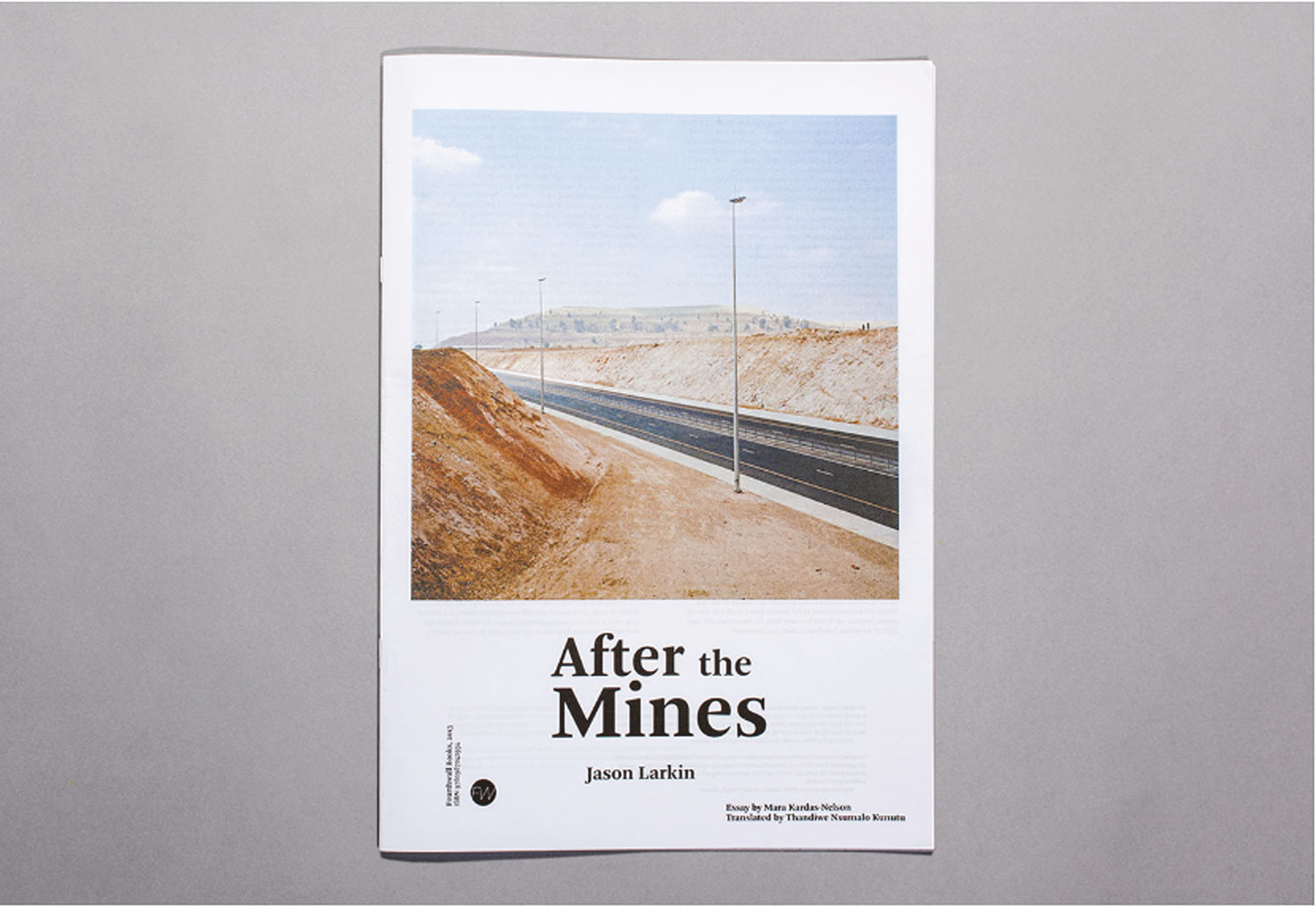
Johannesburg’s mining waste belt (Trangos & Bobbins, 2015).
courtesy of the authors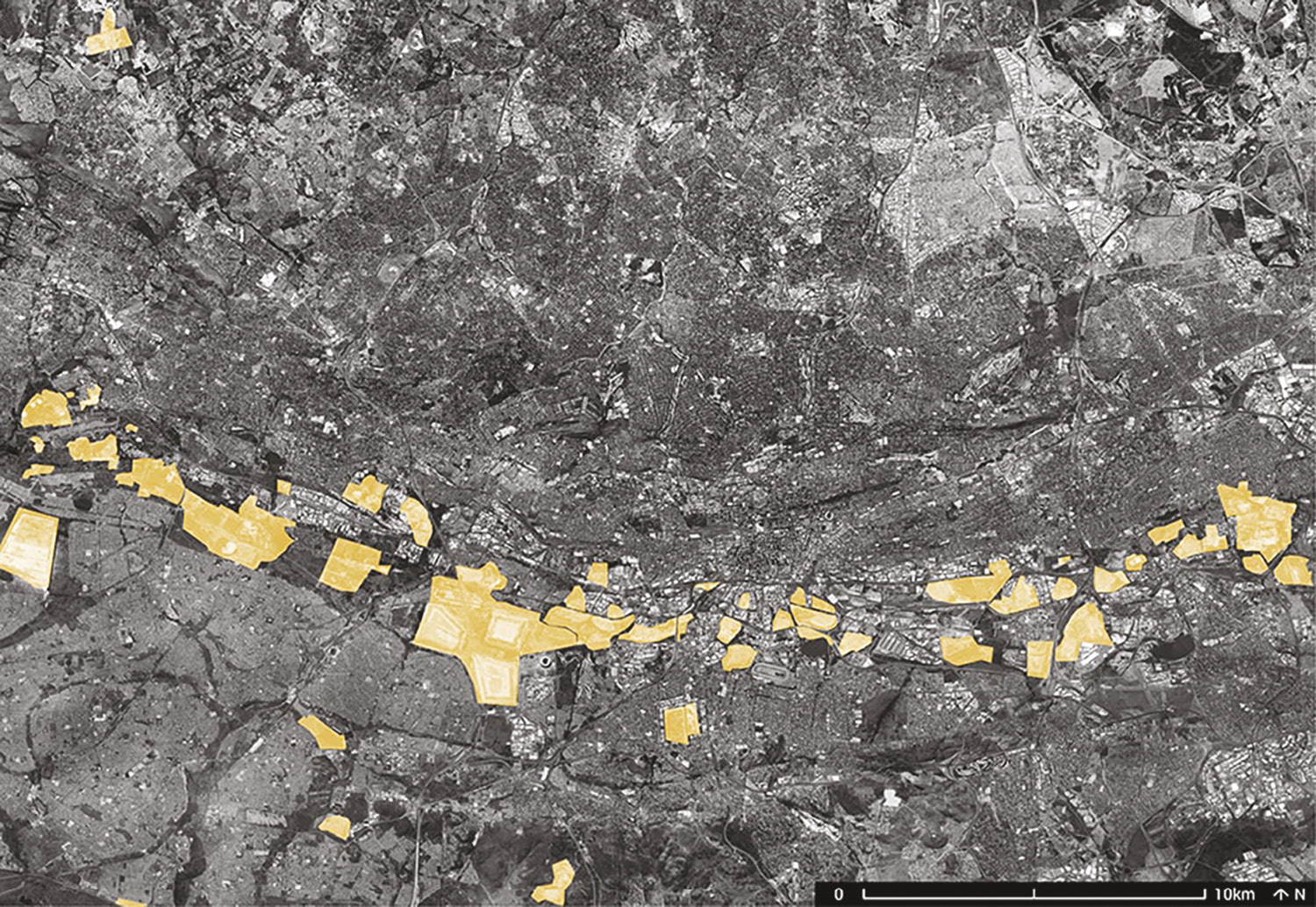
The dumps that resulted from mining were not necessarily coordinated with the planning of the city Johannesburg, and they abut residential areas to
In 1921, when the gold price dropped significantly, mine owners replaced expensive white labour with Black African labour, sparking a white miners’ rebellion and a march under the banner “Workers of the World Unite for a White South Africa”. Racial segregation in the mines and in the city was entrenched by legislation such as the colonial colour bar that prevented Black Africans from attaining higher-level jobs in the mines (Harrison & Zack 2012: 554).
During the early mining period until 1928, many Black African labourers came from the Portuguese East Coast (Mozambique). Their recruitment took place through the Witwatersrand Native Labour Association (wnla), and some argue that recruiting Black labourers from across southern Africa was the only reason deep-level gold mining was economically viable.5 Migrant labourers were housed in men-only compounds for limited-period contracts and were permitted to return to their families in rural areas only once these had expired, essentially fracturing family structures. Socio-political and socio-economic concerns are integral to understanding Johannesburg’s mining history. Such concerns are thoroughly covered in historical, geographic and wider cultural discourses, however, so are not repeated at length here.6
A google maps rendition of the three Mooifontein mine dumps west of the city (on the left)
(Mooifontein 225-IQ 2018).
Although mine dumps are shifting landscapes and change rapidly in geographic terms, at the time of writing (2022), the cluster of mine dumps depicted in District 9 still exists. It is situated to the southwest of Johannesburg, at the intersection between the so-called Soweto highway and the N1 Western bypass (visible running behind and in front of the dump in the foreground of Figure 37). The cluster is in an area known as Mooifontein 225-Iq, and forms part of the Central Rand Goldfields (crg) mines that have declined drastically in production since the 1970s: all the large mines operating there shut down by the late 1970s (Harrison & Zack 2012). The Mooifontein dumps are just three of about 270 tailings dumps in the Witwatersrand area (Figure 40). Some 70 of them were re-treated to recover further gold in the 1990s, but they remain as dubious monuments to the mining industry. The mines here are often described in geographic discourse as abandoned because many have not been
2 Post-landscape
2.1 The Poison Belt
The mine dumps are challenging not only in terms of how they have altered the landscape’s image but also, as mentioned above, how they pose several health and environmental risks to communities living in their proximity. These landscapes are poisoned and poisonous. Before 1991, mines were abandoned when they became unprofitable. Due to a lack of legislation, many of them left corresponding waste sites untreated and the landscape unrehabilitated, the burden of maintenance falling to the government (Mhlongo & Amponsah-Dacosta 2016: 280). The around 6000 abandoned mines across the country
Another side effect of the abandoned mines is acid mine drainage. Water permeates the old mines and, as it rises to the surface, its acidity contaminates the groundwater (Trangos & Bobbins 2015). In addition to acid mine drainage, many of the mine dumps are sources of airborne pollution when toxic dust, classified as pm10,8 is blown across the city (Milaras et al. 2014: 1). This occurs especially from July to October, when the dumps are dry (Cukrowska et al. 2017). A case where mine dumps posed a substantial threat to residents’ health is in the informal settlement of Tudor Shaft, its name related to the old mine, where about 1800 people were living.9 The settlement established in 1996, was built on top of mine tailings, and the adjacent natural water source had high levels of uranium, which reportedly exceed those that residents of the Chernobyl area experienced after the nuclear reactor meltdown there in 1986 (Stassen 2015, Li 2013), making the area utterly uninhabitable. Eventually, in 2017, after many years, residents of Tudor Shaft10 were relocated to “Reconstruction and Development Programme” houses in Kagiso Ext 13.11 This not-uncommon situation highlights the implications of toxicity in the environment, and demonstrates that the mining belt is a problem-ridden artificial landscape that will
Goldblatt’s photograph, Johannesburg from the Southwest (Figure 15), referred to earlier, shows what would be hidden from inside the city: a few isolated shacks standing behind mine waste, underneath towering electricity pylons, seemingly surrounded by mine dumps. The inhabitants look like ants, lost in this ruinous landscape that resembles a scene from a post-apocalyptic film. As well as the drabness of the washed-out sky and desaturated landscape, there is a focus on decaying materials: the rusted corrugated iron of the shacks, and the erosion of the pale dust of the mine dump in the background. The landscape seems barren and uninviting: even the plants here lack colour and vigour. While the electricity pylons are iconic in the Johannesburg landscape, they also echo the headgear that would have been visible when the mines in this area were active. In Figure 41, a remarkably similar post-mining landscape is captured by photojournalist Larkin, although the bright green of the foreground plants lends more colour to the scene.
Image 4/39 from After the Mines. Photograph by Jason Larkin, 2013.
courtesy of the photographer
Goldblatt’s and Larkin’s photographs demonstrate the industrialisation of the landscape around Johannesburg. In both photographs, the contrast between the yellow dust of the mine dumps and the adjacent soil is marked, making the mine dust seem even more alien. The lack of figures or dwellings and the presence of the electricity pylons and the railway line and train alongside the mine dump in Larkin’s photograph make his a more overtly industrialised scene and imply the far-reaching significance of the mining industry in Johannesburg. Railways were historically important to mining development, as transporting ore and other valued materials such as coal was essential to the mining process (Francaviglia 1997: 55, Foster 2003). In Johannesburg the railway lines traverse the city in a course parallel to the mine waste areas to transport materials along that route. These structures fundamentally altered the landscape and remain part of it, just as the mine waste areas do, thus rendering it a post-industrial landscape.
2.2
As Monika Läuferts and Judith Mavunganidze (2009) assert in their discussion of post-industrial heritage in Johannesburg, the mine dumps around the city are unlikely to be seen as valuable parts of history to be preserved, due to their adverse effects on the environment and citizens. Richard V. Francaviglia (1997), who discusses mining landscapes from a historical and cultural perspective, describes them as “hard places”, but thinks of them as having historical value. Writing about mining in California in the US (which coincided with the gold rush in Johannesburg), he argues that mines and the landscapes they shaped
The way that the dumps frame the city in the screenshot from District 9 (Figure 37) suggests the impact of the declining mining legacy on the city. It is this focus on decline and decay that marks the landscape itself as one of ruins. Francaviglia (1997: 215) suggests that, while such industrially ruined landscapes are now regarded negatively, industrial landscapes were often valorised as symbols of progress in the Victorian era, when they were even depicted alongside pastoral landscapes. Nye (1994: 36–43) writes about this phenomenon and notes how in the 1800s Jacksonian era in the U S, industry and nature were not seen as opposed to each other. The progress that technological advancement symbolised was linked to the nation’s moral health: natural wonders were celebrated alongside manufactured wonders that transformed nature into something even more remarkable. Later examples of this valorisation of technological progress are evident in South African Moses Tladi’s painting, Mine scene,14 and J. H. Pierneef’s Johannesburg Railway Station panel series (1929–1932). Tladi portrays a mine dump with industrial buildings to the left of his painting, the dump, structures and natural landscape features blending seamlessly. The golden light that bathes the scene is echoed in the golden colour of
In these paintings, the mining apparatus and its effects on the topography are completely integrated with the landscape. Pierneef’s depictions are quite unlike those in District 9, where the landscape seems polluted and washed out. In Rand Gold Mine, his painting of the City Deep gold mine located near Johannesburg, the mining equipment suggests its own beauty, as the smoke from the smokestacks mingles with majestic cloud formations above the mine, and their curving forms contrast with the geometry of the large, formally centred mine dump. Premier Mine portrays a diamond mine in Cullinan outside Tshwane, where the famous Cullinan diamond, the largest diamond of gem quality ever found, was discovered (Cullinan [n.d.]). The raw red earth of the open mine in the foreground dominates the scene, its enormous scale creating a sense of splendour that belies its scarring of the natural landscape. Pierneef’s heroic depictions of diamond and gold mines represent the importance of South Africa’s mineral wealth to the country’s socio-economic history.15
Pierneef sets up these compositions in much the same way as he portrays sublime natural landscapes in other paintings such as Rustenburg Kloof or Mont-aux-Sources. In these paintings, the landscape is constructed to display grandeur and overwhelming scale in the towering mountain ranges, sheer cliffs and imposing cloud formations (Schön 1973). Everything here points to the natural world’s scale, bounty and beauty, underpinned by a natural order. In applying similar compositional strategies to his paintings of mines, Pierneef undermines the binary of nature against the rationality of human endeavour, instead seeing an order in nature that seems equally mathematical and systematic (Bouman 1955).16 N. J. Coetzee (1992:21) argues that Pierneef sees both nature and culture as emanations of a divine will, and therefore does not distinguish between the beauty of scenes depicting industry and those depicting the natural world. Lize van Robbroeck (2019: 51–52) suggests that Pierneef’s
There has been much debate around Pierneef’s significance in the South African canon: those critical of his work cast him as an Afrikaner nationalist proponent of white supremacist notions of ownership of the South African landscape. His landscapes rarely allude to human interventions, apart from the two mining paintings and the occasional farmhouse or small town, and are devoid of people. The absence of so-called native peoples and their dwellings is particularly conspicuous, implying that the land was originally empty of human influence. Known for his Afrikaner nationalist sentiments, Pierneef advocated for an ostensibly unique African art, uninfluenced by European conventions, yet paradoxically presented an exclusively white view of the South African landscape. Van Robbroeck suggests that his landscapes exemplify settler landscapes, which purported to be ‘empty’ before white settlers arrived, and that Pierneef saw Afrikaners as bound up with the land and thus with an implicit claim to belonging (Van Robbroeck 2019: 51–54). Such a view of white belonging in the South African landscape is problematised in contemporary depictions such as District 9, where whiteness is depicted as in a state of anxiety and non-belonging.
Mining was primarily a colonial project at the outset, the industry ‘claimed’ by Afrikaner nationalism only later. But the mining landscape throughout its history can be seen as a ‘white blight’, leaving a poisoned landscape in its wake. Contemporary depictions of the mine dumps imply awareness of this taint as opposed to the favourable light in which Pierneef painted them. Yet the sublime remains relevant when attempting to comprehend these landscapes.
The mining landscape has caught the attention of recent photographers. Two years after Larkin’s photo essay After the Mines (2013), a comparable visual document of the landscape of mine dumps around Johannesburg was published – Johannesburg-based photojournalist Jansson’s 2015 book on acid mine drainage called An Acid River Runs through It. While the photographs in these projects seem documentary in nature, and focus on an ecological agenda, one cannot but be entranced by the aesthetic qualities of these dystopian images. In the photographs by Jansson and Larkin, the latter in Figure 42, the landscape seems impossibly vast, with little to indicate the scale of the dumps they capture. Pierneef’s depictions celebrated the power of industry in the landscape through scale, but these images depict the aftermath, as signalled in the title of Larkin’s photographs; all that remains of the now defunct mining industry is the poisoned land and waterways, the “acid river” of Jansson’s title. These
Image 28/39 from After the Mines. Photograph by Jason Larkin, 2013.
image courtesy of the photographer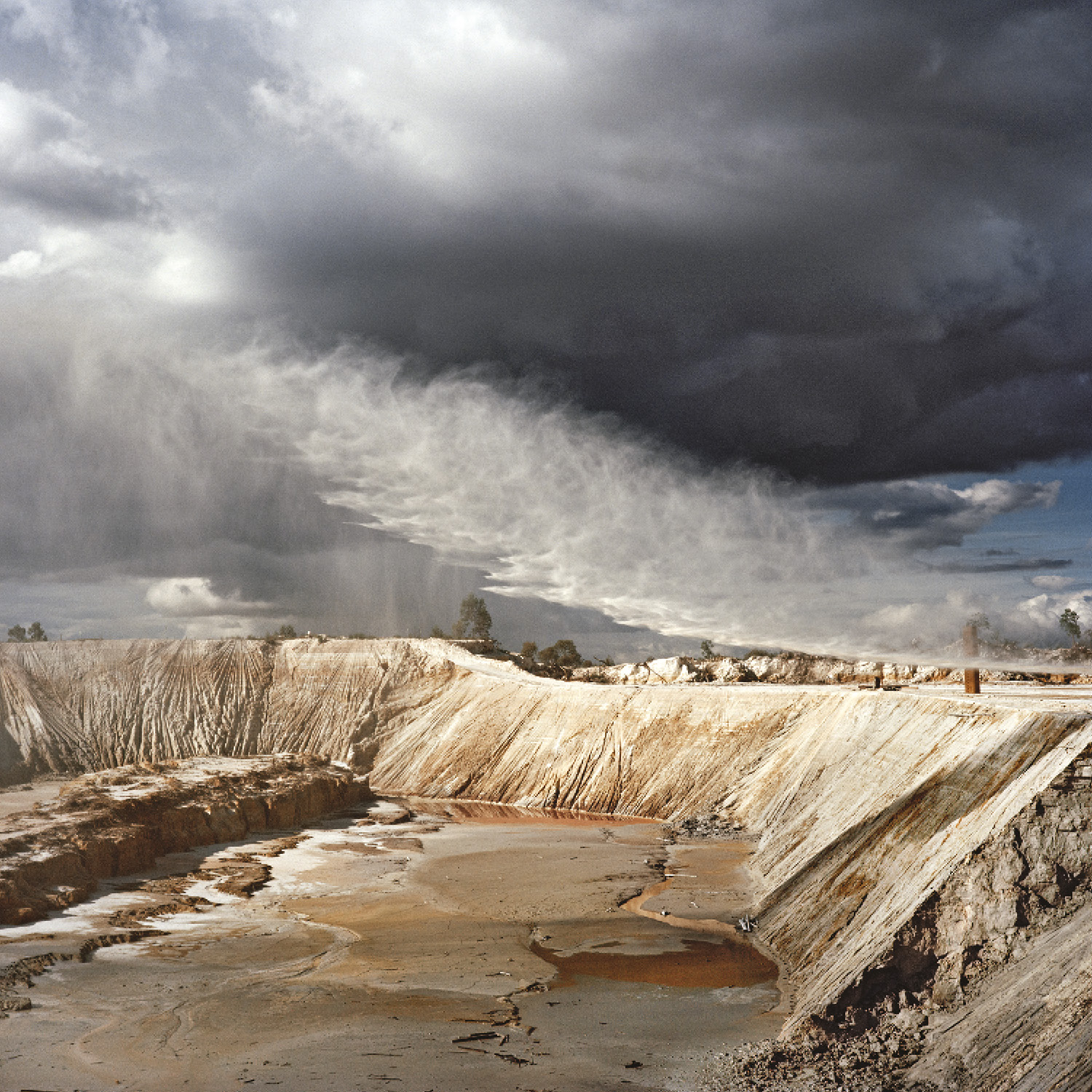
Larkin’s and Jansson’s photographs are reminiscent of Edward Burtynsky’s well-known photographs of industrially poisoned landscapes (Figure 43 was taken by him in Johannesburg). Often described as sublime17 because of the
Gold Tailings #1, Doornkop Gold Mine, Johannesburg, South Africa. Photograph by Edward Burtynsky, 2018. Pigment inkjet print on Kodak Professional Photo Paper, 121.9 × 162.6 cm. Toronto: Nicholas Metivier Gallery.
photo: © edward burtynsky, courtesy nicholas metivier gallery, toronto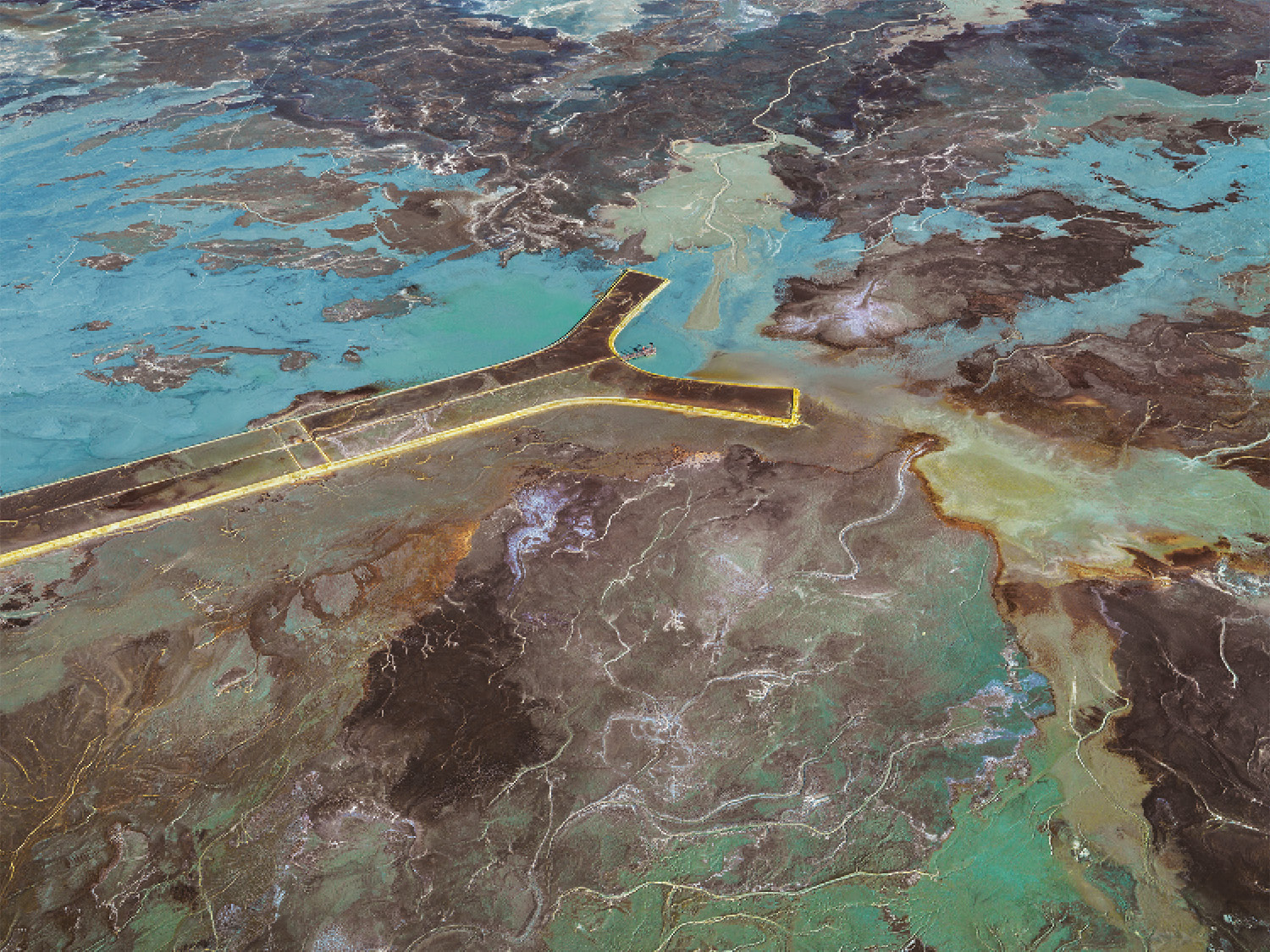
Writing about photography of mining landscapes, Meghan Kirkwood (2019) suggests that removing people from such landscapes gives them a sublime quality. She writes, quoting Giblett, that Burtynsky’s work removes context and social consequence from the image, rendering an abstract sense of landscape that allows “the viewer to more freely ponder the relationship between beauty and decay” (Kirkwood 2019: 437). Such a distancing effect does not leave room for the critical potential I detect in post-industrial landscapes.
An alternative interpretation is proposed in Kirkwood’s subsequent discussion of Legacy of the Mine (2013), a monograph on mining by South African-born photographer Ilan Godfrey. Regarding Godfrey’s depiction of a mine dump near Soweto (Figure 44), she argues that the presence of people prompts the viewer to move beyond an abstract contemplation of scale. To see children in this landscape, with no indication of where the landscape begins or ends, may prompt practical questions such as why they are there, and how they got there to begin with (Kirkwood 2019: 438). Yet, at the same time, sublime elements are present, and even heightened by the small figures. This landscape is vast compared to the children, and its topography is unfamiliar, uncanny, and alien. The relationship between humans and the landscape depicted here, indeed nature itself, is perhaps precisely what we should focus on.
Legacy of the Mine. Riverlea Mine Dump, Main Reef Road, Johannesburg, Gauteng. Photograph by Ilan Godfrey, 2011.
image courtesy of the photographer
Gangster’s Paradise: Jerusalema likewise depicts children playing on a mine dump in Soweto. In the scene, they slide down its slopes on pieces of cardboard, while Lucky and Zakes run a car washing business at the dump’s foot. The children seem to have claimed the site for recreation and are oblivious to its dangers. Although the depiction is very different from Godfrey’s, there is a sense of danger and foreboding, since film audiences would be aware of the site’s toxicity and risks. The scene perhaps highlights the fraught conditions of childhood in this context, emphasised when it ends with a panning shot revealing from a high angle how close the dump is to houses: they appear just across from it with only a road separating the two areas. The sequence may leave the viewer with a sense of unease and foreboding, despite the commonplace appearance of children at play and teenagers trying to earn pocket money by washing cars, activities associated with suburban life.
In the case of Burtynsky’s photographs, which omit human presence, Amanda Boetzkes (2010) considers that they often show nature as something beyond representational grasp. The landscapes he depicts evoke nature but are entirely man-made. Boetzkes (2010: 29) uses Jean Luc Nancy’s term “ecotechnological” to describe them. In other words, nature itself is produced or determined entirely by humanity’s technological relationship to it, whether through
The most important element, comparable to earlier formulations of the sublime, is the notion that these landscapes, and photographs of them, are both attractive and repulsive; for Boetzkes (2010: 27), this dynamic evokes Kant’s description of the oscillation as a vibration, in which the opposing responses alternate. Boetzkes suggests that Burtynsky’s work represents landscapes that simultaneously evoke nature and convey anxieties around large-scale environmental crises (2010: 30), which would indeed have dystopian implications. The photographs in Figures 42, 43 and 44 are compelling in this regard. They present landscapes that seem otherworldly, made of matter that is unnatural and strangely coloured. Nothing here comes across as soil, and the bleached yellows and ochre colours of the dust evoke the toxic mineral content of the sulphides, such as cadmium and pyrite, in Johannesburg’s mine waste areas. The sludge around the dump structures in Larkin’s and Burtynsky’s photographs likewise conveys a sense of toxicity (Figures 42 and 43). The bodies of liquid do not look like water and appear to be highly saturated with coloured matter, dyed to the point of being paint-like.
The dumps have a very particular materiality. I would suggest that they may be interpreted as an instance of the formless, theorised by Bois and Krauss in the 1990s. The formless, like the abject, is about a collapsing of boundaries between things – between figure and ground (in a pictorial sense), and between subject and object. In these landscapes one can see several aspects of such transgressions. Mine waste areas seem inside-out: what should be buried underneath the landscape now becomes the landscape itself, a monstrous inversion. Mine dumps furthermore lack structure and definition – not only in their physicality as structureless “dumps”, but also in their identity as non-landscapes. They are a prime example of the “base material[ity]” that Bois and Krauss (1997: 29) refer to as formless. In this sense, they are not so much unnatural as primordial. None of the terms that describe clearly defined landscape features apply here: neither landforms such as mountains and
Smithson is known for his work with post-industrial sites such as mine dumps. In an interview with Moira Roth in 1973, he suggested that there is often an urge to return industrial landscapes to a supposed previously pure natural state. To him, this did not seem possible: instead, his work can be understood as a series of aesthetic interventions with post-industrial landscapes that allow one to see them afresh – as artworks rather than as wasted sites (Ryan 2007: 95–116). For Smithson, such sites are evidence of the traces of time, and the marks of entropic change on the landscape. The urge to explore entropy may be compared with how the formless disrupts rational categories of aesthetic experience and landscape. Writing about Smithson’s work in the context of environmental aesthetics, Maskit (2007: 323–337) suggests that categories for landscape, such as the beautiful and even the sublime, fail to allow for an appreciation of post-industrial landscapes, such as abandoned mine sites, because they apply only to so-called natural landscapes. I would argue
There is an unsettling tension here between thinking of post-industrial landscapes as aesthetic objects and as sites of human activity. Aside from such sites being poisoned and dangerous, because they no longer fulfil their original function, they are also unregulated spaces (Edensor 2005). In some ways, therefore, such places afford a degree of freedom to those who choose to interact with them. And the negative effects of illicit activities afforded by that freedom are clear. A recent example is the case of a music video crew who were viciously attacked on a mine dump outside Krugersdorp. The suspects are illegal miners (colloquially called zama zamas), reported to habitually hide in tall grass in the area with the intent to commit crimes (Masweneng 2022, Steyn 2022).24 On
In District 9 the mine dumps of Mooifontein are nostalgic objects because they bear the physical traces of the city’s history. This nostalgia is not only for the untouched natural landscape before Johannesburg existed, but an ironic nostalgia that looks back on the history of mining in the area that led to the city’s founding, including its unsavoury aspects, now so recognisably present in the waste that remains. The mine dumps also constitute landscapes that offer aesthetic potential. Despite their real physical threat to humans and the ecology around Johannesburg, one may still legitimately consider what they offer from an aesthetic point of view. Maskit (2007) suggests that such localities may have the potential to transform the way we regard or “see” post-industrial sites, which echoes Brook’s (2012: 115–116) suggestion that the aesthetic appreciation of landscapes may stimulate or require one to regard the same site from different perspectives. Johannesburg’s landscapes are sites of change and metamorphosis in themselves, in flux and unresolved. They embody change materially, geographically, pragmatically and visually. This embodiment of change impacts our very notions of landscape and place as such.
Refer to Clive Chipkin (1993), Guy Trangos & Kerry Bobbins (2015: sp) and Lucia Saks (2010).
See Clive Chipkin (1993) and Sally Gaule (2005: 2337–2338).
See Clive Chipkin (1993) and Sally Gaule (2005: 2339–2340).
These terms can become confusing as they are often used interchangeably. I refer to mine dumps, tailings dumps, slimes dams, tailings and other varieties of mine waste sites in general as mine waste areas (mwas), in the same way as Tahira Toffa (2013: 24–31).
See Harrison & Zack (2012: 555), for example, who cite Jonathan Crush, Alan Jeeves & David Yudelman.
Philip Harrison & Tanya Zack (2012), Clive Chipkin (1993), Phefumula Nyoni (2017: 133–154) and Janet Munakamwe (2017: 155–186) all write about the history of mining and the effect the industry had on particularly Black labourers and their family lives.
For more on the rehabilitation of South African mines, see Milton Milaras et al. (2014: 2), Guy Trangos & Kerry Bobbins (2015) and Sphiwe Emmanuel Mhlongo & Francis Amponsah-Dacosta (2016: 283).
This refers to particulate matter with size less than 10 μm in diameter, which humans can inhale due to its small size (Nkosi, Wichmann & Voyi 2017).
This informal settlement also captured the imagination of authors interested in Johannesburg. Mark Gevisser writes about the informal settlement as abject, dystopian and radioactive in his memoir, Lost and Found in Johannesburg (2014: 176–184). He also draws on the science-fiction novel by Lauren Beukes entitled Zoo City (2010) to discuss the mining landscape around the city in general.
Tudor Shaft was created when the government forcibly removed residents from another informal settlement a short distance away. Since that time many studies were undertaken on the toxicity of the mine waste at Tudor Shaft, although residents were only moved in 2017 (Decommissioning Projects … 2021).
This was government subsidy housing as part of the Reconstruction and Development Programme (rdp) instituted by the African National Congress in 1994 to address housing shortages in the country, in particular for people living in informal settlements (Everything you need … 2017).
In May 2016, Water and Sanitation Minister, Nomvula Mokonyane, directed the State-owned Trans-Caledon Tunnel Authority to implement a so-called ‘long-term acid mine drainage solution’ in the Witwatersrand. The estimated date for implementation of the plan was 2021 (Solomons 2017). It aims to supply fully rehabilitated water fit for human consumption to the area, alleviating the province’s need to rely on the Vaal Dam and the Lesotho Highland Water Project.
Geographical studies such as Milaras et al. (2014: 9) and Mhlongo and Amponsah-Dacosta (2016: 280) consider the appearance of the landscape as altered by mining.
Refer to Angela Caccia’s (2016) article on Tladi. The date of the painting seems unknown, but he was active around the same time as Pierneef.
Coetzee (1992: 39).
Dylan Trigg (2006: 147–148) suggests that historically the sublime was framed within an opposition between nature and human reason, since in the Kantian sublime, for example, human reason allows the viewer of the sublime in nature to experience a sense of triumphant survival in the face of nature’s forces.
See, for example, Amanda Boetzkes (2010) and Jennifer Peeples (2011), who write on post-industrial landscapes.
Both Boetzkes (2010: 23–26) and Meghan Kirkwood (2019: 436–438) consider Burke’s and Kant’s ideas around human subjects and their relation to sublime landscapes.
Hansen does not make use of the term Anthropocene, but his writing focuses on the relationship between humans and technology that has shifted society from the centre of its own worldview, in other words, as post-human.
When I refer to urban planning in Johannesburg, this implies both colonial and apartheid planning regimes, which conceived of planning based on models from the global North (De Satgé & Watson 2018).
The notion of waste is itself interesting in relation to mine waste areas, as it bears similarities to the formless. Waste, that has recently come to be of interest across disciplines such as cultural studies and media studies (Schneider & Strauven 2013: 412–414), is often understood to have a spatial quality, as wasted space, or spaces that are seen as wastelands, idle spaces or dangerous spaces because they do not function as (middle-class) society would have them (Scanlan 2005). Objects that are considered rubbish, garbage or waste are seen as detached from their social context and function (Edensor 2005: 108–117), and as something that is to be separated and removed or which has become devalued (Scanlan 2005: 10). See Walter Moser (2002), Mary Douglas (2002) and Kirsten Seale & Caroline Hamilton (2010) for notable discussions on the significance of the concept as one that has a subversive potential to challenge the rationality associated with modernist and Enlightenment ideas of urban planning and landscape.
The sublime has been applied in the context of the artificial environment, such as industrial landscapes, by David Nye (1994), and more recently has been considered in terms of the Anthropocene by Amanda Boetzkes (2010) Isis Brook (2012) and Dylan Trigg (2006).
According to Brook (2011: 111) participatory aesthetics is a relatively new field within aesthetics that pursues exactly this: the lived aspect of a landscape as part of its aesthetic character. In short, what is at stake in the field of participatory aesthetics is a complication of the academic understanding of the relationship between aesthetics and the lived (and by extension embodied) world, countering the critique that aesthetics is scopic in orientation, and that it neglects the socio-political aspects of landscapes. Brook (2012: 113) suggests, for example, that a farmer, working on and living in a landscape, might have a deeper investment in aesthetic appreciation of the landscape than an artist may have, because the farmer has a physical relationship with the landscape. Farmers regarding land as practical and necessary to their survival would not necessarily preclude them from regarding the land aesthetically.
This upsetting crime led to xenophobic backlashes, as members of the public in the area urged police and the military to take action against illegal aliens in the country (Phooko 2022, Mob attacks … 2022, Magome 2022).