


Contexts and Research Procedure Course
Understanding the significance of human-AI collaboration in creative activities requires situating the discussion within a broader historical, technological, and philosophical context. The evolving relationship between human creativity and technological innovation is not new; it reflects a long-standing dynamic wherein each major technological shift—whether the printing press, photography, or digital computing—has transformed how creative expression is conceptualised, produced, and experienced. However, the emergence of AI marks a qualitative leap: AI does not merely serve as a tool operated by human creators but increasingly participates in creative processes, generating outputs, curating content, and even making autonomous aesthetic decisions.
This new reality invites critical reflection across multiple domains. In the arts, AI challenges traditional notions of authorship, originality, and emotional authenticity. In cultural heritage management, it offers new possibilities for access, preservation, and engagement, while simultaneously raising concerns about authenticity, representation, and narrative authority. Within academic research, AI systems are reshaping knowledge production, interdisciplinary collaboration, and epistemological frameworks. These contextual shifts underscore the urgency of re-examining the aesthetic, epistemic, and ethical foundations of creative activities in an era characterised by human-AI collaboration.
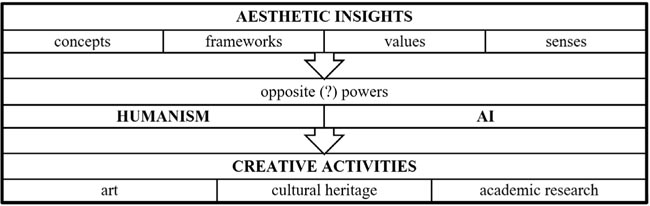
The book explores the aesthetic insight into the transformative interplay between AI and human artistic creativity, cultural heritage, and academic research collaboration. It delves into how AI technologies reshape the arts, culture, and academia, addressing both their potential to enhance creative processes and the challenges they present to traditional aesthetic and ethical frameworks of human creativity. The volume follows my previous books: (1) “Humanistic Management, Organisation and Aesthetics. Art of Management and Management of Art” (Szostak, 2024), and (2) “Management Aesthetics. Kitsch and Modern Organisations” (Szostak, 2025), which prepared a theoretical framework for aestheticisation of human creative activities and presented their positive and negative practical examples.
Seeing the potential for further exploration of aesthetic-humanistic insights and growing interest in AI, at the turn of 2024 and 2025, I gathered almost three dozen international scholars from varied fields, disciplines, and countries in a scientific project, “Aesthetics of humanistic management in the AI era”, held at Civitas University in Warsaw to investigate these phenomena in varied dimensions. After a few months of collaborative work, three domains of extensive studies started to arise: (1) aesthetic insights into humanism and AI in organisational management contexts (Szostak, 2026b); (2) aesthetic insights into humanism and AI in human creative activities within art, cultural heritage management, and academic research contexts (which resulted in this edited volume); and (3) aesthetic insights into humanism and AI in macro-scale organisations, institutions, and political contexts (Szostak, 2026a).
The project’s research process was composed of a few stages. Initially, a general literature review on humanism and AI through the lens of the aesthetics of deepness was undertaken to define the scope of the project’s research area and prepare the space for analysing varied issues. In the second step, scholars from our team (alone or in groups) focused on their organisational and managerial domains (general management theory, decision-making, leadership, human resource management, organisational efficiency) and analysed them using optimal methods (Figure 0.1).

Research Gaps, Problems, Questions, Hypotheses, and Methods
Despite the growing body of research on AI and its applications across creative sectors, significant research gaps hinder a comprehensive understanding of AI’s aesthetic, ethical, and managerial impacts on human creative activities. This volume addresses these deficiencies by tackling key research gaps at the following epistemological, empirical, and practical levels.
At the epistemological level, this book addresses the lack of integrated frameworks that analyse AI through the combined lens of aesthetics and humanistic management within creative domains. Existing scholarship often examines AI from technical, economic, or narrowly ethical perspectives but rarely considers its impact on human creativity’s aesthetic and emotional dimensions. Furthermore, research remains fragmented across disciplines, with little interdisciplinary synthesis linking aesthetics, organisational theory, cultural heritage studies, and technology. Additionally, there is an underexploration of how AI reshapes the epistemology of creativity, knowledge production, and interpretation in art, culture, and academic practices.
At the empirical level, the volume responds to the scarcity of cross-sectoral studies that investigate AI’s effects simultaneously across art, cultural heritage, and scholarly research environments. While individual sectors have been analysed, comparative and integrated empirical research remains lacking on how aesthetic challenges and opportunities manifest in diverse creative fields. Empirical investigations into the dynamics of human-AI collaboration—particularly regarding trust, emotional resonance, and aesthetic co-creation—are limited. Moreover, regional disparities in AI adoption and use in creative industries, especially beyond Western contexts, have been underrepresented in current empirical studies.
At the practical level, the book addresses the absence of human-centric management strategies for integrating AI in creative, cultural, and academic institutions. Most existing approaches emphasise operational efficiency or technological innovation without adequately considering aesthetic quality, ethical responsibility, or emotional engagement. Furthermore, there is a notable lack of ethical guidelines tailored explicitly to creative settings that prioritise human dignity, cultural diversity, and the preservation of creative agency. Finally, there is a pressing need for practical aesthetic evaluation models to guide institutions in assessing the quality and human-centred value of AI-supported artistic, curatorial, and academic outputs.
The book’s aims are the following: (1) to analyse the impact of AI on the aesthetic and emotional engagement of users in arts and cultural contexts, such as museums, galleries, and media; (2) to investigate how AI influences creativity and imagination, offering new tools for artistic expression and scholarly collaboration; (3) to address AI’s ethical and organisational challenges in interdisciplinary academic and cultural settings; and (4) to develop theoretical frameworks and practical insights that blend aesthetic considerations with technological advancement.
The central research problem of the book concerns how AI technologies are transforming the aesthetic, epistemic, and ethical dimensions of human creative activities across the domains of art, cultural heritage management, and academic research practice. The book examines how AI can enhance, challenge, or redefine human creativity, emotional engagement, cultural preservation, and scholarly collaboration while posing critical questions about automation, authenticity, trust, and human agency within creative and knowledge-driven processes. Specifically, the research problem addresses the following issues: (1) How aesthetic principles—such as beauty, harmony, emotional resonance, cultural relevance, and experiential richness—are being reinterpreted, reshaped, or disrupted by AI-driven systems; (2) How humanistic values can be preserved or reimagined in AI-mediated artistic, curatorial, and research activities; (3) How management strategies, ethical frameworks, and interdisciplinary methodologies can balance technological innovation with human-centred creativity and cultural integrity. The inquiry is motivated by the recognition that while AI introduces new tools for creativity, personalisation, and collaboration, it also introduces new aesthetic tensions, ethical dilemmas, and organisational challenges that demand critical, interdisciplinary, and humanistically grounded responses. The importance of this research problem lies in (1) its novelty—it fills a significant gap where existing literature addresses AI’s technical or ethical dimensions separately but rarely integrates these with aesthetic-humanistic analysis across multiple creative sectors; (2) its multidimensionality—it explores a rich intersection of aesthetics, creativity, ethics, cultural heritage, knowledge production, and AI management; and (3) its practical relevance—it provides insights for scholars, artists, curators, educators, cultural managers, and policymakers facing the challenges of AI integration in creative and academic environments.
The main research questions of the volume are:
RQ1: How do AI technologies influence creating, curating, and preserving aesthetic experiences in arts, cultural heritage, and media content?
RQ2: What managerial and organisational strategies can effectively balance automation and human-centric aesthetics in AI-driven cultural and academic practices?
RQ3: How can aesthetic principles, such as emotional engagement, cultural relevance, and visual harmony, enhance the adoption and impact of AI in academic collaboration and interdisciplinary research?
RQ4: What ethical and aesthetic challenges arise in integrating AI into arts, culture, and academia, and how can these be addressed to preserve human values and creativity?
The main hypotheses of the volume are the following:
H1 (Impact on creativity and curation): AI technologies significantly enhance creativity and aesthetic engagement in arts and cultural heritage management by providing tools for content creation, personalisation, and immersive experiences while posing challenges to traditional artistic and curatorial practices.
H2 (Balancing automation and human aesthetics): Integrating AI in cultural and academic practices can balance automation and human-centric aesthetics when guided by managerial strategies prioritising emotional engagement, cultural relevance, and ethical considerations.
H3 (Aesthetic adoption in academia): Aesthetic principles such as visual clarity, empathy, and cultural resonance positively influence the adoption of AI technologies in collaborative academic research, fostering trust and enhancing interdisciplinary engagement.
H4 (Ethical and aesthetic challenges): Integrating AI into arts, culture, and academic practices creates new ethical and aesthetic challenges, which can be mitigated through frameworks that preserve human creativity, ensure fairness, and align with cultural values.
Given this volume’s interdisciplinary and exploratory nature, the contributing authors employed various research methods. Recognising the complexity of examining AI’s aesthetic, ethical, and creative impacts across diverse fields such as art, cultural heritage, and academic practice, each chapter applied the methodological approach best suited to its specific research problem, context, and disciplinary tradition. While the methods are diverse, they collectively reflect a commitment to rigorous, critical, and humanistically grounded inquiry.
The methodological backbone of the volume includes a combination of critical literature reviews, conceptual and theoretical analyses, and empirical research using qualitative, mixed-methods, and comparative designs. Many authors engaged in critical interpretive reviews of existing scholarship, synthesising insights from fields such as aesthetics, cultural studies, AI ethics, humanistic management, translation studies, and interdisciplinary research theory. These reviews provided the conceptual foundations necessary to frame original arguments and identify research gaps at the intersection of AI and aesthetic human creativity.
Empirical components were incorporated where appropriate to strengthen the analysis with real-world data. Several chapters employed fieldwork, including case study research, visitor experience surveys, and semi-structured interviews with practitioners, curators, academics, or media experts. Mixed-methods approaches were adopted in studies examining AI in museum curation, visitor engagement, and content personalisation in media, where both qualitative and quantitative data supported a richer interpretation of findings. Comparative analysis was used to investigate differences in AI adoption and aesthetic practices across geographic, cultural, and institutional contexts, particularly highlighting disparities between Western and non-Western institutions.
Importantly, although no single unified research methodology governs the entire volume, a common formal pattern was maintained across all chapters to ensure coherence and accessibility for readers. Each chapter systematically presents an introduction framing the research gap, research problem, and methods; a structured literature review; an analysis of theoretical or empirical findings; a discussion linking results to broader frameworks; and a conclusion answering research questions, acknowledging limitations, and proposing directions for future inquiry. This structured approach allows the diversity of research methods to remain unified within a coherent editorial vision, reinforcing the interdisciplinary character of the book.
Structure
After three initial components, “Preface” by Stephen Linstead, “Introduction: In search of synergy in human-AI creative collaboration” and an analytical chapter, “Aesthetic insights into human-AI collaboration in art, cultural heritage, and academic practice: Research perspectives”, both written by Michał Szostak, the following eight chapters are organised into three parts. Part I, “Art”, contains two chapters (2–3) about human-AI collaboration in the context of artistic creativity and visual aesthetics. Part II, “Cultural heritage”, contains three chapters (4–6) about the role of AI in managing, interpreting, and aesthetically enhancing museum experiences and heritage preservation. Part III, “Academic research practice”, contains three chapters (7–9) about human-AI collaboration in research, interdisciplinary knowledge production, creative management, and language professions. A detailed scope of each of the nine chapters is below.
Chapter 1, “Aesthetic insights into human-AI collaboration in art, cultural heritage, and academic practice: Research perspectives”, prepared by Michał Szostak, explores the intersection of AI and aesthetics in arts, culture, and academia. The research addresses how aesthetic principles influence AI technologies’ design, implementation, and perception, shaping user engagement, creativity, and cultural preservation. It investigates interdisciplinary methodologies for analysing these intersections and examines AI integration’s ethical and practical challenges. Key research questions include: 1) What aesthetic dimensions shape AI’s impact on arts, culture, and academic practice? 2) How can interdisciplinary research methodologies effectively explore the intersection of AI and aesthetics? 3) What are the emerging trends and challenges in applying aesthetic principles to AI technologies in cultural and academic contexts? The findings highlight the importance of visual harmony, emotional resonance, and cultural relevance in fostering engagement with AI-driven systems. Interdisciplinary methodologies provide nuanced insights, while ethical challenges, such as algorithmic bias and the commodification of aesthetics, remain critical concerns. The chapter concludes with practical recommendations for integrating aesthetic principles into AI applications to balance creativity, inclusivity, and technological innovation, offering valuable insights for scholars, practitioners, and cultural leaders navigating this transformative field.
Part I. Art
Chapter 2, “Pictures at an exhibition—AI-driven surrealist futures: The case of reimagining higher education through aesthetic critique”, created by David Atkinson, explores the problematic of critique in the era of human-AI interaction. Drawing on Benjamin’s conception of dialectics at a standstill, the research uses an AI image generative application to construct an ‘exhibition’ of six imaginations, previously published as part of an imminent critique of entrepreneurial capitalistic economics. The research aim is to explore the potential of AI as a critical tool to unlock, access, or make visible, the value of human imagination. It addresses the question: Can we (collectively) cultivate the use of genAI as a tool for a more general aesthetic engagement with a critical understanding of our future potential as a society? The chapter adopts a methodology of Applied Negative Dialectics, drawing implications from a single-case method, using AI-generated images of the future of Business Schools in Higher Education. The conclusion drawn is that the use of AI to garner the intrinsic value of ‘an empirics of the imagination’, concerning the immanent critique of a defined area of socio-economic activity, provides the excitement of an AI that has value in facilitating the curation, exploration and enhancement of—rather than merely the replication and imitation of—the human experience. The chapter may benefit critical scholars, social and cultural theorists, artists and AI researchers by offering a new approach to utilising AI and aesthetically-informed judgment in socio-economic knowledge production.
Chapter 3, “Aesthetics of AI-driven content personalisation in television: Balancing automation with human experience”, written by Stanisław Jędrzejewski, Krzysztof Kuźmicz, and Aleksandra Chmielewska, provides a nuanced analysis of the impact of AI on content personalisation in free ad-supported streaming television (FAST) channels. It explores the intersection of AI, encompassing machine learning, natural language processing, and advanced data analytics, which is transforming the television landscape by revolutionising how content is personalised for viewers and content aesthetics in television, focusing on virtual product placement (VPP) within FAST channels. It seeks to understand how automation enhances viewer engagement while maintaining a balance with human-centred experiences. Employing a targeted mixed-methods approach, combining a literature review with an empirical component based on seven in-depth interviews conducted with key experts from the television industry, the study systematically examines using AI in television by introducing a topic such as the impact of AI-driven personalisation on content selection and aesthetic preferences. An ethical dimension is incorporated to evaluate the influence of AI on viewer privacy, content selection, and decision-making processes. Although the analysis adopts a local perspective, investigating the role of key players in the Polish television market, the study focuses on specific audience segments, particularly viewers of FAST channels, to assess how AI-driven personalisation affects diverse demographic groups. This research offers a deeper understanding of the delicate balance between technological innovation and aesthetic-ethical responsibility, delivering valuable insights to media stakeholders navigating the evolving landscape of AI in the global television industry. The chapter is dedicated to media experts and academics.
Part II. Cultural Heritage
Chapter 4, “The art of curation in contemporary galleries: Managing AI-driven tools for a perfect visual exhibition”, prepared by Djalel Baghzou, Assala Belsem Bouameur, and Michał Szostak, explores the potential of AI-driven tools to create immersive, inclusive, and meaningful visual experiences while upholding the principles of humanistic management. Through a mixed-methods approach, combining a comprehensive literature review and an empirical visitor survey, the research examines how AI can personalise exhibitions, improve accessibility, and support human creativity. Findings indicate that AI tools, such as predictive analytics, real-time captions, and multilingual translations, significantly enhance visitor engagement and inclusivity, particularly for diverse audiences, including those with disabilities. However, challenges such as algorithmic bias, the risk of diminishing human creativity, and ethical concerns around data privacy and artistic integrity were also identified. The chapter also presents a collaborative workflow diagram between human curators and AI-powered systems in exhibition design. The study underscores the importance of a balanced approach to AI adoption, where technology complements rather than replaces human curators, ensuring that exhibitions remain culturally significant and emotionally resonant. By fostering collaboration between AI and human expertise, galleries can create innovative and inclusive exhibitions that resonate with diverse audiences while preserving art’s emotional and artistic depth. This research contributes to the ongoing discourse on the role of AI in the arts, offering actionable insights for gallery managers and curators navigating the complexities of AI integration.
Chapter 5, “AI in Museum Practice: Aesthetic Engagement and Heritage Management”, created by Katarzyna Jarosz, examines AI’s role in managing and preserving cultural heritage within museums, particularly its impact on visitor engagement, educational value, and the ethical presentation of artefacts. The analysis identifies six core areas of AI application: personalising visitor experience, interactive guides and chatbots, digital reconstruction, collection management and cataloguing, virtual museums and AR, and visitor data analysis. The theoretical framework draws on Strati’s (1999) concept of organisational aesthetics—including sensory engagement, the cultural meaning of artefacts, and the interplay between deep and surface aesthetics—to assess how AI can support ethically grounded, aesthetically meaningful heritage practices. Using a mixed-methods approach combining fieldwork, content analysis, and literature review, the chapter evaluates how these technologies contribute to sustainable and responsible heritage management. This chapter will benefit museum professionals, heritage scholars, cultural policymakers, and digital humanities researchers interested in how AI technologies can ethically and aesthetically enhance curatorial practice, visitor engagement, and access to cultural heritage.
Chapter 6, “The aesthetics of knowledge: Towards a deeper understanding of epistemological and humanistic foundations in knowledge production at AI-supported museum”, written by Justyna Dziedzic, examines the intersection of aesthetic epistemology and AI in the context of museum-based knowledge production. It examines how aesthetic frameworks influence curatorial decisions, audience engagement, and meaning-making while assessing the opportunities and risks associated with AI integration in cultural institutions. The study addresses three key research questions: (1) How does aesthetic epistemology influence knowledge production in museums? (2) To what extent does AI support knowledge production in museums, and in what ways does it remain incapable of replacing the critical-conceptual aspects of knowledge creation? (3) What are the key challenges and opportunities associated with integrating AI into museum knowledge production processes? Using qualitative research methods, including case study analysis, interviews with museum professionals, and interdisciplinary literature review, the findings reveal that while AI enhances data management, audience analytics, and digital accessibility, it cannot replace human intuition, ethical reasoning, and profound interpretation. Furthermore, AI’s reliance on automation poses risks such as eroding critical thinking, standardising curatorial practices, and diminishing analytical depth in museum experiences and heritage. This chapter provides insights for researchers, museum professionals, and policymakers on balancing AI’s potential with human-led knowledge production. It advocates for a hybrid model where AI complements, rather than replaces, curatorial expertise, ensuring that museums remain intellectually rigorous and epistemically diverse.
Part III. Academic Research Practice
In Chapter 7, “AI-based technologies and the modern-day translation and interpreting professions: Perspectives from management aesthetics”, Antony Hoyte-West focuses on the impact of the recent and widespread uptake of generative AI-based technologies on translation and interpreting professions. These AI-related technological developments have been concomitant with broader changes in employment structures, such as the rise of the gig economy. In examining this phenomenon, this chapter places the theoretical lens of management aesthetics—as outlined by Michał Szostak (2024)—on the modern-day translation and interpreting professions. As areas considered relevant and important in this case study, the analysis centres specifically on Szostak’s conceptualisation of organisational stakeholders as recipients, the receiving process, and the intersection of the real world with the world of values. In applying this novel framework, the chapter synthesises recent and relevant literature from management and translation studies to provide a theoretical and practical analysis of the current situation. This involves examining the uptake and impact of automatic translation in international multilingual scholarly publishing. In sum, the findings of this study will benefit not only practicing language professionals but also scholars, policymakers, and other stakeholders involved in all aspects of multilingual communication.
Chapter 8, “The aesthetics of collaborative research management: human-centred approaches to interdisciplinary research in the age of AI”, created by John Reuben Davies and Kirstie Wild, discusses integrating humanistic management principles into the design and sustainability of interdisciplinary spaces that promote genuine collaboration and novel thinking in academia. Emphasising empathy, ethical responsibility, and the intrinsic worth of all participants, the study considers how prioritising human welfare and embodied experiences enriches academic research practices. Theoretical models, including Third Space Theory and Queer Theory, are examined alongside emerging discussions on the ethical implications of AI in academic contexts. AI-powered tools are critically positioned as facilitators of data analysis and logistical support rather than replacements for human interaction, arguing for preserving trust, empathy, and ethical responsibility in research environments. The concept of Third Space (Bhabha, 2004) is adapted to academic settings as a neutral site for dialogue, where methodologies that nurture personal interactions and trust (Hawley and Potter, 2022) are favoured over approaches that risk alienating participants or prioritising technological efficiencies over human values. Case studies illustrate the advantages of values-driven, empathetic research environments, particularly when engaging with AI as a partner rather than a driver of innovation. This approach promotes an academic culture where shared values, ethical decision-making, and spontaneous interaction coalesce to support meaningful and sustainable interdisciplinary collaboration without compromising disciplinary integrity.
Chapter 9, “The aesthetics of interdisciplinary research: Harmony, complexity, and AI”, written by Justyna Dziedzic and Łukasz Sułkowski, delves into the aesthetic dimension of interdisciplinary collaboration, exploring how the synthesis of diverse epistemologies within HBP creates a unique, coherent framework that reflects the inherent complexity of collective research production. This chapter also explores the challenges of conducting large-scale interdisciplinary research, particularly in the context of AI-driven projects. While interdisciplinarity is often celebrated for its innovative potential, it generates epistemological tensions between different disciplinary traditions, methodologies, and values. Aesthetic considerations—such as coherence, harmony, and complexity—play a crucial yet underexplored role in shaping interdisciplinary collaboration. The analysis is based on documentation from HBP, including reports, strategic frameworks and scientific publications from HBP researchers. Key findings focus on aesthetic complexity in interdisciplinary research arising from the need to synthesise diverse methodologies while maintaining epistemological coherence; AI has a dual role as a tool for knowledge integration and as a factor amplifying aesthetic tensions (e.g., the mechanisation of creativity vs. human interpretative flexibility). The HBP exemplifies how AI-enhanced research redefines traditional notions of aesthetics, shifting the focus from individual creativity to algorithmic pattern recognition. This chapter provides valuable insights for researchers exploring interdisciplinary collaboration in AI-driven projects, Policymakers designing frameworks for responsible research and innovation (RRI), and Institutions and funders supporting large-scale interdisciplinary initiatives.
The volume finishes with a “Conclusion: Finding directions” by Michał Szostak, summarising all considerations, answering the volume’s research questions, indicating study limitations, and suggesting future research directions.
References
Bhabha, H. K. (2004). The location of culture. Routledge.
Hawley, S., & Potter, J. (2022). Can a research space be a third space? Methodology and hierarchies in participatory literacy research. In C. Lee, C. Bailey, C. Burnett, & J. Rowsell (Eds.), Unsettling literacies (pp. 19–31). Springer. https://doi.org/10.1007/978-981-16-6944-6_2
Szostak, M. (2024). Humanistic Management, Organisation and Aesthetics: Art of Management and Management of Art. Routledge. https://doi.org/10.4324/9781003458029
Szostak, M. (Ed.). (2025). Management Aesthetics. Kitsch and Modern Organisations. Routledge. https://doi.org/10.4324/9781003504931
Szostak, M. (Ed.). (2026a). AI and Humanistic Management: Aesthetics in Managerial Theory and Practice. Routledge.
Szostak, M. (Ed.). (2026b). Organizations, Humanism and AI: An Aesthetics Approach. Routledge.