Abstract
Part 1 of this study considered how the rabbinic prohibition against erasing the Tetragrammaton led to scribes performing diverse procedures to resolve scribal errors. In part 2 it will be shown that special procedures were performed in Torah scrolls, namely, skiving, excision, and removing sheets. Washing off the divine name was not found in the corpus examined. Despite the rabbinic prohibition, medieval Jewish scribes occasionally marked the Tetragrammaton with a strikethrough or erased it through abrasion. This may have been the handiwork of Karaite scribes who did not see themselves bound by the midrashic interpretation of Deut 12:4. The scribes who wrote the Aleppo Codex may have abraded erroneous instances of the Tetragrammaton in order to create a model codex. Scribes in the isolated Jewish community of Kaifeng, who erased erroneous instances of the Tetragrammaton, may not have been familiar with rabbinic strictures.
Part 2
5.7 Strikethroughs103
5.7.1 Ancient Parallels
A common method for erasing words is the strikethrough, already found in Egyptian texts from the New Kingdom in Egypt, Greek sources, the Aramaic Elephantine papyri, and the Hebrew and Aramaic Dead Sea Scrolls.104 In some of the examples already noted, the scribes employed strikethroughs for nonsacred words but used other means to erase the Tetragrammaton. Defacing the Tetragrammaton with a strikethrough was deemed to violate rabbinic law.105 That said, a number of examples have been found where the Tetragrammaton, or other divine appellation, was invalidated precisely in this manner. An early parallel is the nonbiblical 4Q291 (late Hasmonaean semicursive, 50â¯BCE), which contains the benediction âblessed art thou,â apparently followed by â®××â¬â marked with a strikethrough and the supralinear correction â®××â¨×× ×â©â¬â.106 When â®××â¬â has the sense of âGod,â it is included in the rabbinic list of divine appellations that it is forbidden to erase, a prohibition that did not seem to concern the scribe who performed this strikethrough.
5.7.2 Medieval Strikethrough Defacing the Tetragrammaton
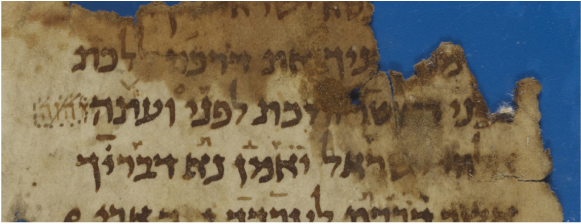
In the medieval period, the method of marking the Tetragrammaton with a strikethrough appears primarily in manuscripts written in the Mizraḥi script, from ca. the ninth century and as late as the seventeenth century. For example, Ox. Heb. b 5/8, written in Mizraḥi square script in the late tenth or early eleventh century, contains an extraneous instance of the Tetragrammaton in 1â¯Kgs 8:26 (fol. 18r, see Fig. 29). The error may have been caused by familiarity with the otherwise verbatim parallel passage containing the Tetragrammaton in 2â¯Chr 6:17 or may reflect a textual variant.107 The scribe resolved the issue by passing a single line through the center of the Tetragrammaton in violation of rabbinic law.108

Figure 29
Ox. Heb. b 5/8, 1â¯Kgs 8:26 (fol. 18r)
Citation: Textus 29, 2 (2020) ; 10.1163/2589255X-bja10010
courtesy of the bodleian libraries, the university of oxford5.7.3 Strikethrough Combined with Erasure Dots
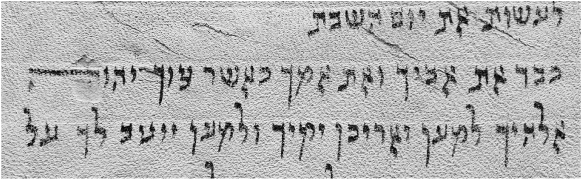
Another example involving the same verse can be found in a ca. ninth-century Cairo Genizah fragment with early Old Babylonian pointing, CUL T-S A39.9.109 In 1â¯Kgs 8:26 (fol. 3r, see Fig. 30), the Tetragrammaton was erroneously added as a correction in the margin. When the issue was noticed, the Tetragrammaton was surrounded with erasure dots.110 Then, for no apparent reason, two oblique strikethroughs were passed through the first he and the vav in violation of rabbinic law.111
Figure 30
CUL T-S A39.9, 1â¯Kgs 8:26 (fol. 3r)
Citation: Textus 29, 2 (2020) ; 10.1163/2589255X-bja10010
reproduced by kind permission of the syndics of cambridge university library5.7.4 Strikethrough Combined with Mid-Letter Dots
An intriguing example appears in a tenth- or eleventh-century Cairo Genizah fragment in Mizraḥi square script, RNL Antonin B 756. In 2â¯Kgs 3:14 (fol. 3r, see Fig. 31), the fragment contains an error caused by a lengthy dittography. The error was evidently caught before the scribe inserted the vowel points and accents. A later corrector using a different color ink initially used mid-letter dots to invalidate the second instance of the repeated clause, which he left unpointed. He also used erasure dots on an extraneous instance of â®××××××â¬â in the first appearance of the repeated clause, which he also left unpointed. He used no fewer than thirty-five dots below, above, and within â®××××××â¬â. Some dots were elongated into a yod-like symbol, reminiscent of the line-fillers used throughout the manuscript. In another phase of erasure, the later scribe apparently decided that the dots on the six repeated words were insufficient and added a strikethrough, including through the Tetragrammaton. In this case, the six words were both unpointed and marked with erasure dots, making the strikethrough redundant.112
Figure 31
RNL Antonin B 756, 2â¯Kgs 3:14 (fol. 3r)
Citation: Textus 29, 2 (2020) ; 10.1163/2589255X-bja10010
photograph © national library of russia, st. petersburg5.7.5 Strikethrough Combined with Supralinear Line
A ca. eleventh-century Cairo Genizah fragment, RNL Antonin B 839, written in Mizraḥi semi-square script, contains the extra phrase â®×××× ×××××â¬â in Deut 6:12 (fol. 2r, see Fig. 32), which was erased with both a supralinear line and a strikethrough. The error was caused by the familiar idiom from elsewhere in Deuteronomy: ââ®××××â¬â your God who took you out â¦â (Deut 5:15; 7:19; 16:1). This strikethrough was forbidden on two counts, since it involved defacing the Tetragrammaton and another divine appellation (â®×××××â¬â) that may not be erased.113 The supralinear line made the strikethrough redundant.114
Figure 32
RNL Antonin B 839, Deut 6:12 (fol. 2r)
Citation: Textus 29, 2 (2020) ; 10.1163/2589255X-bja10010
photograph © national library of russia, st. petersburg5.7.6 Possible Explanations for Strikethroughs
It is possible that using the strikethrough to deface the Tetragrammaton in violation of rabbinic halakah was primarily the handiwork of Karaite scribes. As seen above (§â¯1), the prohibition against erasing the divine name is linked in Sifre Deut to a midrashic interpretation of Deut 12:3bâ4. The plain meaning in the context is about not worshipping God âon the hills and under every leafy treeâ (v. 2), but rather only at âthe place where â®××××â¬â your God chooses ⦠to put his name thereâ (v. 5). The midrashic interpretation disconnects the phrase âAnd you shall destroy their nameâ in 3b from its context, thereby transforming v. 4 (âyou shall not do so to the Lord your Godâ) into a prohibition against erasing the divine name. Perhaps some Karaite scribes interpreted this passage according to its plain meaning, resulting in no prohibition against erasing Godâs name.115 Maimonides may be referring to this un-Orthodox approach when he elaborates on the talmudic law about burning the Torah scroll of a min:
However, â¨concerningâ© an Israelite min who wrote a Torah scroll, it should be burned along with the divine appellations (â®××××ר×תâ¬â) in it because he does not believe in the sanctity of the name, and he only wrote it thinking that it is like the rest of the words. Since this is his thought, the name was not sanctified. It is a righteous deed to burn it, so as not to give credence to the minim and to their deeds.116
The context earlier in the chapter of Mishneh Torah precisely concerns the erasure of divine appellations (Yesode Hatorah 6:1â6). Maimonides appears to be familiar with a sectarian opinion that treated divine appellations like regular words that were permissible to erase. In the talmudic passage upon which Maimonides bases his ruling, the â®×¡×¤×¨× ××× ××â¬â were mentioned alongside what appear to be Gospels (see §â¯3, above), suggesting that the early rabbinic discussion is about Jewish Christians.117 Although Maimonides excludes Karaites from his technical definition of minim, he nevertheless uses the term precisely to refer to Karaites on multiple occasions.118 The minim in the above passage were a group that Maimonides viewed as a threat in his day, which better fits the Karaites than it does Jewish Christians.119
Some Jewish converts to Christianity may have shared the view about erasing Godâs name that Maimonides assigned to âheretics.â Oxford, Corpus Christi, MS 11, written in Ashkenazic square script in thirteenth-century England, contains the Psalms along with a Latin translation. Errors were resolved with strikethroughs on the Tetragrammaton (Ps 35:17 [fol. 46r]), Elohim (Ps 64:11 [fol. 62r]; Ps 66:18 [fol. 63r]), and Adonai (Ps 72:18 [fol. 67v]).120 This led Loewe to remark:
the fact that the name of God has been cancelled â¨with a strikethroughâ© when misplaced or wrongly inserted ⦠argueâ¨sâ© against the writer having been a professional Jewish scribe ⦠such independence of Jewish scruple in this connection is difficult to credit in a professing Jew of the 13th century. One is tempted to think in terms of a convert â¦121
However, Loewe quickly abandoned this hypothesis and instead suggested the scribe was a Jew who prepared the manuscript for a Christian patron. Olszowy-Schlanger suggested these strikethroughs were performed by the Christian scribe who wrote the Latin translation, working in collaboration with a Jewish scribe, who wrote the Hebrew text.122 The above notwithstanding, there can be little doubt Maimonides was referring to Karaites, not Jewish Christians. Later in Mishneh Torah, Maimonides repeats the ruling about burning the books of minim:
A Torah scroll, phylacteries, or mezuzah written by a min should be burned. Those written by a Gentile (â®×××â¬â) or Jewish apostate (â®×שר×× ×ש×××â¬â) ⦠are invalid and should be placed in a genizah.123
Here Maimonides makes a clear distinction between Jewish converts to Christianity and minim, specifically in the context of burning the scriptural texts of the latter. This distinction, along with the above considerations, seems to favor the Karaite hypothesis.124
5.8 Skiving
5.8.1 Special Methods for Torah Scrolls
Medieval rabbinic literature describes two methods of dealing with an erroneous instance of the Tetragrammaton, both of which entail physically removing the portion of skin containing the mistake and placing it in a genizah or another holy place. The first method is excision, that is cutting out (â®×§×״רâ¬â) the Tetragrammaton and leaving a hole in the skin, which could then be replaced with a patch (see §â¯5.9, below). The alternative method is skiving, that is, peeling off (â®×§××´×£â¬â) the layer of skin containing the Tetragrammaton to expose a lower layer that could be written on. Both methods were described in a responsum by Spanish-born Rabbi Simeon ben á¹¢emaḥ Duran (1361â1444), known by the acronym Rashbaá¹£, who became the chief rabbi of Algiers:
â¨Concerningâ© a scribe that was supposed to write â®×× ×××©× ×שר תקר××× ××׳â¬â (Num 28:3) but wrote â®××׳â¬â twice. He has the skill and nimbleness to skive (â®×ק××£â¬â) the entire â¨divineâ© name from its place in one stroke ⦠removâ¨ingâ© the entire â¨divineâ© name intact. Your question is whether this is allowed and would not be forbidden as erasing the name, since the name is neither erased nor abraded, but rather removed intact and put in a genizah ⦠It would be better for him to excise (â®×ק××רâ¬â) every Tetragrammaton and affix in place of the hole a small piece of gevil with glue, as I see the scribes accustomed to doing â¦125
5.8.2 Problems of Skiving
Peretz reported that skiving is still practiced by Yemenite scribes. Rabbi Yitzchak Goldstein of the Ot Institute in Jerusalem, who repairs and restores Torah scrolls, confirmed this is still done today.126 According to Goldstein, this sort of repair involving the Tetragrammaton is exceedingly rare and carried out only by experts to whom he refers such tasks. Goldsteinâs assistant demonstrated skiving on a scrap of parchment, illustrating the immense skill that would be required to remove the entire Tetragrammaton without breaking the letters. Such damage to the letters is precisely the reason Duran forbade the practice:
the ink is absorbed into the gevil ⦠and when â¨the scribeâ© skives the upper layer, the impression of the letter may be visible on the lower layer. This is certainly forbidden, for the â¨divineâ© name might be separated, half on the upper layer and half on the lower layer â¨of skinâ©. How can the scribe prophesy how deep the ink has been absorbed?127
5.8.3 Forbidden Skiving in a Chinese Torah Scroll
The type of damage to the divine name that Duran warned about has survived in a seventeenth-century Torah scroll, originally from the isolated Jewish community of Kaifeng, China, and today designated Dallas, Bridwell, MS 59.128 The scroll contains numerous erasures, often followed by dilating the letters to remove spaces that might be interpreted as open or closed parashot.129 Deut 5:16 (see Fig. 33) contains such an erasure involving the second he of the Tetragrammaton, which originally left a space at the end of the line about three letters wide. To rectify this, the scribe skived off the left leg of this he along with the left end of its roof, including the sting.130 This was done in four exfoliating movements that left four deep gashes in the thick skin. The scribe then dilated the he by elongating the roofâapparently in two strokesâand added a new left leg and left sting, so that it was flush with the left margin. The lower right gash created by the skiving contains traces of the ink from the original left leg of the he, and the upper left gash contains ink from the original left sting. In both cases, the skiving broke the letter not only widthwise but also depthwise, precisely as Duran feared it would.131
Figure 33
Dallas, Bridwell, Ms 59, Deut 5:16
Citation: Textus 29, 2 (2020) ; 10.1163/2589255X-bja10010
reference photograph by nehemia gordon, reproduced by permission of bridwell library special collections, perkins school of theology, southern methodist universityThis erasure was in violation of rabbinic strictures as laid down by the fifteenth-century Rabbi Joseph Iskandarani, cited by Rabbi Joseph Caro (1488â1575) in his monumental halakic compilation Bet Yosef:
â¨Concerningâ© he who erases part of a letter so as to change its appearance making it into another letter ⦠it is as if he erased the original letter entirely. This is the rule for one who completely erases the â¨leftâ© leg of the he so that it becomes a dalet. This is referred to as âhe who erases one letter of the nameâ (Sop. 5:9).132
The isolated Jews of Kaifeng may not have known about this prohibition. According to Michael Pollak, who studied the surviving Torah scrolls from China, âThe Kaifeng exemplars make it abundantly clear that the isolated community of Jews which used them was not nearly as familiar with either the Hebrew language or the rules of Torah writing as were its sister communities in other parts of the world.â133 On the other hand, they may have known about it and simply held a different position. Despite Iskandaraniâs ruling, it is not obvious that erasing part of a letter is, strictly speaking, a violation of the prohibition against erasing âa single letterâ of the divine name.134
5.8.4 Permissible Skiving in a Sefardic Torah Scroll
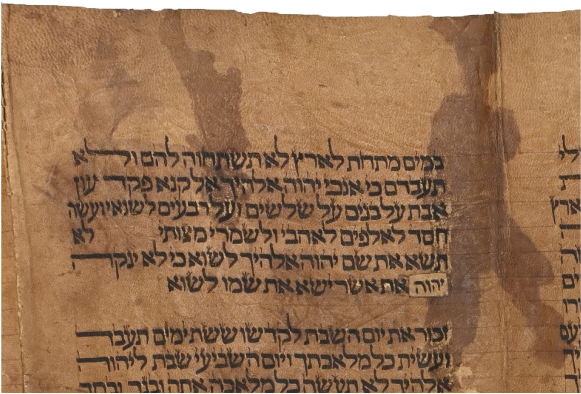
An example of the entire Tetragrammaton skived off the skin can be found in MOTB SCR.4676 (Sefardic square script, ca. fifteenth or sixteenth century). The scroll was damaged by water penetrating from above, perhaps due to a leaky ark, resulting in darkened stripes on sheet 29 (see Fig. 34). This evidently made it difficult to read the Tetragrammaton in Exod 20:7, prompting the scribe to skive it off along with most of the aleph of the following word (â®×תâ¬â). A patch was placed over the thinned section of sheet, with the new Tetragrammaton written on it.135 The cuts of the skiving procedure are still visible on either side of the patch. Parts of damaged letters in the lines above this repair were abraded and rewritten, but that solution was not halakically acceptable for the Tetragrammaton.136
Figure 34
MOTB SCR.4676, Exod 20:7 (sheet 29)
Citation: Textus 29, 2 (2020) ; 10.1163/2589255X-bja10010
photograph by jon lorquet5.9 Excision
5.9.1 Excision in Halakhic Literature
As seen above, excision was employed in the ancient world (§â¯2), in talmudic times (§â¯3) and was still a common practice that Duran observed in the fourteenth and fifteenth centuries in Spain and Algeria (§â¯5.8.1). This was also the case in seventeenth-century Poland when Rabbi Samuel Halevi Segal mentions excision alongside another method, that of removing the entire sheet containing the error (see §â¯5.10, below):
â¨Tâ©here was written in a Torah scroll â®×׳ ×׳ ××ש ×××××â¬â (Exod 15:3). â¨Anâ© elder showed me a responsum of the Maharâal Ḥaviv137 ⦠that if there was an extra divine appellation it should not be excised (â®×ק××רâ¬â) from the Torah scroll, but rather the entire sheet should be removed (â®×ס×ק ××ר××¢×â¬â) ⦠I encountered several scribes of our times whom I asked what they did if damage occurred to the â¨divineâ© name, whether they remove the entire sheet, etc. They answered me that they excise (â®×§××ר××â¬â) that divine appellationâfor example if there was a tear in the letters of the Tetragrammatonâand paste another qelaf over the hole, rewriting there the divine appellation. They put away (â®××× ×××â¬â) the excised divine appellation in a holy place, gluing it to the side of the holy ark ⦠â¨Tâ©his is not â¨a violation ofâ© âhe who blasphemes â¨or âhe who makes a hole inââ© the nameâ (Lev 24:16), heaven forbid, because it is for the purpose of correcting â¨an errorâ©.138
5.9.2 Excision with a Blank Patch
As mentioned above (§â¯5.3.2), the fourteenth-century Ashkenazic Torah scroll Vat. ebr. 2 invalidated erroneous instances of the Tetragrammaton with a rectangle. However, in Num 27:15 it contains a rectangular hole, which is undoubtedly a case of the Tetragrammaton being excised (see Fig. 35). The scribe must have originally written â®××××ר ×××× ×× ×ש×â¬â, âAnd â®××××â¬â said to Moses,â a common phrase that occurs sixty-six times in the Pentateuch, before realizing that he was supposed to have written the less common phrase â®××××ר ××©× ×× ××××â¬â, âAnd Moses said to â®××××â¬â,â which occurs only five times. The scribe solved the problem by abrading the words â®×× ×ש×â¬â and excising the Tetragrammaton, adding a blank patch behind the sheet.139 The scribe then wrote the correct words over the abrasion, following the patch. The result is: â®××××ר {××××} ××©× ×× ××××â¬â. It is unclear why the scribe did not find it sufficient to draw a rectangle around the Tetragrammaton, as he did in the other instances where errors occurred.
Figure 35
Vat. ebr. 2, Num 27:15 (sheet 57)
Citation: Textus 29, 2 (2020) ; 10.1163/2589255X-bja10010
© 2020 biblioteca apostolica vaticana5.9.3 Excision with an Inscribed Patch
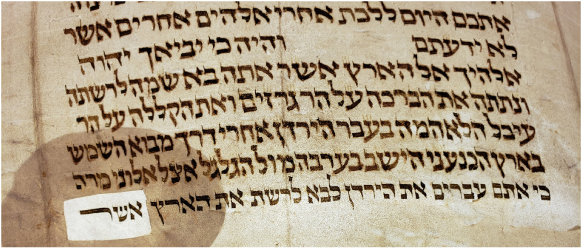
An example where the Tetragrammaton was excised and replaced with a patch can be found in the ca. 1270 Ashkenazic Torah scroll, MOTB SCR. 4820.140 Deut 11:31 (sheet 75, see Fig. 36) contains two lines that were erased, mostly through abrasion, except for the phrase â®×××× ××××××â¬â, which was excised. This erasure may have been prompted by an omission due to homoioarchton of the words â®×ת ××ר×× ××× ×רשתâ¬â, where the scribeâs eye jumped to the following words â®×ת ××רץâ¬â. Correcting this error necessitated rewriting two lines in smaller script to squeeze in the missing text and relocating â®×××× ×××××× × ×ª× ×××â¬â to the top of the following column. A patch was applied to the back of the sheet at the end of the first erased line, with the word â®×שרâ¬â written over the patch with a dilated resh. The height of the excision suggests that the words â®× ×ª× ×××â¬â may have originally been written underneath â®×××× ××××××â¬â at the end of the line. This originally cramped writing may have served to start the following column with the letter vav (â®××× ××¢×××××â¬â) of the word â®××רשת×â¬â.141
The permissibility of writing on patches was debated in early rabbinic literature, with some ruling the practice forbidden.142 The tradition that King Ahaziah excised instances of the Tetragrammaton and wrote idolatrous names in their stead may have influenced this debate. However, as cited above (§â¯5.9.1), Rabbi Samuel Halevi Segal found it to be the common practice of scribes in seventeenth-century Poland who would âpaste another qelaf over the hole, rewriting there the divine appellation.â Unlike the patch in SCR.4676, which was placed on top of the skin, the patch in SCR.4820 was placed behind the skin, a solution suited to excision, but not to skiving.
Figure 36
MOTB SCR.4820, Deut 11:31 (sheet 75). The patch is visible on the back when a light is placed behind the sheet. The light is brighter in the areas where text was erased through abrasion
Citation: Textus 29, 2 (2020) ; 10.1163/2589255X-bja10010
photograph by jon lorquet5.10 Removing Sheets
Removing an entire sheet was already mentioned in early rabbinic sources as a solution for dealing with an error involving the Tetragrammaton. According to Rabbi Samuel Halevi Segal in the seventeenth century, this was the solution recommended by his contemporary Ibn Ḥaviv for resolving an error of dittography of the Tetragrammaton. According to Goldstein, this is still the course of action taken by some modern Ashkenazic scribes.
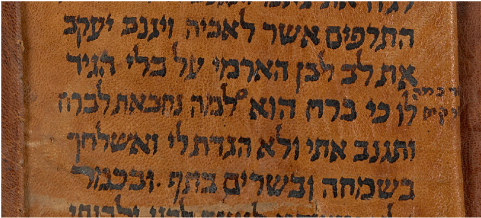
Identifying a removed sheet due to an error involving the Tetragrammaton is methodologically problematic. A lone sheet in a genizah could have been removed due to a variety of factors such as water damage, aging, or normal wear. Nevertheless, it has been possible to identify an individual sheet removed from a Torah scroll due to scribal errors, albeit not involving the Tetragrammaton. The fifteenth-century BL Or. 1455 written in Mizraḥi square script was cobbled together from various loose sheets from numerous scrolls, evidently salvaged from a genizah. Sheet 13 (Gen 31:2â30) consists of a single column written on a different color skin and in a different hand from the adjacent sheets.143 Gen 31:12 contains an error of dittography caused by homoiographon, with â®×עת××× ×עת×××â¬â instead of â®×עת××× ××¢×××â¬â. A corrector marked the second instance of â®×עת×××â¬â with a supralinear line and wrote â®×¢××××â¬â in the margin. Further down on the same column, verses 21 through 26 are missing altogether. The same corrector added a supralinear circellus to mark the spot, writing in the margin â®×סר ××× ×¤×¡×ק××â¬â, âseveral verses missingâ (see Fig. 37).144 When this error was discovered, perhaps soon after the original scroll was completed, the entire column must have been excised from the sheet and placed in a genizah. The fact that the letters â®×סâ¬â and â®×¤×¡â¬â are inside the seam (as confirmed by a physical examination) indicates that the error was discovered and noted before the sheet was sewn into the scroll. While these errors did not involve the Tetragrammaton, it illustrates the practice of removing sheets to accommodate certain types of scribal errors.
Figure 37
BL Or. 1455, Gen 31:2o, 27 (sheet 13)
Citation: Textus 29, 2 (2020) ; 10.1163/2589255X-bja10010
© british library board5.11 Abrasion
5.11.1 Abrasion in the Ancient World
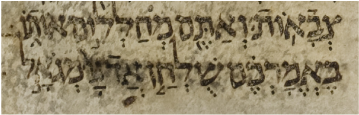
As discussed in §â¯2, the âscribeâs razorâ mentioned in Jer 36:23 may have been used for the abrasion of letters with a sharp instrument. Early rabbinic literature referred to it explicitly with the verb â®×ר״רâ¬â/ â®×ר״×â¬â. A parallel can be found in the widespread use of this method of erasure in the Dead Sea Scrolls. Jonathan P. Siegel has suggested that the reason the Tetragrammaton was written in Paleo-Hebrew characters in some Dead Sea Scrolls was precisely to prevent its being erased through abrasion.145 Despite this, we find an example of the Tetragrammaton being erased in this manner in 1QIsaa XXXV, 15 (see Fig. 38). The text seemingly contains five dots above the word â®×§×¨×ª×××â¬â in Isa 42:6, but Martin argued that these five dots are actually the remains of an erased Tetragrammaton.146 In this case, the Tetragrammaton was omitted by the original scribe, added above the line by a second scribe, and then erased through abrasion by a third scribe. The third scribe seems to have abraded the letters so as to repurpose them as the tetrapuncta, the four dots that represent the Tetragrammaton, also used in a correction by the same hand in 1QIsaa XXXIII, 7 (Isa 40:7).147 What resembles a fifth dot (second from the right) is fainter than the others and appears to be the abraded remnant of the first he in the Tetragrammaton.148 If Siegel is correct about the early adoption of the prohibition against erasing the divine name, then this erasure would not have been in line with the same sectarian ritual observance that produced the Paleo-Hebrew instances of the Tetragrammaton.
Figure 38
1QIsaa XXXV, 15 Isa 42:6
Citation: Textus 29, 2 (2020) ; 10.1163/2589255X-bja10010
photograph © israel museum, jerusalem by ardon bar hama5.11.2 Abrasion in a Chinese Torah Scroll
Another example of the Tetragrammaton being erased through abrasion can be found in a sixteenth- or seventeenth-century section of a Torah scroll from the Jewish community in Kaifeng, China, designated American Bible Society, Acc. 37219.149 In Lev 14:29â32, the scroll contained a lengthy error caused by homoioteleuton. When the scribe reached â®××¤× × ××××â¬â at the end of v. 31, his eye jumped back to the end of v. 29, which also ends with â®××¤× × ××××â¬â. He then proceeded to copy vv. 30 and 31 a second time, followed by v. 32. The result was the following confused sequence of verses: 29, 30, 31, 30, 31, 32. The error must have been detected only after the following section was copied. To fix it, the corrector abraded the second instance of vv. 30â31 as well as the misplaced v. 32, covering four-and-a-half lines of text. This included abrading the Tetragrammaton in the phrase â®××¤× × ××××â¬â at the end of v. 31. The abraded â®××¤× ×â¬â is still clearly visible on the sheet, as is the final tav of â®××תâ¬â at the beginning of v. 32, immediately after the Tetragrammaton (see Fig. 39).
Figure 39
American Bible Society, Acc. 37219, Lev 14:31 (sheet 36)
Citation: Textus 29, 2 (2020) ; 10.1163/2589255X-bja10010
photograph by jon lorquetThis Torah scroll was immersed in water in the flood of 1642 and as a result is covered with ink that was transferred from different parts of the scroll. This transfer sometimes occurred in multiple stages, with ink being transferred from the front of the scroll to the back side and then back to a different section of the front. Above the erased remnants of â®××¤× × ××××â¬â there is ink transfer of â®×ת××× ××רץâ¬â from five columns to the left, in Lev 18:25.150 Traces of the abraded letters yod, he, and vav from the Tetragrammaton are still visible, partially obscured by the mem and aleph of the word â®×ת×××â¬â. Here we have a second instance of the Tetragrammaton erased by a scribe writing in the characteristic Chinese Jewish calligraphic style. In this case, it seems likely that the Chinese Jewish scribe was unfamiliar with the prohibition against erasing the divine name.
5.11.3 Abrasion of Left Leg of He in a Sefardic-Italian Torah Scroll
A ca. sixteenth-century Torah scroll in Sefardic-Italian square script, MOTB SCR.4822c, contains an example of the left leg of the he erased through abrasion in Exod 39:43 (see Fig. 40).151 Verse 42 has the phrase â®×¦×× ×××× ×ת ××©× ×× ×¢×©×â¬â whereas v. 43 has the nearly identical â®×¦×× ×××× ×× ×¢×©×â¬â. Apparently, the scribe accidentally copied â®×ת ×ש×â¬â from v. 42 into v. 43. To resolve this error, he scratched off â®×ת ×ש×â¬â along with the left leg of the second he of the Tetragrammaton. He then dilated this he to avoid creating a closed parashah. Traces of the original left leg of the second he of the Tetragrammaton are still visible along with the bottom half of the left arm of the mem of â®×ש×â¬â. As discussed in §â¯5.8.3, such an erasure was in violation of the rabbinic strictures that specifically deemed it forbidden to erase the left leg of the final he. Whereas Chinese Jews may have been unaware of these strictures, this possibility is less likely to apply to scribes of Sefardic-Italian Torah scrolls. Rather, this discrepancy may reflect the reality of scribal activity not lining up with the rules set down for scribes by halakic authorities. Alternatively, this may reflect an interpretation of the prohibition to erase âa single letterâ of the divine name that differs from that offered by Iskandarani.
Figure 40
MOTB SCR.4822c, Exod 39:43 (sheet 12)
Citation: Textus 29, 2 (2020) ; 10.1163/2589255X-bja10010
photograph by nehemia gordon, taken through a 10Ã magnification loupe5.11.4 Abrasions in the Aleppo Codex
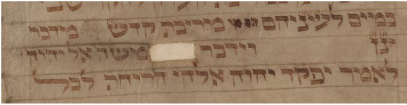
Another manuscript containing erasures of the Tetragrammaton accomplished through abrasion is the Aleppo Codex (Mizraḥi square script, Tiberias, ca. 930).152 Mal 1:12 (fol. 203v) contains Adonai written over an erasure, and Israel Yeivin identified the erased word as the Tetragrammaton in his Erasures Apparatus.153 Although the Tetragrammaton is not visible in the photograph (see Fig. 41), traces of erased letters can be discerned including what appears to be the top of the first he. It is also possible that Yeivin saw more in the original manuscript than is visible in the photograph. This may have been an error of familiar idiom, based on â®×©××× ××××â¬â in Mal 1:7. The proofreader of the Aleppo Codex must not have noticed the error until late in the proofreading process, after the vowel points and accents were already written. To resolve this, he apparently abraded the Tetragrammaton and replaced it with Adonai, leaving the dot of the qamets common to both words unchanged. He also added a rafe above the dalet in a space where the Tetragrammaton would not have had any symbol.
According to the dedication inscription in the Aleppo Codex, Solomon Ben BuyaÊ¿a wrote the letters while Aaron Ben Asher proofread and corrected the manuscript, adding vowel points, accents, and the masorah.154 Rather than Ben Asher correcting Ben BuyaÊ¿aâs error in Mal 1:12, the two scribes may have been using sources that reflected different textual traditions. Numerous manuscripts employ the Tetragrammaton in this verse rather than Adonai.155 Furthermore, y. Ḥag. 3:8 79d seems to assume the Tetragrammaton here.156 All of this suggests that Ben BuyaÊ¿aâs version was made according to an established textual tradition rather than a scribal error.157
Figure 41
Aleppo Codex, Mal 1:12 (fol. 203v)
Citation: Textus 29, 2 (2020) ; 10.1163/2589255X-bja10010
courtesy of the ben-zvi institute, jerusalem. photographer: ardon bar hamaA similar erasure of the Tetragrammaton appears in Ezek 6:3 (fol. 165r, see Fig. 42), where Adonai was once again written over an erasure. This time, however, only the letters were written over the erasure, not the vowel points and accent, indicating that the error was caught and corrected before the vowel points and accents were inserted. In this case, it may have been Ben Buyaʿa who corrected the mistake rather than Ben Asher.
Figure 42
Aleppo Codex, Ezek 6:3 (fol. 165r)
Citation: Textus 29, 2 (2020) ; 10.1163/2589255X-bja10010
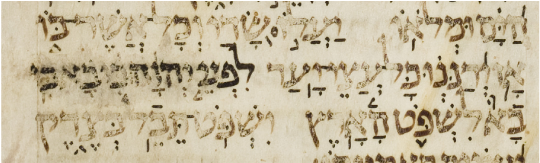
courtesy of the ben-zvi institute, jerusalem. photographer: ardon bar hamaAnother example in the Aleppo Codex identified by Yeivin appears in Ps 96:13 (fol. 259r, see Fig. 43). This erasure corrects an error of haplography in the poetic phrase â®×× ×× ×× ××â¬â.158 According to Yeivin, the scribe originally wrote: â®××¤× × ×××× ×× ×× ××©×¤× ××רץâ¬â. The correction consisted of abrading â®××¤× × ×××× ××â¬â at the end of the line.159 The Tetragrammaton and the other words were then rewritten with different spacing in order to fit in the two missing words â®×× ××â¬â.
The scribe could have easily added the missing words â®×× ××â¬â above the line or in the margin, so the choice to physically erase the Tetragrammaton was purely for aesthetic reasons. It is unclear why he did not erase the following line and rewrite it with different spacing, especially since the second instance of â®××â¬â belongs to that clause. This would have also allowed him to avoid physically erasing the Tetragrammaton.160
Figure 43
Aleppo Codex, Ps 96:13 (fol. 259r)
Citation: Textus 29, 2 (2020) ; 10.1163/2589255X-bja10010
courtesy of the ben-zvi institute, jerusalem. photographer: ardon bar hama5.11.5 Possible Reasons for Abrasion in the Aleppo Codex
The physical erasure of the Tetragrammaton is unexpected in the Aleppo Codex, widely considered the best representative of the MT. A possible explanation for this extreme measure may be the function that the Aleppo Codex was intended to serve, namely, as a model codex for other scribes engaged in copying and correcting the Bible. To produce such a model, the scribes of the Aleppo Codex may have believed it necessary to create a clean text, free of erasure dots and similar notations. This desire for a clean text may be the reason why corrections throughout the Aleppo Codex were carried out by abrading the erroneous letters, accents, vowel points, and masoretic notes.161 This purpose, to make the Aleppo Codex a model, is already mentioned in the eleventh-century dedication inscription:
If anyone ⦠desires on any day of the year to see in it matters of plene and defective â¨orthographyâ©, ⦠open or closed â¨parashotâ©, or any accent of these accents, let them take it out to see, to become wise, and to discern, but not to read and study.162
Maimonides later confirmed this function of the Aleppo Codex:
It is the famous manuscript in Egypt that includes the twenty-four books â¨of the Bibleâ©, that was used in Jerusalem a number of years ago to proofread manuscripts from it. Everyone used to rely on it because Ben Asher proofread it and checked it for many years, proofreading it many times.163
The desire to create a model codex may have been seen by the scribes as justification to even erase the Tetragrammaton, despite rabbinic strictures to the contrary.
Another possible explanation for the physical erasure of the Tetragrammaton is that Ben Asher was a Karaite, an affiliation that has already been suggested for him on other grounds.164 As seen above (§â¯5.7.6), the manuscripts containing strikethroughs may have been produced by Karaite scribes, who, according to Maimonides, ââ¨doâ© not believe in the sanctity of the name, and ⦠only wrote it thinking that it is like the rest of the words.â Of course, if Ben Asher was indeed a Karaite, it raises the question of how Maimonides could have given credence to the Aleppo Codex when he ruled that the Torah scrolls of minim must be burned.165
5.11.6 Abrasion in a Tenth-Century Mizraḥi Codex
Like the Aleppo Codex, RNL Evr. II B 30 (Mizraḥi, tenth century) also contains an erasure of the Tetragrammaton using abrasion in Mal 1:12 (fol. 154v).166 Remnants of all four letters of the Tetragrammaton are still visible under the correction Adonai along with an erased pashá¹a over the second he (see Fig. 44). The same manuscript contains an error involving the Tetragrammaton in Isa 40:10 (fol. 19v), but this time it is marked with erasure dots above, below, and inside the letters, with the Tetragrammaton left unpointed. The scribe must have caught the error in Isa 40:10 immediately, and hence recorded the correction â®××× × ××××â¬â on the same line. The timing of when the errorâor textual variantâwas detected may explain why dots were used in Isa 40:10 and abrasion in Mal 1:12. In the case of Mal 1:12, the problem was not noticed until the line was completed, leaving no room on the line for â®××× ×â¬â other than by erasing the Tetragrammaton.167 The erasure through abrasion in Mal 1:12 was done by the pointer (as evidenced by the erased pashá¹a) who, like Aaron Ben Asher, also proofread the manuscript. In contrast, the use of erasure dots in Isa 40:10 was clearly done by the scribe who wrote the letters, since he caught the mistake and corrected it on the same line, before copying the next words.
Figure 44
RNL Evr. II B 30, Mal 1:12 (fol. 154v)
Citation: Textus 29, 2 (2020) ; 10.1163/2589255X-bja10010
photograph © national library of russia, st. petersburgIn the case of the Aleppo Codex, it was possible to argue that abrading the Tetragrammaton was a measure the scribes employed in order to produce a model codex. No such argument can be made about RNL Evr. II B 30, which already contained erasure dots in Isa 40:10 by the time a corrector took a sharp implement and scratched the Tetragrammaton off the page in Mal 1:12. It seems likely that this erasure through abrasion was indeed the work of a Karaite scribe who did not deem Deut 12:4 to be a biblical prohibition related to correcting scribal errors.
5.12 Washing Off
One of the oldest methods of erasing text, found as early as the Old Kingdom in Egypt, was to wash off (or wipe off) the ink with a wet sponge. Indeed, the early rabbis understood there to be a requirement to erase the Tetragrammaton in this manner in the ordeal of jealousy in Num 5:11â31. According to m. Soá¹ah 2:3, this involved writing the Tetragrammaton in the phrase â®××ª× ×××× ×××ª× ×××× ××ש×××¢×â¬â (Num 5:21) on a scroll and washing it off into a vessel of liquid (Num 5:23). According to Josephus (Ant. 3:270â272), writing and erasing the divine name was central to the ceremony. Maimonides (Mishneh Torah, Soá¹ah 3:8) emphasizes that the priest âwrites the name the way it is written,â i.e., the Tetragrammaton itself and not Adonai. This is an example of the Tetragrammaton being âblotted outâ in the most literal sense of the verb â®×××´×â¬â. This method was suited to papyrus but not animal skin or medieval paper. Furthermore, the ink used in medieval Hebrew Bible manuscripts often contained vitriol (â®×§××§× ×ª×סâ¬â/ â®×§× ×§× ×ª××â¬â), which sets quickly, making it difficult to wash off.168 This may be why no examples of washing off the Tetragrammaton, or any other words for that matter, have been identified thus far in medieval Hebrew Bible manuscripts.
6 Conclusion
Erasing the Tetragrammaton was forbidden by rabbinic strictures based on a midrashic interpretation of Deut 12:4. This prohibition required Jewish scribes to devise creative methods to remove extraneous instances of the Tetragrammaton. Some of these procedures began as early as Second Temple times and others are still in use today.
Erasure Dots: A parallel to the use of erasure dots for marking errors involving the Tetragrammaton can be found in the Dead Sea Scrolls. In the Middle Ages they are found from the ninth century in manuscripts with Old Babylonian pointing and continued in use in Yemen as late as the sixteenth century.
Lines and Bars: Solid lines above, below, or above and below Godâs name were used from the tenth century and as late as the nineteenth century. This method is found in all five of the major Jewish geocultural regions as well as in Yemen. A distinctive Sefardic version of this method used a bar, that is, a line with circles on either end, in the fourteenth and fifteenth centuries.
Rectangles around the Tetragrammaton: A pervasive solution to resolving an error involving the Tetragrammaton was to surround it with an ellipse or rectangle. By way of parallel, this method was used in the Dead Sea Scrolls to mark words (although not the Tetragrammaton) as erroneous. The same method was applied to the Tetragrammaton from the ninth century to the nineteenth century. It can be found in codices with Old Babylonian pointing as well as those written in Mizraḥi, Ashkenazic, Sefardic, Italian, and Yemenite scripts. The method was also used in liturgical Ashkenazic Torah scrolls.
Circelli: Marking the Tetragrammaton with a supralinear circellusâan outgrowth of the masorah parvaâwith a correction in the margin, can be found in an Italian manuscript from ca. 1300.
Text-Correcting Qere: Another outgrowth of the masorah parva was text-correcting qere, that is, using the ketiv-qere notation to indicate scribal errors. This is attested in a single Ashkenazic manuscript from ca. 1300 with the correction brought in the margin and marked as qere. A variation of this method is attested in a single Mizraḥi manuscript from ca. 1000 in which the correction is brought in the margin and marked as ketiv. A search for this phenomenon may produce further examples and variations.
Unpointed Tetragrammaton without Notation and Marginal Correction: Leaving the Tetragrammaton unpointed with a correction in the margin was a common method in Italian manuscripts and also used in Yemen. This method could be employed only in pointed codices and inevitably resulted in a degree of ambiguity.
Strikethroughs: An early parallel to the medieval use of the strikethrough can be found in the nonbiblical 4Q291 where it was employed to erase the divine appellation â®××â¬â. This method appears in erasures of the Tetragrammaton primarily in Mizraḥi codices beginning in the ninth century and as late as the seventeenth century. This was undoubtedly a violation of rabbinic strictures. Maimonides was familiar with a view of âhereticsâ who believed it permissible to erase the Tetragrammaton. This may have been the view of some Karaite scribes who did not consider themselves bound by the midrashic interpretation of Deut 12:4. It could also have been the view of Jewish converts to Christianity, which may explain a thirteenth-century Ashkenazic manuscript of Psalms with Latin translation.
Skiving: The above methods were primarily used in the Middle Ages in pointed codices. Unpointed scrolls required a more elegant solution than that used in codices, because any notation was likely to distract the reader in public liturgy.169 Responsa literature describes three acceptable solutions for resolving an extraneous instance of the Tetragrammaton: skiving, excision, and removing sheets. Skiving is discussed by Duran in the fourteenth and fifteenth centuries and found in a ca. fifteenth- or sixteenth-century Sefardic scroll. A rare example in which the Tetragrammaton was defaced by skiving the left half of the second he is found in a seventeenth-century Chinese Torah scroll. The Jewish scribes in the isolated Jewish community of Kaifeng were either unaware of the rabbinic prohibition or did not consider removing part of the letter a violation of this prohibition.
Excision: As suggested in some medieval responsa literature, excision was the preferred approach for removing the Tetragrammaton in scrolls. This method was found in thirteenth- and fourteenth-century Ashkenazic scrolls. Scribes sometimes replaced the divine name with a patch, which could contain a correction. This was forbidden by some in early rabbinic sources but described as commonplace by Rabbi Samuel Halevi Segal in seventeenth-century Poland.
Removal of Sheets: The removal of sheets due to an error involving the Tetragrammaton is difficult to pinpoint, because any loose sheets in a genizah may have been removed for other reasons. Nevertheless, it has been possible to identify the removal of at least one sheet due to errors it contained. Although this instance does not involve the divine name, it nonetheless illustrates the practice.
Abrasion: The most surprising method used to erase the Tetragrammaton is abrasion. This is indisputably a violation of rabbinic halakah. Nevertheless, this method was employed by a corrector in 1QIsaa, presumably because no such prohibition existed in the ritual observance of the Qumran scribe (third hand) who employed it. This method is also found in two tenth-century Mizraḥi manuscripts, the Aleppo Codex and RNL Evr. II B 30. The Aleppo Codex was written to serve as a model codex against which other manuscripts would be proofread. In order to create a clean text, the scribes of the Aleppo Codex may have permitted themselves to abrade the Tetragrammaton. However, this explanation does not work for RNL Evr. II B 30, whose scribe used erasure dots to mark another instance of the divine name as extraneous. Hence, these rare examples may have been the handiwork of Karaite scribes, as has already been suggested for the Aleppo Codex on other grounds. Another example, from a sixteenth- or seventeenth-century Chinese Torah scroll, was the product of an isolated Jewish community unfamiliar with rabbinic rules. A case of the left portion of the final he abraded in a ca. sixteenth-century Sefardic-Italian Torah scroll may be a matter of this practice not considered a violation of the rabbinic prohibition against erasing âa single letterâ by the scribe who performed it.
Washing Off: Washing off ink is mentioned in Num 5:23 and found in the Dead Sea Scrolls. No examples have been located where the Tetragrammaton was washed off, possibly because of the type of ink and writing materials used in the Middle Ages.
The Tetragrammaton and Adonai: Of the 163 examples of erasures of the Tetragrammaton referenced in this study (see Table 1), sixty-five (40 percent) involved its initially being written instead of Adonai. This was largely due to the medieval pronunciation of the Tetragrammaton as Adonai, the type of error Ronald Hendel has dubbed âsynonym with aural trigger.â170 This may have been a result of the scribe actually reading the Tetragrammaton aloud as Adonai. Alternatively, it may have been due to internal dictation that the scribe mentally rehearsed in what Jonathan Vroom calls a âphonological loop.â171 In one further instance, the Tetragrammaton was recorded instead of the nonsacred â®××× ××â¬â, based on its graphic similarity to Adonai.172 Scribes also sometimes interchanged divine appellations based on their semantic equivalence, independent of their pronunciation. Thus, there were also nine cases (5 percent) in which the Tetragrammaton was recorded instead of â®(×)××××(×)â¬â, unrelated to its medieval pronunciation.173
It is not always clear whether the interchange between the Tetragrammaton and Adonai was the result of a scribal error or an alternative textual tradition. MT attempted to establish, through a masoretic list, the 134 places where Adonai was supposed to appear (unaccompanied by the Tetragrammaton).174 Despite these efforts, variant traditions survived. In twenty-six (40 percent) of the erasures involving the Tetragrammaton and Adonai, BHS identified the Tetragrammaton as a textual variant. BHS even recommended reading the Tetragrammaton instead of Adonai in eight (8 percent) of these. In one case (Vat. Ross 1169 part C, Ezek 21:8), the manuscript in question originally had the same reading as BHS, and it was erasure of the Tetragrammaton that produced the variant reading Adonai.
Some interchanges of Adonai and the Tetragrammaton are found in 1QIsaa. Variants of this sort were recorded in masoretic notes and lists as regional differences between Israel and Babylonia, or Sura and NehardeÊ¿a. Sometimes the scribe who wrote the letters had a different version of the text than the pointer who proofread the manuscript, as in the case of Ben BuyaÊ¿a and Ben Asher. The ultimate origin of many of these variants may have been one of the above factorsâpronunciation or semantic equivalenceâalthough whether Adonai or the Tetragrammaton was original needs to be considered on a case-by-case basis.175
Hebrew Bible manuscripts with identified erasures of the Tetragrammaton:176
-
Berlin, Staatsbibliothek, Or. fol. 1216 (Erfurt 7) (Ashkenazic Torah scroll, thirteenth century)
-
Cambridge, Trinity College Library, F.18.1 (Crimea, 1320â1350)
-
Cambridge, University Library, T-S A5.1 (Mizraḥi square, ca. tenth century)
-
Cambridge, University Library, T-S A9.3 (Mizraḥi square, ca. eleventh century)
-
Cambridge, University Library, T-S A15.10 (Mizraḥi square, ca. 1000)
-
Cambridge, University Library, T-S A16.1 (Mizraḥi proto-square, prior to the tenth century)
-
Cambridge, University Library, T-S A16.22 (Mizraḥi, tenth or eleventh century)
-
Cambridge, University Library, T-S A22.176 (Mizraḥi, eleventhâthirteenth century)
-
Cambridge, University Library, T-S A32.117 (Mizraḥi, twelfth or thirteenth century)
-
Cambridge, University Library, T-S A32.189 (Yemenite?, ca. fifteenth century)
-
Cambridge, University Library, T-S A34.3 (Mizraḥi, eleventh or twelfth century)
-
Cambridge, University Library, T-S A35.56 (Mizraḥi, twelfth or thirteenth century)
-
Cambridge, University Library, T-S A39.9 (early Old Babylonian, ca. ninth century)
-
Cambridge, University Library, T-S B4.28 (late Mixed Babylonian pointing)177
-
Cambridge, University Library, T-S NS7.14 (Mizraḥi, eleventhâthirteenth century)
-
Dallas, Bridwell Library Special Collections, Perkins School of Theology, MSÂ 59 (Chinese Jewish calligraphic style, Torah scroll, 1642â1653)
-
Lewis-Gibson, Bible 2.45 (Mizraḥi, thirteenth century)
-
Lewis-Gibson, Bible 2.52 (Mizraḥi, eleventhâthirteenth century)
-
Lisbon, National Library of Portugal, MSÂ 721 (Sefardic script, 1300)
-
London, British Library, Add. 9399 (Ashkenazic square script, thirteenth century)
-
London, British Library, Add. 15251 (Sefardic square script written in Italy, 1498)178
-
London, British Library, Add. 27167 (Sefardic square, ca. 1450â1475)
-
London, British Library, Harley 5498a (Sefardic, fourteenth century)
-
London, British Library, Harley 5709 (Ashkenazic, ca. 1300â1339)
-
London, British Library, Or. 1473 (Yemenite, sixteenth century)
-
London, British Library, Or. 2201 (Sefardic square script, early fourteenth century)
-
London, British Library, Or. 2366 (Yemenite, ca. fifteenth century)
-
London, British Library, Or. 2367 (Yemenite, fifteenth century)
-
London, British Library, Or. 2375 (Yemenite square, 1460â1483)179
-
London, British Library, Or. 2415 (Sefardic semicursive, fourteenth century)
-
Meir of Padua Torah, Institute of Microfilmed Hebrew Manuscripts FÂ 76338 (Italian square script, 1545)
-
New York, Jewish Theological Seminary, Lutzki 48 (Mizraḥi square, twelfth century)
-
New York, Jewish Theological Seminary, Lutzki 49 (Mizraḥi square, thirteenth or fourteenth century)
-
New York, Jewish Theological Seminary, Lutzki 80 (Sefardic, fifteenth century)
-
New York, Jewish Theological Seminary, Lutzki 195 (Yemenite, nineteenth century)
-
New York, Jewish Theological Seminary, Lutzki 200 (Yemenite, 1847)
-
New York, Jewish Theological Seminary, Lutzki 229 (Yemenite, thirteenth century)
-
New York, Jewish Theological Seminary, Lutzki 420 (Ashkenazic, thirteenth century)
-
New York, Jewish Theological Seminary, Lutzki 442 (Sefardic square, fourteenth or fifteenth century)
-
New York, Jewish Theological Seminary, Lutzki 515.3 (Mizraḥi square, thirteenth century)180
-
New York, Jewish Theological Seminary, Lutzki 589 folio 10 (Mizraḥi square, ca. tenth century)
-
Oxford, Bodleian Libraries, Canonici Or. 87 (Rimini, Italy with Ashkenazic square script, 1374â1378)181
-
Oxford, Bodleian Libraries, Heb. b 5/8 (Mizraḥi square, late tenth or early eleventh century)
-
Oxford, Bodleian Libraries, Heb. d 26/2 (early Old Babylonian, ninth century)
-
Oxford, Bodleian Libraries, Heb. e 72/4 (Mizraḥi square, ca. twelfth century)
-
Oxford, Bodleian Libraries, Marshall Or. 51 (Ashkenazic, ca. 1251â1300)
-
Oxford, Bodleian Libraries, Pococke 348 (Sefardic square, fifteenth century)
-
Oxford, Corpus Christi, MSÂ 11 (Ashkenazic square, thirteenth century)
-
Paris, Alliance Israélite Universelle, X.4 (Mizraḥi, eleventh or twelfth century)
-
Paris, Alliance Israélite Universelle, X.72 (Mizraḥi square script, not prior to the fourteenth century)
-
Parma, Biblioteca Palatina, de Rossi 668 [Cod. Parm. 1849] (Italian, ca. 1300)182
-
Sassoon 369 (Ashkenazic square, 1276â1300)183
-
St. Petersburg, Russian National Library, Antonin BÂ 125 (Sefardic, ca. sixteenth century)
-
St. Petersburg, Russian National Library, Antonin BÂ 252 (Sefardic square, fourteenth or fifteenth century)
-
St. Petersburg, Russian National Library, Antonin B 746 (Mizraḥi, tenth or eleventh century)
-
St. Petersburg, Russian National Library, Antonin B 756 (Mizraḥi square, tenth or eleventh century)
-
St. Petersburg, Russian National Library, Antonin BÂ 812 (early Old Babylonian, ninth century)
-
St. Petersburg, Russian National Library, Antonin B 839 (Mizraḥi semisquare, eleventh century)
-
St. Petersburg, Russian National Library, Evr. I Bibl. 85 (Mizraḥi square; tenth or eleventh century)184
-
St. Petersburg, Russian National Library, Evr. I Bibl. 102 (Ashkenazic [France?] square, ca. 1300)
-
St. Petersburg, Russian National Library, Evr. II B 4 (Mizraḥi square script, fourteenth century)
-
St. Petersburg, Russian National Library, Evr. II B 9 (Mizraḥi, ca. 1000)185
-
St. Petersburg, Russian National Library, Evr. II B 10 (Mizraḥi, tenth century)186
-
St. Petersburg, Russian National Library, Evr. II B 30 (Mizraḥi, tenth century)
-
St. Petersburg, Russian National Library, Evr. II B 52 (Mizraḥi, second half of eleventh century)
-
St. Petersburg, Russian National Library, Evr. II B 63 (Mizraḥi square, tenth or eleventh century)
-
St. Petersburg, Russian National Library, Evr. II B 119 (Mizraḥi square, tenth century)
-
St. Petersburg, Russian National Library, Evr. II B 426 (Mizraḥi, probably eleventh or twelfth century)
-
St. Petersburg, Russian National Library, Evr. II B 497 (Mizraḥi square script, ca. eleventh century)
-
St. Petersburg, Russian National Library, Evr. II B 555 (Mizraḥi, twelfth or thirteenth century)
-
St. Petersburg, Russian National Library, Evr. II B 624 (Mizraḥi, probably eleventh or twelfth century)
-
St. Petersburg, Russian National Library, Evr. II B 644 (Mizraḥi, eleventhâthirteenth century)
-
St. Petersburg, Russian National Library, Evr. II BÂ 725 (Sefardic, fourteenth or fifteenth century)
-
St. Petersburg, Russian National Library, Evr. II BÂ 734 (Byzantine, 1307)187
-
St. Petersburg, Russian National Library, Evr. II B 748 (Mizraḥi, eleventhâthirteenth century)
-
St. Petersburg, Russian National Library, Evr. II B 777 (Mizraḥi, eleventhâthirteenth century)
-
St. Petersburg, Russian National Library, Evr. II B 789 (Mizraḥi, probably twelfth or thirteenth century)
-
St. Petersburg, Russian National Library, Evr. II B 807 (Mizraḥi, thirteenth century or later)
-
St. Petersburg, Russian National Library, Evr. II BÂ 820 (probably North African, thirteenth, maybe fourteenth or fifteenth century?)
-
St. Petersburg, Russian National Library, Evr. II B 917 (Mizraḥi, eleventhâthirteenth century)
-
St. Petersburg, Russian National Library, Evr. II BÂ 927 (North African script?, first half of the eleventh century?)
-
St. Petersburg, Russian National Library, Evr. II B 942 (Mizraḥi, eleventhâthirteenth century)
-
St. Petersburg, Russian National Library, Evr. II BÂ 951 (Sefardic script outside of Spain, ca. fifteenth century)
-
St. Petersburg, Russian National Library, Evr. II B 966 (Mizraḥi, eleventh or twelfth century)
-
St. Petersburg, Russian National Library, Evr. II BÂ 983 (Sefardic, ca. seventeenth century)
-
St. Petersburg, Russian National Library, Evr. II B 998 (Mizraḥi square script, ca. tenth century)
-
St. Petersburg, Russian National Library, Evr. II B 1141 (Mizraḥi square script, ca. tenth century)
-
St. Petersburg, Russian National Library, Evr. II B 1150 (Mizraḥi, probably eleventh century)
-
St. Petersburg, Russian National Library, Evr. II B 1254 (Mizraḥi, tenth or eleventh century)
-
St. Petersburg, Russian National Library, Evr. II B 1344 (Mizraḥi, tenth or eleventh century)
-
St. Petersburg, Russian National Library, Evr. II B 1365 (Mizraḥi square script, ca. tenth century)
-
St. Petersburg, Russian National Library, Evr. II B 1366 (Mizraḥi, tenth or eleventh century)
-
St. Petersburg, Russian National Library, Evr. II B 1373 (Mizraḥi, probably eleventh century)
-
St. Petersburg, Russian National Library, Evr. II B 1375 (Mizraḥi, maybe eleventh or twelfth century)
-
St. Petersburg, Russian National Library, Evr. II B 1384 (Mizraḥi, tenth or eleventh century)
-
St. Petersburg, Russian National Library, Evr. II B 1385 (Mizraḥi, possibly eleventh century or later)
-
St. Petersburg, Russian National Library, Evr. II B 1391 (Mizraḥi, tenth or eleventh century)
-
St. Petersburg, Russian National Library, Evr. II B 1418 (Mizraḥi, probably eleventh century)
-
St. Petersburg, Russian National Library, Evr. II BÂ 1455 (Sefardic, fourteenth or fifteenth century)
-
St. Petersburg, Russian National Library, Evr. II B 1485 (Mizraḥi, tenth or eleventh century)
-
St. Petersburg, Russian National Library, Evr. II C 114 (Mizraḥi square [Karaite?] script, ca. fifteenthâsixteenth century)
-
St. Petersburg, Russian National Library, Evr. II C 124 (Mizraḥi, twelfth century?)
-
St. Petersburg, Russian National Library, Evr. II C 217 (Mizraḥi, thirteenth century?)
-
St. Petersburg, Russian National Library, Evr. II C 408 (Mizraḥi, probably twelfth or thirteenth century)
-
St. Petersburg, Russian National Library, Evr. II C 443 (Mizraḥi, twelfthâfourteenth century?)
-
St. Petersburg, Russian National Library, Evr. II C 592 (Mizraḥi square script, sixteenth or seventeenth century and possibly later)
-
St. Petersburg, Russian National Library, Evr. II C 613 (Mizraḥi, probably twelfthâfourteenth century)
-
Vatican, Biblioteca Apostolica, ebr. 2 (Ashkenazic, fourteenth century)
-
Vatican, Biblioteca Apostolica, Rossiana 1169 part C (Ashkenazic, late thirteenth century)
-
Vienna, Austrian National Library (Ashkenazic square script, 1302)
-
Washington, D.C., American Bible Society, Acc. 37219 (Chinese Jewish calligraphic style, Torah scroll, ca. sixteenth century)
-
Washington, D.C., Museum of the Bible, SCR.4676 (Sefardic square script, Torah scroll, ca. fifteenth or sixteenth century)
-
Washington, D.C., Museum of the Bible, SCR.4820 (Ashkenazic square script, Torah scroll, ca. 1270)188
-
Washington, D.C., Museum of the Bible, SCR.4822c (Sefardic-Italian script, Torah scroll, apparently written in Italy, ca. sixteenth century)
-
Wolfenbüttel, Herzog August Bibliothek, Guelf 3 (Ashkenazic, thirteenth or fourteenth century)
-
Wolfenbüttel, Herzog August Bibliothek, Cod. Guelf. 148 Noviss. 2° (Ashkenazic, Torah scroll, fourteenth century)
-
Zürich, Jeselsohn 5 (Sefardic script, 1477)
Table 1
Erasures of the Tetragrammaton and textual variants
|
Manuscript |
Verse |
Type, reason |
BHS |
Method |
|---|---|---|---|---|
|
Aleppo Codex |
Josh 3:11 |
theological correction |
â |
abrasion |
|
Aleppo Codex |
Ezek 6:3 |
â®××××â¬â > â®××× ×â¬â |
â |
abrasion |
|
Aleppo Codex |
Ezek 21:14 |
â®××××â¬â > â®××× ×â¬â |
â |
abrasion |
|
Aleppo Codex |
Mal 1:12 |
â®××××â¬â > â®××× ×â¬â |
â |
abrasion |
|
Aleppo Codex |
Ps 96:13 |
haplography |
> mlt MSS ð et 1â¯Ch 16,33, cf. 98,9 |
abrasion |
|
BL Add. 9399 |
Dan 9:3 |
â®××××â¬â > â®××× ×â¬â |
nonn MSS â®××××â¬â |
line(s) |
|
BL Add. 9399 |
Dan 9:4 |
â®××××â¬â > â®××× ×â¬â |
â |
line(s) |
|
BL Add. 9399 |
Dan 9:9 |
â®××××â¬â > â®××× ×â¬â |
[L MP: âfor the Easterners, written â®×××××â¬â.â] |
line(s) |
|
BL Add. 15251 |
Dan 9:9 |
â®××××â¬â > â®××× ×â¬â |
[L MP: âfor the Easterners, written â®×××××â¬â.â] |
line(s) |
|
BL Add 27167 |
Lam 2:1 |
â®××××â¬â > â®××× ×â¬â |
l c mlt MSS â®××××â¬â |
line(s) |
|
BL Harley 5498a |
Exod 8:22 |
+ â®××××â¬â, homoioteleuton |
â |
dots |
|
BL Harley 5709 |
Num 14:17 |
â®××××â¬â > â®××× ×â¬â |
mlt MSS Edd â®××××â¬â |
rectangle |
|
BL Or. 1473 |
Jer 14:8 |
+ â®××××â¬â parallel passage |
nonn MSS ð + â®××××â¬â |
dots |
|
BL Or. 1473 |
Ezek 35:13 |
+ â®××××â¬â, familiar idiom |
â |
dots |
|
BL Or. 2201 |
Dan 9:4 |
â®××××â¬â > â®××× ×â¬â |
â |
line(s) |
|
BL Or. 2201 |
Dan 9:9 |
â®××××â¬â > â®××× ×â¬â |
[L MP: âfor the Easterners, written â®×××××â¬â.â] |
line(s) |
|
BL Or. 2366 |
Gen 18:27 |
â®××××â¬â > â®××× ×â¬â |
â3 mlt MSS â®××××â¬â |
unpointed |
|
BL Or. 2367 |
Gen 4:8 |
+ â®××××â¬â, familiar idiom |
â |
rectangle |
|
BL Or. 2375 |
Ps 94:23 |
+ â®××××â¬â |
â |
lines |
|
BL Or. 2415 |
Num 14:17 |
â®××××â¬â > â®××× ×â¬â |
mlt MSS Edd â®××××â¬â |
line(s) |
|
Cambridge, Trinity College Library, F.18.1 |
Gen 3:11 |
â®××××â¬â > â®××××××â¬â |
â |
line(s) |
|
Cambridge, Trinity College Library, F.18.1 |
Deut 9:1 |
dittography |
â |
rectangle |
|
CULÂ L-G, Bible 2.45 |
Lev 3:16 |
+ â®×××××â¬â, familiar idiom |
â ð + â®×××××â¬â |
line(s) |
|
CULÂ L-G, Bible 2.52 |
Lev 3:16 |
+ â®×××××â¬â, familiar idiom |
â |
dots |
|
CUL T-S A9.3 |
2â¯Kgs 21:2 |
+ â®××¢×× × ××××â¬â, dittography |
â |
strikethrough |
|
CUL T-S A15.10 |
Ezek 2:4 |
â®××××â¬â > â®××× ×â¬â |
â |
dots |
|
CUL T-S A15.10 |
Ezek 11:16 |
â®××××â¬â > â®××× ×â¬â |
â |
dots |
|
CUL T-S A16.1 |
Mal 1:14 |
â®××××â¬â > â®××× ×â¬â |
prp c mlt MSS â®×Ö·×××Ö¸×â¬â vel â®×Ö´×â¬â |
strikethrough |
|
CUL T-S A16.22 |
Joel 2:20 |
+ â®××××â¬â |
prb ins â®×Ö°××Ö¸×â¬â |
dots |
|
CUL T-S A22.176 |
Gen 6:13 |
â®××××â¬â > â®×××××â¬â |
â |
dots |
|
CUL T-S A32.117 |
Ps 99:5 |
+ â®×××××â¬â, familiar idiom |
â |
dots |
|
CUL T-S A32.189 |
Ps 64:2 |
â®××××â¬â > â®×××××â¬â |
â |
line(s) |
|
CUL T-S A34.3 |
Job 1:12 |
familiar idiom |
â |
dots |
|
CUL T-S A35.56 |
Lam 3:58 |
â®××××â¬â > â®××× ×â¬â |
l c mlt MSS â®××××â¬â |
dots |
|
CUL T-S A39.9 |
1â¯Kgs 8:26 |
+ â®××××â¬â, parallel passage |
ins c mlt MSS ðððfMsVMss et 2â¯Ch 6,16 â®××××â¬â |
strikethrough |
|
CUL T-S B4.28 |
Deut 6:10 |
+ â®××××â¬â, familiar idiom |
â |
dots |
|
CUL T-S NS7.14 |
Exod 21:6 |
â®××××â¬â > â®××× ××â¬â |
â |
dots |
|
Dallas, Bridwell, Ms 59 |
Deut 5:16 |
space at end of line |
â |
skiving |
|
Erfurt 7 |
Exod 6:2 |
+ â®××××â¬â |
â |
excision |
|
Erfurt 7 |
Lev 20:7 |
+ â®××××â¬â |
â |
excision |
|
Erfurt 7 |
Deut 4:2 |
+ â®××××â¬â, familiar idiom |
â |
rectangle excision |
|
JTS Lutzki 48 |
Lev 9:21 |
â®××××â¬â > â®×ש×â¬â, familiar idiom |
â |
dots rectangle |
|
JTS Lutzki 49 |
Exod 4:10 |
â®××××â¬â > â®××× ×â¬â |
â |
dots |
|
JTS Lutzki 49 |
Exod 4:13 |
â®××××â¬â > â®××× ×â¬â |
â |
dots |
|
JTS Lutzki 80 |
Gen 6:22 |
+ â®××××â¬â, familiar idiom |
â |
line(s) |
|
JTS Lutzki 195 |
Gen 1:4 |
â®××××â¬â > â®×××××â¬â |
â |
rectangle |
|
JTS Lutzki 200 |
Gen 3:13 |
dittography, homoioarchton |
â |
line(s) |
|
JTS Lutzki 229 |
1â¯Sam 1:11 |
+ â®××××× ×××â¬â |
â |
line(s) |
|
JTS Lutzki 420 |
Dan 9:15 |
â®××××â¬â > â®××× ×â¬â |
nonn MSS â®××××â¬â, it 15a.16a.17b.19a; â®×׳â¬â = Q, quod in textum irrepsit |
line(s) |
|
JTS Lutzki 420 |
Dan 9:16 |
â®××××â¬â > â®××× ×â¬â |
nonn MSS â®××××â¬â ⦠â®×׳â¬â = Q, quod in textum irrepsit |
tailed circle |
|
JTS Lutzki 442 |
Ps 33:11 |
+ â®××××â¬â |
â |
rectangle |
|
JTS Lutzki 442 |
Ps 38:10 |
â®××××â¬â > â®××× ×â¬â |
â |
line(s) |
|
JTS Lutzki 515.3 |
Gen 21:12 |
â®××××â¬â > â®×××××â¬â |
â |
rectangle circellus |
|
JTS Lutzki 589 |
Lam 1:14 |
â®××××â¬â > â®××× ×â¬â |
l c mlt MSS â®××××â¬â |
dots |
|
Lisbon, National Library, MSÂ 72 |
1â¯Kgs 22:53 |
dittography |
â |
rectangle |
|
Meir of Padua Torah (FÂ 76338) |
Deut 27:3 |
+ â®××××â¬â |
â |
|
|
Ox. Canonici Or. 87 |
Judg 6:15 |
â®××××â¬â > â®××× ×â¬â |
â |
rectangle |
|
Ox. Heb. b 5/8 |
1â¯Kgs 8:26 |
+ â®××××â¬â, parallel passage |
ins c mlt MSS ðððfMSVMSS et 2â¯Ch 6,16 â®××××â¬â |
strikethrough |
|
Ox. Heb. d. 26/2 |
Deut 15:2 |
+ â®××××â¬â |
â |
dots |
|
Ox. Heb. e 72/4 |
Gen 15:8 |
â®××××â¬â > â®××× ×â¬â |
â |
dots |
|
Ox. Heb. e 72/4 |
Gen 18:27 |
â®××××â¬â > â®××× ×â¬â |
â3 mlt MSS â®××××â¬â |
dots |
|
Ox. Marshall Or. 51 |
Num 4:46 |
â®××××â¬â > â®×שר××â¬â |
â |
line(s) |
|
Ox. Pococke 348 |
Isa 6:8 |
â®××××â¬â > â®××× ×â¬â |
â |
line(s) |
|
Ox. Pococke 348 |
Isa 6:11 |
â®××××â¬â > â®××× ×â¬â |
â |
line(s) |
|
Ox. Pococke 348 |
Isa 11:11 |
â®××××â¬â > â®××× ×â¬â |
â |
line(s) |
|
Oxford, Corpus Christi, MSÂ 11 |
Ps 35:17 |
â®××××â¬â > â®××× ×â¬â |
â |
strikethrough |
|
AIUÂ X.4 |
Deut 11:12 |
dittography |
â |
dots line(s) |
|
AIUÂ X.72 |
2â¯Chr 25:24 |
â®××××â¬â > â®××××××â¬â; familiar idiom |
â |
strikethrough |
|
Parma, de Rossi 668 |
Gen 18:27 |
â®××××â¬â > â®××× ×â¬â |
â3 mlt MSS â®××××â¬â |
circelli |
|
Parma, de Rossi 668 |
Exod 15:17 |
â®××××â¬â > â®××× ×â¬â |
â mlt MSS â â®××××â¬â |
circelli |
|
RNL Antonin BÂ 125 |
Gen 15:8 |
â®××××â¬â > â®××× ×â¬â |
â |
line(s) |
|
RNL Antonin BÂ 252 |
1â¯Chr 28:6 |
+ â®××××â¬â, familiar idiom |
â |
line(s) |
|
RNL Antonin BÂ 252 |
2â¯Chr 5:14 |
â®××××â¬â > â®××××××â¬â, familiar idiom, parallel passage |
â |
line(s) |
|
RNL Antonin BÂ 746 |
Num 31:41 |
+ â®××××â¬â, dittography(?) |
â |
dots |
|
RNL Antonin BÂ 756 |
2â¯Kgs 3:14 |
+ â®××××â¬â, dittography |
â |
strikethrough |
|
RNL Antonin BÂ 812 |
Deut 17:19 |
familiar idiom |
â |
dots |
|
RNL Antonin BÂ 839 |
Deut 6:12 |
+ â®×××× ×××××â¬â, familiar idiom |
â |
strikethrough |
|
RNL Evr. I Bibl. 85 |
Deut 7:12 |
+ â®××××â¬â |
â |
line(s) |
|
RNL Evr. I Bibl. 102 |
Obad 1:1 |
metathesis |
â |
text-correcting qere |
|
RNL Evr. I Bibl. 102 |
Lam 3:31 |
â®××××â¬â > â®××× ×â¬â |
l c mlt MSS â®××××â¬â |
text-correcting qere |
|
RNL Evr. II BÂ 4 |
Jer 26:13 |
+ â®××××â¬â, familiar idiom |
â |
dots |
|
RNL Evr. II BÂ 9 |
Isa 6:8 |
â®××××â¬â > â®××× ×â¬â |
â |
text-correcting qere |
|
RNL Evr. II BÂ 9 |
Isa 7:14 |
â®××××â¬â > â®××× ×â¬â |
â |
text-correcting qere |
|
RNL Evr. II BÂ 9 |
Ezek 21:14 |
â®+â¬â â®××××â¬â |
mlt MSS Edd + â®××××â¬â cf ððfð; l â®××××â¬â cf ð* |
dots rectangle |
|
RNL Evr. II BÂ 10 |
Exod 13:14 |
+ â®××××â¬â |
â |
dots |
|
RNL Evr. II BÂ 10 |
Lev 27:30 |
+ â®×××××â¬â, dittography |
â |
dots |
|
RNL Evr. II BÂ 10 |
Num 30:2 |
â®××××â¬â > â®×ש×â¬â, familiar idiom |
â |
dots |
|
RNL Evr. II BÂ 10 |
Deut 4:1 |
+ â®×שר ××××â¬â, dittography |
â |
dots |
|
RNL Evr. II BÂ 30 |
Isa 40:10 |
â®××××â¬â > â®××× ×â¬â |
â |
dots |
|
RNL Evr. II BÂ 30 |
Amos 7:7 |
â®××× × ××××â¬â > â®××× ×â¬â |
l c mlt MSS ð* â®××××â¬â et tr c ð post â®×ר×× ×â¬â cf ð |
dots |
|
RNL Evr. II BÂ 30 |
Mal 1:12 |
â®××××â¬â > â®××× ×â¬â |
â |
abrasion |
|
RNL Evr. II BÂ 52 |
Gen 20:4 |
â®××××â¬â > â®××× ×â¬â |
nonn MSS â®××××â¬â |
dots |
|
RNL Evr. II BÂ 52 |
Exod 39:26 |
+ â®××××â¬â |
â |
dots |
|
RNL Evr. II BÂ 63 |
1â¯Kgs 3:10 |
â®××××â¬â > â®××× ×â¬â |
mlt MSS ð â®××××â¬â |
dots |
|
RNL Evr. II BÂ 63 |
2â¯Kgs 19:21 |
+ â®××××â¬â, dittography |
â |
dots |
|
RNL Evr. II BÂ 63 |
2â¯Kgs 19:23 |
â®××××â¬â > â®××× ×â¬â |
nonn MSS â®××××â¬â |
dots |
|
RNL Evr. II BÂ 63 |
Isa 6:1 |
â®××××â¬â > â®××× ×â¬â |
â |
strikethrough |
|
RNL Evr. II BÂ 63 |
Isa 7:14 |
â®××××â¬â > â®××× ×â¬â |
â |
strikethrough |
|
RNL Evr. II BÂ 63 |
Isa 30:12 |
+ â®××××â¬â |
â |
dots |
|
RNL Evr. II BÂ 119 |
Isa 21:6 |
â®××××â¬â > â®××× ×â¬â |
â |
dots |
|
RNL Evr. II BÂ 426 |
Gen 19:29 |
â®××××â¬â > â®×××××â¬â |
â |
dots |
|
RNL Evr. II BÂ 497 |
Exod 9:23 |
+ v. 23, dittography |
â |
strikethrough |
|
RNL Evr. II BÂ 555 |
Lev 16:7â8 |
+ â®××××â¬â, homoioteleuton |
â |
dots lines |
|
RNL Evr. II BÂ 624 |
Deut 18:3 |
+ â®××××â¬â |
â |
dots line(s) |
|
RNL Evr. II BÂ 644 |
Deut 14:23 |
+ â®××××â¬â, familiar idiom |
ð-min(ðO c ob) + κύÏÎ¹Î¿Ï á½ Î¸Îµá½¹Ï ÏÎ¿Ï = â®×××× ×××××â¬â cf â |
dots |
|
RNL Evr. II BÂ 725 |
1â¯Kgs 12:15 |
+ â®××××â¬â, familiar idiom |
â |
rectangle |
|
RNL Evr. II BÂ 734 |
Isa 38:14 |
â®××××â¬â > â®××× ×â¬â |
â |
line(s) |
|
RNL Evr. II BÂ 748 |
Ezek 28:22 |
â®××× × ××××â¬â > â®××× ×â¬â |
â®××× ×â¬â: > ð*, dl [A, L: â®××× × ××××â¬â] |
dots |
|
RNL Evr. II BÂ 777 |
Ps 89:18 |
+ â®×××××â¬â |
â |
dots |
|
RNL Evr. II BÂ 789 |
Ps 55:10 |
â®××××â¬â > â®××× ×â¬â |
mlt MSS â®××××â¬â |
dots |
|
RNL Evr. II BÂ 807 |
Ps 15:1 |
dittography |
â |
line(s) |
|
RNL Evr. II BÂ 820 |
Ps 48:6 |
+ â®××××â¬â, familiar idiom |
â |
rectangle |
|
RNL Evr. II BÂ 917 |
Exod 40:35 |
dittography |
â |
rectangle |
|
RNL Evr. II BÂ 927 |
2â¯Kgs 8:2 |
â®××××â¬â > â®××ש ××××××â¬â, familiar idiom |
â |
strikethrough |
|
RNL Evr. II BÂ 942 |
Judg 13:21 |
â®××××â¬â > â®×× ××â¬â |
â |
rectangle |
|
RNL Evr. II BÂ 951 |
Ezek 36:2 |
â®××××â¬â > â®××× ×â¬â |
â |
strikethrough |
|
RNL Evr. II BÂ 966 |
Gen 20:4 |
â®××××â¬â > â®××× ×â¬â |
nonn MSS â®××××â¬â |
rectangle |
|
RNL Evr. II BÂ 983 |
Josh 4:10 |
â®××××â¬â > â®×ש×â¬â, familiar idiom |
â |
rectangle |
|
RNL Evr. II BÂ 998 |
Deut 17:14 |
+ â®××××â¬â, homoioteleuton |
â |
strikethrough |
|
RNL Evr. II BÂ 1141 |
Jer 9:23 |
+ â®××××â¬â |
â |
dots |
|
RNL Evr. II BÂ 1141 |
Jer 11:5 |
+ â®××××â¬â, familiar idiom |
â |
strikethrough |
|
RNL Evr. II BÂ 1150 |
Jer 7:20 |
â®××××â¬â > â®××× ×â¬â |
â |
dots |
|
RNL Evr. II BÂ 1254 |
2â¯Sam 7:2 |
â®××××â¬â > â®××××××â¬â, parallel passage, familiar idiom |
â |
dots |
|
RNL Evr. II BÂ 1344 |
Isa 9:16 |
â®××××â¬â > â®××× ×â¬â |
â |
dots |
|
RNL Evr. II BÂ 1365 |
Ezek 33:17 |
â®××××â¬â > â®××× ×â¬â |
l c mlt MSS â®××××â¬â |
dots |
|
RNL Evr. II BÂ 1365 |
Ezek 33:20 |
â®××××â¬â > â®××× ×â¬â |
l c nonn MSS â®××××â¬â |
dots |
|
RNL Evr. II BÂ 1366 |
Neh 9:6 |
dittography |
â |
line(s) |
|
RNL Evr. II BÂ 1373 |
Ps 30:9 |
â®××××â¬â > â®××× ×â¬â |
â mlt MSS â®××××â¬â, ð(ð) Ïὸν θεόν Î¼Î¿Ï = â®×Ö±×Ö¹×Ö·×â¬â |
line(s) |
|
RNL Evr. II BÂ 1375 |
2â¯Sam 7:18 |
â®××××â¬â > â®××× ×â¬â |
â |
dots |
|
RNL Evr. II BÂ 1384 |
2â¯Sam 7:18 |
â®××××â¬â > â®××× ×â¬â |
â |
dots |
|
RNL Evr. II BÂ 1385 |
Ps 89:50 |
â®××××â¬â > â®××× ×â¬â |
mlt MSS ο εβÏâ â®××××â¬â, ð tr ante â®×ר׳â¬â |
line(s) |
|
RNL Evr. II BÂ 1385 |
Job 28:28 |
â®××××â¬â > â®××× ×â¬â |
mlt MSS â®××××â¬â; pc MSS pr â®××××â¬â; > 2 MSS |
line(s) |
|
RNL Evr. II BÂ 1391 |
2â¯Chr 5:1 |
â®××××â¬â > â®××××××â¬â, parallel passage, familiar idiom |
â |
rectangle |
|
RNL Evr. II BÂ 1418 |
Isa 49:13 |
+ â®××××â¬â |
â |
dots |
|
RNL Evr. II BÂ 1455 |
1â¯Sam 10:22 |
+ â®××××â¬â, dittography |
â |
lines |
|
RNL Evr. II BÂ 1485 |
Ezek 24:24 |
â®××××â¬â > â®××× ×â¬â |
â |
rectangle |
|
RNL Evr. IIÂ C 114 |
Ps 104:27 |
+ â®××××â¬â |
â |
dots |
|
RNL Evr. IIÂ C 114 |
Ps 118:5 |
+ â®××××â¬â |
â |
strikethrough |
|
RNL Evr. IIÂ C 114 |
Ps 118:10 |
+ â®××××â¬â, dittography |
â |
strikethrough |
|
RNL Evr. IIÂ C 124 |
Ps 62:13 |
+ â®××××â¬â |
â |
dots |
|
RNL Evr. IIÂ C 217 |
Judg 13:16 |
+ â®×××××â¬â |
[A, L: â®×××××â¬â] |
dots |
|
RNL Evr. IIÂ C 408 |
Isa 66:6 |
+ â®××××â¬â, familiar idiom |
â |
dots |
|
RNL Evr. IIÂ C 443 |
Exod 12:14 |
+ â®××××â¬â, dittography |
â |
lines |
|
RNL Evr. IIÂ C 592 |
Ps 35:18 |
+ â®××××â¬â, familiar idiom |
â |
strikethrough |
|
RNL Evr. IIÂ C 613 |
Num 14:17 |
â®××××â¬â > â®××× ×â¬â |
mlt MSS Edd â®××××â¬â |
dots |
|
Sassoon 369 |
Lam 3:31 |
â®××××â¬â > â®××× ×â¬â |
l c mlt MSS â®××××â¬â |
line(s) |
|
Vat. ebr. 2 |
Exod 18:10 |
+ â®×××× ××××××â¬â |
â |
rectangle |
|
Vat. ebr. 2 |
Exod 34:9 (1st) |
â®××××â¬â > â®××× ×â¬â |
â |
rectangle |
|
Vat. ebr. 2 |
Exod 34:9 (2nd) |
â®××××â¬â > â®××× ×â¬â |
â |
rectangle |
|
Vat. ebr. 2 |
Num 14:17 |
â®××××â¬â > â®××× ×â¬â |
mlt MSS Edd â®××××â¬â |
rectangle |
|
Vat. ebr. 2 |
Num 27:15 |
â®××××â¬â > â®×ש×â¬â, familiar idiom |
â |
excision |
|
Vat. ebr. 2 |
Num 29:13 |
+ â®×××××â¬â, familiar idiom |
â |
rectangle |
|
Vat. Ross 1169 part C |
Ezek 21:8 |
â®××××â¬â > â®××× ×â¬â |
[A L: â®××××â¬â] |
rectangle |
|
Vienna, Austrian National Library, Cod. Hebr. 11 |
Gen 2:21 |
+ â®××××â¬â |
â |
rectangle |
|
Washington, D.C., American Bible Society, Acc. 37219 |
Lev 14:31 |
homoioteleuton |
â |
abrasion |
|
MOTB SCR.4676 |
Exod 20:7 |
water damage |
â |
skiving |
|
MOTB SCR.4820 |
Deut 9:7 |
writing in margin of Torah scroll |
â |
excision |
|
MOTB SCR.4820 |
Deut 11:31 |
homoioarchton |
â |
excision |
|
MOTB SCR.4822c |
Exod 39:43 |
familiar idiom |
â |
abrasion |
|
Wolf. Cod. Guelf. 3 |
Exod 16:6 |
+ â®××××â¬â |
â |
rectangle |
|
Wolf. Cod. Guelf. 148 Noviss. 2° (Torah scroll) |
Deut 3:24 |
â®××××â¬â > â®××× ×â¬â |
â |
rectangle |
|
Wolf. Cod. Guelf. 148 Noviss. 2° (Torah scroll) |
Deut 4:24 |
+ â®××××â¬â |
â |
rectangle |
|
Zurich, Jeselsohn 5 |
Gen 4:5 |
+ â®××××â¬â |
â |
line(s) |
A= Aleppo Codex; L = Leningrad Codex; MP = masorah parva
dots = dots, short lines, mid-letter circelli; line(s) = lines, bars; rectangles = rectangle, ellipse; circelli = circellus, circelli; unpointed = unpointed with no notation and marginal correction
Part 1 of this study appeared as N. Gordon, âBlotting Out the NameâScribal Methods of Erasing the Tetragrammaton in Medieval Hebrew Bible Manuscripts, Part 1,â Textus 29.1 (2020): 8â43. This article consists of a chapter of my doctoral thesis conducted at the Bible Department at Bar-Ilan University, carried out under the supervision of Prof. Yosef Ofer. See part 1 for abbreviations.
Tov, Textual Criticism, 203â204; idem, Scribal Practices, 198â201; on this method of erasure in nonbiblical medieval manuscripts, see Beit-Arié, Hebrew Codicology, 375.
Isaac Dov Bamberger, Melekhet Shamayim, 2nd ed. (Hanover: Telegenershen Hofbukhdrukkereia, 1860), 31a (Ḥokhmah 9:11). According to Simeon ben á¹¢emaḥ Duran, Sefer Tashbeá¹£, 4 vols. (Amsterdam: Kreskas, 1738), 1.64b (responsum 127), who bases himself on b. Giá¹. 19a, even reinking (â®××¢×רת ק××××סâ¬â) is considered an act of erasure, since the new ink covers the old ink; cf. Peretz, âWays of Correcting,â 29.
According to Bilha Nitzan, â291. 4QWork Containing Prayers A,â in Esther Chazon et al., Qumran Cave 4.XX: Poetical and Liturgical Texts, Part 2, DJD XXIX (Oxford: Clarendon, 1999), 11, âA supralinear â®××â¬â is written by a later hand above â®××â¬â, which was crossed out. The reason for this correction is not clear.â Against this, it is suggested here that the erased word was â®×××× ×â¬â. The benediction formula â®×ר×× ××ª× ×××× ×â¬â appears in 1QHa 13:22 as an alternative to â®×ר×× ××ª× ×××â¬â (1QS 11:15) and â®×ר×× ××ª× ××â¬â (1QHa 19:32; 22:34).
BHS: âins c mlt Mss ðððfMsVMss et 2â¯Ch 6,16 â®××××â¬ââ (see further Kennicott, Vetus Testamentum, 1.619).
No other corrections are visible on the available photographs of this fragment.
Yeivin, The Hebrew Language Tradition, 27, 126. Kahle, âDie hebräischen Bibelhandschriften,â 125 designated this as one of several fragments of manuscript Eb 10; cf. n. 66, above. Eb 10 uses abrasion for nonsacred words, e.g., Joel 3:2; 4:1 (Ox. Heb. d. 64/1, fol. 5r). However, in Isa 48:17 (Ox. Heb. d. 64/1, fol. 1r), the sacred â®××× ×â¬â was written by mistake and marked with eight supralinear dots.
Surrounding an error with erasure dots is also known from the Dead Sea Scrolls. See Tov, Scribal Practices, 194â195, 229.
This strikethrough was already noticed in Malcolm C. Davis, Hebrew Bible Manuscripts in the Cambridge Genizah Collections: Vol. 1 (Cambridge: University Press, 1978), 199. The fragment does not contain any other marginal corrections (although there is a single supralinear correction in Ezek 40:21 [fol. 4r]). A double strikethrough is used to remove (rather than to fix) an instance of metathesis in Ezek 40:24 (fol. 4r). An interesting parallel can be found in Samaritan Pentateuch MS 4 where erasure dots were used to mark a dittography of â®×××××â¬â in Gen 1:21; in a second phase, the erroneous word was marked with two oblique lines. See Luis-Fernando Girón Blanc, Pentateuco hebreo-samaritano: Génesis (Madrid: Consejo Superior de Investigaciones Cientificas, 1976), 147; Tov, Scribal Practices, 196.
The different color inks are not visible on the microfilm but were clear upon physical examination. My thanks to Olga Vasilieva and Boris Zaykovsky for giving me the opportunity to examine this and other manuscripts at the Russian National Library in St. Petersburg. Another example employing strikethroughs in this manuscript involves a dittography of â®×× ×רש×â¬â in 2â¯Kgs 3:11 (fol. 3r). 2â¯Kgs 3:12 (fol. 3r) contains an erasure using abrasion, although in this instance the erased word was replaced with the correction, so a strikethrough would have required a marginal or supralinear correction.
Sep. Torah 4:1; cf. n. 23 above on the distinction between Godâs personal name and his other appellations. Other examples of strikethroughs defacing the Tetragrammaton include AIU X.72 (Mizraḥi square script, fourteenth century or later), 2â¯Chr 25:24 (fol. 1r); CUL T-S A9.3 (Mizraḥi square script, ca. eleventh century), 2â¯Kgs 21:2 (fol. 1v); CUL T-S A16.1 (Mizraḥi proto-square, prior to the tenth century), Mal 1:14 (fol. 1v); RNL Evr. II B 497 (Mizraḥi square script, ca. eleventh century), Exod 9:23 (fol. 12r); RNL Evr. II B 927 (North African script?, first half of the eleventh century?), 2â¯Kgs 8:2; RNL Evr. II B 951 (Sefardic script outside of Spain, ca. fifteenth century), Ezek 36:2 (fol. 1v); RNL Evr. II B 998 (Mizraḥi square script, ca. tenth century); Deut 17:14; RNL Evr. II B 1141 (Mizraḥi square, ca. tenth century), Jer 11:5; RNL Evr. II C 114 (Mizraḥi square [Karaite?] script, ca. fifteenth or sixteenth century), Ps 118:5, 10; RNL Evr. II C 592 (Mizraḥi square script, sixteenth or seventeenth century and possibly later), Ps 35:18 (fol. 4v). An example of a strikethrough defacing â®×××××â¬â can be found in CUL T-S A15.10 (Mizraḥi square, ca. 1000), Ezek 11:8 (fol. 1r). An example of a strikethrough defacing â®××× ×â¬â can be found in RNL Evr. II B 1365 (Mizraḥi square, ca. tenth century), Ezek 28:22.
RNL Antonin B 839 contains a correction through abrasion in Deut 11:31, which was visible in a direct examination of the manuscript. A correction in Deut 12:11 consists of a supralinear line over â®××× ×©×××××â¬ââerroneously inserted from v. 5âwith a circellus above the mem and the correction â®×ש×× ×©××â¬â in the margin. In this case, there is no strikethrough, underscoring how extraneous the strikethrough was in the case of the divine name.
This does not pertain to all Karaite scribes. For example, the early fourteenth-century Crimean Torah scroll Cambridge, Trinity College Library, F.18.1 surrounds a dittography of â®××××â¬â (along with â®××××××â¬â) in Deut 9:1 with an ellipse. The same scroll has a line over â®××××â¬â in Gen 31:11 and â®××××××â¬â in Lev 19:31. My thanks to the staff of Trinity Collegeâs Wren Library for their assistance in my examination of this scroll; on the date and provenance, see Daniel Chwolson, Corpus Inscriptionum Hebraicarum (St. Petersburg: Schmitzdorff, 1882), 232â233. In contrast, a number of Karaite exegetes are noticeably silent on the issue of erasing the Tetragrammaton. For example, Jacob ben Reuben (twelfth century) interprets Deut 12:4 as a prohibition against destroying idols in the Jerusalem Temple (HaÊ¿osher, Ox. Oppenheim Add. 4° 187, fol. 135r), Aaron ben Joseph (ca. 1250â1320) interprets it as a prohibition against bringing sacrifices in the synagogue (Hamivḥar [Yevpatoriya: Finkelman, 1834], 9b), and Aaron ben Elijah (ca. 1317â1369) interprets it as a general prohibition against ceasing to worship God (Keter Torah, [Ramla: Karaite Jewish Community in Israel, 1972], 30). Compare that to Naḥmanides, ad loc., who explains, âthe verse, according to our rabbis, is a warning to he who erases the nameâ (cf. Rashi, ad loc.). On the other hand, Ibn Ezra and Rashbam are also silent on the issue of erasing the divine name in their commentaries on the verse.
Maimonides, Mishneh Torah, Yesode Hatorah 6:8. Some versions refer to â®×פ×ק×ר×ס ×שר××â¬â here. However, the copy of Mishneh Torah checked against the original, as evidenced by the signature of Maimonides himself, reads: â®××× ××× ×שר××× ×©××ª× ×¡×¤×¨ ת××¨× ×©×רפ×× ×××ª× ×¢× ××××ר×ת ש×× ××¤× × ×©××× × ××××× ×ק××שת ××©× ××× ×ת×× ××× ××× ××¢×× ×××¢×ª× ×©×× ×ש×ר ×××ר×× ×××××× ×××¢×ª× ×× ×× × ×ª×§×ש ×ש×. ××צ×× ××©×¨×¤× ××× ×©×× ××× ×× ×©× ×××× ×× ××× ××עש×××â¬â (Ox. Huntington 80, fol. 42r). The Karaite sage Caleb Afendopolo (1464?â1525), seemingly in response to Maimonides, ruled that if the divine name was written in a Torah scroll without the proper intent, the lack of intent invalidates the scroll (Patshegen Kâtav Hadat [Ramla: Karaite National Council, 1977], 69). However, this was unlikely the view of all Karaites. David Stern, The Jewish Bible: A Material History (Seattle: University of Washington, 2017), 229 n. 56 remarks on Afendopoloâs book, âBecause all the known rules governing the production of a kosher Sefer Torah are rabbinic, it is hard to believe that Karaites accepted them, even by default.â
B. Šabb. 116a.
Maimonides, Mishneh Torah, Teshuvah 3:7, distinguishes between minim and Karaites, categorizing the latter as âdeniers of the â¨Oralâ© Law.â Despite this distinction, see the copious examples of min referring to Karaites in the writings of Maimonides collected in Hannah Kasher, Heretics in Maimonidesâ Teaching (Tel Aviv: Hakibbutz Hameuchad, 2011), 44â57 (Heb.); my thanks to Shirili Weisman for this reference.
In one of his responsa, Maimonides identifies the minim of b. Å abb. 116a as including Karaites, see R. Moses b. Maimon Responsa, trans. and ed. Joshua Blau, 3 vols. (Jerusalem: Mekize Nirdamim, 1957â1961), 2.729â732 (responsum 449). In that responsum, Maimonides exempts Karaites who âavoid speaking obdurately and perversely and ignorantly of the rabbisâ from the summary execution to which he condemned those who âinsolently express their heresyâ (English translation adapted from Yuval Sinai, âMaimonidesâ Contradictory Positions Regarding the Karaites,â Review of Rabbinic Judaism 11 [2008]: 277â291 [esp. 278â279]).
Cf. the Hebrew translation of the New Testament by the Jesuit P. Georgio Mayr in Paris, Bibliothèque nationale de France, Heb. 131 (sixteenth or seventeenth century). Pages 104 and 350 originally contained colophon formulas including the Tetragrammaton, and both instances were removed with strikethroughs.
Raphael Loewe, âThe Mediaeval Christian Hebraists of England: The Superscriptio Lincolniensis,â HUCA 28 (1957): 205â252 (esp. 219â220).
Judith Olszowy-Schlanger, pers. comm.; idem, Les manuscrits hébreux, 58â66.
Maimonides, Mishneh Torah, Tefillin Umezuzah Vesefer Torah 1:13. Here too some versions refer to â®×פ×ק×ר×סâ¬â where once again the copy checked against the original has min: â®×¡×¤×¨ ת××¨× ×ª×¤×××× ××××××ת ש×ת×× ××× ××©×¨×¤× ×ת×× ××× ×× ×שר×× ×ש××× â¦ ××¨× ××× ×¤×¡×××× ×××× ××â¬â (Ox. Huntington 80, fol. 120v).
A parallel is found in some Samaritan manuscripts in which erroneous instances of the Tetragrammaton were abraded without any apparent inhibition. See, for example, Shekhem, Samaritan Synagogue, MSÂ 6 (1204â1205) in Gen 24:12, BL Or. 1443 in Num 32:11, and Leiden, University Library, Or. 6 in Deut 28:69 (my thanks to Marcel Krusche and Evelyn Burkhardt for this information). However, it seems unlikely Maimonides would refer to Samaritans as minim. See Kasher, Heretics, 63â64.
Duran, Sefer Tashbeá¹£, 1.73bâ74a (Responsum 149); cf. Peretz, âWays of Correcting,â 33 n. 53.
Peretz, âWays of Correcting,â 32â33; Yitzchak Goldstein, pers. comm.; see also Ganzfried, Qeset Hasofer, 21aâ22a (§â¯11.8â12); Jacob Ḥaim Sofer, Qol YaÊ¿aqov (Sofer: Jerusalem, 1910), 47r n. 28 (on Yoreh DeÊ¿ah 276:9). According to the Ashkenazic scribe Rabbi Shimon Zeide of Merkaz Hasofrim in New York (pers. comm.), âwe do â¨skiving⩠⦠after we get permission from our Rabbi that we are allowed to do it on â¨a givenâ© situation.â
Duran, Sefer Tashbeá¹£, 1.73b.
The full designation is Dallas, Bridwell Library Special Collections, Perkins School of Theology, Southern Methodist University, MS 59. My thanks to R. Arvid Nelson, Anthony Elia, Daniel Slive, and Rebecca Howdeshell for their cooperation in my examination of this scroll. The scroll was apparently written between 1642, when the Kaifeng synagogue was destroyed by a flood, and 1653, when the rebuilt synagogue was dedicated; see Michael Pollak, The Torah Scrolls of the Chinese Jews: The History, Significance, and Present Whereabouts of the Sifrei Torah of the Defunct Jewish Community of Kaifeng (Dallas: Southern Methodist University, 1975), 54â56, 113; idem, The Discovery of a Missing Chinese Torah Scroll (Dallas: Southern Methodist University, 1973), 6â15.
On this technique, see Jordan Penkower, âA Sheet of Parchment from a 10th or 11th Century Torah Scroll: Determining Its Type among Four Traditions (Oriental, Sefardi, Ashkenazi, Yemenite),â Textus 21 (2002): 235â264; Ganzfried, Qeset Hasofer, 18b (§â¯10.17).
On the terminology, see Ada Yardeni, The Book of Hebrew Script, 3rd ed. (Jerusalem: Carta, 2010), 149. Yardeni (ibid.) defines a sting (or serif) as âa short stroke added to the basic strokes of the letters in different directions, or the projection of a stroke beyond its meeting-point with another stroke: e.g., the âstingâ at the end of the âroofâ of Bet or at the bottom of Ṭet, etc.â
The scribe also skived off parts of other divine appellations, e.g., the he in â®×××××â¬â in Deut 8:5; 15:20.
Caro, Bet Yosef, Yoreh DeÊ¿ah 276; the full name of this rabbi, usually referenced as â®××¨×´× ×ס×× ××¨× ×â¬â or â®××ר××״סâ¬â, is given in ibid., Oraḥ Ḥaim 41 as â®×״ר ××סף ×× ×ס×× ××¨× × ××´×â¬â. Parts of Iskandaraniâs discussion are also cited in Ibn Abi Zimra, Shuât Haradbaâz, 2.2 (responsum 596). Ibn Abi Zimra (ibid.) mentions that when he was thirteen years old (i.e., ca. 1492), he met Iskandarani in Safed when the latter was already an established rabbi. Ibn Abi Zimra allowed the erasure of the left leg of the he when it was written erroneously so as to resemble a khet (ibid., 2.2â3), but not in the case of a properly written he; cf. Ganzfried, Qeset Hasofer, 25aâb (§â¯12.18).
Pollak, The Torah Scrolls, 89; cf. also ibid., 110: âthe men who prepared the Kaifeng Torahs were rote copyists rather than knowledgeable soferim.â Cf. Solomon Marcus Schiller-Szinessy, Catalogue of Hebrew Manuscripts: Volume 1 (Cambridge: University Library, 1876), 9 who remarked concerning another Kaifeng scroll (CUL Add. 283): âSeveral of the â®×©××ת ×ק×ש ש××× × × ××ק××â¬â ⦠are unceremoniously erased.â
Cf. Menaḥem Azariah da Fano, Sefer Teshuvot (Venice: Zanetti, 1600), 35aâb (responsum 36).
On the problem of writing on a patch, see n. 25, above.
The abraded and rewritten letters in the three lines above the patched Tetragrammaton are the aleph of â®××תâ¬â (Exod 20:5), the khet of â®×ס×â¬â (Exod 20:6), and the tav of â®×ª×©×â¬â (Exod 20:7). In Num 10:29, the scribe abraded around the letters of the Tetragrammaton to remove water-damaged skin, being careful to avoid removing any ink from the letters themselves. Patches were used extensively throughout this manuscript for words other than the Tetragrammaton (e.g., Exod 13:7, 8, 9), as was abrasion (e.g., Num 29:24; Deut 4:25).
Rabbi Moses ben Solomon Ibn Ḥaviv (1654â1696), a native of Thessaloniki who became the leading rabbi of Jerusalem.
Segal, Naḥalat ShivÊ¿ah: Part 2, 23aâb (responsum 37); cf. also Jacob Emden, Sheʾilat YaÊ¿abeá¹£ (Hamburg: Emden, ca. 1770), 2.47aâb (responsum 2.76).
According to Duran, Sefer Tashbeá¹£, 1.74a some scribes âleave the excised place â¨unpatchedâ©, for a hole does not invalidate a Torah scroll.â However, in Vat. ebr. 2, the white material visible in the photograph behind the hole was confirmed to be a patch upon physical examination. The thirteenth-century Ashkenazic Torah scroll, Erfurt 7 (Berlin, Staatsbibliothek, Or. fol. 1216) contains numerous instances of excision of the Tetragrammaton (e.g., Exod 6:2; Lev 20:7). None of these contains a patch covering the hole where the Tetragrammaton was removed. The scribe who corrected this scroll abraded other erroneous words and replaced them with corrections (e.g., Gen 7:3; 8:12) but excised the Tetragrammaton rather than abrading it. In some instances, the Tetragrammaton (e.g., Deut. 4:2) or other divine appellation (e.g., Deut. 6:12; 9:3) was originally surrounded by a rectangle and then in a second phase excised. In the latter examples, remnants of the lamed and final kaph of â®×××××â¬â are still visible. On this scroll, see Jordan Penkower, âThe Ashkenazi Pentateuch Tradition as Reflected in the Erfurt Hebrew Bible Codices and Torah Scrolls,â in Erfurter Schriften zur Jüdischen Geschichte, Band 3: Zu Bild und Text im jüdisch-christlichen Kontext im Mittelalter, ed. F. Bussert et al. (Erfurt: Bussert & Stadeler, 2015), 118â141; Ephraim Caspi, âBurnt Gevil on the Sabbath of New Moon: Concerning the Torah Scrolls in the Erfurt Collection,â Yerushatenu 7 (2014): 231â249 (Heb.). Excision of the Tetragrammaton was occasionally done to prepare skins for secondary use, as in the pointed ca. fifteenth-century Spanish(?) Haftarah(?) fragment, New York, Yeshiva University, MS 1068; my thanks to David Selis for bringing this example to my attention. A parallel can be found in Samaritan Torah scroll Ox. Laud Or. 270, fol. 161r (described in Crown, Samaritan Scribes, 72) where excision was also apparently used to remove an error of dittography involving the Tetragrammaton.
On this scroll, see Joseph Peretz, Studies in Hebrew Linguistics and Masorah (Elkana: Orot College, 2019), 483â524 (Heb.). My thanks to Jeff Kloha, Stephen Gorman, and Herschel Hepler of the Museum of the Bible for their cooperation in my examination of this and other scrolls in their collection and under their curatorial care.
Another example of the Tetragrammaton being removed through excision is in Deut 9:7 (sheet 74) where the original scribe wrote â®×ת ××××â¬â in the margin at the end of column 221 in order to begin column 222 with the vav of â®×××ר×â¬â. A later scribe was evidently dissatisfied with these two words being written in the margin, possibly due to a responsum of Maimonides against this practice; see R. Moses b. Maimon Responsa, 2.300â301. To fix the problem, a later scribe abraded â®×¢×â¬â and excised the Tetragrammaton, replacing it with a patch. He also abraded the first half of the first line of column 222 and then rewrote it together with â®×¢× ××××â¬â; see further, Peretz, Studies, 514â516.
See n. 25, above.
According to Sep. Torah 2:7, 9, a sheet must contain a minimum of three columns (with the exception of the end of Deuteronomy); so too Sop. 2:7, 10; Maimonides, Mishneh Torah, Tefillin Umezuzah Vesefer Torah 9:12; Ganzfried, Qeset Hasofer, 26b (§â¯13.4).
In the margin of Gen 31:12, only the letters â®×××â¬â are visible on the available photograph. However, a physical examination revealed the letters â®×¢×â¬â in the seam; the correction did not include the particle he. This means the correction itself (â®×¢××××â¬â) differs from the Leningrad Codex, which has â®××¢×××â¬â here. My thanks to Ilana Tahan, Lead Curator of Hebrew and Christian Orient Studies at the British Library, for allowing me to examine the scroll.
Siegel, âThe Employment of Palaeo-Hebrew,â 162, 169.
The explanation of the dots proposed here differs slightly from that described in Malachi Martin, The Scribal Character of the Dead Sea Scrolls, 2 vols. (Louvain: Publications universitaires, 1958), 2:548â550; cf. Siegel, Scribes of Qumran, 272 n. 28.
Tov, Scribal Practices, 218â221, 223.
Cf. ibid., 189, 196 n. 242.
This scroll is currently under the curatorial care of the Museum of the Bible in Washington, D.C. The scroll predates the flood that destroyed the synagogue of Kaifeng in 1642, and the original sections may date from as early as the twelfth century or as late as the sixteenth century. The section discussed here (sheets 32â37) is by âa different hand and on later parchments,â that were âsubmerged in water for some timeâ in the flood of 1642 (Pollak, The Torah Scrolls, 56â61, 111â113; cf. David Sandler Berkowitz, In Remembrance of Creation [Waltham, MA: Brandeis University Press, 1968], 10â11). In contrast to the original sections of the scroll (sheets 1â21, 23â31), these later sheets were written in the characteristic Chinese Jewish calligraphic style; cf. Birnbaum, The Hebrew Scripts, 1:243; 2:215â216. The National Library of Israel, Institute of Microfilmed Hebrew Manuscripts, Online Catalogue (System No. 000168843) dates the scroll to the â16thâ17th century(?).â Sheet 22 was added after the flood and shows no signs of water damage.
Sheet 35 col. III containing Lev 14:28â57 has ink transfer from two different sections of the scroll. One layer of transfer on the front of this column comes from sheet 36 col. III (Lev 16:17â17:5), and the other from sheet 38 col. III (Lev 18:20â19:9). Sheet 38 itself is now lost but survives as ink transfer in the negative on the back of sheet 36 col. IIâsheet 37 col. I and in the positive on the front of sheet 35 col. IIIâsheet 36 col. III.
SCR.4822 includes fragments of several unrelated scrolls. The section designated in this study, SCR.4822c, consists of four unattached fragments, originally part of a single scroll and covering Gen 27:36âDeut 24:10. Numerous other corrections in this scroll were performed in the same manner. For example, Exod 38:1 apparently had a dittography of â®××ש ×××ת ×ר××â¬â, which was resolved by abrading the first instance of the phrase and dilating the khet in the second instance to fill in the space, resulting in a khet that was about fifteen letters wide.
On the Aleppo Codex, see Ofer, The Masora on Scripture, 131â150.
Israel Yeivin, Erasures Apparatus (Jerusalem: Hebrew University Bible Project), ad loc. (Heb.); my thanks to Michael Segal and Rafael Zer of the Hebrew University Bible Project for giving me access to the handwritten unpublished manuscript.
Mordechai Glatzer, âThe Aleppo Codex: Codicological and Paleographical Aspects,â Sefunot 4 [19] (1989): 168 n. 5 (Heb.) dates the dedication inscription to the mid-eleventh century, about 120 years after the codex was written.
The Tetragrammaton appears in Mal 1:12 in the Cairo Codex of the Prophets (Mizraḥi, eleventh century?); RNL Evr. II B 4 (Mizraḥi square script, fourteenth century); RNL Evr. II B 9 (Mizraḥi, ca. 1000); RNL Evr. II B 734 (Byzantine, 1307); CUL T-S A16.2c; CUL T-S A31.82; CUL T-S A40.18; CUL T-S B14.125; CUL T-S NS59.7. In contrast, Adonai appears in the Leningrad Codex (Egypt, ca. 1008); RNL Evr. I B 3 (Mizraḥi, 916); Sassoon 1053 (Mizraḥi, tenth century); RNL Evr. II B 124 (Tunisia, 941â1039).
The third-century Amora Rabbi Samuel bar Naḥman counted ninety-three â®×××ר×תâ¬â in Haggai and Malachi (Zechariah was evidently included as a familiar idiom). Rabbi Huna (â®×¨×× ××× ×â¬â) responded, âI counted them and there are only eighty-three.â While Samuel bar Naḥman included both the Tetragrammaton (eighty-one instances) and Elohim (ten instances), Huna did not include the latter in his definition of â®×××ר×תâ¬â. According to Fürst, âAskara,â 416, both sages must have read the Tetragrammaton instead of Adonai in Mal 1:12 and 1:14, in order to reach ninety-three and eighty-three, respectively. The alternative to Fürstâs explanation is that Huna considered both the Tetragrammaton and Adonai to be â®×××ר×תâ¬â, but not Elohim.
However, according to Yosef Ofer (pers. comm.), âBen BuyaÊ¿a wrote the manuscript for Ben Asher. Even if there was a different tradition, the original intent was that he would write the manuscript so that it would match the tradition known to Ben Asher.â
Or a textual variant, cf. BHS: â> mlt Mss ð et 1â¯Ch 16,33, cf. 98,9â (see further Kennicott, Vetus Testamentum, 2.392).
According to Yeivin (Erasures Apparatus, ad loc.), the lamed and pe of â®××¤× ×â¬â were not abraded. However, the lamed and pe have the same color ink as the other corrections and the outline of the mast of the abraded lamed is visible below â®×××â¬â (Ps 96:12) on the previous line. The corrector must have utilized some of the blank space to the right of the erasure when he rewrote the words. There may have been a misplaced word before â®××¤× ×â¬â that was also abraded.
Other examples in the Aleppo Codex where the Tetragrammaton was apparently erased through abrasion include Josh 3:11 (fol. 7v), Ezek 21:14 (fol. 173r), and possibly Deut 5:16 (facsimile in Joseph Segall, Travels through Northern Syria [London: Society for Promoting Christianity amongst the Jews, 1910], 99).
There are a few exceptions containing âroughâ corrections in the Aleppo Codex, which may be the work of a later hand. See, for example, â®××ש×â¬â in Gen 27:25 (image in William Wickes, A Treatise on the Accentuation of the Twenty-one So-called Prose Books of the Old Testament: With a Facsimile of a Page of the Codex Assigned to Ben-Asher in Aleppo [Oxford: Clarendon, 1887]); Deut 4:39 (Segall, Travels, 99), and masorah parva to 2â¯Sam 7:22 (fol. 59v) (Yosef Ofer, pers. comm.).
Yosef Ofer, âM.D. Cassutoâs Notes on the Aleppo Codex,â Sefunot 4 (1989): 287â289 (Heb.). The dedication inscription states that the codex was also taken out on the three biblical feasts âto read in it and to look and to study from it.â According to Nehemya Allony, âTorah Scroll and Codex in Reading the Torah in Public in the Rabbanite and Karaite Communities,â Beit Mikra 78 (1979): 321â334 (Heb.), this included using the Aleppo Codex for public reading in Karaite liturgical services; but cf. Stern, The Jewish Bible, 229 n. 56.
Maimonides, Mishneh Torah, Tefillin Umezuzah Vesefer Torah 8:4 (Ox. Huntington 80, fol. 131v); cf. Jordan Penkower, âMaimonides and the Aleppo Codex,â Textus 9 (1981): 39â128 (esp. 40â44).
Rafael Zer, âWas the Masorete of the Aleppo Codex of Rabbanite or of Karaite Origin?â Textus 24 (2009): 239â262.
Cf. Penkower, âMaimonides,â 76â77 n. 60 on the problem of Maimonides relying on a Karaite manuscript.
This is noted in Michael Segal and Shemaryahu Talmon, eds., Twelve Minor Prophets (Jerusalem: Hebrew University Bible Project, forthcoming), ad loc. According to Edna Engel, Hebrew Palaeography Project (pers. comm.), RNL Evr. II B 30 may have been written by Solomon Ben Buyaʿa himself, an identification that requires further investigation. However, according to Engel, Ben Buyaʿa might not have been the scribe who wrote the letters of the Aleppo Codex.
A halakically compliant solution in Mal 1:12 would have been to write Adonai in the margin or above the line, but the scribe(s) refrained from such corrections throughout the manuscript. Erasure dots were also used on the Tetragrammaton in Amos 7:7. They were used only rarely on other words, such as in Ezek 12:11; 14:23. Most erasures were done through abrasion, e.g., Jer 39:9; Ezek 13:20; Joel 4:14.
Sep. Torah 1:5; Sop. 1:6; m. Soá¹ah 2:4; b. Soá¹ah 20aâb; Jastrow, Dictionary, 2.1382, ââ®×§××§× ×ª×ס, ק××§× ×ª××â¬ââ; Ashton, Scribal Habits, 158. On the different types of ink used in the ancient world, see Diringer, The Hand-Produced Book, 544â553; Ira Rabin, âBuilding a Bridge from the Dead Sea Scrolls to Mediaeval Hebrew Manuscripts,â in Jewish Manuscript Cultures, ed. Irina Wandrey (Berlin: de Gruyter, 2017), 309â322.
Cf. Nissim ben Reuben Gerondi, Sheʾelot Uteshuvot (Rome: de Lattas, 1545), 87 (responsum 39); Ganzfried, Qeset Hasofer, 23a (§â¯12.2).
Ronald Hendel, Steps to a New Edition of the Hebrew Bible (Atlanta: SBL, 2016), 156â157; cf. Skehan, âThe Divine Name,â 40â41 n. 14.
Vroom, âThe Role of Memory,â 265 defines the phonological loop as âthe means by which verbal information is stored for short periods of time while reading and listening. When scribes would select a transfer unit to copy to the target scroll, they had to maintain that text by mentally repeating it once their eyes left the Vorlage.â Cf. Malachi Beit-Arié, âTransmission of Texts by Scribes and Copyists: Unconscious and Critical Inferences,â BJRL 75 (1993): 33â51 (esp. 40â41).
Cf. Hendel, Steps, 160; Vroom, âThe Role of Memory,â 271.
None of these examples involves the Tetragrammaton when read as ÄlÅhîm in the phrases â®××× × ××××â¬â or â®×××× ××× ×â¬â.
Cf. Christopher Dost, The Sub-Loco Notes in the Former Prophets of Biblia Hebraica Stuttgartensia (Piscataway, NJ: Gorgias, 2016), 213â214; Christian David Ginsburg, The Massorah Compiled from Manuscripts (London: [The Author], 1880), 1.25â26 (â®×â¬â 115).
In eight instances (5 percent, see Table 1), the erasure involved removing a variant reading noted in BHS unrelated to Adonai; in four of these cases (2 percent), BHS even preferred the variant. In two more instances (RNL Evr. II B 748, Ezek 28:22; RNL Evr. II C 217, Judg 13:16), the manuscript in question originally had the same reading as BHS (and the Aleppo Codex) so that the erasure of the Tetragrammaton resulted in a textual variant. The most common type of error was due to familiar idiom in thirty cases (18 percent). Less common errors involved the Tetragrammaton being added due to dittography in seventeen cases (10 percent), a parallel passage in six cases (2 percent), homoioteleuton in four cases (2 percent), and homoioarchton in two cases (1 percent). If the definition of familiar idiom is expanded to include â®××××â¬â in place of â®××× ×â¬â, as well as parallel passages, then the number of errors involving familiar idiom increases to ninety-eight (60 percent). However, as already mentioned, many of these seeming âerrorsâ may have been textual variants.
My thanks to Ben Outhwaite of the Genizah Research Unit (CUL T-S A16.22; T-S A22.176; T-S A32.117; T-S A32.189; T-S A34.3; T-S A35.56; T-S NS7.14; Lewis-Gibson, Bible 2.45; Lewis-Gibson, Bible 2.52; AIUÂ X.4; RNL Antonin BÂ 746; Evr. II BÂ 426; Evr. II BÂ 555; Evr. II BÂ 624; Evr. II BÂ 644; Evr. II BÂ 748; Evr. II BÂ 777; Evr. II BÂ 789; Evr. II BÂ 807; Evr. II BÂ 820; Evr. II BÂ 917; Evr. II BÂ 942; Evr. II BÂ 966; Evr. II BÂ 1150; Evr. II BÂ 1254; Evr. II BÂ 1344; Evr. II BÂ 1366; Evr. II BÂ 1373; Evr. II BÂ 1375; Evr. II BÂ 1384; Evr. II BÂ 1385; Evr. II BÂ 1391; Evr. II BÂ 1418; Evr. II BÂ 1485; Evr. IIÂ C 124; Evr. IIÂ C 217; Evr. IIÂ C 408; Evr. IIÂ C 443; Evr. IIÂ C 613), Edna Engel of the Hebrew Palaeography Project (AIUÂ X.72; CUL T-S A5.1; T-S A9.3; T-S A15.10; T-S A16.1; JTS Lutzki 589; MOTB SCR.4676; SCR.4822c; RNL Antonin BÂ 125; Antonin BÂ 839; Evr. I Bibl. 102; Evr. II BÂ 119; Evr. II BÂ 497; Evr. II BÂ 927; Evr. II BÂ 951; Evr. II BÂ 983; Evr. II BÂ 998; Evr. II BÂ 1141; Evr. II BÂ 1365; Evr. IIÂ C 114; Evr. IIÂ C 592), and Tamar Leiter of the Hebrew Palaeography Project (Ox. Heb. b 5/8; Ox. Heb. d 26/2; RNL Antonin BÂ 756) for providing dates and provenance for many of the manuscripts referenced in this study, as well as to Ekaterina Belkina for her codicological work on some of the manuscripts at the Russian National Library in St. Petersburg.
Yeivin, The Hebrew Language Tradition, 178 (â®×× â19â¬â¬â); Kahle, âDie hebräischen Bibelhandschriften,â 124 (Ka 19).
Kolodni, âThe Torah,â 30 (manuscript 37).
Hebrew Palaeography Project, Sfardata, ZC039.
Morris Lutzki, Catalogue of Biblical Manuscripts in the Library of the Jewish Theological Seminary, unpublished typescript (New York: Jewish Theological Seminary),
Hebrew Palaeography Project, Sfardata, ZC001; Kolodni, âThe Torah,â 24 (manuscript 1).
Kolodni, âThe Torah,â 41 (manuscript 114).
Hebrew Palaeography Project, Sfardata, ZY080.
Hebrew Palaeography Project, Sfardata, ZR012 gives a date range of 951â1132, but also notes âit may have been written in the tenth century and at the latest the eleventh.â Yeivin, Introduction, 26 dates the manuscript to ca. 950.
Hebrew Palaeography Project, Sfardata, ZR039. Yeivin, Introduction, 27 dates the manuscript to ca. 950.
The (now lost) colophon had the date 778 from the destruction of the Temple, corresponding to 846â¯CE. However, âthe date was forged by Firkovich and was originally apparently year 878 = 946 â¨CEâ©â (National Library of Israel, Institute of Microfilmed Hebrew Manuscripts, Online Catalogue, System No. 000057188). Hebrew Palaeography Project, Sfardata, ZY110 gives the date as 901â1000.
Hebrew Palaeography Project, Sfardata, 0R040.
Peretz, Studies, 486.