Abstract
We report a study of expressions of possibility and necessity in the context of sanctioning problematic behaviour: modal sanctions. The study is comparative on two dimensions: We compare across two types of context, oriented to codified rules (playing board games) or to social norms (breakfast with the family), and across four European languages: British English, German, Italian and Polish. We find that (1) only around 16% of sanctioning attempts in mundane social interaction draw on modal expressions; (2) modal sanctions invoke a variety of backgrounds, not just deontic ones; (3) sanctions enforcing codified rules are lean and orient to information, whereas sanctions enforcing social norms are larger and orient to negotiation; (4) interrogative sanctions are used differently across the four languages. In sum, the study shows the importance of data from comparable activities for contrastive pragmatics, and explores the relation of deontic semantics to broader meanings of unacceptability.
1 Social Norms and Agent-Oriented Modality
The concept of modality captures our experience that things could be different: my son probably didn’t empty the dishwasher (in fact, he did), the funding agency should have given me the grant (they didn’t), but the sun might shine later (though it’s cloudy now) (see Perkins, 1983, p. 6). When somebody does something that we think is ‘not okay’, the relevance of alternative possibilities is felt keenly. In such a situation, a person can sanction the norm departure. At the core of informal sanction in everyday life is the expression of disapproval (Horne and Mollborn, 2020). The focus in this report is on sanctions that draw on a modal expression (mostly, modal verbs), as in Examples (1) and (2), adapted from data discussed in the results section. In (1), disapproval of a parental decision (letting the boys stay up late) is expressed directly, whereas in (2), disapproval of whistling is expressed less directly. For short, we will refer to turns like these as ‘modal sanctions’.
(1) But you can’t let the boys watch tv for so long! (adapted from Extract 4)
(2) Can you please stop whistling! (adapted from Extract 6)
The study draws on data from four languages of Europe – English, German, Italian, and Polish – and explores both commonalities and differences across these languages in the use of modal sanctions. From a linguistic perspective, we might expect that expressions of deontic modality, which communicate meanings of moral (un)acceptability (Nuyts et al., 2010) and are used for permission and obligation, are a central tool for verbal sanctions. In a nutshell, however, our study reveals that, across languages, sanctions of social norm departures rarely draw on deontic modal meanings, drawing instead on the full spectrum of agent-oriented modal sources.
To lay some groundwork, we first introduce necessary distinctions among modal meanings, then consider deontic modality specifically.
1.1 The Linguistic Category of Modality
All languages have means for expressing the various ways in which events or actions can be possible or necessary. There is no overall agreement in the literature regarding what types of possibility and necessity should be distinguished, how they should be called, and how they might be related to one another. Still, work on modality has led to a large body of knowledge. In this section, the focus is on introducing distinctions in the non-epistemic domain that should be largely uncontentious.
Epistemic modality, relating to certainty of knowledge (e.g., it must have snowed during the night: I see sludge on the street), has traditionally been contrasted with deontic modality, relating to obligations and permissions deriving from duties, rules, or norms: Visitors must not leave rubbish on the beach.
Duties and rules place external constraints on a person’s action, but such external constraints can also be non-deontic. These can include local circumstances as in the door is closed; we must climb through the window (this is sometimes referred to as ‘circumstantial modality’, e.g., Zifonun et al., 1997), or conditions that hold more generally as in it can snow here in the spring. Moreover, besides such external conditions, possibilities and necessities can be ‘internal’ to an agent, that is, related to abilities and needs, as in I can play the guitar or German ich muss niesen, ‘I must sneeze’; This is often called ‘dynamic’ modality (e.g., Palmer, 2001, p. 9).
This complex neighbourhood of modal meanings is sometimes simply referred to as ‘non-epistemic’ (Narrog, 2016); some authors use the term ‘root’ modality (e.g., Coates, 1983).1 We adopt the cover term ‘agent-oriented’, as all these modes of possibility and necessity specify conditions on a person’s action (Bybee et al., 1994; Bybee and Fleischman, 1995).
Figure 1 summarises these distinctions, adapting the semantic map proposed in typological work (van der Auwera and Plungian, 1998).

An overview of agent-oriented modalities. Arrows indicate directions of grammaticalisation (Bybee et al., 1994; van der Auwera and Plungian, 1998).
Citation: Contrastive Pragmatics 7, 2 (2026) ; 10.1163/26660393-bja10166
1.2 Deontic Modality
The notion of deontic modality has received relatively little specific attention compared to epistemic modality (Nuyts et al., 2010, p. 17). As a result, the concept has been less clearly defined (Bybee and Fleischman, 1995, p. 4). It is therefore important to specify how we will use this concept. The term deontic comes from “the Greek for what one must do” (Williams, 1985, p. 18). This Greek root emphasizes a generic and impersonal source – what one must do – which will be central to our usage. This is in line with many definitions in linguistics drawing on words such as ‘duties’, ‘rules’, or ‘norms’ (e.g., Kratzer, 1977; Charlow and Chrisman, 2016; Perkins, 1983; Kroeger, 2018; Depraetere and Reed, 2006; Palmer, 2001). More recently, the semantic core of such modal sources has been characterized as ‘moral desirability’ or ‘moral acceptability’ of the relevant action or state of affairs (van Linden and Verstraete, 2011, p. 152; Nuyts, 2016, p. 5; Nuyts et al., 2010).
Other definitions (sometimes extending the above) have associated deontic modality with situations in which one person exerts force (Haan, 2006, p. 29) on another to get them to do something. This extension has probably grown out of definitions of deontic modality in terms of obligations and permissions, which focus on dynamics of social action (e.g., Kratzer, 1977; Palmer, 2001; van der Auwera and Plungian, 1998; Wright, 1951). Following such a broader understanding, imperatives and other directives can be treated as prime examples of deontic modality (Lyons, 1977; e.g., Bybee and Fleischman, 1995). With similar breadth, although coming from a different conceptual tradition, some work in conversation analysis uses the term ‘deontics’ to refer broadly to the interactional organization of power asymmetries between participants (Stevanovic and Peräkylä, 2012; Stevanovic, 2018). One consequence of such a wide understanding for linguistics is that deontic modality becomes a very heterogeneous category (Bybee and Fleischman, 1995; Nuyts et al., 2010). We adopt a more restrictive understanding that foregrounds a generic and impersonal source of possibility and necessity outside the speech event, excluding interpersonal directives and immediate power dynamics as being necessarily deontic. This allows us to examine deontic meaning as one among several flavours of possibility and necessity (see Fig. 1) in the context of sanctions.
Having established our understanding of deontic modality among other agent-oriented modalities, we now turn to some turn designs through which modal sanctions are delivered.
1.3 Turn Design of Modal Sanctions
Our study found that modal sanctions predominantly use one of two turn designs: declarative statements of impossibility (e.g., you can’t, Ex. 1) or polar interrogatives (e.g., can you please …, Ex. 2). We therefore review prior work on these turn formats.
Declarative statements have been studied in the context of sanctions in board games and in family breakfasts, but not with a focus on modal expressions (Kornfeld, 2024; Kornfeld and Rossi, 2023). This work found that declaratives may be preferred for initiating sanctions because they inform the recipient of a relevant state of affairs, leaving room for self-directed behavioural adaptation.
Interrogative turns that include modal expressions have been studied extensively by interactional linguists and conversation analysts, but not with a focus on sanctions. That work has focused on a variety of directive actions, including requests for permission (Deppermann and Gubina, 2021; Zinken and Mack, 2024), proposals or suggestions (Gubina et al., 2024), or, most prominently, requests for action (Heinemann, 2006; Lindström, 2005; Wootton, 1997; e.g., Curl and Drew, 2008). This work has shown that polar interrogative requests (in contrast, for example, to imperatives) embody an orientation to the local situation as one in which the request recipient needs to put aside some other activity in order to comply with the request (Wootton, 1997; Rossi, 2012; Zinken and Ogiermann, 2013). This home environment suggests why interrogative directives can also work well as sanctions: Sanctioning interventions by definition target some activity of the addressee as problematic, and call for it to be abandoned in favour of alternative, ‘better’ conduct.
For our cross-linguistic study, it is relevant that modal interrogatives function differently across our four languages, which may affect their deployment in sanctions. In English, polar interrogative requests for action can only be modal, and requests such as can you do x are one of the most common, unmarked ways of recruiting assistance (Coates, 1983; Kendrick, 2020; Culpeper and Demmen, 2011; Jucker, 2020). In contrast, modal interrogative requests are less frequent in German (Gubina, 2021), Italian (Rossi, 2017), and Polish (Zinken, 2020). In Italian and Polish, they are reserved for requests where compliance is expected to be reluctant (Rossi, 2017; Zinken, 2020).
Much of the interactional work described above has analysed modal turns as entrenched ‘formats’ for accomplishing associated social action types (Fox, 2007; Fox and Heinemann, 2016). We take a different approach, focusing on the ‘interactional semantics’ (Deppermann, 2024) of modal expressions in sanctions. Specifically, we examine the ‘conversational backgrounds’ (Kratzer, 1981) that participants recognizably invoke to convey particular modes of possibility or necessity.
2 Data and Methods
In a corpus of video-recorded mundane social interactions in England, Germany, Italy, and Poland, we annotated more than 2,000 sanctioning sequences – instances where one person took issue with another’s behaviour as inappropriate or unacceptable. We adopted a broad definition of ‘sanction’, including all expressions of disapproval aimed at ‘remediation’ (Goffman, 1971): discontinuing or adjusting the targeted behaviour, apologizing, or otherwise showing contrition. The data come from the Parallel European Corpus of Informal Interaction (PECII), which was created as a basis for comparative work using natural interaction data and which includes family breakfasts, car rides, and board games across the four languages (Küttner et al., 2024).
We coded 1,017 of the annotated sanctioning sequences from breakfast and game recordings for various features of turn design and context (Küttner et al., 2023). This allowed us to complement our sequential analyses with descriptive statistics. One of the categories we coded for was whether the sanctioning move contained modal expressions of permission, obligation, ability, or volition. Coding reliability between five coders was assessed on an arbitrarily selected sample of the English and German data. Krippendorff’s alpha initially showed moderate reliability (
We included as modal expressions lexical and grammatical structures encoding possibility or necessity. As opposed to some work on modality (see introduction), we did not treat imperatives as expressions of deontic modality. The modal expressions we found were predominantly modal auxiliaries. Lexical expressions of possibility and necessity were uncommon in sanctioning episodes (but see Ex. 9: ‘do you at least manage …’).
For qualitative analysis, we used an interactional-linguistic approach informed by Conversation Analysis. Conversation Analysis reconstructs participants’ own understandings of the interaction as it incrementally develops in real time, utterance by utterance. From a conversation-analytic perspective, the job of the analyst studying deontic meaning is to explicate how participants themselves treat the varieties of possibilities and necessities that they bring up in their talk, and how they make these understandable to one another. Sequential analysis allowed us to study how participants made expressions of possibility and necessity accountable in the context of sanctioning activities, that is, what participants themselves made recognizable as relevant background for understanding the kinds of possibility and necessity at stake (on the ethnomethodological concept of accountability, see, e.g., Koschmann, 2019; Robinson, 2016).
We compared cases across individuals, activities, and languages based on the social moment modal sanctions constitute – confronting another’s behaviour as misconduct – rather than on modality as a semantic category or specific action types. In line with Interactional Linguistics, we had an interest in commonalities and differences across languages in the normative management of behaviour (Couper-Kuhlen and Selting, 2018). We did not, however, start from the assumption that we would necessarily find differences across our different languages. We studied sequences of sanctioning events involving modal expressions to build collections of practices across our entire data set. The differences we comment upon emerged from this co-investigation (Lerner and Takagi, 1999). Our contrastive interest is in the diverse ways in which modal expressions enter into achieving the generic social task of steering conduct into the ‘right’ tracks.
Annotations were made in ELAN (2020). Statistical analyses were conducted in RStudio with R 4.1.3 (2023). Transcripts follow conversation-analytic conventions (Jefferson, 2004; Mondada, 2018).
3 Results
Agent-oriented modal expressions occurred in 161 out of 1,017 sanctioning attempts (16%). They were somewhat more common in English and German than in Italian and Polish (x2 = 10.2, df = 3, p < .05), which is in line with earlier observations across these languages in the domain of requests for action, as outlined in the introduction (Table 1).
Sanctioning turns containing modal expressions
Citation: Contrastive Pragmatics 7, 2 (2026) ; 10.1163/26660393-bja10166
We begin by examining sanctions of game rule violations. In this context, impossibility statements (‘you can’t …’) are used regularly, invoking deontic backgrounds (the codified rules of the game). In contrast, when impossibility statements are used for problems where no codified rules apply, they draw on other backgrounds (practicalities, common sense).
3.1 Modal Sanctions with Deontic or Other External Backgrounds
We find clear parallels across the four languages in how invalid game moves are halted in sanctioning turns that draw on modal expressions. We present illustrative cases from Polish and English (for similar cases from German and Italian, see Kornfeld and Rossi, 2023, Ex. 7 on pp. 55–56, and Ex. 9 on pp. 60–61).
Extract (1) comes from a game of ‘Catan’, where players build settlements to gain points. Basia places a settlement at line 1, but violates a placement rule. The red settlement token that she puts down on the board is too close to an adjacent white settlement (see Fig. 2). Adrian intervenes, and he does so with a repeated saying of an impossibility statement: nie możesz tutaj (‘you can’t here’, line 2; the repetition may orient to the overlap). The further development of this sequence puts on display the participants’ understanding that it is the rules of the game that make Basia’s move ‘impossible’.
We comment on two observations highlighting characteristics of impossibility statements in the game context. Both relate to the central role of knowledge in sanctioning game rule violations.
The leanness of Adrian’s verbal intervention (nie możesz, ‘you can’t’) indexes his assumption that the details of what his intervention targets are readily appreciable for Basia (What can’t she? On what grounds can’t she?). When Basia asks for a reason (czemu nie mogę, ‘why can’t I’, line 5), she resists Adam’s intervention (Bolden and Robinson, 2011), but in her resistance, she still aligns with the grammatical constraints of the sequence: The declarative form of Adrian’s turn has shaped his intervention as being informative and factual (Kornfeld, 2024; König and Siemund, 2007). By asking for those facts (czemu, ‘because of what’/‘why’), Basia aligns with the claim embodied in that grammatical design. And when the grounds for the intervention are pointed out to her (lines 5–6), Basia’s aha (line 7) first treats the sequence as having supplied relevant information (Weidner, 2016), before Patryk explicitly puts her on the spot for her apparent lack of relevant ‘knowledge’ (lines 9–11). This participant orientation to knowledge and information as the relevant field on which the sanction plays out contrasts markedly with sanctions we will examine later, outside the board game context.
Citation: Contrastive Pragmatics 7, 2 (2026) ; 10.1163/26660393-bja10166
Adrian explains his intervention.
Citation: Contrastive Pragmatics 7, 2 (2026) ; 10.1163/26660393-bja10166
Secondly, rules are treated as the recognizable background for the sanction from the start, but are referred to explicitly only later. Explaining his sanction, Adrian first points to the adjacent white settlement (see Fig. 2). He thereby invites Basia to infer the relevance of this for her game move, that is, to recall the relevant rule (Kornfeld and Rossi, 2023). In overlap, Robert articulates part of the relevant rule (dwie drogi?, ‘two roads?’, line 6), in a manner that is designed for somebody who already knows or should know the game rule (settlements need to be at least two roads apart). That two players independently of one another and in different ways, but at the same time, produce hints about the reason for Adrian’s intervention, embodies the fact that the relevant background is a piece of shared knowledge: a rule. Basia now produces tokens of remembering (aha), of regret (sorry), and of exasperation (o boże, ‘oh god’, line 8), and categorises her misstep as a momentary forgetting of the zasady, the ‘principles’ or rules of the game (line 10). In sum, the participants move from ‘circumstantial’ backgrounds (the state of play) to ‘deontic’ backgrounds (the rules of the game) on the sequential time scale (Zinken and Mack, 2024; Enfield, 2013).
In Extract (1), stating the impossibility of a game move was contingently followed by an explication of what must be done instead (keep settlements two roads apart). This sequential connection between what ‘can’t’ be done and what ‘must’ be done is another characteristic of deontic interventions in board games. It is particularly clear in the following example from an English group playing ‘Fort’. Sean announces that he will take one resource token from each of two piles (line 2), but this choice is disallowed by Mick (you can’t, line 3).
Again, we see a lean initial claim of impossibility (you can’t), followed immediately this time by a statement of what has to be done (you have to pick one, line 3). The participants’ orientation to rules as the relevant modal background is particularly clear in this case: Mick picks up the rule booklet (line 8), finds the relevant page, and reads the rule on ‘gathering resources’ (lines 9–13), which settles the matter.
Moving now to everyday contexts, we find that here, too, others’ conduct is occasionally sanctioned as ‘impossible’; “but participants treat the grounds for such a claim as more contestable”. In Example (3), Kasia and Marek are making preparations for breakfast. Marek is slicing some bread (at line 1, Kasia is reacting to another topic of talk, the advanced time of the day and implications for a meeting). However, the slices Marek makes seem too thin to Kasia, and she intervenes (beginning at line 2) with an impossibility statement (nie możesz tak cienko, ‘you can’t so thinly’, line 3).
Citation: Contrastive Pragmatics 7, 2 (2026) ; 10.1163/26660393-bja10166
The impossibility Kasia states at line 3 is not grounded in an external normative source – there are no codified rules of bread slicing. Instead, she grounds it in practical considerations of feasibility or utility: There is something about ‘this bread’ (ten chleb, (1.0) on jest taki że (0.8), ‘this bread (1.0), it is such that (0.8)’, line 5) that makes cutting it thinly ‘impossible’ (maybe it is particularly crumbly).
Unlike codified (game) rules, utility can be a matter of judgment. Accordingly, Kasia and Marek themselves treat the grounds for Kasia’s intervention as less obvious than did participants in the game cases. Kasia’s turn shows numerous breaks and discontinuities. This may already embody her difficulties in intervening in Marek’s actions without clear and objective grounds to invoke. Sequentially, the impossibility statement comes after Kasia has already produced turn elements that are recognisable as emerging directives: She calls Marek by name, which, in an established dyad, can mark the addressee’s behaviour as untoward (Küttner et al., 2024; Rogowska, 2025). The next element of her unfolding TCU, trochę gł- (‘a bit dee-’), may be headed for trochę głębiej (‘a bit deeper’), asking Marek to make ‘deeper’ cuts resulting in thicker slices. In this sequential context, her impossibility statement (nie możesz tak cienko, ‘you can’t so thinly’) invokes external circumstances (the bread’s texture) as a backup to something she recognizably wanted to happen (Marek cutting thicker slices).
The way Kasia finesses her intervention, moving between (projectable) directives and pointers to circumstances, shows the object of her intervention to be a matter of reasoning, rather than, as in the game situations, a simple pointer to relevant knowledge. Kasia then launches an account specifying her concerns about the bread (line 5), treating her intervention as in need of explanation (Robinson 2016).
Next, consider Marek’s response at line 4 (dobra:., ‘oka:y.’). Unlike game players, who align with interventions (data not shown), ask for explanation (Ex. 1), or openly disagree (Ex. 2), Marek treats Kasia’s intervention as unnecessarily encroaching on what he is doing. In sum, then, both Kasia and Marek treat the intervention as grounded in a (contentious) evaluation of practical adequacy.
Impossibility statements in contexts without codified rules stand on relatively shaky ground. This is also evident in the following German case, which may come closest to invoking a deontic background. The context is this: Sibylle has been criticizing her two sons, Jacob and Jonas, for having developed a habit of going to bed too late. Jacob has announced that it will be late again today, because they want to watch the next episode of a TV series they have been watching with their dad. Sibylle asks how late these sessions finish (line 1). When it emerges they go until midnight (lines 2–4) and Jacob emphasises that they have been watching with their dad (line 10), Sibylle confronts her husband (line 12).
Citation: Contrastive Pragmatics 7, 2 (2026) ; 10.1163/26660393-bja10166
As in Ex (3), the impossibility statement, d(h)u k(h)annst doch die j(h)ungs nich so lange fernseh gucken lassen (‘but you can’t let the boys watch for so long’, lines 17–18), comes in non-initial position within the sanctioning move, pursuing and backing up the initial attempt (calling Gabriel’s name, line 12). Unlike the board game examples, it does not inform Gabriel about a breach and invoke a relevant set of rules. Instead, Sibylle appeals to Gabriel’s ‘common sense’, a background that, crucially, is itself subject to negotiation. The modal particle doch, the degree particle in so lange (‘so long/that long’), and possibly also Sibylle’s laughter-infused prosody, all contribute to designing her move as an appeal to a presumed common sense.
Gabriel’s responses display his orientation to the grounds for sanction as lying in judgments that are subject to argument: Gabriel’s knowledge disclaimers (ich weiß von nichts, ‘I know of nothing’, lines 19 and 21, also line 16) humorously avoid getting into a discussion – showing his understanding that this is exactly where Sibylle’s sanctioning move could lead.
In sum, participants in this sanctioning episode do not treat the grounds for the sanction as lying in an external source of authority, as is typical of deontic backgrounds. Yet the modality of Sibylle’s sanction feels closer to a deontic meaning than in the previous case. This comes from the relationship between the sanction and the behaviour it targets: First, Gabriel’s problematic behaviour took place not just now, but (most proximally) during the previous evening. Second, it evidently took place not once, but several times. These characteristics of the problem behaviour afford understanding the present indicative du kannst doch nicht (‘but you can’t’) as treating such behaviour as not acceptable ‘in general’, and thus invoking something like a rule (Küttner et al., 2022).
The final case in this section illustrates a further difference between modal sanctions with and without rules as deontic backgrounds. When examining cases where codified rules were violated, we found a close sequential connection between statements of impossibility (you can’t) and instructions about what must happen instead (you have to …). In social norm departures, we do not find this sequential connection. Necessity statements are very rare in our data as a method for sanctioning such transgressions. Where we find them, they invoke a relational background, and demand that a prior demand or appeal be honoured (see also Ex. 6). In the following case from an Italian car journey, Mara has started singing a song (line 1) that Viviana obviously dislikes (lines 2, 5). After Viviana’s initial intervention (no vara veramente, ‘no, look, really’, line 2), Mara stops singing and laughs (line 4). But then she goes on to sing another line (line 6). Viviana now intervenes with a modal statement of necessity: no mara no la devi smettere (‘no Mara no you must stop’, line 8).
With this necessity statement, Viviana sanctions not only Mara’s singing, but also the fact that she is ignoring Viviana’s initial protest. The background to the necessity articulated by Viviana, then, is a social-relational one: A lack of consideration for a desired state that has already been communicated.
Citation: Contrastive Pragmatics 7, 2 (2026) ; 10.1163/26660393-bja10166
Viviana appeals to Mara to stop singing (line 8).
Citation: Contrastive Pragmatics 7, 2 (2026) ; 10.1163/26660393-bja10166
In this section, we have seen that the codified rules of games on the one hand, and the judgments and expectations underpinning everyday activities on the other hand, provide very different backgrounds for treating another person’s behaviour as ‘impossible’ or ‘necessary’. Whereas deontic modality is easily invoked where codified rules are at stake, the social norms of everyday life are not like rules or other abstract principles but continuously emerge from processes of building agreement. The last extract already moved us from external to relational backgrounds. This will be the focus of the next section.
3.2 Modal Sanctions with Relational and Participant-Internal Backgrounds
We now turn to sanctions of problematic behaviour that are built like a directive or request in a polar interrogative format: can you do x. We find these directive turns used for sanctioning only in relation to social norms, not codified rules. This is supported by a chi square test (Table 2, x2 = 17.854, df = 1, p < .001).
Here is a first example from the German breakfast data. Patrick has been whistling for the last minute as the family – three children and their dad, Valentin – are making breakfast preparations. At line 2, following a few relatively loud and high-pitched whistle sounds, Katalin asks her brother to ‘please stop whistling’, using a modal polar interrogative.
The format kannst du (‘can you’) is a default method for making requests for action in German and beyond (Gubina, 2021, see introduction). The modal semantics of can are bleached in this context, perhaps expressing no more than the possibility of alternative behaviour. The addition of bitte (‘please’) makes Katalin’s turn hearable as requesting a ‘favour’ from her brother, and serves to minimise the reprimanding potential of her sanctioning turn, appealing instead to her brother’s goodwill (Chalfoun et al., 2025). Katalin’s sanction thus becomes accountable as an appeal in Katalin’s interest, rather than treating ‘whistling’ as inherently problematic.3 The background against which Katalin attempts to change her brother’s behaviour then is one of interpersonal consideration.
Sentential turn design of first utterances in sanctioning attempts containing modal expressionsa
Citation: Contrastive Pragmatics 7, 2 (2026) ; 10.1163/26660393-bja10166
Citation: Contrastive Pragmatics 7, 2 (2026) ; 10.1163/26660393-bja10166
Although the form in which Katalin targets her brother’s behaviour works to subordinate the expression of disapproval to a unilateral request, this disapproval is clearly action-relevant (line 3 onwards): The sanctionability of Patrick’s whistling moves into the foreground as Katalin pursues compliance with her request (line 4) and complains to their dad that Patrick ‘shall’ stop whistling (line 7).
In the context of expressing disapproval of another person’s conduct, modal polar interrogatives as in (6) provide a curious mix of affordances: As sanctions, they retroactively locate another person’s conduct as their source (Schegloff, 2007; Küttner, 2021) and target it as problematic. But by making the sanctioning itself accountable as a unilateral request in the interest of the sanctioner (Rossi, 2012), they can work to minimise the reprimanding potential of a sanction. The languages in our corpus differ in how they tend to draw on these affordances. Specifically, English speakers in our data tend to use polar interrogatives in a way that minimises the reprimanding dimension of the intervention, ostensibly asking the recipient for alternative, ‘better’ behaviour. In contrast, Polish speakers in our data tend to use polar interrogatives in a way that foregrounds the reprimanding dimension, (sarcastically) questioning the sanctioned party’s ‘ability’ to act better.
The next two cases illustrate this difference using English and Polish cases. Extract (7) comes from an English breakfast interaction. Faith, who is five years old, has been eating pieces of pancake with her fingers. As she reaches for another piece, her mum Liddy summons her by name (line 2). Faith turns her gaze to mum and also responds vocally to the summons (lines 3–4). In overlap, Liddy asks her to use knife and fork please (line 5).
Citation: Contrastive Pragmatics 7, 2 (2026) ; 10.1163/26660393-bja10166
Liddy here uses a modal polar interrogative to mobilise ‘proper’ conduct from Faith. Faith’s response fully aligns with the requesting quality of Liddy’s intervention: She immediately reaches for her fork, and with some delay, produces a soft sound that can be heard as agreement to do as requested (line 7).
Requests in the form can you have sometimes been referred to as ‘ability modals’, specifically in the tradition of cross-cultural pragmatics (Blum-Kulka et al., 1989). An ability background becomes hearable in the (few) cases in which Polish speakers in our data use polar interrogatives to sanction behaviour. These sanctions accomplish a more aggravated reprimand. Consider Extract (8). Although this case comes from a board game recording, the sanctioned behaviour is not a rule violation, but a form of ‘undesirable’ behaviour that can be glossed as ‘being unfair’. One of the players, Patryk, can place a figure to block one of the other players. Robert’s ‘helpful’ advice between lines 1–8 amounts to a suggestion to block a spot where primarily Basia would be affected. Basia targets Robert’s behaviour with a modal polar interrogative (line 10).
Citation: Contrastive Pragmatics 7, 2 (2026) ; 10.1163/26660393-bja10166
In contrast to the previous two cases, where the request backgrounded the expression of disapproval, Basia here very much puts Robert on the spot for acting ‘badly’. Robert’s behaviour can be understood as deliberately stoking the flames of competition. Without having been asked, he gives advice that is detrimental to Basia’s chances in the game. He does so in an expanded turn that, humorously and teasingly, plays at impartiality (the unusual reference to Basia by her full name, Barbara, at line 1 might be one element of turn design to make his suggestion sound formal and impartial). In sum, Basia’s sanction here targets behaviour that is ‘on record’ provocative, even if humorously so. Her sanction reprimands Robert for overdoing it, and this makes available an ability hearing of the modal. Details of the design of Basia’s turn contribute to a (maybe playfully) more aggravated sanction. These include the religious interjection that seems to express exasperation, and the prohibitive formulation, telling Robert to stop doing something (as in Ex 5, pfeifen, ‘whistling’). Furthermore, the optional and marked use of the polar question particle czy and of the personal pronoun ty (‘you’) might contribute to problematizing the very ability of Robert to ‘shut it’.
An important characteristic of this Polish interrogative sanction is that it comes after Robert has completed his provocation. This timing contributes to making Basia’s turn hearable as a moral reprimand. She takes the time to roll her eyes, before launching her directive, which Robert cannot now comply with: He is not talking anymore, so he cannot ‘shut it’. Accordingly, Robert can do ‘nothing’ in response; he grins at Basia before she, too, produces a soft laughter token. Across our data, modal sanctions with polar interrogative design tend to be used for directing a behaviour change in English and German, that is, they target problematic behaviour that is still rectifiable, whereas in Italian and Polish, they reprimand problematic behaviour that cannot now be ‘undone’, changed, or adapted (although it can be refrained from in the future). Table 3 shows the different prevalence overall of interrogatively designed sanctions between English and German on the one hand, and Italian and Polish on the other. It also shows the different associations across languages of interrogative sanctions with the rectifiability of problematic behaviour. The numbers are small, but Fisher’s Exact Test confirms that there is a significant association between language and the use of interrogatives for rectifiable problems (p < .001).
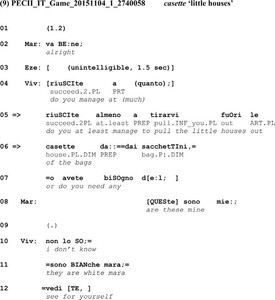
Making a modal interrogative hearable as questioning the other’s ability to act better is a characteristic of sanctions that strongly convey disapproval. This is illustrated in the following Italian case, where it is a lexical expression of ability, rather than a modal auxiliary, that is used in accomplishing a sanctioning turn. Viviana has been setting up the game on her own for some time, while her friends have been smoking, chatting, and drinking wine. In the fragment below, Viviana targets the others’ lack of contribution: riuscite a quanto – almeno a tirarvi fuori le casetti da:: dai sacchettini (‘do you manage at (much) – do you manage at least to pull the little houses out of the bags for yourselves’, lines 5–6)
Modal sanctions in polar interrogative format (and in interrogative formats more broadly) targeting rectifiable or non-rectifiable problem behaviour
Citation: Contrastive Pragmatics 7, 2 (2026) ; 10.1163/26660393-bja10166
Citation: Contrastive Pragmatics 7, 2 (2026) ; 10.1163/26660393-bja10166
Viviana has been occupied with game preparations over the course of the last five minutes. Her sanction targets the fact that her friends did not contribute to any of the jobs that have been completed during this extended stretch of time (e.g., laying out the tiles to build the game board, sorting the various game cards). In that sense, although the lack of contribution on the part of Viviana’s friends is still rectifiable to some extent, we also can see a similar orientation to fully-formed ‘wrong-doing’ as in the previous case. Questioning the others’ ability to make small contributions works to give her reprimand a sarcastic quality. Viviana fills the polar response space at the end of line 6 by expanding her sanction into an alternative question that she does not, however, complete. Her o avete bisogno del (‘or do you need …’, line 7) could be heading for a further elaboration of the others’ seeming ‘inability’ (‘or do you need assistance’), or of their lacking cooperation (‘do you need a special invitation’). When Mara, in response, takes a bag of white game pieces and asks ‘are these mine’ (line 8), Viviana rejects the role of the person who would take responsibility over all preparation decisions, and instead points to the evident (‘they are white mara’, line 11), which can be a method for ‘shaming’ the other for acting inappropriately (Potter and Hepburn, 2020).
We now turn to a final case with a modal auxiliary expressing necessity (‘must’). This will further illustrate the use of interrogative modal sanctions for reprimanding by questioning ‘participant-internal’ backgrounds. This final case (10) comes from a Polish breakfast. Ten-year-old Amela is manipulating a string of melted cheese that has extended between her sandwich and her mouth. She summons her mum (line 2) and makes a comment (nie dotykaj, ‘don’t touch’, line 4) that quotes just prior talk about another matter, but that might also somewhat provocatively point to the untowardness of her own behaviour. Her mum, Renata, takes up a stance that can be seen as mildly critical, fixating her look on Amela with her head inclined (Kidwell, 2005). At line 6, Renata verbalises her disapproval, sanctioning Amela with a modal polar interrogative (musisz robić kulki z tego sera, ‘do you have to make balls out of that cheese’, line 6).
Renata inclines her head and gazes at Amela (line 5).
Citation: Contrastive Pragmatics 7, 2 (2026) ; 10.1163/26660393-bja10166
Citation: Contrastive Pragmatics 7, 2 (2026) ; 10.1163/26660393-bja10166
Renata’s sanctioning turn (sarcastically) attributes Amela’s undesired behaviour to an inner compulsion: She can’t help making balls out of the melted cheese. Invoking a participant-internal background of personal limitations contributes to a sanction that combines a directive to discontinue this behaviour with an expression of disapproval.
Table 4 summarises some of the qualities of context and turn design that enter into accomplishing modal interrogative sanctions and shows these on a continuum from polite requests that convey disapproval only very indirectly, to reproaches that convey disapproval much more directly. The organizing principles behind this continuum are the degree to which the sanction holds the targeted person accountable for having acted badly, its timing, and the rectifiability of the problem behaviour.
Directing and reprimanding sanctioning actions accomplished with interrogative modal turns
Citation: Contrastive Pragmatics 7, 2 (2026) ; 10.1163/26660393-bja10166
The action quality of the sanctioning move as more or less strongly problematizing the targeted behaviour depends on the nature of that behaviour itself: Sometimes, the sanctioned party’s behaviour is quite ‘innocent’ and maybe simply forgetful of certain standards (Ex. 7 ‘knife and fork’); at other times, behaviour that gets sanctioned might occupy a grey area of latent accountability for acting without proper consideration for others (Ex. 6 ‘pfeifen’, Ex. 9 casette); and occasionally, people are being deliberately provocative (Ex. 8 ‘zamknąć się’). In terms of turn design, an important parameter for designing a sanction as more or less reprimanding is whether to tell the person to do something other than they are currently doing, or to tell them to stop doing what they are doing (imagine mum asking Faith to stop eating with her fingers; or Katalin asking her brother whether he can hum the tune).
4 Summary and Discussion
We have studied how speakers use modal expressions in interactional moves that sanction another person’s current or past behaviour as problematic. This is an interactional context in which meanings of obligation, (im)permissibility and (un)acceptability are central. We therefore expected this to be a prime environment for the study of deontic meaning. However, we found, firstly, that modal expressions are relatively rare in this context: Between 11% (Polish) and 20% (German) of sanctioning moves in our data contain modal expressions. Secondly, it turned out that modal expressions in the context of sanctioning invoke a variety of backgrounds: not only deontic backgrounds of rules and norms, but also interpersonal backgrounds of common sense and consideration, practical backgrounds of feasibility, and ‘internal’ backgrounds of ability and predisposition. Using four cases from the results section as examples, Tab. 5 summarises four different patterns of use of modal auxiliaries in the context of sanctioning moves, which invoke distinct kinds of accountability or conversational background.
Different sources of accountability invoked in modal sanctions
Citation: Contrastive Pragmatics 7, 2 (2026) ; 10.1163/26660393-bja10166
Our study involved two contrasts: The first is a contrast between codified rules (in board games), and social norms (mostly in family breakfasts). These contexts make a strong difference to the way modal expressions can be used in sanctioning moves. Board game players achieve an orientation to their activity as rule-bound by pointing to the invalidity of some game moves in very lean turn-constructional units (e.g., Ex. 2, you can’t). Contingent expansions of such interventions turn to the rules of the game as relevant background (either verbally or by consulting the actual rule book). These are prototypical instances of what can be called deontic uses of modal auxiliaries. In our family breakfast data, pointing out the ‘impossibility’ of another person’s action stands on less definitive ground: People rarely do it; when they do it, such moves, in our data, receive responses that either question or reject the grounds for the intervention (Ex. 3, dobra!, ‘okay!’/‘stop it’) or that are evasive and can serve to avoid an argument (Ex. 4, ich weiß von nichts, ‘I don’t know of anything’). The difference we find between (codified) game rules and (informal) social norms evokes discussions of ‘thick’ and ‘thin’ rules (Daston, 2022), or of ‘thick’ ethical concepts (Williams, 1985). The codified rules of games afford ‘thin’ sanctions where a lean pointer to ‘impossibility’ can be enough to invoke a shared deontic background of rules (the same may hold in other contexts where formal rules are enforced, e.g., Raymond et al., 2022). The preferences and ethical needs of everyday life, in contrast, provide very different grounds for sanctioning, where considerations guiding ‘proper’ or ‘good’ behaviour are treated as open to discussion, negotiation, and argument, where ‘practical reason’ can require discretion to be applied and exceptions to be considered.
In the context of family mealtimes, instead of pointing out the unacceptability of some behaviour, modal sanctions instead tend to take the form of directives aimed at mobilizing alternative, ‘better’ conduct (modal polar interrogatives such as Ex. 7, can you use knife and fork please). Such modal polar interrogatives can be used in different ways on a cline of accountability: At one end of the cline, we find polite requests to alter behaviour that downplay or even cancel the addressee’s accountability for the problematic behaviour. At the other end, we find reprimands that hold the other accountable for having acted badly by questioning their personal predisposition as a possible reason for the behaviour (Ex. 8, czy ty możesz się zamknąć, ‘can you shut it (at all)’). This is where the second contrastive dimension of our study comes into play: the comparison across four languages. While in the English data, polar interrogatives are used as a polite method for mobilizing better behaviour, in our Polish data, polar interrogatives are used to reprimand the other for acting badly. This is in line with cross-cultural findings about the different uses of polar interrogatives in the wider domain of requesting assistance and directing behaviour (Culpeper and Demmen, 2011; Rossi 2017; Zinken, 2016; Floyd et al., 2020). It is important, however, to point out that the practices that speakers draw on to accomplish a reprimanding sanction with a modal polar interrogative are available in all of the studied languages. These are a ‘negative’ design of the sanction (e.g., ‘can you stop whistling’ rather than ‘can you hum instead’); questioning the other’s personal predispositions with a modal auxiliary (e.g., musisz robić kulki, ‘do you have to make balls’), and timing and designing a directive in such a way that the grammatically projected response space is unavailable (e.g., asking ‘can you shut it’ well after the other person has stopped speaking). While the constellation of practices that accomplishes a modal polar reprimand is more characteristic of Polish than of British family breakfasts in our data, the individual practices are shared across communities of speakers.
How can this study add to our understanding of the concept of deontic modality? Deontic modality is most commonly defined in terms of obligation and permission. But this seems too broad: Sanctioning episodes in social life are always about prohibiting certain behaviours, and ‘obliging’ persons to act differently. But not only are most sanctioning moves in our corpus done without modal expressions; When modal expressions are used, as we have seen, these invoke various backgrounds. The proposal to understand deontic modality as those varieties of possibility and necessity that invoke a background of ‘moral acceptability’ (Nuyts et al., 2010) also requires further specification. The modal sanctions in our data that most clearly convey moral unacceptability might be those that invoke a ‘dynamic’ modality, questioning the wrong-doer’s personal abilities and dispositions (e.g., Ex. 9, risciute almeno …, ‘do you at least manage …’). Our findings suggest instead that we might define as ‘deontic’ those conversational backgrounds that are treated by participants as generic and impersonal, holding beyond the relation of ‘you’ and ‘me’ in the ‘here-and-now’. This is consistent with the exemplary lists of backgrounds that are often encountered in the literature, including items such as rules, norms, principles etc. It is also consistent with the etymology of the term ‘deontic’, from “the Greek for what one must do” (Williams, 1985, p. 18; our emphasis). It sets sanctions that become accountable as appealing to general reason (Ex. 4, du kannst doch nicht, ‘but you can’t …’) apart from sanctions that become accountable, for example, on the grounds of here-and-now interpersonal consideration (e.g., Ex. 6, kannst du bitte aufhören zu pfeifen, ‘can you please stop whistling’). The crucial characteristic of deontic modality then is not the existence or otherwise of a rule or principle (or that an analyst could see a particular norm or principle at work, for example the norm of ‘consideration for others’). The crucial characteristic is that participants themselves make their claim of ‘impossibility’, or their query about ‘possibility’, accountable in terms of grounds that transcend ‘us here and now’. As the data show, this is achieved easily in a game context, where codified rules can be made relevant, and it requires more work in contexts where no codified rules apply, where ‘common sense’ is itself subject to constant ascertainment and negotiation, and where the generic relevance of a judgment can only be claimed (e.g., Ex. 4, du kannst doch nicht …, ‘but you can’t …!’). Most of the time, for participants to social interaction, social norms are not external standards, but locally emergent agreements.
Acknowledgments
We are grateful to two reviewers for their comments on an earlier version of this report. The reported research was supported by the Leibniz Association under a Leibniz Cooperative Excellence Grant (grant # K232/2019 to Jörg Zinken).
References
Blum-Kulka, Shoshana, Julianne House, and Gabriele Kasper (eds.). 1989. Cross-cultural Pragmatics: Requests and Apologies. Norwood, N.J.: Ablex.
Bolden, Galina B., and Jeffrey D. Robinson. 2011. Soliciting Accounts with Why-Interrogatives in Conversation. Journal of Communication 61(1). 94–119.
Bybee, Joan L., and Suzanne Fleischman. 1995. Modality in grammar and discourse: Papers from a symposium on Mood and Modality held at the University of New Mexico in 1992 (Typological Studies in Language 32). Amsterdam: Benjamins.
Bybee, Joan L., Revere D. Perkins, and William Pagliuca. 1994. The Evolution of Grammar: Tense, Aspect, and Modality in the Languages of the World. Chicago: University of Chicago Press.
Chalfoun, Andrew, Giovanni Rossi, and Tanya Stivers. 2025. The Magic Word? Face-Work and the Functions of Please in Everyday Requests. Social Psychology Quarterly 88(1). 66–88.
Charlow, Nate, and Matthew Chrisman. 2016. Introduction. In Nate Charlow and Matthew Chrisman (eds.). Deontic Modality, 1–10. Oxford: Oxford University Press.
Coates, Jennifer. 1983. The Semantics of the Modal Auxiliaries. London: Croom Helm.
Couper-Kuhlen, Elizabeth, and Margret Selting. 2018. Interactional Linguistics: Studying Language in Social Interaction. Cambridge, New York, NY, Melbourne, Singapore: Cambridge University Press.
Culpeper, Jonathan, and Jane Demmen. 2011. Nineteenth-century English politeness: Negative politeness, conventional indirect requests and the rise of the individual self, Journal of Historical Pragmatics 12(1–2). 49–81.
Curl, Traci S., and Paul Drew. 2008. Contingency and action. A comparison of two forms of requesting. Research on Language and Social Interaction 41(2). 129–153.
Daston, Lorraine. 2022. Rules: A Short History of What We Live By. Princeton, NJ: Princeton University Press.
Deppermann, Arnulf. 2024. What do you understand by X? In Margret Selting and Dagmar Barth-Weingarten (eds.). New Perspectives in Interactional Linguistic Research (Studies in Language and Social Interaction volume 36), 103–131. Amsterdam, Philadelphia: John Benjamins Publishing Company.
Deppermann, Arnulf, and Alexandra Gubina. 2021. When the body belies the words: embodied agency with darf/kann ich? (“May/Can I?”) in German. Frontiers in Communication 6.
Depraetere, Ilse, and Susan Reed. 2006. Mood and Modality in English. In Bas Aarts, April McMahon and April M. S. McMahon (eds.). The Handbook of English Linguistics, 1. (Blackwell handbooks in linguistics), 269–290. Malden, Mass.: Blackwell.
ELAN (Version 7.0) [Computer software]. (2025). Nijmegen: Max Planck Institute for Psycholinguistics, The Language Archive. Retrieved from https://archive.mpi.nl/tla/elan.
Enfield, N. J. 2013. Relationship Thinking: Agency, Enchrony, and Human Sociality (Foundations of Human Interaction). New York: Oxford University Press.
Floyd, Simeon, Giovanni Rossi, and N. J. Enfield (eds.). 2020. Getting Others to Do Things: a Pragmatic Typology of Recruitments. Berlin: Language Science Press.
Fox, Barbara A. 2007. Principles shaping grammatical practices: an exploration. Discourse Studies 9(3). 299–318.
Fox, Barbara A., and Trine Heinemann. 2016. Rethinking format: an examination of requests. Language in Society 45(04). 499–531.
Goffman, Erving. 1971. Relations in Public: Microstudies of the Public Order. New York: Basic Books.
Gubina, Alexandra. 2021. Availability, Grammar, and Action Formation: On Simple and Modal Interrogative Request Formats in Spoken German. Gesprächsforschung – Online-Zeitschrift zur verbalen Interaktion 22. 272–303.
Gubina, Alexandra, Barbara A. Fox, and Chase W. Raymond. 2024. What to do next. In Margret Selting and Dagmar Barth-Weingarten (eds.). New Perspectives in Interactional Linguistic Research (Studies in Language and Social Interaction volume 36), 20–48. Amsterdam, Philadelphia: John Benjamins Publishing Company.
Haan, Ferdinand de. 2006. Typological approaches to modality. In William Frawley (ed.). The Expression of Modality (The Expression of Cognitive Categories 1), 27–70. Berlin: Mouton de Gruyter.
Heinemann, Trine. 2006. “Will you or can’t you?”: Displaying entitlement in interrogative requests. Journal of Pragmatics 38. 1081–1104.
Horne, Christine, and Stefanie Mollborn. 2020. Norms: An Integrated Framework. Annual Review of Sociology 46(1). 467–487.
Jefferson, Gail. 2004. Glossary of transcript symbols with an introduction. In Gene H. Lerner (ed.). Conversation Analysis. Studies from the First Generation, 13–31. Amsterdam, Philadelphia: John Benjamins Publishing Co.
Jucker, Andreas H. 2020. Politeness in the History of English: from the Middle Ages to the Present Day. Cambridge, New York, NY, Port Melbourne, New Delhi, Singapore: Cambridge University Press.
Kendrick, Kobin H. 2020. Recruitment in English: A quantitative study. In Simeon Floyd, Giovanni Rossi, and N. J. Enfield (eds.). Getting Others to Do Things. A Pragmatic Typology of Recruitments, 93–146. Berlin: Language Science Press.
Kidwell, Mardi. 2005. Gaze as social control: How very young children differentiate “the look” from a “mere look” by their adult caregivers. Research on Language & Social Interaction 38(4). 417–449.
König, Ekkehard, and Peter Siemund. 2007. Speech act distinctions in grammar. In Timothy Shopen (ed.). Language Typology and Syntactic Description, 2nd ed., 276–324. Cambridge, UK, New York: Cambridge University Press.
Kornfeld, Laurenz. 2024. Giving space for self-direction: Trouble-flagging declaratives in sanctioning problem behavior. Interactional Linguistics 4(2). 131–157. https://www.jbe-platform.com/content/journals/10.1075/il.24001.kor.
Kornfeld, Laurenz & Giovanni Rossi. 2023. Enforcing Rules During Play: Knowledge, Agency, and the Design of Instructions and Reminders. Research on Language & Social Interaction 56(1). 42–64.
Koschmann, Timothy. 2019. Tracing the Seminal Notion of Accountability Across the Garfinkelian Œuvre. Human Studies 42(2). 239–252.
Kratzer, Angelika. 1977. What ‘must’ and ‘can’ must and can mean. Linguistics and Philosophy 1(3). 337–355.
Kratzer, Angelika. 1981. The Notional Category of Modality. In Hans-Jürgen Eikmeyer and Hannes Rieser (eds.). Words, Worlds, and Contexts. New Approaches in Word Semantics (Research in text theory volume 6), 38–74. Berlin, New York: Walter de Gruyter.
Kroeger, Paul. 2018. Analyzing Meaning: An Introduction to Semantics and Pragmatics (Textbooks in language sciences 5). Berlin, Germany, Genève: Language Science Press; European Organization for Nuclear Research. http://oapen.org/search?identifier=1000382.
Küttner, Uwe-A. 2021. Retro-sequence. The Encyclopedia of Terminology for Conversation Analysis and Interactional Linguistics.
Küttner, Uwe-A., Laurenz Kornfeld, Christina Mack, Lorenza Mondada, Jowita Rogowska, Giovanni Rossi, Marja-Leena Sorjonen, Matylda Weidner, and Jörg Zinken. 2024. Introducing the “Parallel European Corpus of Informal Interaction” (PECII). In Margret Selting and Dagmar Barth-Weingarten (eds.). New Perspectives in Interactional Linguistic Research (Studies in language and social interaction), 132–160. Amsterdam: John Benjamins Publishing Company.
Küttner, Uwe-A., Laurenz Kornfeld, and Jörg Zinken. 2023. A coding scheme for (dis)approval-relevant events involving the direct social sanctioning of problematic behavior in informal social interaction. IDSopen 5.
Küttner, Uwe-A., Anna Vatanen, and Jörg Zinken. 2022. Invoking Rules in Everyday Family Interactions: A Method for Appealing to Practical Reason. Human Studies 45(4). 793–823.
Lerner, Gene H., and Tomoyo Takagi. 1999. On the place of linguistic resources in the organization of talk-in-interaction: A co-investigation of English and Japanese grammatical practices. Journal of Pragmatics 31. 49–75.
Lindström, Anna. 2005. Language as social action: A study of how senior citizens request assistance with practical tasks in the Swedish home help service. In Auli Hakulinen and Margret Selting (eds.). Syntax and Lexis in Conversation, 209–233. Amsterdam: Benjamins.
Lyons, John. 1977. Semantics: Vol. 2. Cambridge: Cambridge University Press.
Mondada, Lorenza. 2018. Multiple Temporalities of Language and Body in Interaction: Challenges for Transcribing Multimodality. Research on Language & Social Interaction 51(1). 85–106.
Narrog, Heiko. 2016. The expression of non-epistemic modal categories. In Jan Nuyts and van der Auwera, Johan (eds.). The Oxford Handbook of Modality and Mood (Oxford handbooks in linguistics), 89–116. Oxford, New York, NY: Oxford University Press.
Nuyts, Jan. 2016. Analyses of the modal meanings. In Jan Nuyts and van der Auwera, Johan (eds.). The Oxford Handbook of Modality and Mood (Oxford handbooks in linguistics), 1–19. Oxford, New York, NY: Oxford University Press.
Nuyts, Jan, Pieter Byloo, and Janneke Diepeveen. 2010. On deontic modality, directivity, and mood: The case of Dutch ‘mogen’ and ‘moeten’. Journal of Pragmatics 42. 16–34.
Palmer, Frank R. 2001. Mood and Modality, 2. ed. (Cambridge textbooks in linguistics). Cambridge: Cambridge Univ. Press.
Perkins, Michael R. 1983. Modal Expressions in English (Open linguistics series). London: Frances Pinter.
Potter, Jonathan and Alexa Hepburn. 2020. Shaming interrogatives: Admonishments, the social psychology of emotion, and discursive practices of behaviour modification in family mealtimes. The British Journal of Social Psychology 59(2). 347–364.
R Core Team (2023). R: A Language and Environment for Statistical Computing. R Foundation for Statistical Computing, Vienna, Austria. <https://www.R-project.org/>.
Raymond, Geoffrey, Lillian Jungleib, Don Zimmerman, and Nikki Jones. 2022. Rules and policeable matters. In Douglas W. Maynard and John Heritage (eds.). The Ethnomethodology Program. Legacies and Prospects (Foundations of human interaction), 162–187. New York: Oxford University Press Incorporated.
Robinson, Jeffrey D. 2016. Accountability in social interaction. In Jeffrey D. Robinson (ed.). Accountability in Social Interaction (Foundations of human interaction), 1–44. New York, NY: Oxford University Press.
Rogowska, Jowita. 2025. Delegitimierungspraktiken in deutschen und polnischen Alltagsgesprächen: Eine sprachübergreifende Perspektive. Heidelberg Dissertation.
Rossi, Giovanni. 2012. Bilateral and unilateral requests: The use of imperatives and mi x? interrogatives in Italian. Discourse Processes 49. 426–458.
Rossi, Giovanni. 2017. Secondary and deviant uses of the imperative for requesting in Italian. Imperative Turns at Talk: The Design of Directives in Action 30. 103–137. https://benjamins.com/catalog/slsi.30.04ros.
Schegloff, Emanuel A. 2007. Sequence Organization in Interaction: A primer in Conversation Analysis. Cambridge, UK: Cambridge University Press.
Stevanovic, Melisa. 2018. Social deontics: A nano‐level approach to human power play. Journal for the Theory of Social Behaviour 48(3). 369–389.
Stevanovic, Melisa, and Anssi Peräkylä. 2012. Deontic authority in interaction: The right to announce, propose, and decide. Research on Language and Social Interaction 45(3). 297–321.
van der Auwera, Johan, and Vladimir A. Plungian. 1998. Modality’s semantic map. Linguistic Typology 2(1).
van Linden An, and Jean-Christophe Verstraete. 2011. Revisiting deontic modality and related categories: A conceptual map based on the study of English modal adjectives. Journal of Pragmatics 43(1). 150–163.
Weidner, Matylda. 2016. Aha-moments in interaction: Indexing a change of state in Polish. Journal of Pragmatics 104. 193–206.
Williams, Bernard. 1985. Ethics and the Limits of Philosophy. Cambridge, Mass.: Harvard Univ. Press.
Wootton, Anthony J. 1997. Interaction and the Development of Mind. Cambridge: Cambridge University Press.
Wright, G. H. von. 1951. Deontic logic. Mind LX(237). 1–15.
Zifonun, Gisela, Ludger Hoffmann, and Bruno Strecker. 1997. Grammatik der deutschen Sprache. Vol 3. Berlin: de Gruyter.
Zinken, Jörg. 2016. Requesting Responsibility: The Morality of Grammar in Polish and English Family Interaction. New York: Oxford University Press.
Zinken, Jörg. 2020. Recruiting assistance and collaboration in Polish. In Simeon Floyd, Giovanni Rossi, and N. J. Enfield (eds.). Getting Others to Do Things. A Pragmatic Typology of Recruitments, 281–324. Berlin: Language Science Press.
Zinken, Jörg, and Christina Mack. 2024. Sequence, gaze, and modal semantics: modal verb selection in German permission inquiries. Linguistics 63(1). 159–192.
Zinken, Jörg, and Eva Ogiermann. 2013. Responsibility and action: Object requests in English and Polish everyday interaction. Research on Language and Social Interaction 46(3). 256–276.
Biographical Notes
Jörg Zinken is a member of research staff at the Leibniz-Institute for the German Language (IDS) in Mannheim, Germany, and Professor of Linguistics at Heidelberg University. He is interested in how grammar enters into the accomplishment of action, particularly from a cross-linguistic perspective.
Uwe-A. Küttner is a member of research staff at the Leibniz-Institute for the German Language (IDS) in Mannheim, Germany, and a former member of the research project Norms, Rules, and Morality – across Languages (NoRM-aL). His research focuses on language use in social interaction and the myriad ways in which it contributes to the constitution of recognizable social actions. He has worked with data from such diverse domains as ordinary social interaction among friends and family members, encounters between copwatchers and the police, as well as social interactions with (and around) voice assistants.
Laurenz Kornfeld is a post-doctoral researcher at Heidelberg University, Germany, and a former member of the project Norms, Rules, and Morality – across Languages (NoRM-aL). His research is mainly in Interactional Linguistics and Conversation Analysis. He focusses on the use of linguistic and bodily resources in social interaction and narrative contexts.
Christina Mack is a PhD student at Heidelberg University, and a former member of the project Norms, Rules, and Morality – across Languages (NoRM-aL) at the Leibniz-Institute for the German Language (IDS) in Mannheim, Germany. Her main interest lies in the analysis of social interaction. She has been pursuing a cross-linguistic and cross-cultural perspective, working with German and Italian data. Currently she works on deontic negotiations, the constitution of deontic relevance and the variety of resources participants use when managing situations that are (potentially) problematic from a socionormative point of view.
Jowita Rogowska is a research associate at the Department of German Linguistics at the University of Marburg and a doctoral candidate at Heidelberg University. Her research interests include social interaction in cross-linguistic comparison, second and foreign language acquisition, and multilingualism.
The term ‘root’ goes back to the generative notion of ‘root clauses’, Haan (2006), p. 29.
Due to the positioning of cameras and bodies, we cannot tell whether Marek adjusts the thickness of the slices he makes.
It may be relevant that Katalin is wearing a hearing aid, which might make the whistling uncomfortable for her.