Abstract
This article brings together evidence that the exercise of justice in Ancient Egypt acted as a crucial liminal sphere of interaction between the worlds of the living and the supernatural. It argues that the judicial sphere provided a conceptual and physical environment that lay at the heart of a belief framework centred on integrating beings who were alive and beings who were not into a single ontological experienceâa shared existence where they could interact with one another. It argues that a personâs participation in a legal process while alive could have a significant bearing on their prospects in the afterlife, and that evidence for this is plentiful in both the textual and archaeological records. Topics considered include the divine tribunal, the involvement of gods and the deceased in human courts, oracular justice, oaths, and the mythology of rightful inheritance surrounding the Contendings of Horus and Seth. These are set against the background of the physical settings in which justice occurred, including temple gates at the threshold of sacred precincts that by virtue of their location occupied the middle ground between earthly and otherworldly realms. Following an initial survey of material relevant to these broader themes, the article then focuses on a detailed case study of one particular physical environment replete with textual and architectural symbolism: the Memphite tomb chapel of Mose. This tomb chapel, containing scenes and descriptions of justice in both this world and the parallel world, can serve as a vehicle for interrogating the way in which overarching judicial themes could bind daily and mythological existences together, transforming the very nature of the litigant from a relatively minor participant in a court case to a transcendent being integrated into imagery of myth and its underlying logic.
Introduction
This article explores Ancient Egyptian judicial procedure from a perspective of liminality, making a case for understanding the Ancient Egyptian lawcourt as a space that was considered both conceptually and physically to be a threshold between the world of the living and a distinct plane of existence inhabited by the deceased and the divine. For the purposes of the article, we refer to this other realm as the âparallel worldââa new term here deliberately preferred to the widely-used concept of âafterlifeâ. By talking of a âparallel worldâ, we aim to illustrate that the judicial space permitted the worlds of the living and non-living to interact in real time, acting in parallel to one another. Such interaction between the worlds could serve both to maintain the overall cosmic balance, in accordance with overarching principles of right order/Maat (MÉá¶t), as well as to provide concrete benefits to various litigants navigating the practicalities of the judicial sphere among the living and non-living alike. We therefore argue that, to the Egyptians, action in the judicial space was simultaneously a manifestation of Maat being carried out among those alive and a form of initiation rite whereby its practitioners could gain access to the parallel world, communicate with it, and ultimately obtain decisions from it.1
As a point of departure, it is important to highlight that Egypt had a long tradition of seeing the judicial process in the world of the living as a form of offering to Maat the goddess, the divine personification of Maat the concept. As early as the Old Kingdom, dispensing justice could be seen as an act of âmaking offerings to Maatâ,2 while judicial practitioners were consistently termed âpriests of Maatâ in texts of the New Kingdom and beyond.3 Consistent with this theme is the description of legal proceedings in Ancient Egypt by Diodorus Siculus: this points out that, before justice could be dispensed, the presiding judge had to physically connect himself to an image of the goddess Maat, the divine personification of right order or truth:4
The [chief justice] regularly wore suspended from his neck by a golden chain a small image made of precious stones, which they called Truth (Maat); the hearings of the pleas commenced whenever the chief justice put on the image of Truth. [â¦] After both parties had twice presented their statements in writing to the judges, it was the duty of the [â¦] chief justice to place the image of Truth upon one or the other of the two pleas which had been presented.
Given that Diodorus was a Greek historian not native to Egypt, his observations would usually warrant being treated with great caution, but the extent to which they appear to match the earlier Egyptian textual evidence does appear to suggest a high level of veracity. Moreover, visual representations of Egyptian officials wearing pendants of this sort are indeed attested.5 The picture painted here can be seen as having hallmarks of a ritualised initiation or transformation: the leading judicial practitioner puts on the image of Maat, and at that point enters the realm where he can conduct justice, perhaps in direct communication with Maat, the deity and concept of which he is a priest, and to which he makes offering through his actions. Thus, could it be that the judge is travelling between the world of the living and the parallel world, with the judicial space serving as a liminal boundary?
This paper seeks to throw light onto this question, from a perspective of both conceptual and spatial links between the living and non-living within judicial spaces and among those who entered them.
Judgment as Conceptual Link between the Living and the Parallel World
On a conceptual level, it is perhaps easiest to start with arguably the most striking instance of a judicial environment serving as a link between the worlds of the living and the non-living: the divine tribunal described in the Book of the Dead, which must be navigated by every deceased person seeking to move from the world of the living to that of the dead.6 It is by virtue of a divine judgment that the deceased is permitted to transcend from one world to the other:7
Thus says Thoth, judge of truth, to the Great Ennead which is in the presence of Osiris: Hear this word of very truth. I have judged the heart of the deceased, and his soul stands as a witness to him. His deeds are righteous in the great balance, and no sin has been found in him. He did not diminish the offerings in the temples, he did not destroy what had been made, he did not go about with deceitful speech while he was on earth.
Thus says the Great Ennead to Thoth who is in Hermopolis: This utterance of yours is true. The vindicated Osiris [name of deceased] is straightforward, he has no sin, there is no accusation against him before us, Ammit shall not be permitted to have power over him. Let there be given to him the offerings which are issued in the presence of Osiris, and may a grant of land be established in the Field of Offerings as for the Followers of Horus.
Thus says Horus, son of Isis: I have come to you, O Wennefer (Osiris) and I bring [name of deceased] to you. His heart is true, having gone forth from the balance, and he has not sinned against any god or any goddess. Thoth has judged him in writing which has been told to the Ennead, and Maat the great has witnessed. Let there be given to him bread and beer which have been issued in the presence of Osiris, and he will be for ever like the Followers of Horus.
This transcendent judgment shares most of its key procedural elements with Egyptian judicial process in the world of the living: the court consists of multiple assessors coalescing around a verdict, several witnesses are present, and judgment is made both orally and in writing.8 The outcomes of the trial are also distinctly familiar to the world of the living, with a grant in land9 and rations being decreed alongside the ultimate prize of entry to the parallel world.
So far, we have shown that the divine tribunal looked and operated like a human tribunal, but what evidence is there for the two actually being linked together as part of a single judicial process? An obvious point of departure are texts which explicitly ask gods to intervene in a human court, such as this short Ramesside prayer known today as Ostracon Borchardt:10
Amun-Ra, the one who calls to account (lit. âreturns an answerâ)11 for the orphan who is poor, may he cause the court to be in one voice when they answer on account of the orphan. May the orphan happen to be vindicated; may the bearer of rewards (i.e. bribes) be upset.
A longer and more elaborate example is found in Papyrus Anastasi II (ll. 8,5â9,1), where the deity is asked to take up the form of an earthly official and thereby quash corruption among various administrators in court:12
Amun, give your ear to the one alone in the court, he being poor. He is not powerful, and the court cheats him of silver and gold for the scribes of the mat (and) clothing for the followers. May it be found that Amun takes up his form as vizier, to cause the poor man to go forth (i.e. be released). May it be found that the orphan happens to be vindicated. May the orphan surpass the powerful.
As well as intervening in the workings of a human court, gods could also be asked to replace it altogether, by dispensing justice in a separate judicial framework: the oracle court.13 The divine oracle, operated by priests either speaking on behalf of the god or moving an effigy to indicate certain decisions, allowed ostensibly divine verdicts to cross into the world of the living and shape judicial outcomes there. While it remains unclear whether the priests themselves consciously chose outcomes on behalf of the gods, whether they presided over a randomised decision-making process, or whether they simply served as communicators for legal decisions already made earlier, for the purposes of the present paper the core argument remains unchanged: one way or another, gods were seen to be direct agents of adjudication. Examples of such judicial oracles come from all periods of Egyptian history,14 but the New Kingdom provides some of the richest evidence. Arguably the best-studied example is Papyrus BM10335, a long and remarkably well-preserved summary of an oracular process where the god Amun on three separate occasions affirms the guilt of a farmer accused of stealing five coloured tunics from another plaintiff in the local community.15 Amun adjudicates very much like a human official would, passing down verdicts in the presence of witnesses, initially granting recourse to appeal, and ultimately confirming that the matter has been settled by administering an oath to the guilty party.
Oaths were another way in which gods could be present in the earthly court process. While several formulae could be used to indicate an oath, by the New Kingdom a standard form had crystalised which revolved around the set phrase wÉḥ Imn wÉḥ pÉ á¸¥á¸³É (âAs Amun endures and as the ruler enduresâ).16 Thus, both Amun and the Kingâhimself a living manifestation of the god Horusâcould be invoked in a very wide variety of judicial settings, from relatively minor property disputes to cases of the greatest gravity, such as the Tomb Robbery Papyri dealing with those who had robbed and desecrated the tomb of Pharaoh himself.17 In all of those cases, the gods were therefore effectively deemed to be participating in the legal case, with the enduring power of both Amun and the living Horus being harnessed to add credibility and divine backing every time litigants took an oath. If an oath was broken, it was this divine authority that would be undermined and that in itself could serve as a reason for sanction. Indeed, going against the gods in this way may have been seen as a more severe offence than whatever original wrongdoing had led to the oath being administered in the first place.
Overall, one can therefore see that, be it through the use of oaths or through direct divine intervention in court process through prayers and oracles, gods featured prominently in the Egyptian justice system on earth, as well as administering their own justice system beyond death. However, the links between justice in the world of the living and the parallel world did not extend only to gods traversing from one realm to the other: mortals were deemed capable of doing so too. A particularly striking example of this is Coffin Text Spell 149, which empowers a living person to transform into what it terms a âhuman falconâ in order to fly up to the divine tribunal and bring charges against one who had offended them in the world of the living.18 Alternatively, such a tribunal might be recreated on earth by the living, with the mummy of the deceased judged by living judges hearing accusations from living plaintiffs as part of a post-mummification ritual associated with helping the dead person move into the parallel world.19
The process could work the other way as wellânot with the living judging the dead, but vice versa. Three letters to the dead, dating from periods as diverse as the late Old Kingdom (22nd century BCE) to the Late Period (7th century BCE), explicitly invoke dead ancestors in solving legal disputes over inheritance.20 Many more, while not strictly alluding to judicial process, nonetheless use communication with a deceased ancestor to implicitly stake a legal claim to the property this ancestor had previously owned, and to solicit their support in securing it.21 Indeed, given the well-known Egyptian legal principle of inheritance going to the one who buries the deceased,22 it can be argued that the entire funerary procedure and accompanying ritual was a way in which contact between the earthly and parallel worlds fuelled legal practice.23 A living person, by carrying out the rites needed to transport the deceased into the parallel world, gained legal grounds to become a legitimate heir in the world of the living. From an angle of Egyptian theology, this is entirely logical: just as the quintessential divine heirâHorusâwas legitimised as rightful in the world of the living through the power and judgment of his father Osiris in the world of the dead,24 so too could every ancestor effectively legitimise the inheritance of his heirs simply by virtue of existing in the parallel world. Ancestors were being resurrected in the parallel world like Osiris, and this process required the ritual funerary actions of their heirs, who attained legal transformation in doing so: they gained the property of the deceased just as Horus had gained the kingship of Osiris. Indeed, whether or not such deceased ancestors were then urged to directly intervene in earthly court cases might be a secondary matterâthe mere fact that they existed may in itself have been of profound importance to a legal landscape incorporating both worlds into one, where they could potentially intervene if such a need arose.
1 Judgment as Physical Link between the Living and the Parallel World
Having established how the exercise of justice could link the world of the living and the parallel world on a conceptual level, this section will now consider how this connection could be manifested in the physical space too, with judicial spaces serving as tangible liminal environments between the domains of those alive and those not. Perhaps most obvious is that a term which at first sight seems to have judicial overtonesâthe âplace of justiceâ (st MÉá¶t)âin fact denotes a necropolis, which is to say a place where the living could visit the dead and interact with them.25 Matters went a step further at gates of Egyptian templesâstructures connecting an inner space sacred to the divine with the outside worldâwhich were frequently used for the practical administration of justice: by the Late and Ptolemaic periods, they had acquired the explicit designation of rwt-dıÍ-MÉá¶t (âgate of giving justiceâ).26 It is possible to learn more about what happened there from an inscription preserved at the entrance of the temple at Edfu, which describes this location as follows:27
Place of hearing the petitions of all petitioners in order to separate truth from falsehood. It is the great building of protecting the vulnerable, to [protect them] from the strong.
As the place where petitions are heard, the judicial space is therefore where right and wrongâpreviously intermingled within one case requiring resolutionâare conceptually separated out. However, as a temple gate, this place of justice could also be seen as one where mortal and divine beingsâpreviously separated outâcan intermingle. Gates of this sort would have been deemed ideal for such liminal contacts, as they connected divine and non-divine spaces and were thus considered accessible to the living and non-living alike.28 Nor is the Edfu example unique: far older texts, such as Papyrus Berlin 3047 of the reign of Ramesses II and Papyrus BM 10221 of the reign of Ramesses XI, also allude to similar practices of judgment at the temple gate: the former mentions a tribunal of priests sitting before a great temple gate at Thebes, while the latterâalso alluding to Thebesâtalks of a tomb robbery trial conducted by investigators passing judgment at a gate leading to a courtyard of Amun.29 Going even further back in time, it has been shown that judicial officials of the Old and Middle Kingdoms frequently held the title âelder of the portalâ (smsw hÉyt) or, less frequently, âoverseer of the gatewayâ (ıÍmy-rÉ rwt).30 Indeed, in one of the canonical literary works of the Middle Kingdom, the Tale of the Eloquent Peasant, the protagonist gives a number of his speeches seeking legal redress at a temple gate,31 while another classic composition of the time, the Maxims of Ptahhotep, uses the term âgateâ (rwt) as a metonym for âcourt.â32 On the other end of the spectrum, much later texts belonging to the Coptic hagiographic tradition of the 1st millennium CE also continue to mention the practice of hearing legal cases at entrances to holy sites,33 thereby illustrating that this custom carried on for several thousand years.
Indeed, there is evidence suggesting that even the gods themselves were believed to favour the liminal space between their domain and the world of the living as a location for conducting their own judicial proceedings. In the Contendings of Horus and Seth, the gods move to the âisland of the middleâ in order to pass judgment. This âislandâ appears to be a venue transcending different planes of existence and accessible via the services of a divine ferryman.34 While the stated reason given by the text for judging on this liminal island is a request from one of the litigants, Seth, to choose an inaccessible venue that could not be influenced by the magic of Isis, the overarching observation holds true: the gods decide that the most appropriate place for dispensing justice is one that is neither entire earthly nor entirely divine. Likewise, the spatial layout of the journey of the deceased documented in the Book of the Dead arguably also points to the divine court being located in a liminal space: it sits at the place where entry to the parallel world is attained.35
2 Case Study: the Memphite Tomb Chapel of Mose as an Example of Divine and Human Justice Combined in a Single Physical Space
A particularly striking case, which combines the exercise of justice in the earthly and parallel worlds within a single physical space, is the tomb chapel of Mose, a treasury scribe of Ptah serving under Ramesses II in the 13th century BCE, which was first discovered by Victor Loret at Saqqara in 1898.36 Particular attention has subsequently been paid to the legal text discovered in this tomb chapel, which tells of a judicial dispute over land that lasted many decades. While no publication on the initial discovery of the tomb chapel appeared, the legal text was published relatively promptly.37 However, work on other elements of the tomb chapel saw publication only much later, with scenes from the offering chamber and a visual rendering of the court process first published in 1940.38 A full publication of the entire tomb in both textual and archaeological perspective was not published until 1977 by Gaballa Ali Gaballa.39
The contrasting levels of research attention paid to the judicial and religious elements in the tomb chapel of Mose broadly reflect wider trends in academic priorities as noted by Jan Assmann: standard formulae associated with the funerary cult tend to attract far less interest than unique texts describing certain dimensions of lived experience.40 Given that this article seeks to combine the religious and the judicial in both the world of the living and the parallel world, our present purpose here is to consider the legal text in its original contextânamely that of a tomb chapel, replete with other elements of religious significance.
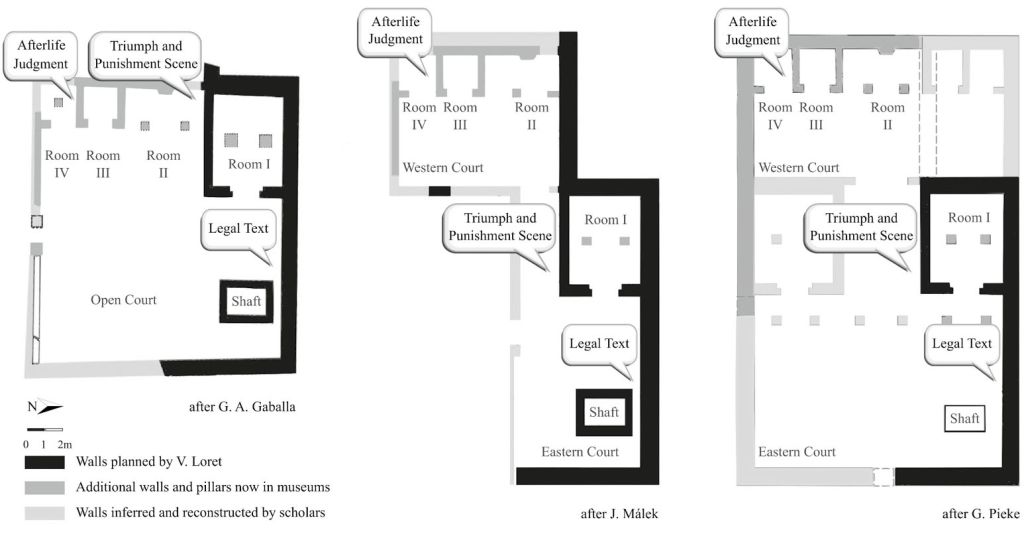
The interpretation of the Mose assemblage is complicated by the partial dismantlement of the tomb chapel in ancient times and its looting in the mid-19th century, as well as the poor level of archaeological recording associated with its discovery by Loret. Consequently, even the basic floorplan of the chapel and the locations of specific chambers relative to one another are not entirely certain and have only been reconstructed hypothetically.41 JaromÃr Málek subsequently proposed a number of convincing amendments to this initial hypothetical reconstruction, explaining the non-standard layout of the cultic space by the need to adapt to spatial constraints in the heavily built-up Saqqara necropolis of 19th Dynasty times.42 In 2016, G. Pieke noted that the evidence of spatial constraints for this period is hard to provide, and proposed further alterations to the floorplan. These allow the reconstruction to follow more closely the symmetrical layout of the funerary chapels characteristic of the Memphite necropolis.43 Plans showing the differing interpretations of the Mose chapel layout are given overleaf (Figure 1).

Differing interpretations of the layout of the Tomb Chapel of Mose after G.A. Gaballa (1977), J. Málek (1981) and G. Pieke (2016). Labels give general indications of the walls where given features were represented according to these three scholars, and do not serve as pinpoints of specific locations.
Citation: Journal of the Economic and Social History of the Orient 68, 1-2 (2025) ; 10.1163/15685209-12341636
The reconstruction by Málek is as follows: the Mose complex divides into eastern and western halves, each with its own open court and connected by a passage. On entry, the visitor would first enter the eastern court, somewhat to the north of the main axis of the chapel. The western court, therefore, is somewhat to the south. Such a partition into a northeastern space of entry, located nearer the world of the living and entered from it, and a southwestern space more evocative of the parallel world, follows a highly traditional model for Egyptian funerary architecture: parallels are already found in the Old Kingdom, both in chapels and in internal chambers of pyramids from as early as the 5th Dynasty.44
Connected to the eastern court is a cultic enclosure (Room I), the walls of which are decorated with scenes of offerings and the funerary banquet of Mose and his family (the two lower registers). The upper register originally contained scenes of Mose and his wife offering to gods whose identities have been rendered unclear by subsequent damage. In the western court, aligned with the central axis of the entire chapel, is a shrine to Osiris housing a cult statue (Room II). Málek has suggested that the northern inner wall of this shrine consisted of blocks with depictions of Mose and his wife worshipping Isis.45 This stands in contrast to Gaballaâs earlier suggestion that this space was occupied by reliefs showing a judicial process about libel, wherefrom Mose emerged victorious.46 In Málekâs interpretation, these images would probably be on the northern wall of the transitional passage. Meanwhile, the representation of the divine tribunal judging the deceased is found in the southernmost of the chapels of the western court (Room IV), which contains a vignette from Book of the Dead Chapter 125âthe spell to gain successful passage through the divine tribunal.47
Such a visual spread of subject matter strikes the present writers as logical because it reflects a gradual transition from earthly realities to realities of the parallel world:
1) Judicial disputes in the world of the living on the northern wall of the open eastern court;
2) An offering procession in the world of the living, a funerary feast of the blessed deceased in the parallel world, and the deceased themselves as offering bearers before the gods in the cultic enclosure of the eastern court (Room I);48
3) Most likely a funerary procession on the southern wall and an earthly legal case ending in triumph on the northern wall of the transitional passage;
4) Worship of Osiris and Isis in the central chapel of the western court (Room II);
5) Divine judgment scene in the parallel world in the southern chapel of the western block (Room IV).
In line with this reconstruction, the text of the earthly legal case finds itself symmetrically opposite the divine judgment scene. It marks a point of departure in the journey of the deceased towards attaining the status of âtrue of voiceâ (mÉá¶-hÌ®rw)49 both in the parallel world and as depicted on the walls and columns in chambers closer to the world of the living. Therefore, the earthly legal case seems to precede the divine judgment.50
The main content of the legal text is as follows: A distant ancestor of Mose, named Neshi, had been awarded an estate around the dawn of the New Kingdom, in the reign of Ahmose I (r. 1550â1525 BCE). It is likely that the legal rights to this land were passed down through direct filiation. After approximately 250 years, in the reign of Horemheb (r. 1323â1295 BCE), a series of legal disputes flared up over the rights to this property:51
1) The grandmother of Mose, named Urnero, proved her right to manage the estate in a dispute against a rival claimant called Khay.
2) A lady named Takharu, likely the sister of Urnero, won a court case about the division of property between all the heirs.
3) Urnero and her son Huy appealed against this verdict and once again became the sole managers of the estate.
4) Following the death of Huy, who was the father of Mose, Khay succeeded in regaining the rights to the land. The wife of Huy, Nubnofret, sought to defend her rights and appealed to family archives and a land register stored in the capital, but she lost her case.
5) Mose, now a grown man living in the age of Ramesses II (r. 1279â 1213 BCE), contested Khayâs rights on the basis of oral testimonies by local inhabitants who confirmed that it was the ancestors of Mose who had worked that land, thereby presumably making Mose its rightful heir.
An important detail here is that the ending of the text is missing, and this ending would no doubt have contained the final court verdict. Consequently, it is impossible to be entirely confident of the outcome. However, there is wide-ranging scholarly consensus that Mose won the case.52 There are three key reasons for such confidence: i) the very fact of this court case being recorded in the tomb chapel as something worthy of commemoration, ii) the wealth of Mose, who was able to construct a monument on this scale despite being an official of comparatively low rank, and iii) the presence of a scene depicting Mose triumphant in court in another part of the tomb chapel. At the same time, it has also been noted that there is no direct correlation between the visual scenes and the legal text, and so the possibility that these may refer to different court cases cannot be altogether discounted.53 In 1989, Schafik Allam argued that it was possible for Mose not to have been victorious in the earthly court, with the legal text instead being recorded in the tomb chapel in the hope of a more favourable verdict in the parallel world, namely at the court of Osiris.54 Here it is also essential to add that all of the proposed reconstructions are in agreement that the scenes of Mose triumphant were located in a space separate to that of the main legal text, being placed either in the passage connecting the two parts of the tomb chapel or in the part associated more with the parallel world rather than the world of the living. Thus, the tomb chapel of Mose contains a series of three judicial stories involving him which may or may not be interrelated: the main land dispute, a secondary dispute possibly about the identity and rights of Mose,55 and finally the court of Osiris. Mose could have enjoyed varying degrees of success in each of these encounters. However, from the perspective of both the overall layout and visual decoration in the tomb chapel, and indeed from its overwhelming theological significance as a guarantee of resurrection, it is ultimately clear that the most important of these legal cases is the justification of Mose before Osiris.
In the view of the present writers, the placing of this highly convoluted legal text on the wall of the tomb chapel should not be interpreted simply as a decisive argument giving closure to a drawn-out land dispute, with whatever consequences this may have had for future earthly protagonists. Instead, it should be seen as presenting a distinct problem requiring a separate interpretation rooted as much in the religious as in the legal context.
Christopher Eyre has proposed that the obvious goal of recording this text on the tomb chapel wall was to guarantee memorialisation of the outcome of the case and the accompanying evidence in perpetuity; a need made more pressing by the inability of earlier papyrus documents to do this same job during the unsuccessful legal appeals initiated by the mother of Mose, Nubnofret.56 However, as Eyre himself demonstrates,57 the main problem associated with the documents in the family archive was not that they were unreliable sources of information: in the legal dispute between Nubnofret and Khay, both sides were able to provide written evidence of their family history and associated property rights. It was precisely because the evidence on both sides was judged to be of equal value that the court had not been able to reach a decisive verdict. The inscription in the tomb chapel of Mose allows for the long-term transformation and memorialisation of only a single type of sourceâthe oral evidence, which had served as a starting point for the case and now takes on monumental form in a sacred context. However, Khay too had claimed that his right had been documented in the presence of witnesses. Thus, by the overarching logic of the legal disputes over the legacy of Neshi which culminated in the case of Mose, even the presentation of such monumentalised oral evidence in court would not necessarily be enough to guarantee legal vindication for Moseâs descendants in the event of the dispute reigniting. However, insofar as Mose himself considered this evidence effective and sufficient in ascertaining the strength of his own position, the materiality of the tomb chapel record could indeed give it a new status as eternal proof of his justification.
One must highlight also that this moveâthe transfer of a text from the oral setting of daily affairs to the medium of monumental hieroglyphsâreflects a phenomenon that stands at the very foundation of Egyptian mortuary literature: the recording of the Pyramid Texts at the end of the 5th Dynasty. The current interpretation of this event ascribes great importance to the de- and recontextualization of the text:58 this holds that ritual texts were excluded from their original function as spoken utterances in ceremonial settings for the living, instead undergoing recompilation and gaining new identity and meaning in the surroundings of funerary architecture. It is apparent that such recontextualization took place also in the case of the Mose legal text being recorded in his tomb chapel:59 in the form in which it was recorded, this text could no longer have feasibly fulfilled its original function as evidence in a court of law. However, in light of the above considerations about texts changing their function when brought into a new setting, one can argue that its integration into a funerary space would have been an entirely acceptable and understandable move, even if it remains somewhat unusual.60
3 Mose in Context: Biographical and Mythological Comparanda
Various other texts from across the corpus of funerary inscriptions may have fulfilled functions in part analogous to that of the Mose narrative. Thus, parallels may be drawn with the various legal descriptions and episodes in Old Kingdom tomb autobiographies, going back to the earliest example of the genreâthe autobiography of Metjen.61 Such texts enumerate the property with which the construction of the tomb and its funerary cult have been endowed, and in so doing they underline the legal rectitude with which all stages of the tomb construction process were carried out.62 With the passage of time, the practical role played by monumental inscriptions in regulating property relations declined, while that of papyri grew ever greater.63 In Ramesside times, this trend was associated not only with evolutions in the burgeoning judicial bureaucracy, but also with the development of a new artistic canon for tomb chapels, which increasingly features interactions between the deceased and the world of the divine in a manner entirely inconceivable in the Old Kingdom, and rare in earlier periods more generally.64 Situations linked specifically to property rights are found in New Kingdom tombs too, but here they are resolved exclusively through recourse to personal relations with the gods, as illustrated for instance in the inscriptions of Samut and Djehutyemheb.65 Particularly interesting in this regard is the stela of the wá¶b-priest Paser, which records that an oracle of the deified King Ahmose successfully resolved a land-rights dispute.66 Even though the legal text of Mose, as preserved today, is devoid of any broader biographical frame, in terms of giving meaning to the overall tomb space it should nonetheless be considered a mode of self-representation of the deceased, a strategy which in Ramesside times could take on a wide variety of forms and with which the Egyptians of the epoch seem to have experimented quite liberally.67 Moreover, as already noted, at this time the key frame of self-representation came to be denoted by personal pietyâthe interaction with the divine as part of lived experience on earth.68
While texts concerned with personal piety typically mention a specific deity by name, this feature is absent from the Mose text. However, the present writers would argue that the key issue at stake in this legal narrative has crucial mythological parallels in itself, which reflects an effort to equate the personal lived experience of the deceased to an established mythological trope, even without the need to mention contact with individual gods in a direct fashion.
First and foremost, this text portrays Mose and his predecessors as indefatigable defenders of what is true and just. Considering the content of traditional tomb autobiographies, it is striking that the Mose narrative inverts the traditional autobiographic claim that âI never judged between two parties ⦠in the case where a son was deprived of his fatherâs inheritance.â69 Here it is in fact Mose himself who has been deprived of exactly that. Furthermore, this simple declarative utterance is replaced here with a lengthy description of complex events. In his capacity as one of the litigants, Mose becomes a protagonist who seeks to restore justice (MÉá¶t)âand he does so not as an external agent, but rather as a direct participant at the very core of the dispute.
A seemingly perpetual lawsuit about inheritance, continuing generation after generation over a course of three centuries, inevitably brings to mind the famous Contendings of Horus and Seth.70 There is no convincing case to be made for the overt influence of one text on the other: the Contendings survive on a papyrus dated to the reign of Ramesses V (r. 1147â1143 BCE), which was written at least sixty years after the tomb chapel of Mose was built. While the story itself is certainly older, no recensions of it in the form of a continuous narrative predating Mose exist, and a case for it directly influencing Moseâs thinking would be based entirely on conjecture. The possibility of influence in the other direction (i.e. the Mose case influencing the later papyrus describing the Contendings) seems improbable in the extreme, given that Mose was not a particularly high profile figure, and certainly not of a standing so exalted that it might influence how a godly tribunal was perceived. Thus, the similarity is likely of a purely thematic and structural nature. This, however, reflects important processes in the mythological interpretation of history and the historical interpretation of myth. The unorthodox and arguably comedic aspects of the Contendings stem in major part from the text undermining the established way in which the mythology deploys cyclical time: typically Horus and Seth enter conflict on the death of a Pharaoh and then make peace when the new Pharaoh is crowned, as marked by the symbolic act of âuniting the Two Landsâ at the coronation.71 When the crowned King dies, the cycle repeats itself. By contrast, in the Contendings, the dispute between the two litigants is presented not in cyclical, but in linear fashionâas a form of quasi-historical narrative that keeps failing to reach its definitive conclusion. In the context of the Mose case, the present writers suggest that by giving a real-life example of such a lengthy court case, the tomb owner was purposefully situating himself in an environment where a real-life linear story could be transformed into a mythological, cyclical story. This would be a good fit for the overall setting of the tomb, replete as it was with the imagery of Osiris and the cyclical theology of death and rebirth.
Looking specifically at the self-representation of Mose, particular attention should be paid to his statement that âmy father died, and my mother Nubnofret came to cultivate the share of Neshi, my (fore)father, but she was not allowed to cultivate it â¨â¦â© I have been expelled (lit. âthrown outâ) from this field of Neshi my father.â72 This is very much consistent with a key overarching theme in the Contendings, which offers a mythological interpretation of an overall state of lawlessness ensuing from a rightful heir being disinherited. Indeed, one part of the story greatly resembles the situation in which Mose claims to have found himself. It involves Isis, mother and key supporter of Horus, disguising herself and attempting to convince Seth to accept the error of his ways by telling him a fictional story which illustrates the injustice Horus has suffered. She says:73
âReflect, my great lord. As for me, I was the wife of a cattleman to whom I bore a son. My husband died, and the lad started tending his fatherâs cattle. But then a stranger came and settled down in my stable. He said thus speaking to my son, âI shall beat you, confiscate your fatherâs cattle, and evict you,â said he speaking to him. Now it is my wish to have you be a champion for him.â Thereupon Seth said to her, âAre the cattle to be given to the stranger even while the manâs son is still about?â
While it is difficult to specifically identify Horus and Seth as the âtwo litigantsâ judged to their mutual satisfaction by the virtuous noblemen of Old Kingdom autobiographies, by Ramesside times such a parallel does become possible. In the view of the present writers, presenting oneself in a tomb chapel as an heir deprived of his rightful inheritance can be interpreted as a strategy for becoming part of the Osirian myth, taking on the role of the youth Horus. Such a role does not in any way indicate a claim to royal status (even if, at least from the Middle Kingdom onwards, similarities in royal and non-royal afterlives could be increasingly apparent), but rather it implies а desire for support and defence from the parents of HorusâIsis and Osiris. Comparison with Horus-Ihy, a syncretistic child-god simultaneously linked to the goddesses Hathor and Isis, is known from the funerary stela of the high priest of Isis Wenennefer.74 There, the entire priestly careerâand the activities it involvedâis depicted as a realisation of divine intent regarding the protagonist of the composition. However, the experience of personally encountering the divine is presented not merely as a determinant of the individualâs own fate, but rather as a mechanism for the protagonist to actually become a participant in the mythological spaceâto play the part of Horus.
The mythological constellation of Isis and Horus played an especially prominent role in household religion, specifically in the context of apotropaic and healing practices surrounding the protection of mothers and children, and it provided a working model for associating a particular person with a given deity. While Isis first appears in Egyptian literature as the spouse and protectress of her deceased husband Osiris, in the later periods of her theological development she is known to be a powerful goddess in her own right, her cult spreading far beyond the boundaries of Egypt as well as gaining further traction inside the country.75 Even though all the motifs associated with the birth and upbringing of Horus in the Nile Delta marshes are already present in the Old Kingdom Pyramid Texts, it appears that it was the New Kingdom that saw the ascendancy of Isis in her role as an all-important mother figure and guardian, as evidenced by a wide range of artefacts.76 In this context it is worth noting that the visual inventory of the tomb chapel of Mose revolves to a large extent around interaction with key guardian deities of the dead in the parallel world: Anubis, Osiris, Isis, Hathor and the local gods of the Memphite regionâPtah, Sokar, and various syncretistic variants thereof. Such a visual inventory is by no means atypical for this period in Egyptian history and the funerary realm in general, but is worth highlighting nonetheless, as it provides a baseline in religion and myth with which the more unusual aspects of the self-representation of Mose would interact in the process of recontextualisation of the legal text.
Indeed, the unorthodox choice of Mose to self-represent himself through describing an inordinately lengthy earthly lawsuit may reflect an attempt to convey through a mythological prism the particularities of his own unique lived experience. Included in the cultic space of the tomb chapel, the legal text becomes incorporated in a series of inscriptions and images that culminates in the successful negotiation of the afterlife judgment by the deceased. The linear distribution of these texts, moving from the part of the chapel dedicated to the living to the one dedicated to the parallel world, highlights the transition from one world to the other. It is complemented by the synchronic and enduring status of the deceased as âtrue of voiceâ (mÉá¶-hÌ®rw)âjustified before the divine court. While technically this epithet is tied specifically to the crucial final vindication of the deceased at the judgment of Osiris, depicted in Room IV of the western side of the chapel, it is already deployed on the façade of Room I, which is directly adjoining to the legal text.77 Consequently, regardless of the outcome of the earthly court case, in his tomb chapel Mose automatically comes across as the winnerâa man who has secured divine justification. In this situation, Osiris serves as an ultimate instance of justice in two ways. The western part of the tomb chapel is aligned with the logic of the afterlife judgment, through which the deceased will be able to âgo forth by dayâ in the entourage of the sun god.78 On the other side, the eastern side of the tomb chapel, serving as a liminal space of burial, follows traditional principles of how such a space should be laid out.79 This environment, oriented towards the rituals of the mortuary cult, gives additional weight to the memorialised testaments of the living witnesses, whose speeches in favour of Mose during his lawsuit are incised in the stone of the chapel walls.
It may also be instructive to draw a thematic parallel with an artefact of a much later period: an inscription on the statue of the Ptolemaic-era official Harimhotep in the V.S. Golenishchev collection.80 The statue dates to the fourteenth year of Cleopatra VII (so approximately twelve centuries after Mose). Its inscription tells of how the line of the high priests of Ptah was miraculously continued through the direct intervention of the founder of the lineage himselfâthe long-dead, and deified, Imhotep. The segment most relevant to the present discussion states that the inheritance of a fatherâs property and administrative office by a son is directly contingent on the father successfully navigating the afterlife judgment before Osiris. It is interesting that in this case over two years passed following the death of the father and the successful accession of the son. Was this due to purported delays in the afterlife, or was it instead supposed that Osiris and his court had serious doubts about the righteousness of the father?81 Bearing in mind this open question, one should note that the room directly adjacent to the hall with the legal text contained scenes of the funerary feast of the deceased, with four generations of Moseâs family taking part. Alongside Mose, his wife, and his parents, all of whom are accorded the âtrue of voiceâ (mÉá¶-hÌ®rw) epithet, there is depicted also the grandson of Mose Amenemheb, who was the son of his daughter.82 Therefore, it is worth considering an additional dimension to the Mose case, complementing the aforementioned rationale for monumentalising the text as proposed by Eyre. This additional dimension evidently served to guarantee the smooth passage of inheritance in the family of Mose not only through carving oral testimony or papyrus records in stone, but also through deploying religious mechanisms and events in the parallel world. Of these, successful passage through the afterlife judgment may have been of particular importance not only to Mose, but also to the living descendants hoping to inherit from him. The possibility of equating himself with the disinherited Horus, thereby integrating his personal life journey into the Osirian myth, would only have increased Moseâs chances of success.
If Mose didâat least implicitlyâcompare himself thus to Horus, he may have seen himself as âacting outâ a role in the mythology, with the court case serving as a performance in some ways not unlike the cultic reenactments of mythological elements mentioned for instance in the Middle Kingdom texts like the Ramesseum Dramatic Papyrus83 or the Stela of Iykhernofret from Abydos.84 Obviously, a major difference was the fact thatâunlike these earlier performative ritualsâthe Mose case had very tangible legal import in the world of the living too, but this should not mean that its implications for the parallel worldâor the parallel worldâs implications for itâshould be discounted.
Concluding Remarks
Via the example of Moseâs tomb chapel, this article has sought to highlight broader trends in how the world of the living and the parallel world could intersect in the judicial sphere, and how perceptions of this could be shaped by physical and textual inputs such as funerary architecture, monumentalisation of ritual utterances, and narratives of biographical or mythological nature. Mose may have been exceptional in the lengths to which he went in highlighting his legal journeyâa choice no doubt influenced by the very specific circumstances he faced in lifeâbut he was probably far less exceptional in perceiving justice as a liminal phenomenon, a mechanism for interacting with the divine and integrating oneself into mythology while also attaining practical objectives on earth. This outlook on justice, and indeed the very nature of human existence itself, is backed by a formidable variety of evidence that ranges from letters to the dead and invocations of gods in oaths, to ostensibly direct divine involvement in oracles and the physical siting of tribunals at entries to sacred temple precincts. While alive, people could rely on such otherworldly dimensions of justice, and when they died it was through an act of justice at the divine tribunal that they moved to the parallel world. It should thus come as no surprise that the place of final physical transformation from living to deadâthe necropolisâwas known as the âplace of justiceâ, for the judicial sphere linked the two worlds conceptually no less than the necropolises named after it did so physically.
Acknowledgments
Support from the Basic Research Program of the National Research University Higher School of Economics is gratefully acknowledged. For providing access to library materials and facilities for interdisciplinary exchange, additional thanks are due to Christâs College, Cambridge, and the University of Cambridge McDonald Institute for Archaeological Research, as well as Kingâs College, London and the Russian State University for the Humanities. The authors alone take full responsibility for any shortcomings.
Bibliography
Allam, S. 1991. Egyptian Law Courts in Pharaonic and Hellenistic Times. Journal of Egyptian Archaeology 77: 109â127.
Allam, S. 1989. Some Remarks on the Trial of Mose. Journal of Egyptian Archaeology 75: 103â112.
Allen, J.P. 2015. Middle Egyptian Literature: Eight Literary Works of the Middle Kingdom. Cambridge: Cambridge University Press.
Allen, T.G. 1974. The Book of the Dead or Going Forth by Day: Ideas of the Ancient Egyptians concerning the Hereafter as Expressed in their Own Terms. Chicago: University of Chicago Press.
Anthes, R. 1940. Das Bild einer Gerichtsverhandlung und das Grab des Mes aus Sakkara. Mitteilungen des Deutschen Archäologischen Instituts, Abteilung Kairo 9(2): 93â119.
Assmann, J. 1987. Priorität und Interesse. Das Problem der Ramessidischen Beamtengräber. In Problems and Priorities in Egyptian Archaeology, eds. J. Assmann, G. Burkard & V. Davies. London: Kegan Paul International: 31â41.
Astapova, O.R. 2017. Istoki sakralizatsii vlasti. Sviashchennaia vlastâ v drevnykh tsarstvakh Egipta, Mesopotamii, Izrailiia. Moscow: RIPOL Klassik.
Baer, K. 1962. The Low Price of Land in Ancient Egypt. Journal of the American Research Center in Egypt 1: 25â45.
Baines, J. & Frood, E.A. 2011. Piety, Change and Display in the New Kingdom. In Ramesside Studies in Honour of K.A. Kitchen, eds. M. Collier & S. Snape. Bolton: Rutherford Press Limited.
Baines, J. 1985. Fecundity Figures: Egyptian Personification and the Iconology of a Genre. Warminster: Aris & Phillips.
Bayoumy, T.F. 2022. Oracular Gods in Ancient Egypt. Journal of Association of Arab Universities for Tourism and Hospitality 22/2: 1â19.
Berlev, O.D. & S.I. Hodjash. 2004. Skulâptura drevnego Egipta v sobranii Gosudarstvennogo muzeia izobrazitelâmykh isskustv imeni A.S. Pushkina. Moscow: Russian Academy of Sciences.
Blackman, A.M. 1925. Oracles in Ancient Egypt. Journal of Egyptian Archaeology 11/3â4: 249â255.
Bolshakov, A. 1997. Man and His Double in Egyptian Ideology of the Old Kingdom. Wiesbaden: Harrassowitz Verlag.
Bonnet, H. 2000. Reallexikon der ägyptischen Religionsgeschichte. Berlin & New York: De Gruyter.
Bontty, M. 2000. Images of Law and the Disputing Process in the Tale of the Eloquent Peasant. In Reading the Eloquent Peasant: Proceedings of the International Conference on the Tale of the Eloquent Peasant at the University of California, Los Angeles, March 27â30, 1997 (Lingua Aegyptia 8), ed. A.M. Gnirs. Göttingen: Seminar fur Ãgyptologie und Koptologie, 2000: 93â107.
Borchardt, L. 1911. Catalogue général des antiquités égyptiennes du Musée du Caire Nos 1â1294: Statuen und Statuetten von Königen und Privatleuten. Teil 1. Berlin: Reichsdruckerei.
Bròze, M. 1996. Mythe et roman en Ãgypte ancienne: Les aventures dâHorus et Seth dans le Papyrus Chester Beatty I. Leuven: Uitgeverij Peeters.
Burton, A. 1972. Diodorus Siculus Book I: A commentary. Leiden & Boston: Brill.
Cannuyer, C. 1998. La Justice à la porte des temples dâÃgypte. Quelques témoignages non pharaoniques. In Egyptian Religion: The Last Thousand Years. Part II, ed. W. Clarysse, A. Schoors & J. Willems. Leuven: Uitgeverij Peeters: 781â788.
Capart, J., A.H. Gardiner & B. van de Walle. 1936. New Light on the Ramesside Tomb-Robberies. Journal of Egyptian Archaeology 22/2: 169â193.
CÌerný, J. 2001. A Community of Workmen at Thebes in the Ramesside Period (2nd Edn). Cairo: Institut français dâarchéologie orientale.
CÌerný, J. 1962. Egyptian Oracles. In A Saite Oracle from Thebes in the Brooklyn Museum [Papyrus Brooklyn 47.218.3], ed. R.A. Parker. Providence: Brown University Press: 35â48.
Dawson, W.R. 1925. An Oracle Papyrus. B. M. 10335. Journal of Egyptian Archaeology 11(3/4): 247â248.
Diodorus Siculus. Library of History: vol. I, trans. C. H. Oldfather. 1933. Cambridge, MA: Harvard University Press (Loeb Classical Library 279).
Donnat Beauquier, S. 2014. Ãcrire à ses morts: enquête sur un usage rituel de lâécrit dans lâÃgypte pharaonique. Grenoble: Jérôme Millon.
Dunand, F. 1973. Le culte dâIsis dans le bassin oriental de la méditerranée. Volume 1: le culte dâIsis et les Ptolémées. Leiden: Brill.
Faulkner, R.O. 2010 The Ancient Egyptian Book of the Dead (Revised Edn). London: British Museum Press.
Fay, B. 2008. Tell me, RichardâDid the Ancient Egyptians Really Wear Suspenders? (Thoughts on the Vizierâs insignia and one of the men who wore it during Amenhotep IIIâs reign). In Servant of Mut: Studies in Honor of Richard A. Fazzini, ed. S.H. DâAuria. Leiden & Boston: Brill: 89â101.
Frood, E.A. 2007. Biographical Texts from Ramessid Egypt. Atlanta: Society of Biblical Literature.
Gaballa, G.A. 1977. The Memphite Tomb Chapel of Mose. Warminster: Aris & Phillips.
Gardiner, A.H. 1937. Late-Egyptian Miscellanies. Brussels: Bibliotheca Aegyptiaca.
Gardiner, A.H. 1905. The Inscription of Mes. A Contribution to the Study of Egyptian Judicial Procedure. Leipzig: J. C. Hinrichsâsche Buchhandlung.
Geisen, C. 2012. The Ramesseum Dramatic Papyrus: A New Edition, Translation, and Interpretation. Toronto: University of Toronto PhD Dissertation: https://hdl.handle.net/1807/65472.
Gregory, S.R.W. 2022. Tutankhamun Knew the Names of the Two Great Gods: dÌ t and nḥḥ as Fundamental Concepts of Pharaonic Ideology. Oxford: Archaeopress.
Griffiths, G. 1960. The Conflict of Horus and Seth from Egyptian and Classical Sources: A Study in Ancient Mythology. Liverpool: Liverpool University Press.
Haring, B.J.J. 2017. SaqqaraâA Place of Truth. In Imaging and Imagining the Memphite Necropolis: Liber Amicorum René van Walsem, eds. V. Verschoor, A.J. Stuart & C. Demarée et al. Leiden & Leuven: Nederlands Instituut voor het Nabije Oosten & Uitgeverij Peeters: 147â154.
Helck, W., E. Otto & W. Westendorf eds. 1975. Lexikon der Ãgyptologie, Bd. III. Wiesbaden: Harrassowitz Verlag.
Hollis, S.T. 2019. Five Egyptian Goddesses: Their Possible Beginnings, Actions, and Relationships in the Third Millennium BCE. London: Bloomsbury Publishing.
Janssen, J.J. & P.W. Pestman. 1968. Burial and Inheritance in the Community of the Necropolis Workmen at Thebes (Pap. Bulaq X and O. Petrie 16). Journal of the Economic and Social History of the Orient 11/2: 137â170.
Katary, S.L.D. 2012. Land and Landholding, Pharaonic Egypt. Wiley Encyclopedia of Ancient History: DOI: https://doi.org/10.1002/9781444338386.wbeah15238.
Lehner, M. 1997. The Complete Pyramids. New York: Thames and Hudson.
Lesko, B.S. 1999. The Great Goddesses of Egypt. Norman: University of Oklahoma Press.
Lippert, S. 2012. Law Courts. In UCLA Encyclopedia of Egyptology, eds. E.A. Frood and E.W. Wendrich. Los Angeles: UCLA: https://escholarship.org/uc/item/4136j3s7.
Logan, T. 2000. The Jmyt-pr Document: Form, Function and Significance. Journal of American Research Center in Egypt 37: 49â73.
Loktionov, A.A. 2019. The Development of the Justice System in Ancient Egypt from the Old to the Middle Kingdom. Cambridge: Robinson College, University of Cambridge PhD Dissertation.
Loktionov, A.A. 2017. May my Nose and Ears be cut off: Practical and âsupra-practicalâ Aspects of Mutilation in the Egyptian New Kingdom. Journal of the Economic and Social History of the Orient 60/3: 263â291.
Loktionov, A. A. 2015. An Assessment of the Practice of Law Enforcement in Ramesside Egypt, c.1300â1100BCE. Cambridge: St. Johnâs College, University of Cambridge MPhil Dissertation (Unpublished).
Loprieno, A. 1996. Linguistic Variety and Egyptian Literature. In Ancient Egyptian Literature, ed. A. Loprieno. Leiden, New York & Cologne: Brill.
Luft, U. 2017. Intriguing against Governor Senwosret? Remarks on Papyrus Berlin P. 10032AB. In 8. Symposion zur ägyptischen Königsideologie/8th Symposium on Egyptian Royal Ideology: Constructing Authority: Prestige, Reputation and the Perception of Power in Egyptian Kingship: Budapest, May 12â14, 2016, ed. T.A. Bács & H. Beinlich. Wiesbaden: Harrassowitz Verlag: 177â184.
Luiselli, M.M. 2014. Personal Piety in Ancient Egypt. Religion Compass 8/4: 105â116.
Málek, J. 1981. Two Problems connected with New Kingdom Tombs in the Memphite Area. Journal of Egyptian Archaeology 67/1: 156â165.
McDowell, A. 1990. Jurisdiction in the Workmenâs Community of Deir el-Medîna. Leiden: Nederlands Instituut voor het Nabije Oosten.
Morales, A.J. 2016. From Voice to Papyrus to Wall: Verschriftung and Verschriftlichung in the Old Kingdom Pyramid Texts. In Understanding Material Text Cultures: A Multidisciplinary View, ed. M. Hilgert. Berlin & Boston: De Gruyter: 69â130.
Orsenigo, C. 2013. A Newly Identified Relief from the Tomb-Chapel of Mose at Saqqara. Zeitschrift für Ãgyptische Sprache und Altertumskunde 140: 167â171.
Peet, T. E. 1930. The Great Tomb Robberies of the 20th Egyptian Dynasty. Oxford: Clarendon Press.
Piacentini, P. & C. Orsenigo. 2009. The Discovery of the Tomb of Mose and its âJudicialâ Inscription. In Egyptian Archives: Proceedings of the First Session of the International Congress Egyptian Archives/Egyptological Archives, Milano, September 9â10, 2008, eds. P. Piacentini & C. Orsenigo. Milan: Cisalpino: 83â102.
Pieke, G. 2016. âDer Blick zurück nach vornâ: Anmerkungen zur Grabdekoration des Mes in Saqqara. In Mit archäologischen Schichten Geschichte schreiben: Festschrift für Edgar B. Pusch zum 70. Geburtstag, eds. H. Franzmeier et al. Hildesheim: Verlag Gebrüder Gerstenberg: 221â243.
Posener, G. 1971. Amon, juge du pauvre. Beiträge zur ägyptischen Bauforschung und Altertumskunde 12: 59â64.
Pritchard, J.B. 1969. Ancient Near Eastern Texts relating to the Old Testament (3rd Edn with Supplement). Princeton: Princeton University Press.
Quaegebeur, J. 1993. La Justice à la porte des temples et le toponyme Premit. In Individu, Société et Spiritualité dans lâÃgypte pharaonique et copte: mélanges égyptologiques offerts au Professeur Théodoridès, eds. C. Cannuyer & J-M. Kruchten. Athens, Brussels & Mons: Association montoise dâégyptologie: 201â220.
Quirke, S. 2013. Going out in Daylightâprt m hrw: The Ancient Egyptian Book of the Deadâtranslation, sources, meanings. London: Golden House Publications.
Reisner, G.A. 1936. The Development of the Egyptian Tomb Down to the Accession of Cheops. Cambridge, Mass.: Harvard University Press.
Sauneron, S. 1954. La justice à la porte des temples. Bulletin de lâInstitut français dâarchéologie orientale 54: 117â127.
Seeber, C. 1976. Untersuchungen zur Darstellung des Totengerichts im Alten Ãgypten. Munich & Berlin: Deutscher Kunstverlag.
Sethe, K. 1928. Ãgyptische Lesestücke zum Gebrauch im akademischen Unterricht. Leipzig: J.C. Hinrichsâsche Buchhandlung.
Sethe, K. 1928. Dramatische Texte zu Altägyptischen Mysterienspielen (Leipzig: J.C. Hinrichsâsche Buchhandlung.
Schiavo, R. 2023. Ancestors as a Source of Legal Authority. In Compulsion and Control in Ancient Egypt: Proceedings of the Third Lady Wallis Budge Egyptology Symposium, ed. A.A. Loktionov. Oxford: Archaeopress: 54â71.
Shupak, N. 1992. A New Source for the Study of the Judiciary and Law of Ancient Egypt: The Tale of the Eloquent Peasant. Journal of Near Eastern Studies 51/1: 1â18.
Simpson, W.K. 2003. The Stela of Iykhernofret. In The Literature of Ancient Egypt: An Anthology of Stories, Instructions, Stelae, Autobiographies, and Poetry, 3rd Edn, ed. W.K. Simpson. New Haven & London: Yale University Press: 425â427.
Smith, M. 2017. Following Osiris: Perspectives on the Osirian Afterlife from Four Millennia. Oxford: Oxford University Press.
Song Huicong & Guo Dantong. 2018. A Reassessment of the Trial of Mose. World History Studies 5/1: https://xianxiao.ssap.com.cn/catalog/5447764.html.
Strudwick, N. 2005. Texts from the Pyramid Age. Atlanta: Society of Biblical Literature.
Théodoridès, A. 1980. Le jugement en cause Neferâbet contre Tyia (Pap. Berlin 3047). Revue Internationale des droits de lâantiquité 27: 11â46.
Valbelle, D. 1985. âLes ouvriers de la Tombeâ: Deir el-Médineh à lâépoque ramesside. Cairo: Institut français dâarchéologie orientale.
van den Boorn, G.P.F. 1985. WdÌ á¶-ryt and Justice at the Gate. Journal of Near Eastern Studies 44/1: 1â25.
van Gennep, A. 1960. The Rites of Passage. Chicago: University of Chicago Press.
VerSteeg, R. 2002. Law in Ancient Egypt. Durham, NC: Carolina Academic Press.
Wente, E.F. 2017. The Beginning and End of Coffin Spell 149: A Living Person Approaches the Netherworld Tribunal. In Essays for the Library of Seshat: Studies presented to Janet H. Johnson on the Occasion of her 70th Birthday, ed. R.K. Ritner. Chicago: Oriental Institute of the University of Chicago: 399â404.
Wente, E.F. 2003. The Contendings of Horus and Seth. In The Literature of Ancient Egypt: An Anthology of Stories, Instructions, Stelae, Autobiographies, and Poetry, 3rd Edn, ed. W.K. Simpson. New Haven & London: Yale University Press: 91â103.
Wilkinson, R.H. 2003 The Complete Gods and Goddesses of Ancient Egypt. London: Thames & Hudson.
Wilson, J.A. 1948. The Oath in Ancient Egypt. Journal of Near Eastern Studies 7/3: 129â156.
For the seminal theoretical work on liminality and initiation rites, see A. van Gennep, The Rites of Passage (Chicago: University of Chicago Press, 1960).
A.A. Loktionov, The Development of the Justice System in Ancient Egypt from the Old to the Middle Kingdom (Cambridge: Robinson College, University of Cambridge PhD Dissertation, 2019): 73â74. For a publication, in hieroglyphic transcription, of a particularly striking instance of an official described as âmaking offerings to Maat by true dividing of words (i.e. judging) every day, foreverâ see L. Borchardt, Catalogue général des antiquités égyptiennes du Musée du Caire Nos 1â1294: Statuen und Statuetten von Königen und Privatleuten. Teil 1 (Berlin: Reichsdruckerei, 1911): 57 (â 66). The corresponding English translation is in Loktionov, The Development of the Justice System: 215. For further recent discussion of Maat offerings, both in the judicial context and beyond, see also S.R.W. Gregory, Tutankhamun Knew the Names of the Two Great Gods: dÌ t and nḥḥ as Fundamental Concepts of Pharaonic Ideology (Oxford: Archaeopress, 2022): 88â92.
N. Shupak, âA New Source for the Study of the Judiciary and Law of Ancient Egypt: The Tale of the Eloquent Peasant.â Journal of Near Eastern Studies 51/1 (1992): 15. For further references, see also R. Versteeg, Law in Ancient Egypt (Durham, NC: Carolina Academic Press, 2002): 21.
Diodorus Siculus, Library of History I, 75: 5â7.
A. Burton, Diodorus Siculus Book I: A commentary (Leiden & Boston: Brill, 1972): 223 and B. Fay, âTell me, RichardâDid the Ancient Egyptians Really Wear Suspenders? (Thoughts on the Vizierâs insignia and one of the men who wore it during Amenhotep IIIâs reign)â. In Servant of Mut: Studies in Honor of Richard A. Fazzini, ed. S.H. DâAuria (Leiden & Boston: Brill, 2008): 90, fn. 11.
For the core texts describing this tribunal, see R.O. Faulkner, The Ancient Egyptian Book of the Dead, Revised Edn (London: British Museum Press, 2010): 27â34 (Spells 30B and 125). Other relevant editions include S. Quirke, Going out in Daylightâprt m hrw: The Ancient Egyptian Book of the Deadâtranslation, sources, meanings (London: Golden House Publications, 2013) and T.G. Allen, The Book of the Dead or Going Forth by Day: Ideas of the Ancient Egyptians as Expressed in their Own Terms (Chicago: University of Chicago Press, 1974).
Book of the Dead Spell 30Bâtranslation follows Faulkner, Book of the Dead: 28.
For studies of the typical features of Egyptian law courts, see for instance A. McDowell, Jurisdiction in the Workmenâs Community of Deir el-Medîna (Leiden: Nederlands Instituut voor het Nabije Oosten, 1990): 143â186, S. Allam, âEgyptian Law Courts in Pharaonic and Hellenistic Times.â Journal of Egyptian Archaeology 77 (1991): 109â127, and S. Lippert, âLaw Courts.â In UCLA Encyclopedia of Egyptology, eds. E.A. Frood and E.W. Wendrich (Los Angeles: UCLA, 2012): https://escholarship.org/uc/item/4136j3s7.
For examples of land grants in legal documents associated with the world of the living, see for instance K. Baer, âThe Low Price of Land in Ancient Egypt.â Journal of the American Research Center in Egypt 1 (1962): 25â45 and more recently S.L.D. Katary, âLand and Landholding, Pharaonic Egypt.â Wiley Encyclopedia of Ancient History (2012): https://doi.org/10.1002/9781444338386.wbeah15238.
G. Posener, âAmon, juge du pauvre.â Beiträge zur ägyptischen Bauforschung und Altertumskunde 12 (1971): 59â64.
The non-literal âcalls to accountâ instead of the literal âreturns an answerâ follows the translation proposed in A.A. Loktionov, An Assessment of the Practice of Law Enforcement in Ramesside Egypt, c.1300â1100BCE (Cambridge: St. Johnâs College, University of Cambridge MPhil Dissertation, 2015): 12. This argues that accountability is the core tenet of the textâthe deity holds the strong to account for oppressing the weak.
A.H. Gardiner, Late-Egyptian Miscellanies (Brussels: Bibliotheca Aegyptiaca, 1937), 17; J.B. Pritchard, Ancient Near Eastern Texts relating to the Old Testament, 3rd Edn with Supplement (Princeton: Princeton University Press, 1969): 380.
For more on the practicalities and mechanics of the oracle procedure, see McDowell, Jurisdiction: 107â141. See also J. CÌerný, âEgyptian Oracles.â In A Saite Oracle from Thebes in the Brooklyn Museum [Papyrus Brooklyn 47.218.3], ed. R.A. Parker (Providence: Brown University Press, 1962): 35â48.
For the latest cross-period survey of the evidence, see T.F. Bayoumy, âOracular Gods in Ancient Egypt.â Journal of Association of Arab Universities for Tourism and Hospitality 22/2 (2022): 1â19.
For the initial publication and transcription, see W.R. Dawson, âAn Oracle Papyrus. B.M. 10335.â Journal of Egyptian Archaeology 11/3â4 (1925): 247â248. For the translation and associated notes, see A.M. Blackman, âOracles in Ancient Egypt.â Journal of Egyptian Archaeology 11/3â4 (1925): 249â255. For a commentary on the case, see McDowell, Jurisdiction: 137â138.
For a general survey of Egyptian oaths, see J.A. Wilson, âThe Oath in Ancient Egypt.â Journal of Near Eastern Studies 7(3) (1948): 129â156. For wÉḥ Imn wÉḥ pÉ á¸¥á¸³É specifically, see A.A. Loktionov, âMay my Nose and Ears be cut off: Practical and âsupra-practicalâ Aspects of Mutilation in the Egyptian New Kingdom.â Journal of the Economic and Social History of the Orient 60/3 (2017): 264â265 and McDowell, Jurisdiction: 36â37.
For this particular case, see J. Capart et al., âNew Light on the Ramesside Tomb-Robberies.â Journal of Egyptian Archaeology 22/2 (1936): 169â193.
E.F. Wente, âThe Beginning and End of Coffin Spell 149: A Living Person Approaches the Netherworld Tribunal.â In Essays for the Library of Seshat: Studies presented to Janet H. Johnson on the Occasion of her 70th Birthday, ed. R.K. Ritner (Chicago: Oriental Institute of the University of Chicago, 2017): 399â403.
See R. Schiavo, âAncestors as a Source of Legal Authority.â In Compulsion and Control in Ancient Egypt: Proceedings of the Third Lady Wallis Budge Egyptology Symposium, ed. A.A. Loktionov (Oxford: Archaeopress, 2023): 59â60. This provides references to primary data attesting this, including source of the Middle and New Kingdoms as well as demotic material and later descriptions by Diodorus Siculus.
Schiavo, âAncestorsâ: 58.
Schiavo, âAncestorsâ: 58â59; S. Donnat Beauquier, Ãcrire à ses morts: enquête sur un usage rituel de lâécrit dans lâÃgypte pharaonique (Grenoble: Jérôme Millon, 2014): 69â70.
This idea, which has become a staple of numerous Egyptological works, is explicitly formulated in J.J. Janssen & P.W. Pestman, âBurial and Inheritance in the Community of the Necropolis Workmen at Thebes (Pap. Bulaq X and O. Petrie 16).â Journal of the Economic and Social History of the Orient 11/2 (1968): 169.
For further thoughts on this, see Schiavo, âAncestorsâ: 64â67.
For an edition of the judgment of Osiris, see M. Bròze, Mythe et roman en Ãgypte ancienne: Les aventures dâHorus et Seth dans le Papyrus Chester Beatty I (Leuven: Uitgeverij Peeters, 1996): 110â117.
Evidence for this term denoting a necropolis is available from both Thebes and Saqqara. For the Theban evidence, see J. CÌerný, A Community of Workmen at Thebes in the Ramesside Period, 2nd Edn (Cairo: Institut français dâarchéologie orientale, 2001): 29â67 and D. Valbelle, âLes ouvriers de la Tombeâ: Deir el-Médineh à lâépoque ramesside (Cairo: Institut français dâarchéologie orientale, 1985): 25, 100. For Saqqara, see B.J.J. Haring, âSaqqaraâA Place of Truthâ. In Imaging and Imagining the Memphite Necropolis: Liber Amicorum René van Walsem, eds. V. Verschoor et al. (Leiden & Leuven: Nederlands Instituut voor het Nabije Oosten & Uitgeverij Peeters, 2017): 147â154.
For the original observation see S. Sauneron, âLa justice à la porte des temples.â Bulletin de lâInstitut français dâarchéologie orientale 54 (1954): 118â119. This gives the specific location of such inscriptions as the outer wall of temple gates/propylaea. More recently, this research has been developed further in J. Quaegebeur, âLa Justice à la porte des temples et le toponyme Premit.â In Individu, Société et Spiritualité dans lâÃgypte pharaonique et copte: mélanges égyptologiques offerts au Professeur Théodoridès, eds. C. Cannuyer & J-M. Kruchten (Athens, Brussels & Mons: Association montoise dâégyptologie, 1993): 201â220.
Despite slight damage to the inscription, the overall meaning appears beyond doubt. See Loktionov, The Development of the Justice System: 78â79 and Sauneron, âLa justiceâ: 119.
For further comments in this vein, see G.P.F. van den Boorn, âWdÌ á¶-ryt and Justice at the Gate.â Journal of Near Eastern Studies 44/1 (1985): 14â15 and U. Luft, âIntriguing against Governor Senwosret? Remarks on Papyrus Berlin P. 10032AB.â In 8. Symposion zur ägyptischen Königsideologie/8th Symposium on Egyptian Royal Ideology: Constructing Authority: Prestige, Reputation and the Perception of Power in Egyptian Kingship: Budapest, May 12â14, 2016, eds. T.A. Bács & H. Beinlich (Wiesbaden: Harrassowitz Verlag, 2017): 182.
For the Papyrus Berlin 3047 example, see A. Théodoridès, âLe jugement en cause Neferâbet contre Tyia (Pap. Berlin 3047).â Revue Internationale des droits de lâantiquité 27 (1980): 27â28. For the Papyrus BM 10221 example, see T.E. Peet, The Great Tomb Robberies of the 20th Egyptian Dynasty (Oxford: Clarendon Press, 1930): 42.
Loktionov, The Development of the Justice System: 78â80; 113â116.
J.P. Allen, Middle Egyptian Literature: Eight Literary Works of the Middle Kingdom (Cambridge: Cambridge University Press, 2015): 283 (ll. 215â216); 285 (ll. 225â226). For comments specifically on the petitioning carried out by the peasant at the gate, see M. Bontty, âImages of Law and the Disputing Process in the Tale of the Eloquent Peasant.â In Reading the Eloquent Peasant: Proceedings of the International Conference on the Tale of the Eloquent Peasant at the University of California, Los Angeles, March 27â30, 1997 (Lingua Aegyptia 8), ed. A.M. Gnirs (Göttingen: Seminar fur Ãgyptologie und Koptologie, 2000): 101â102.
Loktionov, The Development of the Justice System: 114.
C. Cannuyer, âLa Justice à la porte des temples dâÃgypte. Quelques témoignages non pharaoniques.â In Egyptian Religion: The Last Thousand Years. Part II, eds. W. Clarysse et al. (Leuven: Uitgeverij Peeters, 1998): 782â786.
Bròze, Mythe et roman: 49â59.
For illustrations of this layout, see for instance Faulkner, Book of the Dead: 30â31; 34â35.
P. Piacentini & C. Orsenigo, âThe Discovery of the Tomb of Mose and its âJudicialâ Inscription.â In Egyptian Archives: Proceedings of the First Session of the International Congress Egyptian Archives/Egyptological Archives, Milano, September 9â10, 2008, eds. P. Piacentini & C. Orsenigo (Milan: Cisalpino, 2009): 83â102.
For the original publication, see V. Loret, âLa grande inscription de Mes à Saqqarah.â Zeitschrift für Ãgyptische Sprache und Altertumskunde 39 (1901): 1â10 and A. Moret, âUn procès de famille sous la XIXe dynastie.â Zeitschrift für Ãgyptische Sprache und Altertumskunde 39 (1901): 11â39. Four years later, a full translation that would for many decades be the standard reference was published in A.H. Gardiner, The Inscription of Mes. A Contribution to the Study of Egyptian Judicial Procedure (Leipzig: J.C. Hinrichsâsche Buchhandlung, 1905).
R. Anthes, âDas Bild einer Gerichtsverhandlung und das Grab des Mes aus Sakkara.â Mitteilungen des Deutschen Archäologischen Instituts, Abteilung Kairo 9/2 (1940): 93â119.
G.A. Gaballa, The Memphite Tomb Chapel of Mose (Warminster: Aris & Phillips, 1977). This has since been complemented by additional small fragments of tomb relief, previously believed to have been lost, which have now been published in C. Orsenigo, âA Newly Identified Relief from the Tomb-Chapel of Mose at Saqqara.â Zeitschrift für Ãgyptische Sprache und Altertumskunde 140 (2013): 167â171.
J. Assmann, âPriorität und Interesse. Das Problem der Ramessidischen Beamtengräber.â In Problems and Priorities in Egyptian Archaeology, eds. J. Assmann et al. (London: Kegan Paul International, 1987): 31.
Gaballa, The Memphite Tomb Chapel: Pl. I.
J. Málek, âTwo Problems connected with New Kingdom Tombs in the Memphite Area.â Journal of Egyptian Archaeology 67/1 (1981): 156â165.
G. Pieke âDer Blick zurück nach vornâ: Anmerkungen zur Grabdekoration des Mes in Saqqaraâ. In Mit archäologischen Schichten Geschichte schreiben: Festschrift für Edgar B. Pusch zum 70. Geburtstag, eds. H. Franzmeier et al. (Hildesheim: Verlag Gebrüder Gerstenberg, 2016): 222â225. However G. Pieke followed J. Málek in reconstructing the placement of the texts and scenes with which we are concerned here, so we will focus on an overview of Málekâs work.
For the general assessment of N-S and E-W orientation in tomb architecture, see A. Bolshakov, Man and His Double in Egyptian Ideology of the Old Kingdom (Wiesbaden: Harrassowitz Verlag, 1997): 26â28, 32â34; for the outline of evolution of chapel types during the 5th Dynasty, see G.A. Reisner, The Development of the Egyptian Tomb Down to the Accession of Cheops (Cambridge, Mass: Harvard University Press, 1936): 301â304; for the alignment of pyramids along these axes, see plans in M. Lehner, The Complete Pyramids (New York: Thames and Hudson, 1997): 100â177.
Málek, âTwo Problems connected with New Kingdom Tombs in the Memphite Areaâ: 162.
Gaballa, The Memphite Tomb Chapel: 10.
Ibid.: 14, pl. XXIX. For this motif in New Kingdom tomb decoration, see C. Seeber, Untersuchungen zur Darstellung des Totengerichts im Alten Ãgypten (Munich & Berlin: Deutscher Kunstverlag, 1976): 16â23. For the translation of Chapter 125, see Faulkner, Book of the Dead: 29â34.
See Pieke, âDer Blick zurück nach vornâ: 226â230, 232â239 for a discussion of New and Old Kingdom models for these scenes.
For more on this key epithet pertaining to the deceased, see Seeber, Untersuchungen zur Darstellung des Totengerichts im Alten Ãgypten: 112.
Looking from the perspective of the deceased going forth from his tomb, the divine judgment scene and acquisition of an epithet âtrue of voiceâ would in fact be the starting point of his progression through the chapel. For more on afterlife vindication and resurrection as âGoing forth by dayâ, see note 71 below.
Probably due to the breaking down of the direct male line of succession, see C.J. Eyre, The Use of Documents in Pharaonic Egypt (Oxford: Oxford University Press, 2013): 157. For more on the relationship between Khay and Mose, see also Song Huicong & Guo Dantong, âA Reassessment of the Trial of Mose.â World History Studies 5/1 (2018): https://xianxiao.ssap.com.cn/catalog/5447764.html.
Gardiner, The Inscription of Mes: 25â29; Gaballa, The Memphite Tomb Chapel: 30; Eyre, The Use of Documents in Pharaonic Egypt: 162; Pieke, âDer Blick zurück nach vornâ: 221.
Anthes, âDas Bild einer Gerichtsverhandlungâ: 100.
S. Allam, âSome Remarks on the Trial of Mose.â Journal of Egyptian Archaeology 75/1 (1989): 111â112.
Anthes, âDas Bild einer Gerichtsverhandlungâ: 100.
Eyre, The Use of Documents: 162.
Ibid.: 159.
A.J. Morales, âFrom Voice to Papyrus to Wall: Verschriftung and Verschriftlichung in the Old Kingdom Pyramid Texts.â In Understanding Material Text Cultures: A Multidisciplinary View, ed. M. Hilgert (Berlin & Boston: De Gruyter, 2016): 69â130.
In view of the cultural diglossia typical of the Ramesside period, it is worth noting that the tomb chapel of Mose is also remarkable in having a monumental hieroglyphic inscription written in Late Egyptian, as opposed to the classical Middle Egyptian one would usually expect for funerary texts. For more on cultural diglossia in Egypt, see for instance A. Loprieno, âLinguistic Variety and Egyptian Literature.â In Ancient Egyptian Literature, ed. A. Loprieno (Leiden, New York & Cologne: Brill, 1996): 515â29.
See Pieke, âDer Blick zurück nach vornâ: 234â235 for discussion of this unusual decision as well as of Old Kingdom parallels for scenes of punishment and creative interpretation of these by Mose and/or those who worked on his tomb.
T. Logan, âThe Jmyt-pr Document: Form, Function, and Significance.â Journal of the American Research Center in Egypt 37 (2000): 51.
N. Strudwick, Texts from the Pyramid Age (Atlanta: Society of Biblical Literature, 2005): 187â205.
Eyre, The Use of Documents: 124â125.
J. Baines & E.A. Frood, âPiety, Change and Display in the New Kingdom.â In Ramesside Studies in Honour of K.A. Kitchen, eds. M. Collier & S. Snape (Bolton: Rutherford Press Limited, 2011): 7â8; Pieke, âDer Blick zurück nach vornâ: 226â228.
E.A. Frood, Biographical Texts from Ramessid Egypt (Atlanta: Society of Biblical Literature, 2007): 89â94.
Frood, Biographical Texts: 101â103.
Frood, Biographical Texts: 15â29.
For more on the concept of personal piety in the Egyptian setting, as well as further references on the topics, see M.M. Luiselli, âPersonal Piety in Ancient Egypt.â Religion Compass 8/4 (2014): 105â116.
Strudwick, Texts from the Pyramid Age: 329, 367.
Bròze, Mythe et roman. For a convenient translation, see also E.F. Wente, âThe Contendings of Horus and Seth.â In The Literature of Ancient Egypt: An Anthology of Stories, Instructions, Stelae, Autobiographies, and Poetry, 3rd Edn, ed. W.K. Simpson (New Haven & London: Yale University Press, 2003): 91â103.
For analysis of the textual sources on the conflict, see the seminal work by J.G. Griffiths, The Conflict of Horus and Seth from Egyptian and Classical Sources: a Study in Ancient Mythology (Liverpool: Liverpool University Press, 1960) as well as Bròze, Mythe et roman. For the motif of âuniting the Two Landsâ in connection with coronation ceremonies, see J. Baines, Fecundity Figures: Egyptian Personification and the Iconology of a Genre (Warminster: Aris & Phillips, 1985): 261â265. It should be noted that, although Horus and Seth can be present in âuniting the Two Landsâ scenes as well as other depictions of coronations, Seth is often replaced by another deity. A thorough summation of the evidence could be found in O.R. Astapova, Istoki sakralizatsii vlasti. Sviashchennaia vlastâ v drevnykh tsarstvakh Egipta, Mesopotamii, Izrailiia (Moscow: RIPOL Klassik, 2017): 122â140.
Eyre, The Use of Documents: 159.
Wente, âThe Contendingsâ: 96.
Frood, Biographical Texts: 104â106. For more on Ihy and his parallels with Horus, see R.H. Wilkinson, The Complete Gods and Goddesses of Ancient Egypt (London: Thames & Hudson, 2003): 132â133.
For an overview of Isis and her cult, see F. Dunand, Le culte dâIsis dans le bassin oriental de la Méditerranée. Volume 1: Le culte dâIsis et les Ptolémées. (Leiden: Brill, 1973): 1â26; âIsis.â In Lexikon der Ãgyptologie, Bd. III, eds. W. Helck et al. (Wiesbaden: Harrassowitz Verlag, 1975): 186â203; B.S. Lesko, The Great Goddesses of Egypt (Norman: University of Oklahoma Press, 1999): 167â202.
S.T. Hollis, Five Egyptian Goddesses: Their Possible Beginnings, Actions, and Relationships in the Third Millennium BCE (London: Bloomsbury Publishing, 2019): 110â111; H. Bonnet, Reallexikon der ägyptischen Religionsgeschichte (Berlin & New York: De Gruyter, 2000): 327.
Gaballa, The Memphite Tomb Chapel: 7; pls. VâVI.
The decoration scheme of the âOsiris-Roomâ II and the westernmost Room IV is concerned with the judgment and characterised by references to the Book of the Dead, while texts in Room III contain amongst the offering formulae specific wishes âto see the beauty of the sunâs diskâ and to be present in the âcrew of Reââsee Gaballa, The Memphite Tomb Chapel: 10â16. â[The spells of] going forth by dayâ is indeed the original Egyptian name for the collected spells now called the Book of the dead, which gives a more accurate impression of the aspirations of its ownersâsee for example Quirke, Going out in Daylight: viiâxv. For an evaluation of the problem of the interconnection between the Osirian and solar afterlife in the New Kingdom, see M. Smith, Following Osiris: Perspectives on the Osirian Afterlife from Four Millennia (Oxford: Oxford University Press, 2017): 271â355.
For an assessment that this part of the structure âmeets all the requirements of the periodâ, see Málek, âTwo Problems connected with New Kingdom Tombs in the Memphite Areaâ: 163.
Pushkin State Museum of Fine Arts, Moscow, Inv. Number: I.1.a.5351; O.D. Berlev & S.I. Hodjash, Skulâptura drevnego Egipta v sobranii Gosudarstvennogo muzeia izobrazitelâmykh isskustv imeni A.S. Pushkina. (Moscow: Russian Academy of Sciences, 2004): 384â399.
Ibid.: 392, 393, 396.
Gaballa, The Memphite Tomb Chapel: 8, Pl. XI.
C. Geisen, The Ramesseum Dramatic Papyrus: A New Edition, Translation, and Interpretation (Toronto: University of Toronto PhD Dissertation, 2012). For more texts in this tradition, and an earlier edition of this papyrus, see also K. Sethe, Dramatische Texte zu Altägyptischen Mysterienspielen (Leipzig: J.C. Hinrichsâsche Buchhandlung, 1928).
For a convenient translation, see W.K. Simpson, âThe Stela of Iykhernofret.â In The Literature of Ancient Egypt: An Anthology of Stories, Instructions, Stelae, Autobiographies, and Poetry, 3rd Edn, ed. W.K. Simpson (New Haven & London: Yale University Press, 2003): 425â427. For a transcription of the original text, see K. Sethe, Ãgyptische Lesestücke zum Gebrauch im akademischen Unterricht (Leipzig: J.C. Hinrichsâsche Buchhandlung, 1928): 70â71.