Abstract
The article investigates the fifteenth-century Ming diplomat Chen Cheng’s travel accounts by situating them against the backdrop of Islamic and Mongol history. The first part of the article presents Chen Cheng’s travels and his reports in the context of Ming-Timurid relations and comprehensively studies the existing editions of Chen’s writings. The second part of the article provides a complete, critical, and annotated translation of Chen’s travel narrative, the Xiyu fanguo zhi, and a selection of his poems that describe the Timurid and eastern Chaghatayid regions through which the ambassador traveled. The translation is based on the text from Chen’s personal literary collection, the Chen Zhushan wenji, which has not yet been adequately utilized in English scholarship. Incorporating information from contemporary sources, the annotated translation contextualizes Chen’s accounts in Islamic history of Western and Central Asia. Finally, the article supplements the translation with a biography of Chen Cheng and information extracted from his itinerary.
Introduction
The early fifteenth century witnessed major developments in the diplomatic relations between the Ming dynasty of China and the Timurids in Iran and Transoxiana; numerous ambassadors, envoys, and traders traversed the deserts and mountains along various routes of the Silk Road to visit different regions in China and Western and Central Asia. Among the Ming diplomats, Chen Cheng stands out as one of the most important to later historians, for he has left behind first-hand, engaging reports of his travels. His writings not only record geographical features and natural sceneries that he saw en route, but also document his activities and observations of the foreign polities of the “Western Regions” (xiyu
Chen Cheng’s Travel and Ming-Timurid Relations
In the middle of the fourteenth century, with famine, plagues, and peasant revolts sweeping across China, Zhu Yuanzhang rose to command the rebels, forcing the ruling Mongol-Yuan rulers to retreat to the Inner Asian steppe. Upon seizing the Yuan capital of Khanbalik (modern Beijing), Zhu ended the Yuan Dynasty and, in 1368, claimed to be the first Ming emperor in Yingtian (modern Nanjing), beginning the Hongwu era. Meanwhile in Central Asia, the warlord Timur Barlas managed to navigate the tumultuous environment following the waning of Chaghatayid influence to emerge as the dominant power and established his new capital in Samarkand. The newborn Ming and Timurid dynasties would soon become the two largest powers in Asia, viewing each other through the wary and curious eyes of the envoys and diplomats sent to their respective courts.
The Ming and the Timurid dynasties began exchanging contacts in 1387. From that time on, the Hongwu Emperor and Timur maintained a steady two-way flow of envoys and gifts.1 However, their seemingly peaceful ambassadorial exchanges belied Timur’s ambition of world conquest. In 1395, Timur detained the Chinese ambassadors, Fu An
The Yongle Emperor was a well-known sponsor of diplomatic missions and exploration of the world, and is especially renowned for supporting the massive and long-term Zheng He maritime expeditions. Yet this is only one part of the picture. On land, large official delegations were exchanged between China and many Western and Central Asian territories during the twenty-two Yongle years (1403–1424). Much like the Yongle Emperor, meanwhile, Shahrukh subsidized important political missions to China and to India. As a part of these foreign relations, the two new emperors carried on the tradition, established by their fathers, of exchanging envoys—only with more good will. Thus, a decade of prosperous Ming-Timurid relations under these two rulers was no coincidence.4
Starting from 1407, when the detained envoys Fu An and Chen Dewen returned to China, the reciprocal ambassadorial visits between Beijing and Herat became increasingly frequent and they were usually conducted with the dispatch of gifts and imperial correspondence and the escorting of envoys coming back and forth. In 1410, the Ming ambassador Bai’a’er-xintai
Of these ambassadors, Chen Cheng was undoubtedly one of the most important, for he not only contributed nearly thirty years of his career to ambassadorial excursions,7 but was the only one among them who left behind written reports of their journey and experiences in Iran and Central Asia. Chen’s works were produced when Shahrukh finally gained control of most of Timurid territory in Iran and Transoxiana after over a decade of civil war following Timur’s death, and he was seeking new ways of legitimating his authority through the religion of Islam. It was also a time when the Chaghatayid princes were striving to Islamize Moghulistan, which was situated on Chen’s route to the Timurid capital.
The most well-known among Chen’s works are the two reports he submitted to the Yongle Emperor upon his return to Beijing in 1415,8 namely the Xiyu xingcheng ji
Between 1422 and 1424, the Yongle Emperor launched several military campaigns against the Mongols who became increasingly powerful north of China, and he had to deal with domestic issues brought about by the resultant growing military expenditures. In this period, no Chinese ambassadors reached the Timurids, though the Ming court received and rewarded several groups of envoys from Herat and Samarkand. The Yongle Emperor’s successor, the Hongxi Emperor, officially terminated all on-going diplomatic missions immediately after his accession to the throne in 1424.11 Although there were sporadic official exchanges between the Ming and the Timurid houses later on, the golden age of their relations had come to an end. There was therefore no opportunity for any Ming author to produce the like of Chen Cheng’s travel writings.
Chen Cheng’s Travel Literature on the Western Regions
The Xiyu xingcheng ji
The XCJ, “Record of the journey to the Western Regions,” is the itinerary of one Ming ambassadorial group from the Suzhou Guard (
Skipping only the days spent at encampments, the XCJ contains a daily record of weather, landscape, route, place names, and the activities of the group. According to the XCJ, they departed Suzhou in early 1414.13 After praying for safe travel to “the god(s) that ought to be worshipped for the Western Regions,”14 they marched westward and crossed the Jiayu Pass, the first frontier fortress at the west end of the Ming Great Wall.
The overland route to Herat was certainly a difficult one—extreme cold and heat, treacherous mountains and deserts, wildernesses where bodies of men and horses could be seen, occasional lack of water and provisions are among the situations that the group had to deal with. On the other hand, it is clear that the Ming envoys were well-informed travelers; they must have been able to utilize the postal system along the way to communicate with others as well. The XCJ documents a number of occasions on which the group was received by the representatives sent from their destinations a day or two prior to their arrival in those places. Along the way, the group had visited and exchanged gifts with several Chaghatayid and Timurid rulers in Hami, Sayram, Shahrukhiya among other cities and encampments.15
Such depictions in the XCJ provide examples of the diplomatic ritual of envoy escorting, but more importantly, they confirm that the task of solidifying relations with the Timurids was not the only mission with which Chen Cheng’s group was charged. Of their activities, the meeting with the Chaghatayid prince Muhammad (Mahamu
Chen Cheng’s party took the southern route, crossed the Borohoro mountains, and arrived in the Ili Valley. In early May, they reached Tele-hala
The group that took the northern route did not document their journey, but traces of their activities can be found in the XCJ. In the beginning of June, both sections reached the Ili River (
After reaching Timurid territory,23 Chen Cheng’s group visited a number of cities including Tashkent, Shahrukhiya, Samarkand, Kesh (Shahrisabz), Termez, Balkh, and Andkhoy. Notably, representatives from Samarkand received the group as far away as the environs of Tashkent.24 The Timurid envoys probably escorted the Ming group back to Samarkand where the visitors were hosted by Ulugh Beg for ten days.25 In a poem entitled “Reaching the Fruit Garden of Ulugh Beg, Ruler of Samarkand,” Chen Cheng vividly describes the reception and meal at Ulugh Beg’s residence.26 Next, as the group reach Kesh,27 the birthplace and former capital of Timur, Chen lamented on several occasions the state of the monumental but desolate buildings commissioned by Timur,28 which points to Timur’s decision to embellish Samarkand at the expense of his hometown.
When the group was approaching Herat in September 1414, they stayed in Chichektu (Chechetu
The Xiyu fanguo zhi
By contrast with the XCJ, the FGZ is an account of eighteen territories of the Western Regions, composed in order from west to east: Herat, Samarkand, Andkhoy, Balkh, Termez, Shahrukhiya, Sayram, Tashkent, Bukhara, Kesh, Yangi, Beshbalik, Turpan, Yar, Yanze, Huo Zhou (Karakhoja), Luchen, and Hami. These locales are presented in the opposite order shown in the XCJ, indicating that Chen Cheng wrote the FGZ during the group’s stay in the Timurid territory and on their way back to the Ming court in 1415.
The Xiyu fanguo zhi, or “Record of the countries of the Western Regions,” is the name given to Chen’s text when it was collected into the Ming archive and it has become the most commonly known designation of this report of Chen Cheng. However, Chen’s personal literary collection, the ZSWJ, reveals the original title of the text: Jincheng yulan Xiyu shanchuan fengwu jilu
The FGZ is the most valuable—and indeed the only—first-hand report of Iran and Central Asia written in Chinese during the Ming period. After it was submitted to the Yongle Emperor, abridged and collected into the Ming Shilu, almost all succeeding Ming histories and geographical works that involve a description about the Xiyu, “Western Regions,” used the FGZ or some part of it. This contributes to the fact that the FGZ has acquired several different names over the years. Since the name Xiyu fanguo zhi is the one most commonly used in scholarly works, I adopt the abbreviated form FGZ based this title, and I shall discuss the editions and transmissions of the text in the coming section.
The descriptions of the eighteen territories in the FGZ vary considerably in length. The account entitled Halie
Similarly, as I noted above, the account entitled Bieshibali
This section of the FGZ contains some interesting information about both Moghulistan and Chen’s own perception of the region. First, Chen’s designation of Moghulistan as “the Mongol tribes” precisely points to the mobility of eastern Chaghatayids and their lack of a static political center. As Chen describes people’s dwelling locations, he remarks that permanent city walls and other urban structures can only be seen occasionally. Such a description is in accordance with information in the FGZ and Chen’s poem “Reaching the Tent of Muhammad, Ruler of Beshbalik.” Though Chen refers to Prince Muhammad as “Ruler of Beshbalik” (
Second, Chen clearly maps out the territory of Moghulistan at that time, which extended to Yangi (Taraz) in the west and Hami in the east, connecting with the Golden Horde and the Oirats in the north, and stopping at Khotan in the south. Due to the political instability of the Mongol regimes, the territorial boundaries of Moghulistan were not clearly defined at any period, and seldom stayed the same for twenty years at a time.33 The fact that the geographical extent of Moghulistan around 1415 is not documented in any other source makes Chen’s first-hand observation all the more valuable. In addition to describing the geographical extent of Moghulistan of his own time, Chen also remarks that, before the rise of Timur, the western border of Moghulistan reached Samarkand, demonstrating the Ming official’s knowledge of Timurid-Chaghatayid history. Further, Chen makes note of Mongol-Uighur relations whenever he finds evidence of this latter: the two peoples fight against each other in Yangi but they co-inhabit Hami despite their differences in customs.
Last but not least, Chen stresses the Chaghatayids’ inheritance of Chinggis Khan’s legacy more than once. After introducing the geographical extent and major towns of Moghulistan in the latter half of the section entitled “Beshbalik,” Chen asks, “isn’t it based on the virtue accumulated by their ancestors?”. In the poem “Passing the Tomb of Prince Khiḍr Khwāja (
Thus far, the importance of the FGZ has been well recognized in the study of Timurid history and Ming-Timurid relations. However, the latter half of the FGZ (the section “Beshbalik” onward) introducing the situation of Moghulistan has not received the attention that it deserves. Given the scantiness of contemporary sources on Moghulistan and on Chaghatayid history in general, the FGZ is an indispensable document on these topics. To facilitate the scholarly use of the FGZ and to draw attention to Chen’s organization of his report, I have divided the eighteen accounts of the FGZ into two titled categories, “Timurid territory” and “Moghulistan,” while retaining the original order of those accounts.
Chen Cheng’s Poems on the Western Regions
The ZSWJ collects seventy-five34 of Chen Cheng’s poems written on his journey to the Western Regions between 1414 and 1415. These poems are not dated, but it is clear that they were composed enroute, alongside the XCJ and the FGZ. First, the section of the poems in the XCJ is entitled “Travel Poetry Recording the Journey to and from the Western Regions on an Ambassadorial Mission” (
Chen Cheng’s poems are primarily narrative in nature. While the verses of these poems conform to the formal rules of classical Chinese poetry, the most valuable aspect of Chen’s poetic works is the rich information they communicate, not their literary aesthetics. As an official dispatched by the Ming central government, Chen’s principal objective in composing poems is to describe the localities that the ambassadorial group visited and events they experienced. For example, Chen narrates his visit to the tent of Muhammad, ruler of Moghulistan, and the gardens of the Timurid rulers Shahrukh and Ulugh Beg, paying close attention to the rituals of the banquets, exotic items and animals, and unfamiliar customs he observes. He also describes the landscape, geographical features and climatic conditions of the cities and encampments along their route. Such descriptions are useful additions to the more rigorously presented records in the XCJ and FGZ.
Another indispensable aspect of these poems is Chen Cheng’s overt and abounding expression of his pride as a Chinese ambassador and his homesickness. Certain sets of motifs and rhetorical devices are often applied to express those feelings. For example, yinhe
Chen Cheng’s poems are the least studied among his travel literature. There are two main reasons for this lack of study. First, the poems are only found in Chen’s personal collection, the ZSWJ, which had not been given sufficient attention before Wang Jiguang’s discovery of the collection in the 1980s. Though in 2012 Wang published a modern edition of the ZSWJ which includes Chen’s poems, the text is not well introduced and not annotated.38 Second, the poetic form may have masked the information in Chen’s poems and modern readers may easily overlook the historical implications while overinterpreting the connotations of certain phrases. For example, in the poem entitled zhi yangyi cheng
To facilitate the scholarly use of Chen Cheng’s poems dealing with Timurid lands and Moghulistan, I have made a selection of his poems, and translated and annotated them. With a focus on Chen Cheng’s perception of Western and Central Asia, the poems selected either narrate diplomatic events, describe major cities and political figures, or introduce “foreign” customs and technology.
Aside from the travel literature previously discussed, a certain number of other works collected in the ZSWJ shed light on Chen’s xiyu missions in one way or another. They are discussed in the following section on editions of Chen Cheng’s works. Given that my primary aim in the translation is to present information on the Timurids and Moghulistan, I have not included these additional works in the ZSWJ in my translation.
Manuscripts and Pre-modern Printings
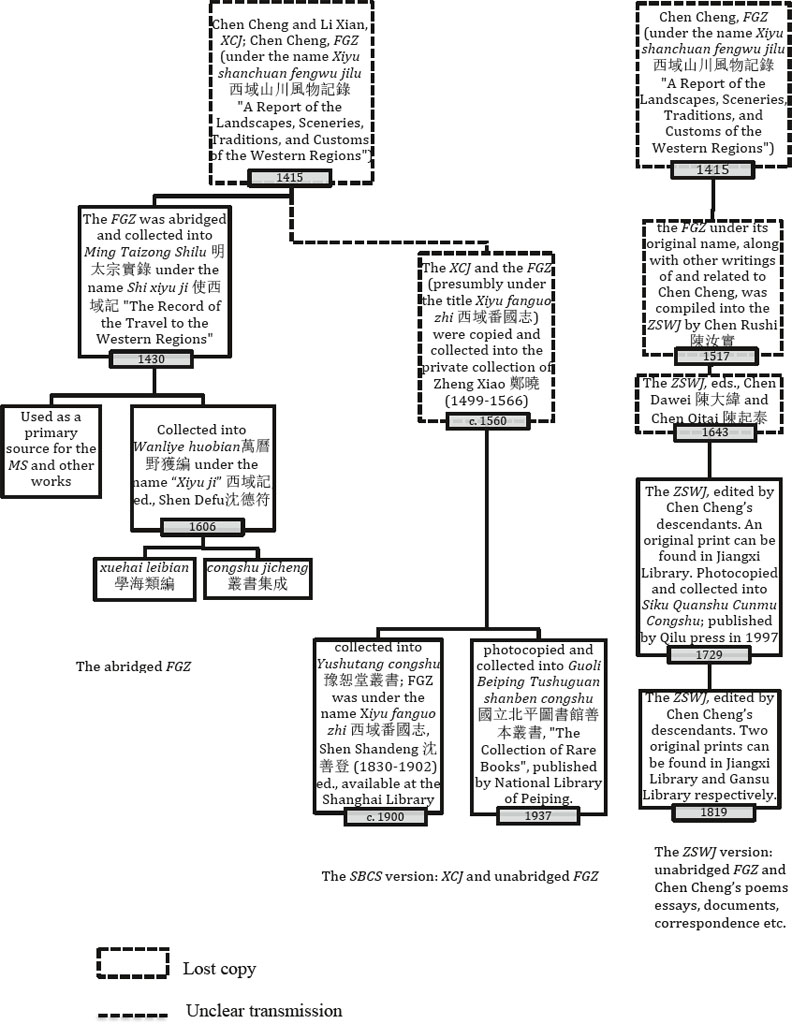
Travel literature attributed to Chen Cheng can be divided into two groups, the unabridged and abridged versions. As previously mentioned, Chen Cheng submitted several documents to the Ming court when he returned from his journey in 1415. His submissions, especially the FGZ, were subsequently excerpted, copied or incorporated in a number of histories and geographical works produced in the Ming and Qing periods, such as the MSL and the MS, the Ming yitongzhi
The SBCS was produced by the Beiping Library (
The SBCS edition of XCJ is the only extant version of the text, and there is thus little room for improvement on its scholarship until new materials are found. Before the recovery of the ZSWJ, the SBCS edition of the FGZ was considered the only unabridged version of Chen Cheng’s travel narrative. For this reason, its title, the Xiyu fanguo zhi
First, there are numerous apparently erroneously transcribed characters in this FGZ.41 Second, the contents page includes the entry “Khotan” (Yutian
Fortunately, the resurfacing of one copy of the ZSWJ in 1984, as well as the later recovery of other editions of the text,42 gave a boost to the study of Chen Cheng’s work. Because the ZSWJ copies display a clear chain of editors and contributors that can be traced all the way back to Chen Cheng’s time, this clarified many obscure issues regarding the FGZ text and its transmissions.
The ZSWJ, or Chen Zhushan Xiansheng Wenji
The ZSWJ is divided into two parts: the “inner chapters” (
The FGZ text in the ZSWJ is entitled Jincheng yulan Xiyu shanchuan fengwu jilu

Prints, copies, and transmission of Chen Cheng’s works
Citation: Journal of the Economic and Social History of the Orient 66, 7 (2023) ; 10.1163/15685209-12341607
Other works in the “inner chapters” include the Shizi fu
Modern Editions, Translations, and Studies
As early as 1888, Emil Bretschneider introduced Chen Cheng to English readers and partially translated his travel accounts for the first time.50 Since the 1970s, Morris Rossabi has published several studies on Chen Cheng, exploring his career and the editions of his works. Furthermore, he has translated the section “Herat” of the FGZ into English.51 Despite the undeniable contributions of these earlier studies, much of the information and translation provided in their works are not accurate, and their style is obsolete; my article therefore will not engage with them.
In 1991, the Zhonghua Book Company (
Another notable development of the study of Chen Cheng’s texts started with Wang Jiguang’s discovery of the Jiaqing edition of the ZSWJ at the Gansu Library in 1984. Later, he acquired Chen’s genealogical register from the latter’s hometown54 and systematically discussed the editions and values of the ZSWJ, adjusting several earlier speculations on Chen Cheng’s travel accounts and their transmissions.55 Drawing on the Jiaqing edition of ZSWJ, Wang published a modern edition of Chen Cheng’s writings, Chen Cheng xiyu ziliao jiaozhu [Annotated Documents of Chen Cheng On Xiyu],56 in which he presented a complete, punctuated version of the ZSWJ, as well as other documents related to Chen that he had collected. On the one hand, the simple layout and the small volume of the book enable the reader to skim quickly through Chen Cheng’s writings, making it a desirable guidebook; on the other, the lack of annotations (opposed to what the book title suggests), the use of simplified Chinese, and the occasional errors would disqualify it from being considered as the main source for a rigorous examination of Chen’s text.
Facilitated by these modern editions, more studies appeared and diverse methods were applied to approach Chen Cheng’s text and the Ming-Timurid ambassadorial exchanges in which he participated. For example, Felicia J. Hecker examined Chen’s career and the Persian vocabulary in the FGZ in “A Fifteenth-Century Chinese Diplomat in Herat”;57 Ralph Kauz utilized Chen’s accounts an important source in his monograph on the Ming-Timurid relations;58 and Sally Church translated the XCJ with Zhou Liankuan’s annotations into English and she has proposed to use GIS to map out Chen Cheng’s trip.59
Notably, Gülçin Çandarlıoğlu translated both of Chen Cheng’s reports, the FGZ and XCJ, into Turkish, along with the letters exchanged between the Timurid and Ming courts. Her study was published in 1995 as Orta Asya’da Timurîler, Çin’de Ming Münâsebetleri Ch’en Ch’eng Elçilik Raporu.60 However, even though her translation was published after the appearance of Zhou Liankuan’s annotated edition of Chen Cheng’s reports, Çandarlıoğlu did not utilize Zhou’s critical edition, and instead relied solely on the SBCS text. As a result, her translation reflects certain salient flaws of the SBCS text and is in need of update.61
In 2012, Michel Didier published a monograph on Chen Cheng that contains Didier’s French annotated translation of the XCJ, FGZ, Chen Cheng’s travel poems and diplomatic correspondence, among other essays from the ZSWJ.62 Didier’s book has brought a number of lesser-known works of Chen to the non-Chinese speaking audience, thereby substantially contributing to the study of Chen Cheng and Ming foreign relations. However, several fundamental problems in Didier’s methodology must be noted. First, Didier’s historical inquiry is not a well-founded one, as it is mostly restricted to the Hongwu era and is dependent on Chinese histories and a very limited number of outdated translations of Timurid sources.63 Second, despite his attempt to highlight the geographic information in Chen’s literature, Didier does not sufficiently consult histories and archeological studies to identify the meanings of place names at the time of Chen’s writing. In addition, Didier’s pairing of the localities in the FGZ with the dates on which those places were visited in the XCJ is redundant and misleading, as the two works were not produced at the same time.64 Third, it seems that Didier resorts to assumptions where he fails to make sense of Chen’s text, leading to the overinterpretation of phrases at times and causing absurd mistakes at other times. For example, Chen wrote the poem, “Baysonghur: Son of Shahrukh,” on his visitation of the Timurid prince Baysonghur, yet Didier translates the proper name “Baysonghur” as “la fratrie du tigre blanc des bois de pins” and comments that this strange and obscure title could be a poetic and symbolic expression.65 Free, uninformed interpretations such as this one constitute the most regrettable aspect of Didier’s translation.
As discussed above, in the past decades, the study of Chen Cheng’s travel literature has seen considerable progress while remaining inadequate from the viewpoint of Islamicate and Eurasian history. First, there is still no complete translation of the FGZ in English. Though Church and Didier have produced annotated translations of the XCJ in English and FGZ in French respectively, their works are heavily influenced by Zhou Liankuan’s Chinese annotated edition, which itself is in urgent need of revision. Second, the majority of scholars still tend to treat Chen’s literature principally from the perspective of Sinology and thus ignore or misrepresent information from sources in Persian or Arabic, and the political backdrop of Islamicate history. Last but not least, in the studies that do consider Chen’s works within a global framework, the focus is mostly on the Timurid capital of Herat and Ming-Timurid relations, whereas the significance of Chen’s report on Moghulistan and its connections with the Timurids is rarely identified and examined.66 The inadequacy in the investigation of Chen’s reports reflects a gap in the study of the medieval history of Iran and Central Asia, where certain important sources are yet to be read with a multi-disciplinary approach, combining the knowledge of Islamicate studies with a good understanding of Turco-Mongol traditions and Eastern Asian history and languages.
Notes on Translation, Transliteration, and Annotation
This translation includes Chen Cheng’s Xiyu fanguo zhi and my selection of his poems on the Western and Central Eurasian regions. The main text I used for my translation is the 1729 edition of the ZSWJ, which was photocopied and published in volume 26 of the Siku quanshu cunmu congshu series by the Qilu shushe in 1997 (Abbreviated as ZSWJ/SK). I have checked this text against the SBCS edition, Zhou Liankuan’s annotated edition, Wang Jiguang’s compilation of Chen Cheng’s documents, which is based on the 1819 edition of the ZSWJ, and Didier’s French translation. Where major differences in the text and disagreements of interpretation occur, I have indicated them in my notes and explained my reading when necessary.
Key locations in Chen Cheng’s travels in the “Western Regions”
Citation: Journal of the Economic and Social History of the Orient 66, 7 (2023) ; 10.1163/15685209-12341607
Naturally, many geographical descriptions in Chen’s texts, especially those regarding direction and distance, do not meet our contemporary standards of accuracy. However, those descriptions reflect how early fifteenth-century Western and Central Asia were perceived specifically by a Ming traveler, I have not altered the text for the sake of “accuracy.” Instead, I have created a map, using GIS and historical gazetteers, to indicate the precise locations of the places mentioned in Chen Cheng’s accounts (see map 1). In addition, I have supplemented necessary information regarding particular Islamicate and Persianate phenomena mentioned in the accounts and provided my readings in the notes. It must also be pointed out that Chen Cheng uses a number of words referring to the concept of “foreign,” that is, not Han Chinese, such as yi
I have translated most proper nouns into English whenever the modern American standard can be applied. For Chinese, I have adopted the Hanyu Pinyin romanization system. Where needed, I have inserted the Chinese characters immediately after the romanized versions to help readers identify the terms. Though I choose to use the traditional Chinese characters, I make exceptions for publications in Chinese, in which cases I stick to the writing system of each publication. For Persian and Arabic transliterations, I have followed the International Journal of Middle East Studies guidelines. For transliteration of Turkic terms, I have followed the forms used by Gerard Clauson in An Etymological Dictionary of Pre-Thirteenth-Century Turkish.
An Annotated Translation of Xiyu fanguo zhi
A Record of the Countries of the Western Regions
or
Record Submitted to the Emperor of the Landscapes, Sceneries, Traditions, and Customs of the Western Regions67
[Timurid lands]
Herat (Halie 哈烈 )68
Herat69 is located southwest of Samarkand (Sama’erhan
The ruler of the country73 resides in the northeast corner of the city.74 Bricks and stones were piled up to build [his] residence, which is flat and square, looking like a high platform. Beams, rafters, and earthenware tiles are not used. There are several dozen empty vaulted chambers (
The ruler of the country wears narrow-sleeved attire, a robe, and a little embroidered hat (
There are no different bureaus (
There is no etiquette at all when meeting with each other; [they] only bend their bodies slightly and say the phrase al-salām ʿalaykum (sali mali
No spoons or chopsticks are laid out for food and drink. They take meat and rice with their hands and drink soup mostly from small wooden ladles. They usually like the tastes of sweet, sour, and oily. Although they often eat rice, they mix it with fat and oil. Dishware is mostly porcelain and earthenware pottery, and is seldom glazed. Only wine flasks, footed cups (
Houses are all built with bricks and stones. The affluent and powerful families [build] massive houses, like that of the ruler of the country. Some even use embroidered silk, saqallāt (sahala
On both sides of the markets and streets, buildings are erected. The top [of the markets and streets] is covered with cloth or enclosed with bricks, with windows in the roof for light. There is no [need to] avoid the sun on clear days, or to set up awnings for the rain. When dust accumulates due to dryness, water is sprinkled [on dusty areas]. Each booth [in the market] offers a separate category of goods: bows, arrows, saddles, bridles, clothes and so on, and [the merchandise] is not mixed. Conflicts and quarrels are seldom seen. Sellers of horses, camels, and [other] livestock, too, gather in separate places. Cooking stoves are seldom seen in the urban households. Food is sold at stores, and thus marketplaces do not close at evening; trading takes place with lamps and candles burning all through the night.89
Silver money is commonly used in trade. The largest weighs one qian
Measuring vessels (
Governmental letters and notes do not use the official seal. When the ruler of the country, as well as every official, issues an order, he only uses a small piece of paper on which text is written directly. Each uses his own signature (
Criminal law is seldom applied in the country. Lawsuits are rare among the military and common people. If there is a case that involves the killing of a person, the punishment will not go beyond compensation for a certain amount of money. There is no death penalty. As for other lesser crimes, only light punishments or flogging would be carried out.98
The prohibition of alcohol is rather strict. Violators are punished by flogging with a leather whip. Thus [the people] do not brew rice wine; they ferment grapes.99 Occasionally, there are illegal sellers.100 Those who have moral principles do not drink alcohol; they pray to God in the morning and in the evening, lest they commit blasphemy.
[According to] the rules of the country, if someone of a different origin (
Men usually marry sisters as wives and concubines, to become a family close as bones and flesh.102 Even patrilineal cousins can marry.103 As for a younger brother marrying his elder brother’s widow, or an elder brother marrying his younger brother’s widow, it is also a common arrangement in this country.104
In the country, men shave their heads, wrapping them with white cloth. Women also cover themselves in white cloth, with their eyes slightly revealed. When there is a funeral, they wear dark blue or black clothes instead. Curtains are all dark blue or black. [People] mourn for no more than a hundred days, and remove their mourning apparel soon after. Coffins are not used for burial at all. Bodies are only wrapped in shrouds and are buried in mounds. Affluent and powerful families usually build up tall earthen structures upon the tombs, making them as luxurious and sumptuous as they wish.105 Indigent and humble families dig graves next to their houses, and there is absolutely no taboo [on doing this].
[People] do not offer sacrifices to ghosts and gods, do not establish temples for the god of the land, do not worship ancestors, and do not build family altars. They only offer sacrifices at the tombs [of holy persons] (
The tenth month of each year and the second month of spring are the fasting months.109 [People] do not drink or eat during daytime; they only eat after sunset. After a whole month, regular [patterns of] eating and drinking are resumed.
On the occasion of breaking the fast, they shoot at gourds as an entertainment. The method of gourd shooting is to insert in the ground a long pole, which is several zhang
The person who understands the classics and the interpretations of the Muslim (Huihui
There are people who give up their family property and positions, with disheveled hair and dirty feet, wearing shabby clothes and sheepskins, holding crutches in their hands and wearing the bones of cows or sheep. They mostly have unusual appearances. They do not avoid cold or heat, begging on the road and mumbling when encountering passers-by, appearing pitiful. If it is extremely difficult to find shelter, [they] may gather outside houses or in graveyards, or reside in caves in the name of practicing their religion. They are called dielimishi
In the middle of crowded markets, there are medical practitioners who gather people seeking cures, make them sit down in a circle, talk with them about illness and disease, and do a variety of other things. Afterwards, these people all pay cash, and [the practitioners] distribute a small amount of medicine to each person and leave. The effects are ultimately unknown.
There are intrusive people in the crowd who wave big axes and gesticulate outrageously with hands and feet in the marketplace of the city, shouting loudly. The reason is not clearly known. It is probably just to admonish people to virtue.115
There are people good at running who can cover two or three hundred li in one day. They lightly lift their feet and [run] faster than a horse. However, they are not born good runners and they practice from childhood to acquire this skill. Whenever the local authorities have urgent affairs, these people are ordered to run with an arrow to deliver a message in order to convey the level of urgency.116 They usually have bells hanging at their waists and stick-shaped weapons (
Men and women seldom carry burdens; they depend on horses, camels, donkeys, and mules for riding and carrying loads. If it is a small charge or the objects are light, they carry it on their heads, walking swiftly, swaying and keeping the objects from falling.
Women all go about on horses or mules. When encountering others on the way, they talk and laugh and tell jokes, appearing totally unashamed. [Women and men] even wantonly salute one another with flirtatious words. Men are especially loose in morals.
The customs of the country are mostly extravagant. Bright-colored clothes are preferred.117 Even the saddles and reins of the horses and riding mules are usually embellished with gold, silver, and colorful [decorations]. The front and back [of the saddles] are carpeted with felt, and bells are attached [to them]. Young people from wealthy families all ornament their clothes and robes with green jade, decorate their belts with gems, and adorn their scabbards with gold, silver, or pins and jewelry, in order to show extravagance and opulence.
Within the city walls and in the countryside, people live peacefully. In the deep mountains and open fields, people and horses walk alone. There are no tigers and wolves during the daytime, and there are no ghosts or evil spirits during the night.
The climate of the four seasons is usually warm and seldom cold. The winter months are like springtime. Grasses grow at the same time as shepherd’s purse (
In remote places, cisterns are often constructed in rural areas to store water for people and horses. Their method is to erect high earthen structures over broad brick lined pools like icehouses. This is because running water seldom collects [naturally].
In the cities and villages, public baths are widely established. Men and women each [bathe] in separate places. The system is different119 from that of China. There are dozens of empty rooms in the bath hall, to house numerous bathers. When the bathers first take off their clothes, they use bath towels to cover their bodies and then enter the bathing room. They do not use plates and buckets. Each [bather] holds a water jar in which he takes [a little] water from each of the warm and cold tubs, in order to clean and wash his body. The rest of the water drains out and no dirt accumulates. There are also people who rub and knead muscles and joints of the body for the bathers, to make them relaxed and comfortable. Upon finishing the bath and leaving the room, each person is given two towels, one to cover the head, and the other to cover the body, and to make sure that [the bather] is dry and clean before he leaves. The bather gives [the massager] one or two copper coins and that is all.120
Waterwheels are the same as those in China. Occasionally, there are windmills.121 The method is to build low walls to enclose a space on a height, open up gates in all four directions, establish screen walls facing the wind outside the doors, erect a wooden pillar within the walls, construct planks around the pillar to catch the wind, and to fix a millstone at the bottom. When the wind comes the pillar rotates. It can operate regardless of the direction [of the wind]. Because of the power of the wind in the vicinity, there are many [windmills].
Earthen houses are built along the roads; they are called langar (langge’er
In the villages, markets are often set up. All the trading places are called bāzār (bazan’er
There is no calendar promulgated [by the emperor].125 The sexagenary cycle (
In the middle of the city there is a big earthen house named madrasa (mode’ersai
Copper and iron are locally produced, from which sharp tools can be made. The production of porcelain is particularly exquisite: flowers and grasses are depicted and painted colorfully. Its style is quite beautiful, but it is not as light, clean, and glittering as that of China. Tapping on it results in no sound because of its earthen nature.
Colored glazed objects are produced. They are not often used in households, but serve as a decoration (
White salt is produced from the ground of Kesh. It is as solid and bright as crystal. If it is carved and polished into plates and dishes, then moistened, meat can be eaten from it.
There is plenty of gold, silver, gems, coral, amber, crystal, diamonds, cinnabar, ruby, pearls, and jadeite (
Breeding silkworms and planting mulberry trees are common. [People] are good at making fine silk fabrics, which are better than those of China in their lightness, fineness, and closeness of weave. However, they are not as firm and thick as those of China. Besides, [people] do not know how to weave luo
The land produces mulberries, elms, poplars, willows, locust trees, sandalwood, pines, cypresses, and white poplars. Fruit trees are frequently planted. From the ruler of the country downward, powerful families cultivate extensive fruit gardens (
The planting of the five grains143 is the same as in China. Hemp, beans (
Quality horses are frequently bred. [People] love them dearly and protect them closely. They all breed them deep within the earthen houses where wind and sunshine do not reach, and it is warm in winter and cool in summer. Sheep, horses, chicken, dogs, geese, and ducks are raised in households. Pigs alone are not raised; their flesh is not eaten either. It is the most [prohibited] taboo. Whichever livestock is not slaughtered by Muslims is not eaten.150 Candles are filled with the tallow of cows and sheep. Tallow and cotton are also entwisted into chunks and put onto plates under which iron handles are affixed in order [that people] may hold [the torch] in their hands and walk. When they stop [walking], they let [the torch] stand upright on the ground, without avoiding wind or rains.
[People] do not know to wave fans in hot weather. They sometimes suspend, high up in the tent room, a cloth curtain, at the lower edge of which tassels151 are often attached. They set ropes at the two sides [of the curtain]. Wind comes naturally when they pull [the ropes]. It is called a “wind fan” (
All objects for giving gifts and paying tributes—no matter if they are money, gems, or animals152—are always grouped in nines. [Objects in groups of nine,] ranging from nine (
Whenever there are banquets, the elite (
Lions breed in the reeds on the bank of the Amu River.156 It is said that their eyes are closed at birth; they only open them after seven days. Those who want to obtain a lion to raise it have to take it when it is just born and has not yet opened its eyes, [in order to] facilitate the taming and training. When the lion grows up, its nature [becomes] hard and fierce, and it is difficult to tame and control it. Besides, it has very powerful strength and extraordinarily sharp claws and teeth. When it is enraged, it is not for one or two people to control. [The lion] is good at fighting against large beasts; it can eat over ten jin of meat at one meal. There are people who seek its tail; they employ bows and arrows and set up nets to kill it. It is extremely difficult to obtain the tail while the lion is alive.157
There is a type of striped beast (
Samarkand (Sama’erhan 撒馬兒罕 )160
Samarkand is located northeast of Herat. Jiayu Mountain161 of the Suzhou Guard of the Shanxi Regional Commission is over 9900 li to the east, and Herat is over 2800 li to the west.162 It lies in a wide level plain. The beauty of its landscape is breathtaking, and the soil of its land is fertile. There is a big northward-flowing river east163 of the city. The city is built on the plain, with a length of more than ten li in the east-west direction, and a width of five to six li in the north-south direction. The city has six gates facing different directions.164 The dry moat is deep and dangerous. There is a subsidiary city north [of the main one].165
The ruler of the country166 resides in the northwest corner of the city.167 [The ruler’s residence] is not less majestic than that of Herat. There is a large population in the city. Streets and alleys crisscross lengthwise and sidewise; stores and shops are dense. Foreigners (fan ke
Alcohol is banned in neighborhoods. Butchers of cows and goats do not sell the blood of animals; they dig a hole in the ground and bury it. There is an earthen building (
The people of Samarkand are handsome, skillful, and talented. Their local products include: gold, silver, and copper money,170 iron, and felt carpets. They usually grow white poplars, elms, willows, peaches, almonds, pears, plums, apple,171 and grapes. The soil there is suitable for growing the five grains. Their traditions and customs are the same as those of Herat.
Andkhoy (Anduhuai 俺都淮 )172
Andkhoy is located northeast of Herat, which is about 1390 li to the southwest; Samarkand, meanwhile, is about 1360 li to the northeast. The city lies within a vast agricultural area (
Balkh (Balahei 巴剌黑 )174
The city of Balkh175 is located northeast of Andkhoy. It is surrounded by a ten-li level plain with no difficult features. [The city] is close to a mountain to the south. The farms of Balkh are vast, and food is plentiful. Foreign (fan
Termez City (Dielimi cheng 迭里迷城 )178
The city of Termez is located southwest of Samarkand, and over 2000 li from Herat. The city sits on the eastern bank of Amu River; it was built beside the river. The river is rather wide; it cannot be crossed except by boat or raft. The city is quite strategically situated and difficult of access.179 There are several hundred families living both inside and outside the city walls. Livestock are abundant and fish are plentiful in the river. The old city180 is over ten li distant. The land on the eastern bank is subordinate to the rule of Samarkand. It is said that lions breed in the reeds on the western bank of the river.
Shahrukhiya (Shaluhaiya 沙鹿海牙 )181
The city Shahrukhiya is located east of Samarkand at a distance of over 500 li. The city is built on a low hill, and is bordered by a mountain and a river on the northwest side. The river is named Khujand (Huozhan
Sayram City (Sailan cheng 塞藍城 )189
The city Sayram is located east of Tashkent (Dashigan
Tashkent (Dashigan 達失干 )193
Tashkent is located west of Sayram and over 700 li from Samarkand. A level plain of two li surrounds the city. All four directions of the city face flat hills, where many gardens can be found, fruit trees are planted extensively, and waters flow constantly. The soil is suitable for growing the five grains. The inhabitants live close together. Carts and oxen are used for carrying burdens.
Bukhara (Bohua’er 卜花兒 )194
The city of Bukhara is over 700 li northwest of Samarkand. The city is located on a plain with a radius of over ten li. It is populous and has abundant products. The streets and markets [of the city] are prosperous and bustling. The population reaches tens of thousands. The land is low and the soil is humid. The weather is mild; in the winter, [people] do not build fires for warmth. The soil there is suitable for growing the five grains, mulberry trees, and flax. Cloth, cotton, and silk textiles are produced. In the winter, [people] eat raw vegetables, and any kind among beef, mutton, chicken, goose, fish, rabbit, and swan.195
Kesh (Keshi 渴石 )196
The city Kesh is about 260 li southwest of Samarkand. The city lies in a vast settlement with a radius of over ten li and has multiple paddy fields to the southwest.197 [The city] is close to a mountain that lies to the northeast.198 In the city there is a garden, which is said to have been built by the former ruler of the country, Timur fuma
Yangi (Yangyi 養夷 )203
The city Yangi is 260 li204 east of Sayram. The city is located in the midst of a jumble of mountains. Northwest of the city, there is a large westward-flowing river.205 The ruins of the desolate city are overgrown with weeds with the passage of years. The city lies among Beshbalik Mongol tribes,206 who have been fighting with the Uighurs (Huihu
[Moghulistan]
Beshbalik (Bieshibali 別失八里 ):209 The Mongol Tribes210
Beshbalik is located in the desert. It is currently ruled by Prince Muhammad (
Turfan (Tu’erfan 土爾番 )229
Turfan is only a hundred li west of Huo Zhou
More than a hundred li northwest of the city, there is a sacred (
Leaving the gorge and walking southeastwards for six or seven li, [one will] come to a high precipice. There is a range of small mountains standing below. Their earth is red, smooth, soft, and ethereal. Their ridges and peaks are magnificent, arranged in lines and rows. On that earth, there is a pile of white stones, as if they are jaspers, light and crisp. There are sacred (
Yar City (Ya’er cheng 崖兒城 )244
The city of Yar is twenty li west of Turfan. The city is built on a steep plateau carved out by two rivers that merged [at one end of the plateau]. Thus, the city is named Yar.245 The city is no more than two li wide; it is inhabited by about 100 families. In the past, there were many temples. Engravings on stones remain.246 [The city] was once the residence of the king of Jushi
Yanze City (Yanze cheng 鹽澤城 )249
The city of Yanze is located southwest of Yar, and is over thirty li from Turfan. The city lies in a level plain. The width of the city is no more than two li, and 100 families reside there. On the east side of the city, there are two tall tombs (
Huo Zhou (Huo zhou 火州 )251
Huo Zhou is seventy li west of Luchen City
Luchen City (Luchen cheng 魯陳城 )255
The city of Luchen, on the land of the ancient Liuzhong County
The city is two or three square li. There are many gardens, running waters, and luxuriant trees surrounding the city. The soil is suitable for growing broomcorn millets, hemp, soy. Grapes, peaches, apricots, apples, walnuts, small dates, melons, and calabashes are widely grown there. There is a [type of] small grape, sweet and seedless; it is named suozi
Hami (Hami 哈密 )260
The city of Hami lies in a level plain. It is about three or four square li. There are only two gates, east and north. There are several hundred households living in low earthen houses. East of the city, there is a creek flowing southwestward. There are two or three fruit gardens in which only qiu
Selected Poems
Reaching the Tent of Muhammad, Ruler of Beshbalik (1 or 2)
Reaching the Tent of Muhammad, Ruler of Beshbalik (2 or 2)
Reaching the City of Yangi
The City of Sayram
The City of Shahrukhiya
Reaching the Fruit Garden of Ulugh Beg, Ruler of Samarkand
Visiting Kesh, the Former Residence of Timur Fuma
Staying in Chichaktu (Chechetu
Gazing at the City of Herat (2 of 2)
Visiting the Residence of the Ruler of Herat, Shahrukh (1 of 2)
Visiting the Residence of the Ruler of Herat, Shahrukh (2 of 2)
Brother Bāysunghur,284 Son of Shahrukh (1 of 2)
The Lion
The Striped Beast
The Windmill
Gourd Shooting
Iron Gate Pass (1 of 2)
Passing the Tomb of Prince Khiḍr Khwāja291
Appendix 1: Selected Records of the XCJ
Citation: Journal of the Economic and Social History of the Orient 66, 7 (2023) ; 10.1163/15685209-12341607
This table presents the major stops and activities in the 1414 trip of the Ming ambassadorial group from Suzhou to Herat. The source for these records is Chen Cheng and Li Xian’s XCJ.
Appendix 2: Chen Cheng—a Biography
Chen Cheng was born in 1365.295 His courtesy name was Zilu
Chen Cheng earned his jinshi degree in year 27 of the Hongwu era/1394, and subsequently started to serve in the government.297 His career as an envoy began at the age of thirty-two when he was sent to the land of the “Yellow Uighurs” (Sali Weiwu’er
While there is no doubt as to Chen Cheng’s fine performance at his post, his social network also played an important role in his career. A letter and an essay by Fang Xiaoru
After enduring a year of financial hardship, in 1403, Chen Cheng made his way back to bureaucracy to serve at the rank-6a position, secretary at the office of pure functionaries.306 He kept this position for seven years, spending most of this time editing the massive Yongle dadian
Less than a year after his return, Chen Cheng was sent to the same destination on the same mission—to escort some Timurid envoys back to Herat. After two years of travel, Chen Cheng returned to Beijing in 1418, bringing with him gift from the foreign countries—fifteen horses, and was rewarded handsomely in cash money. In the same year, he was granted a 4a-rank prestige title and undertook another expedition to the Western Regions. This would be the third and last time he reached the Timurid capital. In 1420, Chen Cheng completed the mission, returned to the Ming court, and was finally promoted to the position right executive administration commissioner of Guangdong Province and was granted the 3b-rank prestige title lesser grand master of the palace.310
In 1424, when the sixty-year-old Chen Cheng was about to cross the Jiayu Pass to start his fourth journey to the Timurid territory, he was recalled to the Ming court upon the death of the Yongle Emperor. The new Hongxi
After his retirement, Chen Cheng lived in his hometown for over thirty years. It seems from the Juxiu yigao
In 1457, Chen Cheng was promoted to the position of the Right Commissioner at the Office of Transmission, supervising the affairs of the Court of Imperial Entertainments.311 At the age of ninety-two, he moved all the way to Beijing for the new job. This senseless assignment may have reflected the absence of talents in the court due to the liquidation following the restoration of Zhengtong Emperor (r.1435–1449; 1457–1464).312 In the following year, 1458, Chen Cheng expired at his post.
Abbreviations
| Bābur/Eiji | Bāburu nāma: mugaru teikoku sōsetsusha no kaisōroku. Edited by Eiji Mano. |
| Bābur/Thackston | The Baburnama: Memoirs of Babur, Prince and Emperor. Translated by Wheeler M. Thackston. |
| Chen Cheng/Didier | Michel Didier. Chen Cheng (1365–1457), ambassadeur des premiers empereurs Ming. |
| Chen Cheng/Wang | Chen Cheng xiyu ziliao jiaozhu |
| Chen Cheng/Zhou | Chen Cheng |
| Clauson | Gerard Clauson. An Etymological Dictionary of Pre-thirteenth-century Turkish. |
| Clavijo/Estrada | Ruy González de Clavijo. Embajada a Tamorlán: Estudio y edición de un manuscrito del siglo XV. Edited by Francisco López Estrada. |
| Clavijo/le Strange | Ruy González de Clavijo. Embassy to Tamerlane, 1403–1406. Translated by Guy Le Strange. |
| DML/Jiang | The Great Ming Code: Da Ming lü. Translated by Jiang Yonglin. |
| EI2 | Encyclopaedia of Islam, second edition. |
| EIr | Encyclopædia Iranica. |
| EMM/Atwood | Christopher Pratt Atwood. Encyclopedia of Mongolia and the Mongol Empire. |
| FGZ | Xiyu fanguo zhi |
| FGZ/SB | Xiyu fanguo zhi |
| HAJ/Haravī | Ḥāfiẓ Abrū. Jughrāfīyā-yi Ḥāfiẓ Abrū: Qismat-i Rub-ʿi Khurāsān, Harāt. Edited by Riḍā Māyil Haravī. |
| Ḥaydar/Ross | A History of the Moghuls of Central Asia: Being the Tarikh-i-Rashidi of Mirza Muhammad Haidar, Dughlát. Translated by N. Elias and E.D. Ross. |
| Ḥaydar/Thackston | Tārīkh-i Rashīdī: Tārīkh-i Khavānīn-i Mughūlistān: Matn-i Fārsī. Edited and translated by W.M. Thackston. |
| HAZ | Ḥāfiẓ Abrū. Zubdat al-tawārīkh. Edited by Kamāl Ḥājj Sayyid Jawādī. |
| HHYF/Song | Song Xian |
| HHZZ | Huihui guan zazi |
| HHZZ/Hongda | Honda, Minobu. Huihui guan yiyu nitsuite |
| HHZZ/Liu | Liu Yingsheng |
| Ibn ʿArabshāh/Ḥimṣī | Ibn ʿArabshāh. ʿAjāʾib al-maqdūr fī nawāʾib Taymūr. Edited Aḥmad Fāʾiz Ḥimṣī. |
| Ibn ʿArabshāh/Sanders | Ibn ʿArabshāh. Tamerlane, or, Timur, the Great Amir. Translated by John Herne Sanders. |
| Ibn Baṭūṭa/Gibb | Ibn Baṭūṭa. The Travels of Ibn Baṭṭūṭa, A.D.1325–1354, volume III. Translated by H.A.R. Gibb. |
| JTS | Jiu Tang Shu |
| MS | Ming Shi |
| MSL | Ming Shi Lu |
| QZL/Jia | Shengwu qinzheng lu |
| RJT/Rawshan | Rashīd al-Dīn, Jāmiʿ al-Tawārīkh. Edited by Muḥammad Rawshan and Muṣṭafa Mūsavī. |
| RJT/Thackston | Rashiduddin Fazlullah’s Jamiʿuʾt-tawarikh: Compendium of Chronicles. Translated by W.M. Thackston. |
| SBCS | Shanben Congshu |
| TMEN | Gerhard Doerfer. Orientalische Kommission. Türkische und mongolische Elemente im Neupersischen: unter besonderer Berücksichtigung älterer neupersischer Geschichtsquellen, vor allem der Mongolen- und Timuridenzeit. |
| XCJ | Xiyu xingcheng ji |
| XSJ | Liu Yu |
| XYDM/Feng | Feng Chengjun |
| XYDMCD | Xiyu diming cidian |
| XYL/Xiang | Yelü Chucai |
| ZSWJ | Chen Zhushan Xiansheng Wenji |
| ZSWJ/SK | Chen Zhushan Wenji |
Bibliography
ʿAlā ʾ al-Dīnī, Bahrām. 2018. Sikkahʾhā-yi Īrān: dawra-yi Gūrkāniyān (Taymūriyān), vol. 1. Tehran: Pāzīnah.
Album, Stephen. 2011. A Checklist of Popular Islamic Coins. Santa Rosa, CA: Stephen Album.
Allen, Terry. 1983. Timurid Herat. Beihefte zum Tübinger Atlas des Vorderen Orients. Geisteswissenschaften. Wiesbaden: Reichert.
Atwood, Christopher Pratt. 2004. Encyclopedia of Mongolia and the Mongol Empire. New York: Facts On File.
Bearman, P.J., Thierry Bianquis, Clifford Edmund Bosworth, E.J. van Donzel, and Wolfhart Heinrichs. 2006. The Encyclopaedia of Islam. Second edition. Leiden: Brill.
Binbaş, Evrim, and Will Kwiatkowski. 2021. Iskandar b. ʿUmar Shaykh’s Farman in the David Collection. Journal of the David Collection 5: 26–79.
Binbaş, İlker Evrim. 2013. The Anatomy of a Regicide Attempt: Shāhrukh, the Ḥurūfīs, and the Timurid Intellectuals in 830/1426–27. Journal of the Royal Asiatic Society 23/3: 391–428.
Bretschneider, Emil. 1888. Chinese Intercourse with the Countries of Central and Western Asia during the Fifteenth and Sixteenth Centuries. In Mediaeval Researches from Eastern Asiatic Sources: Fragments towards the Knowledge of the Geography and History of Central and Western Asia from the 13th to the 17th Century. London: Trübner & Co.: 139–332.
Chen, Cheng 陳誠. 1937. Shanben congshu 善本叢書, vol. 11: Xiyu xingcheng ji Xiyu fanguo zhi 西域行程記 西域番國志. Beiping: Beiping tushuguan.
Chen, Cheng 陳誠. 1991. Xiyu xingcheng ji, Xiyu fanguo zhi 西域行程記, 西域番國志, ed. Zhou Liankuan 周連寬. Beijing: Zhonghua Book Company.
Chen, Cheng 陳誠. 1997. Siku quanshu cunmu congshu 四庫全書存目叢書, v.26: Chen Zhushan Wenji 陳竹山文集. Jinan: Qilu shushe.
Church, Sally K. 程思麗. 2022. A Lion Presented as Tribute during Chen Cheng’s 陳誠 Diplomatic Expeditions to Herat (1413–1420). In Tribute System and Rulership in Late Imperial China, ed. Ralph Kauz and Morris Rossabi. Bonn: Göttingen V&R unipress: 203–222.
Church, Sally K., trans. Xiyu xingcheng ji 西域行程記 (Record of the Journey to the Western Regions) by Chen Cheng 陳誠 and Li Xian 李暹. http://www.thelongridersguild.com/Chen%20Cheng%27s%20Diary%20-%20China%20to%20Herat.pdf.
Clauson, Gerard. 1972. An Etymological Dictionary of Pre-thirteenth-century Turkish. Oxford: Clarendon Press.
Çandarlıoğlu, Gülçin. 1995. Orta Asya’da Timurîler, Çin’de Ming Münâsebetleri – Ch’en Ch’eng Elçilik Raporu. Istanbul: Mimar Sinan Üniversitesi Fen - Edebiyat Fakültesi.
De Nicola, Bruno. 2015. The Travels of a Manuscript: Rashid al-Din’s Compendium of Chronicles (Add.7628). Asian and African studies blog. British Library. https://blogs.bl.uk/asian-and-african/2015/08/the-travels-of-a-manuscript-add-7628.html.
Didier, Michel. 2012. Chen Cheng (1365–1457), ambassadeur des premiers empereurs Ming. Paris: Peeters.
Doerfer, Gerhard. 1963. Türkische und mongolische Elemente im Neupersischen: unter besonderer Berücksichtigung älterer neupersischer Geschichtsquellen, vor allem der Mongolen- und Timuridenzeit. Wiesbaden: Franz Steiner.
Eiji, Mano 間野英二, ed. 2014. Bāburu nāma: mugaru teikoku sōsetsusha no kaisōroku バーブル・ナーマ : ムガル帝国創設者の回想錄. Tokyo: Heibonsha.
Eiji, Mano. 1978. Moghūlistān. Acta Asiatica: Bulletin of the Institute of Eastern Culture 34: 46–60.
Eiji, Mano. 1993. Two Notes on the Genealogy of Moghul Khans in the Early 15th Century. Journal of Turkish Studies 17: 117–123.
Encyclopædia Iranica. 1983–. London: Routledge & Kegan Paul.
Ezhenkhan-uli, Bakhyt 巴阿提・依加汉. 2019. Du Chen Cheng xiyu fanguo zhi zhaji er ze 读陈诚《西域番国志》札记二则, or “Two Notes on the Sections of Halie and bieshibali in Chen Cheng’s Travelogue.” Yuanshi ji minzu yu bianjiang yanjiu jikan 38: 168–176.
Fan, Rong. 2021. The Mongol Empire: Fragmentation, Unity, and Continuity (1206– c.1300). PhD dissertation. The University of Chicago.
Feng, Chengjun 馮承鈞. 1980. Xiyu diming 西域地名, ed. Lu Junling 陸峻嶺. Beijing: Zhong hua shu ju.
Feng, Zhiwen 冯志文, et al. ed. 2002. Xiyu diming cidian 西域地名词典. Wulumuqi shi: Xinjiang renmin chubanshe.
Ge, Zhaoguang 葛兆光. Imagining a Universal Empire: a Study of the Illustrations of the Tributary States of the Myriad Regions Attributed to Li Gonglin. Journal of Chinese Humanities 5/2 (2020): 124–148.
Ge, Zhaoguang 葛兆光. What Is China?: Territory, Ethnicity, Culture, and History, trans. and Michael Hill. Cambridge, Massachusetts: The Belknap Press of Harvard University Press, 2018.
Golombek, Lisa. 1988. The Timurid Architecture of Iran and Turan, ed. Donald Newton Wilber. Princeton: Princeton University Press.
Golombek, Lisa. 1995. The Gardens of Timur: New Perspectives. Muqarnas 12: 137–147.
González de Clavijo, Ruy. 1943. Embajada a Tamorlán: Estudio y edición de un manuscrito del siglo XV, ed. Francisco López Estrada. Madrid: Consejo superior de investigaciones científicas, Instituto Nicolás Antonio.
González de Clavijo, Ruy. 2006. Embassy to Tamerlane, 1403–1406, eBook, trans. Guy Le Strange. First published in 1928. London: RoutledgeCurzon.
Gross, Jo-Ann. 1988. The Economic Status of a Timurid Sufi Shaykh: A Matter of Conflict or Perception?. Iranian Studies 21/1–2: 84–104.
Guo, Li. 2013. Sports as Performance: the Qabaq-game and Celebratory Rites in Mamluk Cairo. Ulrich Haarmann Memorial Lecture, ed. Kolleg Annemarie Schimmel. Berlin: EBVerlag.
Ḥāfiẓ Abrū. 1970. Jughrāfīyā-yi Ḥāfiẓ Abrū: Qismat-i Rubʿ-i Khurāsān, Harāt, ed. Riḍā Māyil Haravī. Tehran: Bunyād-i Farhang-i Īrān.
Ḥāfiẓ Abrū. 2001. Zubdat al-tawārīkh, ed. Kamāl Ḥājj Sayyid Jawādī. Tehran: Sāzmān-i Chāp va Intishārāt, Vizārat-i Farhang va Irshād-i Islāmī.
Ḥaydar Mīrzā. 2004. Tārīkh-i Rashīdī, ed. ʿAbbās Qulī Ghaffārī’fard. Tehran: Markaz-i Nashr-i Mīrās̲-i Maktūb.
Hecker, Felicia J. 1993. A Fifteenth-Century Chinese Diplomat in Herat. Journal of the Royal Asiatic Society 3/1: 85–98.
Hodous, Lewis, and William E. Soothill. 2014. A Dictionary of Chinese Buddhist Terms: With Sanskrit and English Equivalents and a Sanskrit-Pali Index. Abingdon and New York: Routledge.
Holmgren, J. 1986. Observations on Marriage and Inheritances Practices in Early Mongol and Yüan Society, with Particular Reference to the Levirate. Journal of Asian History 20/2: 127–192.
Honchell, Stephanie. 2015. The Story of a Drunken Mughal: Alcohol Culture in Timurid Central Asia. PhD dissertation. The Ohio State University.
Honda, Minobu 本田實信. 1963. Huihui guan yiyu nitsuite 「回回館譯語」に就いて, “On the Hui-hui-kuan i-yü (Chinese-Persian Vocabulary).” In Bulletin of the Faculty of Humanities and Human Sciences, Hokkaido University v.11: 150–224.
Hucker, Charles O. 1985. A Dictionary of Official Titles in Imperial China. Stanford: Stanford University Press.
Hucker, Charles O. 1998. Ming government. In The Cambridge History of China Volume 8: The Ming Dynasty, ed. Denis C. Twitchett and Frederick W. Mote. Cambridge: Cambridge University Press: 9–105.
Ibn ʿArabshāh, Aḥmad ibn Muḥammad. 1986. ʿAjāʾib al-maqdūr fī nawāʾib Taymūr, ed. Aḥmad Fāʾiz Ḥimṣī. Beirut: Muʾassasat al-Risālah.
Ibn ʿArabshāh, Aḥmad ibn Muḥammad. 1976. Tamerlane, or, Timur, the Great Amir, trans. John Herne Sanders. London: Luzac & Co.
Ibn Baṭūṭa. 1971. The Travels of Ibn Baṭṭūṭa, A.D.1325–1354. Volume III, trans. H.A.R. Gibb. Cambridge: Published for the Hakluyt Society by the [Cambridge] University Press.
Ibn Taghrībirdī, Abū al-Maḥāsin Yūsuf. 1963. Turāthunā, vol. 16: al-Nujūm al-zāhira fī mulūk Miṣr wa-al-Qāhirah. Cairo: al-muʾassasah al-miṣriyyah al-ʿāmah li-l taʾlīf wa-al-ṭabāʿah wa-al-nashr.
Jiang, Yonglin, trans. 2005. The Great Ming Code: Da Ming lü. Seattle: University of Washington Press.
Karamustafa, Ahmet T. 1994. God’s Unruly Friends: Dervish Groups in the Islamic Later Middle Period, 1200–1550. Salt Lake City: University of Utah Press.
Karamustafa, Ahmet T. 2007. Sufism: the Formative Period. Edinburgh: Edinburgh University Press.
Kauz, Ralph. 2005. Politik und Handel zwischen Ming und Timuriden: China, Iran und Zentralasien im Spätmittelalter. Wiesbaden: Reichert.
Kauz, Ralph. 2015. Michel Didier’s Chen Cheng (1365–1457), ambassadeur des premiers empereurs Ming: A Review Article, or Some Considerations of the Geographical Knowledge on the Silk Road During the Early Ming Dynasty. Journal of Asian History 49/1–2: 253–266.
Kenzheakhmet, Nurlan. 2017. The Tūqmāq and the Ming China: The Tūqmāq and the Chinese Relations during the Ming Period (1394–1456). Golden Horde Review 5: 770–785.
Kerlouegan, Jerome. 2015. Review of Chen Cheng (1365–1457), ambassadeur des premiers empereurs Ming by Michel Didier. Ming Studies 72: 70–79.
Khvāfī, Faṣīḥ al-Dīn Aḥmad. 2007. Mujmal-i Faṣīḥī, ed. Muḥsin Nājī Naṣrābādī. Tehran: Intishārāt-i Asāṭīr.
Komaroff, Linda. 1986. The Epigraphy of Timurid Coinage: Some Preliminary Remarks. Museum Notes (American Numismatic Society) 31: 207–232.
Krawulsky, Dorothea, ed. 1982. Ḫorāsān zur Timuridenzeit nach dem Tārīḫ-e Ḥāfeẓ-e Abrū (verf. 817–823 h.) des Nūrallāh ʿAbdallāh b. Luṭfallāh al-Ḫvāfī genannt Ḥāfeẓ-e Abrū. Beihefte zum Tübinger Atlas des Vorderen Orients. Geisteswissenschaften. Wiesbaden: L. Reichert.
Laufer, Berthold. 2018. Sino-Iranica: China and Ancient Iran: Commodities and Cultural Exchange from 1000 BC to Medieval Times, ed. Brian Spooner. London: I.B. Tauris.
Lee, Joo-Yup. 2016. Qazaqlïq, or Ambitious Brigandage, and the Formation of the Qazaqs: State and Identity in Post-Mongol Central Eurasia. Leiden: Brill.
Lee, Joo-Yup. 2021. The Timurid View of the Mongols: An Examination of the Mongol Identity of the Timurids. Iran Namag 6/3–4.
Lentz, Thomas W. 1989. Timur and the Princely Vision: Persian Art and Culture in the Fifteenth Century, ed. Glenn D. Lowry, Art Los Angeles County Museum of and M. Sackler Gallery Arthur. Los Angeles: Los Angeles County Museum of Art.
Li, Xiao. 2020. Non-Han literature along the Silk Road. Singapore: Springer.
Liu, Chunying 刘春迎. 2018. Cong beisong dong jing waicheng de kaogu faxian tan beisong shiqi de zaoying chi 从北宋东京外城的考古发现谈北宋时期的营造尺. Wenwu: 54–60.
Liu, Xu 劉昫. 1975. Jiu Tang Shu 舊唐書. Beijing: Zhonghua shuju.
Liu, Yingsheng 刘迎胜. 2006. Chahetai Hanguo shi yan jiu 察合台汗国史研究. Shanghai: Shanghai gu ji chu ban she.
Liu, Yingsheng 刘迎胜. 2008. Huihui guan zazi yu Huihui guan yiyu yanjiu 《回回馆杂字》与《回回馆译语》研究. Beijing: Zhongguo renmin daxue chubanshe.
Liu, Yu 刘郁. Xi shi ji (Qing chaoben)西使記 (清鈔本). Accessed from the Zhongguo jiben guji ku 中国基本古籍库 [Database of Chinese Classic Ancient Books].
Manz, Beatrice Forbes. 1988. Tamerlane and the Symbolism of Sovereignty. Iranian Studies 21/1–2: 105–122.
Manz, Beatrice Forbes. 1989. The Rise and Rule of Tamerlane. Cambridge studies in Islamic civilization. Cambridge; New York: Cambridge University Press.
Manz, Beatrice Forbes. 2007. Power, Politics and Religion in Timurid Iran. Cambridge; New York: Cambridge University Press.
Markiewicz, Christopher. 2019. The Timurid Vocabulary of Sovereignty. In The Crisis of Kingship in Late Medieval Islam: Persian Emigres and the Making of Ottoman Sovereignty. Cambridge: Cambridge University Press.
Matsui, Dai. 2015. Old Uigur Toponyms of the Turfan Oases. In Kutadgu Nom Bitig: Festschrift für Jens Peter Laut zum 60. Geburtstag, ed. E. Ragagnin, J. Wilkens, and G. Şilfeler. Wiesbaden: Harrassowitz: 275–303.
Matthee, Rudolph P. 2005. The Pursuit of Pleasure: Drugs and Stimulants in Iranian History, 1500–1900. Princeton: Princeton University Press.
Meng, Fanren 孟凡人. 2001. Jiaohe gucheng xingzhi buju tedian yanjiu 交河故城形制布局特点研究. In Acta Archaeologica Sinica 4: 483–508.
Meng, Fanren 孟凡人. 2010. Gaochang gucheng xingzhi chu tan 高昌故城形制初探. In Xinjiang kaogu lun ji. Lanzhou Shi: Lanzhou daxue chubanshe: 37–63.
Ming Shi Lu 明實錄. 1962. Taibei: Central Research Academy, Historical Language Research Institute.
Noelle-Karimi, Christine. 2014. The Pearl in its Midst: Herat and the Mapping of Khurasan (15th–19th Centuries). Wien: Verlag der Österreichischen Akademie der Wissenschaften.
O’Kane, Bernard. 1987. Timurid Architecture in Khurasan. Costa Mesa: Mazdâ Publishers in association with Undena Publications.
Rashīd al-Dīn Faḍl Allāh al-Hamdānī. 1994. Jāmiʿ al-Tawārīkh, ed. Muḥammad Rawshan and Muṣṭafa Mūsavī. Tehran: Nashr-i Alburz.
Rong, Xinjiang 荣新江. 2016. Cong Tulufan chutu wenshu kan gudai Gaochang de dili xinxi 从吐鲁番出土文书看古代高昌的地理信息. Journal of Shaanxi Normal University 45/1: 12–24.
Ross, Ney Elias, and Denison E. Ross, ed. 1898. A History of the Moghuls of Central Asia: Being the Tarikh-i-Rashidi of Mirza Muhammad Haidar, Dughlát. London: Sampson Low, Marston.
Rossabi, Morris. 1972. Ming China and Turfan, 1406–1517. Central Asiatic Journal 16/3: 206–225.
Rossabi, Morris. 1976. Two Ming Envoys to Inner Asia. T’oung Pao 62/1–3: 1–34.
Rossabi, Morris. 1983. A Translation of Ch’en Ch’eng’s Hsi-yü fan-kuo chih. Ming Studies 1: 49–59.
Samāʾī Dastjirdī, Maʿṣūma, and Vaḥīd ʿĀbidīnpūr Jūshqānī. 2012. Āyīn-i muḥākama va mujāzāt dar dawra-yi Tīmūriyān. Tārīkh-i Īrān va Islām 22/14: 129–156.
Samarqandī, ʿAbd al-Razzāq Kamāl al-Dīn ibn Isḥāq. 1941. Maṭlaʿ-i Saʿdayn wa Majmaʿ-i Baḥrayn, ed. Muḥammad Shāfiʿī. Lahore: Kitābkhānah-i Gīlānī.
Samie, August Nabe. 2020. The Shibanid Question: Reassessing 16th Century Eurasian History in Post-Soviet Uzbekistan. PhD dissertation. The University of Chicago.
Shengwu qinzheng lu (xin jiao ben) 聖武親征錄 (新校本). 2020. Annotated by Jia Jingyan 賈敬顏, ed. Chen Xiaowei 陳曉偉. Beijing: Zhonghua shuju.
Shim, Hosung. 2014. The Postal Roads of the Great Khans in Central Asia under the Mongol-Yuan Empire. Journal of Song-Yuan Studies 44: 405–469.
Sima, Qian. 1971. Records of Civilization, Sources and Studies, no. 65: Records of the Grand Historian of China, trans. Burton Watson. New York: Columbia University Press.
Song, Xian 宋峴. 2000. Hui hui yao fang kao shi 回回藥方考釋. Beijing: Zhonghua shuju.
Thackston, Wheeler M., trans. 1996. Tārīkh-i Rashīdī: Tārīkh-i Khavānīn-i Mughūlistān: Matn-i Fārsī. Cambridge, Mass.: Dānishgāh-i Hārvārd, Bakhsh-i Zabānhā va Farhang’hā-yi Khāvar-i Nazdīk.
Thackston, Wheeler M., trans. 1998. Rashiduddin Fazlullah’s Jamiʿuʾt-tawarikh: Compendium of Chronicles. Cambridge, Mass.: Harvard University.
Thackston, Wheeler M., trans. 2002. The Baburnama: Memoirs of Babur, Prince and Emperor. New York: Modern Libaray.
Wang, Gungwu. 1998. Ming Foreign Relations: Southeast Asia. In The Cambridge History of China: Volume 8: The Ming Dynasty, ed. Denis C. Twitchett and Frederick W. Mote. Cambridge: Cambridge University Press: 301–332.
Wang, Jiguang 王继光, ed. 2012. Chen Cheng xiyu ziliao jiaozhu 陈诚西域资料校注. Wulumuqi shi: Xinjiang renmin chubanshe.
Wang, Jiguang 王继光. 2005. Chen Cheng jiashi shengping kaoshu 陈诚家世生平考述. In Xiyu yanjiu 1: 11–22.
Wang, Jiguang 王继光. 2010. Chen zhushan wenji de shiliao jiazhi yu banben 《陈竹山文集》的史料价值与版本. In Xiyu yanjiu 1: 17–20.
Wilkinson, Endymion. 2018. Chinese History: A New Manual, fifth edition. Cambridge, Massachusetts: Harvard University Asia Center, for the Harvard-Yenching Institute.
Woods, John E. 1990. Papers on Inner Asia, no. 14. Central Asia: The Timurid Dynasty. Bloomington: Indiana University, Research Institute for Inner Asian Studies.
Woods, John E. 1990. Timur’s Genealogy. In Intellectual Studies on Islam: Essays Written in Honor of Martin B. Dickson, ed. Martin Bernard Dickson, Michel M. Mazzaoui and Vera Basch Moreen. Salt Lake City: University of Utah Press: 85–125.
Wright, Owen. 1996. On the Concept of a “Timurid Music.” Oriente Moderno 15 (76) /2: 665–681.
Wulff, Hans E. 1966. Traditional Crafts of Persia: Their Development, Technology, and Influence on Eastern and Western Civilizations. Cambridge, Mass.: M.I.T. Press.
Yelü, Chucai 耶律楚材. 1981. Xiyou lu 西遊錄, ed. Xiang Da 向達. Beijing: Zhonghua shuju.
Yüksel, Musa Şamil. 2010. Türk kültüründe “levirat” ve Timurlularda uygulanışı. Turkish Studies, International Periodical for the Languages, Literature and History of Turkish or Turkic 5/3: 2027–2058.
Zamjī al-Isfizārī, Muʿīn al-Dīn Muḥammad. 1959. Rawẓāt al-jannāt fī awṣāf-i madīnat-i Harāt, ed. Muḥammad Kāẓim Imām. Tehran: Danishgāh-i Tihrān.
Zhang, Tingyu 張廷玉. 1974. Ming Shi 明史. Beijing: Zhonghua shuju.
Zhang, Wende 张文德. 2006. Ming yu Tiemu’er wang chao guanxi shi yanjiu 明与帖木儿王朝关系史研究. Beijing: Zhonghua shuju.
Zhao, George Qingzhi. 2010. Marriage as Political Strategy and Cultural Expression: Mongolian Royal Marriages from World Empire to Yuan Dynasty. New York: Peter Lang Publishing.
In month 9, year 20 of the Hongwu era/1387, Timur sent a group of envoys led by Mawlana Hāfiz to the Ming court, bringing gifts including horses, camels, and silver. See juan 185 of the Taizu shilu
MS, v. 28, juan 332: 8609.
Clavijo describes the scene in his narrative as such: This Emperor of China [is called] “Chas Khan” (chiscano), a title which signifies “Emperor of Nine Empires” (enperador de nuebe ynperios), but the Chaghatayids (chacatanes), who have insulted him, call him Tunguz (tangus), which means “the Pig Emperor.” Clavijo/Estrada: 160. “Emperor of Nine Empires” is likely a reference to jiuzhou
Evidence of Ming-Timurid relations is documented in both Chinese and Persian sources, most noticeably the MSL and the HAZ; their relations are also examined in two monographs: Ralph Kauz, Politik und Handel zwischen Ming und Timuriden: China, Iran und Zentralasien im Spätmittelalter (Wiesbaden: Reichert, 2005); Zhang Wende, Ming yu Tiemu’er wang chao guanxi shi yanjiu (Beijing: Zhonghua shuju, 2006).
See juan 140 of the Taizong shilu
See juan 143 of the Taizong shilu in MSL, v. 13: 1706.
See Appendix 2: “Chen Cheng—a Biography.”
Chen Cheng and others returned on the guisi day of month 10 of year 13/November 30, 1415. See juan 169 of the Taizong shilu in MSL, v. 13: 1884.
For the list of Chen’s submission, see “Feng shi xiyu fuming shu”
The Cambridge History of China: Volume 8: The Ming Dynasty, ed. Denis C. Twitchett and Frederick W. Mote (Cambridge: Cambridge University Press, 1998): 301–32.
For the circumstances of the compilation of the ZSWJ, see Appendix 2.
See juan 1 of the Renzong shilu
“Documented during the full nine months spent on the way. [We are] still in Herat.”—So is the XCJ concluded. Chen Cheng/Zhou: 49.
Ibid.: 33. See also Appendix 1.
Ibid. “
See Appendix 1.
Chen Cheng/Zhou: 37. Yar is located in the present-day Jiaohe Ruins; for more details, see section “Yar City” in the translation.
Ibid. According to their route, the mountain appears to be Borohoro Range, a major northern range of the Tianshan Mountains.
For examples of Chen Cheng’s usage of “Beshbalik,” see the poem and the FGZ. For the discussion of both the location of the city and the historical term, see my annotations of the section “Beshbalik.”
Chen Cheng/Zhou: 39. For the location of Tele-hala, see XYDMCD: 450.
Chen Cheng/Zhou: 39.
See “Reaching the Tent of Muhammad, Ruler of Beshbalik” in “Selected Poems.”
Chen Cheng/Zhou: 40.
According to Chen Cheng, Yangi is the first pass in the Timurid territory. For more discussion of borders, see “Yangi” in “Selected Poems” and “Beshbalik” in my annotated translation of the FGZ.
Chen Cheng/Zhou: 44.
Chen Cheng/Zhou: 45.
See “Selected Poems.”
Chen Cheng/Zhou: 45.
“Visiting Kesh, the Former Residence of Timur Fuma” in “Selected Poems,” and “Kesh” in the FGZ.
Chen Cheng/Zhou: 48; “Staying in Chichaktu Waiting for the Return of the Ruler of the Country” in “Selected Poems,” and note 273.
HAJ/Haravī: 59; HAZ, 3:366. see also notes in “Staying in Chichaktu Waiting for the Return of the Ruler of the Country” in “Selected Poems.”
Zhou Liankuan attributes the imbalance of the lengths of the accounts to the assumption that Chen Cheng was more familiar with Herat, and Wang Jiguang relates it to the duration of Chen’s stay in those places, see Zhou Liankuan (ed.), Xiyu xingcheng ji, Xiyu fanguo zhi (Beijing: Zhonghua shu ju, 1991): 77; 19.
Bābur/Thackston, 1:26.
For a discussion of the structure of the eastern Chaghatayids, see Mano Eiji, “Moghūlistān.” Acta Asiatica: Bulletin of the Institute of Eastern Culture 34 (1978): 52–60. “The Land of the Moghuls.” In “Introduction.” Ḥaydar/Ross: 51–71.
The number may not be the same in different studies. This is due not to any controversy over the poems themselves but to the fact that some of the poems have two parts and may be counted differently.
ZSWJ/SK: 336.
See Appendix 1; ZSWJ/SK: 342. The 15th day of the 8th month of the Chinese lunar calendar is date for Mid-Autumn Festival, an important occasion for family reunion.
The poems are not included in the list of Chen’s submission according to “Feng shi xiyu fuming shu”
This is his Chen Cheng xiyu ziliao jiaozhu, which is discussed in “Modern Editions and Studies.”
In the MSL, Chen’s text is retitled “shi xiyu ji”
I have only seen the SBCS but not the Yushutang edition. According to the editors of Zhonghua Book Company, the two editions only differ slightly in their styles of copying. Zhou Liankuan ed., Xiyu xingcheng ji, Xiyu fanguo zhi: 30.
Zhou’s edition corrects most of these errors. Wang Jiguang also stresses the flaws in the SBCS’s transcription; thus, I shall not repeat them. See Chen Cheng/Wang: 8.
For more details, see section “Modern Editions and Studies.”
ZSWJ/SK: 310.
In v. 26 of the jibu
Dividing a literary work into inner chapters and outer chapters is a literary tradition of China. Inner chapters consist of the core of the work, while outer chapters are usually of an auxiliary nature.
See notes in Appendix 1.
Since my translation aims at contextualizing Chen Cheng’s works on the Timurid and Chaghatayid history produced during his trip, it does not include these two newer accounts.
The Shizi fu was produced at the same time of Chen Cheng’s major reports around 1415. It takes the literary form of fu
For more discussion of Chen’s social networks and their impact on his career, see Appendix 2.
Emil Bretschneider, “Chinese Intercourse with the Countries of Central and Western Asia during the Fifteenth and Sixteenth Centuries.” In Mediaeval Researches from Eastern Asiatic Sources: Fragments towards the Knowledge of the Geography and History of Central and Western Asia from the 13th to the 17th Century (London: Trübner & Co., 1888).
Morris Rossabi, “Two Ming Envoys to Inner Asia.” T’oung Pao 62/1–3 (1976); “A Translation of Ch’en Ch’eng’s Hsi-yü fan-kuo chih.” Ming Studies 1 (1983); “Ming China and Turfan, 1406–1517.” Central Asiatic Journal 16/3 (1972).
Though by the time of the publication of the Zhonghua Book Company edition, the ZSWJ had become available to the editors, it was not the most accessible text.
In 2000, the book was published again along with the text of Xian bin lu
In Chen Cheng’s hometown Jishui, the scholar Zeng Caitang
Wang Jiguang
Wang Jiguang
Felicia J. Hecker, “A Fifteenth-Century Chinese Diplomat in Herat.” Journal of the Royal Asiatic Society 3/1 (1993).
Chapter 4 in Kauz, Politik und Handel zwischen Ming und Timuriden: China, Iran und Zentralasien im Spätmittelalter.
Sally K. Church, “Xiyu xingcheng ji
Gülçin Çandarlıoğlu, Orta Asya’da Timurîler, Çin’de Ming Münâsebetleri Ch’en Ch’eng Elçilik Raporu (Istanbul: Mimar Sinan Üniversitesi Fen - Edebiyat Fakültesi, 1995).
For example, the accounts on Tashkent and Bukhara in the FGZ are erroneously arranged in the end of the report.
Didier states that he has consulted both the SBCS and the ZSWJ but without indicating which edition(s) of the ZSWJ he used; nor does he sufficiently introduce the importance of the ZSWJ. Chen Cheng/Didier: 8.
Didier’s unsatisfactory use of Timurid sources is pointed out by other reviewers of his work: Jerome Kerlouegan, “Reviews.” Ming Studies 72 (2015); Ralph Kauz, “Michel Didier’s Chen Cheng (1365–1457), ambassadeur des premiers empereurs Ming: A Review Article, or Some Considerations of the Geographical Knowledge on the Silk Road During the Early Ming Dynasty.” Journal of Asian History 49/1–2 (2015).
The XCJ was written on the journey westward and the FGZ on the way back to China. See section “Chen Cheng’s travel literature on the Western Regions.”
Chen Cheng/Didier: 505n250. Apparently, Didier translates the phonetically transcribed Persian name according to the meaning of each character as bai
As examples of the few exceptions, Eiji Mano mentions Chen Cheng’s visit to Moghulistan in an early article; and Bakhyt Ezhenkhan-uli draws attention to Chen’s description of Moghulistan in the latter half of the FGZ. See Mano Eiji, “Two Notes on the Genealogy of Moghul Khans in the Early 15th Century,” Journal of Turkish Studies 17 (1993): 121. Bakhyt Ezhenkhan-uli (
Xiyu fanguo zhi, or “Record of the countries of the Western Regions,” is the name given to Chen’s report when it was collected into the Ming archives and thus it is now the most commonly known name for Chen Cheng’s report. “A Record of the Landscapes, Sceneries, Traditions, and Customs of the Western Regions Submitted to the Emperor” is the title of the report in Chen’s personal literary collection, the ZSWJ.
Herat (Herāt), currently situated in Afghanistan, was the Timurid capital under Shahrukh. Chen mentions two versions of the name “Herat” commonly used in Ming Chinese sources: Halie
The original text is “
Li
Jiayu Guan
Suzhou
“The ruler of the country” refers to Shahrukh (1377–1447), who had been governor of Herat since 1397 and had claimed succession of his father Timur when the latter died in 1405. In 1409, Shahrukh ousted his nephew Khalīl-Sulṭān from Samarkand and became the principal Timurid ruler, ruling from Herat while delegating his sons to other regions.
By 814/1412, Shahrukh had moved to the Bāgh-i Zāghān, “garden of ravens,” a former Kartid estate, to the northwest of the city. Allen, Timurid Herat: 18. This must be where Chen Cheng had visited, though he reports the location of the residence to be in the northeast of the city. In addition, Chen wrote two poems on his visit of Shahrukh’s residence, describing the garden and a banquet scene.
Chen describes the interior decorations of the residence and notices commonly used structure in Timurid architecture such as the vault or dome, and tent. He also makes acute observation of the materials used in construction: frequent use of bricks and stone, and the lack of use of wooden structures such as beams and rafters. For more discussion of Timurid architecture, see Lisa Golombek, The Timurid architecture of Iran and Turan, ed. Donald Newton Wilber (Princeton, N.J.: Princeton University Press, 1988), 1:73–136.
This must be the indication to a fine turban.
Sulṭān, which originally bears the abstract meaning of “power” or “authority,” passes to denote “holder of power” by the tenth century and was often used as a title by Islamicate sovereigns. “Sulṭān,” in EI2. Chen’s report provides evidence for an important development of Timurid ideology. Timur, father of Shahrukh and founder of the dynasty, had never used the title sulṭān for himself. Being a non-Chinggisid commoner (qarachu), Timur proclaimed the Ögödeid prince Suyurghatmish, and his son Sulṭān-Mahmūd after the former’s death, as figurehead khans, while using the modest title amīr (commander) for himself. He also married the Chinggisid princess Saray-Malik Khanum and gained the title küregen (M.) or fuma
Āghā is a title of Mongolian origin used to address princesses or noble ladies. See “21.
Mīrzā, or mirzā, a Persian title meaning “born of a prince,” is a contraction of the Persian term amīrzāda, which consists of amīr, the Arabic title for prince or commander, and -zāda, the Persian passive participial suffix meaning “born of” or “lineage.” See “Mīrzā,” in EI2. It is a title commonly used for Timurid princes.
Yamen
This is an interesting remark on Timurid bureaucracy, or lack thereof. Khvāndamīr’s comment on the appointment of officials during the late Timurid era that “It was the habit of those sultans to quickly install and dismiss officials (wuzarāʾ),” which implies the lack of an official selection system, seems to have substantiated Chen’s observation. See Ghiyās al-Dīn Khvāndamīr, Dastūr al-vuzarāʾ, ed. Saʿīd Nafīsī (Tehran: Iqbāl, 1317/1938): 340–41.
In Islamicate government and politics, dīwān generally indicates a governmental or administrative body. For connotations of the term in different regions and times, see “Dīwān,” in EI2.
Under Shahrukh the chancellery and financial administration—the dīwān—was a significant locus of power. In addition to introducing the term dīwān to his Chinese audience, Chen remarks two aspects of the Timurid administration: First, there did not seem to be any specialized dīwāns. Chen’s statement is in accordance with Manz’s observation that a specialized dīwān is very rarely seen in Timurid sources and that, if several dīwāns were mentioned, they meant dīwāns serving different princes or provinces. Beatrice Forbes Manz, Power, Politics and Religion in Timurid Iran (Cambridge; New York: Cambridge University Press, 2007): 79–81. Second, there is no civil service system with sophisticated rankings as that of Ming China. Charles O. Hucker, “Ming government,” in The Cambridge History of China Volume 8: The Ming Dynasty, ed. Denis C. Twitchett and Frederick W. Mote (Cambridge: Cambridge University Press, 1998): 29–54.
Both al-salām ʿalaykum (“peace be upon you”) and salām (“safety”; “peace”) are greetings in Arabic commonly used by Muslims. For their Qurʾānic connotations, see “Salām,” in EI2.
See previous note.
The term “sahala
Wall tapestry is a common decorative element in Islamicate architecture. As Lentz notes, hangings are among the productions in which the distinctive theatrical bent of Timurid aesthetics was given unfettered expression. Thomas W. Lentz, Timur and the Princely Vision: Persian Art and Culture in the Fifteenth Century, ed. Glenn D. Lowry, et al. (Los Angeles: Los Angeles County Museum of Art, 1989): 216–18.
This must be Chen’s observation of the intersection marketplace (chahār-sū) or markets on the main streets of Herat. Prior to Timurid rule, Herat under the Karts consisted of a square inner city quartered by major market streets. When Shahrukh made Herat his new capital, he embarked on programs of reconstruction and new developments. Golombek, The Timurid architecture of Iran and Turan: 25–26. The prosperity of the commercial district of the Timurid Herat had been reported by other contemporary authors such as Ḥāfiẓ Abrū and Isfizārī. Ḥāfiẓ Abrū, Ḫorāsān zur Timuridenzeit nach dem Tārīḫ-e Ḥāfeẓ-e Abrū (verf. 817–823 h.) des Nūrallāh ʿAbdallāh b. Luṭfallāh al-Ḫvāfī genannt Ḥāfeẓ-e Abrū, ed. Dorothea Krawulsky (Wiesbaden: L. Reichert, 1982): 18. Muʿīn al-Dīn Muḥammad Zamjī al-Isfizārī, Rawẓāt al-jannāt fī awṣāf-i madīnat-i Harāt, ed. Muḥammad Kāẓim Imām (Tehran: Danishgāh-i Tihrān, 1959): 78. See also Noelle-Karimi, The Pearl in its Midst: 23–24; Bernard O’Kane, Timurid Architecture in Khurasan (Costa Mesa: Mazdâ Publishers in association with Undena Publications, 1987): 16–17.
Qian and fen are Chinese units for weight and currency. 1 qian equals to 10 fen, and, during the Ming and Qing periods, 1 qian weighed about 3.73 grams. See Wilkinson, Manual: 612.
Chen notes three denominations for silver coinage in Herat: tanka, ½ tanka or dīnār, ¼ tanka or “jiajimei.” Stephen Album notes that the local silver coins of Herat deriving from the late Kart issues became known as the tanka. In 792/1390, its weight was reduced to about 6.2g. The weight of tanka was reduced gradually in the following years until 822/1419 when Shahrukh establishes the weight of the tanka at approximately 5g through his currency reform. Chen’s observation of the weights of the coinage was confirmed by the surviving coins from Shahrukh’s time. Stephen Album, A Checklist of Popular Islamic Coins (Santa Rosa, CA: Stephen Album, 2011): 257–61. Bahrām ʿAlā ʾ al-Dīnī, Sikkah′hā-yi Īrān: dawrah-ʾi Gūrkāniyān (Taymūriyān), vol. 1 (Tihrān: Pāzīnah, 2018): 67–149.
The origin and the exact meaning of the term jiajimei
Album interprets this statement as a report of the practice of countermarking the coins in circulation, see Islamic Coins: 260–61. However, the practice of countermarking is not evident from the text, as the name of the sovereign—Shahrukh in this case—was stamped at the time of the initial minting, not over the stamp of any previous ruler. Album may have based his statement on other material evidence. For a coin minted in Herat in the name of Shahrukh, see, for example, ʿAlā ʾ al-Dīnī, Sikkah′hā-yi Īrān, 1:92. For a countermarked coin, see #246830 on ZENO.RU-Oriental Coins Database (accessed Oct 27, 2021).
Pūl is a generic term to denote any copper coin in Central Asia from the thirteenth century onward. This is a reference to what is generally known as “civic coinage.”
This phrase usually refers to rice, two kinds of millet, wheat, and leans. Though the exact definition of the phrase may vary from region to region and from time to time, it is a general reference to cereals and grains.
That is, 20%, which appears to be the tamgha, a tax on commercial goods and services levied on the urban population after the Mongol invasion of West Asia. See “Tamg̲h̲a,” in the EI2. Interestingly, despite Shahrukh’s observance of certain Islamic legal practices, he did not employ the zakāt tax, the rate of which (2.5%) is one eighth of what was demanded by Shahrukh.
Such seal rings owned by the Timurid royals Miranshah and Gawharshad have survived, see Lentz, Timur and the Princely Vision: 225. Other Timurid seals are also preserved on manuscripts, see, for example, MS 7628, f.623r, British Library; and Bruno De Nicola, “The travels of a manuscript: Rashid al-Din’s Compendium of Chronicles (Add.7628),” Asian and African studies blog, British Library, 2015, https://blogs.bl.uk/asian-and-african/2015/08/the-travels-of-a-manuscript-add-7628.html., for the seal of Shahrukh on a manuscript of Rashīd al-Dīn’s Jāmiʿ al-tawārīkh. See also Evrim Binbaş and Will Kwiatkowski, “Iskandar b. ʿUmar Shaykh’s Farman in the David Collection,” Journal of the David Collection 5 (2021): 44–45.
Flogging was indeed one of the most common punishments for lesser crimes, though it is not accurate to assert that the death penalty was not exercised, as it was possible to sentence those who committed serious political crimes to death during the Timurid period. Maʿṣūma Samāʾī Dastjirdī and Vaḥīd ʿĀbidīnpūr Jūshqānī, “Āyīn-i muḥākama va mujāzāt dar dawra-yi Tīmūriyān.” Tārīkh-i Īrān va Islām 22/14 (1391/2012): 129–56. Chen’s account thus reflects the relative peace of Herat under Shahrukh’s rule during the time of his visit.
Didier interprets this sentence as “C’est pourquoi ils ne préparent pas d’alcool de riz fermenté ni de vin de raisin” (That is why they do not make fermented rice alcohol or grape wine) based on “context,” see Chen Cheng/Didier: 327n42. However, Didier’s translation seems to have been based on his assumption that Muslims should not drink, rather than any grammatical or historical grounds. Though Chen reports the prohibition of alcohol, his observation of the violators, illegal sellers, and that “those who have moral principles do not drink alcohol” implying the existence of those who do drink alcohol, confirms the practice of wine making. Further, wine (putao jiu
“Sellers” (
Biese ren
In ZSWJ/SK, “
Chen’s observation confirms that the practice of levirate favored by the Mongol elites had a far-reaching influence in the societies they ruled. For the practice of levirate, see “1907.
Timurid funerary structures, secular or religious, have survived in a variety of forms. Chen’s description provides additional information on the social functions of some these monumental structures. See also Golombek, The Timurid architecture of Iran and Turan: 49–52.
The term fenmu
namāz (P.) denotes the obligatory five daily prayers for Muslims. It seems that either the author or a transcriber has mistaken “month” for “day.”
muṣallā (A.), an oratory, a place of prayer; a mosque. Zhou Liankuan reads this term as “maseere,” see Chen Cheng/Zhou: 79n14. He must be referring to musaiyar (P.), a pleasant or celebrated place worthy of a traveler’s curiosity. His explanation is cited by Didier uncritically. However, the meaning of musaiyar (or “maseere”) does not fit in the context. It is important to note that “
The ninth month of the Islamic lunar calendar, Ramaḍān, is the obligatory fasting month for every Muslim. “The tenth month of each year” is most likely a reference to Ramaḍān, but it is not clear what Chen refers to by “the second month of spring.” For fasting in Islam, see “Ramaḍān,” in EI2; “Ṣawm,” in EI2.
During the Ming period, 1 zhang is approximately 320 centimeters.
Chen witnesses and thoroughly reports the qabaq game, an important horseback archery (furūsīya) competition and performance in Turko-Mongol and Islamic traditions. Qabaq (Turkish kàbak, Persian qabāq, “gourd”), or a gourd-shaped object, is the target for this mounted archery competition. See “1419.
During the Ming period, “Huihui” is a term with ethno-religious connotations; it may refer to Muslim or persons of Western or Central Asian origin. Chen’s usage of the phrase “Huihui religion” indicates that the followers of this religion were not uncommon in Ming China.
Transliterated from the Persian term mullā, a title derived from the Arabic mawlā in its sense of “lord” or “master,” which has been commonly used in Islamicate regions as a title for someone who is educated in Islamic theology and sacred law. See “Mollā,” in EI2.
These are undoubtedly members of a local dervish community, the disciples of which would avoid ostentatious dress and behavior and keep the company of the poor. However, the exact word Chen intents to transliterate here may be debated. Interestingly, the words, darvīsh (P.), “dervish, the poor”; tilemchi (T.), “beggar, alms-seeker”; and tilmīẕ (A.), “disciple, pupil” would all denote the same meaning—dervish—in this context, and they all could have been transcribed as “
The “intrusive” person in Chen’s account must be a muḥtasib, someone entrusted with the application of ḥisba (the duty of every Muslim to “promote good and forbid evil”) in the supervision of moral behavior and particularly of the markets. See “Ḥisba,” in EI2. The muḥtasibs described here seemed to be authorized to threaten or use physical force against individuals in public spheres.
This appears to be a description of a messenger within the yam system, the courier network established during the Mongol empire. For the yam system in Iran and Central Asia of the Mongol times, see Hosung Shim, “The Postal Roads of the Great Khans in Central Asia under the Mongol-Yuan Empire.” Journal of Song-Yuan Studies 44 (2014). Chen’s description shows that the yam system survived or was restored, at least in some form, in Timurid Central Asia. This chimes with Clavijo’s observation that there were special messengers and envoys under the service of Timur, and that they could use government horses cared for by yamchis (anchias). Clavijo/Estrada: 126.
Chen previously states that “like the citizens, he [ruler of the country] prefers to dress in white,” thus it is not clear what he refers to by “bright-colored” (
The Hari River (Harī-Rūd) which traverses the Herat valley from east to west formed the artery of the oasis, carrying abundant water for irrigation to the entire valley. The oasis proper was divided into multiple districts on the basis of the major irrigation channels branching off from the Hari River. Noelle-Karimi, The Pearl in its Midst: 24.
“not different” (
Though there is no shortage of sources on the public bathhouse (ḥammām, garmāba) in the Islamicate world, Chen’s detailed report provides unique information on the bathhouse staff in Timurid times. See also “Bathhouses,” in EIr.
See also Chen Cheng’s poem “The Windmill.” Windmills are extensively used in the eastern part of Persia, and their Persian origin is agreed upon by most modern historians of technology. For the development, mechanics, and illustrations of the Persian windmill, see Hans E. Wulff, Traditional Crafts of Persia: Their Development, Technology, and Influence on Eastern and Western Civilizations (Cambridge, Mass.: M.I.T. Press, 1966): 284–89.
Langar (P.), “an anchor; a stay or rope for supporting a tent”; “an alms-house.”
This is most likely an imprecise transcription of ribāṭ (A.), “inn for travelers, caravansary, hospice.” See also “hospices” in Golombek, The Timurid architecture of Iran and Turan: 49.
It is noteworthy that Chen Cheng mentions the street markets in the urban center of Herat earlier without referring to the term bāzār. Though the exact connotation of the term bāzār is not evident from his account, it is clear that Chen noticed at least two types of markets: permanent street markets in the city and fairs gathering weekly in the suburb.
The sexagenary cycle, or the ganzhi
“
Chen records the seven days of the week in the Iranian calendar and their names in their correct order, though he asserts ādīna the first day of the week, which is not accurate. Conventionally, shambih (Saturday) is considered the first day of the week and ādīna (Friday) the last.
Ādīna (P.), corresponding to Friday, is the weekly day of communal worship in Islam. The Arabic name for the day, jumʿa, directly indicates that it is the day when people come together, see “D̲j̲umʿa,” in EI2. Chen acutely points out the two most important aspects of this day: praying and gathering.
The madrasa was well developed as the chief institution for the teaching of religious sciences during the Timurid period. This madrasa mentioned here is likely the madrasa founded by Shahrukh in 813/1410. Unfortunately, no trace of it has survived. Golombek, The Timurid architecture of Iran and Turan: 45; Allen, Timurid Herat: 17–18.
Ding
These are likely the iwans facing onto the court of the madrasa. For the structure of iwan, see Golombek, The Timurid architecture of Iran and Turan: 73–74.
Precious stones produced in Western and Central Asia had attracted the attention of Chinese authors during the Yuan and Ming periods, and records of them are found in other contemporary sources such as the Mishu jianzhi
There is another sentence, “
Luo
ṣūf (P./A.): wool; a kind of silk stuff.
Guoyuan
The term Chen uses here is huahong
Bādām (P.), an almond. Iran was the center from which the almond spread to different regions of Eurasia; see Laufer, Sino-Iranica: 221–25.
Khurmā (P.), a date. The Persian date and the date palm had drawn the interest of Chinese authors for long; as early as the Yuan period, khurmā was seen transcribed in Chinese sources. Ibid.: 201–2.
Pistān (P.), a place abounding with pistachio-nuts. Apparently, Chen is referring to a pistachio tree. For the records of pistachio in Yuan and Ming Chinese sources, see ibid.: 67–68. Laufer mentions the appearance of the word pistān in the Ming yitong zhi [Geography of the Ming Dynasty], and it is worthy to note that Chen’s account was the primary source for that record.
See note 95.
Though it is difficult to determine which variations of the species of pulse Chen is referring to exactly, it is certain that the species had played a dominant role in the nutrition of Iranian people and had been introduced to China long before the Ming period. See Laufer, Sino-Iranica: 121–24.
Two terms of millet are listed here: gu
In Chinese, cong
This appears to be a reference to the carrot. See also HHZZ/Honda: 182; HHZZ/Liu: 438; Laufer, Sino-Iranica: 267–70.
During the Ming period, 1 jin is approximately 596.8 gm or 21.1 oz. See Wilkinson, Manual, 613.
“zaodao
Since the flesh of pigs is considered to involve major impurity in Qurʾānic law, Muslims should not eat it. The prohibition of eating pig meat ipso facto implies the illegality of raising the animal. For other food prohibitions and the method of slaughter in the Islamic laws, see “G̲h̲id̲h̲āʾ,” in EI2.
“toufa
Though Didier also translates the phrase “nine nines” (
The description of the banquets again confirmed the reality of wine drinking despite the prohibition of consuming alcohol, especially among the Mongol elites, see along note 99.
Describing the Timurid custom, Chen Cheng uses the Chinese term, xiqian, meaning “money given as a gift at joyful events.”
“Amu
The “Asiatic lion,” or Persian lion, was a common sight in Iran and Central Asia. Chinese authors’ knowledge of the lion must have come from Iran—Chinese documentation of the lion that dated back to the first century CE was in reference to the Parthian Empire, and the character for lion,
See also Chen Cheng’s poem “The Striped Beast.” Didier translates this sentence as “Il existe un animal au pelage zébré.” Chen Cheng/Didier: 346. Though Chen Cheng is undoubtedly describing a zebra, his phrasing “a type of striped beast” is worthy of attention. Apparently, there was no fixed term for zebra, and Chen uses a descriptive phrase to introduce a bizarre animal. It is documented that the African zebra was presented to Mughal rulers and Safavid rulers as an exotic animal in the seventeenth century; and even by that time, zebra did not seem to be well known. The Mughal emperor Jahanghir was so impressed that he wrote, “One might say the painter of fate, with a strange brush, had left it on the page of the world.” See “The arts of the Mughal Empire,” articles, Victoria and Albert Museum, accessed November 10, 2021, https://www.vam.ac.uk/articles/the-arts-of-the-mughal-empire; “Gift Giving iv. In the Safavid Period,” in the EIr. Chen Cheng’s observation of a zebra is therefore very valuable as it indicates the trading or exchange of exotic animals between Africa and Asia of an earlier time. For this reason, I maintain that the reference to zebra in the text, huashou
“lü
Samarkand, currently in Uzbekistan, has always been an important city in Transoxiana. In 1371, Timur made Samarkand his capital; he fortified the city, and built gardens and residences around it. Because its location on the Silk Roads, it had been known to Chinese authors since the first century BCE by various names, including Kangju Di
Jiayu Mountain (Jiayu shan
“southwest” (xinan
The river mentioned here is Zarafshan River. It acquires the name from the Persian term zarāfshān, “the spreader of gold.”
This description is in accordance with that of Babur, who writes about eighty years later and provides a detailed account of the city plan of Samarkand with the names and locations of the six gates. See “A Description of Samarkand,” in Bābur/Thackston: 55–64; Babur/Eiji: 67–73.
This must be a reference to the old city Afrasiyab, the ruined site of which is now located in the northern part of the modern city of Samarkand. See “Afrāsīāb” and “Samarqand i. History and Archaeology,” in the EIr.
The governor of Samarkand was Ulugh Beg at that time. When Shahrukh became the prominent ruler of the Timurid dynasty and made Herat the new capital, he bestowed Samarkand on his eldest son Ulugh Beg. Chen Cheng’s poem, “Reaching the Fruit Garden of Ulugh Beg, Ruler of Samarkand,” confirms that Chen was received by Ulugh Beg in his residence.
Though little is known about Ulugh Beg’s residence or gardens, Golombek suggests that the Baghcheh of Ulugh Beg had been excavated in Samarkand, though most of the findings are not published. See Golombek, “Gardens of Timur,” esp., notes 1 and 20.
For examples of coins minted in Samarkand in the name of Ulugh Beg, see Album, Islamic Coins: 261.
Though the name of the mosque is not given, it is likely the Friday Mosque of Timur, popularly known as the Bibi Khanum. The Bibi Khanum Mosque is based on the four-iwan plan; in the middle, there is a rectangular open courtyard. Chen’s description closely matches the plan of the mosque and provides additional evidence for its fine structure. It is suggested that Timur chose the four-iwan plan to embody his ambitions of an heir to glorious empires. See Elena Paskaleva, “The Bibi Khanum Mosque in Samarkand: Its Mongol and Timurid Architecture,” The Silk Road, vol. 10 (2012): 83; figure 4.
The original text is
See note 139.
Andkhoy (Andkhūy) is located in what is now northwestern Afghanistan. Historically referred to as Andakhūdh among other names, Andkhoy was long an assembly point for caravans beading north to Bukhara. See “Andḵūy” in the EIr.
da cun
Balkh is located in what is now northern Afghanistan. The city has been known historically as Bactra. Owing its importance to the position at the crossing of major routes connecting China, India, Central Asia, and Iran, the city of Balkh has been known to Chinese since the sixth century if not earlier. Balkh, or Bactra, has been transcribed in Chinese sources variously as Boluo
The original text, “
Shahrukh’s name is erroneously written as “
After 817/1414, Shahrukh might have given the governorship of Balkh to his son Soyurghatmish. Manz, Power, Politics and Religion in Timurid Iran: 26n40.
Termez, or Tirmidh, is located in southern modern-day Uzbekistan. As one of the oldest towns in Central Asia, Termez has been recorded in Chinese sources since the Tang dynasty by various names, including Danmi
ZSWJ/SK:
The old town of Termez was destroyed by Chinggis Khan in 1221. According to Rashīd al-Dīn, the inhabitants of Termez, trusting in their fortifications and proud of their manliness and bravery, refused to surrender to Chinggis Khan. Chinggis Khan then sieged the city and killed all its inhabitants. See RJT/Rawshan, 1:518; RJT/Thackston: 255. This event is also recorded in the Shengwu qinzheng lu [Emperor Shengwu’s conquests] as “The emperor [Chinggis Khan] personally defeated the city of Termez (
Shahrukhiya, “the city of Shahrukh,” also known historically as Banākat or Fanākat, is located on the upper Syr Darya, in present-day Tajikistan. The ZSWJ/SK mistakes “
Khujand River is an alternative name for Syr Darya, or Jaxartes. Babur describes the river in relation to Shahrukhiya: “As it passes on the northern side of Khodzhent and the southern side of Fanakat, which is now known as Shahrukhiyya, it turns again to the north and goes in the direction of Turkistan.” See Bābur/Eiji: 4; Bābur/Thackston, 1:35. Khujand (in various forms of transcription) is the name Chinese authors have used to refer to Syr Darya since the Tang period. See Yong Yuan, “An examination of Khujand.” In Xiao Li, Non-Han literature along the Silk Road (Singapore: Springer, 2020): 122.
This description does not seem in accordance with the earlier one on the river and mountain. I have nevertheless retained the literal meaning of the text (“
ZSWJ/SK:
During the Ming period, 1 chi was approximately 32 cm.
a wei
There is no “yi
This is a phonetic transcription of tarangubīn, a sweet-tasing medicine made from a latex or dew that accumulates on the branches of the plant khārshutur (Alhagi). See “
Sayram is located in southeastern Turkistan Region of present-day Kazakhstan. Sailan
This must be a reference to “black widow,” a species in the genus Latrodectus. Throughout Central Asia, it is known by the name karakurt, “black insect,” in Turkic languages. See Clauson: 648. The poisonous spider is reported by Liu Yu as well: “There is a spider-like insect. A person poisoned by its venom will frequently feel thirsty. If he drinks water, he will die immediately. [The poison] can only be treated by drinking superabundant grape wine and vomiting.” XSJ (accessed from the ARS database, Dec 21, 2021). Didier cites Zhou Liankuan’s annotation on the spider, though it must be noted that Didier mixes up the two sources Xishi ji [Embassy to the West] by Liu Yu and Xiyou ji [Travels to the West of Master Changchun] by Li Zhichang.
Or “local.” See note 187.
Washishi
Tashkent is located in the oasis of the Chirchiq and watered by one of the right bank tributaries of the Syr Darya. In the present day, it is the capital and largest city of Uzbekistan. The town was historically known as Chāch; its name was gradually supplanted by that of Tashkent from late Saljuq and Mongol times onwards. This change of name is reflected in Chinese sources as well: Pre-Ming Chinese authors refer to the town as Zheshe
Bukhara is an oasis city situated on the lower course of the Zarafs̲h̲ān River in the present-day Uzbekistan. As an important locality on the Silk Roads, Bukhara has long been a center of trade, scholarship, and religion; and it has been known to Chinese authors since as early as the seventh century. The name of the town has appeared in Chinese sources in numerous variants, including An Guo
The order of the food listed in the FGZ/SB is slightly different from that in the ZSWJ/SK. Besides, the former does not include “
Kesh, now known as Shahrisabz (shahr-i sabz, “green city” in Persian), is a present-day Uzbekistani city. Historically, Kesh was a significant center of southern Sogdiana since antiquity, as it was situated on the great trade route between Samarkand and Balkh. The political importance of early medieval Kesh in Sogdiana can be seen in Chinese sources; the name of the city had appeared in Chinese sources as Shi Guo
It is “
It is “
Fuma
This must be Chen’s description of the ruins of Aq Saray, the construction of which was ordered by Timur following his successful campaign against Urgench in 1394. In the present day, the proportional entrance portal of over 70 feet wide is the only part of Aq Saray that has survived. The façade, the flanking towers, and the interiors of the two iwans constituting the portal are entirely covered with tiles. While most of these decorations are now destroyed, the remaining glazed tile panels and inscriptions manifest how richly adorned the building must have been. For a detailed examinations of the remaining structures of Aq Saray and the inscriptions on them, see Golombek, The Timurid architecture of Iran and Turan: 271–75. When Clavijo reached Kesh, Aq Saray already had an impressive structure but was still under construction. According to Clavijo, the palace had a very high portal and a long entry with brick arches coated with blue tiles on both sides. Under the arches were reception rooms whose floors were covered with blue tiles. In the middle of the court of the palace, there is a large pool of water. Clavijo/Estrada: 148; Clavijo/le Strange: 109–11. Chen Cheng’s account also sheds light on the court construction and confirms that Aq Saray was a massive complex that consisted of, but not restricted to, halls, pavilions, and gardens; at the same time, it shows the decline of Kesh and the abandonment of the buildings of the city in the ten years after Clavijo’s visit. A comparison of the two accounts also seems to indicate that the plan for the city’s construction, however it might have been, was not carried out fully. In addition, Chen Cheng expresses his sympathy for the ruins he sees in Kesh in his poem “Visiting Kesh, the Former Residence of Timur Fuma.”
The nut of the pistān tree is pistachio; see note 142.
The Iron Gate Pass is also known as darband (P.), “closed door,” or Demirkapı (T.), “iron gate.” It is located in the south of Kesh, leading towards Termiz of historical Bactria. There are other great passes named “Iron Gate” in Central Asia and China; they should not be confused. See also Chen Cheng’s poem “Iron Gate Pass.”
Yangyi
360 li in the FGZ/SB.
Following this sentence, there is “
This is Chen Cheng’s reference to the Eastern Chaghatayid tribes. See note 210.
Here, “the Uighurs” refers to the Gaochang Uighurs, most of whom were Buddhists at the time of Chen’s visit. In this text, Chen uses two terms interchangeably to refer to this group: the Huihu
Chen does not specify the affiliation of the garrison soldiers, but his verse “this is the first pass into the western (rong-qiang) territory” of the poem “Reaching the City of Yangi” indicates that they had entered the Timurid territory by reaching Yangi. Thus, the small number of garrison soldiers were likely sent by a Timurid governor. See “Chen Cheng’s Poems on the Western Regions” in “Introduction” and note 266.
Bieshibali
“The Mongol Tribes” (
Mahamu
Hu
This must be a reference to Chinggis Khan’s qismat, “apportionment” of the Mongol Empire, during which Chinggis Khan assigned appanages to his sons and kinsmen. House Chaghatay, which were “his forebears” in the text, received the territory extending from the borders of the Uighur regions to Samarkand and Bukhara. Rong Fan, “The Mongol Empire: Fragmentation, Unity, and Continuity (1206–c.1300)” (Ph.D., The University of Chicago, 2021): 37–38.
The “embroidered hat” must be an indication to a fine turban. Notably, Muhammad’s imposition of turban wearing was one of his severe measures of enforcing Islam on the people. The Tārīkh-i Rashīdī reports that, if a Moghul (Mughūl) did not wear a turban (dastār), a horseshoe nail would be driven into his head—Such measures were common. Ḥaydar/Thackston, 1:36 (text); 2:31 (trans.). Chen Cheng provides evidence of Muhammad Khan’s enforcement of other Muslim traditions such as the veiling of women and the prohibition of alcohol.
“ci yu
“
By “their former borders,” Chen is clearly describing the geographical extent of Chaghatayid ulus before its division.
For the title of Timur, see note 199. By 1370, Timur gained control of the western Chaghatayid Khanate. For Timur’s rise to power and his relations with the Chaghatayid ulus, see Manz, The Rise and Rule of Tamerlane: 41–65.
Tuohuma
The Wala
The oasis of Khotan is located between the northern foot of the Kunlun mountains and the edge of the Taklamakan desert, where abundance of water could be found in the middle of the arid land. Before the Muslim conquest of the region around 1000, Khotan remained a multicultural Buddhist kingdom, and was a center for the exchange and transmission of people, goods, languages, religions, and art, which show the influence of various civilizations. Since the Han period, Khotan has been known to Chinese historians, and its name appears in Chinese sources as Yutian
He Zhi
The oasis of Khotan was irrigated by two main rivers: the White Jade River (alternatively, Baiyu
Hashiha
See the following sections on Turfan, Huo Zhou, and Luchen.
Almaliq was a medieval city in the Ili basin located in the present-day Huocheng County
That is, the territory of the “Mongol Tribes,” or Moghulistan.
“
Turfan, or Turpan, is located in the east of the present-day autonomous region of Xinjiang, China. The Turfan Chen visited is the ancient Anle city two kilometers east of the modern prefecture-level city of Turfan
See section “Huo Zhou.”
Anle Cheng
See note 246.
“
Jiedushi
Jushi
See section “Yar City.”
This may be a reference to the Bogda mountain. See also Chen Cheng/Didier: 372n227. The word “ling
“Luohan
During the Ming period, 1 mu equals to 608 m2. See Wilkinson, Manual: 614.
“
The phrase “a hundred thousand” (shi wan
The phrase “a hundred thousand” (shi wan
“Pizhi fo
The city of Yar is located in the Yarnaz valley in present-day Xinjiang Uyghur Autonomous Region, China. The remains of the city are currently a preserved site known as the Jiaohe Ruins; it became part of the Silk Road UNESCO World Heritage Sites in 2014. It was also named Jiaohe
Yar means cliff in Turkic languages; see Clauson: 953. As Chen notes, the name was given to the city because of its location on the steep plateau carved out by two rivers. The Chinese transcription, “
Jiaohe (or Yar) was an important city in the Buddhist history. Large numbers of temples and stupas were built and reconstructed in several periods since the sixth century CE. At the present, about 80 still remain in the ruined city, see Meng, “Jiaohe gucheng”: 493–495; 502.
For the earliest recorded history of Jushi, see note 235. In 60 BCE, when the Han army defeated the Xiongnu in a battle, the Jushi lands, which had been a focus of the Han-Xiongnu contention, split into the Anterior Jushi (
In 866, the Uighurs (Huihu
The name of the city means “where salt accumulates” in Chinese, and thus may be translated as “salt city.” Several localities in Xinjiang had been historically named as such. Based on Chen’s description of its location and Khiḍr Khwāja’s tomb which survives today, this “salt city” can be identified as the present-day Yemushi Kan’erzi Cun
Khiḍr Khwāja Khan (d. 1399) was the ruler of Moghulistan between 1390–1399. He was the father of the Muhammad (Mahamu) mentioned in the section of Beshbalik. According to the Ming Shi, Khiḍr Khwāja sent envoys with gifts to the Ming court in 1391, and the Hongwu Emperor received them and sent back envoys and gifts. However, Khiḍr Khwāja was not content with the gift and therefore detained one of the envoys, Kuanche
Huo Zhou
Huo Zhou
Xiyu zhangshi
See note 234.
Luchen, or Lukchen, is currently known as Lukeqin Zhen
From the translations of yi
han hai
The suozi grape, also called suosuo
See note 207.
Hami, or Kumul, is situated in the eastern part of present-day Xinjiang, China. As an important location on the Silk Roads, Hami had been known to Chinese since the Han dynasty and had been referred to in Chinese sources as Yiwulu
Yi Zhou
Junchen
Getian
yi meiduan
The Yinshan Mountains or Yin Mountains, are a mountain range that form the southeastern border of the Gobi desert.
The terms rong
Jiangnan
zhen shang
According to the XCJ, the group arrived in Shahrukhiya in day 13 of month 7 of Year 12 of Yongle era, corresponding to July 29, 1414, shortly before autumn. See Chen Cheng/ Zhou: 44.
Chanyu
Gui huo
Chechetu
According to the XCJ, the ambassadorial group arrived in Chichaktu in day 12, month 9 of Year 12 of the Yongle era (September 25, 1414). They stayed there for half a month, waiting for the return of Shahrukh who was on a campaign. See Chen Cheng/Zhou: 48. Shahrukh’s campaign mentioned by Chen Cheng must be the one against Iskandar, Timur’s grandson who was among the princes that attempted to claim the throne in the aftermath of Timur’s death. Shahrukh headed against Iskandar earlier in 1414, and in July, Shahrukh gained decisive victory in Isfahan. Manz, Power, Politics and Religion in Timurid Iran: 31. This poem is not only in accordance with Ḥāfiẓ Abrū’s account on Shahrukh’s campaign, but also provides rich first-hand information of the activities in Chichaktu as a rear area that provided for Shahrukh’s military.
jie mao
The poem does not indicate whether Shahrukh had arrived in Chichaktu with his army, but it shows that, when Shahrukh’s campaign was over, his army encamped in Chichaktu and celebrated their triumph there. According to Ḥāfiẓ Abru, Shahrukh arrived in Herat on 22 of Rajab 817 (October 2, 1414); see HAZ, 2:573.
The swan goose (yan
Zhang Qian
Xingfeng
“Da Ming
guanxian
This verse provides evidence for two aspects of Timurid music and musicians: First, there were women musicians performing at Timurid court; second, singers and instrumentalists were separate groups with precedence being given to the singers. See also Owen Wright, “On the Concept of a ‘Timurid Music’.” Oriente Moderno 15 (76) /2 (1996): 665–81.
During the Ming period, the three frontiers refer to the regions of Yansui, Gansu, and Ningxia. In this context, the phrase refers to the northwestern frontiers of China in general.
Bāysunghur (1397–1434/799–837) was Shahrukh’s son who, by the time of Chen’s visit, was about eighteen and lived in Herat. See Woods, The Timurid Dynasty: 46. The title brother may indicate that Chen had a personal friendship with the prince.
Shenxian
“Autumn water” (qiushui
Shuangling
Hun hua yi
For a discussion of Khiḍr Khwāja and the location of his tomb, see note 250. This poem is better read together with Chen Cheng’s accounts on Beshbalik and Yanze City.
Xingcha
Fen maotu
The phrase yinie
The year of birth of Chen Cheng is referenced in several writings of the ZSWJ. For example, In the “Yilaotang ji”
Also named Jizhou
Information of Chen Cheng’s appointments mentioned in this section comes from the section “li guan shiji”
Sali
See record of renwu day of month 3 of year 3/ May 2, 1396, in juan 245 of the Taizu shilu in MSL, v. 8: 3556.
For the system of the Nine Ranks and its English translation, consult Hucker, Official Titles: 4–5; Wilkinson, Manual: 282. For the ranks of these official title, see MS juan 72–76, the chapters on the zhiguan
Hanlin yuan jiantao
Chengxuan buzheng shi si zuo canyi
Fang Xiaoru (1357–1402) was an orthodox Confucian scholar-bureaucrat of the Ming Dynasty, famous for his continuation of the Jinhua school of Zhu Xi and later for his loyalty to his former pupil, the Jianwen Emperor. He was Academician Expositor-in-waiting at Hanlin Academy during Jianwen period.
The two pieces are “Song Hanlin jiantao Chen Zilu guixing Luling xu”
When the Prince of Yan summoned Fang Xiaoru to write an inaugural address for him, Fang refused, responding to the threat of the nine familial exterminations with “Never mind nine agnates; go ahead with ten!” His wish was granted; himself, his blood relations and their spouses were killed, along with all of his students and peers as the tenth group. Altogether, 873 people are said to have been executed in the aftermath of the incident.
Qingli si zhushi
“Song Chen yuanwai shi xiyu xu bing shi”
Chen Cheng’s submission of written reports is recorded in “Feng shi xiyu fuming shu”
Libu Yanfeng si langzhong
Guangdong buzheng shi si you canzheng
Tongzheng si you tongzheng
In 1449, the Crisis of Tumu Fortress, a frontier conflict between the Oirat Mongols and Ming China, led to the capture of the Zhengtong Emperor and the enthronement of Jiangtai Emperor. A year later, the Oirats released the former emperor but the new emperor refused to abdicate, which resulted in the Nangong coup in 1457. After Zhengtong Emperor restored his throne, he cleaned up most of Jiangtai Emperor’s trusted officials.