Abstract
This article examines how preschool teachers balance fidelity and adaptation when implementing a research-based mathematics education innovation for toddlers (1â3 years old). The empirical material comprises 43 video-documented teaching activities planned and enacted independently by 34 preschool teachers. The analysis focuses on the pedagogical and mathematical fidelity to the core components of the innovation in these teaching activities. Findings show that pedagogical fidelity to the core component of mathematizing, in the sense of embedding mathematics meaningfully in activities, consistently required productive adaptations. Sometimes these productive adaptations were combined with mathematical fidelity, sometimes not. The study contributes to understanding how fidelity and adaptation can coexist productively â or non-productively â in implementation of an early mathematics education innovation.
The impact sheet to this article can be accessed at https://doi.org/10.1163/26670127-bja10036 under Supplementary Materials.
1 Introduction
In implementation research, there is a tension between fidelity, the extent to which an intervention is delivered as originally designed, and adaptation, referring to the modifications made to the innovation to suit local contexts and conditions (Century & Cassata, 2014). This tension is particularly pronounced in educational settings, where strict adherence to programme design may conflict with the context-dependent nature of teaching and learning (Durlak & DuPre, 2008). Fidelity is generally regarded as essential for preserving the theoretical underpinnings and intended outcomes of an intervention. High fidelity allows researchers to attribute observed outcomes to specific programme components. At the same time, adaptation is often necessary to ensure relevance, responsiveness, and sustainable integration of innovations in diverse educational settings (Carroll et al., 2007).
In line with Jankvist et al. (2022), this study departs from the assumption that adaptation is an inevitable aspect of educational innovation and that adaptations may, under certain conditions, contribute positively to intended outcomes. At the same time, we recognise the importance of implementation processes remaining faithful to the original intentions of the innovation. From this perspective, adaptations can be considered as acceptable, or even productive, provided that the core components of the innovation are preserved. In line with this, Nelson et al. (2012) distinguish between the intervention-as-designed and the intervention-as-implemented, highlighting the analytical importance of examining how innovations are enacted and translated in practice. Hiebert et al. (2017) note that efforts to scale high-quality mathematics interventions often encounter a dilemma between strict fidelity, which risk alienating teachers who need to adapt materials to studentsâ needs, and unstructured adaptation, which may undermine the coherence of the instructional design. Thus, finding the balance between fidelity and adaptation remains a challenge, especially in efforts to scale and sustain evidenceâbased education across diverse contexts. This makes it essential to understand not only whether teachers follow an innovation, but how they enact and negotiate its core components in practice. In this study, we therefore examine the patterns of fidelity and adaptation that emerge when preschool teachers implement a researchâbased mathematics innovation for toddlers. We do not aim to measure fidelity in the intervention-as-implemented per se, nor to assess compliance with the innovation-as-designed. Rather, the aim is to explore how preschool teachers balance fidelity and adaptation when implementing the mathematics education innovation.
The empirical material originates from an implementation study of a preschool mathematics innovation. This innovation consists of mathematics education for toddlers (1- to 3-year-olds), originally developed in a collaborative process involving researchers and preschool teachers (financed by the Swedish Institute for Educational Research, grant no. 2018-00014). The initial study showed that toddlers in the interventionâs preschools enhanced their understanding and use of numbers, both qualitatively and quantitatively, compared to toddlers in a control group (Palmér & Björklund, 2024). This motivated a subsequent study with the aim of implementing the mathematics innovation in new preschools and in larger scale (financed by the Swedish Institute for Educational Research, 2022-00010). A central step in the implementation study was to identify the essential and indispensable elements necessary for implementation of the preschool mathematics education from the initial study, that is, its core components (Century & Cassata, 2014). These core components informed the development of a guiding material, produced collaboratively by researchers and preschool teachers, intended to support teachersâ enactment of the innovation while allowing for contextual adaption. The guiding material was divided into five parts, each consisting of (1) a written text introducing the core component, (2) a video illustrating the content of the text in authentic preschool teaching situations, (3) questions to discuss with colleagues, (4) scripted activities to be enacted with children, and (5) an activity to be planned, enacted, and video-documented by the preschool teachers themselves.
The empirical material analysed in this article consists of the activities planned, enacted, and video-documented by the preschool teachers. In line with the study´s aim, the analysis is qualitative and examines similarities and differences in how the innovations core components are expressed in teachers´ enacted activities. Specifically, the analysis focuses on how fidelity and adaptation are enacted and negotiated in relation to these core components during implementation. By focusing on teachers enacted activities during implementation, the study provides insight into the practical processes through which innovations are translated in early childhood settings, an area where empirical research remains scarce. The focus is on the following research question: What patterns of fidelity and adaptation emerge in preschool teachersâ enactment of the innovationâs core components?
2 Literature Review
Implementation research is broadly concerned with the systematic study of how innovations are enacted in practice, whether under controlled environments or within the complexities of in everyday practice, and with the factors influencing this enactment, as well as the relationships between these factors, the innovations themselves, and resulting outcomes (Century & Cassata, 2014). Implementation processes can be studied at different levels: the micro level, involving a small number of teachers or classrooms, for instance, teachers at a single school; the meso-level, involving multiple teachers or schools, for instance, across schools within a region; and the macro level, which involves larger systems, such as entire districts or national initiatives (Maass et al., 2019). However, emphasizing scale alone may prioritize quantity over quality, overlooking how implementation interacts with individuals, organizations, and broader systems (Century & Cassata, 2014). Coburn (2003) emphasizes that focusing solely on the number of schools or teachers involved in implementation may lead to limited impact if the depth of quality of change is neglected. Similarly, Century and Cassata (2014) further argue that the complexity of educational contexts cannot be reduced or decontextualized without diminishing the relevance and applicability of findings from implementation research. Taken together, these perspectives highlight the need for implementation research that attends not only to the extent of scaling efforts but also to how innovations are translated, interpreted, and enacted in diverse educational settings.
In implementation processes, different elements of an innovation have varying levels of significance. Some features constitute core components, those essential aspects that represent the primary mechanisms of change and are necessary for achieving intended outcomes (Century & Cassata, 2014). Effective implementation therefore requires not only identifying these core components but also determining which features may be adapted, modified, or omitted without undermining the outcomes (Coburn, 2003). This distinction between core principles and adaptable features is closely connects to the concepts of fidelity and adaptation. Fidelity concerns the extent to which an enacted implementation aligns with the innovations original design and intended outcomes (Durlak, 2010), whereas adaptation refers to the modifications made when teachers use the innovation in practice. Within mathematics education, Dick (2008) highlights that fidelity can be conceptualised across pedagogical, mathematical, and cognitive dimensions. Pedagogical fidelity concerns whether an innovation enables meaningful representation and manipulation of mathematical ideas and provides feedback on mathematical actions. Mathematical fidelity refers to how accurately the representations reflect the properties of mathematical objects, and cognitive fidelity concerns the degree to which the enacted activity aligns with learnersâ cognitive processes. Although these distinctions were developed in relation to digital tools, they underscore the multifaceted nature of fidelity in educational interventions.
While some scholars have viewed adaptations as a threat to fidelity and should be minimized, others argue that effective implementation depends on balancing fidelity and adaptations (Century & Cassata, 2014). Emphasizing fidelity assumes that proven innovations should be closely followed in subsequent implementations, whereas focusing on adaptation highlights why modifications occur and how they relate to outcomes (Durlak, 2010). More nuanced perspectives conceptualise fidelity and adaptation as complementary rather than opposing processes (Stirman et al., 2013). In line with this work, Cobb et al. (2020) and Walkowiak et al., (2017) describe how fidelity can be understood as principled adaptation, that is, modifications that preserve the core components of the innovation while allowing flexibility in enactment. Similarly, Debarger et al. (2013) used the term âproductive adaptationsâ to describe those adaptations that address contextual needs while preserving the core components of an innovation. Yet, as Century and Cassata (2014) note, identify which aspects of an innovation are truly core versus adaptable remains a continual challenge in implementation research.
One example of previous research on implementation of a preschool mathematics innovation emphasizing fidelity as a key mediator of effectiveness in early mathematics interventions is Clements et al. (2011). They conducted a large-scale cluster randomized trial on the implementation of the Building Blocks curriculum, a curriculum designed to support childrenâs conceptual development in number, geometry, and patterning through structured, play-based activities. The study focused on both the effectiveness of the intervention and the fidelity of the implementation across diverse educational contexts. Fidelity, measured through observations, teacher logs, and adherence checklists, was strongly associated with childrenâs gains in mathematical understanding, highlighting fidelity as a key mediator. At the same time, the study showed that teachers made adaptations without compromising the curriculumâs core components, suggesting that some level of contextual tailoring can be compatible with maintaining core components. Building on this work, Foster et al. (2016) conducted another study on the implementation of the Building Blocks curriculum in preschool settings focusing on both fidelity and its impact on childrenâs learning outcomes. The researchers measured fidelity through observations of how closely teachers adhered to the prescribed curriculum activities and also considered the extent to which children received the recommended instruction. Consistent with Clements et al. (2011), high-fidelity enactment was associated with greater gains in childrenâs mathematics skills. The study also showed variations across classrooms, where teachers adapted activities to meet local contexts. These adaptations were generally productive; they preserved the curriculumâs core instructional goals while allowing teachers to respond to their specific contexts. Together, these studies illustrate a recurring finding in implementation research, that effective implementation depends on the preservation of core components while permitting contextually appropriate adaptations that support rather than undermine the intended mechanisms of change.
Another example of implementation research that studies the balance between fidelity and contextually appropriate adaptations is Thomas et al. (2018). Their study investigated the scaling of an innovation from small, researcher-led implementations to larger, practitioner-led settings. Fidelity was investigated through a mixedâmethods design combining quantitative analyses of childrenâs learning outcomes with qualitative evidence from observations, interviews, and implementation reports. The results showed that as the intervention was scaled up, fidelity tended to decrease, largely because teachers made pragmatic adaptations in response to local routines resources, and student needs. However, when these adaptations remained aligned with the interventionâs core components, positive child outcomes were still observed. In this sense, the adaptations could be characterised as productive adaptations (Debarger et al., 2013), supporting rather than undermining the mechanisms of change. Thomas et al. (2018) concluded that successful large-scale implementation depends on balancing fidelity with contextual adaptation, supported by ongoing professional development and monitoring systems. A similar focus on productive adaptation is found in Jacobs et al. (2017), focusing on how facilitators can effectively use and adapt mathematics professional development materials when implementing a highly specified geometry curriculum. Fidelity was studied through a logging tool and a teacher learning goals instrument. Results showed that the facilitator maintained high fidelity while making contextually appropriate adaptations. These adaptations included modifying activity timing and sequencing without compromising learning objectives. In line with Debarger et al. (2013), the authors defined productive adaptations as changes that preserve the core components of the professional development while adapting to the context and learners. Finally, Clayback et al. (2022) studied fidelity in an implementation of an early childhood curriculum measuring teacher dosage (how often teachers implemented the curriculum), classroom dosage (how much of the curriculum was delivered in class), and teacher responsiveness (how well teachers engaged with the curriculum). Their findings show that teachers with more positive initial perceptions of the curriculum reported higher levels of implementation, and that less experienced teachers tended to report higher fidelity. Based on their results, the authors underscored that fidelity is multidimensional and influenced by teacher beliefs and contextual fit, underscoring the need for implementation research that attends both to adherence and to the conditions under which adaptions support or hinder intended outcomes.
Taken together, previous research highlights important insights in implementation research: fidelity is a key mediator of effectiveness in the implementation of early mathematics interventions and adaptations to local contexts are often inevitable and necessary. Further, when such adaptations align with the core components, positive child outcomes are still observed. It is in light of this that the results of the present study, focusing on patterns of fidelity and adaptation emerging when preschool teachers implement a research-based mathematics education innovation.
3 The Core Components of the Innovation to Be Implemented
The implementation study presented in this article builds on an earlier intervention in which mathematics education for the youngest preschoolers was developed and tested in authentic Swedish preschool settings (e.g., Björklund & Palmér, 2022; Palmér & Björklund, 2023). A first step in the implementation study was to identify the essential elements of the preschool mathematics education according to the findings from the initial small-scale study; that is, to identify the core components to be implemented on a larger scale. These components served as the foundation for developing a guiding material in collaboration between researchers and preschool teachers. The guiding material consists of five parts, each corresponding to one of the identified core components: part 1: mathematizing; part 2: contrast and generalization; part 3: representations; part 4: cardinality; and part 5: partâwhole relations. For each component, the guiding material also articulates what may constitute productive adaptations, drawing on previous research and the Variation Theory of Learning (Marton, 2015). In this way, the material explicates both the intended fidelity and the space for adaptation within each core component.
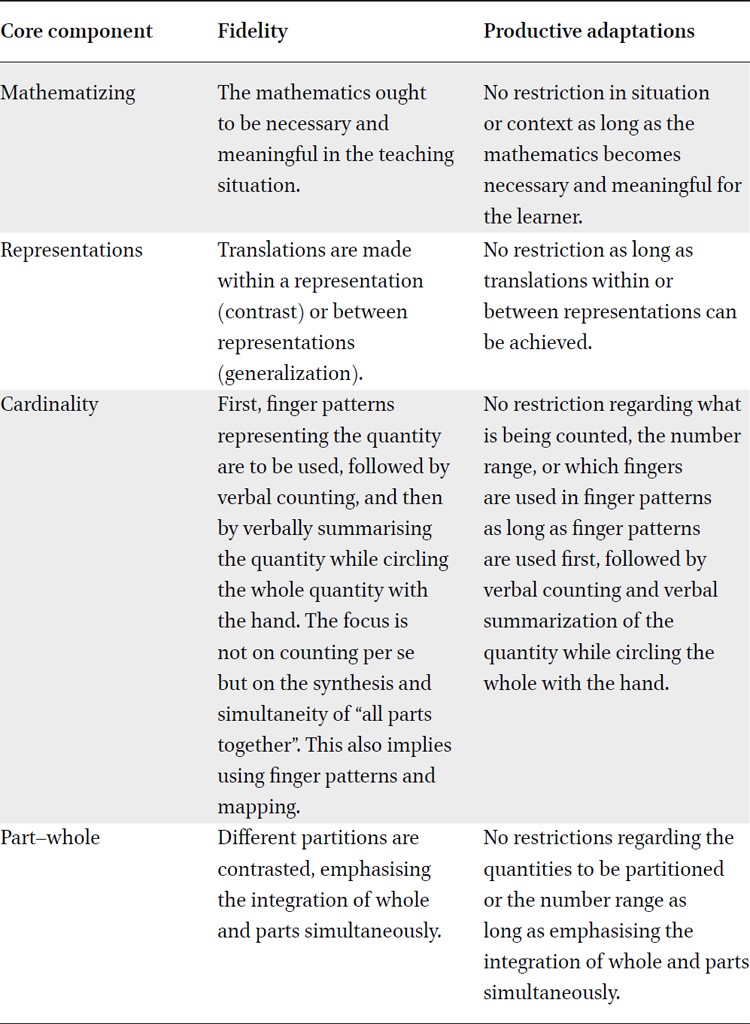
The first part of the guiding material, mathematizing, derives from Freudenthal (1968) work. In brief, mathematizing refers to the process of applying mathematical thinking and skills to solve problems in situations where mathematics is genuinely needed to progress. Central to Freudenthalâs work is the idea that mathematics should be experienced as meaningful and purposeful for the learner, rather than as an application of pre-given procedures distant from lived experience. As a core component, mathematizing means that, whether an activity is self-initiated or planned, the mathematics must contribute to the situation, thereby gaining a purpose and goal that make it meaningful for the children (e.g. Björklund & Palmér, 2024; Freudenthal 1968). Freudenthal distinguished between horizontal mathematization (using mathematics in familiar, realâworld situations) and vertical mathematization (symbolic reformulation that makes problems solvable). In this study, the focus is primarily on horizontal mathematization. Fidelity thus entails ensuring that mathematics is genuinely necessary within the taught situation, whereas productive adaptations relate to the wide range of contexts and situations in which such meaningful mathematizing may occur.
To draw attention to and distinguish the meaning of numbers, the second part highlights contrast and generalization, grounded in the Variation Theory of Learning (Marton, 2015). These principles are used systematically in the activities. Contrast is achieved through a careful selection of representations where as much as possible is kept the same, but the number is varied. For example, children may be shown two sets of objects with the same shapes and colours but with two and three items respectively. Once children have discerned the numbers, Generalization involves holding the number constant while varying the representations, for instance, for instance, showing three blocks, three fingers, and the word âthreeâ to illustrate the same quantity across representations. This part of the guiding material is not evaluated in itself in relation to fidelity or adaptations since contrast and generalization become visible only through the three subsequent parts, that is, through representations in the teaching of cardinality and partâwhole relations.
The third part focuses on the role of representations. For young children, manipulatives, pictures, and symbols have proven to be important representations in learning about numbers and quantity (e.g., Björklund & Palmér, 2022; Lesh et al., 1987). Including these representations in teaching allows children to experience how the same mathematical content can be represented in different ways, and how translations can be made within and between various representations. In relation to representations, fidelity entails translating within one type of representation (contrast) or between different types (generalization), while, with productive adaptations, as long as it is possible to translate within or between representations, different representations can be used. For example, in an activity, the teacher can plan for a contrast between the numbers two and three, using finger patterns or manipulatives, as long as the contrast is made within the same representation.
The fourth part of the guiding material centres on cardinality, understanding that the last number word in a counting sequence represents the total quantity. Successful practice involves pointing and counting âone, two, threeâ followed by a summarizing statement such as âthere are three blocksâ while simultaneously circling all the blocks with a hand movement (e.g. Björklund & Palmér, 2022). Using finger patterns to represent quantities is effective for helping children attend to cardinality (meaning that a certain number of fingers are shown simultaneously to represent a specific number). Finger patterns can be a combination of different fingers shown while representing the same quantity. Another important practice is mapping, which refers to matching fingers and objects one-to-one. Through such mapping, it becomes visually clear whether there are as many fingers as objects, or whether any finger or object is âleft overâ. In relation to cardinality, fidelity implies first using finger patterns for the quantity, then pointing and counting âone, two, three,â followed by summarizing âthere are three blocks,â while circling all blocks with the hand. The focus is not on the counting but on the synthesis and simultaneity of âall parts togetherâ. Fidelity also implies using finger patterns and mapping. Productive adaptations involve what is being counted, the number range, and which fingers are being used in finger patterns.
Finally, the fifth part of the guiding material focuses on partâwhole relations of numbers, that is, how a whole can be decomposed and recomposed in different ways without changing the total quantity. It is important to contrast different partitions (for example, 4 can be decomposed into 2 and 2, or 3 and 1). In relation to partâwhole relations of numbers, fidelity implies that the teacher emphasizes the integration of whole and parts simultaneously, while productive adaptations involve changes to what is to be partitioned and adapting the number range.
Each of the five parts of the guiding material follows a identical structure: a text to read (approximately three pages), a video illustrating the content of the text in authentic preschool teaching situations, questions to discuss with colleagues, scripted activities to be carried out with children and video-documented, and finally, one activity to be planned, carried out, and video-documented by the preschool teachers themselves. Each part concludes with a forward-looking checklist that integrates the components progressively. Although the parts were completed sequentially, they are intended to function as an interconnected whole. For example, when teachers work with cardinality, earlier components: mathematizing, contrast and generalization, and representations, provide essential pedagogical foundations. After the five parts have been completed, the checklist appears as follows:
How will mathematics contribute to the situation or activity?
How will the children be engaged in the mathematical content of the activity?
How will the cardinality of numbers be made visible in the activity?
Will contrasts be used to show similarities and differences in quantity? If so, how?
Will generalization be used to show similarities and differences in quantity? If so, how?
Which representations and gestures (e.g., to summarize or to indicate a whole set of objects) will be used and connected within the activity?
Will finger patterns be used as a form of representation? If so, how?
Will mapping be used? If so, how?
Will the partâwhole relationship of numbers be made visible in the activity? If so, how?
All activities in the guiding material are similar to those commonly occurring in preschool and align with how the curriculum frames teaching and mathematical content in Swedish preschool. Since it was the preschool teachers themselves who designed the activities analysed in this study, we do not know the extent to which these activities resemble or diverge from their usual mathematics teaching. However, we can assume that mathematics instruction does occur at these preschools, as it is content that all children are expected to encounter according to the curriculum (National Agency for Education, 2025).
4 Method
The empirical material in this article derives from a study in which all preschools from one Swedish municipality implemented the above-described guiding material. For this study, video documentations of activities planned and enacted by preschool teachers were analysed. In the Swedish context, being a preschool teacher means having completed a three-and-a-half-year university teacher education program. The preschool teachers in the study had between 0 and 39 years of experience working in preschools. The extent to which the teachers had studied mathematics in their university teacher education varies depending on when they completed their training. All Swedish ethical guidelines for research regarding information, consent, and confidentiality were followed in all stages of the study (approved ethical review 2023-01344-01).
4.1 Analysis
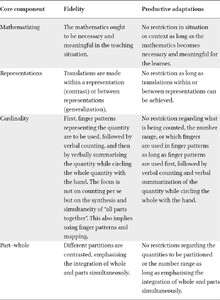
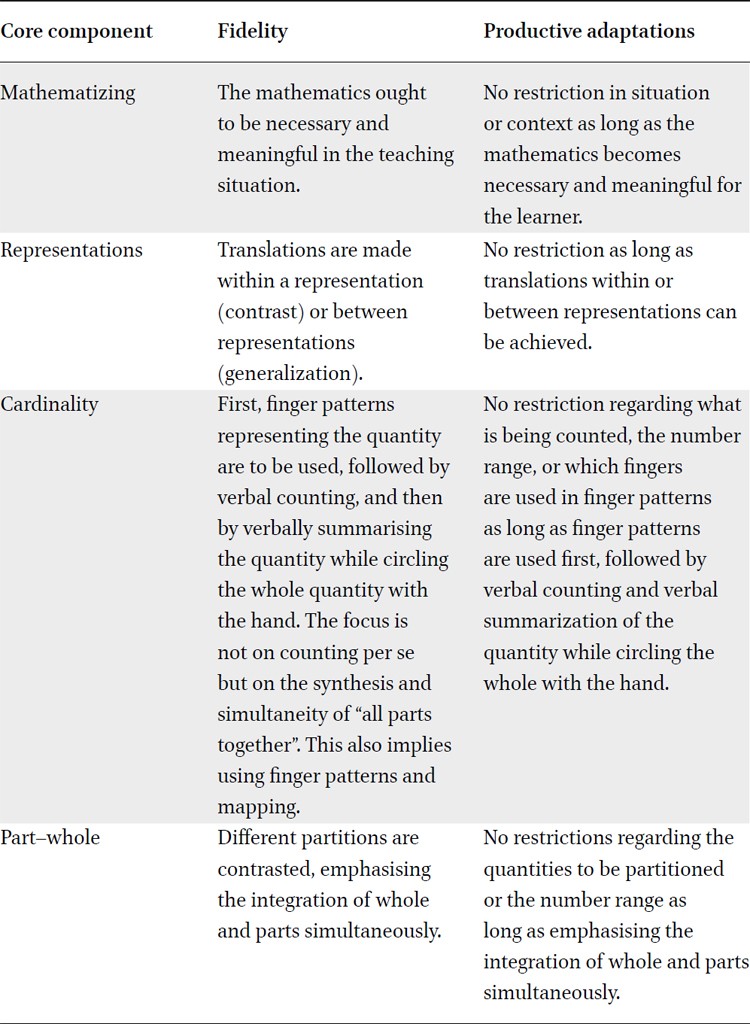
The analysis in this article is based on 43 video documentations of the activities planned and enacted by the teachers themselves. In total, 34 different preschool teachers conducted the teaching in these video documentations. We used a directed content analysis approach (Hsieh & Shannon, 2005), drawing on prior research that informed and underpinned the core principles. In our study, this meant that the constructing elements of the core components were used as codes; these are presented and elaborated on in Table 1. These codes were applied to the video documentations and compiled in a joint file. Subsequently, the analysis focused on identifying patterns of fidelity and adaptation in relation to the innovationâs core components, with a focus on whether the core components were maintained (fidelity) and whether the adaptations made could be considered productive (see Table 1). The analysis was conducted by the first author and then validated by the other authors.

Core components, fidelity, and productive adaptations
Citation: Implementation and Replication Studies in Mathematics Education 6, 1 (2026) ; 10.1163/26670127-bja10035
5 Results
In the analysis, when elaborating on patterns of fidelity and adaptation in relation to the innovationâs core components, it became evident that we could distinguish between fidelity related to the core component of mathematizing and fidelity related to the other core components of the mathematical content, that is, representations, cardinality, and partâwhole relations. Based on this distinction, the analysis resulted in four fidelity categories (Table 2).
Four categories of fidelity in relation to mathematizing and mathematical content
Citation: Implementation and Replication Studies in Mathematics Education 6, 1 (2026) ; 10.1163/26670127-bja10035
Below, empirical examples are provided to illustrate each of the four categories. These examples are intended as representative illustrations of the different categories and can be seen as typical examples, but they do not constitute the basis for the entire analysis. As the analysis is qualitative, the categories were not quantified; however, each category is grounded in more than five video-documented activities.
5.1 Fidelity to Both the Intended Mathematical Content and Mathematizing
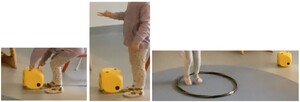
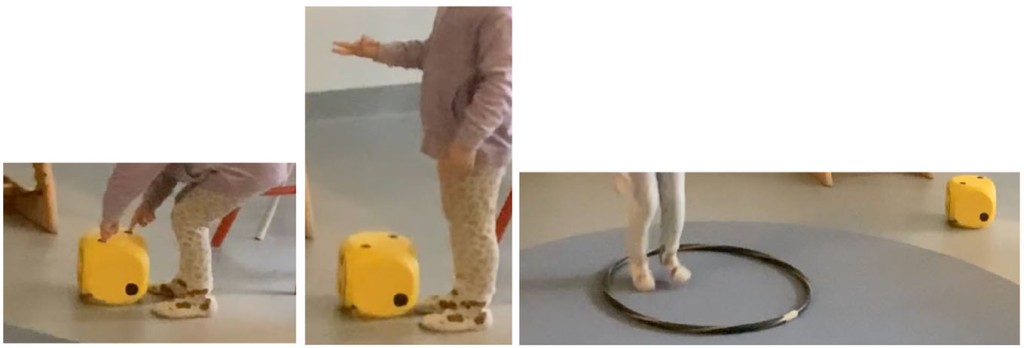
One example of an activity with fidelity to both the mathematical content and the core component of mathematizing is the game âhop-hopâ. In this activity, the teacher and children dance outside hoops lying on the floor (Figure 1, right). When the music stops, a child is asked to roll a large die (approximately 16 Ã 16 cm) and performed a number of jumps corresponding to the dieâs dots (1â3) inside a hoop.
The game âhop-hopâ
Citation: Implementation and Replication Studies in Mathematics Education 6, 1 (2026) ; 10.1163/26670127-bja10035
In the example illustrated in Figure 1, the child rolls a 2 on the die. The child immediately maps one finger to each dot and verbally labels the quantity as âtwoâ (Figure 1, left). The teacher confirms and asks the child to count the dots. The child counts, âone, twoâ pointing at one dot at the time. The teacher then asks whether she can show 2 with her fingers, which she does (Figure 1, middle). The teacher again confirms by also showing the finger pattern for 2 and then circles the dots on the die, saying âtwo dotsâ. The teacher then asks, âHow many times should you jump?â The child holds up two fingers. The teacher confirms and asks how the child would like to jump. She chooses to jump on two feet. The music starts, and both the child and the teacher jump âon two feetâ in their hoop.
In this example, fidelity is maintained with respect to the intended mathematical content, representations and cardinality, even though no contrast between quantity occurs. Furthermore, since the number of jumps forms an integral part of the game, fidelity is also maintained with regard to mathematizing, in the sense that the mathematics becomes both necessary and meaningful in the activity.
5.2 Fidelity to Mathematizing But Not to the Intended Mathematical Content
An example of an activity with fidelity to mathematizing but low fidelity to mathematical content appears in the activity âFive Little Monkeys Jumping on the Bedâ. This activity is a song-based activity in which five monkeys jump on the bed, one at a time falling off until none remain (decreasing quantity). While reciting the rhyme âfive/four/three ⦠little monkeys jumping on the bedâ, the teacher and children act out the scenario jumping with their fingers on their other hand (Figure 2, left). In this situation, the teacher also uses a picture of a bed, five monkeys, the mother, and the doctor (characters in the song, Figure 2, middle).
The game âFive Little Monkeys Jumping on the Bedâ
Citation: Implementation and Replication Studies in Mathematics Education 6, 1 (2026) ; 10.1163/26670127-bja10035
In the example illustrated in Figure 2, two children sit on each side of the teacher. The teacher recites the rhyme aloud, jumping with the fingers on her hand (Figure 2, left), then pointing to the mother when she is mentioned in the song, and to the doctor when he is mentioned. She then removes one monkey and places it on her lap, so it is no longer visible, counting the remaining monkeys: âone, two, three, four.â Then she starts the rhyme again with four monkeys. Occasionally, the teacher takes a childâs hand when counting the monkeys (Figure 2, left).
In this example, fidelity is maintained with regard to mathematizing, in the sense that the mathematics becomes necessary and meaningful in the activity; to know how many monkeys are jumping on the bed. However, fidelity is not maintained with regard to the intended mathematical content, representations, cardinality, and partâwhole relations. For instance, there are no finger patterns and no circling, only counting, and the last number word is not repeated. Moreover, the partâwhole relationship is not made visible, as the monkeys that fall from the bed are placed on the teacherâs lap. Additionally, as the children are very young (around 2 years old), the quantity of five may be challenging for them to comprehend within the activity.
5.3 Fidelity to the Intended Mathematical Content But Not Mathematizing
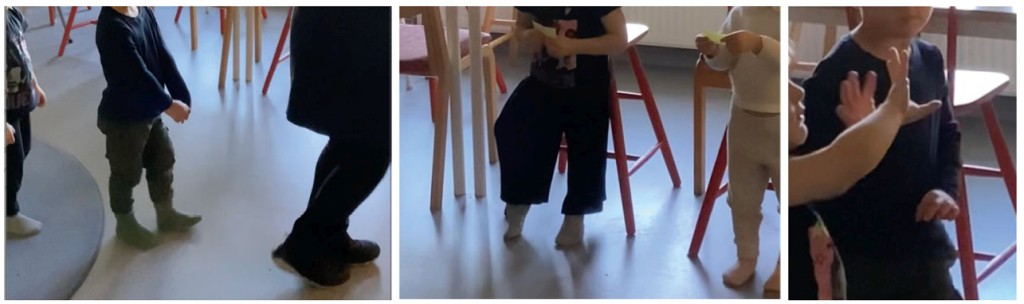
An example of an activity with fidelity to the mathematical content but not to mathematizing is the game âTingeling Trainâ. This activity is a song-based game in which the preschool teacher leads the train, and one child at a time is invited to ride along (Figure 3, left). Each child has a ticket (Figure 3, middle), and before departure the teacher counts the children, using finger patterns to support the counting process, and the children also use finger patterns (Figure 3, right) showing the corresponding number of fingers (not necessarily the same finger patterns). When a child is unsure, the teacher encourages them to count the fingers in the teacherâs finger pattern. After all the children on the train have been counted, the teacher circles around the counted group to emphasize the total number and verbally repeats how many there are.
The game âTingeling Trainâ
Citation: Implementation and Replication Studies in Mathematics Education 6, 1 (2026) ; 10.1163/26670127-bja10035
In this example, fidelity is maintained with respect to the intended mathematical content, representations and cardinality. The teacher uses finger patterns, verbal repetition, and visual marking, consistent with the core components. However, although the song-based narrative of the activity contributes to engagement and interest, the number of passengers on the train is not essential for completing the activity. Thus, fidelity is not maintained with regard to mathematizing in the sense the mathematics is not necessary in the teaching situation.
5.4 Fidelity Neither to Mathematizing Nor the Mathematical Content
An example of an activity showing fidelity to neither mathematizing nor the mathematical content is an activity in which the children draw objects (plastic bird figures) from a bag and distribute them into coloured bowls (red and blue). The children are instructed to place each bird into the bowl of the corresponding colour. The objects in each bowl are counted in collaboration between the child and teacher at regular intervals.
In the example illustrated in the left and middle panel in Figure 4, the child first draws two red birds. He says that there are âtwoâ. The teacher asks what colour they are, and he replies âredâ and places them in the red bowl. Next, he draws one red, one blue, and one yellow figure (Figure 4, middle). Since there is no bowl for the yellow figure, it is placed beside the bowls. A little later, bird figures of different sizes as well as one green figure are drawn from the bag. Occasionally, the teacher pauses the activity, and together they count how many figures are in each bowl. During these moments, both number words and finger patterns are used.
Objects in bowls
Citation: Implementation and Replication Studies in Mathematics Education 6, 1 (2026) ; 10.1163/26670127-bja10035
In this example, fidelity is not maintained with respect to the intended mathematical content, representations, cardinality, or partâwhole relations. Although the teacher uses number words and finger patterns, the chosen representations do not foreground quantity; instead, colour becomes the primary focus. Moreover, when number words and finger patterns are used, they are not connected; the focus is on counting (âone, two â¦â) rather than on the synthesis and simultaneity of âall parts togetherâ. Furthermore, since the number of figures in each bowl does not serve a clear purpose in the activity (for example, there is no goal expressed as to why the figures should be sorted into the bowls), fidelity is not maintained with regard to mathematizing, that is, the mathematics does not become necessary or meaningful within the activity.
6 Discussion
The aim of this study was to examine how preschool teachers enacted fidelity and adaptation when implementing an innovation with several core components. The analysis revealed four qualitatively different categories of fidelity based on the distinction between the core component of mathematizing and the remaining content-related components, that is representations, cardinality, and part-whole relations. These patterns should not be understood as âgoodâ or âbadâ teaching. Rather, they illustrate different ways in which teachers interpreted and translated the innovation in practice. The four categories resonate with the distinction between pedagogical, mathematical, and cognitive fidelity proposed by Dick (2008). Fidelity to mathematizing aligns with pedagogical fidelity while fidelity to the mathematical content is in line with mathematical fidelity. A next step would be to study cognitive fidelity, that is, how children´s learning and understanding unfold. In relation to the four categories presented in the results, we wish to emphasize that we do not consider any activity to be an undesirable teaching activity. From the perspective of our theoretical framing of the innovation, not all activities that the teachers conducted provided children with the best conditions for mathematics learning; however, this does not imply that the children learned nothing or did not experience the activities as enjoyable even when fidelity to core components was low.
The finding that fidelity to mathematical content occurred without fidelity to mathematizing was somewhat surprising given that the Swedish national curriculum emphasizes that preschool teaching should be based on childrenâs exploration, curiosity, and desire to play (National Agency for Education, 2025). This may be explained by teachersâ priorities when implementing new content. Maybe, when core components are unfamiliar, they tended to become the primary focus, which may have overshadowed contextual aspects that make mathematics meaningful. Maintaining more than one focus simultaneously may be challenging, and what was new often became foregrounded. This finding raises important questions about how guiding materials can be designed to support teachers in integrating both content-related core components and contextual meaning into their teaching.
In general, fidelity is essential for preserving the theoretical underpinnings and intended outcomes of an innovation, while adaptation is often necessary to ensure relevance, responsiveness to local needs, and sustainability in diverse settings (Carroll et al., 2007). The findings of this study contribute to ongoing discussions about balancing these dimensions in large-scale implementation of educational innovations. Similar to previous research (Clements et al., 2011, Foster et al., 2016; Jacobs et al., 2017; Thomas et al., 2018), our results show that some level of adaptation was both inevitable and necessary. In the analysis, it became clear that fidelity to mathematizing always involved some form of productive adaptation. Because mathematizing requires teachers to align the mathematical task with childrenâs perspectives and intentions, teachers needed to adjust pacing, representations, or the narrative frame to sustain engagement. In this sense, productive adaptations served to preserve the function of the core component rather than to deviate from it. These findings challenge a common misconception that high fidelity equates to rigid replication; instead, high fidelity can be achieved through context-sensitive adaptations that maintain the innovationâs underlying mechanisms.
Another result from this study concerns the notion of fidelity itself. While some approaches treat fidelity as static adherence to prescribed procedures, our findings suggest a dynamic view. In context, fidelity involves maintaining the intent and core components of an innovation rather than replicating its surface features (Century & Cassata, 2014). From this standpoint, productive adaptation becomes an integral part of high-fidelity implementation rather than its opposite. This interpretation aligns with the notion of principled adaptation proposed by Cobb et al. (2020), where adaptations that preserve core components are considered indicators of high fidelity rather than deviations. Recognizing this interplay highlights their interdependence and points to the need for future research to develop frameworks and tools that help teachers and researchers identify, document, and evaluate productive adaptations as indicators of meaningful, context-sensitive fidelity.
The findings have practical implications for supporting teachersâ implementation of early mathematics innovations. First, guiding materials may need to more explicitly make the distinction between fidelity and adaptation visible, illustrating how core components can be preserved while allowing flexibility in delivery. Second, by highlighting the interconnections between core components, teachers can better integrate representations, cardinality, partâwhole relations and mathematizing into their activities. Finally, acknowledging that adaptations are inevitable and often a productive part of implementation can empower teachers to make informed, context-sensitive decisions while maintaining the educational intent of the innovation.
In conclusion, this study suggests that fidelity and adaptation should not be conceptualized as opposing forces in early mathematics implementation. Instead, productive adaptations are integral to enacting the core components in a meaningful and context-responsive manner. When teachers preserve the underlying mechanisms of the innovation while making context-sensitive adaptions, mathematics becomes both necessary and meaningful for young learners. This dynamic interplay offers an important direction for future implementation research and for the design of guiding materials that support high-quality enactment of educational innovations across diverse preschool contexts.
Acknowledgement
The study was funded by the Swedish Institute for Educational Research (dnr 2022-00010)
References
Björklund, C., & Palmér, H. (2022). Teaching toddlers the meaning of numbers â Connecting modes of mathematical representations in book reading. Educational Studies in Mathematics, 110(3), 525â544. https://doi.org/10.1007/s10649-022-10147-3.
Björklund, C., & Palmér, H. (2024). The challenges of mathematizing in Swedish early childhood education. Journal of Early Childhood Education Research, 13(2), 167â186. https://doi.org/10.58955/jecer.138122.
Carroll, C., Patterson, M., Wood, S., Booth, A., Rick, J., & Balain, S. (2007). A conceptual framework for implementation fidelity. Implementation Science, 2, Article 40. https://doi.org/10.1186/1748-5908-2-40.
Century, J., & Cassata, A. (2014). Conceptual foundations for measuring the implementation of educational innovations. In L. M. Hagermoser Sanetti & T. R. Kratochwill (Eds.), Treatment integrity: A foundation for evidence-based practice in applied psychology (pp. 81â108). American Psychological Association. https://doi.org/10.1037/14275-006.
Clayback, K. A., Williford, A. P., & Vitiello, V. E. (2022). Identifying teacher beliefs and experiences associated with curriculum implementation fidelity in early childhood education. Prevention Science, 24(1), 27â38. https://doi.org/10.1007/s11121-022-01414-z.
Clements, D. H., Sarama, J., Spitler, M. E., Lange, A. A., & Wolfe, C. B. (2011). Mathematics learned by young children in an intervention based on learning trajectories: A large-scale cluster randomized trial. Journal for Research in Mathematics Education, 42(2), 127â166. https://doi.org/10.5951/jresematheduc.42.2.0127.
Cobb, P., Jackson, K., Henrick, E., & Smith, T. M. (2020). Systems for instructional improvement: Creating coherence from the classroom to the district office. Harvard Education Press.
Coburn, C. E. (2003). Rethinking scale: Moving beyond numbers to deep and lasting change. Educational Researcher, 32(6), 3â12. https://doi.org/10.3102/0013189X032006003.
Debarger, A. H., Choppin, J., Beauvineau, Y., & Moorthy, S. (2013). Designing for productive adaptations of curriculum interventions. Teachers College Record, 115(14), 298â319. https://doi.org/10.1177/016146811311501407.
Dick, T. P. (2008). Keeping the faith: Fidelity in technological tools for mathematics education. In G. W. Blume & M. K. Heid (Eds.), Research on technology and the teaching and learning of mathematics: Vol. 2. Cases and perspectives (pp. 333â339). Information Age Publishing.
Durlak, J. A. (2010). The importance of doing well in whatever you do: A commentary on the special section, âImplementation research in early childhood educationâ. Early Childhood Research Quarterly, 25(3), 348â357. https://doi.org/10.1016/j.ecresq.2010.03.003.
Durlak, J. A., & DuPre, E. P. (2008). Implementation matters: A review of research on the influence of implementation on program outcomes and the factors affecting implementation. American Journal of Community Psychology, 41(3â4), 327â350. https://doi.org/10.1007/s10464-008-9165-0.
Foster, M. E., Anthony, J. L., Clements, D. H., Sarama, J., & Williams, J. M. (2016). Improving mathematics learning of kindergarten students through computer-assisted instruction. Journal for Research in Mathematics Education, 47(3), 206â232. https://doi.org/10.5951/jresematheduc.47.3.0206.
Freudenthal, H. (1968). Why to teach mathematics so as to be useful. Educational Studies in Mathematics, 1(1â2), 3â8. https://doi.org/10.1007/BF00426224.
Hiebert, J., Wieman, R. M., & Berk, D. (2017). Designing systems for continuously improving instruction: The case of teacher preparation mathematics courses. In Ferretti, R. P. & Hiebert, J. (Eds.), Teachers, Teaching, and Reform (pp. 116â139). Routledge.
Hsieh, H. F., & Shannon, S. E. (2005). Three approaches to qualitative content analysis. Qualitative Health Research, 15(9), 1277â1288. https://doi.org/10.1177/1049732305276687.
Jacobs, J., Seago, N., & Koellner, K. (2017). Preparing facilitators to use and adapt mathematics professional development materials productively. International Journal of STEM Education, 4(1), Article 30. https://doi.org/10.1186/s40594-017-0089-9.
Jankvist, U. T., Aguilar, M. S., Misfeldt, M., & Koichu, B. (2022). How about fidelity? Implementation and Replication Studies in Mathematics Education, 2(2), 131â148. https://doi.org/10.1163/26670127-02012020.
Lesh, R., Post, T. R., & Behr, M. (1987). Representations and translations among representations in mathematics learning and problem solving. In C. Janvier (Ed.), Problems of representation in the teaching and learning of mathematics (pp. 33â40). Lawrence Erlbaum Associates.
Maass, K., Cobb, P., Krainer, K., & Potari, D. (2019). Different ways to implement innovative teaching approaches at scale. Educational Studies of Mathematics, 102(3), 303â318. https://doi.org/10.1007/s10649-019-09920-8.
Marton, F. (2015). Necessary conditions of learning. Routledge.
National Agency for Education. (2025). Curriculum for the preschool: Lpfö 18 revised 2025 (3rd ed.).
Nelson, M. C., Cordray, D. S., Hulleman, C. S., Darrow, C. L., & Sommer, E. C. (2012). A procedure for assessing intervention fidelity in experiments testing educational and behavioral interventions. The Journal of Behavioral Health Services & Research, 39(4), 374â396. https://doi.org/10.1007/s11414-012-9295-x.
Palmér, H., & Björklund, C. (2023). The teaching of numbers in common preschool activities â A delicate balancing act. Early Childhood Education Journal, 51(5), 971â980. https://doi.org/10.1007/s10643-022-01354-x.
Palmér, H., & Björklund, C. (2024). Extending common preschool activities for mathematics teaching with toddlers. The 15th International Congress on Mathematical Education, Sydney, 7â14 July 2024.
Stirman, S. W., Miller, C. J., Toder, K., & Calloway, A. (2013). Development of a framework and coding system for modifications and adaptations of evidence-based interventions. Implementation Science, 8, Article 65. https://doi.org/10.1186/1748-5908-8-65.
Thomas, J., Cook, T. D., Klein, A., Starkey, P., & DeFlorio, L. (2018). The sequential scale-up of an evidence-based intervention: A case study. Evaluation Review, 42(3), 318â357. https://doi.org/10.1177/0193841X18786818.
Walkowiak, T. A., Pinter, H. H., & Berry, R. Q. (2017). A Reconceptualized Framework for âOpportunity to Learnâ in School Mathematics. Journal of Mathematics Education at Teachers College, 8(1). https://doi.org/10.7916/jmetc.v8i1.800.