Abstract
Adoption is an unusual behaviour across taxa, and for adoption to be successful, with the infant surviving to independence, the adoptive parent must be able to provide appropriate nutrition and care. Successful adoption has now been reported in several nonhuman primate species and here we add a case in wild yaki (Sulawesi crested macaque, Macaca nigra). We observed the adoption of an approx. 2-week-old infant by a female with her own approx. 3-week-old infant who went on to carry, nurse, and care for both infants until they both became independent. The adoptive and biological mother had each previously raised the same number of offspring (5). There was no evidence of aggressive transfer and we did not observe any attempts by the adopted infant’s biological mother to retrieve her. The biological mother went on to have another infant 8 months later while the adoptive mother was still caring for her other infant. This case may reflect some of the health costs and reproductive benefits of adoption for nonhuman primates.
1. Introduction
Adoption is a widespread but infrequent behaviour across social species, such as African wild dogs (Lycaon pictus; McNutt & Weldon, 1996), Atlantic bottlenose dolphins (Tursiops truncates; Howells et al., 2009), common gulls (Larus canus; Bukaciński et al., 2000), common vampire bats (Desmodus rotundus; Razik et al., 2021), eastern grey kangaroos (Macropus giganteus; King et al., 2015), emperor penguins (Aptenodytes forsteri; Jouventin et al., 1995), greater rheas (Rhea americana; Codenotti et al., 1998), northern elephant seals (Mirounga angustirostris, Riedman et al., 1982) and polar bears (Ursus maritimus; Malenfant et al., 2016). In these cases, adoption happened when the mother was killed/disappeared or the offspring was abandoned or kidnapped, but to be successful (i.e. the offspring survives until they become independent of their caregiver) either the offspring or their adoptive parent had to be able to meet the offspring’s nutritional and care needs. Adoption can fail due to the adoptive parent’s inability to provide the necessary care (e.g. chimpanzees, Pan troglodytes; Wroblewski, 2008).
For primates in particular, successful adoption may be more widespread than previously thought, with a spate of recent case studies across diverse species and genera. Successful adoption has been observed in three species of howler monkeys (infant age: approx. 2 months, Alouatta caraya; Pavé et al., 2010; 2 months, Alouatta guariba clamitans; Chaves et al., 2020; 4.5 months, Alouatta seniculus; Agoramoorthy & Rudran, 1992), and has been reported for wild chimpanzees at all long-term research sites (Hobaiter et al., 2014). Two successful intercommunity adoptions of infants from outside the adoptive mothers’ community have been observed in bonobos (2.6 and 3 years, Pan paniscus; Tokuyama et al., 2021), and one case each in black-fronted titi monkeys (approx. 2 months, Callicebus nigrifrons; Cäsar & Young, 2008) and Angola black and white colobus monkeys, although in this last case the adoptive mother’s biological infant died (approx. 4.5 months, Colobus angolensis palliates; Dunham & Opere, 2016). And there have been recent reports of adoption in free-ranging populations of four macaque species, with successful adoption occurring in three of these (“newborn”, Macaca fuscata; Ishizuka, 2020 (unsuccessful); 6 months, Macaca mulatta tcheliensi; Guo et al., 2023; 3.5 months, Macaca radiata; Anand et al., 2022; 3 weeks, Macaca thibetana; Wu et al., 2023).
Here we report a case of successful adoption in wild yaki (a.k.a. Sulawesi crested macaque, Macaca nigra). The infant was adopted at approx. 2 weeks old while the adoptive mother’s own infant was approx. 3 weeks old. The adopted infant’s mother was still alive and remained in the same group. Both mothers were multiparous and of similar age and rank (though exact dominance rank data were unavailable). To our knowledge this is one of the youngest successful infant adoptions (alongside the case of a 3-week-old Tibetan macaque; Wu et al., 2023), reported in wild nonhuman primates. Because of the rarity of adoption in nonhuman species, each individual case expands our understanding of the conditions under which successful adoption can occur and the potential reproductive benefits to the infant’s biological mother.
2. Materials and methods
We received ethical approval from the University of York Animal Welfare and Ethical Review Body. Research permits were granted by the Indonesian Ministry of Research, Technology and Higher Education (RISTEKDIKTI) and from Balai Konservasi Sumberdaya Alam Sulawesi Utara (BKSDA Sulut).
KG and Andre Pasetha (AP) observed the PB1b group of wild yaki at Macaca Nigra Project (MNP), Tangkoko Nature Reserve, North Sulawesi, Indonesia, from March 2018 to September 2019. MNP was established in 2006 and during our study period PB1b was one of four fully habituated groups of yaki (R1, R2, PB1b and PB1a). During the study period, we collected data from 19 adult females and 20 infants (8 females, 12 males) in PB1b.
We conducted full-day focal follows on mother-infant dyads from 0- to 12 months old, with instantaneous scan data collected on the focal pair at 15-min intervals. We recorded mother and infant activity, social partners, and mother-infant proximity. During the two weeks post-adoption (4–18 April 2018), KG and AP conducted daily follows of the two mothers (adoptive and biological) and two infants. After that period, we resumed collecting data at the same schedule as for other mother–infant dyads, i.e. one full-day follow at approx. 1.5 month intervals. More information on data preparation and analysis procedures can be found in the Appendix, and all analysed data can be found at 10.6084/m9.figshare.27094294.
3. Results
Between 6–12 March 2018, Fiona gave birth to her sixth infant, Fufu (female). Between 17–25 March 2018, Kristi also gave birth to her sixth infant, Kiara (female). The birth date ranges reflect when each mother was last seen without an infant and when she was first seen with an infant. Kiara was last seen with Kristi in the morning on 3 April 2018. On 4 April 2018 at approx. 09:30 Fiona was first seen carrying both Fufu (23- to 29-days-old) and Kiara (10- to18-days-old). No injuries were observed on Fiona, Fufu, Kristi, or Kiara, and all appeared to be healthy on the day of the adoption.
During the two weeks post-adoption, we did not observe any attempts by Kristi to retrieve Kiara from Fiona, despite some proximity between the dyad (Kristi was within 5 m of Kiara on 11/144 scans where mother-infant distance was available). On 9 April 2018, Kiara transferred from Fiona to an unidentified female juvenile who carried her periodically throughout the day — this was the first time that Kiara appeared distressed, vocalizing, and attempting to escape from the juvenile, who held her back if she tried to approach any other individual (see Video 1 at 10.6084/m9.figshare.27094294). Kristi still did not attempt to retrieve Kiara, despite some proximity (2/23 scans within 5 m). Fiona retrieved Kiara that afternoon, but for the next few days the juvenile carried Kiara periodically and on 11 April 2018 the juvenile took Kiara full-time, including carrying her into the sleeping tree. Kiara seemed distressed, tired, and weakened from not nursing (see Video 1 at 10.6084/m9.figshare.27094294). Finally, on 14 April 2018, Fiona retrieved Kiara, who remained with Fiona henceforth.
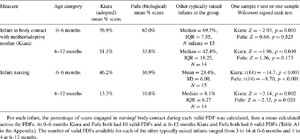
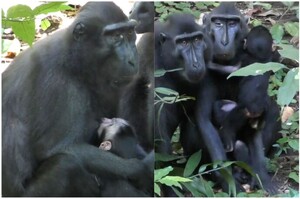
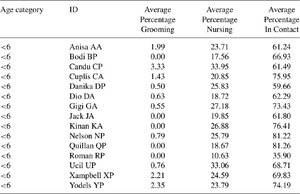
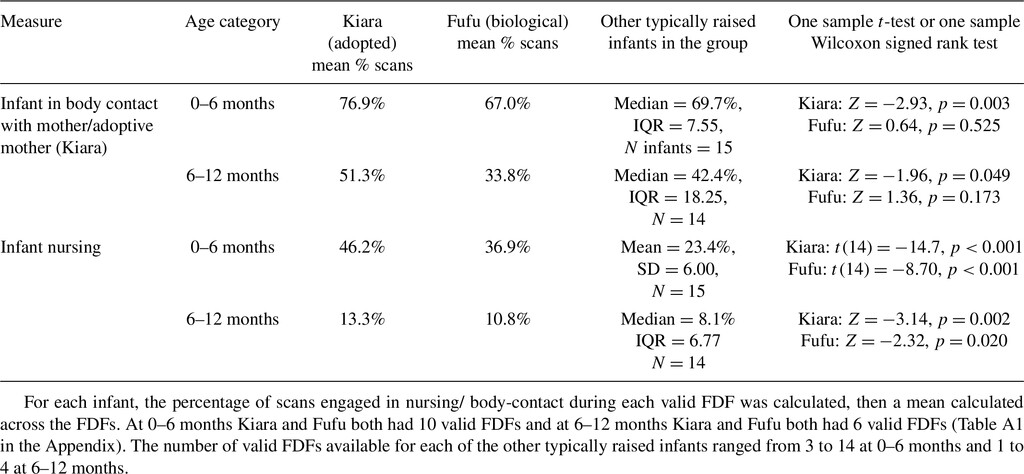
Fiona nursed, carried, and cared for both Fufu and Kiara until they were weaned (Figure A1 in the Appendix). From the day after the adoption, for four days, Fiona appeared to be unwell, with mucus around her eyes and nose (Figure A2 in the Appendix), but she continued to care for both infants throughout and was able to recover. To probe the impact of adoption on the adoptive mother and her biological and adoptive offspring we compared time spent in contact with the mother and nursing of other typically raised infants in the same age bracket (see Section A1 in the Appendix for details of methods; Table A1 in the Appendix). Table 1 shows that at both 0–6 months and 6–12 months Kiara (adopted), but not Fufu (biological) spent significantly more time in contact with Fiona than typically raised mother-infant dyads in the group. Both Kiara and Fufu spent more time nursing than other typically raised infants of similar age, when both 0–6 months old and 6–12 months old.

Mean percentage of scans Kiara (adopted), Fufu (biological), and other typically raised infants in the group spent in body contact and nursing with their mother/adoptive mother during full day follows (FDFs).
Citation: Behaviour 161, 10 (2024) ; 10.1163/1568539X-bja10285
4. Discussion
This case of adoption in wild yaki comes alongside other recent cases of successful adoption in wild nonhuman primates (Chaves et al., 2020; Tokuyama et al., 2021; Anand et al., 2022; Wu et al., 2023). Pre-weaning is thought to be a particularly dangerous time for an infant to be adopted, although these studies demonstrate infant age or adoptive mother’s lactation does not always ensure infant survival (Ishizuka, 2020; Anand et al., 2022). While successful adoption of a newborn infant has been observed in a zoo-housed group of Japanese macaques (Macaca fuscata; Fuccillo et al., 1983), to our knowledge, this is one of the youngest recorded cases of successful adoption in wild primates (see also Wu et al., 2023), with Kiara being approx. 2 weeks old at the time of transfer. At this early developmental stage, parental care is critical, and we were surprised that Kiara survived. Fiona was an experienced mother who was lactating to nurse a similar-aged infant, Fufu, which likely contributed to Kiara’s survival. This case was strikingly like that described in Tibetan macaques (Wu et al., 2023), where a young infant of a multiparous female was kidnapped/transferred to another multiparous female with a similar-aged biological infant, who then continued to care for both infants with no attempt from the adopted infant’s biological mother to retrieve them post-transfer. From the infant perspective, Kiara spent more time in body contact with her adoptive mother than Fufu and typically raised infants in the group, potentially in response to the stressful transfer event. Both Fiona and Kiara spent more time nursing than other infants, but it is unclear whether the subsequent reduction in time for social interaction may negatively impact the social development of either infant.
Despite being a risky strategy, if adoption is successful, the biological mother may incur fitness benefits. Kristi’s infant Kiara survived, and Kristi started ovulating again within two months of the adoption, giving birth to another infant, Kamila (female), on 11 November 2018. In contrast, this adoption was costly for the adoptive mother: in addition to the considerable energetic costs of nursing and caring for two infants simultaneously (both of whom spent more time than other infants nursing, reducing time for Fiona to forage), Fiona did not give birth to another infant until 6 November 2019, almost a year after Kristi. Despite these costs, in both this case and that of the Tibetan macaques, the motivation to take an infant and provide alloparental care seems to have come from the adoptive mothers (Wu et al., 2023). What drives this motivation remains unknown, although it may be a by-product of selection for maternal care (Silk, 1999). Further, as yaki are female philopatric, Fiona may benefit from Kiara’s support in adulthood, and a follow-up study could assess their adult relationship. It is also important to note that as the genetic relationship between Kristi and Fiona is unknown, the alloparental costs incurred by Fiona may also have been offset by inclusive fitness benefits, as found in two other macaque adoption cases: in Tibetan macaques, the infant’s adoptive mother was the granddaughter of the infant’s biological mother, and in Taihangshan macaques, the orphaned infant was adopted by her older sister, with her father also providing care (Guo et al., 2023; Wu et al., 2023). There may also be hormonal drivers of maternal and allomaternal care (Ziegler, 2000), but we were not able to assess these in the current study.
Allomaternal care is well-documented in macaques, and our observation introduces a fifth macaque species to the adoption database (Macaca fuscata; Ishizuka, 2020; Macaca mulatta tcheliensi; Guo et al., 2023; Macaca radiata; Anand et al., 2022; Macaca thibetana; Wu et al., 2023). These species exhibit the full range of macaque social tolerance, from despotic Macaca mulatta to tolerant Macaca nigra (Adams et al., 2015), indicating that social tolerance within this genus is not predictive of successful adoption. Sociality may still play a role though — for 5 cases of adoption in bonnet macaques, infant survival was best explained by mother sociality, not infant age/sex or adoptive mother rank (Anand et al., 2022).
Our observation was the first recorded successful and intra-group case of adoption by yaki at Tangkoko, but researchers have observed two other cases of unsuccessful inter-group adoptions in 2010 and 2016 (Julie Duboscq and Laura Martinez-Inigo, pers. commun.). The infrequency of adoption makes systematic study challenging, and yet these cases suggest adoption to be more widespread than previously thought. As rare as full, successful adoption is, in primates specifically and nonhuman species in general, we are slowly building a phylogeny for this behaviour through the accumulation of individual case studies such as this.
Corresponding author’s e-mail address: kirsty.graham@hunter.cuny.edu
Acknowledgements
We thank Andre Pasetha for his invaluable contribution to data collection; the directors and staff of the Macaca Nigra Project for facilitating the research; and Jérôme Micheletta, Julie Duboscq and Laura Martinez-Inigo for providing additional background information. We also thank the Indonesian State Ministry of Research and Technology (RISTEK), the Directorate General of Forest Protection and Nature Conservation (PHKA) and the Department for the Conservation of Natural Resources (BKSDA), North Sulawesi, for permission for this research. We thank Rismayanti for proofreading and editing our Bahasa Indonesia summary translation. This research was funded by an ERC consolidator grant (No. 724608) awarded to KS. KG is currently also funded through an ERC Horizon 2020 grant (No. 802719).
References
Adams, M.J., Majolo, B., Ostner, J., Schülke, O., De Marco, A., Thierry, B., Engelhardt, A., Widdig, A., Gerald, M.S. & Weiss, A. (2015). Personality structure and social style in macaques. — J. Personal. Soc. Psychol. 109: 338-353.
Agoramoorthy, G. & Rudran, R. (1992). Adoption in free-ranging red howler monkeys, Alouatta seniculus, of Venezuela. — Primates 33: 551-555.
Anand, A., Balakrishna, N., Singh, M., Isbell, L.A., Sirigeri, S., Saikia, A. & Arlet, M.E. (2022). Infant adoptions in wild bonnet macaques (Macaca radiata). — Primates 63: 627-635.
Bukaciński, D., Bukacińska, M. & Lubjuhn, T. (2000). Adoption of chicks and the level of relatedness in common gull, Larus canus, colonies: DNA fingerprinting analyses. — Anim. Behav. 59: 289-299.
Cäsar, C. & Young, R.J. (2008). A case of adoption in a wild group of black-fronted titi monkeys (Callicebus nigrifrons). — Primates 49: 146-148.
Chaves, Ó.M., Martins, V., Camaratta, D. & Bicca-Marques, J.C. (2020). Successful adoption of an orphan infant in a wild group of brown howler monkeys. — Primates 61: 301-307.
Codenotti, T.L. & Alvarez, F. (1998). Adoption of unrelated young by greater rheas. — J. Field Ornithol. 69: 58-65.
Dunham, N.T. & Opere, P.O. (2016). A unique case of extra-group infant adoption in free-ranging Angola black and white colobus monkeys (Colobus angolensis palliatus). — Primates 57: 187-194.
Fuccillo, R., Scucchi, S., Troisi, A. & D’Amato, F.R. (1983). Newborn adoption in a confined group of Japanese macaques. — Am. J. Primatol. 5: 257-260.
Guo, Y., Grueter, C.C. & Lu, J. (2023). Allomaternal care and ‘adoption’ in an edge-of-range population of Taihangshan macaques in Northern China. — Curr. Zool. 69: 215-218.
Hobaiter, C., Schel, A.M., Langergraber, K. & Zuberbühler, K. (2014). ‘Adoption’ by maternal siblings in wild chimpanzees. — PLoS ONE 9: e103777.
Howells, E.M., Reif, J.S., Bechdel, S.E., Murdoch, M.E., Bossart, G.D., McCulloch, S.D. & Mazzoil, M.S. (2009). A novel case of non-offspring adoption in a free-ranging Atlantic bottlenose dolphin (Tursiops truncatus) inhabiting the Indian River Lagoon, Florida. — Aquat. Mamm. 35: 43-47.
Ishizuka, S. (2020). Fake twins? Two cases of intensive allomaternal care by female Japanese macaques before and after their own partum. — Primates 61: 351-355.
Jouventin, P., Barbraud, C. & Rubin, M. (1995). Adoption in the emperor penguin, Aptenodytes forsteri. — Anim. Behav. 50: 1023-1029.
King, W.J., Forsyth, D.M., Coulson, G. & Festa-Bianchet, M. (2015). Adoption in eastern grey kangaroos: a consequence of misdirected care? — PLoS ONE 10(5): e0125182.
Malenfant, R.M., Coltman, D.W., Richardson, E.S., Lunn, N.J., Stirling, I., Adamowicz, E. & Davis, C.S. (2016). Evidence of adoption, monozygotic twinning, and low inbreeding rates in a large genetic pedigree of polar bears. — Polar Biol. 39: 1455-1465.
McNutt, J. (1996). Adoption in African wild dogs, Lycaon pictus. — J. Zool. 240: 163-173.
Pavé, R., Kowalewski, M.M. & Zunino, G.E. (2010). Adoption of an orphan infant in wild black and gold howler monkeys (Alouatta caraya). — Mastozool. Neotrop. 17: 171-174.
Razik, I., Brown, B.K.G., Page, R.A. & Carter, G.G. (2021). Non-kin adoption in the common vampire bat. — Roy. Soc. Open Sci. 8: 201927.
Riedman, M.L. & Le Boeuf, B.J. (1982). Mother–pup separation and adoption in northern elephant seals. — Behav. Ecol. Sociobiol. 11: 203-215.
Silk, J.B. (1999). Why are infants so attractive to others? The form and function of infant handling in bonnet macaques. — Anim. Behav. 57: 1021-1032.
Tokuyama, N., Toda, K., Poiret, M.L., Iyokango, B., Bakaa, B. & Ishizuka, S. (2021). Two wild female bonobos adopted infants from a different social group at Wamba. — Sci. Rep. 11: 1-11.
Wroblewski, E.E. (2008). An unusual incident of adoption in a wild chimpanzee (Pan troglodytes) population at Gombe National Park. — Am. J. Primatol. 70: 995-998.
Wu, X.M., Zhang, J., Chen, S.W., Sun, B.H. & Xia, D.P. (2023). Behavioral adaptation in an adoptive free-ranging female Tibetan macaque. — Primates 64: 469-474.
Ziegler, T.E. (2000). Hormones associated with non-maternal infant care: a review of mammalian and avian studies. — Folia Primatol. 71: 6-21.
Appendix
A.1. Introduction
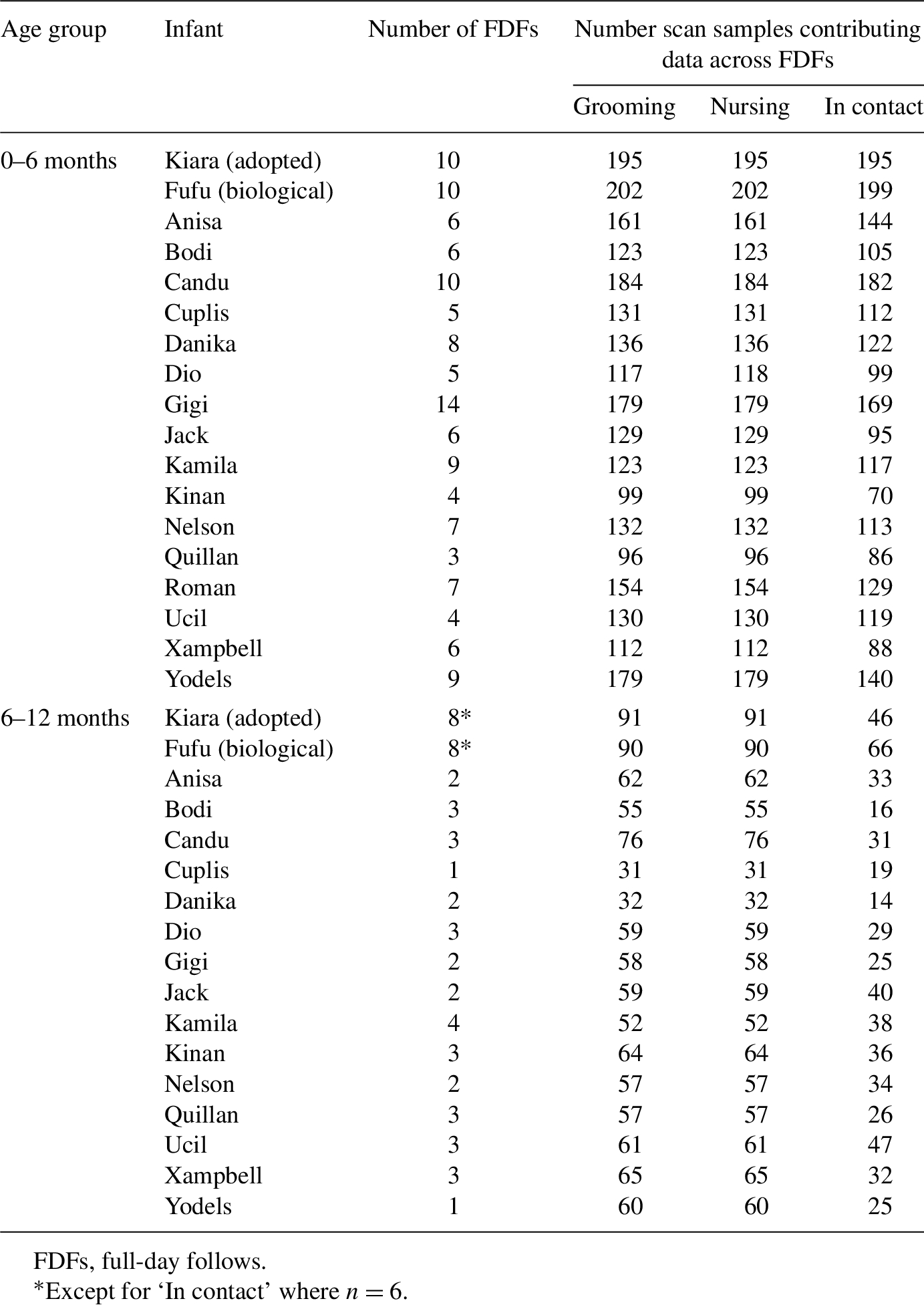
Kirsty Graham (KG) and Andre Pasetha (AP) conducted full-day focal follows on mother-infant dyads from 0–12 months old, in the PB1b group at Macaca Nigra Project, with instantaneous scan data collected on the focal pair at 15-min intervals. We recorded mother and infant activity, social partners, and mother-infant proximity. From 20 April 2018, data for Kiara was collected as if Fiona was her mother, since interactions with Kristi were so infrequent. When following Fufu and Kiara, data was collected on both individuals at the same time if both infants were in sight. There were 21 full-day follows where data was available for both Kiara and Fufu, and three full-day follows where data was not available for both infants because they were ranging more independently.
We compared infant-Fiona experience for Fufu and Kiara (in terms of % scans observed in body-contact, nursing, and grooming) to that of ‘typically raised’ infants in the same 6-month age bracket. We compared infants up to 6 months old (0–5.99 months;
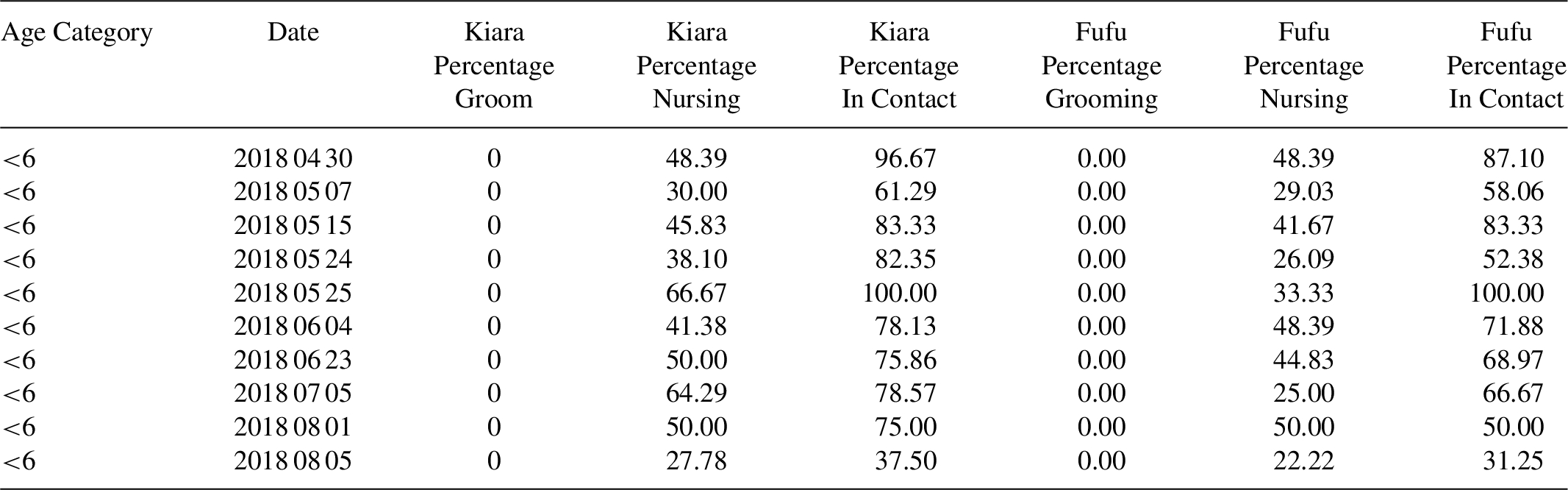
To calculate the average time each infant spent in body-contact, nursing, and grooming when they were 0–6 months and 6–12 months old we first identified all valid full-day follows for each individual. To be considered valid the full-day follow had to contain a minimum of 3 scans. For each valid full-day follow we then calculated the proportion of scan samples where infants were observed in body-contact with their mother, nursing, or grooming with their mother. Finally, for each of the two time periods (0–6 and 6–12 months) we used the daily proportion values to calculate the mean proportion of scans each individual spent engaged in the behaviours of interest.
In order to compare the percentage of scan samples Kiara and Fufu spent nursing and in contact with Fiona, with the percentage of time typically raised infants in the same group spent engaged in these activities, we compared the typically raised infants’ percentages to (i) Kiara’s mean percentage and (ii) Fufu’s mean percentage. Kiara and Fufu’s percentages were used as test values against which we compared the typically raised infant data. One-sample t-tests were used when typically raised infant data were normally distributed, and one-sample Wilcoxon sign rank sum tests were used when data were not normally distributed. Mother-infant grooming was observed at low levels and so inferential statistics were not run for grooming.
In order to directly compare the behaviour of Kiara and Fufu and their interactions with Fiona we also compared Kiara and Fufu’s behaviour within two age brackets: 0–6 months and 6–12 months. Using paired-sample Wilcoxon sign rank sum tests, we compared the percentages for each behaviour on each full day follow. Full-day follows were paired when data was collected on the same day (
Data for Kiara and Fufu was used from 20 April 2018 onwards, 16 days after the initial transfer of Kiara to Fiona.
A.2. Results
A.2.1. Time infant spends in body-contact with (adoptive) mother
At 0–6 months, the median percentage of scan samples where typically raised infants were observed in physical contact with their mother was 69.7% (IRQ = 7.55). The time typically raised infants spent in body contact with their mothers was not significantly different from that of Fufu-Fiona at this age (67.0% of 203 scans; One-Sample Wilcoxon:
At 6–12 months, the median percentage of scan samples where typically raised infants were observed in body contact with their mother was 42.4% (IRQ = 18.25). The time typically raised infants spent in body contact with their mothers at this age was not significantly different to that of Fufu–Fiona (observed in 33.8% of 62 scans;
A.2.2. Time infant spends nursing from (adoptive) mother
At 0–6 months, typically raised infants were observed nursing from their mother in mean 23.4% scan samples (SD = 6.00). The time typically raised infants spent nursing was significantly lower than that of Fufu with Fiona (observed in 36.9% of 206 scans;
At 6–12 months, the median percentage of scan samples where typically raised infants were observed nursing from their mother was 8.1% (IQR = 6.77). The time typically raised infants spent nursing was significantly lower than Fufu with Fiona (observed 13.3% of 91 scans;
When directly comparing Fufu and Kiara, there was no significant difference in the proportion of time they spent nursing from Fiona (matched-sample Wilcoxon:
A.2.3. Time infant spends grooming with (adoptive) mother
At 0–6 months, across 2055 scan samples from typically raised infants, grooming with mother was observed 19 times (in 10 of 15 infant-mother pairs). Neither Fufu nor Kiara were observed to engage in a grooming bout with Fiona in this age range (206, and 200 scans respectively).
At 6–12 months, across 792 scan samples (across 14 infant-mother pairs) from typically raised infants, grooming with the mother was only observed once. Fufu–Fiona grooming at this age was not observed (90 scans). Kiara–Fiona grooming was observed once (91 scans).
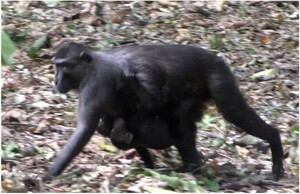
Photo of Fiona (adoptive mother) carrying both Fufu (own infant) and Kiara (adopted infant).
Citation: Behaviour 161, 10 (2024) ; 10.1163/1568539X-bja10285
Photos of Fiona on 02/04/2018 with an apparent mild eye infection. During this period Fiona was often sneezing and wiping her eyes and nose.
Citation: Behaviour 161, 10 (2024) ; 10.1163/1568539X-bja10285
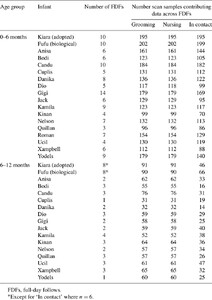
Summary of scan sample data used for infant macaques for the individual Fiona adopted (Kiara), Fiona’s biological infant (Fufu), and other typically raised infants.
Citation: Behaviour 161, 10 (2024) ; 10.1163/1568539X-bja10285
This data was used as the comparison data set from typically raised infants with which to compare Kiara and Fufu’s average percentage nursing, and in contact with Fiona to when less than 6 months old. For the typically raised infants the grooming, nursing, and in contact partners were their respective mothers. Two one-sample Wilcoxon signed rank tests were run to compare (i) Kiara and (ii) Fufu’s contact with Kiara. Comparison value for Kiara was 76.9% and for Fufu was 67.0%. Two one-sample t-tests were run to compare (i) Kiara and (ii) Fufu’s nursing with Kiara. Comparison value for Kiara was 46.2% and for Fufu was 36.9%. These analyses are presented in the main manuscript. No statistical tests were done to compare grooming since no instances of grooming were observed in the scan samples for Kiara-Fiona, and Fufu-Fiona at this age.
Citation: Behaviour 161, 10 (2024) ; 10.1163/1568539X-bja10285
This data was used as the comparison data set from typically raised infants of which to compare Kiara and Fufu’s average percentage nursing, and in contact with Fiona to when 6–12 months old. For the typically raised infants the grooming, nursing, and in contact partners were their respective mothers. Two one-sample Wilcoxon signed rank tests were run to compare (i) Kiara and (ii) Fufu’s contact with Kiara. Comparison value for Kiara was 51.3% and for Fufu was 33.8%. Two one-sample Wilcoxon tests were run to compare (i) Kiara and (ii) Fufu’s nursing with Kiara. Comparison value for Kiara was 13.3% and for Fufu was 10.8%. These analyses are presented in the main manuscript. No statistical test were done to compare grooming since instances of grooming were observed infrequently the scan samples for Kiara-Fiona, and were not observed for Fufu-Fiona at this age.
Citation: Behaviour 161, 10 (2024) ; 10.1163/1568539X-bja10285
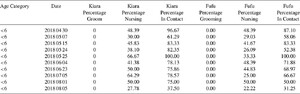
This data was used as the for comparing Kiara and Fufu’s average percentage grooming, nursing, and in contact with Fiona to oneanother when less than 6 months old. Two paired-sample Wilcoxon tests were run to compar Kiara and Fufu’s (i) contact with Kiara and (ii) nursing with Kiara. These analyses are presented in the supplementary material. No statistical tests were done to compare grooming since no instances of grooming were observed in the scan samples for Kiara-Fiona, and Fufu-Fiona at this age.
Citation: Behaviour 161, 10 (2024) ; 10.1163/1568539X-bja10285
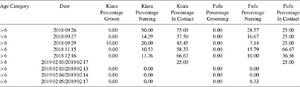
This data was used as the for comparing Kiara and Fufu’s average percentage grooming, nursing, and in contact with Fiona to oneanother when 6–12 months old. Two paired-sample Wilcoxon tests were run to compar Kiara and Fufu’s (i) contact with Kiara and (ii) nursing with Kiara. These analyses are presented in the supplementary material. No statistical test were done to compare grooming since instances of grooming were observed infrequently the scan samples for Kiara-Fiona, and were not observed for Fufu-Fiona at this age.
Citation: Behaviour 161, 10 (2024) ; 10.1163/1568539X-bja10285