


The discussions of the metaphysical modelling debate show that the questions Hamann and Kant debated in the 1750s and 1780s are still on the philosophical agenda. The debate involves the questions about the nature of metaphysical categories, the problem of realism and the question of the sensuous justification of the terms of metaphysics. The search for general concepts that can be applied to understand experience touch upon a larger question: how is the world itself intelligible? We have seen that the problem of evil also concerns the link between the moral and theoretical intelligibility of the world. Both of the interrelated questions of intelligibility, the objectivity of abstract concepts and the problem of evil, feature in the Hamann-Kant debates and come together when developing a conceptual antitheodicy. We have also seen that these debates allow us to identify the questions that a metacritique of speculative metaphysics like the problem of evil must address.1
The objective of this chapter is to discuss these questions head on. Chapter 4.2 concerns the questions of senses/reason and subject/object, and the role of language-games as a necessary condition for concepts. In Chapter 4.1, I develop the discussions of language-games in Chapter 3.1.4 and 3.2 into a technical definition and a characterization of language-games as a background for making sense of the world. I then discuss the objectivity of concepts and models in Chapter 4.2. Chapter 4.2.1 concerns the sensuous applicability of concepts and Chapter 4.2.2 discusses how models function as metaphors of the systems they describe. Chapter 4.2.3 then discusses the subject/object split and the problem of realism, especially in metaphysics. Chapter 4.2.4 defends the claim that language-games are prior to their rules. Chapter 4.3 then takes up the question of categories and the possibilities for modelling them. Chapter 4.3.1 uses the language-games of seeking and finding to locate the concept of existence or being in language. Chapter 4.3.2 show, how these language-games give us the discourse possibilities for categorizing objects, and thus function as metaphysical categories. Chapter 4.3.3 then takes up the role of abstract models of
4.1 Language-Games: a Definition and Examples
The concept of a language-game was introduced in the overview of Hamannian antitheodicies in Chapter 3.1.2.3 and in the description of philosophical grammar in Chapter 3.2. These chapters also included a general overview of the concept. Now we can include the overviews from these two chapters in a larger discussion to make two connections: between language-games and the practices and world/language-encounter that underlies intelligibility, or the Lichtung, and of language-games and formal tools like game and category theory. These connections then lead to a characterization of language-games, which underlies the methodological discussions of the senses/reason and subject/object splits and the role of language-games as categories in the rest of Chapter 4.
Glock discusses Wittgenstein’s concept of a language-game. In the 1930s, Wittgenstein started comparing language with chess. The background for the shift from logical picturing to comparisons with games was Piero Sraffa’s critique of the picture theory and Wittgenstein’s encounter with Hamann’s view of divine language of elements and institutions in the early 1930s. According to the chess metaphor of pi 108 and 197, expressions have the same role in language as chess-pieces have in chess, because both have a role in the game by functioning according to the rules of the game. A chess-game consists of pieces and rules, and a language-game consists of expressions and discourse possibilities, which form the elements and institutions of the game. The discourse possibilities or the possible uses of words then resemble the possible moves of a chess-piece. A language-game has both defining and strategic rules: the defining rules determine the discourse possibilities of the game and
Wittgenstein emphasizes that the point of the game analogy is to highlight that language is intertwined with human actions and the world: “I shall also call the whole, consisting of language and the actions into which it is woven, the ‘language-game’”.4 Wittgenstein gives an example of the various kinds of actions underlying language in pi 23: giving and obeying orders, measuring and describing objects, drawing from instructions, speculating and telling about events, forming hypotheses and then matching the data to them, making up stories, riddles and jokes, solving math problems, play-acting, translations and “asking, thanking, cursing, greeting, praying”. Again, “the term “language-game” is meant to bring into prominence the fact that the speaking of language is part of an activity, or of a form of life”.5 Ordering, measuring, telling and cursing are the forms of life or the linguistic practices that include and underlie the use of words, but are more fundamental. These activities also intertwine expressions and the world: action taking place in the world like telling and cursing are dependent on the use of words, but these words depend on their use to be meaningful. Language-games and their underlying activities or forms of life depend on human nature and human tendencies to respond to reality and the human condition.6
Charles Taylor takes up the theme of forms of life as a background for intelligibility in his article “Lichtung und Lebensform”.7 Taylor uses Heidegger’s concept of Lichtung or clearing to highlight the question of the intelligibility of the world: how can being appear to us, and how are understanding and knowledge possible? The problem of intelligibility was briefly defined in the Introduction, and can be given a background by investigating the questions at the beginning of Categories of Being together with Hamann’s and Putnam’s critique of the subject/object split and representationalism. Are fundamental concepts the underlying logical types of thought, or are they the fundamental types of the being of objects? Do the concepts of intelligibility concern the world, or only our thought of it? The possibility of understanding is then understood
- 1.How is the ability to think possible? (The mind)
- 2.How can rational concepts of the mind be used of empirical objects in the world? (The interface)
- 3.Does the world itself have a rational order and meaning, which can be grasped? (The world)8
Taylor presents Heidegger’s characterization of the classical and modern answers, which Heidegger discusses in his work on the principle of sufficient reason.9 Ancient philosophy had located intelligibility in the world in the Platonic Ideas or Aristotelian essential forms of substances: we can understand the world, because it is structured by the Ideas or the substantial forms that also function as rational definitions of objects. Modern philosophy locates intelligibility in the subject: the rules of reason define an order of logical possibilities and the transcendental conditions of objects, and the world can be understood because it is thus structured. Taylor interprets Heidegger as arguing that the Lichtung or locus of intelligibility arises out of human practices in the human condition, but these practices are already a response to “something that is not us”. Intelligibility then arises out of the relationship between the person and the world. He contrasts this approach with Wittgenstein’s concept of a form of life. I argue that Wittgenstein’s and Heidegger’s views have an overlap, which can be used to locate intelligibility in practices that form the language-world interface and that are a response to reality.
We have seen that forms of life are practices that include and underlie language use, which can be analysed into pieces or elements and rules or institutions. Now we can locate all the three aspects of the semantic triangle sign/object/meaning in language-games and their underlying forms of life. The expressions of language are already a part of the language-game, and hence the form of life. The objects of an activity are a part of its relationships. Wittgenstein argues that the building-stones of builders and colour-models
Wittgenstein also argues that the practices and relationships underlying language or the forms of life also depend on and include general facts of nature. In pi 142, he argues that if pieces of cheese shrank at random, then the practice of weighing them would be pointless. Thus the practice of weighing cheese includes the fact or would-be that if one put cheese on the scales, then gravity would produce a result that reflects its initial mass. The underlying relationship between cheese and scales is then a part of the game, and it consists of objects, possible facts of the game that involve them, and the general facts or would-bes. It can then be seen as a game in its own right, by taking the objects as players, the facts or results as positions in the game, and the general facts or would-bes as rules. It can also be viewed as a system (Objects, Facts, Would-bes) of system theory, by taking the possible facts as states of the system or relationship, and the general facts or would-bes as fixing the laws for the functions of the system.12 Since the linguistic relationship or form of life contains both its objects and also general facts, “language ‘embodies’ reality, makes it present, contains it and is contained by it”.13
Wittgenstein takes language to be a response to reality. Human beings respond to certain situations and certain general facts in certain ways, and build language-games and worldviews on these responses. Moreover, Wittgenstein argues that language-games are based on a direct trust of realities that we encounter through the forms of life. “I really want to say that a language-game is only possible if one trusts something (I did not say “can trust something”)”. He compares trusting reality with grabbing a towel: in both cases we recognize something present and take hold of it in our practices: “If I say “Of course I know that that’s a towel” I am making an utterance. (…) It is just
Linguistic encounters are also value-laden, because they are relationships that involve recognizing reality and include human nature and the nature of the encountered realities. Putnam discusses the role of values in practices that involve encountering facts and describing the social world.18 He gives two examples: the Matrixists of Sydney and the Benthamites of Australia. In the Matrix example, the guru Morpheus has persuaded the citizens of Sydney that they are living in the Matrix. If someone asks them: “How do you know?”, they answer “Morpheus just knows”. Similarly, the Benthamites of Australia follow
The location of values in the context of a language-game raise the problem of the autonomy of grammar. In Chapter 3.2.2 we have seen that the question of the values and virtues of language-games are related to the question of the autonomy of grammar.19 Wittgenstein states that autonomy means that the values and virtues of a language-game can only be described by describing the game as a whole: “The rules of grammar may be called “arbitrary”, if that is to mean that the aim of the grammar is nothing but that of the language”.20 The autonomy of grammar can then be characterized with MacIntyre’s distinction between intrinsic and extrinsic goods. A good is intrinsic, if it can be characterized only by giving an account of the practice it is a part of: for example, being good at chess openings can only be accounted for in the context of chess. This differs from external goods like money and power, which can be defined
Definition:24 A n-player extended game G (of perfect information) consists of
- –a set of players N, for all players i, i∈N
- –a set of histories H such that if
is a possible play with moves , then ∈H. 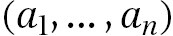
- –
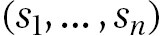
the turn function t determining the player i to move in the situation : t = i, i∈N - –a set of strategies
for the player i that assign a move si as a response to the situation where i moves: if t = i, , and - –the outcome function O assigns an end-point history of the play
that is reached when players play the strategies : O = - –A payoff function
that determines the gains of the player i in the outcome .


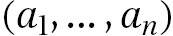


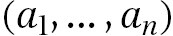


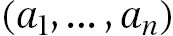


Definition: The selection of strategies
is a Nash equilibrium in the extended game G if and only if for all players i∈N and alternative strategies , ≤ . Definition: The selection of strategies
is a subgame perfect Nash equilibrium in the extended game G if and only if for all histories ∈H, the strategies are a Nash equilibrium in the subgame G(k), whose histories are ∈H and the turns, payoffs, outcomes and players the same as in G. Definition: A game G is a zero-sum game if and only if the player i∈N wins the amount that the other players i’, i’’,…∈N lose in total, i.e. for all strategy profiles (An), the sum for the payoffs
amounts to zero.26


- 1.Word-signs: Word-signs like “Slab!” are empirical objects. They are combined into speech acts and sentences according to the rules of the game. Word-signs are among the elements of the game.
- 2.Objects: empirical and material objects like slabs are part of the language-game, if they have a role in the activities of the game. The objects of language-games also include tools like colour-models and measuring devices. The word-signs and objects are elements of a speech act, and hence of language. Signs and objects are the basic elements of the game, and correspond to chess-pieces.
- 3.Speech acts: speech acts are symbolic Handlungen in Hamann’s sense. A speech act consists of uttering a word-sign together with performing a symbolic act, or uttering a word-sign together with performing a sensuously mediated act that involves an object of the game.
The speech acts thus establish connections word-sign/action and word-sign/action+object. For example, the act of bringing a slab when the word-sign “Slab!” has been shouted connects the word-sign “Slab!” with slabs. The sensuously mediated symbolic actions that are connected with objects are the basic intuitions of the game.
Speech acts correspond to the moves of chess, and the moves an of a formal game.
- 4.Uses, purposes and functions of acts: Speech acts serve a purpose and a function in a language-game, as they are connected with objects, activities, rules and the player’s role in the game.
A speech act functions as a part of a language-game by conforming to the rules of the game. The rules of a language-game arise out of the discourse possibilities of the game. In terms of game theory, the discourse possibilities and rules of the game determine the possible histories H.
Making a speech act involves playing a role in the drama of the language-game. Speech acts are also responses to the situation of the game, its context and the moves of other players in the game. In the terms of game theory, the speech act an is a part of the player’s strategy Sn. Sn codifies the acts of his role in the game and his response to the game situation and the acts of other players. The discourse possibilities arising out of H and strategic uses arising out of S correspond to the moves and strategic capabilities of a chess-piece.
- 5.The communicative and strategic meaning of expressions and speech acts: Strategies and rules constitute speech acts, because speech acts become meaningful in by relating to the context of the game, receiving a communicative role and pursuing their purpose in it.
Speech acts an are communicative, as they are responses to the actions ak of other players. A response an is a part of the strategic role Sn, which codifies the activities of the player n with the activities of other players Sk in reaching their goals in the context of the game. For example, the strategies of the language-game of pi 2 coordinate building a house.
Linguistic expressions, objects and speech acts an are the matter of linguistic communication, as they conform to the discourse possibilities and rules, and have a strategic use in the game. They have a communicative form, as they embody a role in the game and thus embody and present values and concepts for interpretation in the activities of the game.
Strategies and uses give a use to the speech acts as well as their word-signs and objects. An act an is connected with pursuing the ends and activities of a game, and embodying rules, concepts and values in its communicative activities and relationships. Communication is constituted by the symbolic interaction of players in pursuing the goals of the game.
- 6.The activities and contexts of the game: a language-game takes place against the context of a type of communicative activity, or a form of life. For example, building a house and issuing orders and battle reports have different materials, goals, structures of cooperation and possibilities of action. The context determines the values and virtues of the game, the natures and roles of the players and the objects and general facts related to them.
The roles and associated natures of the players are part of a language-game. A role in language-game includes the values of a player, and
the types of interactions and relationships that are possible for him. The values of a player are formally represented by his payoffs, and possible types of interactions and relationships are given by the possible histories H and actions an. A language-game also includes general facts about its objects. The general facts constitute the game by contributing to its causal structure and thus the possible moves taken by the players and by its elements. For example, weighing cheese would not be possible without gravity.
- 7.Learning and tradition: taking part in a language-game locates the player in a tradition. A player builds on the earlier actions of others by answering to their speech acts and strategic roles. Answering others involves coordinating one’s activities within the pre-existing situation and making judgments by doing speech acts. A language-game is often learned by participating in it, and meaningful participation requires learning customary responses and an overlap of judgments.
The long and technical characterization and definition of a language-game can also be used to link language-games with mathematical categories. Category theory is a branch of abstract algebra that investigates structures of structures and relationships between them. Saunders Mac Lane and Samuel Eilenberg developed it in the 1940s to examine structure-preserving transformations on mathematical constructions. They chose the terms “category” and “functor” because they saw themselves as mathematizing Aristotle’s, Kant’s and Peirce’s concepts of categories as higher-order types of structural concepts and Rudolf Carnap’s concept of a functor.28 Category theory is thus built to function as a mathematical analogue to philosophical category theories, and it gives a tool for coping with increasing levels of abstraction in mathematics and logical analysis. Category theory uses the concept of a category and a functor to characterize structure. A category consists of objects and arrows between them. The arrows include identities and can be composed:
Definition29 A category C consists of the following:
- 1.Objects C, D, … The set of objects is Ob(C).
- 2.Arrows f, g, … between objects. Each arrow has an object A as its source (or domain) and B as its target. An arrow f with the source A and target B can be written as f: A ⟶ B.
- 3.
Composition: If f: A ⟶ B and g: B ⟶ C are arrows, so is h = f○g: A ⟶ C. - 4.Association: (f○g)○h = f○g○h = f○(g○h).
- 5.Identities: For all objects A∈ Ob(C) there is an identity arrow 1A: A⟶A s.t. 1A○f = f = f○1A.
The arrows of category theory differ somewhat from set-theoretic functions and isomorphisms. They do not need to be injective, bijective or even functional. They can instead be thought as generalized relationships between structured objects. Consequently, isomorphisms function differently in category theory. In category theory, an arrow f is an isomorphism if and only if it has an inverse g such that g○f = f○g = 1. The internal structure of an object can also be described by its arrows to itself, which reflect its structure. Categories can also be represented as graphs, where the marked nodes stand for the objects, and pictures of arrows connecting them stand for arrows.30
Categories can be used to model language-games. The actions are speech acts of bringing about a state of affairs by acting, uttering word-signs and connecting the two. They thus have an internal structure and self-identity. They are also meaningful only in the context of the discourse possibilities and strategic uses of the game, so they are linked together by relationships of structures that can be modelled with arrows. Therefore we can speak of speech acts as structures and use them as objects in structures of structures, i.e. language-games. The only problematic requirement is association. However, if the history A1⟶A2⟶A3 is in the game, A1⟶A2 is also a history and A2⟶A3 is a history in a subgame, so (A1⟶A2)⟶A3 and A1⟶(A2⟶A3) are both possible paths in the game and they amount to the same path. The same holds for strategies, because a strategy is a possible history that is limited to the turns where a player has to move. Thus Garver’s idea of language-games as categories31 can be given a precise mathematical expression. We can also define dynamic isomorphisms between fragments of language-games by defining functors, which are kinds of structure-preserving morphisms between categories:
Definition:32 Let C and D be categories. A functor F: C ⟶ D is a map from C to D such that
- 1.If A is in C, F(A) is in D i.e. F assigns all objects in C an image in D,
- 2.If f: A ⟶ B is in C, Ff: FA ⟶ FB is in D, i.e. F assigns all arrows in C an image in D,
- 3.
F(1A) = 1F(A) and F(f○g) = Ff○Fg, i.e. F preserves the structure of arrows across categories.
Functors can then be used to describe the mappings of primitive language-games onto fragments of more complex ones, because they are structure-preserving maps across categories. The mathematical point of functors is to help describing structural relationships like the sameness of abstract structure and back-and-forth inverse operations. The concept of the sameness of abstract structure can be used to explicate, how intrinsic necessities in underlying systems can be milked into the rules of language-games. If A→B is a tendency (if cheese were put on scales, it would be pulled down), its manifestation (cheese is put on scales → it is pulled down), as well as the rule (put cheese on scales → it is pulled down) can be practically and empirically isomorphic.33
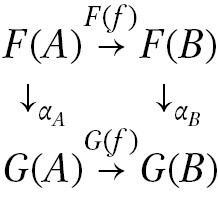
Definition:34 Let F, G be functors from C to D. A sequence of arrows (or relationships)
in D is a natural transformation between F and G iff for all A, B, .., f, g,… in C the following naturality square commutes, or the paths along and end up the same, or :
A natural transformation that is made of isomorphisms is a natural isomorphism.


Definition:36 Let C and D be categories, and F: C ⟶D and G: D⟶C be functors. Then F is the left adjoint to G, or G is the right adjoint to F, iff the sets D(F(A),B) and C(A,G(B)) are naturally isomorphic. That is, for all relationships g and p in D and g corresponds naturally to
, if , there is a corresponding . Also for all relationships f and q in C, and f corresponds naturally to , there is a corresponding .






Hamann describes his basic conviction about functional intertwinings with the slogan: “The communicatio (…) idiomatum is a fundamental law and the master-key of all our knowledge and the whole visible economy”.37 Hamann is thus claiming that functional interdependences network all of reality so that when there is a higher-level relationship H1 → H2 → H3, it functions through the lower-level relationship L1 → L2 → L3 and vice versa through networks of elements, institutions and higher-order functional presences in systems S. Moreover, these relationships commute over correlations that can be drawn between the higher/lower-level objects Hn → Ln and vice versa, or H1 → H2 → L2 = H1 → L1 → L2. These functional interdependences allow one to show that what can be said of the higher-level relationships H1 → H2 → H3 can also be said of the lower level relationships L1 → L2 → L3 and vice versa, due to the back-and-forth relationships and isomorphisms between the relational structures that arise out of the functional intertwining.
The isomorphisms can also be extended to cover relationships as well, in the sense of adjoint functors in category theory. ef games contrast individuals and the isomorphisms of their relationships, but adjoints use the back-and-forth structures FH → L and H → GL to construct isomorphisms between the relationships → themselves. Isomorphic here means one-to-one correspondence between the sets (FH → L) and (H → GL), which preserves relational structure: FH → L → L’ iff H → GL → GL’. To get these relational isomorphisms, one can extend the back-and-forth comparisons to functors by having F take a higher-level state H to its constituted lower-level-state L, and the relationship → between H to the relationship → in L through which it functions. G similarly takes a lower-level state L to its embodied higher-level state H, and the lower-level relationship → to the relationship in H by which it is constituted. Because relationships in H function through relationships in L and thus give correspondences between H1 → H2 → H3 and L1 → L2 → L3 as a matter of the grammar of S, the arrows in L, F(A) → B, are “essentially the same as” arrows A → G (B) in
- 1.If the higher-level relationship H and lower-level relationship L are functionally interdependent, then there are back-and-forth comparisons F and G pointing to objects H and L a structurally corresponding F(H) and G(L), establishing a back-and-forth system between L and H.
- 2.The comparisons can be expanded to adjoint functors F and G, which establish an isomorphism between relationships. Then FH ⟶ L corresponds to the relationship H ⟶ GL and the structures FH ⟶ L ⟶ L’ also correspond to H ⟶ GL ⟶ GL’ isomorphically.
- 3.Since there is a relational back-and-forth-system between H and L, then whatever predicate P can be said of the relational category or nature H can also be said of L and vice versa. Since there is an isomorphic correspondence between FH ⟶ L and H ⟶ GL because one functions through the other, the grammar of the relationships establishes a strong essential dependence between the objects and relationships FH ⟶ L and H ⟶ GL against the background of S.
Then whatever can be said of the essences and systemic logic of higher-level relationships H can be said of the lower level of facts and rules L, and vice versa because of the grammatically given and essential back-and-forth isomorphisms between functions at different levels.40 Now that we have defined a language-game and discussed the abstract nonsense of structural interrelationships, we can introduce some key language-games. Wittgenstein uses the language-games of the builders in pi 2 as an example. Hamann’s idea of divine language can also be formalized. Peirce and Hintikka also introduce games for the concept of existence. The language-game of pi 2 Wittgenstein’s prototype for a referential language-game:
- 1.The players are A and B.
- 2.The objects of the game are slabs, girders, pillars and cubes.
- 3.The word-signs of the game are “Slab!”, “Girder!”, “Pillar!” and “Cube!”.
- 4.The context of the game is building a house. Therefore A wins iff B wins iff B brings the material that A calls for, e.g. a slab for “Slab!” and the end-point is e.g. (“Slab!”, Slab, “Pillar!”, Pillar…).
- 5.
The actions 
- 6.A plays at the start of the game, and when B has delivered a building-block. The actions

- 7.B plays when A has shouted a word-sign. The actions

A few notes about the language-game of pi 2 are required. First, the game is a coordination game, where A and B both win by choosing corresponding actions. The strategies for winning the game produce a connection or isomorphic correspondence between the word-object pairs (“Slab!”, slab), (“Pillar!”, pillar), (“Girder!”, girder), (“Cube!”, cube), but this “reiterated bond”41 arises in the strategic language use of the game and against the background of the form of life of building a house. This connection is a constitutive background for the relation of reference, but the language-game does not include truth and falsity. Therefore strategic coordination in language use against the background of a practice is logically prior to reference. The last point is that the values of coordination and cooperation are embedded in the game through its winning conditions, and the winning conditions are determined by the practice of building houses. One could not build a house, if the actions of the builders were uncoordinated. Thus the values (one could say: virtues) in the game arise out of the suitability of different strategies to the background. This entails that the autonomy of grammar cannot be as strong as Baker and Hacker claim. There is no conceptual gap between the values of the game and its background, because the values of the game depend on its purpose and activities. The game can moreover be embedded onto other language-games.42
These points can be highlighted by studying the Adamic language-game of divine world-creation and human response. In the Genesis, God first calls an X into existence and then constitutes an order that consists of the powers, relationships and laws: “Then God said, “Let there be light”; and there was light.4 And God saw that the light was good; and God separated the light from the darkness”.43 Hamann discusses these ideas in his London Diaries: “God created to make. Matter and form. Existence and its determination, or He calls
- 1.The players are God, Nature and Adam.
- 2.The elements of the game are word-signs “X”, natural phenomena R: X⟶Y and objects (X, xRy).
- 3.The context of the game is God creating an ordered, fertile, law-governed and beautiful world, and relating to Adam and his human life through it. Thus the world wins iff it is ordered according to God’s words, Adam wins iff he does not eat from the tree of knowledge, responds to the objects (X, A⟶B…) through his senses and grasps the divine ideas A⟶B and God wins iff the world and Adam win.
- 4.The actions are as follows:
- –God can do nothing, call “Let there be X!”, or if X and Y exist, “Let xRy!”
- –Nature can either produce chaos, produce X or relate R: X⟶Y such that if R: X⟶Y is in play and X is produced, then Nature constructs a connection xRy.
- –Adam can take a look at objects (X, xRy), and use “X” to marvel and enjoy X, do nothing, eat from the tree of good and evil, or formulate the grammatical rule “X⟶Y” to formulate an divine idea. Adam relates to God iff he marvels and enjoys the objects, and internalizes their ideas.
- 5.The game starts from the position of chaos in nature. God moves first. If Adam has not been created, then God moves first, followed by Nature. If Adam has been created, then the order is God, Nature, Adam.
The game is built to implement some Hamannian ontology and biblical creation theology into a toy model. We can make some preliminary points, which will be taken up later.45 First, objects (X, A⟶B) consist of an element and institution. The element X can be thought of as the object itself, or the spatio-temporal facts of its location. The relationships R: A⟶B are the institutions of the object, and they are constituted by the strategic actions of Nature: Nature wins the game only, if it responds to the object X either by (causally) producing
The language-game of pi 2 can be modified into language-games for first-order logic. Peirce and Hintikka have developed a game-theoretic definition for truth for first-order logic:48
- 1.The players are the Utterer and the Interpreter.
- 2.The objects are the objects of the model M and their relationships (M, I).
- 3.
The game G(ϕ) in the model M begins with the sentence ϕ and the interpretation {}. - 4.If

- 5.If

- 6.If

- 7.If


- 8.If


- 9.If ϕ is atomic and the assignment is s, the utterer wins iff the interpreter loses iff ϕ is true in M on the assignment s.
The game is a zero-sum game, and Utterer can always win the game if and only if he can seek and find the witness individuals that make the sentence true. We can now define truth as correspondence with the aid of the Peirce-Hintikka semantic games. A sentence ϕ is true if and only if the Utterer has a winning strategy in the game G(ϕ). A strategy s is a winning strategy if and only if a player wins by using s, no matter how the opponent plays. Again, referential and semantic relationships like truth are defined in terms of activities in a game. They arise in a strategic interaction where the Utterer is trying to show that his claim is true by seeking and finding the correct witness individuals, and the Interpreter is trying to falsify the claim by pointing out counterexamples.49
One can also note that in the game, concepts like “there is” and “true” are ideal relationships that point out to the structure of the game. Hintikka has strongly criticized Frege’s idea that the quantifiers ∃ and ∀ are concepts of concepts that describe, how first-order concepts have instances.50 One can still describe them as concepts of formulas and sentences that describe what kinds of operations of seeking and finding will go through on them in a given situation. Thus one can describe quantifiers as second-order concepts that describe the world and the functioning of first-order words and concepts in a language-game, and thus the structural properties of expressions and the world in the relationships of the game. Seeking and finding is an abstract relationship, and one must interpret these abstract language-games by finding corresponding
4.2 The Practical Objectivity of Concepts and Models
Language-games also give answers to the foundational questions for the grammatical critique of metaphysics. Wittgenstein’s argument about rule-following is an answer to the question: how is the ability to think and form logical representations possible in the first place? The argument was in fact first formulated by Hamann as an alternative to Kant’s answer to the question about the possibility of using rational concepts to describe empirical objects. Wittgenstein then offered it as a critique of his earlier Scotist ontology of the Tractatus, where the a priori logical form of the world and the combinations of its empirically known facts constitute meaning. The argument about the linguistic nature of conceptual rules moreover gives a ground for uniting senses and reason, as it shows that language use functionally intertwines rational concepts with sensuous word-signs and objects. It also locates both concepts and objects in language-games, which intertwine linguistic social constructs with the world of objects and general facts. Thus it guarantees the practical objectivity of the rules of language-games. The argument also establishes that language-games are genealogically prior to their rules and their conceptual principles, thus making it possible to criticize metaphysical abstractions by pointing out the necessary relational conditions of concepts. I will present the argument as an application of the first principles of grammatical metacritique that were presented in Chapter 3.2.3 and the definition and exposition of the concept of a language-game in Chapter 4.1.53
4.2.1
We have seen that the questions that surface in the metaphysical methodology debates ultimately depend on the question, how logical representations are possible at all. Wittgenstein and Hamann answer this question by analyzing the role of concepts and logical rules in language use. I will present a version of their argument building on the grammar of the concept of a language-game.54
We have seen in Chapter 3.2 that philosophical grammar analyzes language-games into elements and institutions. Expressions, objects and speech acts are the elements of language, because they are constituents of a language-game. Regular use, patterns of discourse possibilities and communicative practices are the institutions of language, because they are the characteristic patterns of functioning and interrelationships that constitute a language-game. This analysis of language-games into the elements of signs, objects and speech acts and the institution of communicative practices in a context was also seen to be a case of a more general approach to relational systems. A relational system consists of elements, institutions and realities that are part of the language-game through the relationships constituted by its characteristic functioning. One thus gets a triadic relationship out of the analysis of a system: (Element, Institution, Present reality).55
These triadic relationships resemble and can be contrasted with Peirce’s triadic philosophy. Peirce offers three interrelated triadisms. His philosophical category theory includes the categories of Firstness or independent existence, Secondness or necessitated reaction, and Thirdness, or lawful mediation. He also introduces the semantic triangle of a sign, an object and an interpretant or meaning. Combining categories with types of signs yields causally determined indices, qualitatively determined icons and symbols that determine their interpretants in a conventional but lawful way.56 Cross-linking Hamann’s and Wittgenstein’s scheme of elements, institutions and present reality with Peirce’s scheme of signs, objects and interpretants helps to clarify the problem of the basis of conceptual rules (see Table 2):57
Contrasting triads in semantics
1. Element |
1. Sign |
2. Institution |
2. Object |
3. Present meaning |
3. Interpretant |
We can now build a functional definition of the institutions of language from the definition in Chapter 4.1. Speech acts are a part of the institution of language-games. A speech act connects a sign with an object, as it is composed of uttering a word-sign together with the performance of a sensuously mediated act that involves the object. A speech act thus mediates the relation (word-sign, intuition+object), and thus helps constitute the institution of language. However, a speech act can constitute the institutions of a language only, if the mediated connection is supported well enough by the relationships and functions of the game to form a relational structure that supports law-like regularities of practice. Otherwise, the connection is not fixed enough to produce a meaning or interpretant. That is, the speech act itself forms a regular relational connection of (word-sign, intuition+object) only, if it stands in the context of the game and receives a role in its relationships.
The definition of language-games in Chapter 4.1 connects speech acts with the structures of a language-game in three ways. A speech act (word-sign, intuition+object) becomes meaningful by being an element of discourse possibilities, the strategic roles and responses of the players of the language-game. The discourse possibilities form the institution of defining rules of the language-game. The roles and responses of players in a language-game connect the speech acts with the symbolic forms of communication, answering and
The institutions of language are thus constituted by the connection of a word-sign with a sensuously mediated practice that gives its object in a speech act, and the embeddings of speech acts in the discourse possibilities, goal-directed strategic activities and symbolic forms of interpretation of the game. These all institutions are constituted by the practices of language use. Discourse possibilities were defined in Chapter 3.2.1 to be capabilities to being put to a use U in a speech situation s. Similarly, playing a role in a language-game, interpreting and answering others and pursuing the point of the activities of the game with speech acts an were seen to involve using language according to a communicative form Sn to respond to others and the situation of the game.
Now we can easily see that language use constitutes both the extension and the intension of the word-signs of language. Language use constitutes the extension of a word, e.g. “chess”,60 because it connects the word-sign with games of chess in speech acts (“chess”, games of chess) that take place according to the discourse possibilities, activities and forms of communicative action of the language-games. They thus determine the objects that are connected with the word “chess” via regular use in the practices of playing chess, and hence its extension. Language use also constitutes the intension of the word “chess”, because the intension of a word consists in its conceptual rules and its role in communication. The communicative role of a word like “chess” was seen to be fixed by its role in answering others and pursuing the activity of a language-game, and the conceptual rules of a word depend on its discourse possibilities. Both communicative roles and conceptual rules depend on use, so the intension of a word depends on use as well. Wittgenstein summarizes the point well: “And hence also ‘obeying a rule’ is a practice”.61
The concept of communicatio idiomatum is defined in theology as an exchange of predicates or properties: although the divine and human natures of Christ are (at least conceptually) separate, their union in the person of Jesus Christ gives a ground for predicating everything that holds of the divine nature of the human nature too, and vice versa.66 It was generalized in Chapters 3.1.2.3, 3.2.2 and 4.1 to a concept of functional intertwining. To establish functional intertwining between the aspects A and B in a system S, it is sufficient to show that whenever 


The concept of functional intertwining can be applied to language-games and linguistic relationships. It can be used to show that rational concepts are
Let’s go through the argument step by step, as it is important to go through the proof in a thorough way and the proof also offers a paradigm-case for using relational grammar to attack unfounded abstractions. First, the properties of sensibility and rationality can be abstracted from the relational system G of a language-game, and then objectified into the senses S and reason R. The abstraction of senses is an abstraction downwards, as senses are taken to be a lower level in Platonic schemes. Similarly, reason is abstracted upwards. Reason and the senses can then be characterized via their typical properties (see Table 3):68
Properties of the senses and reason
Senses S |
Reason R |
|---|---|
Mediates experience and objects |
Forms logical rules and concepts |
Particular |
Universal |
Contingent |
Necessary |
Concrete |
Abstract |
Objective |
Meaningful |

However, the meaning of the word “chess” is constituted by its association with its object in speech acts word 

Then the connections word 


Now we have a functional intertwining between the sensuous aspects S and rational aspects R of a language-game G. A word w has a functional role in the language-game through its meaning in use M(w), so its empirical properties as an expression of language P like sensuousness must play a part in language-games by functioning together with its meanings M(w) and their conceptual properties P’, like rationality. Similarly a meaning M(w) and its conceptual properties P’, like its abstract conceptual connections, are dependent on the
We have thus located concepts in language use: use connects expressions with their objects and gives linguistic acts meaning by embedding them in communicative forms, activities and conceptual rules. Logical representations are thus based on language use. The connection of expressions, objects and meanings also intertwine abstract rational concepts with the empirical expressions and objects in the game, so concepts become empirical and sensuous objects are connected with abstract rules and meanings. Abstract concepts thus have empirical content.
4.2.2 Modelling, Morphisms and Hermeneutics
We have seen that van Fraassen locates scientific models in empirical practices. John Ziman elaborates the link of empirical interpretation and theoretical modelling. He argues that the concept of model and modelling is central in science.71 Modelling is not a formal concept, but depends on use in the scientific community and on its interests of building theories. Theories are maps that classify and structure phenomena, and their pictorial and representative form depends on use in the scientific community. Theories and maps form a picture to point out relationships and aspects of phenomena, and are then interpreted via intersubjective practices. Theories thus point out connections between phenomena. The concept of a theory is closely related to the concept of a model, which Ziman defines: a model is an abstract system that represents a real one. Logical pictorial models can be approached via model theory, and dynamic models for the changes of states in a system can be approached via category theory. A model has parts that stand in a one-to-one correspondence to the system it models, and the parts of a model stand to each other in relationships so that the model corresponds to some aspect of the functioning of the modelled real system. This correspondence between the dynamic relationships of the model and the functioning of the system then points out the mechanisms and dynamics of the system by juxtaposing the model with the system. Models combine theory with experience: a theoretical simulation or the functioning of a model can be watched and compared with the modelled
Models are thus dependent on functional analogies, which make them metaphoric. Max Black argues that metaphors reorganize the view of their principal objects or tenors by describing them with concepts derived from their subsidiary objects or vehicles. The metaphoric description of the object then changes the concepts used, attitudes to it and possible inferences by importing descriptions and attitudes that are associated with the subsidiary through common knowledge.73 Ziman argues that the correspondence between parts of the model and the system, and correspondences between their functional relationships establishes a link that allows the description of an unfamiliar system in terms of the concepts taken from a familiar model. The correspondence between the parts of a model and the parts of a system on the one hand, and the functioning of the model and the dynamic behavior and powers of the system on the other hand, also corresponds to the concept of a functor in category theory and the concept of a (partial) isomorphism between models. Isomorphisms preserve truth in logic, and functors preserve the structure of dynamic arrows in category theory. Thus both preserve descriptions of functional relationships and powers.74 Moreover, the relationship between a model and its object is established via interpretative practices. Thus the functional isomorphisms that are established by interpretative practices allow us to describe and explain the unknown system in terms of the known model: genes are like codes, because they function in a similar way and the similarities of function allow us to describe the unknown genes in terms of known codes.75 Models are thus metaphors that allow the description of their objects by drawing functional comparisons with known systems.
The themes of sensuous reason, the embeddedness of objects in internal relationships and the practices of interpretation as ways of pointing out objects all come together in Wittgenstein’s discussion of seeing-as and aspect phenomena. Wittgenstein discusses three interrelated problems. First, how is seeing different aspect-pictures of e.g. ducks and rabbits possible, when the physical picture-object like the duck-rabbit stays the same and there are no private objects? Second, how does aspect-perception relate to senses and reason? Third: how are seeing aspects, identifying objects in the pictures and the internal relationships of systems and practices interrelated?77 These problems are key to understanding modelling in metaphysics, as they bring together
Wittgenstein takes up the first question by giving examples of different categories of seen objects.79 One can say “I see this” and then draw a picture, or a picture-object. Alternatively, one can say: “I see a similarity between the faces”, and seeing the similarity changes the way faces are perceived. Glock interprets the categorial difference as one between picture-signs and aspects. The picture-object stays the same, but the perception of it changes aspects as one sees it both as a duck and as a rabbit at different times.80 Wittgenstein distinguishes the categories of a visual picture “this” that can be expressed by drawing it, and of a likeness that can be pointed out by comparing faces. He offers a grammar of the different categories of seeing by referring to their roles in relationships. Seeing as is a relationship to the picture: we can see figures as something in the same way that we regard a painting on the wall as its object, i.e. depicting its object. These interpretative relationships are dependent on the relationships that the picture stands to other pictures and the world. Juxtaposing a duck-rabbit with ducks draws out a comparison with ducks and the relationship of comparison leads to seeing it as a duck, and vice versa with rabbits.81 The interpretative relationship has to be described by describing behavior: for example, describing different ways of interpreting the double-cross figure must refer to different ways of tracing and other practices that underlie interpretation. Different interpretations are thus different techniques. Seeing-as depends on mastering sensuous practices of interpretation, drawing comparisons and placing the picture in internal relations.82
Wittgenstein’s comparison of aspects with pictures and their meanings points to his view of “sensuous reason”:83 seeing-as is not either reason or perception, but both at the same time: “’The echo of a thought in sight’ – one would like to say”.84 He argues that seeing-as is not perception, because the physical object of the perception stays unchanged and one cannot characterize aspects by objectifying them as private sense data. It is not thinking either, as one can apply both the concept of a duck and of a rabbit of the duck-rabbit,
One can then identify the grammar of the intertwining of senses and reason in aspect-perception: one has a picture (e.g. a duck-rabbit or a logical model), and it stands in a system of differences and comparisons. The picture is then interpreted by relating to it through a sensuous practice, like tracing its crosses or drawing comparisons with its context. The interpretative practice then points out the its internal relationships and organization in the system. The interpretation also mediates a thought in and through the sensuous practice.86 The aspect-perception can then be analyzed with the grammatical approach to relationships from Chapter 3.2.3: the perceived object is an element in a system S of different comparisons and relationships.87 The sensuous practice of interpretation is an institution that traces the relationship of the system S. The practice then allows one to grasp and point out the internal relationships of the system S via comparisons and seeing the aspects of organization, e.g. by models or metaphors.
Seeing aspects via pointing out the structures and organization of the relationships of perceived objects also organizes the practices of perception to form new kinds of operations of seeking and finding. New aspects correspond to new ways of pointing out different forms and organizations of objects in their relational context, and to reordering sensuous practices into new relationships of seeking and finding.88 Wittgenstein takes the example of seeing the branches of a tree forming the outlines of a man in a puzzle-picture.89 The different ways of seeing-as correspond to two different ways of ordering sensuous practices. One way of looking at the picture is looking at the colour
The step is used in mathematical proofs, so its purpose is to point out internal relationships in mathematical structures to construct a mathematical model that can be embedded onto different situations, where mathematical results are used. The same shape can however be seen-as a concave hinge where the line goes through both of the sides. The picture can then be embedded onto two different mathematical models and different objects can be pointed from it, depending on the practice of interpretation and the internal relationships of model-theoretic embedding that arise from the practices of comparison. The following theses about modelling arise out of the discussion:
- 1.Models are abstract systems representing a concrete one. They represent modelled systems by corresponding to them hermeneutically. The parts of the model correspond to those of the system, and the functioning of a model corresponds to aspects of the relations and dynamics of the system.
- 2.Models are metaphoric. The functional correspondences and morphisms between the model and the system are established through interpretative practices and practices of comparison that draw isomorphic and functorial parallels between the relationships of a system.
- 3.
Models and metaphors enable the aspect-perception of the system in terms of the model: the system is seen as the model. The practice of drawing comparisons with metaphors and models highlight the functional and systemic relationships of the system and thus establish new concepts and new ways of arranging sensuous practices to point out its objects and functional relationships. The new ways of arranging sensuous practices lead to a new way of seeing the system or perceiving a new aspect. Models thus unify senses with reason, theoretical concepts with observation and empirical facts of the system with the logics and meanings pointed out in the system via metaphoric comparisons. - 4.The systemic comparisons form a background for forming new ways of seeking and finding objects, and embedding models to the relationships of a system. The practices of seeking and finding are defined by reorganizing the sensuous practices through the analogies of the model.
4.2.3 Realism, Idealism and the “Practical Matter-of-Factness” of Language
Language-games thus answer the question about the possibility of representation and collapse the reason/senses binary opposition. We saw in Chapter 3.2 that a philosophical grammar locates both idealism and realism as aspects of linguistic activities. Thus it helps to solve the antinomy of metaphysical realism by dissolving the subject/object dualism and showing, how the objective and subjective aspects of language use are interrelated.92 I intend to show the following claims: 1. Both objects and general facts, ideas and causal powers are a part of language use. 2. Grammatical rules are arbitrary and constructed in human activities. 3. The rules of language-games symbolize general facts of the world and correspond dynamically to them, giving linguistic rules a “practical matter-of-factness”. 4. The correspondence of rules with general facts constitutes essential knowledge in interpretative activities, which are formed as a response to reality. 5. The nature of rules as simultaneously arbitrary social constructions and symbols of general facts present in language means that both Aristotelian natural realism and social constructionism are true of language at the same time. My motto in this sub-chapter is pi 372: “Consider: ‘The only
The objects of a language-game are a part of its linguistic relationships by definition. A language-game contains its objects and instruments as well as its expressions and word-signs. For example, the language-game of pi 2 contains slabs, cubes, pillars and girders. These objects become a part of the language-game by being a part of the speech acts and activities of the game. For example, a cube is a part of the language-game of pi 2, because the connection (“Cube!”, cube) is constituted in the communication between A and B in the context of building a house. Similarly natural phenomena and natural objects are a part of the language-game of God and Adam, because God calls them into being and orders them, and Adam can take a look at them and take in the divine ideas into grammatical rules. Thus any object that has a role in the communicative practices and relationships of a game is a part of the game.94
A language-game was also defined to include facts about its objects. Wittgenstein gives the example of the weighing of cheese: if pieces of cheese shrank at random, then the practice of weighing of cheese would not be possible.95 In the example, the context of the language-game and the nature of cheese, the nature of gravity and the functioning of scales guarantee that there is a correspondence between the causal process of (cheese on scales ⟶ result on the meter), and the rule of (seeing cheese on the scales ⟶ empirical measurement of weight). The facts about the behavior of cheese, scales and gravity are necessary relational conditions of a language-game, because without them the rule of (seeing cheese on the scales ⟶ empirical measurement of weight) would not be connected with the causal process of (cheese on scales ⟶ result on the meter). Thus a language-game contains general facts related with its objects, and its rules can reflect or symbolize these facts and thus reveal the essence of the objects of the game.96 Two points stand out. First, the general facts of nature function like causal powers, divine ideas and other essences. Second, the arbitrary rules can nevertheless symbolize essences and ideas, as the relationships of the game mediate a dynamic connection and
The realistic aspect of language-games can be approached by characterizing the role of general facts in structuring the relationships of a language-game and their connection with rules. The question of the nature of general facts is connected with the nature of causation. General facts were seen in the above example to constitute the causal and rule structures of the language-games. One should however note that these facts are a part of the forms of life and relationships of the game, and are independent of the concept of causation that is internal to the game. For example, the language-game of pi 2 does not have a concept of causation, but it depends on the abilities of the builders and the properties of the materials in building houses.98
There are two ways of understanding general facts: Humeanism and realism. Humeanism takes general facts to be just regular connections between types of events.99 For example, a general fact about cheese would be that events of putting cheese on scales is constantly conjoined with events of being pulled down and events of weight not changing. Wittgenstein seems to endorse Humeanism when he argues that events conform to rules and are exceptional depending on their relative frequencies. The realist view of general facts holds that when A and B are linked in a general fact, then the process A ⟶ B tends towards B from A. There are different ways of describing this connection. Peirce speaks of “would-bes”: if A would happen, it would also determine B to happen. Bhaskar, Anjum and Mumford present causal powers as vectors in the space of possible states of affairs: the causal mechanism ⟶ is activated by the state of affairs A and tends towards producing B. Thus A ⟶ B means that A tends to producing B and will lead to B, unless there is an intervening cause that checks or redirects the causal process ⟶ tending to B. Feser describes the relationship between the cause A and effect B in terms of Scholastic realism: if A ⟶ B, A is the efficient cause of B if and only if B is the final cause of A, since A starts the causal process that has B as its goal. Hamann’s concept of divine ideas also moves in a similar terrain, as it is associated with Francis Bacon’s attempts to redefine formal and final causes, and also with Hamann’s own view
The general facts of nature should be interpreted as “real generals”, or tendencies and ideas. The issue of causation will be discussed more thoroughly in Chapter 5 in the context of the fact/meaning split. One could try to follow Wittgenstein and Hume to interpret the general fact A⟶B as a regular conjunction between particular facts of the type A and of the type B.102 There are reasons in the theory of language-games to reject Humeanism in favor of realism, even though the grammar of general facts will have to build on the grammar of causation and arguments about its nature more generally. The general facts A⟶B help form the causal structure of the language-game, and hence determine the actions and powers of the objects in the game, and the possibilities of players to respond to them. For example, the general fact that cheese is pulled down by gravity makes it impossible to let pieces of cheese float in the air to detect zero gravity, and it also makes measuring possible. Hence general facts determine the ways objects react to the situations of the language-game and the ways the human players of the game can pursue the objects of the game by responding to acts.
Reacting to the situations of the language-game and determining the best responses within games are however would-bes, tendencies or strategic actions in the game.103 The general fact A⟶B must determine that if the object O involved in the general fact A⟶B were to put in the position A of the
These formalisms are just a way of pointing out that general facts have to act like realistic causes in language-games if they are to form the structures of the game. Otherwise the would-bes would not have the counterfactual power of producing results and states of affairs in the plays of the game. They also could not contribute to purpose-driven activities, because they would not point towards their results.105 This points to the undermining of the fact/meaning opposition, as causal processes are ideas that have their own logic that cannot be captured by constant connections of “loose and separate”106 Humean facts. These themes will be taken up in Chapter 5.
We have described the role of objects and general facts in language-games, which make up their realistic aspect. The social practices of language use make up its constructivist aspect. Concepts and rational rules depend on contingent and arbitrary social traditions and uses of language, because the meaning of an expression is fixed by its communicative use.107 Therefore logical representation, the norms of representation, conceptual rules and necessities, and the connection of expressions with their objects are constituted by interpretations of experience, historically mediated traditions and social activities of language use.108 The rules of language-games and hence the norms of representation are autonomous and arbitrary, because they are not straightforwardly constituted
We have seen that Wittgenstein brings together intrinsic necessities and arbitrary rules. Hamann similarly connects realism with receiving information of objects through the senses, and idealism with using constructed conceptual rules. He even quotes Aquinas’ realist comment that there is nothing in the intellect that hasn’t been in the senses. Putnam points out that Wittgenstein too follows an approach that in fact amounts to an Aristotle-style direct realism.110 We have shown that a language-game depends on general facts and powers that structure it, and these dependences take the form of dynamic correspondences between rules of language-games like (seeing cheese on the scales ⟶ empirical measurement of weight) and the causal process of (cheese lying on scales ⟶ result on the meter). There are three correspondences in play here:
- 1.Seeing cheese on the scales and cheese lying on the scales: the correspondence is between two empirical states of affairs. The first consists of the player looking at the scales and seeing the cheese. The second consists of cheese lying on the scales. The correspondence (Look, Cheese) is mediated by light relaying information and the senses of the player.
- 2.Empirical measurement of weight and a result on the meter: the correspondence is between an empirical act of looking at the meter and reading its result, and the empirical event of the scales being pulled down and turning the meter with the corresponding force. The correspondence (Weight, result) is mediated by the scales being pulled down, the reading on the dial and the senses of the player.
- 3.The relationship between (seeing cheese on the scales ⟶ empirical measurement of weight) and the causal process of (cheese lying on scales ⟶ result on the meter) consists in the correspondence of the
gravity of the cheese pulling down the scales and producing a reading, with the rule that in a weighing one should first look at the scales to identify the cheese and then read its weight. The correspondence is thus between the histories or processes Cheese 

The correspondence between the weighing then has three parts: empirically correlated states of affairs (Cheese on scales, Identifying the cheese), the parallel production of Weight from Cheese through the functioning of gravity and Result from Look by following the rule, and the fact that the processes Cheese


We have described language-games as categories of discourse possibilities and described causal powers, ideas and tendencies as a part of these games. The above correspondences between arbitrary rules and intrinsic necessities are also rooted in the sensuously mediated relational structure of the game. Mathematical category theory can be used to describe the structural aspects of these correspondences and help to define these dynamic equivalences better. A causal power or tendency is a structure of causal action, which can be seen as a would-be linking a state A to future states: A⟶B.111 For example, a cheese near the ground will be pulled down and will accelerate to the earth. The general fact or causal tendency can be manifested in different situations,
- 1.The cheese to its situation in the game, M(cheese) = (cheese on the scales)
- 2.The power of its gravity to its action in pushing the scales down and producing a reading, M(⟶) =

- 3.The result of the gravity to the effect of producing a reading in the game, M(effect) = (Weight).
The manifestation can be simply defined by taking the states of affairs, the powers and their general facts of an object in a situation, which are in any case a part of the object’s powers and possible relationships. We can similarly define the rules of measurement that measure gravity, i.e. identify an object on the scales and then check the readings on the scales. We can similarly define the measuring rule R, which takes
- 1.The cheese to a word-sign or speech act involving it, R(cheese) = (“That cheese”)
- 2.The power of its gravity to the practice or habit of reading the scales, R(⟶) =

- 3.The result of the gravity to getting a reading by looking at the reading, R(effect) = (Result).

The same model can also used for empirical modelling as well as for everyday practices. For example, scientists can feed values and state-descriptions into their models and then use the rules embedded in the model for connecting the
Hamann’s creation story and the game model that was constructed out of it can be used as another example of dynamic correspondences between language and reality. The model may seem too theological to be useful as a metaphysical example, but the theological traditions behind Hamann’s work can sharpen the points about essential knowledge and natural realism about it. In biblical traditions, God creates and constitutes the natural laws and other essential facts by his command, so the game offers a way of taking a look at essential connections in a theological setting. Hamann’s Lutheran tradition also connects nominalism about concepts with a theological natural realism.113 In the game, God creates an object X and the rules constituting its behavior in a system X⟶Y. The object can then be understood as a combination (X, X⟶Y), where X is the element of an object or its facts, and X⟶Y the rules and institutions that determine how it would act in certain situations and thus establish the “would-bes” of its action. They thus help determine its essence and modal properties, because they determine its activity in the context of the situations of the game, and thus offer a ground for identification and reidentification. The rules or institutions then help constitute the essences and intrinsic necessities that are reflected in linguistic activities.114


The practices and rules of eating fruit ground essential knowledge. We saw that the power ⟶ of producing fruits is a part of the formal and final causes or rules constituting the tree.115 The power is also a part of the linguistically mediated essence of the tree, because the tree is identified in part in reference to the corresponding rule. Then the rule corresponds naturally with powers, forms and final causes that make up the essence of the object, and thus symbolizes its essence in the game. The rules of language-games can then be seen as codifying essential knowledge. Tahko and Morganti have raised the question: how can we identify the constitutive or essential facts that have to be taken as a constant, when making metaphysical abstractions? The discussion shows that the rules of a language-game fix both a basis for abstraction, and for modal descriptions. Rules correspond to general facts and are expressed in grammatical propositions, so they establish a basis for abstractions and ground the basis by corresponding with and symbolizing the nature of things in empirically mediated activities. They also fix the factual basis for modal descriptions, as they fix the space of discourse possibilities that determine the properties, relationships and processes that can be predicated of an object in a possible situation. They thus fix the properties it could have in different possible worlds. To take an example from Garver and Z 498: it is nonsense to say that a pain does not have a localization in the body, as all pains are felt and thus identified as pains of some part of a body. Therefore it is the case that 







To sum up: linguistic activities and relationships have an “objective” side of containing objects, their powers and symbolizing their natures in activities. They also have a subjective side, as their rules are autonomous and arbitrary. They thus overcome the antinomy of metaphysical realism due to their “practical matter-of-factness”.120 The rules are autonomous and arbitrary, because they are constituted by linguistic practices and can only be described within their context. Objects, ideas and causal powers are part of the game. There is also a natural correspondence between objects and empirical speech acts, as the objects are at hand in the sensuous practices and speech acts of the game. Ideas and causal powers can also dynamically and naturally correspond to the rules of the game, as they tend toward states of affairs that empirically correspond to the results of the rules of the game. The presence of objects and tendencies as well as the dynamic symbolization of the tendencies in rules combines the social constructivism of arbitrary rules together with an almost Aristotelian realism about objects that are directly present through the senses and about rules that symbolize the ideas, tendencies and other causal forms of the objects of the game.121 We have established the two theses:
- 1.Aristotelian realism: Objects, their tendencies and relationships are part of language-games. They are accessed through sensuously mediated practices and speech acts. They help constitute the causal structures of the game and dynamically inform the rules of the game that symbolize them.
- 2.Sociological constructivism: the rules of language-games and of logical representation are established by arbitrary use that is mediated by interpretations, social practices and traditions. The rules of
language-games are arbitrary in the sense that they must be understood against the context of the game itself.
My argument has strongly tended to base representation and rules in language-games, answering the question about the possibility of thought by appealing to linguistic practices. The argument has then proceeded to point out the interrelatedness of senses and reason to locate rational conceptual rules in language use that gives empirical access to objects. Similar arguments about the relationships between the subjective and objective aspects of linguistic relationships question the dualisms that make up the antinomy of metaphysical realism, and also some of the assumptions of theodicism.
4.2.4 The Genealogical Priority of Language-Games
One can ask however: Does this place too much weight on the context of the game? Aren’t some prior objectivist norms of description possible e.g. by describing logical rules and then constructing linguistic relationships and language-games out of them? Hintikka has raised the issue by problematizing the primacy of language-games over their rules.122 He connects the primacy of language-games with metacritiques of logical positivism, and with the conviction that a purely formal description of the links between language and the world is not possible from the outside.123
Hintikka makes his case against the primacy of language-games by defining two conceptions of language: the universalist view and the calculus view. According to the universalist view, there is only one system of language uses and language-world relationships. One cannot therefore change the interpretation of one’s language or step outside these links to compare language with reality. Hintikka compares this position with Kant’s view of the unknowability of things-in-themselves: all knowledge is mediated by the senses, so we cannot compare our representations with reality.124 Hintikka argues that the
The relationship of language-games and their rules is crucial to both the project of relational arguments, and for Hintikka’s foundational project. Hintikka’s foundational project presupposes formalism: language can be described from the outside by logical rules and other formal categories, without taking the logical matter of expressions and mediating social activities into account. If language-games are prior to their rules, then the necessary conditions of the linguistic relationships are also the necessary conditions of the meaningful, objective and true use of concepts. Then if language-games are prior, necessary-conditions arguments from the grammar of linguistic relationships, or relational arguments are valid. Also, if relational arguments are valid, then logical rules and formal categories are dependent on mediating practices and their material elements, and this goes for meta- as well as object languages.126 On the other hand, if rules are not dependent on their context, then one cannot chart the necessary conditions for the application of conceptual rules by pointing out the features of their underlying relationships. Hintikka’s program and relational arguments thus stand or fall with the primacy of language-games.
Hintikka associates Wittgenstein’s concept of language-games with the universalistic view. Hintikka argues that Wittgenstein’s holism commits him to universalism: the concept of a rule must be described against the background of a language-game, and a language-game forms an ineffable whole. Thus Wittgenstein is committed to the Kantian position that one cannot step outside language to describe its relationship to the world. Moreover, Wittgenstein’s key relational arguments like the private language argument depend on the primacy of language-games over their rules. If language-games are primary then private rules are not possible, because they stand outside the communicative relationships of a language. On the other hand, if rules can be understood independently of language-games, then one can describe the private rules of a private language.129 Hintikka argues correctly that the rule-following argument of pi 143–242 and of Chapter 4.2.1 shows that rules only
There are two issues in play in Hintikka’s discussion: the possibility of building new languages and representations of language-world links, and the relationship of language-games to their rules. The first concerns the possibility of new languages and metalanguages. It is clear that it is possible to develop new languages, as “new types of language, new language-games, as we may say, come into existence, and others become obsolete and get forgotten”.131 The question about the possibility of metalanguages depends on the second question: there are rules for describing the relationships of language and the world if and only if metalanguages are possible. Metalanguages presuppose rule-following, and metalinguistic rules are also sufficient to specify speech acts that make reference to language-world links possible. The second question concerns the relationship of matter and form in language-games: rules are the form of language-games, and the word-signs, objects and speech acts are its matter. The rule-following argument was seen in Chapter 4.2.1 to show that both the matter of the elements of language and the form of rules and institutions constitute language-games, and they are in fact interdependent in the game. It is telling that Hintikka quotes pi 197 as evidence of the primacy of language-games in Wittgenstein: the citation divides language into elements like the word-sign “let’s play a game of chess!”, institutions like the practice of playing chess and the rules of chess, and the meaning that is a part of language and connected with objects through the institutional practice of playing chess. Wittgenstein thus argues that language-games are prior to rules, because he is using Hamann’s model of sacramental language.132 Hamann in fact argues explicitly for the priority of language-games over their rules and logic:
The genealogical priority of language-games follows directly from the nature of language-games as relational systems that are composed out of elements, institutions and realities that are part of the relationships in and through the systemic functioning of the relationship. Therefore it holds of metalinguistic games and the games of formal logic like the Peirce-Hintikka game as well.134 Moreover, Hintikka misidentifies the dialectical context of the rule-following argument. It is not an argument against metalanguages, but against the tradition of formalistic ideal language theories ranging from Leibniz to Hintikka and the Vienna Circle. There can be no purely formal (or purely material) language, as material elements, formal institutions and communicative and conceptual meanings only function through their mutual relationships in use.135 Four arguments show the primacy of language-games over rules. The parts of the triad (element, institution, meaning) all presuppose each other, institutions only function in virtue of their relationships, the form of rules is only realized if it is realized in the matter of speech acts, and pragmatist psychology of language shows that word-signs are not detachable from concepts.
We have seen in the definition of a language-game that the institutions of a language include its discourse possibilities, the strategies for pursuing the point of the game, and the communicative role of the players. For example, the discourse possibilities of the Peirce-Hintikka game describe the possible uses of terms like “there is”, “some” and “all”. The roles of the game are the Utterer and the Interpreter, and the point of the game is to either find an example supporting the utterance or to find a falsifying counterexample. The communication of the game consists in Utterer and Interpreter uttering sentences to indicate the sentence they are trying to verify or falsify, and producing individuals to
There is another way to argue that rules function in their contexts. One can see from the discussion of pi 2 that the correlations between the word “Slab!” and slabs is formed in language use.138 However, the connection is not referential, because the expressions cannot be true and false. Now suppose that the builders have only a limited amount of slabs and pillars at the building site. If the slabs and pillars run out, B can go look for slabs and pillars at a nearby warehouse. Now suppose that if A shouts “There is-slab” to signal B to go look for a slab in the warehouse. Thus the rule “If A shouts ‘there is-slab’, B will go to search and find slabs at the warehouse” is a part of the game and it also roughly corresponds to the rule that when 
There is a third argument for the interdependence of rules and social practices. The rules of language-games are its form, and the word-signs, speech
There is still one strong argument for the priority of language-games over their rules, and it comes from pragmatist psychology. Hamann quotes the work of Samuel Heinicke, who emphasized the interrelatedness of thought and language. Lev Vygotsky has presented similar arguments in the 20th century by studying concept-formation. Non-human apes can develop practices of problem-solving with tools that they can see, and can communicate emotions with expressions. However, they lack the ability to use concepts to coordinate and generalize their problem-solving practices beyond objects in their immediate grasp, because they lack the connection of expressions and word-signs with the basic intuitions of solving problems with tools in their grasp. Humans differ from other apes, because they can connect expressions with their practices of problem-solving, thus forming concepts. The connection of thought (or the basic intuitions of empirical problem-solving) and language (word-signs) is formed by first learning the grammar of expressions from the speech of others, and then internalizing the logical relationships mediated by grammar into conceptual rules. Vygotsky’s results support the claim that language-games are prior to their rules, because word-signs and their communicative grammar are necessary in the formation of concepts for coordinating activities of problem-solving like seeking and finding, and in learning the logical forms of these concepts and practices.140
Language-games are thus genealogically prior to their rules. This entails straight away that rules can be followed and concepts can be objective only against the background of linguistic relationships and their necessary conditions. Then relational arguments offer a strong tool to criticize speculative
- 1.Elements. Empirical word-signs and objects are the elements of language, and form its necessary conditions. Reference is possible only, if objects are a part of the game. Thus there is no subject/object dualism. Meaning is possible only, if word-signs help constitute them. Therefore there can be no ideal languages transporting pre-linguistic concepts. Conceptual rules are objective only, if they are realized in empirical speech acts through use.
- 2.Institutions: communicative forms, strategic roles and possibilities of use form the institutions of language. Following an institutional rule is possible only, if the rule is connected with communicative exchanges between players. Hence there can be no private languages. A concept has a definite content through having empirically and practically determined rules of use. Hence abstracting from the context of use or transforming it changes the meaning of the concept, or evacuates it altogether.
- 3.Context: the reality included in the game, the nature of players and the goals and virtues of their activities form the context of the game. Having virtue in an activity is possible only, if the agent can make moral choices. The reality that we encounter empirically in our activities is made out of many overlapping relationships. Hence there is no Arche determining everything. Rules can coordinate our activities in reality only, if they dynamically correspond to its powers. Hence they make essential knowledge possible.
4.3 Language-Games and Categories for Being Qua Being
The arguments about rule-following and objects in language-games then solve the antinomy of metaphysical realism and the problems about the possibility of forming logical representations and of applying rational concepts empirically. Models are located in practices of empirical interpretation that intertwine senses and reason as well as facts and meanings. However, Paul and Tahko
4.3.1 Language-Games for the Concept of Being
We discussed Peirce-Hintikka games for first-order logic in Chapter 4.1. Their main idea was to define quantifier expressions like “there is”, “for all”, “some” and others in terms of activities of seeking and finding, and then defining truth (or logical representation) as the existence of a winning strategy for the Utterer, who attempts to find witness individuals to construct a true example of the sentence. Hintikka argues in his article “Language-Games for Quantifiers” that these language-games give a meaning for quantifying expressions “some” and “all” in natural language.145
Hintikka takes another example from ordinary language: “Wenn du hingehst, gibt’s Unglück”. The German phrase makes a prediction of a course of action: if you go there, it’ll give you misfortune. The connection between the outcomes of courses of action and the activities of seeking and finding is captured by developing a formal prototype for these language-games in the form of the Peirce-Hintikka game that was introduced in Chapter 4.1. The connection 
Hintikka gives two presuppositions for the language-games of seeking and finding. The first is that the field of search must be defined. The second is that there must be clear criteria for making the claim: “I have found one!” These two conditions can be used to frame and answer two different problems: the question of the meaning of the words “to exist” and the question of identity criteria for objects, which give a classification of objects into categories right away.150
The first is that using Peirce-Hintikka games as an ideal model for the concept of existence commits one to a version of Quineanism, where the meaning of the concept of existence is given by appealing to practices that underlie quantifiers. There is also another reason for seeing the problems of quantificational reading of existence as problems for a relational ontology: Hamann takes existence to be the most general second-order relationship of being able to instantiate properties in a relationship. Thus the existence of an X means that some entity is able to instantiate the property X and thus to satisfy the predicate “X” in the context of a relationship. The relational and language-game approach to being thus brings together the concept of existence, quantifiers, practices of seeking and finding, and relational systems. This raises the question, whether the quantificational view of existence is right in the first
The second problem concerns the identity criteria of entities. One can only claim “I have found one!” if one can answer, what counts as seeking and finding an object and to identify the found object. This leads right into questions concerning identification and associated questions about the essences and categories of objects. We have seen that the question “What is an X?” has to be answered in order that one can point out an X, so essences and quantification are two sides of the same coin.152 The answers to the questions about the essence of an X are based on the grammar of X. We can establish the grammatical norms of description for the categorization of objects by paying attention to the discourse possibilities and speech acts of everyday language-games containing fragments that are isomorphic to Peirce-Hintikka games. One can then answer the question “What is an X?” by pointing out to the possible situations where one can say “I have found one!” and the question, when one can say “I have found one!” by pointing to the discourse possibilities of the everyday language-games of seeking and finding. The grammatical norms then give a ground for categorization of the objects of language-games and for characterizing their being, which has been taken up in Strawson’s descriptive metaphysics.153
Tahko raises two issues with the Quinean understanding of the concept of existence.154 The first is the univocity of being: all meanings of “to be” and “to exist” are captured by the quantifier “there is”, now interpreted as “to be found there”. One can however ask: is existence univocal, or are there other senses of “exist”? The question is made sharper by the question of second-order quantification over properties. The second issue concerns the ontological commitments of the quantifier “there is”: does it automatically commit to actual existence? Tahko quotes logicians like Tim Crane and Graham Priest giving examples like “Some characters of the Bible existed and some did not” to offer counterexamples to the identification of the quantifier “some” with real existence. Tahko follows the second issue by pointing at a suggestion made by Kit Fine: one can always choose one’s universe of discourse to fix the existential quantifier as one wants, but the philosophically substantive question
My defence of the uses of quantification rests on the flexibility of language-games: one can stipulate one’s universe of discourse by e.g. introducing language-games of telling fiction, so the plurality of language-games leads to a plurality of domains and operations of seeking and finding. The multiple meanings of the word “exist” can then be reconciled with a quantificational metaontology. The term functions via seeking and finding when used in language about a fixed domain or a universe of discourse in a language-game. It can alternatively function as a predicate meaning “actual”, “real” or “ontologically significant in the actual world” in language-games with domains that include non-actual objects. The terms “actual” or “real” however have to be understood in terms of “exists in the actual world” or “is fundamental in the actual world”, which must be understood in terms of seeking and finding actual objects.155
Tahko introduces the view that the existential quantifier is univocal by quoting van Inwagen, who denies that existence includes various genera: although the concept of a colour includes different genera or sub-types like red and green, the concept of existence does not similarly divide into different ways of being in the different categories like universals and particulars. Being red and being green are different ways of being coloured, but being a material or a mental object aren’t different ways of existing, because there is just one concept of existence. The analogy between different ways of existing and different ways of being coloured are misleading, because existence is not an activity or a way of being like being coloured is. Here van Inwagen is just reformulating Scotus’ old position: being is a transcendental concept, or it works the same way across metaphysical categories and across the God/creature distinction.156
The question involving the univocity of the existential quantifier is a tricky one, because there is one sense in which the existential quantifier is univocal, and another sense in which it depends on the linguistic and ontological categories where it is used. We will establish in the next chapter that the operations of seeking and finding take place in and through speech acts and discourse possibilities in language-games, which also ground categorization.157 Thus the concept of existence is bound to a category of a language-game, and different language-games have different way of pointing out objects. Moral
There is also another important sense, in which the existential quantifier is univocal (or at least a family resemblance term).159 Various uses of existential quantification have the same logical form, and higher-order quantifiers resemble first-order ones by pointing out realities (although they point out sets and properties rather than objects). The meaning of logical forms and other ideal terms is investigated in the next chapter, but the main idea is that Peirce-Hintikka games can be isomorphically projected onto other more complex language-games, and this possibility of projection shows that the concept of existence is logically the same in both of the games. The Peirce-Hintikka games thus give a concept of existence that is the same across the categories of language-games, and thus the concept of existence can be called logically univocal across categories. The issue is again one of matter and form: even though different categories of language-games have different logical matter in terms of speech acts, their objects and basic intuitions, they have a similar form of linguistic activities that supports logically similar operations. Logical forms are a special case of ideal concepts, and speech acts and their constituents make up the logical matter of language-games. In Chapter 4.2.1 we saw that conceptual structures and sensuous speech acts and intuitions are functionally intertwined. Thus the concept of existence can be said to be univocal in one sense and not univocal in another significant sense.160
The second issue in the metametaphysics of quantificational language-games concerns the existential weight of the existential quantifier, which has
The approach of Peirce-Hintikka games is flexible enough to meet this objection. The games are played over a model M and its domain, and the domain of quantification can then be changed by changing the model and interpretation of the game. We have seen very clearly that this is something that can be done in language-games.163 When we take a look at the different sentences where the concept of existence is used over non-existent entities, we note that the domain of quantification has first been reinterpreted to include entities that do not exist actually and then the term “to exist” has been interpreted to mean “exists in the actual world”. Let’s look at the examples “Some characters in the Bible existed, and some did not”, and “I thought of something that I would like to give to you as a Christmas present, but I could not get it for you because it does not exist”.164
The first sentence involves interpreting the domain of discourse dom(M) to include all biblical characters, as the quantifying range is defined as “some biblical characters”. The logical form of the sentence then becomes 

The second sentence is technically more complicated, as it involves thinking and other modal notions. When one takes modal if logic into account, it could be paraphrased as “I was planning to give you a Christmas present. In my plans, I had one particular thing in mind. I could not get it, because it does not exist in the actual world”. Here the word “something” then refers to pointing out or picking in the plan (or in planned scenarios), with their different universes of discourse. Moreover, the present must be the same in all of the planned scenarios (i.e. independent of the situation.) The expressions “I could not get it because it does not exist” refers to the actual world, where existence is connected with possibilities of getting, or seeking and finding. The logical form of the sentence is 
We can now sum up the discussion about domain variance and its use in qualifying the thesis that the existential quantifier is the conceptual device for expressing being. The existential quantifier introduces individuals via seeking and finding and points to their roles of functioning in relationships. It can be extended analogously to properties. The word “to exist” however functions in various logically linked ways, as the quantifiers can be reinterpreted. The reinterpretation of quantifiers over fictional domains of discourse also allow us to introduce a Meinongian existence predicate “x exists actually”, but it then has to be understood in reference to a more Quinean sense of seeking and finding in actual situations. The concept of existence also has one (primary) logical core of pointing out realities, but it nevertheless has many interrelated and family resemblant meanings. The formal language-games give logical forms, as they can be embedded onto language-games with different kinds of objects
4.3.2 Discourse Possibilities for Seeking and Finding
Peirce-Hintikka games then give ideal models for the concept of existence. These formal models however pose questions of interpretation, which are a special case of Paul’s, Morganti’s and Tahko’s question of the objectivity of models in metaphysics. We have seen that Hintikka gives a formalist ideal language interpretation for language-games, detaching the operations of seeking and finding from the practices and relationships like looking at the moon or making transuranium elements that constitute them. Such logical foundational projects raise similar problems as metaphysical ones regarding the relationship of formal principles and categories to sensuous practices and language use: “Metaphysics, however, abuses our empirical language and knowledge by attempting to evacuate them of their vital, particular and concrete content; attempting to convert them into the ‘lukewarm hieroglyphs’ of ‘mysticism’”.168
The concept of an übersichtlich representation offers a point of departure to bringing formal representations of concepts like the Peirce-Hintikka game and the general concept of being to the “rough ground”.169 Hamann argues that general concepts like being are the most general relationships. General concepts have their value by serving as abstract types of communicative relationships and their objects, as they point to structures of the object-containing relationships in everyday practices of communication and language use. They are thus structural relationships of relationships that are realized in language use, and function like linguistic categories by pointing out relationships, discourse possibilities and corresponding roles of objects. Thus ideal concepts are objective by being realized in and embedded onto speech acts of ordinary language.170
Wittgenstein makes a similar point by discussing ideals in pi 130: the point of simplified or formal language-games is to offer points of comparison to clarify the grammar of language. Baker and Hacker argue that Wittgenstein’s point is to compare ideal calculi and simple language-games with geometry, which offers conceptual tools for clarifying certain aspects of relationships by constructing an abstract model of them, while abstracting other aspects away in the process. The simplified language-games and abstract calculi like the Peirce-Hintikka-game can then be isomorphically projected to parts of more
In Chs. 3.2 and 4.1 we saw that language-games can be seen as categories, both in the Aristotelian and the mathematical sense. Mathematical category theory has the concept of a functor: a functor is an isomorphism-like functional morphism between categories that preserves structures of structures. Then functors can be used to highlight and give an Übersicht of relationships between ideals and the first-order structures of ordinary language use. They are also an example of the isomorphisms between abstract structural models of metaphysics and empirical reality.172 A key point that emerges from the comparison is that the logical forms and comparisons with an ideal presuppose a structure of speech acts, objects, communication and use in the relationships of the target or object language. Otherwise the morphism onto the target language-game and its objects could not be defined. The structure of the target language is the structure of discourse possibilities and uses that is fixed by the activities of the game, the roles of the players, communicative use and other more complex features of the underlying form of life.
4.3.2.1 Logical Forms and the Categories of Language Use
Children do not learn that books exist, that armchairs exist, etc. etc., – they learn to fetch books, sit in armchairs, etc. etc.
Later, questions about the existence of things do of course arise. "Is there such a thing as a unicorn?" and so on. But such a question is possible only because as a rule no corresponding question presents itself. For how does one know how to set about satisfying oneself of the existence of unicorns? How did one learn the method for determining whether something exists or not?173




- 1.Let F
“That’s milk!”, and F( ) = “Here’s a book”. Let F( Tom sits in a and says “This is a chair!”, F( Tom fetches b and says “Here’s a book!” and F( = Tom drinks c and says “That’s milk!” - 2.F(
) = “There’s a chair” Tom sits in a and says “This is a chair!”), - F
= “There’s some milk” Tom drinks c and says “That’s milk!”, - F(
= “There’s a book” Tom fetches b and says “Here’s a book!”

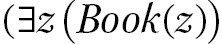
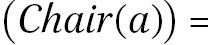







Then the functor F establishes a comparison175 between the Peirce-Hintikka games for formal sentences and a form of life that grounds a fragment of ordinary language English. The functor F then points out the logical form of the fragment of English in the conversation, because it offers a mathematical point of comparison for the relationships of language use. Garver argues that the connection of seeing-as and grammar add to a “radical amalgamation of structuralism and hermeneutics”.176 The amalgamation includes logic as well, as the functor F offers a mapping or an interpretative framework for a way, strategy or a practice of seeing the English fragment as a first-order quantificational language-game. The logical forms of “there is” and the associated ontological principles are thus hermeneutical. They are located in language-games, which embody logical forms and other second-order structures of structures. These structures of relationships are pointed out and modelled via functors and other isomorphisms that embody the possibility of interpretative comparison of structures of language use. For example, some language-games have fragments whose rules are isomorphic to the games of formal logic, and linguistic relationships and their objects can be compared via morphisms to the objects and rules of other language-games.177
Take the definition of the comparison between the Peirce-Hintikka games and the conversation between Tom and Mary earlier in this chapter. It was made by establishing a correspondence F or a morphism between their relational structures. The relational structure of the conversation is however established through language use involving the elements of its expressions, speech acts, sensuous basic intuitions and objects, and the institutions of its discourse possibilities, communicative roles and activities. The rules of the discussion between Tom and Mary are interpretative and communicative, as Mary is trying to interpret Tom’s expressions in terms of the rules of the game. They are also linked to the activity of the game, as Tom is trying to make Mary happy by showing that he knows how to use the words. The speech acts of uttering sentences like “There’s a chair!” and then “This is a chair” while sitting in a chair are moreover a part of the language-game, as they are included in its discourse possibilities. Logical forms and the concept of existence thus fulfill Hamann’s condition: they are second-order structures of communicative use, and are constituted through their links with descriptions of objects through use in first-order language games. The use of descriptions therefore links the abstract forms and concepts like existence with objects themselves. The same also holds for metaphysical concepts that are associated with the concept of existence. This can be seen by taking a look at the speech acts, basic intuitions and discourse possibilities of quantificational practices in ordinary language.179
4.3.2.2
Wittgenstein’s example in oc 476 also raises another point: speech acts and their sensuous practices implement the operations of seeking and finding. I will now examine, how language-games give categories of being, or logical types of encountering objects and types of objects in the encounters of language-games. First, I make a connection between discourse possibilities, the logical space and basic intuitions. I then link essences with basic intuitions and discourse possibilities. The essence of an object X locates the object with basic intuitions and also gives ways of answering questions about its possible properties via discourse possibilities. I then use Wittgenstein’s categorization of mental states as an example, how possible answers or different discourse possibilities also determine a possibility space associated with the object, help reidentify it and also point out essential properties and metaphysical necessities like functional intertwinings between the mind and the body. I then explore, how objects are reidentified and located through stories that give their continuity principles by pointing their roles in relationships. Thus the language-games of encountering objects categorize their objects and function as a background for essences, because they determine the ways of identifying an object, pointing the connection of facts in which it lies, the possibilities associated with it and also its principles of reidentification.180
Let’s continue from the language-game of Tom and Mary. Tom establishes the existence of milk by drinking milk and saying “This is milk!”, so the speech act composed of the utterance “This is milk!” and the bodily and sensuously mediated practice of drinking milk also functions as the basic intuition that implements the logical operation of seeking and finding. Hintikka’s attempt to logicise the forms of intuition thus has to be turned around: it is sensuous bodily practices that mediate the logical activities of seeking and finding. The view of bodily and sensuous practices as basic intuitions is built into the definition of a language-game in Chapter 4.1, and it also arises in Hamann and Wittgenstein. Hamann argues that the oldest languages of painting and music give rise to Kantian forms of intuition, as the visual forms of painting and the rhythm of music give rise to a geometry of space and the measurement of time. Since the forms of intuition are forms of bodily and symbolic practices, then the intuitions themselves are bodily and sensuous symbolic practices of language use. Similarly Wittgenstein makes distinctions between different

Continuation of the classification of psychological concepts.
Emotions. Common to them: genuine duration, a course. (Rage flares up, abates and vanishes, and likewise joy, depression and fear.)
Distinction from sensations: they are not localized (nor yet diffuse!) (…)
Consider the following question: Can a pain be thought of, say, with the quality of rheumatic pain, but unlocalized? Can one imagine this?
If you begin to think this over, you see how much you would like to change the knowledge of the place of pain into a characteristic of what is felt, into a characteristic of a sense datum, of the private object I have before my mind.184
Wittgenstein is here categorizing mental states according to their discourse possibilities. A mental state can have various strengths, durations and phenomenal feels. These different types of properties correspond to different questions that introduce discourse possibilities: expressing the phenomenal feel (and thus pointing to it) in public conversation answers the question “How do you feel?”, and expressing the strength of the sadness is an answer to the question “How sad are you?” There is thus a correspondence between answers to questions and values of a type of a property: a pain belongs to the set of alternatives {not in pain, hurts a little, hurts somewhat, hurts bad, unbearable}. Similarly, in an expanded version of the language-game of pi 2 one can ask: “How much does the slab weigh?” and get an answer from the set of alternative weights for a slab, e.g. {2kg, 5kg}. Each question that establishes a set of discourse possibilities also corresponds to types of basic intuitions. The question “How do you feel?” is answered by a speech act of feeling one’s happiness and saying “I’m happy”, which brings the happy feeling to a public space via the words and thus establishes the connection (“I’m happy”, feeling happy) as a part of the public practice of searching one’s feelings. Similarly, the question “How much does the slab weigh?” is answered by a basic intuition of weighing the slab, establishing the connection (“Slab!”, weighing the slab) in a speech act.185 There is thus a correspondence:
The correspondence of discourse possibilities / sensuous practices / grid of possibilities
Question |
Sensuous basic intuitions |
Space of alternatives |
Discourse possibilities |
Possible values for aspect picked out |
States of affairs |
Thus the pain has both mental and physical properties, which are also functionally intertwined: when one has the qualitative feeling of a pain, one feels it in a part of the body and not as a part of some sense data or qualia. The pain thus functions through the physical body, because a basic intuition helps to seek and find it in the body. The bodily location also functions through the qualitative feeling of a pain, because when a body-part is in pain, we sense the part of the body by feeling the pain and locating the pain in the part of the body. Thus the qualitative feelings of pain are physical and the physical location experiences pain. This contrasts with Descartes’ description of the categories and discourse possibilities of beings. Descartes claims that objects in the category of mind have only mental properties, and objects in the category of matter have only spatiotemporal properties. Classifying the basic intuitions and discourse possibilities associated with pains thus helps to classify the
Wittgenstein also discusses how rages and other mental states also have a duration as well as qualitative features, strength, expressions and an object. Therefore the mental states can be described by giving its coordinates (Feeling, Expressions, Strength, Object) at a time t. The state of the pain can then alternatively be given in terms of its development in time Pain(t) = (Feeling at t, Expressions at t, Strength at t, Object at t). Mental states and other objects can then develop in time, which presupposes the possibility of reidentifying them: how is the pain at t the same pain as at t’? There are thus discourse possibilities and intuitions that can be used to point the principles of continuity for objects. Strawson argues that identifying and reidentifying objects involves locating stories of them in a framework that relates them to other objects and to our knowledge. The theme of stories and frameworks also arises in Hamann’s description of the concept of existence: existence is the most general relationship of exemplifying properties in relationships.188 Describing the place of an object in the network of relationships locates it in a framework, and description of its role in relationships over time involves telling a story. Thus the concept of the existence of an X 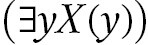
One can point out different questions that are connected with discourse possibilities for reidentification. The physicist Lee Smolin similarly argues that merely describing the properties of an object or events associated with it does not tell what a physical object is like. Instead, physical objects are defined in terms of their causal roles, which guarantee their fixity and are described by stories.189 Thus questions like “Where did the builder take the slab?”, “Why are you sad? You were happy yesterday” determine the locations and other property coordinates of objects like slabs and mental states like sorrows at an earlier time t, and locate them in causal processes that link them with states
The same narrative approach holds in theology as well. Martin Kusch explains Luther’s idea of theological grammar by pointing out that a grammar of religious activities shows how religious practices work, the properties of God, the acts of God towards the believer and the acts of the believer towards God. Thus theological grammar shows how “God ‘deals’ with the person in the word, and the person ‘deals’ with God in faith”.192 Narrative theology expands the same approach to the grammar of the word “God” in religious texts: the Hebrew Bible and the New Testament tell a story of God by telling about His activities in history. This approach is also fruitful to antitheodicy, as the point of Hebrew Bible is to “tell the story of what God has done, is doing, and will do about evil”.193 The discourse possibilities for identifying God and the Holy then become questions about the real presence of the Holy in religious language-games and keeping a track of the activity of God and religious stories: “How does one realize that Brahman = Atman?”, “How can I (seek and) find a merciful God?”, “What did God do with Israel at Sinai?” All of these types of questions allow us to locate the characteristic properties and coordinates with the discourse possibilities of language-games and the linked basic intuitions of our activities, and connect them with the present by drawing connections through roles in causal and social relationships, as well as religious practices.194
4.3.2.3
This approach to categories can be criticized as too linguistic. To take up the distinctions in the Categories of Being, categories can be either logical types or types of objects, and hold either of the Being of the world or of our cognition. Realist metaphysicians like Lowe criticize linguistic approaches as self-referentially incoherent: it is contradictory to claim that our concepts can only reach our representations and not the world, because our conceptual schemes are part of the world. Such criticisms however miss the point against relational approaches: language-games are encounters with reality that include and reveal it, so they do not screen it off.195 In fact, the categories to which the essentialist tradition appeals are logical types in language. To see this, one has to examine the dependence of Kripke’s and Lowe’s essentialisms on the categories.
Kripke defends essentialism by appealing to rigid designators: names that refer directly to the same individual in all possible worlds. Then if A = B and ◊A = C, □B = C.196 He gives two arguments for essential properties: the Queen of Britain could not possibly be identical with the daughter of Harry Truman, because the Queen is the daughter of George vi and nobody is identical to both the daughter of George vi and Harry Truman. Similarly, my desk could not be made of ice, because my desk is identical to a piece of wood and nothing is identical both to a piece of wood and to ice. These appeals to essential namings however point out objects only, if the conceptual role of the terms “table” and “Elizabeth ii” has been given: “This material object is a table”., “See her? She’s the Queen. That lady on the throne”. Then the terms “material object” and “lady” give the logical types or categorial terms of identification that the ostensive namings depend on. These terms then assign continuity principles across possible worlds: material objects are identified in terms of their parts, and human persons are identified by referring to their life.197
E. J. Lowe makes this connection explicit.198 He argues that categories give a priori types for distinguishing between changes of substance and phase
Thus one gets the connection Bfly(larva → adult) = caterpillar → butterfly by following the rules of identification in games of seeking and finding. Then one can point out the real continuities Bfly(larva → adult) = caterpillar → butterfly and Frog (larva → adult) = tadpole → frog by following the rule larva → adult in particular cases of seeking and finding. Moreover, the question “What kind of larva is this?” gives a ground for comparison between the different larvae or tadpoles and caterpillars, and similarly “What animal is this?” contrasts frogs and butterflies. Then the conceptual contrasts given by the categorization of animals are natural or given by commutation over the natural structure of dna change: the conceptual contrast over life change caterpillar → butterfly → frog amounts to the same as caterpillar → tadpole → frog. Then the abstract rule larva → adult is given by the categorial term “animal”, following it in activities of seeking and finding Bfly(larva → adult) and Frog (larva → adult) points out both the real and essential continuities of objects, and also the natural possibilities of comparison tadpole/caterpillar and frog/butterfly. These examples show that abstract concepts for reidentification like “animal” are objective through the practices of rule-following like Bfly and Frog, as the abstract concepts point out continuities of objects through them and establish logical similarities for concepts through their natural possibilities of comparison. Categories then point out types of objects and are also logical types of concepts through conceptual rule-following practices in the activities of reidentification.199
4.3.3 Categories, Being and the Models of Metaphysics
We have now characterized the categories of metaphysics by locating them in language-games. It is now possible to examine the objectivity and relational conditions of metaphysical modelling. Tahko, Morganti and Paul point to models in an attempt to bring metaphysical concepts to the “rough ground”:200 models unify abstract theoretical features with empirical systems. The metaphoric view of modelling has however to be combined with the result of the preceding chapter: formal rules of logical games, the categories of metaphysics and other ideal relationships are structures and types of interpretative practices and their underlying relationships. They relate to the world by typologizing: they point out relational structures and the roles of objects in relationships that underlie operations of seeking and finding and the associated concept of being. In the preceding chapter, we built formal models of language-games and their associated categories. In these discussions, the links between objects and models, like formal rules and grammatical sentences, function through interpretative comparisons of models with linguistic practices where we pick out and classify objects. We can then develop an account of modelling by using formal games and grammatical rules for categories from Chapter 4.3 as an example.201
The first task of logical and metaphysical grammars is descriptive analysis: they describe how some system of concepts and grammatical rules for logic and metaphysics functions. These rules can be derived from an interpretation of our language-games and their underlying relationships, be offered as an alternative interpretation for being qua being or be invented to offer a point of
The grammatical rules of metaphysics and logic can be represented with models. In the exploration of categories, we discussed the formal rules of the Peirce-Hintikka games and the grammar rules for the mental state of pain. These rules can be formally represented by models, e.g. by having a state description vector Pain(t) = (Feeling at t, Expressions at t, Strength at t, Object at t) as a placeholder for a pain, or with diagrams of Peirce-Hintikka games. Thus we can talk of formal models of abstract concepts like Tahko, but this raises the question of their objectivity.203
The role of models as metaphors and as a ground of seeing-as answers the question about the objectivity of metaphysical models. The abstract structural features of the model point out corresponding functional relationships in the system that is being modelled, i.e. the language-games involving the word “exist” and their underlying relationships. Take the example of Tom’s and Mary’s conversation.204 Formalizations were seen to correspond with English sentences, and the rules of the Peirce-Hintikka game were seen to correspond functorially and isomorphically with the conversation. Similarly, the state-vector (Feeling, Expression, Strength, Object) can be used as a place-holder for a pain in a model for grammatical sentences like “All pains have a duration”. The relationship between the abstract model M and pains in the language-games where we seek and find objects is moreover established by interpretative practices like drawing comparisons between the model M, encountered pains and practices of pointing out their duration. Lowe’s example of frogs and butterflies shows, how the abstract model or rule larva → adult points out the continuity of objects through the activities of rule-following Frog and Bfly, and thereby point out the essential principles of continuity and natural ways of drawing comparisons. The relationship between language-games and the Peirce-Hintikka formal model is formed by applying the logical model as a
The metaphorical character of models also guarantees the empirical content of abstract models. In modelling, the modelled system is seen-as in terms of the model. Moreover, seeing-as is analogous to the application of concepts, because it involves having the institution of a sensuous practice to interpret the elements of objects and states of affairs by locating them in a system of relationships. Modelling thus interprets the abstract concepts empirically, and the concepts point out the systemic logic of phenomena. Moreover, metaphorical modelling allows one to develop new sensuous ways to point out objects, and thus leads to new forms of basic intuitions for seeking and finding. This holds especially for the models of metaphysics: the categories of metaphysics explicitly point out ways of seeking and finding objects via different empirically mediated practices, and the properties and narrative principles of continuity that are relevant to encountering them. Thus metaphysical and logical grammars for the concept of being can be used to develop new ways of encountering objects. Developing new encounters leads to new basic intuitions, and thus yields new experiments and new ways of looking at the world. They lead to new concepts when word-signs are associated with new ways of pointing out objects and their relationships. All of these interpretations can then be put to use in developing new scientific paradigms, new readings of history and of social activity, or in developing theological grammars and stories of God.206
4.4
I will now sum up the discussion about the discourse possibilities of seeking and finding and of language-games as categories of the chapter. The categories of being are located in encounters with the object, which include the typical functioning and properties of an object. Language-games for encountering objects then allow an Aristotelian categorization of objects, as the location and functioning of objects in relationships can be pointed out via discourse possibilities for seeking and finding them.207 The discourse possibilities give the properties of a category of an object, as they point out the basic intuitions for pointing the object. The object’s role in different systems and the discourse possibilities of describing and telling stories determine the possibilities of reidentifying the object. The grammatical rules for identifying an object then describe the essences of an object and determine its possibilities relative to a story or system. These rules are dependent on the language use of seeking and finding. They are thus dependent on the relational conditions of language-games.
These results give an answer to Kant’s question: How can the rules concerning categories be objective?208 The answer builds on the Aristotelian and constructivist overcoming of the paradox of metaphysical realism in Chapter 4.2.2, and the rule-following arguments of 4.2.1 and 4.3.2. The rules of language-games for encountering objects empirically via basic intuitions can capture the categorial properties, functional intertwinings, causal powers, dramatic roles and other essential features. First, the stories S that have been derived from an essence of an object and the manifestation M of an essence of an object O can naturally correspond via empirical basic intuitions. The story that goes from e.g. “a coffee cup falling to the floor” 


- 1.Language-games constitute concepts by linking expressions to their objects via practical and sensuous basic intuitions. The objects are then a part of the game.
- 2.The conceptual rules of language-games can capture intrinsic necessities by being isomorphic to general facts. These isomorphisms are mediated by the rule-governed practices of the game.
- 3.If concepts are constituted and connected with objects in a language-game, and conceptual rules capture intrinsic necessities through the activities of a language-game, then concepts are objective and empirical only against the background of a language-game.
- 4.If concepts are objective and empirical only against the background of a language-game, then the concepts of existence and being qua being are objective only in language-games.
- 5.⟶ The concepts of existence and being qua being are objective only in language-games.
- 6.The Peirce-Hintikka logical games of seeking and finding point out the logical structures seeking and finding that underlie the concept of existence. The formal games point out the structure underlying the concept of existence by being embeddable on everyday language-games.
- 7.If the logical games for existence point to the concept of existence by being embeddable to everyday language-games, then the logical concept of existence functions through basic intuitions.
- 8.
If the logical concept of existence functions through basic intuitions, rule-following for metaphysical categories locates the abstract categorical concepts in the relationships of first-order language-games. They are fixed in reference to types of seeking and finding, discourse possibilities associated with types of basic intuitions, and with reidentifications in a system. - 9.⟶ The rules and relationships for metaphysical categories are followed through in first-order language-games. They are fixed in reference to types of seeking and finding, discourse possibilities associated with types of basic intuitions, and with reidentifications in a system.
- 10.⟶ If the rules for metaphysical categories are fixed in reference to types, reidentifications and discourse-possibilities of games seeking and finding, they can correspond naturally to essential general facts, point out the general facts establishing the continuities of their objects and point out natural contrasts or logical types of activities of seeking and finding within language-games.
- 11.If rules for metaphysical categories can correspond naturally to general facts, point out the general facts establishing the continuity of objects and point out natural contrasts of seeking and finding, categories are both logical types for encountering objects and the corresponding types of objects.
- 12.⟶ The concept of being and the rules for categories are objective, empirical and realized in language-games. Categories of being are both logical types for encountering objects in activities of seeking and finding, and also the corresponding types of objects.
We also developed a hermeneutic and practice-based account of models and modelling in Chapter 4.2.2. Modelling is metaphoric and it intertwines observation and theory. Moreover, it is the use of the models in interpretative practices in pointing out the given structure of the object system S that constitutes their objectivity. The objects of a system are compared to a model via the institutions of empirical interpretative practices. These comparisons then highlight the systemic functioning of the system S by establishing a morphism (functor or isomorphism F) from the model M onto the system S. Modelling thus intertwines reason and the senses, and reveals the functional logic of the system as well as the meanings of its facts. This account of modelling was applied in Chapter 4.3.3 to the formal models for language-games for seeking and finding, and categorizing models that can be derived from them. Thus we have a solution to van Fraassen’s and Tahko’s problem:
- 1.
The Peirce-Hintikka games and structures of grammatical rules for categorical description are models. They represent structural relationships that are realized in first-order relationships. - 2.Models are metaphors: they are abstract representations that point out relationships in language-games and the realities they contain. They are mapped onto the modelled systems hermeneutically, through analogies, interpretative practices and seeing the system as the model. The mapping can be characterized by functors, isomorphisms and other structural morphisms.
- 3.⟶The Peirce-Hintikka games, models for categorical descriptions and other models of being are mapped onto the modelled systems hermeneutically, through analogies, interpretative practices and seeing the system as the model. The maps can be characterized via structural morphisms.
- 4.Language-games are genealogically prior to their rules.
- 5.If language-games are genealogically prior to their rules, the modelled realities and relationships are realized in the relationships of a language-game, and cannot go against its necessary conditions.
- 6.⟶The concept of being and associated metaphysical concepts (like categories) are realized in linguistic practices, and the models for these structural relationships metaphorize linguistic practices and their underlying realities.
- 7.⟶Metaphysical concepts are objective and models of them depict their objects only, if the concepts and models do not violate the necessary relational conditions of language-games.
- 8.Types and classifications of the activities of seeking and finding give a basis to metaphysical categories, which are both types of encountering objects, and the corresponding types of objects.
- 9.⟶The categories of metaphysics are not ideal relationships, and models of them can be objective only if the models interpret language use and the real relationships with which it is intertwined.:209
We started the chapter with the observation that the question about the objectivity of metaphysics is a Kantian and Hamannian thematic. It is fitting that the arguments given in this chapter resemble Kant’s deduction.210 We have however seen that answering questions about the objectivity of concepts
Relational grammar resembles Kant’s deduction in another crucial manner. The grammars and grammatical models of being describe relationships of being and are dependent on their relational conditions. Therefore metaphysics cannot go against the relational conditions of language-games for encountering objects. We have seen that the relational grammar of being and its categories also refutes straightforward metaphysical realism and the senses/reason dualisms that are presuppositions of theodicism. We can now turn to investigate more closely the facts/meanings and facts/values dualisms and the principle of sufficient reason. Do they describe the relationships of language use and encountering objects? Or do they instead go against the necessary relational conditions of linguistic relationships? How do they measure as grammatical principles of everyday language, scientific practices, historical and social interpretation or religious language-games? These presuppositions of theodicism prove to be groundless speculative metaphysics as well.
Concave / convex diagram from Wittgenstein
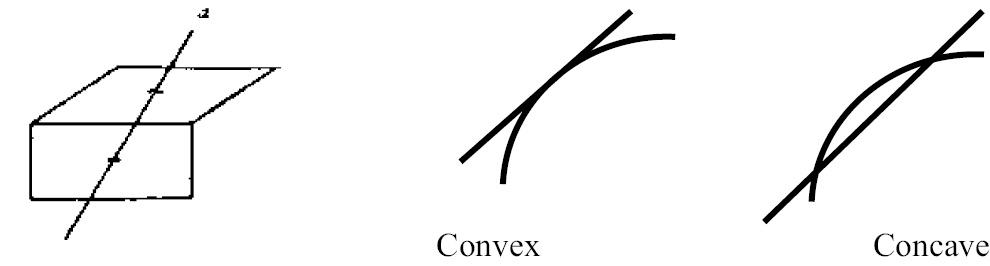
For the debate between Hamann and Kant, see Bayer 2002, 21–26. For the problem of intelligibility as a key question, see Nagel 2012, Neiman 2015. For the metaphysical modelling debate, see Morganti & Tahko 2017.
For language-games, see pi. For the Hamannian background, see Bayer 2002, Dickson 1995, Hein 1983, Snellman 2018. For language-games as a background, see Taylor 1995, 61–78, Glock 1996, 193–198. For language-games as categories, see Garver 1994, 61–72. For the antinomy of realism, see Putnam 1999. For the language-games of seeking and finding, see Hintikka 1973. My argument in Chapter 4 throughout builds on Chapter 3. For Kant’s deduction, see KrV A 84–130/B 116–169, and for language-use as Hamann’s alternative answer, Bayer 2002, 358–360.
Glock 1996, 193–198, Garver 1994, pi 108, 197. For Hamann and Wittgenstein, see Snellman 2018.
pi 7. It was quoted in the discussion of Hamannian antitheodicism in Chapter 3.1.2.3. The discussion of language-games here expands on the discussion of the methods of Hamannian antitheodicy and on philosophical grammar in Chapters 3.1.2.3 and 3.2.
pi 23, Glock 1996, 193–198, Baker & Hacker 1980, 136–138, Snellman 2018, Hein 1983.
Cf. H 22–23/ N ii, 125: “The wealth of all human knowledge consists in the exchange of words”.
Taylor 1995, 61–78. See Heidegger 1996/1971, Dickson 1995. I thank Simo Knuuttila for pointing out the question whether intelligibility is located the mind or the world. See also Chapter 6.1.3 and 6.2.2.
See Haaparanta & Koskinen 2012, 5–6, Putnam 1999, 45–70, Dickson 1995, 311–318, Pihlström 2012.
Taylor 1995, 61–78, Heidegger 1971/1996.
pi 42. pi 8, 16, Baker & Hacker 1980, 26–28, 81–91.
Bayer 2002, 387. Bayer 2002, 374–396, Dickson 1995. The argument continues in more detail in Chapter 4.2.1.
For underlying relationships as games or systems, see zh 7, 169–170, Chapter 3.2.3., Mainzer 2004, Chapter 5.1.2. The argument about general facts is taken up and continued in Chapter 4.2.3 to undermine the problem of realism.
Dickson 1995, 335, pi 16, 142. For causal powers, Bhaskar 2008, esp. 45–56, ep 2.
oc 509–511.
Hein 1983, Dickson 1995, 68–75, zh 7, 163.
H 66/ N ii, 198. See also zh 5, 272. For the theological concepts of encounter and recognition of reality that Hamann and Wittgenstein generalize, see Veijola 1991 and von Rad 1988.
See Bayer 2002, 9–17. The argument is taken up in Chapter 4.4. For a recent attempt to characterize physical systems into informational would-bes and sources of yes/no-choices, facts produced in measurements and other interactions, and scientific results and interpretations, see Wheeler 1990 and Zeilinger 1999. See also Davies & Gregersen 2010.
Putnam 1981, chs. 6, 9. See also MacIntyre 1981, von Rad 1988. The topic is taken up in Chapter 7.1.
My interpretation of Wittgenstein goes against the Baker-Hacker interpretation (1985). Cf. pi 372, Wallgren 2006.
pi 497. On roles, see Bayer 2002, 1–18.
MacIntyre 1981, Chapter 14. Wittgenstein seems to argue that the goal of a language-game is extrinsic to it (pi 499), but concepts and other representations are intrinsic to it, so the goal of language is not to express prelinguistic thoughts.
zh 7, 172 I use O’Flaherty’s translation (quoted in Gray 2012) as a background. See also Hamann’s description of freedom as a ground for linguistic forms of life, which draws from Aristotelian and biblical sources (H 113–117).
See e.g. Hintikka 1973, 1997. See Glock 1996, 193–198. My presentation builds on Osborne & Rubinstein 1994.
The definition is adapted from Osborne & Rubinstein 1994, 89–97, see also Bicchieri 2004.
Osborne & Rubinstein 1994, chs. 2, 6. In a zero-sum game there are always clear winners and losers, or the game ends up in a draw.
The analysis is based on Baker & Hacker 1980, 91–98 and Bayer 2002, but it also includes comments about how language contains its objects, powers and forms of life (Dickson 1995, pi 7, 16, 19, 23, 142 Baker 2004, 52–72), the sacramental models of rule-following (pi 197, 431–432, N iii, 289/H, 216–217, Bayer 2002), the role of tradition (pi 242) and the concept of strategic meaning in Hintikka (cf. Bayer 2002, 9–17).
See Garver 1994, 61–72, Chapter 3.2.1. I will base my treatment of category theory on Smith 2016, Leinster 2014, Marquis 2014 and Wikipedia articles.
Adapted from Leinster 2014, 10 and Smith 2016, 4–5.
Smith 2016, 6–13, 22–30, Marquis 2014.
Garver 1994, 61–72.
Smith 2016, 120–121.
See Baker 2004, 22–52, Marquis 2014, pi 242, 372, Leinster 2014, Chapter 3.1.2.3.
en.wikipedia.org/wiki/category_theory, Smith 2016, 167–191, pi 372. Cf. Chapter 4.3.2.
Leinster 2014, 41, Chapter 2, Smith 2016, chs. 24–27, Marquis 2014, Chapter 3.1.2.3, 3.2.2.
Leinster 2014, 41–42.
H 99/N iii, 27. The comparison of levels of reality taken as categories comes from Ellis 2008 and Meditations.
Hodges (1997, 73–85) discusses back-and-forth games at length.
Saunders Mac Lane famously noted that “Adjoint functors arise everywhere” (quoted in Leinster 2014, Chapter 2). Cf. Hamann’s claim that functional intertwining is a a key feature of reality (H 99/N iii, 27).
For the concept of communication of attributes in theology, see McGrath 2004, 291–294.
N iii, 288/Haynes 2007, 216.
pi 2, Baker & Hacker 1980, 26–28, Osborne & Rubinstein 1994, 15–18, Bayer 2002, 374–396, Wallgren 2006, 391–399, Baker 2004, 22–52, MacIntyre 1981.
Gen. 1:3–4. Wallgren (2006, 259) proposes discussing the creation story in the context of language-games.
N I, 14. The background for the game is Gen. 1–3, Perdue 1991, N ii, 198–199/H 65, N iii, 32/H 108–109, Dickson 1995, 92–95, Bayer 2002, 18–20, 389–393, Bayer 2012. The role of God’s words in the game is somewhat Platonic.
See Chapters 4 and 5.
For Hamann’s ontology, see zh 7, 154–181, 173: “What you call Being in your language, I’d rather call the Word”., zh 1, 14. For Floridi’s ontology, see 2010. For Scholastic realist and game-theoretical theories of causation, see Feser 2014, Bhaskar 2008, Hintikka 2000, ep 2. Bayer 2002, 18–20, 172–173, 389–391.
For “speech to creatures through creatures” see N ii, 198–199/H 65, Bayer 2012, 67–86, Dickson 1995, 92–95, 136–138, Bayer 2002, 18–20, 389–391. For biblical creation theology and Divine Presence, see Perdue 1991, Wright 1996, Simkins 1994, von Rad, 1988. See also pi 2, 372.
Pietarinen & Snellman 2006. The definition is on p. 279. See also Hintikka 1973, 1997, 103–104, ep 2.
oc 476.
pi 107, zh 7, 154–181, Dickson 1995, 306–318, Bayer 2002, 296–312, Hintikka 1973. Note that ∃ and ∀ can be taken for types of ideal relationships (N iii, 283, 285 Haynes 2007, 207, 210.) Hintikka in fact accepts this characterization by comparing seeking and finding with Kant’s forms of intuition (1973, 118–119).
The argument is presented in pi 197, N iii, 288/H 215–216. See Bayer 2002, 374–396, Hintikka & Hintikka 1986, Garver 1994, 231–235, tlp, Appelqvist 2008.
For the argument in Hamann and Wittgenstein, see pi 143–241, N iii, 283–289/H 205–218. My interpretations of their work are based on Baker & Hacker 1980, 1985, Bayer 2002 and Dickson 1995. See also Snellman 2018.
The chapter builds on Chapter 3.2 and its sources (especially Bayer 2002, Dickson 1995, Hein 1983 and Garver 1994).
My summary of Peirce’s triadicism and theory of signs are based on the article “The New Elements” and Peirce’s letters to James (ep 2, 160–178, 300–325, 492–502).
See Bayer 2002, 381–384.
For an interpretation of Peirce’s proof that meaning is use, see Pietarinen & Snellman 2006.
Hintikka often uses the distinction of defining/strategic rules for language-games. See also Glock 1996, 193–198.
The example comes from Wittgenstein (pi 197).
pi 202. Both Hamann and Wittgenstein present a version of the argument as something self-evident (see e.g. N iii, 283/H 206, pi 92, 116, 197). This way of presenting it builds it on a detailed grammar of language-games.
N iii, 288/H 215–216. The collapse of senses/reason dualism in Hamann has been noted by Hein (1983), Dickson (1995) and Bayer (2002).
See Chapter 2.2.
pi 107.
Bayer 2002, 389. Cf. Rep. 2:379. See Chapter 3.2.2, N iii 287/H 213–214 and Bayer 2002, 351–361.
H 99, n. 16. See Chapters 4.1. and 5.2.3. See also McGrath 1994, 291–293.
This is a Wittgensteinian rephrasing of Hamann’s argument (N iii, 287–289, 213–216). See also Bayer 2002, 351–361, 374–396, Dickson 1995, 310–318.
The process of generating conceptual gaps by abstracting words from their contexts was described in Chapter 2.2 and Dickson 1995. Dickson (1995, 300) and Bayer (2002, 378) give similar figures.
The example comes from Wittgenstein (pi 197). The logic of the argument was already discussed in Chapter 4.1.
The theorems are in Chapter 4.1. See also Chapter 5.2.2 for functional intertwinings in various systems.
Ziman 2000, 126–132, 147–151. van Fraassen 2002, 1–30, Chapter 4.1, Hodges 1997, Baez & Stay 2011, Ladyman & Ross 2007, 111–118.
See Chapter 4.2.3 for discussion of models of phlogiston, calculation and empirical correspondences with mechanisms.
Black 1981, Ziman 2000, 147–151.
For the concept of a functor, see Smith 2016, Chapter 13. For morphisms in model theory, see Hodges 1997, 5.
Ziman 2000, 147–151. For models, see Hodges 1997, Chapter 4.1. For functors, see Smith 2016, Chapter 13 and the use of functorial comparisons between Hintikka’s game models and language in Chapter 4.3.
Ricoeur 1993, 207–215. The theme of “sensuous reason” comes from Hein (1983). Hamann took poetic language to embody sensuous images and feelings, and considered biblical poetry to be the original answer to the divine speech in nature. See N ii, 197–199/H 63–66, Dickson 1995, 311. pi part ii, xi, Black 1981.
pi part ii, xi (pp. 193–229). Glock (1996, 36–40) and Ricoeur (1993, 201–215) interpret the theme in Wittgenstein.
These themes bring together seeing-as in Wittgenstein (pi ii, xi) and Ricoeur (1993, 207–215), modelling in Ziman (2000, 147–151), Paul (2012), Morganti and Tahko (2017) as well as seeking and finding in Hintikka (1973).
pi part ii, xi, esp. 194–196.
Glock 1996, 36–40.
pi part ii, 194–196.
pi part ii, 204–208.
pi part ii, 213. See also Chapter 4.2.1.
pi 139–141, Glock 1996, 36–40. The intertwining of senses and reason is discussed in Chapter 4.2.1.
pi part ii, 195–212. Wittgenstein’s approach is used to overcome the fact/meaning split in Chapter 5.2.1, by exploring how we see facts as objects in systems: facts embody systemic logics and we trace objects with reidentifications.
See Hamann’s description of philosophical grammar in Chapter 3.3.2, zh 7, 169. See also Chapter 4.2.1.
See Chapters 4.1 and 4.3. for a description of existence and categories in terms of practices of seeking and finding.
pi part ii, 197.
Cf. pi part 2, 208–212. For basic intuitions and seeking and finding, see N iii, 286/H 211–212, Chapter 4.3.
The picture is from the Past Masters edition of pi part ii, 203.
My approach here is based on Hamann (zh 7, 161–180) and Putnam (1999). See also pi 371–373.
pi 372. Lars Hertzberg discusses the dependence of language-games on facts in the context of the problem of scepticism (Hertzberg 1978).
The definition of language-game is in Chapter 4.1. pi 2, Baker & Hacker 1980, 26–28. Cf pi 16.
pi 142.
pi 372. For the question of the basis for essential knowledge, see Morganti & Tahko 2017.
For the concepts of a causal power and a divine idea, see Bhaskar 2008, Feser 2014, 42–72, N ii, 199, N iii, 37/H 66, 108, Dickson 1995, 91, Moustakas 2003. The dynamic symbolizing relationship of language and reality is discussed in Chapter 3.2.2 and Dickson 1995, 335.
See pi 2, Chapter 4.1.
ep 2, Bhaskar 2008, Feser 2014, Mumford & Anjum 2012, N ii, 199, N iii, 37/H 66, 108, Dickson 1995, 78–79, 91–97, Chapter 3.2.2.
See Chapters 2.2.3 and 2.2.4. For the intertwining of facts and meanings, see Chapter 5.2.
See e.g. pi 142.
My argument builds on Peirce’s view of habits and would-bes in interpretation, as well as Hintikka’s game-theoretic account of final causation. See Pietarinen 2009, ep 2, 456–457, Hintikka 2000, 332–342.
The concept of general facts as causal tendencies, divine ideas or strategies supports a very strong concept of top-down causation (see Ellis 2008): powers, ideas and their manifestations are determined against their contexts and not just their triggering efficient causes. Hence structures of interaction can function as structuring top-down causes, and their activities and outcomes can function as final top-down causes. See Chapter 5.1.2. for a discussion of systems.
The concept of causal realism comes again from Peirce (ep 2, 300–325), Mumford & Anjum (2012), Bhaskar (2008) and Feser (2014).
pi 42, N iii, 288/H 216, Chapters 3.2.2, 4.2.1.
N iii, 284/ H 207–208.
See Chapter 3.2.2, N iii, 289/H 218, Z 320, Wallgren 2006, 391–399. The antinomy of realism is described in Chapter 3.3.3.
pi 372, zh 7, 158–174, Putnam 1999, 22–24.
For scientific models, see Ziman 2000, 147–151, Ladyman & Ross 2007, 111–118. For the question of models in metaphysics, see Paul 2012. For systems, see Mainzer 2004, Chapter 5.1.2. See Smith 2016, chs. 13–16.
Mannermaa 2005. Luther’s view of language is discussed in Työrinoja 1987. For the theology of creation, see Perdue 1991. Wittgenstein discusses immediate certainty in oc 510. The game is in Chapter 4.1.
The game is discussed in Chapter 4.1. The discussion of the example uses chapter 3.2 as a background.
See Chapter 4.1 for a discussion of the game. The institutions A⟶B were seen to be the forms of the object, and thus help constitute its essence. Dickson (1995, 137) argues that Hamann’s nominalism would prevent him from talking about essential knowledge. Hamann however can talk about divine ideas, formal and final causes that amount to the same thing. See N iii, 37/ H 108, Dickson 1995, 79, 335.
For the question of the empirical basis of essential knowledge, see Morganti & Tahko 2017. For discourse possibilities as establishing essential knowledge, see Garver 1994, 61–72, 217–235, Z 498. The de re necessity operator underlines that the grammatical rule concerns the essence of pain.
Cf. Morganti and Tahko (2017) argue that metaphysics offers science possible starting-points for interpretation (see also Bhaskar 2008, 185–199, Kuhn 1970). The grammatical examples I discuss here show the interrelatedness of metaphysics and experience. Experience is interpreted by setting up grammatical rules and norms of description, which then ground metaphysical descriptions. However, the interpretations hinge upon abstract metaphysical claims. See also Paul (2012) for the interaction of science and metaphysics, and Hamann’s metaphors for the interchange of abstract concepts and sensuous intuitions (N iii, 287/H 214, Bayer 2002, 365).
Kuhn 1970. For seeing-as as a practice of interpretation, see pi part 2, xi, Glock 1996, 36–40, Ziman 2000, 147–151.
Putnam (1994) argues that the facts fixing essences are partially determined by epistemic interests. See Chapter 6.2.2.3.
“die Biderkeit der Sprache”: N iii, 285/H 210.
The background for my arguments is in Wittgenstein’s and Hamann’s criticism of the subject/object (or realism/idealism) dualism. pi 371–380 is key for Wittgenstein’s metametaphysics. The point that language-games must include general facts and depend on them is in pi 142, and the argument that they also include their objects is in pi 2. Hamann’s arguments about the presence of divine ideas in language-games offer another influence (N ii, 197–200/ H 65–67, N iii, 37/H 108–109, also the creation game in Chapter 4.1). On Hamann’s way of overcoming the opposition of idealism and realism, see Dickson 1995, 312–313, Snellman 2020a. The background to Hamann’s approach is Luther’s tendency to mix nominalism with Platonic or Aristotelian realism, see Työrinoja 1987. These ideas are then read through ideas about theories of linguistic structures in Chapter 4.1.
See Hintikka & Hintikka 1986, esp. 196–199, 1997 Preface.
For Hintikka’s defence of positivism, see Hintikka 2000, 40–50: the metacritique of logical positivism depends on weak logical tools and a Spectator Theory of science. Therefore stronger formal tools combined with a methodological logical technician’s attitude to science will revive the program of Carnap and the formal wing of the Vienna Circle. For Hintikka’s logical theory and the ineffability of semantics, see Hintikka 1997. On Hamann prefiguring Wittgenstein and Heidegger, see Betz 2009, 242.
The primacy of senses also arises in Hamann, see zh 7, 166. Hintikka and Hamann both view Kant’s transcendental idealism as a failure, and Hamann even endorses the infamous Feder-Garve review accusing Kant of straight-out empirical idealism (see Hintikka 1973, 1989, Bayer 2002, 181, n. 9). The conclusions they draw are diametrically opposite. Hintikka argues that Kant has not purified reason far enough: Kant’s fundamental mistake is to claim that the senses give access to objects, so talk about things-not-subject-to-sensation can be objectified. The correct answer is to logicize the forms of intuition by claiming that we gain access to objects through purely formal operations of seeking and finding. Hamann on the other hand claims that Kant has formalized the categories out of their linguistic contexts and thus cannot connect them with empirical reality otherwise than projecting them on sense-data and ending up in projectivism. (See Dickson 1995, 291–292). Hintikka wants to logicize the senses by viewing intuitions in logical terms, and Hamann wants to sensualize reason by connecting it with linguistic mediation. See Hein 1983.
See Hintikka 1997. For Hintikka on transcendental knowledge, see Hintikka 1989.
See Chapter 3.2.2 for Hamann’s view on the possibility of metalanguages and changing interpretations.
Hintikka 1973, 54–56, 59–61: the logical operations of seeking and finding can be separated from the senses. One arrives to know individuals through seeking and finding and the senses just supply material for a visual field just like one first arrives to New York by plane and then gets a bus from the airport. Practices are independent from word-signs, because one could have the practice of thanking without the word-sign “Thanks!” Hintikka 1997, Preface: rules are prior, because one can design a language-game by listing its rules in a metalanguage. One could add arguments from Peirce: signs are universals that do not depend on their instantiations, and they are representational, as they have the universe of discourse as their final cause. See ep 2, 300–325.
Hintikka 1997, xvii. See Wallgren 2006, 241–242. Cf N iii, 289/H 217: “Here the Homer of pure reason snores as loud a Yes! as Jack and Jill at the altar, presumably because he has dreamed that the universal character of a philosophical language, hitherto sought, is already found”.
Hintikka & Hintikka 1986, 241–243, 261–265. Hintikka quotes pi 202 to make his point (p. 243).
Hintikka & Hintikka 1986,196–199, 1997 Preface.
pi 23. Both Hamann (zh 7, 156) and Wittgenstein (pi 23) explicitly state that forming new languages is possible.
For the matter and form of language in Hamann, see Bayer 2002, 374–396, 413–422. For Wittgenstein’s use of this model, see Snellman 2018.
N iii, 286/H 211. Hamann applies this model to mathematics as well (Bayer 2002, 296–312).
Hamann in fact uses mathematical expressions as an example of the meaning of ideal concepts in empirical use, and contrasts them with metaphysical use that takes ideal concepts to be formally constituted. See N iii, 285/ H 209–211, Bayer 2002, 296–312. The Peirce-Hintikka game can be sought and found in Chapter 4.1.
For the purification of language from Leibniz to the Vienna Circle, see Bayer 2002, 1–4. For the place of Hintikka in the tradition of ideal language theory, see the already quoted section in Hintikka 1997, xvii. For Hamann as a critic of Continental rationalism and his emphasis of the unity of form and matter in language, see Betz 2009, 230–233.
Thus logical games are dependent on communication, as the players have to coordinate their actions to answer the moves of the other players. See Chapter 4.1.
This is a key point of pi 197 and its analogues in Hamann (N iii, 289/H 217–218). See Bayer 2002, 374–396, 413–422.
Chapter 4.1, pi 2, 10, Hintikka 1973, Baker & Hacker 1980.
Appelqvist (2010) presents a similar argument about rules in Wittgenstein. Hamann was an avowed anti-Platonist, see Bayer 2002 297–298. The inspiration behind this argument is a Platonic interpretation of Peirce’s theory of signs (ep 2, 300–325).
Vygotsky 1967, Chapter 4. N iii, 286, 288–289,/ H 211, 215–216, Bayer 2002, §9, 10, 15. See also oc 476.
Most of the examples are from pi and James 1975, but some of them are from the presuppositions of theodicism.
My approach builds on Wittgenstein’s and Garver’s linguistic ground for metaphysical category theory (Garver 1994, 61–72, 217–235, cf. Hintikka 1987), Peirce-Hintikka games (Chapter 4.1, Hintikka 1973), the idea of ideal concepts as types of communicative use that can be embedded on language-games (Chapter 3.2, Baker 2004) and metaphysics that builds on the identification of entities in communicative contexts (Strawson 1959). See also Paul 2012.
I owe this way of describing Kantian and Aristotelian categories to Heikki Kannisto (1996). See Thomassen 2018. Hamann and Heidegger locate the intelligibility of being in the interaction of the knower and the world: see Dickson 1995, Taylor 1995, 61–78. See also the Preface to Haaparanta & Koskinen 2012.
Hintikka 1973, 53–82.
pi 43. For forms of life as underlying and more fundamental practices, see pi 19, Baker & Hacker 1980, 136–137, Chapter 3.2. One should note that the logical priority of forms of life entails the genealogical priority of activities over rules straight away. See N iii, 286/H 211.
Hintikka 1973, 53–56, 57–61. For sensuous encounters as a basis for knowledge and understanding, see N ii, 197–199/ 65–66, zh 5, 265. Glock discusses Strawson’s views on predicates and second order quantifiers (2012).
On formal models as übersichtlich representations of grammar and points of comparison for seeing-as, see Baker 2004, 21–52. For business exchanges as a model for language-use, see N ii, 129/H 22–23.
Hintikka 1973, 63–66, Chapter 4.1. For the concept of Übersicht, see Chapter 3.2.1, Baker 2004, 21–52.
Hintikka 1973, 66–70, Tahko 2015, 29–45, Strawson 1959, pi 371–373, Garver 1994, 61–72.
Tahko 2015, Chapter 3. Quine 1953a, Chapter 3.2.2, zh 7, 168–169, Hintikka 1973, 52–82.
Hamann makes the same point: zh 7, 161, 175.
Hintikka 1973, 70–73, pi 371–373, Garver 1994, 61–72, Glock 2012, 1996, 150–155, Strawson 1959, Chapters 3.2, 5.1.
Tahko 2015, Chapter 3 (39–63). See Glock 2012.
For the plurality of language-games, see pi 23.
Tahko 2015, King 2003, 18–21. van Inwagen interprets quantifiers to mean predicate instantiation (2009).
Chapter 4.2.3, Garver 1994. 61–72.
The idea of categories as types of seeking and finding is in Hintikka (1987). I combine it with anti-formalism: the operations of seeking and finding are intertwined with concrete speech-acts and their basic intuitions. See Chapter 4.2.4 for the critique of Hintikka and Chapter 4.3.2 for an account for the basic intuitions.
For family resemblances, see pi 66–67.
See Chapter 4.1 for the Peirce-Hintikka game and Chapter 4.2.1 for functional intertwining. See Baker 2004, 22–52 for ideals and Chapter 4.3.2 for the dependence of seeking and finding on speech-acts and basic intuitions.
Priest in the book Towards Non-Being, quoted in Tahko 2015, 45. It is interesting that the logic of real existence is approached by taking entia rationis as examples. Well, we’re doing metaphysics (N iii, 287/H 210).
See Tahko 2015, 45–49. It is significant that Peirce speaks of an universe of discourse (ep 2, 300–325), even though he is one of the founders of modern predicate logic. Hintikka’s distinction of one fixed actual universe of discourse vs many universes of discourse (1997) might describe the situation here. Hintikka claims that both Frege and Russell were committed to the universality of logic, but Peirce was not.
pi 23, zh 7, 169, Hintikka 1997, Chapter 4.2.4.
These examples come from Tim Crane and Graham Priest, and have been quoted in Tahko 2015, Chapter 3.
See Tahko 2015, 57–63.
See Ex. 3, Veijola 1991 and Chapter 7.2.1 for the grammar of existence when applied to God.
For seeking and finding with modal expressions, see Hintikka 1969. The expression of logical independence ∃x/Plan means that the chosen present x must be the same in all the planned cases. For if logic, see Hintikka 1997.
Dickson 1995, 291. For mysticism and foundational projects, see Bayer 1991b, 104, n.92.
pi 107.
See Chapter 3.2.2, zh 7, 161–181.
pi 130, Baker & Hacker 1980, 554–555, Baker 2004, 31–46. Cf Bayer 2002, 296–312: ideal languages misconstrue language-use by abstracting the structures of language and then taking them for “hieroglyphs”, i.e. reinterpretable calculi, when the conventions that are needed to interpret calculi are dependent on communicative use.
For the question of isomorphisms between the models of metaphysics and reality, see Paul 2012, Morganti & Tahko 2017, Chapters 4.1, 4.2.2 and van Fraassen 2002, 1–30.
pi 476. The concept of a functor comes from Smith 2016, Chapter 13. For the concept of Übersicht in Wittgenstein, see pi 122, 130, Baker 2004, 22–52.
Cf Hintikka 1973, 61–63, who speaks of verification.
For isomorphisms and adjoints in category theory, see Chapter 4.1, Smith 2016, Leinster 2014.
Garver 1994, 234. The same holds for models in general, see Chapter 4.2.2.
This example again strengthens the case that language-games are prior to the rules of formal logic (see N iii, 286/H 211). Category-theoretical treatments of logic tend to be syntactical or algebraic (see Smith 2016, 231–232, Baez & Stay 2011, Marquis 2014). The method of language-games as categories thus offers new ways of combining semantical approaches to logic with mathematical categories.
For the concept of a functor and concept of sameness of structure in category theory, see Smith 2016 and Chapter 4.1.
The example builds on oc 476, the definition of a language-game in Chapter 4.1 and uses the concept of functors in category theory (Smith 2016) to clarify Wittgenstein’s ideas that ideals are points of comparison that have been reached by abstracting some aspects of a phenomenon, and that simple language-games can be isomorphic with fragments of more complex ones (Chapter 3.2.1, Baker 2004, 22–52). It also builds on Hamann’s ideas that abstract concepts are second-order relationships that are only objective through communicative use (Chapter 3.2.2, zh 7, 161–181).
pi 373, oc 476, Garver 1994, 61–72, Chapter 3.2.1.
N iii, 286/H 211–212. pi 33–37, Bayer 2002, 329–336, Garver 1994, 61–72. Hintikka (1987) also attempts to describe Aristotelian categories as domains for seeking and finding, but does not classify them according to types of intuitions, their associated possibility spaces and discourse possibilities. See also Strawson 1959., Glock 2012.
See Chapter 3.2., pi 371, Glock 1996, 150–155, Hintikka 1973, 52–82, Garver 1994, 217–235.
N iii, 286/H 211–212. pi 33–37, 197, Bayer 2002, 323–336, 374–396, Garver 1994, 61–72, 217–235, Strawson 1959, Hintikka 1973, 52–82.
Z 488, 498, quoted in Garver 1994, 70–71.
The discussion builds on Garver’s description of language-games as categories (1994, 61–72, 217–235), Strawson’s discussions of grids of reference to identify an object (1959, 15–30), Hintikka’s discussion of seeking and finding (1973, 52–82) and Wittgenstein’s and Hamann’s arguments on rule-following (pi 197, N iii, 288–289/H 215–217, Chapter 4.2.1).
The idea of a coordinate system is inspired by Floridi 2010, the concept of modern facts in Chapter 2.2.4 and Wittgenstein’s idea of space, time and colour as forms of an object (tlp 2.0251).
Garver 1994, 70–71, Meditations 6 Nagel 2012, 35–37, Burtt 2016, pi 371–373. The concept of functional intertwining is discussed and used in anti-dualist arguments in Chapters 4.1, 4.2.1 and 5.2.
Strawson 1959, 38, zh 7, 165–170, Garver 1994, 61–72. The theme of reidentification is taken up in Chapter 5.1.
Smolin 2017, 49–65. Cf. the linking of the concept of histories and strategies in game theory, and how they offer the institutions that give a meaning and context for the elements of states of affairs that make up single moves (Chapter 4.1).
Smolin 2017, 50–51.
MacIntyre 1981, Chapter 15. Cf. Hamann’s concept of playing a role (Bayer 2002, 9–17) and the linking of acts into histories and strategies of interpretative action in goal-directed activities in Chapter 4.1.
Bayer 2012, 164, pi 373, zh 7, 169, Kusch 2011.
Wright 2006, 45, McGrath 1994, 170–174.
For the roles of an essence in determining the state-description of an object and for giving grounds for reidentification, see Chapter 3.2, Strawson 1959, Floridi 2010.
Lowe 1998, Chapter 1, Dickson 1995, 136–138. Kantian pragmatists can make similar points about the interrelatedness of subjective concepts and objective structures in linguistic categories: see Pihlström 2012.
These claims follow from rigidity and S5: A is C at w’, so □A=C, A is B at w, so □A=B and these give □B=C.
Kripke 1980, pi 26–30. Nathan Salmon has similarly argued that Kripke’s arguments depend on essentialism.
Lowe 1998, Chapter 8. Tahko (2015) builds on Lowe’s account of the essences. See Hintikka 1973, Garver 1994, 61–72.
The contrasts use the concept of natural transformation between cases of rule-following for pointing out essential connections. See Smith 2016, chs. 20–21. See also H 205–206, Bayer 2002, 216–233, 296–313, pi 197.
pi 107. Morganti & Tahko 2017, Paul 2012.
The chapter builds on the results of the entire chapter, and the account of modelling in Morganti & Tahko 2017.
For descriptive analysis, see Glock 2012, Strawson 1959. Morganti & Tahko 2017, Chapter 5.
The section continues the debate with Paul (2012), Morganti and Tahko (2017) on formal models.
The chapter is based on arguments of Chapter 4.3.2. and the argument about the objectivity of metaphysical rules.
The chapter builds on the definition of models as metaphors (Ziman 2000, 147–151, Chapter 4.2.4) and combines it with the examples of metaphysical categorization in Chapter 4.3.2. It is also a response to Tahko’s and Morganti’s (2017) claim that metaphysical models are second-order models of types of entities in scientific models.
The interpretation is a parallel to Morganti’s and Tahko’s (2017) view that metaphysical models allow for new scientific theories. My claim looks stronger: it allows for new ontologies, new experiments and thus new paradigms. See Kuhn 1970, Bhaskar 2008, 185–199, for paradigms. The section builds on the account of categories as types of relationships of seeking and finding, and the corresponding classification of objects, as well as on the theme of interpretation of models and the resulting new ontologies (Chapter 4.2.2). For the themes of science, history and theology in Hamann, see Bayer 2002, 322–324. For the theme of new languages for interpretation, see Hintikka 1997, zh 7, 156.
Taylor (1995, 61–78) argues that Heidegger locates the intelligibility of objects in the encounter of the subject and the object. This is certainly Hamann’s view, see Chapter 3.2.2. For Aristotle’s categories as both linguistic and concerning objects, see Garver 1994, 61–72, Thomasson 2018.
See KrV A xvi–xvii, Chapter 4.1.3.
For the problem, see Chapter 3.3, van Fraassen 2002, 1–30, Morganti & Tahko 2017.
Pihlström was afraid that the text would end up as a rewriting of Kant’s Critique (KrV). Well, look what happened.