


Forthcoming Series: Indian Ocean Cultures (IOC)
Executive Series Editors
- Dejanirah Couto, École Pratique des Hautes Études, Paris
- Asma Ibrahim, Quetta Archaeological Museum, Pakistan
- Stéphane Pradines, Aga Khan University, London
- Jorge Santos Alves, Universidade Católica Portuguesa, Lisbon
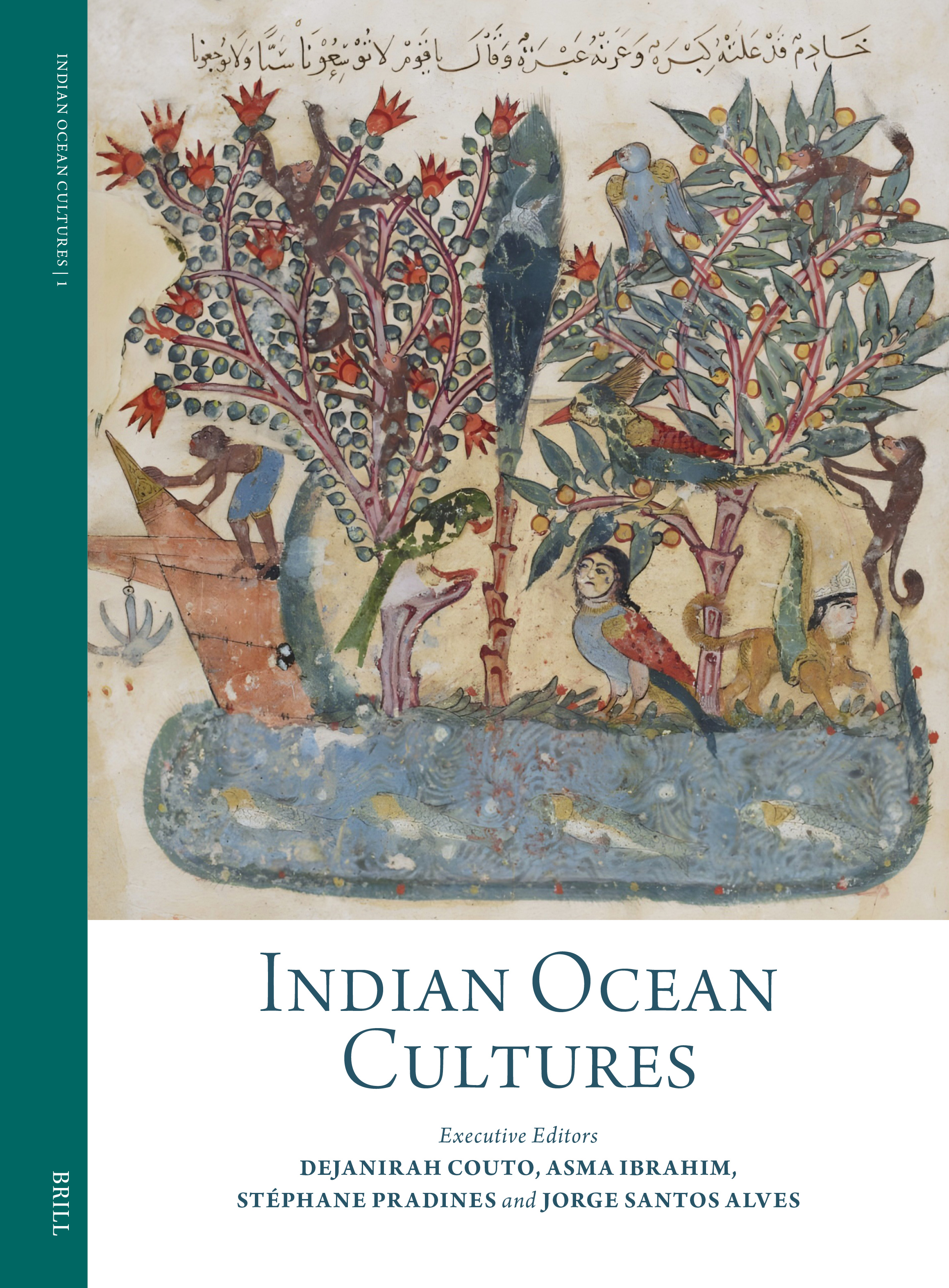 The book series Indian Ocean Cultures (IOC) is a new platform for the study of the tangible and intangible heritage of the vast Indian Ocean space.
It covers a culturally diverse contact zone that has been formed by pluralistic societies within the region and by cultures from around the world. Through the centuries, the Indian Ocean linked the worlds of Asia, India, the Middle East and Africa, facilitating encounters, exchanges and networks that gave rise to cities, ports and civilizations, which, while remaining distinctive, also exhibit traces of interactions and shared knowledge.
There is no time to lose: with global warming and rising sea levels, maritime and littoral heritage are at serious risk.
The series is open to monographs and edited volumes (including co-publications, publications in Open Access, and relevant translations) from diverse fields of study, such as (art) history, archaeology, anthropology, cultural studies, heritage studies, and social sciences. Editions and studies of archival documents and manuscripts are very welcome, as well as studies with an inter- and multidisciplinary profile, and relevant contemporary topics. All relevant original studies of cultural, social, religious, political, diplomatic, and economic connections and interactions between societies and cultures of the coastal landscapes of the Indian Ocean will be considered for inclusion.
The series aims to encourage a reconnaissance of the Indian Ocean as a centre of focus for the study of the Global South. It intends to also include studies that concern:
- The maritime Silk Roads between China, India and Africa
- Cultural links between the Western and Eastern shores of the Indian Ocean
- Zones of circulation of trade and people (incl. the Gulf, the Red Sea and the strait of Malacca)
- Muslim Societies and the Sea
- Indian Ocean Cultures in Global History
- Trading networks
- Important economic, political and social developments
- Academic and political debates about the nature of Islam in the Indian Ocean (for example the role of Buddhism and Sufi orders in the Islamization of the Indian Ocean)
- Religious communities (Muslim, Hindu, Christian, Jewish, Buddhist)
- Women & Gender
Language:
English is encouraged. French and German are also accepted.
Call for Manuscripts:
Authors and Volume Editors are cordially invited to submit proposals and/or full manuscripts by e-mail to Acquisitions Editor Teddi Dols.
Readership:
Historians, archaeologists, anthropologists, art historians, and scholars from the fields of Cultural Studies, Colonial and Post Colonial Studies, Arabic and Middle Eastern Studies, Islamic Studies, Asian Studies, African Studies, Globalisation Studies, Interdisciplinary and Digital Humanities.
Advisory Editorial Board
- Rogaia Abusharaf, Georgetown University, Qatar
- Anne Katrine Bang, University of Bergen
- Uday Chandra, Georgetown University Qatar, Doha
- Michael Feener, Center for Southeast Asian Studies, Kyoto
- Thomas Fibiger, Aarhus University
- Neelima Jeychandran, Virginia Commonwealth University, Qatar
- Mahmood Kooria, University of Edinburgh
- Xialing Liu, University of Macau
- Mohammed Ali Mwenje, National Museums of Kenya, Lamu Museums, Sites and Monuments
- Scott Reese, Northern Arizona University
- Anne Regourd, Centre national de la recherche scientifique, Paris
- Noha Sadek, independent scholar, Paris
- Abdulrahman al-Salimi, German University of Technology, Sultanate of Oman
- Hideaki Suzuki, National Museum of Ethnology, Japan
- Imran bin Tajudeen, National University of Singapore
- Annabel Teh Gallop, British Library, London
- João Teles e Cunha, Universidade Católica Portuguesa, Lisbon
About the Series Editors:
Dejanirah Couto, École Pratique des Hautes Études, Paris, is Professor of Early Modern Portuguese Overseas History and Early Modern Global History. In her research she focuses on Overseas Portuguese History, the Early Modern History of the Indian Ocean, Maritime History, and Early modern Ottoman History.
Asma Ibrahim, Quetta Archaeological Museum, Pakistan, is a Senior Archaeologist, Museologist and Conservationist. She is the Founder and Director of the State Bank Museum, Archives & Art Gallery department in Pakistan.
Stéphane Pradines, Aga Khan University, London, is Archaeologist and Professor of Islamic Art and Architecture at the Aga Khan University, Institute for the Study of Muslim Civilisations (AKU-ISMC). He is the Founding Editor of the Journal of Material Cultures in the Muslim World (MCMW). His work focuses on Islamic archaeology in Sub-Saharan Africa, East Africa (Kenya, Tanzania, Comoros), Indian Ocean medieval trade and Muslim material culture of war.
Jorge Santos Alves, Universidade Católica Portuguesa, Lisbon, is Assistant Professor at the Faculty of Human Sciences (FCH), Universidade Católica Portuguesa (UCP), and Coordinator of the Asian Studies Institute (FCH-UCP). He is affiliated, as senior-researcher, to the Center of Communication and Culture Studies (FCH-UCP), and Director of the journal Oriente (Fundação Oriente, Lisbon).
About the Advisory Editorial Board:
Rogaia Abusharaf, Georgetown University, Qatar, is Professor of Anthropology. Her areas of expertise include human rights, gender, the intersectionality of race and gender, migration and diasporic studies, African migrations, and humanistic and political anthropology, with a geographic focus on her native Sudan, the Gulf, Zanzibar, and the Indian Ocean.
Anne Katrine Bang, University of Bergen, is Professor of Middle Eastern and African Islamic History. She has published widely on Islamic intellectual exchanges in the Indian Ocean (in particular East Africa), and has led projects that brought wider attention to scriptural sources in this field.
Uday Chandra, Georgetown University Qatar, Doha, is Assistant Professor of Government. Expertise: Asian Studies, Cultural History, Culture and Politics, Indigenous History, Indigenous Movements, Migration Studies, Political Anthropology, Political Theology, Social History, Social Theory, South Asia.
Michael Feener, Center for Southeast Asian Studies, Kyoto, is Director of the Maritime Asia Heritage Survey, a Japan based multidisciplinary project team concerned with the creation of a huge digital archive/network/mapping of Indian Ocean heritage. His research focuses on the history of Muslim societies of Southeast Asia and the Indian Ocean World; legal history and across the broader maritime world of Islam around the Indian Ocean littoral; Muslim networks, Quranic Studies, Sufism, Shi’ism, trans-regional histories, and local histories (especially of Aceh and the Maldives).
Thomas Fibiger, is Associate Professor in Arab and Islamic Studies at Aarhus University and works on the Indian Ocean primarily from a point of departure in the Arab world. He holds a PhD in Anthropology (2010) from the same university and has done extensive ethnographic field work in the Arab states of the Gulf during the past 20 years, but also more recently in India and East Africa, co-heading a collective research project on Dawoodi Bohras across the Indian Ocean.
Neelima Jeychandran, is Assistant Professor of African Visual Culture in the Department of Art History at Virginia Commonwealth University, Qatar. She is an ethnographer, editor, and scholar who works on oceanic crossovers and material histories of West and East Africa and western India with research interests in tradeobjects, visual cultures, rituals, architectures of memory, and spatial (re)fabulation oflegacies of slavery. At VCUarts Qatar, she runs the research lab Global Asia: Mobilities and Arts.
Mahmood Kooria, University of Edinburgh, is Lecturer in the History of the Indian Ocean World at the School of History, Classics and Archaeology. His research interests are in the premodern Indian Ocean world, global history of law, Islamic (legal, intellectual or textual) cultures, matrilineal-matriarchal communities, Afro-Asian connections, and manuscript traditions.
Xialing Liu, University of Macau, is an art historian specializing in Transcultural Art History and Early Modern Global Art History. Her research focuses on Transcultural Art History, Material Culture, Chinese Export Art, and Netherlandish Art, with a particular expertise in Coromandel (kuancai)lacquer screens, lacquer rooms, and cabinets.
Mohammed Ali Mwenje, National Museums of Kenya, Lamu Museums, Sites and Monuments, is Curator of Lamu Museums, and Site Manager of Lamu Old Town World Heritage Site. His areas of interest include Swahili historic urban landscapes, archaeological sites along the Kenyan coast, and the transfer of knowledge and technology within the Indian Ocean context.
Scott Reese, Northern Arizona University is Professor of History, and an historian of Islam in Africa and the western Indian Ocean. Reese focuses on comparative history, aiming to break down many regional and geographic categories. He has published widely on Sufism, modern Muslim discourses of reform, and the construction of world systems since 1500. More recently, his research has turned to the history of the Islamic book.
Anne Regourd, Centre national de la recherche scientifique, Paris, is Editor of the journal Nouvelles Chroniques du manuscrit au Yémen, a Codicologist and a Paper Historian. She works on manuscripts from Yemen and the Horn of Africa, and on the material cultures of the Red Sea and the Indian Ocean, on trade routes, trading networks, and on maritime history.
Noha Sadek is an independent scholar of Islamic art based in Paris, France. Her ongoing research focuses on the art and architecture of Yemen.
Abdulrahman al-Salimi is Governor of the German University of Technology, Sultanate of Oman. He has written and edited various books on Islamic manuscripts, classical and modern Islamic history, and on western Indian Ocean maritime history.
Hideaki Suzuki, Associate Professor, Department of Globalization and Humanity, National Museum of Ethnology, Japan. His research focuses on Indian Ocean History, Slavery and the Slave Trade; the African diaspora; the Gujarati mercantile community; Medieval Arab Geography; and Japanese Kanga.
Imran bin Tajudeen, National University of Singapore, is Senior Lecturer at the Department of Malay Studies and the Department of Architecture. His research is focused on Southeast Asia’s cultural encounters through architecture and the vernacular city, with particular focus on mosque forms and ornaments in the context of transregional interactions and translations across the region’s vernacular and Indic architectural legacies.
Annabel Teh Gallop, is Lead Curator Southeast Asia at the British Library, London. Expertise: Malay and Indonesian manuscripts, illumination of Qur’ans and other Islamic manuscripts from Southeast Asia, Ottoman links with Southeast Asia. Maritime Southeast Asia.
João Teles e Cunha, Universidade Católica Portuguesa, Lisbon, is Auxiliary Professor at the Institute of Asian Studies. His field of expertise is the history of the Portuguese Empire in early modern Asia (political, economic, and cultural interactions with South Asia, Safavid Iran, and the Ottoman Empire), and the maritime and commercial history of the Indian Ocean in the early modern age (Persian Gulf and the Arabian Sea).