


As with any scholarly endeavour, this book could not have been written without the support of many. The Dutch Research Council (I) and the British Arts and Humanities Research Council (AHRC) were the channels for the JPI-CH7 project DigiDogon that led to this volume. NWO had already financed Van Beek’s first fieldwork, as well as a number of return visits. The same holds for Utrecht University, Tilburg University and in particular the African Studies Centre Leiden. Michael Rowlands and the Anthropology Department of University College London have been crucial in the British partnership in the DigiDogon project, and we also thank our associate project member Roberto Beneduce of Turin University.
In Mali we thank our partner in the DigiDogon project, the National Museum of Mali, in particular its director Daouda Keita and his adjunct Salia Mallé, as well as Keita’s predecessor, Samuel Sidibe, who was instrumental in earlier phases of the research. Thanks go to Andogoly Guindo, Minister of Culture, and Abinou Témé, Minister of National Education, for their support. As Dogon on high administrative positions in Mali they have been extremely supportive of this project. The UNESCO representatives Lassana Cissé and Moulaye Coulibaly have also been crucial in stimulating heritage preservation in Dogon country. We hope our publication will encourage official UNESCO recognition of the Abirè legacy as intangible heritage, as part of the larger funeral complex called yu yana. An important dynamic resulted from our cooperation with the members of Ginna Dogon, the Dogon cultural association in Mali, whose input has been constant, vital and extremely stimulating. We express our gratitude to their many officials, experts, and more generally to all those Dogon fascinated by their own culture. Since field research depends on the services of many who are not in the limelight, like cooks, drivers and other assistants – in our case Mabudu Saye, Bureima Diarra and Emanuel Saye – our thanks go to them as well. Martina Bom was at our side for the whole project, irreplaceable.
Publishing a text demands a specific attitude, and we thank the editors of this series for their efforts to hone our thinking in this respect. Their deep respect for performed texts underwrites our main intent with this book – and with the project it is part of – i.e. an homage and an expression of gratitude to the baja ni singers of Tireli, whose inspired performances keep a fascinating heritage alive that has hitherto been concealed from a wider public. Dogolu

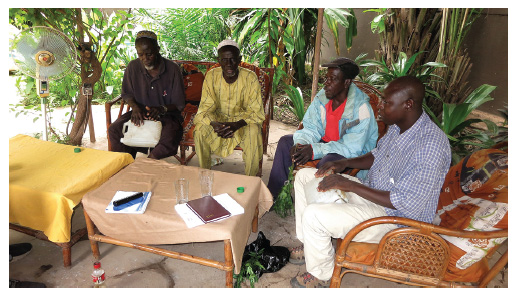
Part of the team singing: Baire Kènugo, Agèmè Domiyon, Mèba Asama and Emanuel Dogolu. Bamako 2018
Joint Program Initiative Cultural Heritage. The DigiDogon project aims at recording, preserving, digitalising and protecting Dogon cultural heritage.