


In 1641, the Dutch physician Nicolaes Tulp (1593–1674), known to art historians primarily through a celebrated work by Rembrandt (1606–69) depicting of one of his anatomical dissections, published his Observationes medicae, which soon – despite being aimed primarily at a specialist readership – became a popular bestseller and appeared in translation in numerous vernacular languages.1 One of the most sensational cases reported by Tulp concerned a remarkably productive but by no means self-evident occupational intersection, specifically between craftsmanship and urological surgery, and one I intend to dissect further in the present essay. Tulp reports that an Amsterdam blacksmith named Jan de Doot (1621–65) suffered from a bladder stone, accompanied by intense pain which no physician had succeeded in relieving through conventional medical treatments, including those attempted by two itinerant ‘stone cutters,’ as lithotomists – surgeons specializing in bladder stones – were called at that time.2 Not once, but twice, this ‘optimistic and incredibly courageous man’3 had submitted to a surgical procedure, extremely dangerous at the time, involving the use of a knife to slice through flesh and tissue between the testicles and anus in order to expose the bladder – but in vain: his sufferings are said to have increased to such a degree that the blacksmith finally performed the operation on himself, using a knife he had fashioned with his own hands. Only a journeyman remained at his side, his wife having been sent away on some pretext. The results of this self-surgery were preserved by the Rembrandt student Carel van Savoyen (1620/21–65) in a portrait that seems to have been executed circa ten or twenty years after Tulp’s report was published (figure 10.1).4 In this image, the standing blacksmith holds the bladder stone in one hand, and the knife used to perform the procedure in the other. Both objects are preserved today in the Museum of Anatomy at Leiden University, which presumably also commissioned the portrait.5 Jan de Doot cut the ‘stone, weighing four ounces,

Carel van Savoyen, Jan Jansz de Doot, oil on canvas, 96 × 84 cm, 1655, Leiden, Academisch Historisch Museum
IMAGE: ANONYMOUS 2004, 4

Anonymous, Bladder Stone and Cutting Blade of Jan De Doot, in Nicolaes Tulp, Observationes Medicae, 2nd expanded edition, Amsterdam 1652, pl. 15
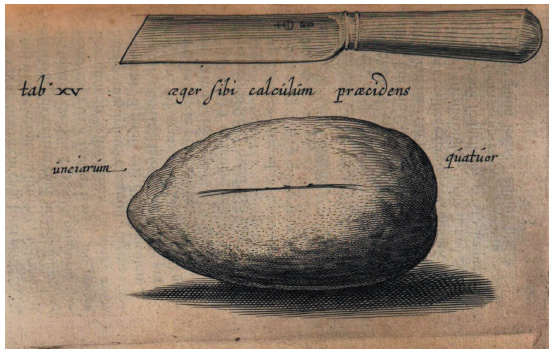
Given its transmission through both material and textual documents, the report is generally regarded as authentic by historians of medicine.8
A blacksmith, of course, is no surgeon, and a ‘student of Vulcan’ is no stone cutter – not even in the early modern era, at a time when surgery had not yet been professionalized as a medical specialization, and was still mostly practiced by skilled wound physicians, highly experienced, ideally, but without the benefit of a university medical training. Still, one of the cultural-historical points of interest of this incident, and one that also accounts, surely, for its
Finally, Carel van Savoyen’s blacksmith, who displays the visible results of his deftness and the bodily control he regained as a result, enjoins us to pose questions concerning the intersection between the pictorial arts and the art of ‘stone cutting.’ For the multifaceted relationship between medicine and surgery, as well as the general dialectic of knowledge and corporeality, characterizes precisely those parameters that were decisive as well for the early modern discourse about art, and which were taken up, for example, by Rembrandt in his Anatomy Lesson of Dr. Nicolaes Tulp, and even more in his Anatomy Lesson of Dr. Deijman, in order to fathom the conditions of his own art.13 The most obvious commonality between stone cutter and artist is the use of their hands. The Dutch term handeling, of significance in particular for the art of Rembrandtesque painters like van Savoyen, is wonderfully apposite here.14 And in a much quoted passage, Marco Boschini (1605–81) writes of Titian (1488–1576) that ‘like a benevolent surgeon,’ the painter excises superfluous or defective elements from his works ‘with no consideration for the pain involved.’15 For both painting and surgery,
This essay addresses such synagonistic phenomena, specifically in relation to the boundaries and possibilities of the comparability as well as the collaboration between two practices that are ostensibly poles apart.16 As with the contributions by Fabian Jonietz and Jasmin Mersmann in the present volume, it is hence not a question of a competitive relationship between artists, media, or disciplines within a given field of shared interests, ideas, or contexts of action. In the cases under investigation here, the focus is instead on a simulated synagonism, one in which the confrontation is constituted only through a successive and on-sided process of conceptual convergence. Foregrounded here will be sociohistorical, epistemological, and media-theoretical aspects of a simulated instance of such productive competition. Urosurgery and art will however not be examined together from an overarching perspective. Advisable methodologically speaking, if we are to fully and accurately comprehend their reciprocal and historically reflected entanglement is a double focus, one that seeks to illuminate points of contact and of friction from the perspectives of each practice. In order to achieve this, we begin with a work by the sculptor Tilman Riemenschneider (1460–1531), one that takes up the theme of a miraculous ‘stone cutting’ procedure in order to underscore the value of the artist’s own manual dexterity. An example dating from the German Renaissance will also be central to the second part of this essay, albeit with a shift of perspective as we inquire, in relation to the stone cutter Georg Bartisch (1535–1606/7), into the possible significance of the pictorial arts for the practice of urosurgery.
During the Middle Ages, and far into the early modern period, surgery was excluded from scholastic studies. Interventions into the genital area in particular were frowned upon, and were often consigned to traveling barber-surgeons or other specialists (often of dubious reputation) who lacked university training.17 The Hippocratic Oath already advises physicians soberly: ‘I will not cut persons laboring under the stone but will leave this to be done by practitioners of the work.’18 Today, this dictum is interpreted as a credo for the division of labor between general practitioners and specialists, one not always lacking in competitiveness. In the Middle Ages and early modern period, in contrast, it was understood primarily as a warning to all educated physicians who were oriented toward rational principles, as well as a final judgment on all stone cutters, and a sweeping condemnation of the bumbling, pretensions, and deceptiveness of the latter occupation. Reflected in this basic conflict between school medicine and the craft of surgery is the traditional privileging of the liberal over the mechanical arts, and more generally of the repeatedly invoked primacy of intellectual activity over manual labor that persisted well into the early modern era (and, in principle, down to the present day).19 As we know, this hierarchy, so deeply grounded in Christian culture, was invoked in discussions about art in Florence, Rome, and later Paris. Prevailing north of the Alps in contrast was, grosso modo, a less idealistic understanding of art, one that was far more naturalistic and materialistic, and was ultimately oriented more emphatically toward corporality, as emphasized at the latest with Michael Baxandall’s The Limewood Sculptors of Renaissance Germany (1980) and Svetlana Alpers’s epochal The Art of Describing (1983).20 Francesco Doni (1513–74) – to give one example – writes in his treatise on art of 1549 that, according to a proverb (one that has received some attention from Martin Warnke), the northern alpine artists do indeed have ‘their heads in their hands.’21 It hardly seems astonishing, then, that in particular north of the Alps, the preferential
A good instance of this commonality is a sculpted relief by Tilman Riemenschneider that testifies to the artist’s intensive preoccupation with the craft of the lithotomist. This work arose in connection with a commission received in 1499 by the Würzburg sculptor, who worked in both stone and wood, for the redesign of the tomb of the Emperor Henry II (St. Henry; reigned 1002–24) and his also sanctified wife Kunigunde (c. 978–1033/39; see figure 10.3).22 This monument, carved from Solnhofen marble, was set up in Bamberg Cathedral in 1513, and consists – alongside the cover slab bearing their effigies – of five reliefs depicting scenes from the lives of the two saints. Since Riemenschneider used models by other hands in producing other scenic reliefs, there has been speculation about a possible cooperation with the Bamberg painter Wolfgang Katzheimer (1478–1508).23 It is important to keep this in mind with regard to the extraordinary iconography of the tomb, even if, for the sake of simplicity, Riemenschneider is referred to below as its sole author.
Tilman Riemenschneider, Tomb of Emperor Henry II and His Wife Kunigunde, tomb, Solnhofen marble, 143 × 116 × 241 cm (h × w × l), 1499–1513, Bamberg Cathedral
IMAGE: KALDEN-ROSENFELD 2004, FIGURE 1

Of special interest here is the relief depicting the Removal of the Stone, an event from the Emperor’s life that transpired in the Benedictine monastery in Monte Cassino and was effected by the community’s founder, already long deceased at that time (figure 10.4). A number of different opinions circulated concerning the performance of this legendary act of healing.24 The Legenda aurea by Jacobus de Voragine (1228–98) mentions the appearance of St. Benedict (c. 480–547) in a dream, so that the miraculous healing takes place while the Emperor sleeps.25 More concrete in contrast is the description contained in Der Heiligen Leben, the most important German-language collection of legends.26 Here, we read explicitly that Benedict held ‘a small piece of sharpened iron, which he used to cut out the stone.’ By virtue of its minimal invasiveness, then, the event qualifies as ‘miraculous,’ if not, however, the actual procedure itself: ‘And [he] cut him,’ we read further on, ‘removing the stone with great
Tilman Riemenschneider, The Removal of the Stone, relief on the imperial tomb, Bamberg Cathedral
IMAGE: KALDEN-ROSENFELD 2004, FIGURE 14

It is against this background that the exceptional quality of Riemenschneider’s relief comes to light: in conformity with the report in Der Heiligen Leben, Riemenschneider has not treated the removal of the stone as an ominous mystery, depicting it instead as the miraculous result of a highly skilled act of urosurgery. Contributing here is the design of the surgical knife, the form of whose handle and blade correspond to contemporary illustrations found in surgical treatises (cf. figure 10.8).30 Moreover, the strongly protruding veins on the back of the hand that guides the knife are suggestive of the physical strength required to perform the now completed operation. Explicit in particular is the contrast between factura and littera: the well-schooled physician must sleep in order for the saint to wield the knife. The knowledge inherent in scholastic medicine must rest before the stone can be cut out manually. The founder of the order himself – although he actually departed this life 500 years earlier – must lend a hand in order to free the Emperor from bodily suffering, while the studiosus turns his back on the sacred operation.
Tilman Riemenschneider, Miracle of the Crystal Bowl, relief on the imperial tomb, Bamberg Cathedral
IMAGE: KALDEN-ROSENFELD 2004, FIGURE 12

Georg Bartisch, The First and Noblest Instrument, pen and ink drawing, in Georg Bartisch, Kunstbuch, 1575, fol. 79v

Hendrick Goltzius, Goltzius’s Right Hand, pen and ink drawing, 229 × 328 mm, 1588, Haarlem, Teylers Museum, inv. no. N-058
IMAGE: KONEČNY & LENCOVÁ 2013, 102

Georg Bartisch, Three Cutting Blades, pen and ink drawing, in Georg Bartisch, Kunstbuch, 1575, fol. 89v

Foregrounded unequivocally in Riemenschneider’s Removal of the Stone is the granting of divine grace and the Christian remembrance of an exemplary saint.35 Inscribed in this paramount function of the depiction is a specific undertaking, namely the conversion of the legend of the miraculous cutting of the stone from the emperor’s body into an emblem of the artist’s own bodily labor, aimed at extracting a human figure from the stone. Moreover, this eulogy to manual labor is compatible with the overall character of the monument, installed in the central nave of the cathedral. Striking in particular is the parallelism with the Miracle of the Crystal Bowl, displayed on the exact opposite side of the tomb (figure 10.5).36 This scene depicts the empress rewarding the builders of the Church of St. Stephen in Bamberg. Manifested in this scene, according to Iris Kalden-Rosenfeld, is the incipient tension between the cathedral chapter, reserved for the aristocracy, which played the decisive role in commissioning the monument,37 and the wealthy burgers of Bamberg.38 In her view, the scene is meant to appeal to the citizens of Bamberg to recognize the just, Christian, and legitimate rule of the authorities. Conversely read, the Miracle of the Crystal Bowl simultaneously reflects the striving of the citizenry for the adequate remuneration for services to church and town, as well as their demands for righteous rule and political influence. In the eyes of an aspiring burgher in Bamberg, Riemenschneider’s interlinking of his own manual skill with the urosurgical miracle of St. Benedict would have appeared less as a self-reflexive statement by an artist than a subversive political statement concerning social status and opposition to the clergy – a constellation familiar to Riemenschneider from his own activities as a councilman in Würzburg.39
Riemenschneider’s The Removal of the Stone provides revealing testimony to the interest on the part of early modern artists in urosurgery in the context of profiling their own discipline. In the following, this inherently one-sided view of the social, technical, and intellectual intersections between these two practices of manual skill will be complemented by an examination of the significance which, conversely, the pictorial arts may have had for lithotomists vis à vis their attempts to establish themselves socially and intellectually. In this gradual process of valorization of surgery as a craft practice, Georg Bartisch was a typical but by no means average protagonist.44 After many years of travel throughout Europe, the ‘oculist, cut, and wound doctor,’45 who was
Characteristic of Bartisch’s courageous commitment to the standing of surgery is his relative disinterest in emphasizing the intellectual character of his activities. He was far more concerned with a fundamental reevaluation of manual activity. A striking instance of this marked appreciation of manual accomplishments is his richly illustrated Kunstbuch from 1575, with a length of 239
And the first and noblest instrument consists of two fingers of the hand. These are used at the start to feel for, locate, and grasp the stone, [as well as to] guide it within the bladder, bringing it to the desired side and position so that it can be cut out. And since these two fingers have the most to do, following [from this] are their correct types, shapes, and skillfulness.57
Georg Bartisch, Bladder Incision According to the Marian Method, pen and ink drawing, in Georg Bartisch, Kunstbuch, 1575, fol. 142r

Fourth, it is good and useful for the surgeon to learn to play the harp, the lute, or other such instruments, … for which the hands and fingers must be used. This allows the physician to acquire flexible joints, subtle and supple limbs and fingers, which are highly useful and necessary for this art.59
On the whole, Bartisch’s requirements are reminiscent of Vitruvius’s list of preconditions for becoming a good architect, as well as of the multiplicity of catalogs of virtues required for diverse occupations and fields of activity which are based on it.60 Above all, the stone cutter should be God-fearing and virtuous, and should, in particular possess a knowledge of Latin; secondly, he should be not simply a lithotomists, but a surgeon and wound physician as well; fourth, as cited above, he should play an instrument; and fifth, should have studied anatomy. The ideal character of this catalog is difficult to overlook, along with the discernible attempt to place stone cutting on level comparable to university medicine.
Third, it is arguably necessary as well for a stone cutter and surgeon to be familiar with the art of painting, to know and master it. For as a rule, this delightful art has the peculiarity and the character of forming subtle, wise, skillful, prudent, reflective and perceptive minds. In the art of medicine, and particularly surgery, these are greatly necessary, just as in the art of painting it is necessary to be able to reflect assiduously, to consider, in order to lay out the poses and proportions pleasingly and with excellence, so that things are neither too short nor too long, that they do not seem either too small nor too thick, that one is instead able to apply them quite pleasingly and with the correct dimensions, form, and manner. It is [also useful] to know [like a painter] how to handle any objects when it comes to shadowing and volume , so that it has neither too much nor too little shadow, but that one instead endows it with the qualities it merits. Required, similarly, when it comes to the dangerous procedure
of cutting out the stone is even greater caution, even more scrupulousness and circumspection. For with this operation, it is required that one [has] good perceptions, is constantly attentive and foresighted, so that one does neither too little nor too much in treating the stone. For when one goes too far, everything is spoiled, so that it can no longer be easily removed. Therefore, it is necessary to have and to exercise a keen, reflective, and prudent intellect.61
This passage is revealing in a number of respects. First, it demonstrates that a pioneering role can indeed be attributed to the artists of the early modern era by virtue of their striving for heightened intellectual and social prestige. That Bartisch refers here to painting and not simply to technical drawing may betray an awareness of the painting chapter in Hermann Ryff’s (c. 1500–48) architectural treatise.62 In any case, we may see a connection with the circumstance that during the second half of the sixteenth century, painting had in many places already succeeded in enhancing the esteem accorded to the physical activity involved, and moreover in a way that remained a distant goal for Bartisch’s own discipline.63 Accordingly, he emphasizes the traditionally ennobled faculties of seeing, imagining, and thinking, whose interplay is indispensable for the manual performance of both disciplines. Explicit, on the
Moreover, the art of painting is necessary and beneficial to the stone cutter and surgeon with regard to his instruments and tools … for it allows him to design and draw his tools and instruments artfully and in accordance with own ideas, [and to] instruct the gold or metalsmith precisely as to how he is to proceed …68
But what is there to say. Today, it is a rare wound physician or surgeon who learns painting or other things that would be enabling, useful, and beneficial to the art of medicine. [For] this would cost a great deal, and would prolong the use of apprenticeship, hence delaying marriage.75
No doubt, Bartisch’s elevation of the art of painting and drawing to a basic prerequisite for the stone cutter is also part and parcel of his efforts at courtly self-presentation. Notwithstanding, his characterization is quite apposite to the argument that comes into focus here. The manual labor, the cheirôn érgon, performed by artists and lithotomist is comparable, and the one can learn from the other how to establish proportions, maintain measure, practice precision. The stone cutter, just like the painter, must ‘ likewise’ shape his material with his hands, in order to create an image, must handle his material in a way that leads to success.
∵
Tilman Riemenschneider’s The Removal of the Stone and Georg Bartisch’s Kunstbuch are two striking instances of the historical proximity of urosurgery
Essentially, the socio-historical, epistemological, and media-theoretical intersections between urosurgery and art are by no means essentially unique. The struggle for courtly acceptance, financial success, and intellectual prestige,
Bibliography
- Bartisch 1575
G. Bartisch, Kunstbuch […], 239 sheets, 298 × 190 cm (sheet), 1575, Dresden, SLUB, Mscr. Dresd. C-291, URL: https://katalog.slub-dresden.de/id/0-1114449164.
- Dembinsky 2011↑
L. Dembinsky, ‘Tilman Riemenschneider im Bauernkrieg: Langer Aufstieg und schneller Fall in Würzburg. Legende und Wirklichkeit,’ in: A. Tacke & F. Irsigler (eds.), Der Künstler in der Gesellschaft: Einführungen zur Künstlersozialgeschichte des Mittelalters und der Frühen Neuzeit, Darmstadt 2011, 303–321.
- Kalden-Rosenfeld 2010
I. Kalden-Rosenfeld, ‘Riemenschneider, Tilman: Kaisergrabmal im Bamberger Dom,’ published on 22 Feb 2010, Historisches Lexikon Bayerns, URL: https://www.historisches-lexikon-bayerns.de/Lexikon/Riemenschneider,_Tilman:_Kaisergrabmal_im_Bamberger_Dom (accessed on 7 Dec 2020).
- Nemes 2016↑
C.N. Nemes, ‘Schlafschwammnarkose (1022)? Die wunderbare Steinheilung Kaiser Heinrich II,’ published in July 2016, Medicine History, http://www.medicine-history.de/files/steinheilung_heinrich_ii_ai_publikation.doc, (last accessed on 7 Dec 2020).
Tulp 1641; on Tulp cf. Beijer & Apeldoorn 1991.
Sumowski 1983, vol. 4, 2546, no. 1697.
Anonymous 2004.
Murphy 1969; Van de Laar 2015, 25–36.
For an introduction to the history of the emancipation and establishment of surgery as a subfield of university medicine in the early modern era, see Ellis & Abdalla 2019, 21–46; Sachs 2000–2005, esp. vol. 4, 1–12 and 223–261.
Kurpershoek 1994, 29–64, esp. 42–47.
Boschini 1674, fol. b4v–b5r: ‘e scoprendo alcuna cosa, che non concordasse al delicato suo intendimento, come chirurgo benefico medicava l’infermo, se faceva di bisogno spolpargli qualque gonfiezza, o soprabondaza di carne, radrizzandogli un braccio, si nella forma l’ossatura non fosse così aggiustata, se un piede nella positura avesse presa attitudine disconcia, mettendolo a luogo senza compatir al suo dolore, e cose simili.’
On the concept of synagonism, see the introduction to this volume, as well as Karagiannis & Wagner 2005, 237–245.
On the professionalization of urosurgery in the early modern era, cf. Moran 2014; Hauri 2013; Konert 2002, 55–92; Hasenbach 1984, 124–148; Ellis 1969, 4–17; Keller 1965. For a general overview, see Steinbock 1993.
For a detailed account, see Androutsos & Marketos 1995; Sachs 2003.
Cf. the incisive chapter on the hand in Leinkauf 2017, vol. 1, 148–153.
Baxandall 1980; Alpers 1983. For a differentiated overview (with an emphasis on the early modern Netherlands), see Chapman & Woodall 2009.
Doni 1549, fol. 16v: ‘si dice in proverbio che gl’hanno il cervello nelle mani;’ cited in Warnke 1987.
Kalden-Rosenfeld 2004; Kalden-Rosenfeld 2001, 62–71 and 132–133, no. 33; Kalden-Rosenfeld 1987; Neundorfer 1985; Bier 1947; for additional literary references, see Iris Kalden-Rosenfeld, 2010. For an overview of the cult of the sanctified imperial couple, in particular in Bamberg, see Guth 2002, 97–119 and (on the tomb) 130–132; Klauser 1957.
Kalden-Rosenfeld 2001, 73–81.
This act of healing has also been much discussed in the historiography of medicine; see among others Schöppler 1919; Sticker 1941; Sachs 2000–2005, vol. 4, 88; Joost 1985, 7; Nemes 2016.
For an introduction to Der Heiligen Leben, see Williams-Krapp 1986, 188–346.
Brand, Jung & Williams-Krapp 1996–2004, vol. 1, 239: ‘Da erschein im sanctus Benedictus vnd trůg ain clains scharpfes eysen, da mit man den stain sneydet. Vnd güzzet den kayser vnd sprach: “Seit du zu got gehofft hast vnd zu mir, so hat mich got zu dir gesant, daz ich dir erczney schol. Vnd lazz mich dich dar ümb sehen, daz nu nymmer zweyfelst…" Vnd [er] snayde im do den stain gar senfticlichen herauz. Da gienge im die wunde wider zu, daz man im newr ain claine masen sach. Vnd leget dem kaiser den stain in die hant. Da erwachet er vnd gedaht im, obb e zain traum wer oder ob ez war wer. Do vant er den stain in der hant. Do wart er gar fro … ‘
On Riemenschneider’s The Removal of the Stone in particular, see Ott 2010, 91–100; Neundorfer 1985, 32–36; Bier 1973, 38–41; Bier 1947, 109–111.
On the contrary identification of the figure as a chamberlain, encountered frequently in the older literature, see Bier 1973, 39.
Cf. in detail Ott 2010, 95–97 (with, among other things, a reference to an even more similar illustration from Santo 1535).
Neundorfer (1985, 34) argues that the man’s sleep is an attribute of negativity, of failure (‘Der Schlaf dieses Mannes ist Attribut des Negativen, des Versagens’).
On the fit between the tomb relief and contemporary popular piety in general, see Kalden-Rosenfeld 1987, 81–87.
In this sense, bladder and kidney stones were widely used votive gifts; see, for example, Döhlemann et al. 2011.
It should be mentioned in this context that earlier scholars have regarded the physician, who wears contemporary dress, as a crypto-self-portrait of Riemenschneider, an identification that was supported primarily through a comparison with the likeness of the artist on the gravestone fashioned by Jörg Riemenschneider; cf. for example Lutzeyer 1975, 27; Toennies 1900, 184; Streit 1888, vol. 1, 13; countering this argument was, among others, Bier 1973, 40.
In this sense, the animals too are legible through the usual interpretive apparatus of Christian allegorism; cf. Ott 2010, 98.
On the legend, cf. Meyer 2003, and here on the legend of the Miracle of the Bowl in relation to the building of St. Stephan 73 and 85–88.
On the details of the commission, see Kalden 1990, 53–64; Kalden-Rodenfeld 1987, 69.
Kalden 1990, 55–57; Kalden-Rosenfeld 2004, 48–51.
On Riemenschneider’s political engagement in Würzburg, see Schneider 2010, esp. 79–82; Kalden 1990, 17–32; the complications with the canons are emphasized by Trenschel 2004, 48–49; on Riemenschneider’s role in the Peasants’ Revolt, see Dembinsky 2011.
On the clients, see Schleif 1993, 614; on Nicodemus, see ibid., 603–610 and 618–619; on the reception history of Riemenschneider’s self-portrait, see Schleif 2004; on the ‘authentic’ crucifix in Lucca, supposedly fashioned by Nicodemus, see Savigni 2017, 275–285.
The entire passage reads (Schnürer & Ritz 1934, 128): ‘Forme igitur corporis Christi quantitate et qualittate diligentissime denotata, liniamentis etiam mente descripttis, sacratissimum vultum non sua, sed divina arte desculpsit.’ – For an introduction to the Volto santo of Lucca, see ibid., 117–123.
In this spirit, Corinna Schleif (1993, 610–626) interprets self-depictions as Nicodemus by artists (in particular those of sculptors, and not only those produced by the German Renaissance). For a later comparable self-positioning, see Shrimplin-Evangelidis 1989; see also on Michelangelo’s kidney stone, Eknoyan 2000, 1190–1201.
For a far later instance of the identification of an artist with a saintly practitioner of miraculous surgery, see Thimann 2016, 556.
For an introduction to Georg Bartisch, see Dietrich, Hausmann & Konert 2009; Hausmann, Konert, & Dietrich 2009, 45–56; Marré & Walther 1985; Keller 1955.
This is Bartisch’s self-description in the title page of Bartisch 1583: ‘Bürger, Oculist, Schnit vnd Wundartzt in der Churfüstlichen Alten Stadt Dresden’.
For example in the title page of his Ophthalmodouleia (see the quote in note 45) in which he additionally reproduces official testimonials to his success (Bartisch 1583, fol. c1v-e3v); for another example, see Holländer 1917.
Bartisch 1583; for an introduction to this work, see Gerste & Pillunat 2018, 3–14; Gliem 1985; Hirschberg 1899–1918, vol. 1, 332–353. Appearing while this essay was in the publication process was Berger 2021.
Baker 2017; Heidel 1985, 12–15.
On Kaltemarckt, with further references, see Müller 2018; Liebenwein 2016, esp. 139–140.
Neefe 1898; Strauchenbruch 2010; Allgemeine Deutsche Biographie, vol. 19 (1884), 692–694; Roebel 2012.
Georg Bartisch, Kunstbuch […], 239 sheets, 298 × 190 cm (sheet), 1575, Dresden, SLUB, Mscr. Dresd. C-291. – There are two modern editions, by Mankiewicz 1904; and Hausmann, Konert & Dietrich 2009, 57–1027.
Bartisch 1575, title page: ‘Darinnen ist der gantze … bericht und erweisung unnd Lehr des hartenn, Reissenden, Schmertzhafftigenn, Peinlichenn Blasenn Steines … Wie derselbige … Blasenstein … künstlich Eigentlich Recht unnd gewis durch die Handwirckunge des Güldenngriffs unnd Instruments, Soll geschnitten, gebracht und gewonnen werdenn. | Mit Rechter Eigentlicher beschreibung und abcontrafactur aller Instrumenta und Figuren. So zu dieser Kunst unnd Handwirckunge sehr dienstlich …’
Bartisch 1575, fol. 78r: ‘Inn dem i. Theil | Wirdt … vor augen gestelt, Der brauch unnd | abcontrafactur aller Instrument …’
See Hauri 2013, 29–34; the method was first published by Santo (1522), whose title led Bartisch to speak of a ‘golden handle.’ On Giovanni de Romanis, see Fabbri 1868.
Bartisch 1575, fol. 79r: ‘Das Erste Stuck und Instrument ist die Fühle und sindt die Finger.’
Konečny & Lencová 2013; cat. Amsterdan, New York & Toledo 2003, 244–246, no. 85; Reznicek 1961, vol. 1, 305–306, no. 165.
Bartisch 1575, fol. 79r: ‘Und das Erste und vornembste Instrument ist und seint Zwene finger der Faust. Darmit muß mann erstlich und vornemlich den Stein fülenn, findenn und greiffenn, denselbenn auch in der Blasenn hertzu treibenn und auff die Rechte seitte und stelle bringenn. Damit er Zu schneyden sey. Unnd müssen dieselbigenn Zwene finger am meisten außrichten und bey diesem werth thun, folget die rechte Art, gestalt und geschickligkeyt derselbigenn.’
The catalog of requirements constitutes the second part of the Kunstbuchs: Bartisch 1575, fol. 6v–19v; Mankiewicz 1904, 32–45; see also Keller 1965, 809–810.
Bartisch 1575, fol. 11v–12r: ‘Zum Vierdenn. Ist einem Schneidt Artzt gut unnd nützlichenn, das er auff der Harffen und Lautten und anderen dergleichen Instrumenten lehrnne … [d]artzu einer die Hendt und finger brauchen muß. Dardurch bekömpt ein Arzt seine gelencke, gefüge, Subtile, gelinde glidtmassen und finger, die einen zu dieser Kunst sehr nützlich und nötig sein.’
Bartisch 1575, fol. 9v–10r: ‘Zum Dritten, werr und ist auch wol vonn nöten, das ein Steinschneider und Schnidt Arzt der Kunst des Malens bericht sey, dasselbige könne und wisse, denn gemeiniglich diese liebliche Kunst die Art und eigenschafft hat, das sie feine vorstendige, geschickte, vorsichtige, nachdenckliche und Scharffsinnige Köpffe giebeth. Welches dann Inn der Artzney und sonderlich im Schneiden, hoch vonn nötenn ist, gleich wie man in der Kunst des Malens ein fleissig nachdencken und betrachtung habenn muß, auff das man die Possenn und Proportion Artlich und Recht wisse zu stellenn, auff das es nicht zu kurtz oder zu lang werde, auch nicht zu klein noch zu dicke scheine, sondern dasselbige gantz Artlich und in Rechter mas, form und weis zu stellenn. Auch das man wisse, wie man ein iedes stück, was es sey, mit der Schattirung und vorförmung weiß recht zu thun. Das es nicht zu sehr noch zu wenigk schattenn habe, sondern Ihm sein gebürlich Recht thue. Also muß mann fürwar in dieser gefehrlichenn Chur den Stein schneiden, Ja viel vorsichtiger und grösser bedenckenn und nachtrachtung habenn, denn da ist vonn nötenn, das mann gutte betrachtung, fleissigk auffsehe und fürsichtig sey, darmit man Ihm ia nit zu viel noch zu wenig thue, Und da mann ihm da ein mal zu viel thut, wirdt es vorderbet, das ihm nicht leichtlich zu helffen ist. Darumb ist vonn nötenn, das man einen scharffen nachdencklichen und vorsichtigen verstandt dartzu habe und gebrauche.’
Cf. Berger 2021, 44.
On the protracted process of establishment of urological surgery in the early modern era, see n. 11; on the value placed on art at the Saxon court during the second half of the sixteenth century, see Liebenwein 2016, 139–140.
Bartisch 1575, fol. 6r-v: ‘Unnd ist diese Kunst billich vor eine freye Kunst zu achtenn, unnd zu haltenn, nicht derwegenn, das eß ein jeder loser verlauffener Bube braucht, und zugelassenn werd und frey stehe, wie itzt leihder geschieht. Sonndernn darumb wirdt es eine freye Kunst geheissen unnd genent, das mann einen jedenn Menschenn, der da große Qual … leiden muß, … helffenn, das er gesundt unnd frisch wirdt, seiner schmertzenn ganz quitt, ledigk unnd loß wirdt.’ – On the valuation of the fine arts as ‘liberal arts’ in the late fifteenth century north of the Alps, see the references in Saß 2016, 50–56.
Aristotle 1956, vol. 9.4 (2005), 50 (Politics § 1337b and 1338b).
See, for instance, Bredekamp 2005 and 2015; Rath, Trempler & Wenderholm 2013; Payne 2015.
Essential here are the three-volumes cat. Munich & Heidelberg 2014; cat. Heidelberg 2015; Nanobashvili & Teutenberg 2019.
Bartisch 1575, fol. 10r-v: ‘Weitter ist diese Kunst des Malenns einem Steinnschneider und Schneidt Artzte vonn nötenn und zutreglich, vonn wegen der Instrument und Zeugk […], da kann Er seinen Zeugk und Instrument selbst Künstlich und gar eigentlichen entwerffen, abreissen den Golt unnd Klein Schmiedenn. Recht an und vorgeben, wie es sein sölle.’
The entire passage reads as follows, Bartisch 1583, fol. b3r (Vorrede): ‘Auch alle dieselbigen eusserlichen Gebrechen / Schäden und Mengel selbest entworffen / abgerissen und Contrafectet, […] Zu welchem mir die Malerkunst / so mir Gott auch verliehen und mitgeteilet / nicht wenig ursache gegeben / sondern viel dienstlich und förderlich gewesen. Denn keinem Oculisten und Schnitartzte solches möglich ist ins werck zu richten oder zu bringen / er könne denn selbest reissen und malen / Wie mir solches alle Maler und Illuministen, die mein fürnemen gesehen und wissen / Zeugnis und beyfall geben. Und darzu hat mich vornehmlich beweget und gebracht der Griechen Exempel / von welchen man schreibet / das sie ihre jugent / als bald sich dieselbige zum studio Medicinae begeben / und damit umbgangen / auch unverharlich neben ihrem Studiren das Reissen und die Malerkunst haben lernen und üben lassen / Als die nach ihrer weisheit wol verstanden / das solches zu der kunst der Artzney hoch nötig und nützlich sey.’
Bartisch 1583, fol. 10r: ‘Das IIII. Capitel meldet / wer und was ein rechter Oculist … verstehen, können und wissen / und wie er sich verhalen sol.’ This chapter encompasses the pages: ibid., fol. 10r-12v.
Bartisch 1583, fol. 11v: ‘Zum achten … [ist] sehr nötig / das er der kunst des malens und reissens bericht und erfahren sey.’
Bartisch 1583, fol. 11v: ‘Darzu ist es alle maal an dem / das die jenigen / so der kunst des Malens und Reissens bericht sind, vornemlich sinnreiche und nachdenckliche köpffe und menschen sein vor andern / welches in der Kunst der Artzney hochnötig / sehr nützlich und zutreglich ist.’
For the citation, see n. 61.
Bartisch 1575, fol. 11r: ‘Aber was soll mann viel sagenn, selten die Wundt und Schnitt Ertzte itziger Zeit noch Malenn lernen, oder andere dinge die zu der Artzney tüchtig, nützlich und gut werenn, das würde viel Kosten und würden die Lehr-Jahr viel zu lange werenn, müßten zu langsamb Weiber nehmenn.’
Qualifying as genuine special cases would be neurologists who were also practicing artists, among them Sir Henry Jacob Thompson; cf. Dunsmuir & Kirby 1995. Exceptional as well is Marin Marais’s musical setting of a stone cutting procedure; see Evers 1998.
For a kidney stone whose supposed imagery became the subject of an intense religio-political discussion, see Stein 2013; Pilaski 2007; for the semantic charging of bladder and kidney stones as evidentiary symbols, see Schutte 2002.
On depictions of stone cutters that are readable against the backdrop of early modern art theory, see Saß 2019.
Wilhelm Fabry von Hilden’s Lithotomia Vesicae, one of the advanced specialist treatises on urology, and in particular the treatment of bladder and kidney stones, contains a report on a pseudo-surgical charlatan (ibid., 41): ‘Solcher Landstreicher einer ist zu meiner zeit gen Cölln kommen / da er sich grosser sachen und Künsten hat außgeben: Als nun daselbst er einen am Stein hat schneiden wollen / und aber keinen Stein bey ihm findet / läßt er verborgener weiß / und mit grosser geschwindigkeit / einen Stein auß dem Ermel zu der Zangen fallen / und thut dergleichen als wann er ihn hette auß der Blaser bracht …’
For introductory material, see the still insightful study by Holländer 1903.