


The early success story of the medium of the panel painting – whose origins can be traced in the German-speaking world back to the 13th century, and reached a highpoint in the transition between the late Middle Ages and early modern era – arrived at its consummate expression with the genesis of the winged altarpiece. From the start, intermedial references and constellations constituted a central and striking trait of the new genre of the winged altarpiece, among whose central achievements, as Klaus Krüger has argued, was ‘the abrogation of heterogeneous multiplicity in favor of overarching homogeneity in a perceptual order.’1 According to Krüger, the winged altar shrine – as a ‘mixed’ form of the winged altarpiece – transferred the various elements that were gathered together on the altar, and which differed in design, function, and valence, into an overarching system of order that subsumed the various media and modes of representation and made possible a set of reciprocal formal and thematic interrelationships. As a liturgical form, this type aimed in particular at ‘polyfunctionality within a formally unified and integrated structure, also with regard to optical impact.’ This resulted, according to Krüger, in a ‘perspectivation of perception’ that relativized the presence of reliquaries and statues to such an extent that they were now embedded in a unified field of vision, and at the same time also in a representative function.2
The winged altarpiece, therefore, strove toward a system of order that translated multiplicity into unity without however seeking to nullify or negate the aspect of difference. Instead, such difference was embedded now in a shared perceptual and representational form, with perception being furnished now in a very particular way with a symbolic, religious, and philosophical coding. And although the invention of the winged altarpiece aimed first and foremost toward the resolution of a preexisting ‘conflict’ between image programs on
The present essay seeks to trace this productive dialectic of the winged altarpiece, and to examine in greater detail in particular the difference between panel painting and sculpture, as manifested in the cooperation but also the opposition between the two media. As Krüger has emphasized, it was panel painting in particular that profited in a very special way from the ‘tendency toward perspectivation.’ Within the larger ‘process of the specific engendering of visual orders of perception,’ this still-young medium succeeded in establishing its presence on the altar in an effective and lasting way – first through a close and varied recourse to the liturgical situation prevailing on the altar and the resultant intermedial constellation, and secondly by exhausting and further developing its own genuine representational and expressive potential.4 How does the interplay – conceived here as synagonistic – between the media take shape with regard in particular to concerns related to optics and perceptual issues? As the research of the past two decades has clearly shown, ‘the gaze and the eyes’ in the late Middle Ages were ‘essential bearers of religious and social communication, of the act of cognition as well as of education.’5 But what specific experiential and cognitive value – in the sense of added value – could intermedial references, the coexistence, opposition, or collaboration of the respective media and their differing qualities, offer religious beholders at the altar, but also in private devotions? This question will be examined more closely with reference to two altarpieces, both – not coincidentally – from Cologne. Observable early on in the metropolis on the Rhine in particular in relation to the altarpiece was a ‘tradition of medial synthesis,’ and concomitantly, of medial reflection:6 discussed briefly as an initial instance of the ‘process of the specific engendering of visual orders of perception’ is the Kleine Dom (Little Cathedral), a ‘mixed’ (i.e. combining painting and sculpture) baldachin altarpiece that dates from 1350/60, and which may have originally included relics. Subjected to a detailed analysis and interpretation afterwards will be
1 Incarnation and Otherworldliness in the Kleine Dom: the ‘Oscillating Gaze’
Little is known about the early history of the small winged altarpiece known since the late 19th century as the Kleine Dom, or Little Cathedral (figures 9.1, 9.2), and preserved today in the Bayerisches Nationalmuseum. Stylistic and technological comparisons leave little doubt that this work, produced in the 1350s, is one of a series of surviving 14th-century Rhenish carved altarpieces.7 No concrete information, however, has survived concerning its context of origin, i.e., the executing artist or donor, original place of display, or intended use. Only in the 19th century, when the ‘beautifully carved holy shrine, furnished with two towers’8 entered the collection of the brothers Sulpiz and Melchior Boisserée, in the process acquiring the name Kleine Dom among their circle of family and friends (probably an allusion to the still-unfinished Cologne Cathedral), was strong light shed on its origins. A note discovered in the posthumous papers of the brothers suggests that the little altar-shrine came from the Franciscan Convent of St. Clare in Cologne, which was secularized in 1802 and destroyed two years later. Presumably, Sulpiz Boisserée acquired it shortly after the building’s demolition together with the celebrated Altarpiece of St. Clare, which came from the same church. The question of when and how the small-format shrine and relic altar came into the convent, and whether it was originally commissioned for this institution, or had instead served previously as a house altar for private devotions by an unknown owner, must unfortunately remain unresolved.9

Der Kleine Dom (Little Cathedral) (exterior view), Cologne, c.1360, 147.5 × 123.5 cm (when closed: 147.5 × 53 cm), Munich, Bayerisches Nationalmuseum, inv. no. L MA 1968 a-d
IMAGE: CREATIVE COMMONS / BAYERISCHES NATIONALMUSEUM

Der Kleine Dom (Little Cathedral) (exterior view), Cologne, c.1360, 147.5 × 123.5 cm (when closed: 147.5 × 53 cm), Munich, Bayerisches Nationalmuseum, inv. no. L MA 1968 a-d
IMAGE: HILGER, GOLDBERG & RINGER 1990, PP. 52–53


Including its crowning superstructure, the vertical, rectangular altar shrine, fashioned from oak, measures altogether 147.5 cm in height; when opened, it measures 123.5 cm in width, and 53 cm when the wings are closed. It is
Although the little altar in Cologne probably served originally as a reliquary, it nonetheless signals a shift in meaning with regard to the relationship between image program and the display of relics. The tendency, referenced above, in the development of the winged altarpiece – namely towards the relativization of the presence of the relic as a consequence of its embeddedness in a unifying structure that aims primarily at a visual impact – is manifested in the little baldachin altar to the extent that here, the shrine itself no longer served as a repository for a relic, and was instead reserved exclusively for the image program. While the relic itself, which has meanwhile been lost, was probably preserved in the window stories, backed with parchment, of the tower zone, the main body of the shrine accommodates the fully sculptural group of the Annunciation.13 The figures of the Archangel Gabriel and the Virgin Mary, each set on its own base, are carved from walnut, and have been given in partially gloss (the garments) and partially matte (the hair) poliment gilding. The
With the scene of the Annunciation, the little winged altarpiece revolves around the central mystery of the history of Christian salvation, which is to say the moment of the Incarnation of Christ. This scene is supplemented and framed on the inner wings by additional painted scenes from the the childhood of Jesus. Displayed in the wider compartmented fields of the inner wings are – proceeding against the reading direction – the birth scene with the Adoration of the Child by Mary and Joseph, followed on the upper left by the Adoration of the Kings, the Presentation in the Temple on the lower right, and the Flight into Egypt on the lower left. Depicted in the vertical fields of the inner compartments of the wings are two male and two female saints: on the left the Princes of the Apostles, Peter (above) and Paul (below), and on the right, and identified by their attire as noble abbesses, St. Gertrude of Nivelles (above) and St. Agnes (below).15 The elevated status accorded to the Annunciation scene when the shrine is viewed in an opened state may seem perfectly legitimate, but may cause confusion when the outer wings are examined, for oddly enough, they repeat exactly the same scene. When closed too, the little altar displays an Annunciation, although the Archangel and the Virgin appear now as painted figures against a green ground that is dotted with stars. Gabriel, whose left wing is still shown outspread and extending upward, seems to have just appeared before Mary, who interrupts her reading to turn toward the angel. Her head lowered submissively, she seems to willingly receive the divine message, and hence her destiny, as probably communicated originally by the raised texted band she holds in her right hand. The dove that hovers directly above her head indicates that she is overshadowed by the Holy Ghost, and hence marks the moment of her virginal conception.
When the little altar is opened, the pictorial presentation is not only broader, more detailed, and more splendid, but also effectuates a new, third dimension, in a sense incarnating and reflecting the theme of the Annunciation on a medial level. When the wings are moved successively, the effect is even more astonishing. One figure remains standing there for a brief time as a flat image, a disembodied, robed figure, while the other has already been awakened to three-dimensional life – and has moreover kneeled down …19
Nel primo tempo nel quale la mente cominci colle infrascrite circunstanzie di Cristo a pensare Cristo pare nella mente e nella imaginativa scritto. Nel secondo pare disegnato. Nel terzo pare disegnato e ombrato. Nel quarto pare colorato e incarnato. Nel quinto pare incarnato e rilevato.23
But the heightened – with regard to both concreteness and impressiveness – presence of the salvific events in the sculptures of the Kleine Dom, which undisputedly represents an ‘added value,’ coexists with another tendency, one whose point of departure is found in the lavish use of gold. Through the nearly all-encompassing gilding of both the shrine cabinet and the figures, the corporeality and presence that is inherent to the three-dimensional medium is relativized and countered here by a tendency toward otherworldliness. To be sure, the pronounced use of gold as a ‘metaphor for the sacred’ also stimulates
This attachment has an intellectual-ecclesiastical and a perceptual-psychological dimension. Enveloped in the eternal light of the Heavenly Jerusalem, the figures – which are actually physically graspable – ultimately escape the world of the beholder, are removed from it both temporally and spatially. Parallel to this ambivalence, visual perception of the shrine oscillates between an impression of pictorial planarity and an impression of depth.26
The Kleine Dom, claims Krischel, demands of the beholder a ‘gaze that jumps back and forth,’ an ‘oscillating gaze;’ in his view, such a vibrating mode of perception, which alternates between two and three dimensionality, is entirely consistent with the principle of the intermedial altarpiece.27 This image-immanent strategy does not, however, seem to be propelled solely by the material-aesthetic qualities of metallic gold, but is also – with regard to the painting – intensified and reflected upon through use of color. A technical investigation of the altar carried out in 1981, accompanied by conservation measures, revealed that the wings of the two music-making angels originally displayed an elaborate, detailed painted surface in the form of a peacock
Without in principle wishing to dispute the ‘ontological superiority’ of sculpture, I want to emphasize here the importance of the oscillating play of media as an important aspect of the complex network of relationships that characterizes the ‘altar ensemble.’ With the celebration of the mass, the mystery of the Eucharist is enacted repeatedly on the altar: according to Catholic doctrine, not only does the sacrificial death of Christ experience a permanent actualization at the moment of the transformation of the bread into the Body of Christ; occurring as well is a connection between terrestrial and celestial liturgy, and hence a union between the visible and the invisible.30 In its material, three-dimensional appearance, does sculpture not correspond more closely to the notion of the authentic presence of Christ in the sacrament? Hence accommodating the inner need of the faithful for bodily presence? But the question nonetheless arises: How is it possible, at the same time, to do justice to the mystery, to the nonvisible, to the enigmatic and ultimately incomprehensible? And does painting, with its capacity for conjuring illusion, perhaps possess a certain ‘added value’ in this context?31 This question is equally relevant to the mystery of the Incarnation, depicted doubly in the Kleine Dom, on both inside and outside. Ultimately, the transformation of the word into flesh,
2 The Crucifixion Altarpiece of the Master of the Bartholomew Altarpiece as a Reflection of the Scope of Visual Perception and Intellectual Cognition
The productive, cognitively generative tension that emerges from the opposition and cooperation between the media and the oscillating gaze associated with them may be a primary reason why recourse to intermedial constellations – first and foremost involving painting and sculpture, but also architecture, goldsmithing, and the textile arts – remained a virtually omnipresent phenomenon in altarpieces in later periods as well – and moreover, not only in ‘mixed’ altarpieces, but specifically in the exclusively painted winged altarpieces of the 15th century. There can be little doubt that this tendency found its most prominent expression in the use of grisaille north of the Alps: depictions of unpainted stone sculpture in the medium of monochrome painting, initiated primarily by the Flemish masters Jan van Eyck and the Master of Flemalle, became well-established on the outside of winged altarpieces, specifically in order to produce a deliberate and graded relationship toward the inner wings, whether these were painted in various colors, executed in relief, or instead took the form of fully three-dimensional sculpture. Moreover, painted works that were suggestive of carved altarpieces enjoyed great popularity: in his The Descent from
Rogier van der Weyden, The Descent from the Cross, before 1443, oil on wood, 204.5 × 261.5 cm, Madrid, Museo del Prado, inv. no. P002825
IMAGE: WIKIMEDIA COMMONS
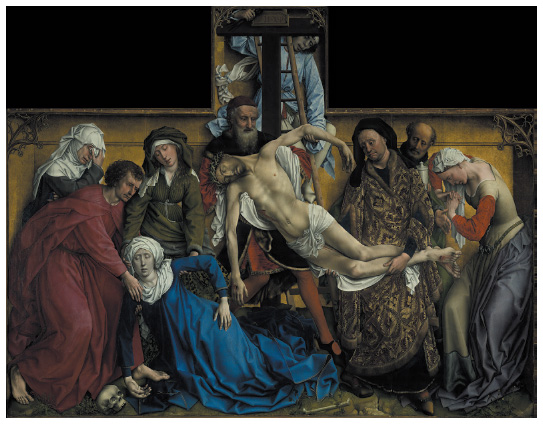
In particular since the early 1990s, the intermedial discourse that is manifested in both the use of grisaille and the painterly imitation of carved altarpieces has been the subject of intense discussion – and has been associated with a heightened interest within art history in pictorial self-referentiality and reflexivity, in the question of how artworks thematize their own existence as images, which is to say their genuinely medial status, their artificiality as something created or invented, but also their illusionistic power and communicative functions.33 Repeatedly, the research has invoked intermedial references –
Discussed now with reference to a specific example is precisely this potential – in relation to synagonism as well – and the demands made upon the beholder’s perceptual powers by this type of intricate illusionistic play. The work in question is the Crucifixion Altarpiece by the Master of the Bartholomew Altarpiece, a work that in sophisticated ways exploits both the concept of the painted shrine cabinet whose figures appear to have been summoned to life, as well as grisaille technique.
The painted triptych, which dates from 1490/95, was commissioned by the highly educated Cologne attorney Peter Rinck, who was born to a wealthy merchant family and studied at the universities in Erfurt, Paris, Cologne, and Pavia, later becoming a professor at the law school at Cologne University. After attempting as a young man to join the Carthusian Order, whose strict demands he evidently found himself physically incapable of satisfying, he resolved upon a life as a scholar, henceforth devoting himself to other, more private forms of piety. Rinck, who was among the most important donors in the Cologne of the late 15th century, not only owned an extensive library whose primary focus, apart from law, was theology, but a private chapel as well. And it was there, in all likelihood, that the Crucifixion Altarpiece was first installed. A testamentary
Master of the Bartholomew Altarpiece, Crucifixion Altarpiece (exterior view), c.1490/95, oak, wings: each 107 × 34 cm, Cologne, Wallraf-Richartz-Museum, inv. no. WRM 0180
IMAGE: © RHEINISCHES BILDARCHIV KÆLN

Present already with the mineral coloration of these figures and their settings, their framing by niche architecture, and their presentation on bases are the three dispositive traits that contribute to the suggestion of stone sculptures – a suggestion that the painter, however, deliberately subverts in the further configuration of the two outer wings, and in ways that are equally playful and artful. Highly unusual already with the use of grisaille is the combination of two figures per niche, one positioned above the next, and moreover with the respective images’ zones being delimited from one another by detailed interlaced branches. Seated upon these in the upper halves of the pictorial fields are the figures of the apostle princes Peter and Paul, while the lower zone is reserved for the Annunciation. Neither the Archangel Gabriel nor the Virgin Mary, with their fine and differentiated shaping, each shown kneeling on the rearmost section of their round bases, and hence actually depicted within the respective niche, make a particularly sculptural impression. Gabriel in particular, with his animated, elaborately draped garments, as well as his outspread wings and the texted ribbon that curls around his messenger’s staff, fluttering freely – both virtually unachievable in a sculptural medium – makes an extremely lively impression. By comparison, the Virgin, who kneels in front of a prie-dieu, receiving the divine message, makes a more passive impression; but she too, with her fine facial features and graceful hands, whose translation into stone seems virtually inconceivable (not unlike the clasp on the cloak or
To interpret the highly creative use of grisaille in the Crucifixion Altarpiece primarily as the expression of an artistic paragone would fail to do justice to
That recourse to a different artistic medium allowed the art of painting, with its capacity for illusion, to highlight its own artificiality and its own medial image status has been regularly emphasized in the research – not least of all with reference to a persistent skepticism or critical stance with regard to images.42 But caution is advised regarding interpretations that conceive of the graduation or staggering of grisaille outer wings and full-color painted interiors far too strictly as antithetical, as juxtaposing exterior, purely empirical perception and inner, imaginative, or intellectual vision – as proposed in particular by Hans Belting with his thesis of the painted anthropology of the gaze.43 To the extent that many grisaille outer wings, including those of the Crucifixion Altarpiece, undermine fixed dichotomies through their concrete designs, since they deliberately oscillate between the media, between the suggestion of inanimate stone material and animate figures, at the same time exploiting trompe-l’œil effects to confront the viewer with the fallible character of external perception, they consciously demand and instigate an intellectual, cognitively-oriented mode of viewing. As an ‘already … mediating intermediate stage with the real world that lies before them,’ they instead open up a transition, a perspective, from the empirically perceptible to the intellectually intelligible.44
Turning now again to the phenomenon of grisaille against the background of this theory of visual perception and the accompanying notion that the world is not directly experienced or recognized in the act of vision, but instead apprehended indirectly via images, we find that the deliberate oscillation between simulated stone sculpture and the depiction of life-like figures, along with the dichotomy between mediated/unmediated which it conveys, acquires a new meaning. Through the grisaille translation of a three-dimensional object – one that is identified as material through its stone appearance – into a de facto two-dimensional image, albeit one that is perceived as three-dimensional by the recipient, it is precisely the transformation of presence into representation (analogous with the species sensibiles) that is taken up as a theme. The striking and calculated artistic play with visual deception encountered in the
With the Annunciation on the outer wings of the Crucifixion Altarpiece, the Bartholomew Master took up a subject that was executed in grisaille more often than any other, doubtless with the intention of reflecting upon the semantic and metaphorical dimension of this central Christian mystery of faith via the ‘metaphoricity of the image support’, but also by means of the chosen mode of depiction.48 That first, the engendering of illusion, and second, the parallel undermining of this consummate optical deception are of special significance in this context was first demonstrated by James Marrow, for to the extent that this paradox serves as a stimulus to reflection on the scope of sensual perception and intellectual cognition, it also serves to heighten the beholder’s awareness of the visual and intellectual elusiveness and inconceivability of the mystery of the Annunciation.49 With the alteration of the viewing side from the gray monochrome outer wings to the colorful painted interior of the Crucifixion Altarpiece, this emergence of a new, incarnated visuality finds its corresponding visualization (figure 9.5).50 The transition from Annunciation to Crucifixion, from the moment when Christ becomes flesh to an image of redemption via sacrificial death by the Son of God does not however correspond to a full transcendence of sensual and intellectual vision. The fact that the outer wings of the altarpiece display the Annunciation in stone niches – its presence doubly fractured medially – as a representation of a representation must be interpreted as a commentary on the finitude and narrowness of the mundane world to which the beholder is subjected.51 And if the new hope of redemption is communicated when the altarpiece is opened, then this does not imply that the viewer can immediately overcome the boundary between this world and the hereafter. Through the oscillation between media and the delimitation and unboundedness of the gaze, I will argue below, this pictorial discourse concerning the scope of visual perception and intellectual cognition is carried further on the inside of the Crucifixion Altarpiece (figure 9.6).
Master of the Bartholomew Altarpiece, Crucifixion Altarpiece (exterior view), c.1490/95, oak, wings: each 107 × 34 cm, Cologne, Wallraf-Richartz-Museum, inv. no. WRM 0180
IMAGE: © RHEINISCHES BILDARCHIV KÆLN

Master of the Bartholomew Altarpiece, Crucifixion Altarpiece (interior view), c.1490/95, oak, central panel: 107 × 80 cm, wings: each 107 × 34 cm, Cologne, Wallraf-Richartz-Museum, inv. no. WRM 0180
IMAGE: © RHEINISCHES BILDARCHIV KÆLN

Master I.A.M. of Zwolle, Memento Mori: A Skeleton in a Niche, late 15th century, engraving, 13.6 × 22.4 cm, New York, The Metropolitan Museum of Art, inv. no 59.595.23
IMAGE: THE METROPOLITAN MUSEUM OF ART, NEW YORK

The object is at once the abode of that which is represented and the medium of its representation. It hence belongs simultaneously to two different spheres: as a medium of embodiment in the beholder’s here and now, but also as the abode of a simulated image world. In this way, it acts as a relay between immanence and transcendence …56
To be sure, the aesthetically strained oscillation between the fictional levels of ‘shrine altarpiece’ and ‘animate representation,’ and hence also between the media of sculpture and painting respectively, generates the impression of an obfuscation of the boundary between the two spheres, but in the case of the Crucifixion Altarpiece of the Bartholomew Master, this oscillating play – it should be emphasized at this point – also represents a critical delimiting of precisely this boundary. If the depiction of salvific history, both the interior view as well as the outer wings, is ultimately always identified as an artistic representation by means of intermedial discourse, then this clarifies for the viewer that he always remains subject to the limitations of earthly existence. But this recognition need not result in resignation: precisely through the generation and undermining of visual deception, through the construction and dismantling of illusion, the viewer’s own act of perception is showcased as a process that is to be sure subject to limitations, but at the same time opens up new insights through reflection on these limitations, thereby making possible at least an intellectual approach to that which remains essentially incomprehensible.
The presence of two saints as yet unmentioned in this discussion – namely the church father and scholar St. Jerome on the left, and the youthful and initially doubting but later chastened apostle Thomas on the right – support this interpretation, since they witness the crucifixion scene in an irritatingly uninvolved fashion. Positioned along the lateral edges of the panel (where they make a decisive contribution to the beholder’s recognition of the illusion), they do not appear as putative eyewitnesses to the adjacent events, but are instead presented both by virtue of their books, and the by carpenter’s square Thomas holds in his hand, as contemplative, inward-looking figures, representatives of the church who search for the truth through faith and in the sacred texts. It was
Thomas and Jerome are supplemented by the four additional saints seen configured in pairs on the outer wings: on the left, John the Baptist and Cecelia, on the right Alexius and Agnes, each group standing on a slightly elevated grassy bank in front of ornamented cloth of honor, while extending far into the distance above or behind the brocade curtain is a landscape view. On the one hand, by positioning the saints – painted in an equally detailed and differentiated fashion – on a narrow stage in close proximity to the beholder, this textile boundary constitutes a link to the central panel, with its recourse to the sculptural altarpiece. On the other, this impression (strengthened further by the golden thistle tendrils set along the upper edge of the picture) is deliberately disrupted by the view into depth, which represents – in combination with the painted shrine cabinet – an artistic innovation by the Bartholomew Master. Taking remarks by Klaus Krüger as his point of departure, Felix Prinz has characterized this tension or polarity between the pictorial suggestion of the proximity and presence of the saints (who are nevertheless manifestly segregated from the mundane exterior world) and the extreme distance of the landscape view, which reveals ‘the remoteness of the beyond of the saints within the this-worldly space of the image,’ as a further ‘optical dissociation’ by means of which a ‘space for reflection’ is opened up for the beholder.57
3 Conclusion
In summary, it is this dense arena of play and reflection, which encompasses all of the panels, that allows the Crucifixion Altarpiece of the Bartholomew Master to become not an exemplar of a paragone, and instead an independent and self-aware artistic statement within an optical and epistemological discourse concerning the scope of visual perception and intellectual cognition. This altarpiece – which may have been intended from the start for private contemplation as well as for a church altar – was capable of satisfying highly
- Belting & Kruse 1994↑
H. Belting & C. Kruse, Die Erfindung des Gemäldes. Das erste Jahrhundert der niederländischen Malerei, Munich 1994.
- Camille 2000↑
Michael Camille, ‘Before the Gaze: The Internal Senses and Late Medieval Practices of Seeing’, in R.S. Nelson (ed.), Visuality Before and Beyond the Renaissance: Seeing as Others Saw, Cambridge 2000, 197–223.
- Exhib. Cat Cologne 2001
R. Budde & Roland Krischel, Genie ohne Namen. Der Meister des Bartholomäus-Altars, exhib. cat. Cologne, Wallraf-Richartz-Museum 2001, Cologne 2001.
- Goldberg 1990
G. Goldberg, ‘Die Malereien des “Kleinen Doms”’, in H.P. Hilger, G. Goldberg & C. Ringer, Der Kleine Dom (Bayerisches Nationalmuseum, Bildführer 18), Munich 1990, 36–43.
- Gregory the Great & Zimmermann 1959
Saint Gregory the Great, Dialogues, translated by O.J. Zimmermann, New York, 1959
- Hessler 2014↑
C. J. Hessler, Zum Paragone. Malerei, Skulptur und Dichtung in der Rangstreitkultur des Quattrocento, Berlin 2014.
- Hilger 1990
H.P. Hilger, ‘Der “Kleine Dom”’, in H.P. Hilger, G. Goldberg & C. Ringer, Der Kleine Dom (Bayerisches Nationalmuseum, Bildführer 18), Munich 1990, 9–35.
- Hilger, Goldberg & Ringer 1985
H.P. Hilger, G. Goldberg & C. Ringer, ‘Der “Kleine Dom” – zum kölnischen Schreinaltärchen des 14. Jahrhunderts im Bayerischen Nationalmuseum in München’, in Zeitschrift des Deutschen Vereins für Kunstwissenschaft, 39 (1985), 40–69.
- Hilger, Goldberg & Ringer 1990
H.P. Hilger, G. Goldberg & C. Ringer, Der Kleine Dom (Bayerisches Nationalmuseum, Bildführer 18), Munich 1990.
- Itzel 2004↑
C. Itzel, Der Stein trügt. Die Imitation von Skulpturen in der niederländischen Tafelmalerei im Kontext bildtheoretischer Auseinandersetzungen des frühen 15. Jahrhunderts, Ph.D. dissertation, University of Heidelberg 2004.
- Jacobs 2016↑
L. F. Jacobs, ‘The Thresholds of the Winged Altarpiece. Altarpiece Exteriors as Liminal Space’, in M. Rimmele & D. Ganz (eds.), Klappeffekte. Faltbare Bildträger in der Vormoderne, Berlin 2016, 209–231.
- Kemperdick 2018↑
S. Kemperdick, ‘Helldunkel statt Farbe. Sind niederländische Grisaillemalereien eine Schwierigkeit oder eine Leichtigkeit?’, in C. Lehmann, N. Gramaccini, J. Rößler & T. Dittelbach (eds.), Chiaroscuro als ästhetisches Prinzip, Berlin 2018, 49–71.
- Krieger 2001↑
M. Krieger, ‘Skulptur als Thema der Malerei im Œuvre des Bartholomäusmeisters’, in R. Budde & Roland Krischel, Genie ohne Namen. Der Meister des Bartholomäus-Altars, exhib. cat. Cologne, Wallraf-Richartz-Museum 2001, Cologne 2001, 222–239.
- Krischel 2008↑
R. Krischel, “Mediensynthesen in der spätmittelalterlichen Sakralkunst. Das Altarbild als Kulisse für liturgische Gegenstände und Handlungen”, in Wallraf-Richartz-Jahrbuch, 69 (2008), 73–168.
- Krüger 2000
K. Krüger, ‘Malerei als Poesie der Ferne im Cinquecento‘, in K. Krüger & A. Nova (eds.), Imagination und Wirklichkeit. Zum Verhältnis von mentalen und realen Bildern in der Kunst der frühen Neuzeit, Mainz 2000, 99–121.
- Krüger 2001
K. Krüger, ‘”Aller zierde wunder trugen die altaere”. Zur Genese und Strukturentwicklung des Flügelaltarschreins im 14. Jahrhundert’, in H. Krohm, K. Krüger & M. Weniger (eds.), Entstehung und Frühgeschichte des Flügelaltarschreins, Berlin 2001, 69–85.
- Krüger 2017
K. Krüger, ‘”Hoc est enim corpus meum”. Bild und Liturgie im gemalten Altaraufsatz des 13. Jahrhunderts’, in K. Krüger, Zur Eigensinnlichkeit der Bilder. Acht Beiträge, Paderborn 2017, 24–52.
- Kruse 1996↑
C. Kruse, ‘Eine gemalte Kunsttheorie im Johannes-Veronika-Diptychon von Hans Memling’, in Pantheon, 54 (1996), 37–49.
- Kruse 1999↑
C. Kruse, ‘”Das selbstbewußte Bild. Der Ursprung der Metamalerei“ by Victor I Stoichita (review)’, in Zeitschrift für Kunstgeschichte 62 (1999), 585–594.
- Lentes 2002↑
T. Lentes, ‘Inneres Auge, äußerer Blick und heilige Schau. Ein Diskussionsbeitrag zur visuellen Praxis in Frömmigkeit und Moraldidaxe des späten Mittelalters”, in Klaus Scheiner (ed.), Frömmigkeit im Mittelalter. Politisch-soziale Kontexte, visuelle Praxis, körperliche Ausdrucksformen, Munich 2002, 179–220.
- Marrow 2007↑
J.H. Marrow, ‘Illusionism and Paradox in the Art of Jan van Eyck and Rogier van der Weyden’, in C. Zöhl & M. Hofmann (eds.), Von Kunst und Temperament. Festschrift für Eberhard König, Turnhout 2007, 157–175.
- Panayotova 2016↑
S. Panayotova, ‘Colour Theory, Optics and Manuscript Illumination’, in Colour: The Art and Science of Illuminated Manuscripts, ed. Stella Panayotova, exhib cat. Cambridge, Fitzwilliam Museum 2016, London/Turnhout 2016, 305–315.
- Preimesberger 1991↑
R. Preimesberger, ‘Zu Jan van Eycks Diptychon der Sammlung Thyssen-Bornemisza’, in Zeitschrift für Kunstgeschichte, 54 (1991), 459–489.
- Prinz 2018↑
F. Prinz, Gemalte Skulpturenretabel. Zur Intermedialität mitteleuropäischer Tafelmalerei des 15. Jahrhunderts, Berlin & Boston 2018.
- Rimmele 2007↑
M. Rimmele, ‘Selbstreflexivität des Bildes als Ansatzpunkt historischer Bildforschung. Ein Diskussionsbeitrag zur Rolle des Trägermediums‘, in I. Reichle, S. Siegel & A. Spelten (eds.), Verwandte Bilder. Die Fragen der Bildwissenschaft, Berlin 2007, 15–32.
- Rimmele 2010↑
M. Rimmele, Das Triptychon als Metapher, Körper, Ort. Semantisierungen eines Bildträgers, Munich 2010.
- Rimmele 2016
M. Rimmele, ‘Transparenzen, variable Konstellationen, gefaltete Welten. Systematisierende Überlegungen zur medienspezifischen Gestaltung von dreiteiligen Klappbildern‘, in M. Rimmele & D. Ganz (eds.), Klappeffekte. Faltbare Bildträger in der Vormoderne, Berlin 2016, 13–54.
- Ringer 1990
C. Ringer, ‘Technologische Untersuchung des “Kleinen Domes” und deren Ergebnisse’, in H.P. Hilger, G. Goldberg & C. Ringer, Der Kleine Dom (Bayerisches Nationalmuseum, Bildführer 18), Munich 1990, 44–63.
- Ringer 2001↑
C. Ringer, ‘Der “Kleine Dom” – ein kölnischer Schnitzaltar um 1360’, in H. Krohm, K. Krüger & M. Weniger (eds.), Entstehung und Frühgeschichte des Flügelaltarschreins, Berlin 2001, 205–213.
- Schlie 2000↑
H. Schlie, Bilder des Corpus Christi. Sakramentaler Realismus von Jan van Eyck bis Hieronymus Bosch, Berlin 2000.
- Schmid 2001↑
W. Schmid, ‘Netzwerk-Analysen – Der Bartholomäusmeister und das soziale Umfeld der Kölner Kartause‘, in R. Budde & Roland Krischel, Genie ohne Namen. Der Meister des Bartholomäus-Altars, exhib. cat. Cologne, Wallraf-Richartz-Museum 2001, Cologne 2001, 52–64.
- Smith 2014↑
A.M. Smith, From Sight to Light: The Passage from Ancient to Modern Optics, Chicago & London 2014.
- Stoichita 1997↑
V.I. Stoichita, The Self-Aware Image: An Insight Into Early Modern Meta-Painting, Cambridge 1997.
- Tachau 1988↑
K.H. Tachau, Vision and Certitude in the Age of Ockham: Optics, Epistemology and the Foundations of Semantics 1250–1345, Leiden 1988.
- Tammen 2009↑
S. Tammen, ‘Vom Haften der Erinnerung. Gedanken zu paragonalen Konstellationen der Gedächtnismedien im Mittelalter‘, in S. Heiser & C. Holm (eds.), Gedächtnisparagone – Intermediale Konstellationen, Göttingen 2009, 131–153.
- Von Rosen 2003
V. von Rosen, ‘Selbstbezüglichkeit’, in U. Pfisterer (ed.), Metzler Lexikon Kunstwissenschaft, Stuttgart/Weimar 2003, 327−329.
- Wenderholm 2006↑
I. Wenderholm, Bild und Berührung. Skulptur und Malerei auf dem Altar der italienischen Frührenaissance, Munich/Berlin 2006.
- Wenderholm 2014↑
I. Wenderholm, ‘Himmel und Goldgrund: konkurrierende Systeme in der Malerei um 1500‘, in J. van Gastel, Y. Hadjinicolaou & M. Rath (eds.), Paragone als Mitstreit, Berlin 2014, 119–139.
Krüger 2001, 70.
Ibid. 82–83.
On this field of conflict, see ibid. 72ff.
Krüger 2017, 32ff.
Lentes 2002, 179.
See in particular Krischel 2008, 100.
Although doubts arose during the 1970s concerning the authenticity of the Little Cathedral, which was dismissed by some researchers as a Neo-Gothic work, a painstaking technical examination and conservation begun by the Bayerisches Nationalmuseum in 1981 confirmed its medieval dating and origins in Cologne. See in detail Hilger, Goldberg & Ringer 1985; same authors 1990; Ringer 2001.
It was with these words that Sulpiz Boisserée characterized the work in a letter to Friedrich Schlegel dated February 13, 1811; cited from Hilger 1990, 15.
On the work’s history, see Hilger 1990, 12–15.
See ibid. 18–21.
Ibid. 33.
For a detailed discussion of the references to the art of goldsmithing, see Hilger 1990, 10–11 and 15–16; Ringer 1990, 61; Ringer 2001, 210–213.
The spires of the towers are removable, allowing relics to be placed in the tower zone. See Hilger 1990, 33; Ringer 2001, 207 and 211.
See Hilger 1990, 10–11; Ringer 2001, 207.
On the painted image program, see Goldberg 1990.
See Hilger 1990, 25–26.
Ibid. 25.
Krischel 2008, 105–106.
Ibid. 105–106.
Wenderholm 2006, 190.
See ibid. 109–112; Camille 2000, 209–210.
Tammen 2009, 136.
Cited from Hessler 2014, 737.
See Wenderholm 2014, 134–136.
The mounted figure of God the Father, for example, seems to ‘push forward into the third dimension from the depths of the flat gold ground’; Krischel 2008, 105.
Ibid. 105.
Ibid. 126–127.
See Ringer 1990, 46 and 49; Ringer 2001, 207.
See Panayotova 2016, 310, as well as the succeeding cat. no. 108, 342–343.
In his Dialogues, Pope Gregory the Great describes this connection occurring at the moment of transformation as follows (Lib.IV,60): ‘For, who of the faithful can have any doubt that at the moment of the immolation, at the sound of the priest’s voice, the heavens stand open and choirs of angels are present at the mystery of Jesus Christ. There at the altar the lowliest is united with the most sublime, earth is joined to heaven, the visible and invisible somehow merge into one.’ Cited from Gregory the Great & Zimmermann 1959, 273; see also Krüger 2017, 50.
See Marrow 2007.
Cited from Didi-Huberman 1995, 35.
Interest in this issue has been propelled substantially by Victor I. Stoichita’s study The Self-Aware Image: An Insight Into Early Modern Meta-Painting, first published in French in 1993; Stoichita 1997. See also the review by Kruse 1999; von Rosen 2003; Rimmele 2007.
Formative for this discussion was Preimesberger 1991, here 8.
See Kemperdick 2018, 63–67. With regard to references to sculpture in the works of Rogier van der Weyden, see also Fransen 2013.
See among others Schlie 2000, esp. 293ff.; Rimmele 2010.
For a detailed account of Peter Rinck’s biography and his activity as a donor, see Schmid 1994, 63–139; Schmid 2001, 54–55.
Krieger 2001, 228–229.
See ibid. 229–230.
Rimmele 2010, 275. In a different context, the author refers as well to the significance of the opened and closed books in connection with the attributes of the key and sword: ‘The popular motif of the Annunciation as an event that occurs prior to the fulfillment of the Crucifixion, and the two Princes of the Apostles as subsequent advocates and intermediaries, is a combination that appears to be thematized by the repeatability of the opening and closing of the triptych, with its depiction of the central event of salvation’; Rimmele 2016, 31–32.
This is however the case in Krieger 2001, 224–225.
See among others Itzel 2004.
Belting & Kruse 1994, 60–62.
Rimmele 2016, 19; Jacobs 2016.
See Camille 2000, 201–202; Tachau 1988, XVI.
See Smith 2014, 248ff.; Camille 2000, 208–209.
Camille 2000, 216.
See Rimmele 2010, 69–72.
See Marrow 2007, 165–168.
See Rimmele 2010, 71; Rimmele 2016, 17.
On the niche as a metaphor for finitude, see Kruse 1996, 44.
See Exhib. Cat. Cologne 2001, cat. nos. 78 and 79, 408–411.
See Roland Krischel in ibid. cat. no. 62, 376–377.
Lothar Schmitt and Marcus Mrass in ibid. cat. no. 74, 400–401.
See Rimmele 2010, 265ff.
Ibid. 276.
Prinz 2018, 224–225. See also Krüger 2000.
See Prinz 2017, 20–21.
See Schlie 2002, 308 and 327–328.