


In Europe, the field of activities covered by premodern painters was widely diversified, and at the same time progressively differentiated via normative standards. Frequently, guild-affiliated painters and others who worked as painters and in the craft trades were drawn into contention concerning the delimitation of their respective areas of activity. At times, collective monopolies were defined and collectively defended against third parties. Such confrontations, together with the increasing textual formalization of normative standards and the progressive differentiation of the respective commercial monopolies favored the formation of niches and specialization within artistic and trade activities, a phenomenon accompanied by the quality enhancement of the results. For many products, the normatively installed division of labor between craft trades necessitated cooperation between various specializations, and resulted in joint products that could never have been achieved at the same level of quality by any of the individuals involved. Such synagonism is observable within the field of oil painting as well: often, artists specializing in diverse genres or motifs – and at times engaged in intense competition on the art market – would willingly collaborate on the making of artworks. Thanks to their complementary, mutually enhancing abilities, they were able to create works whose added value resulted not solely from the renown of the participating masters; often, outstanding quality resulted when each depicted element was the work of highly-prized specialist in his respective area.
1 Painters as Guild-Affiliated Artisans
In Europe during the early modern era, artists such as painters and sculptors were as a rule categorized among the artisans or craft tradesmen. In virtually all cities, accordingly, painters and sculptors were organized – like other

Anonymous, Saint Luke in the clouds with his painting of Mary, his ox, the painters’ guild’s coat of arms and painting utensils above a painters’ guild procession towards the city of Augsburg. Inner front book cover of the guild book of the Augsburg Saint Luke’s brotherhood. Painted after 1600. Watercolors on paper. Augsburg, Bistumsarchiv, ABA HS 168
IMAGE: BISTUM AUGSBURG, ARCHIV DES BISTUMS / PHOTO: CHRISTOPH MEIERFRANKENFELD

Christian Carl Falck, flag of the Frankfurt painters and varnishers, painted 1840. Tempera on silk, 225 × 142 cm. Frankfurt am Main, Historisches Museum Frankfurt
IMAGE: HISTORISCHES MUSEUM FRANKFURT / PHOTO: SAŠA FUIS

Anonymous, flag of the Frankfurt house painters, painted 1859(?). Tempera on silk, 217 × 149.5 cm. Frankfurt am Main, Historisches Museum Frankfurt
IMAGE: HISTORISCHES MUSEUM FRANKFURT / PHOTO: SAŠA FUIS

In the collective guilds, painters were often organized together with related artisans, including glaziers, stained-glass painters, woodcarvers, statue painters, gilders, and grocers. In Augsburg, for example, they shared a guild with glaziers, woodcarvers, and gold leaf makers, and were, like the local corporation of saddlers, subordinated to the guild of smiths. In Magdeburg (ca. 1197), Basel (1361), Trier (ca. 1465), and Ulm (1496), the painters were organized together with grocers, which is logical to the extent that the painting of everyday objects was a not inessential aspect of their spectrum of tasks.3 At times, however, the painters might be incorporated into a guild together with occupations that seem unrelated to their own at first glance. This was the case, for example in Landshut (at the latest in 1564) and Freiburg im Breisgau, where they were organized together with the swordsmiths, and respectively with the barber surgeons, barbers, glaziers, wigmakers, saddlers, and rope makers.4
2 Separation of Crafts
The guilds monopolized specific occupations: nonmembers were forbidden to practice these. Confrontations between various artisan groups or between a group of artisans and outsiders concerning the scope of such guild monopolies were prevalent. Where close points of contact existed between occupations, or confrontations occurred with notable frequency, these circumstances tended to be reflected in guild regulations. Normally, such regulations defined
Sign of the lodging for the journeymen of the Frankfurt carpenters and joiners, made and painted around 1800. Oil on wood, 95 × 92 cm. Frankfurt am Main, Historisches Museum Frankfurt
IMAGE: BRENNER KÜNSTLER 2021 FIG. 48

Jost Amman, winged ox with painters’ guild’s coat of arms. Woodcut, 186 × 144 cm. In: Jost Amman (inventor), Peter Schmid (printer), Sigmund Feyerabend (editor), Kunst- und Lehrbüchlein, printed 1578. Wolfenbüttel, Herzog August Bibliothek, HAB, 27.4 Geom. (3–26)
IMAGE: HAB JAMMAN AB 3.41H

For painters as well, the monopoly on the craft of painting held by guild members, and the delimitation of their area of competence from the activities of other artisans and from the ‘liberal arts,’ were regulated by guild statutes. As with other craft skills, these rules were based on the materials employed. In many places, the use of oil paints was restricted to painters exclusively. At times, the production of complex pictorial imagery was reserved to them as well. An example is the delimitation of the field of activities of painters from those of whitewashers and housepainters. In Augsburg at the latest beginning in 1516, for example, facade painting was reserved to the members of the painters’ guild, while the task of whitewashing or painting a wall white, as well as
Christoph Weigel, Der Tüncher, printed 1698. Copperplate print. In: Christoph Weigel, Abbildung und Beschreibung der gemeinnützlichen Hauptstände, Regensburg 1698
IMAGE: CILLESSEN, TACKE 2019 106

In delimiting the activities of painters from other fields of activity, such separation of occupations with regard to the utilized materials, primarily pigments and paints, was common. In the sources on the Augsburg painter’s guild, the work of the enamellist (Amulierer) was described as follows: they were to mit solchen Farben auf Glas und Kristall malten, die nit mit Nuß= oder Leinöl, sonnder Anndern materialen hergestellt wurden und maists durchs feur zuwegen gebracht warden (paint on glass and crystal, and moreover with pigments which are not bound in oil, but instead fired).13 Chest and trunk painters, in contrast, were permitted to use vff den Wismat vnd von Leimfarben auf Thrülen, Laden vnd Schißlen (to paint caskets and dishes with bismuth and distemper colors.),14 while the activities of printmakers (Briefmaler) were characterized by the application of colors not freehand, but instead with the use of patroniren, i.e. templates. Illuminators and draftsmen (Reißer), finally, were artists die das ‘Reißen’ (Zeichnen) und mit Farben zu ‘Luminiren’ verstehen (who know how to ‘reißen’ (draw) and to ‘illuminate’ with colors).15 In disputed instances, the involved parties invoked the areas of artisanal competence stipulated by the guilds and argued with reference to the utilized materials for or against the affiliation of the disputed activity with the monopoly held by the guild lodging the complaint.
Nor did guild persecution of so-called ‘violators’ neglect newcomers or practitioners taking up temporary residence. For local artists, practitioners arriving from elsewhere and working at a qualitatively high level, often for specific occasions or commissions, were substantial competitors. In confrontations with the guilds, they often argued that their activities did not fall under the local painters’ monopoly covered by the guild by virtue of the working materials, raw materials, or techniques employed. Exemplary here is the case of Hubert Gerhard. On 11 October 1582, the sculptor, a native of ‘s-Hertogenbosch, requested permission from the Augsburg City Council for he and his wife to reside and work in the free city for one year, and moreover absent any requirements to join the painters’ guild, which also incorporated local sculptors. According to his petition, Gerhard planned to execute a number of antique-style figures for
Hubert Gerhard, Hercules, made 1582/1584 for the portal of the Fugger residence at Kirchheim an der Mindel. Terracotta.
IMAGE: DIEMER 2004, 260, TAB. 76

In other instances, the activities of visiting artists infringed quite explicitly on the scope of tasks covered by guild monopolies. Nonetheless, they could receive time-limited special exemptions that allowed them to execute the commissioned work free from the guild regulations in force. This was true in particular for artists such as Hubert Gerhard, who made significant contributions to technology transfer, and potentially to the permanent local establishment of specialist knowledge. Another instance of this is Giulio Licinio, a painter from Venice,20 who was granted permission by the painters’ guild on 20 June 1560 on the basis of a council resolution which granted him permission – in contravention of normal guild regulations – to work wie ain anndern Iren hanndwerkhsgenossen, which is to say, like an ordinary artisan member, allowing him to execute wall paintings (lost today) for Hieronymus Rehlinger with the help of assistants, although he was unmarried.21
In delimiting the work of painters from those of other artisans, further criteria were added in the course of the 16th century alongside those related to working materials. In addition to the above-mentioned restrictions, the painter’s field came to be differentiated from that of whitewashers to an increasing
Giulio Licinio, façade painting at the Rehlingerhaus in Augsburg (today Philippine-Welser Straße 14 [D278], lost in WW2), painted 1560/61, photograph from 1873. Location of original photograph unknown
IMAGE: BILDARCHIV FOTO MARBURG

Jost Amman, duel of a painter and a wall painter. Etching, 55 × 80 cm. In: Jost Amman (inventor and printmaker), Stephan Hermann (editor), Duelle zwischen Handwerkern. Printed 1588. Wolfenbüttel, Herzog Anton-Ulrich Museum, JAmman WB 3.68
IMAGE: BRENNER KÜNSTLER 2021 FIG. 45

Veit Stoß (inventor), Gilg Sesselschreiber (casting), Cimburgis of Masovia (attributed), cast in the first third of the 16th century for the tomb of Maximilian I. Bronze. Innsbruck, Hofkirche
PHOTO: STEPHAN ELSLER

At times, meanwhile, a differentiation of the spheres of activity belonging to diverse artisans based on working materials meant harsh restrictions for artists. In 1514, for example, they interfered with the plans of Veit Stoß, a sculptor from Nuremberg, for casting bronze figures for the tomb of the Emperor Maximilian I. Since bronze casting fell under the monopoly of the bronze founders, Stoß was prevented from casting the figures from the clay molds he had already created. But he was also forbidden from calling in bronze casters for the work. The dispute dragged on for weeks while the unused clay forms dried out, whereupon Stoß lodged a complaint with the council, demanding
3 Cooperation Regarding the Enforcement of the Division of Trades
At times, the painters shared their monopoly on specific activities with other artisans. Specific agreements governed shared or overlapping fields of activity, offering each practitioner legal protection against infringement by third parties. In Augsburg in 1561, for example, extensive negotiations between the painters and goldsmiths resulted in a written agreement sharing the monopoly on die arbait des etzen unnd deckens auff silber unnd alle andere metall, nichts außgenommen.30 Which is to say that henceforth, the painters and goldsmiths shared a monopoly on etching and painting on silver and other metals. Infringements onto these working areas by other artisans would be prosecuted by the painters on behalf of both groups.31 The interests of both groups were also represented when the painters and goldsmiths agreed upon a contract
Jost Amman, duel of a painter and a goldsmith. Etching, 5.9 × 8.6 cm. In: Jost Amman (inventor and printmaker), Stephan Hermann (editor), Duelle zwischen Handwerkern. Printed 1588. New York, The Metropolitan Museum of Art, 62.662.24
IMAGE: THE METROPOLITAN MUSEUM OF ART, ANNE AND CARL STERN FUND, 1962

In 1564, the contractual parties became involved in a dispute with local purse makers (Säckler). The conflict resulted from the circumstance that the purse makers wished to continue decorating the locking rings they used, among other things, in the manufacture of purses, while the painters, etchers, and goldsmiths, together with the ring makers, invoked the contract adopted in 1561 to argue that locking rings fell under the monopoly on the ornamentation of metal rings. In opposition to customary law, the council approved their request.34 The joint monopoly on etched imagery shared by the painters and goldsmiths and their contract with the ring makers was thereby extended to encompass existing activities. Since the painters and goldsmiths – in contradistinction to the purse makers – were able to receive formal training in etching, the subsumption of ornamentation of locking rings under their monopoly is also interpretable as a means of ensuring quality.
For a multitude of products, the normatively codified separation of the various trades from one another – demanded by the artisans and supported by the authorities via guild regulations – both required and promoted close collaboration between various craft disciplines. In creating some objects, the painters too collaborated – whether voluntarily or under duress – with practitioners of other trades.
A well-known instance of such collaboration is the production of large late medieval carved altarpieces such as Hieronymus Imhoff’s Altar of the Rosary in the Chapel of St. Roche in Nuremberg.35 Directing its production, presumably, was Hans Burgkmair the Elder, who received 86 guilders, the lion’s share of the total cost, amounting to altogether 147 guilders. He seems to have been responsible for overall supervision, and supplied designs for parts of the reliefs, as well as executing the polychromy on all of the carvings. Other payments included 32 guilders to the carver Sebastian Loscher, as well as payments to other Augsburgers who contributed to production, transport, or assembly – among them 22 guilders to the joiner (Kistler) Thomas Hebendanz for manufacturing the altar shine, and three guilders and 12 kreutzers to the blacksmith who assembled the individual parts, probably using hinges and iron mounts.36
It is well-known that the artists Hans Holbein the Elder, Gregor Erhart, and Adolf Daucher – all immigrants to Augsburg from Ulm – often worked together as well, as reported in 1502 by an annalist from Kloster Kaisheim: ain costlich chortafel … daran die besten III maister zu Augspurg haben gemacht, alß sy zu der zeit weit und prait mochten sein, der schreinermayster Adolf Kastner in Kaißhamerhof, pildhauer maister Gregori, der maler Hanß Holpain.37 In this quote, the annalist mentions the joiner (Kistler) Adolf Kastner (which is to say Adolf Daucher), the sculptor Gregor Erhart, and the painter Hans Holbein as joint producers of a retable known today as the Kaisheimer Altar. Moreover, his remarks, which refer to the Augsburg artists as the best three masters of their time to be found far and near, bear witness to the awareness on the part of the client of having drawn upon the best practitioner of the respective trade for the project. Also exemplary of the numerous instances of such collaborative
Hans Burgkmair, Sebastian Loscher, Rosenkranzaltar, made around 1522. Altar with sculpture and oil on panel. Nuremberg, St. Rochuskapelle
IMAGE: KIESEWETTER 2010 216

As explained above, the delimitation of the domains of competence proper to painters from those of other artisans differed from town to town, and was based on the types of working materials employed, as well as the application of specified visual motifs. One example of the division of trades based on the function of the painting work will be discussed below with reference painters and compass makers. In addition to the apparatuses for which their occupation was named, the compass makers also manufactured sundials and lunar clocks, as well as other technical and astronomical devices. In Augsburg, numerous exemptions were granted to individuals pertaining to the manufacture of timepieces and technical instruments; these exceptions were intended to promote the local production of these complex devices, which required the participation of a number of different trades. There, the making of timepieces enjoyed the status of a liberal art, and was hence open to all individuals.41 Tobias Klieber was such a non-guild-affiliated compass maker. Surviving from his hand are various devices, among them a pocket sundial dated 1581, an undated gun mount, and various astronomical pocket instruments (dated among others to 1559, 1562, and 1595). He also manufactured wall sundials in Augsburg, including the ones located on the Lower Watertower (1589), the Hay Scales (1595), and St. Ulrich and St. Afra (1601). The local painters sought to impose a fine of one guilder for the transgression of painting his sundials, regarding this activity as an infringement upon their occupation. In his response to the council, Klieber argued that the painting of sundials did not fall under the monopoly held by the painters’ guild, and moreover that its members lacked the competence necessary to carry out this task. In the past, he maintained, the painters had repeatedly painted his sundials incorrectly as a consequence of their lack of technical knowledge concerning the correct construction of timepieces, compelling him to undertake numerous corrections. The council resolved the conflict through a compromise that required a permanent partnership between the painters and the compass makers: henceforth, the painting of all technical aspects of timepieces would be reserved to the compass makers, which is to say the outline, the sun, the numbers, the 12 Zodiacal symbols, and the images of the planets. All other accompanying painted elements, including figures, images, and crests, would be subject to the monopoly of the painters’
5 Specialists
As a further example, chest painting and ‘Dockenmachen,’ which is to say the manufacture of dolls and marionettes, was a matter of dispute for the chest and trunk painters Peter Mair and Wolf(gang) Metzler in Augsburg. In many spa locations in what is now southern and southwestern Germany, for example Baden-Baden or Wildbad, painting chests (also called ‘Wismutmalen,’ or bismuth painting) was a recognized guild craft. There, such caskets, consisting of thin boards that were nailed together and painted with tempera on silver bismuth and sometimes finished with a yellow bismuth varnish that gave them a golden appearance, were offered for sale by chest painters, and were a popular souvenir or small gift.43
In Augsburg, however, bismuth painting was not established prior to the arrival of Peter Mair. The customary guild-based training of this chest painter and of Wolf Metzler, an apprentice who had arrived from Wildbad, was not recognized by the painters of the free imperial city as qualifying them for guild membership. The painters’ guild declined to accept Mair as a guild master, a status that would have allowed him to work unhindered, along with Metzler’s legitimate appointment as a journeyman, instead prosecuting the two chest painters as ‘Störer’ (troubemakers), a common term for people interfering with guild monopolies. Even Metzler’s presentation of the requested certificate of apprenticeship, which certified his recognized guild training, altered
Anonymous, bismuth casket, undated (15th – 18th century). Painted and varnished pine, metal, 10 × 17.5 × 9 cm. Stuttgart, Landesmuseum Württemberg
IMAGE: LANDESMUSEUM WÜRTTEMBERG, HENDRIK ZWIETASCH

Jan Luyken (printer), Dockenmacher von Trachant. In: Christoph Weigel, Abbildung und Beschreibung der gemeinnützlichen Hauptstände, Regensburg 1698. Etching, 13.1 × 8.6 cm. Amsterdam, Rijksmuseum
IMAGE: AMSTERDAM RIJKSMUSEUM / PUBLIC DOMAIN

As before, the polychroming or painting of any type of sculpted work or of larger objects remained the unrestricted monopoly of the guild-affiliated painters. Moreover, members of the painters’ guild were permitted to paint all types of wooden objects for their own use, as well as on commission, and the decision states that neben dem flach und etzmalen nit allain die laden und trühlen, sondern auch gunglen, schisslen und was dergleichen bad und maler arbeit ist, nichtzit außgenomen oder hindangsetzt, wie die der Mair bis anhero gemacht und noch machen mag, zue maln guete macht haben.46 Which is to say that alongside painting and etching on flat surfaces, activities on which their guild held a monopoly, the painters were entitled to paint various small wooden objects such as caskets, boxes, spindles, and dishes – an activity that elsewhere belonged to the sphere of competence of the chest or trunk painters, which was carried out in Augsburg by Mair.47 The Augsburg painters were however forbidden by the local regulations on tradesmen from peddling their painted wares or offering them for sale publicly outside of the three permitted Augsburg fairs: the Fair of St. Ulrich, St. Ulrich’s Day, and the Fair of St. Michael’s, since this would infringe upon the guild rights of the tradesmen.48 Theoretically, the established painters were hence also permitted to practice bismuth painting, which had probably not been represented earlier in Augsburg, and for which Mair and Metzler had received proper training. It seems likely, however, that the guild-affiliated painters – who lacked access to the open market (the primary sales venue for these products) for bismuth caskets or small painted objects, and moreover lacked the necessary technical expertise for bismuth painting – made forays into the (at least for them) novel technique only in exceptional instances. The establishment of casket painting as a specialized technology in Augsburg was hence only secured by a council decision, which shielded the casket painters from the objections of the guild, while at the same time preventing them from infringing on activities covered by the monopoly of the painters’ guild. Both the authorization permitting
In the succeeding period, disputes between professional painters and others concerning trades that employed painting techniques concerning Dockenmachen (puppet making) and the painting of small wooden objects occurred with greater frequency. One instance is exemplary: in 1595, a dispute between the guild-affiliated painters and the illuminators Jeremias Fimpel and Christof Griesser resulted in a council decision which permitted both illuminators, despite objections raised by the painters, to execute work on silver and metal cases of timepieces using enamel colors. The painting of wooden parts of the timepieces, as well as the heads of dolls, both of which they also practiced, would however be prohibited.49 As early as the following year, the same conflict resulted in a renewed dispute between the two parties. The quarrel was resolved on 18 January 1596 through a compromise that resulted from mediation by the officials in charge of the guild ordinances on painting: it specified that the two illuminators would be still be permitted to den goltschmiden ir golt und silber arbeit mit iren masierenden färblein zue zieren und den uhrmaheren die geheuß und bleh, des gleihen die kampf radlein zun uhren einzuelassen und auf die pluemen von mössing zu malen.50 Which is to say that they would still be permitted to work for the goldsmiths to execute enamel painting on objects fashioned from gold and silver, as well as painting timepiece cases and other components for horologists. Not least of all, the decision responded to the circumstance that here, a specialized skill was being applied in which the professional painters were not as a rule trained; nor was it covered by the guild monopoly held by the goldsmiths. For the enamel technique referred to here should not be confused with the above-mentioned and long-standing tradition of enameling based on the firing of powdered pigments in compartments
Anonymous (Augsburg), gold and painted-enamel cased verge watch, case painted 1650–1660. Enamel on gold. London, British Museum
IMAGE: THE TRUSTEES OF THE BRITISH MUSEUM
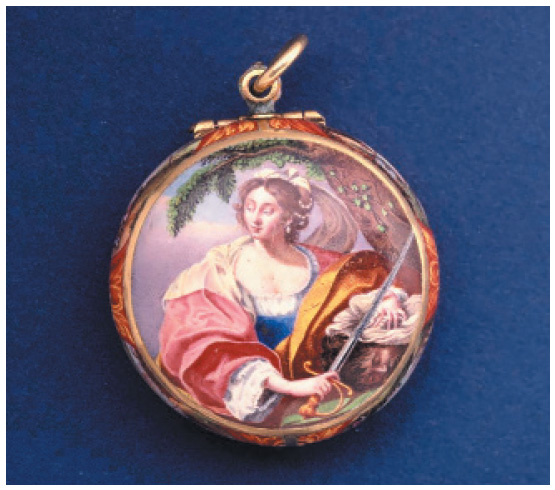
The council’s decision validated the separation of the activities of the painters and the enamel painters respectively based on the materials employed, the same criteria that had been used a number of times to demarcate the trades from one another. Not only did the painting of objects in gold and silver with fired pigments, undertaken by the illuminators for the goldsmiths, as well as ‘inserts’ on timepiece cases, sheet metal, and other parts, undertaken for makers of timepieces, along with the painting of brass flowers with fired colors, did not fall under the customary spectrum of tasks assumed by the painters; as a rule, the latter simply lacked both the technical expertise and the implements required for the execution of enamel work. Emerging through the increasing specialization and differentiation of the handicraft trades, as well as through innovation, was a niche which the illuminators and enamel painters were able to occupy outside of the guild structure. Contributing now to the manufacture of decorated timepieces alongside the primary producers, namely the timepiece makers and gold and silversmiths (cases) were the illuminators (enamel painters), as well as, as a rule, the painters (the painted wooden parts on the balance wheel).
For according to the council’s decision, the hülzenen dockenköpf, maderlen uf den uhren und dergleihen malwerkh,53 which is to say the wooden components of the timepieces, are reserved exclusively to the painting trade. Outside of the painters’ guild, only the illuminators Fimpel and Griesser received specific permission to paint dolls’ heads and the wooden parts of timepieces (i.e. images of girls appearing there), along with similar work. But they were forbidden on threat of penalty from calling on journeyman, apprentices, or their own children to perform such work unless the latter had been properly trained in the craft of painting.54 The painting of the wooden figures set on the
6 Synagonism
The term Synagonism refers to the advancement of an artwork or art form through a productive contention with other ‘arts’, which is to say an attempt to adopt phenomena characteristic of other media productively for one’s ‘own’ art form, hence arriving at a more complex, multilayered result. The concept of synagonism is well-suited to an incisive appraisal of the above-described proceedings in two different ways:
First, the regulations deployed represented a necessary procedure with respect to a synagonism that was consistently present. Such synagonism consisted in the continuous absorption of elements from neighboring domains of activity with the aim of making these fruitful for one’s own production. In order to restrict such manifestations of synagonism, i.e. the adoption of such elements by individuals not affiliated with the painters’ guild, violators were prosecuted at the instigation of the corporation on the basis of the division of trades described in the normative guidelines. But the actions taken by the painters’ guild against individuals, groups, or corporations said to have infringed upon their trade, as reflected in various petitions, supplications, statutes, and decrees, were hardly unique to image painters. They were instead symptomatic of efforts to differentiate one trade from the others, always with the intention of achieving ‘food security,’ (‘Nahrungssicherung’) which is to say of securing the income that would allow the individual guild member to achieve self-sufficiency. Adopted to this end as well were alliances with other
Secondly, the concept of synagonism is well-adapted to precisely evaluating the special permissions and exceptions issued by the authorities, which override the guild rights in force in support of the public interest by establishing new technologies in a given municipality, whether temporarily or permanently. Emerging at times through the existence of guild statutes were new spaces that were situated ‘between’ statutes; only these rendered legal appropriations made by artisans without guild affiliations. For it was the precise definition of activities that stood under guild monopolies that generated spaces ‘ex negative’, which existed outside of the spaces protected by normative guidelines – spaces for unregulated labor and the liberal arts. These spaces, which remained beyond the standardized activities covered by the guilds, also harbored the potential for the explicit protection of newly arrived artisans or individuals planning to settle in a given town, while also promoting new niche technologies. Regarding the proceedings initiated by the Augsburg painters against Peter Mair and Wolf Metzler, as well as against Jeremias Fimpel and Christof Griesser, the claim that such individuals have infringed upon a guild monopoly proved toothless, since these artisans, as bismuth painters or enamel painters respectively, practiced new techniques and employed materials that had never been covered by the monopoly enjoyed by the painters’ guild. And as Hubert Gerhard successfully argued, his terracotta figures did not fall under the monopoly held by the painters, but instead qualified – like his large-format cast bronze figures – as a locally new and moreover highly prized technology. It therefore proved possible for the authorities to protect these new technologies from efforts by these painters’ guild to enforce their monopoly, while the
As shown above, moreover, the occasional overriding by the authorities of valid guild rights could advance practices by non-guild members that did not fit neatly into existing niches, even where these were said to infringe upon the guild monopoly enjoyed by the guild-affiliated painters. And not infrequently, special regulations or exceptions were issued for the sake of the welfare of the town and its citizens, who benefited when new technologies or exceptionally high-ranking artists became established locally, or were at least able to work in the town free of the restrictions imposed by guild regulations. And from the perspective of the local authorities, a synagonistic relationship that took the form of a productive confrontation on the part of local artists and artisans with newly authorized art forms was indeed highly desirable. An example of the licensing of an artist in contravention of valid guild rules is the above-discussed authorization of 1560, adopted by the Augsburg city council and by the mayor, probably thanks to an intervention by an influential client, which made possible Giulio Licinio’s acceptance by the painters’ guild, although he was unmarried. At a time when the ‘welsche’ (Italian) style enjoyed great popularity in Augsburg, it seems likely that Hieronymus Rehlinger deliberately recruited the Italian artist to cover the facades of his house using fresco technique, and had intervened with the council on Licinio’s behalf in response to the complaint lodged by the painters’ guild.56
In many places, the authorities commonly reserved the right to adapt existing guild statutes as needed via council decisions, even retrospectively. Inscribed on occasion into the regulations, moreover, was the stipulation that in general, the authorities reserved the right to authorize specialists by means of individual exceptions and in contravention of current legal practice. This was the case in Nuremberg in relation to the regulations on painters, for example, when in 1595, the city council explicitly granted authorization to exceptionally capable journeyman from the Netherlands or elsewhere who wished to be active in the town on a temporary basis as portraitists or specialists in other painting genres. Such individuals, however, would by no means be permitted to maintain their own households.57 Since the employment of assistants was as a rule practiced ‘around one’s own hearth’,58 which is to say that it was associated
Such special concessions and the targeted recruitment of experts promoted technology transfer, and were hence a means of promoting industry, in relation to which synagonistic processes were explicitly deemed as desirable. In the later Middle Ages, for example, the towns recruited specialists and skilled workers in a targeted way, for example in the textile industry or the technically specialized trade of gunsmithing.62 The practice was widespread in the southern Alpine region as well. In the Italian cities, for example, metal and textile workers in particular were sought after, with the aim of assisting the domestic trades through special expertise and/or initiating the development of one or several export industries.63 Often, the initiation of such relationships occurred via long-distance traders, who ‘enjoyed contacts with other locations, knowledge of the success of promising technologies, financial resources, and access to markets by virtue of their supra-regional activities.’64
Even though painting, among municipal occupations, represented an economically lightweight, not to say insignificant trade, a deeper motivation lay behind the simplified authorization of specialists and exceptional artists. The intention was to establish hitherto unfamiliar technologies in a given municipality, while attracting uncommonly talented artists who would serve as an
Both existing law and newly adopted statutes made possible the limited protection of the liberal arts as well as of new technologies and areas of activity, whether as a whole or instead with reference to individuals, thereby protecting them against monopolization by the guilds. Continuous negotiation concerning activities monopolized by the guilds, the free space lying between these, and the granting of special authorizations to engage in specific activities, whether granted to individuals or to small groups: all were central to the progressive differentiation of the guilds into increasingly specialized trades, and in the gradual formation and establishment of guild-independent specialized technologies, which might however later receive guild protection through tailor-made statutes.
For the craft trades in general, specialization ensured superior quality while at the same time tending to lower prices. As research shows, this was often true as well for the category of ‘high art,’ so often split off from craft production from a contemporary perspective; according to former research, Veit Stoß achieved an exalted level of artistry not despite, but instead precisely in response to strict municipal requirements and the specialization of the trades prevailing in Nuremberg.65 The restrictions with regard to the accessibility of tools and materials that were stipulated by guild statutes regarding the separation of trades compelled Stoß to specialize in the medium of wood, in which he then came to shine so brilliantly.
That within the medium of (oil) painting as well, enhancement of quality could be achieved through greater specialization is well illustrated by Dutch
Paulus Potter, The Bull, painted 1647. Oil on canvas, 339 × 235.5 cm, Mauritshuis, The Hague
IMAGE: MAURITSHUIS, THE HAGUE

Researchers have long been familiar with the frequency of collaborations between in some instances highly-esteemed artists, in particular in 17th century Holland and Flanders.67 Frans Francken II, for example, worked together with 12 different – and equally celebrated – artists, and at least 71 of his works are collaborations.68 Moreover, this includes collaborations between painters who and workshops that would otherwise have stood in a competitive relationship to one another on the art market. For painters of the Golden Age, this is also – or in particular? – true for artists who worked at a qualitatively and artistically exceptional level, and who specialized in specific genres or motifs.
Extensive collaborations between established artists are also documented for a number of major art centers. The extreme spatial proximity between the workshops of a given town, and in particular those of successful artists, who often occupied the same or adjacent districts, must have fostered such associations. Hans Holbein the Elder, Gregor Erhart, and Adolf Daucher, mentioned already in the context of intermedial collaborations, for example, lived in Augsburg in immediate proximity to one another.69 Regarding the numerous collaborations between Antwerp painters, the minimal distance between their workshops must have fostered rapid and uncomplicated exchanges, as well as close coordination when they joined forces to create a picture. Particularly notable among the collaborative works of the Antwerp painters is a pair of panels bearing allegories of the five senses that was purchased by the town of Antwerp from Jan Brueghel the Elder in October of 1618, and which perished in a fire at Coudenberg Palace in 1731; the work is known today from copies, dating from 1633, that are found today in the Museo del Prado in Madrid.
The large-format panels, ‘waerinne gevrocht hebben tweelff diversche van de principaelste meesters deser stadt’ (an endeavor that involved twelve of the best Antwerp masters),70 brought together an exceptionally large number of artists. Substantially involved in this prestigious commission were Peter Paul Rubens and Jan Brueghel the Elder, the only artists mentioned by name in the relevant sources. In an unprecedented way, these paintings, received by Albert
Jan Brueghel the Elder, Hendrick van Balen the Elder, and Frans Francken II, Allegory of sight and smell, painted c.1620. Oil on canvas, 176 × 264 cm, Museo del Prado
IMAGE: WIKIMEDIA COMMONS

But highly successful and lasting collaborations between painters were also carried out across great distances. One example is Hans Rottenhammer. During his time in Venice, he collaborated with other painters on a number of large-format canvases, among them a Venus und Amor76 created with Paolo Fiammingo, and the same is true of his stay in Rome. There, for example, he executed figures for a Rest on the Flight into Egypt produced by Jan Brueghel the Elder, who also resided in the Eternal City in 1595, versions of which are preserved among others in the Kunsthistorisches Museum in Vienna and the Mauritshuis in The Hague. Even after returning to Venice in autumn of 1595, Rottenhammer continued working with Jan Brueghel, who had meanwhile returned to Antwerp. Among the numerous products of this international collaboration is the Baptism of Christ in the Jordan River, Christ’s Descent into Limbo (see figure 4.18), the Contest of Apollo and Marsyas (the Judgment of Midas), and the Marriage of Neptune and Amphitrite.77 Rottenhammer also worked across the boundaries of cities and countries with Paul Bril, then living in Rome. When in Rome, he painted the figures for Bril’s Rest on the Flight to Egypt, among others.78 Following his return to Venice, they collaborated on the production of paintings on copper, among them the Christ with Mary and Martha preserved today in the Musei citivi di Treviso.79 The logistical demands of such international collaborations were enormous. For the collaboration between Rottenhammer and Brueghel, the tiny, shock-sensitive copper images had to be shipped back and forth between Venice and Antwerp, possibly via ship on an Atlantic route around Western Europe, or more probably via land route across the Alps via postal service or messenger.80 Consultations between the artists, moreover, were possible only indirectly, a drawback that
Jan Brueghel the Elder, Hans Rottenhammer, Christ’s Descent into Limbo, painted 1597. Oil on copper, 35.5 × 26.5 cm, Mauritshuis, The Hague
IMAGE: MAURITSHUIS, THE HAGUE

The question nonetheless arises of the motivation for such elaborate collaborations. Both Jan Brueghel and Paul Bril were celebrated artists and in high demand, and both were perfectly capable, presumably, of painting adequate figures themselves. In particular when it comes to collaborations between Antwerp artists, the participants were highly experienced and established figures, all of them – despite their respective degrees of specialization – adept at executing their paintings to a high degree of quality on their own. It is worth
As elaborated above, this was the case as well for other artisanal traditions and collaborations. With more technically complex objects, specialization in specific materials and techniques, genres and motifs made collaboration between a number of independent artisans (or at times between specialists within the same trade) necessary and/or desirable. Participating in the manufacture of timepieces in Augsburg alongside horologists were, among others, silversmith and goldsmiths, painters and enamel painters (illuminators), while the fresh painting of a house facade, including sundial, involved collaborations between whitewashers, compass makers, and painters, and large carved altarpieces resulted from the collaborative work of joiners, carvers of figures, polychromy specialists and gilders, painters and blacksmiths.
Disregarding the circumstance that among the artist’s range of tasks were those we might regard today as rather mundane,83 specialization in specific types of work allowed them to concentrate on perfecting their technical and artistic abilities within their chosen fields. This is true of activities such as oil painting, which we would regard today as belonging to the fine arts, as well
Bibliography
Primary Sources
Stadtarchiv Augsburg (Augsburg City Archive)
StadtAA, Geheimer Rat, Fuggerakten, Karton 2, Nr. 4 (27)
StadtAA, Historischer Verein, H 28
StadtAA, Historischer Verein, H 54a
StadtAA, Reichsstadt, Handwerkerakten, Beinringler, fasz. 1
StadtAA, Reichsstadt, Handwerkerakten, Beinringler, fasz. 2
StadtAA, Reichsstadt, Handwerkerakten, Maler, fasz. 1
StadtAA, Reichsstadt, Handwerkerakten, Maler, fasz. 8
StadtAA, Reichsstadt, Handwerkerakten, Säckler, fasz. 1
StadtAA, Reichsstadt, Schätze, Nr. 72b
StadtAA, Reichsstadt, Zünfte, Nr. 004
Other Locations
Staats- und Stadtbibliothek Augsburg (Augsburg State and City Library), 4° Cod Aug 222
Staatsarchiv Augsburg (Augsburg State Archive), GU Donauwörth 535
Stadtarchiv Memmingen (Memmingen City Archive), A 482/1
Published Sources, Editions, and Literature
- Appuhn 1986↑
H. Appuhn, ‘Kleine Kästen mit Malerei auf Wismutgrund,’ in Landesbildstelle Baden / Badisches Landesmuseum Karlsruhe (eds.), Die Renaissance im Deutschen Südwesten zwischen Reformation und Dreißigjährigem Krieg, exh. cat., Badisches Landesmuseum Karlsruhe, 2 vols., Karlsruhe 1986, vol. 2, 791–801.
- Baxandall 1983↑
M. Baxandall, ‘Veit Stoß, ein Bildhauer in Nürnberg’, in R. Kahsnitz (ed.), Veit Stoß in Nürnberg. Werke des Meisters in Nürnberg und Umgebung, Munich 1983, 9–26.
- Beyer, Savoy & Tegethoff 2005
A. Beyer, B. Savoy & W. Tegethoff (eds.), Saur AKL – Allgemeines Künstlerlexikon. Internationale Künstlerdatenbank. Online edition, URL: https://doi.org/10.1515/AKL
- Bierdimpfl 1884↑
K.A. Bierdimpfl, Die Sammlung der Spielkarten des bairischen Nationalmuseums, Munich 1884.
- Bischoff 2005
M. Bischoff, ‘Hans Rottenhammer (1564)’, in A. Beyer, B. Savoy & W. Tegethoff (eds.), Saur AKL – Allgemeines Künstlerlexikon. Internationale Künstlerdatenbank. Online edition, URL: https://www.degruyter.com/database/AKL/entry/_00121822T/html
- Brenner Künstler 2021
D. Brenner, Der Künstler als Handwerker. Handlungsspielräume zunftgebundener Maler in Spätmittelalter und Früher Neuzeit am Beispiel Augsburgs. Ausbildung – Zusammenleben – Marktstrategien – Sozialtopographie, Petersberg 2021.
- Brenner Nachahmung 2021
D. Brenner, ‘Zwischen Nachahmung und Erfindung. Normative Quellen zu imitation und invention bei Ausbildung und Meisterstück der Maler im Alten Reich’, in M. Grünbart, G. Schwedler & J. Sonntag (eds.), Imitationen. Systematische Zugänge zu einem kulturellen Prinzip des Mittelalters, Paderborn 2021, 231–256.
- Brenner 2018
D. Brenner, ‘‘Ein guter Nachbar ist ein edel Kleinod.’ Sozialtopographische Verortung der Augsburger Maler im 15. und 16. Jahrhundert’, in A. Tacke, T. Schauerte & D. Brenner (eds.), Künstlerhäuser im Mittelalter und der Frühen Neuzeit = Artists’ Homes in the Middle Ages and the Early Modern Era, Petersberg 2018, 28–49.
- Brenner 2017↑
D. Brenner, ‘“Frembder Mallerkunststuckh offendtlich fail haben”: Quellen zur zünftischen Absatzmarktsicherung und Preisbildung am Augsburger Kunstmarkt’, in A. Tacke, M. Herzog, C. Jeggle, B.U. Münch & M. Wenzel (eds.), Kunstmärkte zwischen Stadt und Hof. Prozesse der Preisbildung in der europäischen Vormoderne, Petersberg 2017, 36–62.
- Brenner Diversity 2016
D. Brenner, ‘Diversity and internal heterogeneity of premodern painters’ guilds in the german-speaking regions of the Holy Roman Empire with focus on the free imperial city of Augsburg’, in E. Jullien – M. Pauly (eds.), Guilds and Craftsmen in the Medieval and Early Modern Periods, Stuttgart 2016, 175–193, tab.1, figs. 1–3.
- Brenner Malermeister 2016
D. Brenner, ‘“Und sinem meister gehorsam zu sin als were er sin vater”: Malermeister und Lehrjungen im Augsburg des 15. und 16. Jahrhunderts’, in A.-B. Renger & J. Lee-Kalisch, Meister und Schüler. Master and Disciple: Tradition, Transfer, Transformation, Kromsdorf & Weimar 2016, 169–185.
- Brenner 2011↑
D. Brenner, ‘Veit Stoß, Schöpfer des Bamberger Altares. Vertragsabschluß, Visierung und Endprodukt’, in A. Tacke & F. Irsigler, Der Künstler in der Gesellschaft. Achtzehn Fallbeispiele zur Künstlersozialgeschichte des Mittelalters und der Frühen Neuzeit, Darmstadt 2011, 138–158.
- Buff 1887↑
A. Buff, ‘Der Bau des Augsburger Rathauses mit besonderer Rücksichtnahme auf die dekorative Ausstattung des Innern,’ Zeitschrift des historischen Vereins für Schwaben 14 (1887), 221–301.
- Cilleßen & Tacke 2019
W. Cilleßen & A. Tacke (eds.), Meisterstücke. Vom Handwerk der Maler, exh. cat., Historisches Museum Frankfurt, Frankfurt am Main, 2019.
- Diemer 2004↑
D. Diemer, Hubert Gerhard und Carlo di Cesare del Palagio. Bronzeplastiker der Spätrenaissance, 2 vols., Berlin 2004.
- Doherty, Leonard & Wadum 2006
T. Doherty, M. Leonard & J. Wadum, ‘Brueghel and Rubens at Work. Technique and the Practice of Collaboration,’ in A.T. Woolett & A. van Suchtelen (eds.), Rubens and Brueghel. A Working Friendship, exh. cat., J. Paul Getty Museum & Royal Picture Gallery Mauritshuis, Los Angeles 2006, 215–251.
- Fischer & Taigel 1986↑
H. Fischer & H. Taigel (eds.), Schwäbisches Handwörterbuch. Auf Grundlage des ‘Schwäbischen Wörterbuchs’ von Hermann Fischer und Wilhelm Pfleiderer, Tübingen 1986.
- Hascher 1996↑
D. Hascher, Fassadenmalerei in Augsburg. Vom 16. bis zum 18. Jahrhundert, Augsburg 1996.
- Heusinger 2010
S. von Heusinger, ‘Von ‘antwerk’ bis ‘zunft.’ Methodische Überlegungen zu den Zünften im Mittelalter’, Zeitschrift für Historische Forschung 37 (2010), 37–71.
- Himmelein 1980↑
V. Himmelein, ‘Uhren und wissenschaftliche Instrumente’, in Museen der Stadt Augsburg – Evangelisch-Lutherische Landeskirche in Bavaria (eds.), Welt im Umbruch. Augsburg zwischen Renaissance und Barock, exh. cat., Rathaus – Zeughaus, 3 vols., Augsburg 1980, vol. 2, 55–57.
- Historische Kommission bei der Bayerischen Akademie der Wissenschaften 1953–
Historische Kommission bei der Bayerischen Akademie der Wissenschaften (ed.), Neue Deutsche Biographie, 27 vols., Berlin 1953–.
- Holbach 1999↑
R. Holbach, ‘Städtische und herrschaftliche Gewerbeförderung, Innovation und Migration im Mittelalter und zu Beginn der Neuzeit’, in K. Schulz & E. Müller-Luckner (eds.), Handwerk in Europa. Vom Spätmittelalter bis zur Frühen Neuzeit, Munich 1999, 233–254.
- Jullien & Pauly 2016
E. Jullien & M. Pauly (eds.), Guilds and Craftsmen in the Medieval and Early Modern Periods, Stuttgart 2016.
- Kahsnitz 1983
R. Kahsnitz (ed.), Veit Stoß in Nürnberg. Werke des Meisters in Nürnberg und Umgebung, Munich 1983.
- Kiesewetter 2010
A. Kiesewetter, ‘Der Einfluß Augsburgs auf die Kunst der Frührenaissance in Sachsen. Ein Beitrag zur Ausbreitung der Renaissance im albertinischen Herrschaftsbereich Sachsens zwischen 1520 und 1535’, in Zeitschrift des Deutschen Vereins für Kunstwissenschaft, 64 (2010), 203–242.
- Kohn 1981↑
K. Kohn, ‘Der Starck’sche Kruzifixus. Ein Werk des Veit Stoß’, Mitteilungen des Vereins für Geschichte der Stadt Nürnberg 68 (1981), 297–302.
- Landesbildstelle Baden & Badisches Landesmuseum Karlsruhe 1986
Landesbildstelle Baden & Badisches Landesmuseum Karlsruhe (eds.), Die Renaissance im Deutschen Südwesten zwischen Reformation und Dreißigjährigem Krieg, exh. cat., Badisches Landesmuseum Karlsruhe, 2 vols., Karlsruhe 1986.
- Laufner & Kocks 1996↑
R. Laufner & H.-H. Kocks, Trierisches Handwerk von der Vorzeit bis heute, Trier 1996.
- Lieb 1958
N. Lieb, Die Fugger und die Kunst im Zeitalter der Hohen Renaissance, 2 vols., vol. 2: Die Fugger und die Kunst, Munich 1958.
- Lieb 1952↑
N. Lieb, ‘Kunst- und Kulturgeschichtliches aus Augsburger Baumeisterbüchern der Renaissance’, in Schwäbische Blätter für Volksbildung und Heimatpflege 3 (1952), 261–268.
- Liedke 1979↑
V. Liedke, ‘Landshuter Tafelmalerei und Schnitzkunst der Spätgotik. Retabel aus den Werkstätten der Maler Hans von Würzburg, Jörg Preu, Michel Hurlinger und Wolfgang von Wörth sowie der Bildschnitzer Heinrich Helmschrot und Andre Taubenpeck’, Ars Bavarica 11/12 (1979), 1–150.
- Lill 1908↑
G. Lill, Hans Fugger (1531–1598) und die Kunst. Ein Beitrag zur Geschichte der Spätrenaissance in Süddeutschland, Leipzig 1908.
- Museen der Stadt Augsburg & Evangelisch-Lutherische Landeskirche in Bavaria 1980
Museen der Stadt Augsburg & Evangelisch-Lutherische Landeskirche in Bavaria (eds.), Welt im Umbruch. Augsburg zwischen Renaissance und Barock, exh. cat., Rathaus – Zeughaus, 3 vols., Augsburg 1980.
- North 2001↑
M. North, Das Goldene Zeitalter: Kunst und Kommerz in der niederländischen Malerei des 17. Jahrhunderts, Köln et al. 2001.
- Paas 1990
J.R. Paas, ‘Georg Kress, a Briefmaler in Augsburg in the late sixteenth and early seventeenth centuries. For Wolfgang Seitz’, Gutenberg-Jahrbuch 65 (1990), 177–204.
- Peeters 2002↑
N. Peeters, ‘Marked for the Market? Continuity, Collaboration and the Mechanics of Artistic Production of History Painting in the Francken Workshops in Counter-Reformation Antwerp’, Nederlands Kunsthistorisch Jaarboek 50 (2002), 58–79.
- Petz 1889↑
H. Petz (ed.), ‘Urkunden und Regesten aus dem königlichen Kreisarchiv zu Nürnberg’, Jahrbuch der Kunsthistorischen Sammlungen des Allerhöchsten Kaiserhauses 10 (1889), 20–62.
- Poettering 2013↑
J. Poettering, Handel, Nation und Religion. Kaufleute zwischen Hamburg und Portugal im 17. Jahrhundert, Göttingen 2013.
- Reith 2005↑
R. Reith, ‘Know-How, Technologietransfer und die Arcana Artis im Mitteleuropa der Frühen Neuzeit’, Early Science and Medicine 10 (2005), 349–377.
- Renger & Lee-Kalisch 2016
A.-B. Renger & J. Lee-Kalisch (eds.), Meister und Schüler. Master and Disciple: Tradition, Transfer, Transformation, Kromsdorf & Weimar 2016.
- Rott 1934↑
H. Rott (ed.). Quellen und Forschungen zur südwestdeutschen und schweizerischen Kunstgeschichte im XV. und XVI. Jahrhundert, 6 vols., vol. 2: Alt-Schwaben und die Reichsstädte, Stuttgart 1934.
- Sandrart 1675
J. von Sandrart, Teutsche Academie der Bau- Bild- und Mahlerey-Künste, Nürnberg 1675.
- Schamschula 2019↑
A.-L. Schamschula, ‘Die Meisterstücke der Wahlstube. Zu den Anfängen der Malergesellschaft in Frankfurt’, in W. Cilleßen & A. Tacke (eds.), Meisterstücke. Vom Handwerk der Maler, exh. cat., Historisches Museum Frankfurt, Frankfurt am Main 2019, 82–93.
- Schneider 1983↑
U. Schneider, ‘Die wichtigsten Daten zu Leben und Werk des Veit Stoß’, in R. Kahsnitz, Veit Stoß in Nürnberg. Werke des Meisters in Nürnberg und Umgebung, Munich 1983, 351–353.
- Schulz 2016↑
K. Schulz, ‘Büchsenmeister des Spätmittelalters. Migration und Ausbreitung des neuen Wissens’, in E. Jullien & M. Pauly (eds.), Guilds and Craftsmen in the Medieval and Early Modern Periods, Stuttgart 2016, 221–242.
- Schulz & Suchard 2005↑
K. Schulz & C. Suchard (eds.), Handwerker deutscher Herkunft und ihre Bruderschaften im Rom der Renaissance, Darstellung und ausgewählte Quellen, Rome, Freiburg & Vienna 2005.
- Schulz & Müller-Luckner 1999
K. Schulz & E. Müller-Luckner (eds.), Handwerk in Europa. Vom Spätmittelalter bis zur Frühen Neuzeit, Munich 1999.
- Schürle 2003
W. Schürle, Zwischen Hütte und Zunft. Meister Hartmanns Dornstadter Altar, Ulm 2003.
- Strecker 1998↑
F. Strecker, Augsburger Altäre zwischen Reformation (1537) und 1635. Bildkritik, Repräsentation und Konfessionalisierung, Münster 1998.
- Suárez Blanco 2016
A. Suárez Blanco, ‘J. Brueghel the Elder, F. Francken II, H. van Balen, J. Brueghel the Younger. Sight and Smell’, in T.J. Loughman, K.M. Morris & L. Yeager-Crasselt (eds.), Splendor, Myth, and Vision. Nudes from the Prado, exh. cat., Sterling and Francine Clark Art Institute, New Haven & London 2016, cat. no. 7, 92–97.
- Suchtelen 2006
A. van Suchtelen, ‘Jan Brueghel the Elder and Peter Paul Rubens: Allegory of Taste,’ in A.T. Woollett & A. van Suchtelen (eds.), Rubens and Brueghel. A Working Friendship, exh. cat., J. Paul Getty Museum & Royal Picture Gallery Mauritshuis, Los Angeles 2006, cat. no. 8, 90–99.
- Tacke, Schauerte & Brenner 2018
A. Tacke, T. Schauerte & D. Brenner (eds.), Künstlerhäuser im Mittelalter und der Frühen Neuzeit = Artists’ Homes in the Middle Ages and the Early Modern Era, Petersberg 2018.
- Tacke et al. 2018
A. Tacke et al. (eds.): Statuta pictorum. Kommentierte Edition der Maler(zunft)ordnungen im deutschsprachigen Raum des Alten Reiches, 5 vols., Petersberg 2018.
- Tacke Ordnung 2001
A. Tacke (ed.), Der Mahler Ordnung und Gebräuch in Nürmberg. Die Nürnberger Maler(zunft)bücher ergänzt durch weitere Quellen, Genealogien und Viten des 16., 17. und 18. Jahrhunderts, Munich 2001.
- Tacke Hauer 2001
A. Tacke, ‘Johann Hauer. Nürnberger Flach- und Ätzmaler, Kunsthändler, Verleger und Dürerforscher des 17. Jahrhunderts. Eine Fallstudie zur handwerksgeschichtlichen Betrachtung des Künstlers im Alten Reich’, in A. Tacke (ed.), Der Mahler Ordnung und Gebräuch in Nürmberg. Die Nürnberger Maler(zunft)bücher ergänzt durch weitere Quellen, Genealogien und Viten des 16., 17. und 18. Jahrhunderts, Munich 2001, 11–141.
- Tacke 1999↑
A. Tacke, ‘Vom Handwerker zum Künstler. Thesen zu den Anfängen der deutschen Akademien nach dem Westfälischen Frieden’, in J. Thuillier & K. Bußmann (eds.), 1648. Paix de Westphalie. L’ art entre la guerre et la paix; Westfälischer Friede: die Kunst zwischen Krieg und Frieden, Paris 1999, 319–334.
- Thuillier & Bußmann 1999
J. Thuillier & K. Bußmann (eds.), 1648. Paix de Westphalie. L’ art entre la guerre et la paix; Westfälischer Friede: die Kunst zwischen Krieg und Frieden, Paris 1999.
- Vertova 1976↑
L. Vertova, ‘Giulio Licinio’ in Zampetti P. (ed.), I Pittori Bergameschi dal XIII al XIX secolo. Il Cinquecento, Bergamo 1976, 513–589.
- Vischer 1890↑
R. Vischer, ‘Geschichte der Allgäuer Kunst I. Beiträge zu einer Kunstgeschichte von Memmingen. Fortsetzung’ Allgäuer Geschichtsfreund 3 (1890), 83–85, 97–99.
- Wagner 2014↑
B. Wagner, Bilder ohne Auftraggeber. Der deutsche Kunsthandel im 15. und frühen 16. Jahrhundert. Mit Überlegungen zum Kulturtransfer, Petersberg 2014.
- Wegmann 2003↑
S. Wegmann, Auf dem Weg zum Himmel. Das Fegefeuer in der deutschen Kunst des Mittelalters, Cologne & Weimar 2003.
- Weigel 1698↑
C. Weigel, Abbildung und Beschreibung der gemeinnützlichen Hauptstände Stände von denen Regenten und ihren so in Friedens- als Kriegs-Zeiten zugeordneten Bedienten an bis auf alle Künstler und Handwercker nach jedes Ambts- und Beruffs-Verrichtungen weist nach dem Leben gezeichnet auch nach dero Ursprung, Nutzbar- und Denckwürdigkeiten kurtz doch gründlich beschrieben und ganz neu an den Tag geleget, Regensburg 1698.
- Weihrauch 1964↑
H.R. Weihrauch, ‘Gerhard, Hubert’, in Historische Kommission bei der Bayerischen Akademie der Wissenschaften (ed.), Neue Deutsche Biographie, 27 vols, vol. 6, Berlin 1964, 278–281.
- Weilandt 1993↑
G. Weilandt, ‘Ulmer Künstler und ihre Zunft’, in H. Meurer, G. Weilandt & S. Roller, Meisterwerke massenhaft. Die Bildhauerwerkstatt des Niklaus Weckmann und die Malerei in Ulm um 1500, Stuttgart 1993, 369–387.
- Weinhold 2000↑
U. Weinhold, Emailmalerei an Augsburger Goldschmiedearbeiten von 1650 bis 1750, Munich & Berlin 2000.
- Weiss 2008↑
A. Weiss, Das Handwerk der Goldschmiede zu Augsburg bis zum Jahre 1681, Leipzig 1897; reprint Gotha 2008.
- Wielandt 1936↑
F. Wielandt, ‘Meisterrecht und Meisterstück in Konstanz’, Zeitschrift für die Geschichte des Oberrheins 89 = new series 50 (1936), 454–480.
- Wilhelm 1983↑
J. Wilhelm, Augsburger Wandmalerei, 1368–1530. Künstler, Handwerker und Zunft, Augsburg 1983.
- Wissell & Schraepler 1971↑
R. Wissell & E. Schraepler (eds.), Des alten Handwerks Recht und Gewohnheit, 2nd ed., Berlin 1971.
- Woollett & Suchtelen 2006
A.T. Woollett & A. van Suchtelen (eds.), Rubens and Brueghel. A Working Friendship, exh. cat., Paul Getty Museum & Royal Picture Gallery Mauritshuis, Los Angeles 2006.
- Woollett 2006
A.T. Woollett, ‘Two Celebrated Painters. The Collaborative Ventures of Rubens and Brueghel, ca. 1598–1625,’ in A.T. Woolett & A. van Suchtelen (eds.), Rubens and Brueghel. A Working Friendship, exh. cat., J. Paul Getty Museum & Royal Picture Gallery Mauritshuis, Los Angeles 2006, 1–41.
Brenner Diversity 2016. On the definition of the guilds as military entities, commercial associations, political organizations, or religious fraternities capable of assuming military, commercial, political, and/or religious/charitable functions, see Heusinger 2010. On the guild-dependent training of painters, see Brenner Künstler 2021, and Brenner Malermeister 2016.
On the Frankfurt guild of painters, referred to by contemporaries as the Malergesellschaft (association of painters), cf. Institut für Stadtgeschichte Frankfurt am Main, Handwerkerbuch 2, fol. 93r–96r, published in Tacke et al. 2018, II.32–2, 132–136; Institut für Stadtgeschichte Frankfurt am Main, Handwerkerbücher 231, fol. 2v–10v, published in Tacke et al. 2018, II.32–4, 143–149; Institut für Stadtgeschichte Frankfurt am Main, Handwerkerakten 5988, fol. 24r–27r, published in Tacke et al. 2018, II.32–8, 170–172. Schamschula 2019, 87f., among others, assumed that the statutes adopted by the sign makers as early as circa 1355 may have led to the founding of the first guild of painters in Frankfurt; cf. Institut für Stadtgeschichte Frankfurt am Main, Handwerkerakten 402, no. 4, published in Tacke et al. 2018, II.32–1, 129–130.
Brenner Diversity 2016, esp. 175–183. On these examples, see also the corresponding ordinances of the guild of painters in Laufner & Kocks 1996, 98; Schürle 2003, 34; Weilandt 1993, here 370, 374; Rott 1934, 73–75.
Cf. Brenner Diversity 2016, esp. 177f., as well as the corresponding guild ordinances in Liedke 1979, 140–142; Tacke 1999, 325.
Cf. Wielandt 1936, 480.
Cf. the corresponding guild ordinances, published in Vischer 1890, 83.
Cf. a letter written by the Augsburg painters and addressed to their colleagues in Memmingen; Stadtarchiv Memmingen, Schublade 382, fasc. 2, published in Wilhelm 1983, Beilage XII, 674; on wall painting in Augsburg, see also same author, esp. 2, 71.
Meant are housepainters, which is to say whitewashers and day laborers. StadtAA, Historischer Verein, H 28 (Ordnung der Maler, Glaser, Bildhauer und Goldschlager 1549–1626 or later, § 51.
Cited from Bierdimpfl 1884, 29. StadtAA, Reichsstadt, Zünfte, Nr. 004 Maler, Glaser, Bildhauer, Goldschläger, Silberdrahtzieher (Ordnung der Maler, Glaser, Bildhauer und Goldschlager in Augsburg. Ordinance of 1549, supplemented up until 1654, fol. 11v.
StadtAA, Historischer Verein, H 28 (Ordnung der Maler, Glaser, Bildhauer und Goldschlager 1549–1626 or later, § 46, 51f.; Staats- und Stadtbibliothek Augsburg, 4° Cod Aug 222, fol. 18r–18v; StadtAA, Reichsstadt, Zünfte, Nr. 004 Maler, Glaser, Bildhauer, Goldschläger, Silberdrahtzieher (Ordnung der Maler, Glaser, Bildhauer und Goldschlager in Augsburg. Ordinance of 1549, supplemented up until 1654, fol. 8r, 11r–11v; StadtAA, Handwerkerakten, Maler 8 (Ordnung der Maler, Glaser, Bildhauer und Goldschläger von 1681), § 9; StadtAA, Handwerkerakten, Maler, fasc. 1, fol. 155v, 303r; as well as ibid., fol. 118r, the last-mentioned point published in Hascher 1996, 47–48.
Cited from Bierdimpfl 1884, 29.
Cited from Bierdimpfl 1884, 29.
Which is to say that they could produce and color drawings, as well as book paintings. Cited from Bierdimpfl 1884, 29, parenthesis and emphasis adopted from source.
Cf. StadtAA, Geheimer Rat, Fuggerakten, Karton 2, Nr. 4 (27): für Hannß Fugger etliche antiquische Bilder machen […]
Cf. StadtAA, Geheimer Rat, Fuggerakten, Karton 2, Nr. 4 (27).
On Gerhard as an individual and his commissions, see Weihrauch 1964; on the Kirchheim Castle and its artworks, see Lill 1908, 86–127.
Cf. Diemer 2004, 259f.
Licinio’s signature on an appeal for this exceptional status refers to him as a painter from Venice; StadtAA, Reichsstadt, Handwerkerakten, Maler, fasc. 1, fol. 68.
StadtAA, Reichsstadt, Handwerkerakten, Maler, fasz. 1, fol. 65r–67r, 68r–v, 70r–v, 126; StadtAA, Historischer Verein, H 28, § 26; StadtAA, Zünfte, Nr. 004, Ordnung der Maler, Glaser, Bildhauer und Goldschlager in Augsburg (ca. 1654), fol. 8v–9r, with nearly identical wording found in Staats- und Stadtbibliothek Augsburg, 4° Cod Aug 222, fol. 8r. StadtAA, Reichsstadt, Handwerkerakten Maler, fasc. 1, fol. 67, 126, also published in Hascher 1996, 469; StadtAA, Bürgerbuch 1447–1680, fol. 6r, published in Vertova 1976, 529; StadtAA, Reichsstadt, Baumeisteramt, Rechnungen (Baumeisterbücher), 1561, fol. 12r, after Lieb 1952, 264. Brenner 2017; Hascher 1996, 461f. The building, which was demolished in 1948, stood at what is today Philippine-Welser Straße 14. For a reconstruction of the facade, see Hascher 1996, 461–469. Work on Rehlinger’s home is documented in a photograph of 1873. According to Joachim von Sandrart, Licinio completed it in 1561, Cf. Sandrart 1675, 177; Hascher 1996, 461.
Infringements of the provisions of the ordinances continued to be punished with a payment of two guilders per violation. StadtAA, Reichsstadt, Zünfte Nr. 004 Maler, Glaser, Bildhauer, Goldschläger, Silberdrahtzieher (Ordnung der Maler, Glaser, Bildhauer und Goldschlager in Augsburg. Ordinances of 1549, supplemented up until 1654, fol. 11v (undated); StadtAA, Historischer Verein, H 28, (Ordnung der Maler, Glaser, Bildhauer und Goldschlager, 1549–1626 or later, § 52 (7 December 1577). The identical Augsburg Council ordinance is transmitted in StadtAA, Handwerkerakten, Maler, fasc. 1 (1515–1603), fol. 303r. A dating of the ordinances there to 7 September 1577 is presumably attributable to a copyist’s error.
Staatsarchiv Augsburg, GU Donauwörth 535 (Ordnung der Schreiner, Glaser, Drechsler, Maler und Bildhauer, 6 March 1671), here: §7 of 6 January 1581, published in Tacke et al. 2018, I.20–1, 693–695, here 695.
Stadtarchiv Memmingen, A 482/1 (Ordnung der Maler, 1 September 1608), fol. 5r, published in Tacke et al. 2018, III.72–1, 621–624, here 623.
Germanisches Nationalmuseum Nuremberg, Archiv, Reichsstadt Nürnberg XII/44, fol. 1r– 9r (Ordnung der Maler. After the Hauer manuscript), published in Tacke Hauer 2001, 168–173.
See Ordnung der Maler, Glaser, Bildhauer und Goldschlager in Augsburg von 1549, supplemented up until 1654, StadtAA, Reichsstadt, Zünfte, Nr. 004, Maler, Glaser, Bildhauer, Goldschläger, Silberdrahtzieher fol. 11v: die gesimbs mit gefarbten strihen ein zue fassen, laub und rollenwerkh und dergleihen sahen, so in der maler gerehtigkeit gehörig, zue mahen verbotten.
Stadtarchiv Würzburg, Ratsbuch 383, fol. 1r–11r (Malerzunftsatzungen, ordinance of 1470 with later supplements, up until 1571), here: fol. 3v–4v, published in Tacke et al. 2018, V.128–2, 845–854, here 848f.
Cf. Brenner 2011, 141; Kohn 1981, 300f.; Pelzl 2017, 108f.; Petz 1889, Dok. 5799–5803; Schneider 1983, 352.
Cited from StadtAA, Historischer Verein, H 28, Ordnung der Maler, Glaser, Bildhauer und Goldschlager, 1549–1626 or later, § 24.
StadtAA, Historischer Verein, H 28, § 24–25; almost identical to Staats- und Stadtbibliothek Augsburg, 4° Cod Aug 222, fol. 7r–7v; StadtAA, Reichsstadt, Zünfte, Nr. 004, Ordnung der Maler, Glaser, Bildhauer und Goldschlager in Augsburg (ca. 1654), fol. 8r–8v; StadtAA, Reichsstadt, Handwerkerakten, Maler, 8, Ordnung der Maler, Glaser, Bildschnitzer und Goldschlager in Augsburg 1564, with later supplements, § 1–2. This decree was also incorporated into the statutes of the organization of goldsmiths; see Weiss 2008, 144, 253.
So dated in StadtAA, Historischer Verein, H 28, (Ordnung der Maler, Glaser, Bildhauer und Goldschlager, 1549–1626 or later), § 28f.; Staats- und Stadtbibliothek Augsburg, 4° Cod Aug 222, fol. 9r–12r; StadtAA, Reichsstadt, Handwerkerakten, Maler, fasz. 8, Ordnung der Maler, Glaser, Bildschnitzer und Goldschläger 1564, no pagination. StadtAA, Reichsstadt, Zünfte, Nr. 004, Ordnung der Maler, Glaser, Bildhauer und Goldschlager in Augsburg (ca. 1654), fol. 9r–10v, in contrast, dates the statute to 2 January 1563, probably due to a copyist’s error. A letter written by the foreman of the organization of tradesmen dated 9 March 1564, which refers to this statute, instead dates the comparison to the settlement of 12 September 1562; see StadtAA, Reichsstadt, Handwerkerakten, Säckler, fasc. 1, without numbering.
StadtAA, Reichsstadt, Handwerkerakten, Maler, fasz. 8, (Ordnung der Maler, Glaser, Bildschnitzer und Goldschläger 1564), fol. 9r–v. Although the sources dealing with the trades engaged in decorating rings consistently refer to beede handwerckher als maler oder ezer und ringmacher, the statutes included goldsmiths engaged in etching activity. Cited from: StadtAA, Reichsstadt, Handwerkerakten, Maler, fasc. 8, Ordnung 1564, p. 4. Preserved in StadtAA, Handwerkerakten, Beinringler, fasc. 2, as well as StadtAA, Reichsstadt, Handwerkerakten, Säckler, fasc. 1, are the applications that preceded the enactment of the ordinance and related correspondence, along with a transcript of the ordinance. For the settlement and its incorporation into the ordinances of the guild of painters, see StadtAA, Reichsstadt, Zünfte, Nr. 004, Maler, Glaser, Bildhauer, Goldschläger, Silberdrahtzieher (Ordnung der Maler, Glaser, Bildhauer und Goldschlager in Augsburg. Ordinance of 1549, supplemented up until 1654, fol. 9r–10v; Staats- und Stadtbibliothek Augsburg, 4° Cod Aug 222, fol. 9r–12r; in StadtAA, Historischer Verein, H 28, (Ordnung der Maler, Glaser, Bildhauer und Goldschlager, 1549–1626 or later), § 28f.; StadtAA, Reichsstadt, Handwerkerakten, Maler, fasz. 8, (Ordnung der Maler, Glaser, Bildschnitzer und Goldschläger 1564), no pagination. The statutes were also incorporated into the ordinances for ring makers; see StadtAA, Reichsstadt, Handwerkerakten, Beinringler, fasc. 1, no pagination.
Earlier, on 17 February 1564, the purse makers had sought to affirm their position by appealing to the council, among other things invoking customary law, which had allowed them to work on such rings from time immemorial. The resolution was preceded by a number of written exchanges and testimony from members of the trades. Cf. StadtAA, Reichsstadt, Handwerkerakten, Säckler, fasc. 1, no pagination (letter from the city official responsible of consulting the grocer’s guild regulations dated 9 March 1564), as well as various unpaginated letters from early 1564. See also Brenner 2017, 40.
The altar with its sculptured central shrine and painted wings is still found in its original place of display in the Imhoff Chapel of the St. Rochus Cemetery in Nuremberg.
Cf. Falk 1968, 117f.; Jakupski 1984, 102, 151–153, n. 274. Nuremberg, Germanisches Nationalmuseum, Imhoff-Archiv, fasc. 34, Nr. 4 (loose sheet), after Falk 1968, 117f.; Wegmann 2003, 245.
Knebel 1902, 354, Bl. 226, entry for the year 1502.
See Krause 2002, 151–158.
Cf. Krause 2002, 326. Further examples can be found among others in Strecker 1998, 263; on the collaborations of Jörg Seld (design work), Adolf Daucher (case), Gregor Erhart (carving work), Ulrich Apt (polychromy) and Hans Holbein the Elder (painted wings).
Himmelein 1980, 55f.
Cf. Bobinger 1966, 87–88, 248, 418, 422; Museen der Stadt Augsburg – Evangelisch-Lutherische Landeskirche in Bavaria 1980 vol. 2, 448f.
On chest painters, see also Appuhn 1986, 791f.
The document, created on 24 August 1595 by the Baden panel and chest painter Erhart Weber, witnessed by the Baden citizens and chest painters Jacob Duffes, Tobias Ruaff, and Hannß Hannß, and sealed with a paper imprint of the seal of the town of Baden (Baden-Baden), confirmed Metzler’s proper training as a trunk painter from 1572 until 1577 by Jacob Kottler and by Weber himself. See StadtAA, Reichsstadt, Handwerkerakten, Maler 1, fol. 270f., also published as a reproduction in Landesbildstelle Baden & Badisches Landesmuseum Karlsruhe 1986 vol. 2; 793, ill. 22, where the name of the master is interpreted as ‘Jacob Kettler.’
Cf. Fischer & Taigel 1986, Art. ‘Docke’, 107.
Cf. the correspondence found in StadtAA, Reichsstadt, Handwerkerakten, fasc. 1, fol. 268r–269r.
Cf. StadtAA, Historischer Verein, H 28, Ordnung der Augsburger Maler, Glaser, Bildschnitzer und Goldschlager, 1549–1626 or later, §56, pp. 24–25 (without pagination; page numbers supplied for the sake of clarity), cited from ibid., p. 25. On the disputes, see StadtAA, Reichsstadt, Handwerkerakten, Maler 1, diverse fol., inter alia fol. 268f., 270f., 277f., 280–282, 284–291.
Brenner 2017, 41f.
Cf. StadtAA, Reichsstadt, Handwerkerakten, Maler, fasc. 1, fol. 304, 306–308, 310–315, 317f., 320 and StadtAA, Reichsstadt, Zünfte, Nr. 004, Maler, Glaser, Bildhauer, Goldschläger, Silberdrahtzieher (Ordnung der Maler, Glaser, Bildhauer und Goldschlager in Augsburg. Ordinance of 1549, supplemented up until 1654, fol. 13v–14r.
Both citations StadtAA, Reichsstadt, Zünfte, Nr. 004, Ordnung der Maler, Glaser, Bildhauer und Goldschlager in Augsburg (ca. 1654), fol. 13v–14r.
Cf. Weinhold 2000, 17. On the various enamel techniques, see ibid., esp. 13–19, 21–22.
Cf. Weinhold 2000, 23.
StadtAA, Reichsstadt, Zünfte, Nr. 004, Maler, Glaser, Bildhauer, Goldschläger, Silberdrahtzieher. Ordinances of 1549, supplemented up until 1654, fol. 13v.
StadtAA, Reichsstadt, Zünfte, Nr. 004, Maler, Glaser, Bildhauer, Goldschläger, Silberdrahtzieher. Ordinances of 1549, supplemented up until 1654, fol. 13v. In order to prevent further disputes, a compromise between the two parties adopted by the council was incorporated into the guild ordinances; it stipulated that the special ordinances represented an exception, and should not be taken as establishing a precedent for future disputes. The letters that preceded the agreement between the painters and illuminators are preserved in StadtAA, Reichsstadt, Handwerkerakten, Maler, fasc. 1, among others fol. 304, 306–308, 310–315, 317f., 320. The resolution of 18 January 1596 is found in ibid. (StadtAA, Reichsstadt, Handwerkerakten, Maler, fasc. 1) in fol. 321–322. In identical wording, it was incorporated into the ordinances of the painters’ guild, and is preserved in a transcript from circa 1654; see StadtAA, Reichsstadt, Zünfte, Nr. 004, Maler, Glaser, Bildhauer, Goldschläger, Silberdrahtzieher (Ordnung der Maler, Glaser, Bildhauer und Goldschlager in Augsburg. Ordinances of 1549, supplemented up until 1654, fol. 13v–14r. On the dispute between the guild painters and the illuminator Jeremias Fimpel, see also Spamer 1930, 57–58.
An appeal by the painters dated September 1647 shows that this remained a point of contention between the painters and the illuminators even after the latter had been converted by a decree of the city council into a guild craft with protection by ordinances on 22 December 1626; cf. Bierdimpfl 1884, 28–30.
For a detailed description of the paintings on the facades of Rehlinger’s house, see Hascher 1996, 462–468.
Cf. ordinances concerning the Nuremberg painters and etchers of 1595, Staatsarchiv Nuremberg, Reichsstadt Nürnberg, Rep. 52b, Amts- und Standbücher, vol. 259, fol. 919r–922r, here fol. 920r, published in Tacke et al. 2018, III.80–1, 938–942, here 940; Tacke Ordnung 2001, 168–173.
The German term for this prerequisite was ‘Eigen Haus und Rauch’.
Cf. Wissell & Schraepler 1971, 97.
Cf. Ordnung der Maler, Bildhauer, Seidensticker, Glaser, Kartenmaler und Buchbinder, 31 January 1549 and later supplements, in Stadtarchiv Ulm, A [2508], fol. 6v, published in Tacke et al. 2018, V.114–3, 468–479, here 471, citation ibid.
Cf. Weilandt 1993, 372, 374, for further examples, ibid.
Cf. Reith 2005, 358; cf. also Holbach 1999; also Schulz 2016.
Cf. Schulz & Suchard 2005, 81–83.
Quote translated from Reith 2005, 358.
Cf. Baxandall 1983, 15.
There exists an extensive literature on this topic, among them North 2001, esp. 101f., who shows that during the 1670s, for example, estate inventories in Delft listed an average of 20 paintings, and in Amsterdam 40 paintings per household, and that larger collections as well were commonplace during that decade; a cloth dyer in Leiden, for example, owned 64 paintings (1643), while two other dyers owned 96 and 103 paintings respectively.
Exemplary here are Woollett & Suchtelen 2006, and the international conference ‘Many Antwerp Hands: Collaborations in Netherlandish Art, 1400–1750,’ which took place on 5/6 November 2018 at the Rubenianum in Antwerp.
Peeters 2002, 70.
Brenner Künstler 2021, 202f; Brenner 2018.
Cited from Suchtelen 2006, 99, n. 12.
Suárez Blanco 2016; Suchtelen 2006, 95f.
For examples, see Woollett & Suchtelen 2006, cat. nos. 1–13.
Woollett & Suchtelen 2006.
For examples, see Woollett & Suchtelen 2006, cat. nos. 17–21.
For a map showing the residences of Jan Brueghel the Elder, Peter Paul Rubens, Hendrick van Balen, and Frans Snyders, see Woollett 2006, 11, figure 11.
The painting is preserved today in the Herzog Anton Ulrich-Museum in Braunschweig.
These paintings are found today in the Schaetzlerpalais – Deutsche Barockgalerie Augsburg, the Mauritshuis in the Hague, Fitzwilliam Museum in Cambridge, and the Hermitage in St. Petersburg.
This painting is found today in the USC Fisher Museum of Art in Los Angeles.
Bischoff 2005.
On the postal routes, see Poettering 2013, 229–232.
Cf. Doherty, Leonard & Wadum 2006, 217f., 228; here, it is argued with reference to Peter Paul Rubens and Jan Brueghel the Elder that because the artists had a precise conception of the overall composition and placement of the figures, detailed preliminary drawings or a textual specification of the conditions of the collaboration, which would presumably have reflected extensive prior consultations, were rendered relatively superfluous.
Cf. Doherty, Leonard & Wadum 2006, 217, on the collaborations between Brueghel and Rubens.
Among other things, they decorated everyday objects and produced small art objects such as religious icons for direct sale, adorned municipal objects such as grain sacks with the city’s coat of arms, blackened writing tablets, and so forth; cf. Brenner 2017, 36, 44; Wagner 2014.