


Hephaestus: You shall be grilled by the sun’s bright fire
and change the fair bloom of your skin …
Prometheus: I placed in them blind hopes …
Besides this, I gave them fire.
aeschylus, Prometheus Bound
The Promethean myth, after all, contains an enigmatic prophecy.
ihab hassan, “Prometheus as Performer”
Prometheia is the anticipation of the future,
that is, of danger, foresight, prudence, and an essential disquiet.
bernard stiegler, La Téchnique et le temps : 1 La faute d’Epiméthée
Mimetic posthumanism is located at the productive juncture, crossroads, or intersection where mimetic studies and posthuman studies meet, encounter, and reflect critically and creatively on each other. If, for a long time, the concept of mimesis was traditionally restricted to anthropocentric conceptions of realism characteristic of an exceptionalist species called Homo sapiens, mimetic studies redraws this picture by foregrounding a new theory of homo mimeticus that goes beyond anthropocentric binaries, is immanent and evolutionary in nature, is open to metamorphic transformations, and is now entangled in our process of becoming posthuman as well. From different areas of critical inquiry, including continental philosophy, feminism, political theory,
If we now continue to join these two mirroring concepts to further a mimetic turn, or re-turn, to an immanent, affective, and relational conception of mimesis in posthuman studies, we might still wonder: What kinds of myths are at the plural and contested origins of our protean ability to transform the very nature of what the human is, or can potentially become? And if technological innovations play such a prominent role in the ongoing process of becoming posthuman, is there perhaps an intrinsic relation between technics and mimesis that can serve as a self-reflective critical and creative mirror to reflect back on where humans come from in view of looking ahead to where posthumans are going? After all, technē in Greek designates both art and craft. Hence it already entangles technological production and artistic creation, which, for the Greeks, but not only them, is mimetic creation. As Aristotle puts it in book 6 of Nicomachean Ethics: “Art (technē) is identical with a state of capacity to make.”2 This is why the Poetics is a treatise on the making of poetry, which for Aristotle, as for Plato before him but with a reversed evaluation, is a techne or technics of mimetic making.3 Furthering the genealogy of posthuman mimesis charted in Chapter 6, this chapter will be oriented by the productive interplay between technics and mimesis.
Bridging the threefold configuration of art, philosophy, and technics that orients homo mimeticus 2.0, I would like to revisit from a philosophical perspective one of the founding myths on the origins of technics: the myth of Prometheus and of his brother Epimetheus. This choice is, of course, far from being original. The myth of the trickster Titan who stole fire from the gods to provide humans with technical skills occupies a privileged and well-established
I now add another step to the mimetic turn in posthuman studies by arguing that the ek-static process of becoming posthuman in a geological epoch that often goes under the rubric of the “Anthropocene” benefits from considering the genealogical relation between technics and mimesis already implicitly inscribed in the Promethean myth from which posthuman studies were born. My wager is that both technics and mimesis set up a self-reflecting mirror to Homo sapiens, revealing a conception of a mimetic subject without essential qualities, or homo mimeticus,6 whose embodied, relational, and technological supplements continue to play a massive role in our ongoing process of becoming posthuman in the twenty-first century. This also means that if we want to venture deeper into the unpredictable posthuman future that lies ahead, we need to look first in the unflattering mirror of an epoch that bears the deepening traces of the human, or anthropos—if only because this epoch will continue to metamorphose human and nonhuman life on Earth for generations to come.
1 Metamorphoses in the Anthropocene
In recent years, posthuman studies has established transdisciplinary bridges with the Earth system sciences to account for a new geological epoch that reframes the very concept of the human within the geological formation and
As its contested designation suggests, the Anthropocene remains in the shadow of the humanistic figure (“man”) posthumanism seeks to move beyond—which does not mean that the Anthropocene is simply anthropocentric. Quite the contrary. Introduced in 2001 by atmospheric chemist Paul Crutzen, the “Anthropocene” designates a “new” (cene) geological epoch of “man” (anthropos) in which humans, albeit with radically different degrees of agency, intensity, and responsibility, operate as a “major geological force”8 on planet Earth. In or about 1800, the growth of the human population changed. Where it took the entire history of human evolution (say, ca. 300,000 years) to reach a billion people near the beginning of the nineteenth century, the world population has now skyrocketed to over 8 billion. The curve is steep and is not slowing down. Meanwhile, since the industrial revolution, humans have been altering the climate, causing not only rising temperatures but also acidification of oceans, deforestation, glacier melting, rising oceans, and ozone depletion, all of which are currently generating a cascade of systemic effects that have already started a sixth species extinction. The anthropos that triggered the climate crisis is tragically implicated in a demise of its own making.
It is still up for debate whether this new geological epoch starts with the Industrial Revolution in the second half of the eighteenth century, stretches back to the birth of agriculture, or, more likely, picks ups speed with the Great Acceleration of 1945. Equally debatable is whether we should call it “Anthropocene,” “Capitalocene,” “Plantationocene,” “Chthulucene,”9 or any of the other original denominations proposed in recent years to avoid the universalizing fiction of a homogeneous anthropos erasing the radically different
Given the posthuman critique of anthropocentrism, the return to the centrality of the category of anthropos is not without ironies. As Bruno Latour puts it: “At the very moment when it was becoming fashionable to speak of post-human … Anthropos is back—and has returned with a vengeance.”10 This re-turn of the effects of past human agency haunting, phantom-like, present and, especially, future generations should indeed lead posthumanists to think in terms of genealogical continuities and discontinuities across generations. Critical posthumanists, for instance, were quick to incorporate the concept of the Anthropocene and its alternative denominations. They did so to promote metamorphic transformations for the better, giving rise to productive intersections of “posthuman ecologies” attentive to “complex relations … constituted by circulations of affects,”11 for instance. As the genealogy of homo mimeticus 2.0 makes clear, this affective and infective circulation is constitutive of an embodied, relational, and suggestible species that finds in modernist literary precursors with direct experience in navigating catastrophic disturbances of the atmosphere important starting points to face catastrophic ecologies in the making.12
What we must add now from the perspective of mimetic posthumanism is that these affects circulate via imperceptible forms of imitation, or micro-imitation, which generate complex patho(-)logical effects. For instance, most humans are by now conscious that a catastrophic transformation of the planet is well underway, at least in theory. And yet, in daily practice, unless prevented by pandemic lockdowns which, for a brief moment, offered a window of hope
Via pervasive cultural influences (advertisement, tourism), repeated patterns of behavior (consumerism, travel), shared ideologies mediated by modern technologies of communication (film, social media), and daily repetitions now reloaded via good doses of algorithmic influences, practices of pollution become second nature over time, ingrained in both bodies and minds, individually and collectively. This is perhaps the reason Latour, drawing on the French sociologist Gabriel Tarde, writes that with respect to the climate crisis, “we have progressed like somnambulists.”14 Somnambulism is, indeed, an exemplary manifestation of the mimetic unconscious. Tarde, among other modernist theorists, relied on hypnosis, suggestions, and somnambulism to account for the imitative and unconscious dimension of social behavior in his classic, The Laws of Imitation (1890). As he puts it: “having only suggested ideas and believing them to be spontaneous: this is the illusion proper to the somnambulist and to social beings.”15 Somnambulism is only aggravated in the digital age by new media that operate as black mirrors with powers to fixate the gaze and induce hypnosis (from hypnos, sleep). As sci-fi films from Avatar to Black Mirror make clear, the magnetizing spell of such mirrors generates mimetic or, better, hypermimetic forms of psychic dispossessions that now punctuate everyday life, making trance states the norm rather than the exceptions.16 This “mimetic madness,” as Stiegler also calls it, generates a will to conform that
As we move deeper into the epoch of the Anthropocene, one among many paradoxes constitutive of both mimetic studies and posthuman studies sets up a magnifying mirror to the predicament of the mimetic/posthuman subject: Depending on the models we imitate, be they real or fictional, human or nonhuman, online or offline, technological or natural, among a plurality of possibilities, posthuman mimesis in the digital age is certainly capable of furthering liberating discourses, or logoi, that were already central to poststructuralism and contribute to cultivating a life worth living. They include, feminist emancipation, promotion of racial diversity, sensitivity for sexual differences, support for disabilities, social justice and equality, openness to migrants, and increased ecological awareness, among other life-affirmative modes of existence. They all benefit from new media that do not simply copy or represent the world from a distance, but rather contribute to forming and transforming subjects receptive to the proximity of mimetic affect, or pathos. At the same time, and perhaps more visibly in the last decades aggravated by multiple (economic, pandemic, humanitarian, environmental) crises, the same technologies are driven by profit-oriented corporations that program algorithms in new media to cast a hypermimetic spell on users with pathological effects: from new media violence to the rise of (new) fascist movements, online vitriol to offline addictions, conspiracy theories to insurrectionist practices, among other symptoms that are currently generating contagious and thus mimetic forms of pathological behavior that operate for the worse—a Janus-faced, “patho(-)logical” lesson that is constitutive of the genealogy of mimetic studies18 and is as old as the mythic birth of technics itself.
There are thus significant ethical, political, and environmental reasons for posthuman studies to come to a better understanding of mimetic processes central to our ongoing metamorphoses, if only because the geology of the Earth itself is already changing due to an all too mimetic human behavior. The goal for us affirming survival in the Anthropocene, then, is now no longer limited to Enlightenment ideals of daring to understand or know (saper
For both good and ill, logical and pathological reasons, then, the relational, embodied, affective, and plastic characteristics of homo mimeticus 2.0 render us radically open to influences and will continue to play a major role in our posthuman becoming in the Anthropocene. This is what precursors of the mimetic turn like Nietzsche already recognized. Under the mimetic mask of Zarathustra, he stated for instance that “a polluted stream is the human,”20 urging his readers to go through a mimetic metamorphosis of the sprit beyond the human. As Bruno Latour more recently puts it, renewing the Nietzschean imperative to remain faithful to the Earth from the perspective of the Anthropocene, it is now a question of charting a map that will allow us to find “where to land” (où atterir):21 namely, on the only planet we have.
Landing entails a downward, delicate, and perilous movement that is subjected to an immanent gravitational pull; yet, if the conditions are right, a good pilot manages to partially control this pull via a deft maneuver, change of speed, and right inclination vital to avoid catastrophe. Taken as an imperfect metaphor for collective survival (there is currently no pilot in charge, alas), this all-too-human will to land entails, at least in theory, a radical shift of perspective away from the image of planet Earth seen from a gravitation-free, extra-terrestrial, and somewhat disembodied distance familiar since the Moon landing.

Evans, Ron or Harrison Smith Apollo 17 crew. The Blue Marble, original orientation (as17-148-22727), 1972. https://en.wikipedia.org/wiki/The_Blue_Marble
photo courtesy nasa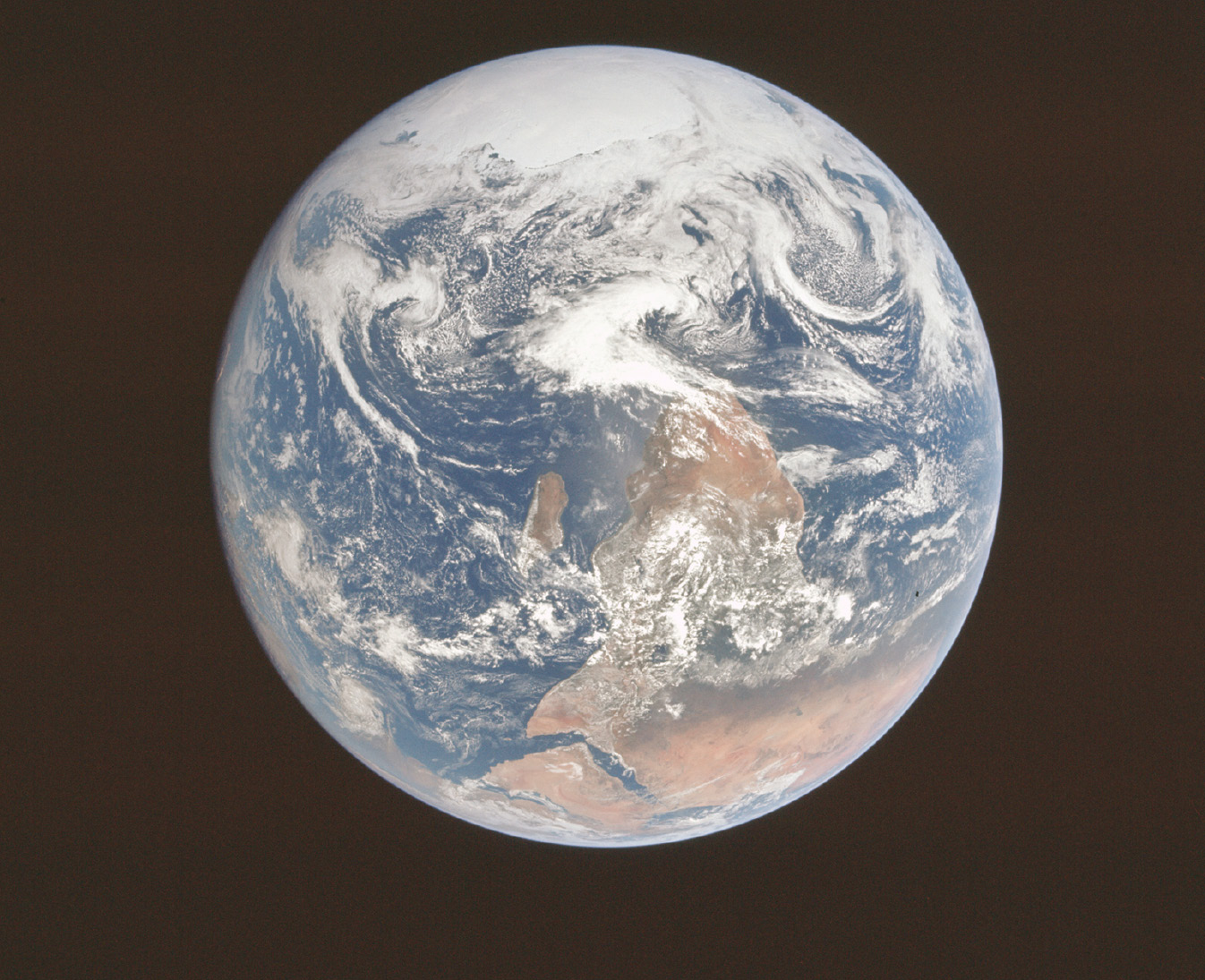
This is, indeed, a view from nowhere that we have by now become mimetically accustomed to due to endless reproductions and iterations. Mesmerizing in its aesthetic beauty that operates on vision alone, the blue marble planet seen from space appears to be objective in abstract theory, at least if we focus
Now, if we want to promote our chances of landing by furthering life-affirmative metamorphoses in the Anthropocene, this reassuringly distant perspective of the Globe must be replaced by a more affectively close view of what Latour calls “Earth” (Terre). This entails taking hold of the fact that life on Earth is only possible within a thin atmospheric zone, or Critical Zone, which spans only a little over 10,000 km and offers a rather different picture of where landing can perhaps take place.
Earth Space Sunlight Sun, https://pixabay.com/illustrations/earth-space-sunlight-sun-rays-1756274/
photo from pixabay
This is, indeed, the Critical Zone, or as Latour also calls it, “the metamorphic zone” where life on Earth is at all possible. It is called critical because it is critical to the existence of life. The fact that we are radically dependent on this thin atmospheric layer for basic physiological functions like breathing and nourishment turns the abstract globe into a fragile surface or skin that should at least generate a feeling of modesty. It should also shatter the imaginary feeling of omniscient distance induced by the globe. Instead, it suggests a subjective feeling, or pathos, that, as Nietzsche foresaw, roots us to the Earth and renders metamorphoses possible in the first place. To put it in the equally earthly language of Latour, “a metamorphic zone can capture in a word all the ‘morphisms’
In order not to fatally mistake Homo sapiens for homo deus, a metamorphosis is thus in order, as historian Yuval Harari also suggests.24 Given that imitation is constitutive of subject formation, the mimetic turn has a role to play in this transformation of consciousness—though new models are urgently needed. The good news is that a theory of homo mimeticus provides an immanent, relational, and intersubjective principle that accounts for humans’ chameleon-like metamorphoses over the epochs; the sad news is that mimetic metamorphoses tend to follow the dominant models in power. If, for a long time, a Christian world rested on a theocentric tradition that promoted the imitation of Christ (or imitatio Christi) as the model of moral virtue leading to imaginary rewards in a paradisiac afterworld, and in an overturning of perspectives, humanism replaced this divine model with an all-too-human model still aspiring to a sapient sovereign position of omniscience, the posthuman will have to find or, rather, create new, postanthropocentric ways of life that can inspire future generations.25
Writing contra dominant neoliberal models of mass consumption and exploitation, a long genealogy of thinkers that goes from Friedrich Nietzsche to Gilles Deleuze, Donna Haraway to Katherine Hayles, Bruno Latour to Rosi Braidotti, William Connolly and Jane Bennett to Bernard Stiegler, and others tends to agree, from different perspectives, with the fundamental assumption now driving the mimetic turn in posthuman studies: namely, that posthumans are not only conscious but also unconscious; not solely driven by the mind but also by bodily affects; not distinct from nonhuman animals but part of a spectrum of mimetic animals; not divided from nature but deeply rooted in, composed, and decomposed by nature; not simply rational and moved by
The vertiginous technological innovations that propel us into the future make it tempting for transhumanists to merge anthropocentrism with theocentrism, to embrace phantasies of technological will to power, and to mistake themselves for gods who can take flight to imaginary afterworlds and perhaps even dream of immortality. These are not new ideals. They are as old as Platonism. As an immanent counterbalancing move, it might thus be sobering to revisit the myth of a demigod who is mostly remembered for his technological gift to humans. This might help to reorient ourselves, change course, and aim to land back on planet Earth. As Braidotti also puts it, metamorphosis leads us “to think through the body, not in flight from it.”26 And who more than Prometheus reminds us that our all-too-human body is bound to Earth? After all, he is the son of Gaia.
As we turn to see, the Greek demigod may not offer the omniscient point of view from nowhere that his gift of technology made possible. His position is much more modest, embodied, and Earth-bound. Still, the myth sets up a self-reflective mirror to techno-patho(-)logies we need to re-evaluate, at least if we want to deepen our self-knowledge and affirm life-affirmative metamorphoses for the future here on Earth.
2 The Patho(-)logies of Prometheus
The mythic text at the very origins of technological innovations that set humans on the course of becoming posthumans generating patho(-)logies that reach into the present, remains, to this day, the myth of Prometheus. One of the most ancient myths of which we have written traces, its exemplary lesson continues to appeal to both posthumanist and transhumanist theorists, albeit often for opposing reasons. As Ibn Hassan put it in a pioneering essay, “Prometheus mirrors our own present.”27 The mirror is, of course, the most classical mimetic trope; it was first invoked by Plato to frame the destabilizing (im)properties of mimesis and structure his vertical metaphysics in book 10 of Republic. And yet, what this mirror reflects might not be the traditional ontological problem
What was true of mimesis in the past, then, remains true of posthuman mimesis in the present: A vita mimetica goes beyond good and evil in the sense that it is a pharmakon (poison/remedy) that can be put to both pathological and patho-logical use. The reality of global warming casts not so much a shadow as an unbearable light on the Anthropocene. It should also bring Hephaestus’s cautionary prophecy to Prometheus at the opening of Aeschylus’s tragic play Prometheus Bound (ca. 479–424 bc) closer to home. As the sympathetic god brutally puts it to the chained Titan: “You shall be grilled by the sun’s bright fire and change the fair bloom of your skin.”30 The lesson that one can be burned by fire goes back to the dawn of Homo sapiens, but in this mythic context, the warning is not deprived of ironic foresight: The “original” god of fire, Hephaestus, makes clear to Prometheus that the fire he stole is a gift (cognate with German Gift, poison) that operates for both good and ill. The ills might thus come back to infect the very figure who stole it for good humanitarian reasons. At one further remove, this warning acquires a renewed urgency under the new climate regime haunting a technologically driven homo mimeticus 2.0. The mythic lesson is as simple as it is fundamental: If humans used fire for grilling, both humans and posthumans alike, including transhumanists, can equally be grilled by fire.
There is thus a mirroring inversion of perspective at play in the myth of the birth of technics. This mirror applies to both Prometheus and his (post)human descendants but deserves to be revisited from a mimetic perspective in the present and future as well. Since times immemorial, in fact, the powers of myth cannot be dissociated from the powers of mimesis to form and transform subjectivity, and the same applies to the myth of Prometheus. Its first mention in writing is registered by Hesiod, in his genealogy of the birth of the Greek gods, or Theogony (730–700 B. C.). There, Hesiod tells us that Prometheus, whose “mind was labyrinthine and swift,” deceived Zeus and, “within a hollow fennel
How does the myth of technics connect to the problematic of mimesis? As often in mimetic matters, it is Plato who provides an important critical beginning. In the Protagoras, the sophist of the same name joins the myth of Prometheus with the one of Epimetheus to prove to Socrates that virtue can be taught via education: namely, via what Plato, as he made clear in books 2 and 3 of Republic, considers an eminently mimetic practice formative of what I have dubbed a “vita mimetica.”32 The Platonic myth narrated by Protagoras specifies what Hesiod had left untold: Epimetheus had taken charge of distributing qualities, or powers, to the newly created mortal creatures, including human and nonhuman animals. Hence, Protagoras narrates that Epimetheus “gave to some creatures strength without speed, and equipped the weaker kinds with speed.”33 He did so by following the “principle of compensation” (P, 320e), so that speed balanced strength, wings balanced weight, and so on, in view of guaranteeing an ecological equilibrium that would make possible the survival of each species.
“Now Epimetheus, who was not a particularly clever person” (P, 321b), specifies Protagoras, used up all the qualities on nonhuman animals and forgot humans, who were left without qualities; we are told that they remained “naked, unshod, unbedded, and unarmed” (P, 321c). It is thus to supplement what appears in afterthought to be the fault of Epimetheus that Prometheus, in a flash of foresight, stole fire to gift it to humans: “Being at a loss to prove any means of salvation for man, stole from Hephaestus and Athena the gift of skill
This, then, is a Janus-faced myth. Epimetheia (afterthought) and prometheia (forethought) join perspectives to compose a picture of an original species characterized by the gift of technics. But it still does not say why this technological gift itself is also a gift of mimesis. Let us thus stress that if the fault of Epimetheus generates an all-too-human default that is constitutive of a lack of essential powers, properties, or even being, Prometheus’s gift of technics supplements this original interior lack with an exterior technical ability to generate ek-static transformations in time. This, you will have recognized, is the fundamental thesis at the origins of Bernard Stiegler’s monumental Technics and Time, a multivolume genealogy of technics that goes from Plato to Rousseau, Husserl to Heidegger, Leroi-Gourhan to Derrida, and, we should add, provides philosophical foundations to account for the technical process of becoming posthuman—out of an ancient mimetic paradox.
Short of reconstructing the entirety of Stiegler’s deconstructive account of the philosophical forgetting, or repression, of technics that, in his post-phenomenological hermeneutics, characterizes the history of western metaphysics, I restrict my focus to its essential starting point, or Stoßpunkt: The first volume of Technics and Time, which is subtitled The Fault of Epimetheus (1994).34 Following a genealogy of anthropological theories of technical evolution based on the paleoanthropologist André Leroi-Gourhan, Stiegler zooms in on the mythic figure of Epimetheus who, he writes, is “not only forgetful [oublieux]” but, like the subject of technology itself, is also “forgotten [oubliée]” (tt, 216). Stiegler’s turn to a forgotten myth is thus geared toward providing an alternative ontology of technics that, not unlike mimesis, from Plato onward, was left at the margins of philosophy.
Starting from a reading of the mythic narrative of Epimetheus and Prometheus dramatized in the passage of Protagoras I have just mentioned, Stiegler stresses that the fault of Epimetheus generates a “default of origin or the origin as default” (tt, 218) whose consequence is to define humans
Perhaps. What is certain is that this paradox, in Stiegler’s reading of the myth, turns a lack of proper qualities caused by Epimetheus’s forgetfulness into an excess of improper technical skills supplemented by Prometheus’s foresight. That is, a future-oriented sight that renders human existence ek-static or located outside of itself in time. For Stiegler, in fact, the gift of technics is impressed by a “promethean stamp [frappe]” (tt, 223) that, après-coup, orients humans toward an ek-static condition that finds in technological prostheses in general, and in writing in particular, its means of self-realization in time. As he puts it: “The being of humans is (to be) outside themselves. To supplement the fault of Epimetheus, Prometheus gives humans the gift of putting them outside of themselves” (tt, 223). This is, of course, a partial summary, but it already reveals essential genealogical connections central to our topic. An ek-static subject without proper qualities, a technological supplement, and an existential/temporal orientation toward finitude and death: these are the ontological foundations on which the subject of technology (objective/subjective genitive)
What we must add now if we want to further our genealogy of technics from the specific angle of posthumanism, is a mimetic supplement that is embryonic in Stiegler’s account of technics and that still needs a push to come into the world. Everything Stiegler says of the gift of technics, namely, its lack of essential properties, its ek-static dimension, its supplementary nature in general, its supplement to a lack of proper qualities in particular, its power of impression or frappe, and so on, can be said about the gift of mimesis as well. And unsurprisingly so. In fact, technics, not unlike writing, on which it models itself, is based on a pharmacology that finds in mimesis the paradigmatic concept that troubles, or deconstructs, metaphysical oppositions like origin/copy, inside/outside, nature/culture, proper/improper, good/evil, poison/therapy, and other binaries. This is a lesson Stiegler directly inherited from his teacher, Derrida, who in “Plato’s Pharmacy” famously argued that “mimesis is akin to the pharmakon,”37 thereby setting in motion a deconstruction of mimesis that already informs mimetic studies and continues to inform the mimetic turn in posthuman studies as well.
The paradox states a law of impropriety, which is also the very law of mimesis: only the “man without qualities,” the being without properties or specificity, the subjectless subject (absent from himself, distracted from himself, deprived of self) is able to present or produce in general. Plato, in his way, knew this very well.39
The paradox of a technological supplement, then, leads us back to the paradox of a mimetic supplement; the gift of technics leads us back to the gift of mimesis. And unsurprisingly so, for, as I tried to demonstrate, technics and mimesis are two sides of the same Janus-faced coin. That is, a conceptual coin that has been, I would not say repressed, but certainly excluded, marginalized, or more simply ignored by dominant idealist trends in philosophy, yet continues to operate in the immanence of existence in time, for good and ill. Prometheus’s gift, in other words, is an improper gift that goes beyond good and evil, health and sickness, remedy and poison. Or, if you prefer a more ancient and duplicitous term, both mimesis and technics operate as a pharmakon that is currently informing the mimetic pathologies and mimetic patho-logies, or diagnostic accounts of a mimetic pathos that continues to infect and affect homo mimeticus 2.0.
At the dawn of mimetic studies, Plato, for one, knew this very well. It is thus no accident that in Protagoras, immediately after having told the myth of the fault of Epimetheus followed by the gift of Prometheus, the sophist resumes the argument with Socrates on the issue of whether virtue can indeed be taught. How? Via a poetic, mythic, and thus mimetic education that was constitutive of ancient oral cultures before Plato and, via different media, remains at play in a contemporary mass-mediatized, globalized, and digitized culture.40 Thus, as Protagoras puts it, teachers give their students “poems containing much admonition and many stories, eulogies, and panegyrics of the good men of old, so that the child may be inspired to imitate them and long to be like them” (P, 326a). Plato, then, was fully aware that mimesis not only represents or copies the world on the side of art. On the contrary, it also provides models for students to copy or mimic, generating performative mimetic effects on the side of
Despite the well-known quarrel between philosophy and myth, then, even a partial genealogy of the sibling concepts of mimesis and technics reveals profound affinities that have so far gone largely unnoticed both in posthuman studies and mimetic studies and that mimetic posthumanism now brings to the foreground. With the fault of Epimetheus in mind, let us thus return to interpret subsequent iterations of the myth of Prometheus. The old practice of interpretation, or hermeneutics, will allow us to re-evaluate patho(-)logical insights that may not only orient the mimetic turn in posthuman studies; they might also provide Janus-faced criteria to decide which models are worthy of imitation in the epoch of the Anthropocene to better land back on Earth.
3 Techno-Patho(-)logies in Prometheus Bound
We have heard that both Hesiod and Plato give voice to the transgressive, supplementary powers of Prometheus’ gift, yet neither of them focused on the pathological consequences of a stolen gift that did not go unpunished. We will have to wait for the origins of Greek drama in Aeschylus’ Prometheus Bound for a tragic dramatization of the consequences of Prometheus’ theft and subsequent gift. As the title suggests, Aeschylus’s focus is on the Titan’s punishment as he is chained to a cliff in the remote mountains of Scythia, overlapping with current-day Ukraine. There, Prometheus’s liver is regularly devoured by an eagle during the day only to regrow at night, in an eternal return of the same that takes titanic efforts not to fall prey to nihilistic despair and to continue affirming life on Earth. What emerges from the first lines of the play is that
The punishment should thus give us pause for thought, for at least two related reasons. The first is because we live in a period in which the same region is currently devasted by a criminal war that relies on high-tech missiles to strike civilians from the above while awakening nightmares of nuclear escalations below—as the Russian invasion of Ukraine has been making palpable since February 2022 in horrors that are still ongoing as I write. The second is because this is an age in which technological powers put humans (collectively, and with radically different degrees of agency) in a position to operate as titanic forces on the planet. The same mythic tradition also reminds us that the planet the Greek tradition called Gaia was, as I mentioned, the mother of Prometheus. Not present in the myth itself, Gaia is endowed with agentic powers of her own that retroact, sometimes devastatingly, on human and nonhuman life in reality—as the catastrophic effects of climate change make palpably clear, from hurricanes to droughts, species extension to rising temperatures. As both technics and mimesis are implicated in the crisis of the present, generating technological solutions but also escalating systemic problems, it is thus useful to further revisit Prometheus Bound with an eye to the future.
Prometheus’s punishment reveals patho(-)logical lessons that are particularly relevant to account for the Janus-faced (im)properties of mimesis and technics alike. Chained by the god of fire and master ironsmith Hephaestus to a cliff, I already mentioned that Prometheus Bound starts with the ominous warning that “you shall be grilled by the sun’s bright fire.”42 This is not only a tragic overturning of fortune that reveals how the trickster god who actively put his labyrinthine mind to use to steal fire is now passively subjected to endure the power of fire with his body; it is also a subtle confirmation that fire, and thus technics, operates as a dangerous supplement that cuts both ways. On the patho-logical side, it can be put to liberating use by furnishing humans without proper qualities with techno-logical powers that partially free them from natural constraints; on the pathological side, and without contradiction, fire can also be put to destructive use insofar as human bodies can easily be subjugated to both natural (the sun as a literal force) and human-made (fire
prometheus:I gave to mortal man a precedence over myself in pity … I caused mortals to cease foreseeing doom.chorus:What cure did you provide them with against that sickness?prometheus:I placed in them blind hopes.chorus:pb, ll. 240–53That was a great gift you gave men.
A few lines into the tragedy and we are already confronted with a complex techno-mimetic patho(-)logy to reinterpret for the present. The sacrificial gesture that animates Prometheus’s gift to humans is a mimetic gesture in a sense that it is, once again, Janus-faced. On one side, the demigod is animated by pity, compassion, or sym-pathos (feeling with) that mimetically binds him to his fellow mortals; and this shared pathos leads him to place humanity over and beyond Zeus’ divine interdiction—an indication that there is an immanent, relational, and affective power I call mimetic pathos that is stronger than any transcendental divine imperative, is not reducible to desire alone, and is constitutive of the mimetic turn in posthuman studies. On the other side, Prometheus, whose primary characteristic, as we have seen, is foresight, provides a “gift” that aims to cure humans by turning, paradoxically, human foresight of their death into what he calls “blind hopes.” The irony that the god of foresight cures the misery caused by humans’ anticipation of their “doom,” namely death, with “hopes” that are “blind” is revealing. It shows that the gift of prometheia is eminently unstable, for it has both therapeutic and pathological sides. The blinding/revealing im-properties of mimetic technics should thus be treated with precaution.
prometheus:Besides this, I gave them fire.chorus:And do creatures of a day now possess bright-faced fire?prometheus:pb, ll. 254–56Yes, and from it they shall learn many crafts.
Fire is, indeed, a real gift insofar as it is at the source of “many crafts,” or technai that “creatures of a day” such as humans will use to master the natural world, expand their powers over the Earth, and reach the quasi-divine status even Olympic Zeus feared. We have thus moved from a gift based on “blind hopes” characteristic of religious beliefs in immortality deprived of material foundations, toward a gift based on fire that is at the material foundations of many crafts with immanent material powers. Prometheus lists “building houses,” “reining horses,” “numbering,” “combining letters,” observing the “rising of the
And yet, what if the two gifts (blind hopes and the technics of fire) are two sides of the same mirroring pharmakon? Taken together, they provide a patho(-)logical frame that already implicitly warns those mastering the art of hermeneutics that the foreseeing gift of technics can equally turn into a blinding poison. After all, fire, not unlike the sun, warms as much as it burns. Plato, in another foundational myth, the one of the cave in book 7 of Republic, will later use the technics of fire to project illusory shadows on the wall, tying mimesis to a technological apparatus of projection that induces neither a vita contemplativa, nor a vita activa, but what I call a vita mimetica aminated by technics of mimetic shadows.44
What we should retain from a Greek tradition sensitive to the excess of what they called hubris, then, is the following advice: When it comes to handling such dangerous pharmaka such as mimēsis and technē it might be a question of right use and measure. And for the Greeks, but perhaps for us too, the right measure in our use of technical objects remains dependent on the question of self-knowledge concerning the mimetic subject that handles technics in the first place. Contemporary descendants of Prometheus, in the end, might have to gain self-knowledge first, not only to avoid pathological schorches but also to propose patho-logical transformations for the Anthropocene.
4 Promethean Self-Knowledge
Given these genealogical reflections that, from mythic times onward, set up a destabilizing mirror to posthuman, transhuman, and all-too-human aspirations, it is no accident that the most ancient of tragedians—yes, still Aeschylus—also convokes the famous Socratic “know thyself” maxim in his Prometheus Bound. He does so in a tragic context that continues to set up a revealing mirror to the mimetic posthuman and is worth revisiting in the guise of a conclusion.
oceanos:Yes, I see, Prometheus, and I want, indeed I do,to advise you for the best, for all your cleverness.pb, ll. 308–11; my italicsKnow yourself and reform your ways to new ways.
What was true for the genealogy of mimesis we traced in Chapter 6 is equally true for the genealogy of technics we trace in this chapter: Mythic wisdom paves the way for philosophical wisdom. “Know yourself” (gnôthi seauton) is, indeed, the philosophical imperative that was inscribed on the temple at Delphi. Thanks to Plato’s dialogues such as Alcibiades, Phaedrus, and others, we now commonly associate it with Socratic wisdom. And yet, in its mythic origins, it was first and foremost an Oceanic wisdom addressed to Prometheus. Rather than being opposed to myth and the mimetic models they entail, as a Platonic tradition conditioned us to blindly believe, myth reveals itself as the very origins of philosophical wisdom. And in a mirroring overturning of perspectives, the object-oriented problematic of technics brings us back to the subject-oriented problematic of mimetic self-knowledge. Or better, as should be clear by now, there is no opposition between the two complementary techno-mimetic perspectives. The Promethean gift of technics, whereby humans conquered the exterior, social, and natural world—now venturing with blind hopes into the cosmos as well—serves as a lead-in to the inner experience of self-knowledge. That is, an experience that for the Greeks was not based on a narcissistic and solipsistic self-reflection in an imaginary imago understood as “an ontological structure of the human world,”45 as psychoanalysis later posited. On the contrary, it entailed a re-evaluation of one’s position in the social, natural, and
This is, indeed, an ancient piece of advice if there is one. It has been tempting for philosophers since Plato to dismiss myth as a fiction; yet, as we saw, Plato was the first to echo myth in his philosophy. Once we understand the “mimetic agonism” that connects Plato’s famous opposition to myth,46 we can see that both myth and philosophy lead us to look back to the birth of technics—out of a mimetic lack of human properties. This backward glance is not deprived of foresight that reaches from an ancient pharmacology, via modern recuperations of Prometheus, into present patho(-)logical diagnostics informing mimetic posthumanism. It is thus no accident that Romantic precursors of posthuman studies such as Mary Shelley were fascinated by the figure of Prometheus in classics like Frankenstein (subtitled, The Modern Prometheus). In this modern version, Shelley also issued a warning against aspirations that “far exceeded moderation” and led to a technical “horror” instead.47 Among the modernist precursors of mimetic/posthuman studies, Nietzsche, who was also fascinated by Prometheus in his youth, called attention to the dangers of pathological infections. In fact, he consistently assumed the role of psychologist qua philosophical physician who inverted perspectives by looking at health from the point of view of sickness, and vice versa. He would thus have been sensitive to the Chorus’s diagnostic warning to Prometheus as they compare him to “a bad doctor that has fallen sick himself” (pb, ll. 473–74). This is, indeed, one of the central lessons of new mimetic studies, which now applies to posthuman studies as well: Not unlike the ancient and the modern Prometheus, the doctor developing a technical patho-logy with the intention to cure can—in a spiraling feedback loop characteristic of the mimetic turn or re-turn—become a pathological victim as well.
The Chorus of this tragic play, then, stages the pathos triggered by Prometheus’s gift in its pathological consequences, while also developing a patho-logical lesson: the pharmakon of techne can be the source of pathologies that retroact to infect and affect the creator and user as well. In fact, as this diagnostic just made clear, the spiraling logic internal to the patho(-)logy of mimetic technics also entails that being infected is not restricted to a debilitating pathology; it is also the experiential condition that allows the philosophical
In the end, between the lines of Prometheus Bound, we find a self-reflective diagnostic mirror that reaches into the present and continues to orient the all-too-human efforts of homo mimeticus 2.0 to find a landing in the Anthropocene. Not unlike the sick physician, there is now increasing pressure in posthuman studies to look into the self-reflective mirror to recognize at least two points: first that the gift of technics operates not only as a therapy but also as a poison; and second, that a “reform” is urgently necessary to develop patho-logies that open “new ways” for the future.
The goal of the “know thyself” imperative is thus in need of reinterpretation. It does not simply aim to discover the truth of an individual self within via ever more sophisticated techniques of introspection uniquely attentive to self-development. Nor is it based on a quasi-divine Promethean model of autonomous and defiant self-sufficiency. On the contrary, as the dialogic nature of the tragedy indicates and the dialogic continuation of philosophy confirms, self-knowledge emerges in relations of bondage and dependence to others, be they human or nonhuman, individually or collectively, all of which remain ultimately exposed to the sun and chained to the Earth, for good and ill. As Michel Foucault also stressed late in his career, shifting the focus from “technologies of production” to what he calls “technologies of the self”: “The Delphic principle was not an abstract one concerning life; it was technical advice, a rule to be observed for the consultation of the oracle. ‘Know yourself’ meant ‘Do not suppose yourself to be a god.’”49
This is still a sound piece of advice in an epoch in which climate catastrophes are compensated for by blind hopes. Transhumanist hubris should indeed be balanced by a posthumanist moderation. One of the future aims of mimetic posthumanism is to turn the gift of technics from a mimetic pathology that
In the end, it is worth recalling that at Delphi, next to the more famous “know thyself” maxim, which is Promethean before being Socratic, there was a second, less known and popular, but equally important maxim that cast a retrospective light, or Epimethean afterthought, on the first one: namely, “nothing in excess.” If Oceanus claims that self-knowledge is needed for Prometheus to reform his ways, the lesson that is currently emerging from their mother, Gaia, is that “nothing in excess” provides a down-to-earth afterthought for humans and posthumans to reform their ways. If recognized in time, this mimetic pathos of dependency, interconnection, and bondage revealed by the mirroring interplay of technics and mimesis, Promethean foresight and Oceanic wisdom, will perhaps allow for the right measure vital to finding out where to land. With some luck, we might then continue inhabiting the Earth—at least for a little while.
See Nidesh Lawtoo, “Posthuman Mimesis,” Special Issue, Journal of Posthumanism 2, no. 2 (2022).
Aristotle, Nicomachean Ethics, in The Complete Works of Aristotle, ed. by Jonathan Barnes (Princeton, N.J.: Princeton University Press, 1984), 1729–867, 1800. In what follows, I sometimes render techne as technics not only to signal its pluralist meaning but also to translate Stiegler’s “technique,” which includes but is not limited to technology as it takes its starting point in the Greek technē (hence my oscillation between techne and technics).
For an informed and rigorous study of techne qua craft rooted in Plato and Aristotle, see Henry Staten, Techne Theory: A New Language for Art (London: Bloomsbury, 2019).
Ihab Hassan, “Prometheus as Performer: Toward a Posthumanist Culture?” The Georgia Review 31, no. 4 (1977): 830–50.
See Bernard Stiegler, La Technique et le temps: 1 La faute d’Epiméthée; 2. La Désorientation; 3. Le Temps du cinéma et la question du mal-être (Paris: Fayard, 2018).
See Nidesh Lawtoo, Homo Mimeticus: A New Theory of Imitation (Leuven: Leuven University Press, 2022).
The literature on the Anthropocene has exploded in recent years, but a good place to start is still Christophe Bonneuil and Jean-Baptiste Fressoz, The Shock of the Anthropocene: The Earth, History, and Us, trans. David Fernbach (London: Verso, 2017).
Paul J. Crutzen and Eugen F. Stoermer, “The Anthropocene,” Global Change Newsletter 41 (2000): 17–18.
See Anthropocene or Capitalocene: Nature, History, or the Crisis of Capitalism, ed. by Jason W. Moore (Oakland, Calif.: pm Press, 2016); and Donna Haraway, Staying with the Trouble: Making Kin in the Chtulucene (Durham, N.C.: Duke University Press, 2016).
Bruno Latour, Face à Gaïa: Huit conférences sur le nouveau régime climatique (Paris: La Découverte, 2015), 155 (my translation).
Simone Bignall and Rosi Braidotti, “Posthuman Systems” in Posthuman Ecologies: Complexity and Process after Deleuze, ed. by Rosi Braidotti and Simone Bignall (New York: Rowman & Littlefield, 2019), 1–16, 5.
See Nidesh Lawtoo, “Conrad in the Anthropocene: Steps to an Ecology of Catastrophe,” in Conrad and Nature: Essays, ed. by Lissa Schneider-Rebozo, Jeffrey Mathes McCarthy, and John G. Peters (New York: Routledge, 2019), 43–67; William E. Connolly and Nidesh Lawtoo, “Planetary Conrad: William Connolly and Nidesh Lawtoo in Dialogue,” The Conradian 46, no. 2 (2021): 144–171. On the political implication of facing catastrophes, see William E. Connolly, Facing the Planetary: Entangled Humanism and the Politics of Swarming (Durham, N.C.: Duke University Press, 2017).
See Nidesh Lawtoo, The Phantom of the Ego: Modernism and the Mimetic Unconscious (East Lansing: Michigan State University Press, 2013). I discuss the relevance of the mimetic unconscious for posthuman studies in Nidesh Lawtoo, “Posthuman Mimesis i: Concepts for the Mimetic Turn,” Journal of Posthumanism 2, no. 2 (2022): 101–14.
Latour, Face à Gaïa, 18.
Gabriel Tarde, Les Lois de l’imitation (Paris: Seuil, 2001), 137 (my translation).
See Nidesh Lawtoo, “Avatar Simulation in 3Ts: Techne, Trance, Transformation,” Science Fiction Studies 42 (2015): 132–50; Nidesh Lawtoo, “Black Mirrors: Reflecting (on) Hypermimesis,” Philosophy Today 65, no. 3 (2021): 523–47.
Bernard Stiegler, Acting Out, trans. David Barison (Stanford, Calif.: Stanford University Press, 2008), 70, 48.
I first defined patho(-)logies as both sickness and therapy in Lawtoo, Phantom of the Ego, 6–9; see also, Nidesh Lawtoo, Violence and the Mimetic Unconscious: Vol. 2, The Affective Hypothesis (East Lansing: Michigan State University Press, 2023).
Friedrich Nietzsche, Thus Spoke Zarathustra, trans. Graham Parkes (Oxford: Oxford University Press, 2008), 12.
Nietzsche, Thus Spoke Zarathustra, 12.
Bruno Latour, Où Atterir: Comment s’orienter en politique (Paris: La Découverte, 2017).
Latour, Face à Gaïa, 180.
Latour, Face à Gaïa, 79.
See Yuval Noah Harari, Homo Deus: A Brief History of Tomorrow (New York: Harper Collins, 2017).
An innovative postanthropocentric perspective comes from the area of biomimicry, which suggests taking nature not only as a “model” for technological innovation but also as a “mentor” for “measure.” See Janine M. Benyus, Biomimicry: Innovation Inspired by Nature (New York: Harper Collins, 1997). For a rich study that gives philosophical foundations to biomimicry in ways that contribute directly to mimetic studies, see Henry Dicks, The Biomimicry Revolution: Learning from Nature How to Inhabit the Earth (New York: Columbia University Press, 2023).
Rosi Braidotti, Metamorphoses: Towards a Materialist Theory of Becoming (Cambridge: Polity Press, 2002), 5.
Hassan, “Prometheus as Performer,” 832.
Hassan, “Prometheus as Performer,” 835.
Hassan, “Prometheus as Performer,” 835.
Aeschylus, Prometheus Bound, trans. David Grene, in The Complete Greek Tragedies, vol. i, eds. by David Grene and Richmond Lattimore (Chicago: The University of Chicago Press, 1959), 309–351, 311, ll.21–23.
Hesiod, Theogony, Works and Days, trans. Apostolos N. Athanassakis (Baltimore, Md.: Johns Hopkins University Press, 1983), 26–27.
See “Vita Mimetica in the Cave,” in Lawtoo, Homo Mimeticus, 69–91.
Plato, Protagoras, trans. W. K. C. Guthrie, in The Collected Dialogues of Plato, ed. by Edith Hamilton and Huntington Cairns (New York: Pantheon Books, 1963), 308–51, 318, 320d-e. Hereafter cited in the text as P.
Stiegler offers a detailed account of Prometheus and technics as a pharmakon directly in line with patho(-)logies of mimesis that go from writing to new media in La Technique et le temps, i, 21–313, esp. 213–311. Hereafter cited in the text as tt. On Stiegler, technics and mimesis see also Azizov’s contribution to this volume in Chapter 12.
Jacques Derrida, “Plato’s Pharmacy,” in Dissemination, trans. Barbara Johnson (Chicago: University of Chicago Press, 1981), 61–171, 93; see also Jacques Derrida, “The Double Session,” in Dissemination, 173–286, esp. 186–98. I discuss Derrida’s deconstruction of mimesis in more detail in Lawtoo, Homo Mimeticus, ch. 3.
See, for instance, Christina Howells and Gerald Moore, eds., Stiegler and Technics (Edinburgh: Edinburgh University Press, 2013).
Derrida, “Plato’s Pharmacy,” 139.
Philippe Lacoue-Labarthe, Typography: Mimesis, Philosophy, Politics, ed. by Christopher Fynsk (Stanford, Calif.: Stanford University Press, 1989), 259. On Lacoue-Labarthe and mimetic studies, see also Lawtoo, Homo Mimeticus, ch. 4.
Lacoue-Labarthe, Typography, 258–59.
For a pioneering link between orality and modern media, see Marshall McLuhan, Understanding Media: The Extension of Man (Signet Books: New York, 1964), viii–ix.
See Plato, Republic, in The Collected Dialogues of Plato, ed. E. Hamilton and H. Cairns, trans. Paul Shorey (Princeton, N.J.: Princeton University Press, 1963), 575–853, 395c–d.
Aeschylus, Prometheus Bound, 311, ll.21–22. Hereafter cited in the text as pb with line number.
Hesiod, Theogony, 26.
Lawtoo, Homo Mimeticus, 74–92.
Jacques Lacan, “The Mirror Stage as Formative of the Function of the I as Revealed in Psychoanalytical Experience,” in Écrits: A Selection, trans. Alan Sheridan (Paris: Seuil, 1977), 1–7, 2.
See Lawtoo, Violence and the Mimetic, 75–123.
Mary Shelley, Frankenstein, ed. by Johanna M. Smith (New York: Bedford/St. Marin’s, 2000), 60–61. For a rich mimetic reading of the modern Prometheus in the context of the Anthropocene, see William E. Connolly, Climate Machines, Fascist Drives, and Truth (Durham, N.C.: Duke University Press, 2019), 24–45.
See Lawtoo, Phantom of the Ego, 3–6.
Michel Foucault, “Technologies of the Self: A Seminar with Michel Foucault,” ed. by Luther H. Martin, Huck Gutman, and Patrick H. Hutton (Amherst: University of Massachusetts Press,1988),19.