Abstract
This review summarises developments published in the period from mid-2022 to mid-2023 on the analysis of a variety of matrices for mycotoxins. Important developments in all aspects of mycotoxin determination, from sampling and quality assurance/quality control of analytical results, to the various detection and quantitation technologies ranging from single mycotoxin biosensors to comprehensive instrumental methods are presented and discussed. This non-exhaustive summary and associated discussion covers such technology as chromatography with targeted or non-targeted high resolution mass spectrometry, detection other than mass spectrometry such as fluorescence or diode array detection, biosensors, as well as assays using alternatives to antibodies. This collaborative critical review intends to guide readers to relevant research by briefly presenting the most important developments in mycotoxin determination published in the past year. This review also relays limitations of the presented methodologies, in order to provide a thorough assessment of the analytical developments.
1 Introduction
This is the latest in a series of annual reviews highlighting analytical method developments in the determination of mycotoxins, continuing on from the previous review covering the mid-2021 to mid-2022 period (Tittlemier et al., 2023). Our continuing aims are to highlight notable advances in the analysis of mycotoxins, as well as to direct researchers to areas where improvements in sampling, quality control, and analytical techniques can help our community of analysts, researchers, regulators, and others using mycotoxin analytical data.
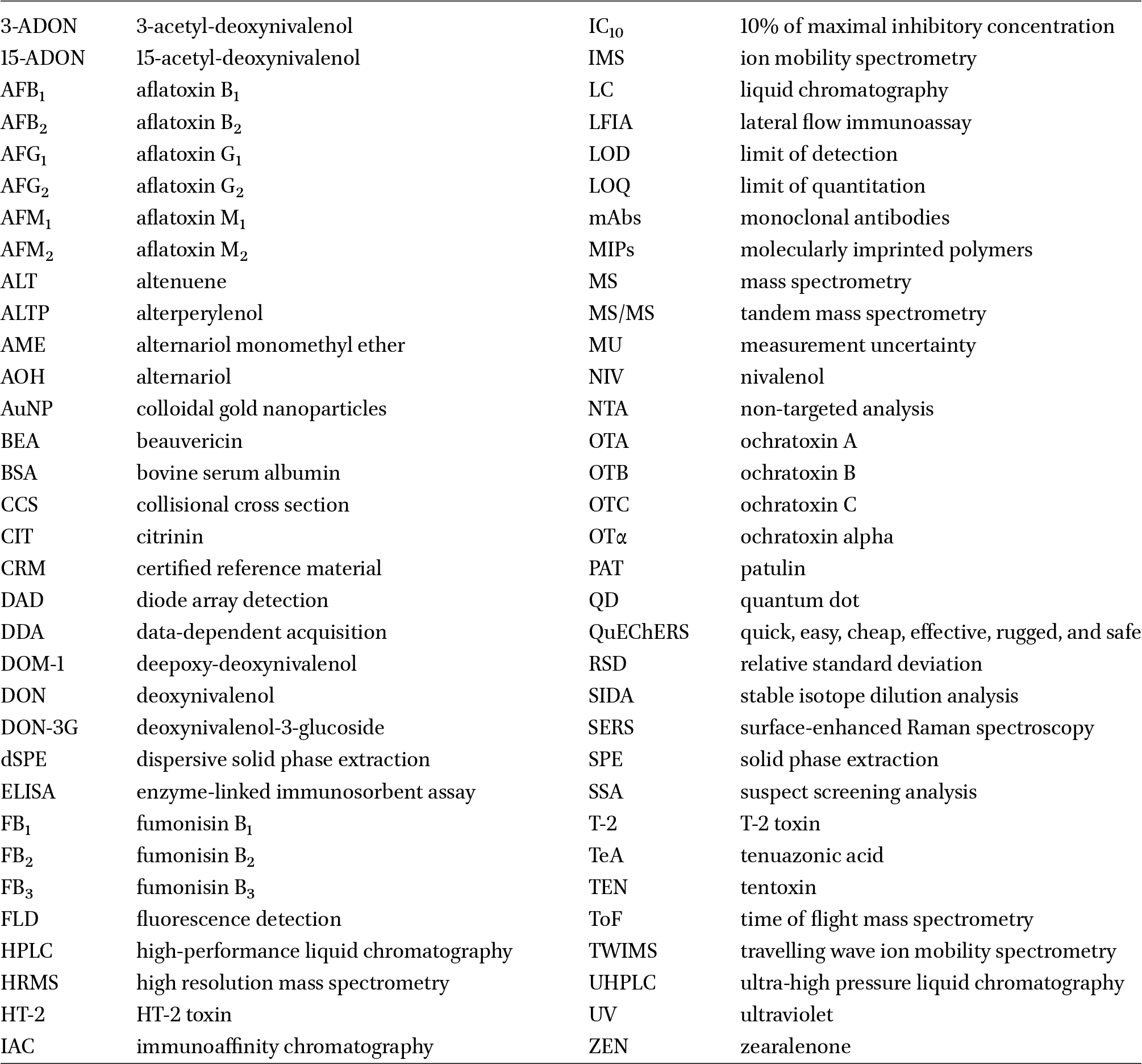
This instalment of the annual review covers sampling (Section 2), quality control of mycotoxin analyses (Section 3), chromatography with a variety of detection methods including tandem mass spectrometry (Section 4), targeted high resolution mass spectrometry (Section 5), non-targeted high resolution mass spectrometry (Section 6), as well as non-mass spectrometric (MS) detection (Section 7). In addition, multiplex biosensors (Section 8) and assays using antibody analogues (Section 9) round out the review. As in past years, this review is not meant to be an exhaustive list of recent publications on mycotoxin analytical methods. At the end of this paper a list of used abbreviations can be found (Table 1).
Analysis of multiple classes of analytes beyond only mycotoxins was one noted trend over the past year. The full versatility of non-discriminatory sample preparation with liquid chromatography-mass spectrometry is being used to analyse a variety of analytes including pesticide residues, veterinary drugs, phycotoxins, and food processing contaminants, along with mycotoxins (CarreÌres et al. 2022; Long et al. 2023; Tae Woong et al., 2022; Tan et al., 2022). This avenue of methodological developments will help laboratories that need to screen for a large number of analytes, including mycotoxins. Successful incorporation of multiple classes of analytes into one method will help maximise efficiency, as long as the required levels of sensitivity, selectivity, accuracy, and precision are maintained.
A less welcome trend of using exotic designs and materials in assays with antibody analogues was noted this year in Section 9. Researchers, reviewers, and editors are asked to maintain focus on the value of real-world applicability and incorporate well-run validation studies into their method development. Even if the technology used is not remarkably innovative, thorough validation and accessible materials and designs will accelerate the development and availability of robust affinity-based methods.
2 Sampling
Research on sampling and sample processing published over the past year includes the use of matrix particle size distribution to evaluate whether homogeneity of laboratory samples is sufficient (Zhang et al., 2023) and application to the characterisation of heterogeneity of mycotoxin content of various dried fruits (Zhang et al., 2022a), as well as use of machine learning to design feed sampling plans (Wang et al., 2022), use of an online tool to assess performance of sampling plans for grains and spices (Tittlemier and Whitaker, 2023), and use of exposure data to design a sampling plan for cattle in order to estimate deoxynivalenol (DON) exposure through feed (Dänicke et al., 2023). Researchers also assessed the relationship of aflatoxin B1-lysine (AFB1-lysine) conjugate in venous and capillary blood in order to sample a more accessible matrix for biomonitoring (Srinivasan et al., 2022).
Zhang et al.(2023) used laser diffraction particle size analysis to characterise the heterogeneity of particle size distributions in various matrices. They tested replicate test portions of comminuted maize, animal feed, white flour, and peanut butter using a commercially available laser diffraction particle sizer optimised for stirring rate, as well particle refractive and absorption parameters. Comminution using a ball mill and dry ice produced particle size distributions wherein 90% had diameters less than 571 μm (whole maize kernels), 616 μm (compound animal feed), 74 μm (peanut butter), and 195 μm (white flour). The relative standard deviations (RSDs) of the cumulative particle size distributions determined from analysis of 20 replicate measurements for each matrix ranged from 4-6 %, indicating a good level of comminution as well as good sub-sampling practices when test portions were taken from the comminuted laboratory samples. Analysis of replicate test portions of each matrix for mycotoxins also showed that concentrations of AFB1 in the peanut butter, DON in the maize, feed, and flour, as well as fumonisins in the feed laboratory samples were consistent between test portions indicating adequate homogeneity of the laboratory samples.
The laser diffraction particle size analysis was also applied to various dried fruit, including raisins, figs, plums, and cranberries prepared using a two-stage process of coarse chopping in a blender with dry ice followed by comminution with dry ice in a high speed blender (Zhang et al., 2022a). In this work, 90% of the particles of each matrix were estimated to have diameters less than 567 μm, with 4-13% RSD of measurements from replicate test portions. The authors thereby concluded their preparation method produced homogeneous samples, according to a definition of sample homogeneity as âparticle sizes < 850 μmâ (AOAC, 1977) but did correctly caution that âcombinations of different mycotoxins and matrices may show different levels of homogeneityâ and suggested that âit is necessary to systematically evaluate the impact of homogeneity on each mycotoxin/matrix pair in the futureâ.
Wang et al. (2022) used four different machine learning algorithms with 14 years of monitoring data to design sampling plans for feed based on the risk of AFB1 contamination (ie. exceeding the European Union maximum level) and also incorporating the cost of sampling and laboratory analysis. The authors stated that the models developed were able to predict feed batches most likely to be contaminated using the factors country of origin, country of testing, product group, and month of sampling. Unfortunately the concept of model accuracy that was assessed was not clearly described, but it was reported as âhigher than 0.9â. When incorporating sampling and analysis costs retroactively over a two year period from 2016-2018 into the model, the sampling plan was estimated to save 96% of the costs spent on the official monitoring program for those two years. At this point, regulators and researchers should consider the impact of future changes in mycotoxin occurrence due to climate change, evolving agricultural and international trade practices, etc., on the algorithmsâ and sampling plansâ ability to reduce risk of contaminated feed entering value chains.
Tittlemier and Whitaker (2023) used the freely available online FAO Mycotoxin Sampling Tool to assess sampling plans. The variance from different sampling plans for the analysis of DON, ochratoxin A (OTA), aflatoxins, and fumonisins in maize, wheat, and ginger were studied. They reported that the current Codex sampling plan (CAC, 2019) could result in the uncertainty around the test result due to variance from sampling, sample preparation, and analytical method of 90% of the current maximum level for OTA in wheat. They also noted higher variance of mycotoxin concentrations for OTA and aflatoxins as compared to DON (in wheat) and fumonisins (in maize) due to the contamination occurring in storage or in the field, and at μg/kg versus mg/kg concentrations. The physical nature of the commodity analysed was also demonstrated to influence variance, with the total variance of aflatoxin measurements in whole grains at 34-109% of the relevant Codex maximum levels as compared to 9-22% at the benchmark level for aflatoxins in powdered ginger. The authors called for consideration of what is an acceptable level of risk of misclassifying a consignment of a commodity as (non) compliant, and then using this level as a starting point in designing meaningful sampling plans.
Another work on developing sampling plans modelled relationships between DON in cow blood, urine, milk, and bile and oral DON exposure using previously published data (Dänicke et al., 2023). One aim of this study was to estimate the number of cattle to sample in a herd in order to estimate the DON exposure via feed consumption. The authors derived an equation to estimate the required sample size from the herd size and confidence interval of DON blood concentrations with a set standard deviation of 20 ng DON/ml blood. Using existing experimental data, the authors determined that 15 cows from a herd of 100 cattle would need to be sampled in order to measure DON in the diet with a precision of ± 1 mg/kg.
Finally, Srinivasan et al. (2022) explored the relevance of using capillary blood samples versus venous blood samples for measuring AFB1-lysine adduct concentrations. Capillary blood can be collected using a finger prick, a much less invasive and less resource-intensive method of sampling than needed for venous blood, which requires trained staff. The authors observed a positive correlation (r = 0.71;
3 Quality control of mycotoxin analyses
The accuracy of the analytical results is ensured by a complex set of steps, which can be time-consuming within the routine mycotoxin analysis of a large number of samples, both from the viewpoint of the preparation in the laboratory and during the instrumental analysis. The most common calibration strategies in mycotoxin analysis comprise matrix-matched calibration and stable isotope dilution analysis (SIDA; Tittlemier et al., 2022). In contrast to these common approaches, several studies have been published in the last year applying a similar approach previously outlined in Maus et al. (2021), consisting of internal calibration using detection of natural isotopic contributions to construct calibration dependencies, which eliminates the need for frequent external calibration. The principle is the construction of a calibration dependence from the points corresponding to the signal of each isotopic peak of the used internal standard. Maus et al. (2021) described this idea mainly for larger molecules (proteins), but demonstration of this strategy was also conducted for a number of smaller molecules (<1000 Da). Later, other authors also applied this approach in their studies investigating alternative calibration strategies in the field of mycotoxin determination (Sun et al., 2023; Wu et al., 2023).
In the study focusing on determination of six aflatoxins (AFB1, AFB2, AFG1, AFG2, AFM1, AFM2) in milk, Sun et al. (2023) tested the use of single-point calibration through the addition of isotopically labelled internal standards to the sample and subsequent multiple isotopologue reaction monitoring using triple quadrupole mass spectrometer, specifically of six natural isotopic contributions. The authors successfully validated the method for the determination of six aflatoxins in milk using immunoaffinity chromatography (IAC) clean-up in terms of sensitivity, inter-day and intra-day precision, and evaluated this strategy as a significantly faster and full-fledged alternative to classic multi-point external calibration. In addition, the multiple isotopologue analysis should enable to increase the method throughput by omitting the sample dilution when the upper limit of linearity is exceeded. In particular, when the signal of the monoisotopic mass of the analyte measured exceeds the linear calibration range of the instrument, authors propose to monitor isotopes with a lower signal, thus enable quantification without sample dilution and re-analysis. Measuring of isotopic contributions with a lower signal is already described in the literature both for quantitative determination (Li et al., 2014) and, for example, also within metabolomics (Wang et al., 2016), but it is not frequently used in routine mycotoxin analysis.
Wu et al. (2023) also used the strategy of detecting natural isotopic contributions, but without isotopically labelled internal standards. Specifically, with this strategy, an alternative quantification option for the determination of sixteen trichothecenes in cereals was investigated, including the most important representatives DON, nivalenol (NIV), HT-2 toxin, and T-2 toxin, etc. Due to the low concentrations of some trichothecenes in cereals and the high number of matrix co-extracts because of analysis of raw extracts, quantification of mycotoxins by a larger number of natural isotopic contributions is difficult. Therefore, the authors proposed the preparation of two calibration points and the monitoring of three ions (M, M+1, M+2) for each analyte. By this approach, the calibration curve would be composed of six calibration points, which theoretically meets the criteria of EU authorities recommending at least three (EC, 2021) or five points (EC, 2002). After the successful validation of the method, the two-point calibration strategy was evaluated as fast and simple, providing good method performance characteristics.
Approaches using the detection of natural isotope contributions and a significantly reduced number of calibration points are advantageous for molecules with a larger isotopic envelope, since the detectability of natural isotopes may already be limited when detecting analytes at low concentration levels. Moreover, the single- or double-points calibration will undoubtedly worsen the trueness of the method, as the occurrence of random errors when processing the sample in the laboratory is not visible (when using one or two calibration points, linearity is not possible to check). The advantage of these approaches is the possibility of implementation with all mass spectrometers commonly used in the analysis of mycotoxins (triple quadrupole, quadrupole-ion trap, etc.), but high-resolution mass spectrometry is preferred due to the possibility of eliminating mass interferences (Maus et al., 2021). The disadvantage is to a certain extent the more complicated calculation of the results, the possibility of distortion of some calibration points due to the detection of interfering ions, lowered method sensitivity due to lower abundance of the isotopic ions and, last but not least, the absence of information about the limit of quantification or linearity during a longer measurement. In routine analysis, it would thus be desirable to use a kind of hybrid model based on classic multi-point calibration in combination with the proposed one- or two-point alternatives which certainly offer interesting potential with regard to economic aspects and time. In addition to the technical considerations, the lack of clarity around the acceptance of using quantitation based on natural isotopic contributions is another disadvantage. It would benefit the community for organisations that set method performance criteria and other requirements to consider the value of this quantitation technique in their schemes.
The second part of this section is devoted to recent studies focusing on mycotoxin reference material. In the last year (from mid-2022 to mid-2023), a number of authors paid attention to production of multi-mycotoxin certified reference materials (CRM; Gab-Allah et al., 2023), evaluating the stability of AFB1 solution reference material (Li et al., 2022a) and production of modified mycotoxins derived from fumonisin B1 (FB1; Angeli et al., 2022).
Gab-Allah et al. (2023) focused on the production of naturally contaminated multi-mycotoxin cereal CRM (KRISS CRM 108-01-011) for four type B trichothecenes [DON, NIV, 3-acetyldeoxynivalenol (3-ADON) and 15-acetyldeoxynivalenol (15-ADON)] and for the first time also for deoxynivalenol-3-glucoside (DON-3G). Regarding the fact that certified DON-3G standard was not commercially available in a solid state (only as a solution) at the time of the study, Gab-Allah et al. (2023) considered the content of DON-3G in flour as informative and not certified, due to the lacking proper traceability to the SI units. Despite the not entirely clear metrological traceability of the DON-3G analytical standard described in the article, the certified analytical standard used can be considered as sufficient for the subsequent certification of the reference material according to ISO/IEC 17025/2018 standard. The incurred analytes in CRM is preferred for the purposes of method validation due to their suitability for determining the method trueness due to possible overestimation of the yield in the case of artificial contamination of a sample free of mycotoxin contamination. The author describes very good homogeneity, low uncertainties (up to 6%) and relatively good stability (6 months at â20 °C; Gab-Allah et al., 2023).
Modified mycotoxins, specifically the production of acylated fumonisin B1 (FB1) derivatives, were addressed by Angeli et al. (2022). They describe a laboratory synthesis of 3-O-palmitoyl- and 15-O-palmitoyl-FB1 using FB1, which was characterised by liquid chromatography coupled with high-resolution mass spectrometry (LC-HRMS) and nuclear magnetic resonance after prior purification. The newly synthesised standards can thus be used for quantitative determination in contaminated corn and also for toxicity studies. This is very important, as another previously synthesised modified mycotoxin derived from FB1, N-acyl-FB1, shows an even higher degree of toxicity compared to free FB1 (Harrer et al., 2013). This issue is also accentuated by European Food Safety Authority with a recommendation to monitor the incidence and levels of acetylated forms of FB1 (Knutsen et al., 2018), but these were not available until now. An alternative strategy of producing standards for quantification is thus very valuable and desirable for the determination of these compounds.
In another study, Li et al. (2022a) was the first to deal with the stability of the analytical standard AFB1 in a solution in detail. An influence of light exposure, temperature, and type of solvent was examined within this study. Accelerated degree of degradation of AFB1 was observed after irradiation with an ultraviolet (UV) lamp (360 nm). Regardless of the type of solvent, AFB1 was completely degraded within 7 days. Interestingly, different degradation behaviour was observed for different solvents under UV exposure, complete degradation occurred even in one day in the case of methanol and chloroform. In the case of sunlight irradiation, there was a significant degradation only in the case of methanol, by tens of percent in units of days. Generally, considerable stability was achieved only with the use of acetonitrile; no change in concentration was observed for AFB1 over 7 days at an elevated temperature (60 °C). Additionally, the authors detected a number of degradation products (n = 15) using LC-HRMS that fit into certain degradation pathways discussed in the publication, mainly addition and oxidation reactions. As a result, storage at low temperatures as well as elimination of exposure to UV light is highly recommended.
4 Chromatography coupled to tandem mass spectrometry
When analysing with tandem mass spectrometry (MS/MS) a first point of debate is the sample preparation and injection approach: dilute-and-shoot or clean-up? Castilla-Fernandez et al. (2022) tried to address this question with a comprehensive evaluation of pros and cons for the determination of mycotoxins in nuts by ultra-high pressure liquid chromatography (UHPLC) with MS/MS. Six clean-ups intended for fatty matrixes were tested in terms of matrix effect, cleanliness of the extract, and co-extractives removal after solid-liquid extraction based on a citrate-buffered QuEChERS. The sorbents evaluated included divinylbenzene/vinulpyrrolidinone copolymer (PRiME HLB), long chain aliphatic hydrocarbons (EMR-Lipid), molecularly imprinted polymers (MIP; AFFINIMIP), zirconia on silica (Z-Sep+), C18, and primary-secondary amine as alternatives to expensive and time-consuming IAC protocols. Nevertheless, none of these clean-ups effectively reduced the strong matrix effects. Instead, a fast 1:100 âdilute-and-shootâ (starting from a simple solid-liquid extraction) approach was successfully tested, obtaining only soft or negligible matrix effects and achieving limits of quantitation (LOQs) that fulfil EU requirements for tree nuts matrix.
Focusing now on specific toxins, letâs start with patulin (PAT); its incidence in fruit products is a worldwide concern due to its acute and chronic toxic effects. An isotope dilution liquid chromatography tandem mass spectrometry method was successfully established and applied to commercially available apple-based products for the corresponding PAT monitoring. Molecularly imprinted polymer-solid-phase extraction (MIP-SPE) was the applied clean-up strategy by Gab-Allah et al. (2022). Conducted to enhanced performance over various previously reported approaches, this method showed high sensitivity, with LOQs ranging from 1.1 to 1.6 μg/kg for various apple products. Accuracy varied between 97.8 and 102%, both inter-day and intraday precision were below 3%, and measurement uncertainty (MU) was lower than 4%.
A highly accurate and specific method was instead developed by Zhang et al. (2022b) for the quantitative determination of FB1, FB2, and FB3 in broiler chicken feed and excreta using UPLC-MS/MS. The transformation into hydrolysed metabolites was also studied through alkaline-hydrolysed extraction and strong anionic exchange adsorbent clean-up. Fumonisins and their hydrolysed forms showed good linearity (r > 0.99) and recovery (from 83 to 116%) with LOQs lower than 200 μg/kg.
Staying in the fumonisins-animal-feed context, FB1 and FB2 toxins were analysed in combination with aflatoxins, DON, OTA, zearalenone (ZEN), HT-2, and T-2 by LC-MS/MS using a single-lab validated method based on a clean-up with a multi-antibody IAC without isotopic labelled nor matrix-matched standards (Mackay et al., 2022). Recoveries were in the range of 74 to 117% in three commercial animal feed matrices and within-day RSDs averaged 1.7 to 10%. This multi-mycotoxin method can handle complex feed matrices such as distillers dried grains with solubles in addition to feed corn and pig feed. The authors reported no matrix effects when analyte peak areas calibration standards in solvent and blank sample matrix extract were compared, but provided no discussion of the factors of the method that could have mitigated matrix effects.
The analytical trend of the last decade is to move from multi-mycotoxins analysis to multi-class analysis, involving contemporaneous analysis of several categories of food contaminants. Following this trend, Long et al. (2023) developed a quality control-oriented method for the simultaneous determination of 9 mycotoxins (AFB1, AFB2, AFG1, AFG2, OTA, DON, T-2, FB1 and ZEN), as well as processing-induced carcinogens acrylamide and 5-hydroxymethylfurfural by UHPLC-MS/MS in cookies cleaned-up through dispersive SPE (dSPE) combined with efficient lipid/matrix removal. The authors reported linear regression coefficients R2Â > 0.99. The recovery of all tested compounds was 70 to 104% with inter-day relative standard deviations (RSD) lower than 13%.
Agricultural products and especially maize and feed are usually challenging matrixes. An efficient and fast magnetic SPE method was developed using nanocomposites. A metal organic framework composed of metal ions and organic ligands with a mesoporous molecular sieve structure and a large number of unsaturated Cr(III) sites [MIL-101(Cr)@Fe3O4] as a nanocomposite adsorbent for purification and enrichment of 9 mycotoxins (AFB1, AFB2, AFG1, AFG2, OTA, OTB, T-2, HT-2 and DAS), verifying the potentialities exactly towards maize but also wheat, and interestingly, watermelon, and melon samples (Guo et al., 2023). Satisfactory recovery (84-109%) and acceptable precision (RSD 1.6-10%) were obtained. No mycotoxins were detected in watermelon and melon; concentrations reported in grain was similar to reported concentrations in other studies.
Dairy is another matrix not so frequently analysed in depth. Zheng et al. (2022) used LC-MS with the QuEChERS sample preparation which resulted in a highly sensitive quantitation of 20 mycotoxins [AFB1, AFB2, AFG1, AFG2, AFM1, AFM2, OTA, ochratoxin B (OTB), ochratoxin C (OTC), ochratoxin α (Otα, T-2, HT-2, DON, ZEN, α-zearalanol, α-zearalenol, β-zearalanol, β-zearalenol, stachybotrylactam, (S)-zearalanone] in milk (LOQs in the 0.02-4.00 μg/kg range). This work optimised a cost-efficient protocol for milk (pasteurised and ultra-high temperature treated) that targeted both commonly and less frequently monitored mycotoxins. In addition, a SPE clean-up, followed by a novel data-dependent acquisition (DDA) approach, based on a combination of inclusion and exclusion lists that help focus mass spectral data acquisition and reduced background influence (see Section 6), permitted low μg/kg concentration large screening surveys of 50 mycotoxins in oats (Tan et al., 2022). Now moving from milk to cheese, RodrıÌguez-Canas et al. (2023) worked on a reliable method for the quantification of 32 mycotoxins in cheese, optimising a QuEChERS extraction process and validating the approach for four cheese varieties (emmental, blue, brie, and camembert). A high occurrence of emerging mycotoxins beauvericin (BEA) and enniatins were found, ranging from 31% for enniatin A to 100% for enniatin B. OTA was also detected in three samples at 4.8 μg/kg to 9.6 μg/kg.
Modified QuEChERS and triple quadrupole mass spectrometry (LC-MS/MS and GC-MS/MS) technology were also used to analyse mycotoxins (AFB1, AFB2, AFG1, AFG2, OTA), pesticides, and veterinary drugs in feed, extracting the samples in presence of EDTA to deliberately increase the extraction efficiency during pre-treatment. The complex feed matrix effect was reduced by appropriate dilution after extraction and purification in association with matrix-matched calibration curves for accurate final quantification, having acceptable recovery for mycotoxins between 73 and 118% and precision < 19% (RSD). The selectivity, linearity, LOQ, accuracy, precision and matrix effects of the method were characterised. Accuracy and precision were also characterised through cross-validation between two different laboratories (Na et al., 2022).
In the interest of a better understanding of emerging mycotoxins, an LC-MS/MS method was set up and validated, obtaining fit for purpose sensitivity, recoveries (70-120%), repeatability (â¤20%) and within-laboratory reproducibility (â¤26%) evaluated according to UNI CEN/TR 16059:2010 in triplicate in three different matrices (tomatoes, wheat, and sunflower seeds). Quantification was carried out by the internal standard method with deuterated forms of the analytes. Measurement uncertainty for each toxin was based on intra-laboratory quality control data according to the SANTE/12682/2019 and resulted in values between 28 and 44%. The method was implemented at a retail-level monitoring programme for Alternaria toxins [alternariol (AOH), alternariol methyl ether (AME), tenuazonic acid (TeA), tentoxin (TEN), and altenuene (ALT)] for cereal-based foods, tomato products, and sunflower seeds, collected in Italy from 2017-2020 (Lattanzio et al., 2022). Alternaria toxins were in fact quite ubiquitous contaminants in highly consumed food products, suggesting a future evolution of European and worldwide legislation to which availability of robust and reliable analytical approaches has to correspond. Following this need, another group (Gonçalves et al., 2022) has recently published a paper that describes an advanced interlaboratory validated LC-MS/MS method based on isotope dilution quantification and suitable for the determination of ALT, AOH, AME, TeA, and TEN with sensitivity close to or below 1 μg/kg in tomato puree, wheat, and sunflower seeds. This method is currently under evaluation by the European Committee for Standardization for adoption as a standard method. Scheibenzuber et al. (2022) developed methods to study the effect of malting on levels of free and modified forms of Alternaria mycotoxins in barley and respective malts from 2016-2020 harvest year campaigns, showing toxin formation during the malting process. LC-MS/MS was successfully applied for the analysis of AOH, AME, TEN, altertoxin I (ATX-I), altertoxin II (ATX-II), alterperylenol (ALTP), ALT, as well as the modified toxins AOH-3-glucoside, AOH-9-glucoside, AME-3-glucoside, AOH-3-sulfate, and AME-3-sulfate. Quantitation was executed exploiting SIDA for AOH, AME, and TeA, and matrix-matched calibration was used for all other toxins. Material for analytical standards for the glucoside and sulphate conjugates, as well as AOH, AME, ATX-I, ATX-II, stemphyltoxin III, and ALTP were synthesised or isolated from cultures. The toxins ALTP and ATX-I were notably found more frequently in the malt samples (in â¼50% of samples), but not in barley (in â¼5% of samples).
Regarding innovation on the automation side, an interesting paper on one-step automatic sample pre-treatment/clean-up protocol using immunomagnetic beads and LC-MS analysis has to be reported (Chen et al., 2022a). In addition to the objective advantages of automation, this approach presented high performance sensitivity (LOD of 0.0008 μg/kg and LOQ of 0.0027 μg/kg) and recoveries between 86-103% with RSD < 4%. This method was demonstrated as effective for the detection of AFM1 in up to 24 milk samples at the same time, simplifying the operational part and reducing in parallel the probability of human errors.
Innovation is not only on automation or sample preparation, but also on novel ways on how to get better with direct MS instrumentation. For example, separation in ambient and direct mass spectrometry ionization techniques, without any prior chromatography, could significantly affect the overall selectivity of analysis. To compensate for this drawback Geballa-Koukoula et al. (2022) proposed to incorporate a biosensing element at the ionization source with a technique called âimmunoaffinity blade sprayâ, featuring a conductive polystyrene blade material with a layer of highly specific monoclonal antibodies (mAbs). The methodâs applicability was demonstrated by analysing DON in spiked and incurred wheat flour samples. After a rapid extraction, DON is immuno-captured, and the blade is positioned in front of the MS for direct immunoaffinity blade spray-MS/MS analysis, with contemporaneous information also obtained for cross-reacting DON conjugates. This immunoaffinity blade spray-MS/MS approach has the potential to enable fast, relatively inexpensive, semi-quantitative and reproducible analysis for both screening or confirmation of substances, thanks to the high specificity provided by mAbs.
5 Chromatography with targeted high resolution mass spectrometry
Key benefits of targeted high resolution mass spectrometry (HRMS) analysis with Orbitrap or time of flight (ToF) mass spectrometers over triple quadrupole MS/MS instruments are the improved selectivity due to high resolution mass spectra as well as the almost unlimited number of analytes that can be covered either when data-independent fragmentation or DDA is applied. On the other hand, triple quadrupole MS/MS instruments generally offer lower limits of detection (LODs) but are limited in the number of simultaneous selected ion transitions (selected reaction monitoring; SRM) that can be monitored. At the beginning of routine LC-MS, this limitation had little relevance as commodity-specific methods with few selected (regulated) mycotoxins were state of the art. Nowadays, multi-analyte and multi-class UHPLC-MS methods for a broad range of food matrices are shifting into focus, leading to triple quadrupole MS/MS methods with narrow retention time windows for specific SRM transitions (scheduled SRM) while targeted, commodity-specific methods with few analytes are on the decline.
This broad range and large number of analytes covering mycotoxins, plant toxins, pesticides or veterinary drugs with multiple product ion spectra is the classical domain ToF and Orbitrap systems. Compared to the tens of thousands of analyte ions detected in proteomics routinely analysed with these instruments, the number of small molecule contaminants to analyse is still low and technically feasible. Retention time shifts as observed due to column aging are also of little relevance for HRMS systems when the abovementioned fragmentation modes are applied while scheduled multiple reaction monitoring methods run on triple quadrupole MS/MS instruments may require laborious re-adjustment.
However, in most cases careful data evaluation and interpretation of the data obtained by the UHPLC-MS systems is the bottle neck before decision making such as accepting or rejecting a new lot. Especially when HRMS systems are applied and extensive datasets are generated, time for data review and processing is often by far longer than the measurement time. In case of quantitative analysis, different procedures such as procedural standard calibrations or matrix-matched calibrations are applied, which should be measured for every matrix of relevance. In the case of quality control or other busy laboratories, this may lead to many calibration standards run and extensive additional data evaluation work. Alternative approaches such as solvent calibration in combination with standard correction factors for specific matrices is also applied, but it may only partially compensate for day-to-day performance differences.
CarreÌres et al. (2022) reports a workflow used in a private laboratory analysing a group of 156 compounds including 90 plant toxins, 54 mycotoxins and 12 phytoestrogens prepared using an established QuEChERS extraction and without additional clean-up (Bessaire et al., 2021). A key element of their workflow is duplicate sample preparation and the assumption that most contaminants are not present in the sample, or will only be detected at trace amounts. Thus, the primary task is to confirm the absence of most analytes and not the exact quantification of compounds. In this workflow, one fraction of a sample is extracted and analysed as is, and the second fraction is fortified with all analytes at a level of 2Ã LOQ. With this kind of single point standard addition, automated data filtering is run with the aim of eliminating all analytes of a specific sample that are not detected in the non-fortified sample but detected in the fortified sample. For these analytes, it is verified that the analytical process works and that the analyte is not present in the sample up to a specified level. In case the analyte is detected in the non-fortified and fortified sample, the analyte is considered present in the sample, assuming that no carry over is observed, which has to be verified by analysis of blank and QC samples. Based on the signal and concentration of the fortified and non-fortified sample, a semi-quantitative assessment based on the one-point standard addition can additionally be made. Critical samples that require manual review are thus limited to those where no analyte is detected in the fortified sample â usually in combination with no detects in the samples as it is. In this case, the performance of the method for this specific matrix is insufficient or a technical error has occurred.
The key element of this publication and the step that accelerates processing is the freely available script developed for the software R. This script is applied to a commonly used file format (.xlsx) report of the datasets, which can be generated from different software used for peak identification and integration. In the R script, calibrations of QC samples with different analyte levels, blanks, and samples for analysis are sorted, a comparison of the sample pairs (fortified and non-fortified) is made, and a final report is generated (CarreÌres et al. 2022). This step away from original vendor software might be a critical step for accredited laboratories, on the other hand, it might unify workflows and can be helpful especially for analysis of small sample numbers from multiple matrices.
Ion mobility spectrometry (IMS) has been shown as a valuable tool for the reduction of matrix interferences and thus for improving and accelerating peak identification as well as lowering the rate of false positive results (Tittlemier et al., 2023). One drawback of IMS however, is a negative impact on overall ion transfer and thus signal intensity observed for some systems (Tittlemier et al., 2022). Depending on the applied technique, this signal reduction can range between no effect and up to almost 90% reduction. As many leading ToF manufacturers nowadays offer IMS devices, its application for small molecules is receiving more and more attention but examples where IMS instruments performed significantly superior to classical instruments in the field of mycotoxin analysis are scarce.
Carbonell-Rozas et al. (2022) tried to fill this gap by investigating the applicability of travelling wave ion mobility (TWIMS), a form of IMS, for the analysis of ergot alkaloids. Ergot alkaloids appear as pairs of two epimers that can interconvert into each other, depending on the chemical environment. The 8R-form is named with the ending â-ineâ and 8S-form ends with â-inineâ, for example ergocornine and ergocorninine. Chromatographic separation of the epimers of the different ergot alkaloids is possible but it requires a carefully optimised chromatographic system as well as a comparably slow gradient. Thus, the first task the authors investigated was whether the separating power of the TWIMS system was sufficient to separate the two stereoisomers and thus to accelerate chromatography by eliminating the requirement for baseline-separation of the peaks of the stereoisomers. Successful separation of isobaric compounds by IMS requires a sufficiently large difference between the three-dimensional structures and thus the collisional cross-sections (CCS) of the ions. In addition to the effect of the conformation, ionization, especially cationization, can have an effect on the CCS: As the cationization with sodium can be assigned to a specific position or functional group of the analyte molecule while protonation is much more dynamic, studying [M+Na]+ ions can significantly increase the CCS difference between to stereoisomers. Accordingly, [M+Na]+ as well as [M+H]+ and [M-H2O+H]+ of the epimer pairs were compared in this study. The authors demonstrated that separation of [M+Na]+ is possible, but baseline separation is not fully achieved with the TWIMS system used. However, as new systems such as cyclic IMS (Waters) appear on the market and existing systems realise improved performance with developments like âHRdm 2.0â for drift tube IMS (Agilent) or âIMEXâ for trapped IMS (Bruker), the likelihood of improved discrimination of isobaric compounds.
For Carbonell-Rozas et al. (2022), the observation that CCS values determined in different laboratories with different TWIMS instruments fit together very well is particularly noteworthy. With a bias below 1% in all cases except [M-H2O+H]+, use of CCS databases as an additional identification criterion in addition to the accurate mass and retention time index, could make identification of compounds without reference standards more reliable. Further investigations by the authors were aimed at the applicability of IMS to reduce background signals and improve the signal-to-noise ratio and simplify automatic integration. For this purpose, different chromatograms with and without IMS filtering were compared to illustrate to what extent a reduction of the background signal is possible. At this point, unfortunately, the description of the experimental setup has some gaps, which is surprising since, the parameters for the traveling wave are described in great detail. Specifically, it is unclear which mass filter was used to perform the comparison of the chromatograms with and without IMS. In the figures shown, all extracted
There was an absence, or only a minimal decrease in analyte signal intensity, observed by Carbonell-Rozas et al. (2022) in their experiments comparing ToF measurements with and without TWIMS, which contrasts with previous TWIMS observations but is very promising for follow-up experiments. Using the optimised TWIMS parameters, a small study on the applicability of their method for the detection of ergot alkaloids was added. Following a previously published QuEChERS approach for oat sample preparation, barley and wheat samples were analysed for six pairs of ergot alkaloid epimers. With their method, LOQ values between 0.6 and 2.0 μg/kg were reached with RSD lower than 14.4% for repeatability and intermediate precision at 5 μg/kg. As the same group performed also the analysis of ergot alkaloids by triple quadrupole MS/MS, a comparison of performance of both types of instruments is possible (Carbonell-Rozas et al., 2021). For the triple quadrupole MS/MS method, the LOQs for the ergots were in the range between 0.49 and 3.92 μg/kg and thus in the same range. However, repeatability RSD for a spiking level of 5 μg/kg were slightly lower with only three alkaloids exceeding a value of 10% in wheat matrix. At this point it has to be mentioned that the triple quadrupole MS/MS method follows the requirements of SANTE/12089/2016 (EC, 2016) while for the TWIMS-ToF method information on possible observed fragment ions are not reported. In conclusion, the authors showed very interesting examples to demonstrate the current application of TWIMS-ToF for mycotoxin analysis and the application of CCS values.
6 Chromatography with non-targeted HRMS
Non-targeted analysis (NTA) and suspect screening analysis (SSA) are powerful techniques that rely on liquid chromatography â high resolution mass spectrometry (LC-HRMS) along with computational tools for the detection and identification of unknown mycotoxins and fungal metabolites. Since the last review of advances in mycotoxin analysis, there have been a number of interesting papers in three main areas related to NTA: a study on the determination of mycotoxins and other chemical contaminates in food; three separate studies demonstrating the application of untargeted metabolomics for mycotoxin identification in cultures of Alternaria; and two related studies on biomonitoring of mycotoxins, one in hair and the other from urine.
A new DDA strategy, based on a combination of inclusion and exclusion lists was developed for high-throughput screening of chemical contaminations including mycotoxins in food (Tan et al., 2022). One interesting aspect of this study is that the authors did not limit their analysis to one class of chemicals such as mycotoxins, pesticides or even pharmaceuticals, as is the case for most targeted analysis work. In this study they screened for 50 mycotoxins in oats, 155 veterinary drugs in dairy milk, and 200 pesticides in tomatoes, in addition to the acquisition of NTA data for the detection of metabolites and degradation products from these compounds. The application of inclusion (ie. Specific precursor ion
In the past year there were three separate studies that used a non-targeted metabolomic approach to study Alternaria mycotoxins. The focus on Alternaria sp. Is not surprising given that they are ubiquitous global contaminants of field crops and cause post-harvest spoilage; there has been significant interest in the past years with respect to potential regulation of emerging mycotoxins from Alternaria. Additionally, the accurate identification of Alternaria species is itself very challenging meaning that chemical analysis is often required to assess species risk. In this first study, untargeted or non-targeted nano-LC-HRMS/MS metabolomic profiling was applied to extracts from 36 strains of Alternaria (Witte et al., 2022). The resulting data were processed using a variety of tools including Global Natural Products Social Molecular Networking of MS/MS data. Mycotoxin identifications were made via matching with Massbank of North America (https://mona.fiehnlab.ucdavis.edu/) and the Global Natural Products Social Molecular Networking natural products library (https://gnps.ucsd.edu/). Analysis of the data showed that the strains tested produced many of the expected and well-characterised Alternaria metabolites in addition to a number of derivatives of dehydrocurvularin, including previously unreported compounds. These finding were supported by whole genome sequencing of the strains and identification of the biosynthesis gene cluster involved in their biosynthesis. The authors refer to the idea of secondary metabolite or chemical phenotypes but these could more commonly be referred to as different chemotypes.
In a related study, seven strains of Alternaria were grown on multiple types of media and analysed by non-targeted metabolomics using high resolution LC-MS/MS (You et al., 2023). The authors reported the production of a number âfreeâ Alternaria toxins in addition to their sulphated versions as detected using the diagnostic fragmentation filtering feature in Mzmine. Global Natural Products Social Molecular Networking was then used to process the MS/MS data where it was observed that the detected secondary metabolites belonged to four main clusters, comprising a number of precursor and modified mycotoxins. The data also demonstrated the power of the metabolomics approach using NTA as it showed a number of tightly clustered nodes that the authors were not able to identify, suggesting that they are potentially novel compounds, which warrant further study. Interestingly, these authors did not report dehydrocurvularin and its derivatives as the previous paper detected. This could be due to differences in secondary metabolite production between strains or they were not able to detect them. Both of these studies would have benefited from analysis of these Alternaria strains growing on a more natural substrate to ensure that artificial media was not responsible for the observed secondary metabolites and the impact of plant/fungus interactions on secondary metabolites would be accounted for.
The third study of Alternaria metabolites used NTA to determine the metabolic response of Alternaria strains challenged with strains of Trichoderma (Tian et al., 2023). The authors made the argument that these types of interactions are constantly occurring in nature and could impact the production and possible metabolism of mycotoxins detected on crops and in food stuff. The presence and amounts of five known Alternaria mycotoxins (TeA, AOH, AME, ALT and TEN) were used to monitor and validate the experiments. Dual culture experiments resulted in the growth inhibition of Alternaria strains. NTA analysis demonstrated that there were many significant metabolic changes as outlined by principal component analysis, including reductions in mycotoxin production by as much as 99%. There was further evidence that one strain of Trichoderma was able to detoxify AOH into its hydroxylated form, which is an interesting and relevant finding from a food safety perspective. The authors have proposed an MS-based work-flow for the use of NTA to study the impact of other microbial interactions on mycotoxin production in crops. Metabolomic studies such as these three are important for understanding the potential chemical diversity of fungal species and using this information to inform analysis of crops and food products to ensure that they are free from emerging mycotoxins.
The most accurate way to assess population exposures to mycotoxins is though the direct analysis of mycotoxins in urine, blood, stool or hair. In the case of urine and stool, these matrices generally represent a measure of recent exposures due to rapid excretion and do not provide accurate information on the long-term average exposures. To address this issue, a large-scale pilot study was conducted to determine multiple mycotoxins in hair as an alternative matrix for biomonitoring (NarvaÌez et al., 2022). The study analysed 100 hair samples collected from hairdressers in Spain, using a targeted HRMS/MS method for 10 common mycotoxins. The results of this targeted analysis showed that 43% of the hair samples contained mycotoxins in the approximate range of 1 to 100 ng/g, with multiple mycotoxins detected in 42% of these samples. Retrospective analysis of the NTA datasets tentatively identified 128 mycotoxins and related metabolites. Interestingly, PAT was detected in 85% of the samples, along with other important mycotoxins, such as T-2, ZEN, and fumonisins. The results demonstrate that mycotoxins of concern can accumulate in hair samples showing promise for long-term exposure assessments. In a related study, these researchers used a similar approach of an HRMS/MS targeted method for 10 mycotoxins in human urine followed by retrospective data analysis (DasıÌ-Navarro et al., 2022). In order to develop a validated method for mycotoxin biomarkers a number sample preparation methods were tested, leading to the use of a QuEChERS approach. The retrospective analysis 100 urine samples showed at least one mycotoxin was detected in 79% of the samples with 24% of the samples containing three or more above LODs. Not surprisingly, DON in its metabolite form de-epoxynivalenol (DOM-1) was the most prevalent, detected in 46% of the samples, followed by OTA and ZEN in lesser amounts. These two studies taken together demonstrate how targeted methods for biomonitoring of mycotoxins can be supported by NTA and how new targeted methods can be developed that better encapsulate the actual mycotoxins and metabolites that these populations were exposed to in their diets.
It is clear from the studies presented that NTA is not going to replace targeted analysis of mycotoxins anytime soon, and probably never will. However there is value in applying NTA or a metabolomics approach to better understanding the potential emerging mycotoxins from fungal cultures that could end up in crops, especially given the impact of climate change on our food production systems. It should also be noted that NTA allows for the detection of multiple classes of chemicals within a single sample. If an HRMS/MS analysis is being conducted for mycotoxins, there is often no reason why the same samples canât also be used to monitor for pesticides or pharmaceuticals as was demonstrated in the first paper. This is a major advantage of these techniques over most traditional targeted analysis. Human biomonitoring is an area of mycotoxin research that is gaining interest and is well suited for NTA. Although there are only a few validated biomarkers of mycotoxin exposure it is still important to study exposure to free mycotoxins in addition to phase I and phase II metabolites, which was addressed in the current studies through NTA.
7 Chromatography with non-MS detection
Mycotoxin analytical techniques utilising HPLC with non-MS detection continue to develop. Current trends within this particular segment of analysis focus on analytical techniques based on environmentally friendly considerations and cost savings, including the use of deep eutectic solvents (green solvents), dispersive methods, magnetic beads, and other novel techniques.
The consideration of environmental friendliness in developing analytical methods entails developing sustainable, reusable technology and practices. An environmentally friendly approach applying HPLC-fluorescence (FLD) for aflatoxins was developed and assessed for validity by Lesan et al. (2023). Their approach involved extracting aflatoxins from rice using a miniaturised pressurised liquid extraction followed by dispersive liquid-liquid micro-extraction. A blend of rice and sand were extracted by the deep eutectic solvent of choline chloride and various hydrogen bond donors (1:2 molar ratio) at 90 °C and 1,500 psi, and the solvent phase containing the aflatoxins was then mixed with another deep eutectic solvent and combined with water. The resulting mixture was centrifuged to provide a clear extract for HPLC-FLD analysis. The researchers reported results showing satisfactory toxin recoveries of 69-82%, RSDs at <5.2%, and quantification limits of 0.07-0.23 μg/kg. Although deep eutectic solvents are shown to work in rice, extraction efficiency studies on varying complex matrices should be performed to expand the scope of this methodology.
Kardani et al. (2023) developed and validated a method for the analysis of aflatoxins with a green focus. The approach entailed synthesising affinity columns using two approaches: the metal-organic framework and molecularly imprinted polymers (MIPs) with deep eutectic solvents. These affinity columns developed were then used for extracting and concentrating aflatoxins prior to quantification with HPLC-FLD. Researchers utilised the âone factor at a timeâ approach to optimise the variables influencing the target aflatoxins. The results indicated LODs for all aflatoxins between 0.023 and 0.033 μg/kg with a linear range of 0.1 and 400 μg/kg. This study has shown the promising advancement of MIP technology by increasing selectivity, which is a major complication of the MIP methods available.
Another environmentally friendly approach for extracting mycotoxins was developed by Pradanas-GonzaÌlez et al. (2023). The approach utilised a sustainable liquid-liquid microextraction technique developed for mycotoxins in edible vegetable oils. The extraction used eco-friendly, naturally existing deep eutectic solvents. The extraction method was coupled with HPLC-diode array detection (DAD)/FLD to simultaneously determine ZEN, AOH, DON, and OTA. All mycotoxins exhibited a RSD of <9.0% and recoveries between 82% and 110% in all oils studied, except for ZEN with a recovery of 36-42%.
A novel microextraction protocol combined with HPLC-FLD was developed as an environmentally friendly approach for determining OTA in legumes and cereals by Olia et al. (2023). This novel sorbent-based microextraction method is referred to as the âfabric-phase sorptive extraction methodâ and used modified cotton as the substrate for a polymeric sorbent. The researchers evaluated solvents and the volumes of solvents used in the adsorption stage, the time it took to completely adsorb the mycotoxin from the sample extract, and the effects of salt on adsorption. During the desorption stage, specific parameters associated with the desorption process were investigated, including the back extraction pH and volume. A mobile phase consisting of a mixture of water, acetonitrile, and acetic acid was used to perform the chromatographic separation. The results of the research study indicated an acceptable detection limit and recovery levels of 0.09 μg/kg and 76% to 113%, respectively.
A dispersive method for analysing chemical substances entails dispersing a solid sorbent in a liquid sample. Dispersed sorbents include carbon-based nanomaterials, magnetic sorbents, and MIPs. An optimised and validated dispersive method for extracting aflatoxins, including AFB1, AFB2, AFG1, and AFG2 was developed by Maneeboon et al. (2023). The liquid-liquid microextraction method combined with HPLC-FLD for analysis of aflatoxins in pods and leaves of the senna plant. The extraction volumes and solvents used for 2 g of plant material were 200 μl of chloroform and 500 μl of distilled water as the dispersive solvent. The extraction of the aflatoxins from the plant material was conducted at a pH of 5.6 in the absence of salt. The linear range for the aflatoxins was 2.0-50.0 μg/kg. The recoveries of mycotoxins from the leaves ranged from 92 to 109% and 84 to 103% from the pods. The LODs of the aflatoxins were variable, ranging from 0.70 to 1.27 μg/kg, with LOQs ranging between 2.13 and 3.84 μg/kg.
In another research study, a micro-dSPE technique was developed to extract aflatoxins from wheat and peanut samples (Zhu et al., 2022). The dispersive technique used a fabricated ZnO nanoflower sorbent in an ionic liquid. The extraction of aflatoxins from the food samples was performed before conducting HPLC-FLD detection. The technique demonstrated good linearity with a correlation coefficient of >0.9994. The aflatoxin LODs and LOQs ranged from 0.024 to 0.067 μg/kg and 0.082 to 0.226 μg/kg, respectively.
Magnetic bead-based strategies are continuing to develop; these could offer lower-cost alternatives to antibody-based immunoaffinity sample preparation. A magnetic bead-based method was developed using mycotoxin-albumin interaction (Ye et al., 2023). This analytical technique involved the use of economically available human and bovine serum albumin (BSA) acting as a receptor with affinity for OTA in beer and wine samples. This extraction technique was coupled with UHPLC-FLD to detect OTA. The recovery of OTA at different concentrations ranged between 91% and 102%. The LODs for beer and wine were 0.15 μg/l and 0.37 μg/l, respectively.
Deng et al. (2022) also applied magnetic bead technology with UHPLC for detecting FB1. The researchers aimed to overcome the poor sensitivity and the time needed to prepare and purify antibodies associated with conventional methods that use IAC. They developed a technique using aptamers selected from oligonucleotide libraries with polyethylene glycol-mediated magnetic nanomaterials that show affinity for FB1. The feasibility of the method was tested with fortified corn flour samples. The results showed toxin recovery of 83-102%, and RSDs of 3.3-6.4%.
8 Multiplex biosensors
New biosensor formats, including those based upon optical sensing techniques (fluorescence, Raman spectroscopy, surface plasmon resonance), as well as electrochemical techniques, continue to be developed both for individual toxins and as multiplexed assays. The number of recent reviews on mycotoxin biosensors was extraordinary: 13 within the past 12 months. Within the mycotoxin biosensor literature there has been a significant shift towards aptamer-based assays, both for individual and multiple mycotoxin detection. However, antibody-based methods (immunoassays) continue to be widely explored. While most immunoassays use large, intact, immunoglobulins, such as IgG, there has been sustained interest in developing small peptides or antibody fragments for use as toxin-binding materials and toxin mimics. Recent progress in the application of small peptides to the detection and removal of mycotoxins was reviewed by Zhao et al. (2022). This is a very comprehensive review of the development of small peptides and their use both as reagents in biosensors and as potential artificial enzymes for mycotoxin degradation. Two other reviews of note were those of Siva et al. (2023) and Zhai et al. (2023). The first of these (Siva et al. 2023) covers the use of nanoliposomes in mycotoxin biosensors. Nanoliposomes are materials composed of self-assembling phospholipids that have aqueous cores. They can be used to carry a wide variety of labels, enabling signal enhancement through mechanisms that donât require enzyme/substrate amplification. The review focused on the structures of nanoliposomes, their production, how they may be functionalised for use in various types of biosensors, and provided a very thorough summary of the many applications of nanoliposomes in mycotoxin biosensors. As an alternative to nanoliposomes many researchers have investigated the use of labels that are encapsulated in other types of shells. Such âcore-shellâ nanoparticles were reviewed by Zhai et al. (2023). The shells of such particles can take many forms including polymers and silicon dioxide (i.e. quantum dots). As with liposomes, such particles can incorporate a wide variety of labels, including those which are fluorescent, electroactive, or have strong Raman signals. Additionally, such particles can be functionalised with iron oxides, rendering them useful in sample pre-treatments using magnetism for separation. The review by Zhai et al. summarised the many publications where core-shell particles have been incorporated into mycotoxin assays, using sensing platforms as diverse as surface enhanced Raman spectroscopy (SERS), colorimetry, fluorescence, up-conversion luminescence, chemiluminescence, and electrochemistry.
Multiplexed lateral flow immunoassay
An interesting and little explored aspect of lateral flow immunoassay (LFIA) is the effect of binding zone location upon sensitivity. Bartosh et al. (2023) examined the impact of binding zone location in the context of a 4-plex assay for AFB1, DON, T-2, and OTA. The effect is believed to result from the non-equilibrium conditions that exist in such assays resulting from different flow rates and interaction times at different locations within a test strip. This suggested that sensitivity depends upon the binding constants of the individual antibody/antigen interactions as well as the duration of the assay. The equilibrium and kinetic constants of each of the antibody/antigen pairs were determined using enzyme-linked immunosorbent assay (ELISA). The optimal arrangement of the binding zones on LFIA was with those having lower equilibrium association constants first on the strip (i.e. closest to the origin). Ordering the binding zones in this fashion decreased the LODs for OTA by two-fold and for DON by 27-fold. This article is significant because of the potential implications not only for LFIA, but also for other immunoassays where the immune reagents are deployed in a series format and where the flow rates and interaction times can vary.
Colloidal gold nanoparticles (AuNP) are widely used as labels in LFIA, particularly for commercial devices. While AuNP remain widely used, many researchers have explored other, potentially more sensitive, labels. Chen et al. (2022b) combined coloured latex microspheres with a cell phone-based reader for measuring AFB1, T-2, and ZEN in cereal grains. Each of the three toxins was distinguished on the test strip both by spatial location and by the colour of the latex microspheres (red, green, or blue). The intensity of the colour at each test line was then evaluated using a smartphone-based device developed previously. The LODs were 0.04, 0.4, and 1.21 μg/kg for AFB1, T-2, and ZEN, respectively, while the cut-off values were 1, 15, and 40 μg/kg. The recoveries ranged from 82% to 108%, while the coefficients of variation ranged from 3.0% to 8.1%. Twenty-six samples of naturally contaminated cereals were examined using the method and commercial ELISA kits. Seven of these contained AFB1 in the range of 0.1 to 0.6 μg/kg. Twenty-one contained T-2 over the range of 1 to 2 μg/kg, and 15 contained ZEN over the range of 0.3 to 26 μg/kg. Coefficients of determination for all three toxins were greater than 0.99, suggesting that latex microspheres may be acceptable alternatives to AuNP.
Quantum dots (QDs) are another label commonly used in LFIA for mycotoxins. In a variation on this theme, Jiang et al. (2023) combined fluorescent QDs with the inner filter effect for measuring AFB1, OTA, and ZEN in maize. In this instance the inner filter effect was caused by placing the QDs in close proximity to a label (AuNP) that absorbed their fluorescence. That is, while for most LFIA formats AuNP are used as a coloured label for detection, in this format AuNP coated with the toxin antibodies were used to quench the fluorescence of immobilised antigen-labelled QDs. As the antibody-AuNP moved through the strip they bound to the antigens, quenching the fluorescence of the QDs. With this format higher levels of toxin result in lower levels of antibody-AuNP binding and therefore increased signals from the QDs. The LODs, reported in terms of solution concentrations, were 0.005, 0.04, and 0.4Â ng/ml for AFB1, OTA, and ZEN, respectively. Maize (5Â g) was extracted with 25Â ml of aqueous methanol, centrifuged, and diluted six to fifteen-fold with buffer. The suggested dilution was 12-fold, equivalent to 0.0167Â ng/ml of extract. The linear detection ranges, in terms of ng/ml of diluted maize extract were 0.01-0.625 (AFB1), 0.08-2.5 (OTA), and 0.8-25 (ZEN). Maize was spiked at three levels for each of the three toxins, with recoveries ranging from 72 to 92% (AFB1), 79 to 106% (OTA), and 82 to 105% (ZEN), with coefficients of variation of less than 15.5%. These results suggest that quenching the signal from QDs using AuNPs may be a useful strategy for developing LFIA that display signals that increase with increasing toxin content.
Among the many types of labels that have been combined with the LFIA format are those which can be detected using SERS. An advantage of SERS in the context of multiplexed assays is that the labels have narrow spectral bandwidths, an important consideration for reducing the overlap of signals. Chen et al. (2023) developed a dual-toxin test for AFB1 and OTA using SERS reporters encapsulated into immunoprobes. The immunoprobes were prepared by incorporating the reporter molecules into AuNP, which were then encapsulated in a SiO2 shell and coated with anti-toxin antibodies. Probes incorporating 4-mercaptobenzoic acid were prepared for AFB1 while probes for OTA incorporated 5,5â-dithiobis-(2-nitrobenzoic acid). Unlike traditional multiplexed LFIA formats, where there is a separate test line for each toxin, in this case there was only a single test line, at which both antigens (OTA-BSA, AFB1-BSA) were immobilised. After excitation with a laser, signals from the immunoprobes were separated based upon their different Raman spectra at 1,074 and 1,334Â cmâ1. Excluding extraction and cleanup steps, the assays took approximately 15Â min. The calculated LODs were 0.24Â pg/ml for AFB1 and 0.37Â pg/ml for OTA. Linear dynamic ranges covered from 250 fg/ml to 25Â ng/ml for both toxins, with R2 of 0.989 (AFB1) and 0.996 (OTA). Testing with cereal samples was extremely limited. Samples of three grains (maize, rice, wheat) were extracted and the extracts spiked with AFB1 or OTA at four levels for each toxin. The levels ranged from 10 to 120Â ng/ml for AFB1 and 0.1 to 60Â ng/ml for OTA, which seems incongruent with the reported linear dynamic ranges. Recoveries for AFB1 ranged from 91% to 105%, while recoveries for OTA ranged from 87% to 112%. It is hoped that these promising results from spiked extracts will be followed by investigations with spiked and naturally contaminated samples.
SERS was also used in a multiplexed method that did not involve antibodies. It has been included in this section because it is a novel multiplexing strategy. Rather than directly measuring the toxins, He et al. (2023) developed a SERS-based platform for predicting content of AFB1, OTA, and ochratoxin B (OTB) in spiked rice. The procedure used âflower-likeâ silver nanoparticles made with different sized polyvinylpyrrolidone polymers with K values of 15, 30, and 60 (i.e. AgNPs@K15, etc.). Rice was extracted three times with acetonitrile/water/formic acid, and the extract was clarified by passing it through a column containing C18 reverse phase sorbent and MgSO4. The clarified extract was dried under nitrogen gas and then reconstituted with acetonitrile/water and de-fatted with n-hexane. The aqueous phase was then filtered and absorbed onto the AgNPs@K30 for acquisition of spectra by SERS. The prominent characteristic peaks for AFB1, OTA, and OTB were at 1,270 cmâ1, 1,009 cmâ1, and 1,345 cmâ1, respectively. In total 120 SERS spectra over the range from 400 to 1,800 cmâ1 were collected for AFB1, OTA, and OTB. Each spectrum contained 656 variables. Ninety spectra were used to develop calibration models using multivariate calibration with partial least squares, while 30 spectra were used to validate the models. A genetic algorithm-partial least squares regression model yielded a correlation coefficient of 0.980 for AFB1 over the range from 0.5 to 250 μg/kg, and coefficients of 0.978 and 0.983 for OTA and OTB over the range from 1 to 500 μg/kg. LODs were 1.15, 1.13, and 1.18 μg/kg for AFB1, OTA, and OTB, respectively. The procedure used a very extensive cleanup, so it will be interesting to see whether the technique can be applied to the simultaneous detection of additional mycotoxins with different polarities and extraction requirements.
Luminescence and fluorescence (non-LFIA)
While most of the recent work on improving immunoassay labels has focused on LFIA formats, recently Huang et al. (2023) explored multiplexed immunoassays using a âbarcodeâ approach conducted in microwells. Immunoprobes were prepared by coating AuNP with a combination of toxin-specific antibodies and fluorophore-labelled single stranded DNA. Probes for each of the four toxins (ZEN, FB1, OTA, AFB1) incorporated a different fluorophore. Intact probes gave a low signal due to the proximity of the AuNP quencher to the ss-DNA-fluorophores. The probes were placed in wells having immobilised toxin-antigens. If free toxin was present, it bound to the probes, preventing them from binding to the immobilised antigen. Binding of probes to antigen decreased in proportion to toxin content. After washing to remove unbound probes, the wells were treated with a reducing agent to free the ss-DNA-fluorophores. Freed from the quencher, the labels were fluorescent. Signals from the assay were therefore inversely proportional to toxin concentrations. The competitive reaction and the reducing agent incubation step each took 1 h. LODs were defined as the concentrations of toxin required to give 10% inhibition of response. In cereal samples, the LODs were 0.02, 2.42, 0.03, and 0.065 μg/kg for ZEN, FB1, OTA, and AFB1, respectively. The sensitivity of this format was good, but the practicality of the technique may be tempered by the long analysis time, which is longer than many LC-MS/MS assays.
Jin et al. (2023) developed a 4-plex fluorescence assay based upon the interaction of signal probes and capture probes. Signal probes consisted of KMnO4 particles that contained QDs and toxin-specific antibodies. Capture probes consisted of magnetic particles with toxin(s) attached. Assays were conducted by mixing the signal probes, capture probes, and sample and incubating for 20 min. The greater the concentration of toxin in the sample, the lower the level of binding between the signal probe and the capture probe. A magnetic field was used to isolate the capture probe-signal probe complexes and unbound capture probes. Treatment of the captured material with glutathione released the QDs from the signal probes and fluorescence was measured. The greater the level of toxin, the lower the amount of signal probe that was isolated, and the lower the fluorescent signal produced. Time required, excluding sample preparation, was 70 min. Signal probes incorporating 4 different QDs, with different emission maxima, were produced to enable simultaneous detection of four mycotoxins (OTA, AFB1, ZEN, FB1). Solution LODs were 0.0001 μg/l for OTA, AFB1 and ZEA, and 0.0003 μg/l for FB1. Three cereal samples, one each of corn, rice, and oats, were tested in triplicate by the method and compared to an LC-MS/MS method, with good agreement. Data on the LODs and LOQs in matrix were not provided and could not be calculated because the extraction ratios and dilution factors were not described. However, the samples that were tested had levels of OTA of circa 1 μg/kg, AFB1 of circa 2 μg/kg, ZEN of 0.43 to 37 μg/kg, and FB1 of 0.1 to 98 μg/kg. So presumably the assay was configured to perform near these ranges. The relative simplicity in performing this type of assay suggests that additional testing of this platform, to determine analytical parameters, is warranted.
A conceptually similar approach, with different types of signal and capture probes, was reported by Li et al. (2022b) for ZEN and AFB1. In this case the signal probes were AuNP which incorporated toxin-specific antibodies and fluorescent labels linked to the probes with oligonucleotides. The capture probes were magnetic nanoparticles to which toxin-antigens were attached. To perform an assay the signal probes, capture probes, and sample were combined and incubated for 30Â min. The magnetic capture probes were washed to remove unbound signal probes. The captured materials were then treated with a reducing agent (dithiothreitol) to dissociate the oligonucleotide-fluorophores from the captured signal probes. The captured probes, no longer with fluorophores attached, were removed magnetically, while the oligonucleotide-fluorophores in the unbound fraction were detected. Limits of detection, defined as the 10% inhibitory concentration (IC10) were 0.378Â pg/ml for ZEN and 0.043Â pg/ml for AFB1. Limits of quantification were calculated as 3 times the LOD. The detection ranges (IC20 to IC80) were 0.654 to 1,440Â pg/ml (ZEN) and 0.215 to 3,190Â pg/ml (AFB1). Samples of maize, wheat, and peanut were spiked with AFB1 and ZEN at three levels from 10 to 500Â pg/g. Recoveries for ZEN ranged from 81% to 113%, with RSDs of less than 14%. Recoveries for AFB1 ranged from 76% to 108%, with RSDs less than 16%. The method was therefore very sensitive. For a total of 18 samples of corn, peanuts, and feeds good agreement was seen between the method and an LC-MS/MS method, with an R2 of 0.978 for ZEN and R2 of 0.997 for AFB1. Although not as rapid as many LFIA, this approach yielded a reasonably rapid assay of excellent sensitive assay that would appear to be relatively simple to perform.
9 Assays with antibody analogues
Despite certain practical shortcomings such as limited shelf life, high relative cost, and batch-to-batch variability, antibody-based technology continues to serve as the benchmark for affinity-based mycotoxin analysis. Nevertheless, antibody alternatives have presented an opportunity to address the issues described above, and as a result, continue to generate interest. To date, the most common analogues under investigation for mycotoxin detection are nucleic acid aptamers and MIPs. Nucleic acid aptamers are oligonucleotide-based synthetic receptors that possess target-specific affinity. MIPs are templated polymers comprised of cavities with pre-determined selectivity for the target of interest. In addition, some interesting studies have recently been reported using a third class of antibody analogues for mycotoxin analysis, short-chain peptide ligands. These oligopeptide affinity agents, typically ranging from 2 to 9 amino acids, are identified either by phage-display, rational design, or combinatorial synthesis. Antibody substitutes offer some key benefits, in particular their economical production cost and their robustness under a variety of storage and use conditions. As a result, mycotoxin assays that leverage these advantages could be highly compatible for on-site applications, such as low-cost screening tests where extensive sampling would be required. Unfortunately, the majority of methods using these analogues have seen limited validation and thus are at the proof of concept stage or, at best, could be considered semi-quantitative.
Over the course of the last year, a variety of innovative new platforms using aptamers and MIPs for single mycotoxin analysis have been reported. Common themes within these works that persist this year include implementation of an exotic signal transduction or amplification approach or inclusion of a unique nanomaterial for detection. For example, electrochemical detection of OTA was achieved using aptamers on a NiCo2S4 nanoparticle-dispersed MoS2 nanosheet-modified electrode (Gao et al., 2022). The platform relied on a DNA catalytic nanostructure known as a DNA walker to trigger a hybridisation chain reaction in the presence of OTA that led to the electrocatalytic oxidation of methylene blue at the electrode surface. In another study, OTA aptamer-target interaction was used to re-orient the order of liquid crystal molecules at a surfactant-arranged interface (Khoshbin et al., 2023). The presence of OTA in grape juice, coffee, corn, and human serum could then be visualised using a polarised microscope. Novel assays for single mycotoxin analysis using MIPs were also reported this year. For example, a citrinin (CIT)-specific MIP was prepared using sonochemical synthesis onto a liquid phase exfoliated 2D graphene nanoflake electrode for use in a variety of spiked food samples (Elfadil et al., 2023). In another report, a ZEA specific MIP was prepared onto a molybdenum disulfide nanoparticle-multiwalled carbon nanotube nanocomposite in a quartz-crystal microbalance sensor for spiked rice samples (Çapar et al., 2023). While all these reports describe creative and well-executed studies, it is difficult to conceive how these approaches could be applied outside of an academic context, usually due to the cost and/or complexity of the sensing materials, and the limited potential for multiplexing. Validation described in many of these studies is often limited to spiked samples, which make it difficult to assess the real-world applicability.
In contrast, portable integrated optical sensor technology could be very attractive for mycotoxin screening in the field. The utility of these systems would require receptors with extended shelf-stability in order to reduce costs and extend the lifetime of the sensor system. Here is a niche where synthetic receptors, such as aptamers, could have an advantage. A recently reported multiplexed fibre optic sensor system, capable of simultaneous detection of OTA, FB1, AFB1, and ZEN, demonstrated the potential value of such a system (Jia et al., 2023). The portable chemiluminescence optical fibre aptasensor platform consisted of a microplate lifting system and a data processing system. The microplate comprised a series of wells containing all the reagents required in the analysis. Eight optical fibres were combined through a coupler on one end and each fibre sensing probe was tightly fitted to a well in the microplate on the other end. Each optical fibre has decorated with the required aptamer, using single-stranded binding protein as a coating to capture each specific sequence. The fibres also served as the transducer of the chemiluminescent emission used to monitor aptamer/mycotoxin binding. Each probe was successively dipped into rows of wells of the microplate, allowing for automatic switching between incubation wells, washing wells, and signal detection wells. The optical data could be recorded at each step. The LOD of AFB1, FB1, OTA and ZEN in simple aqueous solutions were calculated to be 0.032 pg/ml, 0.015 pg/ml, 0.423 pg/ml and 0.275 pg/ml, respectively. Unfortunately, the LOD in a complex matrix (in units on a sample mass basis) was not provided. However, the method was successfully applied to the simultaneous detection of AFB1, FB1, OTA or ZEN in infant cereal with high recovery rates of 95-109% for AFB1, 92-107% for FB1, 94-110% for OTA and 90-110% for ZEN. The RSDs were all less than 7%. No significant difference was noted between the results obtained using this method compared with those obtained using HPLC. Another recent example of a portable multiplexed mycotoxin screening system purported to allow for all steps including sample pre-treatment, signal conversion, and processing, to be completed without complex instrumentation (Zhou et al., 2023). Their system consisted of a sonic toothbrush, a multi-channel microfluidic chip, and a smartphone. For the sample extraction, a 3D printed microcentrifuge tube holder was mounted onto a sonic toothbrush. The authors found that they could effectively extract mycotoxins from 0.25 g of corn powder using 1 ml of 80% methanol, subjected to 3 minutes of sonic vibration. No material difference was noted in extraction efficiency comparing the sonic toothbrush device with a more conventional vortex oscillator. Extracted solutions were filtered with a needle filter and then loaded onto a custom designed microfluidic chip consisting of a central channel leading to multiple branch channels. Alkaline phosphatase-modified aptamer probes for OTA, FB1, and AFB1 were immobilised into separate branch channels to allow for spatial resolution of each enzymatic chromogenic signal. Competitive release of the aptamer probes in the presence of target led to a distinguishable difference in colour that could be used to quantify the mycotoxin. The authors also designed a dark housing for the chip that allowed for signal detection using a smartphone and a custom designed âColor Grabâ app. Overall, this relatively simple set up yielded LODs of 0.4 μg/kg OTA, 1.2 μg/kg AFB1, and 2.6 μg/kg FB1 in corn powder. A field trial using these integrated systems in a variety of real-world settings (e.g. farm, elevator) could be worth exploring as a next step. However, the impact on test result variance from such a small test portion size would need to be investigated.
Thanks to their portability, their potential for miniaturisation, and their low relative cost of production, electrochemical mycotoxin biosensors could also be particularly attractive for real world applications. The recent emergence of paper-based substrates for microelectrodes could drive down the cost of these devices even further. As with conventional electrochemical biosensors, the role of the antibody-analogue coating is to improve the sensitivity and to imbue selectivity to the electrode surface. Recently, a paper-based electrochemical biosensor was developed for the simultaneous detection of AFB and OTA using aptamers as the sensing probes (Jiang et al., 2022). The LOD in simple spiked solutions was 0.023Â ng/ml (AFB1) and 0.039Â ng/ml (OTA) and the sensor was effective in mixtures with no cross-reactivity for other mycotoxins. Spiked wine samples in the range of 0.5 to 5Â ng/ml were also tested using this approach and recoveries from 94% to 109% and RSDs of 3.4% to 6.9%, respectively, were observed. Importantly, the results compared well to those obtained using ELISA. The simplicity low cost, and the capability for multiplexing suggest that there could be an opportunity to apply this sensor in real-world testing.
Aptamers, being nucleic acid-based receptors, can be integrated into certain diagnostic technologies where antibodies cannot. For example, the CRISPR-Cas system has emerged as a versatile biotechnological tool for gene editing and transcriptional regulation. This system relies on CRISPR RNA (crRNA), which guides Cas proteins to recognise and cleave nucleic acid targets. The crRNA can be programmed towards a specific DNA or RNA region of interest through hybridisation to a complementary sequence. This feature allowed the CRISPR-Cas system to be programmed to detect nucleic acids (Kaminski et al., 2021). More recently, the functionality of the system has been expanded to detect non-nucleic acid targets by integrating aptamers as âactivator DNAâ to initiate cleavage activity (Kadam et al., 2023). An innovative example of multiplexed mycotoxin detection exploiting the CRISPR-Cas system was recently reported in an 8-channel microfluidic format that was capable of simultaneous detection of AFB1, OTA, ZEN, FB1, T-2, and DON (Xiang et al., 2023). The basis of the signal generation is that a partially complementary âactivator DNAâ is released from a specific aptamer in the presence of the cognate mycotoxin target. The release of that activator yields a functional CRISPR-Cas system that combines with the crRNA to initiate cleavage of quencher-DNA tethered on the surface of a fluorescent QD. This leads to the enhancement of the fluorescence signal that can be collected and read. The sensor was tested with spiked buffer solutions and reported LODs for AFB1, OTA, ZEN, FB1, T-2, and DON of 2.3, 3.9, 2.6, 1.4, 1.7, and 1.5 fg/ml, respectively. Unfortunately, the LOD from real samples (in units on a sample mass basis) was not provided. When mycotoxins were spiked into corn, peanut, and wheat samples for recovery experiments. the recoveries of AFB1, OTA, ZEN, FB1, T-2, and DON were 87-116%, 92-108%, 91-102%, 91-104%, 91-115%, and 95-116%, respectively, and all results were highly in agreement with HPLC (89-110%). Overall, the approach seems promising but it is unclear whether translation of the approach could be limited because of the complexity of the approach and the short shelf stability of the Cas enzyme.
In recent years, short synthetic peptides have been adapted for use as receptors for mycotoxin detection assays. These peptides boast the high affinity binding that comes from the structural diversity granted from amino acid building blocks, while retaining the greater stability and ease of preparation that are associated with aptamer and MIP technology. There are a variety of approaches used to identify these peptide binders, including screening methods such phage display, or by rational design. In one recent example, the hexapeptide Ser-Asn-Leu-His-Pro-Lys, which had previously been studied for its affinity to OTA, was modified with a N-terminal linker sequence to generate a 11-mer peptide that was conjugated to AuNPs. The modified AuNPs served as the colorimetric reagent in a simple, portable paper-based dot-blot assay for OTA (Rahi et al., 2022). Briefly, a drop of the extracted sample is spotted on the dot-blot paper cassette, followed by a drop of the AuNP-peptide reagent. After a washing step, the persistence of a red dot indicated the presence of OTA in the sample. The results of the dot blot correlated very well with HPLC and displayed high sensitivity (0.49 μg/kg LOD) and excellent specificity against other mycotoxins such as aflatoxin or citrinin. Recovery of OTA from spiked wheat samples were in the range of 69-84%. An evaluation of the assay with 65 natural samples (whole wheat, crushed wheat coarse, crushed wheat fine, wheat flour, and refined wheat flour) showed an accuracy of 98.4% with diagnostic sensitivity and specificity of 100 and 96.6%, respectively. The positive and negative predictive values obtained were 97.2 and 100%, respectively, with only one false positive result reported. A similar dot blot assay was recently reported for AFB1 screening, in this case using a peptide that had been rationally designed using molecular docking to examine which amino acids are present in the AFB1 binding site within human serum albumin. Notably, the octapeptide that was designed (N-KSGKSKPR-C) was found to have an acceptable dissociation constant in the nanomolar range (323 nM). A dot-blot assay was developed using peptide-modified AuNPs as the colorimetric reagent and the approach allowed for a sensitive and rapid visual detection method for AFB1 with an LOD of 0.39 μg/kg (Rahi et al., 2023). The assay compared well to HPLC with AFB1 recovery from spiked wheat samples in the range of 78-91 %, compared to 65-87 % for HPLC. When the assay was used to test CRMs and 146 food and feed samples, the dot blot approach showed high correlation (R2 = 0.87) with HPLC, high accuracy (91%), sensitivity (71%) and specificity (96.5%). Both these examples confirm that short synthetic peptide receptors are promising antibody analogues for use in mycotoxin analysis and the dot-blot assay in particular provides an attractive portable platform for mycotoxin screening in food and feed samples.
The antibody analogue reports highlighted in this section were chosen to reflect examples that could plausibly lead to future in-field applications. The greater emphasis this year on multiplexed assays and low-cost approaches is heartening; however familiar bottlenecks to translation persist. Namely, the limited validation of these new methods will continue to be a barrier to their use in real-world mycotoxin detection. There are some simple steps that authors can take to make advances in this area. In particular, efforts should be made to evaluate the assay beyond a dilution series of aqueous buffers and recovery experiments from spiked samples. Wherever possible, analytical parameters such as linear range and LOD should be established in the food matrix and should be relayed in terms of the analyte concentration in matrix (e.g. ng/g) rather than the concentration of the test solution (e.g. ng/ml). Furthermore, testing of CRMs, assessment of the new method in comparison to established reference methods, and/or interlaboratory studies of assays using antibody substitutes are critical evaluation steps that will be needed to advance these technologies. Beyond authors, there is also a role for reviewers and editors. In order to satisfy the novelty requirements to publish in high impact venues, authors are pushed towards increasingly complicated biosensors and assays using exotic designs and materials. This can often negate the benefits that antibody analogue technology can provide. If reviewers and editors can see the value of real-world applicability, and reward well-run validation studies, even if the platform design is not particularly innovative, this could accelerate progress in this area and allow antibody substitutes to fill an important niche in mycotoxin analysis.
Corresponding author; e-mail:Â sheryl.tittlemier@grainscanada.gc.ca
Acknowledgements
Mention of trade names or commercial products in this publication is solely for the purpose of providing specific information and does not imply recommendation or endorsement by the U.S. Department of Agriculture. This work was in part supported by the U.S. Department of Agriculture, Agricultural Research Service. The U.S. Department of Agriculture is an equal opportunity provider and employer.
Authorsâ contribution
Organisation and responsible for finished article, SAT; literature search and writing, SAT, BC, MCD, ZD, RM, CM, MS, and MWS. All authors have read and agreed to the published version of the manuscript.
Conflict of interest
The authors declare no conflict of interest.
References
Angeli, C., Nagy, T.M., Horvath, L., Varga, M., Szekeres, A., Toth, G.K., Janaky, T., Szolomajer, J., Kovacs, M., Kover, K.E. and Bartok, T., 2022. Preparation of 3-O-, 5-O- and N-palmitoyl derivatives of fumonisin B1 toxin and their characterization with NMR and LC-HRMS methods. Food Additives and Contaminants Part A 39: 1759-1771.
AOAC, 1997. Official method 977.16 sampling for aflatoxins preparation for sample procedure first action. AOAC International, Rockville, MD, USA.
Bartosh, A.V., Sotnikov, D.V., Zherdev, A.V. and Dzantiev, B.B., 2023. Handling detection limits of multiplex lateral flow immunoassay by choosing the order of binding zones. Micromachines 14: 333.
Bessaire, T., Ernest, M., Christinat, N., CarreÌres, B.M., Panchaud, A. and Badoud, F., 2021. High resolution mass spectrometry workflow for the analysis of food contaminants: application to plant toxins, mycotoxins and phytoestrogens in plant-based ingredients. Food Additives and Contaminants Part A 38: 978-996.
Çapar, N., Polat, IÌ., Yola, B.B., Atar, N. and Yola, M.L., 2023. A novel molecular imprinted QCM sensor based on MoS2NPs-MWCNT nanocomposite for zearalenone determination. Microchimica Acta 190: 262.
Carbonell-Rozas, L., HernaÌndez-Mesa, M., Righetti, L., Monteau, F., Lara, F.J., GaÌmiz-Gracia, L., Le Bizec, B., DallâAsta, C., GarcıÌa-CampanÌa, A.M. and Dervilly, G., 2022. Ion mobility-mass spectrometry to extend analytical performance in the determination of ergot alkaloids in cereal samples. Journal of Chromatography A 1682: 463502.
Carbonell-Rozas, L., Khelifa Mahdjoubi, C., Arroyo-Manzanares, N., GarcıÌa-CampanÌa, A.M. and GaÌmiz-Gracia, L., 2021. Occurrence of ergot alkaloids in barley and wheat from Algeria. Toxins 13: 316.
CarreÌres, B.M., Bessaire, T., Desmarchelier, A., Mottier, P. and Delatour, T., 2022. Rapid and reliable data treatment for the control of food chemical contaminants by LC-HRMS. Food Additives and Contaminants Part A 39: 1785-1796.
Castilla-FernaÌndez, D., RocıÌo-Bautista, P., Moreno-GonzaÌlez, D., GarcıÌa-Reyes, J.F. and Molina-DıÌaz, A., 2022. Dilute-and-shoot versus clean-up approaches: a comprehensive evaluation for the determination of mycotoxins in nuts by UHPLC-MS/MS. LWT â Food Science and Technology 169: 113976.
Chen, J., Luo, P., Liu, Z., He, Z., Pang, Y., Lei, H., Xu, Z., Wang, H. and Li, X., 2022b. Rainbow latex microspheres lateral flow immunoassay with smartphone-based device for simultaneous detection of three mycotoxins in cereals. Analytica Chimica Acta 1221: 340138.
Chen, J.Y., Li, L., Wu, Y., Liu, H., Xuan, Z., Chen, M. and Wang, S., 2022a. One-step automatic sample pretreatment for rapid, simple, sensitive, and efficient determination of aflatoxin M1 in milk by immunomagnetic beads coupled to liquid chromatography-tandem mass spectrometry. Food Control 137: 108927.
Chen, R., Wang, H., Sun, C., Zhao, Y., He, Y., Nisar, M.S., Wei, W., Kang, H., Xie, X., Du, C., Luo, Q., Yang, L., Tang, X. and Xiong, B., 2023. Au@SiO2 SERS nanotags based lateral flow immunoassay for simultaneous detection of aflatoxin B1 and ochratoxin A. Talanta 258: 124401.
Codex Alimentarius Commission (CAC), 2019. General standard for contaminants and toxins in food and feed. CXS 193-1995. FAO, Rome, Italy. Available at: https://www.fao.org/fao-who-codexalimentarius/sh-proxy/en/?lnk=1&url=https%253A%252F%252Fworkspace.fao.org%252Fsites%252Fcodex%252FStandards%252FCXS%2B193-1995%252FCXS_193e.pdf.
Dänicke, S., Kersten, S., Billenkamp, F., Spilke, J., Starke, A. and Saltzmann, J., 2023. Estimation of oral exposure of dairy cows to the mycotoxin deoxynivalenol (DON) through toxin residues in blood and other physiological matrices with a special focus on sampling size for future predictions. Dairy 4: 360-391.
DasıÌ-Navarro, N., Lozano, M., Llop, S., Esplugues, A., Cimbalo, A., Font, G., Manyes, L., ManÌes, J. and Vila-Donat, P., 2022. Development and validation of LC-Q-TOF-MS methodology to determine mycotoxin biomarkers in human urine. Toxins 14: 651.
Deng, M., Li, W., Chen, Y., Wang, K., Sun, Y. and Xu, H., 2022. Detection of fumonisin B1 by aptamer-functionalized magnetic beads and ultra-performance liquid chromatography. Microchemical Journal 178: 107346.
Elfadil, D., Silveri, F., Palmieri, S., Della Pelle, F., Sergi, M., Del Carlo, M., Amine, A. and Compagnone, D., 2023. Liquid-phase exfoliated 2D graphene nanoflakes electrochemical sensor coupled to molecularly imprinted polymers for the determination of citrinin in food. Talanta 253: 124010.
European Commission (EC), 2002. Commission decision 2002/657/EC implementing council directive 96/23/EC concerning the performance of analytical methods and the interpretation of results. Official Journal of the European Communities 221: 8-36.
European Commission (EC), 2016. Guidance document on identification of mycotoxins in food and feed. SANTE/12089/2016. European Commission Directorate General for Health and Food Safety, Brussels, Belgium.
European Commission (EC), 2019. Analytical quality control and method validation procedures for pesticide residues analysis in food and feed. SANTE/12689/2019. European Commission Directorate General for Health and Food Safety, Brussels, Belgium.
European Commission (EC), 2021. Analytical quality control and method validation procedures for pesticide residues analysis in food and feed SANTE/11312/2021. European Commission Directorate General for Health and Food Safety, Brussels, Belgium.
Gab-Allah, M., Lijalem, Y.G., Yu, H., Lee, S., Baek, S.Y., Han, J., Choi, K. and Kin, B., 2023. Development of a certified reference material for the accurate determination of type B trichothecenes in corn. Food Chemistry 404: 134542.
Gab-Allah, M.A., Choi, K. and Kim, B., 2022. Development of isotope dilutionâliquid chromatography/tandem mass spectrometry as a candidate reference method for the accurate determination of patulin in apple products. Analytical and Bioanalytical Chemistry 414: 1867.
Gao, H., Yao, J., Jiang, B., Yuan, R. and Xiang, Y., 2022. NiCo2S4 nanoparticle-dispersed MoS2 nanosheets for catalytic and sensitive electrochemical aptamer sensing of ochratoxin A via cascaded amplifications. Sensors and Actuators B: Chemical 371: 132530.
Geballa-Koukoula, A., Gerssen, A., Blokland, M.H. and Nielen, M.W.F., 2022. Immunoaffinity plastic blade spray mass spectrometry for rapid confirmatory analysis of food contaminants. Journal of American Society of Mass Spectrometry 33: 2038.
Gonçalves, C., Tölgyesi, A., Bouten, K., Robouch, P., Emons, P. and Stroka, J., 2022. Determination of Alternaria toxins in tomato, wheat, and sunflower seeds by SPE and LC-MS/ MS-A method validation through a collaborative trial. Journal of AOAC International 105: 80.
Guo, D., Huang, Q., Zhao, R., Guo, W., Fan, K., Han, Z., Zhao, Z. and Nie, D., 2023. MIL-101(Cr)@Fe3O4 nanocomposites as magnetic solid-phase extraction adsorbent for the determination of multiple mycotoxins in agricultural products by ultra-high-performance liquid chromatography tandem mass spectrometry. Food Control 146: 109540.
Harrer, H., Laviad, E.L., Humpf, H.U. and Futerman, A.H., 2013. Identification of N-acyl-fumonisin B1 as new cytotoxic metabolites of fumonisin mycotoxins. Molecular Nutrition and Food Research 57: 516-522.
He, P., Hassan, M.M., Yang, W., Shi, Z., Zhou, X., Xu, Y., Ouyang, Q. and Chen, Q., 2023. Rapid and stable detection of three main mycotoxins in rice using SERS optimized AgNPs@K30 coupled multivariate calibration. Food Chemistry 398: 133883.
Huang, N., Sheng, W., Bai, D., Sun, M., Ren, L., Wang, S., Zhang, W. and Jin, Z., 2023. Multiplex bio-barcode based fluorometric immunoassay for simultaneous determination of zearalenone, fumonisin B1, ochratoxin A, and aflatoxin B1 in cereals. Food Control 150: 109759.
Jia, Y., Zhao, S., Li, D., Yang, J. and Yang, L., 2023. Portable chemiluminescence optical fiber aptamer-based biosensors for analysis of multiple mycotoxins. Food Control 144: 109361.
Jiang, H., Guo, Q., Liu, Y., Qin, M., Bikila, T.L. and Weng, X., 2022. A simple paper-based dual-analyte electrochemical nanobiosensor for mycotoxins using phosphorene-gold nanocomposites. IEEE Sensors Journal 22: 19144.
Jiang, H., Li, X., Nie, L., Leng, Y., Xiong, Y., Su, H., Wu, K. and Dong, Z., 2023. Multiplexed lateral flow immunoassay based on inner filter effect for mycotoxin detection in maize. Sensors and Actuators B: Chemical 374: 132793.
Jin, Z., Sheng, W., Liu, J., Liu, C., Ma, Y., Wang, S., Zhang, W. and Huang, N., 2023. A fluorescence immunoassay based on GSH destroying MnO2@QDs for the simultaneous ultrasensitive detection of four mycotoxins in cereals. Food Chemistry 420: 136099.
Kadam, U.S., Cho, Y., Park, T.Y. and Hong, J.C., 2023. Aptamer-based CRISPR-Cas powered diagnostics of diverse biomarkers and small molecule targets. Applied Biological Chemistry 66: 13.
Kaminski, M.M., Abudayyeh, O.O., Gootenberg, J.S., Zhang, F. and Collins, J.J., 2021. CRISPR-based diagnostics. Nature Biomedical Engineering 5: 643.
Kardani, F., Mirzajani, R., Tamsliian, Y., Kiasat, A. and Frajpour, F.B., 2023. A novel immunoaffinity column based metalâorganic framework deep eutectic solvents @ molecularly imprinted polymers as a sorbent for the solid phase extraction of aflatoxins AFB1, AFB2, AFG1 and AFG2 from cereals samples. Microchemical Journal 187: 1038366.
Khoshbin, Z., Sameiyan, E., Zahraee, H., Ramezani, M., Alibolandi, M., Abnous, K. and Taghdisi, S.M., 2023. A simple and robust aptasensor assembled on surfactant-mediated liquid crystal interface for ultrasensitive detection of mycotoxin. Analytica Chimica Acta 1270: 341478.
Knutsen, H.K., Barregard, L., Bignami, M., Bruschweiler, B., Ceccatelli, S., Cottril, B., Dinovi, M., Edler, L., Grasl-Kraupp, B., Hogstrand, C., Hoogenboom, L., Nebbia, C.S., Petersen, A., Rose, M., Roudot, A.C., Schwerdtle, T., Vleminckx, C., Vollmer, G., Wallace, H., DallâAsta, C., Gutleb, A.C., Humpf, H.U., Galli, C., Metzler, M., Oswald, I.P., Parent-Massin, D., Binaglia, M., Steinkellner, H. and Alexander, J., 2018. Appropriateness to set a group health-based guidance value for fumonisins and their modified forms. EFSA Journal 16: 5172.
Lattanzio, M.T., Verdini, E., Icon, S., Sdogati, R., Ciasca, B. and Pecorelli, I., 2022. Monitoring Alternaria toxins in Italian food to support upcoming regulation. Food Additives and Contaminants Part B 15: 78.
Lesan, S., Mirzaei, H., Khandaghi, J., Mogaddam, M.R.A. and Javadi, A., 2023. Development of deep eutectic solvent based pressurized liquid extraction combined with dispersive liquid-liquid microextraction; application in extraction of aflatoxins from rice samples before HPLC-FLD. Microchemical Journal 190: 108554.
Li, H., Lam, L., Yan, L., Chi, B. and Dasgupta, P.K., 2014. Expanding the linear dynamic range for quantitative liquid chromatography-high resolution mass spectrometry utilizing natural isotopologue signals. Analytica Chimica Acta 850: 65-70.
Li, M., Han, C., Yang, C., Sun, M., Duan, J., Qiu, X. and Du, D., 2022b. Ultrasensitive fluorometric oligonucleotide immunoassay for the simultaneous and efficient detection of two mycotoxins in agricultural products. Analytical Methods 14: 2108-2116.
Li, S., Li, X., Liu, X., Zhang, Q., Fang, J., Li, X. and Yin, X., 2022a. Stability evaluation of aflatoxin B1 solution certified reference material via ultra-high performance liquid chromatography coupled with high-resolution mass spectrometry. ACS Omega 7: 40548-40557.
Long, Y., Huang, Y., Zhu, M., Ma, Y., Gan, B., Wang, Y.X., Yu, Q., Xie, J. and Chen, Y., 2023. Development of QuEChERS clean-up based on EMR-lipid for simultaneous analysis of 9 mycotoxins, acrylamide and 5-hydroxymethylfurfural in biscuit by UHPLC-MS/MS. Food Chemistry 409: 135265.
Mackay, N., Marley, E., Leeman, D., Poplawski, C. and Donnelly, C., 2022. Analysis of aflatoxins, fumonisins, deoxynivalenol, ochratoxin A, zearalenone, HT-2, and T-2 toxins in animal feed by LC-MS/MS using cleanup with a multi-antibody immunoaffinity column. Journal of AOAC International 105: 1330.
Maneeboon, T., Chuaysrinule, C. and Mahakarnchanakul, W., 2023. Optimization and validation of dispersive liquid-liquid microextraction for simultaneous determination of aflatoxins B1, B2, G1, and G2 in senna leaves and pods using HPLC-FLD with pre-column derivatization. Toxins 15: 277.
Maus, A.D., Kemp, J.V., Hoffmann, T.J., Ramsay, S.L. and Grebe, S.K.G., 2021. Isotopic distribution calibration for mass spectrometry. Analytical Chemistry 93: 12532-12540.
Na, T.W., Seo, H.-J., Jang, S.-N., Kim, H., Yun, H., Ahn, J., Cho, H., Hong, S.-H., Kim, H.J. and Lee, S.H., 2022. Multi-residue analytical method for detecting pesticides, veterinary drugs, and mycotoxins in feed using liquid- and gas chromatography coupled with mass spectrometry. Journal of Chromatography A 1676: 463257.
NarvaÌez, A., RodrıÌguez-Carrasco, Y., Ritieni, A. and ManÌes, J., 2022. Human biomonitoring of multiple mycotoxins in hair: first large-scale pilot study. World Mycotoxin Journal 15: 383-392.
Olia, A.E.A., Mohadesi, A. and Feizy, J., 2023. A fabric phase sorptive extraction protocol combined with liquid chromatography-fluorescence detection for the determination of ochratoxin in food samples. Food Analytical Methods 16: 974-984.
Pradanas-GonzaÌlez, F., Aragoneses-Cazorla, R., Merino-Sierra, M.AÌ., Andrade-BartolomeÌ, E., Navarro-Villoslada, F., Benito-PenÌa, E. and Moreno-Bondi, M.C., 2023. Extracting mycotoxins from edible vegetable oils by using green, eco-friendly deep eutectic solvents. Food Chemistry 429: 136846.
Rahi, S., Lanjekar, V. and Ghormade, V., 2022. Development of a rapid dot-blot assay for ochratoxin A (OTA) detection using peptide conjugated gold nanoparticles for bio-recognition and detection. Food Control 136: 108842.
Rahi, S., Lanjekar, V. and Ghormade, V., 2023. Rationally designed peptide conjugated to gold nanoparticles for detection of aflatoxin B1 in point-of-care dot-blot assay. Food Chemistry 413: 135651.
RodrıÌguez-CanÌaÌs, I., GonzaÌlez-JartıÌn, I.M., AlvarinÌo, R., Alfonso, A., Vieytes, M.R. and Botana, L.M., 2023. Detection of mycotoxins in cheese using an optimized analytical method based on a QuEChERS extraction and UHPLC-MS/MS quantification. Food Chemistry 408: 135182.
Scheibenzuber, S., Dick, F., Bretträger, M., Gastl, M., Asam, S. and Rychlik, M., 2022. Development of analytical methods to study the effect of malting on levels of free and modified forms of Alternaria mycotoxins in barley. Mycotoxin Research 38: 137.
Siva, S., Jin Jun, O., Choi, I. and Kim, M., 2023. Nanoliposome based biosensors for probing mycotoxins and their applications for food: a review. Biosensors and Bioelectronics 219: 114845.
Srinivasan, B., Ghosh, S., Webb, P., Griswold, S.P., Xue, K.S., Wang, J.-S. and Mehta, S., 2022. Assessing an aflatoxin exposure biomarker: exploring the interchangeability and correlation between venous and capillary blood samples. Environmental Research 215: 114396.
Sun, F., Wu, P., Abdallah, M.F., Tan, H., Li, Y. and Yang, S., 2023. One sample multi-point calibration curve as a novel approach for quantitative LC-MS analysis: the quantitation of six aflatoxins in milk and oat-based milk as an example. Food Chemistry 420: 135593.
Tan, H., Sun, F., Abdallah, M.F., Li, J., Zhou, J., Li, Y. and Yang, S., 2022. Background ions into exclusion list: a new strategy to enhance the efficiency of DDA data collection for high-throughput screening of chemical contaminations in food. Food Chemistry 385: 132669.
Tian, Y., Abdallah, M.F., De Boevre, M., Audenaert, K., Wang, C., De Saeger, S. and Wu, A., 2023. Deciphering Alternaria metabolic responses in microbial confrontation via an integrated mass spectrometric targeted and non-targeted strategy. Food Chemistry 404: 134694.
Tittlemier, S.A. and Whitaker, T.B., 2023. Current sampling plans can introduce high variance in mycotoxin testing results as demonstrated by the online FAO mycotoxin sampling tool. World Mycotoxin Journal 16: 115-126.
Tittlemier, S.A., Cramer, B., DallâAsta, C., DeRosa, M.C., Lattanzio, V.M.T., Malone, R., Maragos, C., Stranska, M. and Sumarah, M.W., 2022. Developments in mycotoxin analysis: an update for 2020-2021. World Mycotoxin Journal 15: 3-25.
Tittlemier, S.A., Cramer, B., DeRosa, M.C., Lattanzio, V.M.T., Malone, R., Maragos, C., Stranska, M. and Sumarah, M.W., 2023. Developments in mycotoxin analysis: an update for 2021-2022. World Mycotoxin Journal 16: 3-24.
Wang, X., Bouzembrak, Y., Oude Lansink, A.G.J.M. and Van der Fels-Klerx, H.J., 2022. Designing a monitoring program for aflatoxin B1 in feed products using machine learning. NPJ Science of Food 6: 40.
Wang, Y., Hu, H., Su, Y., Zhang, F. and Guo, Y., 2016. Potential of monitoring isotopologues by quantitative gas chromatography with time-of-flight mass spectrometry for metabolomic assay. Journal of Separation Science 39: 1137-1143.
Witte, T.E., Villenueve, N., Shields, S.W., Sproule, A., Eggertson, Q., Kim, N.E., Boddy, C.N., Dettman, J.R. and Overy, D.P., 2022. Untargeted metabolomics screening reveals unique secondary metabolite production from Alternaria section Alternaria. Frontiers in Molecular Biosciences 9: 1038299.
Wu, Y., Ye, J., Wang, S., Han, X., Li, L., Zhu, L., Li, S., Liu, H., Wang, Y., Shao, Y. and Wang, S., 2023. An accurate and efficient method for simultaneous determination of 16 trichothecenes and wheat by UHPLC-Q-orbitrap-HRMS combined one-step pretreatment with a novel isotope multipoint calibration strategy. Food Control 149: 109708.
Xiang, X., Song, M., Xu, X., Lu, J., Chen, Y., Chen, S., He, Y. and Shang, Y., 2023. Microfluidic biosensor integrated with signal transduction and enhancement mechanism for ultrasensitive noncompetitive assay of multiple mycotoxins. Analytical Chemistry 95: 7993.
Ye, J., Bao, H., Zheng, M., Liu, H., Chen, J., Wang, S., Ma, H. and Zhang, Y., 2023. Development of a novel magnetic-bead-based automated strategy for efficient and low-cost sample preparation for ochratoxin A detection using mycotoxin-albumin interaction. Toxins 15: 270.
You, Y., Hu, Q., Liu, N., Xu, C., Lu, S., Xu, T. and Mao, X., 2023. Metabolite analysis of alternaria mycotoxins by LC-MS/MS and multiple tools. Molecules 28: 3258.
Zhai, W., Wei, D., Cao, M., Wang, Z. and Wang, M., 2023. Biosensors based on coreâshell nanoparticles for detecting mycotoxins in food: a review. Food Chemistry 429: 136944.
Zhang, K., Tan, S. and Xu, D., 2022a. Determination of mycotoxins in dried fruits using LC-MS/MS â a sample homogeneity, troubleshooting and confirmation of identity study. Foods 11: 894.
Zhang, K., Tran, I. and Tan, S., 2023. Characterization of particle-size-based homogeneity and mycotoxin distribution using laser diffraction particle size analysis. Toxins 15: 450.
Zhang, S., Zhou, S., Yu, S., Zhao, Y., Wu, Y. and Wu, A., 2022b. LC-MS/MS analysis of fumonisin B1, B2, B3, and their hydrolyzed metabolites in broiler chicken feed and excreta. Research Support 14: 131.
Zhao, Z., Zhang, Z., Zhang, H. and Liang, Z., 2022. Small peptides in the detection of mycotoxins and their potential applications in mycotoxin removal. Toxins 14: 795.
Zheng, B., Yu, Y., Wang, M., Wang, J. and Xu, H., 2022. Qualitative-quantitative analysis of multi-mycotoxin in milk using the high-performance liquid chromatography-tandem mass spectrometry coupled with the quick, easy, cheap, effective, rugged and safe method. Journal of Separation Science 45: 432.
Zhou, Y., Ma, L., Luo, L., Xiang, D., Wang, Q., Luan, Y., Huang, J., Liu, J., Yang, X. and Wang, K., 2023. Portable detection of multiple mycotoxins based on a sonic toothbrush, microfluidic chip and smartphone. Chemical Communications 59: 2907.
Zhu, A., Jiao, T., Ali, S., Xu, Y., Ouyang, Q. and Chen, Q., 2022. Dispersive micro solid phase extraction based ionic liquid functionalized ZnO nanoflowers couple with chromatographic methods for rapid determination of aflatoxins in wheat and peanut samples. Food Chemistry 391: 133277.

List of abbreviations
Citation: World Mycotoxin Journal 17, 1 (2024) ; 10.1163/18750796-bja10002