Abstract
Carayannis and Campbell (2009; 2010) have argued for using quadruple and quintuple helices as models encompassing and generalizing triple-helix dynamics. In the meantime, quadruple and quintuple helices have been adopted by the European Committee for the Regions and the European Commission as metaphors for further strategy development such as in EU-programs in Smart Specialization, Plan S, Open Innovation 2.0, etc. Here we argue that the transition from a double helix to a triple helix can change the dynamic from a trajectory to a regime. However, next-order transitions (e.g., to quadruple, quintuple, or n-tuple helices) can be decomposed and recombined into interacting Triple Helices. For example, in the case of four helices A, B, C, and D, one can distinguish ABC, ABD, ACD, and BCD; each triplet can generate synergy. The triple-helix synergy indicator can thus be elaborated for more than three dimensions. However, whether innovation systems are national, regional, sectorial, triple-helix, quadruple-helix, etc., can inform policies with evidence if one proceeds to measurement. A variety of perspectives can be used to interpret the data. Software for testing perspectives will be introduced.
1 Introduction
The success of the Triple Helix (TH) model of University–Industry– Government Relations (see Etzkowitz and Leydesdorff, 1995) in both research and policy agendas lies in its continuing applicability and capacity for stimulating fresh thought (e.g., Cai and Etzkowitz, 2020). In the nearly four decades since its inception, it has variously been adopted, critiqued, and modified. For example, Carayannis and Campbell (2009; 2010) have argued for using Quadruple and Quintuple Helices as models encompassing and generalizing Triple-Helix dynamics (see Bunders et al., 1999). In the meantime, Quadruple and Quintuple Helices have been adopted by the European Committee for the Regions and by the European Commission, as metaphors for further strategy development such as in European Union (EU) programs for Smart Specialization, Plan S, Open Innovation 2.0, etc. (see, for example, Interreg Europe, 2020; Deakin and Leydesdorff, 2011).
In this article we argue that the transition from a Double Helix to a Triple Helix model can change the dynamic from a trajectory to a regime. This is a step change: the notion of a regime underpins the case made that subsequent next-order transitions (e.g. to Quadruple, Quintuple, or N-tuple Helices) can – for analytical reasons – always be decomposed and recombined into interacting Triple Helices. Thus, no further step changes occur in such expansions. For this reason, the Triple Helix model has a status different from policy models which can be derived from it; the mechanisms can be explained. The paper can also be read as an introduction in this analytical and eventually quantitative approach. Our objective is to explain the potential generation of synergy in TH, QH, and higher-order policy models.
We begin by describing the origins of the TH model and then review and critique subsequent analytical interpretations of interacting dynamics associated with non-linear technology and innovation regime formation.
2 The Triple Helix Model in Context
The “Triple Helix of University–Industry–Government Relations” originated as a research agenda from a confluence of Henry Etzkowitz’s longer-term interests in the entrepreneurial university (Etzkowitz, 1983; 1994; 2002; and also Clark, 1998) with Loet Leydesdorff’s interest in the evolutionary dynamics of science, technology, and innovations as a result of three or more sub-dynamics. Etzkowitz (1994: 139–151) contributed a chapter entitled “Academic–Industry Relations: A Sociological Paradigm for Economic Development” to Leydesdorff and van den Besselaar’s (1994) edited volume entitled Evolutionary Economics and Chaos Theory: New Directions in Technology Studies. There, Etzkowitz (1994) described the development since the 1930s of MIT into an entrepreneurial university.
In the editorial Epilogue to the volume, Leydesdorff (1994: 186f.) argued that more than two interacting dynamics are needed for studying the non-linear dynamics of technology and innovation. Unlike a market-based or political economy, a knowledge-based economy operates on the basis of networks of relations as a third coordination mechanism among the stakeholders in organized knowledge production and control (cf. Gibbons et al., 1994; Lundvall 1988; Powell 1990; Slaughter and Rhoades 2004; Whitley 1984). Integral to this coordination mechanism are recursive effects and normative changes for example in academia both strengthened and diffused by government policies (Etzkowitz and Leydesdorff, 1998). While the implementation of the TH model in abstract is triggered by the institutional logic of the state (Hladchenko and Pinheiro, 2019), Etzkowitz and Leydesdorff (2000) distinguished an etatis’ model from both a laissez-faire and a triple-helix model. In the latter an integrative role is not necessarily played by the state or the market, but can also be based on knowledge production and innovation.
That being said, evolutionary economists have hitherto mainly elaborated on models of two interacting and potentially co-evolving dynamics; for example, adjustments with reference to an assumed equilibrium (or steady state), and the generation of innovations upsetting the movement towards equilibrium. For example, Nelson and Winter (1977: 49) formulated as follows:
We are attempting to build conformable sub-theories of the processes that lead up to a new technology ready for trial use, and of what we call the selection environment that takes the flow of innovations as given. (Of course, there are important feedbacks.)
In our opinion, the feedbacks and feed-forwards can shape an emerging control mechanism in innovation systems on top of the linear flows among supply and demand.
Kline and Rosenberg (1986) were the first to develop a “chaining model” based on feedbacks. Focusing on governmental control and national innovation policies, Freeman and Perez (1988) formulated a macro-level model of long waves in the development of techno-economic paradigms on the basis of key-factors in the economy versus the need for structural adjustments at the institutional level. National and regional governments for example, can compete in terms of institutional reforms. These authors consider “key-factors” (e.g. oil, information) as external drivers of innovative transformations in the political economy. Nelson and Winter (1977; 1982), however, called for models that would endogenize – i.e. explain – technological innovations and not assume technological developments as a consequence of external givens (“manna from heaven”).
In the TH model, organized knowledge production is considered a third dynamic in addition to, and in interaction with, market coordination and political or managerial control. A third dynamic can make a system “complex” and non-linear, so that trajectories and regimes, emergence, lock-in, etc., can also be expected (Arthur, 1989; Simon, 1973). Storper’s (1997) “Holy Trinity of Technologies, Organizations, and Territories” was developed along similar lines (see also Cooke and Leydesdorff, 2006; Slaughter and Rhoades, 2004).
In a critique of the “post-Schumpeterian contributions,” Andersen (1994: 188f.) argued that a largely unresolved question had remained to specify “What evolves?” The author pointed to Boulding (1978: 33) who first raised this question. We shall argue that the complexity of the interactions among codes in the communications evolves, but not the bounded rationality in the behavior of firms or other agency (Alchian, 1950). Behavior is historically observable and phenotypical. Casson (1997) noted that an institutional perspective on innovation eventually leads to a theory of the firm: in the case of TH theorizing, this perspective is extended with theorizing about the university as a pseudo-firm potentially operating as entrepreneur on relevant (e.g., high-tech) markets (Etzkowitz, 2002).
From an evolutionary perspective, agents – entrepreneurs and firms – make choices and can generate new variants. However, evolution is taking place in terms of variation, selection, and retention. Unlike phenotypical variation, selection is deterministic and “genotypical.” Different from biological DNA, the genes are not “given” in processes of cultural evolutions, but theoretically constructed (Hodgson and Knudsen, 2011). The selection environments can be changed and more than a single selection mechanism can be expected to operate. Selections can recursively be selected for stabilizations (for example, in terms of trajectories), and the latter can be selected for globalization (for example, as a next-order regime).
In social systems, stabilization can also be considered as retention and selection as coordination. Agents and their behavior – entrepreneurs and firms – make choices and generate new variants. The bounded rationality of their decisions depends on their capacity to learn reflexively and recognize opportunities. The coordination mechanisms of society have become knowledge-intensive and therefore increasingly transparent and available for reconstruction.
3 Trajectories and Regimes
The coordination mechanisms operate as selections using different criteria. A model of three such selection environments operating upon one another enables us to specify the differences between technological trajectories and regimes in terms of measurable operations. First, a trajectory can be considered as the result of a bi-lateral co-evolution or “mutual shaping”, for example between the dynamics of generating innovation on the supply side and the market mechanism on the demand side. The resulting trajectories, however, can recursively enter into a relation with a third environment, and then generate a technological regime (Dosi, 1982). More than one trajectory can be developed when different selection mechanisms interact. The additional feedback may, for example, also lock the trajectory into a regime (Allen, 1994; Arthur, 1989; cf. Leydesdorff and van den Besselaar, 1998).
While a trajectory can locally be stabilized like a river in a valley – Sahal (1985) used the metaphor of innovation avenues – a regime can be globalized (i.e. meta-stabilized) in a four-dimensional hyper-geometry (Waddington, 1957; see Geels, 2002). This means that there can be a latent dimension in which the system can proceed if the current trajectory is blocked. A regime is by definition in transition; it remains “absent” (Giddens, 1979: 64). The emerging regime guides the order among the subsystems (markets, technologies, etc.) by selecting ex post, while remaining a latent and ex ante condition for the instantiation at any moment of time.
Unlike a linear channel such as that between supply and demand, configurations based on feedbacks and feed-forwards are no longer fixed and given; they remain adaptable albeit with possible delays. When the feedbacks become increasingly important, the dynamics of the system can be expected to change: the logic of production during the morphogenesis can be overtaken by a logic of diffusion.1 Consequently, process innovations can become more important than product innovations after such a transition. Thus, change and innovation are endogenous to these tri-lateral dynamics. When the next-order regime tends towards crisis, the lower-level systems can become less controlled and therefore more active (Simon, 1973). This model can guide the search for clusters of innovations in the frequency domain using, for example, simulations (Petersen et al., 2016; cf. Rosenberg and Frischtak, 1984).
In summary, the origins of a system are bottom-up, but as the system develops next-order layers, selection and control is increasingly top-down. The origin is historical, the system dynamics evolutionary. The bottom-up and top-down arrows operate on each other. However, historical data (e.g., observable trajectories) are phenotypical, whereas only genotypes (regimes) can evolve. Thus, the dynamics are dually layered: both the generation of phenotypical variation and the interactions among “genotypical” selection environments can generate change. Unlike “natural selection” in biology, the selection mechanisms are (co)constructed alongside the variation. However, these selection environments have the status of hypotheses (Langton, 1989: 6). They need first to be specified.
4 Triple and Quadruple Helices
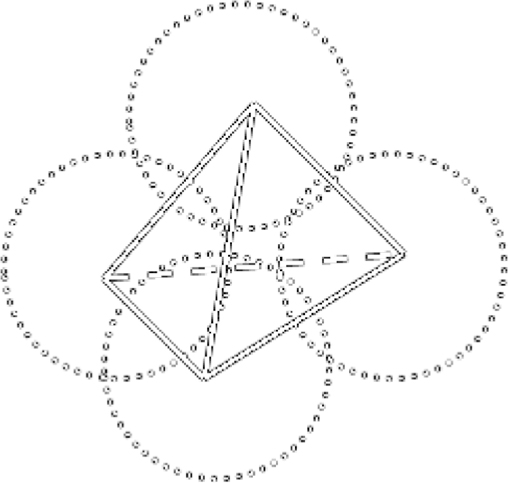
Etzkowitz and Leydesdorff (2000) considered the emerging network of communications among three sub-dynamics (the dashed circle in Figure 1) as a “communication overlay.” However, this emerging dynamic was not yet further elaborated at that time. The overlay can provide a fourth selection environment on top of the three institutionally carried functionalities of (i) wealth generation (by industry), (ii) novelty production (in academia), and (iii) normative control (e.g., by governments).

Tetrahedron of three communication systems with an overlay
Citation: Triple Helix 9, 1 (2022) ; 10.1163/21971927-bja10022
If one imagines the dashed circle in Figure 1 as hovering above the plane, one can envisage the four sub-dynamics as organized in a tetrahedron (Figure 2). The “hovering circle” in Figure 1 may develop a similar status to that of the other three. The historical variation is continuously incorporated as a bottom-up sub-dynamic of a next-order system. When the network is sufficiently populated the evolutionary dynamic can be expected to overwrite the historical one. The history informs us about the system’s (morpho-)genesis (Archer, 1982). However, selection is structural and deterministic.
In summary, the overlay operates on top of and in interaction with the carrying dynamics which continue to interact in a trilateral network of feedbacks. However, the possibility of a Quadruple Helix is endogenous to a Triple Helix in this model: inductively, each next-order helix-model follows as another recursion of a bifurcation as specified above in terms of an overlay. The expectation is that the higher the level, the less frequent the operation: lower levels are more frequently operating than next-order levels. Simon (e.g., 1973) called this vertical differentiation. The vertical differentiation induces horizontal differentiations which feed back.
When vertical and horizontal differentiations can interact, one can expect broken dimensionalities such as a “Helix 3.7” model. Co-evolutions in the bilateral arrangements along trajectories can be broken open at all times and scales by a third perspective along each side of a triangle. When fractals build on fractals, the order is expected to drift towards the edge of chaos. Disruptions can be expected to generate avalanches of all sizes (Bak and Chen, 1987; 1991; cf. Leydesdorff et al., 2018). An example is in the case of crises (Schumpeter, 1943).
5 Triads and Simmelian Ties
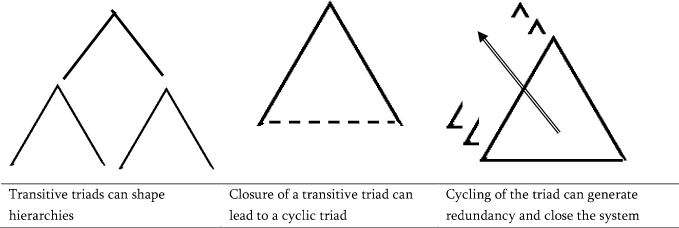
In general, triads are the building blocks of systems (Bianconi et al., 2014); all next-order forms of organization (quadruplets, etc.) can be decomposed into and recomposed from triads (Freeman, 1996). Triads can be either cyclic or transitive (Batagelj et al., 2014: 53f.). Transitive triads – “the friends of my friends are my friends” – are open, while cyclic triads can be closed as a system of relations (Figure 3).
Transitive triads are based on relations and can be aggregated into hierarchies (as in a dendrogram; see the left-hand panel of Figure 3). Cyclic triads can be expected to shape principal components or “eigenvectors” as a consequence of the cycling (von Foerster, 1960). The different perspectives span “horizons of meaning” (Husserl, 1929; Luhmann, 1992).
The cyclic rewrites can be expected to generate redundancy on top of the entropy flows. The panel in the middle of Figure 3 is intended to illustrate the possibility of closure in a triad, when more links become available and the model is increasingly populated. University–industry–government relations shape networks in which both dyads (e.g. university–industry relations) and triads can be expected.
6 Triads in Social Network Analysis
The sociologist Simmel (1902a; 1902b) argued that the transition from a group of two to three is a qualitative one: another awareness of space becomes available. In a triplet, the realization of one or the other relation may make a difference to the further development of the triad. According to Simmel, a dyad remains a private relation whereas the triad introduces “sociality”: each third person can watch the other two and thereby have the advantage of the tertius gaudens (the third who benefits); that is, the third person may see options in the relations between the other two which can be used to their advantage. If the third person actively participates in breaking the tie between the other two, one can consider this as an instance of divide et impera (divide and rule).
The operationalization of these dynamics in terms of social networks was first pursued by Burt’s (1992) theory of structural holes. Structural holes in network configurations enable agents to harvest advantages in specific configurations. For example, agents positioned between cliques may provide the only way to move from one cluster to another. Thus, the concept of structural holes is related to betweenness centrality (Freeman, 1978/1979; cf. Leydesdorff and Ahrweiler, 2014). In the case of a structural hole, an agent between two other agents can induce competition between the latter two and thus reap the benefits; for example, by providing a “weak link” (Granovetter, 1973; 1982).
Krackhardt (1999) argued that Burt’s theory of structural holes was still about the dynamics of interacting dyads, whereas Simmel had meant to focus on how triads contain more capacity than the sum of the interactions among dyads. Krackhardt (1999: 186) formulated as follows:
In his [Simmel’s] view, the differences between triads and larger cliques were minimal. The difference between a dyad and a triad, however, was fundamental. Adding a third party to a dyad ‘completely changes them, but […] the further expansion to four or more persons by no means correspondingly modifies the group any further’ (Simmel 1950, p. 138).
Furthermore, Krackhardt (1999: 186) defined a “Simmelian tie” as follows:
Two people are ‘Simmelian tied’ to one another if they are reciprocally and strongly tied to each other and if they are each reciprocally and strongly tied to at least one third party in common.
A triad of Simmelian ties is by definition cyclic. Unlike transitive triads which can shape hierarchies by relating relations into orders, cycles can operate in parallel and thus be heterarchical (Kontoupolos, 2006). Both processes – differentiation and integration – can be expected to occur concurrently and may disturb one another. The self-organizing selection environments can be expected to differentiate as flows horizontally under the vertical selection pressure of a regime, while institutional organization and agency are based on performative integrations at specific moments of time.
The cyclic loops may add redundancy or lead in the opposite direction to lock-ins and historical stagnation (Ulanowicz et al., 2009). This model is “neo-evolutionary” because the status of the selection environments is different from Darwin’s “natural” selection (Boulding, 1978). The selection environments are knowledge-based constructs and thus remain hypotheses: one can expect the “genotypical” codes to operate selectively on the ongoing production of variation. However, variation is phenotypical. The genotypes function as codes in the communication (Parsons, 1968). In other words, each perspective – spanned by eigenvectors – opens a potentially different horizon of meanings (Husserl, 1929).
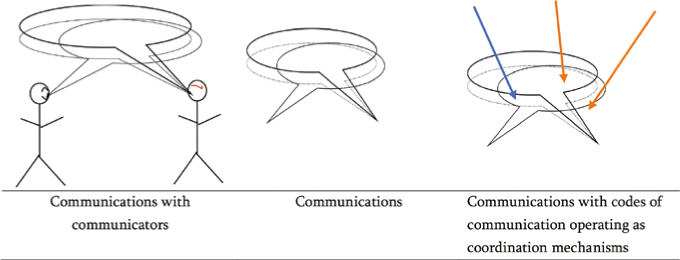
Communications can be considered as attributes of communicators, but they can also be considered as second-order units of analysis to which codes of communication can be attributed.
Citation: Triple Helix 9, 1 (2022) ; 10.1163/21971927-bja10022
How does cultural selection work differently from biological evolution? In an attempt to capture this alternative selection mechanism in socio-cultural evolution, Luhmann (1990), for example, formulated – in his discussion with Habermas (Habermas and Luhmann, 1971: 27) – as follows:
[…] what is special about the meaningful or meaning-based processing of experience is that it makes possible both the reduction and the preservation of complexity; i.e., it provides a form of selection that prevents the world from shrinking down to just one particular content of consciousness with each act of determining experience.
The codes operating in the communications span horizons of meanings: a structure of potentially shared meanings is evolving. The more that the codes can be different as control mechanisms, the more complexity can be processed (Ashby, 1958). One can expect a tendency towards orthogonal spanning of different codes in the communication (Simon, 1973). However, this evolutionary process is constrained because at least one of the system’s subdynamics has to be instantiated historically in order to host historical variations, retention, and stabilizations (Bathelt, 2003). Selections can recursively be selected for stabilization; stabilization can vary and this second-order variation can be meta-stable and selected for globalization.
In this model (Figure 5), one can consider the three (or more) helices as no longer wrapped along a common axis, but opened for input in three dimensions of a space containing many more options than can be realized. Patents, for example, can be considered as output of universities and other knowledge-generating institutions, as well as input to the economy. Thirdly, patents also have a legal function in protecting intellectual property.
Whereas relations operate historically at specific moments or during specific periods of time, the structures operate latently in a vector space including redundancies – that is, options to be potentially realized in the future. In the spatial metaphor, the units are not single events – as in history writing – but distributions that contain uncertainty. The uncertainty can be provided with meanings from the different perspectives. Meanings cannot be communicated, but they can be shared.
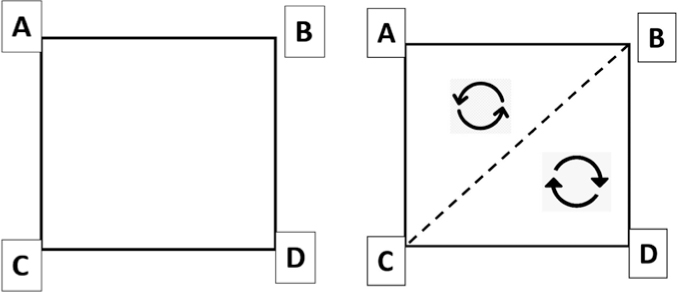
Decomposition of a quadruplet into two triads
Citation: Triple Helix 9, 1 (2022) ; 10.1163/21971927-bja10022
Mutual information between two sets of messages
Citation: Triple Helix 9, 1 (2022) ; 10.1163/21971927-bja10022
7 The Decomposition into Triads
Next-order helix models can be decomposed. Figure 6 shows the decomposition of a Quadruple Helix into two Triple Helices. Analytically, this decomposition is always possible. For example, a quadruple system ABCD can be decomposed into ABC, ABD, ACD, and BCD. (If the dashed line in the right pane of Figure 6 is empirically absent, one can initially attribute the value of zero to it.)
The two triplets (in the right-hand pane of Figure 6) can rotate independently; the one rotation is expected to generate entropy (with the arrow of time) and the other, redundancy in the opposite direction (against the arrow of time). Here entropy can be viewed as the “amount of information” in a variable. Entropy (uncertainty) and redundancy add up to the maximum entropy of the system.
Shannon (1948) defined redundancy as the complement of the entropy to the maximum entropy, as follows:
Citation: Triple Helix 9, 1 (2022) ; 10.1163/21971927-bja10022
where
Citation: Triple Helix 9, 1 (2022) ; 10.1163/21971927-bja10022
When the logarithms are to base 2, the measurement will be in bits; ∑ipi are the probabilities of variables taking specific values, summed over all values in the vector.
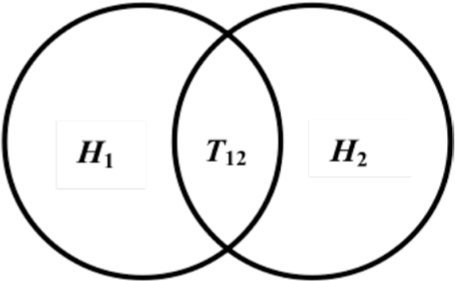
Three sets with positive and negative overlaps
Citation: Triple Helix 9, 1 (2022) ; 10.1163/21971927-bja10022
Figure 7 shows how two sets can contain redundancy because part of the description would be duplicated if it were not corrected by a subtraction of T12. (The T stands for transmission or mutual information.) One can correct for the overlap, by subtraction of the otherwise twice-counted mutual information T12 as follows:
Citation: Triple Helix 9, 1 (2022) ; 10.1163/21971927-bja10022
In this formula of Shannon (1948), each H is an expected information content and T12 is the transmission or mutual information between 1 and 2. (Note that Shannon-type information is formal and not yet provided with substantive meaning.) The redundancy in the overlap R12 is subtracted and thus: R12 = – T12.
In the case of three sets with potential overlaps, it can be derived (e.g., McGill, 1954; Abramson, 1963: 123; Yeung, 2008: 59f.) that
Citation: Triple Helix 9, 1 (2022) ; 10.1163/21971927-bja10022
Shannon-type information values are necessarily positive (Krippendorff, 2009). The alteration of plus and minus terms indicates the generation of both redundancy and uncertainty. When the resulting T123 is negative, self-organization in the flows – redundancy generation – prevails over historical organization, whereas a positive value of T123 indicates conversely a predominance of organization over self-organization as two different (orthogonal) subdynamics. The values have yet to be measured empirically.
The two opposing rotations – with positive and negative overlap (Figure 8) – can also be modeled as two vectors with three dimensions. Using simulations, Ivanova and Leydesdorff (2014) showed that this system can generate both information and redundancy. In general, one can distinguish between a graph-analytical focus on the observable relations or a focus on the latent structures in a network. The latter includes the nodes and, more importantly, the possible non-relations between and among them; i.e. the zeros. A purely relational approach would imply excluding the zeros as non-relations (‘missing links”), and thus reduce the network dynamics to its phenotypical manifestations.
This can be elaborated for dimensionalities larger than three. One can computationally elaborate the formulae for H1… n and T1…. n and determine how much each node or link in the network contributes to the generation of uncertainty and synergy, respectively. The decomposition of next-order helices can also be pursued by considering all possible permutations of three and then compute the value of T123 in terms of the contribution of a triplet to the uncertainty or redundancy generation at the systems level. Thus the entire set – both the visible network and the latent structures in the configuration – can be quantified in terms of positive or negative bits of information.
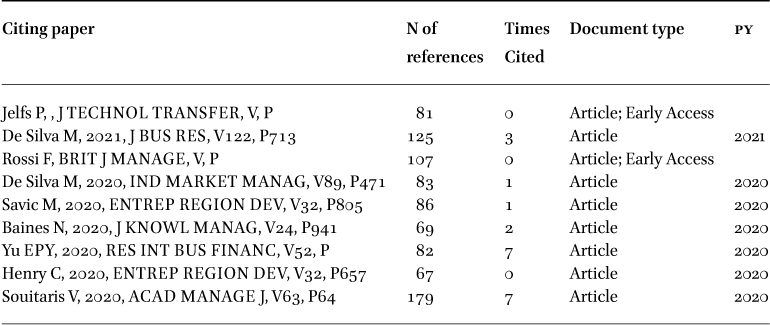
Twelve papers under study (5 February 2021) Web-of-Science data
Citation: Triple Helix 9, 1 (2022) ; 10.1163/21971927-bja10022
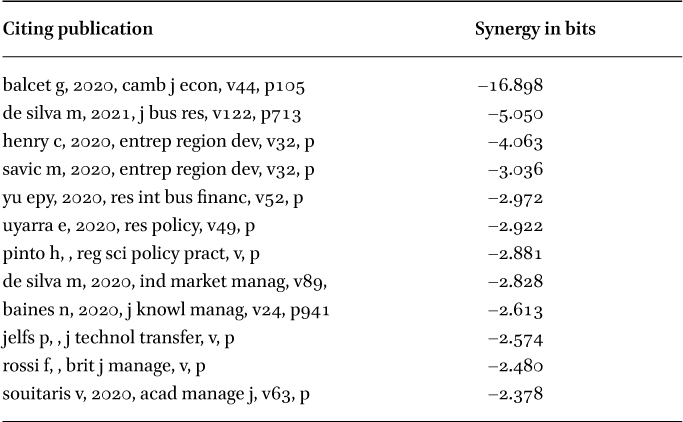
Synergy contributions of the 12 papers under study
Citation: Triple Helix 9, 1 (2022) ; 10.1163/21971927-bja10022
From a TH perspective – and more generally a focus on innovation and change – the not-yet realized states (i.e. the zeros) can be more important than the historically already realized ones. The zeros indicate the options. The not-yet realized, but available states are part of the redundancy which thus offers a window on the future as different from the past. The historical footprints of the network set constraints on the structure of expectations. The latter can be modeled as a probability distribution of expectations which can be used for testing the statistical significance of observations (using, for example, chi-square).
8 The Measurement of Synergy in TH Relations
Both links and nodes can be part of triads. Each node can partake in n – 1 links of which some are parts of triads which generate redundancy while others generate uncertainty t. The number of possible triads among n helices is n * (n – 1) * (n – 2) / (2 * 3). For example, in the case of a Quadruple Helix n = 4 * 3 * 2 / (2 * 3) = 4.2 An analyst may have theoretical reasons for focusing exclusively on relations such as in a neo-institutional approach (Padgett and Powell 2012; Powell and DiMaggio, 1991): the nodes (in the TH case, the institutions) operate by relating; the relations relate in a second-order dynamics of possible relations.
To illustrate how the two sets interrelate with synergy let us choose as an empirical example data in the Annual Report 2020 of the Centre for Innovation Management Research at Birkbeck, University of London. The report lists on pp. 23–26, four books and 23 journal articles as research output. On February 5, 2021 using the Web-or-Science (WoS), the following 12 articles could be retrieved with references and citations and are thus one of our two sets (Table 1). The selection is purely made on availability of data.
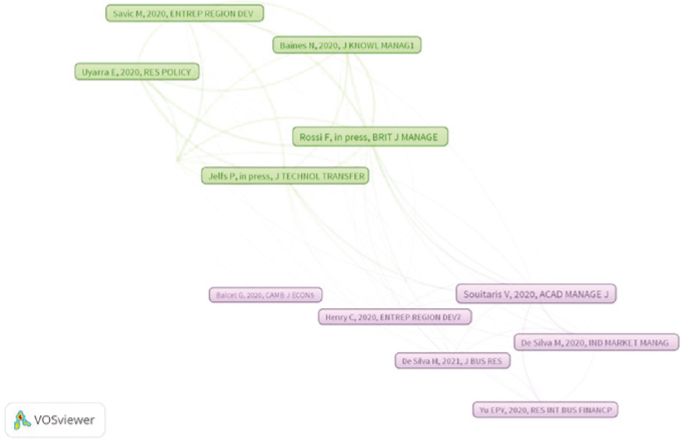
The 1,080 references contain (abbreviated) journal names of which 471 are unique. These references are bibliographically coupled by citations in the citing papers (and vice versa by co-citation). The couplings in terms of documents reflect the integration of knowledge bases by each citation. In sum, we analyze a matrix of 12 citing articles versus 17 cited journals. Figure 10 shows the structure among the 12 citing papers based on the bibliographic couplings among 471 cited journals.
Map of the bibliographic coupling among 12 citing articles. Grouping and visualization using VOSViewer
Citation: Triple Helix 9, 1 (2022) ; 10.1163/21971927-bja10022
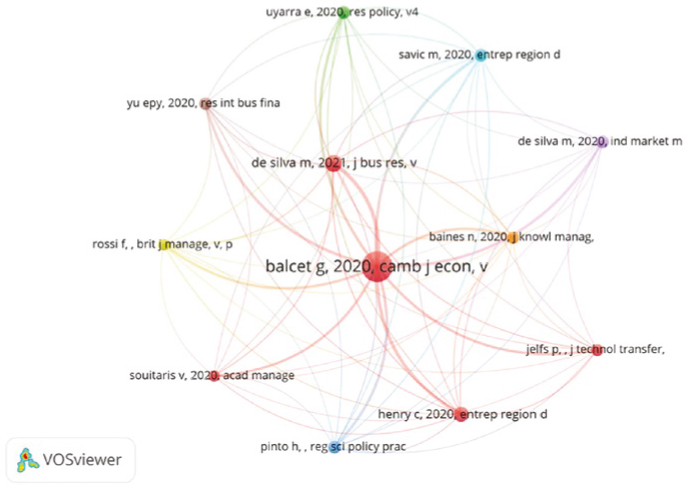
Synergy map among the 12 articles in the sample. Grouping and visualization using VOSViewer
Citation: Triple Helix 9, 1 (2022) ; 10.1163/21971927-bja10022
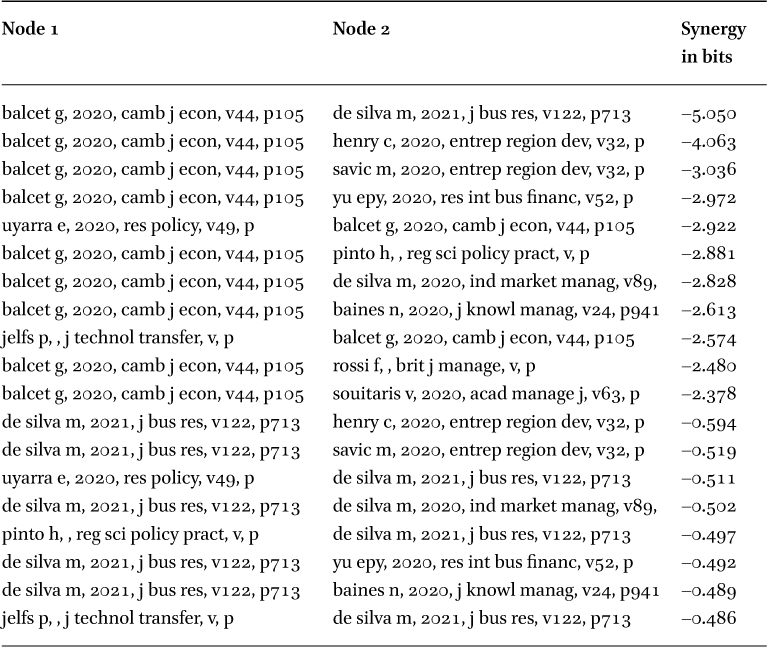
Synergy contributions of the top-19 links
Citation: Triple Helix 9, 1 (2022) ; 10.1163/21971927-bja10022
The synergy in this sample is essentially zero because of the large variation. However, when we focus on those 17 journals which are cited more than 10 times, we obtain the values shown in the synergy map (Figure 11). The map shows the respective contributions of nodes and links listed in Tables 2 and 3.
The strength of the contribution of the Balcet paper to the synergy is at first sight somewhat surprising. This author and his co-author (Ietto-Gillies) are both Visiting Fellows in the Centre rather than being core members. Being less institutionally bounded, one can expect Visiting Fellows to have a function in generating synergy by making new connections possible. The otherwise marginal position of this paper at the top-left corner of the pink cluster in Figure 10 shows its centrality in the triangle represented by the pink and green clusters, and the relevant (cited) literature. For example, the Cambridge Journal of Economics is a disciplinary journal in economics, whereas the Centre publishes in innovation studies as an interdisciplinary specialty. This possibly shows the potential for research centres to build synergies either by publicizing articles/journals that are already synergistic, or by providing opportunities to create synergies. Synergy within the groups as in Figure 9 might for example be based on common research themes or less likely, methodologies.
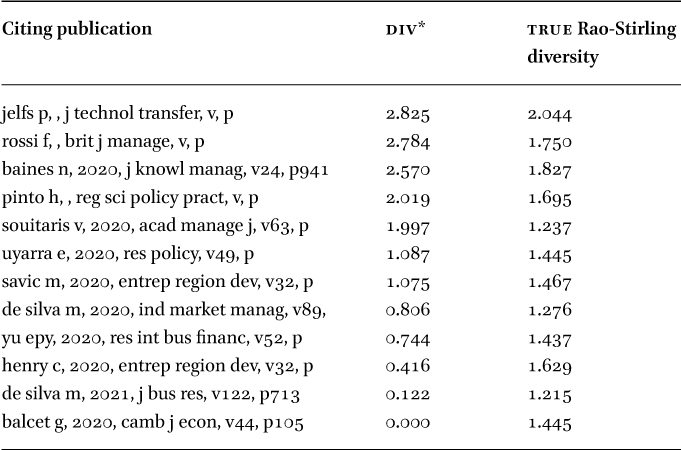
Clearly, given that the twelve papers are related as a result of belonging to the same Centre’s research output, they would be expected to show some synergy. Synergy, however, is different from interdisciplinarity since it emerges in external organization of the disciplines, whereas interdisciplinarity is a form of organization internal to the disciplines and research systems. However, a number of measures for interdisciplinarity have been developed (e.g., Zhang et al., 2016; Leydesdorff et al., 2019; cf. Rafols and Meyer, 2007; Stirling, 2007). Table 5 shows how these measures – provided in Table 4 – correlate with synergy for this set. The rank-order correlation between synergy and DIV* is highly significant (Spearman’s
In a recent article, Zhang & Leydesdorff (2021) compared DIV* with the TRUE Ras-Stirling Diversity. Different from the latter, DIV* is not dependent on the reference set and therefore more reliable when the (in this case three) reference sets are very different.
Pearson and Spearman’s rank-order correlations between synergy and interdisciplinarity measures. (Pearson correlations in the lower and Spearman correlations in the upper triangle, respectively.)
Citation: Triple Helix 9, 1 (2022) ; 10.1163/21971927-bja10022
9 Conclusions and Discussion
The objective of TH and next-order relations among industries, universities, and nation states is the generation of synergy from context-dependent configurations of specific relations. These relations are multi-dimensional. Instead of specifying new and more helices – for example, for politial reasons – we suggest keeping the models simple so that they can be used for the precise (and where possible numerical and visualized) evaluations of where TH-synergy is related in concrete cases (Cai and Lattu, under review).
Our argument is that the analysis becomes interesting when there is a double helix as both sides have their own interests which interact and intersect. When a third helix is added, the actors can play off against each other for competitive advantages such as for funding research or commercialisation (see for example Hladchnko and Pinheiro (2019) on Ukraine). Fourth and higher-order helices add to the sum of the three helices but create no new dynamics, beyond that of the sum of the sub-triple helices.
A perspective for future research is provided by the possibility to permute all combinations of possible triplets of helices and thus to specify a prediction of optimal configurations. We do not expect these configurations to coincide with the historically manifest ones. For example, one can ask which borders between regions are most functional for developing innovation systemness? A limitation remains the quality of available data.
Discussions about whether innovation systems are national, regional, sectorial, Triple-Helix, Quadruple Helix, do not inform the debate until one proceeds to measurement (Leydesdorff et al., 2021). The TH+ data are too complex for an intuitive (and sometimes normative) perspective; one cannot oversee the non-linear interactions. A complex system is able to restore the regime by making adjustments internally. This endogenizes change and innovation, but also makes the system resilient against political intervention (Ashby, 1958). Unintended consequences may then be prevalent. Vicious circles can destroy innovation potentials more rapidly (for example, in the case of a lock-in) than virtuous circles can reconstruct and innovate these capacities. Policies can be informed and not only legitimated by evidence-based Triple, Quadruple, etc. models. Otherwise, the models may remain programmatic metaphors that one can choose as and when it serves one’s interests.
Acknowledgements
Loet Leydesdorff is grateful to Clarivate Analyhtics™ for providing the aggregated citation data in the Journal Citation Reports of the Science and Social Sciences Citation Indexes.
Notes
A diffusion dynamic coupled to a production flow at the system’s level can also be considered as a reaction-diffusion dynamic (Rashevsky, 1940; Turing, 1952).
Each of the four helices can participate in n – 1 = 3 bilateral relations [e.g., (i) n1–n2; (ii) n1–n3; (iii) n1–n4]. The number of unique relations possible in this network is (4 * 3) / 2 = 6; namely: (i) n1–n2; (ii) n1–n3; (iii) n1–n4; (iv) n2–n3; (v) n2–n4; (vi) n3–n4. The number of possible triads in this case is (4 * 3 * 2) / (3 * 2) = 4: (i) n1–n2 – n3; (ii) n1–n2 – n4; (iii) n1–n3 – n 4; and (iv) n2–n3 – n4.
References
Abramson N (1963) Information Theory and Coding. New York: McGraw-Hill.
Allen P (1994) Evolutionary Complex Systems: Models of Technology Change. In: Leydesdorff L and van den Besselaar P (eds) Evolutionary Economics and Chaos Theory: New Directions in technology studies. London: Pinter, 1–18.
Andersen ES (1994) Evolutionary Economics: Post-Schumpeterian Contributions. London: Pinter.
Archer M (1982) Morphogenesis versus structuration: on combining structure and action. The British Journal of Sociology 33(4): 455–483.
Arthur W (1989) Competing technologies, increasing returns, and lock-in by historical events. Economic Journal 99: 116–131.
Ashby W (1958) Requisite variety and its implications for the control of complex systems. Cybernetica 1(2): 1–17.
Bak P and Chen K (1991) Self-organized criticality. Scientific American 264(1): 46–53.
Bak P, Tang C and Wiesenfeld K (1987) Self-organized criticality: an explanation of the 1/f noise. Physical Review Letters 59(4): 381.
Batagelj V, Doreian P, Ferligoj A and Kejzar N (2014) Understanding Large Temporal Networks and Spatial Networks: Exploration, Pattern Searching, Visualization and Network Evolution. Chichester: John Wiley & Sons.
Bathelt H (2003) Growth regimes in spatial perspective 1: innovation, institutions and social systems. Progress in Human Geography 27(6): 789–804.
Bianconi G, Darst R, Iacovacci J and Fortunato S (2014) Triadic closure as a basic generating mechanism of communities in complex networks. Physical Review E 90(4): 042806.
Boulding K (1978) Ecodynamics: A New Theory of Societal Evolution. Beverly Hills, CA: Sage
Bunders J, Broerse J and Zweekhorst M (1999) The triple helix enriched with the user perspective: a view from Bangladesh. The Journal of Technology Transfer 24(2): 235–246.
Burt R (1992) Structural Holes: The Social Structure of Competition. Cambridge, MA: Harvard University Press.
Cai Y and Etzkowitz H (2020) Theorizing the triple helix model: past, present, and future. Triple Helix 7(2/3): 189–226.
Cai Y and Lattu A (under review) Triple helix or quadruple helix: which model of innovation to choose for empirical studies?
Carayannis E and Campbell D (2009) “Mode 3” and “quadruple helix”: toward a 21st century fractal innovation ecosystem. International Journal of Technology Management 46(3): 201–234.
Carayannis E and Campbell D (2010) Triple helix, quadruple helix and quintuple helix and how do knowledge, innovation, and environment relate to each other? International Journal of Social Ecology and Sustainable Development 1(1): 41–69.
Casson M (1997) Information and Organization: A New Perspective on the Theory of the Firm. Oxford: Clarendon Press.
Clark B (1998) Creating Entrepreneurial Universities: Organization Pathways of Transformation. Guildford, UK: Pergamon.
Cooke P and Leydesdorff L (2006) Regional development in the knowledge-based economy: the construction of advantages. Journal of Technology Transfer 31(1): 5–15.
Dosi G (1982) Technological paradigms and technological trajectories: a suggested interpretation of the determinants and directions of technical change. Research Policy 11(3): 147–162.
Etzkowitz H (1983) Entrepreneurial scientists and entrepreneurial universities in American academic science. Minerva 21(2/3): 198–233.
Etzkowitz H (1994) Academic–industry relations: a sociological paradigm for economic development. In: Leydesdorff L and van den Besselaar P (eds) Evolutionary Economics and Chaos Theory: New Directions in Technology Studies. London: Pinter, 139–151.
Etzkowitz H (2002) MIT and the Rise of Entrepreneurial Science. London: Routledge.
Etzkowitz H and Leydesdorff L (1995) The triple helix: university–industry–government relations: a laboratory for knowledge-based economic development. EASST Review 14(1): 14–19.
Etzkowitz H and Leydesdorff L (1998) The endless transition: a “triple helix” of university–industry–government relations. Minerva 36(3): 203–208. doi:10.1023/A:1017159001649
Etzkowitz H and Leydesdorff L (2000) The dynamics of innovation: from national systems and “mode 2” to a triple helix of university–industry–government relations. Research Policy 29(2): 109–123.
Freeman C and Perez C (1988) Structural crises of adjustment, business cycles and investment behaviour. In: Dosi G et al. (eds) Technical Change and Economic Theory. London: Pinter, 38–66.
Freeman L (1978/1979) Centrality in social networks: conceptual clarification. Social Networks 1: 215–239.
Freeman L (1996) Cliques, Galois lattices, and the structure of human social groups. Social Networks 18(3): 173–187.
Geels F (2002) Technological transitions as evolutionary reconfiguration processes: a multi-level perspective and a case-study. Research Policy 31(8/9): 1257–1274.
Gibbons M, Limoges C, Nowotny H, Schwartzman S, Scott P and Trow M (1994) The New Production of Knowledge: The Dynamics of Science and Research in Contemporary Societies. London: Sage.
Giddens A (1979) Central Problems in Social Theory. London: Macmillan.
Granovetter M (1973) The strength of weak ties. American Journal of Sociology 78(6): 1360–1380.
Granovetter M (1982) The strength of weak ties. a network theory revisited. In: Marsden PV and Lin N (eds) Social Structure and Network Analysis. London/New York: Sage, 105–130.
Habermas J and Luhmann N (1971) Theorie der Gesellschaft oder Sozialtechnologie. Frankfurt: Suhrkamp.
Hladchenko M and Pinheiro R (2019) Implementing the triple helix model: means-ends decoupling at the state level? Minerva 57(1): 1–22. https://doi.org/10.1007/s11024-018-9355-3.
Hodgson G and Knudsen T (201) Darwin’s Conjecture: The Search for General Principles of Social and Economic Evolution. Chicago and London: University of Chicago Press.
Husserl E (1929) Cartesianische Meditationen und Pariser Vorträge [Cartesian Meditations and the Paris Lectures, translated by Dorion Cairns]. The Hague: Martinus Nijhoff. Available at: http://ia600601.us.archive.org/10/items/CartesiamMeditations/12813080-husserl-cartesian-meditations.pdf
Interreg Europe (2020) Smart Specialisation Strategy (S3). A Policy Brief from the Policy Learning Platform on Research and Innovation. Available at: https://www.interregeurope.eu/policylearning/news/10681/from-s3-to-s4-smart-specialisation-strategies-for-sustainable-and-inclusive-growth/?no_cache=1&cHash=d36f863c4e0ee8b901357fb72bb44a07 (accessed 29 March 2021).
Ivanova I and Leydesdorff L (2014) A simulation model of the triple helix of university–industry–government relations and the decomposition of the redundancy. Scientometrics 99(3): 927–948. doi: 10.1007/s11192-014-1241-7.
Kline S and Rosenberg N (1986) An overview of innovation. In: Landau R and Rosenberg N (eds) The Positide Sum Strategy: Harnessing Technology for Economic Growth. Washington, DC: National Academy Press, 275–306.
Kontopoulos K (2006) The Logics of Social Structure. Vol. 6. New York, New York and Cambridge, UK: Cambridge University Press.
Krackhardt D (1999) The ties that torture: Simmelian tie analysis in organizations. Research in the Sociology of Organizations 16(1): 183–210.
Krippendorff K (2009) Information of interactions in complex systems. International Journal of General Systems 38(6): 669–680.
Langton CG (1989) Artificial life. In: C. G. Langton CG (ed.) Artificial Life. Vol. VI. Redwood: Addison-Wesley, 1–47.
Leydesdorff L (1994) Epilogue. In: Leydesdorff L and van den Besselaar P (eds) Evolutionary Economics and Chaos Theory: New Directions for Technology Studies. London/New York: Pinter, 180–192.
Leydesdorff L and Ahrweiler P (2014). In search of a network theory of innovations: relations, positions, and perspectives. Journal of the Association for Information Science and Technology 65(11): 2359–2374.
Leydesdorff L and Deakin M (2011) The triple-helix model of smart cities: a neo-evolutionary perspective. Journal of Urban Technology 18(2): 53–63. doi: 10.1080/10630732.2011.601111
Leydesdorff L and van den Besselaar P (eds) (1994) Evolutionary Economics and Chaos Theory: New Directions in Technology Studies. London and New York: Pinter.
Leydesdorff L and van den Besselaar P (1998) Technological developments and factor substitution in a complex and dynamic system. Journal of Social and Evolutionary Systems 21(2): 173–192.
Leydesdorff L and Deakin M (2011) The triple-helix model of smart cities: a neo-evolutionary perspective. Journal of Urban Technology 18(2): 53–63. doi: 10.1080/10630732.2011.601111
Leydesdorff L, Wagner CS and Bornmann L (2018) Discontinuities in citation relations among journals: self-organized criticality as a model of scientific revolutions and change. Scientometrics 116(1): 623–644. doi: 10.1007/s11192-018-2734-6.
Leydesdorff L, Wagner CS and Bornmann L (2019) Interdisciplinarity as diversity in citation patterns among journals: Rao-Stirling diversity, relative variety, and the Gini coefficient. Journal of Informetrics 13(1): 255–264.
Leydesdorff L, Wagner CS and Zhang L (2021) Are university rankings statistically significant? A comparison among Chinese universities and with the USA. Journal of Digital and Information Science (JDIST) 6(2): 67–95. doi:10.2478/jdis-2021-0014.
Luhmann N (1990) Meaning as sociology’s basic concept. In: Luhmann N, Essays on Self-Reference. New York and Oxford, UK: Columbia University Press, 21–79.
Luhmann N (1992) Beobachtungen der Moderne. Opladen: Westdeutscher Verlag.
Lundvall B-Å (1988) Innovation as an interactive process: from user-producer interaction to the national system of innovation. In: Dosi G et al. Technical Change and Economic Theory. London: Pinter, 349–369.
McGill W (1954) Multivariate information transmission. Psychometrika 19(2): 97–116.
Nelson R and Winter S (1977) In search of useful theory of innovation. Research Policy 6(1): 35–76.
Nelson R and Winter S (1982) An Evolutionary Theory of Economic Change. Cambridge, MA: Belknap Press of Harvard University Press.
Padgett J and Powell W (2012) The Problem of Emergence. The Emergence of Organizations and Markets. New York: Princeton University Press, 1–32.
Parsons T (1968) Interaction: I. Social interaction. In: Sills DL (ed.) The International Encyclopedia of the Social Sciences. Vol. 7. New York: McGraw-Hill, 429–441.
Petersen A, Rotolo D and Leydesdorff L (2016) A triple helix model of medical innovation: supply, demand, and technological capabilities in terms of medical subject headings. Research Policy 45(3): 666–681. doi: 10.1016/j.respol.2015.12.004.
Powell W (1990) Neither market nor hierarchy: network forms of organization. Research in Organizational Behavior 12: 295–336.
Powell W and DiMaggio P (eds) (1991) The New Institutionalism in Organizational Analysis. Chicago: University of Chicago Press.
Rafols I and Meyer M (2007) How cross-disciplinary is bionanotechnology? Explorations in the specialty of molecular motors. Scientometrics 70(3): 633–650.
Rashevsky N (1940) An approach to the mathematical biophysics of biological self-regulation and of cell polarity. Bull. Math. Biophys. 1: 15–25.
Rosenberg N and Frischtak C (1984) Technological innovation and long waves. Cambridge Journal of Economics 8(1): 7–24.
Sahal D (1985) Technological guideposts and innovation avenues. Research Policy 14: 61–82.
Schumpeter, J (1943) Socialism, Capitalism and Democracy. London: Allen & Unwin.
Shannon C (1948) A mathematical theory of communication. Bell System Technical Journal 27 (July and October): 379–423 and 623–656.
Simmel G (1902a) The number of members as determining the sociological form of the group. I. American Journal of Sociology 8(1): 1–46.
Simmel G (1902b) The number of members as determining the sociological form of the group. II. American Journal of Sociology 8(2): 158–196.
Simmel G (1950) Quantitative aspects of the group. Free Press, Glencoe, IL.
Simon H (1973) The organization of complex systems. In: Pattee HH (ed.) Hierarchy Theory: The Challenge of Complex Systems. New York: George Braziller Inc, 1–27.
Slaughter S and Rhoades G (2004) Academic Capitalism and the New Economy: Markets, State, and Higher Education. Baltimore, MD: Johns Hopkins Unidersity Press.
Stirling A (2007) A general framework for analysing diversity in science, technology and society. Journal of the Royal Society Interface 4(15): 707–719.
Storper M (1997) The Regional World – Territorial Development in a Global Economy. New York: Guilford Press.
Ulanowicz R, Goerner S, Lietaer B and Gomez R (2009) Quantifying sustainability: resilience, efficiency and the return of information theory. Ecological Complexity 6(1): 27–36.
Turing AM (1952) The chemical basis of morphogenesis. Philosophical Transactions of the Royal Society (Series B)237: 37–72.
von Foerster H (1960) On self-organizing systems and their environments. In: Yovits MC and Cameron S (eds) Self-Organizing Systems. London: Pergamon Press, 31–50.
Waddington CH (1957) The Strategy of Genes. London: Allen & Unwin.
Whitley R (1984) The Intellectual and Social Organization of the Sciences. Oxford: Oxford University Press.
Yeung R (2008) Information Theory and Network Coding. New York: Springer.
Zhang L and Leydesdorff L (2021) The scientometric measurement of interdisciplinarity and diversity in the research portfolios of Chinese universities. Journal of Data and Information Science. https://doi.org/10.2478/jdis-2021-0027.
Zhang L, Rousseau R and Glänzel W (2016) Diversity of references as an indicator for interdisciplinarity of journals: taking similarity between subject fields into account. Journal of the Association for Information Science and Technology 67(5): 1257–1265. doi: 10.1002/asi.23487.