Abstract
Quadruple and Quintuple Helix Innovation Systems aim to optimize the design and operation of modern, democratic societies and economies in a smart, sustainable, inclusive, resilient and efficacious manner via the cyber-physical ecosystems that align with Industry 5.0 and Society 5.0 precepts. In this context, the Quintuple Innovation Helix Framework (which is part of the Quadruple/Quintuple Innovation Helix or Q2IH) represents the most comprehensive, meaningful and valuable construct and modality as it encompasses the five key core dimensions of modern, sustainable and democratic knowledge economies and societies. These are the Environment, the Civil Society as well as the Government, University and Industry dimensions. We strongly feel that it is appropriate and even critical, given current events in Europe that starkly highlight the conflict and struggle between democracies and autocracies, to enable, facilitate and even accelerate the further development of an Emerging Unified Theory of Helical Architectures (EUTOHA). The objective would be to bring clarity, coherence and consistency to the process of leveraging the helical architectures to advance and enhance the design of solutions for the digital transformation of modern knowledge economies and societies towards more democratic and sustainable (green) ones.
1 The Helical Manifest of the Quintuple Helix Framework
unlike most past philosophers who envisaged the Ideal Society to be a utopian changeless and perfect entity, Popper conceives it as an imperfect, changing [growing] and Open Society. This Popperian Society is what the study has called Polyarchy – a term borrowed from Robert Dahl’s A Preface to Democratic Theory and which symbolizes the epitome of the democratic process.
Unpublished thesis on Karl Popper, 1999
Academic theories, constructs, tools and modalities are meaningful and valuable to the extent they help us better understand and deal with the socio-economic, socio-technical and socio-political complexities of modern knowledge economies and societies.
Quadruple and Quintuple Helix innovation systems aim to optimize the design and operation of modern, democratic societies and economies in a smart, sustainable, inclusive, resilient and efficacious manner via the cyber-physical ecosystems that align with Industry 5.0 and Society 5.0 precepts. In this context, the Quintuple Innovation Helix Framework (which is part of the Quadruple/Quintuple Innovation Helix or Q2IH) represents the most comprehensive, meaningful and valuable construct and modality as it encompasses the five key core dimensions of modern, sustainable and democratic knowledge economies and societies. These are the Environment, the Civil Society as well as the Government, University and Industry dimensions.
We strongly feel that it is appropriate and even critical, given current events in Europe that starkly highlight the conflict and struggle between democracies and autocracies, to enable, facilitate and even accelerate the further development of an Emerging Unified Theory of Helical Architectures (EUTOHA). The objective would be to bring clarity, coherence and consistency to the process of leveraging the helical architectures to advance and enhance the design of solutions for the digital transformation of modern knowledge economies and societies towards more democratic and sustainable (green) ones.
All in all, the Q2IH concept represents an eco-systemic approach (see, for example, Carayannis et al., 2018a, 2018b and Carayannis et al., 2021c) that encompasses, extends and completes the TH and in that sense the Neo-TH approach (Cai, 2022).
Moreover, given the name of Neo-TH, there is a clear risk of diminishing and invalidating the Q2IH and the real contributions and value of these two clearly distinct helical configurations (the Quadruple and the Quintuple Innovation Helix Frameworks) – so we propose using the EUTOHA acronym to recognize and acknowledge the distinct identity, substance and critical gravitas of the Q2IH.
The Q2IH Framework allows us to operationalize the socio-economic transformation of industry and society towards the novel Industry 5.0 and Society 5.0 Frameworks that aim to incorporate a more balanced human-centric and techno-centric design thinking approach (Carayannis, et al., 2022) with agile methodology modalities embedded in these frameworks.
The Industry 5.0 and Society 5.0 Frameworks are clearly the emerging policy and practice guidelines for the green and digital socio-economic transformation of modern democracies and they align in a rather coherent, comprehensive and consistent manner with the Q2IH Framework. Therefore, this is another important consideration and criterion for selecting and focusing on the Quintuple Innovation Helix Framework as the core of the EUTOHA and related publications on Q2IH and Industry 5.0 and Society 5.0 (see, for example, Carayannis and Campbell, 2009 and 2010, and Carayannis and Morawska-Jancelewicz, 2022).
2 Analysis: Introduction to the Development of Helical Helices in Comparison
Three helices are sufficiently complex to understand the social reproduction of the dynamics of innovation (Leydesdorff and Etzkowitz, 1998; Etzkowitz and Leydesdorff, 2000); the three institutional spheres can be identified in our type of society as industry, academia, and government.
Leydesdorff and Etzkowitz, 2003: 60
In his famous book, The Structure of Scientific Revolutions, Thomas S. Kuhn (1962) elaborates that there is an evolution of thoughts, with mutual influences, new next stages of thinking, also a learning and a mutual cross-learning of thoughts, where new thoughts are developing in reflection of existing intellectual structures and patterns. There also can be a co-evolution of different ideas with distinct evolutionary lines. The interest of the analysis here is to present a short history of thoughts and models about innovation, in relation to the different “Helical Helix Approaches”. Section 3 provides a historical overview and focuses on explaining conceptually the Quadruple and Quintuple Helix innovation systems. In the conclusion, Section 4, it is being emphasized that the Quadruple and Quintuple Helix are based on democracy and an ecological sensitivity.
3 Triple Helix and the History of Quadruple and Quintuple Helix Innovation Systems
According to Yuzhuo Cai and Annina Lattu (2020 and 2021), early key publications on the Triple Helix are: Etzkowitz and Leydesdorff, 1995, where the Triple Helix model on innovation was introduced and systematically applied, and Etzkowitz and Leydesdorff, 2000, where Triple Helix was explained comprehensively. In 2003, Leydesdorff and Etzkowitz discussed the option of possibly adding of a fourth helix to Triple Helix (see also Leydesdorff and Etzkowitz, 1998). In 2012, Leydesdorff finally introduced the so-called concept of the “N-Tuple of Helices”. The Triple Helix innovation model concentrates on university-industry-government relations (Etzkowitz and Leydesdorff 2000; Leydesdorff, 2012). In that sense the Triple Helix represents a basic or core model for knowledge production and innovation application, also with an emphasis on the economy, or a knowledge economy. Lately, Leydesdorff and Smih (2021) argued: “However, whether innovation systems are national, regional, sectorial, Triple-Helix, Quadruple-Helix, etc., can inform policies with evidence when one proceeds to measurement. A variety of perspectives can be used to interpret the data. Software for testing perspectives will be introduced.”
Early work on the Quadruple Helix dates as far back as the 1990s (Carayannis and Maldifassi, 1992; Carayannis et al., 1998). The explicit co-creators of the “Quadruple and Quintuple Helix innovation systems” are Elias G. Carayannis and David F. J. Campbell. The first publication on the Quadruple Helix is Carayannis and Campbell (2009), and the first publication on Quintuple Helix is Carayannis and Campbell (2010). Both of these publications are peer-reviewed article publications in international journals (see also Caraynnis et al., 2012, and the writings of Danilda et al., 2009).
3.1 The Mode 3 Knowledge Production
Gibbons et al., (1994) developed the “Mode 2 of knowledge production” approach. The first academic work on “Mode 3”, in terms of a way of a knowledge production, was a book chapter released in 2006 (Carayannis and Campbell, 2006). In Carayannis and Campbell (2012),1 this “Mode 3” narrative was developed further. Mode 3 “allows and emphasizes the co-existence and co-evolution of different knowledge and innovation paradigms. In fact, a key hypothesis is: The competitiveness and superiority of a knowledge system or the degree of advanced development of a knowledge system are highly determined by their adaptive capacity to combine and integrate different knowledge and innovation modes via co-evolution, co-specialization and co-opetition knowledge stock and flow dynamics” (see Carayannis and Campbell, 2012: 49; also 2009; on “Co-Opetition”, see Brandenburger and Nalebuff, 1997). Analogies are being drawn and a co-evolution is being suggested between diversity and heterogeneity in advanced knowledge society and knowledge economy, and political pluralism in democracy (the quality of democracy in a knowledge democracy). As is being additionally asserted: “The Democracy of Knowledge, as a concept and metaphor, highlights and underscores parallel processes between political pluralism in advanced democracy, and knowledge and innovation heterogeneity and diversity in advanced economy and society. Here, we may observe a hybrid overlapping between the knowledge economy, knowledge society and knowledge democracy” (Carayannis and Campbell, 2012: 55). In that context it should be emphasized that there also exist different concepts and understandings of “learning” (for instance, see the overview in Carayannis, 2001).
3.2 The Quadruple and Quintuple Helix Innovation Systems
Should the public perhaps be considered as a fourth strand to be added to the Triple Helix model? In our opinion, the conceptualization of the public as merely a fourth helix narrows the public into another private sphere, rather than seeing civil society as the foundation of the enterprise of innovation.
Leydesdorff and Etzkowitz, 2003: 57
Quadruple Helix and Quintuple Helix innovation systems are being designed to comprehend and to refer to an extended complexity in knowledge production and knowledge application (innovation), so the analytical architecture of these models is also broader conceptualized. Quadruple Helix transcends the Triple Helix, while the Quintuple Helix embeds and contextualizes the Quadruple Helix. Quadruple Helix emphasizes in terms of a fourth helix the “media-based and culture-based public”, “civil society”, “arts, artistic research and arts-based innovation”, but also “democracy and knowledge democracy” (Carayannis and Campbell, 2009 and 2012: 14; Carayannis et al., 2012; Carayannis et al., 2018a and 2018b; see furthermore: Bast et al., 2015 and 2019; Danilda et al., 2009; Park, 2014). Therefore, the Quadruple Helix specifically brings in the “dimension of democracy” or the “context of democracy” for knowledge (Campbell, 2019: 61, 343). The Quintuple Helix innovation model contributes the perspective of the fifth helix of the “natural environments of society” (Carayannis and Campbell, 2010: 62) (see Figure 1).

The Multi-Level Helical Structure of the Quintuple Helix Framework
Citation: Triple Helix 9, 1 (2022) ; 10.1163/21971927-bja10028
Source: Author’s own visualization, see also Carayannis and Campbell (2009, p. 207; 2010, p. 62; 2014), Carayannis, Barth and Campbell (2012, p. 4), Etzkowitz and Leydesdorff (2000, p. 112) and Danilda et al. (2009)4 Analysis Conclusion: Quadruple and Quintuple Helix Innovation Systems are Based on Democracy and Ecology
In a November 2020 interview, Carayannis (2020) coined the following metaphor: “Democracy and the Environment are Endangered Species” which has proven tragically prescient especially during the past week in Europe but also on a planetary level with the climate crisis unfolding. The contemporary world may be seen as an unfolding race or as a competition of: “Developed Democracies versus Emerging Autocracies” (Carayannis and Campbell, 2014). The concept and theory of Quadruple and Quintuple Helix innovation systems are based on democracy and ecological sensitivity. “Democracy as Innovation Enabler” (Campbell, 2019) refers to a co-evolution of democracy (knowledge democracy) with knowledge and innovation (see Campbell et al., 2015) which also reflects Popperian Open Society ideals.
Two propositions are key for the approach of Quadruple and Quintuple Helix innovation systems:
Without a democracy or knowledge democracy, the further advancement of knowledge and innovation appear to be seriously constrained. Therefore, knowledge and innovation evolution finally depend on democracy and knowledge democracy (Campbell, 2019).
Ecology and environmental protection are a necessity for humanity, but they act also as drivers for further knowledge and innovation (intentionally leading to a win-win situation for ecology and innovation) (Carayannis and Campbell, 2021; Carayannis et al., 2021a; Carayannis et al., 2021b).
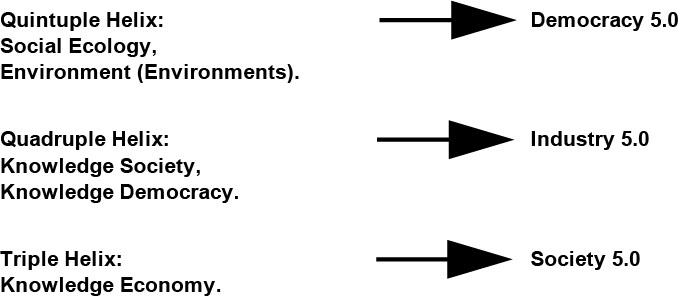
For Quadruple and Quintuple Helix innovation systems, democracy and ecology (environmental protection) are constituting categories, so without these the Quadruple and Quintuple Helix innovation systems are not possible. In this context, Democracy 5.0, Industry 5.0 and Society 5.0 are being structured by a Quadruple and Quintuple Helix dynamism in knowledge economy, knowledge society and knowledge democracy.
We have to ask ourselves, what conceptual understanding does the Triple Helix framework have about democracy and ecology? Based on the two classical publications of Etzkowitz and Leydesdorff (2000 and 2003), the assessment is difficult, because in Etzkowitz and Leydesdorff (2000) democracy and ecology are not mentioned by word, and in Leydesdorff and Etzkowitz (2003) ecology is being not mentioned, while democracy is mentioned, but only once in reference to “technological democracy” (Latour and Weibel, 2002). The direct quote from Leydesdorff and Etzkowitz (2003: 57) on this is: “The axis governance/citizenship is in need of new forms of representation in a ‘technological democracy’ (Latour and Weibel, 2002).” Furthermore, it should be added that in Etzkowitz and Leydesdorff (2000) and Leydesdorff and Etzkowitz (2003), also at no place, are there references to the words or terms of “Quadruple” and “Quintuple”. As of 2012, Leydesdorff published his model of “N-Tuple of Helices”. This can be interpreted as an (abstract) meta-reflection of different helices in innovation systems, but overlooks the (clear, present and critical) significance and differentiation of the Quadruple and Quintuple Innovation Helix Frameworks in comparison with the Triple Helix construct.
One article of Leydesdorff and Etzkowitz (2003) has an interesting title: “Can ‘the public’ be considered as a fourth helix in university–industry–government relations?” However, Leydesdorff and Etzkowitz took the explicit decision of not to develop a fourth helix: “Three helices are sufficiently complex to understand the social reproduction of the dynamics of innovation …; the three institutional spheres can be identified in our type of society as industry, academia, and government.” (Leydesdorff and Etzkowitz, 2003: 60). Referring back to the approach of Kuhn (1962), in his classic, The Structure of Scientific Revolutions: Could the history of ideas about innovation have developed differently, if back in 2003, in their published article, Leydesdorff and Etzkowitz (2003) had decided to add the development of a fourth helix to Triple Helix? Our answer is yes, without a doubt.
In conclusion, we propose to focus on an Emerging Unified Theory of Helical Architectures (EUTOHA) that focuses on the Quintuple Innovation Helix as THE integrative device. The Quintuple Innovation Helix in fact incorporates both the Triple and Quadruple Helixes and provides the best way to advance the use of the helical architectures approach in tackling current and critical socio-economic, socio-technical and socio-political challenges via leveraging their highly efficacious knowledge-flows interface design (see Figure 2) (see also: Carayannis, 2020; Carayannis et al, 2012; Carayannis et al, 2021; Carayannis et al, 2021a; Carayannis et al, 2021b).
The Quintuple Innovation Helix
Citation: Triple Helix 9, 1 (2022) ; 10.1163/21971927-bja10028
Source: Carayannis GWU lectures (2010–2022)References
Bast G, Carayannis EG and Campbell DFJ (eds) (2015) Arts, Research, Innovation and Society. New York: Springer.
Bast G, Carayannis EG and Campbell DFJ (eds) (2019) The Future of Education and Labor. New York, NY: Springer (https://www.springer.com/gp/book/9783030260675).
Brandenburger AM and Nalebuff BJ (1997) Co-Opetition. New York: Doubleday.
Cai Y and Lattu A (2020) Synergy building between triple helix and quadruple helix. Tampere, Finland: Faculty of Management and Business, University of Tampere (unpublished manuscript for an article).
Cai Y and Lattu A (2021) Triple helix or quadruple helix: which model of innovation to choose for empirical studies? Minerva. Online first. https://doi.org/10.1007/s11024-021-09453-6.
Cai Y (2022) Neo-triple helix model of innovation ecosystems: integrating triple, quadruple and quintuple helix models. Triple Helix.
Campbell DFJ, Carayannis EG and Rehman SS (2015) Quadruple helix structures of quality of democracy in innovation systems: the USA, OECD countries, and EU member countries in global comparison. Journal of the Knowledge Economy 6(3): 467–493.
Campbell DFJ (2019) Global Quality of Democracy as Innovation Enabler. Measuring Democracy for Success. New York: Palgrave Macmillan.
Carayannis EG and Maldifassi J (1992) Improving the management of nuclear technology: technical, financial, and organizational measures for assessing the performance of nuclear utilities. International Journal of Global Energy Issues 4(3): 125–139.
Carayannis EG, Rogers EM, Kurihara K and Allbritton MM (1998) High-technology spin-offs from government R&D laboratories and research universities. Technovation 18(1): 1–11.
Carayannis EG (2001) The Strategic Management of Technological Learning. Learning to Learn and Learning to Learn-How-To-Learn as Drivers of Strategic Choice and Firm Performance in Global, Technology-Driven-Markets. Boca Raton: CRC Press.
Carayannis EG and Campbell DFJ (2006) “Mode 3”: meaning and implications from a knowledge systems perspective. In: Carayannis EG and Campbell DFJ (eds) Knowledge Creation, Diffusion, and Use in Innovation Networks and Knowledge Clusters. A Comparative Systems Approach across the United States, Europe and Asia. Westport, CN: Praeger, pp. 1–25.
Carayannis EG and Campbell DFJ (2009) “Mode 3” and “quadruple helix”: towards a 21st century fractal innovation ecosystem. International Journal of Technology Management 46 (3/4): 201–234.
Carayannis EG and Campbell DFJ (2010) Triple helix, quadruple helix and quintuple helix and how do knowledge, innovation and the environment relate to each other? A proposed framework for a trans-disciplinary analysis of sustainable development and social ecology. International Journal of Social Ecology and Sustainable Development 1(1): 41–69.
Carayannis EG and Campbell DFJ (2012) Mode 3 Knowledge Production in Quadruple Helix Innovation Systems. 21st-Century Democracy, Innovation, and Entrepreneurship for Development. New York: Springer.
Carayannis EG, Barth TD and Campbell DFJ (2012) The quintuple helix innovation model: global warming as a challenge and driver for innovation. Journal of Innovation and Entrepreneurship 1(1): 1–12.
Carayannis EG and Campbell DFJ (2014) Developed democracies versus emerging autocracies: arts, democracy, and innovation in quadruple helix innovation systems. Journal of Innovation and Entrepreneurship 3: 12.
Carayannis EG, Carayannis, Grigoroudis E, Campbell DFJ, Meissner D and Stamati D (2018a) The ecosystem as helix: an exploratory theory-building study of regional co-opetitive entrepreneurial ecosystems as quadruple/quintuple helix innovation models. R&D Management 48(1): 148–162.
Carayannis EG, Grigoroudis E, Campbell DFJ, Meissner D and Stamati D (2018b) “Mode 3” universities and academic firms: thinking beyond the box trans-disciplinarity and nonlinear innovation dynamics within co-opetitive entrepreneurial ecosystems. International Journal of Technology Management 77 (1/2/3): 145–185.
Carayannis EG (2020) Democracy and the environment are endangered species. Reconfiguring today for a better tomorrow: theories, policies, practices and politics for smart growth. Interview with Carayannis EG by Koldbye C. Research Reconfiguring and Innovation Constellations. Brussels. Project with funding from the European Union’s Horizon 2020 research and innovation programme under grant agreement No 788047. Available at: http://riconfigure.eu/wp-content/uploads/2020/01/Interview-with-Elias-Carayannis_2020_Final.pdf.
Carayannis EG and Campbell DFJ (2021) Democracy of climate and climate for democracy: the evolution of quadruple and quintuple helix innovation systems. Journal of the Knowledge Economy 12(4): 2050–2082 (https://doi.org/10.1007/s13132-021-00778-x).
Carayannis EG, Campbell DFJ and Grigoroudis E (2021a) Helix trilogy: the triple, quadruple, and quintuple innovation helices from a theory, policy, and practice set of perspectives. Journal of the Knowledge Economy 12. Online first (https://doi.org/10.1007/s13132-021-00813-x).
Carayannis EG, Campbell DFJ and Grigoroudis E (2021b) Democracy and the environment: how political freedom is linked with environmental sustainability. Sustainability 13(10): 5522 https://doi.org/10.3390/su13105522.
Carayannis EG, Grigoroudis E and Wurth B (2021c) OR for entrepreneurial ecosystems: a problem-oriented review and agenda. European Journal of Operational Research. Online first. (https://doi.org/10.1016/j.ejor.2021.10.030.
Carayannis EG and Morawska-Jancelewicz J (2022) The futures of Europe: society 5.0 and industry 5.0 as driving forces of future universities. Journal of the Knowledge Economy. Online first. https://doi.org/10.1007/s13132-021-00854-2.
Inger D, Lindberg M and Torstensson B-M (2009) Women resource centres. a quattro helix innovation system on the European agenda. Available at: http://www.hss09.se/own_documents/Papers/3-11%20-%20Danilda%20Lindberg%20&%20Torstensson%20-%20paper.pdf.
Etzkowitz H and Leydesdorff L (1995) The triple helix – university–industry–government relations: a laboratory for knowledge-based economic development. EASST Review 14: 14–19.
Etzkowitz H and Leydesdorff L (2000) The dynamics of innovation: from National Systems and “Mode 2” to a triple helix of university–industry–government Relations. Research Policy 29: 109–123.
Gibbons M, Limoges C, Nowotny H, Schwartzman S, Scott P and Trow M (1994) The New Production of Knowledge. The Dynamics of Science and Research in Contemporary Societies. London: Sage.
Kuhn TS (1962) The Structure of Scientific Revolutions. Chicago: The University of Chicago Press.
Latour B and Weibel P (2002) ICONOCLASH: Beyond the Image Wars in Science, Religion and Art. Cambridge, MA: MIT Press.
Leydesdorff L and Etzkowitz H (1998) The triple helix as a model for innovation studies. Science and Public Policy 25(3): 195–203.
Leydesdorff L and Etzkowitz H (2003) Can “the public” be considered as a fourth helix in university–industry–government relations? Report on the Fourth Triple Helix Conference, 2002. Science and Public Policy 30(1): 55–61.
Leydesdorff L (2012) The triple helix, quadruple helix, …, and an N-Tuple of helices: explanatory models for analyzing the knowledge-based economy? Journal of the Knowledge Economy 3(1): 25–35.
Leydesdorff L and Smith LS (2021) Triple, quadruple, and higher-order helices: historical phenomena and (neo-)evolutionary models. SSRN http://dx.doi.org/10.2139/ssrn.3817410.
Park HW (2014) Transition from the triple helix to N-Tuple helices? An interview with Elias G Carayannis and David FJ Campbell. Scientometrics 99(1): 203–207.
See: