Abstract
We explored whether university populations (intensity) moderate the link between FDI (foreign direct investment) or DDI (domestic direct investment) and the cityâs innovativeness in the ICT sector. With the moderating role of universities between resources and the cityâs development level, we relied on institutional theory. Institutional theory combines the technical and symbolic concepts (network structure) of the university. With panel data based on 5166 observations from 287 Chinese cities over 18 years (1999 to 2016), we used the maximum likelihood method to test hypotheses for direct and indirect effects. The direct effect of baseline hypotheses represents the FDI and DDI; university intensity has a moderating effect. In the former case, the FDI and DDI positively correlate with the cityâs innovativeness in Chinaâs ICT sector. In the latter case, the population of universities in the city positively moderates the relation between these resources and the cityâs development level. These findings contributed to the literature at three levels. First, the study contributes to ICT development and the cityâs innovativeness in the research context. Second, the study contributes to university intensity as a resource mobilizer in institutional theory, emphasising that interinstitutional interaction supports resource flow for better performance in certain geographical locations. Third, the study contributes to policy- and practice-related issues related to city development, the smart environment, and ICT development as an enabling infrastructure.
Arabic
Tariq H. Malik, Sajal Kabiraj, Chunhui Huo
Chinese
Tariq H. Malik, Sajal Kabiraj, Chunhui Huo
French
Les universités chinoises mobilisent les FDI et DDI pour la capacité dâinnovation de la ville dans le secteur des TIC
Tariq H. Malik, Sajal Kabiraj, Chunhui Huo
Résumé
Nous avons cherché à savoir si les effectifs universitaires (intensité) modèrent le lien entre les FDI (investissements directs étrangers) ou les DDI (investissements directs intérieurs) et la capacité dâinnovation de la ville dans le secteur des TIC. Avec le rôle de modérateur des universités entre les ressources et le niveau de développement de la ville, nous sommes partis de la théorie institutionnelle. La théorie institutionnelle combine les concepts techniques et symboliques (structure du réseau) de lâuniversité. Avec des données dâun panel de 5166 observations de 287 villes chinoises sur 18 ans (1999 à 2016), nous avons utilisé la méthode du maximum de vraisemblance pour tester les hypothèses dâeffets directs et indirects. Lâeffet direct des hypothèses de base représente le FDI et le DDIâ ; lâintensité universitaire a un effet modérateur. Dans le premier cas, le FDI et le DDI ont une corrélation positive avec la capacité dâinnovation de la ville dans le secteur des TIC en Chine. Dans le dernier cas, la population des universités de la ville modère positivement la relation entre ces ressources et le niveau de développement de la ville. Ces résultats ont contribué à la littérature à trois niveaux. Premièrement, lâétude contribue au développement des TIC et à la capacité dâinnovation de la ville dans le contexte de la recherche. Deuxièmement, lâétude contribue à lâintensité de lâuniversité en tant que mobilisateur de ressources dans la théorie institutionnelle, soulignant que lâinteraction interinstitutionnelle soutient le flux de ressources pour une meilleure performance dans certaines zones géographiques. Troisièmement, lâétude contribue aux questions en relation avec les politiques et la pratique liées au développement de la ville, à lâenvironnement intelligent et au développement des TIC en tant quâinfrastructure de soutien.
Mots clés
Capacité dâinnovation de la ville â Investissement direct intérieur â Investissement direct étranger â Développement sectoriel des TIC â Intensité des universités dans la ville â Rôle de modérateur des universités
Portuguese
As universidades chinesas mobilizam FDI e DDI para a inovação da cidade no setor de TIC
Tariq H. Malik, Sajal Kabiraj, Chunhui Huo
Resumo
Exploramos se as populações universitárias (intensidade) moderam a ligação entre o FDI (investimento direto estrangeiro) ou DDI (investimento direto doméstico) e a capacidade de inovação da cidade no setor de TIC. Com o papel moderador das universidades entre os recursos e o nÃvel de desenvolvimento da cidade, contamos com a teoria institucional. A teoria institucional combina os conceitos técnicos e simbólicos (estrutura de rede) da universidade. Com dados em painel baseados em 5.166 observações de 287 cidades chinesas ao longo de 18 anos (1999 a 2016), usamos o método de máxima verossimilhança para testar hipóteses de efeitos diretos e indiretos. O efeito direto das hipóteses de base representa o FDI e o DDI; a intensidade universitária tem um efeito moderador. No primeiro caso, o FDI e o DDI se correlacionam positivamente com a inovação da cidade no setor de TIC da China. Neste último caso, a população das universidades da cidade modera positivamente a relação entre esses recursos e o nÃvel de desenvolvimento da cidade. Esses achados contribuÃram para a literatura em três nÃveis. Em primeiro lugar, o estudo contribui para o desenvolvimento das TIC e para a inovação da cidade no contexto da pesquisa. Em segundo lugar, o estudo contribui para a intensidade da universidade como um mobilizador de recursos na teoria institucional, enfatizando que a interação interinstitucional apóia o fluxo de recursos para um melhor desempenho em determinadas localizações geográficas. Terceiro, o estudo contribui para questões relacionadas a polÃticas e práticas relacionadas ao desenvolvimento da cidade, ao ambiente inteligente e ao desenvolvimento de TIC como uma infraestrutura capacitadora.
Palavras-chave
Inovação da cidade â Investimento doméstico direto â Investimento estrangeiro direto â Desenvolvimento Setorial das TIC â Intensidade de Universidades na Cidade â Papel moderador das universidades
Russian
Spanish
Las universidades chinas movilizan FDI y DDI para la innovación de la ciudad en el sector de las TIC
Tariq H. Malik, Sajal Kabiraj, Chunhui Huo
Resumen
Exploramos si las poblaciones universitarias (intensidad) moderan el vÃnculo entre FDI (inversión extranjera directa) o DDI (inversión directa nacional) y la innovación de la ciudad en el sector de las TIC. Con el papel moderador de las universidades entre los recursos y el nivel de desarrollo de la ciudad, nos apoyamos en la teorÃa institucional. La teorÃa institucional combina los conceptos técnicos y simbólicos (estructura de red) de la universidad. Con datos de panel basados en 5166 observaciones de 287 ciudades chinas durante 18 años (1999 a 2016), usamos el método de máxima verosimilitud para probar hipótesis de efectos directos e indirectos. El efecto directo de las hipótesis de referencia representa la FDI y la DDI; la intensidad universitaria tiene un efecto moderador. En el primer caso, la FDI y la DDI se correlacionan positivamente con la innovación de la ciudad en el sector de las TIC de China. En este último caso, la población de universidades de la ciudad modera positivamente la relación entre estos recursos y el nivel de desarrollo de la ciudad. Estos hallazgos contribuyeron a la literatura en tres niveles. En primer lugar, el estudio contribuye al desarrollo de las TIC y la innovación de la ciudad en el contexto de la investigación. En segundo lugar, el estudio contribuye a la intensidad universitaria como movilizador de recursos en la teorÃa institucional, enfatizando que la interacción interinstitucional apoya el flujo de recursos para un mejor desempeño en ciertas ubicaciones geográficas. En tercer lugar, el estudio contribuye a cuestiones relacionadas con las polÃticas y la práctica relacionadas con el desarrollo de la ciudad, el entorno inteligente y el desarrollo de las TIC como infraestructura habilitante.
Palabras clave
Innovación de la ciudad â Inversión doméstica directa â Inversion extranjera directa â Desarrollo Sectorial de las TIC â Intensidad de Universidades en la Ciudad â Papel moderador de las universidades
1 Introduction
Universities contribute to the cityâs innovativeness in several ways, and some universities share the name of the city. However, the current literature on a cityâs innovativeness explores the FDI (foreign direct investment) role as an external resource, limiting its focus on infrastructure as an internal resource for the cityâs absorptive capacity to attract FDI. The literature explains that FDI creates a spill over effect in the city for the cityâs innovativeness. The flow of FDI benefits the cityâs innovativeness (Huang et al., 2012). Linking FDI to the cityâs innovativeness, the focus on the cityâs attractiveness alludes to infrastructural development to attract internal and external resources (Shi et al., 2018). Likewise, the cityâs infrastructure (physical and intellectual) provides a conducive environment for FDI flow, contributing to the cityâs innovativeness (Wang et al., 2016; Zhao and Zhang, 2007). FDI contributes to the infrastructure of the city, and infrastructural development attracts further FDI. In this cycle, universities moderate the link between the FDI and the cityâs innovativeness. For instance, research universities contribute to the cityâs innovativeness in the ICT sector (Eesley et al., 2016). The current literature has overlooked this intermediary role of the university in FDI and the cityâs innovativeness, which calls for the research question of whether and how universities contribute to the cityâs innovativeness (Harrison and Turok, 2017).
We investigate the moderating role of universities in FDI and city innovativeness. In so doing, we narrow the focus on the ICT sector-related innovativeness of the city. Starting with the baseline argument, we propose that FDI positively contributes to the cityâs innovativeness in the ICT sector. FDI comes in two forms: the amount of foreign capital inflow to the city and the number of foreign enterprises. Universities moderate these mechanisms in the FDI path to the city. Moreover, universities differ in size, number, and status. With some caveats, the universityâs institutional intensity captures the essence of the size, numbers, and collective status. The intensity of universities refers to universitiesâ population in the city. Thus, whether universitiesâ intensity moderates FDI and DDIâs flow to the cityâs innovativeness is the research question to drive the empirical analysis.
The empirical investigation makes three contributions. First, the study contributes to a better understanding of the cityâs innovativeness and regional entrepreneurship. Following the notion of the cityâs geographical absorptive capacity, we explicate citiesâ socioeconomic development through the lens of the information technology sector. If the cityâs innovativeness contributes to the ICT sector, we can apply it to the cityâs innovativeness in the biotechnology sector (Malik, 2020c). In addition, for the cross-sectoral values of the cityâs innovativeness, we contextualised the study in China. The Chinese Belt and Road Initiative (BRI) offers theoretical and empirical insights into the institutionalisation process (Malik, 2020a).
Second, this study contributes to institutional theory by highlighting the intensity effect as a signalling mechanism in two ways. The first signalling mechanism in institutional theory uses the halo effect (Thorndike, 1920). The halo effect suggests that one type of attribute confounds the other types of attributes of an entity. Likewise, the attribute of one organisation confounds the other organisation. In both ways, the halo effect reduces the uncertainty of the audience. In the current case, investors, entrepreneurs, and other entrants to the city are the halo effectâs primary audience. Indeed, foreign entrepreneurs face technological and institutional uncertainties. Combining the high-technology sector with foreign influence increases such uncertainties (Johanson and Vahlne, 2009; Wan et al., 2020); universitiesâ social statuses reduce both types of uncertainties. The other signalling mechanism in institutional theory is universitiesâ social norms and networks in the cityâs status building. The latter reflects the former, and the former explains the latter type of signalling mechanism in institutional theory. After controlling for other variables, we can assess universitiesâ moderating roles between resources and their outcome â the cityâs level of innovation in China.
Third, the findings have implications for three types of managers. The first kind refers to city managers. These city managers can focus on the quantity and structure of foreign enterprises, domestic enterprises, and universities (foreign and domestic) for their socio-economic development. The second type of manager makes decisions about the internationalisation of their activities. These managers come from multinationals and new firms in the location of the decision. The third type of manager includes national policymakers. These state officials may apply these findings to the interregional development of economic, social, and political relations. For instance, the BRI has been increasingly focusing on inward and outward educational relations between countries and regional clusters (Malik, 2020a). The next section develops institutional theory based on organisational intensity in a specific location, and the analytical model develops the moderating hypotheses.
2 Framework and Literature Review
Two levels constitute the framework for the empirical analysis of whether and how universitiesâ intensity moderates foreign and domestic resources for the cityâs innovativeness in the ICT sector. The first level deals with institutional theory in a broad context (North, 2005). Appendix A shows conceptual links of institutional theory. The left side shows the institutional frameworkâs concepts and the four mechanisms that the framework relies on, leading to organisational legitimacy and prestige (Suddaby et al., 2017). Organisational legitimacy through these four components constitutes organisational prestige (Suddaby et al., 2017). In the current case, we identify the institutionalisation of the city with the legitimation of the city. The organisational legitimation literature informs us about legitimation and institutionalisation (Suddaby et al., 2017). At the regional and project level legitimation, the BRI project explains this process (Malik, 2020a). The rhetor links actors and networks in the project at the regional level. These kinds of literature provide insights.
Appendix A explains the included structures as examples of the institutionalisation process. For analytical purposes, we move from the general to a specific institutionalism theory in the current context. Therefore, ignoring the dotted lines, we focus on the two mechanisms shown by the dark arrows: technical resources, such as knowledge, and symbolic structure, such as the network of universities in the city.
The general theory has a higher level and broader scope in a framework (Swedberg, 2014); the specific theory focuses on the specific organisations and their dynamics in the institutionalisation process. In the context of two entities, universities and the city, universities represent the lowest level and narrowest scope of the organisational institutions. The city represents a higher level of the institutional framework. Furthermore, the national level accommodates multiple cities in the framework. Our attention aligns with cities and their constituent parts â the university networks. This population intensity of universities generates functional and symbolic city organisation values (Hope, 1982; Perrow, 1961). Within this general framework of institutional theory in the background, the frameworkâs foreground analytical level alludes to the empirical analysis model in Figure 1.
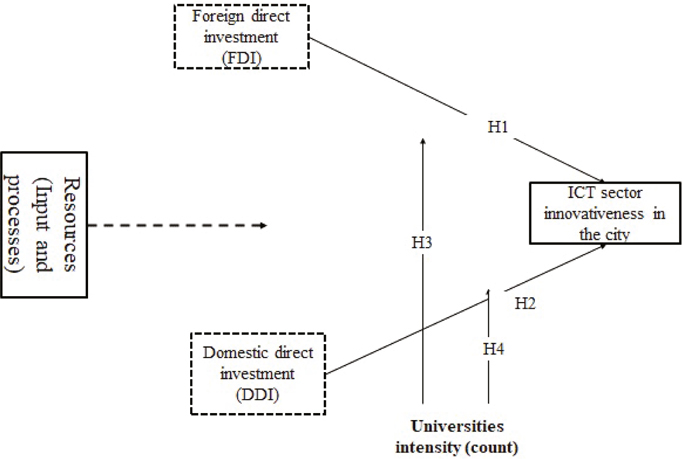
Figure 1 captures this analytical modelâs essence, starting from the right side, which shows the cityâs innovativeness in the ICT sector at the same level and place. Resources lead to the cityâs innovativeness through two paths. One path depicts the FDI (foreign direct investment) flow, and the other path depicts the DDI (domestic direct investment) flow. These two paths capture the baseline hypotheses of the direct link between resource flow and the cityâs innovativeness in the ICT sector. In the middle of these two paths (FDI and DDI), the universityâs intensity as the resource mobiliser interacts with these paths. The interaction between the intensity of universities and the first path creates the first moderator. The interaction between the intensity of universities and domestic investment leads to the second moderator. Without interaction, university intensity also directly contributes to ICT sector development in the city. Since our focus is on the focal argument, we do not explicitly state and evaluate those additional hypotheses. After a brief introduction to the cityâs innovativeness in the ICT sector, we follow Figure 1 in developing baseline hypotheses followed by moderating hypotheses.

Conceptual model for empirical analysis
Citation: Triple Helix 8, 2 (2021) ; 10.1163/21971927-BJA10017
2.1 ICT Sectoral Innovation
ICT development enhances the cityâs innovativeness through multiple components. One component suggests that ICT firms in upstream and downstream activities increase the cityâs innovativeness (Lee et al., 2015). Innovative cities or regions further attract explorers and exploiters of knowledge for entrepreneurial activities. For instance, Silicon Valley has shown consistent technical resources and symbolic resources in the region. Since the late 1950s, Silicon Valley has attracted creative people and high-technology entrepreneurs in various ways, improving multiple performance indicators in the region (Jacobs, 1969). Elsewhere, the evidence from Germany reveals similar patterns of the ICT-based clusters of firms supporting regional innovativeness and the regionâs comparative position (Maurseth and Frank, 2009). Likewise, the evidence from China supports the role of ICT in cities in attracting resources (Hong and Fu, 2011; Shi et al., 2018; Wu, 2000). In China, the regionâs absorptive capabilities, which refer to the firmâs R&D, attract foreign firms leading to innovation in the cityâs ICT sector (Hong and Fu, 2011). Beyond this empirical literature from China, Indiaâs evidence reflects similar patterns of FDI and technology transfer for regional development (Hong and Fu, 2011; Nepelski and De Prato, 2015; Shi et al., 2018; Wu, 2000).
Another set of studies explains citiesâ innovativeness processes in the ICT sector in a technical context. From a technical perspective, ICT makes a cluster of firms and related institutions in the region. At the individual level, executives form links between organisations. For instance, a chief technology officer (CTO) serves these bridges between internal technology development and external environmental evolution (Medcof, 2007). Likewise, interfirm relations plan the internal and external environment within the ICT region at the organisation level towards the regionâs innovativeness (Wang and Lin, 2013). One visible performance of the ICT sector at the city level relates to the efficient delivery of services to the public from governing agencies (Constantinides and Barrett, 2015). In this way, the ICT sector enhances the cityâs participative development by reducing unnecessary barriers and contributing to social inclusion (Van Winden, 2001), resulting in the efficient and effective transfer of knowledge from the supplier to the user.
City innovation needs explicit and tacit knowledge resources for the cityâs innovativeness. The explicit type rests on formal education, which often comes in a codified form such as articles, patents, designs, sketches, mathematical models, and other similar forms; tacit knowledge results in an individual or collective routine (Polanyi, 1967). In the former case, the codification of scientific discoveries in articles, published books, and patents represents the explicit type. Experience and skill-related knowledge represent the tacit type. While these two points relate to the ICT sectorâs technical role in the cityâs innovativeness, the ICT sector also creates symbolic values for the cityâs innovativeness status.
ICT sectoral development contributes to the cityâs symbolic values in two ways: ICT development brings multiple actors and institutions into an integrated system. For instance, an increase in attention to the city increases the cityâs visibility among the audience. Paris and Milan have gained legitimacy as fashion capitals; New York and London have gained legitimacy as financial centresâ. In high technology sectors, private and public enterprises attract attention, direct attention to the city, and give legitimacy status to the regionâs symbolic value. Regulatory organisations complement the ICT infrastructure and the actorsâ presence for better interaction (Suddaby et al., 2017). Another example comes from an emerging project on regional innovation in the BRI (Belt and Road Initiative) project. The BRI project, which China sponsored for regional economic development, has attracted foreign attention and has produced the legitimacy of regions, corridors, and cities within and outside China (Malik, 2020a). At the ICT sector level, social forces affect and reflect such high technology sectors in the world. For instance, the ICT sector in China reflects the cityâs hardware legitimacy, and the ICT sector in India reflects the cityâs software legitimacy (Malik, 2021). Together, the ICT sectorâs technical resources and the symbolic resource of organisational prestige positively contribute to the cityâs socio-economic development, but what are the ICT sectoral development sources for the cityâs innovativeness?
2.2 Foreign Direct Investment (FDI)
The literature on regional innovation suggests that the inflow of FDI contributes to regional innovativeness. Some authors show a positive link between FDI flow and urban economic growth (Wu, 2000). This stream of the literature explains that FDI promotes R&D activity in city-level regions, leading to city organisation innovativeness (Ambos, 2005). Host cities benefit from FDI in knowledge-transfer and technological development. For instance, in the case of China, the evidence is clear in its support of this direct effect of FDI and regional innovativeness in manufacturing R&D. FDI attracts small and medium enterprises in the region, and these enterprises enter at different stages in the value chain to explore and exploit opportunities in innovative technologies (Hong and Fu, 2011; Kloosterman and Lambregts, 2001; Shi et al., 2018). The interaction of FDI and regional development in the ICT sector makes up the core of regional innovativeness. ICT-related activity supports inputs, processes, outputs, and institutional transformation in the region as an enabling technology. A review of popular literature indicates that multiple organisations have prepared league tables of the worldâs top 50 most innovative cities. The academic literature reveals new concepts such as smart cities, connected cities, and creative cities to represent the ICT sectorâs innovativeness through FDI-related R&D flow, entrepreneurial dynamics, and socioeconomic support. Based on the theory and evidence, we link FDI and the cityâs innovativeness in the ICT sector in the following direct hypothesis.
Hypothesis (H1): Foreign direct investment intensity positively contributes to a cityâs innovativeness in the ICT sector.
2.3 Domestic Direct Investment (DDI)
While most studies link FDI and regional innovation in the direct hypothesis, they have overlooked the role of DDI, which complements the cityâs innovativeness. As the FDI flow plays a role in the cityâs innovativeness, the DDI plays a crucial role in the cityâs innovativeness in the ICT sector. When the FDI flow slows down due to conflicts or natural phenomena such as the COVID-19 pandemic, DDI takes the front stage in policy and practice for socioeconomic development. For DDI as an inevitable source of regional innovativeness, we draw examples from the Chinese system of innovation, comprising state-owned enterprises and private-owned enterprises (Malik and Huo, 2019). Both types of enterprises make up the DDI in the city, which leads to the cityâs innovativeness. For instance, the literature on regional development shows that new product development in cities comes from these two ownership structure types in China (Sun and Du, 2011). In other countries, the state plays an entrepreneurial role in high technology sectors through policies supporting DDI-driven R&D (Altenburg et al., 2007). For instance, state entrepreneurship streamlines human capital and other skills in those industries in the region (Asuyama, 2012). Taxation policies, financial institutions, infrastructure, environmental sustainability, and other socioeconomic incentives support the cityâs innovativeness through the DDI of the government and private enterprises. In China, DDI has played a leading role in the BRI project from cities around China, leading to foreign destinations through land and Sea. We propose there is a positive correlation between the DDI and a cityâs innovativeness in the ICT sector.
Hypothesis (H2): Domestic direct investment intensity positively contributes to a cityâs innovativeness in the ICT sector.
2.4 Moderating Effects of Universitiesâ Intensity
Universities (intensity) in the city moderate the flow of resources to the region. This mobilising capability of the universities in the city suggests that there are foreign interactions with universities. In other words, the population of universities in the city moderates the effects of FDI and DDI on the cityâs innovativeness in the ICT sector. Universitiesâ intensity refers to the number of institutions of higher education located in the cityâs domain. These universities vary in disciplinary diversity, such as research universities, professional universities, and engineering universities (Malik, 2020d). In addition to this disciplinary diversity in the city, universities vary in state-driven ranking and regional ownership. For instance, universities in project-211 in China draw support from the central government, and they make up less than 10% of the total population. After state-level universities, provincial universities represent the broader regions, such as Liaoning in the North, Shandong in the East, Sichuan in the West, and Lanzhou in the Northwest. City-level universities represent cities with their names. Dalian University, Shenyang University, Suzhou University, and Shanghai University are examples of this phenomenon. The combination of multiple universities, their students as users of the ICT sector, and their graduates as technical input to ICT entrepreneurship in the city highlights the importance of universitiesâ multiplicity. We include the university population in the city as the intensity of the institutional moderators.
Regarding technical resource flow, universities contribute to the city in many ways in direct and indirect paths (Boucher et al., 2003). First, universities increasingly engage in Chinaâs research activities across cities and regions (Wu, 2007). Such universitiesâ intensity produces a knowledge-based workforce across disciplinary lines (Abel and Deitz, 2012). Second, universities consume intellectual resources in the city. Second, from a technical perspective, the intensity of universities signals the cityâs absorptive capability. This notion of absorptive capacity depends on research knowledge and business development knowledge (March, 1999). The research capacity encourages searching and experimenting with new knowledge, and business development absorptive capacity builds on the testing, refining, and improving the existing knowledge for a practical purpose in the environment. The cityâs absorptive capacity based on the university population provides structural support for ICT sectoral innovation to improve the existing technologies and develop new technologies (Hong and Fu, 2011; Shi et al., 2018; Wu, 2000).
Third, the universityâs population in the city supports the conducive environment for the cityâs knowledge flow because of the cityâs proximity for attracting foreign and domestic enterprises. The structure of knowledge sources, such as universitiesâ networks in the city, contributes to the cityâs absorptive capacity. If knowledge flow to firms contributes to the firmâs absorptive capacity (Kloosterman and Lambregts, 2001), then knowledge flow to the city should contribute to the cityâs absorptive capacity. Some evidence from the Netherlands shows that university-city development relates to geographical proximity and university-industry networks in ICT development (Ponds, van Oort, & Frenken, 2010). Likewise, a comparative study from Europe and China shows that firmsâ capabilities circulate regional development knowledge resources (Hong and Fu, 2011). Since universities contribute knowledge to regional development (Boucher et al., 2003), their role becomes that of resource mobilisers (moderators) from foreign and domestic enterprises to the cityâs ICT innovation.
Fourth, in addition to providing direct knowledge resources to the city, universities connect societies within and across regions (Addie, 2017). Likewise, universities add symbolic value to the social system. For instance, universities create city status, and city status attracts creative people, direct investment, and social attention. In this social value creation and attention to universitiesâ population, the city gains a higher social value in its status. This social status increases the cityâs overall prestige that is then associated with universities, and a virtuous cycle of resources and status values takes shape. For instance, universities highlight regional identity and induce inter-university competition between regions (Boucher et al., 2003). Peking University affects and reflects the city. Cambridge university affects and reflects the city. University of California, Berkeley, affects and reflects the city. The University of Chicago affects and reflects the city. Case studies in the UK show these links between cities and universities (Brennan and Cochrane, 2019). Universities connect societies, increase sociotechnical knowledge (Addie, 2017), and attract FDI and DDI. Based on these views, we draw two moderating hypotheses.
Hypothesis (H3): Universitiesâ intensity moderates the effects of FDI on a cityâs innovativeness in the ICT sector.
Hypothesis (H4): Universitiesâ intensity moderates the effects of DDI on a cityâs innovativeness in the ICT sector.
3 Methods
This study follows the research question of whether and how university intensity moderates foreign and domestic direct investments. Three contextual components define the fit between the setting and the research question. First, we chose the Chinese context for its dynamism. For the last several decades, China has hosted FDI more than other countries. Second, we chose 287 prefecture-level cities in mainland China. Third, we used universitiesâ ability to moderate and reroute resources to the city for their institutional status, intensity, variety, and networks (Florida, 2009). Fourth, ICT sectoral innovation has risen to the central stage in the Chinese innovation model. Smart cities and the ICT sector frequently appear in the policy and public discourse in China. Moreover, China has excelled in developing the ICT sector at the national level and city level.
In addition to these research settings, we relied on the literature linking the interdependence between the cityâs innovativeness and the ICT sector. By combining the ICT sectoral and location context, the literature shows a link between the high-technology sector (Maurseth and Frank, 2009) and the clustering of ICT firms in the region (Nepelski and De Prato, 2015). Between resources and ICT development as an indicator of city development, universities appear to be intermediaries in high-technology sectors between direct investment (FDI/DDI) and citiesâ innovativeness (Addie, 2017). For example, similar to the biopharmaceutical sector, the ICT sector, universities, and the cityâs government interact in subtle ways (Cai and Etzkowitz, 2020). To rationalise the research setting, we relied on the prior literature on ICT and city development (Belderbos et al., 2020; Cohen and Levinthal, 1994; Malik, 2019b). For the methodological process, we followed a rhetorical structure to fit the institutional framework.
The institutional framework dictates five rhetorical questions in research methods (Malik, 2020b): What, who, where, when, and how (process). The presence of such contextual differences links institutional theory to methodological processes, directly or indirectly. We used similar rhetorical questions in the qualitative analysis in management and organisational research (Malik, 2019a). This prior literature on rhetorical methodology converges with the methodology used in the current study on universitiesâ embeddedness in cities (Bourdieu, 2005). Moreover, the rhetorical questions enabled us to combine methodological compatibility between theory and methods for the empirical analysis of universities in Chinese cities (Malik, 2020d). Like foreign firms collaborating with domestic firms in China, foreign universities have shown collaboration with domestic firms and universities in the city. The national education policy stresses that foreign and domestic universities focus on high technology sectors. ICT is among nine of the stateâs selected technologies for universities and firms (Malik, 2020d). Thus, the starting point of the cityâs innovativeness and the interaction between industrial institutions and educational institutions in the formation of the cityâs institutions move our research setting, methods, and analysis.
Based on the city as the unit of analysis, we began to gather data from multiple sources. First, we used the CEIC (Consensus and Economic Information Centre) database, which provides detailed information on prefecture cities such as FDI, DDI, universities, and other city aspects. Second, we used Osiris to find listed and private enterprises. A related data source (Zypher) provides equity investment. Third, we relied on the MOE (Chinese Ministry of Education) for the definition and count, orientation, location, and population of universities in the city network. Fourth, we explored the Web Sites of the universities for relevant information. Fifth, we had personal visits for observations, interviews, and collaboration across cities in the university-industry context.
3.1 Variables
Dependent variable: The dependent variable represents the cityâs innovativeness in the ICT sector. The measurement is comprised of four constituents of the composite variable. We used PCF (principal component factor) analysis to develop the dependent variable. In the factoring process, we use the four components of the dependent variable to make the composite variable of the cityâs innovativeness in the ICT sector. Cronbachâs alpha for the composite variable is 71.2, and the components of the factorised variable are as follows
Broadband subscribers
Mobile subscribers
Industry employees
Construction in the city development
3.2 Independent Variables
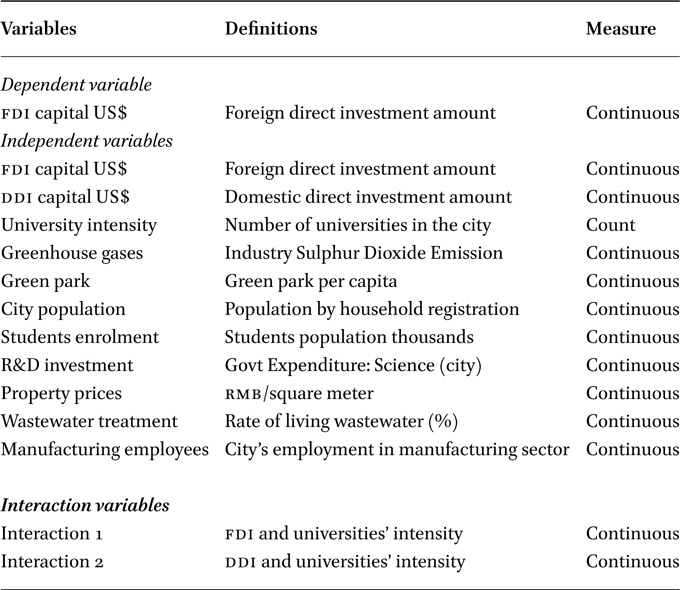
Table 1 defines the independent variables, including the direct variables, interaction variables, and control variables. Among the direct variables, FDI measures the amount in investment (US$), DDI also measures the investment (US$), and the universitiesâ intensity measures the number of institutions of higher education in the city in that year. Naturally, the interactions produce two resulting variables. The list of control variables follows in order. Appendix B provides a preview of those focal variables, with both direct and interaction effects.
For the control variables in Table 1, construction and property prices overlap. City construction constitutes one of the four factors of the dependent variable; likewise, property prices in the city reflect the cityâs prestige and attractiveness. In some contexts, universities play a direct role in developing physical resources such as campuses, incubators, fields for greater experiments, and sustainable development projects. In addition to knowledge producers and users, researchers in the UK note that âuniversities are major property developers, and this is powerfully reflected in our casesâ (Brennan and Cochrane, 2019). This also applies to cities in China. Therefore, we included the cityâs property prices as the control variables.
3.3 Analysis
The analysis applies a dynamic model based on panel data for an appropriate level of validity and reliability of the model, variables, and analysis. This dynamic model has several advantages and is widely used in the literature when temporal variables are relevant and social dynamics are essential parts of modelling industrial development. First, such a dynamic model represents organisational policymakers. As organisations and decision-makersâ past behaviour influences their subsequent decisions, the dynamic model becomes the essence of analysis. For instance, the previous yearâs FDI or DDI influences the current and future FDI and DDI, leading to innovativeness in the city. Second, moderators such as educational institutions tend to be stable compared to the main predictors and outcomes. In this sense, universities in the city may increase gradually. Sometimes they decrease when mergers or integration occurs between universities. Due to contextual inertia or partial adjustment, the dynamic model captures the link between past behaviour and future behaviour through temporal adjustments.
Second, the dynamic model accounts for variations across cities in the time-specific analysis. The analysis includes fixed-effects models and random effect models. We used fixed-effect models based on the Hausman test criteria. Fixed-effect modelling allows for the estimation of unobservable case-specific effects, controls for constant characteristics, and eliminates potential bias caused by omitted variables (Hsiao, 2014). The following equation addresses the fixed-effect model in the panel data analysis.
Yit = c + αYi,tâ1 + βXit + δt + δi + εit
Yit = Dependent variable
c = Constant
Xit = A vector of the group-centred independent variables
4 Results
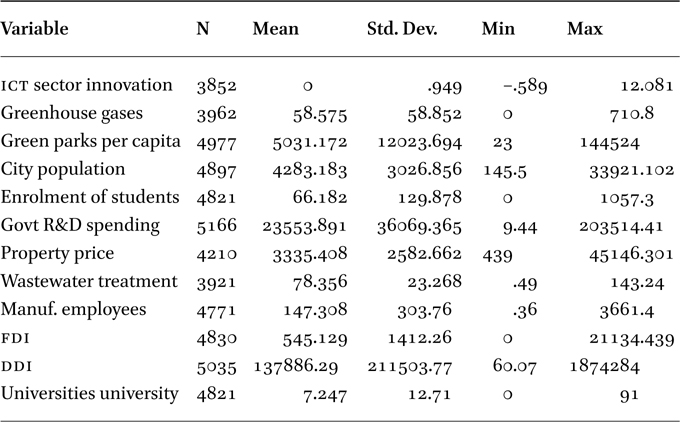
We present results in Tables 2 through 6. Moreover, two graphical plots of the interaction variables complement these results. Figure 2 and Figure 3 show graphical plots of the interaction. We start the results from the summary statistics. Table 2 presents the summary statistics of the variables, with observations, means, and ranges. The dependent variable is factorised (continuous variables). We centred the dependent variable, and the mean was 0 (ranging from -0.6 to 12.1). The mean of FDI is 545 (1,000 units), and the mean of DDI is 137,996 (1,000 units). A typical city has seven universities (range of 0 to 91) across cities.
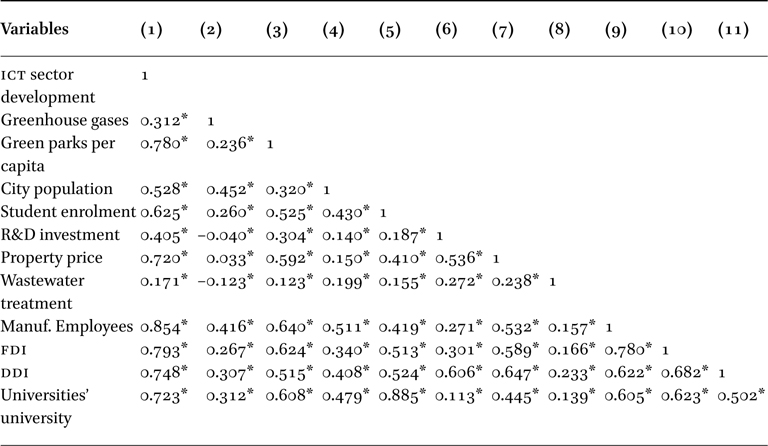
Table 3 shows the inter-variable correlations. Some intervariable correlations are higher than 70%, which motivates us to further assess the multicollinearity between these variables in the next table.
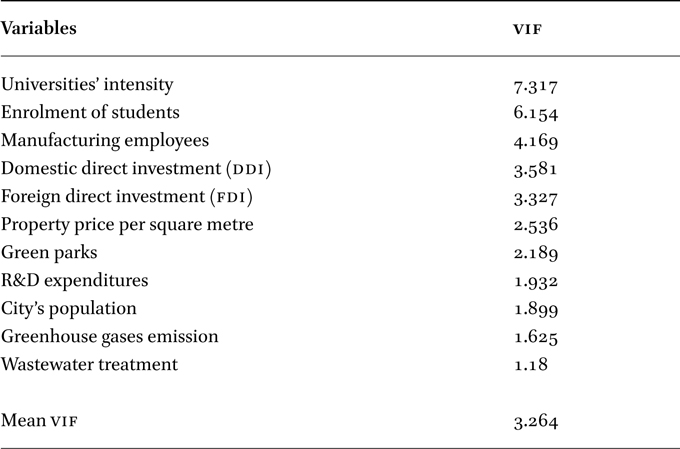
Table 4 shows the VIF (variance inflation factor) diagnostics. The convention suggests that 10 is the cut-off value of VIF for social science research. A value below 10 is acceptable in the social sciences (Cohen et al., 2002). Our VIF values are below this threshold, and the average VIF is less than 5. Therefore, based on our panel data comprising a large sample, we accept these values and move to the main analysis for the direct and interaction effects.
Variance inflation factor (VIF)
Citation: Triple Helix 8, 2 (2021) ; 10.1163/21971927-BJA10017
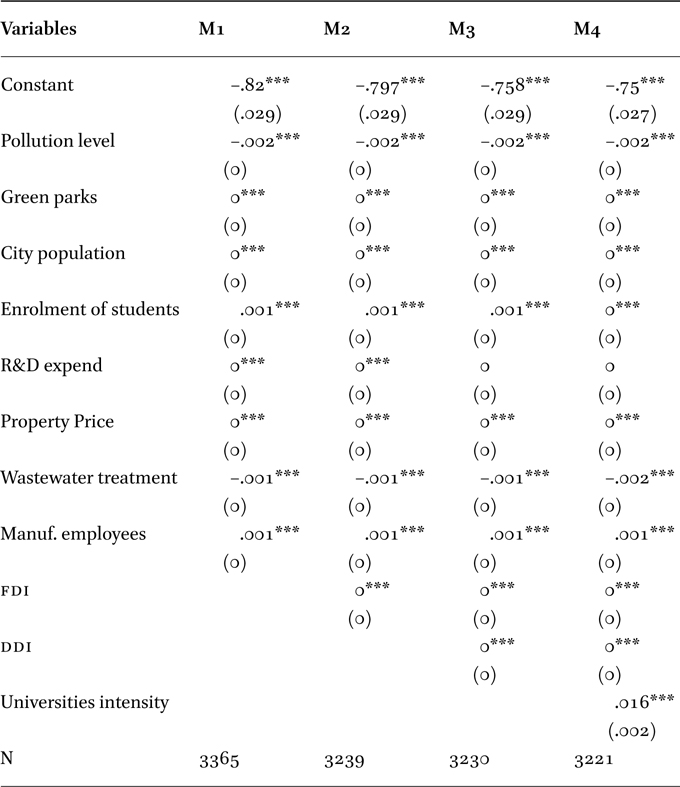
Table 5 shows the direct effects of FDI, DDI, and universitiesâ intensity on the cityâs innovativeness in Chinaâs ICT sector. The direct correlation between FDI and a cityâs innovativeness in the ICT sector is significant and positive (0.0, p < .001). Likewise, the DDI has a positive and significant correlation with the cityâs ICT sectoral innovation (0.0, p < .001). The correlation size in both variables is smaller compared to the university effects. The universityâs direct effect in the city is positive and significant (0.016, p > 001). While baseline hypotheses guide us to the next stage, we aimed to assess their interaction effects for better insights.
Maximum likelihood model (panel data)
Citation: Triple Helix 8, 2 (2021) ; 10.1163/21971927-BJA10017
Before moving to the moderation analysis of the universitiesâ intensity between FDI and the cityâs innovativeness, or between DDI and the cityâs innovativeness, we plotted the interaction effects in Figure 2 and Figure 3 for visual inspection.
Figure 2 shows the interaction plot of FDI and university intensity. The dark line shows the cityâs FDI and innovativeness, and the dotted line shows the number of universities in the city. Since the two lines are unparalleled, the steep upward slowing of universities and FDI shows the interaction effect in the gap between the two lines.
Interaction plot between FDI and universities in the city
Citation: Triple Helix 8, 2 (2021) ; 10.1163/21971927-BJA10017
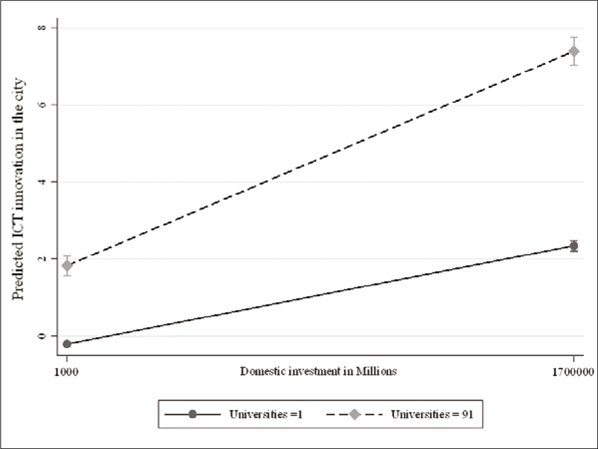
Figure 3 shows the interaction plot of the DDI and university intensity. The dark line shows the cityâs FDI and innovativeness, and the dotted line shows the number of universities in the city. Both lines show an upward slope. However, the slope of the dotted line is steeper than the slope of the dark line. Since the two lines are not parallel, universitiesâ and DDIâs steep upward slopes show the interaction effect in the gap between the two lines at the upper end.
Interaction effects between DDI and universities in the city
Citation: Triple Helix 8, 2 (2021) ; 10.1163/21971927-BJA10017
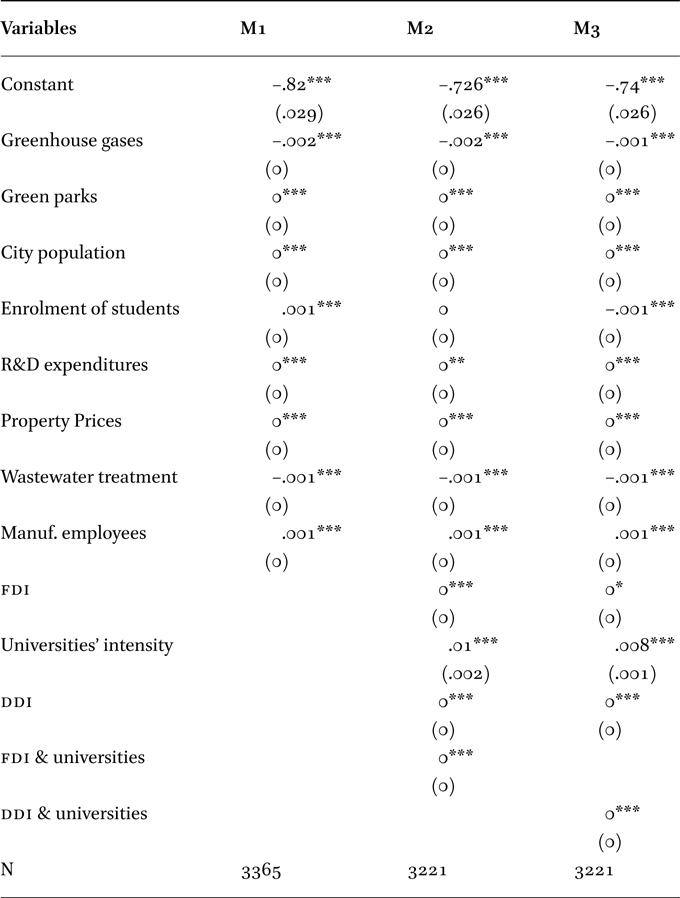
Table 6 shows the interaction effects of the universitiesâ intensity on the cityâs innovativeness. M1 shows the effects of the controlled variable in this baseline model. M2 shows the interaction effects of FDI and universities. The correlation is positive and significant (0.0, p < .001). Likewise, M3 shows a positive and significant correlation of the interaction (0.0, p < .001). Although the coefficient is small, the significant results point to the moderating effects.
Maximum likelihood (panel data)
Citation: Triple Helix 8, 2 (2021) ; 10.1163/21971927-BJA10017
5 Discussion
In regional studies and economic geography, several scholars have drawn attention to universitiesâ resource mobilising roles in cities. To assess universitiesâ mobilising role towards the cityâs innovativeness, we explored the role of universitiesâ population in the city on the cityâs innovativeness. The university population implies intensity, and the cityâs intensity (the number of universities) moderates the flow of investment (foreign and domestic) to the city. Prior literature has assessed universitiesâ role in the social-technical development of regions (Bai, 2013; Wu, 2000). Others have addressed the role of FDI in the cityâs innovativeness, but these authors have overlooked the universityâs interaction with the investment (Kaiser, 2003; Li, 2015). Moreover, hardly any study has explored the complementary role of domestic direct investment (DDI).
We extended the research design to FDI, DDI, and their interactions with the number of universities in the city. The designâs extension accommodates the direct effects of FDI and DDI on the cityâs innovativeness, and it accommodates the interaction effects between universitiesâ intensity and investment. Such an interaction between the industry, university, and city alludes to institutional theory in innovation system studies (Cai and Etzkowitz, 2020). Therefore, institutional theory shaped this research framework, and panel data analysis at the city level assessed the empirical part.
Institutional theory has several streams, and we combined two of them. One stream reflects on the technical role of universities. For instance, universities provide knowledge, skills, and coordination mechanisms. Universities increasingly contribute to ICT sectoral development in city-related R&D, product development, and enabling technologies (Hong and Fu, 2011). The other stream of institutional theory focuses on the symbolic value of institutions. For instance, entrepreneurial activity in the city contributes to the cityâs symbolic value. Social networks develop from the population of firms in the region. Silicon Valley comes to mind for such a reference. Likewise, universities create networks, and the increase in university population increases the cityâs legitimacy to attract further investment (OECD, 2009). Universities have integrated producers and users of knowledge in the city, and in so doing, they transform their environment (Addie, 2017; Brennan and Cochrane, 2019). This transaction between institutions includes technical resources and symbolic values. The evidence from our study supports the direct effects of FDI or DDI on the cityâs innovativeness and moderating effects of the universities in the city.
First, direct support shows that FDI positively contributes to a cityâs innovativeness in the ICT sector. Likewise, direct support shows that DDI positively contributes to the cityâs innovativeness in the ICT sector. The prior literature shows similar patterns. For instance, a study shows that FDI and regional development in China are positively correlated (Zhao and Zhang, 2007). This literature focuses on the region and general innovation; we focused on the city and the ICT sector. For instance, FDI seems to be a direct contributor to R&D spill over, leading to innovation and city development (Wang et al., 2016). Globalising the city argument suggests development from the FDI perspective (Bathelt and Li, 2008). The research design, data quality, and statistical support for the hypotheses suggest that the current analysis a stronger candidate for the development of this theory. Since the analysis indicates that the amount of DDI and the cityâs innovativeness in the ICT sector are positively correlated, our study draws attention to a new direction compared to previous research. Most of the prior studies have overlooked the important contribution of DDI in regional innovation research. These direct effects of investment (FDI and DDI) and the focus on the cityâs innovativeness in the ICT sector show this studyâs departure from the previous literature.
Indirectly, universitiesâ moderating role supports the FDI and DDI flow to the city for ICT sectoral innovation. In the case of FDI flowing to cities, the literature shows that foreign firms enter cities to access universitiesâ intellectual resources in China (Young and Lan, 1997). Such a university-industry collocation in regional development provides a physical, social, and intellectual infrastructure through interinstitutional links and technology transfer (Cai and Etzkowitz, 2020; Shi et al., 2018; Wu, 2000). Boucher et al. (2003) demonstrate the moderating roles of universities between resource and city development. Likewise, universitiesâ intensity moderates between the DDI and the cityâs innovativeness in the ICT sector, unlike in other high-technology sectors (Cai and Etzkowitz, 2020). Most studies have overlooked DDI in China and elsewhere in the study design, analysis, and argument. In China, DDI has a special role in infrastructural development, the network between universities and industries, and the regional entrepreneurship system. For instance, the entrepreneurial state, regions, and cities provide distinctive support to compete between cities (Malik and Huo, 2019). This competition for DDI and universities increases the cityâs absorptive capacity, leading to comparative advantages in capturing the knowledge spill over effects from FDI sources (Huang et al., 2012). Excessive competition between cities can have a âbackwash effectâ, which means that the cityâs high absorptive capacity pulls resources from the low absorptive capacity areas (Crescenzi et al., 2012). In particular, the ICT sector has a special role in the absorptive capacity building of the city (Sun and Du, 2011), and universities contribute to this development through technical and social resources. Our study fills the void identified by the recent literature review (Harrison and Turok, 2017).
This study makes three contributions. First, we explicate the cityâs innovativeness in the ICT sector and include four factors in the construction of innovativeness. The role of ICT in city development is gaining attention in academic and popular literature. For instance, national and international organisations have begun to rank smart cities, innovative cities, and creative cities. The ICT contributes input and output to the cityâs development. For example, smart cities rely on these inputs and outputs. Regional innovation and sustainability have become intertwined in the ICT sector. Most studies focus on broader regions than cities (Chen and Guan, 2012; Li, 2015). The cityâs innovativeness has gained interest among academics and policymakers (Brennan and Cochrane, 2019; Florida, 2009). We respond to this increasing interest in the cityâs innovativeness and the universityâs role in this development (Harrison and Turok, 2017). With this contribution to citiesâ innovativeness in ICT and its implications for socio-economic development, we move to the literatureâs theoretical contribution.
The study makes theoretical contributions to institutional theory at two levels. The first level contextualises the city intertwined with global activity. The FDI links foreign firms and universities in the region (Malik, 2020d) and cities (Benneworth et al., 2010; Brennan and Cochrane, 2019; Harrison and Turok, 2017). Likewise, DDI from national institutions plays a vital role in a cityâs development. Chinaâs case is a particular instance of an entrepreneurial state and its role in national institutional interaction (Malik and Huo, 2019). The second level of theoretical contribution links universities to national and international enterprises on the one hand and citiesâ innovativeness on the other. Universities contribute to organisational institutionalism. For instance, the universityâs population (network) signals symbolic value. The city contributes to organisational institutionalism through its institutional components: foreign enterprises, domestic enterprises, and higher education institutions. From both perspectives, anchored universities bring technical and symbolic values to the city (Addie, 2017; Liu, 2019). Together, the two levels (foreign and national) and two types of values (technical and social) highlight this studyâs theoretical contribution.
Institutional theory links three actors in the city at different levels: the university, industry, and state in the regional innovation system (Cai and Etzkowitz, 2020). Some of these studies on the interaction of the three institutions focus on national or regional systems. We extend institutional theory to cities. The prior literature often reflects the technical role of universities in the city. For instance, universities create knowledge and skills for the market. It has been recognised that universities consume knowledge, skills, and other resources. In part, universities increase the supply of and demand for resources in the city. In addition to these technical resources, we extend the social value of university networks in cities, creating broader support for the cityâs legitimacy status. Previous literature alludes to similar ideas. In the cityâs innovation system (Cai and Etzkowitz, 2020), universitiesâ roles âinclude economic development, image change, aspiration raising, providing opportunity, tackling inequalities and relative disadvantage, active citizenship, and leadership and coordinationâ (Brennan and Cochrane, 2019). In particular, universities contribute to the national and regional innovation system at the frontiers of science and technology (Hong and Fu, 2011; Nepelski and De Prato, 2015; Shi et al., 2018; Wu, 2000). We think that universities contribute to the absorptive capability of the city for the developmental system. At the same time, universities facilitate relationships, cultural exchanges, and symbolic foundations of global cities (Addie, 2017; Brennan and Cochrane, 2019; Liu, 2019).
The third contribution addresses universitiesâ general implications in the city in ICT sector development. Universities attract direct investment and technologies from foreign and national enterprises (Hong and Fu, 2011). For instance, âUniversities are now major actors in their local economies, often among the biggest employersâ, which means they are agents of economic change in the city. In particular, universities are becoming âinvestors, developers, and businessesâ (Brennan and Cochrane, 2019). From a practical perspective, we suggest that city planners attract diverse universities for ICT sectoral development (Hong and Fu, 2011). In addition to universitiesâ intensity, we stress the importance of the cityâs social and institutional values. Pure technical policy is often insufficient for sectoral development. For instance, Shenyang city, the capital of Liaoning Province, has more universities than Hangzhou city in Zhejiang. The former is less developed in the ICT sector than the latter because some of the institutional supportâs symbolic values are weaker in the north than in the south. Despite high rates of publications and patents, entrepreneurial activity is lower in the north than in the south in China. We believe that policy support is missing from the ecology of university-city relationships.
Some limitations come to the fore. First, this study relies on secondary data, and the richness of case studies is missing. Second, the current study draws on the ICT sector, limiting the scope of the cityâs innovativeness. Cities differ in their attraction to sectors. Harbin attracts the winter tourism sector; Dalian attracts summer tourism; Shanghai attracts the financial sector, and Qingdao attracts universal studies and the moviemaking sector. Third, the current study uses cities in China for the panel data analysis. A comparative analysis between cities in a country falls short of the intercountry comparison. Other countries may differ from the current focus; therefore, generalisation comes into question. Fourth, citiesâ histories and specific policies leave some issues in assessing regional development at the methodological level. For instance, three leading institutions in music exist in three cities because of their histories. Therefore, breadth and depth are needed in future studies to be applicable to theories and practices.
Acknowledgements
This article is part of a Special Issue on âFuture of Innovation and Innovation for the Futureâ, edited by Yuzhuo Cai (Tampere University, Finland) and Henry Etzkowitz (International Triple Helix Institute, USA).
References
Abel JR and Deitz R (2012) Do colleges and universities increase their regionâs human capital? Journal of Economic Geography 12(3): 667â691.
Addie J-P (2017) From the urban university to universities in urban society. Regional Studies 51: 1089â1099.
Altenburg T, Schmitz H and Stamm A (2007) Breakthrough? Chinaâs and Indiaâs transition from production to innovation. World Development 36(2): 325â344.
Ambos B (2005) Foreign direct investment in industrial research and development: a study of German MNCs. Research Policy 34: 395â410.
Asuyama Y (2012) Skill distribution and comparative advantage: a comparison of China and India. World Development 45(5): 956â969.
Bai J (2013) On regional innovation efficiency from panel data fo Chinaâs different provinces. Regional Studies 47(5): 773â788.
Bathelt H and Li P-F (2008) Global cluster networks â foreign direct investment flows from Canada to China. Journal of Economic Geography 14(1): 45â71.
Belderbos R, Du HS and Slangen A (2020) When do firms choose global cities as foreign investment locations within countries? The roles of contextual distance, knowledge intensity, and target-country experience. Journal of World Business 55(1): 101022.
Benneworth P, Charles D and Madanipour A (2010) Building localized interactions between universities and cities through university spatial development. European Planning Studies 18(10): 1611â1629.
Boucher G, Conway C and Van Der Meer E (2003) Tiers of engagement by universities in their regionâs development. Regional Studies 37: 887â897.
Bourdieu P (2005) The Social Structures of the Economy. Cambridge: Polity Press.
Brennan J and Cochrane A (2019) Universities: in, of, and beyond their cities. Oxford Review of Education 45(2): 188â203.
Cai Y and Etzkowitz H (2020) Theorizing the triple helix model: past, present, and future. Triple Helix Journal 6(1): 1â38.
Chen K and Guan J (2012) Measuring the efficiency of Chinaâs regional innovation systems: application of network Data Envelopment Analysis (DEA). Regional Studies 47(3): 355â377.
Cohen J, West SG, Aiken L and Cohen P (2002) Applied Multiple Regression/Correlation Analysis for the Behavioral Sciences. Hillsdale, NJ.: Erlbaum.
Cohen WM and Levinthal DA (1994) Fortune favors the prepared firm. Management Science 40(2): 227.
Constantinides P and Barrett M (2015) Information infrastructure development and governance as collective action. Information System Research 26(1): 1â24.
Crescenzi R, RodrÃguez-Pose A and Storper M (2012) The territorial dynamics of innovation in China and India. Journal of Economic Geography 12(5): 1055â1085.
Eesley C, Li JB and Yang D (2016) Does institutional change in universities influence high-tech entrepreneurship? Evidence from Chinaâs project 985. Information System Research 27(2): 233â504.
Florida RL (2009) Whoâs your City? How the Creative Economy is Making where to Live the Most Important Decision of your Life. New York: Basic Books.
Harrison J and Turok I (2017) Universities, knowledge and regional development. Regional Studies 51: 977â981.
Hong J and Fu S (2011) Information and communication technologies and the geographical concentration of manufacturing industries: evidence from China. Urban Studies 48(11): 2339â2354.
Hope K (1982) A liberal theory of prestige. American Journal of Sociology 87(5): 1011.
Hsiao C (2014) Analysis of Panel Data (third edition). Cambridge: Cambridge University Press.
Huang L, Liu X and Xu (2012) Regional innovation and spillover effects of foreign direct investment in China: a threshold approach. Regional Studies 46(5): 583â596.
Jacobs J (1969) The Economy of Cities. New York: Vintage.
Johanson J and Vahlne J-E (2009) The Uppsala internationalization process model revisited: From liability of foreignness to liability of outsidership. Journal of International Business Studies 40: 1411â1431.
Kaiser R (2003) Multi-level science policy and regional innovation: the case of Munich cluster for pharmaceutical biotechnology. European Planning Studies 11: 823â840.
Kloosterman RC and Lambregts B (2001) Clustering of economic activities in polycentric urban regions: the case of the Randstad. Urban Studies 38(4): 717â732.
Lee O-KD, Sambamurthy V, Lim KH and Wei KK (2015) How does IT ambidexterity impact organizational agility? Information System Research 26(2): 243â472.
Li X (2015) Specialization, institutions and innovation within Chinaâs regional innovation systems. Technological Forecasting and Social Change 100: 130â139.
Liu C (2019) The tensions of university â city relations in the knowledge society. Education and Urban Society 51(1): 120â143.
Malik TH (2019a) Founderâs apprehension in small family business succession in Thailand: interpretative view of contextual attention. SAGE Open 9(4): 1â16.
Malik TH (2019b) Society-Nature-Technology (SNT) nexus: institutional causes and cures of national morbidities. Technological Forecasting and Social Change 146: 491â503.
Malik TH (2020a) The Belt and Road Initiative (BRI) Project legitimisation: the Rhetorâs innovation and the US response. Asian Journal of Comparative Politics. DOI: https://doi.org/10.1177/2057891120959476.
Malik TH (2020b) Contextual bricolage and the founderâs apprehension in the inter-generational succession of small family businesses. Management Revue: Socio-Economic Studies 31(1): 55â80.
Malik TH (2020c) Culturally Imprinted Anxiety and the Itinerary of Clinical Trial Projects for its Management. Cross-Cultural Research 55: 1â31.
Malik TH (2020d) Inter-temporal and inter-spatial institutional change influencing the duration decision of the Sino-foreign university alliances. Social Sciences and Humanities Open 2(1): 100010.
Malik TH (2021, forthcoming) Chinese Hardware and Indian Software Sector in the Information and Communication Technology Field. Technology Analysis and Strategic Management.
Malik TH and Huo C (2019) Entrepreneurial state vs liberal market: Chinese comparative advantage in the transformation of national science to technology artefacts. Chinese Management Studies 13(3): 550â573.
March JG (1999) The Pursuit of Organizational Intelligence. Oxford, Malden: Blackwell Business.
Maurseth PB and Frank B (2009) The German Information and Communication Technology (ICT) industry: spatial growth and innovation patterns. Regional Studies 43(4): 605â624.
Medcof JW (2007) CTO power. Research Technology Management 50(4): 23â31.
Nepelski D and De Prato G (2015) Corporate control, location and complexity of ICT R&D: a network analysis at the city level. Urban Studies 52(4): 721â737.
North D (2005) Understanding the Process. New Jersey: Princeton University Press.
OECD (2009) Science, Technology and Industry Score Board. Paris, Paris: OECD.
Perrow C (1961) Organizational prestige: some functions and dysfunctions. American Sociological Review 66(January): 335â341.
Polanyi M (1967) The Tacit Dimension. London: Routledge and Kegan Paul.
Ponds R, van Oort F and Frenken K (2010) Innovation, spillovers and university â industry collaboration: an extended knowledge production function approach. Journal of Economic Geography 10(2): 231â255.
Shi S, Wall R and Pain K (2018) Exploring the significance of domestic investment for foreign direct investment in China: a city-network approach. Urban Studies. DOI: https://doi.org/10.1177/0042098018795977.
Suddaby R, Oliver C, Lawrence TB and Meyer RE (eds) (2017) The SAGE Handbook of Organizational Institutionalism (second edition). London: SAGE.
Sun Y and Du D (2011) Domestic firm innovation and networking with foreign firms in Chinaâs ICT industry. Environment and Planning A: Economy and Space 43(4): 786â809.
Swedberg R (ed.) (2014) Theorizing in Social Science: The Context of Discovery. Stanford, CA: Stanford University Press.
Thorndike EL (1920) A constant error in psychological ratings. Journal of Applied Psychology 4(1): 25â29.
Van Winden W (2001) The end of social exclusion? On information technology policy as a key to social inclusion in large European cities. Regional Studies 9: 861â877.
Wan F, Williamson P and Pandit NR (2020) MNE liability of foreignness versus local firm-specific advantages: the case of the Chinese management software industry. International Business Review 29(1): 101623.
Wang CC and Lin GCS (2013) Dynamics of innovation in a globalizing China: regional environment, inter-firm relations and firm attributes. Journal of Economic Geography 13(3): 397â418.
Wang Y, Ning L, Li J and Prevezer M (2016) Foreign direct investment spillovers and the geography of innovation in Chinese regions: the role of regional industrial specialization and diversity. Regional Studies 50(5): 805â822.
Wu F (2000) Modelling intrametropolitan location of foreign investment firms in a Chinese City. Urban Studies 37(3): 2441â2464.
Wu W (2007) Cultivating research universities and industrial linkages in China: the case of Shanghai. World Development 35(6): 1075â1093.
Young S and Lan P (1997) Technology transfer to China through foreign direct investment. Regional Studies 31(7): 669â679.
Zhao SXB and Zhang L (2007) Foreign direct investment and the formation of global city-regions in China. Regional Studies 41(7): 979â994.
Appendix A: Institutional Theory Explained in a Structure
Citation: Triple Helix 8, 2 (2021) ; 10.1163/21971927-BJA10017
Appendix B: Focal Variables in the Conceptual Model
Citation: Triple Helix 8, 2 (2021) ; 10.1163/21971927-BJA10017