Abstract
In this article, we ask: How can universities create novel responsible, and impactful entrepreneurship education models? Answering this question could enhance the take-up and relevance of entrepreneurship education, encouraging students, academics, entrepreneurs and, indeed, every citizen, to use their skills to address society’s grand challenges. We adopt an in-depth case approach to critically explore the EU-funded ‘Start for Future’ (SFF) alliance, an entrepreneurship and innovation mega-ecosystem that brings universities together to deliver entrepreneurship education in SDG-related domains. Our article contributes by: 1) enhancing understanding of the critical role universities play as entrepreneurial changemakers, driving social, economic and technological transformation; 2) augmenting the growing body of scholarship on entrepreneurship education, specifically illuminating the responsibility dimension in driving impactful entrepreneurship; 3) drawing attention to a novel, playful yet highly impactful entrepreneurship education model – Start for Future – one built on the principles of responsible entrepreneurship, reciprocity, mutual learning, co-creation and experimentation.
1 Introduction
In recent years, scholars have noted a radical shift in how universities are perceived (Klofsten et al., 2019; Hrubos, 2011). They are no longer mere knowledge producers and providers; rather, they are entrepreneurial changemakers, driving social, economic, and technological transformation and localising challenges linked to the United Nation’s Sustainable Development Goals (UN SDGs) (Pontikakis et al., 2022). This changemaker/transformation dimension is rooted in the entrepreneurial university concept, which expands universities’ role beyond traditional academic work to incorporate activities that promote and support innovation, knowledge transfer, and economic development (Etzkowitz et al., 2000; Klofsten et al., 2019).
The entrepreneurial university concept has been described as a second revolution where enterprise is added to the university’s traditional missions of teaching and research to create a ‘third mission’ (Etzkowitz et al., 2000). Through its teaching, research and enterprise activities, the entrepreneurial university (EU) is expected to produce human, social and entrepreneurial capital to enhance economic, technological and social advancement in the region it serves (Etzkowitz et al., 2000). Not surprisingly, therefore, universities are encouraged to strive toward entrepreneurial university status to meet stakeholders’ expectations and deliver on their ‘third mission’ commitments. Such commitments include, amongst others, producing entrepreneurial graduates who can act as future change agents for society (Audretsch & Belitski, 2021; Etzkowitz et al., 2000; Klofsten et al., 2019; Henry & Lahikainen, 2023).
One way for universities to become entrepreneurial changemakers – and, indeed, to cement their ‘entrepreneurial university’ role – is to offer entrepreneurship education programmes and related supports. This has proved an extremely popular mechanism, as evidenced by the significant increase in entrepreneurship programme provision in recent years, a trend evident not only within Europe but also in the USA (Pittaway, 2021). However, if universities are to truly drive transformation, they will need to move beyond the provision of traditional and often generic entrepreneurship education toward the creation of novel and responsible entrepreneurship models that motivate educators and students to widen their thinking and address some of the problems articulated in the UN SDGs (Cai & Ahmad, 2023). Such novel models will, potentially, need to be based on entrepreneurship pedagogies, ecosystem engagement, knowledge exchange, co-creation and a network of shared resources (Pocol et al., 2022; Warhuus et al., 2017). However, to date, with a few exceptions (see, for example, Magni et al., 2020; Puerta-Sierra & Puente-Diaz, 2023), such aspects of entrepreneurship programmes have received insufficient academic attention. To address this gap in knowledge, this article aims to critically explore a novel entrepreneurship education model that universities can consider to fulfil their new entrepreneurial change-maker role – the Start for Future (SFF) project. The authors demonstrate how such a model can help pave the way toward more transformative, responsible and impactful entrepreneurship education.
Adopting a qualitative case approach comprising documentary analysis, score grids and questionnaires, our research question asks: How can universities create novel, responsible, and impactful entrepreneurship education models? Answering this question could not only enhance the take-up and relevance of entrepreneurship education, but also reorient students and educators toward using their entrepreneurial skills, experiences, and resources to address some of society’s grand challenges. Accordingly, our article makes three important contributions: First, we underscore the new and critical role universities play as entrepreneurial changemakers, driving social, economic, and technological transformation. Second, we augment the growing body of scholarship on entrepreneurship education, specifically illuminating the responsibility dimension in driving impactful entrepreneurship. Third, we draw attention to a novel, playful yet highly impactful entrepreneurship education model – Start for Future – built on the principles of responsible entrepreneurship, reciprocity (in terms of knowledge, skills and resources), mutual and intercultural learning, international co-creation and experimentation. This model potentially challenges how future entrepreneurship educators are recognised and rewarded for their entrepreneurial efforts, privileging their contribution to responsible entrepreneurial practice rather than theory.
The remainder of the article is structured as follows: First, we review relevant literatures and outline our conceptual framework. We then detail our methodological approach, present findings and discuss these in the context of the literature. Finally, we draw conclusions, offer recommendations for universities to enable them to create novel, responsible and impactful entrepreneurship education models, and signpost scholars toward avenues worthy of future research endeavour.
2 Theoretical Background
2.1 The ‘Third Mission’
The academic literature suggests that a university’s ‘third mission’ encompasses a commitment to fostering societal and economic progress by engaging in activities beyond teaching and research (Compagnucci & Spigarelli, 2020). This commitment is often conceptualised through the Triple Helix model, which envisions productive collaboration between university, industry and government to co-create sustainable development on a local and global level (Etzkowitz, 1983). Over the years, the Triple Helix model has evolved into the Quadruple Helix (Carayannis & Campbell, 2009), which incorporates civil society as a fourth collaborating helix. By adding the natural environment (planet), the subsequent Quintuple Helix model (Barth, 2011; Carayannis et al., 2012) provides an innovative platform for implementing a systemic approach in the collaborative process of identifying and solving problems. This inclusive approach promotes sustainability and aligns with the goals of the SDGs. Furthermore, as a co-creator in the process of knowledge hybridization through their collaboration in the Quintuple Helix framework, EUs play a significant role in achieving the UN’s SDGs. They transform themselves and become capable of collaborating when dealing with societal and economic issues and also of fostering transformative changes within industries and communities (Trencher et al., 2014). Through their ‘third mission,’ EUs exercise their capability to produce the relevant knowledge needed for progressing toward the well-being of both people and planet (OECD, 2018).
2.2 Creating the Right Environment for Transformation
To perform their entrepreneurial changemaker role, EUs are expected to participate in creating a conducive environment which is crucial for generating human and knowledge capital. This involves working on the body of knowledge related to the various definitions of being entrepreneurial (proactive, innovative, responsible for one’s own choices); exploring how these definitions are perceived by Quintuple Helix actors; deciding how to recognize interconnectedness and establishing collaborations. From the perspective of the university, it is important to design flexible organizational structures, which will be supportive for embedding entrepreneurship competence in learning processes across the campus and for creating support structures for technology transfer activities that contribute to the well-being of both people and planet (start-ups, growing businesses, entrepreneurial governments, active citizens). This transformation is not confined to institutional structures alone; rather, it extends to the curriculum and teaching methodologies. Teaching entrepreneurship becomes a critical component of the EU, with the design of training programmes and active teaching methodologies that foster innovation and entrepreneurship among learners (Rasmussen & Sørheim, 2006; Gibb, 2007). It requires the transformation of educators into mentors and coaches, moving away from their traditional “knowledge transmission” role. Similarly, the role of entrepreneurship educators has evolved to become progressively more engaged in the community (Rubens et al., 2017).
Other actors come into play during this transformation process to provide enhanced opportunities for learners, including incubators, accelerators, academic entrepreneurship programmes, co-working spaces, corporate-based innovation centres and impact hubs, among others. The diverse roles played by the various stakeholders contribute to enriched learning experiences that collectively address the development of a wide spectrum of the entrepreneurial skills, mindsets, and motivations necessary to tackle entrepreneurial challenges. The flexibility of learning formats has also become pivotal, encompassing a range of extracurricular options, mentorship programmes, tailored and flexible courses, and considerations for lifelong learning opportunities that provide just-in-time learning experiences.
In addition to the above, another transformation challenge exists regarding the integration of entrepreneurship education within the evolving entrepreneurial ecosystem landscape (Brush, 2014). While universities increasingly engage as active participants in entrepreneurial ecosystems, there remains a need to address how entrepreneurship education can effectively embrace and adapt to these dynamic environments, reshaping current approaches (curriculum, co-curricular activities, research, stakeholders, resources, and infrastructure). Toutain et al. (2019) propose a multidimensional model to analyse entrepreneurship education ecosystems, encompassing dimensions such as the learning framework, which pertains to curriculum-related information; networks, connections, and relational proximity, emphasizing linkages among internal and external stakeholders; the entrepreneurial culture of the ecosystem, rooted in key values perceived by its actors; pedagogical solutions, including a mix of traditional teaching, experiential methods, and learning by doing to stimulate learning; and the motivation of actors, which serves as a vital driving force for ecosystem development.
2.3 Content and Methodologies
There is an expectation that entrepreneurship education will provide the relevant entrepreneurial-driven knowledge, skills and abilities (KSAs), along with entrepreneurial mindsets and other psychological aspects, such as self-efficacy and entrepreneurial intention, to enable the implementation of innovations into viable and sustainable ventures (Kariv et al., 2019). In this regard, Neck and Greene (2011) advocate for a shift in emphasis from the content to the method of teaching, particularly in a rapidly changing and unpredictable world. This shift is evident in teaching methodologies that are centred on problem-based learning, challenge-based learning, and service learning, which have become widespread among European universities (Reichert, 2019). Such learner-focused methodologies provide opportunities for learners to engage in interdisciplinary learning, optimising connections to real-life cases and projects in collaboration with society. Other recommended approaches in this category include design-based learning, reflective practice, simulations, and serious games (Fox et al., 2018). If EUs wish to fulfil their role of proactive, innovative and responsible changemakers, then learning content and methodology need to be considered as vehicles to prepare learners for the future, because those “who are best prepared for the future are change agents” (OECD, 2018: 4).
2.4 Analysing Universities’ Transformation
In analysing universities’ transformation toward entrepreneurship, several relevant and interlinked theoretical lenses have been used. The first of these is effectuation (Sarasvathy, 2022) (which includes resource-based theory and network theory). Effectuation lenses provide valuable insights into interactions which occur when putting a person together with an environment, and explores how effectual logic can contribute to activating people’s knowledge and motivation even in situations with limited resources (Sarasvathy, 2022). Within such lenses, those using resource-based theory extend traditional concepts of resources by focusing on the capabilities of opportunity recognition, commitment and ability to create different and useful outputs, the viability of which is subsequently confirmed in the marketplace (Alvarez & Busenitz, 2001). Network theory which offers a complementary perspective on the evolution of EUs, highlights their pivotal role in establishing connections among students, faculty, and entrepreneurs. This active involvement results in the creation of valuable networks that facilitate the cultivation of innovative ideas, products, and services.
Linked to effectuation is a second relevant theoretical lens, entrepreneurial ecosystems theory (Graham, 2014; Stam & Van de Ven, 2021), which asserts that entrepreneurial universities’ knowledge and human capital are instrumental in constructing and sustaining local entrepreneurial ecosystems. Through their ‘network of networks’, universities connect entrepreneurs to valuable resources such as education, training and expertise, as well as opportunities for growth through access to finance and markets (Scott et al., 2022). An effective entrepreneurial ecosystem must comprise the necessary networks and supports to enhance entrepreneurship activity at all stages of the new venture creation process (Mazzarol, 2014).
Finally, the concept of ‘university entrepreneurial architecture’ (Cunningham et al., 2022) has been used as a lens to explore and analyse the diverse range of entities and activities that universities employ to deliver their ‘third mission.’ Such architecture examines the diversity of internal factors that interact to shape a university’s entrepreneurial agenda and categorizes the formal organisational units and supports constructed to deliver it. Cunningham et al.’s framework comprises eight organisational units and thirteen activities ranging from Entrepreneurship Centres and Incubators to Entrepreneurship Education, Funding and Networks, with each unit/activity related to a particular stage of entrepreneurial development (Henry & Lahikainen, 2023). In this article we draw on these various analytical lenses to address our research question and discuss our findings.
3 Methodology
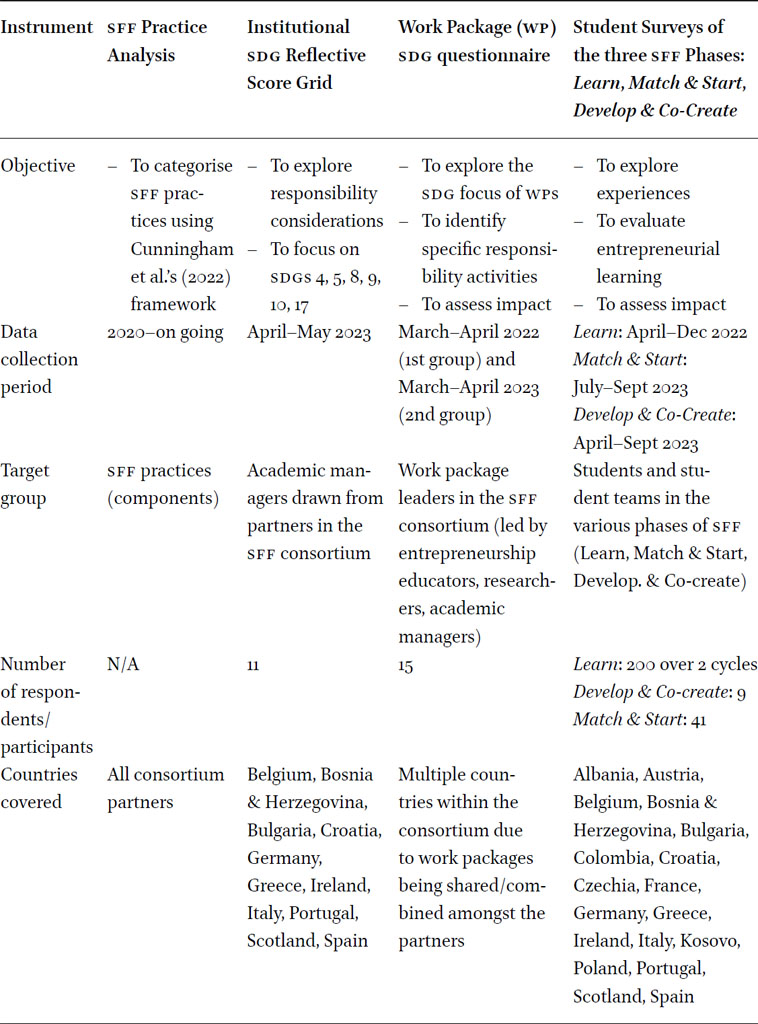
We adopt an in-depth single case approach (Yin, 1994; 2012) to critically explore the responsibility and impact dimensions of the EU-funded SFF project.1 The case method offers an opportunity to uncover rich insights that provide a greater depth of understanding of the phenomenon under investigation. Within our single case, apart from the student samples, we adopt a qualitative, purposeful sampling approach (Creswell & Plano Clark, 2011; Bernard, 2002), which seems appropriate given that we are examining a relatively novel, contemporary, and context-embedded phenomenon within a single setting (Eisenhardt, 1989; Yin, 1994; 2012). We choose the SFF project because it is a contemporary example of a responsibility-focused entrepreneurship education model rooted in transnational and transdisciplinary co-creation. As a consortium of more than 30 HEIs and incubators2 across Europe, USA, Canada and Australia working within a collective entrepreneurial university network context (Etzkowitz et al., 2000; Klofsten et al., 2019), SFF partners share several commonalities, including a strong entrepreneurial orientation, a wide range of entrepreneurial activities across faculties, incubator programmes and a strong supportive business start-up ecosystem (OECD, 2023). Table 1 lists the partner countries involved in SFF.

Partner countries involved in the SFF Project
Citation: Triple Helix 11, 3 (2024) ; 10.1163/21971927-bja10054
3.1 About Start for Future (SFF)
SFF was launched in 2019 and has steadily grown in its geographical coverage, areas of intervention and impact on society. SFF’s first international milestone was attained in 2021 through the collaboration of two projects funded by the first edition of the European Institute of Innovation & Technology (EIT) HEI Initiative programme. These projects, TANDEM+ and EUAcceL,3 each comprised eight partners and aimed to establish a pathway towards 2030 with a multi-dimensional, international Open Entrepreneurship Alliance for societal impact under the UN’s SDGs. These goals were intended to prepare talented individuals for entrepreneurial thinking and action, to promote an international exchange of talents and start-ups, and to create a network of European universities, EIT Knowledge and Innovation Communities (KICs), and regional ecosystem stakeholders. Together, TANDEM+ and EUAccel aimed to transform (one region and ecosystem at a time) the European entrepreneurship and innovation landscape.4
In 2023, SFF was formally established as the Start for Future Cooperative, under the framework of the European Cooperative Society. This framework (and its statutes), as defined by the European Commission (2003), “aims to facilitate cooperatives’ cross-border and trans-national activities. The statute also provides a legal instrument for other companies wishing to group together to access markets, achieve economies of scale, or undertake research and development activities.” SFF’s goal is to be the fastest-growing international, entrepreneurship and cooperative-based alliance in the European landscape.
The SFF Cooperative (and its associated Alliance) comprises four pillars of intervention: The SFF Open Incubator; SFF Open Incubation Programmes; SFF Regional Innovation Valleys, and the SFF Academy. These pillars translate into concrete actions at the individual institutional level. Within the Academy pillar, partner universities establish strategic activities (targeted at students, academic and non-academic staff), and integrate experts and mentors from their regional ecosystems. Students are motivated to critically think about societal challenges where they can create and provide value-added solutions, thus positively impacting society. SFF’s Academy pillar, its activities and its relationship to the relevant actors in each partner institution, is represented by an evolutionary, sequential programme composed of three dedicated phases depending on the entrepreneurial maturity of the participants: Phase 1) Learn; Phase 2) Match & Start; Phase 3) Develop & Co-create.
Learn (phase 1) is the most ambitious and innovative of the three phases, where universities identify challenges for their students to work on. These challenges are addressed through business ideas with the potential to develop solutions to real societal problems. Students are organized into teams, and educators (academic and non-academic staff, and external stakeholders from industry) act as mentors. Each student team is assigned to a “tandem peer team” drawn from other universities and countries, reinforcing the international networking component of the programme. Student teams choose a real, impactful and open challenge related to one of SFF’s six areas of intervention: Manufacturing; Urban Mobility; Energy; Health; Food; Circular Economy. During Learn, students create products, services, projects, or concepts that they believe can contribute to solving the identified challenges.
Subsequently, during Match & Start, participants are matched with internal experts, mentors and incubators, to further develop their ideas through a comprehensive and practical “customer discovery” process. Here, ‘the customer’ can be understood traditionally as the ‘client’ or ‘buyer’ of the start-up’s product or service, or may be interpreted as the environment or society, depending on the problem being solved.
Finally, during Develop & Co-create, teams and start-ups join an incubator of their choice and participate in their related acceleration programmes. This phase is focused on developing a sustainable business model to enable these early stage start-ups to enter national/international markets. In doing so, students and their teams gain access to regional innovation ecosystems at the international level. These three phases of SFF represent a live transformational programme for participants, helping them become better prepared to create valuable solutions for societal problems.
3.2 Data Collection
Our unique sample draws on multiple data sources from within the SFF consortium, collected via a reflective score grid and a series of questionnaires administered to a range of stakeholders within the project (e.g., students from different discipline areas/universities/countries, work package (WP) leaders (academic managers, entrepreneurship educators, researchers) and other representatives from SFF partner universities). First, based on various SFF documents (e.g., original proposal form, promotional literature, SFF platform material) we analysed the various entrepreneurial practices associated with SFF to identify and categorise components. Second, using the UN SDGs as a proxy, we administered two responsibility focused surveys (the first in the form of a reflective institutional score grid, and the second in the form of an electronic questionnaire) to academic managers and WP leaders within the SFF consortium, respectively, to critically explore the nature of responsibility- focused activities. Both these data collection tools required the lead respondent to confer with academic colleagues and/or the WP co-lead/contributor to answer the questions. This conferring exercise allowed for a range of perspectives to be captured and helped provide a degree of internal validity (Guba & Lincoln, 1994). Third, we administered a series of questionnaires to participating students in each phase of the SFF project (Learn, Match & Start, and Develop & Co-create). The construction of these questionnaires was informed by validated assessment tools for entrepreneurship education, such as ASTEE5 and EPIC,6 and sought to assess how participation in SFF influenced their entrepreneurial self-efficacy and encouraged them to pursue a career in self-employment. The questionnaires also sought to assess whether SFF effectively enhanced participants’ entrepreneurial skills and mindset, and/or influenced them to become more entrepreneurial. While the questionnaires differed slightly for each SFF phase, their primary focus was on entrepreneurial self-efficacy from a retrospective standpoint.7 Responses were scored on a Likert Scale from 1 to 7 where 7 = “to a high degree.” Table 2 summarises our various data collection instruments and sample sizes.
Summary of data collection process
Citation: Triple Helix 11, 3 (2024) ; 10.1163/21971927-bja10054
Source: Authors’ construction3.3 Data Analysis
We applied Cunningham et al.’s (2022) university architecture framework to a range of SFF documentation to identify and categorise SFF entrepreneurial practices. This allowed us to construct an entrepreneurial practice typology. We analysed the remainder of our data according to the key constructs covered in our grids/questionnaires. Following Miles and Huberman (1994), we adopted an inductive, iterative approach which involved reading and re-reading the data several times, and reaching a consensus.
4 Findings
4.1 SFF Entrepreneurial Practices
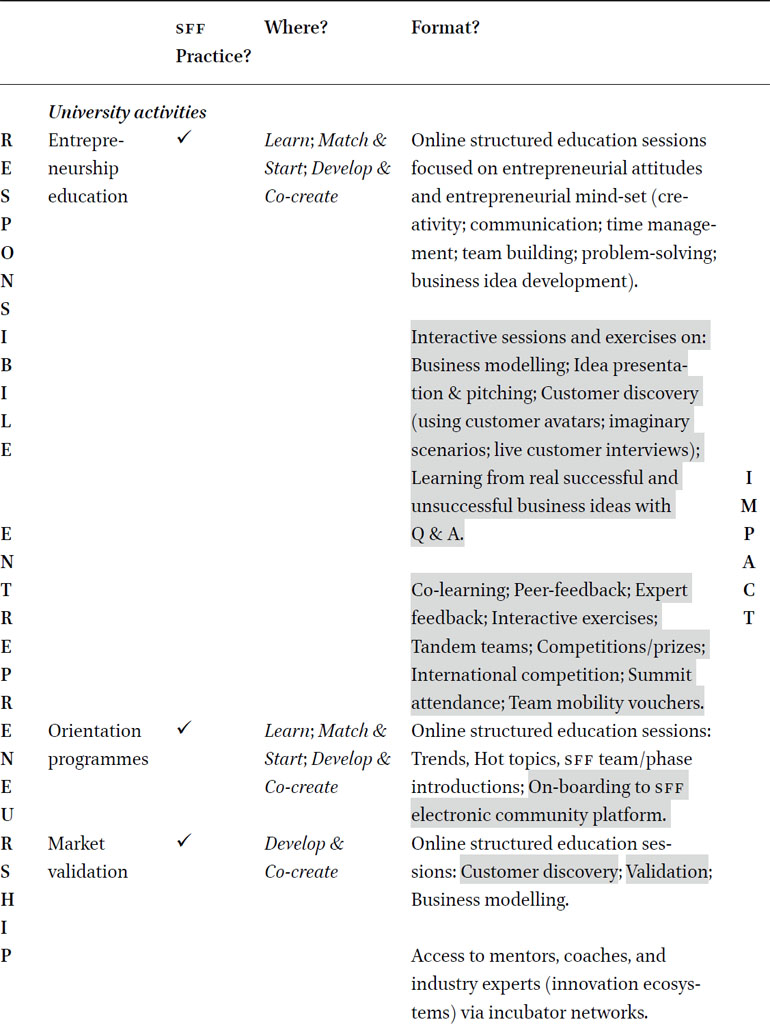
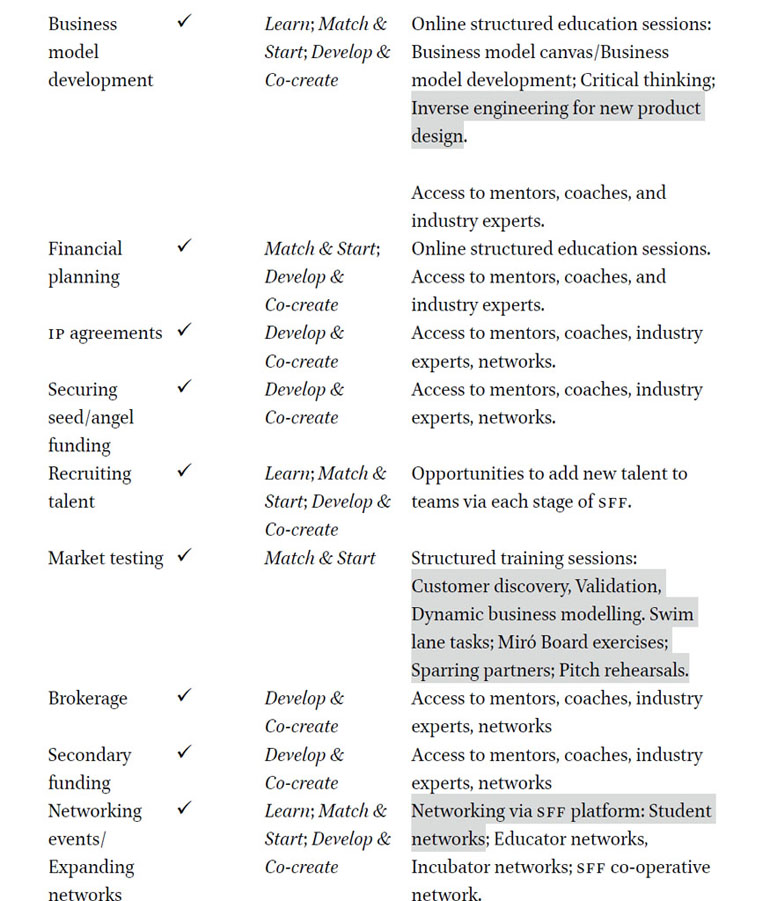
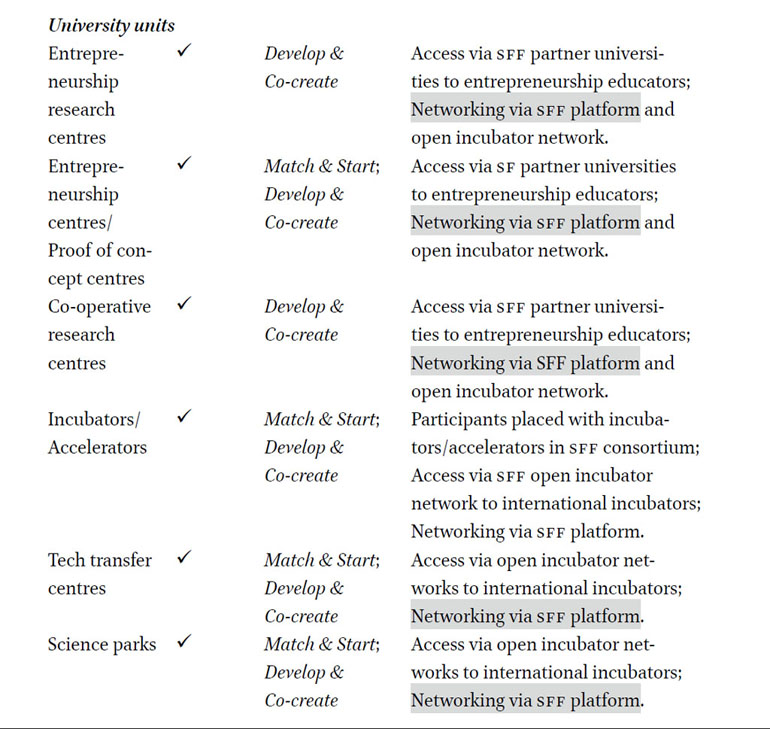
Table 3 shows how the various components of Cunningham et al.’s (2022) framework are operationalised within the different phases of SFF. All components in both the ‘activities’ and ‘units’ are present in SFF in some way, whether explicitly or implicitly. This is not surprising given the size of the consortium and the emphasis on shared resources. The various formats in which these components appear are summarised in the right-hand column of the table.
Mapping SFF entrepreneurial practices
Citation: Triple Helix 11, 3 (2024) ; 10.1163/21971927-bja10054
Source: Authors’ compilation using a framework adapted from Cunningham et al. (2022)Consistent with the entrepreneurial university ethos (Klofsten et al., 2019; Pontikakis et al., 2022), SFF formats rely on principles of engagement, co-creation, and experiential learning, offering participants a sense of independence to work on their own real-life projects in the fun, encouraging and supportive ‘mega entrepreneurial ecosystem’ created by the SFF consortium. SFF methods include tandem teams, competitions, prizes and customer discovery sessions, the latter typically delivered using imaginary scenarios and customer avatars, alongside swim lane tasks and real live customer research and interviews. Such elements provide opportunities for reflective practice within real life contexts.
4.2 Responsibility
Our analysis of the Institutional Reflective Score Grids revealed universities to be fully aware of the importance of responsible entrepreneurship education, with some embedding it into their teaching and learning to varying degrees by focusing on the SDGs. SDG5 (Gender Equality) was found to be one of the responsibility areas given most attention by the universities (mean score 3.27). This is not surprising given the significant efforts made by the European Commission and other bodies, as well as initiatives such as Athena Swan, to enhance gender equality in the higher education sector. However, somewhat surprisingly, SDG10 (Reduced Inequalities) was given less attention (mean 2.54). This may suggest that the positive strides made regarding gender issues have not yet been replicated in other EDI areas such as ethnicity, disability, or social/economic disadvantage.
In a separate questionnaire, SFF WP Leaders were asked to indicate which SDGs their work package focused on (multiple answers were encouraged). SDG17 (Partnerships for the Goals) was the most popular area of focus (cited by 86% of respondents). This was followed by SDG4 (Quality Education) (74%), SDG9 (Industry, Innovation & Infrastructure) (60%), SDG8 (Decent Work & Economic Growth) (59%), SDG5 (Gender Equality) (52%), SDG11 (Sustainable Cities & Communities) (46%), SDG3 (Good Health & Well-being) (42%), and SDG10 (Reduced Inequalities) (38%). Interestingly, even though the project focuses on entrepreneurship and education, the partnership aspect (SDG17) was recognised as crucial to achieving SFF’s objectives. Collaborating and co-creating across disciplines, institutions and national borders proved to be one of the most important components of the project. The focus on Quality Education was not surprising given the academic make-up of the partners and their strong entrepreneurship education orientation. The focus on Decent Work and Industry & Innovation was also to be expected given the aims and objectives of SFF.
When asked about the specific responsibility activities that WP Leaders engaged in as part of SFF, respondents highlighted the project’s strong Partnership, Quality Education, and Industry & Innovation focus, as evidenced by snippets from the narrative responses below.
“[Our WP] aims to establish a strategic, sustainable, international alliance that connects academia, industry, start-ups, and policymakers [who] support each other and strive to create systemic innovations that promote a sustainable society.”
“[Our WP] is designed around a holistic approach which is a perfect match with the most global UN SDGs … UN SDGs are the perfect source for project-based learning process.”
Collectively, these activities highlight a dedication to responsible and impactful entrepreneurship education that is spread across the various SFF WPs. Although various SDGs are focused on to different extents, and, indeed, some SDGs are not mentioned specifically, much of the responsibility focus occurs on a secondary level through the types of business ideas that students are encouraged to pursue, as evidenced in the following quotation:
Throughout this stage [Learn], partner HEIs from SFF.DeepT+ will select topics of deep tech domains and align with BA and MA courses. The challenges dealing with the broader thematic area of deep tech will be either handed-out within the context of the courses, identified by students given their background and expertise, or provided by industry partners from the respective innovation valley.
4.3 Impact: Students’ Entrepreneurial Transformation
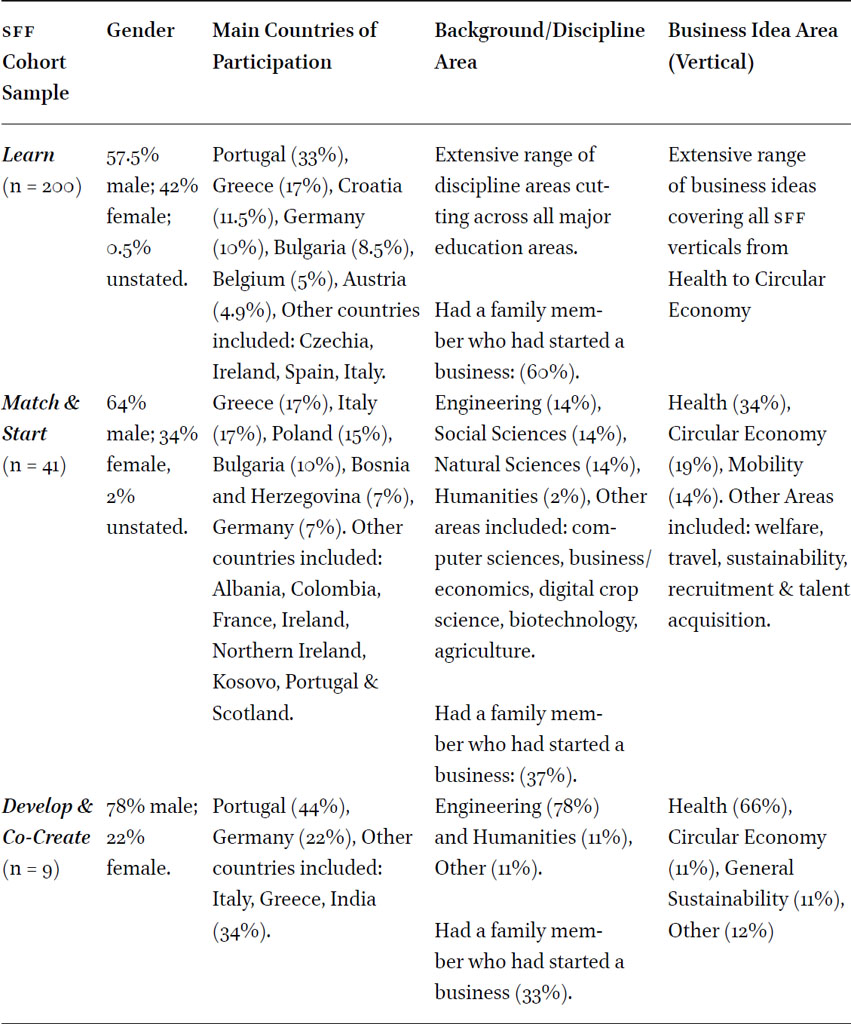
SFF focuses on igniting the entrepreneurial spirit and introducing participants to entrepreneurship in a novel and responsible manner (Learn phase), testing/validating ideas and preparing for incubation (Match & Start phase) and developing ideas and going through the incubation process in a partner incubator (Develop & Co-create phase). Participants covered a wide geographical spread, had different backgrounds and were developing a diversity of business ideas within the SFF verticals. This heterogeneity reflects SFF’s growing international and inclusive ethos (see Table 4).
Profile of the students surveyed (n = 250)
Citation: Triple Helix 11, 3 (2024) ; 10.1163/21971927-bja10054
Source: Authors’ compilationTo assess impact, the student questionnaires included constructs assessed with between three and six items. These measured: Entrepreneurial identity (example item: “I am able to develop a vision of the road ahead that inspires others”), entrepreneurial intentions (“I have seriously considered becoming an entrepreneur”), sustainability competence (“I am able to critically reflect upon what is viewed as ‘good sustainable practice’ in my field of study”), venture creation self-efficacy (“I know how to develop an entrepreneurial project”), and collaboration competence (“I am able to make my team members feel seen and appreciated”). We also explored participants’ idiosyncratic view of the world, asking: 1) if they often get unique ideas; 2) whether now they value resources and combinations of resources differently than many others; 3) whether their capacity in identifying novelty in trends is different to many others. For the Develop & Co-create phase, students were also asked about the benefits derived from the incubator services.
In the first phase of SFF – Learn – participants perceived significant development in their entrepreneurial abilities because of their involvement in the programme. This was particularly true in relation to their venture creation self-efficacy and SFF’s influence on them having an idiosyncratic view of the world. Regarding the latter, the degree to which SFF developed participants’ entrepreneurial identity was especially positive. We observed that students identifying as male and participants with entrepreneurial experience tended to possess a more idiosyncratic world view. We also observed that students identifying as female appeared to benefit more than their male counterparts from the SFF programme. Indeed, compared to males, females exhibited greater development in their entrepreneurial identity and displayed more positive attitudes towards pursuing a career as self-employed due to their participation in Learn.
Not surprisingly, the impact of SFF seemed to increase in subsequent phases of the programme as participants delved deeper into their business ideas. In both Match & Start and Develop & Co-create, participants again scored quite highly across all constructs (4–7). Entrepreneurial purpose, entrepreneurial self-efficacy and entrepreneurial intention were particularly high-scoring areas (6–7), with just one participant in each phase giving a low score in the latter two items (2 and 4, respectfully) for each question. In Develop & Co-create, most participants rated their incubation experience very highly, awarding a score of 7. Incubation seemed to help participants in terms of networking, collaboration and gaining better knowledge and awareness about the product-market fit around their business project. They also found the process particularly useful in terms of business development and access to shared facilities. Business coaches were rated highly, with more than half of the scores awarded being 7. Only one respondent in this phase was unsatisfied with the process. That said, all participants reported that they would recommend SFF to others.
The most valuable aspects of the final phase – Develop & Co-create – identified by participants were experiential in nature, and included: Networks and workshops/Webinars and the general atmosphere; the range of information provided from the European start-up ecosystem that SFF creates; learning how to evolve and improve; moving from an idea to reality; working with coaches; support from the incubators; pitching; getting feedback from judges, and contact with investors. Aspects identified as requiring improvement included: The SFF electronic platform; support with developing the business plan and clearer feedback from judges/coaches.
4.4 Impact: Responsibility and Wider Implications
SFF WP Leaders were confident that their work was having a considerable impact, especially in terms of responsibility. Several references were made to collaboration and networking activities being significantly enhanced through the SFF consortium. Themes of an international community, learning from each other and interacting with stakeholders emerged. It was clear that SFF activities were positively affecting the SDG agenda by providing education and training that promoted innovative start-ups in important SDG-related sectors such as food, health, manufacturing, mobility, energy, and the circular economy. WP activities focused on societal problems to promote well-being, encourage co-working and raise awareness of SDGs across the consortium, as evidenced by the following snippets of narrative:
“The eco-system stakeholders learn from each other; universities and incubators are actively networked with each other. …”
“[SFF] Energizes educators and non-academic staff for collaboration in project-based learning process based on issues of well-being for everyone and of sustaining the life of the planet.”
Finally, and realistically, a few WP Leaders pointed out that it was probably too early to start measuring the responsibility impact of SFF because:
Social innovations are transformation processes that take time … the long-term direct and indirect impact of the SDGs programme can only be estimated in a few years.
5 Discussion
In this section, we delve deeper into the findings from our SFF case study, discussing them in the context of relevant academic literatures. By applying the interlinked theoretical lenses of entrepreneurial ecosystems (Graham, 2014; Stam & Van de Ven, 2021; Mazzarol, 2014), entrepreneurial university architecture (Cunningham et al., 2022), and effectuation (Sarasvathy, 2022), we shed light on how universities create the appropriate environment to execute their new ‘changemaker role,’ adopt impactful approaches to their entrepreneurial activities, and ultimately deliver their ‘third mission.’ These themes intertwine in this discussion to address the various components of our core research question, enhancing our understanding of how universities can “create novel, responsible, and impactful entrepreneurship education models.”
5.1 Creating the Appropriate Entrepreneurship Environment: a Strategic Approach
The three SFF phases offer effective, structured and tailored entrepreneurial development opportunities for students according to the maturity level of their idea. For example, Learn has been shown to enhance the development of an entrepreneurial mindset, which is recognised as an important precursor of entrepreneurial behaviour (EU, 2018). Additionally, this phase has been shown to provide students with a unique perspective on the world, stemming not only from the challenges addressed in their entrepreneurial projects but also from their sense of belonging to a larger cross-country community. Students then continue to the Match & Start phase where they are matched with experts, mentors, and incubators to further develop their ideas. Finally, in phase 3 (Develop & Co-create), the student teams join an incubator of their choice and focus on developing a sustainable business model in preparation for entering national or international markets. Accordingly, students are supported through all phases of the new venture creation process (Mazzarol, 2014).
By applying Cunningham et al.’s (2022) entrepreneurial university architecture framework we were able to map the various entrepreneurial practices within SFF. This analysis shows SFF to comprise the required entrepreneurial architecture to deliver its entrepreneurial activities, offering not only core entrepreneurship education programmes but also, through its ‘network of networks’, providing extensive access to a range of entrepreneurial units/services (e.g., incubators, research centres, tech transfer offices, investors). This demonstrates a deliberate strategic approach on the part of SFF to build the appropriate entrepreneurial ecosystem to promote entrepreneurship on a pan-European scale; a ‘mega ecosystem’ where participants are given access to critical components such as education and training, mentors and advisers, human capital, local and global markets, and funding sources (Mazzarol, 2014; Stam & Van de Ven, 2021). Finally, through this architecture, SFF participants are exposed to other cultures, policies, and regulatory frameworks, broadening their entrepreneurial mindset, and preparing them for internationalisation (EU, 2018).
5.2 The Shift from Content to Method
For some time now, scholars have been calling for entrepreneurship educators to shift their focus from content to method (Neck & Greene, 2011). Interactive elements such as pitch competitions, prizes, imaginary scenarios, swim lane tasks, customer avatars, mobility vouchers and final celebrations/awards contribute to a dynamic learning experience, effectively balancing what some students perceive as a challenging programme with a supportive and safe learning environment. However, HEIs often fail to either incorporate interactive approaches or engage in co-creation activities to foster entrepreneurial mindsets and competencies. Indeed, despite universities often adhering to quintuple helix models (Barth, 2011; Carayannis et al., 2012), a co-creation approach is not consistently reflected in entrepreneurship teaching methods. The SFF model presented in this article offers a framework in which entrepreneurial students, regardless of the stage of their entrepreneurial ideas, can actively interact with ecosystem stakeholders to co-create and enrich their learning experience (Puerta-Sierra & Puente-Diaz, 2023).
5.3 Entrepreneurial Transformation: Operationalising the Changemaker Role
An important and more recent dimension to universities’ ‘third mission’ is the expectation to engage with the UN’s SDGs. We stated at the outset of this article that, as future ‘changemakers,’ universities will need to drive social, economic, and technological transformation. This can be achieved by adopting a responsibility-focused agenda and incorporating SDGs into entrepreneurship programmes to localise solutions to societal problems (Pontikakis et al., 2022). Our findings demonstrate that universities are particularly well placed to do this (Cai & Ahmed, 2023). In SFF, partners have created ‘a network of networks’ (Scott et al., 2022) by deploying effectuation strategies (Sarasvathy, 2022) to connect aspiring and existing entrepreneurs with relevant supports through collaborating, sharing resources, co-creating, and engaging with stakeholders at the international level. Such activity allows universities to exploit their knowledge and human capital to construct and sustain a highly effective entrepreneurial ecosystem capable of supporting entrepreneurship activity at all stages of the new venture creation process (Mazzarol, 2014). Such activity aptly reflects the type of strategic international ecosystem-building capability (Scott et al., 2022) required of universities in their new changemaker role.
Our findings evidence that universities within the SFF consortium are acutely aware of the importance of responsible entrepreneurship education, and the need to embed it into their teaching. Within SFF, this has been achieved by focusing the entrepreneurship education projects on SDG-related verticals that represent some of society’s big contemporary challenges (e.g., urban mobility, circular economy, food, health, etc.). This is not surprising given the overarching focus of the SFF project.
The SFF case fosters an inclusive framework for entrepreneurship on various levels. For example, we could validate the inclusive approach of the entrepreneurial training modules in relation to gender roles. The fact that female students could benefit more from the programme showcases the shift away from the male-dominated sphere of entrepreneurship as it is often perceived in public discourse and research (Henry et al., 2021). Enabling female students to launch entrepreneurial journeys has important implications for gender equality and social justice. On a macro-level, SFF also manifests an inclusive framework, which is evidenced by the significant number of respondents emphasizing SDG17. Our study’s findings suggest that SFF has created an operational model that is inclusive and can be adopted by various national contexts and different kinds of institutional settings.
The impact of SFF’s changemaker role is evidenced in its positive transformational impact across a heterogeneous group of students. The programme has transformed students’ venture creation self-efficacy, most notably in terms of entrepreneurial identity. This transformation has intensified as students progressed from Learn through the subsequent phases of Match & Start and Develop & Co-create. It is noteworthy that the more experiential aspects of SFF, (e.g., networks, working with coaches and incubators, pitching, and getting feedback from judges), were those that participants valued most. These elements would not have been possible without the strategic international ecosystem building approach adopted by SFF. Building such an ecosystem requires collaboration and networking (Scott et al., 2022).
Finally, SFF activities are already having a positive effect on universities’ wider responsibility agendas. Reflecting the importance of effectuation strategies (Sarasvathy, 2022), SFF WP Leaders consistently cited networking, resource sharing activities and collaboration as being significantly enhanced because of their involvement in the SFF project. University staff reported interacting effectively with stakeholders to support innovative start-ups to promote the well-being of both people and planet. They engaged in co-working, shared knowledge across countries and raised awareness of SDGs within their own institutions and across the consortium. All of this reinforces the need for collaboration, networking, and co-creation.
5.4 Implications
Our findings have implications for universities, entrepreneurship educators and all those engaged in the entrepreneurship education agenda. We categorise these under the following thematic areas:
Environment: HEIs need to prioritise creating the appropriate environment for delivering their ‘third mission.’ However, as the SFF case study has demonstrated, this cannot be achieved in isolation. A strategic approach to entrepreneurial ecosystem building is required; one that supports entrepreneurs at every stage of the new venture creation process, and recognises the importance of collaboration, networking and co-creation. Universities must engage effectuation strategies and force themselves to think beyond regions and borders to provide their students and stakeholders with a wider perspective where they can access the full range of ecosystem supports and learn from other cultures, regulatory frameworks and markets. SFF presents as a valuable and highly translational ecosystem framework (Scott et al., 2022) that other universities and consortia can adapt and operationalise.
Inclusivity: Besides creating the right environment for entrepreneurship, the SFF case shows that HEIs need to foster inclusive patterns and mechanisms of cross-institutional and transnational collaborations. While HEIs often focus on their own strategies and specific partnerships, fostering openness and a common goal beyond immediate returns on the time and resources invested can achieve more impact. Similarly, designing entrepreneurship programmes in an inclusive manner, as in the case of SFF, may enhance the development of female entrepreneurship.
Method: Our analysis of SFF entrepreneurial practices reveals a typology of entrepreneurial practice components in terms of both content and methods. This typology should be useful for universities and entrepreneurship educators. Feedback from SFF student participants has demonstrated that students value the more experiential components. Accordingly, consistent with Neck & Greene (2011), we conclude that it is time for universities to shift their focus from content to method – from what they teach to how they teach. In this regard, playful elements such as those identified by Franzén et al. (2020), should be incorporated to engage learners and enhance their learning experience. Many of these are evidenced in the SFF typology presented in this article (Table 2).
Changemaker role: It has been acknowledged that universities, especially those that consider themselves to be ‘entrepreneurial universities,’ are well placed to adopt a responsibility-focused agenda, incorporating the SDGs into their entrepreneurship programmes to localise solutions to societal problems (Cai & Ahmed, 2023; Pontikakis et al., 2022). Indeed, ecosystems theory positions universities as catalysts within the entrepreneurial ecosystem. Consistent with the need to create the right environment, we conclude that universities need to operationalise quintuple helix models to spearhead responsibility agendas and, in so doing, create long-lasting impact not only within their region, but beyond their borders.
6 Conclusions
This article set out to critically explore the novel entrepreneurship education model employed by the Start for Future (SFF) project, and to demonstrate how such a model might help pave the way toward more transformative, responsible and impactful entrepreneurship education.
Adopting a qualitative case approach, we asked: How can universities create novel, responsible, and impactful entrepreneurship education models? Answering this question could enhance the take-up and relevance of responsible entrepreneurship education and encourage educators to engage in novel and impactful teaching approaches.
We conclude that, in order to create novel, responsible and impactful entrepreneurship education models, universities need to first create the appropriate entrepreneurship environment. This involves acting strategically to provide supports appropriate to students’ needs and the stage of development of their entrepreneurial projects. Linked to such strategic actions is a much needed reorientation toward the method rather than the content of entrepreneurship education. This involves recognising the importance of a responsible approach and the critical role of the SDGs. Using the SFF project as an example, this article underscores and enhances understanding of the new and critical role universities play as entrepreneurial changemakers, driving social, economic and technological transformation. Our study, which was informed by multiple data sources, helps illuminate the responsibility dimension in driving impactful entrepreneurship. Finally, by analysing the various entrepreneurial practice components of SFF, we have drawn attention to a novel, playful and impactful entrepreneurship education model – one built on the principles of responsibility, reciprocity, mutual learning, co-creation and experimentation. In doing so, we privilege entrepreneurship educators’ responsible entrepreneurial practice, sharing novel and impactful methodologies that we hope can be readily adopted by other universities globally.
6.1 Limitations of the Study
Notwithstanding the insights gained, we acknowledge the inherent limitations our study. One crucial limitation could be referred to as the ‘insider perspective’. All authors and their institutions were partners in the SFF project, which raises the question of their “personal stake and substantive emotional investment in the setting” (Brannick & Coghlan, 2007, p. 60). Through our methodology and sampling, as well as a heightened reflexive awareness towards our internal perspectives, (Alvesson & Sandberg, 2022), we attempted to decrease such internal biases. Moreover, although 250 students can be considered a reasonable sample size, it represents only 15% of SFF participants to date. Also, while our study captured participants at different stages of the programme, we were unable to track sequentially individual students’ progress from one phase to the next. Finally, we acknowledge that we have not yet tracked SFF ‘graduates’ beyond the incubation phase.
6.2 Avenues for Future Research
Our study reveals some valuable areas worthy of future research. First, researchers in this field should consider conducting larger scale studies into the playful, responsible and impact dimensions of university-led entrepreneurship programmes, critically comparing the influence of the different local ecosystem contexts. Findings could prove invaluable in helping universities’ develop more strategic approaches to ecosystem building, ensuring they develop the appropriate environment for entrepreneurship. Second, future research could critically explore how students transition from one phase to another in the new venture creation process. This could help enhance the success and impact of entrepreneurship programmes, including SFF. Third, focusing on entrepreneurial methods, future research would benefit from longitudinal studies that explore the impact of specific playful pedagogies at various stages of the new venture creation process. This longitudinal dimension could help generate a valuable typology of successful entrepreneurial learners, business ideas and pedagogical approaches.
We hope that sharing the SFF experience has helped demonstrate some of the ways entrepreneurship programmes might be made more playful, responsible and impactful through co-creation, networking and stakeholder engagement. We call on universities globally to continue their efforts to incorporate playful and responsible approaches into their programmes. Finally, we also call on researchers to seek out novel and, potentially, playful approaches for their evaluations so that good practices can be illuminated and shared by everyone.
Acknowledgements
We acknowledge the support of EIT and the European Union through the following projects which form part of the SFF consortium: TANDEM+ (KAVA 21411), EUAccel (803/21410); SFF.DeepT+ (23611) and SFFAccel (23610). We are grateful to the entire Start for Future Consortium, SFF WP Leaders, student entrepreneurs, entrepreneurship educators and managers, and all those who kindly participated in this study.
References
Alvarez, S. A. & Busenitz, L. W. (2001). The entrepreneurship of resource-based theory, Journal of Management. 27(6): 755–775.
Alvesson, M. & Sandberg, J. (2022). Pre-understanding: An interpretation-enhancer and horizon-expander in research. Organization Studies, 43(3), 395–412. https://doi.org/10.1177/0170840621994507.
Audretsch, D. B. & Belitski, M. (2021). Three-ring entrepreneurial university: In search of a new business model. Studies in Higher Education (Dorchester-on-Thames), 46(5), 977–987. doi: 10.1080/03075079.2021.1896804.
Barth, T. D. (2011). The idea of a green new deal in a Quintuple Helix Model of knowledge, know-how and innovation. International Journal of Social Ecology and Sustainable Development, 1(2), 1–14.
Bernard, H. R. (2002). Research methods in anthropology: Qualitative and quantitative approaches, Alta Mira Press: Walnut Creek, CA.
Brannick, T., & Coghlan, D. (2007). In Defense of Being “Native”: The Case for Insider Academic Research. Organizational Research Methods, 10(1), 59–74. https://doi.org/10.1177/1094428106289253.
Brush, C. (2014). Exploring the concept of an entrepreneurship education ecosystem. Innovative Pathways for University Entrepreneurship in the 21st Century (pp. 25–39). https://www.doi.org/10.1108/S1048-473620140000024000.
Cai, Y. & Ahmad, I. (2023). From an Entrepreneurial University to a Sustainable Entrepreneurial University: Conceptualization and Evidence in the Contexts of European University Reforms. Higher Education Policy 36, 20–52. https://doi.org/10.1057/s41307-021-00243-z.
Carayannis, E. G., Barth, T. D. & Campbell, D. F. J. (2012). The Quintuple Helix innovation model: global warming as a challenge and driver for innovation. Journal of Innovation and Entrepreneurship 2012, 1:2 http://www.innovation-entrepreneurship.com/content/1/1/2.
Carayannis, E. G. & Campbell, D. F. J. (2009). ‘Mode 3’ and ‘Quadruple Helix’: toward a 21st century fractal innovation ecosystem. Int. J. Technology Management, 46(3/3), 201–234.
Compagnucci, L. & Spigarelli, F. (2020). The Third Mission of the university: A systematic literature review on potentials and constraints. Technological Forecasting and Social Change, 161, 120284. https://doi.org/10.1016/j.techfore.2020.120284.
Creswell, J. W. & Plano Clark, V. L. (2011). Designing and conducting mixed-method research, Sage, Thousand Oaks, CA.
Cunningham, J. A., Lehmann, E. E. & Menter, M. (2022). The organizational architecture of entrepreneurial universities across the stages of entrepreneurship: a conceptual framework. Small Business Economics, 2022, 59(1), 2: 11–2: 27.
Eisenhardt, K. M. (1989). Building theories from case study research, Academy of Management Review, 14(4): 532–550.
Etzkowitz, H. (1983). Entrepreneurial scientists and entrepreneurial universities in American academic science. Minerva, 21(2–3), 198–233. https://doi.org/10.1007/bf01097964.
Etzkowitz, H., Webster, A., Gebhardt, C. & Terra, B. R. C. (2000). The future of the university and the university of the future: Evolution of ivory tower to entrepreneurial paradigm. Research Policy, 29(2), 313–330. doi://dx.doi.org/10.1016/S0048-7333(99) 00069-4.
EU. (2018). EntreComp Framework. European Commission, Luxembourg. Available from: https://ec.europa.eu/social/main.jsp?catId=1317&langId=en.
Fox, J., Pittaway, L. & Uzuegbunam, I. (2018). Simulations in Entrepreneurship Education: Serious Games and Learning Through Play. Entrepreneurship Education and Pedagogy, 1(1), 61–89.
Franzén, R., Heljakka, K. & Nieminen, L. (2020). Playful approaches to entrepreneurial competencies in university teaching: introducing the 4Cs model. In Advances in Creativity, Innovation, Entrepreneurship and Communication of Design: Proceedings of the AHFE 2020 Virtual Conferences on Creativity, Innovation and Entrepreneurship, and Human Factors in Communication of Design, July 16–20, 2020, USA.
Gibb, A. (2007). Creating the entrepreneurial university: Do we need a wholly different model of entrepreneurship. Handbook of research in entrepreneurship education, 1: 67–103.
Graham, R. (2014). Creating University-Based Entrepreneurial Ecosystems: Evidence from Emerging World Leaders. Cambridge: Massachusetts Institute of Technology.
Guba, E. G. & Lincoln, Y. S. (1994). Competing paradigms in qualitative research, in Denzin, N. K. & Lincoln, Y. S. (Eds), Handbook of Qualitative Research, Sage, Thousand Oaks, CA: 105–117.
Henry, C., Coleman, S., Foss, L., Orser, B. J., & Brush, C. G. (2021). Richness in diversity: Towards more contemporary research conceptualisations of women’s entrepreneurship. International Small Business Journal, 39(7), 609–618. https://doi.org/10.1177/02662426211020608.
Henry, C. & Lahikainen, K. (2023). Exploring Intrapreneurial Activities in the Context of the Entrepreneurial University: An analysis of five EU HEIs, Technovation, Vol. 129, 102893, ISSN 0166-4972, https://doi.org/10.1016/j.technovation.2023.102893.
Hrubos, I. (2011). The changing role of universities in our society. Society and Economy. In Central and Eastern Europe ǀ Journal of the Corvinus University of Budapest, 33(2), 347–360.
Kariv, D., Matlay, H. & Fayolle, A. (2019). Introduction: entrepreneurial trends meet entrepreneurial education. In A. Fayolle, D. Kariv & H. Matlay, The Role and Impact of Entrepreneurship Education. Business. https://doi.org/10.4337/9781786438232.00006.
Klofsten, M., Fayolle, A., Guerrero, M., Mian, S., Urbano, D. & Wright, M. (2019). The entrepreneurial university as driver for economic growth and social change – key strategic challenges. Technological Forecasting & Social Change, 141, 149–158. doi: 10.1016/j.techfore.2018.12.004.
Magni, D., Pezzi, A. & Vrontis, D. (2020). Towards a Framework of Students’ Co-creation Behaviour in Higher Education Institutions. Ijmfa 12 (2), 119–148. doi: 10.1504/IJMFA.2020.109129.
Mazzarol, T. (2014). Growing and Sustaining Entrepreneurial Ecosystems: The Role of Regulation, Infrastructure and Financing. Small Enterprise Association of Australia and New Zealand (Seaanz), P. 17. Available from: https://Smallbusiness.Report/Resources/Whitepapers/28ea2090-9f50-4220-A098-A9435a2dbe20_Iicie.Pdf [last accessed 02/02/24].
Miles, M. & Huberman, A. M. (1994). Qualitative Data Analysis, Sage Publications, Beverly Hills, CA.
Moberg, K. S. et al. (2014). “How to assess and evaluate the influence of entrepreneurship education: A report of the ASTEE project with user guide and tools.” Technical report.
Moberg, K. S. (2020). An Epic literature review. Project report.
Neck, H. M., & Greene, P. G. (2011). Entrepreneurship education: known worlds and new frontiers. Journal of Small Business Management, 49(1), 55–70.
OECD. (2018). The Future of Education and Skills – Education 2030. OECD, Paris. Available from: https://www.oecd.org/education/2030/E2030%20Position%20Paper%20(05.04.2018).pdf.
OECD. (2023). A Long Winding Road: OECD economic outlook, June 2023. Available from: https://www.oecd.org/economic-outlook/june-2023/ (last accessed 10/03/24).
Pittaway, L. (2021). Entrepreneurship education in higher education: A review of the US context. Available at SSRN 3942514.
Pocol, C. B., Stanca, L., Dabija, D-C., Pop, I. D. & Mișcoiu, S. (2022). Knowledge Co-creation and Sustainable Education in the Labor Market-Driven University – Business Environment. Front. Environ. Sci. 10: 781075. doi: 10.3389/fenvs.2022.78107.
Pontikakis, D., Vazquez, I. Bianchi, G. (2022). Partnerships for Regional Innovation Playbook, Luxembourg: Publications Office of the European Union. http://dx.doi.org/10.2760/775610.
Puerta-Sierra, L. & Puente-Diaz, R. (2023). Co-creation in entrepreneurship education: How autonomy support enhances the intention to develop entrepreneurial ideas. Journal of Education for Business, 98(8): 443–451.
Rasmussen, E. A. & Sørheim, R. (2006). Action-based entrepreneurship education. Technovation, 26(2), 185–194. https://doi.org/10.1016/j.technovation.2005.06.012.
Reichert, S. (2019). The role of universities in regional innovation ecosystems. European University Association. https://www.reichert-consulting.de/wp-content/uploads/2021/11/EUA_-TheRoleofUniversitiesinRegionalInnovationEcosystem_report_final_2019.pdf.
Rubens, A., Spigarelli, F., Cavicchi, A. & Rinaldi, C. (2017). Universities’ third mission and the entrepreneurial university and the challenges they bring to higher education institutions. Journal of Enterprising Communities: People and Places in the Global Economy, 11(3), 354–372. htpps://www.doi.org/10.1108/JEC-01-2017-0006.
Sarasvathy, S. D. (2022). Effectuation: Elements of Entrepreneurial Expertise, Elgaronline, ISBN 978 1 83910 258 5 (eBook).
Scott, S., Hughes, M. & Ribeiro-Soriano, D. (2022). Towards a network-based view of effective entrepreneurial ecosystems. Rev Manag Sci 16: 157–187. https://doi.org/10.1007/s11846-021-00440-5.
Stam, E. & Van de Ven, A. (2021). Entrepreneurial Ecosystem Elements. Small Business Economics, 56: 809–832.
Toutain, O., Mueller, S. & Bornard, F. (2019). Decoding entrepreneurship education ecosystems (EEE): A cross-European study in primary, secondary schools and vocational training. Management international, 23(5), 47–65.
Trencher, G., Bai, X., Evans, J., McCormick, K. & Yarime, M. (2014). University partnerships for codesigning and co-producing urban sustainability. Global Environmental Change, 28, 153–165.
Warhuus, J., Tanggaard, L., Robinson, S. & Jensen, S. M. E. (2017). From I to We: Collaboration in Entrepreneurship Education and Learning? Education + Training, 59(3), 234–249. https://doi.org/10.1108/ET-08-2015-007.
Yin, R. K. (1994). Case Study Research: Design and Methods, 2nd ed., Sage Publications, Thousand Oaks, CA.
Yin, R. K. (2012). Applications of Case Study Research, 3rd ed., Sage Publications, Thousand Oaks, CA.
For simplicity, from this point we use the term “HEIs” to include both higher education institutions and universities.
TANDEM+ “Transformation, Acceleration, Networking, Development, Entrepreneurial Education and Mentoring+”) and EUAcceL (“Accelerating Innovation in Europe Through Start-up Development and Co-Creation”).
In May 2023, two new projects were added to the SFF consortium – SFF.DeepT+ and SFFACCEL. These were essentially the ‘new’ versions of the existing projects but with the addition of a deep-tech focus.
Moberg et al. (2014).
ASTEE (2014) – Assessment tools and indicators for entrepreneurship education – “A report of the ASTEE project with a user guide to the tools”, available from: https://eng.ffe-ye.dk/media/789196/astee-report-rev.pdf.
EPIC. (2020). “Entrepreneurial Potential and Innovation Competences – A course assessment tool: A guide to using EPIC on HEInnovate.” Technical report. See also Moberg (2020).
Participants were asked to reflect back to the start of the SFF programme and to determine the level of confidence they had in certain entrepreneurial competences at that specific point in time.