Abstract
Universities support regional innovation and sustainable development through research-based partnerships with local ecosystems, creating new business models addressing global and local societal challenges. In this shift towards a sustainable entrepreneurial university, the Start for Future (SFF) international alliance promotes entrepreneurial and innovation culture across Europe, through entrepreneurship tertiary education and business development. This qualitative case study investigates the characteristics and implications of stakeholder involvement in a cross-European context (with the SFF project as the object of investigation) including contribution to regional development and innovation. Results show the SFFâs significant potential for developing trained human capital acting entrepreneurially in an innovative and sustainable perspective, through a collaborative, transnational, cross-sectoral, and interdisciplinary community of engaged partners. Practical and policy implications include the need to cultivate long-term, bottom-up relationships among partners, both regionally and internationally, and to establish institutional long-term strategies to consolidate the network over time and ensure effective contributions from all.
1 Introduction
Sustainable regional development may be defined by several dimensions, such as natural and socio-spatial characteristics, the actors involved and their forms of collaboration and a temporal perspective (long-term vision) define sustainable regional development. It represents a continuous process of social search, learning, and communication that involves the environment, society and economy (Radinger-Peer et al. 2021). In this context, European universities increasingly conceive themselves as civically engaged (Goddard & Kempton 2016), and committed to fostering co-creation for sustainable development at the regional level. This happens through collaborations with several actors within universitiesâ wider contexts, such as the regions in which they are embedded. As argued by Goddard & Chatterton (2003), within the university, there are productive synergies between teaching, research and service to the community; in the region, there are connections between skills, innovation and community. By effectively managing the interface between these two elements, they can positively reinforce each other, with reciprocal benefits between the university and the region.
In line with the above, this case study aims to investigate the characteristics and implications of stakeholdersâ involvement in the Start for Future project in terms of the contribution to regional development and innovation.
Since 2021, Start for Future (SFF), a joint initiative of two European Institute of Technology (EIT) Higher Education Institution (HEI) projects and other international programs, aims at creating a sustainable international alliance of ecosystems. This promotes systemic innovation involving universities and their incubators, accelerators and the wider regional ecosystems (including other universities, private incubators and accelerators, startups, consultants, policymakers, civil society, governmental and non-governmental organisations) to co-create sustainable socio-economic and environmental impacts in Europe. The wider goal is to support the people participating in the network becoming more entrepreneurial and innovative and to contribute to regional innovation activities, by also creating international connections (EIT Initiative, 2023a; 2023b). For this reason, SFF provides a cross-university, three-stage entrepreneurship education program for talents and startups which transforms their business ideas from conception to sustainable venture. Moreover, it enhances the international mobility of startup teams and fosters knowledge exchange and collaboration among partner incubators. It also sustains peer learning and support among universities within the network, by providing a program that helps SFF partners to further develop and transform their existing regional entrepreneurial ecosystem into a more sustainable and innovative one, addressing stakeholder engagement, among other challenges (EIT Initiative, 2023a; 2023b).
The study draws upon the idea that collaboration within the regional ecosystems goes beyond the co-production of scientific knowledge and complements universitiesâ third mission with the so-called fourth mission of universities (Trencher et al. 2014). The latter applies co-creation approaches to foster sustainability solutions, in line with what was affirmed in the European strategy for Universities (EC 2022a) and the new European Innovation Agenda (EC 2022b), as well as with the Partnerships for Regional Innovation (Pontikakis et al. 2022). Universitiesâ activation of partnerships with other academic institutions, industry, government and civil society (Carayannis & Campbell 2009) is increasingly seen as a prerequisite for tackling various sustainability challenges (Clarke and Holiday 2006; Talwar et al. 2011; Whitmer et al. 2010). Such a multi-stakeholder, multi-department and place-based approach to partnerships is needed to tackle specific territorial challenges and achieve impacts within established time frames, based on an open innovation perspective (Pontikakis et al. 2022). It can be done by investing in Research and Development (R&D) and business innovation but also through education, skills and critical physical infrastructures (Pontikakis et al. 2022). Indeed, universities are increasingly asked to address the so-called twin transition, therefore, by equipping students with adequate skills to face the sustainable and digital transformation of society. This idea of transforming universities into changemakers, by supporting and fully engaging young and lifelong learners in unfolding green and digital transitions and developing sustainable solutions through technological and social innovations is also among the objectives of the European Strategy for Universities (EC 2022a). Universities willing to become agents of change in the sustainable regional development context need to work on shared ownership among the involved stakeholders, in terms of values, processes and outcomes (e.g.: resulting visions and measures) (Stoeglehner et al. 2009). For this reason, they need to consider collaborative ways of research and education allowing the generated knowledge to be negotiated and jointly determined between regional societies and universities (Peer & Stoeglehner 2013). Accordingly, Europe is pushing forward deep tech innovation, namely a form of innovation based on cutting-edge science, technology and engineering, that often combines advancements in the physical, biological and digital spheres and with the potential to deliver transformative solutions in the face of global challenges (EC 2022b). In this sense, universities can support the emergence and dissemination of such innovation through research-based co-creation approaches in collaboration with the actors involved in their regional entrepreneurial and innovation ecosystems and by supporting emerging deep-tech innovations from an entrepreneurial perspective. As expressed in the European Strategy for Universities (EC 2022a), which strongly supports entrepreneurship education and the provision of related services and facilities (e.g.: university incubators), these should work in close cooperation with the entrepreneurial sector, to help student entrepreneurs develop their ideas into businesses.
Moreover, universities should also undertake cross-sector university collaborations, as this can significantly contribute to a local or regional transition to sustainability (Whitmer et al. 2010; Yarime et al. 2012; Trencher et al. 2013). According to the EU perspective, such an approach enables the activation of innovative startupsâ potential to drive innovation across the economy and society in Europe and address the most pressing societal challenges, by â at the same time â also enhancing the European business landscape and associated markets (EC 2022a). To this aim, alliances among regional actors and between universities all over Europe, with their related regional ecosystems, are needed: by linking diverse expertise and activities across society (Arbo & Benneworth 2007), they enable social and technological innovation, thus contributing to their territorial innovation ecosystems (MâGonigle and Starke 2006; EC 2022a; Esparza Masana 2023). In this sense, the University can be seen as a network agent putting in contact the local systems of knowledge and expertise with the related broader national and international circuits (Atterton & Thompson 2010). As addressed in the EU Strategy for Universities (EC 2022a), transnational cooperation between universities strengthens their capacities to create value in terms of excellence in collaborative research and education, thus improving EU universitiesâ attractiveness and global competitiveness. Europe, indeed, fosters the creation of such networks that, in a long-term perspective, activate collaboration and mobility between staff, researchers and students to create new knowledge together, across countries and disciplines, by sharing capacities, resources and facilities (EC 2022a).
In this context, this case study aims to answer the following research question: âWhat are the characteristics of the stakeholders involved in Start for Future, and how does their involvement contribute to regional development and innovation?â Data was gathered through three online workshops entailing qualitative semi-structured collective interviews with a series of specific pre-identified stakeholders coming from different institutions connected to the SFF consortiumâs regional ecosystems â namely internal stakeholders, external stakeholders and educators â based on and adapted from Bischoff et al. (2018) and Galvão et al. (2020).
Results show the SFFâs significant potential for developing trained human capital acting entrepreneurially in an innovative and sustainable perspective, through the interaction within a collaborative, transnational, cross-sectoral, and interdisciplinary community of engaged partners. Nevertheless, some challenges need to be faced to guarantee long-lasting synergies (collaboration) and smooth operations (coordination), to enhance the project impact at the regional level.
The paper is structured as follows: the first section presents the theoretical framework related to the conceptualisation of the Sustainable Entrepreneurial University and its role in fostering stakeholder collaboration within entrepreneurial regional and transnational innovation ecosystems. Following, the methods applied in this study are presented, including a focus on the presentation of the case study. Finally, the main findings are presented and discussed, followed by the conclusions, practical implications and future research.
2 Theoretical Background
2.1 Embracing the Sustainable Entrepreneurial University in the Regional Entrepreneurial and Innovation Ecosystems
Regions are eco-systemic agglomerations of stakeholders (organisational and institutional entities) with socio-technical, socio-economic, and socio-political co-operative (sometimes conflicting, some others converging), goals, priorities, expectations, and behaviours. These are pursued through entrepreneurial actions (including development, exploration, exploitation and deployment), reactions, and interactions. The interactions beneath this regional co-opetitive entrepreneurial ecosystem occur among the Quadruple/Quintuple Helix actors, namely (government, university, industry, civil society, and environment) as the enablers and enactors (Carayannis & Campbell 2009; Carayannis et al. 2017). In this âMode 3â approach, as conceptualised by Carayannis & Campbell (2009), knowledge production is based on mutuality and complementarity among innovation networks and knowledge clusters (e.g.: human and intellectual capital, shaped by social capital, supported by financial capital). This answers the need for more democratised access to knowledge and innovation where local and traditional knowledge systems and the involved actors take part in collective processes of cultural and social transformation, especially in less developed regions (Rapini et al. 2024). This âMode 3â is described as a multi-layered, multi-modal, multinodal, and multi-lateral system, where universities are recognised to play a relevant role in terms of the co-opetitive knowledge creation, diffusion, and use (Carayannis et al. 2017). Indeed, Carayannis et al. (2018) mention and define a new type of entrepreneurial university that refers to âMode 3â. They affirm that a âMode 3â university or HEI can provide higher-order learning in the context of an open, complex and non-linear knowledge production system. This happens through creative ways of combining, recombining and integrating different principles of knowledge produced and applied (Carayannis et al. 2018). The context in which the authors contextualise their conceptualisations is the spatial (regional or national) innovation and entrepreneurial ecosystem that, as defined by Dubina et al. (2017: 438), is considered as âan open complex dynamic system with a framework, where a specific institutional environment of an innovative type is formed, and which takes into account the national (regional) economic interests and contributes to the activation and enhancement of innovations, technologies and human capital.â Cai et al. (2020: 12) take a step forward, by providing a wider definition of innovation ecosystems, in a co-evolutionary perspective: âco-innovation networks, in which actors from organisations concerned with the functions of knowledge production, wealth creation and norm control interact with each other in forming co-evolution and interdependent relations (both direct or indirect) in cross-geographical contexts, and, through which new ideas and approaches from various internal and external sources are integrated into a platform to generate shared values for the sustainable transformation of the societyâ. There are several aspects of this definition that prove relevant for this study: one is the interdependency among different collaborative actors. Indeed, this ecology-based concept focuses on cross-sectoral co-evolution and co-creation activities as links among the entities involved, over time, for the production of innovation from a sustainable development perspective (Oh et al. 2016; Cai et al. 2019). Novelty in this definition also comes with the reference to transnationality. In this sense, we assist in multi-level and synergetic integration processes between two or more innovation ecosystems across national borders, which work better if they start from already existing and bottom-up initiatives, where knowledge flows and innovation processes take place in multiple geographical locations (Cai et al. 2019). In this context, by pursuing their research and teaching missions and drawing upon their outreach knowledge transfer activity at both the regional and international levels, universities can play a pivotal role in activating and making visible the hidden links fostering transnational cooperation among actors from different innovation networks. Indeed, potential collaborations can be activated among entities from different geographical locations, by taking advantage of their common connections to existing university collaborations, often starting from individual collaborators (Cai et al. 2019).
The changing role of universities in contemporary society has been studied, amongst others, by Cai & Ahmad (2023), which highlighted the shift from the entrepreneurial university, focused on promoting economic growth through technology transfer towards a sustainable model of the entrepreneurial university, with several and broader engagement roles for social transformation. The authors highlight the difference between the entrepreneurial university and the sustainable entrepreneurial university in terms of roles played within innovation ecosystems. In terms of knowledge flow, while the former model sees the university as a knowledge producer for technology transfer, the latter sees it as an anchor organisation for knowledge exchange in a bi-directional and interactive way (see also Rinaldi et al. 2018; Tomasi et al. 2021). Regarding the interactions with innovation actors, the entrepreneurial university is more oriented towards a triple-helix approach (Etzkowitz 2008) with reciprocal collaborations with industries and governments. The sustainable entrepreneurial university is instead more focused on the quadruple helix approach (Carayannis & Campbell 2009) as they consider a larger variety of ecosystem actors, including citizens, and are interested in building trust relationships among all collaborators. Finally, considering the university and its relations with society, the entrepreneurial university is described as more focused on meeting societal needs mainly for growth and innovation, whereas the sustainable entrepreneurial university is committed to shaping a better future society by trying to accomplish its developmental role through the transformation of society â also based on the production of new knowledge (Shapiro 2005; Grau et al. 2017).
2.2 Shaping the Role of Universities and Stakeholdersâ Collaboration within Regional and Transnational Entrepreneurial and Innovation Ecosystems
In Europe, recently there has been a progressive transition and transformation in all three universitiesâ missions, leading to the Sustainable Entrepreneurial Universities paradigm (Cai & Ahmad 2023). These transformations entail new organisational processes and roles for Universities, among which the promotion of sustainable development and community engagement and its measurement, also focusing on equity and social justice. Some initiatives to tackle these new roles concern didactical activities (e.g.: designing new curricula and degree programmes), and the adoption of interdisciplinary approaches both on teaching and research, based on universitiesâ societal engagement (Posch and Steiner 2006; Rinaldi et al. 2018; Capano and Pritoni 2019).
Referring to a new economic role played by entrepreneurial universities, Audretsch (2014) adopted the concept of the âuniversity acting in the entrepreneurial societyâ, by shifting the focus towards the wider societal context, that now became âentrepreneurialâ. In this context, the university combines its traditional yet complex missions of an entrepreneurial university (technology transfer and commercialisation of university research; generation of startups and new ventures; supporting economic growth) with a resilient orientation, by adapting to the needs and concerns of society and providing thinking, leadership and activity to enhance the entrepreneurship capital.
In the European University Association report by Reichert (2019), the roles of universities in regional innovation ecosystems clearly emerge. Two main roles were identified:
1) they are central regional actors for knowledge production, skills development and cross-sectoral and interdisciplinary approaches for competitiveness and;
2) they represent cultural actors facilitating regional interactions, working as orchestrators of regional connectivity in all knowledge-intensive sectors and supporting a search for systemic sustainable co-created solutions to societal challenges.
The report also shows that to pursue their goal of orchestrators of multi-actor innovation networks, also beyond their regional borders, in a global orientation of knowledge production and with an open innovation approach, universities operate through the following activities:
1) educating âhuman capitalâ for innovation;
2) research/knowledge (co-)production for private and public value creation;
3) fostering knowledge exchange for innovation systems;
4) strategic transformation â embedding innovation.
As for the first point, related to education, the idea is preparing students or young researchers to become âgame changersâ, namely innovators able to identify social, technological and economic challenges, define or redefine them and find or adapt related disruptive innovations. This can be done through interdisciplinarity, self-organised teamwork project-based/challenge-based learning, digital skills modules and entrepreneurship education (entrepreneurial skills development; support to startups; mentorship with external stakeholders).
In the second point, which concerns research and knowledge co-production, universities balance their commitment to research between international research and regional relevance, by providing access to regional stakeholders in their innovation processes to a âglobal pipelineâ of knowledge and provide an accessible translation of the academic knowledge, to be integrated with external knowledge sectors of the business or public spheres. In these co-production processes, it is relevant for universities to involve experts and scholars from the field of regional science and planning, as they can put the basis for reciprocal understanding and for sharing the collaborative nature of the regional innovation system and overcoming the barrier of mindset differences or misalignment between goals and interests among the different stakeholders involved (Tomasi et al. 2024). Some activities under this point are: running cross-departmental/faculty interdisciplinary research to address major challenges and real-life problems, also through cross-disciplinary networks; focusing on social innovation and balancing innovation for commercial purposes with the attempt to address societal challenges and also running applied collaborative research funded by the industry and supported by other external partners; activating universitiesâ role as âhot spotsâ between the local to the global level, by increasing their research capacity to investigate regional stakeholdersâ needs and gain insights â also in transnational contexts â that support their research work: adapting resources and implementing regionally potential solutions and best practice experiences encountered through international research networks and projects (Tomasi et al. 2022).
In the third point, knowledge exchange is intended to go from technology transfer to multi-actor co-creation. This includes:
transferring technology and creating value and Intellectual Property (IP) from university research;
facilitating business innovation and enabling businesses with high innovation potential to easily access university research results by creating a good interface between university researchers and companies (especially SMEs with fewer resources, lack of time and cultural gap);
conducting university-industry research collaboration and building long-term strategic partnerships with businesses. This could be done in both a short-term and long-term perspective: e.g.: joint research projects (short-term) and establishing shared infrastructure (e.g.: labs, research centres, industry-based PhD programmes, etc.) (long-term);
supporting business creation: university spin-offs and start-ups represent a real contribution to regional innovation, through their impact-driven approach. This activity can be carried out by establishing dedicated support services (consultancy), incubation and acceleration programmes for student start-ups and research spin-offs and complementing them with metropolitan/regional support services;
offering continuing education/professional development courses for external stakeholders.
Finally, the fourth point is about strategic transformation towards innovation embeddedness at the institutional level. This aspect relates to the universityâs institutional transformation and development strategy including changes in terms of updated research organisation and teaching methods, more oriented to respond to regional/global challenges, personnel development, internal governance and financial incentives, creation of new or reinforcement of existing physical and non-physical infrastructure (e.g.: co-creation hubs), to be reflected and redesigned in terms of cultural and social embedding within the regional context.
What is clear is that contributing to regional development and innovation is a matter of co-responsibility among the Quadruple Helix actors (Carayannis & Campbell 2009). This is even more true as entrepreneurship â requiring the contribution of several regional stakeholders â is increasingly acknowledged to be pivotal for the promotion of regional growth (Bischoff et al. 2018). In this context, entrepreneurship education is seen as capable of developing entrepreneurial attitudes and skills in learners (Fayolle et al. 2006) and producing some tangible benefits contributing to regional growth (e.g.: more business and job creation, innovation, knowledge, productivity, resource efficiency, etc.) (Galvão et al. 2020).
Recalling the concept of a new âentrepreneurial societyâ (Audretsch 2014) and concerning a sustainable entrepreneurial university (Cai & Ahmad 2023), when focusing on university-based entrepreneurship education, it is to be recognised that a major role is played by the active participation of the universityâs internal and external stakeholders as members of a network (Galvão et al. 2020). Here, stakeholders encompass all the people or entities directly or indirectly affected by entrepreneurship education, namely, those actively involved in the provision of education or benefitting from it (Bischoff et al. 2018). Internal stakeholders are university affiliates, including university management and instructors, while external stakeholders contain all non-university stakeholders who are directly involved in or related to entrepreneurship education of the respective universities (Bischoff et al. 2018). Among internal ones are students; university managers and instructors; teachers; and Technology Transfer Office staff. External stakeholders include: alumni; other universities and academics (also at the international level); science and technology parks; policymakers at different governmental levels; business and industrial organisations; financial institutions; entrepreneurship support services (consultancy); incubator/accelerators; NGOs, civil society and community leaders; charity and social service providers; international organisations, etc. (Cai & Ahmad 2023; Bischoff et al. 2018).
The roles played by some of the mentioned external stakeholders are highlighted, based on Bischoff et al. (2018). Entrepreneurs and companies play roles mainly related to lecturing and story-telling, coaching and mentoring activities, advising and consulting services also in terms of curriculum development, sponsorship and investments or partnerships and collaboration in start-up projects, the provision of networks and contacts, and student internship placements, sponsorship, being members of a jury during startup contests, etc. Financial institutions mostly provide financial support and investments. They might act as evaluators of startup ideas and give lectures. Support services (public or private) can provide training courses, networking possibilities, and funding. Sometimes they support curriculum development, give lectures and provide mentorship and coaching. Incubators/Accelerators provide funding, coaching, business advice, expertise and infrastructure. From an international perspective, foreign universities cooperate as networks for the exchange of best practices and the joint organisation of entrepreneurship initiatives, entailing the application of international team teaching approaches, studentsâ mobility within entrepreneurship education programs and the establishment of international double-degree teaching programs. The national/regional governments play a more general role at the ecosystem level, by supporting university entrepreneurship and related education from a regulatory and strategic perspective (e.g.: university-related and regional financial/organisational initiatives/regional innovation strategies); by playing as a facilitator and funding agent (e.g.: start-up and accelerator services; economic incentives for university-business collaboration, research and infrastructure; marketing to attract investments and talents) (Reichert 2019). Even though the sustainable entrepreneurial university supports a Quadruple Helix approach to regional development and innovation and entrepreneurship education, the role of non-governmental organisations is still neglected. Nevertheless, NGOs and civil society organisations play a pivotal role in entrepreneurship education, in terms of provision of feedback, advice, experience, infrastructure and funding, activities and workshops organisation. Engagement in networking and partnerships is also relevant (Bischoff et al. 2018).
As affirmed by Galvão et al. (2020: 176) âStakeholder engagement plays a key, strategic role in the dynamics of local systems. When stakeholders are part of a network, their combined resources can form a framework for development policies and mechanisms that improve the transfer of knowledge and innovation leading to regional growth.â These networks, especially in entrepreneurship education, represent channels facilitating the flow of skills, knowledge, technology and development. To succeed in this facilitation of interactions, such networks need to be created, developed and consolidated (Galvão et al. 2020).
2.3 Challenges in Implementing the Sustainable Entrepreneurial University and Activating Their Roles in Regional Entrepreneurship and Innovation Ecosystems
Even though the scientific literature does not specifically address the challenges faced by universities in implementing the sustainable entrepreneurial university approach and in deploying their multifaceted roles in this context, there are several scientific and policy contributions that allow to reflect upon some of the barriers that might limit universitiesâ actions in this sense.
From an economic perspective, the willingness of European universities to progressively support sustainable innovation face financial limitations due to the institutionsâ dependence on public funding. This prevents or limits their ability to invest in long-term sustainability initiatives, especially if these take time to demonstrate their benefits (Compagnucci & Spigarelli 2020). Moreover, the availability of such fundings is often project-dependent. On the one hand, this approach is mainly supported by researchersâ or research groupsâ guided by a sense of the mission. Namely, such academics are willing to invest on the sustainable entrepreneurial university approach as part of their third mission in a variety of ways (Tomasi et al. 2024). Direct initiative in scouting funding opportunities and applying to call for projectsâ funding is one of these. On the other hand, such a willingness might suffer from constraints related to competing priorities (DÃaz-GarcÃa et al. 2015), e.g.: ordinary research activity, teaching or other institutional activities. In this context, there is not enough space for projects and, often, even when they are carried on, they end without a guarantee for continuity.
This is also a cultural and social issue. Indeed, in social terms, not all universities in Europe adopt an entrepreneurial mindset to produce sustainable impacts. Some universities still deal with traditional academic values focused on research excellence, while community-driven outcomes are not a primary objective (Guerrero et al. 2015). This can also be described as a cultural form of resistance, particularly common in institutions that do not consider entrepreneurship and sustainability as part of their academic integrity and independence (Lockett et al. 2019). On the opposite, a cultural change would require integrating sustainability and entrepreneurship within more traditionally research-focused institutions, discouraging the idea that such an approach would represent a shift away from core academic values (Foss & Gibson 2015).
Additionally, in legal terms, implementing the sustainable entrepreneurial university might be slowed down by some rigid regulatory frameworks and related bureaucracy. Even though the Bologna Process fostered the universityâs institutional autonomy and the European University Association (EUA 2021) describes the 2030 universities as âstrong, autonomous and accountableâ, such legal and administrative frameworks can decelerate the implementation of sustainable entrepreneurship initiatives. Indeed, structural regulations can hinder universitiesâ response to sustainability goals (EC 2017). Especially concerning their sustainable entrepreneurial role for research commercialisation, legal and policy barriers (e.g.: restrictive regulations for intellectual property) might prevent universitiesâ engagement with industry and governmental bodies (Pavie et al. 2014). Finally, from a more systemic perspective, challenges arise concerning the intermediary role sustainable entrepreneurial universities may play in their innovation ecosystems. Indeed, navigating complex stakeholder networks â especially when transnational â and supporting their interconnectedness, also entails facing misalignment among institutional, national, and EU-wide sustainability goals, producing fragmentation, as a consequence (EUA 2021). Cohesive policy support and structural reforms would facilitate the establishment of the sustainable entrepreneurial universities around Europe, also considering transnationality as a way to overcome the above mentioned challenges, in line with the most recent European strategies for Higher Education in connection with the European Green Deal (EC 2020).
3 Methodology
3.1 Case Study Presentation
Since 2021, SFF has been an international ecosystem alliance initiative running joint international entrepreneurship programs for talent and start-ups, intending to bridge the gap between academia and business creation by leveraging existing activities of HEIs and ecosystems to foster co-creation among innovation actors, combining the regional and international levels.
When the project started, many consortium partners already had cross- institutional ties. They built upon these connections, utilising existing successful formats from their institutions, further developing and promoting them under a unique international brand (EIT HEI Initiative 2023a; 2023b).
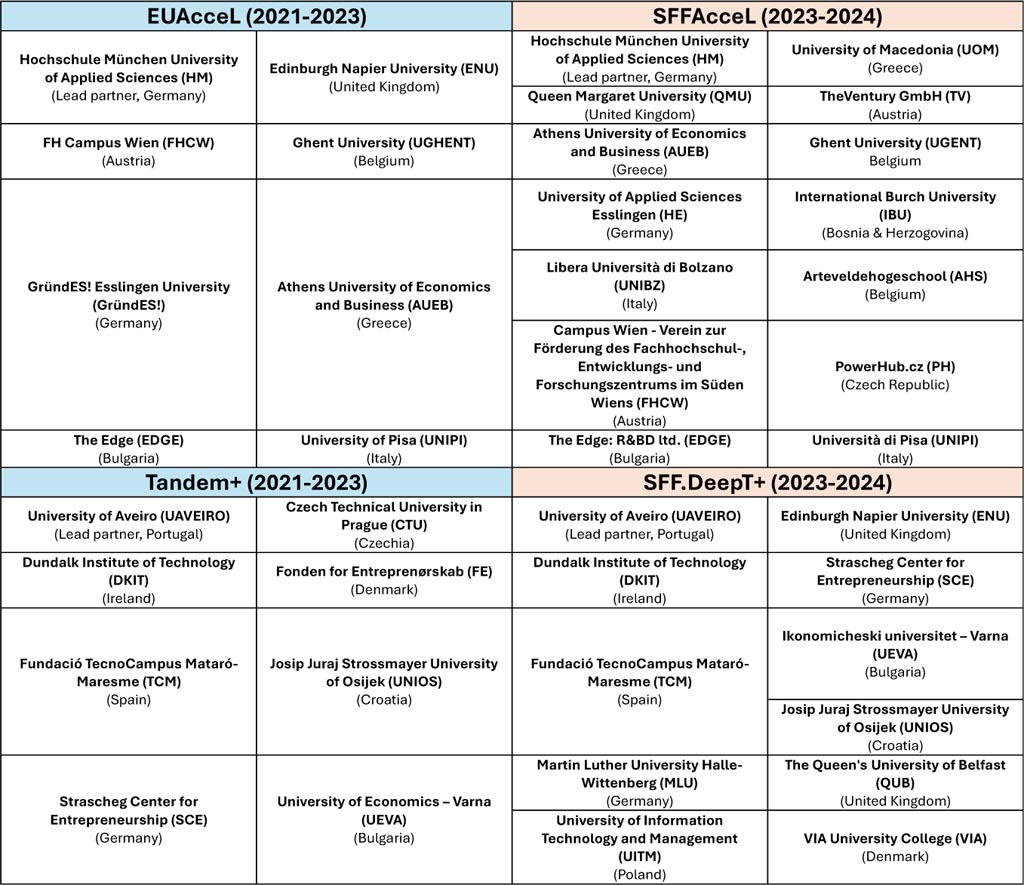
SFF1 (EIT HEI Initiative 2023a) is sustained by two EIT HEI projects and various international and national programs, including EUAcceL,2 Tandem +3 (EIT HEI Initiative Cohort 1, 2021â2023). During this research timeframe, SFF was funded under the EIT HEI Initiative Cohort 3 (2023â2024) through SFFAcceL4 and SFF.DeepT+5 projects, with a focus on DeepTech.
Figure 1 shows the SFF project consortium and its changes over time.

Project-based overview of the SFF consortium
Citation: Triple Helix 11, 3 (2024) ; 10.1163/21971927-bja10057
Source: authorsâ elaboration from EIT HEI Initiative websiteStrategic meetings organised by the consortium led to several working groups focused on governance, education and training for students and staff, research, startup incubation, business and ecosystem development, monitoring and assessment. Moreover, in-presence networking activities, conferences, co-creation workshops, start-up contests and meetings with investors are put in place during the SFF Summits, run every year, twice a year, both in Munich and in other hosting partner regions (e.g.: Varna â Bulgaria; Athens â Greece), involving SFF partners and members of their entrepreneurial and innovation ecosystems.
In line with the descriptions provided above and based on Cai & Ahmad (2023) and Bischoff et al. (2018), the SFF stakeholders can be divided into core target group; internal stakeholders and external stakeholders.
The SFF core target group is formed by international students, talents and student teams involved in the entrepreneurial education and startup development program, as well as early-stage startups. They are enrolled in Bachelorâs and Masterâs Degrees at the partner HEIs in the SFF consortium. Often, they attend curricular and extra-curricular entrepreneurship education courses in their institutions, which leads them to apply to the SFF programme. They come from several fields, such as STEM (especially from engineering and IT, as well as medical and healthcare sectors), social sciences (including economy, management and sociology) and humanities (including arts and creative fields).
Among the internal stakeholders are the consortium university partners themselves. They can be lecturers or researchers in the entrepreneurship field or the domains relevant to the project (e.g.: energy, mobility, manufacturing, health, food, etc.). Their role in SFF is to support studentsâ participation in the SFF programme, sharing knowledge and expertise by acting as trainers, coaches, mentors and sparring partners during the educational activities. Moreover, they establish and maintain good relationships with the external stakeholders from their innovation ecosystem and engage themselves in the networking activities promoted by SFF at the international level. This role might be also played by the staff from the technology transfer offices, university incubators and accelerators, who are also among the internal stakeholders. The people involved, at their institutions, work as incubator/accelerator managers, consultants, business advisors, designers and administrative staff. Some have a managerial role within the SFF programmes, and take care of specific tasks and educational activities. When involved in delivering entrepreneurship educational services as trainers and coaches, these stakeholders fall under the educatorsâ sub-category, which is internal.
All of the above-mentioned profiles play a role in fostering entrepreneurial mindsets and innovation through their active participation in the SFF educational programs and other relevant project activities, also at the ecosystem level, by sharing their knowledge and expertise and by running research and taking care of the monitoring and evaluation activities of the project.
External stakeholders include the businesses and industry stakeholders as well as the public sector and civil society representatives.
As for the formers, within SFF, they collaborate with startups and universities, by providing their expertise as coaches, mentors and industry experts. Companies and trade associations sometimes provide sponsorships, and share their facilities and infrastructure. They often belong to the fields relevant to the SFF project and also host (both virtually and physically) SFF startups and talents for the incubation processes. Moreover, they engage their representatives in the ecosystem and networking activities promoted by the SFF consortium at the regional and international levels. Among the external stakeholders, there are also private incubators/accelerators and innovation hubs, which provide support, resources, and mentorship to startups and talents, helping them grow and succeed. Moreover, individuals, such as consultants and business advisors, investors, venture capitalists and business angels offer their knowledge and expertise to support entrepreneurial activities and innovation within the ecosystem and promote investment opportunities for SFF startups and talents.
Public institutions, often municipalities and regions, support local innovation and entrepreneurial ecosystems/valleys, by creating the proper environment for startups and entrepreneurial activities. Sometimes, they launch public entrepreneurship initiatives such as support services offices for entrepreneurs, innovation hubs and co-working spaces, incubators/accelerators, and providing financial incentives for startups. In the context of SFF, they collaborate to enhance the regional entrepreneurial and innovation ecosystems by supporting initiatives and networking events and by putting funding, facilities and infrastructures at the projectâs disposal.
NGOs are less represented. Some engage with the SFF program to address socio-economic and environmental challenges, especially at the regional level. They also participate in ecosystem events, representing challenges and needs from civil society, to inspire startup ideas.
To allow all these stakeholders to connect and share initiatives held online or within the regional ecosystems, the SFF network also implemented the SFF online platform (startforfuture.eu). For the SFF consortium, it represents a shared space for operational tasks and scalability. It is used to complement the SFF entrepreneurship programme and reinforce its network. As for the former, it does it by stimulating and updating the programme participants as the programme managers can publish posts in the live feed with requests to accomplish small tasks, by providing students with knowledge pills and relevant news, by sending out programmes-related eventsâ invitations, etc. As for the latter, the platform serves as a dedicated virtual community working as a social network. The platform also hosts specific regional innovation ecosystems and thematic hubs: these are private groups where people from a specific geographical area or working on a specific theme (e.g.: research & academia) can share contents, events and update each other.
In line with the above-presented overview, at the moment, SFF has four main pillars of intervention:
SFF Academy: educational programs to foster entrepreneurial and innovation skills among university staff and students;
Open Incubation Programme: a three-stage cross-university entrepreneurship education program helping talents and startups transform ideas into viable ventures (LEARN, Match&Start, Develop&Co-create) continuously monitored and undergoing improvements and organisational changes.
Open Incubator: collaboration and resource sharing among SFF Alliance partners, promoting joint activities and mentoring.
Regional Innovation Valleys: fosters the development of existing ecosystems into sustainable innovation hubs with a deep tech focus and through peer support among partners.
Moreover, to provide continuity in time and economic sustainability to the SFF activities, besides the public fundings deriving from the funded projects, in 2023, the Start for Future European Cooperative Society, as a legal entity, was launched (Start for Future 2023), towards a transnational sustainable business-oriented approach.
3.2 Research Methods
In this research, a case study approach is used as it allows an in-depth exploration from multiple perspectives of the complexity and uniqueness of a particular project â more specifically â the SFF initiative, in a âreal lifeâ perspective (Simons, 2009; Yin, 2009). This case study was selected as it represents a good practice (EIT Initiative 2023a) of a sustainable international alliance of ecosystems governed by principles of systemic innovation and involving Quadruple Helix actors (Carayannis & Campbell 2009) that aim to actively co-create for delivering socio-economic and environmental impact in Europe and their regional entrepreneurial and innovation ecosystems through entrepreneurship and entrepreneurship education.
The authorsâ proposition is that the SFF alliance may become a network of sustainable entrepreneurial universities, whose capacity to produce a transformative impact at the regional and European levels derives from their ability to promote entrepreneurship and entrepreneurship education through transnational stakeholdersâ collaboration (Cai et al. 2019). Therefore, this study aims to investigate the characteristics and implications of stakeholdersâ involvement in the SFF initiative also in terms of contribution to regional development and innovation. To do so, the authors ran a series of online workshops entailing semi-structured interviews with selected stakeholders involved in the SFF initiative, reflecting and adapting the classification by Bischoff et al. (2018) and Galvão et al. (2020) of internal and external stakeholders. The stakeholdersâ selection process directly involved the SFF partners, which, in a preliminary phase, were requested to run a stakeholder mapping activity by filling out a table6 to identify primary and secondary stakeholders and modalities for their engagement as well as a power-interest matrix,7 to identify stakeholders according to their relevance for the project. Moreover, the authors asked partners to provide the contacts, among the identified stakeholders, of one internal stakeholder (IS), one external stakeholder (ES) and one educator (E). The main criteria for selection were the stakeholdersâ awareness of the project and their direct contribution through a specific role played in it. Due to the projectâs great focus on entrepreneurship education, the presence of the latter typology of stakeholders, even though mainly belonging to the first category (internal), was required to provide specific insights on the entrepreneurship education side of the project and its potential to create opportunities for regional development and innovation.
Data was gathered in two cycles: 1) in May 2023 with stakeholders related to project partners from EUAcceL and Tandem+; 2) in May 2024 with stakeholders related to project partners (the so-called ânewcomersâ â who more recently joined the SFF consortium) from SFFAcceL and SFF.DeepT+ (see Case study presentation section below).
Cycle 1 took place on May 11th and 12th 2023 with 3 online workshops, one per each category of stakeholder. Each workshop/collective semi-structured interview lasted about 1 hour, it was held online via the Microsoft Teams platform. The meeting was recorded and transcribed. During the sessions, the researchers promoted support tools such as Google Jamboard, where the participants could write down their summarised replies on virtual sticky notes, visible, in real time, to all participants. One researcher acted as moderator/interviewer while another one took real-time notes on a separate file. In some cases, an additional figure supported the logistic aspects, by giving access to participants on the platform and supporting them in using the Google Jamboard.
Additionally, for those stakeholders who could not attend the workshop due to other concurrent commitments, the research team prepared an online form (Google Form) reporting the same questions presented to the stakeholders who participated in the workshop, to be filled out in a written way by the end of May 2023.
On May 27th 2024, one online workshop lasting about 1h30 was run. The stakeholdersâ selection process followed the same procedure as the previous one. In this case, the research team decided to bring together the three categories of stakeholders identified by the 11 new partners from the SFF consortium, to ensure a good level of participation in the workshop and to foster major exchange among the diverse partners, allowing them, from different roles and positions, to share their experience in SFF. The team adopted the same protocol, platform and support tools as in the previous data-gathering cycle. Also, in this case, the workshop was recorded and transcribed. One internal stakeholder who could not participate agreed to fill out a template with the same questions asked during the interview.
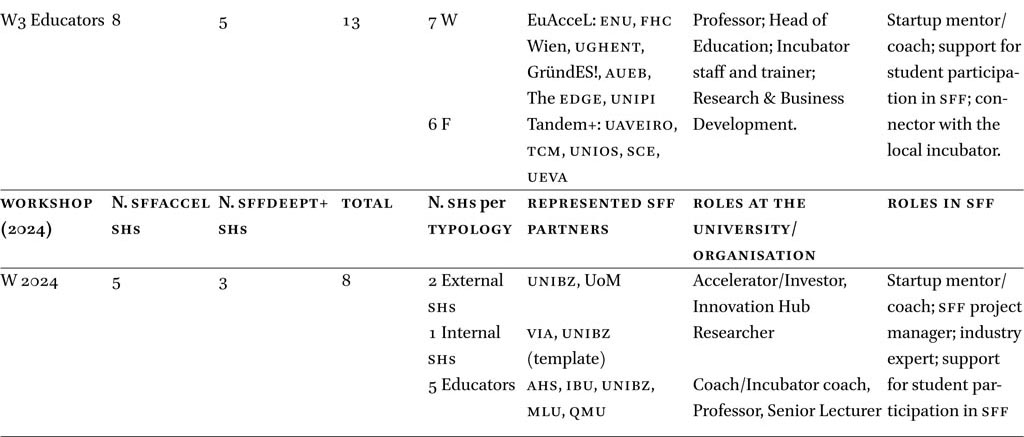
Table 1 presents an overview and comparison between the 3 workshops held in 2023 and the workshop from 2024, based on the number of participant stakeholders (SHs), type of participation in the research (only for 2023: workshop â W; form â F), stakeholdersâ position at their university/ organisation, role in SFF, according to partner (acronym) and project affiliation (EUAcceL or Tandem+/SFFAcceL or SFFDeepT+).
An overview and comparison between the 3 regional innovation workshops held in 2023 and the workshop from 2024 (authorsâ elaboration)
Citation: Triple Helix 11, 3 (2024) ; 10.1163/21971927-bja10057
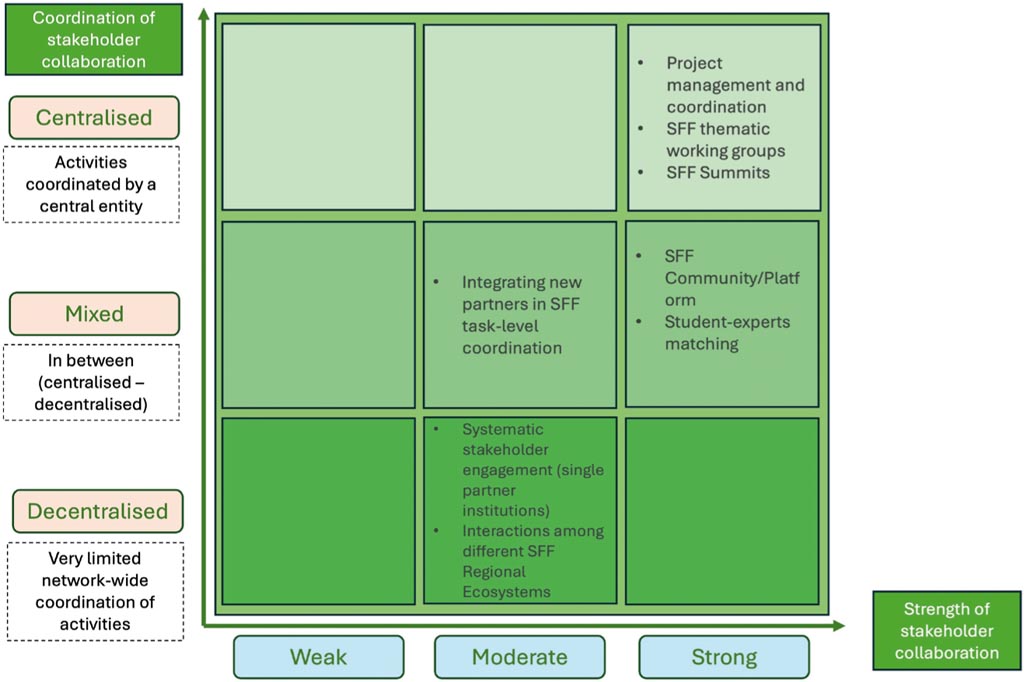
The questions aimed at digging into participantsâ experiences and fostered an exchange of views and perspectives on the SFF project by gathering diverse stakeholders from several organisations in the same virtual room. The topics addressed in the interview concerned the motivations of the stakeholdersâ institutions/organisations to take part in the project; the roles played by each institution/organisation as well as the perception of other partnersâ roles in the project. Some questions focused on participantsâ perceptions of stakeholdersâ collaboration and coordination, based on the stakeholder collaboration matrix by Bischoff et al. (2018), resulting from the interaction between weak/moderate/strong collaboration (x-axis) with decentralised/mixed/ centralised coordination (y-axis). Some questions differed according to the responding stakeholders: 1) perceived regional impact and contribution of SFF in terms of entrepreneurship education (educators: E); 2) regional development and innovation, also through education (external stakeholders: ES) (Galvão et al. 2020); and 3) institutions/organisationsâ strategiesâ to manage and maintain relationships with external stakeholders (internal stakeholders: IS) (Bischoff et al., 2018). Data was analysed through qualitative thematic coding analysis (Gibbs, 2007) and discussed according to Bischoff et al. (2018) and Galvão et al. (2020) content categorisation.
4 Research Results
4.1 Motivations of the Stakeholdersâ Institutions/Organisations to Participate in SFF
Two main reasons encourage institutions/organisationsâ participation in SFF. One relates to the educational perspective. In general, SFF spreads an entrepreneurial culture among students (Reichert 2019; Henry et al., forthcoming). All stakeholders, but mainly ESs and ISs both from the 2023 and 2024 workshops, stressed the importance of SFF in providing and increasing opportunities for student teams and talents to develop entrepreneurship-related skills. According to respondents, international exposure represents one of the main added values of the programme. The challenge-based learning and interdisciplinary approaches support students in gaining a multi-faced perspective on regional and global challenges, activating their entrepreneurial mindset (Whitmer et al. 2010; Yarime et al. 2012; Trencher et al. 2013; EC 2022a). Indeed, it was recognised that connecting and co-creating with different stakeholders (other teams, industry experts, mentors, incubators and investors from other countries) and developing their business ideas, in an open environment, represents a huge opportunity for studentsâ future careers, if they will not become entrepreneurs. SFF, as a network of entrepreneurial organisations, shapes its programme according to an iterative co-creation process based on cross-sectoral and interdisciplinary exchanges between students and international innovation actors to prepare them to act as âgame changersâ (Oh et al. 2016; Cai et al. 2019; Rinaldi et al. 2018; Reichert 2019; Tomasi et al. 2021).
From an institutional/organisational perspective, especially for ISs, SFF supports the accomplishment of partnersâ entrepreneurial university role, thus creating a wide and innovative entrepreneurial community based on synergies and collaboration to leverage each oneâs capabilities (Es) in an open innovation perspective (Pontikakis et al. 2022) and integrating different activities and expertise (Arbo & Benneworth 2007). Related to this, trust in partnersâ perspectives emerged as a theme. This is even more true considering the âfriendship-bornâ nature of SFF, since the consortium originated from the choice of partners that collaborated in past projects to undertake a new collaboration, whose long-term perspective has recently been consolidated in the launch of the SFF Cooperative Society. This, linked to the fact that many local collaborations are also based on individual research-based/teaching-based, third mission-based relationships, which creates positive conditions for effective co-creation and innovation (Cai et al. 2019). In this sense, ESs also highlighted international networking and collaboration as an opportunity to access shared resources (e.g.: funding, facilities, high-quality learning programmes and startup support services, incubation, etc.). This enhances the shared sense of ownership needed when it comes to sustainable regional development with universities as change agents involving all regional stakeholders in processes of knowledge co-creation (Stoeglehner et al. 2009; Peer & Stoeglehner 2013).
According to ESs, each organisation in SFF can play the role of connector between SFF (European level) and the related entrepreneurial ecosystems (regional level) (Cai et al. 2019). In this sense, one respondent among ESs (2023) affirmed: âOur main reason for being part of SFF as an innovative ecosystem and network relates to our continuous research and evaluation of future factors and trends (technology, society, environmental, legal). We are always searching for innovative new business models, new solutions, new partners, new processes and collaboration models.â Some ISs (2023 and 2024) mentioned participation in the SFF Academia-Research research network as a reason to take part in SFF (meetings, conferences, contributions to special issues, creating the groundwork for future projects), in an attempt to contribute to the connected innovation ecosystems also in terms of knowledge co-production, by acting as knowledge âglobal pipelinesâ and âhot spotsâ between the local to the global level and by translating research results to make them available to build innovative, sustainable and viable business solutions for regional development (Reichert 2019; Tomasi et al. 2022; Tomasi et al. 2024).
4.2 Collaboration and Coordination among Stakeholders in SFF
The level of collaboration and coordination among partners and stakeholders in SFF varies according to the lens of analysis.
In terms of SFF project management: most of the stakeholders perceive a very cooperative environment, with strong management and coordination capacity. Anyway, some new ISs (2024) affirmed it is sometimes difficult to get oriented and updated on the ongoing processes and take a proactive approach, due to the high complexity of the project and the diverse reference points for each specific task. Communication flows and coordination are facilitated by some supporting tools (e.g.: the SFF community platform and app, matching of students and experts, updating e-mailing and consortium meetings, social media, etc.) (ESs). Some coordination challenges, especially in delivering the SFF educational programme, derive from different countriesâ jet legs, limited time, variety in the organisation of the academic calendars, and difficulties in ensuring continuity in professors, students and expertsâ participation (ISs 2023).
Concerning SFF-Regional Ecosystems relationships, the existing personal/ institutional relationships with project partners represent the main entrance point for participation in SFF. This enhances trust bonds among partners and capitalises on previous collaborative processesâ results to foster long-term oriented collaborations (Cai et al. 2019). Students connect to ESs mainly through mentorship/coaching activities. Sometimes such relationships last beyond SFF phases (ESs). Other networking opportunities come from the SFF Summits and the SFF Community with related interactions also through social media. Scholars and professors are the most difficult to engage and keep engaged (Es) since they do not always realise what benefits may come from their participation in the project. On the one hand, this confirms that these processes work if there is co-responsibility as the networks need to be consolidated over time with the contribution of all involved parties (Galvão et al. 2020).
At the SFF partner institution/organisation level, there should be a higher extensive and systematic effort to communicate to the whole regional ecosystem the opportunities and advantages coming from participating in the project. TTOs, university-based entrepreneurship centres, and university-based, professors may have a role in this task (Es, ISs). Communication among the different networksâ knots is also still not completely exploited, even though a dedicated activity of ecosystem development is foreseen in the project. As an example, some ESs who are looking into SFF to broaden their market opportunities affirmed that they would need a higher number of contacts and more opportunities for encounters. Increasing mobility funding could enhance chances for exchanges (ESs) both among partners and their ecosystem stakeholders.
Figure 2 systematises these findings by adapting Bischoff et al. (2018) stakeholdersâ collaboration matrix.
SFF collaboration matrix
Citation: Triple Helix 11, 3 (2024) ; 10.1163/21971927-bja10057
Source: retrieved and adapted from Bischoff et al. 20184.3 Regional Impact of SFF
Some stakeholders (from all categories) affirmed that SFF currently contributes to regional development mainly in terms of entrepreneurship education, by creating complementarity between the local and the international programmes. This is in line with the Mode 3 approach to innovation by Carayannis & Campbell (2009), where knowledge production is based on mutuality and complementarity among innovation networks, thus supporting human capital creation to fostering social capital. Incubation and acceleration, coaching, mentorship and networking enable knowledge triangle interrelations and capacity building thanks to access to industry expertise, market research and business development resources. Some also highlighted that SFF helped them build connections within their local entrepreneurial ecosystem (ISs). This somehow reflects the co-evolutionary perspective proposed by Cai et al. (2020), where SFF activates interdependent relations (both direct and indirect), based on cross-geographical contexts. In this sense, SFF works as a platform, as an open complex system (Dubina et al. 2017) in which new ideas and approaches to co-creation for the sustainable transformation of the society â through the support from various internal and external sources â are developed and integrated into a unique multi-layered, multi-modal and multi-modal âhubâ (Carayannis et al. 2017).
Most of the stakeholders, not being able to estimate the regional impact of SFF, yet, as they consider it is still too early to assess it, recognised the high potential of the project in terms of future positive impacts. For some, more could be done: dedicated channels to reach the regional innovation stakeholders in a more effective, systemic and long-term perspective are needed (ISs).
The majority of respondents, from all categories, both in 2023 and 2024, recognised that, by fostering entrepreneurial development starting from the classroom, SFF can help spread the entrepreneurial culture, especially regionally (Reichert 2019). Stakeholders recognise that SFF â allowing students to access an international community of innovators â enhances their understanding of how to create value through circular and sustainable business models and potentially take action, in this sense, thus contributing to regional development and innovation (Cai & Ahmad 2023). Moreover, SFF can support regions in widening their international connections and fostering best practice exchange, by also attracting talents and investments, finding new research paths, technology improvements and know-how and also reinforcing their local networks of stakeholders, by bringing in new ones. This would enable social and technological innovation and contributing to their territorial innovation ecosystems (MâGonigle and Starke 2006; EC 2022a; Esparza Masana 2023). Finally, such interactions between universities (including students), businesses and the remaining helices of the wider regional ecosystems create â both locally and internationally â those productive synergies mentioned by Goddard & Chatterton (2003) between teaching (skills), research (innovation) and service to the community.
4.3.1 Entrepreneurship Education (Educators)
Educators recognised that the SFF programme, on the one hand, creates complementary ties with local entrepreneurship programs (e.g.: direct access to SFF via participation in university-based programmes), allowing parallel links with the regional ecosystem, while, at the same time, supports the development of a sense of belonging to a wider international community also fostering multicultural competence, among others. Moreover, Es highlight that SFF facilitates cross-sectoral and interdisciplinary knowledge and competence development (Posch and Steiner 2006; Rinaldi et al. 2018; Capano and Pritoni 2019) through âlearning through practiceâ and âpeer-learningâ approaches, which enhance the acceleration of ideas, understanding of market needs, sustainable business development, etc. The result is improved entrepreneurial skills (Fayolle et al. 2006), such as self-confidence, creativity, problem-solving, risk-taking, and decision-making. This is considered positive by respondents, also for studentsâ future employability perspectives.
4.3.2 Regional Development and Innovation (External Stakeholders)
External stakeholders replied to this question by reflecting on their specific regionsâ challenges. Some of them highlighted that besides huge ambitions, there are limited resources to implement innovations: support, optimisation of resources and collaborative (network) efforts could help overcome this issue. Other stakeholders complained about the lack of entrepreneurial mindset within the regional ecosystem while some others stressed the importance of digital transition, data-driven business models and sustainability-oriented more than profit-oriented approaches to business, for facing their regional challenges. Entrepreneurship education from an early stage (e.g.: high school) is also needed to spread the entrepreneurial culture regionally.
Stakeholders agreed that SFF already provides some potential solutions to such challenges through its DeepTech and sustainability-driven entrepreneurship programme and network. This reflects the idea the role of the university or â in the case of SFF â an alliance of entrepreneurial universities and other organisations â to act âin the entrepreneurial societyâ where sustainable and digital transitions are requested to respond to regional needs and global societal challenges (Audretsch 2014; Cai & Ahmad 2023), also in line with the new European strategy for Universities (EC 2022a) and with the new European Innovation Agenda (EC 2022b).
4.3.3 Institutions/Organisationsâ Strategiesâ to Manage and Maintain Long-Term Relationships within the Ecosystem (Internal Stakeholders)
Most of the internal stakeholders revealed that they do not have any specific strategy for stakeholder engagement. Some created and constantly updated internal databases to keep track of the stakeholdersâ constellation; others built, reinforced and ensured continuity in the stakeholdersâ relationships by involving regional actors in their local entrepreneurship programmes and in the SFF programme, by asking for their contribution as lecturers in the classroom or as mentors/coaches/experts during the SFF sessions.
As the relationships with stakeholders need to be cultivated, as they are the channels which the flow of skills, knowledge, technology and development passes through (Galvão et al. 2020), those who affirmed they have a strategy to involve their regional actors describe it as a series of subsequent actions: 1) stakeholder mapping; 2) establishing communication channels to facilitate engagement (social media channels and personal relationships through designated team members); 3) organising engaging events and activities (workshops, seminars, conferences, pitch competitions, networking sessions) 4) involve stakeholders in feedback and evaluation sessions by conducting unstructured interviews to gather insights for improvements.
4.4 Boosting the Sustainable Entrepreneurial University: Taking an Integrated Transnational Perspective
The results presented so far show that SFF allows continuity and combination between the local and the international levels (Dubina et al. 2017). This is relevant if we take into account the need for a cultural shift, where university sustainability, entrepreneurship, innovation and societal impact start becoming indispensable aspects of the European universities personality.
Indeed, results show that SFF can represent a good example of how, through interconnectedness and the creation of transnational links universities can truly aspire to fulfil their role as âsustainable entrepreneurial universitiesâ. Such links can also influence the respective regional innovation ecosystems and support universities to overcome all those cultural, social, legal and institutional barriers that â at the local level â prevent universities from becoming effectively sustainable and entrepreneurial (Compagnucci & Spigarelli 2020; DÃaz-GarcÃa et al. 2015; Guerrero et al. 2015; EC 2017; Pavie et al. 2014; EUA 2021; Lockett et al. 2019; Foss & Gibson 2015). This is clear as, on the one hand, SFF mostly works as a complementary entrepreneurship programme, aligned to the ones provided locally, and SFF partners represent the access point to the programme for interested regional stakeholders, both internal (including educators) and external ones. In this way, it enhances the potential of regional innovation as it guarantees international exposure also to regional stakeholders: they can bring in their capabilities and values while learning through other networksâ experiences (Arbo & Benneworth 2007; Pontikakis et al. 2022).
Trust and direct relationships among partners (locally, locally-internationally and internationally) are quite relevant. In SFF, the former originated from previous collaboration experiences and is oriented to a long-term relationship (SFF Cooperative Society). As for the latter, at the regional level, stakeholder engagement often relied on existing individual collaborations, exchanges and resources from certain researchers and departments. These types of relationships â which entail trust and friendliness â increase the opportunity for collaboration among stakeholders in their ecosystems and among ecosystems, thus enabling the co-creation of innovation (Cai et al. 2019).
While SFF is generally perceived as a cooperative environment with strong management and coordination capacities and there is a common feeling of being part of a European community, some challenges emerged from the results, due to the projectâs multi-layered approach and complexity. Some stakeholders need dedicated channels and increased opportunities for face- to-face networking to effectively understand the benefits of the project and get engaged with continuity. This would support more connections among the different ecosystems. Some of SFF partners (internal stakeholders) that recently joined the project, need more time and support to orient themselves within the network and to proactively contribute to the activities, beyond supporting them. The tools to foster communication flows and coordination are already there and should be applied more systematically: the SFF Community and SFF Summits appear particularly useful in this sense. More has to be done also at a single partner level, internally (e.g.: extensively involving more professors and students) and within each regional ecosystem (establishing long-term relationships), to develop tailored strategies for stakeholder engagement.
Finally, the results show that coordination and collaboration can be improved to allow SFF to properly fulfil its role of â and foster its â âtransnational sustainable entrepreneurial universityâ characteristic (Reichert 2019; Galvão et al. 2020).
5 Conclusions
This research aimed to investigate the characteristics and implications of stakeholdersâ involvement in the SFF project, also in terms of contribution to regional development and innovation. Results show a positive perception of the impact the project produces among internal and external stakeholders, especially concerning the SFF entrepreneurship education programme, even though it is not completely possible to draw the borders of its regional impact, yet.
What emerged is that it supports spreading an entrepreneurial culture across Europe, helping students and teams develop entrepreneurial mindsets and skills, useful for their future careers and addressing regional and global societal challenges (Reichert 2019; Cai & Ahmad 2023). This is mainly due to the international exposure it offers through the creation of a multicultural, interdisciplinary and cross-sectoral environment that allows accelerating ideas and their translation into viable and sustainable business models. It does it via practice-based learning supported by mentorship and expertsâ support from different disciplines and sectors and peer learning among teams from different countries. Moreover, it allows different regional innovation ecosystems benefit from the interconnection and mutuality among entrepreneurial universities committed to produce sustainability-related impacts at the local and â as a consequence â international levels.
At the SFF level, some recommendations emerge to further foster and stabilise the underneath international infrastructure. For it to better represent a transnational entity promoting the sustainable entrepreneurial university approach, SFF has to strengthen its connection and collaboration capacity, by making the communication flows easier, more accessible and capillary for all the partners, both new and established, academic and non-academic. It has to de-construct its complex and multi-layered structure by making automatic those tasks that do not require much control and by favouring face to face meetings and real-life encounters when more direct exchange is needed. To do so, improving the use of the SFF Platform, further valuing staff mobility (e.g.: through institutional agreements such Erasmus that also offer funding support) and making room for strategic planning and exchange during the SFF Summits are among the potential solutions.
At the ecosystem level, practical implications may include the need to cultivate and expand long-term, bottom-up relationships among partners, both regionally and internationally, and to establish institutional long-term strategies to consolidate the network over time and ensure effective contributions from all. In this sense, the international coverage of the project might support a cultural shift towards a more committed approach of universities within their ecosystems, by also overcoming the still rooted prejudice of some more conservative institutions towards those universities that adopt an active approach in fostering sustainability, digital and social innovations in their regions.
Finally, some general policy recommendations can be drawn. There is a need of more cohesive policy support and structural reforms to facilitate the growth of sustainable entrepreneurial universities across Europe. This might entail targeted funding, bureaucracy simplification schemes and dedicated initiatives in line with the European Green Deal, supporting regional collaboration, partnerships within regional innovation ecosystems, programs promoting skills development and knowledge transfer which value established strong connections among partners, namely, pre-existing formal/informal collaborations both funded or pro-bono, to ensure the success and continuity of the initiatives.
The study presents some limitations. A potential limitation lies in the possibility of bias depending on the direct involvement of the authors in the SFF project, which might have influenced their objectivity when analysing and interpreting the data collected. Nevertheless, the authors took all relevant initiatives to ensure that results could be, as much as possible, rigorous and free from subjectivity. To do so, interviews were led, time after time, by several colleagues from different institutions involved in the project evaluation, and the same happened with the data analysed.
Moreover, the case demonstrates that â even though SFF is challenge-based and addresses compelling societal challenges, and most of the partners are socially engaged regionally, in the interviews, collaboration with and active participation of civil society and NGOs does not emerge strongly (Rapini et al. 2024), thus showing an approach that is still more oriented towards a triple-helix approach (Etzkowitz, H. 2008) than a quadruple-helix one (Carayannis & Campbell 2009). Anyway, this could be also due to the type of external stakeholders that adhered to the interviews, mainly belonging to the business and public institutions. Finally, for the same reasons, the studentâs experience emerges through the stakeholdersâ voices.
Future research could further explore the concept of âsustainable entrepreneurial orientationâ (Cai & Ahmad, 2023) in the context of SFF by examining how civic stakeholder engagement influences the projectâs long-term impact, assessing the extent to which students perceive SFF not only as a transformative educational experience but also as a platform for fostering their integration and active participation within regional innovation ecosystems. This could be done by investigating the interplay between these factors in driving sustainable development, community resilience, and entrepreneurial capacity at both individual and institutional levels, and analysing how such initiatives contribute to the creation of new professional figures equipped with entrepreneurial skills and the ability to foster innovation, collaboration, and growth at the regional level. To do so, the SFF consortium could increase the involvement of NGOs and socially engaged organisations within the programme. This would be relevant to let startups and talents explore critical societal, environmental and economic challenges as a basis for their business ideas. Consequently, it would be possible to analyse the processes towards the design of potential innovative solutions in this sense and the descending outputs and outcomes.
Conflicts of Interest
All authors declare that they have no conflicts of interest.
Acknowledgements
This study was funded under the EIT HEI Initiative Third call for proposals: November 2022, in the context of the SFFACCELÂ â Accelerating Innovation across Regional Deep Tech Valleys in Europe project. The authors acknowledge Dr Annapia Ferrara, a research fellow at the University of Pisa, for her support in data collection during Cycle 1 (2023).
References
Arbo, P., & Benneworth, P. (2007). Understanding the regional contribution of higher education institutions: A literature review. OECD Education Working Papers. OECDiLibrary. ISSN: 19939019. https://doi.org/10.1787/19939019.
Atterton, J., & Thompson, N. (2010). University engagement in rural development: a case study of the Northern Rural Network. Journal of Rural and Community Development, 5(3), 123â132.
Audretsch, D. B. (2014). From the entrepreneurial university to the university for the entrepreneurial society. The Journal of Technology Transfer, 39, 313â321.
Bischoff, K., Volkmann, C. K., & Audretsch, D. B. (2018). Stakeholder collaboration in entrepreneurship education: an analysis of the entrepreneurial ecosystems of European higher educational institutions. The Journal of Technology Transfer, 43, 20â46.
Cai, Y., & Ahmad, I. (2023). From an entrepreneurial university to a sustainable entrepreneurial university: Conceptualization and evidence in the contexts of European university reforms. Higher Education Policy, 36(1), 20â52.
Cai, Y., Ma, J., & Chen, Q. (2020). Higher education in innovation ecosystems. Sustainability, 12(11), 4376.
Cai, Y., Ramis Ferrer, B., & Luis Martinez Lastra, J. (2019). Building university-industry co-innovation networks in transnational innovation ecosystems: Towards a transdisciplinary approach of integrating social sciences and artificial intelligence. Sustainability, 11(17), 4633.
Capano, G. & Pritoni, A. (2019). Varieties of hybrid systemic governance in European Higher Education. Higher Education Quarterly 73(1), 10â28.
Carayannis, E. G., & Campbell, D. F. (2009). âMode 3âand âQuadruple Helixâ: toward a 21st century fractal innovation ecosystem. International journal of technology management, 46(3â4), 201â234.
Carayannis, E. G., Grigoroudis, E., Campbell, D. F., Meissner, D., & Stamati, D. (2017). The ecosystem as helix: an exploratory theoryâbuilding study of regional coâopetitive entrepreneurial ecosystems as Quadruple/Quintuple Helix Innovation Models. R&D Management, 48(1), 148â162.
Carayannis, E. G., Grigoroudis, E., Campbell, D. F., Meissner, D., & Stamati, D. (2018). âMode 3âuniversities and academic firms: thinking beyond the box trans-disciplinarity and nonlinear innovation dynamics within co-opetitive entrepreneurial ecosystems. International Journal of Technology Management, 77(1â3), 145â185.
Clark, W. & Holiday, L. (eds) (2006). Linking Knowledge with Action for Sustainable Development: The Role of Program Management. Summary of a Workshop. Washington, DC: National Academies Press.
Compagnucci, L., & Spigarelli, F. (2020). The third mission of the university: A systematic literature review on potentials and constraints. Technological Forecasting and Social Change, 161, 120284. https://doi.org/10.1016/j.techfore.2020.120284.
DÃaz-GarcÃa, C., González-Moreno, Ã., & Sáez-MartÃnez, F. J. (2015). Eco-innovation: insights from a literature review. Innovation, 17(1), 6â23. https://doi.org/10.1080/14479338.2015.1011060.
Dubina, I. N., Campbell, D. F., Carayannis, E. G., Chub, A. A., Grigoroudis, E., & Kozhevina, O. V. (2017). The balanced development of the spatial innovation and entrepreneurial ecosystem based on principles of the systems compromise: a conceptual framework. Journal of the Knowledge Economy, 8, 438â455.
EC 2017. European Commission (2017). Communication (COM(2017) 247 final)Â â A renewed EU agenda for higher education. Directorate-General for Education, Youth, Sport and Culture. Last review: 24/10/2017. Publications Office of the European Union. Accessible at: https://eur-lex.europa.eu/legal-content/EN/ALL/?uri=legissum:4301062 (last retrieved: 20.10.2024).
EC 2020. European Commission (2020). Directorate-General for Communication. The European Green Deal, Publications Office of the European Union. https://data.europa.eu/doi/10.2775/19001 (last retrieved: 20.10.2024).
EC 2022a. European Commission (2022a). Communication from the Commission to the European Parliament, the Council, the European Economic and Social Committee and the Committee of the Regions on a European Strategy for Universities. COM(2022) 16 final. Strasbourg, 18.1.2022. Accessible at: https://education.ec.europa.eu/document/commission-communication-on-a-european-strategy-for-universities (last retrieved: 27.06.2024).
EC 2022b. European Commission (2022b). Communication from the Commission to the European Parliament, the Council, the European Economic and Social Committee and the Committee of the Regions â A New European Innovation Agenda. COM(2022) 332 final. Brussels, 5.7.2022. Accessible at: https://eur-lex.europa.eu/legal-content/EN/TXT/?uri=CELEX%3A52022DC0332 (last retrieved: 27.06.2024).
EIT HEI Initiative (2023a). Start for Future â New Deal of Innovation for Europe. Good Practice. European Institute of Technology, Higher Education Institution Initiative. Available at: https://eit-hei.eu/good-practices/start-for-future-new-deal-of-innovation-for-europe/ (last accessed: 25.06.2024).
EIT HEI Initiative (2023b). How Start for Future is uniting students, academics and start-ups. Accessible at: https://eit-hei.eu/get-inspired/how-start-for-future-is-uniting-students-academics-and-start-ups-an-interview-with-pavlina-vujovic/ (last accessed: 28.06.2024).
Esparza Masana, R. & Woolford, J. (2023). European Universities and Knowledge Alliances in their territorial innovation ecosystems. Publications Office of the European Union, Luxembourg. doi: 10.2760/429140, JRC135388.
Etzkowitz, H. (2008). The triple helix: university-industry-government innovation in action. New York; London: Routledge.
European University Association (EUA) (2021). Universities without walls: A vision for 2030. https://eua.eu/downloads/publications/universities%20without%20walls%20-%20a%20vision%20for%202030.pdf (last retrieved: 20.10.2024).
Fayolle, A., Gailly, B., & Lassas-Clerc, N. (2006). Assessing the impact of entrepreneurship education programmes: A new methodology. Journal of European Industrial Training, 30(9), 701â720.
Foss, L., & Gibson, D. V. (2015). The entrepreneurial university: Context and institutional change. In The entrepreneurial university (pp. 1â17). Routledge.
Galvão, A., Marques, C., & Ferreira, J. J. (2020). The role of entrepreneurship education and training programmes in advancing entrepreneurial skills and new ventures. European Journal of Training and Development, 44(6/7), 595â614.
Gibbs, G. R. (2007). Thematic coding and categorizing. Analyzing qualitative data, 703(38â56).
Goddard J., Kempton L. (2016). The civic university: universities in leadership and management of place. Centre for Urban and Regional Development Studies, Newcastle University.
Goddard, J. B., & Chatterton, P. (2003). The response of universities to regional needs. Economic Geography of Higher Education: Knowledge Infrastructure and Learning Region. In F. Boekema, E. Kuypers, R. Rutten (eds.), Economic Geography of Higher Education: Knowledge, Infrastructure and Learning Regions. Routledge, London.
Grau, F. X., Goddard, J., Hall, B. L., Hazelkorn, E., and Tandon, R. (2017). Higher education in the world 6. Towards a socially responsible university: Balancing the global with the local. Girona: Global University Network for Innovation.
Guerrero, M., Cunningham, J. A., & Urbano, D. (2015). Economic impact of entrepreneurial universitiesâ activities: An exploratory study of the United Kingdom. Research Policy, 44(3), 748â764. https://doi.org/10.1016/j.respol.2014.10.008.
Henry, C., Bernadó Mansilla, E., Coelho Gabriel, B., Valente, R., Moberg, K., Tomasi, S., Planck., S., Sailer, K. (forthcoming). Creating Novel, Responsible, and Impactful Entrepreneurship Education Models. Triple Helix Journal.
Lockett, N., Kerr, R., & Robinson, S. (2019). Multiple perspectives on the challenges for knowledge transfer between higher education institutions and industry. Technological Forecasting and Social Change, 146, 339â348. https://doi.org/10.1177/0266242608096088.
MâGonigle, M., & Starke, J. C. (2006). Minding place: towards a (rational) political ecology of the sustainable university. Environment and Planning D: Society and Space, 24(3), 325â348.
Oh, D. S., Phillips, F., Park, S., & Lee, E. (2016). Innovation ecosystems: A critical examination. Technovation, 54, 1â6.
Pavie, X., Scholten, V., & Carthy, D. (2014). Responsible innovation: From concept to practice. World Scientific Publishing, Singapore.
Peer, V., & Stoeglehner, G. (2013). Universities as change agents for sustainability â framing the role of knowledge transfer and generation in regional development processes. Journal of Cleaner Production, 44, 85â95.
Pontikakis, D., Gonzalez Vazquez, I., Bianchi, G., Ranga, L., Marques Santos, A., Reimeris, R., Mifsud, S., Morgan, K., Madrid Gonzalez, C. and Stierna, K. (2022). Partnerships for Regional Innovation Playbook. EUR 31064 EN, Publications Office of the European Union, Luxembourg. ISBN 978-992-76-52325â3, doi: 10.2760/775610, JRC129327.
Posch, A. & Steiner, G. (2006). Integrating research and teaching on innovation for sustainable development. International Journal of Sustainability in Higher Education, 7(3), 276â292.
Radinger-Peer, V., Pflitsch, G., Kanning, H., & Schiller, D. (2021). Establishing the regional sustainable developmental role of universities â from the multilevel-perspective (MLP) and beyond. Sustainability, 13(13), 6987.
Rapini, M. S., Chiarini, T., & Stein, A. D. Q. (2024). Universities in inclusive regional innovation systems: Academic engagement and uneven knowledge use in Brazil. Journal of Regional Science, 64(1), 108â135.
Reichert, S. (2019). The role of universities in regional innovation ecosystems. EUA study, European University Association. Brussels, Belgium. https://www.reichert-consulting.de/wp-content/uploads/2021/11/EUA_-TheRoleofUniversitiesinRegionalInnovationEcosystem_report_final_2019.pdf (last retrieved: 07/01/2025).
Rinaldi, C., Cavicchi, A., Spigarelli, F., Lacchè, L., & Rubens, A. (2018). Universities and smart specialisation strategy: From third mission to sustainable development co-creation. International Journal of Sustainability in Higher Education 19(1), 67â84.
Shapiro, H. T. (2005). A larger sense of purpose: higher education and society. Princeton, NJ; Woodstock: Princeton University Press.
Simons, H. (2009). Case study research in practice. London: SAGE.
Start for Future (2023). Transforming Innovation in Europe: Start for Future Launches European Cooperative Society. LinkedIn post. Accessible at: https://www.linkedin.com/pulse/transforming-innovation-europe-start-future-launches/ (last accessed: 25.06.2024).
Stoeglehner, G., Brown, A. L., & Kørnøv, L. B. (2009). SEA and planning: âownershipâ of strategic environmental assessment by the planners is the key to its effectiveness. Impact assessment and project appraisal, 27(2), 111â120.
Talwar, S., Wiek, A., & Robinson, J. (2011). User engagement in sustainability research. Science and Public Policy, 38, 389â390.
Tomasi S., Cavicchi, A., Aleffi C., Paviotti, G., Ferrara, C., Baldoni F., & Passarini, P. (2021). Civic universities and bottom-up approaches to boost local development of rural areas: the case of the University of Macerata. Agricultural and Food Economics, 9(1), 15.
Tomasi, S., Aleffi, C., Crespi, I., Cavicchi, A., UrbanÄÃková, N., Hudec, O., Fodor, A., Szávics, P., Kiss, A., Márton, A., Lieszkovszky, J. P., Reis, C., Dos Santos, P., Mendes Silva, C., Ribeiro, A., Geraldes, J. (2022). The role of HEIs in a Quadruple Helix collaboration for RIS3. White paper with policy recommendations. RE-ACT project deliverable, D.4.3.1. RE-ACT â Self-reflection tools for Smart Universities Acting Regionally. Accessible at: http://ris3heinnovate.eu/wp-content/uploads/2022/12/D4.3.1-White-Paper-with-policy-recommendations_aut.pdf (last accessed: 20.06.2024).
Tomasi, S., Szávics, P., Aleffi, C., Ferrara, C., Márton, A., UrbanÄÃková, N., dos Santos, P., Ribeiro, A., Cavicchi, A., Hudec, O. (2024). Drivers and challenges of RIS3ârelated university engagement: Insights from five European regions. Regional Science Policy & Practice, 16(1), 12567.
Trencher, G. P., Yarime, M., & Kharrazi, A. (2013). Co-creating sustainability: cross-sector university collaborations for driving sustainable urban transformations. Journal of cleaner production, 50, 40â55.
Trencher, G., Yarime, M., McCormick, K. B., Doll, C. N., & Kraines, S. B. (2014). Beyond the third mission: Exploring the emerging university function of co-creation for sustainability. Science and Public Policy, 41(2), 151â179.
Whitmer, A., Ogden, L., Lawton, J., Sturner, P., Groffman, P. M., Schneider, L., Hart, L., Halpern, B., Schlesinger, W., Raciti, S., Bettez, N., Ortega, S., Rustad, L., Pickett, S. TA., Killilea, M. (2010). The engaged university: Providing a platform for research that transforms society. Frontiers in Ecology and the Environment, 8, 314â321.
Yarime, M., Trencher, G., Mino, T., Scholz, R. W., Olsson, L., Ness, B., Frantzeskaki, N. & Rotmans, J. (2012). Establishing sustainability science in higher education institutions: towards an integration of academic development, institutionalization, and stakeholder collaborations. Sustainability Science, 7, 101â113.
Yin, R. K. (2009). Case study research: design and methods (4th ed.). Thousand Oaks, CA: Sage.
Start for Future project: https://startforfuture.eu/ (last accessed: 28.06.2024).
EIT HEI Initiative. EuAcceL project: https://eit-hei.eu/projects/euaccel/ (last accessed: 28.06.2024).
EIT HEI Initiative. Tandem+ project: https://eit-hei.eu/projects/tandem-plus/ (last accessed: 28.06.2024).
EIT HEI Initiative. SFFAcceL project: https://eit-hei.eu/projects/sffaccel/ (last accessed: 28.06.2024).
EIT HEI Initiative. SFF.DeepT+ project: https://eit-hei.eu/projects/sff-deept/ (last accessed: 28.06.2024).
Urbact Toolbox, Stakeholder Analysis Table: https://urbact.eu/toolbox-home/implementing/stakeholders-analysis-table (last accessed: 25.06.2024).
Urbact Toolbox, Stakeholder Power-interest Matrix: https://urbact.eu/toolbox-home/implementing/stakeholders-powerinterest-matrix (last accessed: 25.06.2024).