Abstract
Despite the importance of low-tech manufacturing sectors for national economies, previous studies on UIC benefits for the firms were conducted mostly in high-tech sectors, making the knowledge on the impact of UIC on innovation in low-tech sectors unexplored. The present research aims to identify combinations of UIC s that may lead the low-tech firms to high innovation performance. By using the csQCA technique applied to secondary data from the BR Survey, which is the largest UIC databank in Brazil, the researchers identified that the most intense collaborations in terms of knowledge and resource exchange, such as development-oriented and research-oriented, are among the most beneficial for firms’ innovativeness. Diffusion-oriented UIC does not contribute to innovation, unless it is combined with both research-oriented and development-oriented UIC s. Finally, the csQCA suggests that in most cases the firms should focus on engaging in one specific UIC type rather than split its effort and resources among a mix of UIC. The findings amplify comprehension of the range of impacts that entrepreneurial universities promote in low-tech sector, creating both theory and policy implications.
1 Introduction
Universities play a crucial role in society as producers of state-of-the-art scientific knowledge (D’este and Patel, 2007). They are positioned as important engines of economic development and innovation (OECD, 2011). Most innovative world economies also possess top-tier research and education institutions.
The university-industry collaboration (UIC) has attracted the attention of innovation scholars for decades (Bastos et al., 2021). While the first studies focused on investigating the conditions that favor the establishment of UIC, the twentieth century UIC research streams have been incorporating investigations into the effects of U-I relations on firm performance (Colombo and Delmastro, 2002; Bishop et al., 2011; Eom and Lee, 2010; Zhang et al., 2022). The emergence of this research stream was encouraged by the increasing use of the triple helix and entrepreneurial university academic approaches, which advocated the proactive role of universities in firms’, regional and national innovation. Currently, one of the research questions being asked by the triple helix’s and entrepreneurial university’s scholars is: what is the impact of an entrepreneurial university on firm innovation?
Since the first studies, there has been an emphasis in the literature on the effects of UIC on firm innovation regardless idiosyncrasies of the sector they take part of (Bishop et al., 2011; Eom and Lee, 2010; Min et al., 2019; O’Connor et al., 2021) or specifically on high-tech companies (Ahrweiler et al., 2011; Baba et al., 2009; Buenstorf and Heinisch, 2020; Lee et al., 2015; Yang et al., 2022). However, there has been much less emphasis on the sectoral view of UIC effects on innovation in low-tech firms, which differ from their high-tech counterparts. For instance, while innovation in high-tech companies tends to have a considerable R&D component, the low-tech sector tends to innovate through changes in product design (Kastelli et al., 2018; Reichert et al., 2016), reducing production costs (Von Tunzelman and Acha, 2005) or embracing eco-innovations (González-Moreno et al., 2019).
Are the types of UIC s that enhance the innovative performance of high-tech companies the same in the case of low-tech companies? Current academic knowledge on UIC outcomes may be biased in terms of sectoral representation toward high-tech firms. Therefore, despite the existence of some studies that analyzed UIC and innovation in low-tech sectors (Maietta, 2015), more studies are needed to obtain a more objective and deeper comprehension of UIC outcomes for this category of firms.
To date, different studies have investigated the outcomes of different types of UIC for firms. Studies conducted either with samples of firms from different companies or only high-tech companies showed that, with few exceptions, in the vast majority of cases, firms that actively engaged in UIC perform better than those that do not and those that do not seek to access university resources (Apa et al., 2021; Eom and Lee, 2010; Garcia-Perez-de-Lema et al., 2017; Yang et al., 2022). However, the debate on which types of UIC are the most important for firm innovation is still an open question.
For instance, Jones and De Zubielqui (2017) showed that while human resource-based UIC positively impacts firm innovativeness, relations based on scientific publications do not affect firm innovativeness. Abdulai et al. (2020) and Fudickar and Hottenrott (2019) found that informal mechanisms of knowledge transfer between firms and universities positively affect innovation performance. Kafouros et al. (2015) found that R&D-based UIC positively influences the sales performance of new products. Maietta (2015) concluded that low-tech firms could achieve high levels of innovativeness by engaging in patenting activities.
Some studies have also shown that specific UIC s may not have a significant effect on innovation. Thus, Garcia-Perez-de-Lema et al.’s (2017) investigation conducted in Spain showed that while formal relations are positively related to a firm’s innovation, informal UIC had no significant effect. In some cases, specific UIC types may actually be related to a lower degree of firm innovativeness (Puffal, 2014). It is important to consider that countries differ from one another in terms of innovation systems, sectoral innovation patterns and intensity of UIC. Therefore, more investigation is required to deepen knowledge of the outcomes of UIC for firms.
Firms may engage in different UIC types using different UIC channels simultaneously over a period of time (Garcia-Perez-de-Lema et al., 2017; Mikhailov et al., 2022; Puffal et al., 2021; Schaeffer et al., 2017). In some cases, the use of more than one UIC type has a greater positive effect on innovation than the use of one unique interaction form (Apa et al., 2021). Few articles address the combinations1 of different UIC types that lead firms to high levels of innovativeness (Mikhailov et al., 2020). Thus, we posit the following research question: which combinations of UIC s lead low-tech firms to high innovation performance?
To this end, a crisp-set qualitative comparative analysis (csQCA) data analysis technique (Ragin, 2014) was applied to the data retrieved from the BR Survey, which is the largest UIC survey conducted in Brazil. QCA, unlike traditional statistical techniques such as regression and structural equation modeling that analyze the influence of a given variable in isolation, allows us to identify combinations of different types of UIC that lead firms to high innovativeness. The study used Schaeffer’s et al. (2017) UIC typology, which defined five UIC types: training-oriented, service-oriented, diffusion-oriented, development-oriented, and research-oriented.
The study contributes to the research stream of triple helix stakeholder’s role in innovation. Particularly, it contributes to the UIC outcomes and entrepreneurial university research streams through the analysis of low-tech sectors, which have been understudied in the literature and which differ from the traditionally studied high-tech sectors. Thus, it allows us to expand the theoretical comprehension of the benefits obtained by the companies from UIC, reducing the existing sectoral bias in the UIC literature.
The case of Brazil is particularly interesting, as, like other emerging and even part of developed economies, its manufacturing sectors is mostly composed of low-tech companies (Reichert et al., 2016). This study seeks to obtain valuable information that can be used to formulate policies that enhance company growth and, therefore, improve national innovation. The knowledge on the option that low-tech firms in Brazil may have to improve its innovativeness is particularly important considering that over half of manufacturing GDP comes from emerging economies.
The results of csQCA showed that 4 out of 5 UIC combinations included either development-oriented collaborations or research-oriented collaborations, leading firms to high innovativeness, suggesting that in the case of firms from low-tech sectors engaging in the most intense and effort-demanding collaborations are preferable over shorter and less demanding collaborations for building firms’ innovativeness. The paper is structured as follows. Section 2 presents the theoretical literature on UIC outcomes and innovation in low-tech sectors. Section 3 shows the Brazilian panorama of UIC. In Section 4, the research method is explained. The results and discussion are presented in Section 5. Conclusions are made in Section 6. Finally, references are listed.
2 University-industry Collaboration
In this section, we first present the review of related literature on UIC benefits, followed by the nature of innovation in low-tech firms and this sector’s idiosyncrasies. We then present the Brazilian context of UIC in Section 3.
2.1 Benefits of UIC for the Firms
With the arrival of the new millennium, the investigation of the university’s third mission has become increasingly popular among innovation scholars (Bramwell and Wolfe, 2008; Etzkowitz and Zhou, 2018; O’Shea et al., 2007). The strengthening of the perception that universities should transform themselves into active promoters of innovation and its institutionalization through specific policies and activities has been influenced by the diffusion of a “triple helix” and entrepreneurial university theoretical approaches. These approaches state that, in addition to teaching and research activities, the modern university must also encompass the so-called “third mission”, that is, proactive interaction with the private and public sector (Etzkowitz and Zhou, 2018; Guerrero and Urbano, 2017). In the same period, societal and institutional pressures on universities increased, encouraging them to provide greater returns to society (Hulsink et al., 2014; MacKenzie and Zhang, 2014; Reihlen and Wenzlaff, 2014), thus generating the need to assess the impacts of entrepreneurial universities.
One of the methods universities may adopt to transform themselves into entrepreneurial universities is to transfer research results to the market based on industrial and social problems, thus facilitating innovations (Etzkowitz, 2004; Ratten et al., 2017). In contrast, firms collaborate with universities for numerous reasons, such as sourcing state-of-the-art scientific and technological knowledge, using physical facilities such as laboratories, conducting tests of their products and services, outsourcing research projects or conducting joint research, improving companies’ image, reducing costs and enhancing innovativeness (Bonaccorsi and Piccaluga, 1994; Meyer-Krahmer and Schmoch, 1998; Bastos et al., 2021; Perkmann et al., 2013).
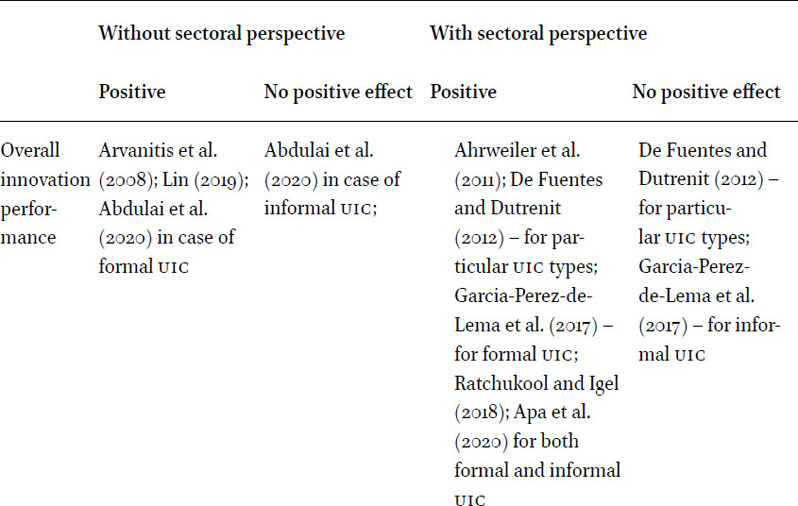
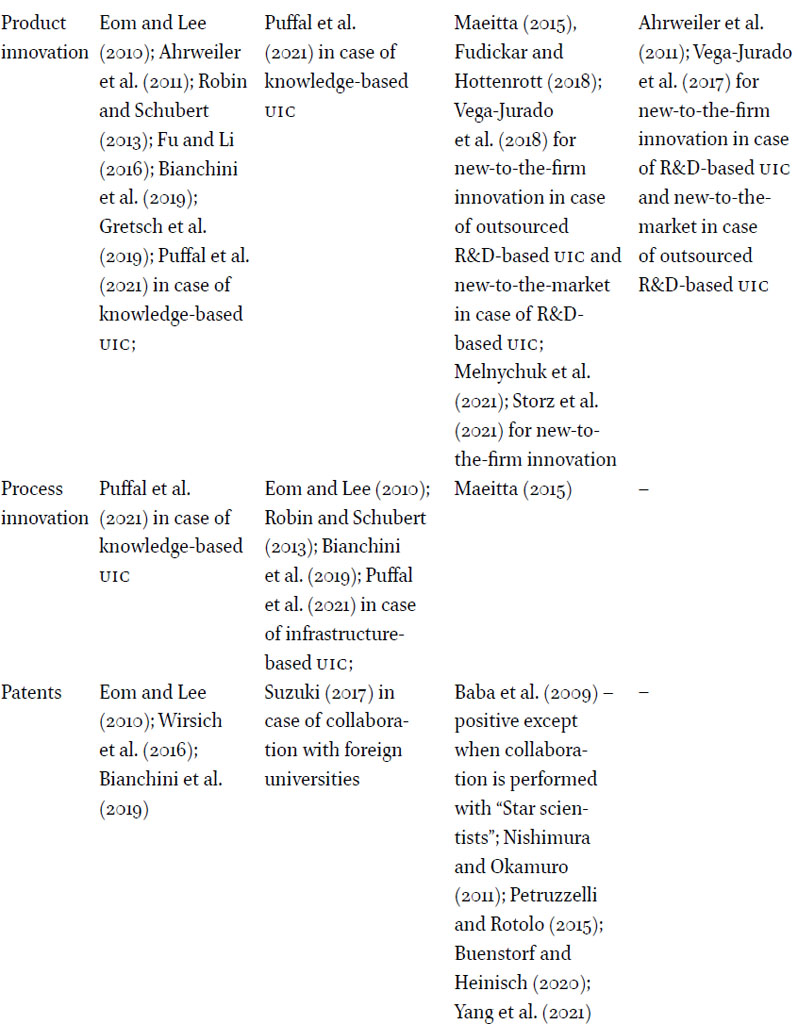
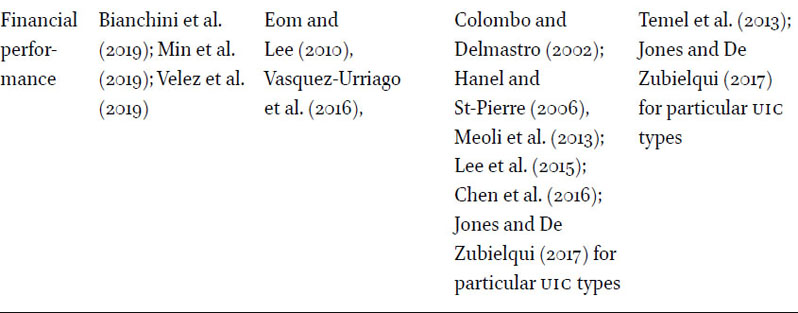
Comprehending the importance of learning about the impacts of entrepreneurial universities, scholars turned their attention to the evaluation and measurement of the impacts of entrepreneurial universities on firm innovation (Colombo and Delmastro, 2002; Hanel and St-Pierre, 2006; Robin and Schubert, 2013; Puffal et al., 2021). These studies can be divided into two groups. The first comprises studies that measured outcomes of UIC within large samples of firms regardless of their economic activity.2 The second group includes studies that added a sectoral view to the UIC outcomes. As shown in Table 1,3 studies have found different UIC outcomes for firms in terms of product and process innovation, patent production, overall innovation performance,4 and financial performance.

Summary of the findings of the quantitative studies of the benefits of UIC obtained by the firms
Citation: Triple Helix 10, 3 (2024) ; 10.1163/21971927-bja10042
Studies that did not apply a sectoral perspective showed that UIC, in most cases, positively impacted all previously cited firms’ outcomes except for process innovation. For instance, while Puffal et al.’s (2021) empirical study showed that only knowledge-based UIC enhances firm process innovativeness, other studies found no effect (Bianchini et al., 2019; Eom and Lee, 2010; Robin and Schubert, 2013). In most cases, studies measured the impact of UIC as a whole (Arvanitis et al., 2008; Eom and Lee, 2010; Bianchini et al., 2019), rather than evaluating the impacts of different UIC types. There are still some exceptions that divide the impacts of UIC in terms of its degree of formality (Abdulai et al., 2020) and interaction channel type (Puffal et al., 2021).
In contrast, sectoral studies presented a more diverse division of UIC types concerning the impact on firm outcomes, including, in addition to the formality of UIC (Apa et al., 2021; Garcia-Perez-de-Lema et al., 2017), UIC type in terms of market and science orientation of university researchers (Baba et al., 2009), the nature of R&D cooperation (Vega-Jurado et al., 2017) and other UIC types (De Fuentes and Dutrenit, 2012). Similar to the panorama of studies without a sectoral approach, empirical studies with a sectoral approach showed that in most cases, UIC positively impacts firm performance, including product and process innovation, patent creation, overall innovation performance and financial performance.
Despite the consensus that in most cases firms engaged in UIC performed better than those that do not, as well as firms that engaged most intensively in UIC perform better than those with less engagement, the debate on which types of UIC are the most important for innovation remains wide open, regardless of the sectoral approach used by scientific articles. For instance, Puffal et al. (2021) posit that only UIC based on the exploration of university knowledge enhances the product and process innovativeness of Brazilian firms. Similarly, Mikhailov et al. (2020) stated that only UIC s with an intensive exchange of information and knowledge, such as research-based UIC s and development-based UIC s, lead Brazilian manufacturing firms to high innovativeness.
Apa et al. (2021) showed that both formal and informal UIC positively impacted the overall innovation performance of Italian small and medium enterprises (SME s), and their interaction enhanced this impact. Informal UIC may also not have an impact on innovation in the case of Ghanian companies (Abdulai et al., 2020) and Italian SME s (Garcia-Perez-de-Lema et al., 2017). De Fuentes and Dutrenit’s (2012) study showed that while training-based UIC predominantly does not affect innovation in Mexican manufacturing firms, human resource-based UIC does. Similarly, Jones and De Zubielqui (2017) stated that human resource-based UIC is the only UIC type that impacts the financial performance of Australian SME s. In contrast, UIC s such as research services, research partnerships and informal UIC s did not present a significant impact (Jones and De Zubielqui, 2017). Whether R&D-based UIC is joint or outsourced will have different effects on the level of a firm’s new product novelty for Spanish manufacturing firms (Vega-Jurado et al., 2017).
It is crucial to add that considering that the vast majority of sectoral UIC studies were performed in high-tech sectors and technology-based firms, the debate over which UIC s are the most beneficial is even more widely open for firms from low-tech sectors, which differ from their high-tech counterparts, requiring deeper investigation.
Concerning companies from the low-tech sectors, the main gap not addressed by the previous studies concerns the analysis of the relationship between the combination of different U-I collaborations and firm innovativeness. The use of a combination of different UIC s rather than the influence of a particular UIC type is particularly important when considering that firms frequently engage in more than one U-I collaboration type (Apa et al., 2021; Mikhailov et al., 2020; Schaeffer et al., 2017). In some cases, only those UIC types that require a high intensity of knowledge and information exchange lead the firm to high levels of innovativeness (Mikhailov et al., 2020). In turn, the issue of the combination of UIC s that lead the firm to high innovativeness is underexplored (Mikhailov et al., 2020), especially in low-tech companies.
Hence, the general proposition made in this study is that not all UIC types are of equal significance (in terms of necessity) and that the value of UIC s resides not in the individual UIC itself but in the proper configurations of different UIC types, or “recipes”, as called in qualitative-comparative analysis. It is crucial to test this proposition when considering that not all UIC types sustain innovation performance (Robin and Schubert, 2013).
2.2 Innovation in Low-tech Sectors
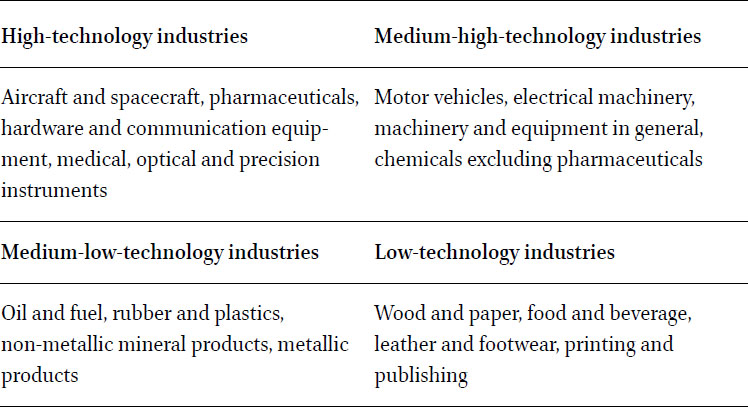
There are several ways to classify industrial sectors according to their technological intensity. The most applied classification is the OECD’s Organization for Economic Cooperation and Development (2011), which considers the percentage of revenue spent on R&D activities to categorize industrial sectors at four levels. Thus, low- and medium-low-tech companies invest up to 2.5% of their revenue in R&D activities, while medium-high- and high-tech companies invest more than 2.5% (OECD, 2011). The low- and medium-low-tech sectors include companies engaged in the production of food and beverages, leather and footwear, metal products, rubber and plastics, oil and fuel. In general, low- and medium-low-tech industries have a stable and widespread technological base (Robertson and Smith, 2008). Table 2 shows examples of sectors according to the OECD’s (2011) technological intensity classification.
Examples of sectors within sectoral intensity classification according to OECD (2011) Isic 3 revision
Citation: Triple Helix 10, 3 (2024) ; 10.1163/21971927-bja10042
The high-tech manufacturing sector includes companies engaged in the production of hardware and communication equipment, medical, optical and precision instruments, aircraft and pharmaceuticals. In contrast to low-tech sectors, these sectors are very important for breakthrough technological innovations and their diffusion to other industries. It is common for them to engage in patenting activities and R&D collaboration for new products and process development with different partners, including universities and research institutes (Hall, 2005). The R&D expenditures of high-tech firms are high (OECD, 2011).
Nevertheless, the terms “R&D” and “innovation” are not interchangeable, as R&D activities are one among many parts of the innovation process (Kastelli et al., 2018). This is because innovation comes from different sources, such as machinery and equipment acquisition and employee training (CIS, 2018). For instance, the Community Innovation Survey (CIS) considers that innovation may arise from sources such as the acquisition of machinery and equipment, software, training of employees and outsourced product development and collaboration/partnerships with different actors, which is particularly true for low-tech sectors (Reichert et al., 2016).
Today, diverse studies claim that innovation comes from production processes (Hirsch-Kreinsen, 2008; Ruffoni et al., 2018), especially by reducing production costs (Von Tunzelman and Acha, 2005). In doing so, firms from low-tech sectors might achieve even higher levels of operational efficiency than firms in high-tech industries (Kirner et al., 2009). Process innovation in low-tech firms may occur through reorganizing manufacturing systems, such as improving factory layout and operations techniques for production planning and control (Lee et al., 2018).
Likewise, low-tech companies are production intensive, and many of their innovations derive from the adoption of technologies developed elsewhere (Pavitt, 2004). Therefore, interaction with universities and research institutes that are willing to spread the knowledge developed in the academy could be a good option for increasing the innovation output of low-tech firms (Apa et al., 2021). In sum, low-tech firms benefit more from efforts made in different areas than from focusing on only one (Reichert et al., 2016).
Nevertheless, at least some low-tech companies engage in patenting activities and cooperation with universities to produce innovations of high novelty (Apa et al., 2021; Mendonça, 2009). In the case of Brazil, those engaged in cooperation with universities’ research groups usually develop research and development-based activities rather than training or consulting (Mikhailov et al., 2022).
In sum, low-tech firms may innovate by lowering production costs, reorganizing production processes, making product design improvements and adopting technologies developed somewhere. They may also conduct intensive R&D activities, engage in patenting and cooperate with universities and research centers to produce innovation of greater novelty. The interesting question to answer is which types of relationships with universities are the most important for achieving high levels of innovativeness of industrial companies: those that are the least intensive in knowledge flows and commitment intensity or the most intensive?
The presence of an innovative low-tech sector is very important for both emerging and developed economies. While low-tech firms are the backbone of the manufacturing industry in many emerging economies, many technologically advanced countries also have low-tech manufacturing sectors that contribute more to overall manufacturing revenue than high-tech sectors.
Even in developed countries, the high-tech sector is not necessarily a backbone of national economy. For instance, until recently, in the United States, Japan and Germany, the high-tech sector represented less than 10% of total GDP (Hirsch-Kreinsen, 2008). Another importance of having an innovative low-tech sector is that they fulfill important roles both as partners in high-tech firms’ innovation processes and as buyers of high-tech products (Hansen and Winter, 2011), thus, providing high-tech companies with financial sources.
Moreover, firms from the low-tech sectors can be more technologically advanced in emerging economies than in their developed counterparts. Particularly in Brazil, large low-tech firms perform better than high-tech firms (Reichert and Zawislak, 2014). The low-tech sectors are also responsible for a considerable part of UIC, as, according to the CNPq-DGP Research Group Census5 (CNPq-DGP) 2016, over 51.33% of UIC in the manufacturing sector occurs with firms from low- and low-medium technology intensity industries (Mikhailov et al., 2022).
3 Brazilian Context of U-I Collaboration
Although the academic concept of the entrepreneurial university only started to become popular among innovation scholars at the beginning of the 21st century (Etzkowitz, 2004; Etzkowitz and Leydesdorff, 2000), the first governmental and institutional policies related to the promotion of a greater engagement of the university with the community emerged in the 19th century. In the US, the first public policy aimed at stimulating interaction between universities and the productive sector was the Morrill Act (1862), which allocated government-owned land to universities involved in supporting agricultural development (Etzkowitz et al., 2000). More than a century later, the Bayh-Dole Act (1980) facilitated commercial exploitation by universities of government-funded R&D projects (Lee, 1996). In 1986, the adoption of the Stevenson-Wydler Act increased the motivation of federal laboratories to establish industrial technology centers at universities and nonprofit institutions, facilitating the transfer of technology from research laboratories to the private sector (Lee, 1996).
In Western Europe, the creation of the first entrepreneurial universities took place at the end of the 20th century, with the creation of various government policies and programs for cooperation with the third sector, in addition to the initiatives of some specific universities (Hulsink et al., 2014). Brazil, like other emerging countries, has seen the emergence of entrepreneurial universities only after the beginning of the XXI century (Dalmarco et al., 2019). Although Brazil has traditional teaching and research institutions, it was unable to promote an interactive dynamic between these actors to the point of establishing a positive feedback process between the scientific and technological spheres (Suzigan and Albuquerque, 2008).
However, some recent studies argued that U-I collaboration in Brazil has intensified (Fischer et al., 2019). Since the 2000s, the openness of the university to interactions with industry has constantly been growing, as well as the percentage of companies that engage in U-I collaborations (Fischer et al., 2019). For instance, while in 2003 only 1.96% of Brazilian companies with an innovative profile declared having participated in the IUE, in 2008 this number increased to 4.27% and 7.20% in 2014. (Fischer al., 2019)6 Considering that in the last two decades the country has promoted the emergence of research-intensive universities, which has spawned a wide range of new scientific and technological knowledge, there is still room for the translation of national regulatory policies into productive U-I relations (Fischer et al., 2019).
When arguing the importance of university-industry collaborations for firms’ innovativeness, it is important to add that the comparison between PINTEC data and BR Survey7 data, which is the largest U-I collaboration survey in Brazil, showed that the nominal innovativeness rates of low-tech firms that collaborated with universities are much higher than those of Brazilian low-tech manufacturing companies in general (Table 3).
Comparison of degree of product innovation between PINTEC’s (2011) firms and BR Survey’s (2009) firms
Citation: Triple Helix 10, 3 (2024) ; 10.1163/21971927-bja10042
For instance, while 34.41% of low-tech companies from PINTEC (2011) introduced at least new-to-the-firm innovations, the BR Survey counterparts showed a 90.20% innovation rate. The higher the innovation degree used in the comparison, the higher are the nominal differences in innovation rates between companies from the PINTEC and BR surveys. Thus, while 17.39% of BR Survey medium-low tech manufacturing companies introduced new-to-the- world innovations, the PINTEC counterparts presented a rate of only 1.77%. Nevertheless, caution is urged in interpreting the conclusions, as the numbers were not statistically compared.8
4 Data and Method
To identify the combinations of UIC s that lead a company to high levels of innovativeness, the data were analyzed through qualitative comparative analysis (QCA). The qualitative-comparative analysis (QCA) was first created by Charles Ragin in 1987, who used Boolean Algebra (logic of 1 – present and 0 – absent) and a set theory to identify the combination, that is, the solution formula of given factors that lead to a specific outcome (Grofman and Schneider, 2009).
The QCA principles are based on causal complexity, which states that isolated variables may not comprise the complexity of social phenomena, as the conditions under which they occur vary in different cases. Unlike statistics, which are variable-oriented (Hair et al., 2009), and traditional case-study methods, which are case-oriented, the QCA was designed to be used with a moderate number of cases, that is, more than those in traditional case studies but fewer than the samples used in surveys (Grofman and Schneider, 2009; Ragin, 2014). Unlike most statistical methods, csQCA was designed to work with medium-N samples (Rihoux and Ragin, 2008). The researchers used a data bank of the Brazilian University-Industry relations survey, also known as the BR Survey (Rapini et al., 2019).
4.1 Population and Sample
This paper draws on secondary data retrieved from two sources. The first is the Brazilian UIC survey conducted in 2008–2009 by the main Brazilian universities within a project called “University-industry cooperation in Brazil”, also known as the “BR Survey”. Currently, it is the largest UIC database in Brazil, and it has been widely used by innovation scholars (Fernandes et al., 2010; Puffal et al., 2021; Rapini et al., 2017).
The BR survey database was constructed as follows: of the CNPq Database 2004, only those groups that declared to have cooperated with private companies were selected. The procedures resulted in 2.151 research groups, which declared they had cooperated with 1,688 companies with different pay tax numbers. Of the 1,688 companies, 325 agreed to answer the survey, resulting in a response rate of 19.3%, which is similar to other UI relations and non-mandatory innovation surveys (Fitjar et al., 2013; Reichert et al., 2016; Robin and Schubert, 2013). The second data source is the CNPq Directory of Research Groups Census (DGP-CNPq) 2004. It was used to identify the combinations of UIC undertaken by the analyzed manufacturing low- tech firms.
4.2 Data Collection and Treatment
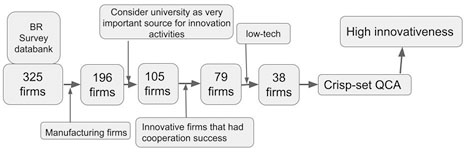
To select manufacturing low-tech companies, the researchers first undertook the procedures suggested by Mikhailov et al. (2020), which were the following: first, out of 325 companies, a sample of 196 manufacturing firms according to OECD (2011) criteria was selected. Second, to increase the nomothetic validity of the cause-effect investigation, researchers excluded firms that matched at least one of the following criteria: (a) firms that did not consider universities as an important source of innovation; and (b) firms that stated that undertaking interaction with universities had no success. Finally, out of 79 remaining companies, 38 low-tech firms were selected (Figure 1).
Sample selection for crisp-set qualitative-comparative analysis
Citation: Triple Helix 10, 3 (2024) ; 10.1163/21971927-bja10042
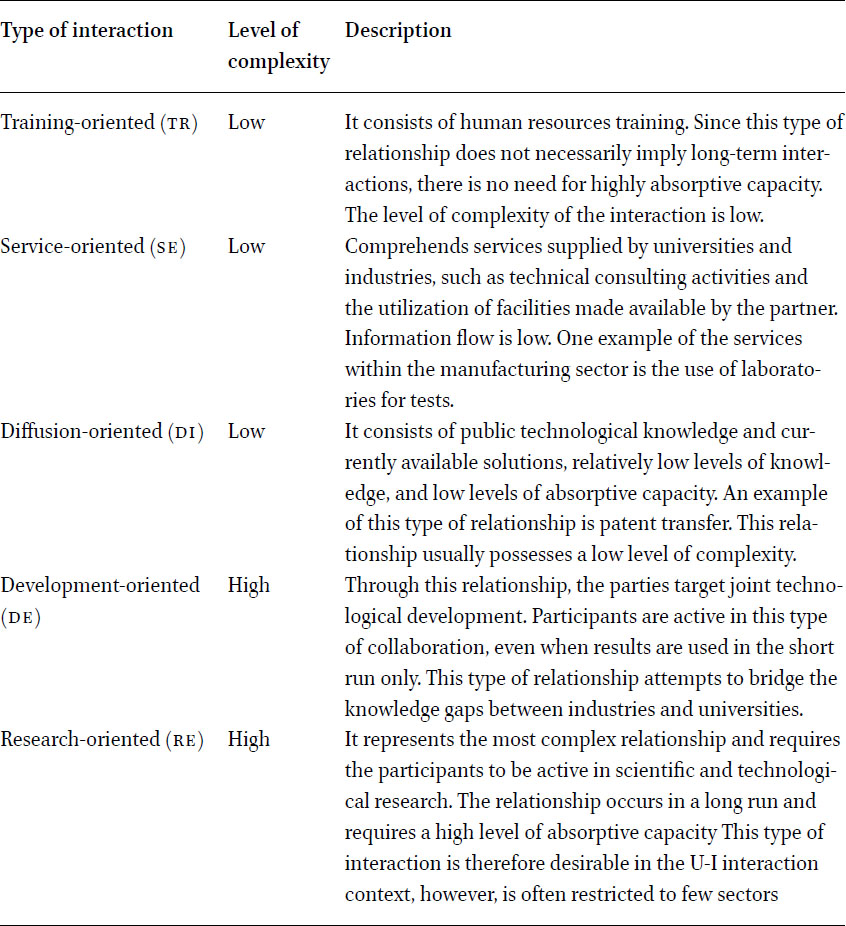
The researchers collected data on firm innovation through the BR Survey and DGP-CNPq Census 2004 to obtain information on the UIC types that analyzed firms engaged during the period 2002–2004. Schaeffer et al.’s (2017) UIC typology9 was applied to previous studies that used qualitative-comparative analysis (Mikhailov et al., 2020). The advantage of using the abovementioned typology resides on the fact that it was developed from DGP-CNPq census typology of UIC. Schaeffer et al. (2017), by reviewing the previous UIC typologies and analyzing original 11 types of UIC indicated in the DGP-CNPq databank, grouped it into five categories of UIC, that are the following: training-oriented, service-oriented, diffusion-oriented, development-oriented and research-oriented.
4.3 Conditions and Outcome
According to the csQCA technique, the given outcomes are the result of combinations of different conditions (Ragin, 2014). Thus, unlike traditional quantitative techniques that use the terms “independent variables” and “dependent variables”, the csQCA nomenclature uses the terms “conditions” and “outcome”. The process of csQCA starts with definitions of the conditions of the outcome, that is, with the definition of factors that lead to a given outcome (Ordanini et al., 2014). Thus, 5 types of the UIC (Schaeffer et al. 2017) typology were defined as the factors that lead the firm to high innovativeness. In the present study, we suggest combinations of the 5 types of Schaeffer’s et al. (2017) interaction types. Therefore, the study tested the following csQCA model:
HInovOut = (TR, SE, DI, DE, RE).
Typology of UIC according to Schaeffer et al. (2017)
Citation: Triple Helix 10, 3 (2024) ; 10.1163/21971927-bja10042
Each UIC type was labeled “1” when present and “0” otherwise. In turn, only those firms that implemented at least either “new-to-the-country product innovation” or “new-to-the-country process innovation” were considered highly innovative. Thus, the outcome of “high innovativeness” was labeled “1” when present and “0” otherwise.
4.4 Data Analysis
The output of csQCA includes three types of solutions: complex, intermediate and parsimonious. Ragin (2014) suggests using an intermediate solution, as it represents the balance between complexity and parsimony by using procedures similar to the practice of conventional case-oriented comparative research. The quality of the csQCA solution is measured by two indicators: consistency and coverage. Ragin (2014) suggests the threshold for considering “valid” the solution when it presents consistency of at least 0.75 and coverage of 0.5. These thresholds were used in the present study.
5 Results and Discussion
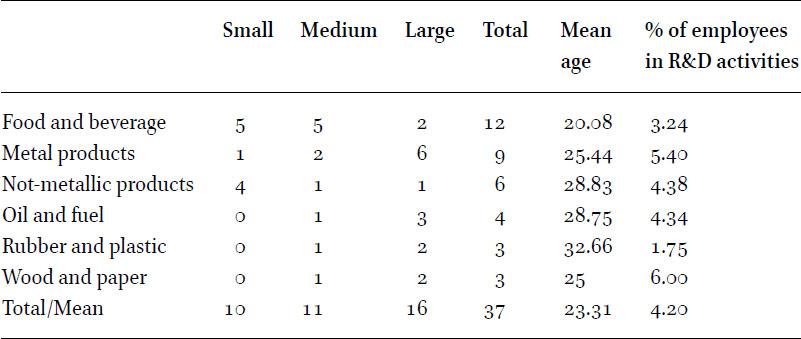
The distribution of companies per sector and by size are shown in Table 5.
Distribution of companies per age,a sector and sizeb
Citation: Triple Helix 10, 3 (2024) ; 10.1163/21971927-bja10042
As observed in Table 5, the food and beverage sector (12 out of 37), the metal products sector (9 out of 27) and the nonmetallic products sector (6 out of 37) were included. Overall, 15 companies are from low-tech sectors, and 22 are from low-medium-tech sectors. Additionally, it is observed that, in general, all sectors are composed of quite mature companies in terms of age. The wood and paper sector has the highest proportion of employees engaged in R&D activities (6.00%), followed by metal products (5.40%), while rubber and plastic have the lowest proportion (1.75%). Most analyzed companies are located in the south and southeast of Brazil.
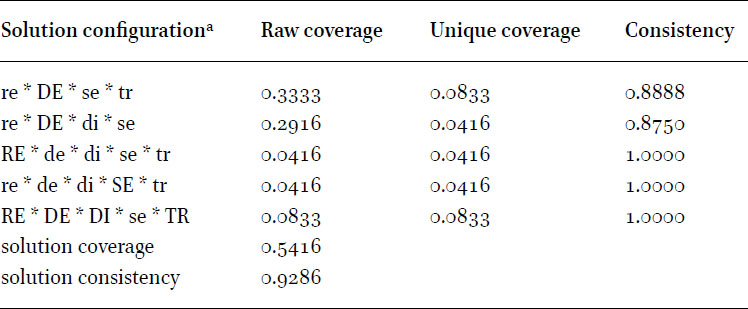
The outcomes of crisp-set QCA are shown in Table 6. Three out of 5 combinations include development-oriented interaction (DE), and 2 out of 5 include research-oriented interaction. Overall, all except one combination includes either DE or RE, hence R&D-based activities. Previously, De Fuentes and Dutrenit’s (2012) empirical investigation of Mexican manufacturing firms also showed that R&D-based UICs are beneficial for firms, particularly for enhancing their R&D capabilities. In the case of Italian firms, previous studies (i.e., Maietta, 2015) showed that R&D UIC positively impacts both firm process and product innovation performance. Some empirical studies separate joint R&D from R&D outsourced to universities (Vega-Jurado et al., 2017). In the case of Spanish manufacturing firms, both types of R&D are able to support product innovation (Vega-Jurado et al., 2017). Process innovation can also have research relations with universities as one of the determinants, particularly in technology-oriented firms (Wirsich et al., 2016).
Results of csQCA for high innovativeness
Citation: Triple Helix 10, 3 (2024) ; 10.1163/21971927-bja10042
Which is the possible explanation for these combinations? Let us look to the first, second and third combinations. First, particularly the training-oriented and service-oriented collaborations tend to be shorter and require lower absorptive capacity and innovation effort than their scientific-based collaborations counterparts (Schaeffer et al., 2017). In contrast, science-based collaborations tend to require more time, effort, knowledge exchange, capabilities and learning abilities recruitment to be performed (Fitjar et al., 2013; Puffal et al., 2021; Schaeffer et al., 2017). In this way, it is possible to hypothesize that more intense UIC s, such as RE and DE, which take more times to be performed, encourage the firm to develop its internal routines to absorb valuable knowledge which in turn may impact its innovation performance (Bishop et al., 2011; Murovec and Prondan, 2009; Zahra and George, 2002).
The present findings are also in line with Mikhailov et al.’s (2020) empirical findings concerning manufacturing firms, which showed by applying QCA that UIC with a high exchange of knowledge and resources is important for the firm to achieve high innovativeness. Also, is in line with Mendonca’s (2009) study, which suggested that the high innovativeness of low-tech firms may come from adopting edge-breaking technology developed elsewhere. Similarly, low-tech Italian firms that engaged in UIC were able to improve their process and product innovation performance (Maietta, 2015).
Combinations 2, 3 and 4 suggest that DI must be absent to achieve firm’ high innovativeness. Most international studies have shown that university’s intellectual property transfer is benefic for firm performance (Min et al., 2021; Vega-Jurado et al., 2017). However, even today there is a debate about whether UIC based on intellectual property transfer are more benefic for the firms that other types of collaborations, as not many studies compared the differences between impacts of different types of UIC s (Apa et al., 2021).
Concerning Brazilian context, some previous studies conducted in Brazil showed that most technological output of the universities are outdated, and, for instance in the recent past it could take more than 10 years to register a patent in Brazil (Dalmarco et al., 2019). Also, the technological products created by universities may have little correspondence with the needs of the productive sector (Costa et al. 2007). It can be one of the possible explanations of why combinations 2, 3 and 4 require the absence of this type UIC.
Accordingly, Povoa and Rapini (2010) investigation conducted in Brazil showed that most university’ technological products require a lot of adaptations before being transformed into innovation or market product. Here, it is worth mention that according to combination 5 when combined with both DE and RE, but not only on of them, diffusion oriented UIC (DI) may lead the firm to high innovativeness. So, if assumed, for instance, that firms in emerging countries and particularly in low-tech sectors miss these abilities (Alves et al., 2017; Reichert et al., 2016), they cannot adequately incorporate the new university technological knowledge into its internal routines unless they improve it through R&D activities conducted with universities (Bishop et al., 2011). But even the firm has these capabilities, it still will need to adapt the transferred university intellectual property into commercialize product. That could be possible explanation for why DI contributes to firms’ high innovativeness in the presence of both research-oriented and development-oriented UIC, but not one only.
Except for combination 5, all combinations suggested by QCA showed the necessity of presence of one only UIC type to achieve high innovativeness. Possible hypothesis for these configurations of combinations may reside on limited resources that firms, particularly low-tech firms in emerging markets have (Alves et al, 2017; Povoa and Rapini, 2010; Reichert et al., 2016). Thus, to achieve progress and success in UIC firms need to focus on limited number of UIC types rather than to spread their efforts across a variety of UIC s. Still, it is important to stress that discussion above contain possible hypotheses require further investigation by future studies.
The findings of the present study have some interesting implications for theory and practice. Previous studies showed that most low-tech companies tend to innovate in a more reserved way than their high-tech counterparts. That is, its innovation tends to be incremental, usually related to cost reductions and changes in design (Hirsch‐Kreinsen, 2008; Hirsch-Kreinsen, 2015; Von Tunzelmann and Acha, 2005). However, the collaboration with actors that have a high level of technological and scientific knowledge, that is, universities, favors companies in their search for high-novelty innovations.
As shown by QCA the presence of combinations that include either development- and research-oriented UIC s is required for most firms to achieve high innovativeness. Thus, one possible suggestion that can be made is that low-tech firms benefit from UIC as much as their high-tech counterparts. In contrast, training-oriented UIC did not appeared in any combination and diffusion-oriented was required to be absent in most combinations also. Therefore, not all types of UIC should be encourage at all costs (Robin and Schubert, 2013). Overall, the study reinforces the role of collaborative R&D in supporting innovation in low-tech firms. Therefore, Brazilian universities are important sources of knowledge and innovation for different companies. In this way, although the innovation system is not yet a mature system, universities could be very important contributors to the growth of the national innovation system.
6 Conclusion and Avenues for Future Research
The results showed that in most cases development-oriented and research oriented UIC are the one firms need to pursue to achieve high innovativeness. Likewise, it is important to the firms to focus on limited number of UIC to be able to increase its innovation performance. In contrast, most QCA combinations suggested that diffusion oriented UIC must be absent. Possible explanation for that is discrepancy between technological output produced by the universities and firms’ innovation necessities (Zawislak and Dalmarco, 2011; Dalmarco et al., 2019). Another possible explanation refers to the low innovation capability of Brazilian firms which results into lower ability to absorb new technologies (Alves et al., 2017; Reichert et al., 2014)
The results can be used by policymakers to formulate appropriate policies for UIC for low-tech sectors. Once it is understood that low-tech firms present a similar configuration of university-industry interactions for high innovativeness, policy development may be similar as well, at least in some aspects. Managers of low-tech firms should pay attention to opportunities for interactions with universities. The low-tech sector represents the largest sector of most developed economies (Reichert et al., 2016), so innovation in the low-tech sector has a significant impact on all economies.
The present study presents some limitations. First, BR Survey (2009) does not cover all UIC in Brazil. It happened because the population of contacted firms was identified through DGP-CNPq 2016 which in turn is filled only by the leaders of the research groups but not by the firm managers (Mikhailov et al., 2022; Schaeffer et al, 2022). For instance, some university researchers that collaborated with the firms may have decided not to declare this in the database for different reasons. Likewise, UIC does not necessarily involve research groups. It may involve contacting through a technological and business incubator, and science parks (Puffal et al., 2021). Still, this limitation is common to most empirical investigations of the effects of U-I collaboration (Arant et al., 2019; Baba et al., 2009; Bishop et al., 2012).
The second limitation refers to the fact that it is not possible to guarantee that the applied U-I collaboration typologies did not affect the study’s results. It is important to add that previous studies created many different typologies of U-I collaboration (Schaeffer et al., 2017. In this case, it can be hard for research scholars to choose between such a vast range of typologies. Also, this limitation occurs due to the differences in data available through U-I collaboration and innovation survey databases collected in different countries through different questionnaires (Baba et al., 2009; Fitjar et al., 2013; Schaeffer et al., 2017).
The third limitation refers to the data itself, as it was collected during the first decade of the century; therefore, it would be important to perform the same study with more recent data. However, particularly in U-I relations studies, it is quite common to use data that were collected 10 or more years ago (Fudickar and Hottenrott, 2019; Mikhailov et al., 2020; Lin, 2019; Puffal et al., 2021). This may be because the core aspects of UIC and institutional aspects tend to change at a slow pace. We also add that, since the Innovation Law in 2005, innovation policies in Brazil have been relatively stable (Puffal et al., 2020). The only innovation outcome variable in the BR Survey (2009) database refers to the degree of innovativeness, not to the firm performance itself. Therefore, in the future, it would be important to construct new databases incorporating other innovativeness measures.
The present study paves the way for new empirical investigations. For instance, we suggest deepening the knowledge of how combinations of UIC impact innovation outcomes by uncovering step-by-step processes. A multiple case study with a process approach could be a suitable method for this issue. It would be interesting to analyze the configurations of U-I relations that lead to the high innovativeness of low-tech and high-tech firms in the same sample. Exploring qualitative aspects of each UIC would also be an interesting opportunity. We suggest deepening the nature of UIC outcomes for low-tech companies by adding qualitative data to the analysis. Investigating the benefits of combining different UIC for obtaining benefits beyond innovation performance would be interesting.
Some previous empirical studies provided support to the hypothesis that universities and research institutes differ in their ability to provide resources and benefits to the collaborative firms (Hou et al., 2019). Thus, it is suggested to conduct studies comparing the possible differences in effects of above-mentioned institutions on firm performance and capabilities. The benefits obtained by the firms from U-I collaboration can be affected by factors such as actor’s and environmental characteristics. The environmental characteristics include factors such as market competition, technological turbulence, and institutional features (Kafouros et al., 2015; Min et al., 2019; Shi et al., 2020; Yang et al., 2022). Hence, it is suggested to investigate how and how much above-mentioned factors affect the benefits obtained by the firms from collaboration with universities.
While the idea of sourcing innovation from UIC s is not new, research on how to combine different UIC s in a way that contributes to innovativeness is in its infancy. The empirical evidence presented in this study provides a small but significant starting point for future research. Therefore, it would be interesting to replicate the study in the context of different emerging and advanced economies.
Conflict of Interests
The present study has no conflict of interests.
Funding
The present study was partially funded by Coordenação de Aperfeiçoamento de Pessoal de Nível Superior (CAPES) – finance code 001.
Notes
The term “combination” refers to the mathematical definition of a term “combination”. As the csQCA data analysis technique is based on Set Theory and Boolean Algebra (Ragin, 2014), regardless the firm engages in two UIC types out of five possible or one UIC type out five possible, both cases will be considered as combination of UIC. When the csQCA data analysis technique suggests more than one combination of UIC, the term used will be “combinations of UIC” as plural form of a term “combination”.
Term “without sectoral perspective” refers to the cases when given articles used a sample composed by the firms from different sectors and different economic activities.
The table was based on a systematic literature review of studies that evaluated UIC benefits performed by the authors. It is important to stress that some studies analyzed samples composed exclusively of firms that collaborated with univer‑ sities. Hence, the absence of the positive effect of a given UIC on a given type of benefit does not necessary imply that firms that collaborated with universities have equal or lower performance than firms that did not.
Overall innovation performance refers to the cases when innovation is measured by a set of different variables such as Likert-scale constructs in some cases.
The research group census has been conducted since 1993 by the Nation Council for Scientific and Technological Development (CNPq), which is a large Brazilian science funding agency. The research questionnaire is filled in by the scientific research groups leaders formally registered by CNPQ and contains questions on interactions performed by the research groups with other actors, including firms. This database has been widely used by studies of UI relations in Brazil (Caliari and Chiarini, 2018; Povoa and Rapini, 2010; Rapini et al., 2019). Currently the DGP-CNPq Census 2016 is the most recent. The procedure of the data collection of DGP-CNPq 2004 (cited in the following Section 4 – Data and Method) were the same as for DGP-CNPq Census 2002 and DGP-CNPq Census 2016. For more information access http://lattes.cnpq.br/web/dgp/censos-realizados.
Statistics presented out by Fischer et al. (2019) are based on the compilation of PINTEC data in the years 2003, 2005, 2008, 2011 and 2014. PINTEC is the Brazilian innovation survey carried out every three years by the IBGE (2023) – Brazilian Institute of Geography and Statistics. PINTEC was created to collect indicators on innovation activities across all economic sectors and have been applied with Brazilian firms which have at least ten employees. In turn, these indicators helps to formulate public policies for innovation (IBGE, 2023). The recent editions of the surveys used questionnaires based on Oslo Manual (2005) and was similar to Community Innovation Survey (CIS) in different aspects. For more information, go to https://www.ibge.gov.br/estatisticas/multidominio/ciencia-tecnologia-e-inovacao/9141-pesquisa-de-inovacao.html?=&t=what-is.
The BR Survey was conducted within the national project called ‘Interactions of Universities and Research Institutes with commercial firms in Brazil in the year 2011, checking for information on firms’ innovation activities between 2009 and 2011 (Garcia et al., 2018). The reason to apply the survey resided on the necessity of deepening the understanding the characteristics of UIC in Brazil. Data collected through the survey included information such firm’ characteristics, interaction channels and its importance for the firms, types of funding used by the firms, among others. The BR Survey’s structured questionnaire was based on the Carnegie Mellon Survey on Industrial R&D (Cohen et al., 2002) and the Yale Survey on Industrial R&D (Klevorick et al., 1995).
The microdata from PINTEC survey are not publicly available, so it was not possible to perform tests of statistical significance differences between the data from PINTEC and BR Survey. The 2011 edition surveyed 15.703 manufacturing companies from all sectors.
Schaeffer’s et al. (2017) typology is presented in the following subsection in Table 4.
References
Abdulai, A. F., Murphy, L., & Thomas, B. (2020). University knowledge transfer and innovation performance in firms: the Ghanaian experience. International Journal of Innovation Management, 24(03), 2050023.
Ahrweiler, P., Pyka, A., & Gilbert, N. (2011). A new model for university‐industry links in knowledge‐based economies. Journal of Product Innovation Management, 28(2), 218–235.
Alves, A. C., Barbieux, D., Reichert, F. M., Tello-Gamarra, J., & Zawislak, P. A. (2017). Innovation and dynamic capabilities of the firm: Defining an assessment model. Revista de Administração de Empresas, 57, 232–244.
Apa, R., De Marchi, V., Grandinetti, R., & Sedita, S. R. (2021). University-SME collaboration and innovation performance: the role of informal relationships and absorptive capacity. The Journal of Technology Transfer, 1–28.
Arant, W., Fornahl, D., Grashof, N., Hesse, K., & Söllner, C. (2019). University-industry collaborations – The key to radical innovations? Review of Regional Research, 39(2), 119–141.
Baba, Y., Shichijo, N., and Sedita, S. R. (2009). How do collaborations with universities affect firms’ innovative performance? The role of “Pasteur scientists” in the advanced materials field. Research Policy, 38(5), 756–764.
Bishop, K., D’Este, P., & Neely, A. (2011). Gaining from relations with universities: Multiple methods for nurturing absorptive capacity. Research Policy, 40(1), 30–40.
Bramwell, A., & Wolfe, D. A. (2008). Universities and regional economic development: The entrepreneurial University of Waterloo. Research Policy, 37(8), 1175–1187.
Bastos, E. C., Sengik, A. R., & Tello-Gamarra, J. (2021). Fifty years of University-industry collaboration: a global bibliometrics overview. Science and Public Policy, 48(2), 177–199.
Bonaccorsi, A., & Piccaluga, A. (1994). A theoretical framework for the evaluation of university‐industry relationships. R&D Management, 24(3), 229–247.
Colombo, M. G., & Delmastro, M. (2002). How effective are technology incubators? Evidence from Italy. Research Policy, 31(7), 1103–1122.
Costa, A., Martinelli, O., Puffal, D., & Ruffoni, Janaina. (2007). Grupos de Pesquisa Científica e Tecnológica e suas Relações com o Setor Produtivo no Rio Grande do Sul. Proceedings of Encontro de Relações universidade-empresa no sul do Brasil: Experiências e possibilidades de desenvolvimento tecnológico para um Sistema Regional de Inovação, Brazil, Santa Catarina.
Dalmarco, G., Hulsink, W., & Zawislak, P. A. (2019). New perspectives on university-industry relations: an analysis of the knowledge flow within two sectors and two countries. Technology Analysis and Strategic Management, 31(11), 1314–1326.
D’este, P., & Patel, P. (2007). University – industry linkages in the UK: What are the factors underlying the variety of relations with industry? Research Policy, 36(9), 1295–1313.
De Fuentes, C., & Dutrénit, G. (2012). Best channels of academia – industry interaction for long-term benefit. Research Policy, 41(9), 1666–1682.
Eom, B. Y., & Lee, K. (2010). Determinants of industry – academy linkages and, their impact on firm performance: The case of Korea as a latecomer in knowledge industrialization. Research Policy, 39(5), 625–639.
Etzkowitz, H. (2004). The evolution of the entrepreneurial university. International Journal of Technology and Globalisation, 1(1), 64–77.
Etzkowitz, H., & Leydesdorff, L. (2000). The dynamics of innovation: from National Systems and “Mode 2” to a Triple Helix of university – industry – government relations. Research policy, 29(2), 109–123.
Etzkowitz, H., & Zhou, C. (2018). The Triple Helix: University – industry – government innovation and entrepreneurship. London: Routledge.
Etzkowitz, H., Webster, A., Gebhardt, C., & Terra, B. R. C. (2000). The future of the university and the university of the future: evolution of ivory tower to entrepreneurial paradigm. Research policy, 29(2), 313–330.
Eurostat. (2018). Community Innovation survey 2018 [Data set]. Available at: https://ec.europa.eu/eurostat/cache/metadata/en/inn_cis11_esms.htm.
Fernandes, A. C., De Souza, B. C., Da Silva, A. S., Suzigan, W., Chaves, C. V., & Albuquerque, E. D. M. E. (2010). Academy – industry links in Brazil: evidence about channels and benefits for firms and researchers. Science and public policy, 37(7), 485–498.
Fischer, B., Meissner, D., Vonortas, N., & Guerrero, M. (2022). Spatial features of entrepreneurial ecosystems. Journal of Business Research, 147, 27–36.
Fischer, B. B., Schaeffer, P. R., & Vonortas, N. S. (2019). Evolution of university-industry collaboration in Brazil from a technology upgrading perspective. Technological forecasting and social change, 145, 330–340.
Fitjar, R. D., & Rodríguez-Pose, A. (2013). Firm collaboration and modes of innovation in Norway. Research Policy, 42(1), 128–138.
Fudickar, R., & Hottenrott, H. (2019). Public research and the innovation performance of new technology based firms. The Journal of Technology Transfer, 44(2), 326–358.
Garcia-Perez-de-Lema, D., Madrid-Guijarro, A., & Martin, D. P. (2017). Influence of university – firm governance on SMEs innovation and performance levels. Technological Forecasting and Social Change, 123, 250–261.
González-Moreno, A.; Triguero, A. and Sáez-Martinez, F. J. (2019). Many or trusted partners for eco-innovation? The influence of breadth and depth of firms knowledge network in the food sector. Technological Forecasting and Social Change, 147, 51–62.
Guerrero, M., and Urbano, D. (2017). The impact of triple helix agents on entrepreneurial innovations’ performance: An inside look at enterprises located in an emerging economy. Technological forecasting and social change, 119, 294–309.
Grofman, B., & Schneider, C. Q. (2009). An introduction to crisp set QCA, with a comparison to binary logistic regression. Political research quarterly, 62(4), 662–672.
Hall, B. H. (2005). The financing of innovation. The handbook of technology and innovation management, 409–430. Chichester, England: Wiley & Sons Ltd.
Hanel, P., & St-Pierre, M. (2006). Industry – university collaboration by Canadian manufacturing firms. The Journal of Technology Transfer, 31, 485–499.
Hair, J. F., Black, W. C., Babin, B. J., Anderson, R. E., and Tatham, R. L. (2009). Multivariate data analysis. New Jersey: Pearson Hall.
Hirsch-Kreinsen, H. (2015). Innovation in low-tech industries: current conditions and future prospects. In Low-tech innovation (pp. 17–32). United States: Springer, Cham.
Hirsch‐Kreinsen, H. (2008). “Low‐tech” innovations. Industry and innovation, 15(1), 19–43.
Hulsink, W., Dons, H., Lans, T., & Blok, V. (2014). Boosting entrepreneurship education within the knowledge network of the Dutch agri-food sciences: the new ‘Wageningen” approach. In Fayolle, A. & Redford, D. (Eds) Handbook on the Entrepreneurial University. United Kingdom: Edward Elgar.
Instituto Brasileiro de Geografia (IBGE). 2023. Retrieved from: https://www.ibge.gov.br/estatisticas/multidominio/ciencia-tecnologia-e-inovacao/9141-pesquisa-de-inovacao.html (accessed 10 January 2023).
Jones, J., & de Zubielqui, G. C. (2017). Doing well by doing good: A study of university- industry interactions, innovationess and firm performance in sustainability-oriented Australian SMEs. Technological Forecasting and Social Change, 123, 262–270.
Kafouros, M., Wang, C., Piperopoulos, P., & Zhang, M. (2015). Academic collaborations and firm innovation performance in China: The role of region-specific institutions. Research Policy, 44(3), 803–817.
Kastelli, I., Tsakanikas, A., & Caloghirou, Y. (2018). Technology transfer as a mechanism for dynamic transformation in the food sector. The Journal of Technology Transfer, 43(4), 882–900.
Kirner, E., Kinkel, S., & Jaeger, A. (2009). Innovation paths and the innovation performance of low-technology firms – An empirical analysis of German industry. Research Policy, 38(3), 447–458.
Lee, B., Cho, H. H., & Shin, J. (2015). The relationship between inbound open innovation patents and financial performance: Evidence from global information technology companies. Asian journal of technology innovation, 23(3), 289–303
Lee, Y. S. (1996). Technology transfer and the research university: a search for the boundaries of university-industry collaboration. Research Policy, 25(6), 843–863.
Lin, J. Y. (2019). How does collaboration between universities and R&D firms influence performance?. Management Decision, 57(9), 2436–2476.
Maietta, O. W. (2015). Determinants of university – firm R&D collaboration and its impact on innovation: A perspective from a low-tech industry. Research Policy, 44(7), 1341–1359.
MacKenzie, N. G., & Zhang, Q. (2014). A regional perspective on the entrepreneurial university: Practices and policies. In Fayolle, A. & Redford, D. (Eds) Handbook on the Entrepreneurial University. United Kingdom: Edward Elgar Publishing.
Mendonça, S. (2009). Brave old world: Accounting for ‘high-tech’knowledge in ‘low- tech’ industries. Research Policy, 38(3), 470–482.
Meyer-Krahmer, Frieder; Schmoch, Ulrich. (1998). Science-based technologies: university – industry relations in four fields. Research Policy, 27(8), 835–851.
Mikhailov, A., Ruffoni, J., Morales, G. de L., Glaser, I. G., & Puffal, D. (2022). Características da Hélice Universidade-Empresa no Brasil: interações entre grupos de pesquisa das universidades e empresas industriais. In Amaral, M.G., Mineiro, A. A. de C., Faria, A. F. (Orgs). As Hélices da Inovação: Interação universidade-empresa-governo-sociedade no Brasil. Editora CRV.
Mikhailov, A., Puffal, D., & Santini, M. (2020). University-Industry Relations and Industrial Innovation: Evidence from Brazil. Journal of technology management and innovation, 15(3), 6–16.
Min, J. W., Vonortas, N. S., & Kim, Y. (2019). Commercialization of transferred public technologies. Technological Forecasting and Social Change, 138, 10–20.
Murovec, N., & Prodan, I. (2009). Absorptive capacity, its determinants, and influence on innovation output: Cross-cultural validation of the structural model. Technovation, 29(12), 859–872.
O’Connor, M., Doran, J., & McCarthy, N. (2020). Cognitive proximity and innovation performance: are collaborators equal?. European Journal of Innovation Management, 24(3), 637–654. https://doi.org/10.1108/EJIM-11-2019-0347.
OECD ISIC, R. (2011). Technology intensity definition. Classification of manufacturing industries into categories based on R&D intensities. Eurostat.
Ordanini, A., Parasuraman, A., and Rubera, G. (2014). When the recipe is more important than the ingredients: A qualitative comparative analysis (QCA) of service innovation configurations. Journal of Service Research, 17(2), 134–149.
Organisation for Economic Cooperation and Development. (2011). Technology intensity definition. Available at: http://www.oecd.org/dataoecd/43/41/48350231.pdf. Accessed on December 2021.
O’Shea, R. P., Allen, T. J., Morse, K. P., O’Gorman, C., & Roche, F. (2007). Delineating the anatomy of an entrepreneurial university: the Massachusetts Institute of Technology experience. R&D Management, 37(1), 1–16.
Pavitt, K. (2004). Changing patterns of usefulness of university research. Opportunities and dangers. The science – industry nexus. History, policy, implications, 119–131.
Perkmann, M., Tartari, V., McKelvey, M., Autio, E., Broström, A., D’este, P., … & Sobrero, M. (2013). Academic engagement and commercialisation: A review of the literature on university – industry relations. Research Policy 42(2), 423–442.
Póvoa, L. M. C., & Rapini, M. S. (2010). Technology transfer from universities and public research institutes to firms in Brazil: what is transferred and how the transfer is carried out. Science and Public Policy, 37(2), 147–159.
Puffal, D. (2014). Effects of university-industry relation on firm’s innovation: Empirical evidence from Brazilian firms. Revista Ibero-Americana de Estratégia-RIAE, 13(1).
Puffal, D. P., Ruffoni, J., & Spricigo, G. (2021). Empirical evidence for Brazilian firms in terms of university-industry interaction, public funding and innovation outcome. International Journal of Innovation Management, 2150040.
Ragin, C. C. (2014). The Comparative Method: Moving Beyond Qualitative and Quantitative Strategies. Berkley, CA: University of California Press.
Rapini, M. S., Chiarini, T., Bittencourt, P., and Caliari, T. (2019). The intensity of private funding and the results of university? Firm interactions: the case of Brazil. Innovation and Management Review, 16(2), 161–184. https://doi.org/10.1108/INMR-11-2018-0088.
Rapini, M. S., Chiarini, T., & Bittencourt, P. F. (2017). Obstacles to innovation in Brazil: The lack of qualified individuals to implement innovation and establish university – firm interactions. Industry and Higher Education, 31(3), 168–183.
Ratten, V. (2017). Entrepreneurial universities: the role of communities, people and places. Journal of Enterprising Communities: People and Places in the Global Economy, 11(3), 310–315.
Reichert, F. M., Zawislak, P. A., and Arundel, A. (2016). Exploring innovation success recipes in low-technology firms using fuzzy-set QCA. Journal of Business Research, 69(11), 5437–5441.
Reihlen, M., & Wenzlaff, F. (2014). Institutional change in the German higher education system: From professional dominance to managed education. In Fayolle, A. & Redford, D. (Eds) Handbook of Entrepreneurial University (pp. 112–135). United Kingdom: Edward Elgar Publishing.
Rihoux, B., & Ragin, C. C. (2009). Configurational comparative methods: Qualitative comparative analysis (QCA) and related techniques. (Vols. 1–51). Thousand Oaks, California: SAGE Publications, Inc.
Robertson, P., & Smith, K. (2008). Distributed knowledge bases in low-and medium-technology industries. Innovation in low-tech firms and industries, 93–117.
Robin, S., & Schubert, T. (2013). Cooperation with public research institutions and success in innovation: Evidence from France and Germany. Research Policy, 42(1), 149–166.
Schaeffer, P. R., Dullius, A. C., Rodrigues, R. M., and Zawislak, P. A. (2017). Searching to bridge the gaps: a new typology of university-industry interaction. Academia Revista Latinoamericana de Administración, 30(4), 459–473.
Suzigan, W., & Albuquerque, E. D. M. (2008). A interação entre universidades e empresas em perspectiva histórica no Brasil. Belo Horizonte: UFMG/Cedeplar, 1–27.
Vega-Jurado, J., Kask, S., and Manjarrés-Henriquez, L. (2017). University industry links and product innovation: cooperate or contract? Journal of Technology Management and Innovation, 12(3), 1–8.
Von Tunzelmann, N., and Acha, V. (2005). Innovation in “low-tech” industries. In Fagerberg, J. & Mowery, D. C. (Eds.) The Oxford Handbook of Innovation. Oxford: Oxford Academic. https://doi.org/10.1093/oxfordhb/9780199286805.003.0015.
Wirsich, A., Kock, A., Strumann, C., & Schultz, C. (2016). Effects of university – industry collaboration on technological newness of firms. Journal of Product Innovation Management, 33(6), 708–725.
Yang, J., Zhang, J., & Zeng, D. (2022). Scientific collaboration networks and firm innovation: the contingent impact of a dynamic environment. Management Decision, 60(1), 278–296.
Zahra, S. A., & George, G. (2002). Absorptive capacity: A review, reconceptualization, and extension. Academy of management review, 27(2), 185–203.
Zawislak, P. A., & Dalmarco, G. (2011). The silent run: new issues and outcomes for university-industry relations in Brazil. Journal of technology management and innovation, 6(2), 66–82.
Zhang, Y., Yuan, C., & Zhang, S. (2022). Influences of university-industry alliance portfolio depth and breadth on growth of new technology-based firms: Evidence from China. Industrial Marketing Management, 102, 190–204.