Abstract
The pandemic, along with the sanitary measures put in place by provincial governments, disrupted collective life right down to its very foundations. In particular, religious groups had to adapt to the restrictions in place, and some also sought to make contact with governments in order to advance their cause and role in the public sphere. This article will show how four religious traditions (Roman Catholic, Protestant, Muslim, and Jewish) in Canada evolved during the pandemic, and particularly in the realm of digital innovations, where online rituals and âhybrid churchâ have become part of a new normal.
1 Introduction
Using a systematic analysis, based on two questionnaires, which reached more than 600 leaders and 700 members, 200 articles from religious media, more than 330 public documents from religious groups of the four selected traditions in Canada, and eighty semistructured interviews conducted with members and leaders of these groups, this article analyzes how religions coped during the COVID-19 pandemic in Canada, and especially how this crisis has led to an online transformation in order to sustain religious activity, but also as a new way to reach the religious community. See the introduction of this special issue for details about the projectâs rationale, methods, and data sources. A much fuller explanation has also been published (Radde-Antweiler et al. 2026). Results will be presented and discussed according to the three core areas of research designed for the project: discourses on health, illness, and science; relationships with governments and policymakers; and digital innovations. This article is based on the âReligion in Societies Emerging from Covid-19 (RECOV-19)â research project.1 It draws on the most relevant data sources from this mixed-methods project, including religious organizationsâ public documents, online questionnaires, and interviews. This article focuses on the notion of the âhybrid church,â a term frequently used in religious media and documents to describe how religious institutions adapted to the digital challenges brought about by the COVID-19 pandemic. While the impact of the pandemic varied across religious groups, certain commonalities can be observed in their responses to the shift toward online religious engagement and in their general compliance with public health measures. However, tensions sometimes emerged between the expectations of religious leaders and the actual responses of congregantsâparticularly regarding levels of spiritual engagement and the use of digital platforms.
The mixed methodology employed in this study, detailed fully in the methodological introduction, centers on the analysis of four religious traditions in Canada: Roman Catholicism, Protestantism (subdivided by denomination), Islam, and Judaism. The research was structured in three phases. The first phase involved the collection, NVivo coding, and qualitative analysis of 330 public documents (e.g., websites, official statements) from these religious traditions. A parallel process was applied to 200 press articles from the same traditions. To reflect Canadaâs bilingual context, one English and one French source were selected whenever feasible. For Roman Catholicism, the chosen publications were The Catholic Register and Le Verbe, the leading media outlets for the Roman Catholic Church. For Protestantism, the selected sources were the Anglican Journal, the primary online Anglican publication in Canada, and Broadview, an ecumenical publication affiliated with the United Church of Canada, though not its official media outlet. For Islam, the website Muslim Link was selected, and for Judaism, The Canadian Jewish News. In the second phase, two questionnairesâone for leaders (609 responses: 168 Catholics, 419 Protestants, 14 Muslims, 8 Jews) and one for members (728 responses: 446 Catholics, 184 Protestants, 7 Muslims, 46 Jews and 44 others)âwere designed using SurveyMonkey and distributed in two waves between autumn 2023 and spring 2024, with assistance from religious leaders and email contacts. The third phase comprised eighty semi-structured interviews (58 with leaders, 22 with members; including 30 Roman Catholics, 31 Protestants [19 mainline, 4 Baptists, 1 Adventist, 7 Evangelicals], 6 Jews, and 13 Muslims), conducted online and offline with participants recruited via the questionnaires (volunteers who opted for follow-up contact) and through snowball sampling between spring and summer 2024. Fifty participants were male and thirty were female; forty-nine were French-speaking and thirty-one were English-speaking. These interviews were also coded and analyzed qualitatively.2
The article is structured in three sections. The first examines the national context of Canada during the pandemic; the second offers an analytical synthesis of the empirical findings; and the third explores how religious groups have responded to the challenges and transformations brought about by digital technologiesâparticularly in relation to community management, ritual practice, and media strategies. Special attention is given to the concept of the hybrid church. The article argues that while this model creates new opportunities for connecting religious communities with their leadership, it may also reinforce the growing individualization of religious practice.
1.1 Timeline of the Pandemic
As of 20Â August 2024, Canada had reported nearly 5 million cases of COVID-19 and more than 60,000 deaths. Throughout the pandemic, restrictions on places of worship varied significantly across provinces, as each provincial government implemented its own measures. As Cyr et al. (2021) note, while the Canadian federal government implemented comprehensive public health measures, particularly regarding border travel restrictions, the countryâs decentralized health-care system led to significant heterogeneity in the application of these measures. This variation manifested in both the timing of implementation across provinces and the stringency of the measures, likely influenced by differing political sensitivities and approaches among provincial governments, rather than by the prevalence of the virus in each province. Restrictions on places of worship exhibited considerable variation in both timing and stringency across Canadian provinces, leading to diverse experiences for religious groups and their adherents during the pandemic.
As noted by journalists, in Quebec, for instance, places of worship were closed beginning on 15Â March 2020. They were later reopened with a mask mandate (effective 18Â July 2020), social distancing, and a twenty-five-person limit starting on 1Â April 2021. In British Columbia, places of worship were closed from November 2020 to May 2021. Upon reopening, restrictions such as mask mandates and social distancing were enforced, before being lifted in July 2021. These measures were reintroduced in December 2021 and remained in place until March 2022. In Ontario, places of worship were closed in March 2020 and reopened gradually, with in-person attendance limits implemented from 12Â June 2020. During the fall of 2020, restrictions were tightened to allow a maximum of twenty-five people for outdoor services and ten for indoor gatherings. Further limitations on religious services remained in effect until July 2021 (Lawson et al. 2022).
Most restrictions across Canada were lifted following the spring of 2022. The variation in restrictions and public health measures between provinces contributed to a complex national context and shaped diverse experiences and perspectives among religious communities and individuals across the country.
1.2 Religion in the National Context
This study focuses on two majority religions and the two largest minority religions in Canada, as identified in the 2021 census: Roman Catholicism (29.9â¯%) and Protestantism (13â¯%) as majority religions; and Islam (4.9â¯%) and Judaism (0.9â¯%) as minority religions. Notably, individuals declaring no religious affiliationâthe so-called ânonesââhave become a significant demographic, rising from 16.5â¯% in 2001 to 34.6â¯% in 2021 (Statistics Canada 2022).
Christianity remained the largest religious affiliation in Canada in 2021, with 53.3â¯% of the population identifying with a Christian traditionâa notable decline from 77.1â¯% in 2001 (Statistics Canada 2022). Among Christians, Roman Catholics form the largest group (29.9â¯%). Although this proportion varies by region, the Roman Catholic Church in Canada is highly centralized, with the Canadian Conference of Catholic Bishops (CCCB) serving as the national authority, and various dioceses and regional organizations operating at the local level.
Protestants represent the second-largest Christian denomination, although membership is spread across various churches. For this reason, the study focuses on the two largest liberal Protestant denominations: the Anglican Church (3.1â¯%) and the United Church of Canada (3.3â¯%). The United Church, Canadaâs largest Protestant body, was formed in 1925 through the merger of the Methodist Church, the Congregational Union of Ontario and Quebec, and two-thirds of the Presbyterian Church in Canada; it later integrated the Canadian Conference of the Evangelical United Brethren Church in 1968. Other Protestant currents, including Baptists (approximately 435,940 adherents) and Evangelicals (around 101,545), are also influential. Evangelical groups are primarily affiliated with the Evangelical Fellowship of Canada, though it is not the only such organization.
Islam is now the second-largest religious group in Canada. Its share of the population has more than doubled in two decades, from 2â¯% in 2001 to 4.9â¯% in 2021 (Statistics Canada 2022). The Jewish community comprises 0.9â¯% of the population (approximately 335,000 people), down from 1.1â¯% in 2001. Most Jewish organizations in Canada are represented by the Centre for Israel and Jewish Affairs (CIJA).
1.3 Literature Review on COVID-19 and Religion in Canada
The Canadian literature on religion during the COVID-19 pandemic highlights the unequal social and spiritual consequences experienced by different groups, with religious minorities being disproportionately exposed to the virus and to discrimination (Rehmani et al. 2023). For some, the pandemic led to a renewed emphasis on spiritual life, with spirituality and religion serving as sources of psychological support during the crisis (Miconi et al. 2021; Cherblanc et al. 2021; Sen et al. 2022; Champagne 2023), particularly among certain religious leaders (Kappler et al. 2022). Although vaccine hesitancy was at times linked to religious belief when compared to atheists and agnostics, political orientation, and levels of trust in science, government, and media proved to be more consistent predictors (Tippins et al. 2023).
The pandemic also provided a context in which religion interacted more visibly with the public sphere and government or health authorities. While most religious groups complied with public health directives and implemented safety protocols, tensions arose with specific communities. In Montreal, for instance, disputes with some Hasidic Jewish and Muslim groups were resolved through a dialogical approach involving mediation teams (El-Majzoub et al. 2021). Some faith communities, especially among immigrants, reported feeling stigmatized, as illustrated by the 2020 controversy over the public broadcasting of the Muslim call to prayer in an Ontario city. This incident highlighted conflicting views between those supporting a privatized model of religious expression and those advocating for a multicultural public space (Riskedahl 2020).
Other studies have underlined the significant impact of worship space closures on communities, particularly for recent immigrants who rely on these institutions for social support and integration. Resettled refugees, in particular, faced greater difficulties due to language barriers, bureaucratic complexity, and limited health literacy (Edmonds and Flahaut 2021). Legal scholarship has also examined the tension between public health measures and religious freedom, noting that while most groups complied with restrictions, many felt their rights had not been adequately considered from a freedom-of-religion perspective (Bird 2022; Flood et al. 2020; Boutilier 2022).
The literature further explores the effects of the pandemic on mourning rituals and the theological implications of conducting religious ceremonies online (Barreau 2021; Cardita 2020; Demirovic 2021; Riskedahl 2020). Shared rituals and community belonging are emphasized as essential, while digital mediation is seen as having both enabled continuity and introduced challengesâparticularly by reinforcing individualization in religious practice and necessitating new ways of engaging in worship (Barreau, 2021; Cardita, 2020). Some studies highlight how digital platforms blurred the boundaries between virtual and physical communities and even expanded religious networks, especially among ethnically diasporic groups (Tompoudi 2023). However, the shift online also exacerbated generational divides and marginalized individuals who lacked digital access or literacy (Tompoudi 2023; Rehmani et al. 2023).
Additionally, the internet became a central hub for both religious resources and conspiracy theories. Some research points to a rise in online searches related to religion and spirituality during the pandemic (Ahangar et al. 2021). At the same time, digital spaces facilitated the alliance of some marginalized religious groups with antigovernment movements, united by stigmatized knowledge, a rejection of mainstream sources of authority, and a preference for charismatic leadership (Meintel 2022; see also Dyrendal et al. 2018, for earlier developments).
Canadian scholarship has predominantly focused on specific case studies rather than providing a comprehensive overview of the religious landscape during the pandemic. This article aims to fill this gap through a systematic analysis, utilizing two large-scale surveys, qualitative analysis of 200 religious media articles, over 330 public documents from religious groups within the four selected traditions, and eighty semistructured interviews with members and leaders (see the introduction of this special issue for details on the research design). The article concludes by exploring the concept of the hybrid church (Baker 2007), a term frequently employed in Protestant media but less commonly in Roman Catholic contexts, to evaluate the challenges posed by the digital shift during the pandemic and its implications for religious authority and community cohesion.
2 Findings
This section outlines the key findings from our projectâs core research areas (for further details, see the introduction to this special issue).
2.1 Discourses around Health, Illness, and Science
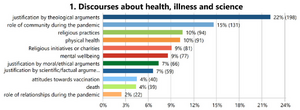
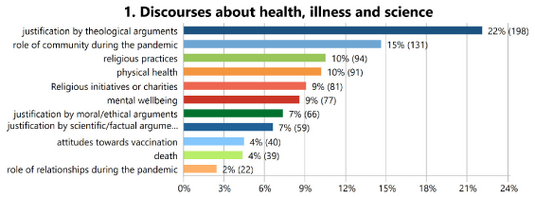
Figures 1 and 2 illustrate the recurrence of the coded themes, revealing clear patterns in both the public documents disseminated by the religious groups and their main media outlets. The most frequently used codes were âJustification by theological argumentsââreferring to appeals to religious scriptures, God, or doctrinal principlesâand âRole of community during the pandemic,â which highlights how religious groups sought to protect their members and emphasized the centrality of community during this period.
In particular, Christian traditions often employed theological arguments as ethical narratives to make sense of the pandemic. These arguments were used to inspire specific behaviors through references to scripture, and were mobilized either by journalists or religious actors to interpret or frame events through a Christian lens. Similar strategies were found in public documents, where theological reasoning was used to justify particular behaviors and support adherence to government-imposed health measures. Over time, general compliance with these measures came to be portrayed as both necessary and morally imperative, especially in light of the need to save lives and promote the âcommon goodââas illustrated in the following excerpt from a Roman Catholic media source:
âAn erroneous conscience does not forbid certain consequences, such as measures mandating vaccinations. Bishops, therefore, have urged the faithful to educate and inform their conscience according to the teachings of our Church,â [Bishop Ronald Fabbro] said. Catholics need to be vaccinated âout of love for their neighbour and to serve the common good.â
Bishop Ronald Fabbro quoted in Swan 2022
However, discourses surrounding health, illness, and science varied in their modes of justification. Muslim organizations tended to adopt a more secularized discourse compared to Christian denominations, consistently emphasizing cooperation, compliance with public health measures, and respect for those outside their religious community. This leads to the following hypothesis: As a minority often subject to public controversies, Muslims may seek to appear socially acceptable within Canadaâs broader secular context. Consequently, they tend to frame their public communications in secular terms and place particular emphasis on not disturbing or alienating those outside their community. As Miconi et al. (2021) argue, Muslims and individuals identifying with nondominant religions were more likely to report experiencing discrimination during the pandemic. Moreover, Muslims were also more likely to be exposed to the virus. These dynamics suggest that protecting the communityâfrom both social stigma and viral transmissionâwas a primary concern. This helps explain the consistent emphasis on public acceptability, adherence to health measures, and the use of a shared secular language in Muslim public discourse.

Figure 1
Public documents: main codes for discourses on health, illness, and science
Citation: Journal of Religion in Europe 19, 1-2 (2026) ; 10.1163/18748929-bja10145
Figure 2
Religious media: main codes for discourse on health, illness, and science
Citation: Journal of Religion in Europe 19, 1-2 (2026) ; 10.1163/18748929-bja10145
A second dominant code concerns the importance of community, which was frequently linked to religious practices. The need for supportâparticularly in relation to mental healthâemerged as a central concern during the pandemic, reinforcing the crucial role played by religious communities in sustaining social and emotional well-being:
We worked very hard at trying to maintain community, maintain connection between people, because we felt that that was not just good for the church, that was good for the individuals concerned, that was good for their mental health and their well-being, particularly when we were isolated from each other.3
In the leadersâ questionnaires, when asked about the main challenges faced by their members during the pandemic, Christian leaders did not prioritize health issues as their top concern. Among Roman Catholic leaders, the most frequently cited challenge was death and grief (62â¯%), followed by physical health issues (54â¯%) and mental health issues (46â¯%). Protestant leaders, on the other hand, identified mental health as the most significant consequence (69â¯%), followed by physical health issues (64â¯%) and death (63â¯%).
In the membersâ questionnaire, mental health also emerged as a notable concern across traditions: 18â¯% of Roman Catholic respondents, 17â¯% of Muslims, 25â¯% of Jews, and 21â¯% of Protestants cited mental health issues, alongside concerns related to physical health. These results highlight the differing emphases between leadership and membership, but also underscore a shared recognition of the psychological toll of the pandemic across religious communities. In a similar vein, the code âattitudes towards vaccination,â while not among the most dominant, offers insight into how religious communities framed vaccination as both a matter of public health and religious responsibility. Many groups made a concerted effort to promote vaccination within their communities (Ganiel, this issue). Public documents and religious media from Muslim, Jewish, Anglican, and United Church communities consistently supported vaccination, with little indication of internal contestation. In some cases, Muslim communities even offered religious facilities as vaccination sites in collaboration with public health officials, as illustrated in the following public document:
We are very proud to offer our spaces and resources to serve Canadians in Alberta, Ontario and Quebec. Our faith guides us to be of service and benefit to the communities we live in. Stepping in during times of crisis is of paramount importance. We can only get through this pandemic if we all work together. These community and government partnerships proved to be effective working models for working together during challenging times.
Muslim Association of Canada 2021
The questionnaire results indicate that most religious leaders and members aligned with broadly consensual positions regarding vaccination and public health measures. Support for vaccination was widely shared across religious traditions. In the leadersâ questionnaire, when asked whether âpeople who refused to be vaccinated were putting the health of others at risk,â 61â¯% of Roman Catholic leaders agreed (including âagreeâ and âstrongly agreeâ responses), along with 93â¯% of Muslim leaders, 88â¯% of Jewish leaders, and 64â¯% of Protestant leaders. Similarly, in the membersâ questionnaire, 59â¯% of Roman Catholics, 71â¯% of Muslims (five out of seven respondents), and 62â¯% of Protestants agreed with the statement. While the number of Muslim and Jewish member respondents was too limited to identify statistically robust trends, interview data confirmed widespread support for vaccination within these communities.
Within Roman Catholic circles, however, vaccination was also the subject of some internal debate. While several dioceses strongly encouraged vaccination as part of a broader Christian commitment to safeguarding life, the CCCB initially expressed reservations regarding vaccines developed using fetal cell lines. In early 2021 the CCCB publicly endorsed vaccines such as Pfizer and Moderna, while advising that vaccines like AstraZenecaâlinked to fetal cell researchâshould only be used in the absence of alternatives. This position generated controversy and public backlash, particularly after the Assembly of Quebec Catholic Bishops distanced itself from the CCCBâs stance. In response, the CCCB ultimately revised its position, offering support for all approved vaccines.
Evangelical and Baptist communities, by contrast, were generally more critical of vaccination efforts. According to several interviewees, this criticism was not necessarily rooted in opposition to vaccines per se, but rather in a theological perspective grounded in the doctrine of âsphere sovereignty.â As articulated by Weinberger (2014), this doctrine emphasizes the autonomy of religious institutions from state control. In this view, public health directivesâespecially when perceived as infringing on church authority or worship practicesâwere sometimes met with suspicion or resistance, not due to antiscience sentiment, but as a defense of institutional independence: âAnd for me, as a pastor, I felt like the government was trying to get us to do messaging for them, and I felt like that was a step where our denomination crossed the line from the leadership to get us to do the governmentâs messaging for them as wellâ (Leader interview, Evangelical). However, some Baptist and Evangelical churches were publicly criticized for disregarding or actively challenging public health measures during the pandemic (Montpetit 2023; Lamoureux 2021), underscoring the internal diversity and complexity of attitudes within the Evangelical movement. As Tippins et al. (2023) observe, vaccine hesitancy is often rooted in a broader distrust of governmentâan attitude that appears particularly salient among certain religious groups. This dynamic is especially evident within segments of the Evangelical and Baptist communities, where concerns about government overreach and interference in religious affairs have long been a point of contention. Such concerns contributed to varying degrees of skepticism toward health directives and helped shape a more critical posture toward state-imposed restrictions.
2.2 Relationships with Governments and Policymakers
Once again, the coding of public documents and religious media revealed similar trends. The category âImpact of restrictions on churches and institutionsâ included subcodes addressing effects on membership, financial challenges, disruptions to religious rituals, and impacts on organizational structures. The code âLevels of cooperation/conflictâ captured religious groupsâ attitudesâboth positive and negativeâtoward government and health officials. Results from the online questionnaire also demonstrated broad consensus among the religious groups surveyed: Most leaders and members believed that their tradition had made appropriate decisions regarding the restrictions imposed during the pandemic (Lefebvre, this issue). A similar consensus emerged regarding governmental actions, with members across traditions generally agreeing that their governments had made appropriate decisions. High levels of compliance with public health measures were reported by religious leaders themselves: 91â¯% of Roman Catholic leaders, 93â¯% of Muslim leaders, 100â¯% of Jewish leaders, and 92â¯% of Protestant leaders stated that they had followed the instructions âwellâ or âvery well.â These leaders also reported that their members complied at similar levelsâan assessment largely confirmed by the membersâ own responses. Nevertheless, while most religious leaders adhered to the health measures, implementation was not without difficulty. As interviews and religious media revealed, some leaders encountered resistance from within their communities. This was particularly the case among Muslim respondents (50â¯%), followed by Protestants (36â¯%) and Roman Catholics (below 34â¯%).
Although the majority of members reported that it was relatively easy to follow the health guidelines, a significant minority raised concerns about the coherence of those measures. Specifically, 31â¯% of Roman Catholics, 17â¯% of Muslims, 29â¯% of Jews, and 34â¯% of Protestants perceived the measures as inconsistent or contradictory. Roman Catholics were also more likely than other groups to view the restrictions as infringing upon their personal freedoms (27â¯%, compared to 23â¯% among Protestants and lower percentages among others).
Roman Catholics and Protestants expressed particular concern about the classification of churches as nonessential services during the pandemic. These frustrations were often amplified by comparisons to bars and restaurants, which, in some provinces, received more favorable treatment. Many perceived this as a sign that churchesâas providers of spiritual careâwere undervalued by authorities and public discourse alike:
Figure 3
Public documents: main codes for relationships with policymakers
Citation: Journal of Religion in Europe 19, 1-2 (2026) ; 10.1163/18748929-bja10145
Figure 4
Religious media: main codes for relationships with policymakers
Citation: Journal of Religion in Europe 19, 1-2 (2026) ; 10.1163/18748929-bja10145
Religions had a role that they didnât really play over the two years ⦠Well, there was, this role that could have been there to unburden the health system that couldnât cope with supporting people who were worried ⦠who needed to talk to someone to help them, just to be listened to and then responded to. To break the isolation. Religion could do that ⦠I would tell you that it came from a lack of impetus on the part of the Catholic Church. The bishops lacked leadership. Very much so.4
Although the vast majority of media articles and public documents supported public health measures, some commentators in Roman Catholic media adopted a more critical stance toward government policies as the pandemic progressed. These critiques often focused on perceived government intrusion into church affairs and the imposition of what were characterized as âharshâ measures, such as proof-of-vaccination requirements. The timing of these debates is noteworthy, closely aligning with key phases of the pandemic in Canada. Roman Catholic leaders and publications became increasingly critical following the initial vaccine rollout for the general population in spring 2021âa period marked by significant provincial variation in health mandates, which contributed to complex and sometimes contentious situations, as noted by some Catholic journalists (Stockland 2021).
Despite this criticism, there was a general consensus among religious leaders that vaccine mandates were excessively coercive and raised difficult questions about community cohesion. Leaders faced a dilemma: Comply with mandates and risk alienating some members, or exercise autonomy in enforcement and potentially jeopardize community health. Opposition to government involvement was also evident among Evangelical and Baptist leaders, as reflected in interviews and questionnaire data. For these groups, resistance was partly rooted in the theological doctrine of sphere sovereignty, which emphasizes the independence of religious institutions from state authority, alongside broader distrust of government prevalent in the general population (Carignan et al. 2022).
Muslim media outlets, while emphasizing their communitiesâ full cooperation with federal and provincial health measures, expressed concerns that adaptations to the pandemic might fuel renewed Islamophobiaâparticularly regarding controversies over public broadcasting of the call to prayer. Meanwhile, mainstream Jewish media highlighted legal challenges involving Hasidic communities accused of violating health regulations, while also underscoring the importance of cooperation. These findings align with Birdâs observation that, although the vast majority of religious groups in Canada complied with public health requirements, many felt marginalized or unfairly treated (2022, 640). Thus, the emphasis on religious freedom voiced by larger groups like the Roman Catholic Church and smaller communities such as the Hasidim does not signify inherent opposition to health measures. Rather, it reflects a perception that official authorities inadequately recognize the significance of religious rituals, particularly in the context of increasing secularization and societal misunderstanding of faith practices (Bird 2022).
2.3 Digital Innovations
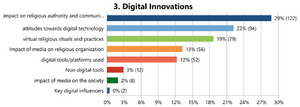
As illustrated in Figures 5 and 6, public documents primarily focused on the platforms utilized for the virtual transition of religious groups. Zoom, Facebook, and YouTube emerged as the most prevalent platforms, with mailing lists also playing a significant role. Discussions in religious media swiftly shifted to the impact of online platforms on the relationships between religious authorities and their communities, as well as the positioning of various actors regarding virtual engagement, particularly when comparing in-person and online rituals, such as the Eucharist (see KoÅodziejska, this issue). The adaptations necessitated by the pandemic, including social distancing and lockdowns, significantly increased reliance on online platforms for connection and communication, proving essential for a broad segment of the population (Branscombe 2020; Pew Research Center 2021; Statistics Canada 2021a). Religious institutions were no exception, rapidly transitioning rituals and celebrations to virtual formats. Notably, prior to the pandemic, most religious groups did not offer online engagement opportunities. For example, an online questionnaire revealed that 58â¯% of Protestant leaders reported their groups lacked such provisions, compared to 67â¯% of Roman Catholic leaders. This trend was corroborated by responses from members, with approximately 56â¯% of all respondents indicating that their groups had no online opportunities before the pandemic, with responses distributed nearly evenly among Roman Catholics and Protestants (approximately 57â¯%).
Figure 5
Public documents: main codes for digital innovations
Citation: Journal of Religion in Europe 19, 1-2 (2026) ; 10.1163/18748929-bja10145
Figure 6
Religious media: main codes for digital innovations
Citation: Journal of Religion in Europe 19, 1-2 (2026) ; 10.1163/18748929-bja10145
Christian clergy were strongly encouraged to create online content using platforms such as Zoom and YouTube and to actively promote these initiatives among their congregations. In Protestant documents and media, online engagement was frequently depicted as a dynamic space for developing innovative content to foster member participation, giving rise to the concept of the âhybrid church,â a term prevalent in both Protestant and Roman Catholic media. For the Anglican Church, public documents emphasized the importance of maintaining âconnectionâ between clergy and parishioners to preserve the communityâs essence, facilitated by digital technologies. However, a common concern across Christian media was the theological validity of online rituals compared to in-person practices, particularly regarding the Eucharist. Roman Catholics, in particular, exhibited significant division on this issue, as noted by a journalist from The Catholic Register:
Bodies are not optional. Thereâs a reason God created us as bodies. Why canât we go to Confession by Skype? Because the body must be present. (This sacramental question was actually settled much earlier with the invention of the telephone.) The sacraments are not convenientâbut that makes them quite beautiful, and each one of us quite valuable.
Burns 2020
The emphasis on the physical presence of the bodyâand the view that online rituals cannot fully substitute for in-person rituals, especially the Eucharistâis a concern shared by both Roman Catholics and Protestants in our sample. However, their attitudes toward digital technology differ significantly. Roman Catholics tend to be more critical and uncompromising, whereas Protestants, particularly within the Anglican Church, acknowledge the inevitability of the digital transformation accelerated by the pandemic. They stress that this transition will require time and institutional adaptation. The United Church, by contrast, adopts a more enthusiastic stance toward these changes.
The adoption of digital technologies and attitudes toward them differ across the four religious groups. Muslims and Jews demonstrate limited discourse on digital innovations, viewing these technologies primarily as essential tools for delivering religious services to their communities. This perspective may stem from two factors: constrained financial resources, given their status as minority religions, and their diasporic nature, where online communication is already an integral part of daily life. Consequently, there is less emphasis on digital technologies as a means of fostering connection within communities that are already tightly knit. These groups tend to rely on social media platforms, such as Facebook or WhatsApp, to sustain communication (as noted in interviews) or to engage with content produced by international figures rather than local ones, reflecting the relatively small size of their communities within the Canadian context.
3 Hybrid Church or the Paradox of the Online
The expression âhybrid churchâ is not new (Baker 2007), but the pandemic context has given it a new reality. Whereas the term hybrid referred, for Baker, to the place of the church in urban space, having to position itself in a kind of postmodern third space between the city and the civil community, the pandemic reality has shifted the discussion from positioning to virtual space (Campbell 2021; Garner 2021). The term now refers to how groups manage the synchronous and asynchronous dimensions of religious practice and how clergy have been forced to acquire new skills to make religion exist online (Garner 2021). The concept of the hybrid church emerges from the discourse within religious communities themselves, making it an emic termâone rooted in the perspective and language of the practitioners (Pike 1967; Mostowlansky and Rota 2020). In contrast, researchers have not widely adopted or developed the concept as a robust analytical tool. A primary reason for this academic hesitation lies in the theoretical challenges posed by the term. Specifically, hybrid church implies a dualistic distinction between digital and nondigital forms of religionâa separation that assumes these domains are discrete and independent. However, contemporary research in the field of digital religion, particularly under the framework of deep mediatization, argues against such a clear-cut division (Radde-Antweiler 2012). Deep mediatization suggests that digital technologies and media have become so thoroughly integrated into all aspects of social and cultural life that the boundaries between the digital and the physical are increasingly blurred, if not entirely dissolved (Hepp 2016). This expression, and variations on it (hybrid worship, hybrid rituals, etc.) appear some thirty times in Protestant religious media (especially Anglican), compared to only twice in Roman Catholic media, and identifies the new digital reality experienced both by religious authorities and communities, as highlighted by an Anglican leader in the Anglican Journal:
As I write, it seems that significant numbers of churches are expecting not to go back to the pre-COVID-19 way of being. Anglican churches across the country are investing in technology and training to enable services to be broadcast. We seem to be moving towards a âhybrid churchâ model where there will be both online and in-person services in many churches.
Elliott 2021
The concept of the hybrid church has significantly reshaped how religious groups engage with their communities and how members practice their religious life. For example, between December 2023 and March 2024, when the questionnaire was distributed, approximately 60â¯% of religious leaders reported continuing live-streamed gatherings or prayers immediately after pandemic restrictions were lifted. This trend was particularly pronounced among Protestants (69â¯%) and Jews (75â¯%), while Roman Catholics (43â¯%) and Muslims (57â¯%) were more likely to discontinue these initiatives. Additionally, recorded gatherings or prayers remained available online for about 40â¯% of leaders. Overall, more than 30â¯% of leaders expressed no intention to expand online opportunities, and another 30â¯% were uncertain about future plans. Regarding membersâ perspectives on the expansion or continuation of online opportunities, 26â¯% of Roman Catholics and 25â¯% of Protestants favored expansion, while 29â¯% of Roman Catholics and 49â¯% of Protestants preferred maintaining the status quo. Jews and Muslims exhibited greater uncertainty on this matter. When reflecting on the adaptation to online formats during the pandemic, 58â¯% of members appreciated the flexibility offered, though 50â¯% noted that some members experienced a diminished sense of belonging, and 52â¯% viewed the shift as a temporary necessity, expressing appreciation for the return to in-person practices.
In their media, Protestants, particularly Anglicans and United Church members, exhibit greater enthusiasm for technology compared to Roman Catholics, developing a broader range of discourses surrounding its use. Online services are perceived as a convenient and engaging means of fostering connection and facilitating celebrations, enabling members to participate in religious life from the comfort of their homes. As Helland (2012) shows, Canadian religious organizations were quick to set up websites from the late 1990s onwards. Among these organizations, the United Church was particularly active in creating websites to strengthen the online community, wanting to bring a more horizontal dimension between members of the organization. Conversely, more hierarchical organizations, such as the Catholic Church, had websites but few collective initiatives to strengthen the religious community and dialogue between the faithful (Helland 2012). This difference in approach and conception of the collective online space thus seems to be perpetuated several years later, at the time of the pandemic.
Simultaneously, the adoption of digital technologies has strengthened ties with religious communities during times of crisis, fostering innovative approaches to discussing religion, the meaning of life, and the role of rituals as sources of joy, faith, and communal gathering, regardless of geographic constraints. This shift, driven by the pandemic, has ushered in a new reality wherein the online dimension prompts the church to evolve. For example, Anglican Church leaders have been tasked with producing documents that outline the various platforms and methods for accessing online services, along with detailed instructions for their use, as emphasized by an Anglican leader in the Anglican Journal:
While we are still mastering the intricacies of the technology, we are making it work for us. And we are finding that it is still possible to experience an atmosphere of trust, respect and friendship, all bound together by readings from our faith that continue to nourish us in these days of social isolation. In short, this new way of studying and sharing together works!
Hadley 2020
These findings align with KoÅodziejska et al. (2022), who observe that during periods of deep mediatization, religious organizations strive to uphold traditional structures and authority by adopting media strategies and embracing digital transformations. In practice, such strategies were in place prior to the pandemic. However, the pandemic likely served as an abrupt disruption, compelling religious organizations to rapidly adapt to maintain their authority.
These organizations, described as media settlers by KoÅodziejska et al. (2022), aim to ensure the sustainability of their structures by adopting or replicating formats made available by media pioneers (Hepp 2016; see also KoÅodziejska, this issue; Nà Dhónaill, this issue). The notion of hybrid church, from an emic perspective, is thus linked to the perception of an intensification of deep mediatization and the absolute necessity for religious organizations to maintain both their authority and their connection to their communities. From an etic perspective, however, this reflects more a temporary acceleration of the media settling process than a paradigmatic shift.
This optimistic outlook is tempered by concerns regarding the seemingly inevitable transformation of the relationship between individuals and religious institutions. Roman Catholics and Protestants, in particular, express apprehension about the future of their membership, feeling compelled to embrace online platforms to retain parishioners and offer both virtual and in-person services postpandemic. Digital media has profoundly reshaped the dynamics between religious authorities and their communities, as highlighted in numerous articles from Roman Catholic and Protestant media. These sources describe the challenges faced by newly ordained priests in adapting to the digital landscape, including conducting online Masses and rituals, nurturing virtual communities, maintaining engagement, and navigating internet-based interactions. A frequently cited issue is the generational divide, with older individuals facing significant difficulties in using digital tools, a challenge that religious groups endeavored to address during the pandemic. Notably, Christians, particularly Roman Catholics, report a decline in membership post-COVID, with 54â¯% of Roman Catholic respondents estimating a loss of less than 25â¯% of their membership, compared to 36â¯% of Protestant leaders reporting similar losses. Both groups attribute part of this decline to online platforms, with 40â¯% of Roman Catholics and 35â¯% of Protestants agreeing that virtual opportunities have reduced in-person attendance.
It also emerges from interviews with leaders that one of their fears concerns the individualization of religious practices, which they believe is linked to this trend of declining attendance. As a matter of fact, some authors note that the sudden and forced digitalization of religion during COVID-19 has reinforced a process of networked individualization: according to Berger and Golan (2023), while religious institutions still play an important role, online users tend to be more autonomous regarding the way they select religious sources for their own need and practice, thus moving the center of epistemic religious authority from the institution to the individual.
This argument is further supported by the heterogeneous digital responses observed among different religious groups, as evidenced in the contexts examined in our research project. Additionally, Külhe and Larsen (2021) observe in their study of religions in Denmark that religious groups swiftly reverted to analog modes of worship and in-person rituals, suggesting that the shift to online platforms was (a) temporary and (b) necessitated by external circumstances. Consequently, no coherent or visible strategy for digitalization and subsequent mediatization was established by these groups, revealing and exacerbating pre-existing tensions regarding online engagement (14). While the pattern of digital continuity in Canada differs, with religious groups continuing to offer some online opportunities to their communities, nearly all groups sought to return promptly to in-person worship, yielding mixed outcomes in terms of attendance. From an emic perspective, religious leaders note that the heterogeneous online responses across denominations and local groups, coupled with the absence of a cohesive strategy regarding digitalization and the theological implications of the hybrid church, may have amplified the individualization of religious practice. As a United Church leader stated in an interview:
And so, I think Iâm finding a lot of the newer people that come to church for whatever spiritual needs they have personally. But that spiritual position doesnât necessarily include the view that spiritual, sometimes needs to embrace others ⦠I think that goes back to COVID forcing people apart. And I donât think itâs terribly different to businesses who are having trouble getting people to come back to work in the office. You know, weâve discovered we can do this from home. Why do we need to show up? ⦠I think even without COVID there is a general decline in people who are interested in the type of environment that the church provides.5
The issue of individualization has yet to be confirmed by cross-national, scholarly research. As Dzirasa-Payne (2024, 70) notes, several theologians have warned about a âculture of individualismâ that would make people forget that religious rituals, such as the Eucharist, are inherently community rituals needing a physical place. These assertions need to be qualified, however: on the Island of Ireland (Ni Dhonaill, this issue) Protestant churches seem to have cultivated social connections by creating online networks of interactions, and in Poland, groups like the Jehovahâs Witnesses consider digital media (which they had adopted well before the pandemic) to be an essential part of the community in times of crisis (KoÅodziejska, this issue). This phenomenon was also present in Canada, as reported by a Roman Catholic leader:
I think that as a gathering, as a celebration ⦠Sharing is really important, very essential. Around the Word, thereâs no sermon, so everyone shares equally ⦠So for me, every participant, theyâre at home and take the time to create, to create a space too. So thatâs important ⦠I donât understand why God would be limited in space. He isnât. We experience him in so many other ways.6
The online realm presents a paradox in religious life, functioning as both a connector and a disruptor. It has facilitated innovative ways of linking individuals with religious authorities and fostering communal bonds, while simultaneously contributing to a decline in offline attendance. During the pandemic, the online sphere served as a paradoxical instrument, catalyzing new, organized forms of religious practice while undermining traditional modes of worship.
4 Conclusions
This study demonstrates that religious institutions not only underwent significant transformations during the pandemic but also actively shaped these changes. The pandemic provided an opportunity to emphasize the importance of mutual support within religious communities, integrating the crisis narrative into religious frameworks. Values such as protecting the vulnerable, loving oneâs neighbor, and fostering resilience were leveraged to adapt religious practices in response to health restrictions and to support global vaccination efforts, despite some resistance citing religious freedom. This commitment was evident in the strong alignment of religious groups with government policies and the implementation of restrictions, even though these measures profoundly disrupted the religious lives of both leaders and followers, including the closure of places of worship and the cancellation or virtualization of funerals. Such measures significantly impacted attendance at religious venues, raising concerns among some groups about irreversible decline and frustration over their diminished role in providing spiritual well-being during a time of crisis, a need that governments appeared to overlook. Digital innovations and challenges have been central to the discourse of religious groups during the pandemic. Protestants exhibit greater enthusiasm than Roman Catholics for utilizing digital media, though both groups express a preference for in-person rituals and gatherings. A recurring theme across religious documents, media, and questionnaire responses is the recognition of an inevitable and necessary shift toward online practices. While this transformation has created new opportunities for religious communities in an era of deep mediatization, religious leaders express concern that the hybrid church model and the pandemicâs broader impact may have accelerated a secularizing trajectoryâa hypothesis that requires further investigation. In both online and offline contexts, the primary challenge for religious institutions remains preserving their authority, a role profoundly tested during the pandemic. The process of mediatization, which accelerated during the pandemic, clearly illustrates a central paradox: While it fosters a more individualized approach to religious practiceâor at least expands the range of tools available to individualsâit simultaneously enables the emergence of collective forms of practice that exist at the margins of traditional institutions or that reshape the relationship with religious authority. This presents a dual challenge for established religious institutions, particularly Christian ones, which are acutely aware of the long-term decline in membership in Canada. On the one hand, they must adapt to mediatization in order to meet the evolving needs of the faithful; on the other hand, they must preserve their authority over ritual practices and institutional structures to maintain organizational cohesion and legitimacy. Whether this period of upheaval will lead to a reinvention of religious institutions or hasten their decline remains an open question, one that only time will resolve.
RECOV-19 is a three-year multidisciplinary project that analyzes the roles of religions in societies emerging from the COVID-19 pandemic; specifically Canada, Germany, the island of Ireland, and Poland. It has three areas of investigation: (1) discourses about health, illness and science; (2) religionsâ relationships with governments and policymakers; and (3) digital innovations.
For a detailed account of the projectâs rationale, sources, and methods see Radde-Antweiler et al. 2026.
Leader interview, Anglican.
Leader interview, Roman Catholic.
Leader interview, United Church.
Leader interview, Roman Catholic.
References
Ahangar, Amin Akbari, Meysam Tavakoli Bina, and Ata Pourabbasi. 2021. âSearching God in the Midst of Pandemic: Interests in Religion and Spirituality during COVID-19 Pandemic,â European Journal of Science and Theology 17:1, 111â125.
Baker, Christopher Richard. 2007. The Hybrid Church in the City: Third Space Thinking, London: Routledge.
Barreau, Jean Marc. 2021. âStudy of the Changing Relationship between Religion and the Digital Continent: In the Context of a COVID-19 Pandemic,â Religions 12:9, 736â748.
Berger, Akiva, and Oren Golan. 2023. âOnline Religious Learning: Digital Epistemic Authority and Self-Socialization in Religious Communities,â Learning, Media and Technology 49:2, 274â289.
Bird, Brian. 2022. âCOVID-19 and Religious Freedom in Canada,â Journal of Church and State 64:4, 621â640.
Boutilier, Misha. 2022. âLimiting Freedom of Religion in a Pandemic: The Constitutionality of Restrictions on Religious Gatherings in a Response to COVID-19,â Alberta Law Review 60:4, 949â949.
Branscombe, Mary. 2020. âThe Network Impact of the Global COVID-19 Pandemic,â The New Stack, April 14., https://thenewstack.io/the-network-impact-of-the-global-covid-19-pandemic/.
Burns, Helena. 2020. âVirtual Reality and Theology of the Body,â The Catholic Register, November 19, www.catholicregister.org/opinion/columnists/item/32396-sr-helena-burns-virtual-reality-and-theology-of-the-body.
Campbell, Heidi. (ed.). 2021. Revisiting the Distanced Church, College Station: Texas A&M University, 97â106. https://oaktrust.library.tamu.edu/items/68930bfa-fd7b-4dc2-ae90-0f02c7f1035c.
Canadian Conference of Catholic Bishops. 2020. âCCCB Signs Letter to Prime Minister Trudeau Regarding Research for a COVID-19 Vaccine,â May 21, www.cccb.ca/media-release/cccb-signs-letter-to-prime-minister-trudeau-regarding-research-for-a-covid-19-vaccine/
Cardita, Ãngelo. 2020. âLa liturgie confinée,â Laval théologique et philosophique 76:3, 349â375.
Carignan, Marie-Eve, David Morin, Marie-Laure Daxhelet, Sylvain Bédard, Olivier Champagne-Poirier, Emmanuel Choquette, Guilhem Aliaga, Yanni Khennache, and Esaie Kuitche Kamela. 2022. Le mouvement conspirationniste au Québec: leaders, discours et adhésion, Sherbrooke: Chaire UNESCO-PREV.
Champagne, Elaine. 2023. âLooking for Spirituality in the Context of a Pandemic in the Province of Quebec, Canada,â International Academy of Practical Theology Conference Series 3, 93â98.
Cherblanc, Jacques, Christiane Bergeron-Leclerc, Danielle Maltais, Susan Cadell, Geneviève Gauthier, Oscar Labra, and Claudiane Ouellet-Plamondon. 2021. âPredictive Factors of Spiritual Quality of Life During the COVID-19 Pandemic: A Multivariate Analysis,â Journal of Religion and Health 60:3, 1813â1827.
Colin, Mathieu, Solange Lefebvre, and Denitsa Tsvetkova. 2023. Research Report: Publications by Religious Organisations During the Covid-19 Pandemic in Canada, Recov-19: Religion Emerging from Covid, https://papyrus.bib.umontreal.ca/xmlui/handle/1866/28528.
Cyr, Amelie, Prosanta Mondal, and Gregory Hansen. 2021. âAn Inconsistent Canadian Provincial and Territorial Response During the Early COVID-19 Pandemic,â Frontiers in Public Health 9, 708903.
Demirovic, Alena. 2021. âReligious Communities in the US and Canada and Their Responses to COVID-19,â Religions 17:1, 56â63.
Dzirasa-Payne, Gertrude. 2024. âHybrid Faith: A Study on the Impact of Digital Technology on Church Communication During the Covid-19 Pandemic.â DMin diss., George Fox University, Newberg. https://digitalcommons.georgefox.edu/dmin/628.
Dyrendal, Asbjørn, Egil Asprem, and David G. Robertson. 2018. âIntroducing the Field: Conspiracy Theory in, about and as Religion,â in Asbjørn Dyrendal, David G. Robertson, and Egil Asprem (eds.), Handbook of Conspiracy Theory and Contemporary Religion, Leiden: Brill, 1â18.
Edmonds, Jennifer, and Antoine Flahault. 2021. âRefugees in Canada during the First Wave of the COVID-19 Pandemic,â International Journal of Environmental Research and Public Health 18:3, 947.
El-Majzoub, Salam. 2021. âNegotiating Safety and Wellbeing: The Collaboration Between Faith-Based Communities and Public Health During the COVID-19 Pandemic,â Journal of Religion and Health 60:4, 2539â2550.
Elliott, Neil. 2021. âOur Response ⦠Gives Me Huge Hope,â Anglican Journal, May 10. https://anglicanjournal.com/our-response-gives-me-huge-hope/.
Flood, Colleen M., Vanessa MacDonnell, Bryan Thomas, and Kumanan Wilson. 2020. âReconciling Civil Liberties and Public Health in the Response to COVID-19,â FACETS 5:1, 887â898.
Garner, Stephen. 2021. âFrom Distanced Church to Returning Church to Hybrid Church,â in Heidi Campbell (ed.), Revisiting the Distanced Church, College Station: Texas A&M University, 97â106. https://oaktrust.library.tamu.edu/items/68930bfa-fd7b-4dc2-ae90-0f02c7f1035c.
Hadley, Anita. 2020. âBible Study Finds New Platform,â Anglican Church Diocese of British Columbia Newsletter, June.
Helland, Christopher. 2012. âOnline Religion in Canada: From Hype to Hyperlink,â in Lori Beaman (ed.), Religion and Canadian Society: Contexts, Identities, and Strategies, Toronto: Canadian Scholarâs Press, 375â390.
Hepp, Andreas. 2016. âPioneer Communities: Collective Actors in Deep Mediatization,â Media, Culture & Society 38:6, 918â933.
Kappler, Stephan, Innocent Okozi, Francois Diouf, and Katharina Hartinger. 2022. âThe Impact of the COVID-19 Pandemic on the Psychological Well-Being of Catholic Priests in Canada,â Religions 13:8, 718â737.
KoÅodziejska, Marta, Åukasz Fajfer, Dorota Hall, and Kerstin Radde-Antweiler. 2022. âReligious Media Settlers in Times of Deep Mediatization,â Religion 53:2, 199â223.
Kühle, Lene, and Tina Langholm Larsen. 2021. ââForcedâ Online Religion: Religious Minority and Majority Communitiesâ Media Usage during the COVID-19 Lockdown,â Religions 12:7, 496â505.
Lamoureux, Mack. 2021. âSome Canadian Pastors Are Waging a Holy War Against COVID-19 Lockdowns,â Vice, March 15, www.vice.com/en/article/some-canadian-pastors-are-waging-a-holy-war-against-covid-19-lockdowns/.
Lawson, Trevor, Lara Nathans, Adam Goldenberg, Marco Fimiani, and Charlotte Simard-Zakaib. 2022. âCOVID-19 Emergency Measures Tracker,â McCarthy Tétrault LLP, www.mccarthy.ca/en/insights/articles/covid-19-emergency-measures-tracker.
Lefebvre, Solange. 2022. âWhat the COVID-19 Pandemic Has Revealed about Religions,â Religions 13:6, 1â8.
Mayring, Philipp. 2000. âQualitative Content Analysis,â Forum Qualitative Sozialforschung / Forum: Qualitative Social Research 1:2, Art. 20. https://nbn-resolving.de/urn:nbn:de:0114-fqs0002204.
Mayring, Philipp. 2014. Qualitative Content Analysis: Theoretical Foundation, Basic Procedures and Software Solution, Klagenfurt: n.p. https://nbn-resolving.org/urn:nbn:de:0168-ssoar-395173.
Meintel, Deirdre. 2022. âSpiritualités et complotisme, alliances insolites?,â Relations 819: 62â63.
Miconi, Diana, Zhi Yin Li, Rochelle L. Frounfelker, Tara Santavicca, Jude Mary Cénat, Vivek Venkatesh, and Cécile Rousseau. 2021. âEthno-Cultural Disparities in Mental Health during the COVID-19 Pandemic: A Cross-Sectional Study on the Impact of Exposure to the Virus and COVID-19-Related Discrimination and Stigma on Mental Health across Ethno-Cultural Groups in Quebec (Canada),â BJPsych Open 7:1.
Montpetit, Jonathan. 2023. âInside the Fundamentalist Christian Movement that Wants to Remake Canadian Politics,â CBC News, 5 June, www.cbc.ca/news/politics/fundamentalist-christian-movement-1.6793677.
Mostowlansky, Till, and Andrea Rota. 2020. âEmic and Etic,â in Felix Stein (ed.), The Open Encyclopedia of Anthropology, Online, http://doi.org/10.29164/20emicetic.
Muslim Association of Canada. 2021. âLaunch of MAC Islamic Center Temporary Vaccination Clinic in Edmonton,â 16 June, https://macnet.ca/launch-of-mac-islamic-center-temporary-vaccination-clinic-in-edmonton/.
Pew Research Center. 2021. âThe Internet and the Pandemic,â 1 September, www.pewresearch.org/internet/2021/09/01/the-internet-and-the-pandemic/.
Pike, Kenneth L. 1967. Language in Relation to a Unified Theory of the Structure of Human Behavior, Berlin: De Gruyter Mouton.
Radde-Antweiler, Kerstin. 2012. âAuthenticity,â in Heidi Campbell (ed), Digital Religion: Understanding Religious Practice in New Media Worlds, London: Routledge, 88â103.
Rehmani, Amyna Ismail, Khadija Abdi, Esra Ben Mabrouk, Tianqi Zhao, Bukola O. Salami, Allyson Jones, Hongmei Tong, and Jordana Salma. 2023. âImpact of the COVID-19 Pandemic on Muslim Older Immigrants in Edmonton, Alberta: A Community-Based Participatory Research Project with a Local Mosque,â Canadian Journal of Public Health 114:3, 378â388.
Riskedahl, Diane. 2020. âThe Muslim Call to Prayer in Canadaâs Pandemic Soundscape,â Soundscapes Journal 10:1, 112â118.
Sen, Heera Elize, Laura Colucci, and Dillon T. Browne. 2022. âKeeping the Faith: Religion, Positive Coping, and Mental Health of Caregivers during COVID-19,â Frontiers in Psychology 12:1, 1â14.
Statistics Canada. 2021a. âHow Have Canadians Been Using the Internet during the COVID-19 Pandemic?,â 28 January, www.statcan.gc.ca/o1/en/plus/198-how-have-canadians-been-using-internet-during-covid-19-pandemic.
Statistics Canada. 2021b. âLe QuotidienâPortrait de la société canadienne: Les expériences pendant la pandémie,â 27 September, https://www150.statcan.gc.ca/n1/daily-quotidien/210927/dq210927b-fra.htm.
Statistics Canada. 2022. âLe recensement canadien, un riche portrait de la diversité ethnoculturelle et religieuse au pays,â 26 October, https://www150.statcan.gc.ca/n1/daily-quotidien/221026/dq221026b-fra.htm.
Stockland, Peter. 2021. âVaccine Edict Sets Dangerous Example,â The Catholic Register, September 25, www.catholicregister.org/opinion/columnists/item/33535-peter-stockland-vaccine-edict-sets-dangerous-example.
Swan, Michael. 2022. âMandatory Vaccines? Educators Have No Doubts,â The Catholic Register, January 20, www.catholicregister.org/item/33942-mandatory-vaccines-educators-have-no-doubts.
Tippins, Emily, Renate Ysseldyk, Claire Peneycad, and Hymie Anisman. 2023. âBelieving in Science: Linking Religious Beliefs and Identity with Vaccination Intentions and Trust in Science during the COVID-19 Pandemic,â Public Understanding of Science 32:8, 1003â1020.
Tompoudi, Wagdia Samuel. 2023. âLe religieux à lâère de la numérisation: La pandémie de la COVID-19, accélératrice des technologies en ligne du culte chez les évangéliques à lâinstar de lâÃglise Impact Centre Chrétien.â MA diss., Université du Québec à Montréal. https://archipel.uqam.ca/16557/.
Weinberger, Lael Daniel. 2014. âThe Relationship between Sphere Sovereignty and Subsidiarity,â in Michelle Evans and Augusto Zimmermann (eds.), Global Perspectives on Subsidiarity, New York: Springer, 203â220.