Abstract
What future aspirations have informed the incentives for producing childrenâs literature in Muslim minority communities? What social dynamics and theological debates have accompanied its visions of Islamic futures? What narrative tropes, visual-aesthetics norms and literary genres has it appropriated, while maturing into an innovative religious-pedagogic-literary expression? Probing such questions, this article challenges distinctions between âIslamicâ and âsecularâ to build a concept of Islamically minded childrenâs literature. It follows the diversification of the literature as a globalised child cultural format, emulating genres such as picture books, fairy tales, detective stories, romantic fiction, autobiographies, handbooks, graphic novels and comics. As cultural texts, Islamically minded childrenâs literature has developed through increasingly confident, open-ended and dialogic literary negotiations of the socio-cultural complexities of Muslim minority life vis-Ã -vis the formative pasts of sacred history, theology and textual canons â all under the pedagogical sway of envisioning Islam and Muslim futures, in minority communities and beyond.
Pedagogy is inescapably interwoven with imaginaries of the future.1 Whether formal or informal, education is a stage upon which future scenarios can be envisioned and where children are cast in dual roles. They are staged as the carriers of cherished legacies and future hopes, and simultaneously provide the very subject matter to be processed in the present, under the sway of the ideals and anxieties of the adult world. It is hardly surprising, therefore, that education remains a central and contested issue in Muslim minority communities. Facing the precariousness of minority existence, educational needs continue to generate varied responses, from quietist seclusion to affirmative activism; from a reliance on traditional authorities to innovative cultural formats (Janson, 2012 and 2017; Kinnvall and Nesbitt-Larkin, 2011).
This is, of course, nothing unique for Muslim minorities. Child culture has been a perpetual subject of debate throughout its modern history (Nikolajeva, 1996). With reference to childrenâs morality and wellbeing, concerns are regularly voiced about the âcorrosive influenceâ of popular culture, from cinema, books and comics to computer games and mobile-phone applications. Conversely, child culture may be criticised for not being influential enough â as suffering from cynicism and slack commercialism and as predicated on misguided conceptions of childhood (Mouritsen, 2002). To this day, childrenâs literature remains fraught with controversy. It is subject to censorship under political authoritarianism, nationalist mobilisation when sorted into ânational canonsâ, and social-spatial stratification with the proliferation of âcommunity book shopsâ (Barry, 1992; Hunt, 2005; Kümmerling-Meibauer and Müller, 2017).
For the same reasons, child culture provides an important, yet understudied, perspective on Muslim visions of Islamic futures, in a context of migration and globalisation.2 In childrenâs literature published during recent decades, theological, ideological and moral imaginaries of the future coincide with pictorial and textual images of the future, a dynamics theorised as âimage politicsâ in visual anthropology (Khatib, 2013; Veneti and Rovisco, 2023). What social-cultural dynamics, pedagogical concerns and theological debates, then, have accompanied the envisioning of the future of Islam in childrenâs literature, in response to migration and minority existence? And in accordance with what narrative tropes, visual codes and broader representational trajectories? Probing these questions, I shall take Britain as a point of departure, being the setting for the first significant endeavours in this field of publishing, with a particular focus of one of the pioneering publishers of childrenâs literature in a Euro-Muslim setting: the Islamic Foundation (today re-named Kube Publishing). As will be clear, however, the literature flourishes on a transnational field, engaging multiple publishers, and reflecting intellectual, artistic and commercial flows beyond national borders.
1 Problematising âIslamic Childrenâs Literatureâ beyond a Religious-Secular Divide
During a summer visit to his relativesâ Egyptian farm, a British Muslim boy, Adam, experiences the richness of rural life. More significantly, however, he learns about Islam and Islamic practice. As he finally visits Cairo, intent on seeing the pyramids, things take a surprising turn. âNever mind the pyramids!â, exclaims his cousin, guiding him through the city. Al-Azhar, the theological centre of the Sunni Islamic world, is a destination far more valuable than the tourist magnet of ancient Giza. When summer ends, Adam returns to his British existence, thoroughly mindful of his Muslim self.
This summarises the plot of New Friends, New Places, by Susan Scott (1993). It marked a watershed in the publication of childrenâs literature by the British educational organisation the Islamic Foundation. After two decades of childrenâs publishing in English, Adam became its very first contemporary protagonist. He was followed by a veritable flood of Euro-Muslim characters: male and female, mundane and exalted, toddler and teen, exploring nature, solving crime, playing sports, practising rituals, discovering history, making history, caring for neighbours or simply enjoying friendship and family life (Janson, 2017).
The incentive to publish childrenâs literature arose from theological discussions on minority Islam from the 1970s (Janson, 2003). Critical of the traditionalism of British Muslim communities, Sunni reformist thinkers conceptualised education within the framework of daÊ¿wa, Islamic edification. âThe key to the future is education. Education in the wider sense of changing hearts, minds and livesâ, insisted Khurram Murad (1986: 4). Traditional institutions are necessary, but not enough. Forging a future Islam in a minority situation requires comprehensive cultural strategies, while safeguarding inviolable principles (ibid.). This echoes broader discourses about the âIslamisationâ of culture, knowledge and science, associated with influential writers on Islamic futures, among them Ziauddin Sardar, Ismail al-Farooqi, Maurice Bucaille and Adnan Oktar (Guessoum and Bigliardi, 2023). Accordingly, ground-breaking publishers were intent on book publishing with a âdifferenceâ, providing knowledge allegedly unsupplied by âordinaryâ childrenâs literature.
If Sunni activism provided the first impetus, however, publications soon diversified beyond specific organisational agendas, with the pluralisation of publishers and the sheer dynamics of literary depiction in a minority context (Janson, 2017). Hence the quest for âIslamic alternativesâ must be understood in the wider context of the whiteness and secularism that pervades European literature, spurring recent critical reflection and innovative publishing endeavours (Ahmed and Morey, 2023).
Accordingly, while the literature in focus for this article is indeed characterised by narrative, aesthetic and topical particularities, conceptualising it as âIslamicâ as opposed to âsecularâ childrenâs literature runs into several problems associated with the quagmires of âidentityâ and âdifferenceâ (Appadurai, 1990; Fraser et al., 2004).3 It may be misread as âIslamically correctâ, inadvertently reproducing confessional debates. It overtakes the literatureâs self-conception as âdifferentâ at face value, disregarding the fact that it is part and parcel of an ideological-cum-commercial branding. And perhaps most insidiously, foregrounding Islamicness as its defining feature reproduces only too familiar orientalist hierarchisations that regard âIslamâ as deviant from the mainstream: difference transmutes into otherness.
Abdullah Sahin has compellingly captured a similar problem in his harsh assessment of the neighbouring discipline of âIslamic educational studiesâ. Academia, Sahin argues, tends to approach Islamic education as a political, sociological and ideological phenomenon, indifferent to or ignorant of the dynamic practices and thought that de facto shape pedagogics and learning in Muslim societies (Sahin, 2018). Analysing (self-identified) âIslamicâ ventures in childrenâs literature in minority situations, I suggest, presents us with a similar problem, requiring a delicate balancing act. How do we acknowledge (and reverse) the orientalist, colonial and/or racist hegemonies traversing fiction, recognising other aesthetics and literary formats, while avoiding the trap of pigeonholing âIslamâ as a static sub-genre? Focusing on publishersâ organisational and ideological ârootsâ qua âIslamicâ obscures the literary nature of the child culture thus created, reducing it to âideological outputâ. It falls short of probing the creative innovations traversing the literatureâs topical, narrative and aesthetic strategies. It misses, to draw on a concept of Jan Assmann (2006: 122ff.), how it negotiates and represents Islamic discursive traditions, rituals, theological ideas, tropes and venerated historical personae as cultural texts.
To map out an alternative conceptualisation, I shall take as my cue the words of Jacqueline Roseâs ground-breaking study of Peter Pan: âIf childrenâs fiction builds an image of the child inside the book, it does so in order to secure the child who is outside the book, the one who does not come so easily within its graspâ (Rose, 1984: 2). Returning to Adam in New Friends, New Places (Scott, 1993), I suggest that we read the interjection ânever mind the pyramidsâ as signifying something more than (religious/historical/cultural) disdain. Aside from hierarchising one heritage over another, it expresses an attempt to secure and grasp the elusive Muslim child in front of us, complicated by the complexities of migration and multicultural society, generational and gender dynamics, racism and marginality, parochialism and extremism. The depiction of Adam torn between pharaonic Giza and Islamic al-Azhar reflects the challenges involved in caring for, and hence minding, young Muslim selves.4
Accordingly, I shall conceptualise the child culture in focus for this article as an Islamically minded childrenâs literature,5 challenging dichotomisations of âsecularâ versus âIslamicâ literature. Beyond organisational and ideological perspectives (which I have discussed in other contexts [see Janson, 2003]), the following sections will emphasise the narrative, aesthetic, theological and ethical motifs that characterise the literature. This is devised to capture the broader trends found in the future visions and social imaginaries traversing childrenâs literary depiction, when instrumentalised as a cultural instrument for navigating life in Muslim minority communities (and beyond).
2 Narratives: from Sacred Past to Euro-Muslim Present
Since its inception in Britain in the early 1970s, Islamically minded childrenâs literature has developed from a more or less homogeneous literary phenomenon into an increasingly complex child cultural format. Early publications had all the characteristics of in-house productions. In the case of the Islamic Foundation, germinating from the South Asian Sunni Islamic reform movement Jamaat-i Islami, early literature for children consisted of unassuming, non-fictional volumes of low production value. In a monological and homiletic voice, it imparted doctrine without any attempt to catch the readerâs imagination either narratively or visually. If innovative as a medium, the early literature hence responded to the task of forging Muslim futures by largely reproducing the mimetic pedagogy of madrasas (Janson, 2017).
An important shift occurred with the books relating tales from formative Islamic history. The Muslim Childrenâs Library came to comprise some 30 titles from the 1980s. This commercial success became a hallmark for early Islamically minded childrenâs literature, many titles of which remain in circulation. With its dramatic tales of oppression, struggle, bravery, battle and ultimate victory, sacred history provided a rich stock of engaging narratives. Even so, they remained hagiographies, authored by non-professional (male) authors, closely connected to the publisher, as patently observable from the extensive presentations of publishers and pedagogical agendas.
This, in turn, indicates how innovative and controversial the literature was held to be â and how instrumental as a pedagogical tool for reimagining Islamic futures. Chastising traditional educational institutions as inadequate in their response to the current and future challenges of minority existence foundationally challenges the legitimacy of Euro-Muslim leaderships. This deficiency, in turn, stimulated an increasingly open-ended and vulnerable literary exploration of Islamic futures, as reflected in the transformation and diversification of Islamically minded childrenâs literature in the decades to follow.
From the early 2000s, professional authors and illustrators were enlisted, production techniques developed, and costs decreased. This took place concurrently with the cultural, generational and educational dynamics of members of Muslim minorities entering adulthood (and parenthood) in a minority setting â and putting their experiences into words. Since the turn of the millennium, female authors have come to significantly dominate authorship, as the literature diversified to employ a broad narrative range in addressing young readers. Hence the forging of Muslim futures, and the cultural adaptations of Islamic thought guiding it, has been a significantly trans-generational and gendered affair, evolving in direct response to socio-cultural experiences.
This occurred alongside a predominance of stories set in domestic settings, often in various series formats, among several publishers. Here the pious home became a central motif. The I Can series introduces Islamic ethics and ritual for the very youngest (I Can Say Bismillah Everywhere; I Can Pray Anywhere, etc). In simple rhymed prose, with colourful illustrations depicting everyday scenarios, it imparts religious virtues while demonstrating that ritual observance seamlessly conforms to, and enriches, daily life. The Allah Gave Me ⦠series takes bodily senses as a point of departure for exploring the world in its mundane and spiritual dimensions. In the Young Muslim Nature Series, children explore nature in combined science/history/religion/ethics lessons, again in a domestic space, with ample references to sacred tradition, personages and textual canons.
Despite its narrative simplicity, and despite the narrative transfer from sacred tradition to domestic space, the literature remained guided by theological principles at the very core of Sunni Islamic reform movements, intersecting with future-oriented ecological imperatives. Islam is the din al-fitra, the natural religion, and the life-ethic revealed for humankind as a whole, placing each human as a care-taker and vicegerent (khalifa) of divine creation. A pedagogy of Islamic, everyday self-care hence becomes indistinguishable from care for the planet and the future of humankind, all stimulated by the forging of Islamic futures in minority contexts.
The literary exploration of innovative narrative formats opens new vistas for religious didactics, a far cry from the imposition of religious instruction found in earlier productions. In the process, the boundaries between âthe realâ and âthe imaginaryâ dissolve, as young readers are invited to marvel, reflect and enjoy through learning. In the charmingly impressionistic The Swirling Hijab (Robert, 2002), a girl plays with (and in) her motherâs headgear, imagining herself as a maturing subject, as well as a âwarrior princessâ, while the swirling fabric vividly envelopes the book pages. We find a more direct, if no less creative, engagement with Islamic canon in Migo and Ali: Love for the Prophets (Mian, 2016), where a boy and his bear friend are immersed in exciting Qurʾanic tales, followed by reflective, personal and humorous chats between boy and bear.
The older the implied reader, the less explicit the engagement with Islamic themes. Then again, the more central becomes the negotiation of Muslim selves vis-Ã -vis daily experiences and social relations. In daily life or in fantastic settings, protagonists face individual challenges and social problems, and manage to overcome them with the help of Muslim peers, inspiration from historic role-models, team efforts and personal courage. The theological themes and ethical principles of earlier publications often remain, but are narratively adapted to individual experience and personal contexts, whether mundane or fantastic. This is often achieved by modelling the books on established (globalised) genres and literary traditions, such as the fairy tale, the detective story and the sports-team-trope. Hence the literary forging of Islamic imaginaries and future scenarios appeals to the virtues of everyday social care and moral responsibility, also when funnelled through engaging and heroic narratives of solving crime, subduing evil, fighting injustice, resolving conflicts or winning matches.
While the element of Islamic instruction sometimes remains obvious, many recent books engage with Islamic themes only loosely, rendering a religious reading a plausibility, an affordance rather than a directive. This is particularly true of literature intended for older readers. The last decade has seen an abundance of publications blurring the boundaries between instruction and entertainment, attracting Muslim and non-Muslim alike. With Laughing All the Way to the Mosque (2015), Zarqa Nawaz won praise and a broad base of readers with her non-sentimental and humorous reflections on Muslim life in minority situations. It depicts social imaginaries and Islamic themes through real-life interactions with Muslim peers and non-Muslim communities and institutions alike. Edgier still are Huda Fahmyâs self-deprecating autobiographical graphic novels Huda F Are You? (2021) and Huda F Cares (2023), cleverly twisting the trope of âhow-to-be-accepted-as-a-hijabi-in-a-non-Muslim-contextâ into the more recent problem of âhow-to-distinguish-myself-in-this-sea-of-hijabisâ! Despite her biting sarcasm and humorous engagement with the lingering tensions, anxieties and absurdities of minority existence, Fahmy confidently depicts minority Islam as a social fact, not any ideal (or idealised) future vision.
This said, entirely non-fictional books for older readers also remain an important niche, often with the explicit intent of stimulating religious norms: Qurʾan and tafsir adaptations; prayer (duʿaʾ) collections; handbooks on teenage life, food and sexuality. The booming fictional creativity non-withstanding, religious instruction thus remains central for the forging of Muslim futures. Even though explicitly confessional, however, recent handbook literature engages readers in colloquial and dialogic communication, a far cry from the homiletics and didacticism of earlier days.
3 Negotiating an Islamic Visual Aesthetics
The narrative innovativeness of the literature has coincided with renegotiations of visual presentation, resulting in a similar diversification. As noted above, visual aesthetics comprises a particularly central and sensitive carrier of a (re)imagined minority presence and Islamic futures, juxtaposing mental imaginaries with pictorial images, in perpetual dialogue with theological legacies and representational norms.
It is true that early publications of the pioneering Islamic Foundation largely avoided visual elements altogether: the odd map; a black-and-white photograph of the holy sanctuaries; a decorative border round the pages. The Islamic Foundation gradually introduced illustrations during the 1980s, with the publication of historical tales. Even so, the publisher continued to some extent to heed (Sunni) Islamic principles of representation, according to which depictions of animated beings have been regarded as futile infringements on the divine domain, God being the exclusive âmoulderâ (musawwir) and creator of life (Janson, 2012; Gruber, 2019). In several books from the period, human presence was marked purely indicatively: a pot over the fire; a sleeping rug on the floor; the tips of spears and swords in battle. Concomitantly, the publisher guaranteed that illustrations were âkeeping in view the limitations set by Islamâ, as formulated by Murad (1982: 3) in the foreword to Love Your God.
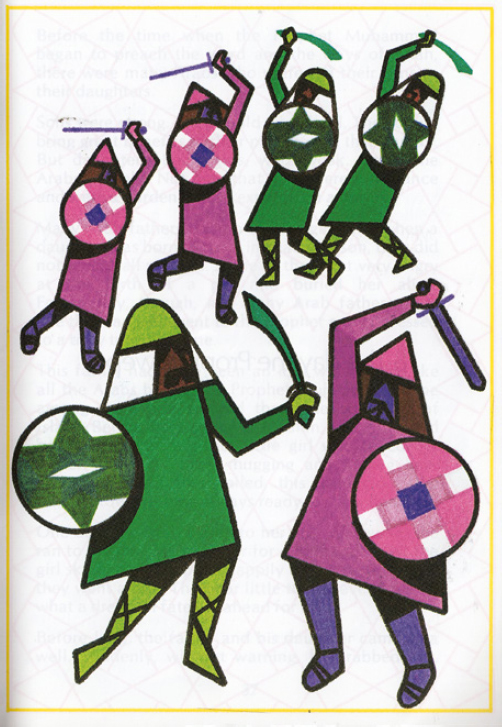
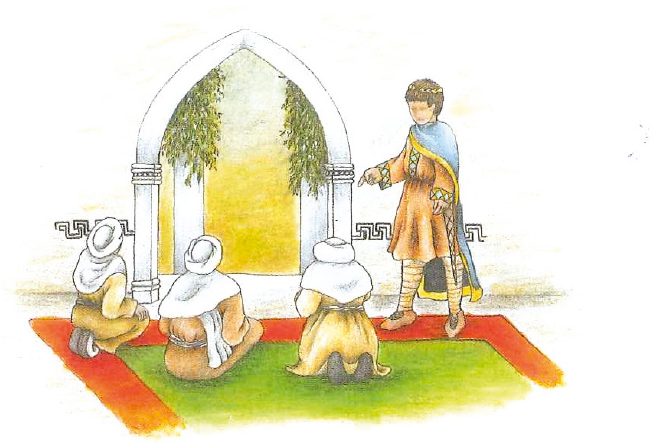
When living beings were depicted during this early phase, this was often modified by using visual strategies to âde-animateâ characters through de-naturalisation, ornamentation or perspectival adjustment. Hence the fighters in a battle scene in A Great Friend of Children (Kayani, 1981) appeared as more symbolic than realistic, flat and choreographic rather than rounded and naturalistic, subdivided by colour rather than individuality (see Figure 1). Similarly, the proverbial spider (which, according to popular tradition, played a central role in the Prophet Muhammadâs mysterious rescue during his migration, hirja, to Medina) was represented figuratively in Love Your God but not depicted as a naturalistic representative of its species, but âornamentalisedâ into a symbol for the establishment of the Islamic era (hijra marking year 0 in the Islamic calendar) (see Figure 2.).

Visual de-naturalisation. Illustration by Jerzy Karo in A Great Friend of Children (Kayani, 1981)
Citation: Journal of Muslims in Europe 13, 3 (2024) ; 10.1163/22117954-bja10114
Image courtesy of the Islamic Foundation and Kube PublishingVisual ornamentalisation. Illustration by Zainusa Gamiet in Love Your God (Murad, 1982)
Citation: Journal of Muslims in Europe 13, 3 (2024) ; 10.1163/22117954-bja10114
Image courtesy of the Islamic Foundation and Kube PublishingFinally, as the literature embarked on engaging with the daily life of contemporary children in minority contexts during the 1990s, non-representational restraint gave way to fully-fledged figural, and often naturalistic, representation. This is not to suggest that embracing naturalism implies a progression towards a more âadvancedâ or âemancipatedâ aesthetics.6 Rather, the aesthetic turn towards naturalism underscores how Islamically minded literature has developed as cultural texts, to again draw on Jan Assmann (2006: 122ff,). The books are not âreproductionsâ or âmini-versionsâ of sacred texts (Qurʾan, tafsir, Hadith, or sira). Yet, they often carry (pedagogically instrumental) motifs and narratives of the sacred texts into novel cultural formats, not unlike the way Islamically minded science fiction taps into mysterious-cosmological Qurʾanic motifs (Determann, 2021). Through this process of culturalisation, Islamically minded childrenâs literature dissociates from the limitations and taboos associated with formal canons. It matures into open-ended interpretations of theological tenets and aesthetics, negotiated vis-à -vis, and dynamised by, the social complexities and pedagogical needs of minority life, its future prospects and anxieties.
Neither is this to suggest that religious-cum-aesthetic image norms are becoming obsolete. But they are re-negotiated. What was earlier perceived as a set of injunctions has developed into a range of stylistic, visual-aesthetic choices, wherein figurative depictions have become widely accepted. Nevertheless, images continue to distinguish the literature as Islamically minded. While the bulk of the literature today represents humans vividly, it is often characterised by what I would like to conceptualise as an aesthetics of figural and perspectival modesty.
For instance, The People of the Cave (Al-Albani and Qalaji, 2001) narrates the Qurʾanic tale of âThe Sleepersâ, told by a father, set in a domestic space. Here, the Muslim protagonists are depicted with their faces turned away, and gazes modestly downcast. Only the ungodly king of the tale is represented en face (if blurred), arrogantly gazing down on his repressed subjects (see Figure 3). A similar visual strategy is employed in the contemporary story Umar and the Bully (Mir, 1998). Here too, the local (non-Muslim) school-thug hovers over his assailants in full-frontal position, while Muslim subjects tend to be depicted as facing each other, engaged in horizontal dialogue (see Figure 4). Here, the visual composition functions as a scaffolding of the virtues thematised, as the images co-construct the social imaginaries carrying the textual narrative. Thus, pictures function as visual indexes for distinguishing ungodly repression from pious resistance, and care for Muslim peers and Islamic principles. In other words, the predominance of naturalistic representation occurs alongside a cultural-contextual naturalisation of Islam, as integral to minority Muslim everyday existence, present and future.
Visualising corruption vs. piety in sacred canon. Illustration by Terry Norrige in People of the Cave (al-Albani and Qalaji, 2001)
Citation: Journal of Muslims in Europe 13, 3 (2024) ; 10.1163/22117954-bja10114
Image courtesy of the Islamic Foundation and Kube PublishingVisualising corruption vs. piety in everyday life. Illustration by Asiya Clarke in Umar and the Bully (Mir, 1998)
Citation: Journal of Muslims in Europe 13, 3 (2024) ; 10.1163/22117954-bja10114
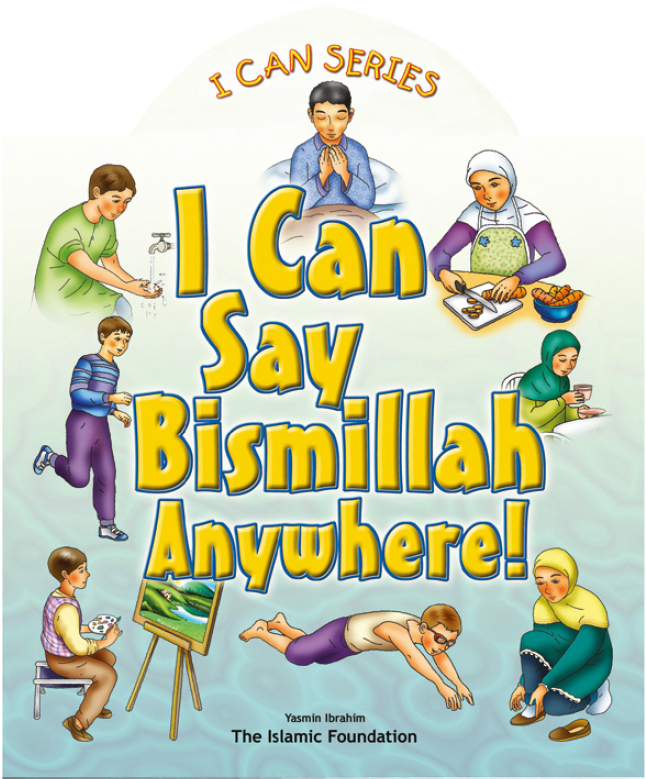
Image courtesy of Islamic Foundation and Kube PublishingConsequently, and in line with the pedagogics proposed by Khurram Murad (1986), everyday life becomes a lesson on Islam. I Can Say Bismillah Everywhere! (Ibrahim, 2009) amply illustrates this point. With its curved âroofâ, the very materiality of the book invokes the shape of a traditional madrasa or mosque building (see Figure 5). Here children are depicted voicing the bismillah (formally a duÊ¿aʾ), rendered in transliterated as well as calligraphic form, in all walks of life. Domestic settings are infused with markers for the integration of religion and mundane life. A girl says bismillah as she helps her parents to cook. A boy pronounces the duÊ¿aʾ as he plays with building blocks, a tank and a model of the Dome of the Rock, in front of posters with Latin and Arabic numerals and letters. An extended family enjoys afternoon tea in the garden. A boy dives into the waves, clad in long shorts and a tank-top. A girl prepares for football, dressed in hijab and jalaba. Beyond its narrative simplicity, the series is replete with descriptive and prescriptive visual markers for ritual, creed, learning and social mores. It represents minority Islam as an everyday reality, a social trajectory, as well as an ideal mindset for a maturing Muslim subject.
Visualising Islam through the depiction of everyday life. Illustration by Yasmin Ibrahim in I Can Say Bismillah Anywhere (Ibrahim, 2009)
Citation: Journal of Muslims in Europe 13, 3 (2024) ; 10.1163/22117954-bja10114
Image courtesy of Kube PublishingWhile the images often function co-narratively, the literature provides few examples of âcontrapuntal relationsâ (Nikolajeva and Scott, 2001), that is, dynamic contradictions between text and image. More common is what I would like to term a semiotics of transcendence: visual markers pointing beyond the narrative altogether yet establishing an Islamic ambience and distinction. Calligraphic panels (âMuhammadâ, âAllahâ, Qurʾanic quotations) and pictures of sacred geography (Mecca, Medina, al-Quds) adorn domestic walls. Copies of the Qurʾan lie on tables or stands. âIslamicâ art and craft decorate shelves and mantlepieces. Individuals carry religiously or traditionally coded clothes items (hijab, jalaba, cap). As semiotic markers they do not âsayâ anything narratively, but they tie down the narratives to an unambiguous Islamic framework.7
The recent boom in comics and graphic novels comes across as a particularly significant trajectory in the field of Islamically minded literature, illustrative of the perpetual diversification of the ways in which cultural texts negotiate theological norms, social imaginaries and visual aesthetics. Intended for an older readership, the graphic novel centres image and figural representation (just like picture books for younger readers). However, it renegotiates the dynamic between figural and textual sign, as compared with traditional text-and-image literature. While figurative images are central in graphic novels as narrative devices, they are employed differently from stand-alone pieces of representational art (a picture on a wall; an illustration in a book). Comics and graphic novels operationalise text and image dynamically, offering new and innovative opportunities for the figurative depiction of characters traditionally surrounded with representational sensitivities and taboos. They present an art form bustling with creativity and experimentation, thoroughly reshuffling the imaginaries of how an Islamically minded story may be told and visually presented â and have just begun to attract serious academic attention (Kent, 2015; Reyns-Chikuma and Ben Lazreg, 2017; Landis, 2019; Brooks et al., 2020).
If Britain has been a centre for traditional text-and-picture books, comic albums and graphic novels have distinctly transnational roots, and continues to flourish worldwide. Early pioneering works such as Persepolis and The 99 have been followed in recent years by Ms Marvel: Kamala Khan, Academy Story, Huda F, and Hani & Huda. The innovativeness of the format seems to have coincided with intensified negotiations of social imaginaries and theological principles. It comprises sarcastic depictions of social and religious repression and edgy gender-critique, as well as tales of transnational and cosmopolitan humanism. But the genres are also appropriated in re-narration of sacred historiography. It is emblematic that Kube Publishing, the pioneering publisher of traditional text-and-image books, recently (re)published The Rise of Islam (Gamiet, 1970/2022). This sacred-historiographic comic album was originally published in South Africa in 1970 and only now is available to a wider readership. This illustrates the rapidly growing popularity of the genre, but also the perpetual re-negotiation of visual aesthetic norms of the literature.
All in all, Islamically minded childrenâs literature encompasses dramatically different attitudes to figural representation, ranging from faceless humans in Salafi-leaning productions (Shavit, 2017), to elaborate Prophet and Imam depictions in Shia-leaning outlets (Mohagheghi and Steinwede, 2010). Unsurprisingly, the vast majority of publications are found somewhere in the middle. My Special Angels: The Two Noble Scribes (Noor 2017) captures the predominant trajectory guiding the aesthetics of Islamically minded childrenâs literature today. Taken as a whole, it tends to acknowledge the permissibility of elaborate, figural, visual representation of ordinary human beings, while it avoids figurative images of particularly venerated and/or transcendent beings: the Prophet, his family, or the angelic creatures found in My Special Angels. The young human protagonist of this story is vividly depicted in full frontal images, with careful attention to facial features, moods and individual character. In contrast, the angelic scribes (kiraman katibin) perched on his shoulders are only represented as sparks of light (see Figure 6). They hover ambiguously between the iconic and the symbolic, the corporeal and the ethereal, imparting moral behaviour simultaneously as (external) angelic voices and as (internal) self-disciplinary mindfulness within their young âhostâ.
Visualising transcendence in symbolic/iconic negotiation. Illustration by Omar Burgess in My Special Angels: The Two Noble Scribes (Noor, 2017)
Citation: Journal of Muslims in Europe 13, 3 (2024) ; 10.1163/22117954-bja10114
Image courtesy of Kube Publishing4 Present Pasts on a Future Path: a Concluding Note
In his recent study on memory art, Andreas Huyssen (2022: 10) contemplates the temporal dynamics that often guide artistic engagement with memories of trauma and repression: âAt stake was never only the historical past, but rather living memory in the presentâ, mobilised through art to envision better futures. Islamically minded childrenâs literature is, I suggest, expressive of similar temporal ambiguities in its envisioning of Islamic futures. As cultural texts, they are predicated on authoritative canons of the past, paradigmatic historical events and formative role models. As didactic tools, they envision paths towards an Islamic future, emplacing Muslim children as the present-day carriers of such trajectories, in negotiation of the daily realities of minority existence.
As a child cultural format, the literature has matured beyond theological- ideological agendas, through creative negotiations of the experiences of minority existence. Then again, it was precisely such agendas that provided the first impetus to the literature, by identifying and conceptualising a prospective Islamic future as a pedagogical challenge, induced by migration and minority existence. This challenge has been straddled by a diversifying body of writers, artists and publishers. Some remain connected with faith movements (casting the literature as âIslamicâ, in response to religious-educational needs), others with secular-educational institutions (casting the literature as âmulticulturalâ, in response to migration, prejudice, war and terrorism). Currently, however, the literature is âcoming of ageâ,8 departing from institutional drivers, pre-set categorisations, homiletics and didacticism. This, in turn, means a ânormalisationâ of many publishers in the market, as the âIslamicâ character is downplayed. Beyond ideological roots and edifying drivers, the publications evolve in literary negotiation of the care for young Muslim selves in a context of cultural complexity and subalternity. Or to put it differently: it becomes increasingly difficult for a publisher to foresee its prospective consumers. As the labelling and benchmarking of narrative styles, visual aesthetics and theological topics subsides, readers become more eclectic in patronising retailers and producers.
This is not to suggest that Islamically minded childrenâs literature is departing from the depiction of the complexities of minority life, or the envisioning of Islamic futures, but the means of doing so is transforming. The ideational underpinnings of the literature are often virtually indistinguishable from the social issues it reflects. Without so much as mentioning technical concepts or specific thought-traditions, an Islamically minded detective story, romantic novel or self-deprecating autobiography may provide a veritable catalogue of theological notions â if read with such a mindset. Then again, it may just as well simply provide a captivating adventure, a good laugh or a big yawn. As a maturing child cultural intervention, it can stimulate identification of theological notions and ethical reflections, but it cannot command it.
The teenage romance She Wore Red Trainers (2014) by Naâima bint Robert provides a suitable exit-point for this article, as it captures the core of the tendencies I have explored. The novel offers an innovative and daring exploration of the young love of Amirah and Ali, both of Pakistani descent. It reached a readership (and gained critical praise) far beyond the base originally envisioned by the publisher, when promoted as a âfree readâ by The Guardian. As may be recalled from the outset of this article, we were never invited to follow Adam as he re-entered his British Muslim life after his Egyptian sojourn. Amirah and Ali never left. Just like Adam, they are in the process of grasping their Muslim selves, but they are not enabled to do so by any Pakistani vacation or validation; quite the opposite.
What they do need is to figure out how to âhave a halal happy ever afterâ, to quote the formulation on the back-cover. They need to dialogue, to experiment, to challenge boundaries. Their present path and future trajectory direct them towards caring for their British Pakistani Muslim selves â and each other â while minding theological frameworks, religious sensitivities and complex family relations. In all such respects, the novel captures the direction of Islamically minded childrenâs literature at large, as it moves down the path of a diversified, open-ended and confident literary imagination of Islamic futures â in and beyond a Euro-Muslim context.
References
Ahmed, Rehana, and Morey, Peter (eds.), âSecularism in the Literary Marketplaceâ, special issue of Journal of Postcolonial Writing, 58 (2023).
Al-Albani, Murteza, and Qalaji, Zuka R., The People of the Cave (Leicester: Islamic Foundation, 2001).
Appadurai, Arjun, âDisjuncture and difference in the global cultural economyâ, Theory, Culture and Society, 7/2â3 (1990), 295â310.
Assmann, Jan, Religion and Cultural Memory (Stanford, CA: Stanford University Press, 2006).
Barry, Peter, âCensorship and childrenâs literature: Some recent trendsâ, in Censorship in Britain, Paul Hyland and Neil Sammells (eds.) (London: Routledge, 1992), pp. 232â242.
Brooks, M.C., Cutler, K.D., Sanjakdar, F., and Liou, D.D., âTeaching jihad: Developing religious literacy through graphic novelsâ, Religions, 11 (2020), 1â16.
Determann, Jörg Matthias, Islam, Science Fiction, and Extraterrestrial Life: The Culture and Astrobiology of the Muslim World (London: I. B. Tauris, 2021).
Elias, Jamal J., Alef is for Allah: Childhood, Emotion, and Visual Culture in Islamic Societies (Berkley: University of California Press, 2018).
Fahmy, Huda, Huda F Are You? (New York: Dial Books, 2021).
Fahmy, Huda, Huda F Cares (New York: Dial Books, 2023).
Foucault, Michel, Historie de la sexualité, vol. 3: Le souci de soi (Paris: Ãditions Gallimard, 1984/1996).
Fraser, Nancy, Dahl, Hanne Marlene, Stoltz, Pauline, and Willig, Rasmus, âRecognition, redistribution and representation in capitalist global society: An interview with Nancy Fraserâ, Acta Sociologica, 47/4 (2004), 374â382.
Gamiet, Arshad, The Rise of Islam (Leicester: Kube, 1970/2022).
Gruber, Christiane (ed.), The Image Debate: Figural Representation in Islam and across the World (Chicago, IL: Chicago University Press, 2019).
Gruber, Christiane, and Karimi, Pamela (eds.), âImages of the child and childhood in modern Muslim contextsâ, special issue of Comparative Studies of South Asia, Africa and the Middle East, 32/2 (2012).
Guessoum, Nidhal, and Bigliardi, Stefano, Islam and Science: Past, Present, and Future Debates [Elements in Islam and Science] (Cambridge: Cambridge University Press, 2023).
Gultekin, Mehmet, âMonotheist but not monolithic: Middle Eastern identity and intersectionality in Middle Eastern picture booksâ (Diss., Georgia State University, 2019).
Hunt, Peter, âThe expanding world of childrenâs literature studiesâ, in Understanding Childrenâs Literature, Peter Hunt (ed.) (London: Routledge, 2005), pp. 1â14.
Huyssen, Andreas, Memory Art in the Contemporary World: Confronting Violence in the Global South (London: Lund Humphries, 2022).
Ibrahim, Yasmin, I Can Say Bismillah Everywhere! (Leicester: Kube, 2009).
Janson, Torsten, Your Cradle Is Green: The Islamic Foundation and the Call to Islam in Childrenâs Literature (Stockholm: Almqvist Wiksell International, 2003).
Janson, Torsten, âImaging Islamic identity: Negotiated norms of representation in British-Muslim picture booksâ, Comparative Studies of South Asia, Africa and the Middle East, 32/2 (2012), 323â338.
Janson, Torsten, âIslamic childrenâs literature: Informal religious education in diasporaâ, in Handbook of Islamic Education, H. Duan and R. Arjmand (eds.) [International Handbooks of Religion and Education, 7] (Cham: Springer International, 2017) https://doi.org/10.1007/978-3-319-53620-0_53-1.
Kayani, M.S., A Great Friend of Children (Leicester: Islamic Foundation, 1981).
Kent, Miriam, âUnveiling marvels: Ms. Marvel and the reception of the new Muslim superheroineâ, Feminist Media Studies, 15/3 (2015), 522â527.
Khatib, Lina, Image Politics in the Middle East: The Role of the Visual in Political Struggle (London: I. B. Tauris, 2013).
Kinnvall, Catarina, and Nesbitt-Larkin, Paul, The Political Psychology of Globalization: Muslims in the West (Oxford: Oxford University Press, 2011).
Kümmerling-Meibauer, Bettina, and Müller, Anja (eds.), Canon Constitution and Canon Change in Childrenâs Literature (London: Routledge, 2017).
Landis, Winona, âMs Marvel, Qahera, and superheroism in the Muslim diasporaâ, Continuum, 33/2 (2019), 185â200.
Mian, Zanib, Migo and Ali: Love for the Prophets (London: Muslim Childrenâs Books, 2016).
Mir, Shabana, Umar and the Bully (Leicester: Islamic Foundation, 1998).
Mohagheghi, Hamideh, and Steinwede, Dietrich, Was der Koran uns sagt: Für Kinder in einfacher Sprache (München: Bayerischer Schulbuch-Verl, 2010).
Mouritsen, Flemming, âIntroductionâ, in Childhood and Childrenâs Culture, Flemming Mouritsen and Jens Qvortrup (eds.) (Odense: University Press of Southern Denmark, 2002).
Murad, Khurram, Love Your God (Leicester: Islamic Foundation, 1982).
Murad, Khurram, Muslim Youth in the West: Towards a New Education Strategy (Leicester: Islamic Foundation, 1986).
Nawaz, Zarqa, Laughing All the Way to the Mosque (London: Virago, 2015).
Nietzsche, Friedrich (1889/1990), Also Sprach Zarathustra (MuÌnchen: Deutcher Taschenbuch Verlag de Gruyter, 1889/1990).
Nikolajeva, Maria, Childrenâs Literature Comes of Age: Toward a New Aesthetic (New York: Garland, 1996).
Nikolajeva, Maria, and Scott, Carole, How Picture Books Work (New York: Garland, 2001).
Noor, Razana, My Special Angels: The Two Noble Scribes (Leicester: Kube, 2017).
Papazian, Gretchen, âColor multiculturally: Twenty-first-century multicultural picturebooks: Color(ing) beyond the linesâ, Childrenâs Literature, 46 (2018), 169â200.
Reyns-Chikuma, Chris, and Ben Lazreg, Houssem, âMarjane Satrapi and the graphic novels from and about the Middle Eastâ, Arab Studies Quarterly, 39/1 (2017), 758â775.
Robert, Naâima bint, The Swirling Hijaab (London: Mantra Lingua, 2002).
Robert, Naâima bint, She Wore Red Trainers (Leicester: Kube, 2014).
Rose, Jacqueline, The Case of Peter Pan, or The Impossibility of Childrenâs Fiction (London: Macmillan, 1984).
Sahin, Abdullah, âCritical issues in Islamic education studies: Rethinking Islamic and Western liberal secular values of educationâ, Religions, 9/11 (2018), 1â29.
Scott, Susan, New Friends, New Places (Leicester: Islamic Foundation, 1993).
Shavit, Uriya, âRaising salafi children in the Westâ, Islam and Christian-Muslim Relations, 28/3 (2017), 333â354.
Veneti, Anastasia, and Rovisco, Maria, (eds.), Visual Politics in the Global South (London: Palgrave Macmillan, 2023).
The research for this article has been supported by the Centre for Advanced Middle Eastern Studies, Lund University.
This article partly relies on my previous work on childrenâs literature (Janson, 2003; 2012; 2017), but is expanded with recent material, and discussed in a futuristic framework. Apart from a handful of substantial studies on Islamically minded childrenâs literature (Janson, 2003; Gruber and Karimi, 2012; Elias, 2018; Gultekin, 2019), and didactic studies of âmulticultural childrenâs literatureâ, most work on the subject has a confessional leaning. Notable, however, is a growing interest in comics and graphic novels, a topic to which I shall return.
In this sense, the present article may be read as a conceptual critique also of my own previous contributions; see Janson, 2012; 2017.
Understood here in Foucaultâs (1984/1996) meaning of âcare for oneâs selfâ (le souci de soi).
Compare âmulticulturally minded picturebooksâ (Papazian, 2018).
Indeed, many celebrated authors/artists of childrenâs literature are renowned for their expressionist, naivist and/or symbolic style, among them Leo Leonni, Patricia Polacco, Pija Lindenbaum and Shaun Tan.
The semiotics of such markers may be read as âparablesâ in Nietzscheâs understanding, as ânames for good and evil: they do not speak out, they merely wave.â (Nietzsche, 1897/1980: 98, my translation). As I have argued elsewhere, the transcendental semiotics of calligraphies, dress codes, and symbolic artefacts hence become âboth playful and deeply relevant sacralisations of physical locus, inscribing religious and intellectual meaning, familiarity and purpose into an alien, secular landscape. /â¦/ [They] signal that the activities occurring here consist in âpromoting the good and rejecting the evilâ (al amr bi al-maÊ¿ruf wa al-nahy Ê¿an al-munkar) and âmaking Islam a realityâ.â (Janson 2003: 144), while decreasingly taking recourse to such slogans patronised in Sunni-Islamic reformist discourse. In short, they âmerely waveâ at the reader: this is a good place; Islamic things are occurring here.
This concept was established by Maria Nikolajeva (1996), in her analysis of (âgeneralâ) childrenâs literature by the turn of the century.