Abstract
What motivates young Muslims to study Islamic theology or religious education? Are they aiming for a specific professional qualification that requires the study of Islamic theology, or do they want to deepen their faith and aim for further personal development? The question of motives for studying Islamic theology is linked to the life goals and biographies of young Muslims, which opens up the issue of migration and Islam. This article aims to investigate the relationship between the study motives, professional aspirations, and life goals of Islamic theology students within the context of migration. Additionally, it seeks to explore their experiences with foreign and self-positioning in society. Empirical data gathered through qualitative and quantitative research methods will serve as the basis for this examination.
Young Muslims in Germany face the task of defining their role amid an Islamophobic discourse.1 As highlighted by Foroutan (2017: 266), they must navigate discussions involving anti-Muslim sentiments and redefine their societal position as Muslims. Opting for Islamic theological studies is a means to address this challenge that allows individuals to deepen their knowledge of Islam, reflect on their migration experience, and assert their religious expertise in post-migratory societies. This choice places Islamic studies within an integration debate, unlike the experience of previous generations. The pursuit of Islamic theology as a field of study is motivated by various factors, such as the aspiration to acquire knowledge through academic means rather than unquestioningly accepting belief. This raises the question about the life context of the students. The media’s portrayal of Islam significantly shapes public discourse, thus influencing individual decisions. Proficiency in Islamic theology can have a social impact, making the religion more accessible to Muslims and fostering bridges to society. This quest for social positioning is a response to the persistent negative labelling and stereotyping faced by Muslims in the context of anti-Muslim rhetoric in societies with immigrant communities.
Following brief introductory remarks, this study’s first section outlines its objectives and research design. The second section engages in a three-step theorisation. Chapter 2.1 explores study motives based on a sociological concept of foreignness, further developed in Section 2.2. Section 2.3 summarises the discourse on anti-Muslim arguments. Section 3 presents the positioning of Muslim students in society using qualitative (section 3.1) and quantitative data (section 3.2). It discussed experiences related to foreignness and difference theories within the discourse on Islam and delves into the role and significance of Islam in post-migration for young student Muslims, addressing the impacts of the negative media discourse on Islam and the role of religion in student self-empowerment (section 3.3). Finally, the conclusion consolidates the main findings.
1 On the study “Islamic Theology at German Universities. A Study on Islamic Religious Expertise in Germany”
The results presented in this article are derived from the study “Islamic Theology at German Universities: A Study of Islamic Religious Expertise in Germany”, which was funded by the German Research Foundation (DFG) from 2018 to 2021. The focus of this study, which took place at the centres for Islamic theology in Germany (Erlangen-Nuremberg, Frankfurt a.M./Gießen, Münster, Osnabrück, and Tübingen) was to examine the training of experts in Islam, including imams, religious workers, teachers of Islamic religious education in schools and junior academics. To gather insights, 29 qualitative interviews were conducted, involving one professor from each centre, along with interviews with five postdoctoral fellows, five research assistants and ten experts from related disciplines, foundations, and politicians. In addition, three advisory board of Institutes of Islamic Theology members were interviewed, and a discussion with the advisory board and five group discussions with students of Islamic theology were conducted.
During the interviews, semi-standardised guides were used to discuss topics such as satisfaction, experience, focus, goals, and expectations of the study programme. The interviews were analysed and transcribed in five steps using MAXQDA. First, the interview materials were categorised according to content guide categories and, in a second step, analysed according to content dimensions. In the third step, the content categories of interviews within a respondent group were compared. Typologies were created in the fourth step by comparing the responses of the respondent groups along thematic dimensions. In the fifth step, a “qualitative cluster analysis” was conducted to reconstruct the overall typologies (see Liebold and Trinczek, 2009: 43–5). An empirical-quantitative online survey of students of Islamic theology at the five centres mentioned above was conducted online by the BEMA research group at the Institute of Sociology of the Westphalian Wilhelm University of Münster between 1 September 2020 and 15 March 2021, to capture their opinions on university education (see BEMA, 2021). Of the 73 students surveyed, 72 were able to be evaluated. The students were primarily female (81.7%) and 18.3% were male. The distribution of students across the five centres was as follows: Münster (43.8%), Osnabrück and Frankfurt a.M. (16.4% each), Tübingen (15.1%), and Erlangen-Nuremberg (8.2%). The students’ degree programmes were distributed as follows: 52.1% were in a teaching degree programme (including 5.5% in a Master’s programme and 1.4% in an extension degree programme), and 46.3% were studying Islamic theology (including 25.8% in a Bachelor of Arts programme, 20.5% in a Master of Arts programme, and 1.4% in other programmes). Of the survey participants, 22.2% were in their first semester, 17.5% in their third semester and 14.3% in their fifth semester. Results from the University of Giessen were not included in the study due to a lack of participation.
2 Reference Issues
2.1 Motives for a Subject of Study
In the literature, the motive orientation for choosing a course of study is often categorized into intrinsic and extrinsic motives. Intrinsic motives are rooted in personal interest, subject-related inclinations, and personality development, while extrinsic motives are driven by intentions for future professional activity (see Willich et al., 2011: 139–41).
The decision-making process for selecting a course of study is influenced by various factors. Stagel (1984: 222–236) and Guggenberger (1991) identify socio-demographic factors, institutional determinants, and motivational aspects as key influencers. Social features take precedence among socio-demographic characteristics, considering gender, social, and regional background. The individual level is shaped by factors such as origin, abilities, and interests. Institutional and societal factors encompass governmental and educational policy aspects, including types of higher schools, graduation options, and newly created study opportunities. Additional considerations involve motivation, career prospects, and student expectations during and after studies (see Guggenberger, 1991: 62–65). Ideological influences are also considered, with Guggenberger (1991: 68) describing the decision-making process as a multifactorial and individual process influenced by historical and social environments.
Schneeberger’s (1985: 44) framework outlines five aspects of the decision- making process, including an individual, life-historically determined process influenced by nature and environment (1), a collectively founded and interactively influenced decision (2), a decision predetermined by national education system structures (3), a decision influenced by job market and employment system structures (4), and a decision dependent on anticipated socio-cultural conditions beyond the professional realm (5).
The social integration of decision subjects further shapes the understanding of study choices (see Guggenberger, 1991: 74). Schneeberger also proposes five themes related to the framework or boundary conditions of study choice in a changed situation. These themes include the shift of the selection or allocation mechanism concerning status, income, and life opportunities from the commencement of studies to the choice of study direction (1), the lack of vocational relevance for students from non-academic backgrounds (2), study choices as a deferral or avoidance of clear career decisions due to poor job market prospects (3), internal differentiation of study programs based on performance requirements and career relevance (4), and a shift from traditional idealism to economic utility considerations in study decisions (5). However, Guggenberger (1991: 85) emphasizes that different orientations may be evident depending on the study program, with economic utility expectations or educational idealism taking precedence in different contexts.
Making decisions about which field of study to pursue can be challenging because students may have unclear ideas, expectations and intentions, as well as thinking short-term, factors that are commonly associated with study choice. Against the backdrop that the choice of a field of study is a life path, Windolf (1992) draws attention to the relationship between the subject culture and the individual’s cognitive orientation. When these aspects align, the decision-making process becomes easier. However, Windolf notes that social ties, costs and personal interests often play a greater role than subject-related reasons in the choice of university. While these factors cannot be completely discounted, they should be balanced against the individual’s subject-related goals (see Hachmeister, Harde and Langer, 2007: 18).
2.2 The Sociological Problem of Otherness
Otherness is a sociological issue for migrants, who feel different because of their foreignness, and it is a complex experience that needs clarification. Sociological concepts view the “stranger” as an outsider to a group with which they are not affiliated, which results in unfamiliarity and exclusion (see Reuter, 2002: 69). This process is dynamic and not easily defined, making it hard to distinguish between the foreigner and “one’s own”.
Simmel’s “Excursus on the Stranger” is important to consider when examining the concept of strangeness. According to Simmel (1992: 764), the stranger is someone who comes today and stays tomorrow, well known and present within the social group to which he belongs, but excluded and not fully belonging. The defining feature of the stranger is what he does not have in common with the group, which means that he approaches events with a distanced attitude. Simmel views the stranger as a wanderer in a new place and studies his relation with the locals. The native represents the normal case, while the stranger represents the new. This approach connects two spatial orders: spatial-material and symbolic (see Stenger, 1998: 20, after Reuter, 2002: 83).
Schütz’s (1972) sociology of knowledge perspective highlights the significance of cultural identity and unfamiliarity for immigrants. Schütz focuses on the encounter between immigrants and the native group, emphasising that immigrants represent a contrast to the native group as a result of their membership in a different cultural community, which is apparent in their behaviour. Because they belong to a different cultural community, immigrants may not always be aware of the meanings and consequences of their actions within the native group (see Reuter, 2002: 105).
Park ([1937] 1964) has a different view of the stranger from Simmel and Schütz. He sees the sense of being a stranger as a psychological outcome of a lack of belonging and of pressure to assimilate. Park focuses on the “moral indifference” of the stranger, who carries “identity ballast” from an unclear origin (see Reuter, 2002: 18). A culturally homogeneous group tends to marginalise the stranger and create social upheaval because of individual tension and the challenges of double cultural affiliation. Park’s idea of the stranger highlights the impact of being in a middle position with regard to personal and collective identity. Unlike Simmel and Schütz, Park stresses the importance of cultural negotiation and adaptation rather than innate cultural characteristics (see Reuter, 2002: 98).
Mead (1973) emphasises the role of interaction between the self and the foreign. He assumes that interaction with strangers shapes one’s identity and actions, and strangeness is a crucial aspect of social interaction that affects identity theory.
Elias and Scotson (2006) present an insightful analysis of foreignness in their sociological figuration theory. They argue that a sense of foreignness can arise from the hierarchy between old-established and new-established groups, leading to power imbalances and exclusivity, which marginalise the newer group, even if they share the same nationality or origin. This hierarchy is established on the basis of length of residence and creates a sense of exclusivity that can contribute to the marginalisation of and discrimination against the newer group.
The concept of the stranger is a social construct that depends on the context and actors involved. As Aydin (2009: 121) notes, strangeness is a “product of social construction” and only exists in the context of social relations. The multifaceted concept of strangeness is defined by social context, both relational and regulatory, and serves as a cipher of power. Strangeness is ambivalent and dependent on the length of time an individual is viewed as a stranger.
In migration research, the question of how long the stranger remains a stranger has been extensively debated. This is not merely a political or legal question of when immigrant strangers become naturalized, but also a question of social acceptance, and when strangers, such as young Muslims, are no longer perceived as such in the public eye.
2.3 Recognizing Islam in Europe: Challenges of Perpetual Foreignness and Unfamiliarity
Islam’s place in German society is a multifaceted issue involving political, legal and social considerations. The central question is the extent to which Islam is considered a part of the country, and this has resulted in both inclusive and exclusive discussions. The persistent theme is the challenge of recognising and integrating into a predominantly Christian society a religion and its members that are often perceived as eternally foreign and unfamiliar. To better understand the challenges faced in recognising Islam in Europe, it is important to acknowledge that Islam is often associated with migrant workers, the underclass and people living in ghettos, as highlighted by Schiffauer (2004: 347). This shift in the paradigm of the “other” from “foreigner” to “Muslim”, as noted by Horz (2018: 121), Mannitz and Schneider (2014) and Spielhaus (2018, 2013, 2011, 2006), has contributed to negative associations and discomfort resulting from lack of personal contact with Muslims, as discussed by Tiesler (2006: 58).
The image of Islam in opposition to Christianity, as demonstrated in the demonisation of the Prophet Muhammad, adds another layer to the challenges faced in recognising Islam in Europe (see Naumann, 2010: 26). This negative portrayal has been reinforced by historical events such as the Crusades and the siege of Vienna by the Ottomans in 1529 and 1683, which led to the development of the concept of “Türkengefahr” (see Nielsen, 1992: 2; Tiesler 2006: 61). This is compounded by the fact that Islam has also been portrayed as an exotic other in colonialist and Orientalist attitudes, as emphasised by Hafez (2010: 108), Ruf (2010: 124) and Hippler (2010: 276).2 The increased presence of Muslims in Germany and Islamist terrorism have reignited old European fears and enemy images (see Naumann, 2010: 34). However, although prevalent perceptions of Islam today are negative, historical studies indicate that this was not always the case. For instance, during the period between 1920 and 1945, Middle Eastern students coexisted peacefully with others and there was a different perspective on Islam (for an overview of Islam before and after labour migration, see Bauknecht, 2001; Wunn, 2007). Furthermore, a brief examination of the history of Muslim migration in Germany, starting with guest worker immigration, shows that there was a peaceful atmosphere in the 1970s and 1980s, which shifted with the turn of the millennium (see Pollack and Müller, 2018: 103; Hüttermann, 2018: 229).
Negative images of Islam, its symbols and media coverage of it have been documented, leading to stereotyping and the neglect of crucial topics (see Bertelsmann Stiftung, 2015: 3; Donlic and Yildiz, 2022; Badawia and Uygun-Altunbas, 2022; Hafez and Schmidt, 2015; SVR, 2016; Hafez and Richter, 2007; Hafez, 2002). Discussions about Islam often fail to differentiate between devout Muslims and those who have simply come from Muslim-majority countries, which has led to the exclusion of the majority of Muslims who do not advocate extremist acts (see Spielhaus, 2006: 31). Moreover, the multiculturalism debate has reinforced cultural differences, exacerbating the lack of societal integration (see Strasser and Tošić, 2014: 124). For example, Thilo Sarrazin’s Deutschland schafft sich ab: Wie wir unser Land aufs Spiel setzen (Germany Abolishes Itself: How We’re Putting Our Country in Jeopardy; 2012) presented Muslims as a “special human species” (Kosnick, 2014: 310) and portrayed Muslims as a threat to the nation’s decline due to their high birth rate, which intensified the perceived threat scenario for some. Despite Christian Wulf’s statement of Christian Wulf, Germany’s former president (2010–2012) that “Islam now also belongs to Germany” (Schröder, 2015: 14), his remarks were criticised and later qualified by his successor, Joachim Gauck (2012–2017), as “the Muslims who live here belong to Germany” (Kalwa, 2015: 139). This controversy reflects the challenge of how to balance cultural diversity with national identity in German society. Most recently, Thomas de Maizière (Germany’s Minister of Interior, 2013–2018) reignited the Leitkultur (dominant culture) debate by establishing a dichotomy between a German “us” and Muslims “you” (see Yavas and Gläser, 2018: 252). However, this “us and them” debate reinforces generalisations and stereotypes, which further increases sensitivities to cultural differences and foreignness, and serves as “a central dispositive3 of the ethnicisation of immigration societies” (Nieswand and Drotbohm, 2014: 19).
Even so, the idea of foreignness only becomes a problem when explicitly highlihted (see Köklü, 2017: 112). Muslims have been presented as less willing or able to integrate, particularly in discussions around Leitkultur and parallel societies (on the discourse of parallel societies, see Bukow et al., 2007), so there is a growing demand for immigrants and their descendants to integrate.
It can be stated that broader Islam-sceptical discourses contribute to discrimination against Muslims, leading in turn to the construction of young Muslim identities characterised by religious categorisations, distancing, othering,4 stereotyping and behavioural attributions (see Sauer and Halm, 2019: 118). This creates challenges for the discourse of recognition, as the pursuit of religious capital requires exclusion of others, as Tezcan (2003: 258) points out. Exclusivity, rather than inclusivity, becomes a prerequisite for claiming recognition, underscoring the complexities of identity negotiation and recognition for Muslim communities in Western societies (see Köklü, 2017: 132).
3 The Study of Islamic Theology for Self-Empowerment. “The Longing for a Different Islam” among Young Muslim Students
3.1 Intrinsic Motivations and Identity Formation: A Qualitative Exploration of Young Muslims Studying Islamic Theology
Young Muslims view Islam as a religion that values human rights and promotes peace, tolerance, and respect. However, negative media coverage and political statements have led to stereotypes that misrepresent their religion, leading to discrimination and social stigma (see Pollack and Müller, 2018: 107; SVR, 2016: 72). Despite this, Muslim students yearn for a version of Islam that aligns more closely with their values and beliefs, and that is accepted by society (see Harwazinski, 2015: 231; Voas and Fleischmann, 2012: 537).
Nowadays, Muslims face pressure to assimilate and homogenise, which can be compounded by transgenerational experiences of discrimination passed down through older family members. Indeed, there are generational differences in how the first generation of Muslims integrate into society and participate in life compared with the younger generations (see Pollack and Müller, 2018; Voas and Fleischmann, 2012; Scourfield et al., 2012; Maliepaard, Lubbers and Gijsberts, 2010; Diehl and König, 2009). The first generation of Muslims, who immigrated to Germany as guest workers, assumed a defensive stance, while the majority of young Muslims tend to adopt an offensive approach (see Aysel, 2018; Donlic and Yildiz, 2022: 83f.).5
To counteract diverse forms of discrimination, young Muslims construct religious, social and cultural capital to enhance their status, through a comprehensive Muslim identity approach (see Foroutan, 2017). They seek to differentiate themselves from the majority society and highlight their cultural heritage (see Antes, 2018: 9). Continually confronting and asserting themselves against discrimination, they develop counter-strategies and self-definitions (see Aysel, 2018).6
Students of Islamic theology are primarily driven by intrinsic factors, such as personal interest, self-development and a desire to improve the perception of Islam (see Dreier and Wagner, 2020).7 They study in order to gain intercultural and interreligious understanding and promote mutual understanding. While career prospects are not the primary motivation, the study of Islamic theology can lead to various career opportunities and contribute to self-empowerment, as the following example illustrates:
[...] why I decided to do this, […] I have seen the anti-Islamism here in Germany, in extreme, for example, the AfD and so on, argued against Islam, against Muslims and so on and so forth. And then I thought to myself, okay, we can argue, but we can’t now argue as academically as they do, so to speak. […] And then I thought to myself, something has to change. And then I researched what I could do for that, and then I came up with Islamic [theology].
This interview excerpt8 highlights how personal experiences of discrimination and attacks on Islam can motivate young Muslims to take up the study of Islamic theology. By gaining a deeper understanding of their own religion, they are better equipped to generate rational arguments and counteract stigmatised views of Islam. This emphasises the heightened awareness among younger generations of the political and social climate in society, and how it affects their decision-making. The student’s personal experiences highlight the need to address misunderstandings and combat stigmatisation through education and informed discussion.
Overall, this interview excerpt demonstrates the importance of intrinsic motivations and personal experiences in shaping students’ decisions to study Islamic theology, as is also echoed by another student’s reported motivation:
Where I come from is a very small town, I have to say, in Baden- Wuerttemberg, and at that time I also noticed at school that my other comrades knew little about Islam in general and always attacked Islam. They also attacked me personally on some things, aspects […] and topics. And then I realised that something has to change. Something has to – the view of the others has to be changed somehow, something has to be done […] After a research it turned out that you need a study of IT [Islamic theology] to be able to argue well against it. […] So that I can justify more, for example, now this religiosity or these religious aspects better, also on an academic foundation.
This quotation shows that personal experiences of discrimination and stigmatisation related to Islam play a significant role in motivating young Muslims to study Islamic theology. The students feel a sense of powerlessness in the face of anti-Muslim discourse prevalent in society, which makes them vulnerable to attacks based on their religious affiliation. Thus, they seek to empower themselves by gaining a deeper understanding of Islam through academic study.
One student shared the experience of feeling “invisible” and “marginalised” as a Muslim in German society, leading to the study Islamic theology as a way to better understand their religion and empower themselves to confront prejudice and discrimination. The study has helped them develop a sense of self-worth and resilience,9 enabling them to confidently engage in public discourse and advocate for themselves and their community. This student explained as follows:
In my case, it started […] when I was in the first grade that you always had to deal with [Qur’anic] verses like “Kill the infidel” in class, as a layperson, so to speak, as a child or as a teenager in school, as an expert on Islam, i.e. to serve as an expert on Islam. You don’t really deal with such topics as a devout Muslim. And I started this course of study without having any idea of a profession. So for me it was really about acquiring the knowledge myself in the first place, to cover my interest, so to speak. But what I got out of my studies was always this contact to the outside, as my fellow students have already mentioned, that one really communicates, gets into a dialogue, but on an equal footing. So that I don’t now have to justify myself somehow for my religion, but you can simply talk about religious topics on the same level.
The challenges faced by Muslim students in providing theological explanations for sensitive issues in the classroom highlight the need for them to gain the necessary knowledge and expertise to tackle these issues, and this serves as a strong motivation for them to study Islamic theology. Schütz’s sociological framework offers a valuable tool for understanding the life situation of these young Muslims, as they strive to reduce social distance and integrate into society. Park’s sociological construction of the stranger sheds light on the identity struggles they face, torn between the desire to belong and the need for self-assertion. Mead’s interactionist theory underscores the importance of the interaction between self and others in shaping identity. Taken together, these theoretical frameworks provide insight into the experiences of Muslim students and the challenges they face in their pursuit of theological knowledge and identity formation.
To summarise, this excerpt highlights that students of Islamic theology prioritise intrinsic motivations over career aspirations and aim to bridge gaps between communities. They aspire to engage in religious discussions on an equal footing and promote dialogue, skills they feel they lacked as pupils. Young Muslims choose to study Islamic theology to reflect on their experiences and their religion, which is a fundamental part of their identity discourse as Muslims (see Köklü, 2017: 197). The study of Islamic theology serves as a means of self-empowerment, enabling these students to shed their identity ballast and gain confidence in social interactions. Through the study of Islamic theology, they hope to confront anti-Islamic sentiments, develop a better understanding of their culture and strengthen their resilience. By positioning themselves in the midst of a dichotomy between a narrow understanding of Islam among Muslims and the broader and public media understanding of Islam, students seek to bridge the gap and form their own identity as Muslims. However, not all are equally successful in dealing with this, as some may experience hardened perceptions of others and of themselves, particularly those who have difficulty locating themselves in everyday reality (see Mannitz and Schneider, 2014: 71). Students view their academic path as a means of acquiring knowledge and skills to apply in their profession, but with career aspirations not being the primary driver of this decision. This is consistent with patterns observed in other fields of study, where career goals tend to develop later (see Ramm, Multrus and Bargel, 2011: 28f.; Scheller, Isleib and Sommer, 2013: 78).
3.2 Motivation for Studying Islamic Theology: A Comprehensive Examination through Quantitative Analysis
The quantitative online survey provides further support for the findings obtained through qualitative data analysis. The distribution of study choice motives supports the argument that Muslim students use Islamic studies as a means of academic and social integration, rather than as a means of segregation or closure against the majority society.

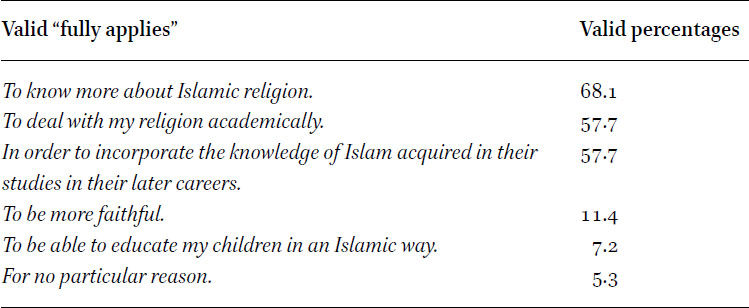
Reasons for taking up the study of Islamic theology
Citation: Journal of Muslims in Europe 13, 2 (2024) ; 10.1163/22117954-bja10093
The results presented in Table 1 from the empirical quantitative data analysis indicate that a majority (68.1%) of respondents decided to pursue the study of Islamic theology in order to gain a deeper understanding of their religion. In addition, 57.7% of respondents reported that they wanted to approach the study of their religion academically, while another 57.7% stated that they intended to utilise the knowledge gained in their future careers. These three reasons appear to be the most significant factors influencing the decision to study Islamic theology, and they are interrelated. While it is possible to interpret these findings differently, the results from the “open” questions in the quantitative questionnaire correspond with the qualitative results.
3.3 Navigating Religious Identity: a Comparative Analysis of Mosque Teaching and Academic Approaches in Islamic Theology Studies
The students bring up another important point in this context. A clear polarisation is revealed by the students’ comparison between mosque teaching and an academic approach to religion. The academic approach focuses on the functional aspects of Islam, such as the motives behind religious narratives and phenomena, while mosque teaching primarily negotiates the substantive aspects of religion through commands and prohibitions. This contrast becomes particularly apparent in the following interview excerpts from group discussions with the focus group of Islamic theology students, which confirm the significant value placed on academic discussion of Islam:
I would also like to get this [knowledge about Islam] on a more scientific level than just these studies in the mosque, where the imam or someone says: “Yes, this is so and so, and this is forbidden and this is right and that’s it.” So, without a great explanation, without, yes, why is it like that, where is the origin, etc.?
Through the study of Islamic theology, students are able to engage in academic exploration of their religion and examine the underlying reasons behind certain religious commandments and prohibitions. This provides them with a broader understanding of their religion and the ability to address complex issues that are significant in the daily lives of young Muslims. In contrast to mosque teachings, which often present religion through the lens of commands and prohibitions, the academic approach enables a deeper investigation of and explanation for religious phenomena. This is further supported by the following interview excerpt:
And then I did a bit of research, talked to prospective theologians […] and realised, hey, they don’t just see Islam in the mosque, or Islam through the Qur’an, through the hadiths and so on, but beyond that, the academic actuality. And then I thought to myself, okay, this is really something with which I can really argue and really look at Islam differently, so to speak. And that’s why I decided to study Islam[ic theology].
Engaging with other students and prospective theologians can be helpful in determining one’s motives for studying Islamic theology. This academic perspective extends beyond the teachings of the mosque, as Islam is not solely focused on the Qur’an and Hadiths. By studying Islamic theology, students can gain competencies that allow them to engage in dialogue with others, even when it may be challenging. Unlike mosque teaching, Islamic theology does not offer a particular Islamic perspective, as some students report. Its focus is broad and complex, as one student explained as follows:
I think it’s – I mean, in the mosque it’s like, there’s always a certain direction. That is, a certain school of law, for example, to which one belongs. And in the university there are no longer these schools of law in principle, but it is much more general, and all schools of law or many are treated, and in the mosque it is more specific, I would say.
This interview excerpt also highlights the differences between the traditional dogmatic perspective of mosque teaching and the comprehensive and critical approach of the university. However, the scientific approach not only distinguishes itself from the common mosque doctrine but also provides students of Islamic theology with the opportunity to discover new perspectives and broaden their horizons. This opinion is further illustrated in the following example:
So, my horizon used to be very limited. I don’t know how it is with others, but especially when you come from the parental home, then it is, you learn the standard things, and you don’t actually get the idea that it goes beyond that, really. And that can be very simple things, for example, if you deal with the biography of the prophets, about such things, like the biography of Ibn Ishaq, something like that, you don’t know anything about it. And when you hear about it for the first time, that it has such an important position in the academic discourse, but you didn’t know that at all, then you think to yourself, so in which world have I actually lived, right? So what have I actually learned so far?
The examples provided demonstrate how Islamic theology studies aid students in transcending their limitations and expanding their skills. It is important to note that lecturers in Islamic theology do not always interpret the study choices of young Muslim students correctly. It is often assumed that students enrole in the programme to deepen their faith. As a result, some institutions have developed a questionnaire that helps students evaluate their expectations and perceptions of the course to determine whether it aligns with their objectives. Nonetheless, this research indicates that students seldom undertake Islamic theology studies with this specific goal in mind. In addition, the efforts of the Muslim younger generation to equalise power relations in the public sphere are often seen as a religious turn and increasing religiosity. This engagement with Islam should be viewed as participation and integration, rather than segregation or demarcation (see Pollack and Müller, 2018: 111f.; Yavas and Gläser, 2018: 257). While the reasons for religious devotion are diverse, it is important to recognise that young Muslims expect social recognition of their cultural characteristics, which include religion. Social recognition empowers young Muslims to assert their identity without losing their cultural and religious heritage. Hence, it is crucial to appreciate the importance of religion as an integral part of cultural identity for the Muslim younger generation, rather than dismissing it as a sign of segregation or lack of integration.
This is significant in the context of sociological conflict analysis, which suggests that Muslim immigrants aim to break away from established “Platzanweisungen” (place orders), as Hüttermann (2018) points out. In this context, young Muslims use Islamic theology studies as a medium of communication in their self-empowerment process, as the empirical data also shows. Unlike first-generation Muslim immigrants, whose identity is closely linked to their original nationality, language and regional and ethnic affiliations, and migration experiences, and for whom Islam served a protective function, young Muslims see Islam as an imperative that must be protected. Research indicates that younger generations perform traditional religious practices less than the older generation but still rate themselves as more religious than them, suggesting a symbolic affirmation of their cultural background. This creates a distinction between individually practised and socially asserted forms of religiosity (see Pollack and Müller, 2018). However, Demmrich, Pollack and Müller (2022) argue that Muslim students are using Islam to bridge cultural gaps and counteract negative stereotypes. These students, who embrace a religious identity assigned to them in migration, seek to expand it through their academic skills and counteract the collective stigmatisation of Islam. By correcting the negative image of Islam, they hope to weaken anti-Muslim alterity debates and overcome their position as second-class citizens. Thus, it is not a matter of closing off from one’s own group as a way to gain social recognition, but rather an academic confrontation with Islam that represents a social opening. In this regard, the study of Islam gains essential significance in the migration structure, and anti-Muslim debates become functional in the study motives of young Muslims.
4 Conclusion
The article explores the motivations behind the pursuit of Islamic theology in the European-German context, and specifically the purpose of such studies. An analysis of study motivations reveals intrinsic factors such as interest, personal development and the desire to enhance the societal image of Islam. These factors are interconnected.
Qualitative data demonstrates that young Muslims hold a positive image of Islam associated with human rights, peace, tolerance and respect. However, challenges arise from negative media coverage and political statements, which contribute to stereotypes that erect significant societal obstacles for young Muslim students. In response, those engaging in Islamic theology studies emphasise the importance of knowledge and expertise, acquiring religious, social and cultural capital, and adopting a comprehensive Muslim identity distinct from that of previous generation. The way Aydin (2009) has elucidated this shows that the concept of strangeness is multifaceted. Sociological frameworks such as those proposed by Simmel (1992), Schütz (1972), Park (1964), Mead (1973) and Elias and Scotson (2006) provide valuable tools for understanding the experiences and identity struggles of these young Muslims.
The role and function of religion transform, with Islam becoming a medium that requires protection while simultaneously being utilised for intercultural and interreligious bridge building. This reflects young Muslims’ evolving relationship with Islam in a generational context. Despite practising traditional religious rituals less frequently than their elders, young Muslims still perceive themselves as religious, symbolically affirming their cultural heritage. Experiences of discrimination and Islamophobia motivate them to pursue Islamic theology studies, empowering them to participate confidently in public discussions.
Quantitative data from online surveys align with qualitative findings, indicating that Muslim students choose Islamic theology for academic and social integration rather than isolation from the majority society. Comparisons between mosque teachings and university studies in Islamic theology highlight students’ ability to counter reductionist views of Islam and deepen their understanding of the religion.
A profound understanding of Islam gained through the study of Islamic theology promotes intercultural and interreligious dialogue, contributes to social cohesion and enables students to engage on an equal footing in society. Islamic theology studies serve as a means of communication and societal positioning in their self-empowerment process.
The results suggest that Muslim students desire an Islam that aligns more closely with their values and is accepted by society. Academic engagement with Islam for young Muslims represents a form of social openness, potentially mitigating anti-Muslim alterity debates, rather than being interpreted as a religious turn leading to increased isolation from society. Instead, students aim to integrate into society and build bridges through expertise in Islamic theology.
The study of Islamic theology serves as a medium for balancing societal power imbalances, offering an opportunity for societal acceptance. A nuanced understanding of Islam allows for in-depth discussions about its role in European migration contexts. Future studies should consider the effects of this intended bridging function on social power relations.
In the context of migration, the study of Islam becomes essential, with anti-Muslim debates influencing the study motives of young Muslims. The study provides an understanding of the multifaceted experiences, motivations and challenges faced by young Muslims in their pursuit of Islamic theological studies. This serves as a means of self-empowerment for young Muslims navigating their social and religious identities in a complex and often challenging environment. It remains essential to uphold and engage with this field of study, as it serves as a vital avenue for fostering mutual understanding and dialogue across diverse cultures and religions. The contribution underscores the importance of incorporating the lifeworld context and migration-specific aspects into the study of Islamic theology. In addition, students, in transferring theological knowledge from the university to society or various professional fields, find themselves standing alone in areas they dare to explore. This ties into a broader question: to what extent does and should the university prepare students for real-life situations? This question needs thorough discussion in the broader context of university education. Empirical findings emphasise the urgency of further investigations in the research field of Islamic theological studies.
References
Antes, Peter, “Funktion und Rolle von Religion in der Gesellschaft: Eine religionswissenschaftliche Perspektive”, in Transformation religiöser Symbole und religiöser Kommunikation in der Diaspora Sozialpsychologische und religionssoziologische Annäherungen an das Diskursfeld Islam in Deutschland, Rauf Ceylan and Haci-Halil Uslucan (eds.) (Wiesbaden, Springer VS, 2018), pp. 3–17.
Aydin, Yasar, Topoi des Fremden: Zur Analyse und Kritik einer sozialen Konstruktion (Konstanz: UVK, 2009).
Aysel, Asligül, Vom “Gastarbeiter” zum “Deutschtürken”: Studien zum Wandel türkischer Lebenswelten in Duisburg (Baden-Baden: Ergon-Verlag, 2018).
Badawia, Tarek, and Uygun-Altunbas, Ayse, “Die Begegnung mit der Religion in den Medien: Empirisch-qualitative Erkundungen zum Einfluss der Medien auf muslimische Religiosität in Familie und Jugend”, in Jahrbuch Migration und Gesellschaft 2021/2022: Schwerpunkt “Familie”, Hans Karl Peterlini and Jasmin Donlic (eds.) (Bielefeld: transcript, 2022), pp. 73–90.
Bauknecht, Bernd, Muslime in Deutschland von 1920 bis 1945 (Köln: Teiresias, 2001).
BEMA, eds., Kurzbericht Islamische Theologie an deutschen Universitäten: Online-Umfrage von Studierenden islamtheologischer Fächer (unpublished manuscript, 2021).
Bertelsmann Stiftung, eds., Religionsmonitor – verstehen, was verbindet. Sonderauswertung Islam 2015: Die wichtigsten Ergebnisse im Überblick. (2015), https://www.bertelsmann-stiftung.de/fileadmin/files/Projekte/51_Religionsmonitor/Zusammenfassung_der_Sonderauswertung.pdf (accessed 30 January 2024).
Bukow, Wolf-Dietrich, Nikodem, Claudia, Schulze, Erika, and Yildiz, Erol, eds., Was heißt hier Parallelgesellschaft? Zum Umgang mit Differenzen (Wiesbaden: VS Verlag für Sozialwissenschaften, 2007).
Demmrich, Sarah, Pollack, Detlef, and Müller, Olaf, “Religion und Integration unter türkeistämmigen Muslimen in Deutschland”, Soziale Welt, Sonderband, 25 (2022), 185–205.
Diehl, Claudia, and Koenig, Matthias, “Religiosität türkischer Migranten im Generationenverlauf: Ein Befund und einige Erklärungsversuche”, Zeitschrift für Soziologie, 38 (2009), 300–319, https://kops.uni-konstanz.de/server/api/core/bitstreams/c94e56ac-f38e-4df1-b26d-9fcf268048ad/content (accessed 17 April 2023).
Donlic, Jasmin, and Yildiz, Erol, “Postmuslimische Generation und ihre Lebensentwürfe: Vom Islamdispositiv zu Alltagserfahrungen”, Forum Islamisch-Theologische Studien, 1/1 (2022), 83–106.
Dreier, Lena, and Wagner, Constantin, Wer studiert Islamische Theologie? Ein Überblick über das Fach und seine Studierenden (Frankfurt am Main: Goethe Universität, 2020), https://aiwg.de/wp-content/uploads/2020/03/Wer-studiert-islamische-Theologie_Expertise.pdf (accessed 6 September 2020).
Elias, Norbert, and Scotson, John L., Etablierte und Außenseiter: Zur Theorie von Etablierten-Aussenseiter-Beziehungen (Frankfurt am Main: Suhrkamp, 2006).
El-Menouar, Yasemin, “Muslimische Religiosität: Problem oder Ressource?”, in Muslime in Deutschland: Historische Bestandsaufnahme, aktuelle Entwicklungen und zukünftige Forschungsfragen, Peter Antes and Rauf Ceylan (eds.) (Wiesbaden: Springer VS, 2017), pp. 225–264.
Foner, Nancy, and Alba, Richard, “Immigrant Religion in the U.S. and Western Europe: Bridge or Barrier to Inclusion?”, International Migration Review, 42/2 (2008), 360–392.
Foroutan, Naika, “Religiöses Kapital als Element muslimischer Identitätsperformanzen”, in Muslime in Deutschland: Historische Bestandsaufnahme, aktuelle Entwicklungen und zukünftige Forschungsfragen, Peter Antes and Rauf Ceylan (eds.) (Wiesbaden: Springer VS, 2017).
Garcia-Muñoz, Teresa, and Neuman, Shoshana, “Is Religiosity of Immigrants a Bridge or a Buffer in the Process of Integration? A Comparative Study of Europe and the United States”, IZA Discussion Paper, 6384 (2012), https://www.iza.org/publications/dp/6384/is-religiosity-of-immigrants-a-bridge-or-a-buffer-in-the-process-of-integration-a-comparative-study-of-europe-and-the-united-states (accessed 12 May 2023).
Guggenberger, Helmut, Hochschulzugang und Studienwahl: Empirische und theoretische Ergebnisse von Hochschulforschung, mit einem Anhang: Studienmotive und Arbeitsperspektiven (Klagenfurt: Kärntner Druck- u. Verlagsges., 1991).
Hachmeister, Cort-Denis, Harde, Maria, and Langer, Markus F., Einflussfaktoren der Studienentscheidung: Eine empirische Studie von CHE und EINSTIEG (Gütersloh: Zentrum für Hochschulentwicklung GmbH, 2007).
Hafez, Kai, Die politische Dimension der Auslandsberichterstattung (Baden-Baden: Nomos, 2002).
Hafez, Kai, “Mediengesellschaft – Wissensgesellschaft? Gesellschaftliche Entstehungsbedingungen des Islambildes deutscher Medien”, in Islamfeindlichkeit. Wenn die Grenzen der Kritik verschwimmen, Thorsten Gerald Schneiders (ed.) (Wiesbaden: Springer VS, 2010), pp. 101–119.
Hafez, Kai, and Richter, Carola, “Das Gewalt- und Konfliktbild des Islams bei ARD und ZDF: ‘Eine Untersuchung öffentlich-rechtlicher Magazin- und Talksendungen’”, (Erfurt: Univ. Erfurt, Seminar für Medien- u. Kommunikationswissenschaft, 2007).
Hafez, Kai, and Schmidt, Sabrina, Die Wahrnehmung des Islams in Deutschland: Religionsmonitor – verstehen, was verbindet (Gütersloh: Verlag Bertelsmann Stiftung, 2015).Harwazinski, Assia Maria, “‘Ich hätte einfach gesagt, die Muslime, die hier leben, gehören zu Deutschland’: Reflexionen über präsidiale Einschätzungen”, in Gehört der Islam zu Deutschland: Fakten und Analysen zu einem Meinungsstreit, in Klaus Spenlen (ed.) (Düsseldorf: Düsseldorf University Press, 2015), pp. 229–249.
Hippler, Jochen, “Gestörte Kommunikation: Wie grundlegende Fehler im internationalen Dialog zwischen westlich und muslimisch geprägten Gesellschaften gegenseitige Ressentiments schüren”, in Islamfeindlichkeit: Wenn die Grenzen der Kritik verschwimmen, Thorsten Gerald Schneiders (ed.) (Wiesbaden: Springer VS, 2010), pp. 273–282.
Horz, Christine, “Kommunikation in der Diaspora: Medienbeteiligung der Muslime”, in Transformation religiöser Symbole und religiöser Kommunikation in der Diaspora, Rauf Ceylan and Haci-Halil Uslucan (eds.) (Wiesbaden: Springer Fachmedien, 2018), pp. 119–140.
Hüttermann, Jörg, “Figurationssoziologische Konfliktanalyse statt Kulturalismus: Was die Einwanderungsgesellschaft aus Konflikten um islamische Präsenzformen lernen könnte”, in Transformation religiöser Symbole und religiöser Kommunikation in der Diaspora, Rauf Ceylan and Haci-Halil Uslucan (eds.) (Wiesbaden: Springer Fachmedien, 2018), pp. 213–249.
Jukschat, Nadine, and Lehmann, Lena, “‘Die sagen wirklich dass das radikal ist ein Kopftuch zu tragen: Ich bin jetzt schon für die Extremistin’: Zum Umgang praktizierender musliminnen mit stigmatisierenden Fremd(heits)zuschreibungen und Terrorismusverdacht”, Zeitschrift für Religion, Gesellschaft und Politik, 4/1 (2020), 289–313.
Kalwa, Nina, “Von der sprachlichen Konstruktion des Islam”, in Gehört der Islam zu Deutschland: Fakten und Analysen zu einem Meinungsstreit, Klaus Spenlen (ed.) (Düsseldorf: Düsseldorf university Press, 2015), pp. 139–158.
Köklü, Patricia, Muslimsein als Ressource der Selbsterzählung: Zur soziologischen Bedeutung muslimischer Selbstbeschreibung (Baden-Baden: Nomos, 2017).
Kosnick, Kra, “Nach dem Multikulturalismus: Aspekte des aktuellen Umgangs mit ,Diversität‘ und Ungleichheit in der Bundesrepublik Deutschland”, in Kultur, Gesellschaft, Migration, Boris Nieswand and Heike Drotbohm (eds.) (Wiesbaden: Springer Fachmedien, 2014), pp. 297–323.
Liebold, Renate, and Trinczek, Rainer, “Experteninterview”, in Handbuch Methoden der Organisationsforschung: Quantitative und Qualitative Methoden, Stefan Kühl, Petra Strodtholz and Andreas Taffertshofer (eds.) (Wiesbaden: VS Verlag für Sozialwissenschaften, 2009), pp. 32–56.
Maliepaard, Mieke, Lubbers, Marcel, and Gijsberts, Mérove, “Generational Differences in Ethnic and Religious Attachment and Their Interrelation: A Study among Muslim Minorities in the Netherlands”, Ethnic and Racial Studies, 33/3 (2010), 451–472.
Mannitz, Sabine, and Schneider, Jens, “Vom ‘Ausländer’ zum ‘Migrationshintergrund’: Die Modernisierung des deutschen Integrationsdiskurses und seine neuen Verwerfungen”, in Kultur, Gesellschaft, Migration, Boris Nieswand and Heike Drotbohm (eds.) (Wiesbaden: Springer Fachmedien, 2014), pp. 69–96.
Mead, Georg Herbert, Geist, Identität und Gesellschaft: Aus der Sicht des Sozialbehaviorismus (Frankfurt a. M.: Suhrkamp, 1973).
Mecheril, Paul, and van der Haagen-Wulff, Monica, “Angst und Wut: Zur affektiven Konstruktion migrationsgesellschaftlicher Ordnung”, in Migration, Religion, Gender und Bildung: Beiträge zu einem erweiterten Verständnis von Intersektionalität, Meltem Kulaçatan and Harry Harun Behr (eds.) (Bielefeld: transcript, 2020), pp. 157–173.
Naumann, Thomas, “Feindbild Islam: Historische und theologische Gründe einer europäischen Angst”, in Islamfeindlichkeit: Wenn die Grenzen der Kritik verschwimmen, Thorsten Gerald Schneiders (ed.) (Wiesbaden: Springer VS, 2010), pp. 19–36.
Nielsen, Jørgen, Muslims in Western Europe (Edinburgh: Edinburgh University Press, 1992).
Nieswand, Boris, and Drotbohm, Heike, “Einleitung: Die reflexive Wende in der Migrationsforschung”, in Kultur, Gesellschaft, Migration: Die reflexive Wende in der Migrationsforschung, Boris Nieswand and Heike Drotbohm (eds.) (Wiesbaden: Springer VS, 2014), pp. 1–37.
Park, Robert Ezra, “Cultural Conflict and the Marginal Man”, in Race and Culture: Essays in the Sociology of Contemporary Man, Robert Ezra Park (ed.) (London: Free Press of Glencoe, [1937] 1964), pp. 372–377.
Peek, Lori, “Becoming Muslim: The Development of a Religious Identity”, Sociology of Religion, 66/3 (2005), 215–242.
Pollack, Detlef, and Müller, Olaf, “Streitfall Islam: Religion und Integration aus Sicht der ‘Mehrheitsgesellschaft’ und der Türkeistämmigen in Deutschland”, in Transformation religiöser Symbole und religiöser Kommunikation in der Diaspora, Rauf Ceylan and Haci-Halil Uslucan (eds.) (Wiesbaden: Springer Fachmedien, 2018), pp. 101–117.
Ramm, Michael, Multrus, Frank, and Bargel, Tino, Studiensituation und studentische Orientierungen. 11. Studierendensurvey an Universitäten und Fachhochschulen, Langfassung (Bonn, Berlin: Bundesministerium für Bildung und Forschung, 2011).
Reuter, Julia, Ordnungen des Anderen: Zum Problem des Eigenen in der Soziologie des Fremden (Bielefeld: transcript, 2002).
Ruf, Werner, “Muslime in den internationalen Beziehungen: Das neue Feindbild”, in Islamfeindlichkeit: Wenn die Grenzen der Kritik verschwimmen, Thorsten Gerald Schneiders (ed.) (Wiesbaden: Springer VS, 2010), pp. 121–129.
Said, Edward, Orientalism (London: Penguin Books, [1978] 2003).
Sarrazin, Thilo, Deutschland schafft sich ab: Wie wir unser Land aufs Spiel setzen (München: Dt. Verl.-Anst., 2010).
Sauer, Martina, and Halm, Dirk, Der Einfluss muslimischer Religiosität auf die gesellschaftliche Integration von Einwanderern in Deutschland: Eine systematische Literaturanalyse (Opladen: Barbara Budrich, 2019).
Scheller, Percy, Isleib, Sören, and Sommer, Dieter, Studienanfängerinnen und Studienanfänger im Wintersemester 2011/12 (Hannover: 2013), https://www.fachportal-paedagogik.de/literatur/vollanzeige.html?FId=3183275 (accessed 30 January 2024).
Schiffauer, Werner, “Vom Exil-zum Diaspora-Islam: Muslimische Identitäten in Europa”, Soziale Welt, 55 (2004), 347–368.
Schneeberger, Arthur, “Studienwahl als familial und gesellschaftsstrukturell praedeterminierter Entscheidungsprozess. Eine theoretische Skizze.”, Zeitschrift für Hochschuldidaktik, 1 (1985), pp. 43–57.
Schröder, Lothar, “Islam-Debatte zwischen Erregungspotenzial, Populismus und Verantwortung”, in Gehört der Islam zu Deutschland: Fakten und Analysen zu einem Meinungsstreit, Klaus Spenlen (ed.) (Düsseldorf: Düsseldorf University Press, 2015), pp. 13–15.
Schütz, Alfred, “Der Fremde: Ein sozialpsychologischer Versuch”, in Gesammelte Aufsätze, vol. 2: Studien zur soziologischen Theorie, Alfred Schütz (ed.) (Den Haag: Martinus Nijhoff, 1972), pp. 53–69.
Scourfield, Jonathan Bryn, Taylor, Christopher Matthew, Moore, Graham, and Gilliat-Ray, Sophie, “The Intergenerational Transmission of Islam in England and Wales: Evidence from the Citizenship Survey”, Sociology, 46/1 (2012), 91–108.
Simmel, Georg, “Exkurs über den Fremden”, in Georg Simmel Soziologie: Untersuchungen über die Formen der Vergesellschaftung, Otthein Rammstedt (ed.) (Frankfurt am Main.: Suhrkamp, 1992), pp. 764–771.
Spielhaus, Riem, “Religion und Identität: Vom deutschen Versuch ‘Ausländer’ zu ‘Muslimen’ zu machen”, IP-Internationale Politik, 3 (2006), 28–36.
Spielhaus, Riem, Wer ist hier Muslim? Die Entwicklung eines islamischen Bewusstseins in Deutschland zwischen Selbstidentifikation und Fremdzuschreibung (Berlin: Ergon, 2011).
Spielhaus, Riem, “Vom Migranten zum Muslim und wieder zurück: Die Vermengung von Integrations- und Islamthemen in Medien, Politik und Forschung”, in Islam und die deutsche Gesellschaft, Dirk Halm and Hendrik Meyer (eds.) (Wiesbaden: Springer, 2013), pp. 169–194.
Spielhaus, Riem‚ “Zwischen Migrantisierung von Muslimen und Islamisierung von Migranten”, in Postmigrantische Perspektiven: Ordnungssysteme, Repräsentationen, Kritik, Naika Foroutan, Juliane Karakayali and Riem Spielhaus (eds.) (Frankfurt am Main: Campus Verlag, 2018), pp. 129–143.
Stagel, Wolfgang, “Beeinflussungsfaktoren der Studienwahl – Analyse von Trends in der Entwicklung der Studienwahl in Österreich von 1960 bis 1980.”, in: Studienaufnahme und Studienzulassung. Aspekte des Wandels im Zugang zu den Hochschulen, Paul Kellermann, Paul (eds.) (Klagenfurt: Klagenfurter Beiträge zur bildungswissenschaftlichen Forschung Vol. 15, Kärntner Druck- und Verlagsgesellschaft, 1984), pp. 218–242.
Stenger, Horst, “Soziale und kulturelle Fremdheit: Zur Differenzierung von Fremdheitserfahrungen am Beispiel ostdeutscher Wissenschaftler”, Zeitschrift für Soziologie, 27/1 (1998), pp. 18–38.
Strasser, Sabine, and Tošić, Jelena‚ “Egalität, Autonomie und Integration: Post-Multikulturalismus in Österreich”, in Kultur, Gesellschaft, Migration, Boris Nieswand and Heike Drotbohm (eds.) (Wiesbaden: Springer Fachmedien, 2014), pp. 123–150.
SVR: Sachverständigenrat deutscher Stiftungen für Integration und Migration, eds., Viele Götter, ein Staat: Religiöse Vielfalt und Teilhabe im Einwanderungsland. Berlin (2016), https://www.bosch-stiftung.de/sites/default/files/publications/pdf_import/SVR_JG_2016-mit-Integrationsbarometer_WEB.pdf (accessed 4 April 2023).
Tezcan, Levent, “Das Islamische in den Studien zu Muslimen in Deutschland”, Zeitschrift für Soziologie, 32/3 (2003), 237–261.
Tiesler, Nina Clara, Muslime in Europa: Religion und Identitätspolitiken unter veränderten gesellschaftlichen Verhältnissen (Berlin: LIT, 2006).
Voas, David, and Fleischmann, Fenella, “Islam Moves West: Religious Change in the First and Second Generations”, Annual Review of Sociology, 38 (2012), 525–545.
Welter-Enderlin, Rosmarie, and Hildenbrand, Bruno, eds., Resilienz – Gedeihen trotz widriger Umstände (Heidelberg: Carl-Auer-Systeme, 2006).
Willich, Julia, Buch, Daniel, Heine, Christoph, and Sommer, Dieter, “Studienanfänger im Wintersemester 2009/10: Wege zum Studium, Studien – und Hochschulwahl, Situation bei Studienbeginn”, HIS: Forum Hochschule, 6 (2011), https://www.fachportal-paedagogik.de/literatur/vollanzeige.html?FId=938475 (accessed 24 March 2023).
Windolf, Paul, “Fachkultur und Studienwahl: Ergebnisse einer Befragung von Studienanfängern”, Kölner Zeitschrift für Soziologie und Sozialpsychologie, 44 (1992), 76–98.
Wunn, Ina (in collaboration with Schmitz, Bertram, and Seibert, Leif), Muslimische Gruppierungen in Deutschland: Ein Handbuch (Stuttgart: Kohlhammer, 2007).
Yavas, Aylin, and Gläser, Mirjam, “(Kollektive)Identitätsprozesse von Muslim*innen im Kontext von öffentlichen Debatten: Am Beispiel von politischer Bildung und Prävention”, in Transformation religiöser Symbole und religiöser Kommunikation in der Diaspora, Rauf Ceylan and Haci-Halil Uslucan (eds.) (Wiesbaden: Springer Fachmedien, 2018), pp. 251–261.
This article was written as part of the study “Islamic Theology at German Universities. A Study of Islamic Religious Expertise in Germany”, which was funded by the German Research Foundation in 2018–2021 and to which we owe our thanks.
One of the most influential discussions of the topic is certainly Edward Said’s Orientalism (1978 [2003]).
In the sense of “construction”.
The term “othering” has its roots in postcolonial theory (see Mecheril and van der Haagen- Wulff, 2020: 158).
At this point, two remarks need to be made. First, not all Muslims residing in Germany arrived as part of the so-called guest worker program. The first generation also includes students, apprentices, and political refugees, etc. Second, in the European context, the Islamic religion is perceived as a sociological problem of “otherness”, which represents a barrier to integration (see Voas and Fleischmann, 2012: 530). This is in contrast to the American context, where religion plays an identitarian role (see Peek, 2005). Other authors such as Foner and Alba (2008: 368) and Garcia-Muñoz and Neumann (2012) have also noted this difference.
On young Muslims seeking their own path of integration into society. El-Menouar (2017) offers some insights, while Jukschat and Lehmann (2020) discuss coping strategies for dealing with stigmatising experiences.
The relationship between religion and the integration of ethnic or cultural minorities is discussed using the conceptual pair “bridge vs. barrier” (see Demmrich, Pollack and Müller, 2022: 187).
Note: All the names of people and places in the text have been changed so that they cannot be identified.
As described by Welter-Elderlin and Hildenbrand (2006: 13), resilience refers to an individual’s ability to overcome crises at various stages in their life by utilising personal and social resources, and leveraging opportunities for personal growth.