Abstract
This study explores discourse restructuring in English-Chinese legal translation, focusing on the translation shift to Chinese-specific topic chain clauses. Using data from a parallel English-Chinese legal corpus, this research reveals that the shift from English “subject-prominent” clause combining to Chinese topic chaining is influenced by the textual status of the English grammatical subject. Parameters for determining textual status include semantic animacy, discourse saliency and position within the schematic structure of the genre. The more marked the English grammatical subject is according to these parameters, the higher its textual status, the more likely it is to be translated into Chinese as topic chaining clauses into sentence.
The study argues that topic chain translation accounts for universal translation shifts, including explicitation, implicitation, and reference tracking shifts. It proposes that topic chain translation is the “hybridization” strategy adopted by translators to preserve the specific legal coherence of the source text while aligning with the linguistic and communicative norms of the target language. This makes translation shifts predictable. Viewing “translation as legal action” emphasizes the recreation of meaning, considering extra-linguistic factors relevant to the genre-specific discourse community.
Topic chain translation offers a practical approach to achieving equivalent communicative purposes in the target genre, thereby facilitating the “text translation” of morphologically structured languages like English into Chinese, which is characterized by a freer word order. The corpus and empirical findings of this study can inform the teaching of legal translation and the development of algorithms in machine translation to assist in generating or annotating appropriate clause combining structures.
The study also calls for further investigations into discourse restructuring in legal translation, particularly at the intersection of language contrasts, legislative contexts, and genre conventions, where the effective recreation of international legal reasoning occurs.
1 Introduction
In English-Chinese legal translation, topic chain, the Chinese-specific clause combining via zero noun phrases (NP) co-referring with the overt NP topic, is often used by translators as a way of discourse restructuring in attaining the “dynamic equivalence in legal translation” (Alcaraz Varó and Hughes, 2002: 178–181). For example:1
(1) Original text: A certificate called a Passenger Ship Safety Certificate shall be issued after an initial or renewal survey to a passenger ship which complies with the relevant requirements of chapters II-1, II-2, III, IV and V and any other relevant requirements of the present regulations.
Chinese translation:
客船经初次检验或换证检验,符合第 II-1、 II-2、 III、 IV和V章要求以及本公约规则其他有关要求,应予签发客船安全证书。
Gloss: ‘Passenger shipi after an initial or renewal survey, Øi comply with … requirement, Øi shall YU (co-verb marking benefactive) issue …’.
In English source text, clauses are combined with such devices as connectives, subordination and subject-verb consistency. In Chinese translation text, however, the topic ties clauses together, as in Example (1),
This paper reports a study carried out in order to elucidate the mechanics of Chinese topic-chain translation of English in international laws.
International laws are treaties and codes underlying international organizations and non-governmental organizations (NGOs), functioning to govern and enhance international cooperation and business. The drafting, continual modification and implementation of the international laws involve the work of legal translation (see Alcaraz Varó and Hughes, 2002: 2), in this study, from the original language of English to the target language of Chinese.
Topic chain as a Chinese-specific clause combining construction is one of the “nestles” where clause combining in the free order language of Chinese differ mainly from that of English (e.g. Li and Thompson, 1976, 1981; Tsao, 1990; Chu, 1998; Shi, 1989, 2000). As a structural shift (Catford, 2000: 143–147), topic chain translation involves not only the discourse restructuring but also other types of adaptation, among which connective adding/omission, or explicitation/implicitation (Blum-Kulka, 2000), reference tracking shift and others. The study of topic chain translation, therefore, can provide a consistent explanation of the above-mentioned translation strategies. Moreover, as will be presented, topic chain shift finds its high frequency in the English-Chinese legal translation and plays an indispensable role in rendering the equivalent communicative purposes of the genre, thus realizing “text translation” (Hatim and Mason, 1990; Baker, 1992; Hatim, 1997; Munday, 2012). Topic chain translation as a structural shift, as will be presented in this paper, is informed by the systematic English-Chinese clause combining differences and the genre features of the legal discourse.
Findings of this study can help support the point that those seemingly “universal” translation preferences are actually out of language-pair systemic differences and out of genre consideration (see Becher, 2011; Munday and Zhang, 2015). Practically, findings and corpora of this study can be applied to teaching the legal translation and to devising proper algorithms in machine translation that help generate or annotate the appropriate clause combining in the target language.
The paper is structured as follows. Section 2 gives an overview of related theoretical concepts; Section 3 presents the research hypothesis, the data, the method and the study objects. Section 4 quantitatively explores the triggers of topic chain translation from English to Chinese in international laws. The qualitative discussion in Section 5 clarifies some translation “universals” in terms of the comparison of English and Chinese clause combing, arguing the “hybridity” between language features and socio-cultural contacts involved in topic chain translation. Section 6 is the conclusion, wrapping up all the findings and argumentation to the thesis that a tangible framework, as the topic-chain translation presented in this study, is needed to systemically clarify some puzzling “universal” translation shifts in genre and to provide feasible algorithms in machine translation.
2 An Overview of Related Theoretical Concepts
Discourse-based linguistic approach to translation studies (e.g. Hatim and Mason, 1990; Baker, 1992; Munday, 2012) see translation as the recreation of meaning in context (Li and Hu 2021 on political discourse translation; Wang and Munday 2020 on “contextual recreation of meaning”; Matthiessen 2014, 2021’s extensive exploration, with functional linguistic framework, seeing translation as the recreation of meaning in context through choices). That means the primary unit of translation is the text. Comparable meanings between languages on the stratum of text include the information packaging, discourse organization and logical planning. These are, to quite some degree, contributed by clause combining, which is language-specific.
Clause combining refers to the syntactic and semantic linking of clauses into a cohesive discourse unit (Haiman and Thompson, 1988). The differences between English and Chinese clause combining primarily lie in the degree to which sentence structure and word order are governed by syntactic rules versus discourse factors (e.g. Li and Thompson, 1976, 1981; Tsao 1990; Shi 1989, 2000). In English, clauses are typically defined by the syntactic notions of subject and the finite verb agreement. When clauses combine into complex sentences, coordination and subordination are more overtly marked by connectives and verb morphology. In this sense, English clause combining is considered “subject-prominent”. In contrast, the basic structure of a Chinese clause follows a topic-comment pattern: as defined by Hockett (1958), the speaker announces a topic and then says something about it (comment). When Chinese clauses combine, coordination and subordination are less explicitly marked. Successive clauses are often juxtaposed semantically through topic continuity. Thus, Chinese clause combining is “topic-prominent”. As shown in Example (1), topic chains are a common translation shift from the English “subject-prominent” clause combining to better convey the communicative intent.
Previous studies of clause combining translation between English and Chinese mainly draw on the difference of English Xinghe-prominence (form-oriented, featuring subject-predicate structure) and Chinese Yihe-prominence (meaning-oriented, featuring message-segments) (e.g. Li, 2011), or on the Systemic Functional Linguistics (SFL) model of theme progression in text (e.g. Ghadessy and Gao, 2000; Liu and Yang, 2013; Kim and Huang, 2012). The Xinghe/Yihe approach is in line with the English subject-prominence vs. Chinese topic-prominence difference. However, defining the free order feature of Chinese clause combining only by the vague concept Yihe does not help translators much in their choosing specific translation strategies. If there are syntactic rules combining English subject-prominent clauses into a discourse unit, there also should be some tangible and feasible structural rendering of Yihe in Chinese for translators. Topic chain is one of the Yihe rendering strategies; in terms of translatology, topic chain rendering is a pipe hole through which specific language-pair translation shifts can find explanation and expression.
Theme progression approach (Kim and Huang, 2012; Ghadessy and Gao, 2000; Huang, 2006) finds more persuasion when the translation unit lies in clause. SFL model defines the first element of a clause as the theme of a clause, and a clause may have multiple themes linearly presenting textual, interpersonal and experiential meanings. Theme progression refers to the successive selection of themes from one clause to another according to one of a fairly small number of motivated patters (Kim and Matthiessen, 2015: 337–338). When it comes to sentence as discourse translation unit, topic continuity plays the prominent role in organizing the discourse (Li and Thompson, 1981; Xu and Langendoen, 1985; Shi, 1989; Chu, 1998). The translation shift question is when and how the subject-prominence in English sentences can be rendered into the topic-prominence in Chinese ones.
Previous studies on clause combining in legal genres primarily focus on conjunctions, reference tracking, and circumlocutions in sentences (e.g. Bhatia, 1997; Alcaraz Varó and Hughes, 2002; Pan, 2014). Alcaraz Varó and Hughes (2002: 190) propose legal translation should distinguish between the grammatical concept of subject and the semantic concept of theme, thus “by indirection find directions out”.
As Bhatia (1993: 102–103) maintains, in the statute genre, the communicative purposes of modelling the world of obligations and rights, permissions and prohibitions with particularity and all-inclusive contingency contribute to the syntactic discontinuity and anfractuosities in text. Legal translation is decided not only by source-target linguistic differences but also by socio-cultural backgrounds, communicative purposes, thus schematic structures specific to the legislative genre.
Therefore, when analyzing and determining clause combining in legal translation, an integrative framework is needed – one that is sufficiently robust to account for both linguistic contrasts and genre-specific factors in achieving textual equivalence for legal communicative purposes.
3 Research Hypothesis, Data, Method and Study Objects
On the basis of the above-mentioned English-Chinese clause combining contrasts and legal translation principles, the following hypothesis is proposed:
Hypothesis (H)
In English-Chinese legal (statute) translation, the higher textual status the English subject referent has, the more likely it will be restructured as the topic overt NP and continue to combine clauses into a Chinese topic chain sentence.
This hypothesis was tested on an English-Chinese translation corpus with two sets of texts: one is composed of five texts of the international maritime conventions originally written in English; the other of their equally authentic Chinese translations. The English set comprises 970,569 running words. The Chinese set comprises 504,106 running characters.
The corpus is constructed out of the reasons as follow. As a typical category of the international legislation, international maritime conventions and treaties validated by the departments of the United Nations (UN) and by those shipping NGOs function to regulate maritime international coordination and business on the ratification and fulfilment by state members. Maritime legislative texts drafted in English are usually translated into the languages of the member states adopting the protocol, and translations are considered as authentic primary legal instruments, equally binding as the English source text. When China as a state member adopts the statute, Chinese will be added to the list of “Languages” provision, giving authenticity to the Chinese translation. Therefore, the legalized translation contributes, with the “natural equivalence” (Alcaraz Varó and Hughes, 2002: 180), to the effective implementation of international maritime conventions. On the other hand, the international legislation as a genre is new in the Chinese discourse system. How the “imported” genre factors bend the translation process is worthy of in-depth investigation.
The analytical model is formulated as shown in Figure 1.

The analytical model
Citation: Contrastive Pragmatics 7, 2 (2026) ; 10.1163/26660393-bja10140
Legal translation is a dual problem-solving activity (Alcaraz Varó and Hughes, 2002: 153–154), tackling linguistic as well as socio-cultural issues. The analysis should therefore consider factors of two levels. The systemic English-Chinese difference in terms of clause combining motivates translation shifts in rendering the comparable discourse organization; communicative purposes and the cognitive structure of the international legislation genre inform translation shifts in rendering the comparable information packaging and logical planning.
In our corpus, the alignment between English and Chinese sentences (as indicated by the use of a period) exceeds 99%. A total of 401 Chinese topic chain sentences were extracted. For each Chinese topic chain sentence, the corresponding English sentence was parsed with the software of BFSU Stanford Parser 1.0. In this way, the grammatical subject of each clause in English sentences can be identified. The textual status of the English subject was coded using BFSU Qualitative Coder 1.2 based on three parameters: animacy; semantic centering; and position within the genre’s schematic structure. The hypothesis (H) can be verified if the markedness of the English subject, as determined by these three parameters, predicts the likelihood of its restructuring as a Chinese chaining topic.
4 Determinants of Topic Chain Shifts in English-Chinese Legal Translation
4.1 Animacy
When translating from subject-prominent English into topic-prominent Chinese, translators must determine which English subject reference in a sentence should be shifted into a Chinese topic. Animacy plays a significant role in assessing the likelihood of a NP selected as a topic. Hawkinson and Hyman (1974) and Givón (1976) propose a universal implicational hierarchy for NP topicality, summarized as “human > animate > inanimate”. This means that human NPs are more likely to be chosen as topic than non-human animate NPs, which, in turn, are more likely to be selected than inanimate NPs. Human references that occupy subject positions in English sentences are often central to the discourse (Givón, 1979, 1983; Du Bois, 1987; Fox and Thompson, 1990). Consequently, animacy serves as a factor in motivating the shift from English subject to Chinese chaining topic.
The animacy of a NP referent has long been treated on a continuum from the least animacy of abstractness through concreteness, and within concrete referents, from inanimate to animate referents (Gries, 1999; Yamamoto, 2006). Accordingly, subject NP referents in English source texts of corpus fall into the following three categories:
a. Animate
Human beings, administrative authorities including the International Maritime Organization, UN, NGO s, state members, governments etc. Ships and vessels, which are referred to as with volition and liabilities in the shipping industry world.
b. Concrete Inanimate
Referential concrete objects or substances including documented regulations and provisions.
c. Abstract Inanimate
Events, abstract concepts, and anything else that is not prototypically concrete.
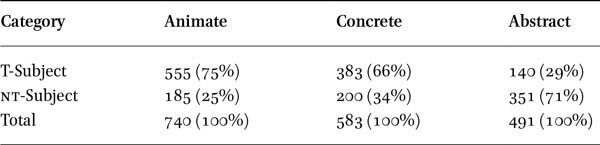
Table 1 presents the distribution of English subject referents of animacy categories in cases being restructured as a Chinese chaining topic (T-Subject) or not (NT-Subject).
Distribution over animacy in topic-chain translation
Citation: Contrastive Pragmatics 7, 2 (2026) ; 10.1163/26660393-bja10140
Table 1 demonstrates a strong correlation between Chinese chaining topic translation and the animacy of English subject referents (χ² = 278.54, df = 2, p < 0.001). A clear progression is observed from animate to concrete, and finally to abstract referents. Specifically, in English-Chinese maritime statute translation, animate English subjects, which possess higher textual status, are most likely to be restructured into Chinese topics and maintained in subsequent sentence as zero co-references. Conversely, the lower the degree of animacy in English subject referents, the less likely they are to be restructured into Chinese chaining topics. The findings in Table 1 support the conclusion that animacy, as an indicator of textual status, plays a significant role in determining the likelihood of English subjects being restructured into Chinese chaining topics within a sentence.
4.2 Centering Algorithm
In his discussion of machine translation (MT) from English into the “free” word order language of Turkish, Hoffman (1996) proposes heuristics based on discourse salience and grammatical relations in determining a sentence topic in the target language. The Centering Algorithm is used to evaluate discourse saliency based on the persistence of NP referents within the discourse. Salient discourse entities are typically referenced repeatedly within a discourse segment. As a result, entities that persist throughout the discourse and are frequently realized as pronouns (both null and overt) in the source language are generally the most salient. These entities are, therefore, more likely to be chosen as sentence topics in the target free order language.
Givón (1983) also has persistence as a heuristic measure of discourse saliency. If the entity evoked by a NP is salient in discourse, it tends to persist in the subsequent discourse after its initial introduction into discourse. In the present study, the more salient, or centering an English subject referent is in the source text, the more it will be mentioned, thus chosen as the chaining topic in the target Chinese.
Thus, the centering value, or the persistence of the English subject can be another textual status indicator determining the possibility of its being selected as the chaining topic in target Chinese.
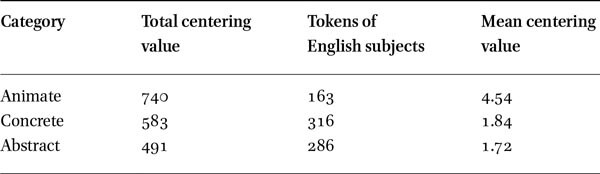
The centering values of English subject referents in corpus are calculated by their number of occurrence (in the forms of null, pronoun or full NP) in the sentence. For example, if an English subject referent occurs three times in the clause-combing sentence, its centering value is 3. The total number of centering values is then divided by tokens of the subject. Therefore, the centering value, or the discourse saliency, of an English subject referent – whether restructured as a Chinese chaining topic (T-Subject) or not (NT-Subject) – depends on its frequency of occurrence within sentences. Moreover, English subject referents are classified into three types: Animate, Concrete and Abstract. The centering values of T-Subjects and NT-Subjects in the corpus are calculated by dividing the total number of centering values by the total number of subject referent tokens, categorized according to animacy. The results are shown in Table 2.
Table 2 shows that English subject referents, when restructured as chaining topics in Chinese target texts, exhibit a higher centering value, signifying a greater textual prominence.
Centering value in topic-chain translation2
Citation: Contrastive Pragmatics 7, 2 (2026) ; 10.1163/26660393-bja10140
Centering value for animacy
Citation: Contrastive Pragmatics 7, 2 (2026) ; 10.1163/26660393-bja10140
Additionally, centering value calculations are conducted separately for the categories of Animate, Concrete and Abstract, with the results presented in Table 3.
Since animacy is another textual status indicator, data in Table 3 combined together with those in Table 2 help reach the judgement that those English subject referents salient in discourse, with their higher textual status, tend to be chosen and shifted into Chinese chaining topics.
4.3 PC (Provisionary Clause) Status
As demonstrated in the analytical model, the subject-topic translation shift can be influenced by genre-specific factors, particularly in terms of communicative purposes and the corresponding schematic structure.
Maritime laws govern maritime commerce and transport by defining actions on sea and offshore, as well as by imposing obligations and rights on the legal entities involved. In maritime legislative provisions, cognitive structuring exhibits “a characteristic interplay of the main provisionary clause and the qualifications inserted at various syntactic openings within the structure of a sentence” (Bhatia, 1993: 115). For example,
(2) If a Contracting State has two or more territorial units in which different systems of law are applicable in relation to the matters dealt with in this Convention, it may, at the time of signature, ratification, acceptance, approval or accession, declare that this Convention is to extend to all its territorial units or only to one or more of them, and may amend its declaration by submitting another declaration at any time.
The legal subject a Contracting State is given the permission of declaring and amending in the above underlined provisionary clause. Qualifications specifying conditions, circumstances and alternatives are inserted into various syntactic positions, which “make the legislative provision precise, clear, unambiguous and all-inclusive” (Bhatia, 1993: 117). In English the “subject-prominent” clause combining mechanics help delineate the “tangling” interplay between the provisionary and qualification clauses.
Chinese, on the other hand, has topic chain as one of clause combining methods. Clauses with the overt topic NP in topic chain have been proved to foreground their host ideas, and those with zero ones present less salient ideas in discourse relations, providing background information of elaboration, justification, condition, retreat and so on (Chu, 1998; Li, 2005; Zhang, 2012). When it comes to legislation translation, topic chains can be the Chinese-specific way to recreate the discourse relation between provisionary clauses and qualifications, with overt topic NP clauses characterizing legal subjects and their action, zero NP clauses offering qualifications.
Therefore, the position of the English grammatical subject referent in the genre schematic structure can predict its possibility of being translated and restructured as the chaining topic in Chinese. The English grammatical subject in the provisionary clause controls the predicate verb, which refers to the legal action in the provision. Compared with those in qualification clauses, this English grammatical subject in the provisionary clause, with its more important textual role, will be more likely restructured into a Chinese chaining topic.
The corpus is coded with the interactive schematic structure of provisionary clauses and qualifications. A careful analysis of English provisionary/qualification clause subjects (PC-Subjects/Qu-Subjects), based on whether they are translated as Chinese chaining topics or not, yields the results presented in Table 4.
Distribution of PC-subjects and Qu-subjects based on restructuring as chaining topics
Citation: Contrastive Pragmatics 7, 2 (2026) ; 10.1163/26660393-bja10140
Table 4 shows that the position of English clause subject in the genre’s schematic structure is relevant to its likelihood of being translated and restructured into a Chinese chaining topic (χ² = 207.49, df = 1, p < 0.001). The vast majority of English PC-subjects are translated into Chinese chaining topics (78%). In contrast, among all English Qu-subjects, those translated into Chinese chaining topics are outnumbered by those are not (10%). Table 4 also reveals that, overall, English grammatical subjects tend to be translated into Chinese chaining topics (61%), and English Qu-subjects can co-refer with PC-subjects in text. Given these factors, it can be concluded that English Qu-subjects are less likely to be translated into Chinese chaining topics. The data in Table 4 lead to the conclusion that English PC-subjects, due to their higher status in the generic structure, are more likely to be translated into overt Chinese NP topics, continuing to form topic chains across clauses.
The quantitative analysis in this study has confirmed the hypothesis that, in English-Chinese legislative translation, the structural shift from the English “subject-prominent” clause combination to Chinese topic chains is influenced by the textual status of English grammatical subjects. Parameters for evaluating the textual status include semantic animacy, discourse saliency (as measured by the centering value), and position within the schematic structure of genre. The more marked an English grammatical subject is along these parameters, the higher its textual status, and the more likely it is to be translated into Chinese overt NP topics. Subsequently, it continues in text as a zero NP, facilitating clause combination into a topic chain sentence.
5 Discussion
The results of this study suggest that the shift from English grammatical subjects to Chinese chaining topics in legal translation goes beyond mere structural change. By linking the grammatical concept of word order to textual semantics (as discussed in Kim and Matthiessen, 2015), translation is framed as the recreation of meaning in context. When the text is viewed as the primary unit of translation, specific strategies and challenges in legal translation can be clearly explained and articulated. The Chinese-target topic chain translation provides a practical and effective means of representing the Chinese Yihe clause combining, which serves as an equivalent to the English Xinghe. Furthermore, the recreation of meaning within the context of international law involves “translation as legal action,” requiring the inclusion of extra-linguistic factors. These factors encompass industry-specific and discourse community-specific genre elements that influence legal translation.
5.1 Topic Chain Translation: Some Clarifications
5.1.1 Explicitation vs. Implicitation
Explicitation Hypothesis suggests “an observed cohesive explicitness from SL to TL texts regardless of the increase traceable to differences between the two linguistic and textual systems involved” (Blum-Kulka, 2000). Becher (2011) criticizes this and maintains that the translation strategy of explicitation or of implicitation is attributable to language pair-specific differences in terms of lexico-grammatical and communicative norms.
Traditional English-Chinese contrastive studies suggest the “hypotaxis vs. parataxis” distinction, that is, English uses more connectives in clause combining than Chinese does (Zhu et al., 2001: 99–102). Pan (2014) attributes to this cross-linguistic factor the tendency of conjunctive implicitation in English-Chinese legislative text translation. However, attributing the implicitation translation to the implicitness of Chinese is somewhat circulative. Furthermore, there is also an observed tendency for explicitation when translating English adversative conjunction into Chinese. Therefore, a more integrative and consistent explanation is needed to account for the varying tendencies towards explicitation and implicitation in the translation of different conjunctions.
In line with Becher (2011) this study proposes subject/topic-prominent clauses combining differences between English and Chinese as the explanation of translation explicitation and implicitation.
In English, clauses are linked via syntactically motivated subordination or coordination, which are defined by “subject-predicate verb” agreement. As a result, the use of connectives marking inter-clausal relationships is to quite a degree determined by this “subject-prominent” quality. In Chinese, the pragmatic notion of topic extends its domain to more than one clause and controls co-referential NP deletion of successive clauses, thus functions to combine clauses into a cohesive and coherent discourse segment (Chu, 1998). In this sense, it is not surprising for Chinese speakers to use clause connectives only when they are needed to make semantic distinctions clear. Conjunctions that are semantically neutral, such as the temporal and the additive, as noticed by Pan (2014: 13), tend to become “implicit” in their Chinese translation. For example,
(3) Original text: (a) The carrier is, after reasonable effort, unable to locate the consignee (b) in order to request delivery instructions, (c) the carrier may so advise the shipper (d) and request instructions in respect of the delivery of the goods.
Chinese translation: (a)
承运人 i经合理努力无法确定收货人, (b) Øi请求就货物的交付发出指示, (c)则 承运人 i可以通知托运人, (d) Øi请求就货物的交付发出指示。
Gloss: ‘(a) Carrieri PREP-via reasonable effort unable locate consignee, (b) Øi request PREP-about goods-DE-delivery issuing instruction, (c) so carrieri may advise shipper, (d) Øi request PREP-about goods-DE-delivery instruction issuing instruction’.
In Example (3), the connectives after, in order to, and and in English source text get implicit in the Chinese target text. The high textual status of the subject the carrier in English (being animate, salient in discourse as well as in genre) determines its being restructured as the chaining topic in Chinese, which then functions as a cohesive tie, making those connectives unnecessary.
The subject/topic-prominent clause combining differences between English and Chinese also explain the hypothetical connective (if, where) implicitation in our corpus, which runs counter to Pan (2014). For example,
(4) Original text: (a) If a Contracting State has two or more territorial units (b) in which different systems of law are applicable in relation to the matters dealt with in this Convention, (c) it may, at the time of signature, ratification, acceptance, approval or accession, declare that […] (d) and may amend its declaration by submitting another declaration at any time.
Chinese translation: (a)
一缔约国 i拥有两个或多个领土单位, (b) Øi各领土单位对本公约所涉事项适用不同法律制度的, (c) Øi可以在签署、 批准、接受、核准或加入时声明 […] (d) Øi且可以在任何时间通过提出另一声明修改其所作的声明。
Gloss: ‘(a) A Contracting Statei has … (b) Øi different territorial units apply … (c) Øi may declare … (d) Øi may amend …’
The English subject referent a Contract State, with its higher textual status in the sentence, is restructured into the topic in Chinese
On the other hand, translation explicitation is consistently informed by this “deep-seated, non-trivial lexico-grammatical and pragmatic contrast” (Becher, 2011: 43) between English and Chinese, that is, English syntactical “subject-prominence” vs. Chinese discourse-oriented “topic-prominence”.
Unlike English subjects, Chinese topics do not exert a controlling force on verbs, meaning that the logic linking between clauses cannot rely solely on the cohesive tie of topics. For the English ing-participle clause, although it agrees in forms with the subject, a range of meanings can be conveyed: from temporal, conditional, causal, concessive, or circumstantial (Quirk et al., 1985: 1124). In the absence of such morphological syntax in Chinese, translators tend to “upgrade” the ing-participle clause in Chinese to one with the finite verb, adding a connective to preserve the linguistically encoded meaning in the target text. Observations from the corpus in this study show that this translation strategy becomes obligatory when the ing-participle clause appears between the legal subject and its corresponding legal action. For example,
(5) Original text: However, (a-) the Administration legal subject, (b) having regard to overall safety considerations, (-a) may accept legal action a partial reduction in propulsion capability from normal operation.
Chinese translation:
但是 , (a)当 主管机关 i对整体安全性作考虑 后 , (b) Øi可以接受将正常运行的推进能力作部分降低。
Gloss: ‘… (a) when Administrationi consider overall safety after, (b) Øi may accept …’
(6) Original text: (a-) The Contracting Governments legal subject (b) Being Desirous of promoting safety of life at sea by establishing in a common agreement uniform principles and rules directed thereto, (c) Considering that this end may best be achieved by the conclusion of a Convention to replace the International Convention for the Safety of Life at Sea, 1960, (d) Taking Account of developments since that Convention was concluded, (-a) Have Agreed legal action as follows.
Chinese translation: (a)
各缔约国政府 i愿共同制订统一原则和有关规则,以增进海上人命安全, (b) Øi考虑到1960年国际海上人命安全公约缔结以来的发展情况, (c)Øi重新缔结一个公约,以替代 1960年公约,可以最好地达到这一目的, (d) Øi特议定下列各条。
Gloss: ‘(a) The Contracting Governmentsi desire establish in a common agreement uniform principles and relevant rules, to promote safety of life at sea, (b) Øi consider the International Convention for the Safety of Life at Sea, 1960 since that Convention was concluded DE-developments, (c) Øi conclude a Convention, to replace Convention 1960, may best achieve this end, (d) Øi hereby agree as follows’.
As is shown in Example (5) and (6), the word order in English source text proceeds from the grammatical subject, also as the legal subject, inserted with qualifications in the form of ing-participles in agreement, then to the predicate verb fulfilling the provisional clause. This subject-controlling clause combining indicates the obvious and strong protasis-apodosis interdependence between a serial of clauses. When it comes to the Chinese topic chain, connectives have to be added to compensate for the lack of constructions comparable to the English ing-participle clause and to add topic chaining with some cohesive force. The translator chooses translation explicitation to recreate and secure the logic dependence between qualifications and the provisionary clause in genre. This resonates with Buysse’s (2023: 204) observation that translators are highly conscious of implicit pragmatic signals and the pragmalinguistic potential of certain linguistic items in the target language to convey these signals, even when there is no direct equivalent in the source language.
5.1.2 Reference Tracking
In dealing with the complex and lengthy co-reference chains in legal translation, the translator has to balance the tortuousness against the overall need for clarity, “making all necessary adjustments to the target text to ensure that coherence is preserved” (Alcaraz Varó and Hughes, 2002: 192).
Chinese topic chain translation is a feasible way of not only realizing equivalent reference tracking but also complying with the linguistic and communicative norms of the target language. In English, new information is attached to the appropriate point of attachment in the sentence under construction, which represents the strategy of incremental parsimony (SIP) (Doherty, 2006: 60). Reference tracking is therefore realized through morphological and syntactic markers. Chinese, on the other hand, follows the principle of incremental discourse organization (PIDO) (Fabricius-Hansen, 1999): paratactic clauses specify different aspects of the topic in discourse, thus increasing the incrementality of the text. Topic chain thereby juxtaposes clauses with more syntactic autonomy, but tracks references effectively via the chaining topic’s control of the zero co-references in text. For example,
(7) Original text: (a) When a container is packed or (b) a vehicle is loaded by the shipper, (c) the shipper shall properly and carefully stow, lash and secure the contents in or on the container or vehicle, (d) and in such a way that they will not cause harm to persons or property.
Chinese translation: (a)
集装箱或车辆由托运人装载的, (b)托运人 i应妥善而谨慎地积载、绑扎和加固集装箱内或车辆内的货物, (c) Øi使之不会对人身或财产造成损害。
Gloss: ‘(a) Container or vehicle by shipper pack DE (nomination), (b) shipperi shall …, (c) Øi make ZHI (objective pronoun, singular/plural) will not DUI (preposition to) person or property cause harm’.
English SIP clause combining makes the co-reference accessible between obligatory manners of the legal action and the determiner such, and between the antecedent the contents and the pronoun they. In Chinese translation, the legal subject
In English, it-reference is “the most neutral and semantically unmarked of the personal pronouns” (Quirk et al., 1985: 348). There are substantial possibilities for the resolution of the it-reference, among which the “empty” or “prop” clause subject/object referring to event/state poses the most challenges for English-Chinese translation. English “subject-prominent” morphological- syntactic rules help construct plausible chains of co-reference in its SIP discourse. Lacking such grammatically “empty” construction as anticipatory it references, Chinese has topic-chain structure in the form of PIDO discourse to fulfil the balance between contextual information and textual encoded information. For example,
(8) Original text: (a) It is, however, advisable for existing oil tankers of 40,000 tons deadweight and above (b) to carry the IOPP Certificate or an appropriate document issued by the Administration upon entry into force of MARPOL 73/78 (c) which can be presented to the control officers at foreign ports or terminals.
Chinese translation:
但是, (a) 73/78防污公约生效时, (b) 40,000载重吨及以上的现有 油船 i最好带有 IOPP证书或由主管机关签发的适当的文件, (c)以便 Øi能在国外港口或装卸站提交给管理官员。
Gloss: ‘However, (a) MARPOL 73/78 enter into force when, (b) … oil tankersI had better carry … document, (c) in case Øi can at foreign ports or terminals present to control officers’.
The discourse entity of
Most legal activities involve the creation, exercising and extinguishment of rights and obligations, which necessarily entail active and passive parties within legal relationships. In the international maritime legislation, legal relationships are established at the will of parties involved, including not only state members and authorities, but also shippers, carriers, vessels, and their owners, masters, and crews. Legislation is crafted not only to promote “justice and equity” in the social or professional relationships between these parties but also to regulate their activities in response to the risks of marine pollution and life hazards.
In English legal provisions, the morphological-syntactic systems of subject-verb agreement, along with the combination of subordinate and coordinate clauses, help establish reference chains in discourse, thereby defining the legal status of the entities involved – whether as active or passive participants in the legal action. For example,
(9) Original text: (a) Except where it has been determined (b) that a risk of collision does not exist, (c-) every vessel (d) which hears apparently forward of her beam the fog signal of another vessel, or (e) which cannot avoid a close quarters situation with another vessel forward of her beam, (-c) shall reduce her speed to the minimum (f) at which she can be kept on her course. (g) She shall if necessary take all her way off (h) and in any event navigate with extreme caution (i) until danger of collision is over.
Chinese translation: (a)
除 Øi已断定不存在碰撞危险外, (b)每一船 i当听到他船的雾号显似在本船正横以前, (c)或者 Øi与正横以前的他船不能避免紧迫局面时, (d) Øi应将航速减到能维持 其 i航向的最小速度。 (e)必要时, Øi应把船完全停住, (f)而且,无论如何, Øi应极其谨慎地驾驶, (g)直到碰撞危险过去为止。
Gloss: ‘(a) Except Øi has determined not exist collision risk, (b) every vesseli when hears another vesselj’s fog signal …(c) or Øi with forward of her beam DE another vesselj cannot avoid …(d) Øi shall Jiang (prep.) speed reduce …(e) when necessary, Øi shall BA vessel all stop, (f) and, in any event, Øi shall with extreme caution navigate … (g) until collision danger is over’.
Figure 2 displays English reference tracking as represented in Example (9):
English reference tracking through subject-prominent clause combining
Citation: Contrastive Pragmatics 7, 2 (2026) ; 10.1163/26660393-bja10140
As the diagram shows, a network of tracking legal parties involved is constructed via English hypotaxis text organization. The grammatical subject referent, if with semantic animacy, discourse salience and genre prominence, will figure out as the “reference-point” (Langacker, 1993, 2001) to combine a serial of propositions into a coherent discourse.
Such English linear clause combining can be restructured into Chinese paratactic topic reference chaining, which renders equivalent legal relationships natural to Chinese in terms of semantic prosody and syntax.
Figure 3 displays Chinese reference tracking as represented in Example (9):
Chinese reference tracking through topic chaining
Citation: Contrastive Pragmatics 7, 2 (2026) ; 10.1163/26660393-bja10140
The English subject, as the “reference point”, is selected as the chaining topic in the Chinese translation. Passive legal parties and objects of risks are incorporated into paratactic comments within clauses that elaborate on different aspects of the topic. Topic chain translation conveys the “equivalent” legal relationships using distinct cohesive co-referential chains in Chinese, while maintaining the same level of discourse processing efficiency for Chinese readers as for English readers.
In terms of legal reference tracking, topic chain translation is a strategic and well-justified choice, supported not only by the contrasts between English and Chinese discourse organization but also by the coherence of legal relationships defined within the genre.
5.2 Maritime Law Translation: Authentication
Maritime laws regulate international maritime commerce and nautical affairs, with state members (authorities), ships, carriers, and other entities acting as volitional legal subjects. The primary goal of maritime law translation is to recreate the performative nature of maritime norms, thereby safeguarding life at sea and protecting international marine environments.
One predominant feature of maritime laws lies in the fact that all language versions of the same legal instrument are legally valid and with equal authenticity. In English-Chinese context, upon China PRC’s ratification of the maritime law concerned, Chinese translation gets its status of being an authentic primary legal instrument, equally binding as the source text.
On the one hand, international law, as a genre, is imported and thus new to the Chinese discourse system. On the other hand, the adoption of international maritime law by the People’s Republic of China (PRC) grants it legal status, thereby necessitating its incorporation into Chinese legal instruments through amendments, consistent interpretations, or the addition of special provisions to address any discrepancies. The “newcomer” status of the genre and the “legislative” status of authenticated texts lead Chinese translation to favor a literal reproduction of the English original with high fidelity. However, some international provisions are integrated into the Chinese legal system, with the interpretation and implementation of these laws handled by Chinese legislative bodies. These factors call for a target-oriented Chinese translation that includes cultural and linguistic adaptations.
The game between the above two “vectors” produces Chinese translation of international maritime legislation as “hybrid text” (Felici, 2010: 102): the recreation of legislative meaning in international context, with features of English-Chinese language and legislative contacts. Topic chain translation discussed in this study is the representation of such “hybridization”, which requires not only the translator’s linguistic competence but also the proper legal reasoning.
Some “hybridization failure” can be attributed to the superposition of introduced legal reasoning on Chinese-specific “topic-prominent” tendency in discourse organization. That is, the delineation of international maritime legal relationships is new for Chinese legal systems, which adds the difficulty of target-language adaptation, thus possible “translationese” cases. For example,
(10) Original text: (a) If such corrective action is not taken, (b) the certificate should be withdrawn by the Administration.
Chinese translation: (a)
如果 Øj未采取纠正措施, (b)主管机关 i应撤销该证书。
Gloss: ‘(a) If Øj not take corrective action, (b) Administrationi should withdraw this certificate’.
(11) Original text: On the other hand, (a) by following the guidance provided in Part B, (b) the Member concerned, as well as the ILO bodies responsible for reviewing implementation of international labour Conventions, can be sure without further consideration (c-) that the arrangements (d) the Member has provided for (-c) are adequate to implement the responsibilities under Part A (e) to which the Guideline relates.
Chinese translation:
另一方面, (a) Øi(?i+j)通过遵循B部分给出的 指南, (b)有关成员国以及国际劳工组织负责审议国际劳工公约实施的机构 i+j能够确定, (c)成员国 i做出的安排充分履行了导则所涉及的A部分中的责任, (d)而 Øi(?i+j)无需作进一步考虑。
Gloss: ‘On the other hand, (a) Øi(?i+j) by follow Part B provide DE guidance, (b) the Member concerned and the ILO responsible for reviewing international labour Conventions implementation DE bodiesi+j can be sure, (c) the Memberi has provided … (d) and Øi(?i+j) need not further consider’.
In spite of the correspondence between English discourse item with higher textual status and the Chinese chaining topic, as is in Example (10), there is the inconsistency in linguistic and legal reference tracking in the target text. The zero NP in the topic chain does not co-refer with the full NP topic as expected, but rather refers to different legal parties, which makes the reference structure unreasonable for the target language reader.
As for Example (11), the mal-chaining of zero NPs with full NPs results from, to some degree, the macro-structure of the international maritime convention which is new to the Chinese legal system. There is the structural division between Regulations and Guidelines in text, with the former entirely binding and directly applicable to all legal parties, but the latter, only as suggestions for member states’ choice of the form and method to achieve the results prescribed in Regulations. Consistent with such macro-structure background, the English “subject-prominent” clause combining and word order clearly establish the legal relationship centering the Member in Example (11). However, the topic reference tracking in Chinese translation shifts between the part and the whole, as is suggested in the reference annotation, which is not only out of place linguistically in Chinese but results in confusion about the legal relationship involved.
Translation occurs at the intersection of two areas of inquiry: the legal reasoning of international law and the linguistic contrasts between English and Chinese. This process is inherently indeterminate, which means that impasses are always a possibility.
6 Conclusion
In English-Chinese international law translation, the topic chain – specifically, the Chinese clause construction that combines via zero noun phrases (NPs) co-referring with the overt NP topic – proves to be an effective method of discourse restructuring in achieving textual equivalence from English. This study identifies the key determinants of topic chain translation from English to Chinese in the context of international law, offering a framework that consistently explains shifts in translation explicitation/implicitation and reference tracking. Additionally, the research reveals that Chinese topic chain translation is shaped not only by structural differences between the language pair but also by the specific social and discursive characteristics of the genre in question.
Empirical findings from the analysis of an English-Chinese international maritime law translation corpus show that the structural shift from the English “subject-prominent” clause combining to the Chinese topic chaining is influenced by the textual status of the English grammatical subject. Parameters for determining the textual status include semantic animacy, discourse saliency in terms of the centering value and position within the schematic structure of the genre. The more marked the English grammatical subject is according to these parameters, the higher its textual status, the more likely it is to be translated into a Chinese overt NP topic and continues in text as zero NP, thus combining clauses into a topic chain sentence.
We argue that topic chain translation provides a coherent and integrated explanation of specific language-pair translation shifts: explicitation vs. implicitation, and reference tracking shifts. Topic chain translation is the “hybridization” strategy adopted by the translator to preserve the specific legal coherence of the source text while aligning with the linguistic and communicative norms of the target language. This makes translation shifts between the source text and the target text predictable. Viewing “translation as legal action” emphasizes the recreation of meaning, considering extra-linguistic factors relevant to the genre-specific discourse community.
Chinese-target topic chain translation offers a practical approach to achieving equivalent communicative purposes in the target genre, thereby facilitating the “text translation” of morphologically structured languages like English into Chinese, which is characterized by a freer word order. In such a process, those seemingly “universal” translation preferences are out of the systemic source-target language pair differences and out of genre considerations. The corpus and empirical findings of this study can inform the teaching of legal translation and the development of proper algorithms in machine translation to assist in generating or annotating appropriate clause combining structures.
Acknowledgments
This research is funded by the following projects:
The 2021 National Social Science Fund of China – “Research on Maritime Language Standardization and International Maritime Discourse under the Perspective of a Strong Maritime Country” (Project Number: 21BYY017);
The 2024 National Construction High-Level University Postgraduate Program of China Scholarship Council (CSC) (Project Number: 202408310292).
References
Alcaraz Varó, Enrique, and Brian Hughes. 2002. Legal Translation Explained. Manchester: St. Jerome.
Baker, Mona. 1992. In other Words: A Course Book on Translation. London/New York: Routledge.
Becher, Viktor. 2011. When and why do translators add connectives? A corpus-based study. Target 23(1): 26–47.
Bhatia, Vijay K. 1993. Analysing Genre: Language Use in Professional Settings. New York: Longman.
Bhatia, Vijay K. 1997. Translating legal genres. In: Anna Trosborg (ed.), Text typology and Translation. Amsterdam: John Benjamins, 203–214.
Blum-Kulka, Shoshana. 2000. Shifts of cohesion and coherence in translation. In: Lawrence Venuti (ed.), The Translation Studies Reader. London: Routledge, 298–313.
Buysse, Lieven. 2023. Counterexpectational translations: The Dutch markers toch and eigenlijk contrasted with their English correspondents. Contrastive Pragmatics 4(2): 178–212.
Catford, John C. 2000. Translation shifts. In: Lawrence Venuti, ed., The Translation Studies Reader. London: Routledge, 141–147.
Chu, Chauncey C. 1998. A Discourse Grammar of Mandarin Chinese. New York: Peter Lang.
Doherty, Monika. 2006. Structural Propensities: Translating Nominal Word Groups from English into German. Amsterdam: John Benjamins.
Du Bois, John W. 1987. The discourse basis of ergativity. Language 63: 805–855.
Fabricius-Hansen, Cathrine. 1999. Information packaging and translation: Aspects of translational sentence splitting (German – English/Norwegian). In: Monika Doherty (ed.), Sprachspezifische Aspekte der Informationsverteilung [Linguistic Aspects of Information Distribution]. Berlin: Akademie, 175–213.
Felici, Annarita. 2010. Translating EU law: Legal issues and multiple dynamics. Perspectives: Studies in Translatology 18(2): 95–108.
Fox, Barbara A. and Sandra A. Thompson. 1990. A discourse explanation of the grammar of relative clauses in English conversation. Language 66(2): 297–316.
Ghadessy, Mohsen, and Yanjie Gao. 2000. Thematic organization in parallel texts: Same and different methods of development. Text 20(4): 461–488.
Givón, Thomas. 1976. Topic, pronoun and grammatical agreement. In: Charles N. Li, ed. Subject and Topic. New York: Academic Press, 149–188.
Givón, Thomas. 1979. From discourse to syntax: Grammar as a processing strategy. In: Thomas Givón, ed., Syntax and Semantics. New York: Academic Press, 81–112.
Givón, Thomas (ed.). 1983. Topic Continuity in Discourse: A Quantitative Cross-Linguistic Study. Amsterdam: John Benjamins.
Gries, Stefan T. 1999. Particle movement: A cognitive and functional approach. Cognitive Linguistics 10: 105–145.
Haiman, John, and Sandra A. Thompson (eds.). 1988. Clause Combining in Grammar and Discourse. Amsterdam: John Benjamins.
Hatim, Basil. 1997. The Translator as Communicator. London/New York: Routledge.
Hatim, Basil, and Ian Mason 1990. Discourse and the Translator. London/New York: Longman.
Hawkinson, Annie K., and Larry M. Hyman. 1974. Hierarchies of natural topic in Shona. Studies in African Linguistics 5: 147–170.
Hockett, Charles F. 1958. A Course in Modern Linguistics. New York: The Macmillan Company.
Hoffman, Beryl. 1996. Translating into free word order languages. In: Proceedings of Coling 1996 Volume 1: The 16th International Conference on Computational Linguistics. Copenhagen: Center for Sprogteknologi, 556–561.
Huang, Guowen. 2006. 翻译研究的语言学探索——古诗词英译本的语言学分析 [Linguistic Explorations in Translation Studies: Analysis of English Translations of Ancient Chinese Poems and Lyrics]. Shanghai: Shanghai Foreign Language Education Press.
Kim, Mira, and Christian M.I.M. Matthiessen. 2015. Ways to move forward in translation studies: A textual perspective. Target 27(3): 335–350.
Kim, Mira, and Zhi Huang. 2012. Theme choices in translation and target readers’ reactions to different theme choices. T&I Review 2: 79–112.
Langacker, Ronald W. 1993. Reference point constructions. Cognitive Linguistics 4(1): 1–38.
Langacker, Ronald W. 2001. What WH means. In: Alan Cienki, Barbara J. Luka, Michael B. Smith (eds.), Conceptual and Discourse Factors in Linguistics Structure. Stanford, USA: CSLI Publications, 137–152.
Li, Charles N., and Sandra A. Thompson. 1976. Subject and topic: A new typology of language. In: Charles N. Li (ed.), Subject and Topic. New York: Academic Press, 457–489.
Li, Charles N., and Sandra A. Thompson. 1981. Mandarin Chinese: A Functional Reference Grammar. Berkeley: University of California Press.
Li, Jingmin. 2011. Xinghe vs. Yihe in English-Chinese translation: Analysis from the perspective of syntactic construction. Perspectives: Studies in Translatology 19(3): 189–203.
Li, Tao, and Kaibao Hu. 2021. Reappraising Self and Others: A Corpus-Based Study of Chinese Political Discourse in English Translation. Singapore: Springer.
Li, Wendan. 2005. Topic Chains in Chinese. Munich: Lincom.
Liu, Xiangjun, and Xiaohu Yang. 2013. Thematic progression in English-Chinese translation of argumentative classics: A quantitative study of Francis Bacon’s ‘Of Studies’ and its 11 Chinese translations. Perspectives: Studies in Translatology 21(2): 272–288.
Matthiessen, Christian M.I.M. 2014. Choice in translation: Metafunctional considerations. In Kerstin Kunz, Elke Teich, Silvia Hansen-Schirra, Stella Neumann & Peggy Daut (eds.), Caught in the middle – language use and translation: A festschrift for Erich Steiner on the occasion of his 60th birthday. Saarbrücken: Saarland University Press, 271–333.
Matthiessen, Christian M.I.M. 2021. Translation, multilingual text production and cognition viewed in terms of Systemic Functional Linguistics. In Fabio Alves and Arnt Lykke Jakobsen (eds.), The Routledge handbook of translation and cognition. Abingdon & New York: Routledge, 517–544.
Munday, Jeremy. 2012. Introducing Translation Studies. London/New York: Routledge.
Munday, Jeremy, and Meifang Zhang. 2015. Introduction. Target 27(3): 325–334.
Wang, Binhua, and Jeremy Munday (eds.). 2020. Advances in Discourse Analysis of Translation and Interpreting. London/New York: Routledge.
Pan, Hanting. 2014. Translating conjunctive cohesion in legal documents. Perspectives: Studies in Translatology 22(1): 1–20.
Quirk, Randolph, Sidney Greenbaum, Geoffrey Leech, and Jan Svartvik. 1985. A Comprehensive Grammar of the English Language. London: Longman.
Shi, Dingxu. 1989. Topic chain as a syntactic category. Journal of Chinese Linguistics 17(2): 223–262.
Shi, Dingxu. 2000. Topic and topic-comment constructions in Mandarin Chinese. Language 76(2): 383–408.
Tsao, Fengfu. 1990. Sentence and Clause Structure in Chinese: A Functional Perspective. Taipei: Student Book Co. Ltd.
Xu, Liejiong, and D. Terence Langendoen. 1985. Topic structures in Chinese. Language 61(1): 1–27.
Yamamoto, Mutsumi. 2006. Agency and Impersonality: Their Linguistic and Cultural Manifestations. Amsterdam/Philadelphia: John Benjamins.
Zhang, Yan. 2012. 话题链的句法-话语界面研究 – 汉语话语导向类型特征的一个 表现 [A Syntax-discourse Study of Topic Chain – Evidence for Chinese as A Discourse-oriented Language]. Modern Foreign Languages (2): 111–117.
Zhu, Yongsheng, Lixin Zheng, and Xingwei Miao. 2001. 英汉语篇衔接手段对比研究 [A Contrastive Study of Cohesion in English and Chinese]. Shanghai: Shanghai Foreign Language Education Press.
Biographical Notes
Shijie Liu is currently pursuing his Ph.D in Maritime Language Studies and Applications at Shanghai Maritime University, China. His research primarily explores computational linguistics, with a particular emphasis on multilingual terminology extraction and translation technology. He has published in peer-reviewed journals such as IEEE Transactions on Professional Communication, The Interpreter and Translator Trainer, Foreign Language Education, and Shanghai Journal of Translators.
Yan Zhang is the Full Professor of Applied Linguistics at Shanghai Maritime University, China. Her research interests intersect English for specific purposes, maritime language studies, and English-Chinese contrastive linguistics. She has published extensively in international peer-reviewed journals, including Ibérica, Journal of Foreign Languages, Modern Foreign Languages, Foreign Language Teaching and Research, and Journal of Marine Science and Engineering.
Examples are from the corpus constructed as described in Section 3.
The two centering values in are obtained via the following formula:
T-Subject: [555(Animate)+383(Concrete)+140(Abstract)]/[107(Animate)+189(Concrete)+92 (Abstract)] = 2.78
NT-Subject: [185(Animate)+200(Concrete)+351(Abstract)]/[56(Animate)+127(Concrete)+194(Abstract)] = 1.95