Abstract
This study explores a gay couple’s display of affective stances as they construct what is futsuu (normal/usual/ordinary) and what is not regarding their sexuality and marriage in varying contexts they describe. The couple relocated from Japan to France, where they married in 2023. Compared to France, Japan is a highly heteronormative society, where same-sex marriage is banned (institutional homophobia) and homophobic behaviour (societal homophobia) is not uncommon. Applying multimodal conversation analysis (CA) and membership categorisation analysis (MCA) to conversational data from the couple, this study demonstrates how societal and institutional homophobia contribute to shaping affective stances by contrasting the speakers’ construction of futsuu in Japan and France. They display a range of affective stances that indicate a continuing orientation to heteronormativity, but also some resistance to homophobia. Theoretically, the study contributes to the conceptualization of the notion of norms by showing the context-dependent variability of what is considered normal.
1 Introduction
This study explores a gay couple’s display of affective stances as they construct what is futsuu (normal; usual; ordinary) and what is not regarding their sexuality and marriage in varying contexts they describe. What is futsuu, or a norm, differs depending on context. As Hall, Levon, and Milani (2019: 483) discuss, social norms are laden with moral and affective meanings. In other words, the norms in a given context play an important role in shaping people’s affective stances (e.g., feeling scared, surprised, moved, happy, alienated, and the like) toward certain things and events involved in the context.
The couple consists of a Japanese partner and a Lithuanian partner. They had lived in Japan, but relocated to France, where they married in 2023. Japan is a heteronormative society where same-sex marriage is banned (institutional homophobia), and homophobic behaviour by the general public (societal homophobia) is not uncommon. Many previous studies have examined gay people’s experiences, including their feelings and emotions, in such situations. However, few studies analyse empirical interactional data to pursue this issue. For this purpose, this study adopts multimodal conversation analysis (CA) in combination with membership categorisation analysis (MCA). The data come from a variety of publicly available Japanese-language media involving the couple as creators or participants.
With these methodologies and data, this study demonstrates what kind of affective stances the gay couple display as they construct what is futsuu and what is not. By contrasting their affective stances toward things and events in Japan versus France, the study considers how societal and institutional homophobia contribute to shaping such stances. The analysis also demonstrates both their continuing orientation to heteronormativity and their resistance to homophobia. Theoretically, the study contributes to the conceptualisation of the notion of norms by showing the context-dependent variability of what is considered normal.
2 Background: Homosexuality and Same-Sex Marriage in Japan
Despite a long history of homosexuality and no religious constraints on it, Japan is the only G-7 nation which has not legalised same-sex marriage as an institution (Arai, 2014; Nakanishi, 2022). As a reason for this situation, Schulman (2009) proposed “familial homophobia” based on the fear and stigma of “queering the family home” (Gorman-Murray, 2008). The strong connection between marriage and family emphasised by the Japanese family system (ie seido) legislated in 1898 is not merely a legacy of the modernisation period. Continuing one’s family lineage through marriage is a value still commonly shared in Japanese society (Arai, 2014: 132–133).
In pre-modern Japan, homosexuality was not related to the “normal” and “abnormal” values of the modern society (Mitsunari et al., 2019: 59). However, influenced both by European law systems that made same-sex marriage illegal and by the aforementioned Japanese family system, attitudes toward homosexuality changed. It is now labelled “unnatural” and “abnormal sexual desire” (hentai seeyoku; Kawaguchi and Kazama, 2010). Such negative attitudes and feelings on the part of the general public are societal homophobia.1 Institutional homophobia, on the other hand, is structural, when such attitudes are realised in economic, educational, religious, and family structures (Barker, 2003). In this study, institutional homophobia refers specifically to the Japanese legal system, which bans same-sex marriage.
Since the 2000s, with the LGBTQ+ movement as well as the rising, albeit still niche, popularity of “boy’s love” (BL) media (e.g., comics, dramas, and films) featuring gay couples, Japanese people seem to be growing more open-minded about homosexuality and same-sex marriage. Promising developments include the rulings of five high courts against the ongoing ban on same-sex marriage as of 2025 (Ninivaggi, 2025). In 2023, a poll found that 64 percent of respondents favoured legalising same-sex marriage (“64% favor,” 2023). However, the government has not yet taken any legal action to do so, and conservatives continue to disparage homosexuality. Homophobic remarks by both ordinary people and politicians appear regularly in SNS and other media, including explicitly insulting comments, such as calling gay people “disgusting” (Reynolds, 2023; Ueda, 2023) and “unproductive” (Sugita, 2018). As such, the situation regarding homosexuality and same-sex marriage is ambivalent in Japan. There are many previous studies on this issue in Japan, which discuss, for instance, history, people’s attitudes, gay people’s experiences, and legal systems (e.g., Arai, 2014; Nakanishi, 2022; Tamagawa, 2016). Most such research, however, draws on literature reviews, questionnaires, ethnography, and/or self-reports, rather than analysing actual interaction. Against this social and academic backdrop, this study explores what kind of affective stances two married gay men display as they construct what is futsuu and what is not in varying contexts, based on their descriptions and narratives of their experiences, particularly in the overtly heteronormative society of Japan and the less overtly heteronormative society of France.
3 The Diversity and Complexity of Sexual Norms and Normativities
A heteronormative society such as Japan considers heterosexuality to be the norm (futsuu). Such a society enables homophobia, which presumes homosexuality to deviate from what is normal, thereby justifying negative attitudes and behaviours toward homosexuals. However, according to Anderson (2025), homophobia is “a culturally conditioned response to homosexuality, and attitudes toward homosexuals vary widely across cultures and over time.” In other words, what a norm is varies depending on the context (e.g., culture, nation, era) as well as other conditions and social variables involved. As demonstrated in Milani and Levon’s (2019) study on gay Palestinians in relation to homonationalism in Israel, normativity and non-normativity are simultaneous, inextricable, and influenced by many contextual differences. Further, as Hall et al. (2019: 485) contend, it may not be possible to analyse how people negotiate sexual normativities without also considering such elements as gender, race, ethnicity, and tradition and modernity, among others.
In this regard, analysing the experiences of this Japanese-Lithuanian gay couple who relocated from Japan to France serves to illustrate how contextual differences affect sexual norms and normativity.2 This analysis will show the diversity, variability, and complexity of what is considered normative or futsuu. For this purpose, this study utilises multimodal conversation analysis in combination with membership categorisation analysis, focusing on the display of affective stances, as discussed in Section 4.
4 Methodologies
4.1 Conversation Analysis (CA) and Membership Categorisation Analysis (MCA)
As suggested by Hall et al. (2019: 483), the study of sexual norms and normativities necessitates a more processual approach to explore their variety, diversity, and complexity. Responding to their call, this study adopts conversation analysis (CA) in combination with membership categorisation analysis (MCA). Both are methods for exploring social order and ordinariness (i.e., “doing being ordinary,” ten Have, 1999) and categorisation practices, which they uncover in talk-in-interaction through detailed sequential analysis of empirical data. Social order and ordinariness are governed by norms. The breaching of a normative expectation (e.g., by representations of non-normative sexuality) is often treated by conversation participants as an understanding problem (Land and Kitzinger, 2005), as shown by actions such as the initiation of conversational repair or a request for an account or clarification. In a heteronormative community, for example, a woman who says “my wife is …” will frequently be met with a repair initiation, such as “your wife?” Schegloff (1996) also contends that “deviant cases” (i.e., interactions which breach normative expectations) show that the interaction is affected in a way that reveals the existence of the norm in focus.
Thus, CA’s sequential analysis reveals how norms and normativity are instantiated in the form of the understanding troubles that occur when conversationalists encounter deviant cases, or what they consider non-normative. CA restricts itself to what is observable to interactants and researchers – which can be multimodal – for example, through combinations of verbal utterances, prosody, facial expressions, gestures, postures, and the like. Adopting this approach, many CA studies explicate gender, sexuality, identity, and normativity as emergent products of interaction and underlying norms.
Kitzinger (2005b: 223), citing Seidman’s (1996) argument that heterosexuality is “produced as a natural or normal way to be” (emphasis original), analysed heterosexual talk in several diverse datasets constituting much of the foundational data of CA as a field. As Kitzinger noted, “nowhere in the data is heterosexuality itself treated as problematic” (231). Hence, the interactions in the data seem to “display an assumption of living in a world apparently almost entirely devoid of LGBT people” (222). Thus, in CA, heteronormativity (as well as other social orders and social actions) “is embodied and displayed endogenously, in the details of conduct, and may be studied empirically as such,” rather than being embodied and displayed in “beliefs, values, ideologies, or faiths” (Kitzinger, 2005a: 478).
Likewise, MCA examines people’s categorisation practices: how they produce, understand, and utilise categories (e.g., heterosexuals, homosexuals) to achieve social actions. A category consists of a collection based on a “membership categorisation device” (MCD) which “unites them [i.e., the categories] into a team” (Antaki and Widdicombe, 1998: 3). For example, categories of “heterosexual,” “homosexual,” “bisexual,” and “asexual” are united through the MCD of “sexual orientation.” Also, certain attributes or characteristics are normatively expected to be shared by all members in a category; these are called “category-bound predicates” (CBPs). For example, in Japan, homosexual men are stereotypically considered to use so-called feminine language, to cross-dress as female, and so on. CBPs and MCDs are crucial for analysing categorisation practices. In addition, as Hall et al. (2019: 483) point out, norms and normativity play a significant role in the organisation of categories and practices as “normal” or “deviant,” “acceptable” or “unacceptable.” Among the social actions that CA and MCA explore, this study focuses on the display of affective stances, which will be discussed in Section 4.2.
4.2 Affective Stances in CA and MCA
In CA, an affective stance is defined as “the teller’s affective treatment of the event he or she is describing” (Stivers, 2008: 37), such as surprise, relief, disappointment, and the like, as these are revealed in interaction. Ethnomethodological approaches, such as CA and discursive psychology (DP), consider psychology as something that “is constructed, understood and displayed as people interact in everyday and more institutional situations” (Wiggins and Potter, 2008: 73; emphasis mine), in contrast to mainstream psychological research approaches. Cognitive psychology analyses what is in participants’ minds, including affects and emotions, using experiments and questionnaires. In contrast, CA (and DP) is concerned with social behaviours and actions in which affect and emotion are displayed through multiple semiotic resources and interactional practices (Burch and Kasper, 2016). Emotional cues (e.g., laughter, tone of voice, lexical choices, and/or facial expressions) are intertwined with the content of spoken utterances, and constitute an important resource for interlocutors’ understanding of an action as emotional and their interpretation of its affect (Ruusuvuori, 2012: 330). Affect is also relevant to categorisation practices. As Eckert (2016: 80) noted, “affect interacts with, is part of the construction of, macrosocial categories, as certain populations […] have come to distinguish themselves on the basis of those states.” In other words, to use MCA terminology, people may display “category-bound affective stances” as part of their everyday categorisation practices. For example, Fukuda (2024) reported a speaker, talking about their gender, “I want to say male,” which expresses affective stance of desire that is category-bound to “non-male people,” including, in this case, female-to-male (FtM) transgender people who have not fully transitioned.
There are two reasons this study takes up affective stances. First, as discussed above, norms have “moral and affective weight” (Hall et al., 2019: 483). In this regard, exploring the affective stances of people deemed non-normative in a given context illuminates how normativities are revealed in interaction. Second, as also touched on above, the methods of previous studies of gay people’s experiences of homophobia in Japan are largely limited to questionnaires, research interviews, self-report, ethnography, and so on. Very few Japanese LGBTQ+ studies explore affective stances through interactional approaches. This study also aims to uncover how the same individuals orient to distinct norms and normativities in different contexts.
5 Data and Research Questions
The couple in this study are Jun, a Japanese man (and speaker of Japanese as a first language), and Kris, a Lithuanian man (and speaker of Japanese as a second/additional language). They became a couple in Japan, but then moved to France, where they got married in 2023. The data come from a YouTube video created by the couple, a YouTube video and text of a Japanese TV interview, an interview video and an interview text from a Japanese newspaper, and a Japanese TV show that invites newlyweds to appear on the show as guests (Jun and Kris were the first gay couple in the show’s 53-year history). All conversations were conducted in Japanese. The present study addresses the following research questions.
How do the participants construct what is futsuu and what is not regarding their sexuality and marriage?
In such interactions, what kind of affective stances do they display and how?
How do their construction of futsuu and accompanying affective stances vary depending on the context they describe?
6 Analysis
6.1 Resignation to the Impossibility of Marriage in Japan
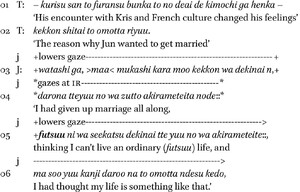
In the following excerpt, Jun recalls his life before moving to France in a TV news interview. In the transcripts below, embodied actions are shown in the line above the Japanese utterance so readers familiar with Japanese can easily see when they occur. The doer of the action is indicated by the lowercase initial. Transcript conventions are in the appendix.
Excerpt 1 (Nittere NEWS 2023, 3:34–3:50)
T = Telop, J = Jun

Citation: Contrastive Pragmatics 7, 1 (2026) ; 10.1163/26660393-bja10161
The telops in lines 1 and 2 provide the audience with the topics of the upcoming talk – how Jun’s feelings changed after encountering Kris and French culture, and the reason he wanted to be married to Kris. In lines 3 and 4, Jun is recalling his past self, displaying an affective stance of resignation to the impossibility of marriage back then. The adverb moo in line 3 shows his emotional emphasis on this feeling of resignation. The expression kekkon wa dekinai (direct translation ‘I can’t get married’) shows his orientation to institutional and societal homophobia, namely, the legal and societal non-recognition of same-sex marriage in Japan.
Jun further produces the juxtaposing utterance futsuu ni wa seekatsu dekinai ‘I can’t live an ordinary life,’ in line 5. Here he describes himself as deviating from ordinariness (i.e., he is doing being not ordinary), thus orienting to the heterosexual norm in Japan. In addition to these verbal productions, he displays his resignation and lack of confidence by lowering his gaze, which also contributes to the construction of himself as not futsuu. Here, Jun’s resignation to not being able to marry is category-bound to homosexual people in Japan, where same-sex marriage is socially and institutionally not recognised. His narrative produces a contrastive categorial pair of heterosexual people who can live an ordinary life and get married, and homosexual people who cannot. In contrast to this narrative, in the next excerpt, the couple recall how their marriage was treated as futsuu in France.
6.2 Surprise at Being Treated as Normal in France
In contrast to Jun’s sense of not being futsuu when he lived in Japan (as he describes in Excerpt 1), in the excerpt below, from a newspaper interview video, the couple recall how their marriage was treated as futsuu in France.
Excerpt 2.1 (Asahi Shimbun, 2023, 1:14–1:31)
J = Jun, K = Kris
Citation: Contrastive Pragmatics 7, 1 (2026) ; 10.1163/26660393-bja10161
When describing the process of getting married in France, Jun solicits Kris’s shared affective stance of being surprised when they were treated as futsuu. Surprise marks something as unexpected (Wilkinson and Kitzinger, 2006) or a breach of a norm to which the surprised person is oriented. In response, Kris agrees and then upgrades his assessment of the ordinariness of how they were treated with the extreme case formulation (Pomerantz, 1986) zenzen ‘totally; at all,’ repetition, and a louder, breathy voice (line 3). At this point, what enables this construction of futsuu is not yet clear.
In line 5, Kris elaborates his description of the scene by animating the person receiving the marriage document, saying, ‘oh, okay, okay.’ This animated utterance demonstrates the lack of interactional trouble (e.g., no repair initiation, no clarification/account request). Kris then clearly refers to their expected trouble source – being two men – in line 6, but only to highlight that no such trouble occurred, which he emphasises with the extreme case formulation zenzen ‘(not) at all’ and a waving hand gesture of negation. From a CA perspective, the interactional sequence being reported by Kris takes place in a world where there is no heteronormative social order (Kitzinger, 2005a), and where being homosexual is futsuu (ordinary; legitimate). In other words, their surprise reveals that their orientation to a heterosexual norm (as when they were in Japan) was breached by their normal treatment in France. In the next excerpt, from a TV show, Jun and Kris elaborate on their surprise in the same scene on a TV show.
Excerpt 2.2 (Shigesawa and Tanaka, 2023)
J = Jun, K = Kris, I = Inoue (MC)
Citation: Contrastive Pragmatics 7, 1 (2026) ; 10.1163/26660393-bja10161
In this narrative, Jun claims to reproduce the mayor’s words regarding her, or France’s, acceptance of ‘all loves, regardless of sex and citizenship.’ The phrase donna seebetsu demo (direct translation ‘(we accept love/marriage of people of) any gender and sexuality’) indicates that, in this setting, neither heteronormativity nor homophobia exist. Jun reproduces his affective stance of surprise back then, saying he? ‘what?,’ and gazes at Kris to invite him to share the surprise. Kris provides a positive assessment, sugoi ‘amazing,’ of the mayor’s words and verbally displays an affective stance of emotion (kandoo shimashita ‘I was moved’). Jun indicates that he shares the same affective stance by repeating Kris’s remark, and he upgrades it with the intensifier sugoi ‘extremely,’ in line 5.
In lines 7 through 9, Jun recalls another affective stance from his past – the feeling of alienation that he had had since childhood, saying that he was not able to blend into society. Through his gaze and solicitation with the interactional particle ne ‘you know,’ Jun invites Kris to share the same affective stance as a categorial co-incumbent, and Kris ratifies it by nodding. After producing these affective stances, Jun verbally displays another affective stance of delight, when he says ureshikatta ‘I was so happy,’ referring to his experience of being treated as normal in France in line 10. Through this narrative, the couple constructs a contrast between France, which treats them as normal, and Japan (and possibly Lithuania), which treats them as deviant due to heteronormativity. As Wilkinson and Kitzinger (2006) discuss, participants rely on each other’s cultural knowledge about what is normal and what is unexpected; thus, cultural and national normative differences are revealed through the display of different affective stances.
6.3 Categories in Marriage
In the following excerpt, from the same TV interview as Excerpt 1, Kris is discussing marriage in France, and specifically, as the context of the interview makes evident, how it differs from marriage in Japan (and possibly Lithuania).
Excerpt 3.1 (Nittere NEWS 2023, 5:27–5:46)
K = Kris, J = Jun, T = Telop, Ps = Pause
Citation: Contrastive Pragmatics 7, 1 (2026) ; 10.1163/26660393-bja10161
Kris claims that France has no gay marriage, but simply marriage. In other words, there is no distinction between heterosexual and homosexual marriage in France. In line 3, he assesses this state of affairs as futsuu in France, and the term “gay marriage” as wrong.3 His confidence, expressed in this strong negation with no hedging or mitigation, is also an affective stance, which he takes toward the category “same-sex marriage,” whose MCD is sexual orientation. Jun co-constructs this representation of ordinariness by repeating the same word, futsuu, and translating Kris’s English ‘gay marriage’ into Japanese (dooseekon). Kris strongly agrees with Jun’s words and repeats ‘just marriage’ again, this time in Japanese. After Jun’s display of understanding, in line 10, Kris paraphrases what they said using the word “category”: ‘there is no (gay) category in marriage’; in the video, this utterance is emphasised by being repeated in the telop.
From sociolinguistic and MCA perspectives, according to Jun and Kris, gay marriage is unmarked in France: there is no MCD of sexual orientation for marriage and no heteronormativity, in contrast to Japan (and possibly Lithuania). In another part of the same interview, when asked about differences between French and Japanese cultures, as shown in the telop (line 1), Jun again refers to categories in his answer.
Excerpt 3.2 (Nittere NEWS 2023, 2:00–2:26)
T = Telop, J = Jun, IR = Interviewer
Citation: Contrastive Pragmatics 7, 1 (2026) ; 10.1163/26660393-bja10161
In lines 2 and 3, Jun hesitantly states that in Japan people categorise them, and then, in lines 4 and 5, claims that in France people see them as futsuu. His following comments (as well as the rest of the interview context) show that the category in question is “gay.” Thus, in Jun’s view, the gay category in line 3 is considered not futsuu and marked in Japan, in contrast to France. His delivery here is very careful and hesitant: Jun delays his comment on Japan by using many elongated vowels, a filler, and the indirect expression tte yuuka ‘I mean.’ With the phrase ‘categorise us’ (kategorii toshite miru), he also avoids explicitly saying that people in Japan see them as not futsuu, so that the category of “not futsuu” only becomes clear in lines 4 and 5, when he juxtaposes how they are categorised in Japan to how they are constructed as futsuu in France.
Jun claims that people in France see gay people as futsuu, which he emphasises with a louder voice and his hand gesture, in which he holds his hands slightly apart, with palms parallel, while moving them horizontally from one side to the other, a gesture which seems intended to depict the equivalence or lack of distinction between homosexual and heterosexual people. In lines 6 and 8, Jun further claims that they do not have to identify or express themselves as gay in France, indicating that they are not marked. His verbal expression in line 6 includes the explanatory ending nanda and the interactional particle yo, which mark statements designed to inform a listener of information that s/he does not know. This utterance, together with Jun’s vivid, louder voice, suggests the performativity of “having to” explain being gay in Japan,4 as an obligation of those of a minority status.5 In lines 9 and 10, Jun displays an affective stance of relief as he describes learning that there is a different world from Japan, a world in which he is treated as normal and unmarked, and hence does not have to refer to his sexual orientation. Jun’s description in this excerpt represents his experience as one of gaining access to the same “privilege” enjoyed by heterosexual people (Cameron and Kulick, 2003; Kitzinger, 2005b).
6.4 The Hope of Being “Normal”
In the excerpt below, from a newspaper interview text, Jun recalls how he changed after moving to France, responding to a question of what they plan to do next.
Excerpt 4 (Asahi Shimbun, 2023)
Watashi jishin wa, doosee ga suki demo futsuu ni koo irareru nda to mietekita no wa hatachi de ooshuu ni iki, furansu no hitotachi o mitekara.
Futsuu de irareru tte iina tte omotte imashita.
Korekara nani ga dekiruka mada wakaranai keredo, dekiru kagiri
watashitachi no futsuu no seekatsu ya furumaikata tte yuu no o mitemoratte,
sore ga futsuu ni naru to iina to omoimasu.
‘I myself came to realise I can be normal (futsuu) even if I’m a homosexual
when I went to Europe at the age of 20 and saw French people.
I thought it was nice that I could be normal (futsuu).
I’m not sure what we can do now. However, I would like to show our normal (futsuu) daily life and the ways we behave as much as possible, and
hope it (seeing same-sex couples) will become normal (futsuu) (in Japan).’
His concessive clause doosee ga suki demo futsuu ni koo irareru ‘even if I’m a homosexual, (I can be normal)’ reveals Jun’s past orientation to heteronormativity, which forced him to consider himself deviant. Then he provides a positive assessment through his display of an affective stance of envy of the situation in France where homosexual people can be normal. His expression futsuu de irareru ‘I could be normal’ points to his realisation that nothing prevented him from being normal, again demonstrating his perception that there is no homophobia or heteronormativity in France.
In response to the question of what they would like to do next, Jun expresses his hope for same-sex couples to be considered normal and taken-for-granted (futsuu ni naru to iina) in Japan, and contributing to this societal shift by showing his and Kris’s daily life through SNS. This is a mild challenge to the current state of futsuu in Japan, namely the heteronormativity that allows homophobia and makes homosexuality deviant.
While the wish Jun expresses is quite restrained, it makes a sharp contrast to some public discourse in Japan. For example, in 2023, a secretary to the then-prime minister said that he could not stand having a same-sex couple living next door and did not even want to look at LGBTQ people (Ueda, 2023). The fact that a high-ranking politician’s secretary still feels justified in making such hostile, homophobic remarks suggests the persistence of societal homophobia. Such attitudes are also observed among private individuals, including Jun’s father. In the next excerpt, Jun describes his family’s reactions to his marriage.
6.5 The Reaction of Jun’s Family
The excerpt comes from the same TV interview as Excerpts 1, 3.1, and 3.2.
Excerpt 5 (Nittere NEWS 2023, 4:00–5:46)
T = Telop, J = Jun
Citation: Contrastive Pragmatics 7, 1 (2026) ; 10.1163/26660393-bja10161
In response to the question about telling his parents about his marriage (as shown in the telop), Jun describes his hesitation about talking to his family; after long consideration, he told his mother and sister immediately before the marriage, but did not tell his father. His hesitation suggests his orientation to a possible homophobic reaction from his father. In fact, in lines 6 and 7, Jun says, with much hesitation, that his father does not understand, avoiding the matter of his marriage and/or sexuality. When Jun describes his father’s attitude in line 7, he lowers his gaze and produces a long filler and a deep, breathy sigh. These multimodal features reveal his affective stance of sorrow about his father’s lack of understanding. In another interview (Asahi Shimbun interview text, 2023), Jun mentions that his father had once demanded he date a woman, indicating the father’s strong heterosexual norm. If his father had expected him to date a woman, he presumably expected him to marry a woman, and Jun’s marriage to Kris breaches that normative expectation.
In contrast to his father, Jun’s mother congratulated him on his marriage, to which he responded with surprise and emotion. As mentioned in the analysis of Excerpt 2.1, an affective stance of surprise toward a thing or event reveals its unexpectedness; Jun’s mother’s reaction to his marriage breached Jun’s assumption of his mother’s heterosexual norms. Jun continues by describing his sense that his mother had actually noticed his sexuality long ago and now accepts it without problem (futsuu ni, line 13). Jun hesitantly upgrades his certainty about his mother’s acceptance, from ukeirete kureta kana:: ‘I guess she accepts it’ to sugoku omoimashita ‘I really thought (she has accepted me).’
This excerpt shows different sexual norms at a personal level; Jun’s father still orients to heteronormativity whereas his mother and sister apparently do not. Because what is futsuu and what is not thus varies even within one family, individuals may maintain contrasting orientations to norms simply to interact with their families, and their affective stances will vary accordingly, as shown by Jun in Excerpt 5. In the following excerpt, Jun and Kris describe their fear when they announced their marriage on social media to the (mainly) Japanese public.
6.6 On Japanese Social Media: Fear of Expected Reactions
The excerpt come from the same TV show data as Excerpt 2.2.
Excerpt 6 (Shigesawa and Tanaka, 2023)
J = Jun, F = Fujii (MC), K = Kris, A = Audience, I = Inoue (MC)
Citation: Contrastive Pragmatics 7, 1 (2026) ; 10.1163/26660393-bja10161
In lines 1 and 3, Jun, recalling their SNS announcement of their marriage, portrays their indecision about whether they should do so or not. He solicits agreement from Kris, using gaze and the interactional particle ne, and Kris agrees to it and upgrades their indecision with the intensifier sugoi ‘very; extremely.’ This indecision resonates with Jun’s hesitation to tell his father about his marriage in Excerpt 5. In line 5, Jun displays an affective stance of fear (kowakute ‘scared’), emphasised with repetition, the same intensifier that Kris used but with prosodic emphasis (sungoi ‘very; extremely’), and a louder volume. Jun does not specifically mention what scared them, but given the context of the interaction (i.e., talking about same-sex marriage as persons concerned) and the societal background in Japan, it is hearable as expecting societal homophobia to be manifested as hostile homophobic reactions.
After one of the MCs, Fujii, shows his understanding about their fear and the impulsive act of ‘just clicking and posting’ their announcement, Jun displays affective stances of delight and gratitude toward the positive reactions to the announcement, in contrast to what they had expected. However, the verb ukeireru ‘to accept’ (line 16) itself evokes a contrast between those who accept and those who are accepted. In addition, the expression (ukeire)te kudasatta, which literally translates as ‘did us the favour of (accepting)’ suggests that the acceptance of homosexuals is up to the discretion of heterosexuals; in this view, heteronormative society can grant the “favour” and allow the “privilege” of being futsuu, or it can choose not to. Jun also uses this expression (te kureru) when describing his mother’s acceptance in Excerpt 5. Thus, the assumption underlying Jun’s gratitude is of an asymmetric relationship between a normative category (heterosexuals) and a non-normative category (homosexuals) in Japan.
7 Discussion
This study has analysed displays of affective stances of a gay couple as they construct what is futsuu and what is not in varying contexts they describe. Through the analysis of their contrastive affective stances toward events and things in Japan and France, this study illuminates Japanese societal and institutional homophobia and heteronormativity. According to Jun and Kris, homosexuality and same-sex marriage are considered as not futsuu in Japan and as futsuu in France. On the personal level, in Jun’s telling, his father does not see his marriage as futsuu, whereas his mother and sister do. These normative contrasts are revealed in the couple’s various affective stances.
In Japan, Jun displays resignation to the impossibility of marriage and an ordinary life (Excerpt 1) and a sense of alienation in the past (Excerpt 2.2), and even after marriage, he describes his fear when they announced their marriage to Japanese audiences (Excerpt 6). This is because Jun orients to the societal and institutional homophobia which do not allow him to be futsuu. Jun also shows sorrow when talking about his father’s non-acceptance of his marriage due to his father’s heterosexual norms (Excerpt 5).
On the other hand, in France, they show surprise, emotion, and delight at being treated as futsuu (Excerpts 2.1 and 2.2). Jun also shows his surprise and emotion when his mother accepts his sexuality and marriage (Except 5). Such affective stances, namely, surprise, emotion, and delight at being treated as futsuu demonstrate that Jun and Kris are still oriented to heteronormativity and societal homophobia, even while living in France. Surprise indicates a breach of assumptions, in this case, their assumption that they will be treated as deviant due to their sexual orientation. They were moved (Excerpts 2.2 and 5) because they had never before experienced the “privilege” enjoyed by heterosexual people (Cameron and Kulick, 2003; Kitzinger, 2005b). Jun also expressed the relief of finding a world unconstrained by heterosexual norms which allowed him to be futsuu (Excerpt 3.2) and his envy of such a world (Excerpt 4). These feelings of relief and envy reflect the lack of homophobia in France (as far as Jun and Kris are concerned) in contrast to Japan.
Thus, through these displays of different affective stances, cultural/national contrasts of sexual normativities become clear. As demonstrated in Excerpts 3.1 and 3.2, for Jun and Kris, in France marriage has no categories based on sexual orientation, and same-sex couples are treated as futsuu, which is shown by their description of the non-problematic interaction when they submitted marriage documents and the mayor’s remark at the ceremony. On the other hand, Japan legally discriminates between heterosexual and homosexual marriages, considering the latter as marked, not futsuu, and not legitimate. In addition to cultural/national differences, Excerpt 6 shows personal-level differences in sexual normativities,7 such that some but not all of Jun’s family members accept his marriage.
Although some of their affective stances reflect their orientation to heteronormativity and homophobia in Japan, the couple also shows some resistance to this orientation as well, refusing to completely cut themselves off from Japanese society. Their claims of normal treatment and categorisation in France (Excerpts 2.1, 2.2, 3.1, and 3.2) are hearable as mild criticism of their treatment as not normal in Japan, or as a counterargument to Japan’s institutional and societal homophobia. Resistance is also seen in Kris confidently asserting that the category of same-sex marriage is wrong (Excerpt 3.1), and Jun expressing the hope that all people will eventually be treated as normal, regardless of sexuality, in Japan (Excerpt 5).
This study also makes theoretical and methodological contributions to the field of sexual normativities research. What is futsuu varies depending on the culture/nation, and it also differs at a personal level. The contrasts at cultural/national and personal levels (i.e., homophobic or non-homophobic attitudes) observed in the study reveal the context-dependent nature of norms and normativity. In this regard, this study serves as an illustration of a theoretical issue concerning how we conceptualise the notions of norms and normativity: the context-dependent variability of what is considered socially normal.8 The study also makes methodological contributions for research on sexual norms and normativity, responding to Hall et al.’s (2019) call for a more processual approach. There are few studies examining gay people’s experiences and affective stances in Japan through empirical, interactional analysis, particularly multimodal analysis. Thus, by applying CA and MCA to an understudied topic, the study also demonstrated that they serve as effective tools for understanding how categorisation practices and breaches of normativity reveal norms.
8 Concluding Remarks
Beyond specific remarks, the couple also offer a challenge to homophobia in Japan through their media participation; they inform Japanese audiences of their life and experiences, particularly things and events overseas where homosexuality is treated as futsuu, through their own YouTube videos and through taking part in multiple media interviews. Their interactions with audience members through these media are outside the scope of this study, but it is worth noting that they have received many positive, congratulatory comments on their YouTube videos.9 The following example of a comment and their reply is from a YouTube video created by Jun and Kris, and illustrates the possibility of a societal change taking place in Japan.
Excerpt 7 (Takeda and Budelis, 2023)
Comment:
Hayaku sekaijuu de mitomete moraeru yooni naru to ii desu ne. Watashi wa shoogakkoo no kyooshi o shiteiru nodesu ga, ninensee no otoko no ko ga nakayoshi no otoko no ko to kekkon shitai! tte itta ndesu. Soshitara suunin ga otoko dooshi wa kekkon dekinai nda yo to itta node, onna dooshi, otoko dooshi de sukini naru koto mo arushi, kekkon mo dekiru kuni mo arushi, korekara no nihon mo soo natte iku nja naikana to hanashitara minna soo na nda ne to juunan ni ukeirete kuremashita. Chiisai koro kara mukashi yori juunan ni nari, otoko dooshi de suki to hatsugen shitari, onna no ko de ore to yuu ko mo itari,10 nihon mo kawatteikeru na tte kakushin kitemasu.☺
‘I hope same-sex marriage will be accepted all over the world soon. I’m an elementary school teacher. One of the 2nd grade boys said, “I want to get married to my good (male) friend!” Then, a few kids said, “a man cannot get married to another man.” So I told them, “there can be love between two men or two women. In some countries, they can get married. Japan will also become like that in the near future, I think.” Everyone open-mindedly accepted it, saying, “yeah, that may be right.” I’m quite sure Japan has become more flexible than in my childhood, and will be able to keep changing, seeing things like boys openly saying they like boys and some girls using ore.☺’
Reply from Jun and Kris:
Sutekina ohanashi arigatoo gozaimasu. ♥ soo yuu sensee ga ite kuretara nihon mo kawatte ikimasu ne!!
‘Thank you for the wonderful story. ♥ We are sure Japan will change if there are teachers like that!!’
Thus, children and younger generations may be much more open-minded about homosexuality than older people, and many people hold hope for future generations.
As discussed above, homophobia is a culturally conditioned response to homosexuality that changes over time (Anderson, 2025). Japan is currently undergoing a crucial transitional period concerning LGBTQ+ issues. The mixture of positive and negative reactions and comments Jun and Kris received about their marriage demonstrates that societal homophobia seems to be gradually weakening. On the other hand, institutional homophobia is still persistent. In France and some other countries that have legalised same-sex marriage, governments have taken the initiative to legislate marriage equality and to work to change people’s attitudes. In contrast, the Japanese government is far behind on this issue.
Marriage should be a fundamental human right, not something to be granted by others. As Moriyama (2023) discusses, beyond showing sympathy for minority groups in their society, those in the majority can take real-world action. Politicians in particular have a responsibility, not simply to sympathise with sexual minorities, but to create concrete systems to protect their human rights and to work to change society for the better. I hope this study will also contribute to such actions being taken to promote marriage equality for all people, not only in Japan but worldwide.
Acknowledgements
I am grateful to the journal editors and to Shigeko Okamoto, Momoko Nakamura, Gavin Furukawa, Toshiaki Furukawa, Yumiko Tateyama, Lynn Lethin, and Laurie Durand, and members of a study group organised by Momoko Nakamura for their invaluable comments, advice, and assistance. Any remaining errors or misinterpretations are entirely my own.
References
Primary References
Asahi Shimbun. 2023. “Puropoozu ni ‘YES!’ demo mayotta koohyoo: ‘Shinkon san’ ni hatsu no dooseekon” [‘Yes!’ to the propose but hesitant in announce: The first same-sex couple on the “Welcome, Newlyweds!]. May 28, 2023. Video in Asahi Shimbun, 3:39. https://digital.asahi.com/articles/ASR5W0VP3R5VOXIE052.html?pn=5&unlock=1#continuehere.
Nittere NEWS. 2023. “Dooseekon:‘Kekkon wa dekinai, futsuu no seekatsu mo dekinai’ dooseeaisha no ‘akirame’ wo kaetekureta jinsee no paatonaa [Same-sex marriage: “I can’t get married, and I can’t live an ordinary life either” Life partner who changed “resignation” of a homosexual]. June 4, 2023. TV News, 7:05. https://www.youtube.com/watch?v=EwAF6el38xk.
Takeda, Jun, and Kristijonas Budelis. 2023. “Furansu no burowa shi de no sutekina kekkonshiki no uragawa wo kookai!” [Behind the scenes of a wonderful wedding in Blois, France is now open to the public!]. JUN and KRIS. June 3, 2023. Vlog, 9:58. https://www.youtube.com/watch?v=BZTnjkR1xD0.
Shigesawa, Ryo, and Kazuya Tanaka, chief directors. 2023. Shinkon san irasshai! [Welcome, Newlyweds!]. Aired June 4, 2023, on TV Asahi.
Secondary References
Anderson, Eric. 2025. Britania Encyclopedia. https://www.britannica.com/topic/homophobia.
Antaki, Charles, and Sue Widdicombe. 1998. Identities in Talk. London: Sage.
Arai, Yuri. 2014. Is Japan ready to legalize same-sex marriage? Asian-Pacific Law & Policy Journal 16(1): 122–155.
Barker, Robert L. 2003. The Social Work Dictionary. Fifth Edition. Washington, DC: National Association of Social Workers Press.
Burch, Rue A., and Gabriele Kasper. 2016. Like Godzilla: Enactments and formulations in telling a disaster story in Japanese. In: Matt Prior and Gabriele Kasper (eds.), Emotion in Multilingual Interaction. Amsterdam: Benjamins, 59–85.
Cameron, Deborah, and Don Kulick. 2003. Language and Sexuality. Cambridge, UK: Cambridge University Press.
Eckert, Penelope. 2016. Variation, meaning and social change. In: Nikolas Coupland (ed.), Sociolinguistics: Theoretical Debates. Cambridge, UK: Cambridge University Press, 68–85.
Fukuda, Chie. 2024. Interactional and categorial analyses of identity construction in the talk of female-to-male (FtM) transgender individuals in Japan. Pragmatics 34(3): 319–346. https://doi.org/10.1075/prag.20066.fuk.
Gorman-Murray, Andrew. 2008. Masculinity and the home: A critical review and conceptual framework. Australian Geographer 39(3): 367–379.
Hall, Kira, Erez Levon, and Tommaso M. Milani. 2019. Navigating normativities: Gender and sexuality in text and talk. Language in Society 48(4): 481–489.
Have, Paul ten. 1999. Doing Conversation Analysis. Second edition. London: Sage.
Kawaguchi, Kazuya, and Kazama, Takashi. 2010. Dooseeai to iseeai [Homosexuality and heterosexuality]. Tokyo, Japan: Iwanami Shinsho.
Kitzinger, Celia. 2005a. Heteronormativity in action: Reproducing the heterosexual nuclear family in after-hours medical calls. Social Problems 52(4): 477–498.
Kitzinger, Celia. 2005b. Speaking as a heterosexual: (How) does sexuality matter for talk-in-interaction? Research on Language and Social Interaction 38(3): 221–265.
Land, Victoria, and Celia Kitzinger 2005. Speaking as a lesbian: Correcting the heterosexist presumption. Research on Language and Social Interaction 38(4): 371–416.
Milani, Tommaso M., and Erez Levon. 2019. Israel as homotopia: Language, space, and vicious belonging. Language in Society 48(4): 607–628.
Mitsunari, Miho, Tomoko Sasanuma, Naoko Tateishi, and Tomoe Yatagawa. 2019. Jendaa hoogaku nyuumon [Introduction of gender law], 3rd ed. Tokyo: Horitsubunkasha.
Miyazaki, Ayumi. 2004. Japanese Junior high school girls’ and boys’ first-person pronoun use and their social world. In: Shigeko Okamoto and Janet S. Shibamoto Smith (eds.), Japanese Language, Gender, and Ideology: Cultural Models and Real People. Oxford, UK: Oxford University Press, 256–274.
Moriyama, Noritaka. 2023. “‘Kyookan’ yori kenri mamoru hoo wo” [Legislation to protect rights, rather than ‘sympathy’]. Asahi Shimbun, June 7, 2023. https://digital.asahi.com/articles/DA3S15656039.html?iref=pc_ss_date_article.
Nakamura, Momoko. This volume. Expanding the research on binary pronouns: The norm of gendered first-person pronouns in Japanese.
Nakanishi, Yumiko. 2022. A comparison of human rights protection in Europe and Japan: The quest for marriage equality. Hitotsubashi Journal of Law and Politics 50: 1–8. https://doi.org/10.15057/hjlp.2021001.
Ninivaggi, Gabriele. 2025. Signs of change emerge in constitutional interpretation of same-sex marriage, Japan Times, May 2, 2025. https://www.japantimes.co.jp/news/2025/05/02/japan/crime-legal/constitution-day-same-sexmarriage/.https://www.japantimes.co.jp/japantimes/uploads/images/2025/05/02/467013.jpg.
Okamoto, Shigeko. This volume. Girls shouldn’t use rough language? Diverse views of Japanese speech norms.
Pomerantz, Anita. 1986. Extreme case formulations: A way of legitimizing claims. Human Studies 9: 219–229. https://doi.org/10.1007/BF00148128.
Reynolds, Isabel. 2023. “Kishida apologizes for aide’s anti-LGBTQ comments,” Japan Times, February 6, 2023. https://www.japantimes.co.jp/news/2023/02/06/national/anti-lgbt-comment-apology/.
Ruusuvuori, Johanna. 2012. Emotion, affect and conversation. In: Jack Sidnell and Tanya Stivers (eds.), The Handbook of Conversation Analysis. Oxford, UK: Wiley- Blackwell, 330–349. https://doi.org/10.1002/9781118325001.ch16.
Schegloff, Emanuel A. 1996. Confirming allusions: Toward an empirical account of action. American Journal of Sociology 102(1): 161–216.
Schmidt, Marco F. H. and Hannes Rakoczy. 2024. Open Encyclopedia of Cognitive Science. https://oecs.mit.edu/pub/sr3246n4/release/1.
Schulman, Sarah. 2009. Ties that Bind: Familial Homophobia and Its Consequences. New York: The New Press.
Seidman, Steven (ed.). 1996. Queer Theory Sociology. Cambridge, MA: Blackwell.
“64% favor recognizing same-sex marriage in Japan, poll finds.” 2023. Kyodo News, Feb 13, 2023. https://english.kyodonews.net/news/2023/02/d95968c3f7d5-urgent-64-favor-recognizing-same-sex-marriage-in-japan-kyodo-poll.html.
Stivers, Tanya. 2008. Stance, alignment, and affiliation during storytelling: When nodding is a token of affiliation. Research on Language and Social Interaction 41 (1): 31–57.
Sugita, Mio. 2018. LGBT shien no do ga sugiru [Over-supportive for “LGBT”]. Shinchoo 45, August: 57–60.
Tamagawa, Masami. 2016. Same-sex marriage in Japan. Journal of GLBT family studies 12(2): 160–187. http://dx.doi.org/10.1080/1550428X.2015.1016252.
Ueda, Koichi. 2023. “Kishida sacks close aide Arai for anti-LGBT comments.” Asahi Shimbun, February 4, 2023. https://www.asahi.com/ajw/articles/14831805.
Wiggins, Sally, and Potter, Jonathan. 2008. Discursive psychology. In: Carla Willig and Wendy Stainton-Rogers (eds.), The SAGE Handbook of Qualitative Research in Psychology. London: Sage, 72–89.
Wilkinson, Sue, and Celia Kitzinger. 2006. Surprise as an interactional achievement: Reaction tokens in conversation. Social Psychology Quarterly 69(2): 150–182.
Appendix
Transcription conventions:
| [Wo]rd |
Overlapping talk |
| Wo::rd |
Phonological lengthening (each colon is approx. 0.1 sec.) |
| Wo- |
Sound cutoff |
| Word |
Emphatic stress |
| ((bows)) |
Non-verbal actions and comments |
| h |
Outbreath |
| (h) |
Breath within a word |
| (1.2) |
Silence in seconds and tenths of a second |
| (.) |
Micro-pause (less than 0.2 second) |
| . |
Falling intonation |
| , |
Continuing intonation |
| ? |
Rising intonation |
| > word < |
Faster than the speaker’s surrounding speech |
Embodied conduct notation in transcripts:
| + + |
Descriptions of embodied movement are delimited between two identical symbols. |
| * * | |
| +-> |
The action described continues across subsequent lines until the same symbol is |
| ->+ |
reached. |
| --- |
Full extension of the movement is reached and maintained. |
Biographical Note
Chie Fukuda received a PhD in Japanese at the University of Hawai‘i at Mānoa. Her research interests are in sociolinguistics and cultural studies in Japanese contexts, focusing on identity construction. Her work has been published in Research on Language and Social Interaction, Pragmatics, Journal of Pragmatics, Japanese Studies, Gender and Language, and some edited books.
“Homophobia” does not necessarily mean the irrational fear indicated by the suffix phobia; instead, it refers to “an attitudinal disposition ranging from mild dislike to abhorrence” (Anderson, 2025) of homosexuals and other sexual minorities.
A norm indicates “what is ‘usual, typical and standard’” (Oxford English Dictionary online, cited in Hall et al., 2019: 242). On the other hand, normativity is “an inherent aspect of the intentional, evaluative stance we take towards objects and situations” (Schmidt and Rakoczy, 2024). Put more simply, normativity is a phenomenon which is instantiated by norms. Also see Okamoto, this volume.
The utterance sore wa chigau in line 4 could also be translated as ‘that’s different,’ with the interpretation: “That’s the difference between France and Japan/Lithuania.” However, Kris’s preceding comments and his following agreement with Jun’s remark in line 6 favour the interpretation of line 4 as a statement that the term “gay marriage” is wrong.
I am grateful to Gavin Furukawa for pointing this out.
Those in the majority do not have to explain themselves in this way; for example, heterosexual people are not routinely expected to identify themselves as heterosexual.
Although not in the transcript, here, the telop says otoosan to wa se o muketeiru ‘we are still completely avoiding it,’ indicating mutual avoidance. However, in another interview (Asahi Shimbun interview text, 2023), Jun maintains that he really wants his father to accept him and his marriage, suggesting that the avoidance is only on his father’s side. I am grateful to Lynn Lethin for pointing this out.
Likewise, there are homophobic people in France as well, even though same-sex marriage is legal there. However, French homophobia is not attested in this study’s data.
I appreciate Shigeko Okamoto for pointing this out.
While much less frequent, homophobic comments do show up, such as “disgusting,” “Don’t show men kissing,” and an emoticon of a vomiting face. These positive and negative comments also demonstrate diversity in sexual normativity at a personal level.
On the significance of girls using ore, see Miyazaki (2004) and Nakamura, this volume.