Abstract
Kenji Sawada, a Japanese pop culture icon, embodies a paradox. Early in his decades- long career, he sang songs with lyrics reflecting patriarchal gender norms. At the same time, he deliberately used multimodal semiotic resources at multiple levels to undermine the hegemonic masculinity expressed in those lyrics. In contrast, Sawada’s recent songs convey his egalitarian gender ideologies and political views; having assumed full agency over his artistic production, he no longer needs to counter the effects of his lyrics with other semiotic resources. Using Kenji Sawada as a case in point, this article illustrates how individuals can deal with and negotiate a society’s sexist norms and patterns, and construct a particular style through diverse multilevel, multimodal semiotic resources. The article also points to possible changes and increasing diversity in gender views in Japan, and argues that Sawada’s current popularity represents a ray of hope in Japan’s still patriarchal society.
1 Introduction
Kenji Sawada, a singer, actor, and songwriter, is a superstar and pop culture icon in Japan. Born in 1948, he debuted as lead vocalist in a band called The Tigers in 1967 and released his first solo album in 1969.1 Sawada’s popularity was rivalled by none in the 1970s and 1980s. When he won the Japan Record Award Grand Prix in 1977, the highest televisual viewership rating of all time was recorded at 50.8% (Nakagawa, 2023: 455). Mari Yoshimura, the host of a popular TV music show, observed that when Sawada appeared on the show, other singers paled in comparison: “He was so cool, we couldn’t handle it. […] He was a true star and monster of Showa”2 (Shimazaki, 2023: 239).3 Historian Yoko Kato (2023) described Sawada as “a superstar who changed the worldview of music and film in one fell swoop.” In addition to his star aura and celebrated voice, Sawada was known for his striking physical beauty. Anthropologist Laura Miller (2006: 126) wrote, “with a distinctive face rendered rather androgynous with the aid of eye makeup, Sawada exhibited an external male beauty not commonly seen in mainstream media.”
In the late 1980s, Sawada’s popularity waned and he disappeared from television. However, he did not stop making or performing music. Since his debut solo album in 1969, he has released one or more albums every year (except for 1970) until 2018.4 His latest single was released in 2022. Sawada also goes on national concert tours every year. In 2025, as of this writing, he is scheduled to perform in thirty-six concerts (Sawada Kenji Ofisharu, n.d.). In other words, Sawada is still a prolific and active musician to this day. And recently, Sawada has been enjoying a renaissance. A seven-DVD set featuring his performances was released in 2021. The Mainichi Newspaper published an article titled “Reasons Why Kenji Sawada, Who Debuted as a Solo Singer 50 Years Ago, Is ‘Trending’ Again” (Yamada, 2021). In 2023 and 2024, three books chronicling his career were published (Nakagawa, 2023; Shimazaki, 2023; Tanaka, 2024). Tabloid magazine Friday, calling Sawada by his nickname, Jurī (‘Julie’), reported that his concert tours were attracting sold-out crowds and proclaimed: Ima “Jurī” ga atsui ‘Right now “Julie” is hot!’ (Sasaki, 2024).
Sawada is relevant to our understanding of language and gender in contemporary Japan not because he is currently “trending,” but because he epitomises the paradox of Japanese views on gender, as well as hope for their evolution. In my analysis of Sawada, I examine lyrics, interview discourses, and other types of semiotic expression. Many of his songs are love songs, but, as Zettsu (2022: 10–11) observed:
Often, Japanese pop songs are perceived as having love as their main theme and are equated with so-called love songs. However, […] one could say that they are gender songs. This is because the dynamics of pop songs/love songs are such that men and women engage in a kind of bargaining and try to determine each other’s position in the relationship. […] The lyrics of popular songs, sensitive to the atmosphere of the time, directly and indirectly record the changes in the collective (un)conscious regarding gender at that time.
Sawada’s love/gender songs provide a window into Japanese views on gender in the 1970s and 1980s, as well as in contemporary Japan. As this article will show, drawing on Goffman’s (1981) dissection of the role of a “speaker,” Sawada primarily functioned as an animator rather than author or principal in the 1970s and 1980s. In contrast, more recently he has fulfilled all three of these speaker roles, and has acted as an agent of progressive gender ideologies. Throughout his career, he has taken agency through the construction of his desired styles, for which he has employed multilevel, multimodal semiotic resources (Okamoto, forthcoming).
2 “Men’s Language” and Polyindexicality
So-called Japanese “men’s language” is prominent in Sawada’s songs. I am especially interested in expressions associated with “powerful or rugged masculinity” (Okamoto and Shibamoto-Smith, 2016: 240). As Okamoto and Shibamoto-Smith (2016: 238–239) wrote in a discussion of what they proposed were “two (perhaps, overlapping) models of masculinity”:
The first is the older model of rugged masculinity accompanied by forceful or rough language practices […], and the second seems to correspond to a newer, gentler image of masculinity associated with language that is neither rough nor particularly indexical of physical prowess.
“Forceful or rough language practices” are what Nakamura (2007) called kyū otoko kotoba ‘old-style men’s language’ (77). In contrast, the gentler “language that is neither rough nor particularly indexical of physical prowess” corresponds to Nakamura’s shin otoko kotoba ‘new-style men’s language’ (74). For example, the first- and second-person pronoun pair ore and omae represents the old, rugged style while another pair, boku and kimi, represents the newer, gentler style (74).
The following linguistic forms represent elements of the rugged masculinity style.5

Citation: Contrastive Pragmatics 7, 1 (2026) ; 10.1163/26660393-bja10148
Although these forms have been described as “stereotypically strongly masculine forms” (Okamoto and Shibamoto-Smith, 2016: 240), they do not directly index gender (Ochs, 1992). Rather, the forms index the pragmatic meanings of roughness, harshness, or forcefulness, which in turn index rugged masculinity.
In addition, these linguistic forms index many other meanings: they are polyindexical (Okamoto and Shibamoto-Smith, 2016: 2). For example, Abe (2010: 45–47) reported that an employee of a lesbian bar used the first-person pronoun ore and the second-person pronoun omē when expressing strong emotions such as anger or frustration in an argument. Okamoto and Shibamoto-Smith (2016: 279–280) also observed that female college students used direct imperative forms to communicate anger and criticism. In another context, Nakamura (2010) observed that a marketer of sexual services used ore to construct (homosocial) intimacy among men. Similarly, Abe (2010: 50) noted the use of the various utterance-ending forms shown in (1) “to create an intimate relationship among lesbians at the bars they frequent or to treat other lesbians as in-group members.” In yet another context, Miyazaki (2004) interpreted the use of ore by a female middle-school student as a reflection of her rebellion against social norms. Okamoto and Shibamoto-Smith (2016: 242) also observed that films and TV dramas assigned the linguistic forms shown in (1) to “relatively young male characters portrayed as tough, rough, non-conformists, maverick, and/or rebellious.” Lastly, Okamoto (1995: 313) quoted a young woman saying that forms associated with roughness are wakamono no kotoba ‘the language of young people’ rather than men’s language. To summarise, many individuals identifying as female as well as those who identify as male use the linguistic forms shown in (1) as resources to express diverse meanings which vary depending on the context.
This situation represents the concept of polyindexicality (Okamoto and Shibamoto-Smith, 2016: 2), or of the indexical field, which Eckert (2008: 454) defined as a “constellation of ideologically related meanings, any one of which can be activated in the situated use of” a linguistic form. While Eckert illustrated the concept with individual linguistic forms, we can apply it more broadly, such as to the entire set of forms shown in (1). As mentioned, these forms index affective stances such as roughness, harshness, and forcefulness, which can be interpreted in different contexts to index one or more related meanings, including, among others, rugged masculinity, strong emotions, in-groupness, rebelliousness, and youthfulness.
Because the terms “men’s language” and “masculine forms” do not represent all the possible meanings indexed by the linguistic forms shown in (1), these labels are inappropriate. From here on, I will use the label “rough forms” to represent them.
3 Paradox: the Contradictory Presentations of Kenji Sawada in the 1970s and 1980s
3.1 Rough Language, Gender Tropes, and Misogyny
In the lyrics of Kenji Sawada’s songs, the following three pairs of first- and second-person pronouns figure prominently.7
Citation: Contrastive Pragmatics 7, 1 (2026) ; 10.1163/26660393-bja10148
While the words of the third pair are among the rough forms, those of the first and second pairs are not. Ito (1993: 31–32) conjectured that the lyricists of many of Sawada’s early solo songs assigned him the role of a younger man in love with an older woman. The first pair, boku and anata, appears frequently in these songs. For example, the 1973 hit song Kiken na futari ‘Dangerous lovers’ includes the verse in (3).
Citation: Contrastive Pragmatics 7, 1 (2026) ; 10.1163/26660393-bja10148
Ito noted that this use of the second-person pronoun anata, along with the role of a younger man longing for an older woman, symbolised a man’s desire to be the object of love and desire. Anata is more conventionally used in love songs by a woman addressing a romantic partner (usually a man) and connotes politeness towards the partner (Sumi, 2013: 29).8 Thus, at the beginning of his solo career, Sawada’s songs deviated from a more traditional heterosexual model in which the man has the higher social status and is an agent (rather than an object) of love and desire.
However, after the 1977 mega hit Katte ni shiyagare ‘Have it your way,’ which won the Japan Record Award Grand Prix and made Sawada’s position as a superstar unassailable, his production team seems to have pivoted away from the boku-anata pair and towards the ore-omae pair. Many of his hit songs in the late 1970s and early 1980s contain either the combination of ore and omae or omae alone. These songs include Katte ni shiyagare ‘Have it your way’ (1977), Samurai ‘Warrior’ (1978), Ronrī urufu ‘Lonely wolf’ (1979), Tokio ‘Tokyo’ (1980), Sakaba de DABADA ‘DABADA at the bar’ (1980), and Sutorippā ‘Stripper’ (1981), as well as two songs, Omae ga paradaisu ‘You are paradise’ (1980) and Omae ni chekku in ‘Checking in with you’ (1982), which even contain omae in the title.
Although omae can be used among individuals of equal status to indicate intimacy, especially in male homosocial contexts (SturtzSreetharan, 2009), in the heteronormative mainstream society of Japan, omae in love songs tends to be interpreted as referring to a female partner. When a man addresses a woman as omae, it takes on a condescending tone. In her analysis of Japanese romance novels, Shibamoto-Smith (2004: 124) observed, “Omae is an old-fashioned second-person pronoun and one with more condescending connotations than the competitor kimi.” Okamoto and Shibamoto-Smith (2016: 242) associated omae “with sexist men’s usage toward women.”9 Thus, in the context of the romantic/(hetero)sexual relationships represented in Sawada’s songs in the late 1970s and early 1980s, listeners would be likely to interpret the use of omae as an expression of a man’s dominance over, as well as feeling of intimacy with, a woman.
In addition to ore and omae, the lyrics from this era of Sawada’s career contain numerous instances of other rough forms. For example, a number of them appear in the lyrics of the mega-hit Katte ni shiyagare ‘Have it your way’ (Aku, 1977), as shown in (4), where the rough forms are marked in bold.
Citation: Contrastive Pragmatics 7, 1 (2026) ; 10.1163/26660393-bja10148
Line 1 contains omae as well as the utterance-final particle na ‘right?’, which elicits agreement in a rough manner. Lines 2 and 3 include the direct imperative forms kakko tsuke sasete kure ‘let me put on a cool front’ and dete itte kure ‘leave.’ Line 4 includes a casual and coarse-sounding goodbye, abayo (as opposed to a more conventional sayonara), and an utterance-final ka after a plain form of a verb. As discussed in Section 2, the rough forms do not always index powerful or rugged masculinity. However, in the context of these songs that feature heterosexual relationships, the image of a coarse, forceful, and domineering masculinity figures prominently, especially when the rough forms occur with ore and/or omae. This image is reinforced by other elements in the lyrics, as discussed below.
Many of the lyrics in this period of Sawada’s career were written by the well-known and prolific lyricist Yu Aku. Among the most famous songs Aku wrote for Sawada are Toki no sugiyuku mama ni ‘As time goes by,’ Katte ni shiyagare ‘Have it your way,’ Samurai ‘Warrior,’ Dāringu ‘Darling,’ Nikumikirenai rokudenashi ‘Loathsome bastard,’ and Kasaburanka dandī ‘Casablanca dandy,’ several of which depict stereotypical gender tropes and misogyny. For example, Nikumikirenai rokudenashi ‘Loathsome bastard’ presents a man who sleeps around and his (presumably heterosexual) partner who grudgingly accepts this behaviour and waits for him to settle down. Kasaburanka dandī ‘Casablanca dandy’ features a man’s casual violence towards women, as shown in (5).
Citation: Contrastive Pragmatics 7, 1 (2026) ; 10.1163/26660393-bja10148
In this song, a romantic/sexual partner is simply referred to as onna ‘woman,’ and is neither named nor directly addressed. This impersonal linguistic choice communicates a sense of distance and disrespect and adds to the blatant misogyny conveyed by the content (i.e., slapping a woman and disapproving of a woman who talks much).
Aku also used otoko ‘man’ in the song Samurai ‘Warrior,’ in which a man addresses the woman he is leaving, as shown in (6).
Citation: Contrastive Pragmatics 7, 1 (2026) ; 10.1163/26660393-bja10148
The definitional statement about men towards the end of the verse purports to explain why the speaker could not stay with “Jenny” and be happy: otoko wa dare demo fukō na samurai ‘every man is an unhappy warrior.’ Another definitional statement about men appears in the second verse of the song: otoko wa itsudemo kanashī samurai ‘a man is always a sorrowful warrior.’ This reluctance to accept domestic happiness is also echoed in Sakaba de DABADA ‘DABADA at the bar.’ The song goes, “If you were an evil woman, I would stay, but if I found out you were a kind woman, I would say good-bye” (Aku, 1980).
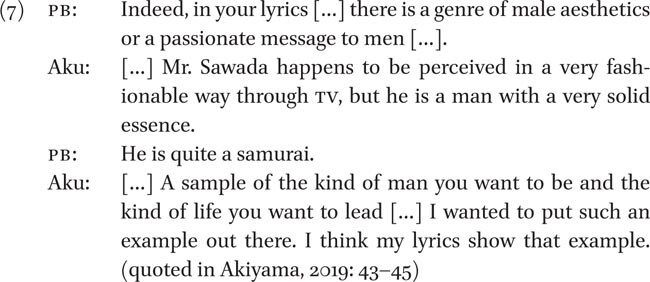
Feminist writer Kyoko Shimazaki (2023: 230) referred to this period as “when Kenji Sawada performed Yu Aku’s masculinity philosophy, which represents men’s kiza ‘conceit, pretentiousness’ and yasegaman ‘pretended endurance (for the sake of pride).’” Another author also described Aku’s lyrics as expressing yasegaman ni ikiru otoko no bigaku ‘the aesthetics of men who live with pretended endurance (for the sake of pride)’ (Akiyama, 2019: 145). In a 1980 interview with Playboy magazine, Aku himself affirmed this characterisation. In (7), “PB” refers to the Playboy interviewer.
Citation: Contrastive Pragmatics 7, 1 (2026) ; 10.1163/26660393-bja10148
To summarise, in the songs he wrote for Sawada, Aku created male characters who are misogynistic and prideful and who reject ordinary domestic happiness, and he intended this portrayal to serve as a role model for men to aspire to. The linguistic choice of the rough forms in many of the hit songs from this era, including the first- and second-person pronouns ore and omae and the direct imperative verb forms, as well as the sexist content and expressions, contributed to this image of a dominant, powerful, sexist, and misogynistic man.
Whether or not men actually aspired to follow this model, Sawada’s songs with Aku’s lyrics, as well as other songs that used the rough forms, were extremely popular. Sawada’s enormous popularity, which began in the 1970s and continued into the early 1980s, suggests the audience’s approval, or at least tolerance, of these gender stereotypes, reflecting the patriarchal nature of Japanese society at the time. Ito (2019: 51) characterised the gender structure of the 1970s and 1980s in Japan as a system in which “men worked long hours and women did housework, childcare, and part-time work after raising children.” If women worked outside the home, they were often expected to serve their male colleagues tea (Ueno, 2022: 63) and pressured to resign after getting married (58). Suzuki (2017) observed that this gender role division of labour, in which women did unpaid care work (or work for low pay) and men engaged in paid full-time employment, was deeply involved in the reproduction of inequality between men and women in the society. She also noted that gender role stereotypes emphasising female-male differences greatly contributed to the maintenance of this gender role division of labour (76).
Female-male differences were certainly emphasised in Sawada’s lyrics, especially those written by Aku. In songs such as Samurai ‘Warrior,’ Nikumikirenai rokundenashi ‘Loathsome bastard,’ and Kasaburanka dandī ‘Casablanca dandy,’ women are passive, forgiving, and domestic. On the other hand, men are dominant, prideful, misogynistic, and dismissive of domestic happiness. Aku, in the Playboy interview in (7), described Sawada as “a man with a very solid essence,” while the interviewer called him “quite a samurai,” both of them portraying him as if he were a stereotypically manly man. They implied that Sawada embodied Aku’s ideal man, a role model for other men in Japan. However, there was another side to Sawada, to which I now turn.
3.2 Gender Non-conformity
Although the lyricists who wrote for Sawada in the 1970s and 1980s (most notably Yu Aku) often emphasised his masculinity, Sawada himself engaged in various gender non-conforming behaviours which undermined the normative masculine imagery of his songs, including the nickname he chose for himself, the acting roles he accepted, and the visual style he displayed in his performances.
As Nakamura (2021: 55) observed, a name “has the power to create the person it refers to and sometimes gives an identity to them.” While he was still a member of The Tigers, Sawada had to choose a nickname. He decided on Jurī, from the name of the English actress Julie Andrews (Sawada, 1986: 5), and Jurī is how his fans and the general public refer to him to this day. The name contributes to what is often described as Sawada’s aura of androgyny (e.g., Miller, 2006: 126).
As an actor, Sawada took some roles that involved sexually heightened scenes with another man. For example, his character kisses a man in the 1981 film, Makai tenshō ‘Rebirth of the World of Spirits.’ In the 1975 television drama, Akuma no yō na aitsu ‘He Is Like a Devil,’ Sawada played a character whose relationship with another man was strongly suggestive of a romance. This drama inspired the novelist Kaoru Kurimoto (a.k.a. Azusa Nakajima) to write a trilogy which is considered to be the first work of “boys love” (BL) literature in Japan (Shimazaki, 2023: 9–10). Minori Ishida, who studies BL fiction, said:
Citation: Contrastive Pragmatics 7, 1 (2026) ; 10.1163/26660393-bja10148
Miller (2006: 126) also argued that Sawada’s celebrity persona was “an early expression of a male interest in being the object of female and/or male observation and desire.” Neither homoerotic behaviour nor being the object (as opposed to the agent) of desire easily fits the image of a stereotypical (heterosexual) man, certainly not the role model that Aku had in mind.
In addition, in his music performances, Sawada projected gender non- conformity through semiotic signs such as makeup, jewellery, and costumes. For example, in one concert, Sawada
emerged in a bright pink, gorgeously embroidered Chinese dress. He wore silver eye shadow, purple nail polish, heavy earrings, rings, and even a pearl necklace under his jacket and silver net shirt. (Shimazaki, 2023: 104)
Even on a conservative public broadcasting channel, NHK, Sawada appeared
waving a red ostrich stole, wearing a white jacket with a fur waistband and flared hem, flared pants of the same colour, and London boots. He wore a black glove on his left hand, a black brooch on his fur collar, and four strands of pearls swinging on his bare chest. (Shimazaki, 2023: 102)
The images that Sawada’s artistic director designed and Sawada embodied in his performances did not conform to the gender norms expected of (heterosexual) men. Eiko Ishioka, who designed Sawada’s nude photography book, remarked, “All by himself, Kenji Sawada challenged the Japanese man’s rigid belief of how a man should be” (Shimazaki, 2023: 27).
These contradictory presentations made him a paradoxical figure in Japan. Many people with conservative views on gender roles nonetheless appeared to accept Sawada’s gender non-conforming behaviours. This paradox, in fact, reflects a long history of “blurred sexualities and gender-bending practices” in Japan (Robertson, 2017). Salenius (2023: 10) wrote:
Gender in Japan has traditionally been constructed through emphasizing distinct gender roles for men and women, […] but there also is, and has been, a strong presence of gender ambiguous figures. In addition, cross-dressing has been a prominent feature in Noh Theater since the fourteenth century and in Kabuki performances of the sixteenth century.
Based on this history and her observations of more recent society, Mitsuhashi (2008: 22) concluded that the Japanese have a strong affinity for performing arts that transcend gender boundaries. Seen in this light, Sawada’s gender non-conformity may merely reflect Japan’s paradoxical acceptance of gender ambiguities; however, Sawada’s statements from this era suggest otherwise, as discussed in the following section.
3.3 Intentionally Paradoxical Style
In the 1970s and 1980s, Sawada made public comments suggesting that his gender non-conformity in performance was an intentional choice to undermine images of dominant masculinity. For example, a 1978 interview with a conservative critic includes the following exchange:
Citation: Contrastive Pragmatics 7, 1 (2026) ; 10.1163/26660393-bja10148
Looking back on this era, he described his strategies more explicitly, as in (10).
Citation: Contrastive Pragmatics 7, 1 (2026) ; 10.1163/26660393-bja10148
Both statements indicate that Sawada’s paradoxical style was not accidental, but the result of a conscious decision to use his appearance to contradict the stereotypically sexist gender ideologies represented in the songs he was performing.
Later in his career, Sawada brings more of his own ideologies into his lyrics, thus displaying fuller agency, as detailed in Section 4.
4 Hope: Gender and Political Ideologies of Kenji Sawada in Contemporary Japan
4.1 On Gender
More than forty years have passed since Sawada’s popularity was at its peak. I argued in Section 3 that the lyrics of Sawada’s songs reflected how male-dominant Japan was in the 1970s and early 1980s. Has Japan changed? To some extent, yes. Many sexist customs and laws have disappeared. Aku’s explicitly misogynistic lyrics would probably not sell today. However, in other ways Japan remains deeply patriarchal. Suzuki (2017: 62) observed that despite “the increasing participation of women in the workforce and the establishment of laws prohibiting gender discrimination, […] gender inequality still persists in Japanese society.” In 2024, The Japan Times reported that the World Economic Forum ranked Japan 118th out of 146 countries on gender equality (Tang, 2024). Recently, Taro Aso, vice president of the ruling Liberal Democratic Party, spectacularly demonstrated how patriarchal the country still is when he called Foreign Minister Yoko Kamikawa an obasan ‘middle-aged woman,’ saying: oretachi kara mitetemo, kono obasan yarunē to omotta ‘even from our point of view, we thought this obasan was good’ and sonna ni utsukushī kata to wa iwan keredomo ‘I wouldn’t say she is that beautiful’ (Asahi Newspaper, 28 January 2024, cited by Nikaido and Matsui, 2024). While his sexist remarks were widely criticised, Aso suffered no consequences; he remains powerful in the ruling party.
Against this bleak background, Kenji Sawada and the fact that he is “trending” again provide a ray of hope. Although Aso (b. 1940) and Sawada (b. 1948) belong to roughly the same generation, they are light-years apart in their perspectives on gender. Notice that in the sexist comment Aso made, he used the rough first-person pronoun oretachi (‘us, we’; the plural form of ore) to refer to himself and his fellow male politicians. His use of this pronoun in this context, which highlights male in-group solidarity and alienates the female foreign minister, reflects his gender ideology. In this section, I will examine Sawada’s interview discourses, the content of his lyrics from the mid-1990s on, and his linguistic choices in these lyrics to argue that he expresses a much different gender ideology.
After he vanished from television, Sawada continued to release albums and singles. During the 1970s and early 1980s, a large company managed the production and branding of his performances. However, from 1985, when he left that production company and created his own, Sawada gradually took charge of his own career. In his 1986 autobiography, he said he had been feeling a sense of crisis, wanted to control his work, and planned to show more of his “true self” (Sawada, 1986: 225–227). In 1995 he started self-producing all of his music (Shimazaki, 2023: 345). An Asahi Newspaper journalist reported:
Citation: Contrastive Pragmatics 7, 1 (2026) ; 10.1163/26660393-bja10148
In another interview (Morobushi, 1998: 36), Sawada said that he preferred female lyricists because they are more articulate and bolder. Otoko no bigaku ‘male aesthetics,’ mentioned in (11), is a phrase often associated with Yu Aku’s lyrics (as also seen in the Playboy interview cited in (7)). As discussed earlier, Aku portrayed misogynistic and prideful men who dismiss ordinary happiness, and Aku intended this portrayal to serve as a role model for men. Sawada’s scorn for “male aesthetics” and “men of [his] generation” in (11) and his praise of female lyricists suggest that he intended to challenge what Aku’s lyrics represented and to express a different gender ideology in his self-produced albums.
After Sawada started to self-produce his music in 1995 and especially in the 2000s, he worked frequently with two female lyricists: Grace and Wakako Kaku. Kaku has said that Sawada shared surprisingly private matters with her (Shimazaki, 2023: 350), presumably so that she could use them in her lyrics. The lyrics of Grace, Kaku, and Sawada himself clearly reject the image of a man promoted by Aku. For instance, Grace’s lyrics in the 2001 song, Taisetsu na futsū ‘Precious ordinary,’ read like a direct rebuttal to the lyrics of Samurai (as shown in (6)).
Citation: Contrastive Pragmatics 7, 1 (2026) ; 10.1163/26660393-bja10148
The song embraces ordinary life and shuns suffering. Other songs portray the pursuit of happiness. In fact, the word shiawase ‘happiness’ appears in multiple songs. (13) is from the 1995 Gin no hone ‘Silver bones,’ written by Kaku; (14) is from the 2002 Tsuzuku shiawase ‘Lasting happiness,’ written by Sawada; and (15) is from the 2007 Ikitetara shiawase ‘Happy if we are alive,’ also by Sawada.
Citation: Contrastive Pragmatics 7, 1 (2026) ; 10.1163/26660393-bja10148
Other songs that Sawada has self-produced portray a couple who both work outside the home (Ai wa itai ‘Love hurts’; Sawada, 1997), a man who is a homemaker (Kimi no kirei no tameni ‘For your beauty’; Kaku, 2000) and a man who cheers on a partner who is going through menopause (MENOPAUSE, Sawada, 2005). Unlike the hero of Yu Aku’s creations, who is dominant, misogynistic, prideful, and dismissive of domestic life, the man that Sawada (and the female lyricists with whom he has worked closely) depicts often embraces ordinary life and happiness, which seems to reflect Sawada’s egalitarian gender ideology.
Another theme which recurs in Sawada’s self-produced songs is men who cry. (16) is from the 2006 Sakura mau ‘Cherry blossoms dance,’ and (17) is taken from the 2008 Umi ni mukete ‘Towards the sea,’ both written by Sawada.
Citation: Contrastive Pragmatics 7, 1 (2026) ; 10.1163/26660393-bja10148
In both songs, a man imagines the death of his partner and cries. As Ito (1993: 7), among others, has pointed out, the hegemonic manly man would not show any emotion, let alone cry. The theme of a man crying at the thought of parting with a loved one clearly contests the image of an unemotional and dominant man.
Such contestation of the old gender ideology is also evident in the choices of personal pronouns. Gone is the pair of rough forms, ore-omae, which was ubiquitous in Sawada’s songs in the 1970s and 1980s. As discussed in Section 3.1, the use of omae alone or in tandem with ore conveys a man’s feeling of intimacy with as well as deprecation of and dominance over a woman (SturtzSreetharan, 2009: 268). Instead of the ore-omae pair, Grace, Kaku, and Sawada heavily use the boku-kimi pair, as seen in examples (13)–(17). As Nakamura (2007: 74) observed, the first-person pronoun boku and the second-person pronoun kimi represent the newer, gentler style of masculinity. In a 2003 interview, Sawada said that kimi in all of his contemporary songs refers to his wife, Yuko Tanaka (Shimazaki, 2023: 357). Sawada has publicly expressed his respect for Tanaka, who is an accomplished actor (HS, 2019).
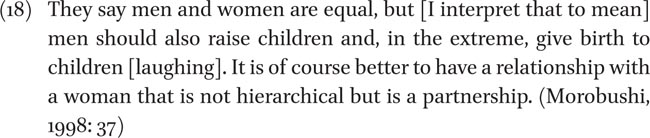
In addition, Sawada has explicitly challenged the patriarchal society in interviews, as, for example, in (18).
Citation: Contrastive Pragmatics 7, 1 (2026) ; 10.1163/26660393-bja10148
Sawada was obviously aware that his gender ideology was in direct opposition to the patriarchal norms in Japan, and the lyrics of the songs he has self-produced, which include the use of kimi to address a romantic partner in an equal or respectful relationship, reflect this ideology.
4.2 On Politics
Section 4.1 focused on lyrics and interview discourses centring on issues of gender. In Sawada’s self-produced songs, the softer boku and kimi are used instead of the rough personal pronouns, ore and omae. However, this does not mean that these songs do not contain any rough forms. Instead of expressing powerful or rugged masculinity, however, in the self-produced songs, Sawada seems to have employed the rough forms to make strong assertions of his political views.
An article in The Japan Times called show business in Japan “an industry whose members usually avoid anything smacking of politics so as not to jeopardize employment opportunities” (Brasor, 2020). Sawada is one of the few celebrities who speak up, and he has expressed his political views in both interviews and songs. In a 2012 interview with the Asahi Newspaper (cited in Akiyama, 2019: 186), Sawada said that around the time he turned 60, he decided to express his political views. Sawada has written the lyrics of every song he has released since 2010, many of which address politics. In a 2012 interview with the Mainichi Newspaper, Sawada said:
Citation: Contrastive Pragmatics 7, 1 (2026) ; 10.1163/26660393-bja10148
The political issues addressed in Sawada’s songs range from the need to protect the Constitution and criticism of the governing Liberal Democratic Party to protests against nuclear power. In fact, since the Fukushima nuclear plant disaster in 2011, most of the new songs Sawada has written convey compassion towards the disaster victims and opposition to nuclear power.
In the songs in which Sawada aggressively criticises politicians, he uses the rough forms, as (20) and (21) illustrate.
Citation: Contrastive Pragmatics 7, 1 (2026) ; 10.1163/26660393-bja10148
In the first two lines in (20), Sawada urges Japanese citizens to protect themselves because the government will not protect them. These words are quite strong and biting, and the force of the third line, “Swallow your pride and protect yourself,” adds to their impact. The word mamore ‘protect’ is a direct imperative and thus among the rough forms. The aggressive tone comes across even more strongly in (21). The content of the repeated line negusare politician ‘root-rotting politician,’ as well as other phrases such as makaritōsu ‘get away with it,’ inpei ‘cover-up,’ and otamegokashi ‘lie,’ conveys Sawada’s anger towards politicians. The caustic tone peaks in the last line, sorya otamegokashi hikari nanka mienē ‘That’s a lie, I can’t see the goddam light.’ The topic marker nanka indicates the feeling of contempt, but more crucially, the predicate mienē, the contracted form of mienai ‘can’t see,’ which belongs to the rough forms, sounds extremely aggressive. In both (20) and (21), Sawada effectively uses the rough forms to increase the forcefulness of his messages.
As mentioned in Section 2, the rough forms index pragmatic meanings such as roughness, harshness, and forcefulness, which can be interpreted in different contexts to index one or more related meanings including, among others, rugged masculinity, strong emotions, in-groupness, rebelliousness, and youthfulness. In the 1970s and 1980s, when Sawada’s different lyricists (most notably Yu Aku) used the rough forms, they used them to express powerful masculinity. In (20) and (21), the songs written by Sawada, masculinity does not seem to play a central role. Although listeners might still interpret these uses of the rough forms to signal masculinity, I argue that Sawada used the rough forms primarily to communicate his strong emotions (e.g., anger) and perhaps rebelliousness, but not masculinity. I base this interpretation on the distaste for overt manliness that Sawada has expressed in the past, as when he said he “preferred to be a sissy” when discussing his displeasure with Aku’s lyrics in (10), and when he wrote, “It’s okay to be a sissy, I’ll weep and weep,” in the song Umi ni mukete, shown in (17).
4.3 Hope for a More Progressive Japan
Sawada’s core fans are women in their 60s or 70s. These fans have followed him from his early years (Watanabe, 2023).11 More recently, Sawada has been gaining new generations of fans. In 2018, he cancelled a concert at the last minute, which was widely reported and for which he was severely criticised. As his core fans stood by his choice and defended him,12 the incident caught the attention of many (Tanaka, 2024: 98). It was at this time that some news sites reported on Sawada’s political songs (Henshūbu, 2018). Ironically, as a result of the harsh criticism, Sawada gained new fans and wider attention to his political views. In addition, young people have been encountering him and his music for the first time on YouTube and other sites (Watanabe, 2023).
As mentioned, Japan’s patriarchy is still quite powerful. The taboo against celebrities speaking out politically also attests to the dominance of those who are currently in power. Into this grim scene, Sawada’s recent popularity brings a ray of hope. As new fans are experiencing Sawada’s performances, they are also discovering his songs that address gender and political issues. At least some of the new fans embrace his political stances and gender ideologies. For example, the Osaka Lawyers Association published an interview which favourably featured Sawada’s views (Osaka Bengoshi-kai, 2015). The news site Litera has also expressed respect for Sawada’s political outspokenness (Henshūbu, 2018). On 14 May 2024, Asahi Newspaper published an opinion forum titled Yappari Jurī ‘After all, it’s Julie,’ in which Sawada was praised for the way he presents himself in terms of gender and political ideologies as well as his musical performances (Nakajima and Yamaguchi, 2024). The growing numbers of his fans and admirers might suggest the possibility of a more socially and politically progressive Japan.
5 Discussion
Goffman (1981) argued that the notion of “speaker” is too simplistic. He proposed that the role of a speaker actually encompasses three roles, which he labelled the “animator,” “author,” and “principal” (144). An animator refers to the individual who makes the physical sounds that comprise an utterance. An author is “someone who has selected the sentiments that are being expressed and the words in which they are encoded” (144). And a principal represents “someone whose position is established by the words that are spoken, someone whose beliefs have been told, someone who is committed to what the words say” (144). We can apply these notions to Kenji Sawada’s songs from different eras in an attempt to understand how he positioned himself in relation to the lyrics.
In the 1970s and 1980s, the “animator” was Sawada as he sang those songs. However, the “authors” were the lyricists, such as Yu Aku. It is not clear who the “principal” would have been, since neither Sawada nor the lyricists necessarily believed in the sentiments expressed in the songs (although, as we saw in the Playboy interview shown in (7), Aku did express his own gender ideals in some of his lyrics). In the songs of this era, the lyrics contained numerous instances of rough forms, which the lyricists used to portray dominant, assertive, and misogynistic men. Some songs also included definitional statements about gender relations in which men are prideful and dismissive of domestic happiness while women are passive, forgiving, and expected to wait for their men at home. These portrayals depicted men and women as complete opposites, and reflected the gender ideologies of the conservative and patriarchal society that Japan was (and to some extent still is).
Sawada the animator clearly wanted to distance himself from these authors. His statements in various interviews indicate that his own views on gender relationships greatly differed from those expressed in the lyrics of that era. Sawada also exhibited various gender non-conforming behaviours: he adopted the nickname Julie, conventionally a woman’s name; he performed homoerotic roles in which he presented himself as an object of desire; he wore makeup, jewellery, and costumes that were considered feminine.
As Eckert (2016: 77) mentioned, a style is composed of many elements: “clothing, facial expression, posture, movement, speech, and so on.” Okamoto (forthcoming) also describes styling as a process in which individuals employ a wide variety of multilevel and multimodal semiotic resources to construct the desired contexts in situated practice. Applying these notions to Sawada, we can say that he actively pursued his style by employing multilevel and multimodal semiotic resources and intentionally contradicted the image of domineering masculinity through gender non-conforming acts. His style communicated his agency in contradicting the prevailing patriarchy.
After Sawada started self-producing his music in 1995, his styling practices changed. He gradually stopped wearing makeup and “feminine” costumes. We can understand this change in terms of Goffman’s (1981) notions of animator, author, and principal as well. Sawada is obviously the “animator.” He is also the “author.” He himself writes the lyrics. And he closely works with the female lyricists he has hired so that their lyrics are consistent with his ideas. In interviews, he has explained his progressive ideas, which echo the messages expressed in the lyrics. This means that Sawada is also the “principal.” Since he is now the animator, author, and principal, he no longer draws on the same semiotic resources he employed when his agency was limited and he could not control the messages of the songs he sang. He no longer needs to contradict the message of his songs, and his style reflects this fact.
6 Concluding Remarks
The implications of the findings discussed in this article, as they relate to the topic of this special issue, sexism and homophobia in Japan, might be summarised as follows. Kenji Sawada embodies a paradox. He sang songs in the 1970s and 1980s whose lyrics often reflected patriarchal gender norms. At the same time, he deployed multilevel and multimodal semiotic resources, quite intentionally, in order to push back against and undermine the images of hegemonic masculinity, which assumes heteronormativity, expressed in those lyrics. Using Kenji Sawada as a case in point, this article has illustrated how individuals can deal with and negotiate the norms and patterns of a society (such as sexist and/or homophobic language, beliefs, or customs), decide what stances they wish to take in a particular context, and construct a particular style by deploying diverse multilevel and multimodal semiotic resources.
This article also points to the possibility of change and of growing diversity in gender views in Japan. Sawada’s more recent songs, for which he serves as his own producer, embrace egalitarian gender ideologies and reject hegemonic masculinity. In his political songs, he employs the very linguistic resources that the songs of the 1970s and 1980s used to express male dominance and misogyny in order to index something quite different. In the process, Sawada is sending powerful messages to his audience: it is okay to challenge the conservative gender norms that are ubiquitous in Japan; it is okay to speak up on political issues even when you are not supposed to. In a society where the pressure to conform abounds (Kokami, 2019), Kenji Sawada’s messages are quite powerful, and his current popularity represents a ray of hope.
Acknowledgements
I would like to thank Shigeko Okamoto and Momoko Nakamura for inviting me to contribute to this special issue and giving me encouragement. I am also grateful to the peer reviewers whose suggestions significantly helped me revise the original draft. Special thanks go to Kanon Nakajima for her help in locating the lyrics and Laurie Durand for her editorial support.
Data (Lyrics)
Aku, Yu. 1978. Samurai. https://www.uta-net.com/song/2115/.
Aku, Yu. 1979. Kasaburanka dandī. https://www.uta-net.com/song/1265/.
Aku, Yu. 1980. Sakaba de DABADA. https://www.uta-net.com/song/2035/.
Grace. 2001. Taisetsu na futsū. https://www.uta-net.com/song/151588/.
Itoi, Shigesato. 1980. Tokio. https://www.uta-net.com/song/3241/.
Kaku, Wakako. 1995. Gin no hone. https://petitlyrics.com/lyrics/2777660.
Kaku, Wakako. 2000. Kimi no kirei no tame ni. https://www.uta-net.com/song/150991/.
Kitajo, Makoto. 1979. Ronrī urufu. https://www.uta-net.com/song/40992/.
Miura, Yoshiko. 1980. Omae ga paradaisu. https://www.uta-net.com/song/1057/.
Miura, Yoshiko. 1981. Sutorippā. https://www.uta-net.com/song/2737/.
Sawada, Kenji. 1997. Ai wa itai. https://www.uta-net.com/song/150819/.
Sawada, Kenji. 2002. Tsuzuku shiawase. https://j-lyric.net/artist/a000aa6/l046db3.html.
Sawada, Kenji. 2005. MENOPAUSE. https://www.uta-net.com/song/151590/.
Sawada, Kenji. 2006. Sakura mau. https://www.youtube.com/watch?v=CZP21Vrq82o.
Sawada, Kenji. 2007. Ikitetara shiawase. https://www.uta-net.com/song/179741/.
Sawada, Kenji. 2008. Umi ni mukete. https://www.youtube.com/watch?v=VecbaF37IMw.
Sawada, Kenji. 2018. Kaku naki sekai. https://www.youtube.com/watch?v=vVnyrxLqZAo.
Sawada, Kenji. 2019. Negusare politician. https://utaten.com/lyric/qk19032013/
Yanagawa, Hidemi. 1982. Omae ni chekku in. https://www.uta-net.com/song/1066/.
Yasui, Kazumi. 1973. Kiken na futari. https://www.uta-net.com/song/1439/.
Data (Interviews and Autobiography)
HS. 2019. Yoshida Takuro, Sawada Kenji. YouTube, 12 May. https://www.youtube.com/watch?v=dzpGODiGQl8&t=5s.
Morobushi, Kurumi. 1998. Sawada Kenji to iu genshō. Purintsu 21 (Winter): 25–41.
Nakajima, Tetsuro, and Hiroko Yamaguchi. 2024. Yappari Jurī. Asahi Shinbun, 14 May. https://digital.asahi.com/articles/DA3S15933027.html?iref=pc_ss_date_article.
PARAMYLOVE TOPAZ. 2022. Jurī to hosokawa ryūichirō-san no taidan. YouTube, 2 May. https://www.youtube.com/watch?v=d-1bEtu8294.
Sawada, Kenji. 1986. Waga na wa Jurī. Tokyo: Chuo Koron-sha.
References
Abe, Hideko. 2010. Queer Japanese: Gender and Sexual Identities through Linguistic Practices. New York: Palgrave Macmillan.
Akiyama, Daisuke. 2019. Sawada Kenji to Aku Yū, sono jidai. Tokyo: Bokka-sha.
Aku, Yu. 1992. Aku Yū: Uta wa jidai o kataritsuzuketa. Tokyo: NHK Shuppan.
Brasor, Philip. 2020. In a rare move, entertainers air criticism of Japan’s response to COVID-19 crisis. The Japan Times, 16 May. https://www.japantimes.co.jp/news/2020/05/16/national/media-national/entertainers-criticism-response-covid-19-crisis/.
Eckert, Penelope. 2008. Variation and the indexical field. Journal of Sociolinguistics 12(4): 453–476.
Eckert, Penelope. 2016. Variation, meaning and social change. In: Nikolas Coupland (ed.), Sociolinguistics: Theoretical Debates. Cambridge, U.K.: Cambridge University Press, 68–85.
Goffman, Erving. 1981. Forms of Talk. Philadelphia: University of Pennsylvania Press.
Hayashi, Rumi. 2021. Sawada Kenji: Jibun o tsuranuku muni no hyōgensha. Asahi Shinbun, 29 May. https://digital.asahi.com/articles/DA3S14918481.html?iref=pc_ss_date_article.
Henshūbu. 2018. Dotakyan Sawada Kenji no kobinai yūki. Litera, 19 October. https://lite-ra.com/2018/10/post-4321.html.
Ito, Kimio. 1993. “Otoko rashisa” no yukue: Dansei bunka no bunka shakaigaku. Tokyo: Shinyosha.
Ito, Kimio. 2019. Nihon ni okeru jendā byōdō o habamu mono. Gakujutsu no Dōkō 12: 49–53.
Kato, Yoko. 2023. Konshū no hondana “Jurī ga ita: Sawada Kenji 56 nen no kōbō.” Mainichi Shinbun, 2 September. https://mainichi.jp/articles/20230902/ddm/015/070/009000c?_gl=1*smbebm*_ga*MTk4NDcxODg2OS4xNjk1NDg0NDEx*_ga_TWF4RDH5YQ*MTcwMTAzMzc1My44LjEuMTcwMTAzMzk3NS4xNS4wLjA.
Kokami, Shoji. 2019. Kūki o yondemo shitagawanai: Ikigurushisa kara raku ni naru. Tokyo: Iwanami Shoten.
Miller, Laura. 2006. Beauty Up: Exploring Contemporary Japanese Body Aesthetics. Berkeley: University of California Press.
Mitsuhashi, Junko. 2008. Josō to nihonjin. Tokyo: Kodansha.
Miyazaki, Ayumi. 2004. Japanese junior high school girls’ and boys’ first-person pronoun use and their social world. In: Shigeko Okamoto and Janet S. Shibamoto-Smith (eds.), Japanese Language, Gender, and Ideology: Cultural Models and Real People. Oxford, U.K.: Oxford University Press, 256–274.
Nakagawa, Yusuke. 2023. Sawada Kenji. Tokyo: Asahi Shinbun Shuppan.
Nakamura, Momoko. 2007. “Sei” to nihongo: Kotoba ga tsukuru onna to okoto. Tokyo: NHK Shuppan.
Nakamura, Momoko. 2010. Women’s and men’s languages as heterosexual resource: Power and intimacy in Japanese spam e-mail. In: Janet Holmes and Meredith Marra (eds.), Femininity, Feminism and Gendered Discourse: A Selected and Edited Collection of Papers from the Fifth International Language and Gender Association Conference. Newcastle, U.K.: Cambridge Scholars, 125–144.
Nakamura, Momoko. 2021. “Jibun rashisa” to nihongo. Tokyo: Chikuma Shobo.
Nikaido, Yuki, and Nozomi Matsui. 2024. Yōshi genkyū, aso-shi ni hihan. Asahi Shinbun, 30 January. https://www.asahi.com/articles/DA3S15851259.html?iref=pc_ss_date_article.
Ochs, Elinor. 1992. Indexing gender. In: Alessandro Duranti and Charles Goodwin (eds.), Rethinking Context: Language as an Interactive Phenomenon. Cambridge, U.K.: Cambridge University Press, 146–169.
Okamoto, Shigeko. 1995. “Tasteless” Japanese: Less “feminine” speech among young Japanese women. In: Kira Hall and Mary Bucholtz (eds.), Gender Articulated: Language and the Socially Constructed Self. New York: Routledge, 297–325.
Okamoto, Shigeko. Forthcoming. Styling as a dynamic and ideological process of deploying multimodal semiotic resources. In: Haruko Cook and Momoko Nakamura (eds.), Getting Close in a “Formal Context”: Ideologies and Styling Practices in Japanese. Amsterdam: John Benjamins.
Okamoto, Shigeko, and Janet S. Shibamoto-Smith. 2016. The Social Life of the Japanese Language: Cultural Discourse and Situated Practice. Cambridge, U.K.: Cambridge University Press.
Osaka Bengoshi-kai. 2015. Kakko-ī Jurī kara kakko-ī Sawada Kenji e. Gekkan Bengoshi-kai January: 4–12.
Robertson, Jennifer. 2017. Japan’s gender-bending history. The Conversation, 28 February. https://theconversation.com/japans-gender-bending-history-71545.
Salenius, Sirpa. 2023. Gender in Japanese Popular Culture: Rethinking Masculinities and Femininities. Cham, Switzerland: Springer Nature.
Sasaki, Hiroyuki. 2024. Nenmatsu nenshi wa soku kanbai mo futatabi kenkō fuansetsu ga deta ga … Digital Friday, 24 February. https://friday.kodansha.co.jp/article/360721.
Sawada Kenji Ofisharu. n.d. http://www.co-colo.com/ (Accessed 7 April 2025).
Shibamoto-Smith, Janet S. 2004. Language and gender in the (hetero)romance: “Reading” the idea hero/ine through lovers’ dialogue in Japanese romance fiction. In: Shigeko Okamoto and Janet S. Shibamoto-Smith (eds.), Japanese Language, Gender, and Ideology: Cultural Models and Real People. Oxford, U.K.: Oxford University Press, 113–130.
Shimazaki, Kyoko. 2023. Jurī ga ia: Sawada Kenji 56 nen no kōbō. Tokyo: Bungei Shunju.
SturtzSreetharan, Cindi. 2009. Ore and omae: Japanese men’s uses of first- and second- person pronouns. Pragmatics 19(2): 253–278.
Sumi, Tomoyuki. 2013. Josei kashu no ryūkōka ni miru “kimi” no hensen. Tenri Daigaku Jinken Mondai Kenkyūshitsu Kiyō 16: 19–31.
Suzuki, Atsuko. 2017. Jendā yakuwari fubyōdō no mekanizumu: Shokuba to katei. Japanese Psychology Review 60(1): 62–80.
Taira, Asuko. 2007. Anata ga paradaisu. Tokyo: Asahi Shinbun Shuppan.
Tanaka, Ine. 2024. Naze Sawada Kenji wa yurusareru no ka. Tokyo: Jitsugyō no Nihon-sha.
Tang, Francis. 2024. Japan makes gains in political empowerment in gender equality report. The Japan Times, 12 June. https://www.japantimes.co.jp/news/2024/06/12/japan/society/japan-gender-gap/.
Ueno, Chizuko. 2022. Feminizumu ga hiraita michi. Tokyo: NHK Shuppan.
Watanabe, Kaoru. 2023. “Jurī” Sawada Kenji wa naze ima mo saikō no rokkunnrōru sutā nano ka. Aera.dot, 27 November. https://dot.asahi.com/articles/-/207378?page=1.
Yamada, Michiko. 2021. Soro debyū 50 shūnen no Sawada Kenji ga futatabi “kiteiru” wake. Mainichi Shinbun, 17 May. https://mainichi.jp/premier/business/articles/20210514/biz/00m/020/022000c.
Zettsu, Tomoyuki. 2022. Dō ni mo tomaranai kayōkyoku: 70 nendai no jendā. Tokyo: Shobun-sha.
Biographical Note
Satoko Suzuki, DeWitt Wallace Professor, teaches Japanese language and linguistics at Macalester College. Her research interests include discourse analysis, pragmatics, sociolinguistics, and linguistic anthropology. Her current scholarly work focuses on issues surrounding language and identity. She has edited Emotive Communication in Japanese (John Benjamins) and several special issues of journals, and authored a number of journal articles and book chapters. Her most recent articles include “Asian Masculinity Celebrated and Otherised: Representations of Chinese and Korean Men in Japanese Written Media” (Gender and Language) and “Identity Presentations of L1-Japanese Female Professors in the United States” (Journal of Language, Identity & Education).
The Tigers disbanded in 1971. After that, Sawada belonged to another band, PYG, for a short time.
The Showa era, 1926–1989.
All Japanese quotations are translated by the author.
From 2009 to 2018, Sawada released mini-albums rather than full-length albums.
The linguistic forms in (1) are closely associated with (strong) masculinity in the standard variety of Japanese. However, speakers of other varieties may not have this association. For example, the first-person ore is not linked to masculinities in many regional dialects.
See Nakamura (this issue) for a discussion of various Japanese first-person pronouns.
The first-person pronouns are sometimes not mentioned.
Anata is also an old-fashioned term of address by a wife to a husband. Anata is not linked to politeness outside of marital/romantic/sexual contexts.
SturtzSreetharan (2009: 268) reported that omae’s “full linguistic ideology as a deprecatory and aggressive second-person pronoun” can be exploited in man-to-man conversation as well.
In the songs shown in (13)–(17), the lyricists used boku as the first-person pronoun and kimi as the second-person pronoun, as noted in the translation. I will discuss their significance later in this section.
Asuko Taira’s 2007 novel Anata ga paradaisu ‘You are paradise’ portrays such fans, depicting them closely examining Sawada’s lyrics and expressing their sense of how his songs support and encourage them, and their appreciation of his egalitarian messages.
Many have noted the strong bond between Sawada and his fans (Tanaka, 2024). See Miyazaki and Furukawa (this issue) for a discussion of fandom in Japan.