Abstract
This paper examines pragmatic variation in the use of anyway between Nigerian English and Ghanaian English, in terms of its frequency, position, collocational patterns, pragmatic functions and occurrence in different text types. The data for the study, which are retrieved from the Nigerian and Ghanaian components of the International Corpus of English, are examined from a variational pragmatic framework. The results indicate that overall, there is no significant variance in the frequency of anyway between Nigerian English and Ghanaian English; however, there are significant differences in the frequency of anyway across different text types between the two varieties. Moreover, while anyway occurs most frequently at clause-initial position in Ghanaian English, it occurs most often at clause-final position in Nigerian English. Anyway performs different pragmatic functions in Nigerian English and Ghanaian English, including signalling affirmation, which is a function that has not been identified in other varieties of English. The study, thus, contributes to the research on anyway as a pragmatic marker as well as pragmatic variation in Nigerian English and Ghanaian English.
1 Introduction
The English language was brought into West African countries such as Nigeria and Ghana through slave trade and colonialism from the 16th century to the 19th century (Gut, 2012; Jowitt, 2019). In Nigeria, English co-exists with over five hundred indigenous languages and cultures, such as Efik, Nupe and Ibibio, while in Ghana, it co-exists with about seventy-three ethnic languages and cultures including Akan, Ewe and Ga (Eberhard et al., 2023). All these languages and cultures have influenced the varieties of English used in these countries, leading to national varieties including Nigerian English (NigE; Jowitt, 2019) and Ghanaian English (GhE; Huber, 2012). English functions as the de facto state language in these countries, as it serves official functions in the domains of law, media, administration, education and commerce, among others (Gut, 2017). Sub-varieties of these national varieties have also been identified (Gut, 2017). Based on Schneider’s (2007) Dynamic model of Postcolonial Englishes, the two varieties are at the nativisation stage, while NigE has been reported to show signs of approaching the endonormative stabilisation stage (Collins, 2022).
Existing studies on Nigerian and Ghanaian Englishes have examined the phonological (Huber, 2004; Akinola and Oladipupo, 2022), lexico-semantic (Brato, 2019; Taiwo, 2024) and syntactic (Akinlotan, 2018; Brato, 2020) features of these two varieties. Previous investigations of pragmatic features in the varieties have concentrated on politeness (Adegbija, 1989; Anderson 2009), pragmatic markers (Ogoanah, 2011; Amuzu et al., 2018), and speech acts (Mustapha, 2011; Anchimbe, 2018). Corpus pragmatic studies of these two varieties are still growing, and have largely investigated stance markers (Gut and Unuabonah, 2019), interjections (Thompson, 2019; Unuabonah and Daniel, 2020), pragmatic markers (Unuabonah, 2021; Unuabonah and Anderson, 2023), speech acts (Sarfo-Kantankah, 2021; Gut and Unuabonah, 2024) and general extenders (Oyebola et al., forthcoming). Some of these studies have explored single pragmatic markers such as even and still (Fuchs et al., 2013) and now (Oladipupo and Unuabonah, 2021) or groups of pragmatic markers (Unuabonah and Gut, 2018; Unuabonah, 2019) in NigE.
These studies reveal that there are dissimilarities in the rate of occurrence and functions of pragmatic markers between NigE and other world varieties such as British English. For instance, using the Nigerian and Great British components of the International Corpus of English (ICE), Unuabonah (2019) reveals that NigE users employ elaborative (e.g. and, in addition) and contrastive (e.g. but, although) discourse markers less regularly than British English users, but employ inferential discourse markers (e.g. so, hence) more often than British English users. Furthermore, Oladipupo and Unuabonah (2021) explore the use of the pragmatic marker now in ICE-Nigeria and indicate that NigE users utilise now as an emphasis pragmatic marker due to the impact of Yoruba, a major ethnic Nigerian language. Unuabonah (2021) opines that the low rate of occurrence of English emphasis pragmatic markers (e.g. indeed, really) in NigE, as indicated in Unuabonah and Gut (2018), may be due to a high frequency of different kinds of emphasis pragmatic markers borrowed from ethnic Nigerian languages (e.g. o, jare). There is even less attention on pragmatic markers in GhE where few English pragmatic markers such as actually (Sarfo-Kantankah and Yussif, 2019) or pragmatic markers borrowed from indigenous Ghanaian languages such as paa and kraa (e.g. Unuabonah and Anderson, 2023), have been explored. In some cases, pragmatic markers in NigE and GhE are explored within studies that cover several English varieties (e.g. Mazzon, 2019; Collins, 2022), thus limiting the extent to which specific attributes of these pragmatic markers in these two varieties are studied. Overall, the studies that address English pragmatic markers have shown that there are regional and text type differences in the use of the different pragmatic markers between these two varieties and other World Englishes (e.g. Mazzon, 2019; Collins, 2022).
One pragmatic marker that has not been extensively studied in NigE and GhE is anyway, which is a multifunctional pragmatic marker that is largely used to perform dismissive and resumptive functions (Aijmer, 2016). Previous studies show differences in the use of anyway in different varieties of English in terms of its frequency, positioning, collocational patterns and pragmatic functions (Aijmer, 2022). Although previous research indicates that pragmatic markers are used differently depending on text types, past studies pay less attention to text category variation in the use of anyway in diverse world Englishes, thus restricting full knowledge of the use of anyway in diverse text categories in both varieties. It is expected that there will be variation in the use of anyway between NigE and GhE, as noted for other pragmatic items in both varieties (Gut and Unuabonah, 2019). Specifically, it is expected that there will be similarities in the frequency of anyway in NigE and GhE and that anyway will occur less frequently in both varieties than in other native English (ENL) varieties, based on previous studies on pragmatic items in NigE and GhE (Unuabonah and Gut, 2018; Gut and Unuabonah, 2019). It is also likely that there will be variations in relation to the positioning and collocational patterns of anyway in the two varieties, as noted in previous studies on anyway in different varieties of English (Aijmer, 2022). It is also expected that anyway will perform similar functions found in other world varieties since the different varieties belong to the same language. However, it is also probable that there are distinctive functions of anyway in NigE and GhE, not mentioned in ENL varieties due to the impact of ethnic languages and cultures on both varieties. In addition, it is likely that there is text type distinction in the usage of anyway in NigE and GhE, based on prior research (Gut and Unuabonah, 2019). As such, this study aims to extend pragmatic marker research in NigE and GhE by examining the pragmatic marker anyway in the two West African Englishes, which is imperative because pragmatic markers, including anyway, contribute to nativisation and endonormative stabilisation processes in postcolonial Englishes (Unuabonah and Gut, 2018). The following are the objectives of this study:
(a) to examine similarities and differences in the frequency and position of anyway between NigE and GhE;
(b) to explore similarities and dissimilarities in the collocational patterns and pragmatic functions of anyway between NigE and GhE;
(c) to investigate text type distinction in the use of anyway in NigE and GhE.
In this section, we have provided the background on NigE and GhE, reviewed previous studies on the two varieties, and presented the aim and objectives of the present paper. In Section 2, we explore general pragmatic marker research and variational pragmatics, which is the perspective from which this study has been investigated. In Section 3, we review prior research on anyway and explain the research method in Section 4. Thereafter, we provide the results in Section 5 and discuss the findings in Section 6. We then conclude the paper in Section 7.
2 Pragmatic Markers and Variational Pragmatics
Pragmatic markers, equally referred to as discourse connectives and pragmatic particles, amongst others,1 are syntactically optional lexical items including well, you know, and certainly, which signal the connection of an utterance to its linguistic and/or situational context (Buysse, 2012). Although they do not significantly add to the basic propositional meaning of an utterance, they are required in interpreting the utterance (Fraser, 1996, 2009). Pragmatic markers possess great meaning potential as new functions may emerge from the basic functions of the markers (Aijmer, 2013). They accomplish diverse kinds of textual and interpersonal roles such as indicating interruption, elaboration and contrast, and expressing attitude, politeness and affectivity (Brinton, 1996, 2008; Aijmer, 2013). As such, different types of pragmatic markers have been well examined in different varieties of English, including ENL such as British English (e.g. Torgersen et al., 2018), Australian English (e.g. Mulder et al., 2019), American English (e.g. Izutsu and Izutsu, 2022) and Irish English (e.g. Aijmer, 2022). These studies confirm that there are distinctions in the frequency, structure and roles of different pragmatic markers across different varieties of English. Despite the large volume of research on pragmatic markers in ENL varieties, there is less attention on varieties where English is primarily used as a second language (ESL). The few studies on ESL varieties explore English pragmatic markers such as shame in South African English (Huddlestone and Fairhurst, 2013), basically in Singapore English (Lange 2021), and comment clauses such as I guess and I believe in Sri Lankan and Indian Englishes (Degenhardt, 2024). These studies show variation in the use of English pragmatic markers, some of which may be based on the impact of local languages on the use of English pragmatic markers in these varieties. Others explore pragmatic markers borrowed from local languages such as si (you know, right) in Kenyan English (Muro and Unuabonah, 2022), mara (but) in South African English (Unuabonah and Mtembu, 2023) and sia (an intensifier, a marker of youth identity) in Singapore English (Hafiz et al., 2024), which indicate the multilingual nature of postcolonial English varieties.
One popular approach that has been utilised in examining pragmatic markers in world Englishes is variational pragmatics. Variational pragmatics operates at the intersection between pragmatics and variational linguistics (Schneider and Barron 2008; Schneider 2021), necessitated by the need to understand language in use based on different social factors. It enables a “systematic analysis of the effects of regional and social factors on language in action and interaction” (Schneider and Barron, 2008: 1), as it allows the inves- tigation of pragmatic variation in geographical and social spaces. The approach recognises two aspects of pragmatic analysis, which include types of language variation and levels of pragmatic analysis. In terms of the former, it distinguishes five macro-social variables of language variation such as region, ethnicity, social class, gender, and age, and their impact on language use. For the latter, it presents five levels of pragmatic analysis, which include the formal (e.g. pragmatic markers), the actional (e.g. illocutions), the interactional (e.g. adjacency pairs), the topic (e.g. propositions) and the organisational levels (e.g. interruptions) (Schneider, 2012: 348). Besides these, text or discourse types (e.g. speech or writing) and social situations (e.g. chat, dispute), among others, have been included as important factors that could influence the variation of pragmatic features (Aijmer, 2013: 3). The current article focuses on the formal level of pragmatic analysis, which enables form-to-function mappings of the pragmatic marker anyway in two West African varieties of English across various spoken and written text types. In line with the principles of empiricity, contrastivity and comparability within variational pragmatics, the study examines the use of anyway in the Nigerian and Ghanaian sections of the International Corpus of English, with a view to exploring the impact of regional variation on its form and function across various text categories.
Variational pragmatics itself is subsumed under cross-cultural pragmatics as cross-cultural pragmatics encompasses comparative as well as pragmatic variation of linguistic elements across lingua-cultures, and provides a framework for “understanding the relationship between language and cultures from a strictly linguistic pragmatic point of view” (House and Kádár, 2021:3). Cross-cultural pragmatics comprises three major units of analysis: expressions (e.g. lexical or multiword units), speech acts (e.g. declarative, directives) and discourse levels (spoken, written or computer-mediated). It allows the use of both naturally occurring and elicited data, with its analytical procedure based on the principle of comparability. The present study contributes to the field of cross-cultural pragmatics as it analyses linguacultural variation in the use of the lexical (pragmatic) expression anyway in spoken and written GhE and NigE texts.
3 Anyway in Prior Research
Anyway has been widely explored in spoken and written texts, and described in terms of its position in utterances, communicative functions, grammaticalisation and variation across text categories and regional varieties. For instance, Ferrara (1997) examines three variants of anyway, two adverbials and a discourse marker, in recorded conversations of Texan speakers of English and finds a preponderance of the discourse marker anyway in the recorded speeches. She finds that the discourse marker anyway was either a teller or listener-trigger, the former being the predominant one, used to manage self-digression in discourse, and serve resumptive or topic-shift functions. The study also finds sociolinguistic variables such as region, education and rurality significant for the realisation of variants of the discourse marker in the study. Park (2010) finds that anyway repairs conversational impasse especially where it stands alone in a Turn Construction Unit (TCU).
Fairhurst (2013) explores the use of anyway in East African Englishes (Kenyan and Tanzanian Englishes) and South African English, and opines that anyway in both varieties can function as a mitigation marker, a conversational management marker and a resumptive marker. She notes, however, that anyway occurs more frequently in South African English than in East African Englishes. Haselow (2015) introduces the notion of left and right periphery as a major determinant of the functional value of the pragmatic marker in utterances. According to him, anyway in the left periphery shows the end of an ongoing conversational activity and the beginning of a new one. He calls anyway on the right periphery a TCU, which reinforces the illocutionary force of an assertion and downtones the value of the information in the preceding conversation. On the left periphery, anyway frames an utterance before it is produced. He suggests that the functional classification of anyway in the peripheries is based on its structural position.
Aijmer (2016), in a comparative study, examines the meaning potential of anyway in Canadian, New Zealand and Philippine Englishes. She finds that anyway, as an Outside the Clause construction, has both formal and functional properties and suggests that the meaning potential of anyway must project information about “its position in the clause and the turn sequence, collocation, specific function based on activity types and regional specialisation” (Aijmer, 2016: 53). She finds that anyway can occupy the left (e.g. But uhm anyway I’m just about uh seeing the light) or right (e.g. No well we don’t need scales anyway) periphery and can stand alone. In the left periphery, it is resumptive, closes a turn sequence or marks a transition from one stage of discourse to another. On the right periphery, it is dismissive, restrictive or can be used as part of an interrogative clause, while in stand-alone position, it marks the close of an unresolved topic.
Ranger (2018) identifies four main functional values of anyway in spoken and written texts, and finds that it marks additive (e.g. and anyway we like being the underdogs), concessive (e.g. I was just going to stroke it, but it flew off anyway), resumptive (e.g. No that’s what I thought. [pause] Anyway she said I can see her) and corrective values (e.g. further outside appointments. [pause] Appointment anyway, and possibly appointments), (Ranger, 2018: 105–121). He further discusses other less frequently mentioned ones such as topic change (e.g. Anyway, I’m going to change the subject again), closure/conclusion (e.g. Anyway, Alf, thank you very much indeed er, for your call), and interrogative values (e.g. Well where did you go on the evening anyway?). He submits that the “parameters that contribute to determining the values of anyway from an underdetermined schematic form concern essentially the position of anyway and the surrounding linguistic forms” (Ranger, 2018: 130).
Aijmer (2022) extends her previous findings on anyway as she compares the pragmatic marker in the Irish component of the International Corpus of English (ICE) with six other components of ICE (British, Australian, New Zealand, Canadian, Philippine, Singapore) and the Santa Barbara Corpus of American English. She finds that anyway is more frequent in Irish English followed by Canadian English. She confirms the flexibility of the pragmatic marker across all varieties examined and corroborates existing findings that anyway has a distinctive pragmatic profile based on its position in the periphery. In Irish English, the study finds that anyway favours the left periphery and collocates with other particles such as and, but, so and serves other specific functions apart from being resumptive. In the right periphery, on the other hand, it marks politeness, hedging and an emphasising function when used in wh-questions.
These studies have shed light on the forms and functions of anyway in many ENL varieties and a few ESL varieties (e.g. Philippine and Singapore Englishes). They have all established the significance of macro-social factors in the pragmatic analysis of the forms and functions of the marker across geographical and social spaces. They have also demonstrated the place of text types and communicative situations in determining the functions of the markers which have been characterised as “flexible and context-bound elements” whose “meaning potentials must contain information about their position in the clause, and the turn sequence, collocation, specific functions depending on the activity type and regional specialisation” (Aijmer, 2016: 52–53). The present study aims to extend existing research on anyway as it examines the impact of region and text type on the use of anyway in Nigerian and Ghanaian Englishes. This is to account for specific pragmatic realities of the use of anyway in the two West African English varieties.
4 Methodology
The data for this article involve tokens of anyway with its surrounding contexts retrieved from the International Corpus of English-Nigeria and Ghana (ICE-NIG and ICE-GH). Both corpora involve the English language usage of citizens of the respective countries who are 18 years and above and who at least have a secondary school education in the early 21st century (Wunder et al., 2010; Huber and Dako, 2013). Both corpora contain about a million words of spoken texts, comprising monologues (e.g. unscripted speeches, broadcast news) and dialogues (e.g. conversations, broadcast interviews) as well as written texts, involving printed texts (e.g. news reports, academic writing) and non-printed texts (e.g. student examinations, student essays). However, legal presentations in ICE-NIG were excluded since these had not been collected for ICE-GH.
The corpora were searched with AntConc 3.4.4 (Anthony, 2015), while a manual search of the retrieved tokens was done so as to delete samples in which anyway surfaced in Pidgin utterances, as exemplified in (1), where it did not function as a pragmatic marker, as depicted in (2), or where it was repeated, as seen in (3):

Citation: Contrastive Pragmatics 6, 3 (2025) ; 10.1163/26660393-bja10135
To code anyway in the data in terms of its position, collocational patterns with other discourse-pragmatic features2 (DPF s) and its function, insights were drawn from Ferrara (1997), Aijmer (2016, 2022) and other related literature. In terms of its position, anyway was coded as occupying the clause-initial position if it occurred before the subject. Anyway was at clause-medial position if it appeared anywhere within the clause and after the subject, while anyway was at clause-final position if it appeared at the end of the clause. Anyway occurred alone if it was not attached to any clause as in Example 7, section 5.1. Anyway could collocate with connectives such as but, and, so, or well or other DPF s such as uh, ah, erm amongst others; these too were coded alongside the forms and functions. The functions were coded based on functions established in previous studies (Ferrara, 1997; Aijmer, 2022) as well as those found in the data. Nine functional types were identified and coded: additive, resumptive, affirmative, dismissive, emphatic, mitigating, conversational impasse, topic change and topic continuation. These are discussed with their examples in Section 5.
5 Results
The results show that anyway has 133 tokens (138.7 pmw)3 in ICE-GH and 159 tokens (160.6 pmw) in ICE-NIG. Although the number of tokens of anyway is slightly higher in ICE-NIG than in ICE-GH, the difference is not significant at 0.21, based on log-likelihood tests. The following subsections present the results for positions, collocation patterns, pragmatic functions and text type variation.
5.1 Position and Collocational Patterns of Anyway in GhE and NigE
Figure 1 shows that anyway occurs in the initial and final positions of utterances in both ICE-GH and ICE-NIG. On very rare occasions, it may occur alone in both corpora. It is only in ICE-NIG that anyway occurs in the medial position; however, its frequency in that position is extremely rare.
Position of anyway in ICE-GH and ICE-NIG
Citation: Contrastive Pragmatics 6, 3 (2025) ; 10.1163/26660393-bja10135
As Figure 1 shows, there are differences in the positioning of anyway in both corpora. Anyway occurs more often at clause-initial position in ICE-GH than in ICE-NIG while it occurs more frequently at clause-final position in ICE-NIG than in ICE-GH. While the difference at clause-initial position of anyway in ICE-GH and ICE-NIG is not significant, the difference at clause-final position
in ICE-GH and ICE-NIG is significant at 0.01, based on log-likelihood tests. Anyway in initial, medial and final positions are cited in (4), (5) and (6), respectively; its appearance alone is shown in (7):
Citation: Contrastive Pragmatics 6, 3 (2025) ; 10.1163/26660393-bja10135
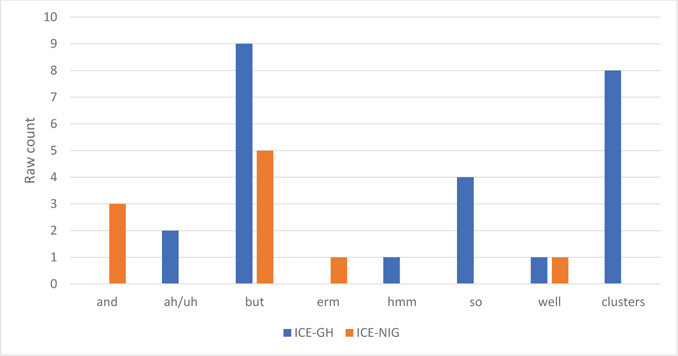
Figure 2 shows the kinds of DPF s that anyway collocates with as well as their frequencies.
Collocational patterns of anyway in ICE-GH and ICE-NIG
Citation: Contrastive Pragmatics 6, 3 (2025) ; 10.1163/26660393-bja10135
Figure 2 shows that anyway occurs more frequently with but than other DPF s in both varieties, followed by so in ICE-GH, and and in ICE-NIG, as exemplified in (8), (9) and (10), respectively:
Citation: Contrastive Pragmatics 6, 3 (2025) ; 10.1163/26660393-bja10135
It is only in ICE-GH that anyway co-occurs with a cluster of more than one DPF, as depicted in (11).
Citation: Contrastive Pragmatics 6, 3 (2025) ; 10.1163/26660393-bja10135
5.2 Discourse-Pragmatic Functions of Anyway in GhE and NigE
Table 2 shows the nine functions that anyway performs in ICE-GH and ICE-NIG with their frequencies. The table indicates that anyway performs additive, resumptive, continuative, mitigation, affirmative, dismissive, and emphatic functions; it can also signal topic change and conversational impasse. Anyway is additive when it adds to an ongoing conversational turn; it is resumptive and continuative when it resumes a topic after an interruption. However, the resumptive function is slightly different from the continuative in the sense that topic continuation anyway is used by the speaker after a digression not instigated by the co-interactant. The resumptive anyway, on the other hand, is the result of a digression that was initiated by the other speakers in the conversation. Anyway may also signal topic change. It is mitigating when used to soften the effect of expressions in a turn on the co-interactant. Here, it indicates the speaker’s awareness of the co-interactant’s emotions and face wants. The affirmative anyway marks the speaker’s confirmation of or agreement with the preceding comment while the dismissive is used to ‘reject the potential inference’ (Aijmer, 2022: 15). Anyway is emphatic when it features at the end of an interrogative sentence typically to express the speaker’s negative emotions, and it can signal conversational impasse when interactants cannot reach an agreement on a topic of discourse and rather decide to change the topic or end the discussion.
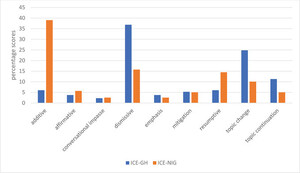
Figure 3 shows that NigE users largely utilise anyway to perform additive, dismissive and resumptive functions, which are illustrated in (12), (13) and (14), respectively:
Citation: Contrastive Pragmatics 6, 3 (2025) ; 10.1163/26660393-bja10135
Functions of anyway in ICE-GH and ICE-NIG
Citation: Contrastive Pragmatics 6, 3 (2025) ; 10.1163/26660393-bja10135
In (12), anyway signals an addition to a sports commentator’s earlier comment in a wrestling match. The sports commentator, who after commenting on the chances of Nigerians in the competition, adds that Nigerians had the best of wrestlers, with anyway signalling the addition at clause-final position. In (13), anyway is dismissive in a statement where Speaker 2 indicates that they are polished despite being brought up in Mushin which is regarded as a lowbrow area in Lagos, compared to VI (Victoria Island), which is a highbrow area in Lagos. Anyway is resumptive in (14) in a parliamentary debate where the addresser was interrupted by the Speaker of the House of Representatives due to some disturbance from other members of the parliament. He then uses anyway to signal the resumption of his earlier talk.
On the other hand, GhE users of English mainly employ anyway to perform dismissive, topic change and topic continuation functions, as exemplified in (15), (16), and (17), respectively:
Citation: Contrastive Pragmatics 6, 3 (2025) ; 10.1163/26660393-bja10135
In (15), anyway signals a concessive tone; it dismisses the Speaker C’s impression about distance learning, which Speaker B says may be beneficial or appealing to the younger generation. Anyway in (16) signals a topic change from a previous topic where other speakers were laughing and discussing love relationships to a new one initiated by Speaker B on the number of children they would like to have. In (17), it marks the speaker’s continuation of their subject of discourse after a brief pause, possibly to ponder briefly on the accuracy or appropriateness of the adjective with which they described the subject.
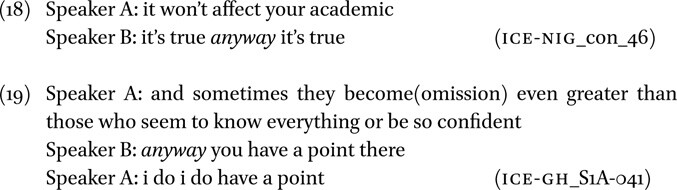
In (18) and (19), both speakers use anyway to signal affirmation, a function that has not been identified for users of other varieties of English. Here, anyway is used to mark confirmation of or agreement with preceding comments.
Citation: Contrastive Pragmatics 6, 3 (2025) ; 10.1163/26660393-bja10135
In (18), speaker B uses anyway to signal the confirmation (it’s true) of Speaker A’s utterance that an action will not affect the academic work of Speaker B, and in (19), Speaker B employs anyway to indicate their agreement (you have a point there) with Speaker A’s opinion.
Other functions such as emphasis, conversational impasse and mitigation are illustrated in (20), (21) and (22), respectively:
Citation: Contrastive Pragmatics 6, 3 (2025) ; 10.1163/26660393-bja10135
Example (20) exemplifies anyway at the end of a wh-interrogative which has been described as polemic, emphatic and known to project a negative connotation (Ranger, 2018; Aijmer, 2022). In the example, it expresses the speaker’s critical view of the elite and their exploitative tendencies and conveys a negative perception of education and the educated class as people who dominate politics. The interrogative clause was not uttered to demand an answer but to express the speaker’s exasperation on the subject of the conversation. In (21), anyway stands alone and it is used to manage the conversation as the speaker does not seem to know how the issue discussed will be resolved. Speaker B needs financial assistance and engages Speaker A for possible assistance. Speaker A responds (how do I give you the money), laughs and uses a stand-alone anyway to manage the turn from being misinterpreted and from ending in a gridlock. Anyway in (22) has a mitigating effect; it is used by Speaker B to weaken the negative effect of the taboo word in the utterance (buttocks), which Speaker A might find unacceptable. The response from Speaker A confirms that they did not pick offense but rather went ahead to establish the fact that their religious and moral orientation did not permit promiscuity for any personal gains.
5.3 Variation in the Use of Anyway in GhE and NigE Text Types
The use of anyway in spoken and written text categories as well as in the individual text categories in the ICE corpora was also examined. Overall, anyway occurred more frequently in ICE-GH (N = 94; 178.5pmw) and ICE-NIG (N = 141; 239.3pmw) spoken texts than in ICE-GH (N = 39; 90.2pmw) and ICE-NIG (N = 18; 44.9pmw) written texts. Anyway occurred in 15 ICE-NIG text categories and 12 ICE-GH text categories, as shown in Table 1, out of the 25 text categories that were examined in the corpora. This indicates that there is a bit more spread of anyway in ICE-NIG text types than in ICE-GH text categories.
Table 1 indicates that anyway occurred most frequently in ICE-NIG demonstrations, conversations, and phone calls, while it occurred most frequently in ICE-GH social letters, phone calls, and conversations. Anyway is largely used to perform additive functions in ICE-NIG demonstrations (N = 9; 75%) and phone calls (N = 6; 75%), as in (23) and (24), respectively. In ICE-NIG conversations, anyway is often employed to fulfill additive (N = 29; 30.2%), resumptive (N = 18; 18.8%) and dismissive functions (N = 15; 15.6%), as in (25), (26) and (27), respectively.
Variation in the use of anyway across ICE-NIG and ICE-GH text categories
Citation: Contrastive Pragmatics 6, 3 (2025) ; 10.1163/26660393-bja10135
Citation: Contrastive Pragmatics 6, 3 (2025) ; 10.1163/26660393-bja10135
In (23), while demonstrating how to add accessories to a client’s temporary henna hand tattoos (laali), the speaker informs the audience that she would select pink studs, and uses anyway to signal additional information that she would do so to make the design look more trendy and attractive. Since demonstrations involve teaching and illustrating different phenomena, the addresser will likely have many reasons to provide the audience with additional information; such additional information may be marked by different discourse markers, including anyway. In (24), Speaker 1 indicates that former Nigerian President Goodluck Jonathan is incapable of managing the crisis in the country and uses anyway to signal additional information that the whole world knows he can.
Citation: Contrastive Pragmatics 6, 3 (2025) ; 10.1163/26660393-bja10135
Conversations involve different kinds of informal interactions during which interlocutors may discuss different kinds of topics, indicating contrasting opinions on topics, sometimes moving unto different topics, and then returning to previous topics. To sustain the discourse, interactants may also provide additional information to contribute to ongoing talk, clarify statements or provide reasons for certain actions (Thornbury and Slade 2006); anyway may sometimes be employed to signal some of these functions. In (25), Speaker 1 indicates that politicians are fraudsters, liars and robbers; Speaker 2 adds to this list by indicating that the politicians are also killers and uses anyway to mark this additional information. In (26), Speaker 2 talks about their grouse with the former President, Goodluck Jonathan; however, the discussion goes into other related topics such as previous potential vice-presidential nominees and the system of government in Nigeria by the interactants. Speaker 2 then utilises anyway to signal their return to their previous complaint about Goodluck Jonathan. In (27), Speaker 2 employs anyway to signal the contrast between what they do not know (the concept of Alliance française) and what they know (it’s a French School).
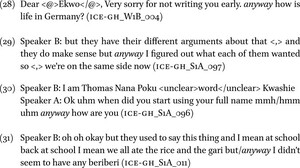
In ICE-GH social letters, out of the 29 instances of anyway in the text type, 14 were used to indicate topic change (48.3%), as in (28), while in ICE-GH phone calls, anyway largely performs both dismissive (N = 6; 28.6%) and topic change (N = 5; 23.8%) functions, as in (29) and (30), respectively; in ICE-GH conversations, anyway is largely used to perform dismissive functions (27 out of 50 cases; 54%), as in (31).
Citation: Contrastive Pragmatics 6, 3 (2025) ; 10.1163/26660393-bja10135
Social letters are written informal correspondence between interlocutors in which writers inform their recipients of different personal issues as well as enquire about matters that affect the interactants. As such, anyway may be employed to signal a change from one topic to the other, as in (28), where the writer apologises to the addressee for not writing sooner, and then uses anyway to signal a topic change that focuses on enquiring about the addressee’s welfare. While ICE phone calls involve informal non-face-to-face-interactions, conversations are informal face-to face-interactions during which interactants express different opinions and move from one topic to the other. As such, anyway may perform dismissive functions, as in (29), where the speaker on a phone call uses anyway to signal the speaker’s identification of arguments raised by different people despite the differences in the arguments, and signal topic change, as in (30), where the speaker switches from asking when the addressee started using their full name to asking after the addressee’s welfare. In (31), the speaker uses anyway in a conversation to signal a concessive situation: they did not get beriberi despite eating a lot of rice and gari (which lack Vitamin B1) while in school.
Table 2 also shows that anyway occurred more significantly in ICE-NIG conversations and commentaries than in the ICE-GH counterparts, while it occurred more significantly in ICE-GH phone calls, social letters and classroom lessons than in the ICE-NIG equivalents. The table also shows that anyway did not appear in ICE-NIG non-broadcast talks and reportage, neither did it appear in ICE-GH demonstrations, skills/hobbies, unscripted speeches, parliamentary debates, and cross-examinations. There was also a low preference for anyway in ICE-NIG broadcast talks, classroom lessons and popular writings and in ICE-GH popular writings and reportage.
6 Discussion
This study set out to (a) examine similarities and differences in the frequencies and positions of anyway between NigE and GhE; (b) explore similarities and dissimilarities in the collocational patterns and pragmatic functions of anyway between NigE and GhE; and (c) investigate text type distinction in the use of anyway in NigE and GhE. In this sub-section, we discuss the effects of the outcomes for the pragmatics of GhE and NigE and relate the findings to the use of anyway in other world Englishes.
With regards to the frequency of anyway in the two varieties, the study shows that there is no significant variance in the frequency of anyway between GhE and NigE. The similarity in the frequency of anyway is expected since NigE and GhE share linguistic similarities such as in the use of syntactic features and stance markers (Bamiro, 1995; Gut and Unuabonah, 2019). However, the frequency of anyway is lower in NigE and GhE compared to ENL varieties such as British English, at least when considering face-to-face interactions and phone calls (see Aijmer, 2022). The lower rate of occurrence of anyway in these varieties compared to ENL varieties may be linked to the influence of ethnic languages, where equivalents from indigenous languages are sometimes used in place of the English forms in ESL varieties. This can be seen in the case of sha in NigE (Unuabonah and Oladipupo, 2018). Sha, which is the shortened form of Yoruba amosha, is similar to anyway and performs similar functions with anyway in NigE. Moreover, Fairhurst (2013) also confirms that anyway occurs less frequently in East African Englishes, which are ESL varieties, than in South African English, represented by ICE-South Africa that captures White South African English, which is an ENL variety (Jeffery, 2003). As previous studies have shown, a number of English stance markers and pragmatic markers occur less frequently in these two varieties than in ENL varieties (e.g. British English; Unuabonah and Gut, 2018; Unuabonah, 2019; Gut and Unuabonah, 2019), and this is also confirmed for anyway.
In relation to the positioning of anyway in the clauses, the study shows that anyway occurs more frequently at clause-initial position in GhE, and this is similar to what obtains in American English, Canadian English, Philippine English and Singapore English (Aijmer, 2022). This preference for the clause-initial position in GhE may indicate a greater influence of American English on GhE, at least in relation to the positioning of anyway. The opposite is the case for the position of anyway in NigE where there is the preference for anyway at clause-final position. The preference for the clause-final position of anyway in NigE is similar to what obtains in Irish English, British English, Australian English and New Zealand English (Aijmer, 2022), which may reflect a greater influence of British English on NigE, at least in relation to anyway. It is also probable that the preference for the clause-final position of anyway in NigE is tied to the preference for the clause-final position of sha, which shares similar functions with anyway (Unuabonah and Oladipupo, 2018).
Regarding the collocation of anyway with other DPF s, the frequency of but as the highest collocating DPF with anyway is similar to what obtains in other varieties (Aijmer, 2022). But may have been preferred since it reinforces the dismissive function of anyway. What is also noticeable is that when and co-occurs with anyway, anyway is used to perform additive functions. This confirms the suggestion that the functions of anyway may be influenced by the item it collocates with (Aijmer, 2022). In terms of the discourse-pragmatic roles of anyway in the two West African varieties, anyway performs functions that have been identified in other varieties, which is to be expected since they are varieties of one language. However, this study confirms the use of anyway in signalling affirmation, a function that has not been identified in other varieties. Thus, the affirmative function may be a distinctive function of anyway in West African English varieties. Furthermore, there seems to be some variation in the functions of anyway between the two varieties. While GhE users largely utilise anyway to perform dismissive and topic change functions, NigE users mainly employ anyway to perform additive functions. It appears this variation is due to NigE users’ utilisation of sha (Yoruba anyway) to perform, not only additive functions, but also dismissive functions (Unuabonah and Oladipupo, 2018). Thus, it seems NigE users rely less on anyway to perform other functions since they can utilise sha to perform other roles such as dismissive and mitigation functions.
In relation to the use of anyway across different spoken and written text categories in GhE and NigE, the study reveals that overall, anyway occurs more often in spoken text types (which is typical of many pragmatic markers) than in written text categories except in GhE social letters, which may be linked to the informality of social letters. In both varieties, anyway generally occurs more often in informal spoken texts, represented by conversations and phone calls. However, in NigE, anyway also occurs very frequently in monologues, represented by demonstrations and commentaries, which confirms previous studies that NigE users utilise pragmatic markers very commonly in monologues (Unuabonah, 2019). The frequent use of anyway and other pragmatic markers in NigE monologues may be linked to a need to make the monologues more engaging for the addressees, and indicate how different pieces of information fit into one another in the interactions. On the other hand, anyway does not occur very often in GhE monologues, which might indicate that pragmatic markers do not generally occur very frequently in GhE monologues; however, this latter point needs to be investigated further to confirm this. For GhE, anyway features more often in social letters and novels which contain informal interactions; this foregrounds the connection of anyway to informality. In addition, there seem to be some links between a few text types and the functions of anyway within individual varieties. For instance, speakers in NigE monologues and phone calls largely employ anyway in performing additive functions while speakers in GhE phone calls mainly utilise anyway in carrying out dismissive and topic change functions. While speakers in NigE conversations utilise anyway in carrying out additive functions, speakers in GhE conversations use it for performing dismissive functions. This might indicate that regional variety has a greater influence on the use of anyway than text type, at least, in African Englishes.
7 Conclusion
This study has examined the use of anyway in two West African English varieties: GhE and NigE. The similarities in the use of anyway between GhE and NigE may be based on their similar socio-historical development and demographic proximity while the differences may be based on communicative preferences in the genres. The study also identifies an affirmative function of anyway in the two varieties that has not been discussed in previous studies. Notwithstanding, it appears that GhE shares some structural features with American English in terms of positioning, while NigE shares some structural features with British English. Thus, this study contributes, not only to the examination of anyway as a pragmatic marker, but also, to pragmatic variation between these two West African varieties and between these African varieties and other world Englishes. However, this study has utilised corpora that contain only offline interactions; hence, further studies may explore the use of anyway in corpora that contain online interactions which are sites where users increasingly interact with one another. This might reveal other functions of anyway among speakers of African varieties of English. Moreover, this study has focused on only two varieties; thus, further studies on anyway are still required in other African varieties of English so as to endorse or negate some of the findings of this article. In addition, it is also necessary to examine other discourse-pragmatic features in African Englishes, which will further contribute to the pragmatics of African Englishes.
Acknowledgements
The authors appreciate the journal editors and two anonymous reviewers for their very useful comments on this paper.
References
Adegbija, Efurosibina. 1989. A comparative study of politeness phenomena in Nigerian English, Yoruba and Ogori. Multilingua 8(1): 57–80.
Adegbija, Efurosibina, and Janet Bello. 2001. The semantics of ‘okay’ (OK) in Nigerian English. World Englishes 20: 89–98.
Aijmer, Karin. 2013. Understanding Pragmatic Markers: A Variational Pragmatic Approach. Edinburgh: Edinburgh University Press.
Aijmer, Karin. 2016. Pragmatic markers as construction. The case of anyway. In: Gunther Kaltenböck, Evelien Keizer, and Arne Lohmann (eds.), Outside the Clause. Form and Function of Extra-Clausal Constituents. Amsterdam: John Benjamins, 29–57.
Aijmer, Karin. 2022. “Well he’s sick anyway like”: Anyway in Irish English. Corpus Pragmatics 6: 101–125.
Aijmer, Karin, and Anne-Marie Simon-Vandenbergen. 2011. Pragmatic markers. In: J. Zienkwoski, J.-O. Östman, and J. Verschueren (eds.), Discursive Pragmatics. Amsterdam: John Benjamins, 223–247.
Akinlotan, Mayowa. 2018. Structural patterns of postmodifier in Nigerian English noun phrase. Glottotheory 9(1): 41–75.
Akinola, Aderonke, and Rotimi Oladipupo. 2022. A corpus-based study of word stress free variation in Nigerian English. English Today 38 (3): 165–177.
Amuzu, Evershed K., Abigail A. Kuwornu, and Sylvia Opoku-Fofie. 2018. “Awww, we r sorry wai”: Pragmatic functions of L1 discourse markers in Ghanaians’ English-based WhatsApp conversations. Contemporary Journal of African Studies 5(2): 60–86.
Anchimbe, Eric. 2018. Offers and Offer Refusals: A Postcolonial Pragmatics Perspective on World Englishes. Amsterdam: John Benjamins.
Anderson, Jemima Asabea. 2009. Polite requests in non-native varieties of English: The case of Ghanaian English. Linguisitica Atlantica 30: 59–86.
Anthony, Lawrence. 2015. AntConc (Version 3.4.4) [Computer Software]. Tokyo: Waseda University. http://www.laurenceanthony.net/ (accessed 10 August 2015).
Bamiro, Edmund. 1995. Syntactic variation in West African English. World Englishes 14 (2): 189–204.
Beeching, Kate. 2016. Pragmatic Markers in British English: Meaning in Social Interaction. Cambridge: Cambridge University Press.
Brato, Thorsten. 2019. Lexical expansion in Ghanaian English from a diachronic perspective: A structural and semantic analysis. In: Alexander Esimaje, Ulrike Gut, and Bassey E. Antia (eds.), Corpus Linguistics and African Englishes. Amsterdam: John Benjamins, 260–291.
Brato, Thorsten. 2020. Noun phrase complexity in Ghanaian English. World Englishes 39: 377–393.
Brinton, Laurel. 1996. Pragmatic Markers in English: Grammaticalization and Discourse Functions. Berlin: Walter de Gruyter.
Brinton, Laurel. 2008. The Comment Clause in English: Syntactic Origins and Pragmatic Development. Cambridge: Cambridge University Press.
Buysse, Lieven. 2012. So as a multifunctional discourse marker in native and learner speech. Journal of Pragmatics 44: 1764–1782.
Collins, Peter C. 2022. Comment markers in world Englishes. World Englishes 41: 244–270.
Degenhardt, Julia. 2024. Parentheticals in spoken Indian and Sri Lankan English. World Englishes: 1–18. https://doi.org/10.1111/weng.12696.
Eberhard, David M., Gary F. Simons, and Charles D. Fennig (eds.). 2023. Ethnologue: Languages of the world. Texas: SIL International. http://www.ethnologue.com. (accessed 21 July 2023).
Fairhurst, Melanie. 2013. The pragmatic markers anyway, okay and shame: A comparative study of two African varieties of English. Unpublished Master’s thesis. University of Stellenbosch.
Ferrara, Kathleen W. 1997. Form and function of the discourse marker anyway: Implications for discourse analysis. Linguistics 35(2): 343–378.
Fraser, Bruce. 1996. Pragmatic markers. Pragmatics 6(2): 167–190.
Fraser, Bruce. 2009. Topic orientation markers. Journal of Pragmatics 41. 892–898.
Fuchs, Robert, Ulrike Gut, and Taiwo Soneye. 2013. ‘We just don’t even know’: The usage of the pragmatic focus particles even and still in Nigerian English. English World-Wide 34(2): 123–145.
Gut, Ulrike. 2012. Standards of English in West Africa. In: Raymond Hickey (ed.), Standards of English. Cambridge: Cambridge University Press, 213–228.
Gut, Ulrike. 2017. English in West Africa. In: Markku Filppula, Juhani Klemola & Devyani Sharma (eds.), The Oxford Handbook of World Englishes. Oxford: Oxford University Press, 491–507.
Gut, Ulrike, and Foluke O. Unuabonah. 2019. The use of stance markers in West African Englishes. In Alexandra U. Esimaje, Ulrike Gut, and Bassey B. Antia (eds.), Corpus Linguistics and African Englishes. Amsterdam: John Benjamins, 206–229.
Gut, Ulrike, and Foluke O. Unuabonah. 2024. Expressing gratitude in Nigerian English. English World-Wide. https://doi.org/10.1075/eww.23061.gut.
Hafiz, Mohamed, Mie Hiramoto, Jakob R. E. Leimgruber, Wilkinson D. W. Gonzales, and Jun J. Lim. 2024. Sociolinguistic variation in Colloquial Singapore English sia. World Englishes, 1–19. https://doi.org/10.1111/weng.12700.
Haselow, Alexander. 2015. Left vs. right periphery in grammaticalisation: The case of anyway. In: Andrew Smith, Graeme Trousdale, and Richard Waltereit (eds.), New Directions in Grammaticalisation Research. Amsterdam: John Benjamins, 157–186.
House, Juliane, and Daniel Z. Kádár. 2021. Cross-Cultural Pragmatics. Cambridge: Cambridge University Press.
Huber, Magnus. 2004. Ghanaian English: Phonology. In: Edgar W. Schneider, Kate Burridge, Bernd Kortmann, Rajend Mesthrie, and Clive Upton (eds.), A Handbook of Varieties of English. Berlin: De Gruyter Mouton, 842–865.
Huber, Magnus, and Kari Dako. (compilers). 2013. International Corpus of English, Ghana Component (preliminary version of January 19, 2021). Giessen: University of Giessen.
Huddlestone, Kate, and Melanie Fairhurst. 2013. The pragmatic markers anyway, okay, and shame: A South African English corpus study. Stellenbosch Papers in Linguistics 42: 93–110.
Izutsu, Mitsuko N., and Katsunobu Izutsu. 2022. American and Irish English speakers’ perceptions of the final particles so and but. World Englishes 41(2): 207–223.
Jeffery, Chris. 2003. On compiling a corpus of South African English. Southern African Linguistics and Applied Language Studies 21(4): 341–344.
Jowitt, David. 2019. Nigerian English. Berlin: Mouton de Gruyter.
Lange, Claudia. 2021. Basically in Singapore English. World Englishes 40: 488–501.
Mazzon, Gabriella. 2019. Variation in the expression of stance across varieties of English. World Englishes 38(4): 593–605.
Mulder, Jean, Cara P. Williams, and Erin Moore. 2019. Sort of in Australian English: The elasticity of a pragmatic marker. Journal of Asian Pacific Communication 29(1): 9–32.
Muro, Loveluck P., and Foluke O. Unuabonah. 2022. Borrowed discourse-pragmatic features in Kenyan English. Language Matters 53 (2): 3–22.
Mustapha, Abolaji S. 2011. Compliment response patterns among speakers of Nigerian English. Journal of Pragmatics 43(5): 1335–1348.
Ogoanah, Felix. 2011. The pragmatic roles of as in in Nigerian English usage. World Englishes 30(2): 200–210.
Oladipupo, Rotimi O., and Foluke O. Unuabonah. 2021. Extended discourse-pragmatic usage of now in Nigerian English. World Englishes 40(3): 371–389.
Oyebola, Folajimi, Foluke O. Unuabonah, and Florence O. Daniel (forthcoming). General extenders in African Englishes. In Istvan Kecskes, Alfred Buregeya, Akin Odebunmi, Foluke O. Unuabonah, Kofi Agyekum, and Hanh. Dinh (Eds.), Pragmatics of African Varieties of English. Berlin: De Gruyter.
Park, Innhwa. 2010. Marking an impasse: The use of anyway as a sequence-closing device. Journal of Pragmatics 42: 3283–3299.
Ranger, Graham. 2018. Discourse Markers – An Enunciative Approach. Cham: Palgrave MacMillan.
Sarfo-Kantankah, Kwabena. 2021. I withdraw and apologise but …: Ghanaian parliamentary apologies, the issue of sincerity and acceptance. Journal of Pragmatics 180: 1–14.
Sarfo-Kantankah, Kwabena S., and Ben K. Yussif. 2019. The use of actually in a non- native English parliamentary context: A corpus study. Word 65(4): 234–251.
Schneider, Edgar W. 2007. Postcolonial English: Varieties around the World. Cambridge: Cambridge University Press.
Schneider, Klaus P. 2012. Pragmatic variation and cultural models. Review of Cognitive Linguistics 10(2): 346–372.
Schneider, Klaus P., and Anne Barron. 2008. Where pragmatics and dialectology meet: Introducing variational pragmatics. In: Klaus P. Schneider & Anne Barron (eds.), Variational Pragmatics: A Focus on Regional Varieties in Pluricentric Languages. Amsterdam: John Benjamins, 1–32.
Schneider, Klaus P. 2021. Variational pragmatics. In Dániel Z. Kádár, Marina Terkourafi & Michael Haugh (Eds.), The Cambridge Handbook of Sociopragmatics. Cambridge: Cambridge University Press, 663–686. https://doi.org/10.1017/9781108954105.034.
Taiwo, Rotimi. 2024. Otherness and cultural conceptualisations of Gender and Social Class in Nigerian English. World Englishes 43(3): 456–470.
Thompson, Rachel. 2019. Tweaa! – A Ghanaian interjection of “contempt” in online political comments. Ampersand 6: 100047.
Thornbury, Scott, and Diana Slade. 2006. Conversation: From Description to Pedagogy. Cambridge: Cambridge University Press.
Torgersen, Eivind, Costas Gabrielatos, and Sebastian Hoffmann. 2017. A corpus-based analysis of the pragmatic marker you get me. In: Eric Friginal (ed.), Studies in Corpus-Based Sociolinguistics. Oxford: Routledge, 176–196.
Unuabonah, Foluke O. 2019. Frequency and stylistic variability of discourse markers in Nigerian English. Corpus Pragmatics 3: 249–271.
Unuabonah, Foluke O. 2021. “Oya, let’s go to Nigeria”: A corpus-based investigation of bilingual pragmatic markers in Nigerian English. International Journal of Corpus Linguistics 26(3): 370–395.
Unuabonah, Foluke O., and Jemima A. Anderson. 2023. “You are quite funny paa!”: A corpus-based study of borrowed discourse-pragmatic features in Ghanaian English. Corpus Pragmatics 7(3): 267–289.
Unuabonah, Foluke O., and Florence O. Daniel. 2020. Haba! Bilingual interjections in Nigerian English. Journal of Pragmatics 16: 66–77.
Unuabonah, Foluke O., and Ulrike Gut. 2018. Commentary pragmatic markers in Nigerian English. English World-Wide 39 (2): 193–213.
Unuabonah, Foluke O., and Noloyiso Mtembu. 2023. Multilingual pragmatic markers in South African English. Southern African Linguistics and Applied Language Studies 41 (3): 264–279.
Unuabonah, Foluke O., and Rotimi O. Oladipupo. 2018. “You’re not staying in Island sha o”: O, sha and abi as pragmatic markers in Nigerian English. Journal of Pragmatics 135: 8–23.
Wolf, Hans-Georg, and Herbert Igboanusi. 2003. A preliminary comparison of some lexical items in Nigerian English and Cameroon English. In: Peter Lucko, Peter Lothar and Hans-Georg Wolf (eds.), Studies in African varieties of English. Frankfurt am Main: Peter Lang, 69–81.
Wunder, Eva-Maria, Holger Voormann, and Ulrike Gut. 2010. The ICE Nigeria corpus project: Creating an open, rich and accurate corpus. ICAME Journal 34: 78–88.
Biographical Notes
Foluke Olayinka Unuabonah teaches at the Department of English, Redeemer’s University, Ede, Nigeria. Her research areas include (multimodal) discourse analysis and (corpus) pragmatics. Some of her publications can be found in journals such as Discourse & Communication, Discourse & Society, Journal of Pragmatics, Pragmatics, English World-Wide, World Englishes, Corpus Pragmatics and Intercultural Pragmatics.
Florence Oluwaseyi Daniel lectures at the Department of English, Redeemer’s University, Ede, Nigeria. Her areas of research include (legal) discourse analysis and (corpus) pragmatics. She has published articles in journals such as Journal of Pragmatics, Lingua, English Text Construction and International Journal of Legal Discourse.
See Aijmer and Simon-Vandenbergen (2011) for other names.
“Discourse-pragmatic features” is an umbrella word for a group of lexical items that perform textual and interpersonal functions (Pichler, 2016). They include pragmatic markers, question tags, interjections, intensifiers, quotatives, vocatives and general extenders.
Per million words.
There was a long discussion by the interactants on different past potential vice-presidential nominees and the system of government in Nigeria.