Abstract
This study compared the uses of the textual and interpersonal functions of English pragmatic markers (PMs) by learners of English as a foreign language (EFL) from three different linguacultural backgrounds in two spoken genres. Thirty Chinese, 30 Thai and 30 Indonesian EFL learners were recruited to participate in semi-structured interviews and dyadic conversations. Significant differences in the ways in which the participants used textual and interpersonal functions in the two spoken genres were found, whereas there were significant differences in the use of textual functions by speakers from different linguacultural backgrounds. The spoken genres and the linguacultural backgrounds mainly affected the more frequently used functions, and had no effect on the functions that were used less frequently. Furthermore, the spoken genre had a greater effect on the different uses of the functions of English PMs than did the linguacultural backgrounds.
1 Introduction
Several studies of the use of English pragmatic markers (PMs) by learners of English as a second or foreign language (ESL or EFL) have compared their use of PMs to that of native English speakers, with the results being described as “overuse” (Aijmer, 2011; Ament et al., 2020) or “underuse” (Alkhawaja et al., 2023; Müller, 2005). Despite the fruitful results, criticism of adopting native English speakers’ use of English as the norm in ESL or EFL studies has increased (Barron, 2019; Taguchi, 2022; Taguchi and Caprario, 2024; Taguchi and Li, 2021) because ESL and EFL learners “do not always use the target language to mimic native speakers” (Taguchi and Li, 2021: 10), but use English to exchange information or to achieve mutual understanding. Gilquin (2020: 289) also contended that overuse and underuse “are not meant as being evaluative but purely descriptive”. Hence, it is essential to examine ESL or EFL learners’ use of English PMs without adopting native English speakers’ use of PMs as the norm. While recent studies have examined the English PMs used by EFL learners from different linguacultural backgrounds in Asia, such as China (Xiao et al., 2021) and Thailand (Pan, 2023), these studies have only focused on individual PMs, such as well and you know; thus, how these EFL learners use English PMs as a complete category remains unknown. Moreover, as each study only examined the use of English PMs by EFL learners from one linguacultural background, there is limited knowledge regarding whether EFL learners from different linguacultural backgrounds used English PMs similarly or differently. Thus, it is essential to compare the use of English PMs by EFL learners from different linguacultural backgrounds.
Accordingly, the present study sought to compare the pragmatic functions of the English PMs used by EFL learners from three linguacultural backgrounds in two spoken genres, namely semi-structured interviews and dyadic conversations. The first of the three aims of the study was to investigate whether there were significant differences in EFL learners’ use of the pragmatic functions of the English PMs in the two spoken genres. The second aim was to examine whether there were cross-cultural variations in EFL learners’ use of the pragmatic functions of English PMs in the semi-structured interviews and dyadic conversations. The third aim was to identify the similarities and differences in EFL learners’ use of the pragmatic functions of English PMs in relation to the genre and to the participants’ linguacultural backgrounds. The results of this research revealed distinct patterns in the use of the pragmatic functions of English PMs by EFL learners from different linguacultural backgrounds in the two spoken genres. The three research questions were as follows:
1 Is there a significant difference in EFL learners’ use of the pragmatic functions of English PMs in the semi-structured interviews and dyadic conversations?
2 Are there cross-cultural variations in EFL learners’ use of the pragmatic functions of English PMs in the semi-structured interviews and dyadic conversations?
3 What are the similarities and differences in EFL learners’ use of the pragmatic functions of English PMs in the two spoken genres and across different linguacultural backgrounds?
2 Literature Review
2.1 Pragmatic Markers
The use of the terms “discourse markers” and “pragmatic markers” to describe the same markers in previous studies has created some confusion in this field. For example, the marker like was labelled as a pragmatic marker by Magliacane and Howard (2019) and by Santos (2019), but as a discourse marker by Öztürk and Köse (2021) and by Pan and Aroonmanakun (2022). This raises the question of whether there is a difference between the two terms. A closer examination of the use of the marker like in these studies revealed that the main investigation focused on non-native English speakers’ use of the different functions of this marker. The functions of this marker were found to be the same, despite the use of different terms for certain functions in various studies (Magliacane and Howard, 2019; Pan and Aroonmanakun, 2022).
No consensus regarding the appropriate terminology for these types of markers has been reached, but the differences between the terms have been discussed. Hansen (2006: 28) stated that “discourse markers should be considered a hyponym of pragmatic markers”, whereas discourse markers were mainly used for “transactional coherence”, and PMs comprised “various forms of interactional markers” that served to ensure “interactional coherence”. This viewpoint is consistent with that of Fraser (2009: 296), who considered discourse markers to be a sub-type of PMs that “typically signal a relation between the discourse segment which hosts them and the prior discourse segment”. Therefore, discourse markers have mainly been regarded as markers that serve a variety of coherence functions to connect discourse (Crible and Blackwell, 2020; Leuckert and Rüdiger, 2021; Unuabonah, 2019). Although some early research included a wider range of functions apart from the coherence functions when using the term “discourse markers”, such as interactional or cognitive functions (Fung and Carter, 2007; Müller, 2005), recent studies have mainly used the term “pragmatic markers” when studying PMs at the interpersonal level (Pan, 2023; Vine and Holmes, 2023). Brinton (2008, 2017) used the term “pragmatic markers” to highlight interpersonal use in interactions, and defined PMs as “phonologically short items that have no or little referential meaning but serve pragmatic or procedural purpose” (Brinton, 2008: 1). Thus, PMs function at the discoursal and interpersonal levels (Crible and Blackwell, 2020). As the definition of PMs proposed by Brinton (2008) unifies the discoursal and interpersonal levels, this study follows this definition.
2.2 Theoretical Frameworks for Analysing Pragmatic Markers
In addition to issues pertaining to the terminologies for and definitions of PMs, the criteria for identifying PMs and the framework for studying their pragmatic functions have not been unified. Previous research identified PMs based on the features of the PMs found in earlier research (Pan, 2023) or by adopting a bottom-up approach (Müller, 2005). As this study examined the English PMs used by EFL learners via a learner corpus research (LCR) method, it used the bottom-up approach to identify English PMs based on their features using concordances in AntConc (Anthony, 2023). Based on previous research (Aijmer, 2011; Ament et al., 2020; Brinton, 2017; Crible and Blackwell, 2020; Diskin, 2017; Leuckert and Rüdiger, 2021; Pan and Aroonmanakun, 2022; Pan, 2023), this study classified English PMs according to the six features shown in Figure 1.

Features of PMs adapted from previous research
Citation: Contrastive Pragmatics 6, 2 (2025) ; 10.1163/26660393-bja10120
PMs are short lexical items that are phonologically unstressed in interactions, such as and, like, you know and I mean (Aijmer, 2011; Brinton, 2017; Vine and Holmes, 2023). They typically occur in the initial position of an utterance, but certain PMs tend to be used at the end of an utterance, such as like (Diskin, 2017). They are syntactically independent; thus, deleting them from an utterance has little or no effect on the semantic meaning of the utterance. Moreover, they have little or no referential meaning in any given utterance, but have pragmatic or procedural meanings instead (Brinton, 2017). Most importantly, they have a diverse range of functions that indicate pragmatic value (Aijmer, 2011; Pan, 2023). These six features of English PMs were used, together with Brinton’s (2008) definition of PMs, as criteria to identify the English PMs used by EFL learners in this research.
Although function analysis has been a major concern in studies of PMs, the development of a theoretical framework for studying their functions has been difficult, mainly because each PM has unique functions. A few studies have attempted to develop theoretical frameworks for analysing their functions. Fraser (2009) proposed a framework for determining the functions of discourse markers. Although this framework has been used in several studies (Unuabonah, 2019), the discourse markers to which Fraser (2009) referred do not align with the PMs investigated in this study. Fung and Carter (2007) proposed a different framework in which the functions of the PMs were classified according to four categories: referential, structural, cognitive and interpersonal. However, Xiao et al. (2021: 620) pointed out that “the referential function is proposition-based”, and included conjunctions such as because. Thus, this framework is not suitable for the definition of PMs adopted here.
By contrast, the framework proposed by Brinton (2017) is suitable for studying PMs. Brinton (2017) believed that functional semantic changes in PMs created two major functional categories. At the discoursal level, they created “cohesive passages of discourse” (Brinton, 2017: 11). They marked various boundaries in the discourse, such as new topics, requests and repairs. Therefore, the PMs function at the discoursal level to indicate different types of relationships between prior and subsequent utterances, which are identified as textual functions. This function category aligns with the structural function in Fung and Carter’s (2007) framework. At the interpersonal level, PMs exhibit different types of (inter)subjectivity to maintain the interactions and relationships between speakers and hearers. The interactants used different PMs to express “attitudes, judgments, expectation, and demands, as well as aspects of the social exchange” (Brinton, 2017: 11). These interpersonal functions have a pragmatic effect on the hearer’s understanding of the speaker in both interactional and cognitive aspects, and can influence the cooperation and intimacy of the interactants in communications. Figure 2 illustrates the two main pragmatic functions of PMs, based on Brinton’s (2008, 2017) work.
Two major pragmatic function categories of PMs, adapted from Brinton (2017)
Citation: Contrastive Pragmatics 6, 2 (2025) ; 10.1163/26660393-bja10120
Brinton’s (2017) framework is an overarching concept that covers the concrete functions of each PM, as detailed in previous studies (Pan and Aroonmanakun, 2022), based on a series of empirical studies from synchronic and diachronic perspectives (Brinton, 2008, 2017; Pan, 2023). It is a concise framework for conceptualising the fundamental pragmatic functions of PMs in communication. The two major pragmatic function categories at the discoursal and interpersonal levels clearly and sufficiently reveal the roles of the PMs in discourses and interactions. Moreover, several recent studies have acknowledged and used this framework (Crible and Blackwell, 2020; Leuckert and Rüdiger, 2021; Pan, 2023; Pan and Aroonmanakun, 2022). Hence, Brinton’s (2017) framework for studying the pragmatic functions of PMs was deemed to be suitable for this study.
2.3 Recent Studies of Pragmatic Markers Used by Learners of English
As mentioned in the previous section, recent studies of EFL learners’ use of English PMs have focused on only one or several individual PMs. Although these studies shed light on EFL learners’ use of English PMs in comparison to their use by native English speakers, these studies have reported somewhat contradictory findings.
Öztürk and Köse (2021) and Pan and Aroonmanakun (2022) conducted similar comparative research on Turkish and Thai EFL learners’ use of several English PMs that had been analysed frequently in previous research (e.g., well and you know). Both studies adopted native English speakers’ use of PMs as the norm; however, their results differed. Öztürk and Köse (2021) found that there was no significant difference in the use of like and you know between Turkish EFL learners and native English speakers, while Pan and Aroonmanakun (2022) found no significant difference in the use of like and I mean between Thai EFL learners and native English speakers; however, you know was underused by Thai EFL learners and I mean was underused by Turkish EFL learners. Moreover, Turkish EFL learners used you know to mark self-repair as a textual function, whereas Thai EFL learners did not. The different results in both studies clearly show that a comparison of the use of English PMs with native English speakers’ use cannot fully reveal the complete picture of how EFL learners use English PMs, hence the conflicting findings (Xiao et al., 2021).
Several other studies have examined EFL learners’ use of English PMs, but they have various deficiencies that have caused their results to differ. Arya (2020) investigated a frequency list of the English PMs used by Thai EFL learners, and found that the most frequent PMs were and, OK, but and so, while other PMs such as you know, well and I think were used less frequently. This result not only contradicts Aijmer’s (2011) and Müller’s (2005) findings that Swedish and German EFL learners used well more often than did native English speakers, but also contrasts with Pan and Aroonmanakun’s (2022) findings that Thai EFL learners overused I think in comparison to native English speakers. The discrepancies in these results may have been due to different research designs. Xiao et al. (2021) conducted a longitudinal study of Chinese EFL learners’ use of three English PMs (yeah, well and you know), and found that the participant’s role influenced the use of English PMs. Unfortunately, Xiao et al. (2021) used role-play and film-situated dialogue tasks to collect data; thus, the results may not have revealed the ways in which Chinese EFL learners used English PMs in actual communication.
A critical review of recent studies of the English PMs used by EFL learners revealed substantial achievements in this field. However, the conflicting findings of these studies do not allow us to draw generalisations regarding EFL learners’ use of PMs. These inconsistent results, based on comparisons with native English speakers’ use of English PMs, further indicate that this type of comparison cannot fully explain the patterns of English PM use by EFL learners from different linguacultural backgrounds in any type of oral communication. Hence, the current study did not compare EFL learners’ use of PMs to that of native English speakers in the present study, but focused on the pragmatic functions of English PM use in two spoken genres by EFL learners from different linguacultural backgrounds instead.
3 Methodology
3.1 Participants
Many universities in Thailand have recently begun to provide diverse majors in English or international programmes at the undergraduate level to attract more international students, particularly those from neighbouring countries such as China. Therefore, many international students from different countries attend universities in Thailand.
The 90 participants who were recruited for this study consisted of 30 Chinese, 30 Thai and 30 Indonesian EFL learners. There were 33 male (37%) and 57 female (63%) students in the sample, but gender was not included as a variable. All the participants were undergraduate students enrolled in English or international programmes in four faculties (e.g., the School of Information Technology) at a public university in Bangkok, Thailand. They were first- and second-year students who were aged between 18 and 21 during the data collection period. The researcher hung several posters around the university campus to recruit participants. Each participant provided consent to participate in the study before the data collection began, as required by the university’s ethics committee.
All the participants were EFL learners, and their first languages (L1s) were the official languages of their respective home countries; English was regarded as a foreign language for the participants who, despite having studied EFL in their home countries, did not necessarily use it in daily communication (Yoon, 2020). All the participants had been studying EFL at school for 11–14 years in accordance with the different education policies of their countries. None of the participants had intentionally studied English in an English-speaking country prior to the data collection. The participants’ level of English proficiency was intermediate according to their valid scores on specific international English examinations (e.g., IELTS) and the Common European Framework of Reference for Languages (CEFR; Council of Europe, 2020).
3.2 Data Collection
The data for this study were collected in January and February 2023. Each participant was required to engage in a semi-structured interview with the researcher, who worked at the same university as their English lecturer, and a dyadic conversation. The researcher prepared 10 questions (see Appendix B) based on the syllabus of the English course that the participants were required to attend. The topics covered five areas: happiness, university life, advanced technology, urban life and social media. As the interviews were semi- structured, the researcher had the opportunity to ask other questions in response to the different and unpredictable answers provided by each participant. Each semi-structured interview lasted approximately 20 minutes.
Pairs of participants with the same nationality were required to conduct dyadic conversations in English, and were allowed to discuss anything they wished. Although the participants could not be prevented from using words from their L1s, each participant was informed about the requirement to only use English prior to the dyadic conversations to guarantee oral communication using EFL. The paired participants knew each other because they were friends or classmates at the same faculty and were from the same country. Each conversation lasted for approximately 20 minutes.
It should be noted that the semi-structured interviews in this study were conducted in an informal setting and did not follow strict procedures. However, as the interviewer was a lecturer at the university, and thus had more social power and higher social status than the participants, and was the one who mainly asked the questions in the interviews, the semi-structured interviews were more formal than the dyadic conversations. To ensure that each participant was as relaxed as possible, data collection occurred on the campus at a location in which each participant felt comfortable, such as common areas in the education building. All the data were collected during each participant’s free time after classes. Furthermore, the researcher was not present when the dyadic conversations occurred to ensure that the participants felt comfortable. The semi-structured interviews and dyadic conversations were recorded using Voice Memos on an iPhone 11, resulting in 28 hours of semi-structured interview recordings and 17 hours of dyadic conversation recordings.
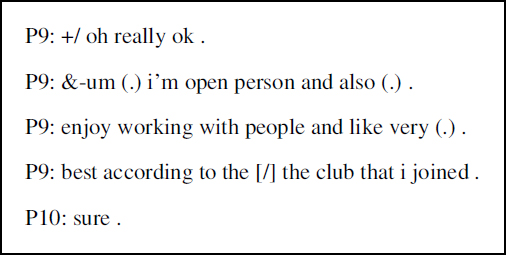
The Codes for Human Analysis of Transcripts (CHAT) format (MacWhinney, 2000) was used to transcribe the data for analysis. CHAT was originally used to establish a corpus containing children’s authentic language. Its transcription format was based on MacWhinney (2000), as shown in Appendix A. Figure 3 presents an example of a transcription extracted from this study.
An example of a CHAT transcription extracted from this research
Citation: Contrastive Pragmatics 6, 2 (2025) ; 10.1163/26660393-bja10120
The two learner corpora created for this study were the Corpus of English Learners’ Interviews (CELI) and Corpus of English Learners’ Conversations (CELC). The CELI contained 185,724 tokens, including 62,860 produced by Chinese EFL learners, 58,346 by Thai EFL learners and 64,518 by Indonesian EFL learners. The CELC contained 196,843 tokens, including 65,369 tokens produced by Chinese EFL learners, 64,244 tokens by Thai EFL learners and 67,230 tokens by Indonesian EFL learners.
3.3 Data Analysis
This study used both quantitative and qualitative methods that are common in the LCR field. A contrastive interlanguage analysis2 (CIA2), proposed by Granger (2015), was used for the comparisons. Granger (2015: 17) highlighted that CIA2 was a response to the criticism of using a native English-speaker corpus as the norm: “[T]he corpus does not necessarily need to represent a norm”. To apply CIA2, learner corpora representing the EFL that learners used in their EFL communications were constructed for this study, as described above. EFL communication refers to communications in which non-native English speakers used English as a foreign language to exchange information and to achieve mutual understanding (Gilquin, 2020; Yoon, 2020). The term “EFL” was used instead of “interlanguage” in this study, as the term “interlanguage” implicitly refers to the language used by non-native speakers in comparison to native speakers, and our sole focus was on the EFL communications produced by EFL learners from different linguacultural backgrounds. Although CIA2 has been used for many years, native English speakers’ use of English remains the norm in studies of ESL or EFL learners’ use of English (Diskin, 2017; Öztürk and Köse, 2021). A few studies have compared the use of English by ESL or EFL learners from different linguacultural backgrounds without using native English speakers as the norm (Barron, 2019; Taguchi and Caprario, 2024), such as studies of request strategies (Ogiermann and Bella, 2020). However, research comparing the use of English PMs by EFL learners from different linguacultural backgrounds is scarce. Figure 4 illustrates the data analysis process that was used to analyse the pragmatic functions of the English PMs used by the EFL learners from different linguacultural backgrounds.
The data analysis process
Citation: Contrastive Pragmatics 6, 2 (2025) ; 10.1163/26660393-bja10120
After completing the written transcription of the spoken data, two raters first identified each English PM that the EFL learners used based on Brinton’s (2008) definition of PMs and the features of PMs discussed above. A bottom-up approach was used to identify each PM based on the concordances provided by AntConc MacOS version (Anthony, 2023). The inter-rater reliability was 0.903 for the identification of the PMs, and discrepancies between the two raters’ findings were discussed until a consensus was reached.
Subsequently, the two raters identified the pragmatic functions of each PM using the concordances provided by AntConc (Anthony, 2023). In addition to Brinton’s (2008, 2017) framework for the pragmatic functions of PMs, the pragmatic functions of each PM found in the previous research enabled the two raters to determine the pragmatic functions of each PM. For example, like has been examined in several studies, in which eight functions were identified (Diskin, 2017; Magliacane and Howard, 2019; Müller, 2005; Öztürk and Köse, 2021; Pan and Aroonmanakun, 2022; Santos, 2019), as illustrated in Table 1.
Functions of the PM like identified in previous research
Citation: Contrastive Pragmatics 6, 2 (2025) ; 10.1163/26660393-bja10120
As mentioned in the previous section, the individual pragmatic functions of each PM can be classified as textual or interpersonal functions based on Brinton’s (2017) framework. For example, as illustrated in Table 1, there are eight functions of like, with functions 1 to 7 belonging to the textual function and function 8 belonging to the interpersonal function. The inter-rater reliability was 0.872 for the identification of the pragmatic functions of the PMs, and discrepancies in the findings of the two raters were discussed until a consensus was reached.
A log-likelihood (LL) test was used to compare significant differences in the pragmatic functions of the English PMs. Following Rayson et al. (2004), the critical LL value was set to 15.13 at the 0.01% level (p < 0.0001) to compare the frequencies of the target tokens in the two corpora at the optimal level.
4 Results and Discussion
The data analysis enabled the identification of 24 English PMs, as shown in Table 2. The EFL learners in this study produced 13,542 English PMs, including 7,243 (53%) in interviews and 6,299 (47%) in conversations. The English PM that the EFL participants used most frequently was uh/um, followed by the English PMs like and I think.
PMs identified in this study
Citation: Contrastive Pragmatics 6, 2 (2025) ; 10.1163/26660393-bja10120
4.1 Different Uses of Pragmatic Functions in Two Spoken Genres
Table 3 presents the descriptive statistics and the LL test results for the textual, interpersonal and all the pragmatic functions in both spoken genres.
Comparison of pragmatic functions in both spoken genres
Citation: Contrastive Pragmatics 6, 2 (2025) ; 10.1163/26660393-bja10120
Table 3 shows significant differences in the use of pragmatic, textual and interpersonal functions in the two spoken genres (LL > 15.13). Both the raw and the normalised frequencies demonstrated that EFL learners used English PMs significantly more often for both textual and interpersonal functions in the semi-structured interviews. These results indicate that different spoken genres affected EFL learners’ use of English PMs in their EFL communication. However, Table 3 also shows that the EFL learners used textual functions more often than interpersonal functions in both spoken genres. This result is similar to that of Arya (2020), who examined the discourse markers used by Thai EFL learners and found a predominance of textual functions, whereas other function categories were used much less often. While significant differences were found, there was a pattern in the EFL learners’ use of English PMs in the two spoken genres, as they mainly used English PMs at the discoursal level. Moreover, if the spoken genre was more formal, EFL learners tended to use both types of functions more often than they did in less formal settings.
4.2 Different Uses of Pragmatic Functions across Linguacultural Backgrounds
Table 4 resents the descriptive statistics and LL test results for both the textual and interpersonal functions of English PMs used by EFL learners from the three linguacultural backgrounds in the semi-structured interviews and dyadic conversations, respectively.
Comparison of pragmatic functions across linguacultural backgrounds
Citation: Contrastive Pragmatics 6, 2 (2025) ; 10.1163/26660393-bja10120
Table 4 shows the patterns in the use of the functions of English PMs by EFL learners from different linguacultural backgrounds. Significant differences were found in the use of the textual functions of English PMs in both spoken genres (LL > 15.13), whereas no significant differences were found in the use of interpersonal functions (LL < 15.13). This indicates that different linguacultural backgrounds had an effect on the use of the textual functions of English PMs, but did not significantly influence the use of the interpersonal functions of English PMs.
Based on Tables 3 and 4, the participants used the textual functions of PMs in both spoken genres much more often than they used the interpersonal functions. As demonstrated in several studies involving EFL learners from various linguacultural backgrounds worldwide (Arya, 2020; Müller, 2005; Öztürk and Köse, 2021; Pan, 2023; Pan and Aroonmanakun, 2022), the present study also showed that the textual functions of English PMs were used more often than were the interpersonal functions. Nevertheless, the EFL learners from different linguacultural backgrounds used the textual functions significantly differently in the two spoken genres (Table 4), which indicates that the linguacultural background should be considered to be a factor that affects the frequency of the use of the textual function in EFL communication. By contrast, the linguacultural background did not affect the EFL learners’ use of interpersonal functions. To elaborate on the EFL learners’ concrete uses of English PMs, the similarities and differences in their use of concrete textual and interpersonal functions are discussed below.
4.3 Similar and Different Uses of Textual Functions according to the Spoken Genre
Following the identification of the EFL learners’ use of the concrete textual functions of English PMs, nine concrete textual functions were found, five of which showed no significant differences based on spoken genre (LL < 15.13), while four showed significant differences (LL > 15.13), as demonstrated in Table 5.
Comparison of EFL learners’ use of concrete textual functions according to the spoken genre
Citation: Contrastive Pragmatics 6, 2 (2025) ; 10.1163/26660393-bja10120
The results of the LL for each textual function that the EFL learners used in the spoken genres (see Table 5) indicated that marking an elaboration function was the most frequent use amongst the five textual functions that showed no significant difference according to the spoken genre. As indicated in previous studies (Ament et al., 2020; Fraser, 2009; Unuabonah, 2019), this function provides an explanation, additional information, or a refinement of a preceding utterance in the context. The English PM and was used most frequently for this function in both spoken genres, as illustrated below.
Citation: Contrastive Pragmatics 6, 2 (2025) ; 10.1163/26660393-bja10120
Thus, the participant used the PM and to provide more information about the previous utterance, “my friend just left”. In line with Ament et al. (2019) and Arya (2020), the EFL learners used and in many instances, not only for the discursive connection but also for the elaboration of a preceding utterance in the different spoken genres. Based on the findings of previous research (Arya, 2020; Fraser, 2009; Unuabonah, 2019), the EFL learners from different linguacultural backgrounds tended to use the PM and most often for different types of textual functions because the PM and has versatile uses in different types of oral communication, and it is relatively easy for EFL learners to master its different uses as a PM during the EFL learning process (Arya, 2020).
By contrast, four textual functions significantly differed according to genre type; the function of searching for the right word was used most frequently in both spoken genres, with uh/um and like being examples of this function, as illustrated in Excerpts 2 and 3.
Citation: Contrastive Pragmatics 6, 2 (2025) ; 10.1163/26660393-bja10120
Tübben and Landert (2022) contended that uh and um had different pragmatic values, one of which was to allow the speaker to think of the next utterance in an interaction. Several studies have analysed this function; the finding that filled or unfilled pauses usually occurred in tandem with this function is a linguistic phenomenon that has been used to identify this function (Diskin, 2017; Müller, 2005; Tübben and Landert, 2022). In line with previous research (MacWhinney, 2000; Pan and Aroonmanakun, 2022), this study deemed a longer pause of between three and five seconds to be a short pause, marked using the symbol “(.)”; a longer pause of between six and 10 seconds was termed a medium pause that was marked using the symbol “(..)”, and a pause that was longer than 10 seconds was called a long pause marked using the symbol “(…)”. Excerpt 2 shows that participant P28 inserted uh, which was followed by a pause of approximately eight seconds, while trying to think of words that could be used to describe what he did in the library. In Excerpt 3, there was a pause of approximately four seconds before the insertion of like, which was followed by a pause of approximately seven seconds. Moreover, the participant repeated the preceding words “he sometime” before completing the entire utterance. Hence, in this context, the participants used like to give themselves more time to consider the words that they wanted to say next.
The EFL learners used each concrete textual function in both spoken genres, with the two textual functions that were mainly used being searching for the right words and marking a repair. However, there were significant differences in the use of both textual functions in the two spoken genres, as the EFL learners used both textual functions much more frequently in semi-structured interviews than in dyadic conversations. According to the excerpts shown above, it seems that the EFL learners from different linguacultural backgrounds attempted to answer each question that the researcher asked to the best of their ability; thus, searching for the right words and marking a repair functions were used significantly more often in the semi-structured interviews than in the dyadic conversations since the participants aimed to speak well when using EFL with the researcher (Pan 2023). Although five textual functions were used at similar frequencies in the spoken genres, they were generally used much less frequently than were those that were used in significantly different ways in the spoken genres.
4.4 Similar and Different Uses of Interpersonal Functions according to Spoken Genre
The EFL learners used six of the interpersonal functions of English PMs in the spoken genres, as illustrated in Table 6.
Comparison of EFL learners’ use of concrete interpersonal functions in both spoken genres
Citation: Contrastive Pragmatics 6, 2 (2025) ; 10.1163/26660393-bja10120
Table 6 indicates that three interpersonal functions were used in significantly different ways (LL > 15.13):
1 marking opinions, feelings, or stances;
2 holding the floor; and
3 as a mitigator.
The remaining three interpersonal functions were used with similar frequencies (LL < 15.13). The main interpersonal function that the EFL learners used in both spoken genres was intended to mark their opinions, feelings and stances. The PM I think was used most often for this function, as illustrated in Excerpt 4.
Citation: Contrastive Pragmatics 6, 2 (2025) ; 10.1163/26660393-bja10120
Previous studies have identified that the main function of I think was to mark the speakers’ personal opinions, feelings or stances towards the object or person that was currently being discussed (Brinton, 2008, 2017; Pan and Aroonmanakun, 2022). In addition to the use of the PM I think, several other PMs, including I mean, so, well and you know, served this function in both spoken genres. Although this function was used most often in both spoken genres, significant differences in its use were also found, as the EFL learners used this function more often in the semi-structured interviews than in dyadic conversations. This may be attributed to several factors. For example, the interviewer’s questions might have elicited more personal opinions, feelings or stances related to each topic from the participants. Moreover, because the interviewer was a lecturer at the university, the participants tended to share their personal opinions and did not provide simple narrations in their responses to the interview questions (Ament et al., 2020).
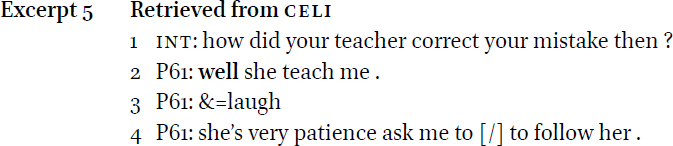
Of the three interpersonal functions used at similar frequencies, the marking of an incomplete answer was used most often in both spoken genres. It has been reported that speakers insert certain PMs to indicate that their answers are not complete responses to the questions posed by the previous speaker (Aijmer, 2011; Müller, 2005; Pan and Aroonmanakun, 2022). In such cases, the speaker usually provides more information after receiving an incomplete answer. The PM well was used most frequently for this function, as illustrated below.
Citation: Contrastive Pragmatics 6, 2 (2025) ; 10.1163/26660393-bja10120
In this excerpt, P61’s answer “she teach me” did not allow the interviewer to fully understand how P61’s teacher corrected his mistake. This is because the interviewer attempted to inquire about the method that the participant’s teacher used in Line 1, but the participant did not answer the question fully in Line 2. After laughing, the participant provided more information about the teacher’s method. The contextual environment indicated that well was used to mark an incomplete answer. Previous research found that the PM well was versatile and had broad applications in different social interactions; thus, it is likely that EFL learners from different linguacultural backgrounds used it for different functions (Aijmer, 2011; Öztürk and Köse, 2021).
An examination of the concrete interpersonal functions that the EFL learners used revealed their use in both spoken genres. The interpersonal functions that were significantly different in the two spoken genres were used much more often than were those that did not differ according to genre. Thus, different spoken genres impacted on the frequency of EFL learners’ use of several textual and interpersonal functions, whereas their use of certain textual and interpersonal functions at low frequencies was not influenced by the spoken genres.
4.5 Uses of Textual Functions across Linguacultural Backgrounds
A detailed examination identified the different uses of concrete textual functions in both spoken genres according to the linguacultural backgrounds of the participants, as shown in Table 7.
Different uses of concrete textual functions according to the participants’ linguacultural backgrounds
Citation: Contrastive Pragmatics 6, 2 (2025) ; 10.1163/26660393-bja10120
Of the nine textual functions presented in Table 5 in the earlier section, the two most frequently used functions, searching for the right words and marking a repair, were used in significantly different ways by participants from different linguacultural backgrounds in the semi-structured interviews, whereas the three most frequently used ones (the two functions mentioned above and the marking a topic shift function) were also used significantly differently by participants from different linguacultural backgrounds in the dyadic conversations.
The same pattern was found for differences in the use of textual functions in both spoken genres. Thai EFL learners used the function of searching for the right words least often, while Chinese EFL learners used the function of repair least often. Moreover, the Indonesian EFL learners used both these textual functions at high frequencies, as indicated below in the example of an Indonesian EFL learner’s use of the marking a repair function.
Citation: Contrastive Pragmatics 6, 2 (2025) ; 10.1163/26660393-bja10120
The Indonesian EFL learners used I mean most often to mark a repair. Research has illustrated that speakers may choose different PMs to assist them to self-correct their errors in their oral communication (Brinton, 2008, 2017; Müller, 2005; Pan and Aroonmanakun, 2022). Speakers may make grammatical or content errors, as demonstrated in Excerpt 6, in which the participant corrected the utterance “my life is fine” as “not perfect fine” by inserting I mean before the self-correction, thereby attracting the listener’s attention to the self-correction. The extensive use of the PM I mean for self-correction may have been due to the influence of the original semantic meaning of I mean from a diachronic point of view (Brinton, 2017).
Moreover, Thai EFL learners used the function of marking a topic shift most frequently in the dyadic conversations, whereas the Chinese EFL learners used it least frequently. This function was used at similar frequencies in the semi-structured interviews. An example of a Thai EFL learner using this function is presented below.
Citation: Contrastive Pragmatics 6, 2 (2025) ; 10.1163/26660393-bja10120
As Excerpt 7 demonstrates, Thai EFL learners used OK most often to mark topic shifts in both spoken genres. In Excerpt 7, P35 used OK to shift the topic from studying to travelling abroad. This finding aligns with the works by Arya (2020) and Xiao et al. (2021), who found that Thai and Chinese EFL learners used OK as a PM to mark a topic shift at a relatively high frequency, which may have been due to the colloquial nature of the PM OK (Alkhawaja et al., 2023; Arya, 2020).
The comparison of the use of textual functions according to the participants’ linguacultural backgrounds revealed that the participants from different linguacultural backgrounds used the most frequently used textual functions in significantly different ways in both genres, whereas the textual functions that were used relatively less frequently were not used significantly differently by participants from different linguacultural backgrounds. This indicates that the factor of the linguacultural background had a major impact on the textual functions that the EFL learners used frequently, but had no influence on the ones that they used relatively less frequently.
4.6 Uses of Interpersonal Functions across Linguacultural Backgrounds
Only one interpersonal function was used in a significantly different manner by the EFL learners from different linguacultural backgrounds in both spoken genres, as shown in Table 8.
Different uses of concrete interpersonal functions according to linguacultural backgrounds in both spoken genres
Citation: Contrastive Pragmatics 6, 2 (2025) ; 10.1163/26660393-bja10120
The interpersonal functions showing different uses according to different linguacultural backgrounds differed from the textual functions. The most frequently used interpersonal function of marking an opinion, feeling or stance did not differ significantly across the linguacultural backgrounds, whereas the mitigator function, which was used relatively less frequently in the spoken genres, differed significantly. The descriptive data indicated that Thai EFL learners used this function most often in both spoken genres, as illustrated below.
Citation: Contrastive Pragmatics 6, 2 (2025) ; 10.1163/26660393-bja10120
The argument in Excerpt 8 began with P69’s opposition to the use of social media in the first two utterances. This was supported by the audio recordings, in which P69’s voice was raised and had a more serious tone than was the case in their other utterances. Sensing potential tension, P70 used I think as an attempt to de-escalate the tension when discussing the strengths of social media. In fact, research has shown that EFL learners frequently used I think as a mitigator (Öztürk and Köse, 2021; Pan and Aroonmanakun, 2022), which may be because the PM I think exists in the EFL learners’ L1s, and is frequently used to convey intersubjectivity (Alkhawaja et al., 2023; Pan and Aroonmanakun, 2022). In addition, politeness in the Thai culture requires any type of tension or conflict in conversations to be avoided (Pan, 2023). Therefore, it may be conceivable that the Thai EFL participants used the mitigator function most frequently due to the influence of the Thai culture.
The focus of this study centred on the use of English PMs in two spoken genres by EFL learners from three different linguacultural backgrounds; as revealed by the results of the analyses, the problem of conflicting findings in studies in which native English speakers’ use of English PMs was treated as the norm (Xiao et al., 2021) can be resolved. Although certain functions that were found in previous studies, such as textual functions leading to a summary and marking a quotation, were not identified in this study (Diskin, 2017), all the functions that were found in this study were used in both spoken genres. This indicates that the spoken genre and the linguacultural background did not affect the EFL learners’ use of concrete types of textual and interpersonal functions. Moreover, the findings confirmed that the EFL learners tended to focus on a limited number of functions of English PMs (Arya, 2020; Öztürk and Köse, 2021; Pan, 2023; Pan and Aroonmanakun, 2022). The results also revealed that the spoken genre and the linguacultural background mainly impacted on the functions that were used more frequently. However, the functions that the EFL learners used at high frequencies differed significantly in the two spoken genres based on their linguacultural backgrounds. Furthermore, the spoken genre had more of an effect on the different uses of the functions of the English PMs when evaluating the two factors, namely the spoken genre and the linguacultural background. Finally, the different linguacultural backgrounds did not affect the EFL learners’ use of interpersonal functions, as no significant difference in their use was found.
5 Conclusion
This study focused on the pragmatic functions of the English PMs used by EFL learners from three different linguacultural backgrounds in two spoken genres, and avoided adopting native English speakers’ use of these PMs as the norm. The findings showed that EFL learners from different linguacultural backgrounds used the same textual and interpersonal functions in both spoken genres, and that the pragmatic functions that were used in significantly different ways according to the spoken genre and the linguacultural backgrounds were almost the same. The spoken genre had a greater effect on the use of the functions of the English PMs than did the linguacultural background. The results of this study suggest that EFL learners should receive more instruction about the interpersonal functions of English PMs to enhance their interpersonal relationships at the interactional level. The systematic teaching and learning of English PMs needs to be implemented for EFL learners because there were significant differences in the frequently used pragmatic functions according to their linguacultural backgrounds.
As this study only examined the use of the functions of English PMs by EFL learners from three different linguacultural backgrounds, future studies should include more participants from a wider range of linguacultural backgrounds to extend this study’s findings. Furthermore, as this study identified the ways in which English PMs were used by EFL learners from different linguacultural backgrounds without using native English speakers’ use as the norm, future research in the field of ESL or EFL should focus on the comparison of the use of specific English language phenomena by ESL or EFL learners from different linguacultural backgrounds.
Acknowledgements
I wish to extend my deep and sincere gratitude to all the anonymous reviewers and to the editor, Professor Dániel Z. Kádár, for their invaluable support and assistance with this paper.
Appendix A: Transcription Conventions
All participants’ names are pseudonyms.
Citation: Contrastive Pragmatics 6, 2 (2025) ; 10.1163/26660393-bja10120
Appendix B: Questions Asked in the Semi-structured Interview
Topic: Happiness
Sample question 1: What are the five things that make you happy in daily life?
Sample question 2: Do you think people who live in big cities are happier than others?
Topic: University life
Sample question 1: Could you describe a typical weekday in your campus life?
Sample question 2: What has been different in your university life compared to your high school life so far?
Topic: High technology
Sample question 1: Has the use of certain advanced technology had a huge impact on your life?
Sample question 2: Do you think the innovation of artificial intelligence will have more benefits or risks for our future life?
Topic: Urban life
Sample question 1: What are the advantages and disadvantages of living in a metropolitan city?
Sample question 2: What are the major problems of the city where you live now?
Topic: Social media
Sample question 1: What are the existing problems in using social media?
Sample question 2: To which factors do you think younger generations are addicted in terms of using social media?
References
Aijmer, Karin. 2011. Well I’m not sure I think … The use of well by non-native speakers. International Journal of Corpus Linguistics 16(2): 231–254.
Alkhawaja, Hussein W., Shamala Paramasivam, Vahid Nimehchisalem, and Zalina M. Kasim. 2023. Pragmatic markers used by Arab postgraduate students in classroom oral presentations. Journal of Research in Applied Linguistics 14(1): 140–155.
Ament, Jennifer, Júlia B. Páres, and Carmen Pérez-Vidal. 2020. A study on the functional uses of textual pragmatic markers by native speakers and English-medium instruction learners. Journal of Pragmatics 156: 41–53.
Anthony, Lawrence. 2023. AntConc (MacOS 10/11 4.2.0) [Computer Software]. http://www.laurenceanthony.net/software.
Arya, Tanyaporn. 2020. Exploring discourse marker use in Thai university students’ conversations. LEARN Journal: Language Education and Acquisition Research Network Journal 13(1): 247–267.
Barron, Anne. 2019. Norms and variation in L2 pragmatics. In: Naoko Taguchi (ed.), The Routledge Handbook of Second Language Acquisition and Pragmatics. New York: Routledge, 447–461.
Brinton, Laurel J. 2008. The Comment Clause in English: Syntactic Origins and Pragmatic Development. Cambridge: Cambridge University Press.
Brinton, Laurel J. 2017. The Evolution of Pragmatic Markers in English. Cambridge: Cambridge University Press.
Council of Europe. 2020. Common European Framework of Reference for Languages: Learning, teaching, assessment-Companion volume. Strasbourg: Council of Europe Publishing. Available at www.coe.int/lang-cefr.
Crible, Ludivine and Sarah E. Blackwell. 2020. Introduction: Discourse-pragmatic markers in speech and sign. Journal of Pragmatics 156: 24–27.
Diskin, Chloé. 2017. The use of the discourse-pragmatic marker ‘like’ by native and non-native speakers of English in Ireland. Journal of Pragmatics 120: 144–157.
Ferrante, Laura D. 2021. Transitioning between small talk and work talk through discourse markers: Evidence from a workplace spoken corpus. Brno Studies in English 47(2): 7–30.
Fraser, Bruce. 2009. An account of discourse markers. International Review of Pragmatics 1(2): 293–320.
Fung, Loretta and Ronald Carter. 2007. Discourse markers and spoken English: Native and learner use in pedagogical settings. Applied Linguistics 28(3): 410–439.
Gilquin, Gaëtanelle. 2020. Learner corpora. In: Magali Paquot, and Stefan Th. Gries (eds.), A Practical Handbook of Corpus Linguistics. Switzerland: Springer, 283–303.
Granger, Sylviane. 2015. Contrastive interlanguage analysis: A reappraisal. International Journal of Learner Corpus Research 1(1): 7–24.
Hansen, Maj-Britt M. 2006. A dynamic polysemy approach to the lexical semantics of discourse markers (with an exemplary analysis of French toujours). In: Kerstin Fischer (ed.), Approaches to Discourse Particles. Amsterdam: Elsevier, 21–41.
Leuckert, Sven and Sofia Rüdiger. 2021. Discourse markers and world Englishes. World Englishes 40: 482–487.
MacWhinney, Brian. 2000. The CHILDES Project: Tools for Analyzing Talk (3rd ed.). New York: Lawrence Erlbaum Associates.
Magliacane, Annarita and Martin Howard. 2019. The role of learner status in the acquisition of pragmatic markers during study abroad: The use of “like” in L2 English. Journal of Pragmatics 146: 72–86.
Müller, Simone. 2005. Discourse Markers in Native and Non-Native English Discourse. Amsterdam: John Benjamins.
Ogiermann, Eva and Bella Spyridoula. 2020. An interlanguage study of request perspective: Evidence from German, Greek, Polish and Russian learners of English. Contrastive Pragmatics 1(2): 180–209.
Öztürk, Yusuf and Gül D. Köse. 2021. “Well (er) you know …”: Discourse markers in native and non-native spoken English. Corpus Pragmatics 5(2): 223–242.
Pan, Zhaoyi. 2023. The use of English pragmatic markers by learners of English in interlanguage communication. Theory and Practice in Language studies 13(10): 2552–2562.
Pan, Zhaoyi and Wirote Aroonmanakun. 2022. A corpus-based study on the use of spoken discourse markers by Thai EFL learners. LEARN Journal: Language Education and Acquisition Research Network 15(2): 187–213.
Rayson, Paul, Damon Berridge, and Brian Francis. 2004. Extending the Cochran rule for the comparison of word frequencies between corpora. Le poids des mots: Proceedings of the 7th International Conference on Statistical Analysis of Textual Data (JADT 2004), Louvain-la-Neuve, Belgium.
Santos, Giovani. 2019. Second language pragmatics: a corpus-based study of the pragmatic marker like. Letrônica 12(4): 1–16.
Taguchi, Naoko. 2022. Second language pragmatics: A historical overview and future directions. In Nicola Halenko, and Jiayi Wang (eds.), Pragmatics in English Language Learning. Cambridge: Cambridge University Press, 7–25.
Taguchi, Naoko and Marcella Caprario. 2024. L2 pragmatics research and the problem. In: Carol A. Chapelle (ed.), The Encyclopedia of Applied Linguistics. New York: Wiley, 1–4.
Taguchi, Naoko and Shuai Li. 2021. Contrastive pragmatics and second language (L2) pragmatics: Approaches to assessing L2 speech act production. Contrastive Pragmatics 2(1): 1–23.
Tübben, Ilenia T. and Daniela Landert. 2022. Uh and um as pragmatic markers in dialogues: A contrastive perspective on the functions of planners in fiction and conversation. Contrastive Pragmatics 4(2): 350–381.
Unuabonah, Foluke O. 2019. Frequency and stylistic variability of discourse markers in Nigerian English. Corpus Pragmatics 3(3): 249–271.
Vine, Bernadette and Janet Holmes. 2023. Doing leadership in style: Pragmatic markers in New Zealand workplace interaction. Intercultural Pragmatics 20(1): 1–27.
Xiao, Hao-Zhang, Chen-Yu Dai, and Li-Zheng Dong. 2021. The development of interlanguage pragmatic markers in alignment with role relationships. Pragmatics 31(4): 617–646.
Yoon, Soyeon. 2020. The learner corpora of spoken English: What has been done and what should be done. Language Research 56(1): 29–51.
Biographical Note
Zhaoyi Pan holds a Ph.D. in applied linguistics from the English as an International Language Program, the Graduate School, Chulalongkorn University. He is now working as an English specialist in the English Language Coordinating Section, the School of Information Technology, King Mongkut’s University of Technology Thonburi. His research interests are interlanguage pragmatics, intercultural pragmatics, corpus linguistics, and learner corpus research.