Abstract
This exploratory study examined L2 Spanish learnersâ tone choices and oral fluency when producing preferred and dispreferred speech acts, specifically acceptances and refusals. Participants were 27 college students enrolled in intermediate-level Spanish classes. They completed a video-based speaking task that elicited four acceptances and four refusals in response to imaginary scenarios (two status-equal and two status-unequal scenarios for refusals and acceptances, respectively). After reading a scenario, they watched a short video depicting the scenario and then produced an acceptance or refusal directed to the person in the video. All responses were recorded and analyzed using the Spanish Tones and Break Indices framework (Sp_ToBI; Estebas-Vilaplana and Prieto, 2009). Participantsâ tone choices (rising or falling) and speech rate (average number of words spoken per minute) were analyzed and compared between acceptances and refusals. There was a tendency of the participants using more rising tone and less falling tone in refusals in comparison to their acceptances. Similarly, there was a tendency of them speaking more slowly in refusals than acceptances. However, these tendencies were not statistically significant, indicating that intermediate-level learners were not able to differentiate intonation and fluency between preferred and dispreferred speech acts.
1 Introduction
Dispreferred acts are defined as structurally unexpected next acts (Levinson, 1983; Yule, 1996). For example, an invitation can be accepted or refused. While accepting an invitation is a preferred act, refusing an invitation is a dispreferred act because it contradicts the hearerâs expectation. Since dispreferred acts often cause feelings of discomfort and unease, they usually involve longer, more complex forms than their preferred counterparts, and are featured with marked linguistic devices such as hesitations, accounts, and prefaces (Pomerantz, 1984; Yule, 1996). While a number of studies have documented how second language (L2) learners perform preferred and dispreferred acts such as acceptances and refusals, most studies have focused on learnersâ use of lexico-syntactic forms (e.g., direct and indirect forms, lexical mitigation devices) to reveal developmental insights (e.g., Su, 2021; for a review, see Taguchi and Roever, 2017). To date, almost no studies have compared L2 learnersâ use of prosodic features such as intonation and speech fluency between preferred and dispreferred acts. This is a crucial gap in the literature because prosody often helps convey speakersâ emotions, attitude, and stance (Pickering, 2018; Wichmann, 2005). L2 speakers may be able to use prosody strategically as a pragmatic resource to moderate the face-threatening nature of dispreferred acts. To fill this gap, this exploratory study investigates the connection between prosody and preferred/dispreferred speech acts in L2. We examine L2 Spanish learnersâ intonation (rising and falling tone) and fluency (speech rate) when producing refusals in comparison to acceptances. The goal of the study is to investigate whether learners of Spanish are able to differentiate intonation and fluency between preferred and dispreferred speech acts to convey different pragmatic meaning. For the remaining paper, we first present a literature review on preferred and dispreferred speech acts, Spanish refusals, and prosody (intonation and fluency) in speech acts. Then, research questions are presented followed by methods. Findings of the study are presented and discussed. The paper concludes with limitations and implications of the study.
2 Background
2.1 Preferred and Dispreferred Speech Acts
According to Levinson (1983), preferred and dispreferred speech acts are distinct from each other based on the concept of expectancy. While preferred speech acts conform to the hearerâs expectation (e.g., an acceptance following a request), dispreferred speech acts do not conform to the hearerâs expectation and thus are considered marked (e.g., a refusal following a request). As an expected and unmarked act, an acceptance is usually produced directly and promptly without hesitations (âSure, I can do that.â). In contrast, a dispreferred act such as refusal is an unexpected, marked act, requiring some face-saving work on the part of the speaker. The existing literature shows that a refusal is often produced slowly with delays (e.g., pauses, hesitations), prefacing expressions, or accounts (e.g., âWell. ⦠I want to help you out, but unfortunately Iâm a bit busy that day and not sure if I can do that.â) (Heritage, 1984; Pomerantz, 1984; Yule, 1996). By delaying a response and elaborating on it using multiple linguistic devices â syntactic, lexical, and prosodic â the speaker can potentially mitigate negative impact of the dispreferred act (i.e., refusal) on the listener.
Thus far, existing studies have primarily revealed delays associated with dispreferred acts (e.g., use of hedging such as âWell â¦â) (e.g., Pomerantz, 1984). However, intonation and speech fluency can also mitigate the face-threatening nature of dispreferred acts. Indeed, studies have shown that speakers select certain intonation patterns (rising or falling) to express specific pragmatic meanings (e.g., falling tones for sincere gratitude and rising tones for routine gratitude) (Aijmer, 1996; Knowles, 2016). Just like delays, specific tone choices can serve as a face-saving device, moderating the feelings of discomfort and unease associated with dispreferred acts. This study investigates tone choices and speech fluency associated with a common dispreferred act of refusal in comparison to those in a preferred act of acceptance. Specifically, we examine whether L2 Spanish learners can use these two prosodic features strategically to mark the dispreferred nature of refusals in contrast to their preferred counterparts (i.e., acceptances).
2.2 Spanish Refusals in First and Second Language
Refusals are one of the most commonly studied speech acts in Hispanic linguistics. Researchers have collaborated with native speakers (NSs) of a number of regional dialects to understand how this commissive speech act is achieved in different contexts. Carmen GarcÃa achieved this goal with her studies involving role-plays with Peruvian (1992), Argentinian (2007), and Venezuelan (1999) Spanish speakers. She found that speakers of these dialects needed to be able to refuse an invitation multiple times due to a common tendency for insistence after an initial refusal. Félix-Brasdefer (2006) corroborated these findings with data coming from role-plays between male speakers of Mexican Spanish. He also found that Mexican Spanish speakers demonstrated a preference for group involvement by providing indefinite responses and justifications for their refusals. In each of these contexts, NSs of Spanish consistently relied on indirect strategies (e.g., giving a reason/explanation, mitigation, the use of impersonal se) to soften the face-threatening nature of their refusals (for similar patterns with heritage speakers of Spanish, see Elias, 2015).
Investigations of L2 Spanish learnersâ pragmatic competence have also focused on learnersâ (in)directness when refusing. A prime example of this is Félix-Brasdeferâs (2008a) pedagogical intervention with fifth-semester students of Spanish as a Foreign Language (SFL). Learners in this study were given metapragmatic instruction on the use of internal modification when refusing. Specifically, they were taught the pragmatic functions associated with indirect strategies such as: mental-state predicates (e.g., Creo/Pienso que â¦, Me parece que â¦; I believe/think that â¦, It seems that â¦), the conditional tense (e.g., No tendrÃa yo el tiempo para â¦; I would not have time for â¦), adverbs (e.g., quizá, tal vez, probablemente, desafortundamente; maybe, perhaps, probably, unfortunately), and the use of impersonal se (e.g., No se puede asistir tu fiesta; Your party cannot be attended). Félix-Brasdefer found that the learners decreased their use of inappropriate direct refusals (e.g., No, No puedo; No, No I canât) and increased their use of these indirect strategies. Notably, this development remained stable during a delayed posttest one month after instruction.
Additional studies have also helped elucidate the development of pragmatic competence when refusing in L2 Spanish. With third-semester SFL students, Sykes (2005) investigated how synchronous computer-mediated communication (SCMC) (i.e., written chat and oral communication) would compare with face-to-face communication. Her instructional intervention also focused on developing pragmatic competence when refusing. Similar to Félix-Brasdefer (2008), Sykes found that both types of SCMC instruction led to learnersâ refusals becoming more indirect with supporting moves (e.g., expressions of sorrow/regret, grounders, requests for event information to signal potential compliance). Importantly, Sykes (2005) also noted that the oral SCMC group, despite a lack of variety in supporting moves compared to the written SCMC group, made use of falling intonation to signal their refusals (e.g., âa::hâ with falling tone). Additional analyses of pragmatic ability when refusing in L2 Spanish have focused on: the effect of study abroad and length of residence in the target community (Félix-Brasdefer, 2013; Félix-Brasdefer, 2004, respectively), learnersâ perceptions of grammar and insistence in refusals during role-plays (Félix-Brasdefer, 2008b), and learnersâ perceptions of their own use of nonverbal communication strategies during role-plays (Vacas Matos and Cohen, 2021).
As illustrated above, a number of studies have analyzed refusals in L2 Spanish, demonstrating that learners of Spanish often use indirect forms to refuse, avoiding explicit marking of negation (e.g., âNoâ or âI canâtâ). They also use lexical mitigations (e.g., hedging with mental-state predicates, adverbs, the conditional tense, impersonal se) and semantic moves (e.g., apologizing, expressing sorrow/regret, grounders) to soften a potential face threat. These tendencies are more noticeable in advanced-level learnersâ refusals in high-stake situations where learners produce their refusals to someone with a higher social status and larger social distance. While these findings are consistent across studies, researchers have largely focused on semantic and lexico-syntactic aspects of L2 refusals (e.g., directness of forms). Other aspects of spoken refusals â especially prosodic aspects â have largely been neglected. As a result, we do not know whether L2 learners use marked intonation patterns or fluency to characterize their refusals as opposed to acceptances. This study addresses this gap in the literature by analyzing prosody of refusals in L2 Spanish.
2.3 Prosody in Speech Acts
Prosody refers to suprasegmental features of speech, including intonation, sentence prominence, word stress, pausing, speech rate, pitch, tempo, and voice quality (Kang and Kermad, 2019; Wichmann and Blakemore, 2006). These prosodic features are important for pragmatics research because prosody often conveys the speakerâs intentions, feelings, and attitude, assisting the listener to interpret meaning in a certain way. For example, the utterance âYouâre always on timeâ can be a compliment or a sarcasm, depending on how the speaker says it. The speakerâs intonation, sentence stress, pitch, and speed of delivery (i.e., fluency) serve as contextual cues signaling the listener to interpret the utterance in a particular way.
2.3.1 Fluency in Speech Acts
Fluency is often influenced by contextual factors such as power, social distance, and degree of imposition (Brown and Levinson, 1987). When talking to someone in a higher social status about a serious matter (e.g., refusing a bossâs request to make up missed work), a certain degree of hesitation is usually expected in speech. A prompt, fluent response in such situations can be perceived as rude (Tateyama, 2001), and less fluent speech can be considered a reflection of speakersâ sensitivity to context.
Several studies have analyzed fluency of L2 speech acts using measures such as speech rate, pause length, and repetition. Those studies have revealed unique information about learnersâ speech act performances, independent from the traditional lexico-syntactic analyses (see the previous section). For example, in Taguchiâs (2012) longitudinal study, learners of English completed a spoken DCT (discourse completion test) eliciting requests and complaints. Results showed that, over time, the learnersâ speech rate became faster, but their use of complex syntactic forms did not improve. Another longitudinal study by Li (2014) revealed developmental variations across different dimensions of speech acts. L2 Chinese learners of two proficiency levels completed a spoken DCT eliciting request-making. Both groups made a significant improvement in the appropriateness of the speech act. However, only the advanced-level group made a significant gain in speech rate at the end of the semester. In other words, the lower proficiency group improved on appropriate request-making forms, but they did not develop their fluency. These studies confirm that the use of lexico-syntactic forms and fluency do not develop in parallel. Rather, they provide complementary insight into L2 speech acts competence.
2.3.2 Intonation in Speech Acts
Intonation is another feature of prosody that adds to pragmatics meaning (Kang and Kermad, 2019; Kostromitina and Kermad, in press). For example, the speech act of apology changes its intonation corresponding to the degree of offense committed. While a routine expression of âsorryâ usually takes a rising or fall-rising tone, more serious apologies often end with a falling tone (Aijmer, 1996; Knowles, 2016). Intonation also indicates sincerty of a gratitude. Saying âthank youâ with a falling tone indciates a sincere gratitude, while the same phase said with a rising tone indicates that the gratitude is simply a routine (Knowles, 2016). Wichmann (2000) underscores the critical role of prosody in meaning-making saying that âpronunciation has the power to reinforce, mitigate, or sometimes undermine the words spokenâ (p. 229).
Despite its importance in pragmatics meaning, intonation has not been analyzed systematically in L2 speech acts (Ren, 2022). This is a long-standing neglect because, like fluency, intonation can help us better understand the quality of L2 speech acts beyond typical lexico-syntactic aspects. Only a few studies to date have analyzed prosody in L2 speech acts. Using a spoken DCT, Kang et al.âs (2021) cross-sectional study examined the effect of study abroad experience and proficiency on L2 English learnersâ requests and complaints. Results showed that higher proficiency learners used fewer rising tones than their lower proficiency counterparts. Furthermore, those who studied abroad used more level tones (neutral tones between falling and rising), approximating native speakersâ performance. Using the same spoken DCT, Taguchi et al.âs (2021) longitudinal study revealed changes in L2 English learnersâ prosody in requests and complaints over one academic year in an immersion setting. The learnersâ use of rising and falling tones decreased over time, while their use of level tones increased, approximating native speakersâ patterns.
More recently, using a multi-turn video-based role-play task, Kostromitina (in press) analyzed tone choices in L2 English learnersâ requests and refusals in comparison to native English speakersâ tone choices. When making a request, learners of English used significantly more rising tones and fewer level tones than native speakers. As for refusals, rising tones were significantly more common among learners, while falling and level tones were more frequent among native speakers. Clearly, findings from these studies indicate that, besides lexico-syntactic forms, tone choices can serve as an important indicator of L2 speech act competence. A common tendency found in data is L2 English learnersâ overuse of rising tones in face-threatening speech acts (requests, complaints, and refusals). Development in learnersâ intonation patterns is seen in their decreased use of rising tones as their proficiency increases. Native speakers seem to use falling and level tones frequently to mitigate the force of speech acts.
In summary, while a few studies have illustrated the connection between intonation and speech acts in L2, given the limited amount of findings available in this area, more research is needed to investigate how L2 learners use intonation and other vocal features (e.g., fluency) to convey meaning in speech acts. Dispreferred speech acts such as refusals offer a particularly useful ground for such research because they are often delivered with marked linguistic and non-linguistic devices such as hesitations, accounts, and prefaces (Pomerantz, 1984; Yule, 1996). It is reasonable to ask whether prosodic features such as intonation and fluency can serve as those marked devices and whether L2 learners can use them as such to signal dispreferred nature of refusals.
To be sure, such a question should be addressed in a target language other than English because existing studies on L2 prosody have almost exclusively focused on English learners. Those studies have predominantly adopted Brazilâs (1997) framework to conceptualize and analyze prosodic systems in English. Other frameworks accounting for prosody of other languages like Spanish have been almost completely neglected in L2 speech act research (Sp_ToBI by Estebas-Vilaplana and Prieto, 2009; to be explained in the Method section). To expand the scope of the prosody research beyond typical English learners, different languages and frameworks need to be explored to contribute to the small yet growing literature on prosody in L2 pragmatics. The present study is a preliminary attempt in this direction.
3 Research Questions
The present study addresses the following research questions:
1) Do L2 learners of Spanish differentiate their tone choices between preferred and dispreferred acts (acceptances and refusals)?
2) Do L2 learners of Spanish differentiate their speech rate between preferred and dispreferred acts (acceptances and refusals)?
4 Method
4.1 Participants
Participants were 27 learners of Spanish enrolled in intermediate-level Spanish courses in a U.S. university (3 male, 23 female, and 1 non-binary gender). They were all native speakers of American English. They had in average six years of formal Spanish study. Four of them were heritage learners of Spanish. One student had a one-year study-abroad experience in a Spanish-speaking country, while others had no study abroad experience. They were all volunteer participants recruited from extant classes. They received a $10 Amazon gift card for their participation.
4.2 Instrument
Participants completed a computer-delivered video-based speaking task involving 14 items: eight target items (four eliciting acceptances and four eliciting refusals), four filler items (e.g., eliciting a request), and two practice items. Each item followed the same format. Participants first read a scenario displayed on the screen for 20 seconds and then watched a short video depicting the scenario. When the video stopped, participants orally responded to the person in the video (e.g., accepting the personâs invitation to a coffee break), and their speech was recorded on a computer. After they finished speaking, they moved on to the next item. The eight target items illustrated two types of power relationships: equal power (e.g., refusing a friendâs request) and unequal power (e.g., refusing a bossâs invitation to a party). They were adapted from previous studies in which plausibility of the items was confirmed (e.g., Félix-Brasdefer, 2002; 2004; 2008a; 2008b). Plausibility of the role-play scenarios were also confirmed via interviews with two native Spanish speakers. Below is a sample scenario of unequal power relationship â eliciting a refusal of a professorâs suggestion â and a screenshot of the video (see Appendix A for the entire instrument).
Sample scenario:
You are a sophomore majoring in English at la Universidad Nacional Autónoma de México, in Mexico City. You have a tentative schedule for next semester and need your advisorâs approval. Your advisor suggests that you take an additional class, but you donât want to. What do you say?

Citation: Contrastive Pragmatics 6, 2 (2025) ; 10.1163/26660393-bja10099
4.3 Data Collection Procedure
Participants completed the task individually in a quiet office on campus using a desktop computer. They first signed the informed consent form and completed a background survey. Participants were told to proceed with the task at their own pace. It took about 15 minutes to complete the entire task.
4.4 Data Analysis Procedure
Participantsâ responses for the target items were transcribed and analyzed using the Spanish Tones and Break Indices framework (Sp_ToBI; Beckman et al., 2002; Estebas-Vilaplana and Prieto, 2009). The prosodic analysis with Sp_ToBI involved aligning the audio recording of each response with a Praat TextGrid containing five transcription tiers (Boersma and Weenik, 2023). Before this alignment took place, each participantâs eight target responses (four acceptances and four refusals) were spliced together with an online tool for joining audio segments (i.e., the individual recordings of target responses; Clideo, https://clideo.com/merge-audio).
The five transcription tiers included in each participantâs audio-aligned Praat TextGrid file are described in Table 1. All ratings for tones and Break Indices (BIs) were carried out with both acoustic and instrumental analysis (i.e., perceived pitch movement and fundamental frequency (F0) contours in Praat, respectively).
Transcription tiers included in Praat TextGrids, according to the Sp_ToBI framework
Citation: Contrastive Pragmatics 6, 2 (2025) ; 10.1163/26660393-bja10099
The first step in our analysis of tone choices was to identify intonational phrases (IPs). To clarify, IPs refer to contiguous speech contained between one BI rating of 4 and the next BI rating of 4 (i.e., the speech contained between areas with the largest prosodic disjuncture). Each IP also contains a tonal rating for a nuclear pitch accent (i.e., pitch movement on the last prosodically prominent syllable) and a boundary tone (i.e., pitch movement on the final syllable). The combination of nuclear pitch accent and boundary tone makes up the âNuclear Pitch Configurationâ for all IPs. We categorized all IPs as having either a ârisingâ or âfallingâ intonation pattern based on their Nuclear Pitch Configuration. In other words, the categorization of IPs as rising or falling tone depended on whether there was a rise or fall in pitch through the nuclear pitch accent and how pitch was used to end the IPs (i.e., boundary tone ratings). Proportions of rising and falling tones in a response (refusal or acceptance) were calculated and averaged out across four refusals and four acceptances per participant. After checking underlying assumptions, paired-sample t-test was used to compare the proportion of rising and falling tone choices between acceptances and refusals.
In addition to intonation patterns (rising or falling), fluency was analyzed and compared between acceptances and refusals. Fluency was analyzed as speech rate, namely the average number of words spoken per minute. We first counted all the words that appeared in a response, excluding fillers, repetitions, and false starts. Then, we divided the total word count by speech duration and multiplied it by 60 seconds. We used the average speech rate of four acceptance and refusal responses respectively for the final analysis. Paired-sample t-test was used to compare the average speech rate between acceptances and refusals. Underlying assumptions for t-test were checked.
5 Results
Table 2 presents descriptive statistics of proportions of rising tone and falling tone identified in participantsâ acceptances and refusals (average proportion of four items eliciting acceptances or refusals).
Descriptive statistics for tone choices in acceptances and refusals
Citation: Contrastive Pragmatics 6, 2 (2025) ; 10.1163/26660393-bja10099
Participants used a greater proportion of falling tone in acceptances. The same trend was observed for refusals although the difference between these two tone choices was smaller than that of the acceptances (closer to equal use of rising and falling tone). We used a paired-sample t-test to evaluate whether the proportion of rising tones and falling tones was significantly different between acceptances and refusals. Results revealed no significant difference, t(26)=-1.68, p=0.11, d=-0.32 [-0.71, 0.07] for the rising tone comparison and t(26)=1.70, p=0.10, d=0.33[-0.06, 0.71] for the falling tone comparison.
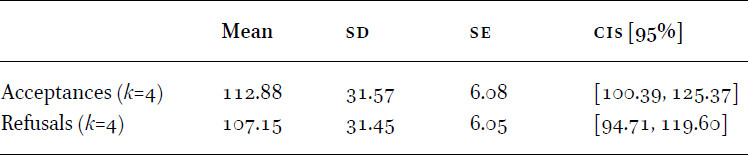
Table 3 presents descriptive statistics for speech rate (average number of words spoken per minute). There was a tendency of faster speech rate for acceptances than refusals. However, a paired-sample t-test revealed no significant difference, t(26)=1.51, p=0.14, d=.29 [-0.10, 0.67].
Descriptive statistics of speech rate in acceptances and refusals
Citation: Contrastive Pragmatics 6, 2 (2025) ; 10.1163/26660393-bja10099
Excerpt 1 below presents a refusal consisting of three intonational phrases (IPs). The blue arrows indicate the categorization of rising or falling for each of the IPs in the response, separated by the â\\â symbol. The capital letters represent stressed syllables and bold capital letters represent the syllables where tonal ratings were placed on nuclear pitch accents in the IPs.
Excerpt 1
LO siento profeSORa
(L*L%) [um 0.47] \\ no me GUSta: [0.61] la clase l-liti-liTURA
(L+H*HH%) \\ [um 0.53] [1.37] [uh 0.55] no QUIERo:: [0.44] toMAR la clase
(H+L*L%) \\
[I am sorry professor \\ I do not like literature class \\ I do not want to take the class \\]
This excerpt demonstrates how the learners in general used both rising and falling intonation patterns within the same refusal. In this response, she used a falling intonation pattern at the beginning and end of the refusal, but a rising intonation pattern in the middle of the response. In our analysis, the intonation for this refusal response was calculated as 33% rising and 67% falling (out of 100%).
6 Discussion
Based on the existing findings that refusals, as a dispreferred speech act, often involve marked linguistic resources such as hesitations, delays, and prefaces (Pomerantz, 1984; Yule, 1996), this study investigated whether L2 Spanish learners can use prosody as a resource to mitigate the face-threatening nature of refusals. Our study was grounded in the recent interface between prosody and pragmatics (for a review, see Kang and Kermad, 2019; Kostromitina and Kermad, in press). A growing body of literature has shown that prosody (e.g., intonation, fluency, tempo, pitch, and stress) serves as a contextualization cue to signal certain pragmatics meaning (Aijmer, 1996; Culpeper, 2011; Knowels, 2016). Correspondingly, L2 learnersâ use of prosody has become an important area of investigation when conceptualizing their pragmatic competence. Empirical results from L2 English studies have revealed that learners use prosodic features (intonation and fluency) in a certain way when producing speech acts and that the use often indicates their level of pragmatic competence and development (Kang et al., 2021; Kostromitina, in press; Li, 2014; Taguchi, 2012; Taguchi et al., 2021).
As the first study on prosody in L2 Spanish, the present study expanded the current research practice beyond English as a target language. We adopted the framework of Spanish Tones and Break Indices (Sp_ToBI; Estebas-Vilaplana and Prieto, 2009) to specifically analyze Spanish prosody. Since the Sp_ToBI had never been used to analyze L2 speech, our study demonstrated the potential (and challenges) of applying the framework to L2 Spanish data. Based on the systematic analysis of L2 Spanish prosody, the current findings revealed characteristics of L2 refusals beyond lexico-grammatical and semantic aspects. While previous studies revealed indirectness of refusal utterances (e.g., use of explicit negation markers), lexical and syntactic mitigations (e.g., use of hedging and subjunctive mood), and semantic moves accompanying the refusal (e.g., apology, excuse) (Félix-Brasdefer, 2006; GarcÃa, 1992, 1999, 2007), the current study showed that L2 Spanish learners use almost equal proportion of rising and falling tones in refusals. This pattern was different from their counterparts of acceptances, which involved a greater use of falling than rising tones. Similarly, learners produced refusals more slowly than acceptances. Hence, it seems that L2 Spanish learnersâ refusals can be characterized in part involving a balanced mix of rising and falling tones, as well as some degree of disfluency.
Despite these observed differences, when statistical testing was applied, tone choices and speech rate revealed no significant difference between refusals and acceptances. Hence, the current findings do not support the previous findings that refusals are spoken slowly with hesitations and other marked linguistic features that are absent in acceptances (Pomerantz, 1984). However, a direct comparison between the present results and previous findings may not be plausible because previous studies analyzed English refusals. It is possible that Spanish refusals do not demonstrate some of the spoken features of English refusals. Alternatively, it is possible that the perceived degree of face-threat is smaller in Spanish refusals, consequently requiring less need to mitigate the force using prosodic features.
Another possible reason for no statistically significant difference between refusals and acceptances is participantsâ proficiency level. L2 Spanish learners in this study were recruited from intermediate-level Spanish classes in a U.S. university. They had about six years of formal Spanish study in average. Except for one student who studied abroad, none of them had experience living in a Spanish-speaking country. Given their restricted proficiency and limited exposure to target language input, it is possible that they were not yet capable of distinguishing the preference structure (preferred vs. dispreferred act) at the level of prosody. As a result, they ended up producing refusals and acceptances in a similar manner. In fact, we found that the participantsâ speech contained a number of disfluency features specific to L2 speech, not specific to the preference structure.
The followings excerpts illustrate disfluency features in both acceptances and refusals. In Excerpt 1 when accepting their sisterâs invitation to get lunch, Participant 300_019 used several filled pauses, an excessively long silent pause (over three seconds), and inverted the pronunciation for the two syllables in the word mejor (i.e., mojer). Similarly in Excerpt 3 when refusing their friendâs invitation to a birthday party, the same participant again used several filled pauses, a false start (e.g., qui-querÃa; I wa- I wanted), and the English word âsoâ at the end of their response.
Excerpt 2, Participant 300_019, acceptance to get lunch
Es un bueno idea [um 0.46] vamos a la: [0.76] la restaurante: [um 0.66] [3.22] Me gusta: la carne tacos: [um 0.24] es mojer de: el pollo tacos.
(It is a good idea [um 0.46] letâs go to the [0.76] the restaurant [um 0.66] [3.22] I like meat tacos [um 0.46] it is better than chicken tacos.)
Excerpt 3, Participant 300_019, refusal to attend a birthday party
Lo siento mi amigo [um 0.47] qui-querÃa [uh 0.54] a la fiesta de cumpleaños [um 0.52] pero: [0.54] yo tengo planes [uh 0.36] para [0.58] el dÃa [um 0.62] [0.96] so no.
(Iâm sorry my friend [um 0.47] I wa- I wanted [uh 0.54] to the birthday party [um 0.52] but: [0.54] I have plans [uh 0.36] for [0.58] the day [um 0.62] [0.96] so no.)
Previous findings indicate that developing native-like prosody takes a long time and requires extensive exposure in the target language community. For example, Kang et al (2021) showed that L2 English learners who had advanced-level proficiency and at least one-year study abroad experience were able to approximate native-like intonation and fluency, while learners with intermediate-level proficiency or those with no study-abroad experience were not. Similarly, Kostromitinaâs (in press) intermediate-level learners of English produced requests and refusals using atypical intonation patterns compared with those of native English speakers. Hence, it is possible that the ability to use prosody skillfully to express meaning is a characteristic of advanced pragmatic competence that develops only with high-level general proficiency and target language exposure, which participants in the current study did not have. Yet, without baseline data from native speakers or data from other proficiency groups, this claim stays at the level of speculation. It remains for future research to assess plausibility of this assumption.
7 Limitations and Future Directions
This study examined whether L2 learners of Spanish use marked prosodic features (i.e., intonation and fluency) to characterize their refusals as opposed to acceptances. Since studies looking at the role of prosody in pragmatics meaning largely concentrate on English using Brazilâs (1997) framework, this study focusing on Spanish using the Sp_ToBI framework (Estebas-Vilaplana and Prieto, 2009) is a contribution to the existing literature. Yet, as an exploratory attempt, this study has several limitations that need to be addressed in future research.
First and foremost, a small sample of 27 learners (mostly female from a similar age group) comprising the same proficiency group is a limitation. Without a comparison group (advanced-level learners and native speaker group), we do not know how to interpret the tone choices and fluency observed in the current group. As shown in the results, intermediate-level learners in this study were not able to differentiate prosody to convey dispreferred nature of refusal intentions, but we cannot pinpoint the reason for the findings without a comparison group. We need to analyze native speaker data to establish baseline intonation patterns and fluency for refusals and acceptances separately, and then compare them with those of L2 learners. Similarly, lack of prosodic differences between refusals and acceptances needs to be tested again with advanced-level learners to see whether proficiency can indeed account for learnersâ ability to use different prosody to project different pragmatics meaning. Finally, it is possible that learners transfer L1-based prosody to L2 speech. While this study was limited to one L1 (American English), future research can include different L1 groups for comparison.
Another future consideration revolves around using Sp_ToBI for the prosodic analysis of L2 Spanish. Despite our rigorous attempt to adhere to the online training materials and published literature explaining how to implement this framework, transcriber uncertainty remains an important issue that needs to be addressed for more generalizable applications of Sp_ToBI. To clarify, we found that categorizations for tonal ratings (on pitch accents and boundary tones) and ratings for prosodic phrases were often difficult to assign to L2 Spanish responses because of their unclear speech and disfluency features. Because prior to this study the Sp_ToBI framework had been mostly used to analyze native Spanish speakersâ speech, specifically short utterances read one-by-one in a laboratory setting, its applicability to a bulk of novel utterances produced by L2 learners remains a question. More research using Sp_ToBI to analyze L2 speech is necessary to evaluate the validity of this framework. On the other hand, major differences in speech produced by L2 learners and native speakers of Spanish (e.g., different pausing behaviors and disfluency features, and transfer of L1 intonation patterns to L2) may require an alternative approach to the prosodic analysis of L2 Spanish speech that results in more readily interpretable findings for L2 Spanish teachers and learners.
All in all, this exploratory study identified some challenges but also possibilities for future research in the role of Spanish prosody in pragmatics meaning-making. Expanding the scope of the existing literature beyond the commonly-studied language of English, methods of analyzing prosody in other languages can certainly push the field forward, promoting our understanding of L2 speech act competence beyond typical areas of syntax, lexis, and semantics in speech act strategies. A systematic acoustic analysis of prosody and a framework that allows such an analysis can reveal L2 learnersâ ability to use prosody to convey pragmatic meaning (e.g., intention, politeness, and directness), and how their ability develops in conjunction with their proficiency and target language experience. Such findings can eventually inform instruction and assessment of prosody in L2 pragmatics.
Acknowledgements
We are grateful for Juliana Suby for her extraordinary help with participant recruitment. Our thanks also go to Anderson Ferrer, Betsy Macias, Yuly Asencion Delaney, and Jersus Colmenares for their help with instrument development, as well as to Rochelle Cardenas and Julia Atrian for their help with data analysis.
Appendix A: Video-Based Speaking Task Scenarios
NOTE: The items are displayed according to the order of appearance in the study.
Citation: Contrastive Pragmatics 6, 2 (2025) ; 10.1163/26660393-bja10099
References
Aguilar, Lourdes, Carme de-la-Mota and Pilar Prieto. (coords.) 2009. Sp_ToBI Training Materials. Web page: http://prosodia.upf.edu/sp_tobi/.
Aijmer, Karin. 1996. Conversational routines in English: Convention and creativities. London: Longman.
Beckman, Mary E., Manuel DÃaz-Campos, Julia Tevis McGory and Terrell A. Morgan. 2002. Intonation across Spanish, in the Tones and Break Indices framework. Probus 14: 9â36.
Boersma, Paul and David Weenink. 2023. Praat: doing phonetics by computer [Computer program]. Version 6.3.09, retrieved 2 March 2023 from http://www.praat.org/.
Brazil, David. 1997. The communicative value of intonation in English. Cambridge, UK: Cambridge University Press.
Brown, Penelope and Stephen C. Levinson. 1987. Politeness: Some universals in language use. Cambridge, UK: Cambridge University Press.
Culpeper, Jonathan. 2011. âItâs not what you said, itâs how you said it!â Prosody and impoliteness. In: Linguistics Politeness Research Group (eds.), Discursive approaches to politeness. Berlin: De Gruyter Mouton, 57â84.
Estebas Vilaplana, Eva and Pilar Prieto. 2009. La notación prosódica en español. Una revisión del Sp_ToBI, Estudios de Fonética Experimental XVIII: 263â283.
Félix-Brasdefer, Julio César. 2002. Refusals in Spanish and English: A cross-cultural study of politeness strategies among speakers of Mexican Spanish, American English, and American learners of Spanish as a foreign language. Minneapolis: University of Minnesota.
Félix-Brasdefer, Julio César. 2004. Interlanguage refusals: Linguistic politeness and length of residence in the target community. Language Learning 54(4): 587â653.
Félix-Brasdefer, Julio César. 2006. Linguistic politeness in Mexico: Refusal strategies among male speakers of Mexican Spanish. Journal of Pragmatics 38: 2158â2187.
Félix-Brasdefer, Julio César. 2008a. Pedagogical intervention and the development of pragmatic competence in learning Spanish as a foreign language. Issues in Applied Linguistics 16(1): 49â84.
Félix-Brasdefer, Julio César. 2008b. Perceptions of refusals to invitations: Exploring the minds of foreign language learners. Language Awareness 17(3): 195â211.
Félix-Brasdefer, Julio César. 2013. Refusing in L2 Spanish: the effects of the context of learning during a short-term study abroad program. In: Otilia MartÃ-Arnándiz and Patricia Salazar-Campillo (eds.), Refusals in instructional contexts and beyond. Amsterdam: Rodopi, 147â176.
GarcÃa, Carmen. 1993. Making a request and responding to it: A case study of Peruvian Spanish speakers. Journal of pragmatics 19(2): 127â152.
GarcÃa, Carmen. 1999. The three stages of Venezuelan invitations and responses. Multilingua 18: 391â433.
GarcÃa, Carmen. 2007. âChé, mirá, vos sabés que no no voy a poderâ: How Argentineans refuse an invitation. Hispania 90(3): 551â564.
Heritage, John. 1984. Garfinkel and ethnomethodology. Cambridge, UK: Polity Press.
Kang, Okim and Alyssa Kermad. 2019. Prosody in L2 pragmatics. In: Naoko Taguchi (ed.), The Routledge handbook of SLA and pragmatics. New York: Routledge, 78â92.
Kang, Okim, Alyssa Kermad and Naoko Taguchi. 2021. The effect of study abroad and proficiency on speech acts. Journal of Second Language Pronunciation 73: 343â369.
Knowles, Gerald. 2016. Patterns of spoken English: An introduction to English phonetics. New York: Routledge.
Kostromitina, Maria. (in press). An exploratory study of intonation variation in L1 and L2 English speakersâ pragmatic production of high imposition requests and refusals. Applied Pragmatics.
Kostromitina, Maria and Alyssa Kermad. (in press). Prosody in pragmatics. In: Naoko Taguchi and Daniel Z. Kadar (eds.), Encyclopedia of applied linguistics: Pragmatics. Hoboken, NJ: Wiley.
Levinson, Stephen C. 1983. Pragmatics. Cambridge, UK: Cambridge University Press.
Li, Shuai. 2014. The effects of different levels of linguistic proficiency on the development of L2 Chinese request production during study abroad. System 45: 103â116.
Pickering, Lucy. 2018. Discourse intonation: A discourse â pragmatic approach to teaching the pronunciation of English. Ann Arbor: University of Michigan Press.
Pomerantz, Anita. 1984. Agreeing and disagreeing with assessments: Some features of Preferred/dispreferred turn shapes. In: J. Maxwell Atkinson and John Heritage (eds.), Structures of social action. Studies in conversation analysis. Cambridge, UK: Cambridge University Press, 57â101.
Ren, Wei. 2022. Second language pragmatics. Cambridge, UK: Cambridge University Press.
Su, Yunwen. 2021. Accepting invitations and offers in second language Chinese: Effect of proficiency on pragmatic competence in interaction. Journal of Pragmatics 180: 131â149.
Sykes, Julie M. 2005. Synchronous CMC and pragmatic development: Effects of oral and written chat. CALICO Journal 22(3): 399â431.
Taguchi, Naoko. 2012. Context, individual differences, and pragmatic competence. Multilingual Matters.
Taguchi, Naoko and Carsten Roever. 2017. Second language pragmatics. Oxford: Oxford University Press.
Taguchi, Naoko, Kevin Hirschi and Okim Kang. 2021. Longitudinal L2 development in the prosodic marking of pragmatic meaning: Prosodic changes in L2 speech acts and individual factors. Studies in Second Language Acquisition 44(3): 843â858.
Tateyama, Yumiko. 2001. Explicit and implicit teaching of pragmatic routines: Japanese sumimasen. In: Kenneth R. Rose and Gabriele Kasper (eds.), Pragmatics in language teaching. New York: Cambridge University Press, 200â222.
Vacas Matos, Marta and Andrew D. Cohen. 2021. Native-like performance of pragmatic features: Speech acts in Spanish. Contrastive Pragmatics 3(2): 222â251.
Wichmann, Anne. 2000. Intonation in text and discourse: Beginnings, middles and ends. London: Longman.
Wichmann, Anne and Diane L. Blakemore. 2006. The prosody-pragmatics interface. Journal of Pragmatics 38(10): 1537â1541.
Yule, George. 1996. Pragmatics. Oxford: Oxford University Press.
Biographical Notes
Naoko Taguchi is a professor in the Applied Linguistics program at Northern Arizona University. Her research interests include pragmatics, technology- enhanced learning, intercultural communication, and English-medium instruction. She is currently the co-editor of Language Learning and Applied Pragmatics.
Andrew Dennis is a doctoral student in the Applied Linguistics program at Northern Arizona University. His research focuses on SLA, second language speaking, second language pragmatics, and Spanish as a second/foreign language.