Abstract
The incorporation of insect-derived products into poultry diets has received increasing attention as a sustainable alternative to conventional protein sources. This study evaluated the effects of replacing soybean meal and vegetable oil with whole Tenebrio molitor larvae meal on egg quality and sensory attributes in free-range laying hens. A total of 110 Lohmann Brown hens housed in 10 pens were assigned to two dietary treatments for 16 weeks: a control diet based on cereals, soybean meal, and sunflower oil, or an experimental diet in which T. molitor meal was included at 80 g/kg, partially replacing soybean meal and vegetable oil. Egg quality parameters, including Haugh units, yolk colour and the incidence of blood spots in the yolk and meat stains in albumen, were assessed at the end of the experimental period. Sensory evaluation was performed by 57 untrained panellists using the discriminative triangle test methodology (ISO 4120:2021) to assess whether there were noticeable sensory differences between the eggs from the two experimental groups. No significant differences were detected between treatments in yolk colour, blood spots, or meat stains (
1 Introduction
The use of insects as a source of nutrients has received increasing attention in recent decades (van Huis and Tomberlin, 2017). However, the high costs of insect-derived products cannot yet compete with those of conventional protein sources unless considered within a circular economy framework (Gasco et al., 2023). In addition, although their commercial implementation as food remains limited by low consumer acceptance in societies unaccustomed to entomophagy, the use of insect-derived products in fish, poultry and swine nutrition is generally well accepted (van Huis et al., 2024).
Insect meal is a novel protein source proposed to replace soybean meal in livestock diets, and its use has been evaluated in different species (Rossi et al., 2025). However, the limited number of studies assessing the sensory characteristics of poultry products from birds fed insect-based diets may constrain their market viability in terms of consumer acceptance (Okaiyeto et al., 2024; Shaviklo, 2023). Therefore, the sensory quality of eggs from free-range hens fed whole T. molitor larvae meal in substitution of soybean meal and vegetable oil was compared using the triangle test methodology to identify potential sensory differences.
2 Material and methods
Bird husbandry and experimental diets
The procedures used in this research were approved by the Animal Ethics Committee of the University of Zaragoza (procedure PI69/20) and complied with the Spanish Policy for Animal Protection (RD 53/2013), in accordance with the EU Directive 2010/63 on the protection of animals used for experimental and other scientific purposes. A total of 110 Lohmann Brown laying hens at 17 weeks of age were randomly allocated in 10 free-range pens (2.5 m2 × 3.5 m height indoor area, 3 m2 outdoor area) for 16 weeks. Throughout the experimental period, indoor environmental conditions and the lighting program were adjusted according to commercial practices (Lohmann, 2018). Outdoor minimum and maximum environmental temperatures ranged from 3 to 12 °C and 13 to 24 °C, respectively. Feed and water were provided ad libitum, and birds had unrestricted access to outdoor areas.
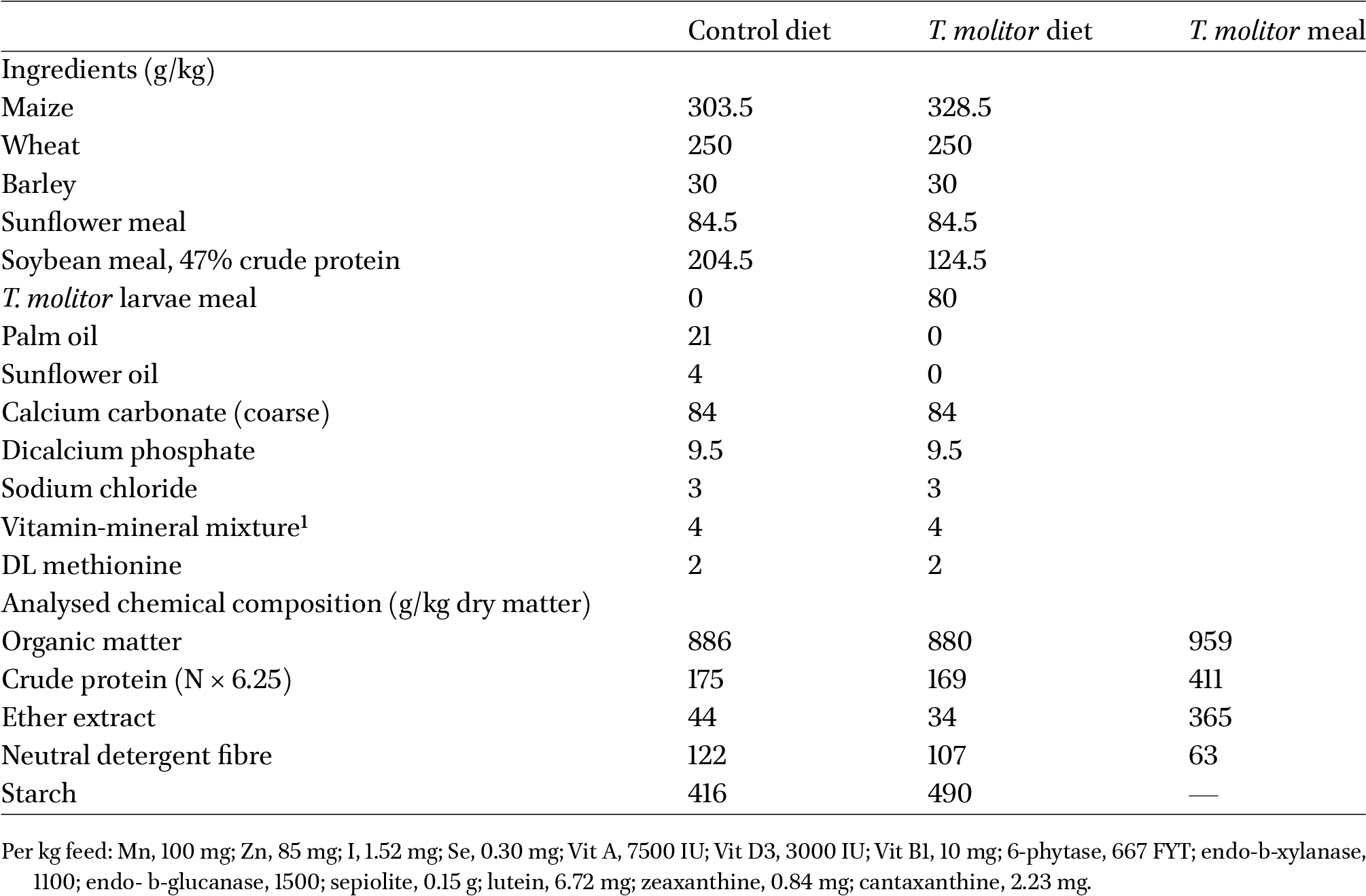
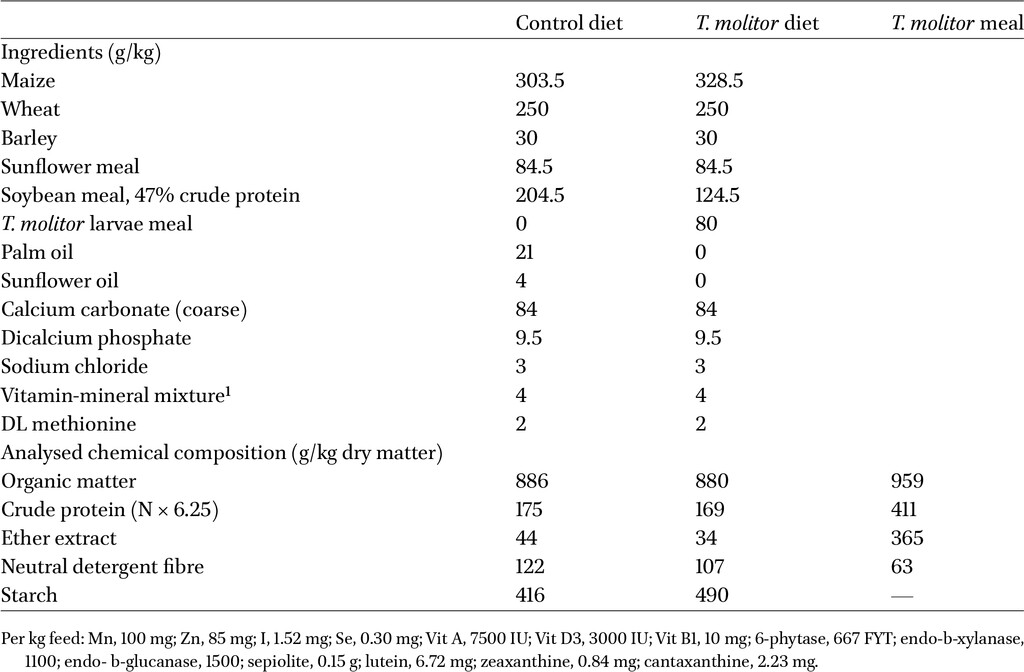
The feeding program consisted of a single diet provided from 17 to 33 weeks of age. Hens received either a control commercial diet, based on cereals, soybean meal and sunflower oil, or a diet in which whole T. molitor larvae meal (Iberinsect, Reus, Spain) was included at 80 g/kg to partially replace soybean meal and sunflower oil. Both diets were formulated to be isoenergetic and isonitrogenous, providing 2.730 MCal AMEn/kg and 7.4 g/kg digestible Lys (FEDNA, 2018). To avoid nutritional deficiencies, feed formulation ensured that all other nutrients, including essential amino acids, minerals and vitamins, met or exceed bird requirements. Each treatment was replicated in 5 pens. The ingredient composition of the experimental diets and the analysed nutrient content of diets and whole T. molitor larvae meal are presented in Table 1.

Ingredient composition of the experimental diets and chemical analysis of diets and whole T. molitor larvae meal
Citation: Journal of Insects as Food and Feed 12, 8 (2026) ; 10.1163/23524588-bja10346
Laboratory analysis and egg quality measurements
Representative samples of the T. molitor meal experimental diets were analysed by duplicate for dry matter, total ash, crude protein (as N × 6.25) and ether extract by AOAC (2005) procedures (refs. 934.01, 942.05, 976.05 and 2003.05, respectively). Neutral detergent fiber was determined with an Ankom 200 Fiber Analyzer (Ankom Technology, Fairport, NY, USA) using α–amylase and sodium sulphite (Mertens, 2002), and results expressed exclusive of residual ash. Total starch content was measured enzymatically with a commercial kit (Total Starch Assay Kit K-TSTA 07/11; Megazyme, Bray, Ireland) from samples ground to 0.5 mm.
At the end of the experimental period, 8 eggs per pen were randomly collected and immediately analysed for Haugh Units, the presence of meat stains in the albumen and blood spots in the yolk using an Egg Quality Meter (Technical Services and Supplies, York, UK), and yolk colour by visually assessment (DSM yolk colour fan).
Sample preparation and sensory evaluation: triangle test procedure
Batches of 8 eggs laid 3 days before the sensory evaluation were randomly selected according to treatment and stored at room temperature. Tests were carried out in two sub-groups (26 and 31 assessors) with a total of 9 sub-sessions (3–9 assessors per sub-session). Two hours before each sub-session, eggs were beaten for 30 s, poured into silicone moulds, and cooked in a convection oven (Rational SCC 61, Italia) at 80 °C and 100% humidity for 15 min. After cooling, samples were cut into 1 × 1 cm cubes and presented on ceramic plates. Each plate contained three coded samples (triad), two identical and one different, following the six possible combinations (ABA, AAB, BAA, BAB, BBA, ABB).
Sensory analysis followed the European Standard ISO 4120:2021 (triangle test method). The panel comprised 57 untrained volunteers (13 males, 40 females, aged 20-60 years) from University staff. Panellists received written and verbal instructions as specified in the standard and performed the test individually in a standardised sensory room. Assessors were blinded to treatments and received randomized coded triads. Each assessor indicated which sample they believed was different, and the number of correct identifications of the different sample was recorded.
Statistical analysis
Results on the effects of dietary treatment on egg quality measurements were analysed by one-way ANOVA using the GLM procedure (SAS version 9.4), considering the pen as the experimental unit (n = 5). Differences were considered significant at
Sensory evaluation results from the triangle test were analysed by calculating the minimum number of correct responses required to confirm perceptible differences as defined in ISO 4120:2021. For the discriminative test, statistical sensitivity was set at
3 Results
The effects of dietary treatments on egg quality measurements are presented in Table 2. No treatment differences were detected for the presence of meat stains in the albumen or blood spots in the yolk (
Effects of the diet fed to the hens on egg measurements at 16 weeks of experiment
Citation: Journal of Insects as Food and Feed 12, 8 (2026) ; 10.1163/23524588-bja10346
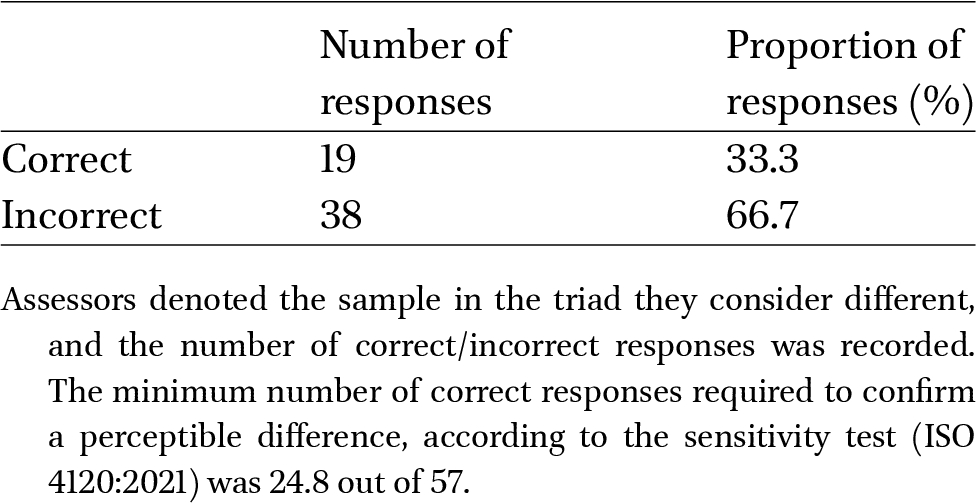
Sensory analysis encompasses a set of techniques for the accurate assessment of human responses to foods and for tracing potential sources of bias related to fraud, brand identity and perceived quality. The results of the sensory analysis obtained from the triangle test are presented in Table 3. Among the 57 panellists asked to identify the different sample in the triad, 19 correct responses (33%) and 38 incorrect responses (66%) were recorded. The triangle test method indicates that a proportion of correct responses exceeding the expected level constitutes evidence of a perceptible difference between products (Lawless and Heymann, 2010). According to the sensitivity test (ISO 4120:2021), the minimum number of correct responses required to confirm a perceptible difference between the two products (
Results on the sensory analysis of eggs evaluated using the triangle test (n = 57)
Citation: Journal of Insects as Food and Feed 12, 8 (2026) ; 10.1163/23524588-bja10346
4 Discussion
Information on the effects of including insect-based products in laying hen diets on egg quality parameters is scarce and mainly limited to the use of Hermetia illucens larvae (Al-Qazzaz et al., 2016; Maurer et al., 2016; Mwaniki et al., 2018). In our study, yolk colour, as well as the presence of meat stains in the albumen and blood spots in the yolk, were similar between eggs from hens fed the control or T. molitor diets. Ko et al. (2020) reported a linear increase in yolk colour with the inclusion of 3% defatted T. molitor larvae meal replacing soybean meal in the diet of brown laying hens. In contrast, Dublecz et al. (2025) found that the inclusion of 10 and 15% of larvae meal from Alphitobius diaperinus (Tenebrionidae) in diets for brown laying hens as a replacement for extracted soybean meal and corn oil did not affect yolk colour, in agreement with the current results. On the other hand, eggs from hens fed the T. molitor diet in the present study tended to have lower Haugh Units compared with those from hens fed the control diet, despite values obtained were well above the thresholds (>90) considered optimal by industry standards (USDA, 2020). Therefore, the trend observed is of limited practical relevance, consistent with the absence of any effect on Haugh Units following the inclusion of T. molitor in laying hen diets reported by Ko et al. (2020).
Previous studies evaluating the sensory attributes of broiler meat from chickens fed T. molitor meals reported limited differences on consumer preference and meat quality traits compared with conventional protein sources (Bovera et al., 2016; Khan et al., 2018; Shaviklo et al., 2021). The effects of including insect-derived products in laying hen diets on the sensory properties of eggs have also been investigated. For example, the inclusion of defatted (Al-Qazzaz et al., 2016) or whole (Bejaei and Cheng, 2020) H. illucens larval meal in laying hen diets showed positive or no effects, respectively, on egg sensory parameters such as appearance, texture, taste, flavour and overall acceptance. However, no studies have evaluated the effects of including T. molitor larvae meal in laying hen diets on egg sensory properties. In laying quails, Dalle Zotte et al. (2024) reported that dietary supplementation with live T. molitor larvae did not affect overall quality traits, chemical composition or storage stability of the eggs, but decreased overall flavour, sulphur and greasy-oily intensities in a descriptive sensory analysis. In this respect, Ko et al. (2020) and Dublecz et al. (2025) observed that the inclusion of defatted T. molitor larvae meal altered the fatty acid profile in the egg yolks, which in turn could potentially influence consumer sensory acceptance. In this respect, the sensory evaluation of boiled eggs from hens fed A. diaperinus meal revealed higher scores for quality and overall acceptance than of eggs from hens fed a commercial diet, with the insect-containing diet producing a specific volatile compound profile characterized by reduced intensity of dimethyl sulphide, ethyl acetate and acetaldehyde (Dublecz et al., 2025). In our study, participants in the triangle test were unable to reliably distinguish between eggs from hens fed the control or T. molitor diets. Therefore, any differences in sensory properties resulting from the dietary inclusion of whole T. molitor larvae meal were too small to have practical relevance for consumer perception.
In conclusion, the inclusion of whole T. molitor larvae meal partially replacing soybean meal and vegetable oil in laying hen diets did not compromise egg quality or sensory attributes. The lack of perceptible differences in yolk colour, albumen and yolk defects and sensory characteristics between control and insect-based diets suggests that T. molitor meal can be included without adversely affecting consumer-relevant egg traits. These findings support the suitability of using insect meals as sustainable protein and lipid sources in poultry production.
Corresponding author; e-mail: mfonde@unizar.es
Acknowledgements
The work was supported by INSECTOPIA 2050, together with the Department of Industry and Innovation of the Government of Aragon and the European Social Fund. There are no conflicts of interest.
References
Al-Qazzaz, M.F.A., Ismail, D., Akit, H. and Idris, L.H., 2016. Effect of using insect larva meal as a complete protein source on quality and productivity characteristics of laying hens. Revista Brasileira de Zootecnia 45: 518-523. https://doi.org/10.1590/S1806-92902016000900003
AOAC International, 2005. Official methods of analysis of AOAC International, 18th edn. AOAC International, Gaithersburg, MD, pp. 24-56.
Bejaei, M. and Cheng, K.M., 2020. The effect of including full-fat dried black soldier fly larvae in laying hen diet on egg quality and sensory characteristics. Journal of Insects as Food and Feed 6: 305-314. https://doi.org/10.3920/JIFF2019.0045
Bovera, F., Loponte, R., Marono, S., Piccolo, G., Parisi, G., Iaconisi, V., Gasco, L. and Nizza, A., 2016. Use of Tenebrio molitor larva meal as protein source in broiler diet: effect on growth performance, nutrient digestibility, and carcass and meat traits. Journal of Animal Science 94: 1-9. https://doi.org/10.2527/jas.2015-9201
Dalle Zotte, A., Singh, Y., Palumbo, B., Contiero, B. and Cullere, M., 2024. Live yellow mealworm (Tenebrio molitor) larvae: a promising nutritional enrichment for laying quails. Poultry Science 103: 103759. https://doi.org/10.1016/j.psj.2024.103759
Dublecz, K., Baranyay, H., Such, N., Weinlaender, F., Kern, J., Tewelde, K.G., Pál, L., Kiss, B., Wágner, L. and Csiszér, T., 2025. Feeding laying hens with insect meal affects the production traits and some quality parameters of table eggs. Animal Feed Science and Technology 327: 116415. https://doi.org/10.1016/j.anifeedsci.2025.116415
FEDNA, 2018. Necesidades nutricionales para avicultura, 2nd edn. FEDNA, Madrid. Available online at https://www.fundacionfedna.org/sites/default/files/NORMAS_FEDNA_AVES_2018v.pdf
Gasco, L., Renna, M., Bellezza-Oddon, S., Rezaei Far, A., Naser El-Deen, S. and Veldkamp, T., 2023. Insect meals in a circular economy and application in monogastric diets. Animal Frontiers 13(4): 81-90. https://doi.org/10.1093/af/vfad016
ISO 4120:2021, Sensory analysis — Methodology — Triangle test. ISO, Geneva.
Khan, S., Khan, R.U., Alam, W. and Sultan, A., 2018. Evaluating the nutritive profile of three insect meals and their effects to replace soya bean in broiler diet. Journal of Animal Physiology and Animal Nutrition 102: 662-668. https://doi.org/10.1111/jpn.12809
Ko, H.S., Choi, Y.H., Khun, S., Cho, E.S., Kim, Y.Y., Pi, J.S., Park, K.H., Kim, J.D., Lee, S.H. and Kim, J.S., 2020. Laying performance, egg quality, haematological traits, and faecal noxious gas emission of laying hens fed with Tenebrio molitor meal. European Poultry Science 84: 1-13. https://doi.org/10.1399/eps.2020.307
Lawless, H.T. and Heymann, H. (eds.), 2010. Sensory evaluation of food: principles and practices. 2nd ed. Springer, New York, NY.
Lohmann, 2018. Management guide. alternative systems. Lohmann Tierzucht, Cuxhaven. Available online at https://lohmann-breeders.com/e-guide/alternative-housing/2/
Maurer, V., Holinger, M., Amsler, Z., Früh, B., Wohlfahrt, J., Stamer, A. and Leiber, F., 2016. Replacement of soybean cake by Hermetia illucens meal in diets for layers. Journal of Insects for Food and Feed 2: 83-90. https://doi.org/10-3920/JIFF2015.0071
Mertens, D.R., 2002. Gravimetric determination of amylase-treated neutral detergent fiber in feeds with refluxing in beakers or crucibles: collaborative study. Journal of AOAC International 85: 1217-1240. https://doi.org/10.1093/jaoac/85.6.1217
Mwaniki, Z., Neijat, M. and Kiarie, E., 2018. Egg production and quality responses of adding up to 7.5% defatted black soldier fly larva meal in a corn–soybean meal diet fed to Shaver White Leghorns from wk 19 to 27 of age. Poultry Science 97: 2829-2835. https://doi.org/10.3382/ps/pey118
Okaiyeto, S., Yu, S.H., Deng, L., Wang, Q.H., Sutar, P., Wang, H., Zhao, J.H., Mujumdar, A., Ni, J. and Lv, W., 2024. How to enhance the acceptability of insects food – a review. Food Frontiers 5. https://doi.org/10.1002/fft2.349
Rossi, G., Psarianos, M., Ojha, S. and Schlüter, O.K., 2025. Review: Insects as a novel feed ingredient: processing technologies, quality and safety considerations. Animal 19: 101495. https://doi.org/10.1016/j.animal.2025.101495
Shaviklo, A.R., 2023. The influence of insect-derived and marine-based diets on sensory quality of poultry meat and egg: a systematic review. Journal of Food Science and Technology 60: 1903-1922. https://doi.org/10.1007/s13197-022-05484-3
Shaviklo, A.R., Alizadeh-Ghamsari, A.H. and Hosseini, S.A., 2021. Sensory attributes and meat quality of broiler chickens fed with mealworm (Tenebrio molitor). Journal of Food Science and Technology 58: 4587-4597. https://doi.org/10.1007/s13197-020-04946-w
USDA, 2020. Department of Agriculture. United States standards, grades, and weight classes for shell eggs. AMS 56.210. USDA, Washington, DC. Available online at https://www.ams.usda.gov/sites/default/files/media/Shell_Egg_Standard%5B1%5D.pdf
van Huis, A. and Tomberlin, J.K., 2017. Insects as food and feed. From production to consumption. Wageningen Academic, Wageningen.
van Huis, A., Rumbos, C.I., Oonincx, D.G.A.B., Rojo, S., Kovitvadhi, A. and Gasco, L., 2024. From traditional to industrial use of insects as feed: a review. Journal of Insects as Food and Feed 11: 115-137. https://doi.org/10.1163/23524588-00001232