Abstract
To bridge sustainability potential and consumer acceptance, this study profiled ten edible insects approved or temporarily permitted in Korea, integrating nutritional, electronic-nose/electronic-tongue, and human sensory data to enhance utilization in the food system. Proximate composition and mineral content were analysed using standard procedures, including inductively coupled plasma–mass spectrometry (ICP–MS). On a dry-weight basis, Japanese rhinoceros beetle larvae presented the highest protein content (35.4%), and drone pupae the highest fat content (60.2%). Japanese rhinoceros beetle larvae were rich in calcium, potassium, and iron, whereas two-spotted crickets contained relatively high phosphorus, sodium, and zinc; silkworm larvae had the highest magnesium, indicating potential as alternative mineral sources. Electronic nose profiling revealed species-specific volatile signatures: ethanol-dominant profiles in drone pupae and two-spotted crickets (alcoholic/sweet), buttery notes in rice grasshoppers (acetoin/diacetyl), nutty/earthy tendencies in silkworm larvae (propanal), acidic/vinegar-like notes in white-spotted flower chafer larvae (formic acid), onion-like characteristics in migratory locusts (1-propanethiol), and fusel/green notes in white muscardine silkworms (n-butanol). Electronic-tongue analysis revealed higher saltiness in Japanese rhinoceros beetle larvae and giant mealworm larvae, whereas drone pupae showed higher sourness and umami; yellow mealworm larvae had the lowest umami. In the human sensory panel (n = 60), drone pupae and yellow mealworm larvae received the highest preference, whereas Japanese rhinoceros beetle larvae and migratory locusts elicited greater aversion. These findings emphasize both nutritional value and sensory diversity of edible insects and offer guidance for selecting species and tailoring processing strategies to increase consumer acceptance of insect-based foods.
1 Introduction
Edible insects are gaining increasing global attention as a sustainable and nutrient-dense food source, especially in the context of increasing food insecurity, climate change, and the need for more environmentally responsible dietary options (de Carvalho et al., 2019; Kłobukowski et al., 2025). According to the Food and Agriculture Organization of the United Nations (FAO), compared with traditional livestock, insects offer high feed conversion efficiency, require less land and water, and produce fewer greenhouse gas emissions (van Huis et al., 2013). These environmental advantages are matched by their nutritional merits: many edible insect species provide high-quality protein, essential fatty acids, and a broad spectrum of micronutrients – including calcium, iron, zinc and selenium (Ghosh et al., 2017; Kim et al., 2016; Orkusz, 2021; Psarianos et al., 2025; Rumpold and Schlüter, 2013).
In this global context, the integration of edible insects into mainstream food systems is being actively pursued through research and commercialization. However, a major barrier remains consumer acceptance (Adámková et al., 2017; Kroger et al., 2022). Although some cultures have long histories of entomophagy – such as in Thailand, Mexico, and parts of Central Africa – in which insects are traditionally consumed in diverse culinary forms (van Huis et al., 2013), many nations, particularly industrialized ones, still perceive insects as unfamiliar, unpalatable, or potentially unhygienic (Kroger et al., 2022; Sun-Waterhouse et al., 2016). Sensory perception plays a critical role in shaping food acceptance, particularly for novel or unfamiliar foods (Martins et al., 2022). Therefore, in addition to nutritional value, attributes such as odour, flavour, appearance and texture must be carefully evaluated when developing insect-based food products for wider markets.
Korea presents a compelling case study in this regard. Although insects such as Bombyx mori pupae (silkworms) have historically been consumed as snacks or functional foods, the broader adoption of edible insects in contemporary Korean diets remains limited. Consumers in Korea – who tend to prioritize food aesthetics, safety, and palatability – can be deterred by unfamiliar visual cues or flavours. Sensory unfamiliarity, disgust reactions to visible insect forms, and concerns about taste and appearance have been identified as key barriers (Alhujaili et al., 2023; Bae and Choi, 2021; Wendin and Nyberg, 2021). This finding contrasts with other Asian countries such as Thailand, Cambodia, or Laos, where edible insects are more deeply embedded in traditional diets and widely accepted. Despite recent regulatory efforts to expand the range of approved insect-based food products, South Korea continues to exhibit relatively lower levels of insect consumption.
Addressing this challenge requires scientific approaches that can simultaneously evaluate the nutritional value and sensory characteristics of edible insects. However, many previous studies conducted in Korea and globally have focused solely on proximate composition or biofunctional components, often neglecting sensory acceptability. Moreover, human sensory evaluations of edible insects pose ethical and cultural challenges, especially among populations unfamiliar with entomophagy. Advanced instrumental technologies such as the electronic nose and electronic tongue provide objective, reproducible measurements of odor and taste attributes, enabling the evaluation of unfamiliar foods such as insects without direct consumption (Adámek et al., 2017; Cho and Moazzem, 2022). These tools are particularly useful for evaluating food ingredients that may cause hesitation or aversion among naïve consumers, allowing researchers to assess their sensory potential in a standardized and non-invasive manner.
Therefore, this study aimed to address the gap in the current literature by conducting a comprehensive evaluation of ten edible insect species that are approved or temporarily permitted for food use in South Korea. Specifically, the objectives of this study were as follows:
(1) determine the nutrient composition, focusing on the mineral profile, of each insect species;
(2) analyse their volatile compound profiles using an electronic nose;
(3) assess taste-related properties using an electronic tongue system; and
(4) evaluate consumer responses on the basis of visual, olfactory, and tactile sensory attributes through panel testing.
This study expands previous research by combining nutritional, instrumental, and sensory analyses within a single experimental framework, thereby enabling an integrated interpretation of how compositional and flavor attributes relate to consumer perception. By integrating nutritional composition data with instrumental flavor profiling and human sensory evaluations, this study is expected to provide scientific evidence to support product development and enhance consumer acceptance of edible insects in both the Korean and global food markets.
2 Materials and methods
Materials
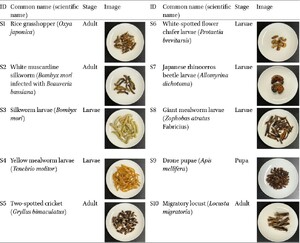
The Korean Ministry of Food and Drug Safety (MFDS) has officially approved seven insect species as food ingredients and granted temporary approval of three other species for use as food ingredients. Therefore, this study targeted ten edible insect species purchased from five vendors in South Korea. Among these edible insects, the approved species were the rice grasshopper (Oxya japonica, O. japonica), white muscardine silkworms (Bombyx mori infected with Beauveria bassiana), silkworm larvae (Bombyx mori), yellow mealworm larvae (Tenebrio molitor), two-spotted cricket (Gryllus bimaculatus), white-spotted flower chafer larvae (Protaetia brevitarsis), and Japanese rhinoceros beetle larvae (Allomyrina dichotoma). The three temporarily approved species were giant mealworm larvae (Zophobas atratus), drone pupae (Apis mellifera), and migratory locusts (Locusta migratoria). Detailed information on the common names, scientific names, developmental stages, and representative images of these insect species is provided in Table 1. All the edible insects purchased were stored at –70 °C until analysis. All the chemicals used in this study were of reagent grade and were obtained from either Sigma-Aldrich (St. Louis, MO, USA) or Junsei Chemicals (Tokyo, Japan).

Common and scientific names, developmental stages, and representative images of the edible insect species used in this study
Citation: Journal of Insects as Food and Feed 12, 8 (2026) ; 10.1163/23524588-bja10345
Proximate composition analysis
The dried edible insect samples were homogenized using a grinder (HR1673; Philips, Tokyo, Japan). The proximate composition was determined according to the AOAC (2005) protocols. The moisture content was measured by atmospheric drying at 105 °C, the ash content was measured by incineration at 600 °C, the crude fat content was measured by Soxhlet extraction using ethyl ether as a solvent, and the crude protein content was measured using the Kjeldahl method. The crude protein content was calculated using species-specific nitrogen-to-protein conversion factors instead of the conventional 6.25 (Finke, 2007; Janssen et al., 2017; Rumpold & Schlüter, 2013). The carbohydrate content was estimated by subtracting the sum of the moisture, ash, crude fat, and crude protein contents from 100 g of the sample. The energy value was calculated using standard energy conversion factors: 37 kJ/g for fat, 17 kJ/g for protein, and 17 kJ/g for carbohydrate.
Mineral content analysis
The mineral contents of ten edible insect samples were determined by wet digestion and inductively coupled plasma–mass spectrometry (ICP–MS). Approximately 0.8 g of homogenized insect powder was weighed into a Teflon digestion vessel, and 7 ml of concentrated nitric acid (HNO3, trace metal grade) and 2 mL of hydrogen peroxide (H2O2, 30%) were added. The vessel containing the sample was sealed and digested using a microwave digestion system (Titan MPSTM, Perkin Elmer, Waltham, MA, USA). After cooling, the digests were diluted with ultrapure water to a final volume of 50 ml. The solutions were filtered through a 0.45 μm PVDF syringe filter prior to analysis.
Quantification of mineral elements was carried out using ICP–MS (NEXION-350X, PerkinElmer, Waltham, MA, USA). The analysed elements included calcium, phosphorus, magnesium, potassium, sodium, iron, zinc, copper, silicon, selenium and manganese. Calibration was performed using multielement standard solutions (Inorganic Ventures, Christiansburg, VA, USA). Quality control was ensured by including procedural blanks and a certified reference material (CRM No. 2007-00959-001; KRISS, Daejeon, South Korea), with recoveries within ±5%. All measurements were conducted in triplicate, and the relative standard deviation (%RSD) was maintained below 3%. To minimise contamination, all plastic apparatuses were soaked in 0.4% EDTA solution for 24 h, while the glassware was soaked in undiluted nitric acid, followed by three rinses with secondary distilled water. To verify analytical consistency, the sum of all analysed mineral contents was compared with the crude ash values determined by incineration. The total mineral-to-ash ratio averaged 79.8 ± 25.6 %, indicating acceptable agreement between the two analytical methods.
Volatile compound analysis using an electronic nose
Volatile compound profiling of the edible insect samples was performed using a HERACLES-II electronic nose system (Alpha MOS, Toulouse, France) equipped with dual-flame ionization detectors (FIDs) and two capillary columns with different polarities: a nonpolar column (MXT-5, 10 m × 0.18 mm × 0.4 μm) and a slightly polar column (MXT-1701, 10 m × 0.18 mm × 0.4 μm). For each analysis, 2 g of ground insect sample was placed in a 20 mL headspace vial and incubated at 50 °C for 20 min with agitation at 500 rpm. The samples were analysed in their commercially available form without modifying the moisture content to reflect the actual aroma characteristics under consumer conditions. The headspace volatiles were then injected using an autosampler with a 1000 μl injection volume and an injection speed of 125 μl/s. The injection port was maintained at 200 °C, and the syringe was held at 60 °C. Chromatographic separation was conducted with an initial oven temperature of 50 °C (held for 2 s), followed by a two-step temperature program: an increase to 80 °C at 1 °C/s and then to 250 °C at 3 °C/s, with a final hold time of 21 s. The detector temperature was 260 °C. Hydrogen was used as the carrier gas at a constant flow, with split flow set to 10 ml/min.
Volatile compounds were identified on the basis of retention time matching with the AlphaSoft library and confirmed by authentic standards when available. Only compounds representing more than 10% of the total chromatogram peak area per sample were considered dominant. Compound identity, molecular formula, and odour category were annotated using the AroChemBase database (https://www.arochembase.com).
Instrumental taste profiling using an electronic tongue
Taste profiling of the edible insect samples was conducted using an electronic tongue system (Astree V, Alpha MOS, Toulouse, France). For the analysis, 1 g of each sample was homogenized with 5 ml of distilled water using a homogenizer (AM-5; Nissei, Anjo, Japan) for 1 min. The samples were analysed in their commercially available form without modifying the moisture content, representing their typical taste characteristics as perceived by consumers. The homogenate was filtered through Whatman No. 1 filter paper (Whatman, Maidstone, UK), and the filtrate was 100-fold diluted before being transferred into the sample container of the instrument. Seven taste sensors were employed: CTS (saltiness), AHS (sourness), and NMS (umami) along with the four reference sensors PKS, SCS, ANS and CPS. The signal intensity values from each sensor reflected the relative strength of the corresponding taste attribute.
Sensory evaluation
To investigate the consumer perception of edible insects, a sensory evaluation was conducted with a healthy adult panel. This study was approved by the Institutional Review Board (IRB) of Kongju National University (IRB No. KNU_IRB_2023-032), and all participants provided informed consent prior to participation. A total of 60 adults (29 men and 31 women; aged 19–59 years) participated in the test. The evaluation was conducted in individual, partitioned sensory booths to minimize external influences and ensure independent assessment by each panellist. The panellists were instructed to avoid consuming any food or drink, except for water, for at least one hour prior to testing. Ten edible insect samples were served simultaneously in identical white disposable containers, each labelled with a unique three-digit code generated using a random number table to ensure blinding. The panellists independently evaluated the samples using a self-administered questionnaire.
The questionnaire assessed sensory responses to five attributes – appearance, scent, hand-perceived texture, colour, and overall impression – based on both preference and aversion using a 7-point Likert scale (1 = very weak, 7 = very strong). Here, preference represented a positive hedonic response (liking), whereas aversion reflected a negative hedonic response (disliking). The texture evaluation was limited to tactile sensation by hand and excluded mouthfeel.
Statistical analysis
The mean and standard deviation were calculated for the proximate composition, mineral contents, and sensory evaluation scores. Owing to the small number of replicates and nonnormal distribution, differences in proximate composition and mineral contents among the ten insect groups were analysed using the Wilcoxon test (PROC NPAR1WAY) in SAS (version 9.4; SAS Institute, Cary, NC, USA). For sensory evaluation, differences among the groups were assessed using one-way analysis of variance (ANOVA), followed by Duncan’s multiple range test for post hoc comparisons. Statistical significance was determined at
3 Results
Proximate composition of edible insects
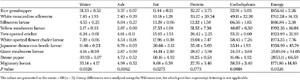
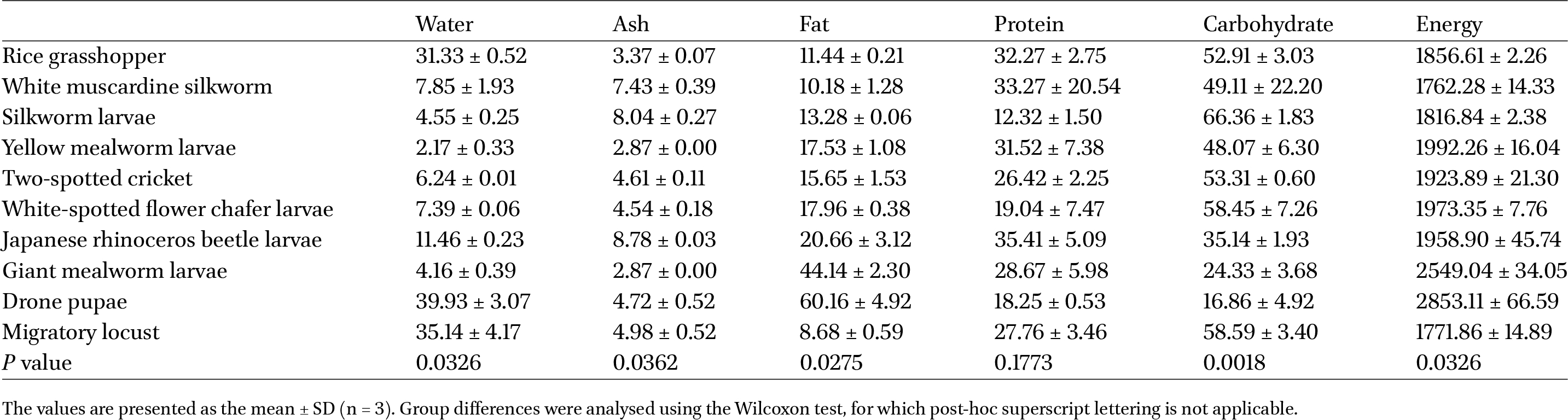
Table 2 shows the proximate composition of the ten edible insects. The moisture content ranged from 2.17 to 39.93%, with drone pupae having the highest value. The ash content per 100 g dry weight ranged from 2.87 to 8.78%, with Japanese rhinoceros beetle larvae having the highest value. The protein content per 100 g dry weight ranged from 12.32 to 35.41%, with Japanese rhinoceros beetle larvae showing the highest level. The fat content per 100 g dry weight varied from 8.68 to 60.16%, with drone pupae having the highest value, whereas the carbohydrate content per 100 g dry weight ranged from 16.86 to 66.36%, with silkworm larvae having the highest value. In addition, the energy content per 100 g dry weight ranged from 1762.28 to 2853.11 kJ, with drone pupae having the highest value.
Proximate composition (in g/100 g dry weight, for energy in kJ/100 g dry weight) of ten edible insects
Citation: Journal of Insects as Food and Feed 12, 8 (2026) ; 10.1163/23524588-bja10345
Mineral contents of edible insects
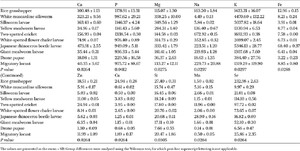
The contents of eleven minerals significantly differed among the ten edible insects (Table 3). The calcium content per 100 g dry weight ranged from 18.08 to 473.91 mg, with the highest level observed in Japanese rhinoceros beetle larvae. The phosphorus, sodium, and zinc contents ranged from 229.56 to 1338.54 mg, 4.49 to 672.92 mg, and 1.30 to 24.94 mg, respectively, with the highest values found in two-spotted crickets. The magnesium content ranged from 36.37 to 349.56 mg. The three species with the highest magnesium contents were silkworm larvae (349.56 mg), white muscardine silkworms (338.25 mg), and Japanese rhinoceros beetle larvae (333.42 mg). The potassium content ranged from 384.40 to 5346.13 mg. The three species with the highest potassium contents were Japanese rhinoceros beetle larvae (5346.13 mg), silkworm larvae (5037.82 mg), and white muscardine silkworms (4470.60 mg). The iron content ranged from 3.22 to 68.40 mg, with the highest concentration observed in Japanese rhinoceros beetle larvae. The contents of copper, silicon, and selenium ranged from 0.50 to 24.94 mg, 7.66 to 27.40 mg, and 6.56 to 232.98 μg, respectively, with the highest levels detected in rice grasshoppers.
Mineral contents (in mg/100 g dry weight, for Se in μg/100 g dry weight) of ten edible insects
Citation: Journal of Insects as Food and Feed 12, 8 (2026) ; 10.1163/23524588-bja10345
Profiling of volatile compounds in edible insects
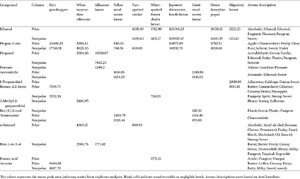
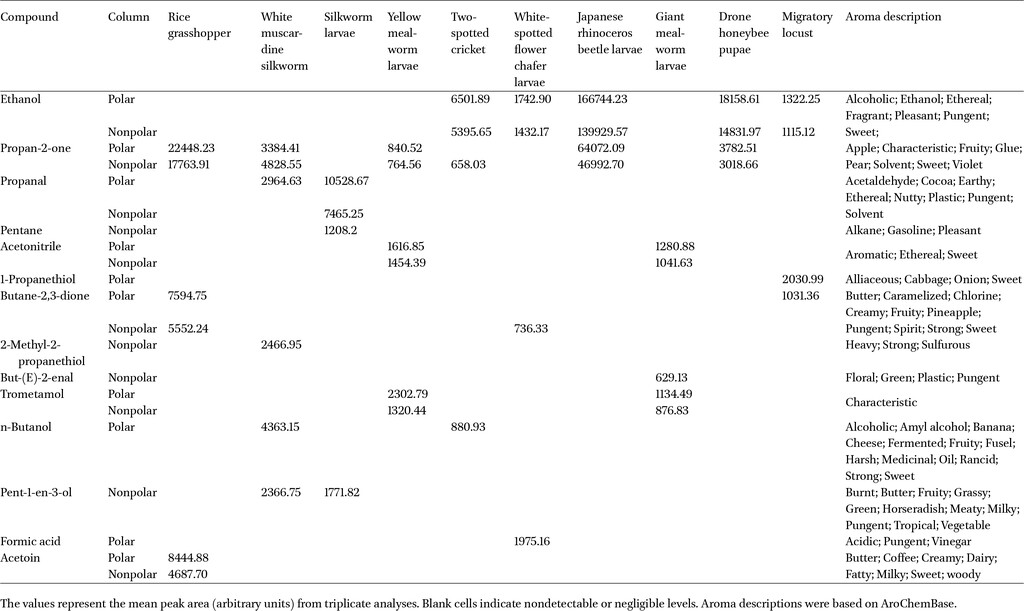
Table 4 presents the major volatile compounds of the ten edible insects identified by the electronic nose, with their mean peak areas and aroma descriptions. Rice grasshoppers exhibited a profile containing propan-2-one together with butane-2,3-dione and acetoin, producing buttery and creamy notes. White muscardine silkworms contained n-butanol, which is associated with fermented odours; silkworm larvae were characterized by propanal with nutty and earthy notes. Yellow mealworm larvae and giant mealworm larvae were distinguished by acetonitrile and trometamol, which are linked to ethereal and characteristic odours. Two-spotted crickets and drone pupae were dominated by ethanol, imparting alcoholic and sweet notes. White-spotted flower chafer larvae contained ethanol and formic acid as major volatiles, with the latter providing acidic and vinegar-like notes. Japanese rhinoceros beetle larvae contained both ethanol and propan-2-one, contributing fruity and solvent-like odours. Migratory locusts exhibited a profile dominated by ethanol and 1-propanethiol, contributing to alcoholic and onion-like odours. Overall, alcohols, ketones, and selected aldehydes and acids were the principal contributors to the differentiation of aroma profiles across edible insect species.
Mean peak area and aroma characteristics of volatile compounds identified in the edible insects
Citation: Journal of Insects as Food and Feed 12, 8 (2026) ; 10.1163/23524588-bja10345
Instrumental taste profiling of edible insects
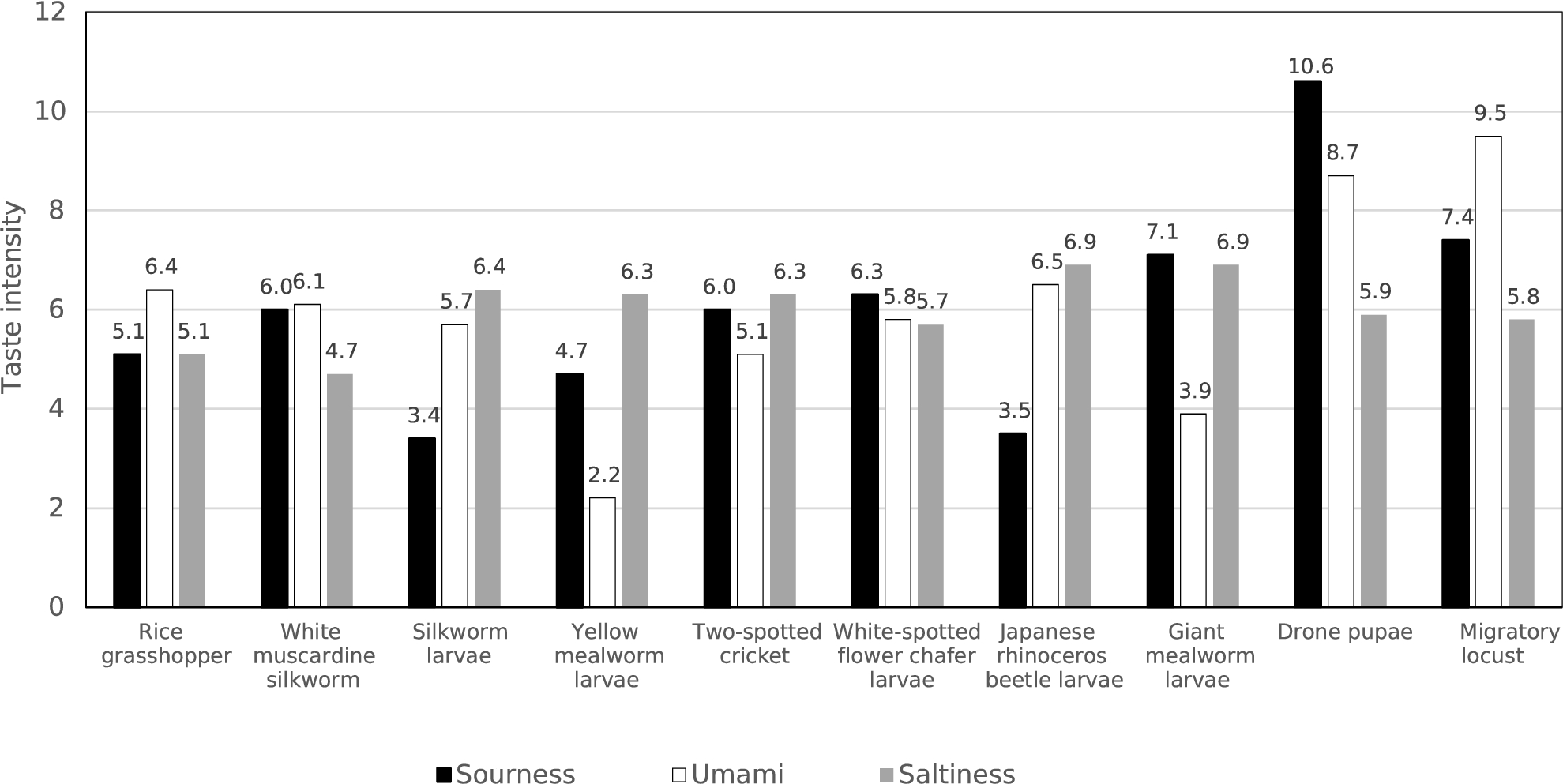
Taste responses obtained from the electronic tongue system revealed distinct differences among the ten edible insect samples. As shown in Fig. 1, the intensities of sourness (AHS), umami (NMS), and saltiness (CTS) exhibited notable variation across species. Drone pupae presented the highest sourness intensity (10.6), followed by migratory locusts (7.4) and giant mealworm larvae (7.1). Sourness was lowest in silkworm larvae (3.4) and Japanese rhinoceros beetle larvae (3.5). Umami intensity was highest in migratory locusts (9.5) and drone pupae (8.7) and lowest in yellow mealworm larvae (2.2). Saltiness was most pronounced in giant mealworm larvae (6.9) and Japanese rhinoceros beetle larvae (6.9), and white muscardine silkworms exhibited the lowest response (4.7). Because electronic tongue data represent reflect relative intensity patterns, inferential statistics were not applied.
Electronic-tongue taste intensities of ten edible insects.
Citation: Journal of Insects as Food and Feed 12, 8 (2026) ; 10.1163/23524588-bja10345
Sensory evaluation of edible insects
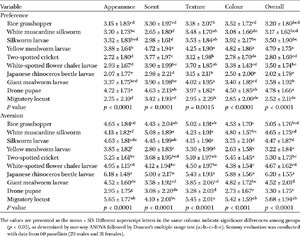
Table 5 summarizes the sensory evaluation results. Drone pupae received the highest appearance (4.72) and overall preference (4.78) scores. Yellow mealworm larvae had the highest scores for scent (4.72), tactile sensation (4.25), colour (4.82), and overall preference (4.70). The highest aversion scores for appearance (6.18), tactile sensation (5.43), colour (5.88), and overall aversion (6.20) were recorded for Japanese rhinoceros beetle larvae. Unpleasant scent scores were highest for white muscardine silkworms (5.08) and Japanese rhinoceros beetle larvae (5.00). As shown in Table 6, overall preference correlated positively with appearance, scent, texture, and colour, strongest for appearance (r = 0.6551,
Sensory evaluation of ten edible insects
Citation: Journal of Insects as Food and Feed 12, 8 (2026) ; 10.1163/23524588-bja10345
Pearson’s correlation coefficients among sensory evaluation attributes
Citation: Journal of Insects as Food and Feed 12, 8 (2026) ; 10.1163/23524588-bja10345
4 Discussion
This study examined ten edible insect species by combining complementary analyses of nutritional composition, instrumental flavour profiling, and human sensory evaluation to provide scientific evidence that can inform product development and enhance consumer acceptance of edible insects in both the Korean and global food markets.
One of the main reasons that edible insects are gaining attention as future alternative food sources in the context of food security is their high nutritional value (Churchward-Venne et al., 2017). Several studies have reported that edible insects are rich in protein (Adámková et al., 2017; De Castro et al., 2018; Nongonierma and FitzGerald, 2017; Zielińska et al., 2018). In a comparative nutrient analysis of three edible insects, Baek et al. (2017) reported the highest protein content in white-spotted flower chafer larvae (Protaetia brevitarsis seulensis), ranging from 40.0 to 62.0 g per 100 g dry weight. Similarly, Ghosh et al. (2017) reported that crickets (Acheta domesticus) contain 44.2 to 58.3 g of protein per 100 g dry weight.
In the present study, Japanese rhinoceros beetle larvae showed the highest protein contnet (35.41%), and high protein contents (>30%, dry weight basis) were consistentaly observed in white muscardine silkworm, rice grasshopper and yellow mealworm lavae. These values are within a comparable range to previous findings. Compared with conventional protein sources, pork and beef contain 28.9 and 32.0 g of protein per 100 g dry weight, respectively (Rural Development Administration and National Institute of Agricultural Science, 2021). Among the insect species studied, silkworm larvae, white-spotted flower chafer larvae, and drone pupae presented lower protein levels than pork and beef did, while the remaining seven species presented comparable or higher protein contents. In support of this, Payne et al. (2016) reported that when nutritional value scores were evaluated, beef and chicken scored below 3.0, whereas all edible insect species scored above 3.0, supporting their potential as alternative protein sources.
From a mineral perspective, several edible insect species were rich in micronutrients per 100 g of dry weight. The highest concentrations of calcium (473.91 mg), potassium (5346.13 mg), magnesium (333.42 mg), and iron (68.40 mg) were detected in Japanese rhinoceros beetle larvae. Two-spotted crickets presented the highest levels of phosphorus (1338.54 mg), sodium (672.92 mg), and zinc (24.94 mg). Silkworm larvae had the highest magnesium content (349.56 mg), and the contents of copper (24.94 mg), silicon (27.40 mg), and selenium (232.98 μg) were particularly high in rice grasshoppers.
For comparison, eggs – considered a nutritionally superior food – contain 215.8 mg calcium, 45.6 mg magnesium, 215.8 mg potassium, 7.5 mg iron, 4.8 mg zinc, 0.15 mg copper, 0.15 mg manganese, and 147 μg selenium per 100 g dry weight (Rural Development Administration and National Institute of Agricultural Science, 2021). When edible insects were compared with eggs, the differences were substantial: the calcium content was 2.2 times higher in rhinoceros beetle larvae, the magnesium content was 7.7 times higher in silkworm larvae, the potassium content was 24.8 times higher in rhinoceros beetle larvae, the iron content was 9.1 times higher in rhinoceros beetle larvae, the zinc content was 5.2 times higher in two-spotted crickets, the copper content was 166.3 times higher in rice grasshoppers, the manganese content was 192.7 times higher in rhinoceros beetle larvae, and the selenium content was 1.6 times higher in rice grasshoppers. Overall, the mineral contents of edible insects surpassed those of commercially available eggs, which is consistent with the findings of previous studies (Kim et al., 2016; Park et al., 2023). These findings underscore the potential of edible insects as dense sources of essential minerals, especially in populations at risk for micronutrient deficiencies.
To translate the nutritional value of edible insects demonstrated in this and previous studies into practical dietary use, consumer acceptance is essential. Beyond nutritional benefits, sensory appeal is a key determinant of food acceptance, as it is strongly influenced by taste, aroma, and visual appearance. Electronic nose profiling revealed that drone pupae and yellow mealworm larvae were rich in volatile compounds such as ethanol and acetoin, which are commonly linked to sweet, alcoholic, and buttery odour categories. The prominence of short-chain alcohols and ketones is in agreement with prior work showing that acetoin/diacetyl systems underpin dairy-like pleasantness and can act synergistically to increase aroma intensity (Li et al., 2024; Tian et al., 2020), as well as with reviews reporting alcohols and ketones among the dominant volatiles in edible insects (Perez-Santaescolastica et al., 2022). These volatile features likely contributed to the higher olfactory preference scores for these species in the sensory evaluation.
In contrast, silkworm larvae and white muscardine silkworms presented elevated levels of aldehydes and n-butanol. Although some aldehydes can impart fruity or green notes, lipid-derived aldehydes are well-known secondary oxidation products with low odour thresholds that frequently drive rancid/off-flavours (Shahidi and Hossain, 2022). In edible insect matrices, processing and storage increased the levels of these aldehydes: drying increased the levels of aldehydes in Locusta migratoria and Bombyx mori (Mishyna et al., 2020), and the storage of Acheta domesticus powders increased the levels of hexanal and pentanal (Marzoli et al., 2023). These mechanistic links are consistent with the higher odour aversion of our panel for silkworm larvae and white muscardine silkworms, which exhibited aldehyde-rich profiles.
Electronic-tongue analysis indicated that insects with higher umami and sourness intensity with moderate saltiness (e.g. drone pupae) aligned with higher human sensory preference ratings, suggesting that glutamate-related compounds and mineral salts may have enhanced taste perception and overall palatability (Miyaki et al., 2016). However, yellow mealworm larvae showed relatively low umami intensity with moderate sourness/saltiness intensity but high preference scores in scent and overall impression, implying that umami alone is not the sole driver of acceptability; rather, pleasant and congruent odour cues can compensate for weaker taste signals and increase hedonic responses (Spence, 2022).
In sensory evaluation, drone pupae were rated the most favourably for appearance, likely reflecting familiarity with silkworm larvae as a traditional food in Korea, while yellow mealworm larvae ranked highest in terms of scent, texture, and colour, which is consistent with their widespread use in processed insect-based products (Kotsou et al., 2023). In contrast, Japanese rhinoceros beetle larvae had the highest aversion scores for appearance and colour, and migratory locusts were most disliked in terms of texture. These results suggest that modifying or masking these less favourable attributes during processing could improve consumer acceptance of insect-based products. Correlation analyses among the sensory attributes further indicated that overall preference showed the strongest positive associations with appearance and colour, whereas overall aversion correlated most strongly with colour, followed by appearance. Thus, visual cues exerted a greater influence on acceptance than odour or texture.
Overall, instrumental evaluations showed both convergence and divergence with the sensory results. The electronic-nose profiling of volatile compounds corresponded with the panel’s olfactory responses, whereas the electronic-tongue results showed partial discrepancies. Saltiness intensity showed a weak positive trend with overall preference, while umami intensity showed an inverse relationship. This divergence may arise because instrumental sensors capture chemical intensities objectively, whereas human preference reflects a complex integration of multiple sensory and psychological factors. Thus, instrumental flavour profiling can effectively predict certain sensory tendencies but cannot fully replicate the holistic perception underlying consumer acceptance.
Regarding to relation between nutritional value and sensory acceptance, the sensory appeal of edible insects did not necessarily align with their compositional richness. Species such as Japanese rhinoceros beetle larvae and two-spotted crickets were rich in protein and mineral profiles but received relatively low preference scores. This discrepancy highlights that superior nutrient density does not guarantee consumer liking, as sensory acceptance depends on factors beyond nutritional composition, including flavour congruence, texture familiarity, and visual aesthetics. Similarly, although instrumental analyses captured distinct taste and odour intensities, these chemical profiles explained only part of the variability in sensory responses. The divergence among nutritional, instrumental, and human sensory dimensions underscores the complexity of consumer perception, suggesting that optimizing edible insect–based foods requires a multidimensional approach that integrates nutritional adequacy with sensory refinement and psychological acceptability.
Despite several limitations – restricted species coverage, commercial sourcing, and the absence of actual ingestion during sensory testing – this study provides comprehensive data on ten edible insect species currently approved in Korea. By integrating nutritional analysis with electronic nose and tongue profiling and human sensory evaluation, this study demonstrates how species-specific aroma and taste attributes shape consumer acceptance. This combined instrumental–human assessment offers a multidimensional understanding of flavor and acceptability, which is essential for consumer-oriented product development. We also employed a pragmatic sensory protocol based on visual, olfactory, and tactile cues without tasting, mirroring how consumers often appraise unfamiliar foods; this design reduces risk and bias while increasing ecological validity, thereby enhancing the applicability of our findings to real-world behaviour and product design.
5 Conclusions
Among the ten edible insects, Japanese rhinoceros beetle larvae and yellow mealworm larvae showed the highest protein content, whereas rice grasshoppers, two-spotted crickets, and Japanese rhinoceros beetle larvae were richer in minerals. Electronic nose profiling revealed species-specific aroma profiles, with ethanol dominating in drone pupae and crickets, buttery notes dominating in grasshoppers, and sulphurous or acidic volatiles dominated in rhinoceros beetle larvae and migratory locusts. Electronic tongue profiling further revealed stronger saltiness in Japanese rhinoceros beetle larvae and giant mealworm larvae and higher sourness and umami in migratory locusts and drone pupae. In the sensory panel, drone pupae and mealworms received the greatest preference, whereas rhinoceros beetle larvae and migratory locusts elicited greater aversion.
Overall, the integration of nutritional, instrumental, and sensory data revealed that nutritional richness did not necessarily correspond with sensory acceptance. While species such as drone pupae and yellow mealworm larvae combined favourable flavour attributes with high consumer preference, others with high nutrient density showed limited sensory appeal. These findings highlight drone pupae and yellow mealworm larvae as promising candidates for product development and indicate that targeted processing strategies may be needed for species with unfavourable sensory traits to improve consumer acceptance.
Corresponding author; e-mail: mhkim1129@kongju.ac.kr
Conflict of interest
The authors have no conflicts of interest to declare.
Funding
This research received no external funding.
References
Adámek, M., Adámková, A., Borkovcová, M., Mlček, J., Bednářová, M., Kouřimská, L., Skácel, J. and Řeznı́-ček, M., 2017. Electronic nose in edible insects area. Potravinarstvo Slovak Journal of Food Sciences 11: 446-451. https://doi.org/10.5219/785
Adámková, A., Mlček, J., Borkovcová, M., Bednářová, M., Kouřimská, L. and Pařil, P., 2017. Nutritional and sensory quality of edible insects. Potravinarstvo Slovak Journal of Food Sciences 11: 460-465. https://doi.org/10.5219/748
Alhujaili, A., Nocella, G. and Macready, A., 2023. Insects as food: consumers’ acceptance and marketing. Foods 12: 886. https://doi.org/10.3390/foods12040886
Bae, Y. and Choi, J., 2021. Consumer acceptance of edible insect foods: an application of the extended theory of planned behavior. Nutrition Research and Practice 15: 122-135. https://doi.org/10.4162/nrp.2021.15.1.122
Baek, M., Hwang, J.-S., Kim, M.A., Kim, S.-H., Goo, T.-W. and Yun, E.-Y., 2017. Comparative analysis of nutritional components of edible insects registered as novel foods. Journal of Life Science 27: 334-338. https://doi.org/10.5352/jls.2017.27.3.334
Cho, S. and Moazzem, M.S., 2022. Recent applications of potentiometric electronic tongue and electronic nose in sensory evaluation. Preventive Nutrition and Food Science 27: 354-364. https://doi.org/10.3746/pnf.2022.27.4.354
Churchward-Venne, T.A., Pinckaers, P.J.M., van Loon, J.J.A. and van Loon, L.J.C., 2017. Consideration of insects as a source of dietary protein for human consumption. Nutrition Reviews 75: 1035-1045. https://doi.org/10.1093/nutrit/nux057
de Carvalho, N.M., Madureira, A.R. and Pintado, M.E., 2019. The potential of insects as food sources – a review. Critical Reviews in Food Science and Nutrition 60: 3642-3652. https://doi.org/10.1080/10408398.2019.1703170
De Castro, R.J.S., Ohara, A., Aguilar, J.G.S. and Domingues, M.A.F., 2018. Nutritional, functional and biological properties of insect proteins: processes for obtaining, consumption and future challenges. Trends in Food Science & Technology 76: 82-89. https://doi.org/10.1016/j.tifs.2018.04.006
Finke, M.D., 2007. Estimate of chitin in raw whole insects. Zoo Biology 26: 105-115. https://doi.org/10.1002/zoo.20123
Ghosh, S., Lee, S.-M., Jung, C. and Meyer-Rochow, V.B., 2017. Nutritional composition of five commercial edible insects in South Korea. Journal of Asia-Pacific Entomology 20: 686-694. https://doi.org/10.1016/j.aspen.2017.04.003
Janssen, R.H., Vincken, J.P., van den Broek, L.A.M., Fogliano, V. and Lakemond, C.M.M., 2017. Nitrogen-to-protein conversion factors for three edible insects: Tenebrio molitor, Alphitobius diaperinus, and Hermetia illucens. Journal of Agricultural and Food Chemistry 6: 2275-2278. https://doi.org/10.1021/acs.jafc.7b00471
Kim, S.-K., Weaver, C.M. and Choi, M.-K., 2016. Proximate composition and mineral content of five edible insects consumed in Korea. CyTA – Journal of Food 15: 143-146. https://doi.org/10.1080/19476337.2016.1223172
Kłobukowski, F., Śmiechowska, M. and Skotnicka, M., 2025. Edible insects from the perspective of sustainability – a review of the hazards and benefits. Foods 14: 1382. https://doi.org/10.3390/foods14081382
Kotsou, K., Chatzimitakos, T., Athanasiadis, V., Bozinou, E., Athanassiou, C.G. and Lalas, S.I., 2023. Innovative applications of tenebrio molitor larvae in food product development: a comprehensive review. Foods 12: 4223. https://doi.org/10.3390/foods12234223
Kroger, T., Dupont, J., Busing, L. and Fiebelkorn, F., 2022. Acceptance of insect-based food products in western societies: a systematic review. Frontiers in Nutrition 8: 759885. https://doi.org/10.3389/fnut.2021.759885
Li, D., Cui, Y., Wu, X., Li, J., Min, F., Zhao, T., Zhang, J. and Zhang, J., 2024. Graduate student literature review: network of flavor compounds formation and influence factors in yogurt. Journal of Dairy Science 107: 8874-8886. https://doi.org/10.3168/jds.2024-24875
Martins, O.M.D., Bucea-Manea-Ţoniş, R., Coelho, A.S. and Simion, V.-E., 2022. Sensory perception nudge: insect-based food consumer behavior. Sustainability 14: 11541. https://doi.org/10.3390/su141811541
Marzoli, F., Tata, A., Zacometti, C., Malabusini, S., Jucker, C., Piro, R., Ricci, A. and Belluco, S., 2023. Microbial and chemical stability of Acheta domesticus powder during one year storage period at room temperature. Frontiers in Sustainable Food Systems 7: 1179088. https://doi.org/10.3389/fsufs.2023.1179088
Mishyna, M., Haber, M., Benjamin, O., Martinez, J.J.I. and Chen, J., 2020. Drying methods differentially alter volatile profiles of edible locusts and silkworms. Journal of Insects as Food and Feed 6: 405-416. https://doi.org/10.3920/jiff2019.0046
Miyaki, T., Retiveau-Krogmann, A., Byrnes, E. and Takehana, S., 2016. Umami increases consumer acceptability, and perception of sensory and emotional benefits without compromising health benefit perception. Journal of Food Science 81: S483-S493. https://doi.org/10.1111/1750-3841.13195
Nongonierma, A.B. and FitzGerald, R.J., 2017. Unlocking the biological potential of proteins from edible insects through enzymatic hydrolysis: a review. Innovative Food Science & Emerging Technologies 43: 239-252. https://doi.org/10.1016/j.ifset.2017.08.014
Orkusz, A., 2021. Edible insects versus meat – nutritional comparison: knowledge of their composition is the key to good health. Nutrients 13: 1207. https://doi.org/10.3390/nu13041207
Park, E.S., Kang, M.H. and Choi, M.K., 2023. Nutritional composition and antioxidant properties of edible insects sold in Korea. Journal of Insects as Food and Feed 9: 245-254. https://doi.org/10.3920/jiff2022.0036
Payne, C.L.R., Scarborough, P., Rayner, M. and Nonaka, K., 2016. Are edible insects more or less ‘healthy’ than commonly consumed meats? A comparison using two nutrient profiling models developed to combat over- and undernutrition. European Journal of Clinical Nutrition 70: 285-291. https://doi.org/10.1038/ejcn.2015.149
Perez-Santaescolastica, C., De Winne, A., Devaere, J. and Fraeye, I., 2022. The flavour of edible insects: a comprehensive review on volatile compounds and their analytical assessment. Trends in Food Science & Technology 127: 352-367. https://doi.org/10.1016/j.tifs.2022.07.011
Psarianos, M., Aghababaei, F. and Schlüter, O.K., 2025. Bioactive compounds in edible insects: aspects of cultivation, processing and nutrition. Food Research International 203: 115802. https://doi.org/10.1016/j.foodres.2025.115802
Rumpold, B.A. and Schlüter, O.K., 2013. Nutritional composition and safety aspects of edible insects. Molecular Nutrition & Food Research 57: 802-823. https://doi.org/10.1002/mnfr.201200735
Rural Development Administration and National Institute of Agricultural Science, 2021. Korean food composition table. Rural Development Administration, Seoul, Korea.
Shahidi, F. and Hossain, A., 2022. Role of lipids in food flavor generation. Molecules 27: 5014. https://doi.org/10.3390/molecules27155014
Spence, C., 2022. Behavioural nudges, physico-chemical solutions, and sensory strategies to reduce people’s salt consumption. Foods 11: 3092. https://doi.org/10.3390/foods11193092
Sun-Waterhouse, D., Waterhouse, G.I.N., You, L., Zhang, J., Liu, Y., Ma, L., Gao, J. and Dong, Y., 2016. Transforming insect biomass into consumer wellness foods: a review. Food Research International 89: 129-151. https://doi.org/10.1016/j.foodres.2016.10.001
Tian, H., Yu, B., Yu, H. and Chen, C., 2020. Evaluation of the synergistic olfactory effects of diacetyl, acetaldehyde, and acetoin in a yogurt matrix using odor threshold, aroma intensity, and electronic nose analyses. Journal of Dairy Science 103: 7957-7967. https://doi.org/10.3168/jds.2019-17495
van Huis, A., Van Itterbeeck, J., Klunder, H., Mertens, E., Halloran, A., Muir, G. and Vantomme, P., 2013. Edible insects: future prospects for food and feed security. FAO Forestry Paper 171. FAO, Rome.
Wendin, K.M.E. and Nyberg, M.E., 2021. Factors influencing consumer perception and acceptability of insect-based foods. Current Opinion in Food Science 40: 67-71. https://doi.org/10.1016/j.cofs.2021.01.007
Zielińska, E., Karaś, M. and Baraniak, B., 2018. Comparison of functional properties of edible insects and protein preparations thereof. LWT 91: 168-174. https://doi.org/10.1016/j.lwt.2018.01.058