Abstract
This is the first report on the in vitro bioavailability of zinc (Zn) in silkworm (Bombyx mori) larva powder (SLP) developed for human consumption. We used the chick bioassay, which has been extensively employed to evaluate the relative Zn bioavailability of animal feeds and foodstuffs, using ZnSO4 ⋅ H2O as the 100% reference standard. Multiple regression analysis of total tibia Zn against supplemental Zn intake yielded a slope-ratio relative bioavailability value of 175% for Zn in SLP, which was significantly higher (
1 Introduction
With increasing protein demand globally, many sustainable alternate sources of protein are being developed, including insects. The consumption of insects, or entomophagy, contributes positively to the environment and to health and livelihood of humans (van Huis et al., 2013). Thus, many large food companies and small start-up companies across the globe are investigating the feasibility of industrializing insects for food and feed, and some are already on the market.
Historically, silkworm (Bombyx mori) has been consumed in Asian countries, including Japan. A report dated back in 1919 by the Japanese Ministry of Agriculture and Commerce shows how silkworms at various parts of the life stage (pupa and larva) were consumed for nutritional and medicinal purposes (Miyake, 1919). Silkworm pupae are a byproduct of sericulture and were most popular for human consumption since they have high content of proteins (Tomotake et al., 2010). On the contrary, silkworm larvae have not been very popular for human consumption since larvae are not a byproduct per se. They are at the stage just before producing valuable silk cocoon so farmers are reluctant to consume them. Silkworm larvae are also known to have high content of proteins, lipids, vitamins, and minerals (Finke, 2002). However, their nutritional value and nutrient bioavailability have not been fully explored.
Because silkworms only eat the leaves of mulberry plant (Morus alba), they are known to accumulate nutrients and substances from mulberry. For example, mulberry leaf is rich in 1-Deoxynojirimicin (DNJ), a known potent α-glucosidase inhibitor (Asano et al., 1994), silkworm larvae are indeed rich in DNJ (Yin et al., 2010). Mulberry leaf is rich in zinc (Zn), iron, and calcium (Srivastava et al., 2006), and so are silkworm larvae (Finke, 2002).
Zinc is an important nutrient in human and animal nutrition. Zinc is essential in many aspects of cellular metabolism and physiological functions and supports healthy growth and development (Roohani et al., 2013). Dietary sources of Zn include red meat, poultry, seafood, grains, and various inorganic Zn salt supplements such as Zn-sulfate and Zn-gluconate.
Zinc bioavailability is affected by multiple factors. The source and the chemical form seem to largely affect digestibility and absorbability. In general, animal-based Zn is more bioavailable than plant-based Zn. The reason is that the plant-based Zn is mostly bound to an anti-nutrition factor, phytic acid, and the presence of which makes it less digestible. On the other hand, animal-based Zn is often bound to proteins (enzymes, transporters, and storage proteins) which is more digestible in the mammalian alimentary tract (Mwangi et al., 2018; Welch, 1993). Furthermore, the in vitro solubility and availability of Fe and Zn from various insect species (not including the silkworm) have been compared with those from sirloin beef using a Caco-2 cell model (Latunde-Dada et al., 2016). It was found that Fe and Zn solubility was significantly higher from the insect samples than from beef, implicating higher bioavailability of Zn in insects.
No information is available on the forms of Zn in silkworm larva and their bioavailability. Thus, we hypothesized that Zn in silkworm larva is more bioavailable than Zn in mulberry leaf, which is the only source of Zn consumed by the silkworm.
There is a limited number of methods to access Zn bioavailability, including in vitro animal and isotopic human studies (Dias et al., 2017). We chose the chick bioassay which has been extensively used to evaluate relative Zn bioavailability of animal feed and foodstuffs against ZnSO4 ⋅ H2O as the 100% reference standard (Aoyagi et al., 1995; Smiricky-Tjardes et al., 2024; Wedekind and Baker, 1990).
2 Material and methods
Preparation of silkworm larvae powder (SLP)
The 5th instar mulberry silkworms were provided by a local silk farmer. They were harvested on Day 4 or at approximately 3 g body weight and frozen. Frozen silkworms were pulverized and blended with hot water at 95 °C for at least for 10 min but not longer than 20 min. Silkworm emulsion was quickly frozen and freeze-dried until the moisture level fell below 5% within 30 h. Freeze-dried silkworm was pulverized (mesh 0.3 mm) to produce SLP.
Preparation of experimental diet
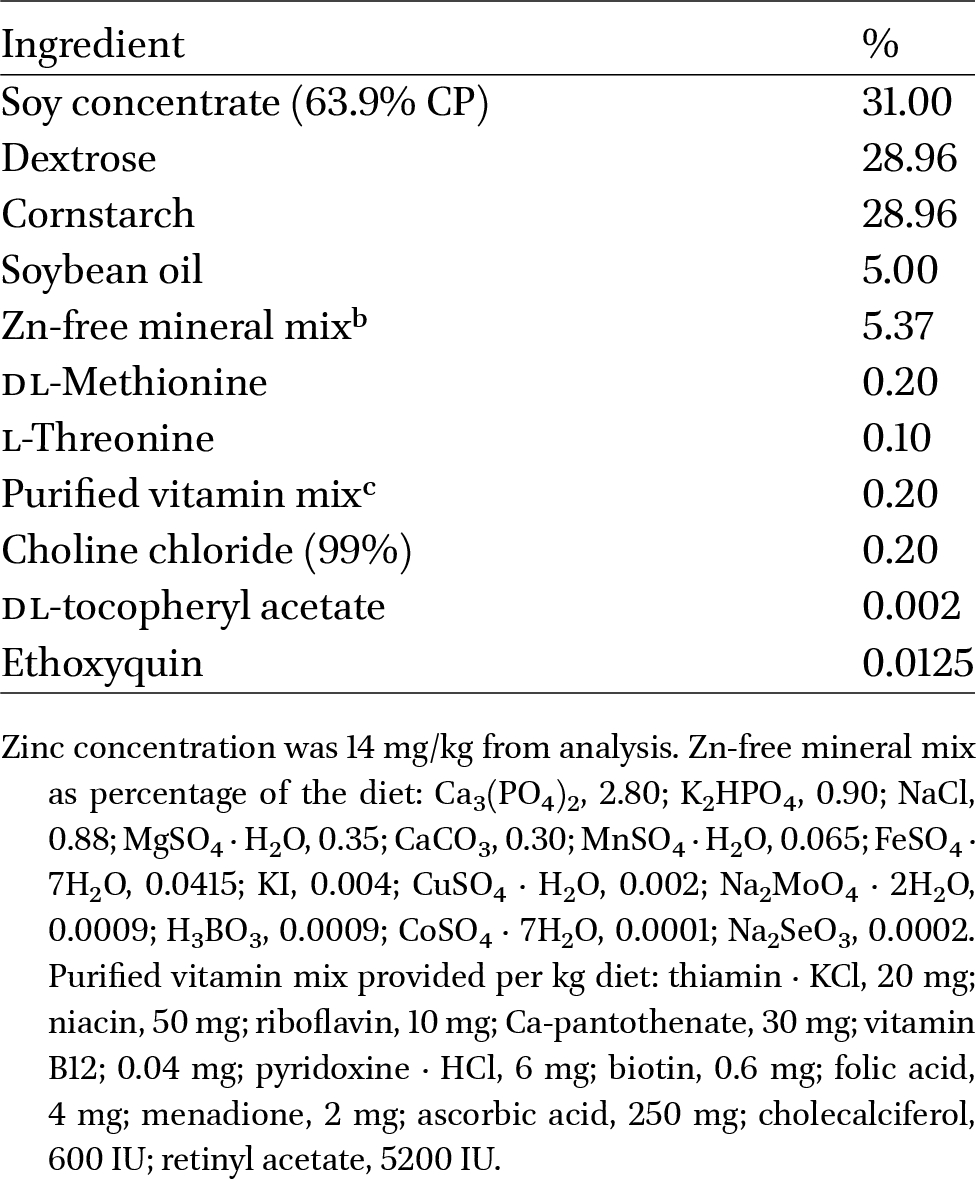
A Zn-deficient semi-purified diet based on dextrose, cornstarch, and soy protein concentrate was formulated to contain approximately 14 mg Zn per kg (Table 1). There were 9 dietary treatments in the experiment. Diet 1 was the Zn deficient base diet. Diets 2-3 contained 4 and 8 mg/kg of Zn, respectively, from feed grade ZnSO4 ⋅ H2O (36% Zn as determined by analysis). Diets 4-5 contained 4 and 8 mg/kg of Zn, respectively, of added Zn from SLP (57 mg/kg Zn from analysis). Diets 6-7 contained 5 and 10 mg/kg of Zn, respectively, of added Zn from soybean meal (SBM) which contained 71 mg/kg Zn from analysis. Diets 8-9 contained 4 and 8 mg/kg, respectively, of added Zn from mulberry leaf powder (MLP) purchased from Toyotama Healthfood (Tokyo, Japan) which contained 29.7 mg/kg Zn from analysis. All Zn additions were made in place of cornstarch in the base diet.

Composition of Zn-deficient basal diet
Citation: Journal of Insects as Food and Feed 12, 8 (2026) ; 10.1163/23524588-bja10349
Chick bioassay
Commercial Ross 308 broiler male chicks were used. All chicks were fed a corn SBM starter diet (120 mg of Zn/kg from analysis) from 0 to 3 days of age. All chicks were then fed the Zn-deficient base soy protein concentrate diet (Table 1) until 7 days of age. After an overnight withdrawal of feed, chicks were weighed, wing-banded, and assigned randomly to 9 experimental groups at Day 8 post-hatching. Seven replicate groups of five chicks per pen were fed each of the 9 experimental diets from 8 to 21 days post-hatching.
At day 21 post-hatching, all chicks were weighed and then were euthanized with carbon dioxide gas and the right tibia bone was removed, autoclaved, cleaned of adhering tissue, and they were pooled by replicate, and dried at 105 °C for 24 hours. Dry tibiae were weighed and ashed in a muffle furnace. The ashed tibiae were then sent to the University Missouri Experiment Station Laboratory for the analysis of Zn concentration using flame atomic absorption spectrophotometry.
Weight gain and feed intake were calculated for each pen of chicks. Total bone ash in mg/tibia and bone ash as a percent concentration were calculated. In addition, supplemental Zn intake, tibia ash Zn concentration, and total bone Zn were calculated.
Statistical analysis
All data were initially analyzed by analysis of variance and differences among treatment means were determined using the least significant difference test at
3 Results
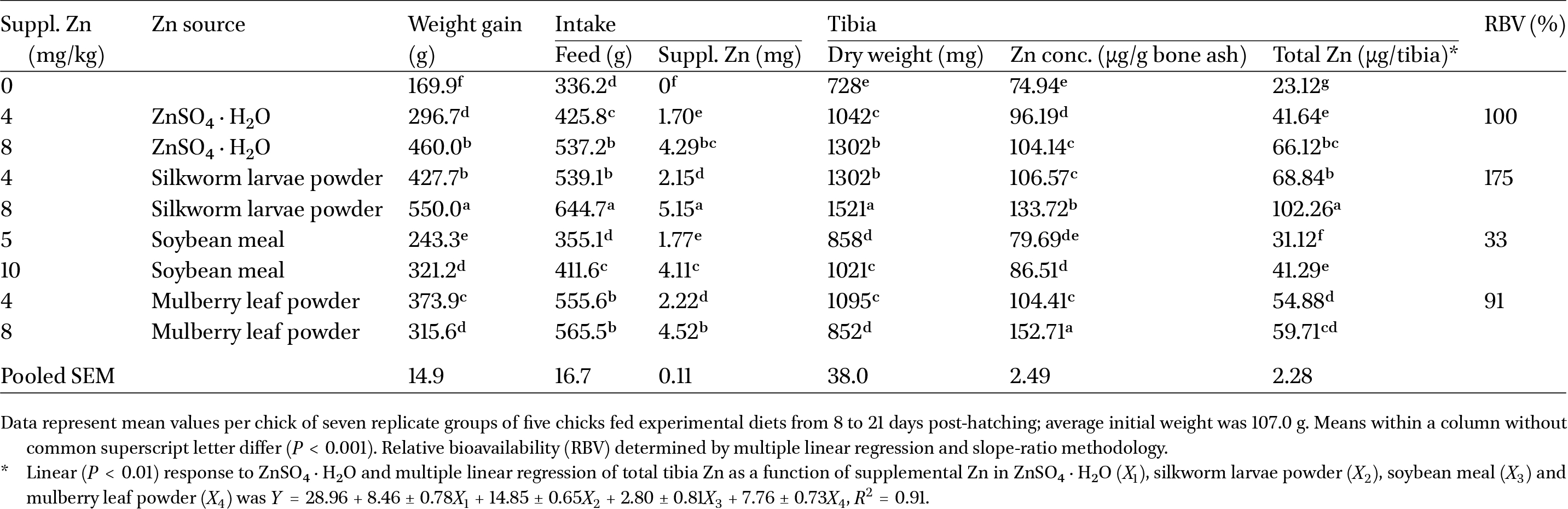
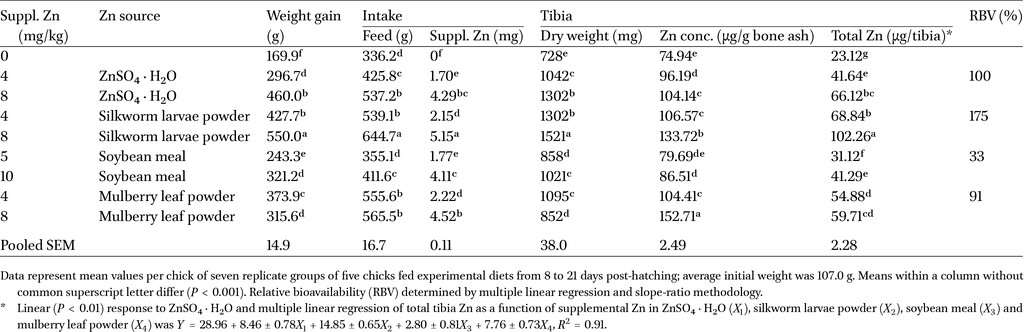
Weight gain increased with increasing dietary Zn and the increase for SLP was greater than for the other Zn sources (Table 2). Feed intake generally increased with increasing added Zn. Bone weight and bone ash also generally increased with increasing added Zn. As expected, supplemental Zn intake increased with increasing added Zn. Tibia ash Zn concentration and total tibia Zn increased greatly and linearly with increasing added Zn. For total tibia Zn, the key and most important parameter, the values for chicks fed SLP were higher than the other Zn sources.
Zinc bioavailability in silkworm larvae powder, soybean meal, and mulberry leaf powder
Citation: Journal of Insects as Food and Feed 12, 8 (2026) ; 10.1163/23524588-bja10349
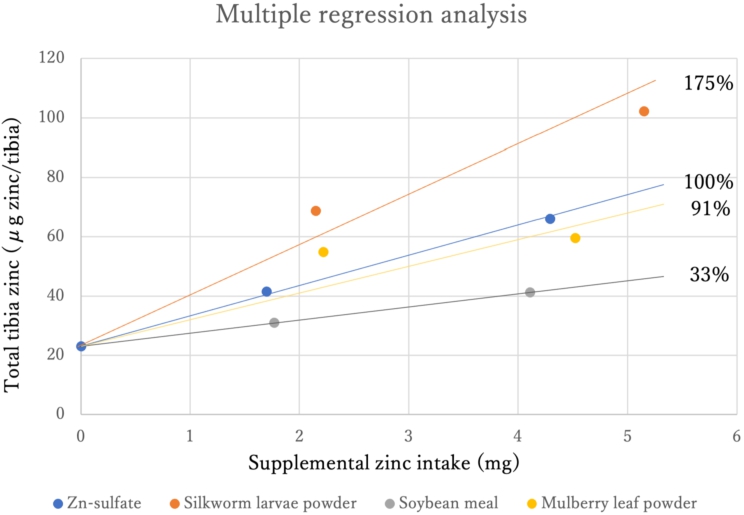
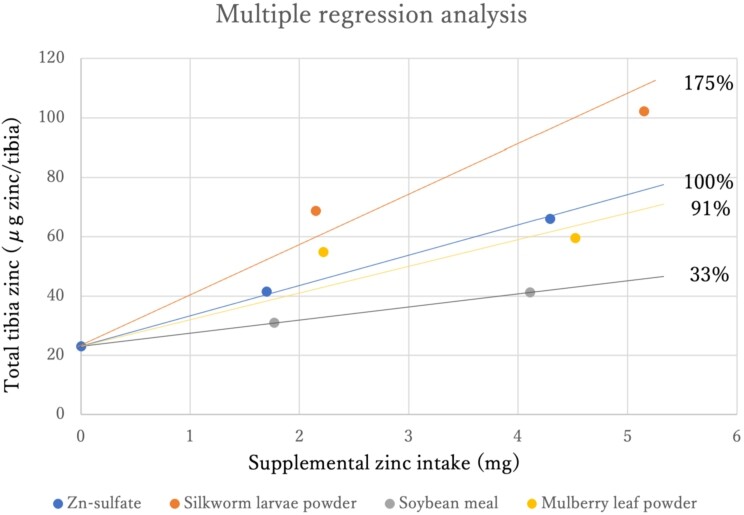
For the multiple regression analysis of total tibia Zn on supplemental Zn intake, an excellent
4 Discussion
This is the first report on the in vitro bioavailability of the Zn in SLP, which was developed for human consumption by Morus (Tokyo, Japan). Zinc content in SLP was 57 mg/kg, which is similar if not higher to the values previously reported across other eatable insects (Finke, 2002).
The main conclusion of this study was that the bioavailability of the Zn in SLP was higher than the Zn in the inorganic ZnSO4 ⋅ H2O, which is often used as the Zn source in multi-mineral supplements. Moreover, the Zn in SLP (animal-based Zn) was about twice more bioavailable than the Zn in MLP (plant-based Zn) as we had hypothesized. It can be said that bioconversion of mulberry Zn by the silkworm enhanced Zn bioavailability. This would be the similar reason as in the iron (Fe) bioavailability differences between animal-based heme Fe versus plant-based nonheme Fe (Hurrell and Egli, 2010). Insect Fe, however, is not considered as a heme Fe as the Fe is found in ferritin and holoferritin in insects (Mwangi et al., 2018). Further investigation is warranted for other trace mineral bioavailability enhancement by the silkworm.
Protein (more specifically: amino acids such as histidine and methionine) is known to enhance Zn absorption (Lönnerdal, 2000). Silkworm larvae powder has a high protein content (approximately 60% from analysis). Therefore, the high protein content in SLP might have promoted the uptake of Zn compared to the lower protein content (approximately 20% DM) in MLP.
In conclusion, SLP is an excellent efficacious source of very highly bioavailable Zn.
Illustration of relative Zn bioavailability from the multiple linear regression of total tibia Zn as a function of supplemental Zn from ZnSO4 ⋅ H2O (
Citation: Journal of Insects as Food and Feed 12, 8 (2026) ; 10.1163/23524588-bja10349
Corresponding author; e-mail: seiji.aoyagi@morus.jp
Funding
This study was funded by Morus Inc.
References
Aoyagi, S., Hiney, K.M. and Baker, D.H., 1995. Estimate of zinc and iron bioavailability in pork liver and the effect of sex of pig on the bioavailability of copper in pork liver fed to male and female chicks. Journal of Animal Science 73: 793-798.
Asano, N., Oseki, K., Tomioka, E., Kizu, H. and Matsui, K., 1994. N-Containing sugars from Morus alba and their glycosidase inhibitory activities. Carbohydrate Research 253: 235-245.
Dias, D.M., Costa, N.M.B., Nutti, M.R., Tako, E. and Martino, H.S.D., 2018. Advantages and limitations of in vitro and in vivo methods of iron and zinc bioavailability evaluation in the assessment of biofortification program effectiveness. Critical Reviews in Food Science and Nutrition 58: 2136-2146.
Finney, D.J., 1978. Statistical methods of biological assay. 3rd ed. Charles Griffin, London.
Hurrell, R. and Egli, I., 2010. Iron bioavailability and dietary reference values. American Journal of Clinical Nutrition 91: 1461S-1467S.
Latunde-Dada, G.O., Yang, W. and Aviles, M.V., 2016. In vitro iron availability from insects and sirloin beef. Journal of Agricultural and Food Chemistry 9: 8420-8424.
Lönnerdal, B., 2000. Dietary factors influencing zinc absorption. Journal of Nutrition 130: 1378S-1383S. https://doi.org/10.1093/jn/130.5.1378S
Lye, J.C., Richards, C.D., Dechen, K., Paterson, D., de Jonge, M.D., Howard, D.L., Warr, C.G. and Burke, R., 2012. Systematic functional characterization of putative zinc transport genes and identification of zinc toxicosis phenotypes in Drosophila melanogaster. Journal of Experimental Biology 215: 3254-3265.
Miyake, T., 1919. Special report 31. Agricultural Research Center. Ministry of Agriculture, Tokyo.
Mwangi, M.N., Oonincx, D.G.A.B., Stouten, T., Veenenbos, M., Melse-Boonstra, A., Dicke, M. and Van Loon, J.J.A., 2018. Insects as sources of iron and zinc in human nutrition. Nutrition Research Review 2: 248-255.
Roohani, N., Hurrell, R., Kelishadi, R. and Schulin, R., 2013. Zinc and its importance for human health: an integrative review. Journal of Research in Medical Sciences 2: 144-157.
Smiricky-Tjardes, M., Utterback, P., Blair, J., Drysdale, R., Hack, A., Cristobal, M., Glende, J., Parsons, B. and Parsons, C., 2024. Relative bioavailability of zinc in zinc hydroxychloride for chicks. Poultry Science 103: 103315.
Srivastava, S., Kapoor, R., Thathola, A. and Srivastava, R.P., 2006. Nutritional quality of leaves of some genotypes of mulberry (Morus alba). International Journal of Food Science and Nutrition 57: 305-313.
Tomotake, H., Katagiri, M. and Yamamoto, M., 2010. Silkworm pupae (Bombyx mori) are new sources of high-quality protein and lipid. Journal of Nutritional Sciences and Vitaminology 56: 446-448.
van Huis, A., Van Itterbeeck, J., Klunder, H., Mertens, E., Halloran, A., Muir, G. and Vantomme, P., 2013. Edible insects: future prospects for food and feed security. FAO Forestry Paper 171. FAO, Rome.
Wedekind, K.L. and Baker, D.H., 1990. Zinc bioavailability in feed-grade sources of zinc. Journal of Animal Sciences 68: 684-689.
Welch, R.M., 1993. Zinc concentrations and forms in plants for humans and animals. In: Robson, A.D. (ed.) Zinc in soils and plants. Developments in plant and soil sciences 55. Springer, Dordrecht, pp. 183-195. https://doi.org/10.1007/978-94-011-0878-2_13
Yin, H., Shi, X.Q., Sun, B., Ye, J.J., Duan, Z.A., Zhou, X.L., Cui, W.Z. and Wu, X.F., 2010. Accumulation of 1-deoxynojirimycin in silkworm, Bombyx mori L. Journal of Zhejiang University Science B 4: 286-291. https://doi.org/10.1631/jzus.B0900344
Zhou, J. and Han, D., 2006. Safety evaluation of protein of silkworm (Antheraea permyl). Food and Chemical Toxicology 447: 1123-1130.