Abstract
Hermetia illucens commonly known as black soldier fly (BSF), is a rich source of protein, lipids, vitamins, and minerals, fulfilling the nutritional needs of both humans and animals. The larvae (BSFL) are recognised for converting food waste into valuable organic fractions and is rich in several nutrients, thereby supporting a circular economy and addressing a significant global challenge such as organic waste management. The aim of this work was to evaluate the ability of attenuated total reflectance (ATR) mid infrared (MIR) spectroscopy combined with chemometrics to classify lipids extracted from BSFL fed with three different waste streams (supermarket, food waste mix and childcare centre waste). The results of this study indicated that most fatty acid (FA) levels, except for palmitic and stearic acids, vary across the different dietary groups, supporting that diet significantly influences fatty acid levels and the distribution of saturated (SFA) and unsaturated (UFA) in BSFL. The results also demonstrate the potential of ATR-MIR spectroscopy combined with principal component analysis (PCA) and Soft Independent Modelling of Class Analogy (SIMCA) to differentiate and classify H. illucens larvae lipids reared on various organic side streams. This method offers a promising alternative for the industry to link BSFL to their diet, based on their lipid profile, enabling rapid and accurate analysis with minimal sample amount and no need for pretreatment.
1 Introduction
Hermetia illucens, commonly known as the black soldier fly (BSF), is one of the most widely utilized insects used for converting by-products into valuable organic fractions, thereby supporting a circular economy and addressing a significant global challenge: organic waste management (Barroso et al., 2014; Oonincx et al., 2015). Several characteristics make H. illucens particularly noteworthy, including its short life cycle, high feed conversion ratios, and the fact that it only consumes food during its larval stage, not as an adult (Da Silva and Hesselberg, 2020; Oonincx et al., 2015). Moreover, H. illucens can process a diverse range of waste types, including soy waste, cattle, pig, or chicken manure, sewage sludge, food waste, restaurant waste, and even faecal sludge, among others (Lalander et al., 2013; Liu et al., 2020; Rehman et al., 2017). The different substrates used can impact the larvae (BSFL) growth rates, size, survival rate, fertility, and nutritional composition, including fat and protein contents (Kim et al., 2021). Additionally, the diet can influence their fatty acid profile (Oonincx et al., 2020; Riekkinen et al., 2022). Nonetheless, H. illucens remains a rich source of protein, lipids, vitamins and minerals, fulfilling the nutritional needs of humans and animals (Barroso et al., 2014). Despite the variation in feed substrates, BSFL consistently exhibit a high lipid content, storing up to 39% of their dry weight in lipids, which are used as an energy source during the non-feeding adult stages (Wang and Shelomi, 2017). H. illucens has a lipid fraction distinct from most other insects studied, characterized by a high percentage of saturated fatty acids (58-72%), particularly lauric, myristic, and palmitic acids, which contribute to its solid state at room temperature (Sosa and Fogliano, 2017). Additionally, it contains unsaturated fatty acids, mainly oleic and linoleic acids (Barragan-Fonseca et al., 2017). This unique lipid profile makes H. illucens particularly appealing for some applications where other insect species may be less suitable. For instance, Smetana et al. (2020) obtained margarine with a lower environmental impact than butter, with the same spreading properties as plant-based margarine, by replacing vegetable fats with H. illucens fats, thanks to its similar physical state. Delicato et al. (2020) used H. illucens fat instead of butter in bakery products and found that substituting 25% of the butter with insect fat did not affect consumer preference. They could even replace up to 50% of waffle production without compromising taste or texture. Schiavone et al. (2018) partly and fully replaced soybean oil with H. illucens larva fat in broiler chicken diets and found no adverse effects on growth performance or blood parameters. Similarly, Cullere et al. (2019) studied the sensory characteristics of chicken meat under the same rearing conditions and concluded that substituting soybean oil with H. illucens fat is feasible, even up to 100%. In addition to its applications in food and feed production, H. illucens fat also has a range of industrial uses. It can serve as a non-food feedstock for biodiesel production or in the cosmetic industry, where it can be used in products like soaps and various personal care items (Franco et al., 2021; Li et al., 2011; Verheyen et al., 2018).
Besides all the conditions before insect harvesting that impact their composition, the techniques employed during the killing process, manufacturing, fraction extraction, storage, and transport also play a significant role (Mendez-Sanchez et al., 2024; Ojha et al., 2021; Ravi et al., 2020). Caligiani et al. (2018), for instance, followed three different protocols for fractioning H. illucens, revealing that these methods significantly impacted the purity, yield, and integrity of specific components. Numerous techniques have been described for lipid extraction from insects, with organic solvents being the most common. However, other methods, including aqueous extractions, three-phase partitioning, ultrasound, pressing, centrifugation, enzyme-assisted extraction, and supercritical fluid extraction, have also been explored (Laroche et al., 2019; Li et al., 2024; Tzompa-Sosa et al., 2014). The choice of method significantly influences both the yield and composition of the final lipid extract.
The biochemical composition of the lipid fraction is important for its application, but traditional analysis methods are time-consuming, require chemicals, and demand significant investment in equipment. Furthermore, the use of harsh chemicals tends to negate the positive image of BSFL being a “green” answer to waste management within the circular economy. Infrared (IR) spectroscopy is emerging as an alternative analytical technique, enhanced by advances in miniaturized devices (Cebi et al., 2023; Rodriguez-Saona et al., 2020). These instruments enable real time analysis, with almost instant results and no destruction of the sample. IR spectroscopy is based on the interaction between the radiation and the chemical bonds in the sample, allowing for detailed structural identification (Cebi et al., 2023; Rodriguez-Saona et al., 2020). The fingerprint region, in the mid-infrared (MIR) spectrum, provides a unique pattern specific to each sample. This distinct spectral pattern makes it highly useful for identifying and comparing different samples (Garcı́a-Gutiérrez et al., 2021). Combined with multivariate analysis, MIR spectroscopy has been successfully used to classify and quantify components and variables in different samples, including lipids. There are already results of insect samples analysed using MIR spectroscopy. For instance, Hoffman et al. (2022) successfully classified H. illucens larvae powders reared on different waste stream diets. Similarly, Mellado-Carretero et al. (2020) differentiated insect powders by species and, within the same species, based on variations due to processing conditions while Alagappan et al. (2024) quantified insect powder mixed with chickpea and flaxseed flours. However, no reports were found in the literature that combines the use of IR spectroscopy to analyse lipids extracted via ultrasound from BSFL.
This work aimed to evaluate the ability of attenuated total reflectance (ATR) MIR spectroscopy combined with chemometrics in discriminating lipids extracted from BSFL fed with three different waste streams. Furthermore, the study assessed the impact of the ultrasound technique on the lipid extract profile during the extraction process based on organic solvents.
2 Materials and methods
Samples
Three waste streams, called supermarket (WL), food waste mix (WB) and childcare centre (CC) were used as feed for BSFL under commercial rearing conditions as reported previously (Alagappan et al., 2024b). These commercial waste streams are supplied on a daily basis and were used by the commercial waste processing facility to feed the larvae. The waste streams were received from local suppliers, de-packaged, and ground using an industrial grinder in a commercial waste processing facility (particle size approximately between 10 and 15 mm) (Alagappan et al., 2024b, 2025). Although the detailed rearing conditions were protected by industrial rights (e.g. temperature and humidity protocols) (Alagappan et al., 2024b) and not disclosed in this paper. However, the BFSL were reared in a room where the temperature was maintained above 25 °C, and at approximately 80% ambient humidity. The harvested live 5th instar BSFL samples were blanched (100 °C for 5 mins) and freeze-dried (Labconco™ FreeZone™ 4.5 L −50 °C Benchtop Freeze Dryer, USA) (–50 °C, 0.054 bar for 96 h). The freeze-dried samples were finely ground into a fine powder before being stored at –20 °C in the freezer until analysis.
Lipid extraction
The lipid extraction was based on the Bligh and Dyer method (Bligh and Dyer, 1959). Initially, 1 g of freeze-dried H. illucens larvae powder was mixed with 5 ml ethanol in a tube and vortexed. The suspension was then ultrasonicated for 15 min at room temperature. Methylene chloride (5 ml) and Milli-Q water (4 ml) were added to the tube, followed by vortexing and centrifugation. The upper phase was discarded, and the methylene chloride phase containing the lipids was collected. The insect powder underwent a second extraction by mixing it with a methylene chloride and methanol mixture 1:1 (v/v) and centrifuging again. The organic solvent portion was collected and combined with the previously collected phase. Finally, the solvent was removed to obtain the lipid fraction at 45 °C under a nitrogen flux. Each extraction was performed in triplicate.
Reference analysis
Fatty acids were derivatized and quantified using a Shimadzu QP-2010 Ultra gas chromatography-mass spectrometry (GC-MS) system (Shimadzu Scientific Instruments, Sydney, NSW, Australia) and FAME standards according to Srivarathan et al., (2021). Fatty acids were derivatized according to and quantified using a Shimadzu QP-2010 Ultra GC-MS system (Shimadzu Scientific Instrumentsa) and an Agilent DB-23 fused silica capillary column (60 m × 0.25 mm diameter i.d, 0.15 μm film thickness; Agilent Technologies, Santa Clara, CA, USA). Helium was used as the carrier gas, maintaining a constant linear velocity of 42.7 cm/s. The injection port temperature was set to 230 °C. The temperature gradient program started at 40 °C for 1 min, followed by an increase to 170 °C at a rate of 30 °C/ min, and then a slower rise to 230 °C at 3 °C/ min. The ion source and interface temperatures of the mass spectrometer were set to 200 and 230 C, respectively. Fatty acids were identified using a Supelco 37-component FAME mix standard (Sigma-Aldrich).
ATR-FTIR analysis
The infrared spectra of the lipids were collected using a Bruker Alpha II spectrometer (Bruker Optics, Ettlingen, Germany). This instrument was equipped with platinum diamond attenuated total reflectance (ATR) single reflection accessory. Each spectrum was an average of 24 scans with a resolution of 4 cm–1 and ranged from 4000 to 400 cm–1. For lipid analysis, 0.8 μl of sample was placed on the sample stage, and measure twice. The ATR crystal was cleaned with 70% ethanol between measurements and dried with laboratory Kimwipes® before the measurement of each sample. The region between 2400 to 1900 cm–1 was removed from the analysis due to water vapour and CO2 interferences. Air was used as the reference background spectra and was collected every 10 samples.
Data analysis
The multivariate analysis used Piroutte 4.5 (Infometrix, Bothell, WA, USA). The spectra were mean-centred, normalized using the Divide By function, and then processed with a second derivative Savitzky-Golay transformation (25-point window) (Savitzky and Golay, 1964; Rinnan et al., 2009). Principal component analysis (PCA) was used to identify underlying patterns in the spectral data. For classification, Soft independent modelling of class analogy (SIMCA), a supervised algorithm based on individual PCA for each group, was employed to differentiate H. illucens larvae lipid samples by rearing waste stream (Bureau et al., 2019).
One-way analysis of variance (ANOVA) was used to determine statistically significant differences in each fatty acid’s amount between group means using R language. Following a significant ANOVA result, Tukey’s post hoc test was conducted to identify which specific groups differed from each other, providing a detailed pairwise comparison (
3 Results and discussion
Lipid profile
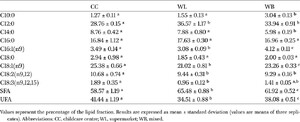
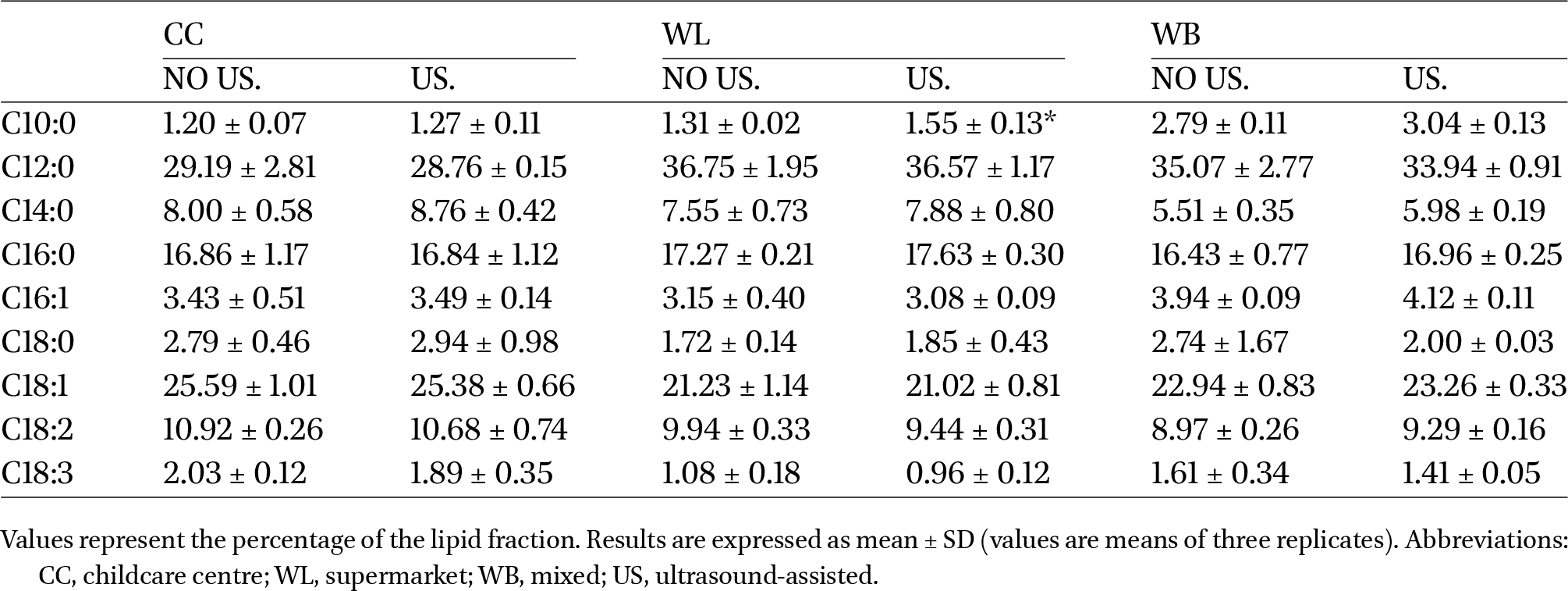
According to previous studies, the composition of H. illucens larvae can be significantly influenced by their diet, including variations in their lipid profile, which is also subject to variation based on dietary differences (Barragan-Fonseca et al., 2017). It has been reported that diets rich in fruits (e.g. sugars, high carbohydrate content, protein to carbohydrate ratio) and meat can increase the lipid content and composition in the larvae (Danieli et al., 2019; Tognocchi et al., 2024). The fatty acid composition of the lipid fractions from larvae fed with different organic wastes in this study is presented in Table 1. Consistent with earlier research, H. illucens larvae are rich in saturated fatty acids (SFA) (Bessa et al., 2020; Smets et al., 2020), comprising between 58.58 and 65.48% of the total lipid content. The SFA group includes capric (C10:0), lauric (C12:0), myristic (C14:0), palmitic (C16:0), and stearic (C18:0), with notable levels of lauric (28.76–36.57%) and palmitic (16.84–17.63%). On the other hand, the total content of unsaturated fatty acids (UFA) is lower, ranging from 34.51 to 41.44%. The UFA fraction consists of palmitoleic (C16:1), oleic (C18:1), linoleic (C18:2), and α-linolenic (C18:3) acids. Most fatty acid levels, except for palmitic and stearic acids, vary across the different dietary groups, corroborating that diet significantly influences fatty acid levels and the distribution of SFA and UFA in BSFL. Among the BSFL, those reared on waste from the childcare center (CC) had the highest UFA content (41.44%), in contrast to those fed on supermarket (WL) and market (WB) waste. The CC waste comprises of salad, bread and other cooked dishes, with a high proportion of starch and non-structural carbohydrates (Alagappan et al., 2025). Interestingly, there were also notable differences in the levels of omega-3 (α-linolenic acid) and omega-6 (linoleic acid) fatty acids, reflecting similar findings in other studies where H. illucens diets were supplemented with sources of these fatty acids to increase their content (Barroso et al., 2017; Li et al., 2022). These fatty acids are recognized for their health benefits, enhancing the nutritional value of the larvae’s lipid fraction (Simopoulos, 2002). Despite these variations, the overall fatty acid profile remains similar to previous findings.

Lipid profile of Hermetia illucens larvae fed with different organic wastes obtained by lipid extraction ultrasound assisted and measured using gas chromatography mass spectrometry
Citation: Journal of Insects as Food and Feed 12, 8 (2026) ; 10.1163/23524588-bja10347
Infrared spectra
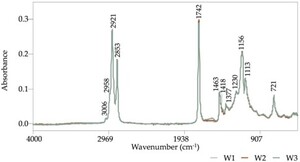
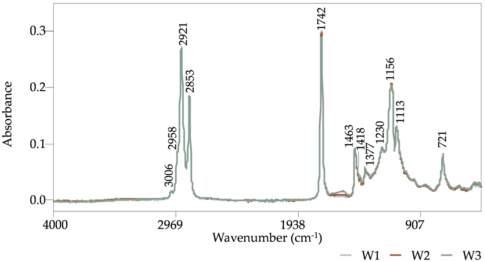
Using ultrasound-assisted extraction, Figure 1 displays the MIR spectra for lipid fractions extracted from larvae reared on different organic waste streams. These spectra exhibit the characteristic bands for lipids (Aykas et al., 2020). The band at 3006 cm–1 is associated with the =C-H stretching found in cis double bonds present in UFA. The band at 2921 /cm and the shoulder band at 2958 cm–1 correspond to C–H asymmetric stretching (CH2 and CH3), while the absorbance at 2853 cm–1 is associated with the same bond but symmetric stretching. The main band, located at 1742 cm–1, corresponds to the stretching of the ester carbonyl (C=O), a functional group characteristic of lipids. The IR spectra also show absorbances at 1463 cm–1, and 1418 cm–1, corresponding to C–H bending vibrations of the CH2 group and cis double bonds, respectively. The band at 1377 cm–1 corresponds to the C–H bending (symmetrical) vibration of the CH3 group. Additionally, bands in the range 1250–1110 cm–1 are related to stretching vibrations of the C-O ester groups and bending vibrations of CH2. Another notable band is centered at 721 cm–1, representing the rocking vibration of CH2 and bending (out of plane) of HC=CH- (cis) group (Kaneko et al., 2018; Lerma-Garcı́a et al., 2010; Salas-Valerio et al., 2022). The lipids from larvae reared on the three waste streams display a similar spectrum.
Mid-infrared (MIR) spectra of Hermetia illucens larvae lipids fractions extracted by organic solvents and ultrasound-assisted. Abbreviations: CC, childcare centre; WL, supermarket; WB, mixed.
Citation: Journal of Insects as Food and Feed 12, 8 (2026) ; 10.1163/23524588-bja10347
Effect of ultrasound assisted extraction
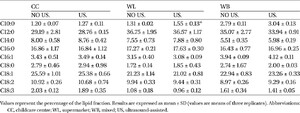
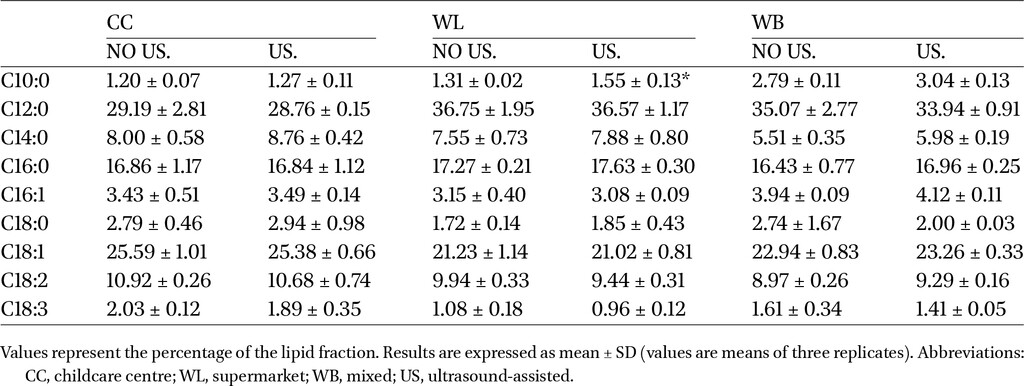
The effect on the fatty acids extracted during the ultrasound-assisted extraction on the lipid profile is given in Table 2. It has been reported that ultrasound-assisted lipid extraction improves yield by enhancing cell rupture and increasing the amount of lipids released into the solution phase (Gharibzahedi and Altintas, 2022; Keris-Sen et al., 2014). This study found no significant (
Lipid profile of Hermetia illucens larvae fed with different organic waste sources obtained with or without ultrasound during lipid extraction and measured using gas chromatography mass spectrometry
Citation: Journal of Insects as Food and Feed 12, 8 (2026) ; 10.1163/23524588-bja10347
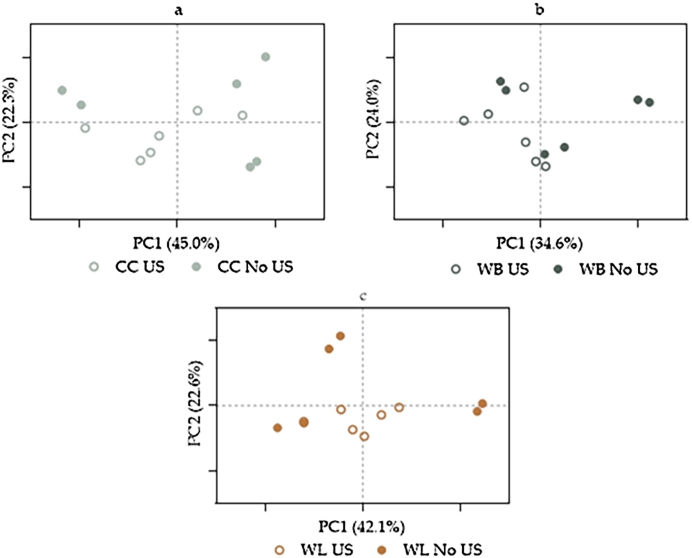
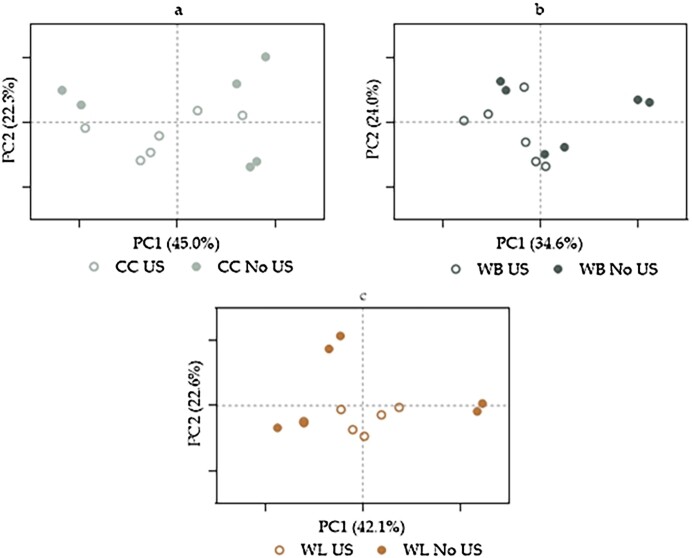
The two principal components account for between 58.6 and 67.3% of the variability in the data (Figure 2). Overlapping is observed between the ultrasound-assisted samples and those extracted using only organic solvents in the three groups. These results indicated that no clear differentiation existed between the samples obtained through extraction with organic solvents and those assisted with ultrasound, regardless of the waste stream utilised by the larvae. Furthermore, the PCA results obtained from both lipid analyses using the GC-MS suggested that the ultrasound method did not significantly impact the lipid composition extracted by solvents, highlighting the consistency of the extraction process proposed in this study. This finding aligns with Gharibzahedi and Altintas (2022), who concluded that ultrasound had no effect when using a mixture of ethanol-isopropanol to extract lipids from Alphitobius diaperinus larvae. While there is no prior research on the impact of ultrasound-assisted organic solvent extraction on H. illucens lipids, other studies have analysed various extraction techniques, including ultrasound combined with different solvents and microwaves (Almeida et al., 2022). Although differences in fatty acid composition were noted (Almeida et al., 2022), no specific reference was made to the potential impact of extraction.
Principal component (PCA) score plots of Hermetia illucens larvae lipids extracted by organic solvent with or without ultrasound-assisted: (a) childcare centre, (b) market, and (c) supermarket waste. Each waste stream was analysed using three independent samples, and each sample was measured in duplicate Abbreviations: CC, childcare centre; WL, supermarket; WB, mixed; US, ultrasound-assisted.
Citation: Journal of Insects as Food and Feed 12, 8 (2026) ; 10.1163/23524588-bja10347
Classification of H. illucens larvae lipids
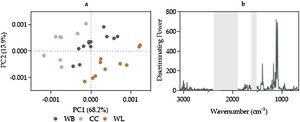
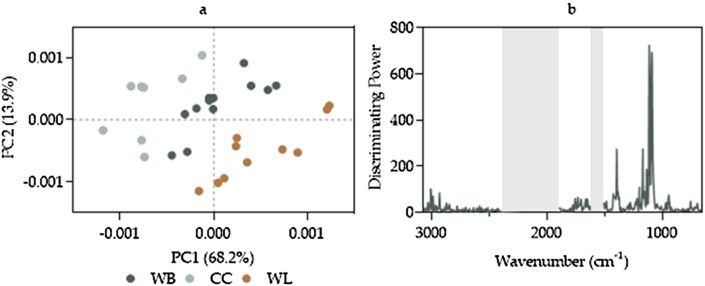
The effect of the waste stream used to feed H. illucens larvae was evaluated using Soft Independent Modeling of Class Analogy (SIMCA) algorithm, aiming to classify lipid samples based on IR spectral data using the pre-treated spectra. Specific regions related to lipids were selected to construct the models, avoiding irrelevant information or noise. Each group represents lipids obtained from a different organic waste source, including samples with and without ultrasound assistance during fractioning. Figure 3 shows the distribution of these classes based on the two main principal components. Four factors were selected for each class to create the model, explaining more than 90% of the variance in the dataset. The analysis shows clear separation between the three groups. The interclass distance (ICD) value represents the distance between clusters. An ICD value greater than 1.0 indicates that there are differences between the groups, while a value larger than 3.0 means that the groups are statistically different from each other (Mellado-Carretero et al., 2020). All ICD values were greater than 3.0, indicating that the groups are statistically different from each other, demonstrating SIMCA’s effectiveness in classifying all lipid samples according to the waste stream due to differences in their composition. No samples were misclassified during the construction of the model. These results demonstrate how small differences in the lipid fractions of insects, such as H. illucens, can be quickly and affordably detected using portable devices combined with multivariate data analysis. These results can be contrasted with other research done in the same IR spectrum range, where insect samples with varying compositions have been successfully classified. For instance, Hoffman et al. (2022) successfully classified H. illucens larvae at different development stages based on the waste stream (soy or bread-vegetable mix waste) using Partial Least Squares Regression Analysis (PLS-DA). They tested diverse wavelength combinations within the spectrum, which focused exclusively on the lipid specific region between 3000 and 2500 cm–1, they were able to correctly classify 100% of the samples with a determination coefficient of 0.9. Additionally, Mellado-Carretero et al. (2020) used a portable MIR spectrometer to classify insect powders using SIMCA models. They separately analysed Acheta domesticus and Alphitobius diaperinus powders, successfully highlighting differences between the samples. In both cases, many of the bands identified in the discriminating power analysis were associated with lipids.
Soft Independent Modelling of Class Analogy (SIMCA) model constructed using spectral data in the wavelength ranges 3070–2400 cm–1, 1880–1620 cm–1, and 1500–655 cm–1, showing (a) class projection plot and (b) discriminating power. Abbreviations: CC, childcare centre; WL, supermarket; WB, mixed.
Citation: Journal of Insects as Food and Feed 12, 8 (2026) ; 10.1163/23524588-bja10347
The results of these studies further support the idea that the composition of the lipid fraction significantly contributes to distinguishing insect samples. Although there is limited research on insect lipids analysed by MIR spectroscopy, the classification results are comparable to those obtained for other fatty samples, such as vegetable oils. For example, highly similar samples of olive oil were classified by their purity with sensitivity and specificity values of 100% (Aykas et al., 2020). Beyond food samples, even crude petroleum oils have been 100% correctly classified by SIMCA and PLS-DA models based on their geographical origin (Galtier et al., 2011). This supports the broad applicability and effectiveness of MIR spectroscopy in distinguishing and classifying insect lipids.
The discriminating power identifies the wavenumbers that provide relevant information for class differentiation. The main bands identified were 3006, 1393, 1197, 1167, 1134, 1111 and 1088 cm–1. The bands at 3006 and 1393 cm–1 are associated with different types of C–H related to double bonds in lipid chains, which correspond to differences in the proportion of UFA and SFA between the groups. The other bands correspond to C–H and C–O bond vibrations present in the fatty acids (Kaneko et al., 2018; Lerma-Garcı́a et al., 2010; Salas-Valerio et al., 2022).
Overall, knowledge about efficient and green lipid extraction methods will provide the insect industry with better analytical methods. These methods can provide improved methods to search for alternate lipid sources for animal feed, food, biodiesel, cosmetic, and pharmaceutical industries (Franco et al., 2021; Siddiqui et al., 2025). Solid Safety Regulation would bring innovative food businesses to the EU and the worldwide market, guaranteeing at the same time their safety. Consequently, the knowledge about health benefits of insect oils as an alternative food source could help to improve the global market of insects and their farming practices in communities with limited access to food sources. To conclude, based on a good FA profile with PUFAs, edible insects make a valuable alternative for feed, and food if it is safe, legal, and accepted by the consumers. For this reason, more research is required to evaluate their optimal inclusion level and their safety as a source of fats and FAs in diets (Franco et al., 2021; Siddiqui et al., 2025)
4 Conclusions
The results demonstrate the potential of MIR spectroscopy combined with multivariate analysis tools to differentiate and classify H. illucens larvae lipids based on changes in lipid profile composition, specifically due to rearing on different organic side streams. This method offers a promising alternative for the industry to link BSFL to their diet, enabling rapid and accurate analysis with minimal sample amount and no need for pretreatment. Additionally, our findings indicate that ultrasound/sonification during the lipid extraction phase does not significantly impact/improve the fatty acid composition obtained through lipid fractionation using organic solvents. Although these results are encouraging, some limitations need to be highlighted such as the relatively small number of waste streams and samples used and no analysis of other lipid functional properties (e.g. melting point, oxidative stability).
Corresponding author; e-mail: d.cozzolino@uq.edu.au
Acknowledgement
The authors acknowledge the support of the University of Queensland.
Author contributions
C. Mendez Sanchez, S. De Lamo Castelvi, S. Alagappan, L. Hoffman, O. Yarger, D. Cozzolino: investigation, methodology, writing (original draft). L. Hoffman, O. Yarger, D. Cozzolino: methodology, writing (review and editing the final version). D. Cozzolino: conceptualization, investigation, methodology, project administration, writing (original draft). All authors: writing (review and editing the final version).
Conflict of interest
The authors declare that they have no known competing financial interests or personal relationships that could have appeared to influence the work reported in this paper.
Ethical approval
Ethics approval was not required for this work.
References
Alagappan, S., Ma, S., Nastasi, J.R., Hoffman, L.C. and Cozzolino, D., 2024a. Evaluating the use of vibrational spectroscopy to detect the level of adulteration of cricket powder in plant flours: the effect of the matrix. Sensors 24: 924. https://doi.org/10.3390/s24030924
Alagappan, S., Mallard, S., Cozzolino, D., Mikkelsen, D., James, P., Mantilla, S.O., Yarger, O. and Hoffman, L., 2024b. Effect of larval instar and post-harvest treatments on heavy metals in BSFL and frass reared on commercial food waste streams. International Journal of Food Science and Technology 59: 8214-8223. https://doi.org/10.1111/ijfs.17511
Alagappan, S., Hung, H., Mikkelsen, D., Olarte Mantilla, S., James, P., Yarger, O., Hoffman, L. and Cozzolino, D., 2025. Investigating the effect of larval instar, postharvest treatments, and substrate on the nutritional profile of black soldier fly larvae (Hermetia illucens). Animal Production Science 65: AN24108. https://doi.org/10.1071/AN2410
Almeida, C., Murta, D., Nunes, R., Baby, A.R., Fernandes, Â., Barros, L., Rijo, P. and Rosado, C., 2022. Characterization of lipid extracts from the Hermetia illucens larvae and their bioactivities for potential use as pharmaceutical and cosmetic ingredients. Heliyon 8: e09455. https://doi.org/10.1016/j.heliyon.2022.e09455
Aykas, D.P., Karaman, A.D., Keser, B. and Rodriguez-Saona, L., 2020. Non-targeted authentication approach for extra virgin olive oil. Foods 9: 221. https://doi.org/10.3390/foods9020221
Barragan-Fonseca, K.B., Dicke, M. and Van Loon, J.J.A., 2017. Nutritional value of the black soldier fly (Hermetia illucens L.) and its suitability as animal feed – a review. Journal of Insects as Food and Feed 3: 105-120. https://doi.org/10.3920/JIFF2016.0055
Barroso, F.G., De Haro, C., Sánchez-Muros, M.-J., Venegas, E., Martı́nez-Sánchez, A. and Pérez-Bañón, C., 2014. The potential of various insect species for use as food for fish. Aquaculture 422-423: 193-201. https://doi.org/10.1016/j.aquaculture.2013.12.024
Barroso, F.G., Sánchez-Muros, M.-J., Segura, M., Morote, E., Torres, A., Ramos, R. and Guil, J.-L., 2017. Insects as food: Enrichment of larvae of Hermetia illucens with omega 3 fatty acids by means of dietary modifications. Journal of Food Composition and Analysis 62: 8-13. https://doi.org/10.1016/j.jfca.2017.04.008
Bessa, L.W., Pieterse, E., Marais, J. and Hoffman, L.C., 2020. Why for feed and not for human consumption? The black soldier fly larvae. Comprehensive Reviews in Food Science and Food Safety 19: 2747-2763. https://doi.org/10.1111/1541-4337.12609
Bligh, E.G. and Dyer, W.J., 1959. A rapid method of total lipid extraction and purification. Canadian Journal of Biochemistry and Physiology 37: 911-917. https://doi.org/10.1139/o59-099
Bureau, S., Cozzolino, D. and Clark, C.J., 2019. Contributions of Fourier-transform mid infrared (FT-MIR) spectroscopy to the study of fruit and vegetables: a review. Postharvest Biology and Technology 148: 1-14. https://doi.org/10.1016/j.postharvbio.2018.10.003
Caligiani, A., Marseglia, A., Leni, G., Baldassarre, S., Maistrello, L., Dossena, A. and Sforza, S., 2018. Composition of black soldier fly prepupae and systematic approaches for extraction and fractionation of proteins, lipids and chitin. Food Research International 105: 812-820. https://doi.org/10.1016/j.foodres.2017.12.012
Cebi, N., Bekiroglu, H., Erarslan, A. and Rodriguez-Saona, L., 2023. Rapid sensing: hand-held and portable FTIR applications for on-site food quality control from farm to fork. Molecules 28: 3727. https://doi.org/10.3390/molecules28093727
Cullere, M., Schiavone, A., Dabbou, S., Gasco, L. and Dalle Zotte, A., 2019. Meat quality and sensory traits of finisher broiler chickens fed with black soldier fly (Hermetia illucens L.) larvae fat as alternative fat source. Animals 9: 140. https://doi.org/10.3390/ani9040140
Da Silva, G.D.P. and Hesselberg, T., 2020. A review of the use of black soldier fly larvae, Hermetia illucens (Diptera: Stratiomyidae), to compost organic waste in tropical regions. Neotropical Entomology 49: 151-162. https://doi.org/10.1007/s13744-019-00719-z
Danieli, P.P., Lussiana, C., Gasco, L., Amici, A. and Ronchi, B., 2019. The effects of diet formulation on the yield, proximate composition and fatty acid profile of the black soldier fly (Hermetia illucens L.) prepupae intended for animal feed. Animals 9: 178. https://doi.org/10.3390/ani9040178
Delicato, C., Schouteten, J.J., Dewettinck, K., Gellynck, X. and Tzompa-Sosa, D.A., 2020. Consumers’ perception of bakery products with insect fat as partial butter replacement. Food Quality and Preference 79: 103755. https://doi.org/10.1016/j.foodqual.2019.103755
Franco, A., Salvia, R., Scieuzo, C., Schmitt, E., Russo, A. and Falabella, P., 2021. Lipids from insects in cosmetics and for personal care products. Insects 13: 41. https://doi.org/10.3390/insects13010041
Galtier, O., Abbas, O., Le Dréau, Y., Rebufa, C., Kister, J., Artaud, J. and Dupuy, N., 2011. Comparison of PLS1-DA, PLS2-DA and SIMCA for classification by origin of crude petroleum oils by MIR and virgin olive oils by NIR for different spectral regions. Vibrational Spectroscopy 55: 132-140. https://doi.org/10.1016/j.vibspec.2010.09.012
Garcı́a-Gutiérrez, N., Mellado-Carretero, J., Bengoa, C., Salvador, A., Sanz, T., Wang, J., Ferrando, M., Güell, C. and Lamo-Castellvı́, S.D., 2021. ATR-FTIR Spectroscopy combined with multivariate analysis successfully discriminates raw doughs and baked 3D-printed snacks enriched with edible insect powder. Foods 10: 1806. https://doi.org/10.3390/foods10081806
Gharibzahedi, S.M.T. and Altintas, Z., 2022. Ultrasound-assisted alcoholic extraction of lesser mealworm larvae oil: process optimization, physicochemical characteristics and energy consumption. Antioxidants 11: 1943. https://doi.org/10.3390/antiox11101943
Hoffman, L.C., Zhang, S., Alagappan, S., Wills, V., Yarger, O. and Cozzolino, D., 2022. Monitoring compositional changes in black soldier fly larvae (BSFL) sourced from different waste stream diets using attenuated total reflectance mid infrared spectroscopy and chemometrics. Molecules 27: 7500. https://doi.org/10.3390/molecules27217500
Kaneko, F., Katagiri, C., Sazaki, G. and Nagashima, K., 2018. ATR FTIR spectroscopic study on insect body surface lipids rich in methylene-interrupted diene. The Journal of Physical Chemistry B 122: 12322-12330. https://doi.org/10.1021/acs.jpcb.8b10026
Keris-Sen, U.D., Sen, U., Soydemir, G. and Gurol, M.D., 2014. An investigation of ultrasound effect on microalgal cell integrity and lipid extraction efficiency. Bioresource Technology 152: 407-413. https://doi.org/10.1016/j.biortech.2013.11.018
Kim, C.-H., Ryu, J., Lee, J., Ko, K., Lee, J., Park, K.Y. and Chung, H., 2021. Use of black soldier fly larvae for food waste treatment and energy production in Asian countries: a review. Processes 9: 161. https://doi.org/10.3390/pr9010161
Lalander, C., Diener, S., Magri, M.E., Zurbrügg, C., Lindström, A. and Vinnerås, B., 2013. Faecal sludge management with the larvae of the black soldier fly (Hermetia illucens) from a hygiene aspect. Science of The Total Environment 458-460: 312-318. https://doi.org/10.1016/j.scitotenv.2013.04.033
Laroche, M., Perreault, V., Marciniak, A., Gravel, A., Chamberland, J. and Doyen, A., 2019. Comparison of conventional and sustainable lipid extraction methods for the production of oil and protein isolate from edible insect meal. Foods 8: 572. https://doi.org/10.3390/foods8110572
Lerma-Garcı́a, M.J., Ramis-Ramos, G., Herrero-Martı́nez, J.M. and Simó-Alfonso, E.F., 2010. Authentication of extra virgin olive oils by Fourier-transform infrared spectroscopy. Food Chemistry 118: 78-83. https://doi.org/10.1016/j.foodchem.2009.04.092.
Li, A., Dewettinck, K., Verheust, Y., Van De Walle, D., Raes, K., Diehl, B. and Tzompa-Sosa, D.A., 2024. Edible insects as a novel source of lecithin: Extraction and lipid characterization of black soldier fly larvae and yellow mealworm. Food Chemistry 452: 139391. https://doi.org/10.1016/j.foodchem.2024.139391
Li, Q., Zheng, L., Cai, H., Garza, E., Yu, Z. and Zhou, S., 2011. From organic waste to biodiesel: Black soldier fly, Hermetia illucens, makes it feasible. Fuel 90: 1545-1548. https://doi.org/10.1016/j.fuel.2010.11.016
Li, X., Dong, Y., Sun, Q., Tan, X., You, C., Huang, Y. and Zhou, M., 2022. Growth and fatty acid composition of black soldier fly Hermetia illucens (Diptera: Stratiomyidae) larvae are influenced by dietary fat sources and levels. Animals 12: 486. https://doi.org/10.3390/ani12040486
Liu, T., Awasthi, M.K., Awasthi, S.K., Duan, Y. and Zhang, Z., 2020. Effects of black soldier fly larvae (Diptera: Stratiomyidae) on food waste and sewage sludge composting. Journal of Environmental Management 256: 109967. https://doi.org/10.1016/j.jenvman.2019.109967
Mellado-Carretero, J., Garcı́a-Gutiérrez, N., Ferrando, M., Güell, C., Garcı́a-Gonzalo, D. and De Lamo-Castellvı́, S., 2020. Rapid discrimination and classification of edible insect powders using ATR-FTIR spectroscopy combined with multivariate analysis. Journal of Insects as Food and Feed 6: 141-148. https://doi.org/10.3920/JIFF2019.0032
Mendez-Sanchez, C., Güell, M.C., Ferrando, M., Rodriguez-Saona, L., Jimenez-Flores, R., Domingo, J.C. and De Lamo Castellvi, S., 2024. Prediction of fat content in edible insect powders using handheld FT-IR spectroscopic devices. LWT 207: 116652. https://doi.org/10.1016/j.lwt.2024.116652
Ojha, S., Bußler, S., Psarianos, M., Rossi, G. and Schlüter, O.K., 2021. Edible insect processing pathways and implementation of emerging technologies. Journal of Insects as Food and Feed 7: 877-900. https://doi.org/10.3920/JIFF2020.0121
Oonincx, D.G.A.B., Laurent, S., Veenenbos, M.E. and Van Loon, J.J.A., 2020. Dietary enrichment of edible insects with omega 3 fatty acids. Insect Science 27: 500-509. https://doi.org/10.1111/1744-7917.12669
Oonincx, D.G.A.B., Van Broekhoven, S., van Huis, A. and Van Loon, J.J.A., 2015. Feed conversion, survival and development and composition of four insect species on diets composed of food by-products. PLoS ONE 10: e0144601. https://doi.org/10.1371/journal.pone.0144601
Ravi, H.K., Degrou, A., Costil, J., Trespeuch, C., Chemat, F. and Vian, M.A., 2020. Effect of devitalization techniques on the lipid, protein, antioxidant and chitin fractions of black soldier fly (Hermetia illucens) larvae. European Food Research and Technology 246: 2549-2568. https://doi.org/10.1007/s00217-020-03596-8
Rehman, K.U., Rehman, A., Cai, M., Zheng, L., Xiao, X., Somroo, A.A., Wang, H., Li, W., Yu, Z. and Zhang, J., 2017. Conversion of mixtures of dairy manure and soybean curd residue by black soldier fly larvae (Hermetia illucens L.). Journal of Cleaner Production 154: 366-373. https://doi.org/10.1016/j.jclepro.2017.04.019
Riekkinen, K., Väkeväinen, K. and Korhonen, J., 2022. The effect of substrate on the nutrient content and fatty acid composition of edible insects. Insects 13: 590. https://doi.org/10.3390/insects13070590
Rinnan, Å., van den Berg, F. and Engelsen, S.B., 2009. Review of the most common pre-processing techniques for near-infrared spectra. Trends in Analytical Chemistry 28: 1201-1222. https://doi.org/10.1016/j.trac.2009.07.007
Rodriguez-Saona, L., Aykas, D.P., Borba, K.R. and Urtubia, A., 2020. Miniaturization of optical sensors and their potential for high-throughput screening of foods. Current Opinion in Food Science 31: 136-150. https://doi.org/10.1016/j.cofs.2020.04.008
Salas-Valerio, W.F., Aykas, D.P., Hatta Sakoda, B.A., Ludeña-Urquizo, F.E., Ball, C., Plans, M. and Rodriguez-Saona, L., 2022. In-field screening of trans-fat levels using mid- and near-infrared spectrometers for butters and margarines commercialized in the Peruvian market. LWT 157: 113074. https://doi.org/10.1016/j.lwt.2022.113074
Savitzky, A. and Golay, M.J., 1964. Smoothing and differentiation of data by simplified least squares procedures. Analytical Chemistry 36: 1627-1639. https://doi.org/10.1021/ac60214a047
Schiavone, A., Dabbou, S., De Marco, M., Cullere, M., Biasato, I., Biasibetti, E., Capucchio, M.T., Bergagna, S., Dezzutto, D., Meneguz, M., Gai, F., Dalle Zotte, A. and Gasco, L., 2018. Black soldier fly larva fat inclusion in finisher broiler chicken diet as an alternative fat source. Animal 12: 2032-2039. https://doi.org/10.1017/S1751731117003743
Siddiqui, S.A., Zeiri, A. and Asif Shah, M., 2025. Insect lipids as novel Source for future applications: chemical composition and industry applications – a comprehensive review. Food Science and Nutrition 13: e70553. https://doi.org/10.1002/fsn3.70553.
Simopoulos, A.P., 2002. The importance of the ratio of omega-6/omega-3 essential fatty acids. Biomedicine and Pharmacotherapy 56: 365-379. https://doi.org/10.1016/S0753-3322(02)00253-6
Smetana, S., Leonhardt, L., Kauppi, S.-M., Pajic, A. and Heinz, V., 2020. Insect margarine: Processing, sustainability and design. Journal of Cleaner Production 264: 121670. https://doi.org/10.1016/j.jclepro.2020.121670
Smets, R., Verbinnen, B., Van De Voorde, I., Aerts, G., Claes, J. and Van Der Borght, M., 2020. Sequential extraction and characterisation of lipids, proteins and chitin from black soldier fly (Hermetia illucens) larvae, prepupae and pupae. Waste and Biomass Valorization 11: 6455-6466. https://doi.org/10.1007/s12649-019-00924-2
Sosa, D.A.T. and Fogliano, V., 2017. Potential of insect-derived ingredients for food applications. In: Shields, V.D.C. (ed.) Insect physiology and ecology. InTech, London. https://doi.org/10.5772/67318
Tognocchi, M., Abenaim, L., Adamaki-Sotiraki, C., Athanassiou, G.C., Rumbos, I.C., Mele, M., Conti, B. and Conte, G., 2024. Effect of different diet composition on the fat profile of two different black soldier fly larvae populations. Animal 18: 101205. https://doi.org/10.1016/j.animal.2024.101205.
Tzompa-Sosa, D.A., Yi, L., Van Valenberg, H.J.F., Van Boekel, M.A.J.S. and Lakemond, C.M.M., 2014. Insect lipid profile: aqueous versus organic solvent-based extraction methods. Food Research International 62: 1087-1094. https://doi.org/10.1016/j.foodres.2014.05.052
Verheyen, G.R., Ooms, T., Vogels, L., Vreysen, S., Bovy, A., Van Miert, S. and Meersman, F., 2018. Insects as an alternative source for the production of fats for cosmetics. Journal of Cosmetic Science 69: 187-202.
Vilkhu, K., Mawson, R., Simons, L. and Bates, D., 2008. Applications and opportunities for ultrasound assisted extraction in the food industry – a review. Innovative Food Science and Emerging Technology 9: 161-169. https://doi.org/10.1016/j.ifset.2007.04.014
Wang, Y.-S. and Shelomi, M., 2017. Review of black soldier fly (Hermetia illucens) as animal feed and human food. Foods 6: 91. https://doi.org/10.3390/foods6100091
Warren, F.J., Perston, B.B., Royall, P.G., Butterworth, P.J. and Ellis, P.R., 2013. Infrared spectroscopy with heated attenuated total internal reflectance enabling precise measurement of thermally induced transitions in complex biological polymers. Analytical Chemistry 85: 3999-4006. https://doi.org/10.1021/ac303552s
Williams, P., Dardenne, P. and Flinn, P., 2017. Items to be included in a report on a near infrared spectroscopy project. Journal of Near Infrared Spectroscopy 25: 85-90. https://doi.org/10.1177/0967033517702395