Abstract
Insects have long been a part of the human diet, but their appeal as a human meal has only grown in recent years due to their potential as a vast future food supply with high nutritional value and significant environmental benefits. The African palm weevil (APW) larvae (Rhynchophorus phoenicis) is one of the promising insects with promise in food application. This paper provides a comprehensive review of APW larvae based on bioecological, consumption, nutritional value, nutraceutical and pharmaceutical properties, and consumer acceptance. APW larvae are an alternative food, especially in the African region, that has been consumed by people for a long time. Over time, APW larvae consumption has developed both in terms of quantity and quality; this is indicated by an increase in APW farming followed by diversification of processed products. APW larvae contain high nutrients, including amino acids, fatty acids, and minerals. In several African countries, APW has been utilized in various dishes prepared using different methods. APW farming has economic potential that can increase peopleâs income. APW larvae are highly accessible, inexpensive, have low environmental footprints, and have the potential to solve food poverty in Africa. This study is intended to provide policymakers with a framework for developing and implementing more appropriate rules and regulations to support the expansion of the APW industry.
1 Introduction
Insects are often considered a nuisance to humans and mere pests for both crops and animals. Nonetheless, they are also a food source with a low environmental impact and cost, and tend to contribute positively to small-scale livelihoods, in addition to playing an important role in nature (Muafor et al., 2012; Ebenebe et al., 2017). However, the public remains largely unaware of these benefits. Contrary to popular belief, insects are not merely âfamine foodsâ eaten at times of food scarcity or when purchasing and harvesting âconventional foodsâ becomes difficult. In the twenty-first century, due to the rising human population, food, feed, and fuel insecurity, climate change and increasing demand for protein among the middle classes, insects are increasingly being selected as food and feed in a bid to overcome these contemporary problems (Akande et al., 2020). Compared to white or red meat as a source of protein, insects can be raised among unused or underutilised organic materials, which helps to reduce negative environmental contamination (Ukwo et al., 2021). Furthermore, insects are reported to emit fewer greenhouse gases and produce less ammonia than both ruminant and non-ruminant animals; they also require less water than ruminants (Sjofjan and Adli, 2021). Aside from their lower negative environmental impact, insects are highly nutritious and healthy, with a high fibre and mineral content. Insects have a higher unsaturated fatty acid composition compared to white and red meat. These higher nutritious compositions also reflect the large and widely available range of edible insect species (Ayensu et al., 2020). Another factor in these variations is the different media conditions in different nutrient compositions of the larvae (Ayensu et al., 2020).
The practice of eating insects is called entomophagy and positively impacts small-scale livelihoods. Van Huis et al. (2013) has reported that in Africa, insects are reared as food to help ensure a sustainable livelihood. Insects form part of the traditional diets of at least two billion people worldwide (Akande et al., 2020). More than 2100 edible insect species have reportedly been used as food. These practices have also contributed to altering the perception of using insects as an alternative source of protein for human food (Fernando, 2023). Globally, the most consumed insects are beetles and caterpillars, followed by grasshoppers, crickets and termites (Figure 1) (Quaye et al., 2018; Seiyaboh and Izah, 2020). The larvae of African palm weevil (APW), Rhynchophorus phoenicis (Fabricius) (Coleoptera: Curculionidae), are also reported to be edible. In Africa, most insects are harvested in the wild, except bees and silkworms, which have a long history of domestication for their products (Siddiqui et al., 2023a). The APW is commonly known as the âBedongâ in Western Africa especially Cameroon (Monzenga et al., 2022). It is considered a pest and is found in the trunks of palm trees; however, the larvae can be collected before they develop into adults and fly. The modes of consuming the APW include (1) eating alive (Mba et al., 2018); (2) dry-frying (Quaye et al., 2018); (3) mixing in a stew blend with local vegetables; and (4) deep-frying (Ebenebe and Obinna, 2015).

The percentage of edible insects across the world (Quaye et al., 2018; Seiyaboh and Izah, 2020).
Citation: Journal of Insects as Food and Feed 11, 3 (2025) ; 10.1163/23524588-00001005
This article aims to provide an overview of the APW as a human food source, including its general bioecology, records of its consumption in Africa, its nutritional value, nutraceutical and pharmaceutical properties, harvesting and rearing, and the techniques employed to process and store it. In addition, updated information on consumer acceptance of edible APW as human food is discussed.
2 Bioecology of Rhynchophorus phoenicis
Distribution
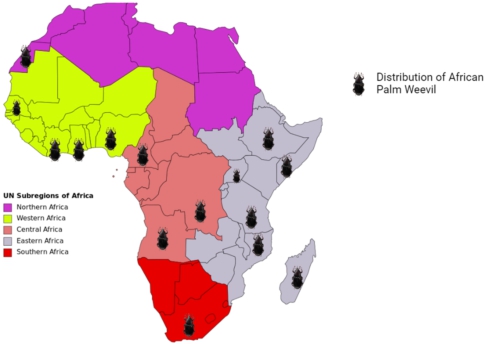
APW is distributed across the African continent. Several articles have reported its distribution in the following countries: Angola, Cameroon, Democratic Republic of the Congo, CoÌte dâIvoire, Ethiopia, Ghana, Kenya, Mozambique, Nigeria, Senegal, Sierra Leone, Somalia, South Africa, Tanzania and Uganda (Commander et al., 2019; EPPO, 2023) (Figure 2). It has also been reported in various other locations, including Mexico; however, the veracity of these records remains doubtful (Commander et al., 2019). Unfortunately, the APW is considered a major insect pest in palms (Hajjar et al., 2021; Hoddle et al., 2021; Ukwo et al., 2021) and is found widely throughout tropical and equatorial Africa. Their spread has been influenced by economic factors via the plantation of oil palms (Elaeis guineensis). The damage reported has been similar to that seen by the Asian palm weevil, Rhynchophorus ferrugineus (Olivier), in India and South East Asia (Manee et al., 2023), Socotra Island (Yemen) (Witt et al., 2020) and the South American palm weevil, Rhynchophorus palmarum (Linnaeus), in Latin America (Dalbon et al., 2021; Gonzalez et al., 2021).
Distribution of Rhynchophorus phoenicis in the several countries.
Citation: Journal of Insects as Food and Feed 11, 3 (2025) ; 10.1163/23524588-00001005
General morphology of Rhynchophorus phoenicis
Adult APW has the following general morphology: head, thorax and abdomen. It has three pairs of legs, a long rostrum and two pairs of wings, where the front wings are hardened (elytra) and the hindwings are membranous. Tambe et al. (2013) stated that differences exist between the general morphologies of males and females. The males feature hair in a row on the central anterior dorsal end of the rostrum and at the distal segment of the forelimbs (Tambe et al., 2013; Debrah et al., 2022). Compared to males, females have hair in the ventral anterior arches (Tambe et al., 2013). APW eggs are identified as oval in shape, a yellowish-white colour and approximately 2-3Â mm in length (Ayensu et al., 2020). The eggs are laid on damaged surfaces inside palm trees (Akande et al., 2020). They begin to hatch after three days, whereby the larvae tunnel into the crown and trunk. Moreover, the larvae are legless (apodous), yellowish-white in colour and have brown heads (Ebenebe et al., 2017). APW larvae may reach 5-6Â cm in length and have brown edges displaying bristles (Mba et al., 2018). When reared, however, they can reach up to 10.5Â cm in length, 5.5Â cm in width and approximately 6.7Â g in weight (Monzenga et al., 2022). Later, the pupae develop within the fibrous cocoons of plant material and can grow up to 8Â cm long and 3.5 wide. The adults are approximately 30 to 45Â mm long and reddish-brown or black (Quaye et al., 2018). The underside of the body is light brown with diffused black spots and wing (Seiyaboh and Izah, 2020).
Rhynchophorus phoenicis life cycle
The APW life cycle takes place in palm trees over approximately three months; as such, the APW develops entirely within the host tree. Several trees can serve as hosts to the APW: Cocos nucifera (Aneni, 2022; Thomas and Dimkpa, 2022), Elais guineensis (Baguma et al., 2019; Anankware et al., 2021), Metroxylon sagu (Chinarak et al., 2020; Moreno et al., 2022) and Phoenix dactylifera (Alshehri et al., 2022). APW larvae can excavate cavities of more than one metre in length, which may induce the death of the palm tree after three to four months of infestation (Aneni, 2022). Since the damage is not detected and the palm tree cannot recover, APW has been reported and is categorised as a quarantine pest in Israel (2009) and Morocco (2018) (Aneni, 2022; EPPO, 2023; Abdel-Baky et al., 2023). Females can lay between 200 and 500 eggs in a year (Aneni, 2022) and begin to do this within the first four to five weeks. They preferentially lay eggs near the sites of existing damage and will actively search for such ovipositional sites using plant odour cues. Second, the eggs hatch in approximately three weeks (Aneni, 2022). It is reported that the larvae feed internally by penetrating the crown initially. The larvae stage runs from approximately two to four weeks. The pupal stage then lasts from 14 to 28 days before adults emerge from the cocoon and immediately leave the palm (Aneni, 2022).
3 Records of Rhynchophorus phoenicis consumption in Africa
Food and feed with the potential for a circular economy, such as edible insects, have attracted a lot of attention. The farming of insects, including APW, is a rapidly expanding industry in Africa that offers consumers access to income, protein, and other essential nutrients (Ayemele et al., 2017). This phenomenon needs support on technical, financial, and clear roadmap aspects to develop a circular food economy from insect farming by improving technology through public-private partnerships (Tanga et al., 2021).
Consumption of Rhynchophorus phoenicis
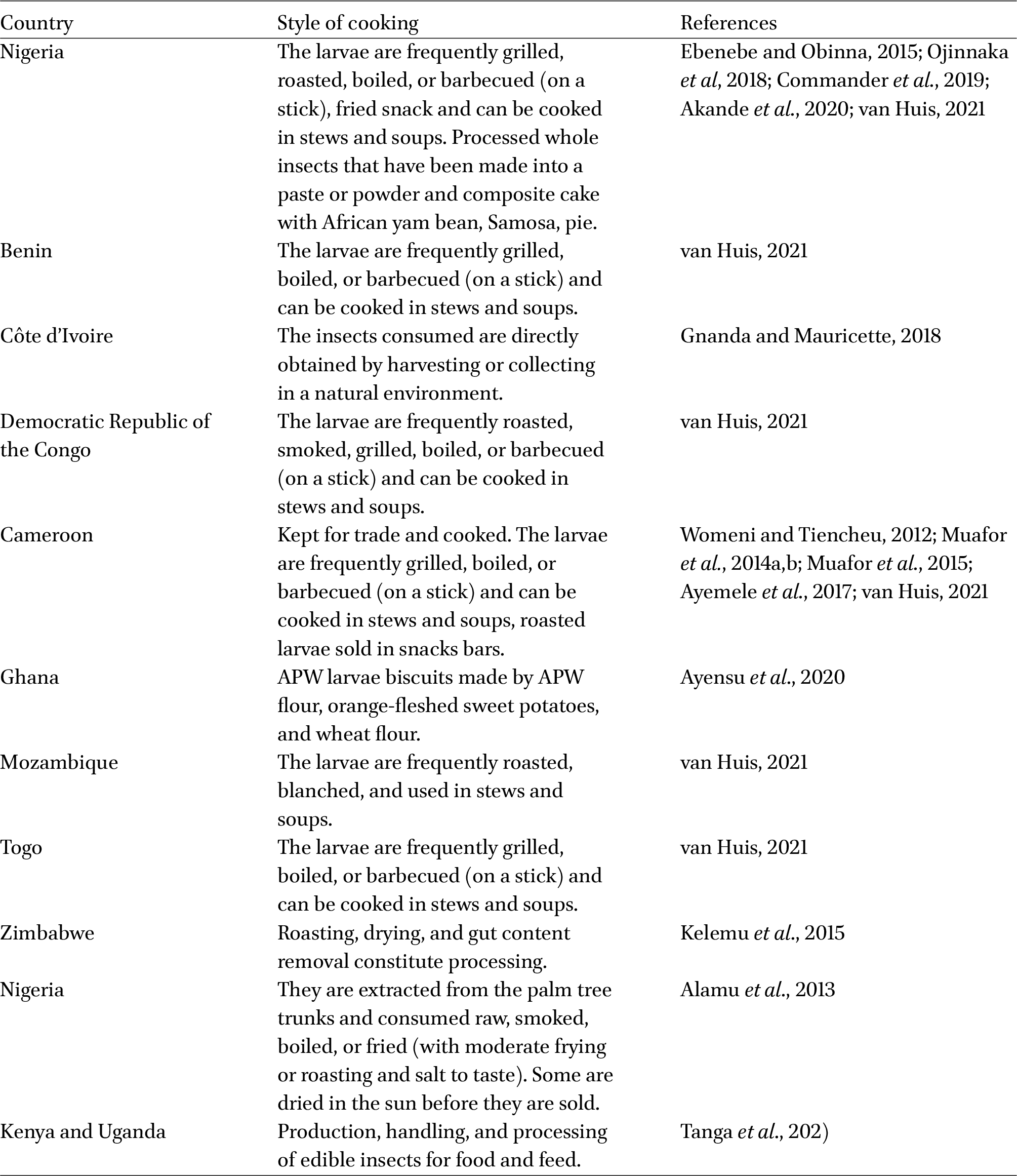
By 2050, it is expected that Africa will have a population of roughly 2.53 billion people, causing a large increase in the need for food that the continentâs current linear food system would not be able to provide (Sidder, 2022). Therefore, it is necessary to enhance and promote traditional foods, including edible insects (Tanga et al., 2021). Based on a previous study, APW is eaten in Nigeria, Benin, the Democratic Republic of the Congo, and Cameroon. Most often, Raphia spp. and oil palms (Elaeis guineensis) are used to attract the insect, but other palm trees like Metroxylon sagu, Phoenix dactylifera, and Cocos nucifera are also used (van Huis, 2021). APW was studied almost exclusively in Africa, and it is a preferred edible insect species in West Africa. Studies have been conducted in Nigeria (western Africa) and South Africa, Botswana, and Zimbabwe (southern Africa); however, some studies presented the relationship between the nutritional value and eating habits of APW. Studies conducted in central and western Africa revealed that APW was the species that was most frequently eaten (Alamu et al., 2013; Kelemu et al., 2015). Moreover, in addition to being a delicacy in central and western Africa, APW were also significant economically in Ghana, Benin, Cameroon, and Nigeria (Muafor et al., 2014a; Muafor et al., 2014b). Consumption of APW larvae in several African countries has similarities, such as in Benin, the Democratic Republic of the Congo, Mozambique, and Togo, which consume APW larvae in the form of roasted, smoked, grilled, boiled, or barbecued (on a stick) and can be cooked in stews and soups (van Huis, 2021) and gut content removal before cook in Zimbabwe (Kelemu et al., 2015). In Cameroon, the processing of APW larvae is the same as in previous countries, but they sell roasted larvae in snack bars (Muafor et al., 2014a,b; Muafor et al., 2015; Ayemele et al., 2017; van Huis, 2021; Womeni and Tiencheu, 2012). Meanwhile, in CoÌte dâIvoire, the APW larvae consumed are directly obtained by harvesting or collecting them in a natural environment (Gnanda and Mauricette, 2018).
According to De Foliart (1993), before they were cooked or fried in vegetable oil for food, some villagers in Africa cut the larvae in the abdomen with a sharp stick and washed them in water to drain off the white fatty liquid from their bodies. However, they might result in the loss of important macro and micronutrients in cooked meat, which is consistent with Adams and Erdman (1988), results that the degree of boiling has a significant impact on the nutritional value of meat. The larvae are usually grilled, roasted, boiled, or barbecued (on a stick), served as a fried snack, and cooked in stews and soups. Whole insects are processed into a paste or powder, and a composite cake is made with African yam beans (Ebenebe and Obinna, 2015; Ojinnaka et al, 2018; Commander et al., 2019; Akande et al., 2020; van Huis, 2021). APW larvae biscuits were made by APW flour, orange-fleshed sweet potatoes, and wheat flour (Ayensu et al., 2020). Consumers who were thoughtful about the effects of their food choices revealed that 10.2% and 12.4% of the participants in this study chose to roast and grill APW for consumption, respectively (Debrah et al., 2019). Some people also substituted roasted larvae for meat when eating rice.
Economic value of Rhynchophorus phoenicis
In general, the APW come from the wild, and research has shown that insect farming has advantages over wild collection (Oonincx and de Boer, 2012; Reverberi, 2020). Although insect farming for feed and food is still relatively new in East Africa, more than 75% of feed millers and farmers have indicated that they are eager to implement these techniques (Chia et al., 2020). Thus, by adding value and increasing profitability, cost-effective insect rearing and processing methods are introduced. In contrast to Europe, where just seven species are permitted for animal feed, all edible insect species are accepted for feed and food in Kenya and Uganda (Madau et al., 2020; Tanga et al., 2021).
APW has potential as a commodity in East Africa. However, the rapidly expanding industry is receiving little attention. Although it is still in its infancy, insect farming is quickly developing into a lucrative industry for farmers (Abro et al., 2020). Due to the ability for low-cost insect production and the use of easily available organic waste. In Uganda, Tanzania, and Kenya, a number of companies cultivating edible insects, including APW, have emerged. With the potential to become more automated systems as the demand for edible insects in the area increases, over 95% of these farms already function as microenterprises (Tanga et al., 2021). APW larvae constitute a crucial economic resource in Cameroon. Many rural residents who depend on the rising APW trade as their primary or secondary source of income receive supplemental revenue from it. Small-scale roadside sellers or hawkers in some urban markets sell this insect cooked or uncooked. APW larvae are traded in these marketplaces throughout the year, however, in varying quantities (Muafor et al., 2014a).
In urban markets, a single glass of APW larvae costs US $5, compared to US $1 in rural markets. A network of collectors, intermediary merchants, and retailers work in the APW industry. For live larvae sold to merchants supplying city markets, the income for larvae harvesters in rural areas is roughly US $71 per month; for roasted larvae sold in snack bars and give monthly income is US $50. The APW larvae has a higher monthly revenue compared to other non-timber forest products (Lopez and Shanley, 2004; Muafor et al., 2014b). In Cameroon, APW larvae are a crucial source of income. Transborder trade is also evident because some grubs are shipped to nearby nations like Nigeria, Gabon, and Equatorial Guinea, as well as Belgium and France (Muafor et al., 2015).
A survey of 560 semi-trained farmers in Ghana shows that 271 (48.39%) were actively engaged in APW farming close to their houses or gardens. A farmer would have three production cycles in a year, producing GH 3018.79 in total income and GH448.79 in net profit in the first year. At the small-holder level, APW domestication is currently profitable in Ghana (Commander et al., 2019). The traditional system show that one collector may exploit 10-15 trunks per day and create 3.59-3.86Â kg of larvae, whereas in the semi-farming method, a single collector can exploit 8-10 trunks per day and produce 4.58-5.27Â kg of grubs per collector (Muafor et al., 2015). Therefore, compared to the old collection approach, semi-farming is less environmentally harmful (Ayemele et al., 2017). In Kenya, adopting and replacing 5-60% of the traditional feed sources could result in an economic value gain of US $69-687 million for the entire poultry industry, translating to a reduction in poverty of between 0.32 and 3.19 million people and an increase in employment of up to 252,000 people (Abro et al., 2020). The cost of farmed and wild-caught edible insects is quite expensive; in Europe, the cost of bug meal was higher than that of fish meal (Madau et al., 2020). It is obvious that as the market develops and mass production rises in Africa, costs will drop as farms adopt the cutting-edge idea of a circular economy and become more cost-effective protein alternatives to livestock at US $4-5 per kg (Chia et al., 2019).
Up until 2015, collectors in Cameroon sold eight APW larvae for 200 XAF. Since 2016, there are now just 5 larvae available for 200 XAF (300,000 XAF is equal to US $600). As a result, before the price of larvae increased, the daily income in the traditional harvesting method reached 10,450 XAF, while in the semi-farming system it reached up to 14,250 XAF. By increasing the price, collectors can now earn up to 16,720 XAF per day in traditional gathering and 22,800 XAF per day under the semi-farming method. For instance, a market glass with an average of 30 larvae that costs 800 XAF in a rural area is sold for 1,500 XAF in places like YaoundeÌ (Ayemele et al., 2017).
4 Processing and product development of Rhynchophorus phoenicis
There are three possible ways to consume insects. First, as identifiable entire insects (whole insects); second, as identifiable processed whole insects that have been made into a paste or powder; and third, as an extract like a protein isolate. Along with live or cooked insects, whole, recognized insects are eaten as a fried snack or daily meal. Insects can be processed into an unrecognizable form, such as bug powder, which can be used to add protein to a range of low-nutrient diets or feeds (Ojinnaka, 2018). The most common form of edible insects is ground meal or dried whole, it can be used as a protein source in animal feed as well as baked goods (Mutisya et al., 2018).
In CoÌte dâIvoire, the larval and adult stages of APW are eaten. To guarantee food supply, both in quality and quantity, strict guidance and development are needed both for APW collectors from the wild, suppliers or traders, and companies that cultivate APW (Gnanda and Mauricette, 2018). Adult insects are consumed after being stripped of their heads and intestines. They can be squeezed to remove the faeces or have their abdominal tips severed, as well as their elytra. Moreover, the larvae are frequently roasted, blanched, and used in stews and soups. In Nigeria, roasted APW larvae is considered similar to chicken, and both are offered for sale at intersections and along expressways in the state of Anambra (Commander et al., 2019). In order to improve their nutrition and boost customer acceptance, many typical food products, such as cereal-based porridge, cookies, bread, biscuits, chapatis, samosas, cupcakes, buns, and crackers, are supplemented with insect meal (Mutisya et al., 2018; Tanga et al., 2021), including those from APW.
Based on previous research, APW was used as a replacement for common proteins in snack filling and customer acceptance evaluation. The protein level of the snacks made with APW fillings was significantly higher than that of beef fillings. In addition, the fat level was 18% lower than beef fillings. The snack containing APW had a much higher mineral content than the other samples. The general acceptability and taste of the samosa made with APW and beef were not significantly different (Akande et al., 2020).
In Nigeria, processed APW larvae are generally processed into grilled, roasted, boiled, or barbecued (on a stick) snacks and can be cooked in stews and soups (Akande et al., 2020; Commander et al., 2019; Ebenebe and Obinna, 2015; Ojinnaka et al., 2018; van Huis, 2021). In addition, processed whole insects that have been made into a paste or powder and a composite cake with African yam beans, samosas, and pie Next, it will be explained in detail regarding the processing of samosas and pie with APW larvae as a filling material. Without any seasonings, APW larvae were prepared by boiling each edible insect (100 g) in water (150 mL) for 15 min. The cooked APW larvae were next put through 10 min electric blend to get a smooth texture. The same process was used as before with 10 g of seasoning cubes and 5 g of salt for APW larvae that were boiled with seasonings. First, production of the pie with APW filling begins with preparing the margarine and flour and mixing them together before the remaining ingredients are added and the dough is kneaded. Pie fillings were made using APW larvae as the primary sources of protein. Seasonings were added each to protein source (150 g), and the mixture was cooked in 200 mL of water for 15 min. The cooked material was then combined. For the pie, fresh Irish potatoes (100 g) were cooked in water (150 mL) for about 10 min before being added to the mixed mixture with chopped onions and cooked for about 5 min in vegetable oil (10 mL). The kneaded dough was then filled with equal portions of each filling, cut, sealed, and baked for 35 min at 205 °C. The second product that can use APW larvae as a filling is samosa. The all-purpose flour, margarine, and water were thoroughly combined before being added to the mixture, which was then kneaded on a smooth surface. Samosa fillings were made with AWP. Seasonings were added each protein source (100 g) and boiled water (200 mL) for 15 min. The combined mixture was then mixed with fresh pepper (10 g) and onions (10 g) before being fried. The meticulously cut-out samosa coverings were then filled with 2 g of each filling for each batch of samosas, which were then deep-fried till brown (Akande et al., 2020).
Another study shows that cooked APW larvae flours have a high-water absorption capability (WAC). Following boiling (3.25Â ml/g), grilling and roasting appear to have much lower WAC (2.50 and 2.25Â ml/g, respectively) than the control. Grilling and boiling did not dramatically change the WAC. Low protein distortion from boiling, grilling, and smoking would have exposed more polar protein groups on the surface. The ability to absorb water would have been lessened by roasting and grilling, which encouraged proteins aggregation with cross-linking or more non-polar groups. Due to low thermal denaturation, non-dissociation results in a reduction in WAC. By using a longer processing time, this might be maximized. Then, as examples with good WAC, boiled, smoked, and grilled-boiled can be kept (Womeni and Tiencheu, 2012).
In Ghana, diversification of APW larvae-processed products is used to produce biscuits made from APW flour, orange-fleshed sweet potatoes, and wheat flour (Ayensu et al., 2020). A study was conducted to determine whether enriched biscuits with APW larvae would enhance the nutritional condition of pregnant Ghanaian women. 25 female Wistar albino rats were divided into five groups and given feed additives for each group for a total of 28 days. The treatmentâs effects on the lipid profile and other hematological (HB) and biochemical indicators were then evaluated. HB measurements didnât show any discernible differences. However, compared to the normal or standard rat chow group, the APW larvae-enhanced biscuits had significantly higher overall cholesterol levels. APW larvae biscuits had no negative effects other than increased total cholesterol concentrations and could maintain HB levels (Ayensu et al., 2020). The biscuits were made with APW flour, orange-fleshed sweet potatoes (OFSP), and wheat flour. A steady weight was achieved by washing, parboiling, and oven-drying the larvae at 60 °C. The dried larvae were then ground into a powder using a grinder. To create composite flours, APW flour and OFSPF were combined. These flours were then combined with bicarbonate of soda, shortening, sugar, salt, and flavoring to create a dough. The dough was rolled out to a consistent texture and thickness and cut into the desired sizes and shapes and baked for around 15 min at 220 °C. The cooked biscuit was packaged and kept after being allowed to cool to room temperature (Ayensu et al., 2020).
In order to create composite cake examples, the utilization of blended flours made from African yam beans and wheat and enhanced with APW powder was investigated. According to the nutritional analysis of the composite cake, the percentage of protein increased from 5.65% to 21.40% when African yam bean flours and APW were added as supplements. Similar patterns were seen in the decline in carbohydrate content, from 60.39% to 47.94%. The cake of acceptable quality was made from blends of African yam bean flour enhanced with APW, according to the organoleptic evaluation performed on it (Ojinnaka, 2018).
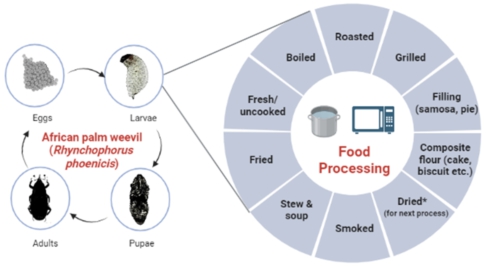
Different processing methods have been utilized to dramatically enhance the nutritional characteristics, reduce microbial contamination, and enhance the acceptability and palatability of the product. These methods include oven extrusion, vacuum cooking, pan frying, roasting, smoking, boiling, and baking. Therefore, it is necessary to coordinate innovative processing technologies to create a new generation of products with improved safety standards and longer shelf lives. Oils, chitosan, chitin, biodiesel, and nutraceutical compounds from various APWs are examples of further value-added products (Tanga et al., 2021). Protein sources alternatively used for the preparation of foods like meals and snacks could include APW larvae (Akande et al., 2020). Oil-flour due to their impact on the nutritive content and texture of the food, interactions play a crucial role in food systems. Following cooking treatments on larvae, the OAC of flour is lowered. These decreases might be brought on by an alteration in the proteinsâ natural structure, which would cause more or fewer crosslinks to form aggregates. Since lipids serve as taste sensors, the capacity of lipids to be bound by proteins is a significant property (Womeni and Tiencheu, 2012). Various processing methods and processed product diversification based on APW larvae are shown in Table 1 and Figure 3.
The list of African nations that have consumed Rhynchophorus phoenicis larvae with their cooking style
Citation: Journal of Insects as Food and Feed 11, 3 (2025) ; 10.1163/23524588-00001005
Product diversification of Rhynchophorus phoenicis larvae in African countries.
Citation: Journal of Insects as Food and Feed 11, 3 (2025) ; 10.1163/23524588-00001005
5 Nutritional value of Rhynchophorus phoenicis
Proximate content
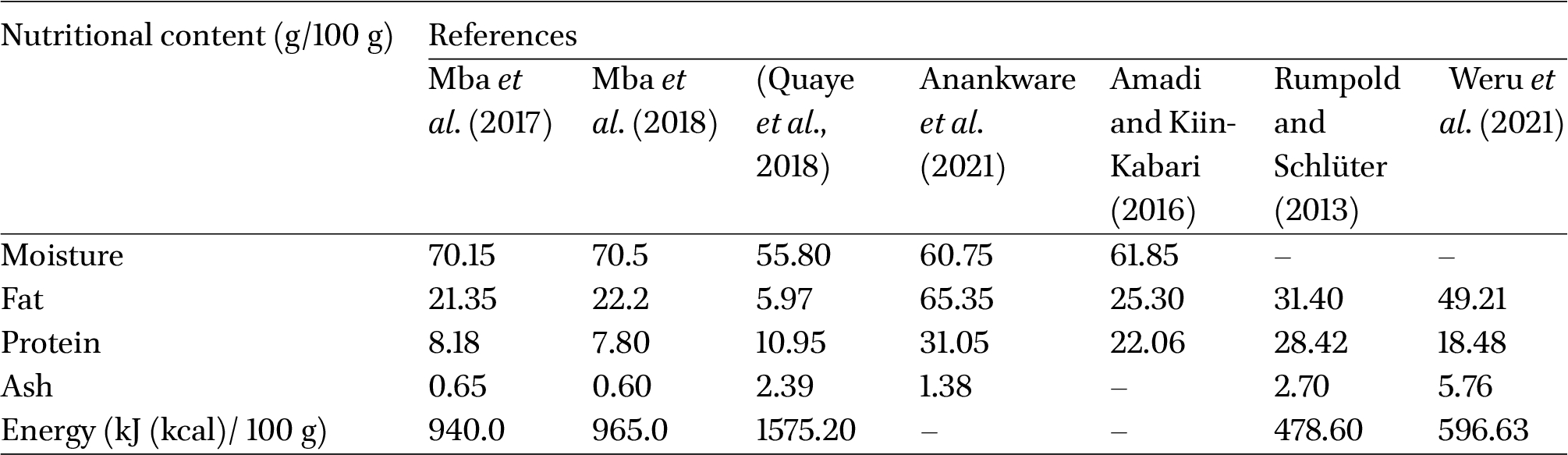
In general, the diversity in the nutritional composition of APW larvae is equally high (Daniel and Onilude, 2017; Roos, 2018). Table 2 lists numerous articles that have reported the nutritional composition of APW larvae. The larvae have a moisture content ranging from 60.75% (Anankware et al., 2021) to 70.5% (Mba et al., 2018). This aligns with van Huis et al. (2021) who reported that edible insects have a moisture content of approximately 65%. Since 2011, it has been recommended that the protein quality of edible insects should be assessed based on the amino acid composition. This is because the amino acid content of each edible insect also reflects its protein content. Previous articles have reported that the protein content of the APW ranges from 8.18% to 31.05% (van Huis et al., 2021; Anankware et al., 2021). However, while these edible insects are rich in protein, it is essential to be alert to the presence of Staphylococcus aureus (Nrior et al., 2018). Surprisingly, it has been found that despite consisting of chitin, APW has a relatively low ash content, ranging from 0.60% (Mba et al., 2018) to 5.76% (Weru et al., 2021). However, this condition is relatively linear with the fat content, which ranges from 5.97% (Quaye et al., 2018) to 65.35% (Anankware et al., 2021). A holistic approach is utilised concerning the fatty acid profile of the APW as an edible insect.
Utritional composition of Rhynchophorus phoenicis larvae
Citation: Journal of Insects as Food and Feed 11, 3 (2025) ; 10.1163/23524588-00001005
Amino acid profile
The generalisability of much of the research published on this issue is reported. Numerous studies have attempted to explain the amino acid profile and have consistently reported, for example, lysine values of between 560 and 589 (mg/100 g) and histidine values of 221.00 and 211.00 (mg/100 g) (Mba et al., 2017, 2018) (Table 3). Mba et al. (2018) reported a higher tryptophan value, while Olaoye and Ubbor (2021) reported a lower value of 0.86 (mg/100 g). This discrepancy in the amino acid profile may be attributable to the food that the APW converts into nutrients. It has been suggested that levels of amino acids in the APW may infer the proteins required by humans (Olaoye and Ubbor, 2021). Some authors have speculated that the APW contains varying amounts of palmitic, oleic and linoleic acids, which are unsaturated and essential for the human body (Amadi and Kiin-Kabari, 2016). There is thus abundant scope for further progress in determining the amino acid profile of the APW.
Nutritional composition of amino acids of Rhynchophorus phoenicis larvae
Citation: Journal of Insects as Food and Feed 11, 3 (2025) ; 10.1163/23524588-00001005
Fatty acid profile
The composition of fat was subsequently related to the composition of saturated fatty acids (SFA), monounsaturated fatty acids (MUFA) and polyunsaturated fatty acids (PUFA) (Table 4). The findings from this study make several contributions to the current literature. First, Mba et al. (2021) and Amadi and Kiin-Kabari (2016) reported similar results for C:12 of 0.21 g/100 g and 0.20 g/100 g, respectively (Table 4). Surprisingly, the PUFA level showed a dramatic increase from the lowest point to the highest point of 3.24 g/100 g (Mba et al., 2018) and 28.00 g/100 g, respectively (Rumpold and Schlüter, 2013). Somehow, the availability of SFA is relatively low to digest compared with PUFA to ensure a sufficient energy content (Thomas and Dimkpa, 2022). Research on the APW has been largely restricted to limited comparisons of edible insects. Overall, however, far too little attention has been paid to the APW.
Nutritional composition of fatty acids of Rhynchophorus phoenicis larvae
Citation: Journal of Insects as Food and Feed 11, 3 (2025) ; 10.1163/23524588-00001005
Mineral content
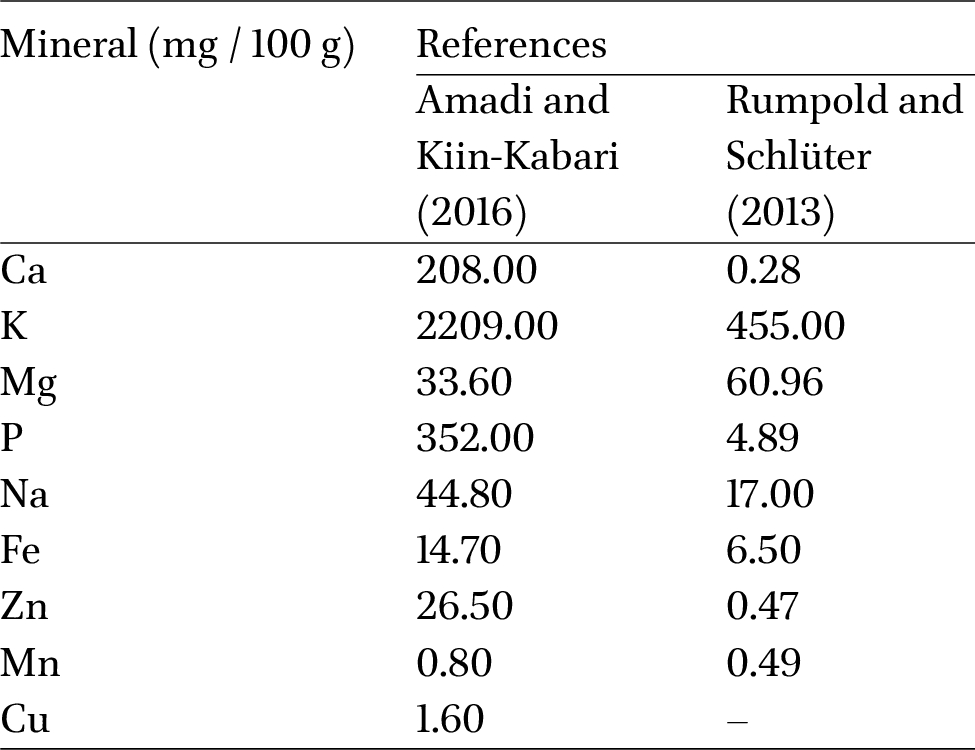
The calcium, magnesium and phosphorus contents of APW are 208.00 (mg/100 g), 33.60 (mg/100 g) and 352.00 (mg/100 g), respectively (Amadi and Kiin-Kabari, 2016) (Table 5). In contrast, another study reported calcium, magnesium and phosphorus contents of 0.28 (mg/100 g), 60.96 (mg/100 g) and 4.89 (mg/100 g), respectively (Rumpold and Schlüter, 2013) (Table 5). Idowu et al. (2019) showed a broader perspective in stating that the mineral content of the edible insect was related to the developmental periods in enclosed chambers of the termitarium, where they were extensively fed different foods and thus nutrients. Idowu et al. (2019) also stated that calcium and magnesium were considerably high in different species of edible insects and that magnesium is significant in the context of maintaining the development of the muscle, nerve function and heart rhythm. There are, however, other possible explanations, such as that both phytate and oxalates have the ability to form di-and tri-valent ions such as Mg, Zn and Fe to form soluble compounds that are not readily absorbed from the gastrointestinal tract, thus reducing the bioavailability and inhibiting specific enzymes on it (Ayensu et al., 2020; Idowu et al., 2019). Moreover, iron is important for use in blood, such as for haemoglobin and myoglobin, among others (Idowu et al., 2019).
Nutritional composition of mineral of Rhynchophorus phoenicis larvae
Citation: Journal of Insects as Food and Feed 11, 3 (2025) ; 10.1163/23524588-00001005
6 Nutraceutical and pharmaceutical properties of Rhynchophorus phoenicis
Pharmaceuticals made from insects are referred to as entomoceuticals. The direct use of various folk medicines derived from three specific sources â the glandular secretions of insects (such as silk, honey, or venom), the insectâs body parts or the entire thing used live or after various processing (such as cooking, toasting, or grinding), and active ingredients extracted from insects or insect-microbe symbiosis â has empirically validated the therapeutic effect of insect-derived drugs (Siddiqui et al., 2023b). In most places with well-preserved traditional medicine, there is an astonishingly large amount of ancient knowledge about the therapeutic uses of insects. The ethnoentomological culture, which involves entomophagy, entomotherapy, and the use of insects in rites of passage ceremonies, has been widely characterised in Latin America, Mexico, Africa, India, China, and South Korea. According to Neto (2023) at least 42 species from nine insect groups were utilised as folk medicines in the northeastern Brazilian state of Bahia. Insect MUFAs lower blood pressure and treat inflammatory and immunological illnesses in people. The best source of PUFAs is adult insects. Linoleic acid has the ability to brighten skin and reduce acne. In humans, the synthesis of prostaglandin, thrombin, and a-Linolenic acid depends on both linolenic acid precursors. Growth retardation, skin damage, reproductive problems, neurological and visual ailments, as well as kidney, liver, and neurological issues, may be brought on by inadequate consumption of linolenic and -Linolenic acids in humans. The potential for using these compounds that are extracted from insects in the healthcare system is enormous (Tang et al., 2019).
Tocopherol isomers were discovered and quantified in the total lipid extracts of APW larvae (Kabri et al., 2013). The antioxidant properties of vitamin E (Tocopherol) as well as its functions in anti-inflammatory activities, platelet aggregation inhibition, and immune system stimulation may contribute to the protection against antigens (Setyowati et al., 2023). Additionally, vitamin E may aid in preventing blood clots caused by venous thromboembolism. The tocopherol exist within the larvae in three forms such as γ tocopherol (1.54 ± 0.18 to 3.02 ± 0.86 mg/100 g FW), Vitamin E (total tocopherols) (4.11 ± 0.27 to 4.76 ± 1.10 mg/100 g FW) and α-tocopherol (0.57 ± 0.08 to 1.35 ± 0.21 mg/100 g FW) (Mba et al., 2018).
Isomers of carotene are thought to be pro-vitamin A. The concentration of vitamin A in APW larvae is 3,150 g/100Â g (Banjo et al., 2012). Carotenoids have a broad range of biological functions that support therapeutic benefits, including neuroprotection, immunomodulation, anti-inflammatory, antibacterial, and anticancer. It is believed that carotenoids have health benefits through lowering chances of disease, especially tumours and disorders of the eye (Glynn et al., 2007).
7 Harvesting and rearing of Rhynchophorus phoenicis
Availability
APW is most commonly found in the humid lowland forest and savannah region. According to Balinga (2003), these insect contributions to Cameroonâs food security, many tribes in the southern part of the country choose to trade and consume palm weevil larvae over caterpillars. High moisture content in APW means that when the larva is taken as food, the majority of the vital nutrients will be in solution and in forms that are simple for the body to absorb (Ekpo and Onigbinde, 2005). In temperate regions, herbivorous insects exhibit striking variations in activity and abundance, mostly in reaction to alterations in climatic conditions. The tropics also experience this fluctuation, however it is more complicated and rainfall is unquestionably more significant than temperature or photoperiod (Louton et al., 1996). Due the insectâs tendency to burrow, harvesting the larvae was said to be exceedingly challenging. According to Muafor et al. (2015) the larvae were routinely taken from the wild in Cameroonâs Abong-Mbang and Mbalmayo regions by breaking an infected raphia/palm tree and manually collecting the larvae.
Traditional gathering
The APW larvae are collected by deliberately removing them from the trunks of oil palms (Elaeaeis guineensis Jacq.) that have been harvested for palm wine production or from the trunks of raffia palms (Raphia spp.) which have become abandon in swamps and are dead or injured. Sap produced by wounded raffia trunks draws adult weevils. Female weevils mate with males after landing on the plant. Within a week, the eggs that the females lay on the trunksâ rotting areas hatch into young larvae. Over the course of four weeks, these larvae grow into harvestable larvae. The oil palm harvest is easier than the raffia palm. When harvesting raffia, workers take the risk of snake and pest attacks by spending hours or days in murky, dark waterways. Using axes or machetes, dead raffia stems are cut apart, and larvae are manually plucked out. Palm weevil larvae were harvested by traditional collecting and semi-farming methods. Only a few villages in southern Cameroon, according to Dounias (1999), specialise in collecting larvae for commerce. Each of these specialised collectors has acquired some competence and uses unique harvesting instruments and methods (Dounias, 1999). When larvae were traditionally collected, they were taken out of the trunks of oil palms that had been chopped down to make palm wine or from the trunks of raffia trees that were naturally infected with larvae in the swamps. The larva collectors show more attention to the sound and vibration produced by feeding larvae, and this method was very common in several communities in the southern sections of Cameroun, as collectors in regions like Ntoung and it was viewed by Abong-Mbang (1999) as a productive method of locating and collecting the larvae (Dounias, 1999).
According to the Raffia palm species (Raphia hookeri, Raphia mombuttorum, and Raphia mambillensis) in Cameroon, palm weevil larvae either have yellow or white morphotypes. Consumers have varying levels of appreciation for these morphotypes. The two forms are both APW, according to a recent molecular analysis employing cytochrome oxydase1 markers, although the white and yellow larvae donât share any haplotypes (De Laage, 2017). Compared to raffia, less larvae were obtained from oil palm. In this method, collectors scoured raffia habitats for hours, and perhaps days, looking for raffia stems that had been taken over by larvae. To get at the larvae, these raffia stems were uprooted and cut apart using axes or machetes. However, considerable knowledge was needed to distinguish between naturally infected or dead raffia stems. This involves looking for young raffia stems with juvenile leaves that are a little yellow or mature raffia stems that are dead. In order to find the vibrations caused by nibbling larvae, collectors also sniffed the trunks and carefully listened for the noise they made. About six communities in southern Cameroon used this technique. These people are experts in collecting larvae for trading. Such knowledgeable collectors have created particular instruments and procedures for harvesting (Dounias, 1999). In the regions of Ntoung and Abong-Mbang, this is the sole technique utilised to gather larvae.
Semi-farming technique
The semi-farming technique was created and is used in the Obout village region, where a major section of the population engages in the trading and harvesting of palm weevil larvae as one of their main livelihoods. In this approach, larva farmers start the harvest by locating the raffia that encourages the growth of larvae. In the Ewondo dialect, the inhabitants of the Obout region have distinguished between two varieties of raffia called essa and zam. Zam is utilised to produce wine, whereas Essa is exploited for weevil larvae. Essa is used as a resource in the Obout region to produce larvae. Despite the fact that these two raffia species could not be taxonomically distinguished from one another, certain morphological distinctions between the two species could be found. Zam is distinguished by stems arranged within compact clusters of closely packed individuals. Essa is composed of less thick solitary stems. As opposed to those of essa, the leaves of zam are greater in size and are characterised by the presence of many thorns. The mature stems of essa raffia are chosen and trimmed down throughout the larva semi-farming procedure to aid in larva colonization (Commander et al., 2019).
Following the cutting of the stem, a 20 to 25Â cm long and 5Â cm deep incision is made on the trunk, around 1Â m from the base of the crown. Fresh raffia leaves are then placed over the cut area to give warmth and deter rats, squirrels, and other predators from eating the larvae. After that, the stems are allowed to decompose for 25 to 30 days so that the larvae can develop before being harvested. The deterioration of the colonised stem segments is accelerated by the larvae, which grow inside the raffia stem. The first step in the collecting procedure is to remove the leaves that were covering the incision (Muafor et al., 2015).
The collector sets his ear on the incision to listen for larvae chewing the trunk in order to ascertain whether or not palm weevil larvae have colonised a raffia stem. Once the presence of larvae in the trunk has been established, the collector splits the trunk. Axes are used to break apart the infected raffia trunk from the incision to around 60Â cm in the base and 40Â cm in the top of the apex. The larvae are now accessible for collecting. The extent of the infection, however, determines the length of the trunk split. The amount of water present in the raffia environment has a major impact on the production of trunks. Partially submerged trunks are often less productive (Hilbert et al., 2020).
One by one, the larvae are manually removed from the stem. The two indigenous systems produce raffia trunks at different rates. By adopting the conventional collection method, a single trunk may yield an average of 35 13.2 larvae and 50 10.1 larvae while semi-farming. The productivity per raffia stem is better for the semi-farming system than for the conventional larva harvesting technique with an average of 50 13.2 individuals. However, each of these traditional harvesting techniques has pros and cons which is represented in Table 6.
Pros and cons of semi-farming method and traditional gathering according to Hilbert et al. (2020)
Citation: Journal of Insects as Food and Feed 11, 3 (2025) ; 10.1163/23524588-00001005
In an experimental study set up by (Muafor et al., 2015) ecolological samples were gathered, particularly adults of the APW and raffia stem tissues. The decomposing raffia tissues were used to harvest the adult weevils. In all, 70 adult weevils were removed from the degraded (dead) raffia tissues. The majority of the mature weevils that were gathered were male. Nevertheless, female individuals were recognised and mated for reproduction. Adult palm weevils that were removed Identifying and mating mature female weevils. Adult APWs exhibit sexual dimorphism. It shows that females have much larger abdomens and heads than males, while males have significantly longer pronotums (thorax) than females. In terms of abdomen length and breadth, total head size, and length from the tip of the rostrum to the antennal insertion, females are bigger than males. Following established procedures, the breeding of palm weevils was done in a lab (Thomas, 2003).
Insect consumption in Nigeria is increasing due to their potential as alternatives to animal protein and a source of income to alleviate hunger and poverty, and it is more popular and widely accepted in southern Nigeria than in the north (Aigbedion-Atalor et al., 2024). Insect farming can occur on a variety of scales, ranging from a modest single cage to a massive semi-automated factory (Raheem et al., 2019). However, partners in the commercial and governmental sectors are actively focused on innovation and information transfer operations to build farming systems that include rearing facilities and management strategies appropriate for various insect species. Similar farming approaches are now being used and promoted in Africa to produce insects on small, medium, and large scales (Alemu et al., 2023; Aidoo et al., 2023). According to Alemu et al. (2023), 48% of trained farmers were actively cultivating APW after training. In Kenya, insects are increasingly being grown and sold economically, both in rural and urban markets. Production patterns are developing to incorporate not only wild gathering but also semi-domestication and insect farming due to efforts to improve small and large-scale production systems (Kinyuru, 2018). Indigenes of almost all ethnic groups/tribes (Ijaws, Ibos, Urhobos, Ogonis, and Ibibios) in Nigeriaâs Niger Delta region have extensive experience harvesting edible larvae from young palms that have been wounded or intentionally cut down as fodder for this insect. This habit is comparable to traditional APW farming in Ghana, Cameroon, and Sierra Leone, all of which are located in West Africaâs palm belt (Thomas and Dimkpa, 2016). In Asia, insects are mostly gathered wild; however, semi-domestication and farming are becoming more popular. APW larvae and beetles, such as APW (Ebenebe and Okpoko, 2016). Traditional collection was performed in both the Center and East regions of Cameroon, although semi-farming was popular in the Center region (particularly near the Obout area). In this approach, grub farmers begin harvesting by locating the raffia that promotes grub development. In the Obout area, locals have identified two types of raffia: essa and zam (Ewondo dialect). Essa is harvested for weevil grubs, whereas zam is used to make wine. Essa is exploited for grub production in the Obout region. Grub semi-farming involves selecting and cutting down mature stems of Essa raffia to enable grub colonization. The productivity of raffia trunks varies between the two indigenous systems. Traditional gathering yields an average of 35 ± 13.2 grubs per trunk, while semi-farming yields 50 ± 10.1. Semi-farming yields higher productivity per stem of raffia (50 ± 13.2 individuals) compared to typical grub harvesting methods. The difference in productivity between semi-farming and traditional gathering methods is statistically significant at a 95% confidence level (Muafor et al., 2015). In comparison to the traditional gathering approach, semi-farming produce collectors spend fewer days in the forest during harvest. Furthermore, APW larvae are available for eight months of the year (November to June), but the semi-farming system only has a six-month gathering season (October to March). The exploitation of larvae has a significant negative influence on the environment, including raffia ecosystems and wildlife populations. The exploitation of larvae results in the monthly felling of thousands of raffia stems. In the traditional gathering, exploited trunks are primarily young raffia stems that have naturally become infested with larvae. However, with the semi-farming technique, most of the trunks are healthy, fresh, and mature (Ayemele et al., 2017). In addition, the Commander et al. (2019) study shows A reconnaissance survey of APW semi-cultivation (domestication) was conducted in Ghana from September to October 2016 to determine the economics of domesticating the production of edible larvae near houses and gardens. Semi-cultivation is the domestication of APW breeding near living houses and gardens to provide correct management and ongoing production of edible larvae throughout the year.
Artificial breeding setup
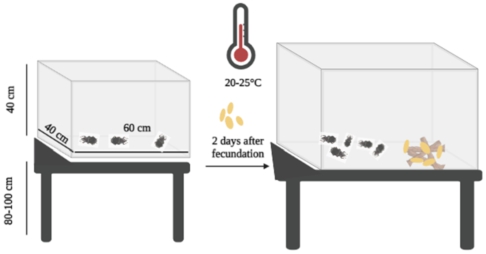
Figure 4 shows that breeding takes place in plastic containers with appropriate ambient environmental conditions for mating, oviposition, and sex identification. The oil palm or raffia stems (some other diets like sugar cane tops, spoiled watermelon, spoiled pineapple, and spoiled papaya also followed), are mentioned in Table 7. It was replenished weekly so that the young larvae could grow to food size within 3-4 weeks and be harvested for sale to customers. To ensure the longevity of adult generations, some final instar larvae were permitted to go to pupal stages before emerging as adults. The artificial rearing of insect larvae in the laboratory provides perfect, abundant, and readily available material. The larvae that have been effectively raised on the artificial diet are preferentially picked from the final instars â where the amount of haemolymph is larger (Baragano and De Viedma, 1986). Furthermore, several studies on insect reproduction have been conducted, including biological observation in its natural environment as well as semi-artificial (i.e. regulated greenhouses with sunlight) and artificial breeding methods (i.e. regulated rooms with artificial light) that have been developed and optimized for environmental factors such as light intensity, humidity, and temperature. In an artificial setting, raising necessitates the development of breeding technologies in a limited habitat with no sunlight (Hoc et al., 2019).
Artificial breeding of Rhynchophorus phoenicis.
Citation: Journal of Insects as Food and Feed 11, 3 (2025) ; 10.1163/23524588-00001005
Kinds of diet used for rearing Rhynchophorus phoenicis
Citation: Journal of Insects as Food and Feed 11, 3 (2025) ; 10.1163/23524588-00001005
Artificial rearing of APW is critical in order to avoid the risk of harvesters using traditional methods of raising the insect in the wild. Thomas and Dimkpa (2016) found that alternative plant materials can be used to create artificial diets with high moisture content, adequate protein, lipid, ash, fiber, and carbohydrates, particularly glucose and related sugars such as galactose, fructose, maltose, and lactose. The medium can be enriched with small amounts of vital minerals and vitamins (A and C), as well as yeast. Artificial diets have certain advantages over natural plant material since they are semi-synthetic or completely synthetic and may be utilized for a variety of insect species, making them available for bioassays or other uses as needed (Meyer-Rochow et al., 2022). As a result, selective breeding can also be carried out more effectively during insect rearing. Fasunwon et al. (2022) conducted laboratory experiments with artifical rearing of edible larvae of APW and rhinoceros beetle, Oryctes boas (Fabricius). There were substantial variations in the nutritional content of the reared insects when containers were filled with a salt and pepper mixture (10 g/container). Reared O. boa larvae contained 56.1-60.6% protein compared 39.3% in the control (container without salt and pepper), whereas APW had 34.8-37.3% protein versus 22.7% in the control (Fasunwon et al., 2011). Based on the study conducted by Lokela et al. (2017), on an artificial diet consisted of a paste formed of ripe plantains, sweet potatoes for the energy component (40%), and cowpeas for the protein component; and another medium in which palm cake substituted cowpeas as a protein component (60%), and lemon juice. The developmental time of APW was longer when compared to that of reared on young palm trunk. The APW larvae were also weight less when reared on the artificial diet. This indicates that the quality of the artificial diet still needs to be improved. The positive outcomes obtained with sugar cane could be a strategy to improve these artificial diets. The results show that the output of the last-stage larvae of sugar cane and diet with palm cake (55%) was higher than that of the young palm trunk split and the old palm oil trunk not split (15%) (Lokela et al., 2017).
The principles of natural selection can be used to manipulate phenotypic frequencies in insect populations. In the context of insect production, Eriksson and Picard (2021) want to differentiate between phenotypes associated with economic and fitness aspects. Economic features are those that are directly related to the insectâs intrinsic commercial value (for example, silk and honey production rates). Fitness characteristics such as fecundity, fertility, immunity, and environmental tolerance influence an insectâs ability to survive and reproduce in controlled settings. Optimizing an economic attribute may result in the loss of a fitness trait, and vice versa (Eriksson and Picard, 2021). Selection allows for significant genetic improvement in other edible insects such as Hermetia illucens L. (Diptera: Stratiomyidae, black soldier fly). In the study of Facchini et al. (2022), effective genetic improvements are made in the genetics lab, which are then tested in industrial settings. This study demonstrates that genetic improvement initiatives can play a role in the insect farming business, just as they did in plants and other animal species (Facchini et al., 2022). The basic goal of selection programs is to increase the prevalence of phenotypes that will raise the quantity or quality of commercial output, shorten the time to harvest, or promote stability and health in artificial rearing conditions (Eriksson and Picard, 2021).
8 Utilizization and potential of Rhynchophorus phoenicis larvae as feed
APW can produce as feed in several studies. Another study shows that 70-day feeding trial was conducted to investigate the effects of processed APW larvae with phyto-additives on African sharptooth catfish (Clarias gariepinus) juvenilesâ diet. Seven experimental diets with three replicates per treatment, including 45% crude protein, were developed. Six of these diets included processed APW larvae with phyto-additives such as APW with Telfairia occidentalis (TEL), APW with Corchorus olitorious (COR), APW with Cymbopogon citratus (CYM), APW with Telfairia occidentalis (TELCOR), APW with Telfairia occidentalis and Cymbopogon citratus (TELCYM), and APW with with Corchorus olitorious and Cymbopogon citratus (CORCYM). A diet with fishmeal served as the control. A total of 420 juveniles were gathered, with a mean weight of 7.51 ± 0.01 and 20 fish given to each circular basket. Each basket was inserted into a polygon tank filled with water. The mean weight growth was significantly different across the fish fed the experimental diets, with the COR group gaining the most (32.28 g) and the CORCYM group gaining the least (19.82 g). The feed conversion ratio (FCR) was significantly different across the experimental groups. The control group showed the highest FCR value (1.59 ± 0.02), whereas the COR group had the lowest (1.27 ± 0.03). There were no significant differences in protein efficiency ratio (PER) across experimental groups. Clarias gariepinus thrived in conditions with optimal temperature, pH, and dissolved oxygen levels (Adeparusi et al., 2023). In addition, a feeding trial was done to investigate the dietary benefits of including APW in the diet of catfish. Five experimental diets comprising 40% crude protein were developed; four of these diets comprised defatted APW larvae meal at varied inclusion levels labeled as APW25%, APW50%, APW75%, and APW100%, while the diet containing fish meal (APW0%) served as the control diet. The experiment was carried out in triplicate over a 10-week period, with 15 aquaria glass tanks containing 10 fish each. The percentage weight growth was considerably varied across the fish fed experimental diets, with fish fed diet APW100% gaining the most (1118.30 g) and fish fed diet FM gaining the least (749.40 g). The feed conversion ratio (FCR) did not differ significantly (
9 Processing and storage techniques of Rhynchophorus phoenicis
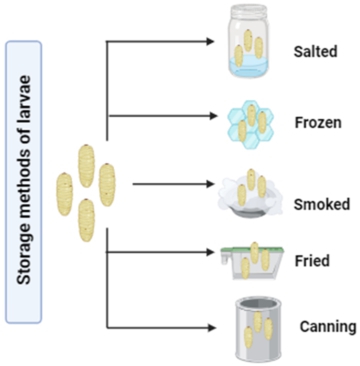
Tropical Africa is home to the common APW, which many populations exploit as a source of food. Rural inhabitants consume APWs as delicacies as a regular part of their diet during the whole year and in times of scarcity (Tamesse et al., 2016). These can be processed or cooked and can be used as a good protein sourced meal. In the past, insects were prepared in straightforward methods to enhance their flavour and suitability for consumption, including steaming, frying, roasting, stewing and smoking which is represented in the Figure 5. The preparation of edible insects has gotten increasingly complex as a result of the development of new processing methods (Melgar-Lalanne et al., 2019).
Processing and storage method of larvae.
Citation: Journal of Insects as Food and Feed 11, 3 (2025) ; 10.1163/23524588-00001005
Insectsâ nutritional makeup might change depending on how they are obtained and how they are processed. Acidic or alkaline extraction, organic solvents, or isoelectric point precipitation are common extraction techniques when obtaining insect protein. However, these techniques can produce waste that is dangerous to the environment and can have a greater or lesser impact on the targetâs stability and purity (Gravel and Doyen, 2020; Okolie et al., 2019).
As mentioned in the Table 8, the freeze-drying technology used to dry the insects by sublimating the ice. These method helps in preserving the heat sensitive chemicals (Mujumdar, 2015). Sun drying method used to dry the insects with help of solar radiation, this method reduces the energy consumption. Blanching is a method where insects are killed by using boiling water. This method will reduce the lipid oxidation (Lee et al., 2023). Fermentation is the most popular method of processing of insects. In this method the edible insects are allowed to ferment in anaerobic condition. It is mainly used to improve the biochemical properties of insects (Fombong et al., 2017). Salting is simple method used to reduce the bacterial growth.
Processing techniques used for edible insects
Citation: Journal of Insects as Food and Feed 11, 3 (2025) ; 10.1163/23524588-00001005
Drying food extends its shelf life by inhibiting the growth of germs, mould, and yeast. Food can be preserved for many years with the correct drying method and food storage conditions. It is advised to keep dry food in airtight jars to extend its shelf life. Furthermore, dried foods offer a more potent energy boost than conventional snacks since the dehydration process focuses the calories and sugar content. According to study, our bodies are able to more readily absorb the nutrients in dried food, giving you more energy for a longer duration of time. Fluidized bed drying, freeze drying, hot air oven drying, microwave drying, smoke drying, roasting, solar (or sun) drying and however drying have all been used to dry the edible insects (Kröncke et al., 2019). The two types of drying which is most frequently cited are freeze drying and hot air oven drying (Melgar-Lalanne et al., 2019). At the industrial level, oven drying is the most commonly used process for drying insects.
The most popular technique, both traditionally and industrially, is blanching since it provides sanitary benefits and lowers lipid oxidation (Lee et al., 2023). Blanching often involves briefly submerging the meal in hot or boiling water. Depending on the insect type and stage of development, the immersion time and temperature will vary. Blanching and pasteurisation are frequently compared because both procedures lessen the productâs overall microbial load, reducing the risk of microbial contamination in the finished goods. The temperatures that kill insects might vary depending on their species and stage of growth. The primary distinction is that pasteurisation is used to preserve liquid meals, whilst blanching is used to preserve solid foods.
The freeze-drying procedure involves drying a sample by sublimating the ice. It entails freezing the product, then lowering the pressure and increasing the temperature to allow the frozen water in the substance to sublimate. One advantage of freeze drying is that it can preserve heat-sensitive chemicals because it is done at low temperatures (Mujumdar, 2015). However, it has a low productivity and a high cost when compared to most other drying technologies, making it less appealing for large-scale application. Solar drying, commonly referred to as sun drying, is undoubtedly one of the most traditional drying techniques used for drying intact edible insects. Because of the minimal energy input and ease of implementation, it is mostly used at the household level. Sun drying is based on the idea that as the sample and the surrounding air warm up due to sun radiation, the rate at which the insectsâ water evaporates rises (Kröncke et al., 2019).
The most often used technology is roasting, which is another classic method. It involves drying the bug on top of a stainless-steel pan over an open flame for five minutes at a temperature of about 150 °C, with or without the use of oil. It will inactivate the enzymes and creates the Maillard reaction products roasting can prevent lipid oxidation reactions, it can increase oxidative stability (Nyangena et al., 2020).
This procedure has the disadvantage that it could ruin the flavour. Additionally, there are some signs that polycyclic aromatic hydrocarbons, which are known as carcinogens or potential carcinogens, may be present in smoked meals (Alexander and Cushing, 2011). Smoke drying whole edible insects is another age-old method. The insects are exposed to the smoke created when wood is pyrolyzed. This procedure is typically paired with salting, and the entire procedure comprises of a seamless integration of procedures for heating, drying, salting, and smoking in a smoking chamber (Tiencheu et al., 2013). The insects are boiled and then pureed for 10 minutes with an electric blender until they were smooth. The same technique was followed with 5Â g salt and 10Â g seasoning cube for the insects boiled with seasonings (Akande et al., 2020).
The simple practices of transforming farm products into edible and preservable forms, which were crucial for their survival, may be credited to the cultural diversity of African people. The most ancient method which is fermentation ultimately results in desirable food properties like discrete organoleptic characteristics, great palatability, and long shelf life (Chan et al., 2023). The method also simultaneously improves the biochemical properties and eliminates or depletes the harmful elements of the original raw material. Additionally, fermentation procedures promote the development of bioactive chemicals that may be initially absent or only slightly present in the unprocessed substrate.
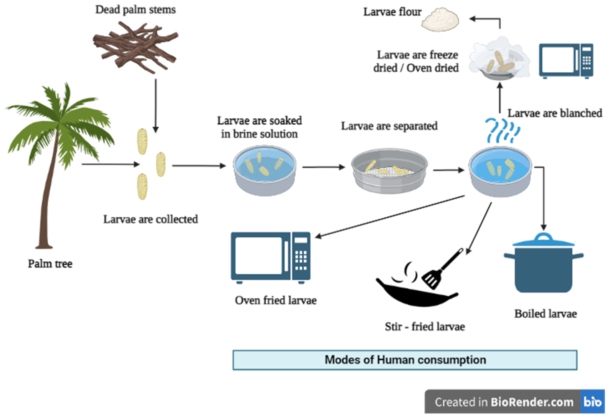
Before beginning the fermentation process, edible insects are first prepared (blanching, roasting, boiling, crushing/size reduction, salting, drying or smoking) (Fombong et al., 2017). These pre-processes are crucial for exposing vital nutrients required for microbial activity during fermentation and for removing the protective barrier (exoskeleton) which represented in Figure 6.
Steps in processing and storage of Rhynchophorus phoenicis larvae.
Citation: Journal of Insects as Food and Feed 11, 3 (2025) ; 10.1163/23524588-00001005
Innovatively fermented edible insect-based by products like sauce, paste and powder could reduce persistent food insecurity on the continent by successfully integrating into the continentâs food supply (Kewuyemi et al., 2020). Insects that are edible can be consumed whole or powdered and sieved into flour that can be used in the formulation of a wide range of food products or as animal feed, which is represented in the Figure 6. Insect proteins can also be isolated to create protein isolates (>90% dry basis) or concentrates (65% to 90% protein dry basis) (Gravel and Doyen, 2020). Due to their high fat content â which can range from 8% to 50% â insect flours are vulnerable to lipid oxidation. In order to lower their lipid content, insect flours are typically defatted for this reason.
Prior to any storage or culinary preparation after collection, insects must be fasted for a limited period of time (between one and three days) and then killed. In order to lower the faecal microbiota, fasting is an essential phase in the process (Mancini et al., 2020). As has been investigated for fruits and vegetables, emerging physical field-based drying technologies such as microwave, radio frequency, infrared radiation, ultrasound, and pulsed electric field may also be employed for edible insects as emerging technology (Yudhistira et al., 2023; Sulaimana et al., 2022). In addition, using sustainable drying methods is important. Solar-based hybrid drying systems are among the most promising and can be used in the edible insect industry (Acar et al., 2022).
10 Consumer acceptance of Rhynchophorus phoenicis as food
In recent years, the environmental and nutritional benefits of edible insects have drawn growing attention, but the process of consumer acceptance has gotten far less spotlight. Westerners hardly eat edible insects, therefore understanding consumer acceptance of insects as food is crucial to understanding the adoption process (Hartmann et al., 2015). Understanding the factors that influence customer acceptance or rejection of edible insects will assist future research and development be more productive and can advance public understanding of the edible insectsâ potential for commercialization. The knowledge of customer requirements, experiences, behaviors, and aspirations is currently insufficient to effectively encourage their interaction with insect-based products. Consumer studies on edible insects havenât yet offered a comprehensive review of the subject; instead, they focus on specific issues one at a time, leaving the field almost fragmented for further investigation. This is a particularly difficult challenge for academics who struggle to grasp how their research might advance general knowledge as well as for industries trying to put their results to use (House, 2016). They created a framework that categorizes recent consumer research findings into three key areas based on the outcomes of the literature study, including discoveries about the customer, the product, and the adoption techniques. Consumer and product-related factors are further categorized down into two areas. Long-term adoption of the product is highly related to sociocultural factors including culture and social acceptability (Kauppi et al., 2019). A consumerâs unique reasons for eating insects, gender, and age are examples of individual consumer factors. It is also known that certain relevant product characteristics, such as flavor and form, as well as product-related circumstances like availability, suitability, and product placement, have an impact on the adoption process. Adoption tactics establish connections between the customer and the good.
However, food choice is a complex mix of sensorial, situational, social, cultural, demographic, and cognitive factors (Tan et al., 2017), so a combination of factors may offer the best potential for efficient adoption. According to House (2016) other factors that affect the success of routinely consuming insect food include household composition, or who a person eats with, and the degree of match with present eating patterns. Tan et al. (2017) come to the conclusion that insect food is needed aligned with what is deemed to be palatable and culturally appropriate, but they also note the necessity for additional research to fully grasp the range of insectsâ acceptability for the western diet. In comparison to other European customers, Nordic consumers approved of insect food more strongly (Piha et al., 2018). In Poland (Kostecka et al., 2017) and Italy (Sogari, 2015), where informants did not have a favourable attitude towards insect-eating, this type of distinction was validated.
Individual factors
Younger males who are open to trying new cuisines and who have stated a desire to eat less meat are likely to be the first group to start eating insects, therefore they could be explicitly targeted as potential market trendsetters (Verbeke, 2015). They are concerned about how their dietary choices may affect the environment as a whole. According to Verbeke (2015) research, men were 2.17 times more likely than women to accept insects as a meat alternative, and the possibility that someone would be willing to adopt insects as food decreased by 27% with every ten years of age. A possible reason for this might be that young men tend to have more adventurous taste preferences or find eating insects less repulsive than other demographics.
Product properties
Indeed, whether or not people accept insect-based foods depends on a variety of elements, including flavour and nutrition. Deroy et al. (2015) notes that the most appetising insect species may not be promoted as food at the moment since marketing decisions prioritised insect farming practises over insect flavour attributes. The success of introducing insects as food will almost surely be negatively impacted by unpleasant tasting experiences, whereas pleasant tasting ones may not always increase consumption intentions (Tan et al., 2017). Comparing insects with well-known flavours seems to lessen aversion than simply experiencing unflavored insects. Additionally, in societies lacking entomophagy traditions, cooking with visible insects seems to cause greater animosity than when they are hidden (Megido et al., 2016). This result is in line with a previous study that found that people from cultures where eating insects is more common, such as western consumers, are more likely to choose processed insects over unprocessed ones but did not show any difference in willingness to do so (Hartmann et al., 2015).
Entomophagy in Africa
The practise of entomophagy, or eating insects, has a long history in human diets and is practised in many regions of the world (FAO, 2004). Entomophagy has a key role to play in ensuring food security and enhancing the standard of living for many people throughout the world when it comes to a sustainable diet. Nearly 2111 different species of edible insects have been discovered identified worldwide, according to a 2017 estimate (Jongema, 2017). Many people still eat insects as food on a global scale, primarily in Africa, Asia, South and Latin America (Raubenheimer and Rothman, 2013). According to a study on entomophagy conducted by Kelemu et al. (2015) around 470 species of edible insects are only found in Africa, and the majority of them are found in Central Africa (Cameroon, Congo Republic-Brazzaville, and Democratic Republic of the Congo and the Central African Republic). According to Kelemu et al. (2015) entomophagy survey, over 470 Commonalities exist among parts of the continent, and these insects are available throughout the year. Caterpillars, mopane worms, termites, crickets, APW, grasshoppers, locusts, stinkbugs, beetles, ants, and bees are examples of often used types. Edible insects can be consumed after minored processing or consumed after preparation by curing, smoking, parboiling, roasting, sun drying, stewing, frying, or combination of these processes, depending on the metamorphic life stage (eggs, larva/nymph, pupae, or adult) and after that, they are subsequently consumed either alone, as a snack, or in soups if desired (Melgar-Lalanne et al., 2019).
In many regions of Nigeria and other nations in Africa where APW is present, the larva is considered a delicacy. The larva is referred to by a number of terms by the different cultures in Nigeria, who fervently believe it has significant nutritional as well as possible medicinal value. From one geographical location to another, different methods are used to prepare it for consumption. Ibibios in Akwa Ibom State and Ibos in the state of Anambra both consume it uncooked, while others smoke, fry, or boil it (Ilesha). It can be eaten with bread or tapioca as a side dish or as a whole meal (Urhoboâs in Delta state). Some tribes, including the Urhobo and Isoko in Delta State, strongly advise it to their pregnant mothers, likely as a source of vital nutrients (Ekpo and Onigbinde, 2005). It is thought that there are uses for APW larvae beyond their usefulness as food. Many people have historically asserted that the larva has therapeutic powers. For instance, the Itsekiri people of Delta State think that live larva could treat a condition that affects newborns and has symptoms like twitching hands and feet, restlessness, and other similar motions.
Over 90% of Ghanaiansâ daily protein needs are met by imports, making our food system unsustainable (Anankware et al., 2015). The consumption of meat has rapidly expanded recently, both in Africa and the rest of the globe (Kenis and Hien, 2014), despite the issue of food and nutritional insecurity in Ghana being addressed by the quest for a substitute for protein like the palm weevil. In the western and Niger Delta regions of Nigeria, entomophagy is an a centuries-old custom (Oibiokpa, 2017). Insects have been crucial to human nutrition throughout history, and hundreds of species are still consumed in Latin America, Asia, and Africa. Grasshoppers, caterpillars, termites, bees, ant, larvae and pupae, beetles, cicadas, and palm larvae are a few of the more significant categories. Insects typically have significant cultural and symbolic value, are nutrient-rich, and are plentiful without facing the threat of resource extinction.
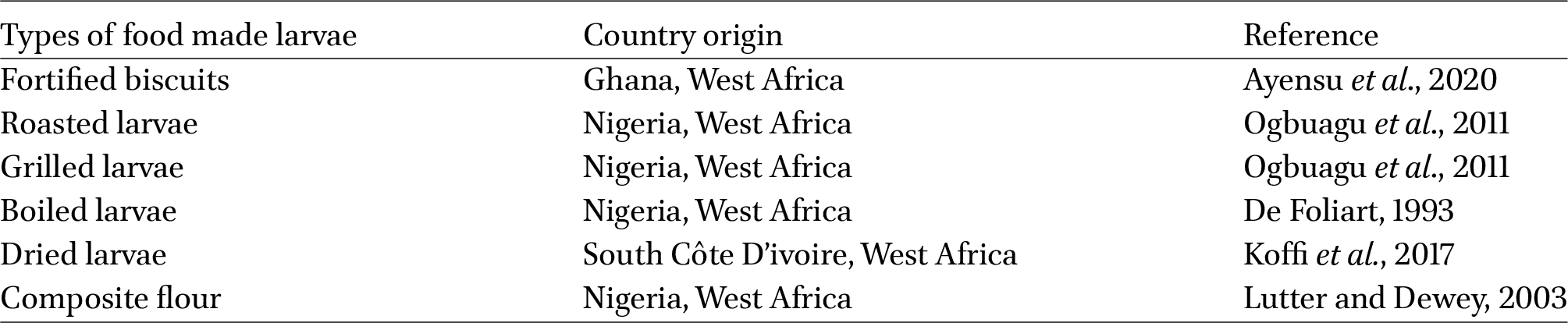
The larvae represent a delicacy in the western and Niger Delta regions of Nigeria, where they are either eaten raw or after heating by boiling, roasting, or frying which can be used for medicinal purposes, the Table 9 shows the types of food made from APW and their country of origin. APWs are pests because they damage valuable plant resources, but the larvae are highly appreciated delicacies in these areas. According to Chinweuba et al. (2011), palm larva has a high level of fatty acids, thiamine, and riboflavin vitamins as well as zinc, iron, and crude protein (23.44%).
Types of food products made from Rhynchophorus phoenicis larvae
Citation: Journal of Insects as Food and Feed 11, 3 (2025) ; 10.1163/23524588-00001005
Health maintenance
However, according to Adeoye et al. (2014), 10% and 15% of the respondents in Itokin and Epe, Nigeria, respectively, employed R. phoenicis in their diet, particularly the overweight and diabetic patients, since it has the ability to maintain weight and treat diabetes patients. However, the results revealed that while 7.6% of the respondents ate the larvae out of curiosity, 10.5% of the respondents said that the flavour of the APW aroused their hunger and persuaded them to eat it.
Heavy metals accumulation in edible insects
The accumulation of heavy metals in the body of field-harvested edible insects possesses a greater health risk. The species, stage of development, environment, and food source of insects all adversely impact the quantities of heavy metals in their bodies. Edible insects contain heavy metals that come from habitat pollution as well as human activity. Cadmium, lead, arsenic, and mercury are the heavy metals that are most frequently found in edible insects. Similarly, cultivating insects will significantly lower the dangers of heavy metals to human health (GaÅęcki et al., 2023).
11 Future perspectives and conclusions
The demand for food sources with protein will rise as the continentâs population rises, with an estimated 8 billion people living there in 2025. Edible insects are a possible alternative to the traditional production of meat of direct use like human consumption or for indirect use as feedstock, according to recent innovations in research and development. However, much effort will need to be done over many years by a variety of stakeholders in order to fully realise the potential that insects provide for the security of food and feed. APW is a familiar edible insect used as food and feed. Because of its nutritional content and economic value, APW has been widely exploited in the wild. However, along with the increase in demand and consumption of APW, there has been a lot of APW farming. This has been done a lot, especially in African countries, where it has been proven to be able to improve the peopleâs economies. APWâs processed products experienced growth. At first, they were only processed by burning, baking, and boiling. However, now APW larvae have been used as a filling for samosas, cakes, or even as a biscuit ingredient.
The use of fermentation methods to turn edible insects into wholesome foods could go a long way towards helping a country achieve food security. As these insects are highly nutritious, easily accessible, inexpensive, and their reproduction is linked to low environmental footprints, eating edible insect-based meals could be investigated as a potential approach of solving food poverty in Africa. It also gives give money, job prospects, and potential enterprises in addition to household nourishment, all of which have a favourable impact on the economy, science, and culture.
Insect research has some gaps that provide great opportunities for novel strategies. Risk assessments relating to the primary or secondary toxicity of consumed insects should be done in terms of food safety. If the legal framework is carefully created and put into place, the value chain for edible insects could become even stronger. Veterinarians and others need to be trained on harvesting techniques as well as processing and packaging, which could result in rules. Furthermore, much work needs to be done in the areas of agricultural productivity to guarantee the food security potential of edible insects. There is still a lot of work to be done in order to properly strike a balance between the requirement for food security and the threat of running out of edible insect resources.
Corresponding authors; e-mail:Â s.siddiqui@dil-ev.de; barayudhistira@staff.uns.ac.id
Author contributions
S.A.S.: conceptualization, methodology, validation, data curation, writing â original draft, writing â review and editing, visualization, supervision, formal analysis, project administration, investigation, resources. K.T.: writing â original draft. D.N.A.: writing â original draft. B.Y.: writing â original draft. I.F.: writing â review and editing. P.D.P.: validation, funding.
Conflicts of interest
The authors declare that they have no known competing financial interests or personal relationships that could have appeared to influence the work reported in this paper.
Funding
This study was carried out within the Agritech National Research Center and received funding from the European Union Next-GenerationEU (PIANO NAZIONALE DI RIPRESA E RESILIENZA (PNRR)-MISSIONE 4 COMPONENTE 2, INVESTIMENTO 1.4-D.D. 1032 17/06/2022, CN00000022).
References
Abdel-Baky, N.F., Aldeghairi, M.A., Motawei, M.I., Al-Shuraym, L.A.M., Al-Nujiban, A.A.S., Alharbi, M.T.M. and Rehan, M., 2023. Genetic diversity of palm weevils, Rhynchophorus species (Coleoptera: Curculionidae) by mitochondrial COI gene sequences declares a new species, R. bilineatus in Qassim, Saudi Arabia. Arabian Journal for Science and Engineering 48: 63-80. https://doi.org/10.1007/s13369-022-07104-w
Abro, Z., Kassie, M., Tanga, C., Beesigamukama, D. and Diiro, G., 2020. Socio-economic and environmental implications of replacing conventional poultry feed with insect-based feed in Kenya. Journal of Cleaner Production 265: 121871. https://doi.org/10.1016/j.jclepro.2020.121871
Acar, C., Dincer, I. and Mujumdar, A., 2022. A comprehensive review of recent advances in renewable-based drying technologies for a sustainable future. Drying Technology 40: 1029-1050. https://doi.org/10.1080/07373937.2020.1848858
Adams, C.E. and Erdman Jr, J.W., 1988. Effects of home food preparation practices on nutrient content of foods. In: Karmas, E. and Harris, R.S. (eds.) Nutritional evaluation of food processing. Van Nostr and Reinhold Co., New York, USA, pp. 557-595.
Adeoye, O.T., Alebiosu, B.I., Akinyemi, O.D. and Adeniran, O.A., 2014. Socio economic analysis of forest edible insects species consumed and its role in the livelihood of people in Lagos state. Journal of Food Studies 3: 104-111. https://doi.org/10.5296/jfs.v3i1.6026
Adeparusi, E.O., Omosuyi, O.M. and Dada, A.A., 2023. Dietary effects of processed African palm weevil (Rhynchophorus phoenicis) larvae with phyto-additives on growth performance and nutrient utilization of Clarias gariepinus juveniles. Journal of Aquaculture Research and Development 14: 1-6. https://doi.org/10.35248/2155-9546.23.14.787
Agbanimu, A.B. and Adeparusi, E.O., 2020. Growth performance and nutrient utilization of African catfish (Clarias gariepinus) juveniles fed varying inclusions of defatted African palm weevils (Rhynchophorus phoenicis) meal. Aquaculture Studies 20: 73-79. https://doi.org/10.4194/2618-6381-v20_2_01
Aidoo, O.F., Osei-Owusu, J., Asante, K., Dofuor, A.K., Boateng, B.O., Debrah, S.K., Ninsin, K.D., Siddiqui, S.A. and Chia, S.Y., 2023. Insects as food and medicine: a sustainable solution for global health and environmental challenges. Frontiers in Nutrition 10: 1-14. https://doi.org/10.3389/fnut.2023.1113219
Aigbedion-Atalor, P.O., Fening, K.O., Adeyemi, A.O., Idemudia, I., Ojukwu, K.C., Nwobodo, M.A., Sunday, O., Isiogu, N.C. and Oke, A.O., 2024. Regenerative edible insects for food, feed, and sustainable livelihoods in Nigeria: consumption, potential and prospects. Future Foods 9: 100309. https://doi.org/10.1016/j.fufo.2024.100309
Akande, O.A., Falade, O.O., Badejo, A.A. and Adekoya, I., 2020. Assessment of mulberry silkworm pupae and African palm weevil larvae as alternative protein sources in snack fillings. Heliyon 6: 03754. https://doi.org/10.1016/j.heliyon.2020.e03754
Alamu, T.O., Amao, O.A., Nwokedi, I.C., Oke, A.O. and Lawa, O.I., 2013. Diversity and nutritional status of edible insects in Nigeria: a review. International Journal of Biodiversity and Conservation 5: 215-222. https://doi.org/10.5897/IJBC12.121
Alemu, M.H., Halloran, A., Olsen, S.B., Anankware, J.P., Nyeko, P., Ayieko, M., Nyakeri, E., Kinyuru, J., Konyole, S., Niassy, S., Egonyu, J.P., Malinga, G.M., Ngâangâa, J., Ngâongâa, C.A., Okeyo, N., Debrah, S.K., Kiiru, S., Acur, A. and Roos, N., 2023. Promoting insect farming and household consumption through agricultural training and nutrition education in Africa: a study protocol for a multisite cluster-randomized controlled trial. PLOS ONE 18: 1-20. https://doi.org/10.1371/journal.pone.0288870
Alexander, D.D. and Cushing, C.A., 2011. Red meat and colorectal cancer: a critical summary of prospective epidemiologic studies. Obesity Reviews 12: 472-493. https://doi.org/10.1111/j.1467-789X.2010.00785.x
Alshehri, H., Alkenani, N. and Asiry, K.A., 2022. A preliminary study on the main insect pests associated with a date palm Phoenix dactylifera in the western part of Saudi Arabia. Journal of King Abdulaziz University: Meteorology, Environment and Arid Land Agriculture Sciences 31: 13-17. https://doi.org/10.4197/Met
Amadi, E.N. and Kiin-Kabari, D., 2016. Nutritional composition and microbiology of some edible insects commonly eaten in Africa, hurdles and future prospects: a critical review. Journal of Food: Microbiology, Safety and Hygiene 1: 322-331. https://doi.org/10.4172/2476-2059.1000107
Amobi, M.I. and Ebenebe, C.I., 2018a. Performance of broiler chicks fed on two insect based-diets in south east Nigeria. Journal of Insects as Food and Feed 4: 263-268. https://doi.org/10.3920/JIFF2017.0078
Amobi, M.I. and Ebenebe, C.I., 2018b. Quality of the carcass and organs of chicken fed with two different insects meals. Journal of Insects as Food and Feed 4: 11-17. https://doi.org/10.3920/JIFF2017.0079
Anankware, J., Paarechuga, K., Oseckre, E. and Obengh, D., 2015. Insects as food and feed: a review. International Journal of Agricultural Research and Review 3: 143-151.
Anankware, J.P., Roberts, B.J., Cheseto, X., Osuga, I., Savolainen, V. and Collins, C.M., 2021. The nutritional profiles of five important edible insect species from west Africa â an analytical and literature synthesis. Frontiers in Nutrition 8: 1-19. https://doi.org/10.3389/fnut.2021.792941
Aneni, T., 2022. Rhynchophorus phoenicis (African palm weevil). African Invertebrates 58: 1-8. https://doi.org/doi/pdf/10.1079/cabicompendium.47474
Asomah, S., Anankware, J.P., Debrah, S.K. and Obeng-Ofor, D., 2023. Evaluation of different substrates on the life history parameters of African palm weevil, Rhynchophorous phoenicis (Coleoptera: Curculionidae) in Ghana. Cogent Food & Agriculture 9: 2232170. https://doi.org/10.1080/23311932.2023.2232170
Ayemele, A.G., Muafor, F.J. and Levang, P., 2017. Indigenous management of palm weevil grubs (Rhynchophorus phoenicis) for rural livelihoods in Cameroon. Journal of Insects as Food and Feed 3: 43-50. https://doi.org/10.3920/JIFF2016.0002
Ayensu, J., Larbie, C., Annan, R.A., Lutterodt, H., Edusei, A., Loh, S.P. and Asiamah, E.A., 2020. Palm weevil larvae (Rhynchophorus phoenicis Fabricius) and orange-fleshed sweet potato-enriched biscuits improved nutritional status in female Wistar albino rats. Journal of Nutrition and Metabolism 20: 1-11. https://doi.org/10.1155/2020/8061365
Baguma, J., Otema, M., Ddamulira, G., Naluyimba, R. and Egonyu, J.P., 2019. Distribution and incidence of the oil palm weevil Rhynchophorus phoenicis (Fabricius, 1801) (Coleoptera: Curculionidae) in selected agro-ecological zones of Uganda. African Entomology 27: 477-487. https://doi.org/10520/EJC-1878aed099
Balinga, M.P., Mapunzu, P.M., Moussa, J.P. and Nggase, G., 2003. Contribution des insectes aÌ la seÌcuriteÌ alimentaire. In: Lâexemple des chenilles dâ Afrique centrale. Forest products and economics division. FAO, Roma, Italy. Availabe at: https://www.fao.org/3/j3463f/j3463f.pdf
Banjo, A., Aina, S. and Salau, A., 2012. Shelf life and heavy metals study of two common edible insects in Ijebu Division, southwestern, Nigeria. Journal of Biology and Life Science 4: 18-23. https://doi.org/10.5296/jbls.v4i1.2251
Baragano, J.R. and De Viedma, N.Y.M., 1986. Artificial laboratory breeding of xylophagous insect larvae and its application in cytogenetic studies. Eos Transactions American GeophIical Union 22: 7-22.
Chan, S.X.Y., Fitri, N., Mio Asni, N.S., Sayuti, N.H., Azlan, U.K., Qadi, W.S.M., Dawoud, E.A.D., Kamal, N., Sarian, M.N., Mohd Lazaldin, M.A., Low, C.F., Harun, S., Hamezah, H.S., Rohani, E.R. and Mediani, A., 2023. A comprehensive review with future insights on the processing and safety of fermented fish and the associated changes. Foods 12: 1-9. https://doi.org/10.3390/foods12030558
Chia, S.Y., Macharia, J., Diiro, G.M., Kassie, M., Ekesi, S., van Loon, J.J.A., Dicke, M. and Tanga, C.M., 2020. Smallholder farmersâ knowledge and willingness to pay for insect-based feeds in Kenya. PLOS ONE 15: 1-25. https://doi.org/10.1371/journal.pone.0230552
Chia, S.Y., Tanga, C.M., van Loon, J.J. and Dicke, M., 2019. Insects for sustainable animal feed: inclusive business models involving smallholder farmers. Current Opinion in Environmental Sustainability 41: 23-30. https://doi.org/10.1016/j.cosust.2019.09.003
Chinarak, K., Chaijan, M. and Panpipat, W., 2020. Farm-raised sago palm weevil (Rhynchophorus ferrugineus) larvae: potential and challenges for promising source of nutrients. Journal of Food Composition and Analysis 92: 103542. https://doi.org/10.1016/j.jfca.2020.103542
Chinweuba, A.J., Otuokere, I.E., Opara, M.C. and Okafor, G., 2011. Nutritional potentials of Rhynchophorus phoenicis (African raphia palm weevil): implications for food security. Asian Journal of Research in Chemistry 4: 452-454.
Commander, T.N., Anankware, J., Royal, O. and Obeng-Ofori, D., 2019. Econometrics of domestication of the African palm weevil (Rhynchophorus phoenicis F.) production as small-scale business in Ghana. In: Mikkola, H. (ed.) Edible insects. Intechopen, London, UK, pp. 1-9. https://doi.org/10.5772/intechopen.90259
Dalbon, V.A., Acevedo, J.P.M., Ribeiro Jr, K.A.L., Ribeiro, T.F.L., da Silva, J.M., Fonseca, H.G., Santana, A.E.G. and Porcelli, F., 2021. Perspectives for synergic blends of attractive sources in South American palm weevil mass trapping: waiting for the red palm weevil Brazil invasion. Insects 12: 33-41. https://doi.org/10.3390/insects12090828
Daniel, E.O. and Onilude, A.A., 2017. Isolation of muitidrug resistant Listeria monocytogenes from processed Rhynchophorus phoenicis. Larvae 3: 340-344.
De Foliart, G.R., 1993. Hypothesizing about palm weevil and palm rhinoceros beetle larvae as traditional cuisine, tropical waste recycling, and pest and disease control on coconut and other palms can they be integrated? Principes 37: 42-47.
De Laage, R.D.M., 2017. Outils moleÌculaires de traçabiliteÌ pour lâeÌlevage du charançon des palmiers en Afrique tropicale. In: Production dâinsectes. Adebiotech, Paris, France, pp. 32. Available at: https://adebiotech.org/ins2/images/Insectinov2_2017_livret.pdf
Debrah, S.K., Anankware, P.J., Asomah, S. and Ofori, D.O., 2022. Challenges associated with Rhynchophorus phoenicis Fabricius (Coleoptera: Curculionidae) farming: a case study of the Ejisu-Juaben Municipality. Journal of Insects as Food and Feed 4: 1-10. https://doi.org/10.3920/JIFF2021.0219
Debrah, S.K., Kyerematen, R. and Afreh-Nuamah, K., 2019. African palm weevil, Rhynchophorous phoenicis Fabricius (Coleoptera: Curculionidae): an alternative mini livestock in southern Ghana. International Journal of Novel Research in Life Sciences 6: 13-21.
Deroy, O., Reade, B. and Spence, C., 2015. The insectivoreâs dilemma, and how to take the west out of it. Food Quality and Preference 44: 44-55. https://doi.org/10.1016/j.foodqual.2015.02.007
Dounias, E., 1999. Les insectes dans la tradition orale. In: Motte-Florac, E. and Thomas, J.M.C. (eds.) Lâexploitation meÌconnue dâune ressource connue: la reÌcolte deslarves comestibles de charançons dans les palmiers raphia au Cameroun. Peeters-SELAF, Paris, France, pp. 260-278. Available at: https://horizon.documentation.ird.fr/exl-doc/pleins_textes/divers13-12/010034742.pdf
Ebenebe, C.I., Okpoko, V.O., Ufele, A.N. and Amobi, M.I., 2017. Survivability, growth performance and nutrient composition of the African palm weevil (Rhyncophorus phoenicis Fabricius) reared on four different substrates. Journal of Bioscience and Biotechnology Discovery 2: 1-9. https://doi.org/10.31248/jbbd2016.018
Ebenebe, C.I. and Okpoko, V.O., 2016. Preliminary studies on alternative substrate for multiplication of African palm weevil. Journal of Insects as Food and Feed 2: 171-177. https://doi.org/10.3920/JIFF2015.0089
Ebenebe, I.C. and Obinna, V., 2015. Microbiological quality of raw and roasted African palm weevil (Rhynchophorus Phoenicis) consumed in the south eastern Nigeria. Animal Research International 12: 2159-2165. Available at: https://www.ajol.info/index.php/ari/article/view/130560
Ekpo, K.E. and Onigbinde, A.O., 2005. Nutritional potentials of the larva of Rhynchophorus phoenicis (F). Pakistan Journal of Nutrition 4: 287-290. https://doi.org/10.3923/pjn.2005.287.290
EPPO, 2023. Rhynchophorus ferrugineus and Rhynchophorus palmarum. EPPO Bulletin 37: 571-579.
Eriksson, T. and Picard, C.J., 2021. Genetic and genomic selection in insects as food and feed. Journal of Insects as Food and Feed 7: 661-682. https://doi.org/10.3920/JIFF2020.0097
Facchini, E., Shrestha, K., van den Boer, E., Junes, P., Sader, G., Peeters, K. and Schmitt, E., 2022. Long-term artificial selection for increased larval body weight of Hermetia illucens in industrial settings. Frontiers in Genetics 13: 1-9. https://doi.org/10.3389/fgene.2022.865490
FAO, 2004. Contribution of forest insects to food security: The example of caterpillars in Central Africa, the non-timber forest products. FAO, Rome, Italy. Available at: https://www.fao.org/forestry/50057/en/
Fasunwon, B. and Jemine, T.A., 2011. Effect of Dermestes maculatus on the nutritional qualities of two edible insects. Ajfand 11: 5600-5613.
Fernando, I., Siddiqui, S.A., Nugraha, W.S., Yudhistira, B., Adli, D.N., Nagdalian, A.A., Blinov, A.V. and Mario, M.B., 2023. Overview of larvae of red palm weevil, Rhynchophorus ferrugineus (Olivier) (Coleoptera: Curculionidae), as human food. Journal of Insects as Food and Feed 9: 1265-1283. https://doi.org/10.3920/JIFF2022.0095
Fombong, F.T., Van Der Borght, M. and Broeck, J.V., 2017. Influence of freeze-drying and oven-drying post blanching on the nutrient composition of the edible insect Ruspolia differens. Insects 8: 77-83. https://doi.org/10.3390/insects8030102
GaÅęcki, R., BakuÅa, T. and GoÅaszewski, J., 2023. Foodborne diseases in the edible insect industry in Europe â new challenges and old problems. Foods 12: 1-13 https://doi.org/10.3390/foods12040770
Glynn, R.J., Ridker, P.M., Goldhaber, S.Z., Zee, R.Y.L. and Buring, J.E., 2007. Effects of random allocation to vitamin E supplementation on the occurrence of venous thromboembolism: report from the womenâs health study. Circulation 116: 1497-1503. https://doi.org/10.1161/CIRCULATIONAHA.107.716407
Gnanda, E.P. and Mauricette, O.N., 2018. Biological studies on palm tree weevil Rhynchophorus Phoenicis fabricius (Coleoptera; Curculionidae): an interest food bug in CoÌte dâIvoire (west Africa). International Journal of Biosciences 13: 137-147. https://doi.org/10.12692/ijb/13.1.137-147
Gonzalez, F., Johny, J., Walker, W.B., Guan, Q., Mfarrej, S., JaksÌe, J., MontagneÌ, N., Jacquin-Joly, E., Alqarni, A.S., Al-Saleh, M.A., Pain, A. and Antony, B., 2021. Antennal transcriptome sequencing and identification of candidate chemoreceptor proteins from an invasive pest, the American palm weevil, Rhynchophorus palmarum. Scientific Reports 11: 96402. https://doi.org/10.1038/s41598-021-96402-8
Gravel, A. and Doyen, A., 2020. The use of edible insect proteins in food: challenges and issues related to their functional properties. Innovative Food Science and Emerging Technologies 59: 102272. https://doi.org/10.1016/j.ifset.2019.102272
Hajjar, M.J., Ajlan, A.M. and Al-Ahmad, M.H., 2021. Integration of repellency effect of neem-based insecticide and pheromone bio-trap® with Beauveria bassiana (Hypocreales: Cordycipitaceae) to control the red palm weevil, Rhynchophorus ferrugineus (Olivier) (Coleoptera: Curculionidae). African Entomology 29: 611-619. https://doi.org/10.4001/003.029.0611
Hartmann, C., Shi, J., Giusto, A. and Siegrist, M., 2015. The psychology of eating insects: a cross-cultural comparison between Germany and China. Food Quality and Preference 44: 148-156.
Hilbert, D.R., North, E.A., Hauer, R.J., Koeser, A.K., McLean, D.C., Northrop, R.J., Andreu, M. and Parbs, S., 2020. Predicting trunk flare diameter to prevent tree damage to infrastructure. Urban Forestry and Urban Greening 49: 126645. https://doi.org/10.1016/j.ufug.2020.126645
Hoc, B., Noël, G., Carpentier, J., Francis, F. and Megido, R.C., 2019. Optimization of BSF artificial reproduction. PLOS ONE 14: 1-13. https://doi.org/10.1371/journal.pone.0216160
Hoddle, M.S., Hoddle, C.D. and MilosavljevicÌ, I., 2021. Quantification of the life time flight capabilities of the South American palm weevil, Rhynchophorus palmarum (L.) (Coleoptera: Curculionidae). Insects 12: 1-13. https://doi.org/10.3390/insects12020126
House, J., 2016. Consumer acceptance of insect-based foods in the Netherlands: academic and commercial implications. Appetite 107: 47-58. https://doi.org/10.1016/j.appet.2016.07.023
Idowu, A.B., Oliyide, E.O., Ademolu, K.O. and Bamidele, J.A., 2019. Nutritional and anti-nutritional evaluation of three edible insects consumed by the Abeokuta community in Nigeria. International Journal of Tropical Insect Science 39: 157-163. https://doi.org/10.1007/s42690-019-00021-w
Jongema, Y., 2017. List of edible insects of the world. Wageningen University and Research, Wageningen, The Netherlands. Available at: https://www.wur.nl/en/research-results/chair-groups/plant-sciences/laboratory-of-entomology/edible-insects/worldwide-species-list.htm.
Kabri, T.H., Meynier, A., Bontemps, D., Gaillard, C., Foucat, L., Linder, M. and Genot, C., 2013. Formulation of sub-micron emulsions containing docosahexaenoic acid esterified in triacylglycerols or phospholipids. European Journal of Lipid Science and Technology 115: 1294-1308. https://doi.org/10.1002/ejlt.201300045
Kauppi, S.M., Pettersen, I.N. and Boks, C., 2019. Consumer acceptance of edible insects and design interventions as adoption strategy. International Journal of Food Design 4: 39-62. https://doi.org/10.1386/ijfd.4.1.39_1
Kelemu, S., Niassy, S., Torto, B., Fiaboe, K., Affognon, H., Tonnang, H., Maniania, N.K. and Ekesi, S., 2015. African edible insects for food and feed: inventory, diversity, commonalities and contribution to food security. Journal of Insects as Food and Feed 1: 103-119. https://doi.org/10.3920/JIFF2014.0016
Kenis, M. and Hien, K., 2014. Prospects and constraints for the use of insects as human food and animal feed in west Africa. In: 1st international conference insects to feed the world, 14-17 may 2014. Wageningen (Ede), The Netherlands, p. 22. Available at: https://www.wur.nl/upload_mm/1/4/8/7109f18e-5a71-45f3-910a-57ae524050cd_fniueowjio.pdf
Kewuyemi, Y.O., Kesa, H., Chinma, C.E. and Adebo, O.A., 2020. Fermented edible insects for promoting food security in Africa. Insects 11: 1-16. https://doi.org/10.3390/insects11050283
Kinyuru, J., 2018. Promoting consumption of edible insects: a Kenyan perspective. Journal of Insects as Food and Feed 4: S5. https://doi.org/10.3920/jiff2018.s1
Koffi, D.M., Cisse, M., Koua, G.A. and Niamke, S.L., 2017. Nutritional and functional properties of flour from the palm (Elaeis Guineensis) weevil Rhynchophorus phoenicis larvae consumed as protein source in south CoÌte DâIvoire. Annals of the University Dunarea de Jos of Galati, Fascicle VI: Food Technology 41: 9-19.
Kostecka, J., Konieczna, K. and Cunha, L.M., 2017. Evaluation of insect-based food acceptance by representatives of Polish consumers in the context of natural resources processing retardation. Journal of Ecological Engineering 18: 166-174. https://doi.org/10.12911/22998993/68301
Kröncke, N., Grebenteuch, S., Keil, C., Demtröder, S., Kroh, L., Thünemann, A.F., Benning, R. and Haase, H., 2019. Effect of different drying methods on nutrient quality of the yellow mealworm (Tenebrio molitor L.). Insects 10: 1-13. https://doi.org/10.3390/insects10040084
Lee, J.H., Kim, T.K., Park, S.Y., Kang, M.C., Cha, J.Y., Lim, M.C. and Choi, Y.S., 2023. Effects of blanching methods on nutritional properties and physicochemical characteristics of hot-air dried edible insect larvae. Food Science of Animal Resources 43: 428-440. https://doi.org/10.5851/kosfa.2023.e4
Lokela, J.C.M., Guillaume Jean, L.G., Kalenga, K. and Thierry, H., 2017. Influence of substrates on the rearing success of Rhynchophorus phoenicis (Fabricius). African Journal of Food Science and Technology 8: 7-13. https://doi.org/10.14303/ajfst.2015.065
Lopez, C. and Shanley, S., 2004. Riches of the forest: for health, life and spirit in Africa. In: LoÌpez, C. and Shanley, P. (eds.) Riches of the forest: for health, life and spirit in Africa. CIFOR, Bogor, Indonesia, pp. 5-9. https://doi.org/10.17528/cifor/001475
Louton, J., Gelhaus, J. and Bouchard, R., 1996. The aquatic macrofauna of water-filled bamboo (Poaceae: Bambusoideae: Guadua) internodes in a Peruvian lowland tropical forest. Biotropica 28: 228-233. https://doi.org/10.2307/2389077
Lutter, C.K. and Dewey, K.G., 2003. Proposed nutrient composition for fortified complementary foods. Journal of Nutrition 133: 3011S-3020S.
Madau, F.A., Arru, B., Furesi, R. and Pulina, P., 2020. Insect farming for feed and food production from a circular business model perspective. Sustainability 12: 1-11. https://doi.org/10.3390/su12135418
Mancini, S., Fratini, F., Tuccinardi, T., DeglâInnocenti, C. and Paci, G., 2020. Tenebrio molitor reared on different substrates: is it gluten free? Food Control 110: 20-23. https://doi.org/10.1016/j.foodcont.2019.107014
Manee, M.M., Alqahtani, F.H., Al-Shomrani, B.M., El-Shafie, H.A.F. and Dias, G.B., 2023. Omics in the red palm weevil Rhynchophorus ferrugineus (Olivier) (Coleoptera: Curculionidae): a bridge to the pest. Insects 14: 1-17. https://doi.org/10.3390/insects14030255
Mba, A.R.F., David-Briand, E., Viau, M., Riaublanc, A., Kansci, G. and Genot, C., 2021. Protein extraction yield, lipid composition, and emulsifying properties of aqueous extracts of Rhynchophorus phoenicis larvae extracted at pH 3.0 to 10.0. Future Foods 4: 100037. https://doi.org/10.1016/j.fufo.2021.100037
Mba, A.R.F., Kansci, G., Viau, M., Hafnaoui, N., Meynier, A., Demmano, G. and Genot, C., 2017. Lipid and amino acid profiles support the potential of Rhynchophorus phoenicis larvae for human nutrition. Journal of Food Composition and Analysis 60: 64-73. https://doi.org/10.1016/j.jfca.2017.03.016
Mba, A.R.F., Kansci, G., Viau, M., Ribourg, L., Fogoh Muafor, J., Hafnaoui, N., Le Gall, P. and Genot, C., 2018. Growing conditions and morphotypes of African palm weevil (Rhynchophorus phoenicis) larvae influence their lipophilic nutrient but not their amino acid compositions. Journal of Food Composition and Analysis 69: 87-97. https://doi.org/10.1016/j.jfca.2018.02.012
Megido, R.C., Gierts, C., Blecker, C., Brostaux, Y., Haubruge, EÌ., Alabi, T. and Francis, F., 2016. Consumer acceptance of insect-based alternative meat products in western countries. Food Quality and Preference 52: 237-243. https://doi.org/10.1016/j.foodqual.2016.05.004
Melgar-Lalanne, G., HernaÌndez-AÌlvarez, A.J. and Salinas-Castro, A., 2019. Edible insects processing: traditional and innovative technologies. Comprehensive Reviews in Food Science and Food Safety 1: 1-26. https://doi.org/10.1111/1541-4337.12463
Meyer-Rochow, V.B., Gahukar, R.T., Ghosh, S. and Jung, C., 2022. Chemical composition, nutrient quality and acceptability of edible insects are affected by species, developmental stage, gender, diet, and processing method. Foods 10: 1-36. https://doi.org/10.1016/j.jnc.2022.126173
Monzenga, J.C., Bolondo, G., Boyombe, L.L. and Goff, G.L.K.T.H., 2022. Palm weevils, Rhynchophorus sp. (Coleoptera: Dryophthoridae): species inventory and population dynamics in the Kisangani region of DR Congo. African Journal of Tropical Entomology Research 1: 72-82.
Moreno, J.P., Ganguly, A. and Reyes-Prado, H., 2022. Taxonomic analysis of some forest insects used in the diets in Mexican rural areas: evaluation and perspectives. Journal of Insects as Food and Feed 8: 207-216. https://doi.org/10.3920/JIFF2020.0099
Muafor, F., Gnetegha, A., Le Gall, P. and Levang, P., 2015. Exploitation, trade and farming of palm weevil grubs in Cameroon. CIFOR, Bogor, Indonesia. https://doi.org/10.17528/cifor/005626
Muafor, F.J., Le Gall, P. and Levang, P., 2014a. Improving rural livelihoods through participative research on the domestication and breeding of the palm weevil larvae (Rhynchophorus phoenicis Fabr.): the African palm weevil project: final project report. Centre IRD de Bondy. Available at: http://www.documentation.ird.fr/hor/fdi:010062139AN
Muafor, F.J., Levang, P., Angwafo, T.E. and Gall, P.L., 2012. Making a living with forest insects: beetles as an income source in southwest Cameroon. International Forestry Review 14: 314-325. https://doi.org/10.1505/146554812802646693
Muafor, F.J., Levang, P. and Gall, P.L., 2014b. A crispy delicacy: augosoma beetle as alternative source of protein in east Cameroon. International Journal of Biodiversity 20: 1-7. https://doi.org/10.1155/2014/214071
Mujumdar, A.S., 2015. Handbook of industrial drying. CRC Press, Boca Raton, FL, USA.
Mutisya, M.M., Agbodzavu, M.K., Kinyuru, J.N., Tanga, C.M., Gicheha, M., Hailu, G., Salifu, D., Khan, Z. and Niassy, S., 2018. Can black soldier fly Desmodium intortum larvae-based diets enhance the performance of Cobb500 broiler chickens and smallholder farmersâ profit in Kenya? Poultry Science 100: 420-430. https://doi.org/10.1016/j.psj.2020.11.021
Neto, C.E.M., 2023. Insect production, food neophobia and food security. Journal of Insects as Food and Feed 9: 265-266. https://doi.org/10.3920/JIFF2023.X001
Nrior, R.R., Beredugo, E.Y. and Wariso, C.A., 2018. Dual purpose edible insect larva (Rhynchophorus phoenicis) in south south Nigeria-microbiological assessment of body parts. Journal of Environmental Science, Toxicology and Food Technology 12: 59-68. https://doi.org/10.9790/2402-1209035968
Nwofia, G.E. and Okwu, Q.U., 2012. Studies on nutritive characteristics and variability in pawpaw (Carica papaya L.). Pakistan Journal of Nutrition 11: 859-864. https://doi.org/10.3923/pjn.2012.957.962
Nyangena, D.N., Mutungi, C., Imathiu, S., Kinyuru, J., Affognon, H., Ekesi, S., Nakimbugwe, D. and Fiaboe, K.K.M., 2020. Effects of traditional processing techniques on the nutritional and microbiological quality of four east Africa. Foods 9: 574.
Ogbuagu, M.N., Ohondu, I. and Nwigwe, C., 2011. Fatty acid and amino acid profiles of the larva of raffia palm weevil: Rhynchophorus phoenicis. The Pacific Journal of Science and Technology 12: 22-28.
Oibiokpa, F.I., 2017. Nutrient and antinutrient compositions of some edible insect species in northern Nigeria. Fountain Journal of Natural and Applied Sciences 6: 9-24. https://doi.org/10.53704/fujnas.v6i1.159
Ojinnaka, E.A., 2018. Production and quality characteristics of African yam bean â wheat cake enriched with edible palm weevil (Rhynchophorus phoenicis Fabricius). International Journal of Agricultural Research and Review 6: 680-694.
Okolie, C.L., Akanbi, T.O., Mason, B., Udenigwe, C.C. and Aryee, A.N.A., 2019. Influence of conventional and recent extraction technologies on physicochemical properties of bioactive macromolecules from natural sources: a review. Food Research International 116: 827-839. https://doi.org/10.1016/j.foodres.2018.09.018
Okunowo, W.O., Olagboye, A.M., Afolabi, L.O. and Oyedeji, A.O., 2017. Nutritional value of Rhynchophorus phoenicis (F.) larvae, an edible insect in Nigeria. African Entomology 25: 156-163. https://doi.org/10.4001/003.025.0156
Olaoye, O.A. and Ubbor, S.C., 2021. Estimation of amino acids, thiobarbituric acids and free fatty acids in palm weevil (Rhynchophorus Phoenicis) larvae fried at different time intervals during ambient and refrigerated storage. Annals: Food Science and Technology 22: 369.
Oonincx, D.G.A.B. and de Boer, I.J.M., 2012. Environmental impact of the production of mealworms as a protein source for humans â a life cycle assessment. PLOS ONE 7: 1-5. https://doi.org/10.1371/journal.pone.0051145
Piha, S., Pohjanheimo, T., Lähteenmäki-Uutela, A., KrÌecÌkovaÌ, Z. and Otterbring, T., 2018. The effects of consumer knowledge on the willingness to buy insect food: an exploratory cross-regional study in northern and central Europe. Food Quality and Preference 70: 1-10. https://doi.org/10.1016/j.foodqual.2016.12.006
Quaye, B., Donkoh, A., Mensah Adjei, B., Opoku, O. and Amankrah, M.A., 2018. Alternative feed resource for growing African palm weevil (Rhynchophorus phoenicis) larvae in commercial production. American Scientific Research Journal for Engineering, Technology, and Sciences 48: 36-44. Available at: https://asrjetsjournal.org/index.php/American_Scientific_Journal/article/view/4387
Raheem, D., Carrascosa, C., Oluwole, O.B., Nieuwland, M., Saraiva, A., MillaÌn, R. and Raposo, A., 2019. Traditional consumption of and rearing edible insects in Africa, Asia and Europe. Critical Reviews in Food Science and Nutrition 59: 2169-2188. https://doi.org/10.1080/10408398.2018.1440191
Raubenheimer, D. and Rothman, J.M., 2013. Nutritional ecology of entomophagy in humans and other primates. Annual Review of Entomology 58: 141-160. https://doi.org/10.1146/annurev-ento-120710-100713
Reverberi, M., 2020. Edible insects: cricket farming and processing as an emerging market. Journal of Insects as Food and Feed 6: 211-220. https://doi.org/10.3920/jiff2019.0052
Roos, N., 2018. Insects and human nutrition. In: Halloran, A., Flore, R., Vantomme, R. and Roos, N. (eds.) Edible insects in sustainable food systems. Springer, Cham, Switzerland, pp. 83-91. https://doi.org/10.1007/978-3-319-74011-9_5
Rumpold, B.A. and Schlüter, O.K., 2013. Nutritional composition and safety aspects of edible insects. Molecular Nutrition and Food Research 57: 802-823. https://doi.org/10.1002/mnfr.201200735
Seiyaboh, E.I. and Izah, S.C., 2020. Assessment of microbial characteristics of processed palm weevil âRhynchophorus phoenicisâ larvae sold in some market areas in Bayelsa State, Nigeria. Journal of Advanced Research in Medical Science and Technology 7: 24-29. https://doi.org/10.24321/2394.6539.202004
Setyowati, N., Masyhuri, Mulyo, J.H., Irham and Yudhistira, B., 2023. The hidden treasure of wedang uwuh, an ethnic traditional drink from Java, Indonesia: its benefits and innovations. International Journal of Gastronomy and Food Science 31: 100688. https://doi.org/10.1016/j.ijgfs.2023.100688
Shahina, F., Salma, J., Mehreen, G., Bhatti, M.I. and Nematological, N., 2009. Rearing of Rhynchophorus ferrugineus in laboratory and field conditions for carrying out various efficacy studies using EPNs. Pakistan Journal Nematology 27: 219-228.
Sidder, A., 2022. Food deficits in Africa will grow in a warmer world. Available at: https://www.preventionweb.net/news/food-deficits-africa-will-grow-warmer-world
Siddiqui, S.A., Aidoo, O.F., Ghisletta, M., Osei-Owusu, J., Saraswati, Y.R., Bhardwaj, K., Khalid, W., Fernando, I., Golik, A.B., Nagdalian, A.A., Lorenzo, A.M., De Palo, P. and Maggiolino, A., 2023a. African edible insects as human food â a comprehensive review. Journal of Insects as Food and Feed 10: 51-78. https://doi.org/10.1163/23524588-20230025
Siddiqui, S.A., Li, C., Aidoo, O.F., Fernando, I., Haddad, M.A., Pereira, J.A.M., Blinov, A., Golik, A. and CaÌmara, J.S., 2023b. Unravelling the potential of insects for medicinal purposes â a comprehensive review. Heliyon 9: e15938. https://doi.org/10.1016/j.heliyon.2023.e15938
Sjofjan, O. and Adli, D.N., 2021. The effect of replacing fish meal with fermented sago larvae (FSL) on broiler performance. Livestock Research for Rural Development 33: 1-8.
Sogari, G., 2015. Entomophagy and Italian consumers: an exploratory analysis. Progress in Nutrition 17: 311-316.
Sulaimana, A.S., Yudhistira, B., Chang, C., Gavahian, M., Yu, C.C., Hou, C.Y. and Hsieh, C.W., 2022. Optimized alternating current electric field and light irradiance for Caulerpa lentillifera biomass sustainability â an innovative approach for potential postharvest applications. Sustainability 14: 1-16. https://doi.org/10.3390/su142114361
Tambe, J.T., Riolo, P., Okolle, J.N., Isidoro, N., Fanciulli, P.P. and Dallai, R., 2013. Sexual size differences and colour polymorphism of Rhynchophorus phoenicis in the southwest region of Cameroon. Bulletin of Insectology 66: 153-159.
Tamesse, J.L., Kekeunou, S., Tchatchouang, L.J., Ndegue, O.L.M., Aissatou, L.M., Tombouck, D. and Youssa, B., 2016. Insects as food, traditional medicine and cultural rites in the west and south regions of Cameroon. Journal of Insects as Food and Feed 2: 153-160. https://doi.org/10.3920/JIFF2015.0088
Tan, H.S.G., Verbaan, Y.T. and Stieger, M., 2017. How will better products improve the sensory-liking and willingness to buy insect-based foods? Food Research International 92: 95-105. https://doi.org/10.1016/j.foodres.2016.12.021
Tang, C., Yang, D., Liao, H., Sun, H., Liu, C., Wei, L. and Li, F., 2019. Edible insects as a food source: a review. Food Production, Processing and Nutrition 1: 1-13. https://doi.org/10.1186/s43014-019-0008-1
Tanga, C., Egonyu, J.P., Beesigamukama, D., Niassy, S., Emily, K., Magara, H.J., Omuse, E.R., Subramanian, S. and Ekesi, S., 2021. Edible insect farming as an emerging and profitable enterprise in east Africa. Current Opinion in Insect Science 48: 64-71. https://doi.org/10.1016/j.cois.2021.09.007
Thomas, C.N., 2003. Biology utilisation and roaring of African palm weevil (Rhynchophorus phoenicis F) in palms of the Niger Delta, Nigeria. Nkpolu, Port Harcourt, Nigeria. International Journal of Entomology and Nematology Research 6: 1-10.
Thomas, C.N. and Dimkpa, O.N.S., 2022. Population dynamics of African palm weevil (Rhynchophorus phoenicis F.) on breeding sites of oil palm (Elaeis guineensis Jacq.) in Niger Delta, Nigeria. International Journal of Entomology and Nematology Research 6: 1-10. https://doi.org/10.37745/ijenr.16/vol6n1110
Thomas, C.N. and Dimkpa, S.O., 2016. Nutrients associated with breeding of African Palm Weevil (Rhynchophorus phoenicis) in oil palm (Elaeis guineensis Jacq.). Acta Agronomica Nigeriana 16: 71-80.
Tiencheu, B., Womeni, H.M., Linder, M., Mbiapo, F.T., Villeneuve, P., Fanni, J. and Parmentier, M., 2013. Changes of lipids in insect (Rhynchophorus phoenicis) during cooking and storage. European Journal of Lipid Science and Technology 115: 186-195. https://doi.org/10.1002/ejlt.201200284
Ukwo, S., Udo, M. and Ekong, E., 2021. Nutrient content of Rhynchophorus phoenicis and its application in complementary food formulation. Food and Environment Safety Journal 20: 21-34. https://doi.org/10.4316/fens.2021.003
van Huis, A., Van Itterbeeck, J., Klunder, H., Mertens, E., Halloran, A., Muir, G. and Vantomme, P., 2013. Edible insects: future prospects for food and feed security. Wageningen Academic Publishers, Wageningen, the Netherlands, 45 pp. Available at: https://www.fao.org/3/i3253e/i3253e.pdf
van Huis, A., Rumpold, B., Maya, C. and Roos, N., 2021. Nutritional qualities and enhancement of edible insects. Annual Review of Nutrition 14: 1-8. https://doi.org/10.1146/annurev-nutr-041520-010856
van Huis, A., 2021. Cultural significance of beetles in sub-Saharan Africa. Insects 12: 1-14. https://doi.org/10.3390/insects12040368
Verbeke, W., 2015. Profiling consumers who are ready to adopt insects as a meat substitute in a western society. Food Quality and Preference 39: 147-155. https://doi.org/10.1016/j.foodqual.2014.07.008
Weru, J., Chege, P. and Kinyuru, J., 2021. Nutritional potential of edible insects: a systematic review of published data. International Journal of Tropical Insect Science 41: 2015-2037. https://doi.org/10.1007/s42690-021-00464-0
Witt, A., Hula, V., Suleiman, A.S. and Van Damme, K., 2020. First record of the red palm weevil Rhynchophorus ferrugineus (Olivier) on Socotra island (Yemen), an exotic pest with high potential for adverse economic impacts. Rendiconti Lincei 31: 645-654. https://doi.org/10.1007/s12210-020-00918-6
Womeni, H. and Tiencheu, B., 2012. Nutritional value and effect of cooking, drying and storage process on some functional properties of Rhynchophorus phoenicis. International Journal Life Science Pharmateutical 2: 203-219.
Yudhistira, B., Punthi, F., Gavahian, M., Chang, C., Hakkim, S., Hou, C. and Hsieh, C., 2023. Nonthermal technologies to maintain food quality and carbon footprint minimization in food processing: a review. Trends in Food Science & Technology 141: 104205. https://doi.org/10.1016/j.tifs.2023.104205