Abstract
Insect frass, the residual product of mass-rearing insects for food and feed can be used as a soil amendment to fertilise the soil for crop growth. Heating frass before applying it to the field could be beneficial to enhance microbial safety and is required to align with EU regulatory standards before market placement as organic fertiliser. This study aimed to assess the effect of heat treatment of black soldier fly (BSF) Hermetia illucens L. frass as a soil amendment, on crop growth. The frass was heat-treated at 70 °C for one hour in an oven, after which it was cooled, milled, and used as a soil amendment. Seeds of Brassica rapa were sown in soil amended with both heat-treated and untreated frass sourced from two different commercial BSF producers and applied at two doses. Control plants were grown in unamended soil. The experiment assessed the impact on seed germination, leaf area growth, shoot biomass production, and leaf number. Our results show that heat-treated frass significantly enhanced plant leaf area and boosted shoot biomass, outperforming non-heated frass. Specifically, heat-treatment increased plant leaf area by up to 24% and shoot biomass by up to 41%. The impact of BSF frass on plant growth did not differ between producers. Seed germination percentages remained unaffected by frass treatment, and were similar to those observed in unamended controls, ranging from 88% to 100%. This study demonstrates that thermal processing of BSF frass at 70 °C substantially improves vegetative growth in B. rapa without affecting seed germination, reinforcing its value as a sustainable and effective soil amendment. Integrating heat-treated frass into soil management aligns with European standards and global sustainability goals, offering a validated approach to boost crop productivity without synthetic inputs. Thus, this practice adheres to regulatory standards contributing to sustainable agriculture by linking insect farming with the production of crops.
1 Introduction
The growing global demand for sustainable agricultural practices has intensified interest in novel organic fertilisers. Among others, insect frass, a byproduct of insect farming, is noteworthy due to its nutrient-rich composition and ability to improve soil conditions for plant growth (Amorim et al., 2024; Antoniadis et al., 2023; Beesigamukama et al., 2023; Chia et al., 2024; Pretty et al., 2018). The black soldier fly (BSF; Hermetia illucens L.; Diptera: Stratiomyidae) is renowned for its ability to efficiently convert diverse organic residual streams into a valuable source of nutrition (van Huis et al., 2013). Insect farming produces insects containing protein and fat, while also generating large amounts of residues that can enhance agricultural productivity and profitability, thereby transforming organic residual streams into valuable resources and boosting the economic viability and sustainability of operations (Barragán-Fonseca et al., 2022; Chia et al., 2020; Niyonsaba et al., 2021). In recognition of these benefits, the European Union has set regulatory standards (Regulation (EU) 2021/1925) for the production and marketing of insect frass as crop fertiliser, including a mandatory heat treatment at 70 °C for 1 h to eliminate pathogens while preserving nutrient quality, thus ensuring its safety and effectiveness as a soil amendment (European Commission, 2021).
Insect frass, the common term for the residue remaining after harvesting insects from the feed substrate, consists of insect excreta, moulted skins (exuviae) and non-consumed substrate. This material is a rich source of nutrients, which varies depending on the insect species and the substrate on which they were reared (Amorim et al., 2024). Recently, the European Union Regulation 2021/1925 has defined frass as a mixture of excrements from farmed insects, feeding substrate, parts of farmed insects, dead eggs, with dead insect content not exceeding 5% by volume and 3% by weight. These characteristics make frass an interesting component of organic fertilisers, contributing to sustainable agriculture (European Commission, 2021; Torgerson et al., 2021).
Insect frass contains essential plant nutrients like nitrogen, potassium, and phosphorus that can be mixed with soil as an amendment, enhancing soil health and promoting plant growth (Amorim et al., 2024; Beesigamukama et al., 2022). The high levels of nitrogen (up to 5%) and potassium (up to 4%) found in the frass of certain insects like the BSF and mealworms (Tenebrio molitor L.; Coleoptera: Tenebrionidae) underscore its potential to support seed germination and soil mineralization effectively (Amorim et al., 2024; Beesigamukama et al., 2022). Moreover, the stimulation of beneficial microbes in the soil by frass amendment may increase plant tolerance to stresses and improve growth (Barragán-Fonseca et al., 2022; Poveda, 2021).
Insect frass may include a variety of micro-organisms such as protists, fungi, bacteria, and archaea, which contribute to nutrient cycling and organic matter decomposition in the soil (Poveda, 2021). Additionally, frass may promote residential soil microbes that produce chitinase (Barragan-Fonseca et al., 2022), an enzyme important for plant defence against pathogens (Houben et al., 2020; Ray et al., 2016). This interaction highlights the dual role of insect frass in enhancing plant growth and providing support to plant resilience against pests and diseases (Barragán-Fonseca et al., 2022; Chia et al., 2024). By integrating insect frass into agricultural practices, farmers may reduce reliance on chemical fertilisers, reduce production costs, and support sustainable farming initiatives (Torgerson et al., 2021). This aligns with sustainable development goals, particularly those focused on responsible consumption and production (Amorim et al., 2024).
Thermal processing of insect frass involves heating to reduce harmful microorganisms like Enterobacteriaceae, Salmonella spp. and Clostridium perfringens to undetectable levels, thus making it safe for agricultural use (Praeg and Klammsteiner, 2024; Van Looveren et al., 2021). By reducing microbial counts, the risk associated with the application of frass as a soil amendment in agriculture is markedly reduced.
Positive effects of using frass as soil amendment have been reported in various crops, including field mustard (Brassica rapa L.), barley, maize, lettuce, ryegrass, and beans (Antoniadis et al., 2023; Anyega et al., 2021; Beesigamukama et al., 2020a,b; Chia et al., 2024; Dzepe et al., 2022; Lomonaco et al., 2024). Field mustard is extensively cultivated for its applications in food, oil, and animal feed. Its high economic value is attributed to its nutritional benefits, medicinal properties, and potential in various bio-industrial uses. It has also been considered as a model plant in research (Chia et al., 2024).
Overall, while heat treatment enhances the safety of insect frass by reducing pathogens, it can also affect the nutrient profile and microbial activity, both of which are critical for promoting plant growth. However, research on the impact of thermally treated frass remains limited. To date, to the best of our knowledge, only two studies have investigated the effect of thermal treatment on the frass from BSF larvae. Van Looveren et al. (2021) reported the successful reduction of counts of pathogenic Enterobacteriaceae, Salmonella spp., and Clostridium perfringens to below-detection limits. Additionally, Praeg and Klammsteiner (2024) found that thermal treatment reduced microbial activity, microbial biomass, and viable counts of pathogenic Escherichia coli and Salmonella spp., while increasing concentrations of plant-available nutrients such as ammonium (NH4+-N), nitrate (NO2-NO3−-N) and phosphorus. This contrast with untreated frass suggests that thermal processing may enhance nitrogen mineralisation, making nitrates more readily available for plant use. However, the absence of plant growth performance data in these studies highlights the need for further investigation to determine the agronomic benefits and potential environmental risks associated with thermal-treated frass. The current study addresses this important knowledge gap for the effects of thermal treatment of BSF frass on the performance of Brassica rapa plants.
With the surge in edible insect farming, it is paramount to conduct proper assessments to align the value of farmed insect products with the current standards and regulations for commercialising these products. Our study provides this novel assessment. The main objective of this study was to evaluate the effect of heat treatment and application rates of BSF frass from different commercial producers on the growth performance of B. rapa, to assess its potential as a sustainable soil amendment. We tested three key hypotheses: (1) heat-treated frass enhances plant growth more than untreated frass, (2) frass from different commercial producers vary in effectiveness, and (3) frass application rate influences plant growth responses, with higher doses enhancing biomass accumulation and foliar development. The null hypotheses were that neither heat treatment, frass source, nor application rate of BSF frass significantly affect growth performance of B. rapa. To test these hypotheses, we compared the growth performance of B. rapa plants grown in unamended soil, soil amended with untreated frass, and soil amended with heat-treated frass from BSF larvae sourced from two different commercial edible insect producers. We assessed the effects on plant growth, biomass production, and foliar development.
2 Materials and methods
Experimental site description and soil sampling
Soil for this study was sourced from the Droevendaal organic experimental farm at Wageningen University and Research in the Netherlands (51.9899634°N, 5.6652231°E). Since 2011, this soil has been used for cultivating various brassicaceous plants, most recently black mustard (Brassica nigra L.). The collected soil was homogenised by sieving to a particle size of less than 5 mm. The soil composition consisted of 81% sand, 14% silt and 2% clay. The organic matter content of the soil was 3.2%, with a nitrogen delivery capacity of 80 kg/ha (Chia et al., 2024; Wantulla et al., 2023).
Origin and treatment of black soldier fly frass
Freshly harvested frass from black soldier fly (BSF) larvae was obtained from two commercial insect mass-production companies in the Netherlands, designated as company X and company Y in this study. BSF larvae were reared on by-products from food production by both producers; details of the rearing substrates were, however, not disclosed because of commercial reasons. Upon arrival, the frass was inspected to remove any live BSF larvae and then stored at 4 °C for a week. Before use, the frass was evenly spread on an aluminium tray in a layer approximately 2 cm thick and incubated at 70 °C for 1 h in a preheated drying oven. After cooling to room temperature, the frass was ground to a fine powder (particle size: 1 mm) using an SM 100 cutting mill (Retsch, Haan, Germany).
Soil amendments
In a greenhouse pot trial, five distinct treatments were established to evaluate the effects of BSF frass on plant growth: (1) unamended soil (control-NoFrass), (2) frass from company X applied at 2 g/kg soil, (3) frass from company X at 5 g/kg, (4) frass from company Y at 2 g/kg, and (5) frass from company Y at 5 g/kg. This treatment structure was implemented for both heat-treated and non-heated frass. The design allowed for the assessment of the effects of frass source (X and Y), application rate (2 g/kg and 5 g/kg), and thermal treatment (heat-treated and non-heated) on plant performance. These doses were validated as effective in our prior studies (Chia et al., 2024; Wantulla et al., 2023). To incorporate the frass into the soil, either 20 g or 50 g of frass was added to 10 kg of soil contained in plastic bags. The contents were then manually mixed to ensure a uniform distribution, continuing until no visible clumps of frass remained (Chia et al., 2024).
Experimental plants
Seeds of field mustard (Brassica rapa L.), originating from a natural population in the Netherlands, were generously provided by Dr Erik Poelman from the Laboratory of Entomology, Wageningen University and Research. To break seed dormancy, the seeds were stored on moist filter paper at 4 °C for 7 days (Chia et al., 2024). Afterwards, they were germinated directly in 1-L plastic pots filled with either amended or unamended soil. Each pot was placed on an individual round saucer (16 cm wide, 1.8 cm deep) and maintained at 20 ± 2 °C with 60-70% relative humidity in a greenhouse. Three seeds were initially sown per pot, and after the emergence of the first true leaf, two seedlings were removed, leaving one healthy seedling per pot. A total of 20 replicates were maintained for the heated frass treatment, while 30 replicates were used for the untreated frass treatment. The variation in number of replicates was due to space limitations within the experimental setup. However, within each frass treatment category, the number of replicates for control (unamended soil, NoFrass) matched the number of replicates used for the frass-amended treatments, ensuring balanced comparisons within each category. Seedlings were watered every other day using a bottom-watering method: water was added to the saucers to allow absorption into the soil through the pot’s bottom perforations. As the plants grew, watering frequency was adjusted to accommodate their increased moisture requirements and prevent dehydration stress.
Seed germination and plant growth measurements
Five days after germination, the total number of seedlings for each treatment was counted to evaluate the germination rate and success. Subsequently, the total number of leaves on each B. rapa plant was recorded. Forty days after germination, the width of the broadest mature true leaf was measured at its widest point using a tape measure (Chia et al., 2024). At the same time, plant biomass was quantified by harvesting the entire aboveground portion of each plant. The harvested material was then oven-dried at 70 °C for 72 h, and the dry biomass of each plant was recorded.
Statistical analysis
Statistical analyses were conducted in R (v.4.3.1; R Core Team, 2023). A Chi-squared test of homogeneity was implemented to evaluate if germination percentages differed significantly between seeds in soil amended with heat-treated frass and those with untreated frass across soil amendments. This test compared observed germination percentages organised into a contingency table by treatment condition (treated vs non-treated) and amendment type. The Chi-squared statistic, alongside the resulting p-value, assessed the null hypothesis that treatment effects on germination rates are uniform across amendments. The analysis confirmed that all expected frequency counts exceeded five, validating the assumptions necessary for the reliability of the Chi-squared test (Agresti, 2007). Leaf area was estimated using a polynomial model: area = 0.88735 × (leaf width)2 + 0.93503 × leaf width and was based on leaf width measurements (Chia et al., 2024). Data normality was confirmed with boxplots, QQ plots, and the Shapiro-Wilk test, while homogeneity of variance was confirmed using Levene’s test. Leaf area, plant biomass and leaf count were analyzed using a generalised linear model (GLM). A p-value below 0.05 was considered to indicate statistically significant differences.
3 Results
Seed germination
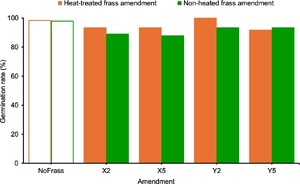
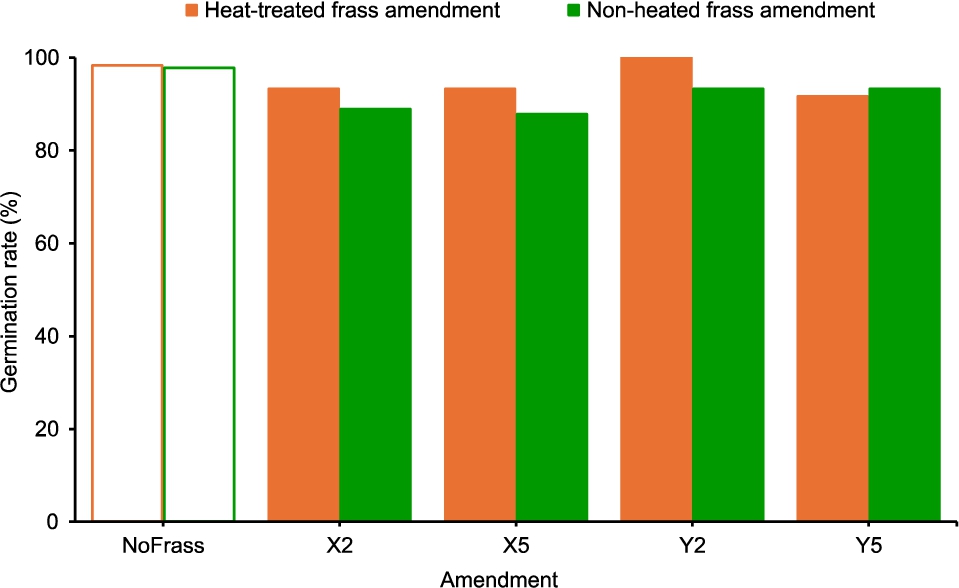
Amending soil with frass did not significantly affect germination of B. rapa seeds (

Germination rate of Brassica rapa seeds exposed to different BSF frass treatments and amendments. NoFrass, no amendment. White bars outlined in orange and green represent control groups without frass, corresponding to the heat-treated and non-heated frass amendments, respectively. X2, X5 and Y2, Y5, amendment with 2 or 5 g frass per kg soil from either source X or Y. Heat-treated frass has been exposed for 1 h to 70 °C, non-heated frass has not been heated. Number of replicate seeds for heat-treated and non-heated frass amendments was 60 and 90, respectively.
Citation: Journal of Insects as Food and Feed 11, 16 (2025) ; 10.1163/23524588-bja10250
Effects of heat-treated and non-heated BSF frass on B. rapa leaf area growth
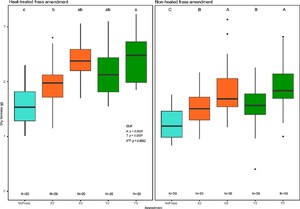
Amending soil with heat-treated BSF frass significantly influenced B. rapa leaf area compared to the non-heated frass (
Leaf area of B. rapa under different soil amendments with heat-treated and non-heated BSF frass. A, soil amendment (NoFrass is control i.e. unamended), amendment with 2 g/kg or 5 g/kg frass from either source X or source Y); T, frass treatment (heat-treated or non-heated). The boxes represent the interquartile ranges (IQR), with the bottom and top edges corresponding to the first quartile (Q1, 25%) and third quartile (Q3, 75%), respectively. The line within the box indicates the median, and the whiskers indicate 1.5 × IQR. The dots represent outliers. Median values within each panel capped with the same letter are not significantly different (
Citation: Journal of Insects as Food and Feed 11, 16 (2025) ; 10.1163/23524588-bja10250
In the heat-treated frass group, there was no significant difference between the 2 g/kg and 5 g/kg soil doses for frass from producer X; however, frass from producer Y applied at 5 g/kg significantly increased leaf area growth compared to the 2 g/kg amendment (Figure S1). Significant effects of dose, with a significant interaction among the dose of frass applied and the source of the frass on the leaf area growth were recorded (Figure S1). In the non-heated-frass group, amending soil with frass at 5 g/kg resulted in bigger leaves than at 2 g/kg for both X and Y-sourced frass (Figure S1).
Effect of heat-treated and non-heated BSF frass on shoot biomass production in B. rapa
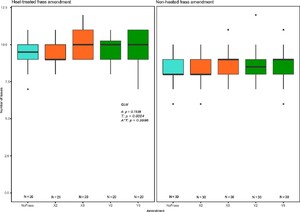
Application of BSF frass enhanced biomass production in B. rapa plants, with both soil amendment and frass treatment showing significant effects (
Biomass production by B. rapa plants grown in unamended soil (NoFrass), soil amended with heat-treated and non-heated BSF frass. A, soil amendment (amendment with 2 g/kg or 5 g/kg frass from either source X or source Y); T, frass treatment (heat-treated or non-heat-treated). The boxes represent the interquartile ranges (IQR), with the bottom and top edges corresponding to the first quartile (Q1, 25%) and third quartile (Q3, 75%), respectively. The line within the box indicates the median, and the whiskers indicate 1.5 × IQR. The dots represent outliers. Median values within each panel capped with different letters differ significantly (
Citation: Journal of Insects as Food and Feed 11, 16 (2025) ; 10.1163/23524588-bja10250
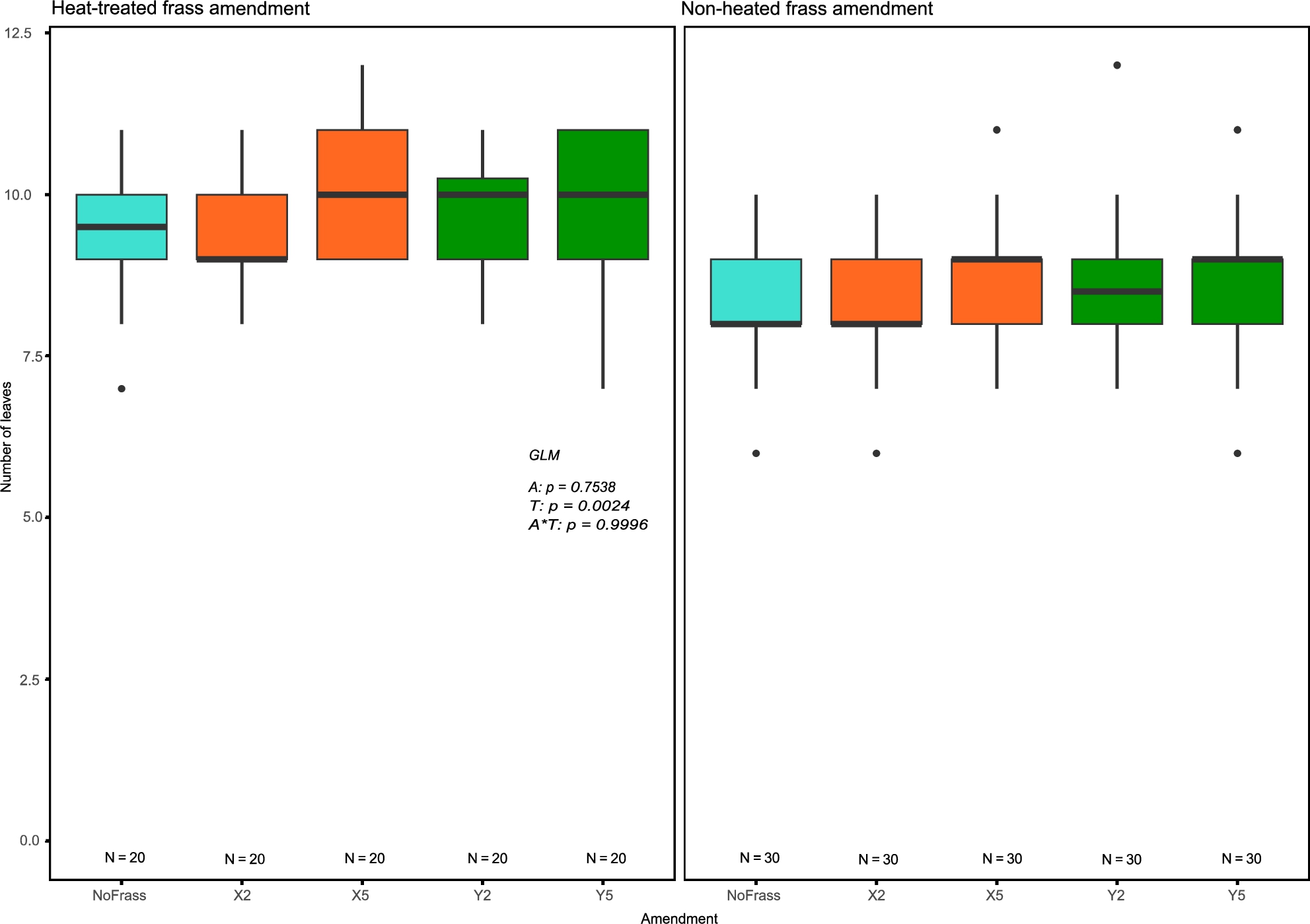
Effect of heat-treated and non-heated BSF frass on leaf number in B. rapa
Amendment with BSF frass did not significantly affect leaf number in B. rapa (
Number of leaves of B. rapa plants grown in unamended soil (NoFrass), soil amended with heat-treated and non-heated BSF frass. A, soil amendment (amendment with 2 g/kg or 5 g/kg frass from either source X or source Y); T, frass treatment (heat-treated or non-heated). The boxes represent the interquartile ranges (IQR), with the bottom and top edges corresponding to the first quartile (Q1, 25%) and third quartile (Q3, 75%), respectively. The line within the box indicates the median, and the whiskers indicate 1.5 × IQR. The dots represent outliers. N indicates the number of replicate plants.
Citation: Journal of Insects as Food and Feed 11, 16 (2025) ; 10.1163/23524588-bja10250
4 Discussion
This study provides compelling evidence that soil amendment with heat-treated BSF frass significantly enhances the growth performance of B. rapa plants. The results affirm the efficacy of heat-treated frass as a potent organic fertiliser and align with the European Commission’s initiative to promote environmentally friendly agricultural practices (Van Looveren et al., 2021; European Commission, 2021). By examining the differential impacts of frass sourced from two producers, frass dose and thermal treatment, our findings offer valuable insights for improving frass application in agriculture.
The germination of B. rapa seeds in soil amended with heat-treated or non-heated frass or in unamended soil in our study did not reveal any significant differences, suggesting that the heat treatment of the frass does not affect the germination capability of the B. rapa seeds. These findings align with studies reporting safe use of BSF frass as an organic amendment with minimal phytotoxic effects. Specifically, BSF frass has been shown to promote high seed germination rates, underscoring its potential benefit for plant growth and development, and highlighting the benign nature of frass as an amendment (Beesigamukama et al., 2022). The relatively high germination rates across treatments in this study indicate that neither heat-treated nor non-heated frass introduced any phytotoxic substances into the soil that adversely affected seed germination. However, other studies have reported that the effects of frass on seed germination can vary significantly depending on the rearing substrate, insect species, and application rate. For instance, Beesigamukama et al. (2022) observed low (23.3%) seed germination rates with frass using non-heated frass from Schistocerca gregaria, while Watson et al. (2021) reported reduced germination and potential salt and ammonia toxicity at higher application levels (such as 3%) using non-heated frass. These contrasting findings, which involved non-heated frass, highlight the relevance of frass source and application rate, and further support the importance of assessing thermal treatment as a strategy to improve the safety and agronomic performance of frass-based soil amendments.
The increase in leaf area and biomass in plants treated with heat-treated frass compared to those with non-heated frass suggests that the heat treatment may enhance nutrient availability or reduce the presence of substances inhibiting plant growth (Xie et al., 2022). The difference in the growth parameters leaf area and dry plant biomass between frass sourced from different producers and heat-treated versus non-heated frass suggests that the original quality and composition of the frass, possibly influenced by the original feed substrate of the BSF larvae or processing method before treatment, influenced its effect as a soil amendment (Amorim et al., 2024). This underscores the potential variation in the nutrient profile and microbial composition of frass depending on the pre-treatment conditions and source, as discussed in other studies (Amorim et al., 2024; Lomonaco et al., 2024).
Higher doses of frass generally promoted greater growth, in line with findings from Beesigamukama et al. (2020a), Nogalska et al. (2023) and Van de Zande et al. (2024). This dose-response relationship suggests that while frass is beneficial, its effects are contingent on the application rate, which must be optimised based on the source and treatment of the frass.
The absence of significant differences in the number of leaves among the treatment groups suggests that while frass amendments can influence overall plant growth, they may not specifically alter developmental patterns such as leaf production. This indicates that the primary influence of frass is nutritional rather than hormonal or developmental. Klammsteiner et al. (2020) described BSF frass as a rapidly acting organic fertiliser. Similarly, Beesigamukama et al. (2020) found that BSF frass enhanced maize yield and nitrogen use efficiency, emphasising its role as a nutrient-rich organic fertiliser.
The primary advantage of heat treatment for insect frass lies in enhancing its microbiological safety, by largely reducing counts of pathogenic microorganisms, while also ensuring compliance with the EU regulation that categorises frass alongside processed manure, necessitating stringent treatment procedures (Regulation (EU) 2021/1925, 2021), thereby facilitating its safe and effective use in sustainable agricultural practices (IPIFF, 2021). This reduction is crucial as it lowers the risk associated with using frass as a soil amendment in agriculture, particularly by mitigating the threat posed by foodborne pathogens that could cause health risks to consumers. Such heat treatment ensures that frass can be safely incorporated into sustainable agricultural practices, promoting waste recycling within a circular economy framework. Notably, some recent studies have demonstrated that thermal treatment effectively reduces counts of pathogenic microorganisms like Salmonella spp. and Clostridium perfringens to undetectable levels, while largely preserving beneficial microbes that enhance soil health (Praeg and Klammsteiner, 2024; Van Looveren et al., 2021). This balance is essential for the safe use of frass as a biofertiliser. Moreover, maintaining microbial diversity is vital for nutrient cycling and soil structure stability (Dai et al., 2024; Ding et al., 2024). While the studies by Praeg and Klammsteiner (2024) and Van Looveren et al. (2021) focus on microbial safety, our results add a practical dimension by exploring how the thermal treatment of BSF frass fertiliser boosts plant growth. Frass amendment has been reported to stimulate the abundance of microbial taxa that are known to promote plant growth (Barragan-Fonseca et al., 2022; Wantulla et al., 2023).
Although our study did not directly measure frass nutrient profiles post-heat-treatment, the preservation of essential nutrients such as nitrogen and phosphorus, reported in previous studies (Beesigamukama et al., 2022; Lomonaco et al., 2024) is inferred in our results through the improved performance of B. rapa plants. The time-temperature combination seems to maintain the nutritional content of BSF frass, ensuring that the essential macro- and micronutrients remain available for plant uptake, which is crucial for plant growth and development (Zewide and Sherefu, 2021). The application of insect frass to soil not only boosts nutrient levels but also contributes significantly to soil health, particularly in terms of organic matter content and carbon sequestration. Klammsteiner et al. (2020) showed that the application of frass significantly increased soil microbial biomass, carbon and enzyme activities, suggesting improved microbial activity and nutrient cycling. Amending soil with frass can increase soil carbon levels, a critical factor in improving soil structure and fertility, especially in regions with depleted organic matter. Ashworth et al. (2025) reported that repeated application of frass over two years in forage production systems significantly increased soil carbon and nitrogen levels, alongside measurable improvements in overall soil fertility. Furthermore, Klammsteiner et al. (2020) also estimated that 56-70% of the carbon in frass remains stable in the soil, contributing to long-term soil carbon sequestration (Klammsteiner et al., 2020). This increase in soil organic carbon is crucial for enhancing the soil’s water retention and nutrient-holding capacity, thereby supporting more robust plant growth (Antoniadis et al., 2023; Dzepe et al., 2022). These findings collectively underscore the potential of insect frass as a nutrient source and as a soil health promoter with both immediate and cumulative agronomic benefits Klammsteiner et al., 2020).
Our results reinforce the view that sustainable waste management practices, such as the conversion of organic residual streams into insect frass and its subsequent sanitization through heat treatment, not only mitigate potential health hazards but also enhance the agronomic value of insect frass as fertiliser. This aligns with the broader goals of sustainable agriculture by reducing reliance on synthetic fertilisers, lowering greenhouse gas emissions, and promoting a circular economy as highlighted in the wider literature (Amorim et al., 2024; Beesigamukama et al., 2022; Chia et al., 2024; Choi and Hassanzadeh, 2019; Dzepe et al., 2022; Klammsteiner et al., 2019; Watson et al., 2021). Our findings provide important support for regulatory frameworks by demonstrating the practical impacts of heat treatment on plant growth performance, beyond microbial safety. This is particularly relevant considering the narrow range of substrates currently allowed for insect rearing under the EU guidelines. This restriction contrasts with the broader spectrum of organic residues that could potentially be utilised for insect production, many of which remain untapped despite their suitability. While large volumes of substrates are required to scale up insect mass production, it is not a question of limited availability but rather of regulatory limitations. Expanding the list of approved substrates would enable the industry to harness these underutilised organic residual streams for insect production.
While heat treatment can effectively sanitise insect frass and ensure effective plant growth, there needs to be consideration for infrastructure that can consistently achieve and maintain the necessary temperature (e.g. 70 °C for 1 h). This can be facilitated through industrial ovens, rotary drum heaters, or conveyor belt systems with built-in heaters. Moreover, accurate temperature controls and monitoring systems are essential to ensure that the frass is uniformly treated.
Building on the findings from this study that demonstrate the positive impact of heat-treated frass on plant growth, several avenues for future research emerge. First, there is a need to optimise heat-treatment parameters such as temperature and duration to maximise nutrient availability and ensure microbial safety effectively. This is crucial because microorganisms typically thrive under specific environmental conditions, including varying temperatures (Nedwell, 2006; Pietikäinen et al., 2005). These optimisations could further refine the effectiveness of frass as a biofertiliser, enhancing both its safety and nutritional contributions to soil health. Second, future research should focus on the long-term effects of heat-treated frass on soil health, specifically examining changes in soil fertility and microbial diversity. Praeg and Klammsteiner (2024) found that heat-treated frass can reactivate and significantly boost soil microbial activity. This will help determine the sustainability and safety of using heat-treated frass in agricultural practices, ensuring that it contributes positively to soil health and plant growth. Additionally, assessing plant response variability across different crop species will help tailor frass application strategies.
Previous research on the economic feasibility of using insect frass in agriculture has demonstrated profitability for farmers and environmental benefits, such as improved soil health and reduced reliance on chemical pesticides. Future research should extend these evaluations to include the economic viability of heat treatment of frass, exploring its potential benefits and practical implementation at a large scale. Evaluating heat treatment against other frass sanitisation methods such as composting could further elucidate its relative benefits and practicalities. Our previous study showed that composting or incubating frass in the soil promoted and enhanced the growth of B. rapa and enhanced its resistance to insect herbivory (Chia et al., 2024). Therefore, exploring the impact of heat treatment of frass on pathogen and pest control within crop systems could provide insights into its broader agricultural applications. Additionally, while our study focused on the growth performance of B. rapa in response to heat-treated BSF frass treatments, future investigations should benefit from integrating plant and soil nutrient analyses to enhance understanding of the mechanisms underlying observed effects. Recent studies have shown that insect frass contains considerable levels of plant-available macronutrients such as nitrogen, phosphorus, and potassium (Amorim et al., 2024; Praeg and Klammsteiner, 2024), which are likely contributors to its fertilisation potential. Integrating such nutrient data would complement plant performance results and further validate the use of frass as a sustainable organic soil amendment.
5 Conclusion
This study underscores the efficacy of heat-treated BSF frass as a sustainable organic fertiliser, which complies with European Commission regulations aimed at fostering sustainable agricultural practices. By employing a specific temperature-time treatment (70 °C for 1 h), we demonstrated that sanitising BSF frass preserves its enhancing effect on vegetative growth of B. rapa. Specifically, the heat treatment improved parameters such as leaf area growth and shoot biomass production without inhibitory effects on seed germination rates, when compared to untreated frass and the unamended controls.
These findings affirm the dual benefits of pathogen reduction and nutrient preservation through thermal processing, confirming its practical applicability and environmental advantages for soil fertilisation. Moreover, our findings advocate the integration of heat-treated frass into soil management practices as a viable method to boost crop productivity and ecological health, aligning with the principles of circular economy. Future research should focus on the long-term effects of heat-treated frass on soil health and plant resilience across diverse agricultural settings. Such studies will help optimise the application of frass and broaden its use in different crop production systems, potentially reducing the reliance on synthetic fertilisers and promoting environmental sustainability. By enhancing our understanding of thermally processed frass and its benefits, we can better support sustainable agricultural practices that contribute to a healthier ecosystem and more robust food systems.
Corresponding author; e-mail: schia@icipe.org
Acknowledgements
We thank two commercial insect production companies based in the Netherlands for providing the black soldier fly frass. This research was funded by the Dutch Research Council, WOTRO Science for Global Development (NWO-WOTRO, project number: 481.20.122).
Conflict of interest
The authors declare no conflict of interest.
References
Agresti, A., 2007. An introduction to categorical data analysis. 2nd ed. Wiley, Hoboken, NJ. https://doi.org/10.1002/0470114754
Amorim, H.C.S., Ashworth, A.J., Arsi, K., Rojas, M.G., Morales-Ramos, J.A., Donoghue, A. and Robinson, K., 2024. Insect frass composition and potential use as an organic fertiliser in circular economies. Journal of Economic Entomology 117: 1261-1268. https://doi.org/10.1093/jee/toad234
Antoniadis, V., Molla, A., Grammenou, A., Apostolidis, V., Athanassiou, C.G., Rumbos, C.I. and Levizou, E., 2023. Insect frass as a novel organic soil fertiliser for the cultivation of spinach (Spinacia oleracea): Effects on soil properties, plant physiological parameters, and nutrient status. Journal of Soil Science and Plant Nutrition 23: 5935-5944. https://doi.org/10.1007/s42729-023-01451-9
Anyega, A.O., Korir, N.K., Beesigamukama, D., Changeh, G.J., Nkoba, K., Subramanian, S., Van Loon, J.J.A., Dicke, M. and Tanga, C.M., 2021. Black soldier fly-composted organic fertiliser enhances growth, yield, and nutrient quality of three key vegetable crops in Sub-Saharan Africa. Frontiers in Plant Science 12: 680312. https://doi.org/10.3389/fpls.2021.680312
Ashworth, A.J., Amorim, H.C.S., Drescher, G.L., Moore Jr, P.A., Rojas, M.G., Morales-Ramos, J. and Donoghue, A.M., 2025. Insect frass fertiliser as soil amendment for improved forage and soil health in circular systems. Scientific Reports 15: 3024. https://doi.org/10.1038/s41598-025-87075-8
Barragán-Fonseca, K.Y., Nurfikari, A., Van de Zande, E.M., Wantulla, M., Van Loon, J.J.A., De Boer, W. and Dicke, M., 2022. Insect frass and exuviae to promote plant growth and health. Trends in Plant Science 27: 646-654. https://doi.org/10.1016/j.tplants.2022.01.007
Beesigamukama, D., Mochoge, B., Korir, N.K., Fiaboe, K.K.M., Nakimbugwe, D., Khamis, F.M., Subramanian, S., Dubois, T., Musyoka, M.W. and Ekesi, S., 2020a. Exploring black soldier fly frass as novel fertiliser for improved growth, yield, and nitrogen use efficiency of maize under field conditions. Frontiers in Plant Science 11: 574592. https://doi.org/10.3389/fpls.2020.574592
Beesigamukama, D., Mochoge, B., Korir, N., Musyoka, M.W., Fiaboe, K.K.M., Nakimbugwe, D., Khamis, F.M., Subramanian, S., Dubois, T. and Ekesi, S., 2020b. Nitrogen fertiliser equivalence of black soldier fly frass fertiliser and synchrony of nitrogen mineralisation for maize production. Agronomy 10: 1395. https://doi.org/10.3390/agronomy10091395
Beesigamukama, D., Subramanian, S. and Tanga, C.M., 2022. Nutrient quality and maturity status of frass fertiliser from nine edible insects. Scientific Reports 12: 7182. https://doi.org/10.1038/s41598-022-11336-z
Beesigamukama, D., Tanga, C.M., Sevgan, S., Ekesi, S. and Kelemu, S., 2023. Waste-to-value: Global perspective on the impact of entomocomposting on environmental health, greenhouse gas mitigation and soil bioremediation. Science of the Total Environment 902: 166067. https://doi.org/10.1016/j.scitotenv.2023.166067
Chia, S.Y., Van Loon, J.J.A. and Dicke, M., 2024. Effects of frass from larvae of black soldier fly (Hermetia illucens) and yellow mealworm (Tenebrio molitor) on growth and insect resistance in field mustard (Brassica rapa): differences between insect species and frass treatments. Entomologia Experimentalis et Applicata 172: 394-408. https://doi.org/10.1111/EEA.13425
Chia, S.Y., Tanga, C.M., Osuga, I.M., Cheseto, X., Ekesi, S., Dicke, M. and Van Loon, J.J.A., 2020. Nutritional composition of black soldier fly larvae feeding on agro-industrial by-products. Entomologia Experimentalis et Applicata 168: 472-481. https://doi.org/10.1111/eea.12940
Choi, S. and Hassanzadeh, N., 2019. BSFL Frass: a novel biofertiliser for improving plant health while minimizing environmental impact. Canadian Science Fair Journal 2: 41-46. Available online at https://csfjournal.com/s/Sarah-and-Neelah-mjep.pdf
Dai, Z., Zhang, N., Wang, F., Li, Y., Peng, J., Xiang, T., Zhao, X., Yang, S. and Cao, W., 2024. Loss of microbial functional diversity following Spartina alterniflora invasion reduces the potential of carbon sequestration and nitrogen removal in mangrove sediments – from a gene perspective. Journal of Environmental Management 365: 121569. https://doi.org/10.1016/j.jenvman.2024.121569
Ding, Y., Gao, X., Shu, D., Siddique, K.H.M., Song, X., Wu, P., Li, C. and Zhao, X., 2024. Enhancing soil health and nutrient cycling through soil amendments: Improving the synergy of bacteria and fungi. Science of The Total Environment 923: 171332. https://doi.org/10.1016/J.SCITOTENV.2024.171332
Dzepe, D., Mbenda, T.K., Ngassa, G., Mube, H., Chia, S.Y., Aoudou, Y. and Djouaka, R., 2022. Application of black soldier fly frass, Hermetia illucens (Diptera: Stratiomyidae) as sustainable organic fertiliser for lettuce, Lactuca sativa production. Open Journal of Applied Sciences 12: 1632-1648. https://doi.org/10.4236/OJAPPS.2022.1210111
European Commission, 2021. Commission regulation (EU) 2021/1925 of 5 November 2021 amending certain Annexes to Regulation (EU) No 142/2011 as regards the requirements for placing on the market of certain insect products and the adaptation of a containment method. Official Journal of the European Union: 50. Available online at https://ipiff.org/press-statement-ipiff-welcomes-the-entry-into-force-of-the-commission-regulation-eu-2021-1925-which-included-a-definition-for-frass-derived-from-farmed-insects/
Houben, D., Daoulas, G., Faucon, M.P. and Dulaurent, A.M., 2020. Potential use of mealworm frass as a fertiliser: Impact on crop growth and soil properties. Scientific Reports 10: 4659. https://doi.org/10.1038/S41598-020-61765-X
Klammsteiner, T., Turan, V., Oberegger, S., Insam, H. and Juárez, M.F.-D., 2019. Black soldier fly (Hermetia illucens) frass as plant fertiliser. 7th International Conference on Sustainable Solid Waste Management. June 26-29, 2019, Heraklion, Crete.
Klammsteiner, T., Turan, V., Fernández-Delgado Juárez, M., Oberegger, S. and Insam, H., 2020. Suitability of black soldier fly frass as soil amendment and implication for organic waste hygienisation. Agronomy 10: 1578. https://doi.org/10.3390/agronomy10101578
Lomonaco, G., Franco, A., De Smet, J., Scieuzo, C., Salvia, R. and Falabella, P., 2024. Larval frass of Hermetia illucens as organic fertiliser: Composition and beneficial effects on different crops. Insects 15: 293. https://doi.org/10.3390/INSECTS15040293
Nedwell, D.B., 2006. Effect of low temperature on microbial growth: lowered affinity for substrates limits growth at low temperature. FEMS Microbiology Ecology 30: 101-111. https://doi.org/10.1111/j.1574-6941.1999.tb00639.x
Niyonsaba, H.H., Hohler, J., Kooistra, J., van der Fels-Klerx, H.J. and Meuwissen, M.P.M., 2021. Profitability of insect farms. Journal of Insects as Food and Feed 7: 923-934. https://doi.org/10.3920/JIFF2020.0087
Nogalska, A., Przemieniecki, S.W., Krzebietke, S.J., Załuski, D., Kosewska, A., Skwierawska, M. and Sienkiewicz, S., 2023. The effect of mealworm frass on the chemical and microbiological properties of horticultural peat in an incubation experiment. International Journal of Environmental Research and Public Health 20: 21. https://doi.org/10.3390/ijerph20010021
Pietikäinen, J., Pettersson, M. and Bååth, E., 2005. Comparison of temperature effects on soil respiration and bacterial and fungal growth rates. FEMS Microbiology Ecology 52: 49-58. https://doi.org/10.1016/j.femsec.2004.10.002
Poveda, J., 2021. Insect frass in the development of sustainable agriculture. A review. Agronomy for Sustainable Development 41: 1-10. https://doi.org/10.1007/s13593-020-00656-x
Praeg, N. and Klammsteiner, T., 2024. Primary study on frass fertilisers from mass-reared insects: Species variation, heat treatment effects and implications for soil application at laboratory scale. Journal of Environmental Management 356: 120622. https://doi.org/10.1016/J.JENVMAN.2024.120622
Pretty, J., Benton, T.G., Bharucha, Z.P., Dicks, L.V., Flora, C.B., Godfray, H.C.J., Goulson, D., Hartley, S., Lampkin, N., Morris, C., Pierzynski, G., Prasad, P.V.V., Reganold, J., Rockström, J., Smith, P., Thorne, P. and Wratten, S., 2018. Global assessment of agricultural system redesign for sustainable intensification. Nature Sustainability 1: 441-446. https://doi.org/10.1038/s41893-018-0114-0
Ray, S., Alves, P.C.M.S., Ahmad, I., Gaffoor, I., Acevedo, F.E., Peiffer, M., Jin, S., Han, Y., Shakee, S., Felton, G.W. and Luthe, D.S., 2016. Turnabout is fair play: herbivory-induced plant chitinases excreted in fall armyworm frass suppress herbivore defenses in maize. Plant Physiology 171: 694. https://doi.org/10.1104/PP.15.01854
Torgerson, K.L., Meijering, J., Sok, J., Dicke, M. and Oude Lansink, A., 2021. Towards circular agriculture – exploring insect waste streams as a crop and soil health promoter. Journal of Insects as Food and Feed 7: 357-368. https://doi.org/10.3920/JIFF2020.0095
Van de Zande, E.M., Wantulla, M., Van Loon, J.J.A. and Dicke, M., 2024. Soil amendment with insect frass and exuviae affects rhizosphere bacterial community, shoot growth and carbon/nitrogen ratio of a brassicaceous plant. Plant and Soil 495: 631-648. https://doi.org/10.1007/s11104-023-06351-6
van Huis, A., Van Itterbeeck, J., Klunder, H., Mertens, E., Halloran, A., Muir, G. and Vantomme, P., 2013. Edible insects. Future prospects for food and feed security. FAO Forestry Paper 171. FAO, Rome. Available online at https://www.fao.org/4/i3253e/i3253e.pdf
Van Looveren, N., Vandeweyer, D. and Van Campenhout, L., 2021. Impact of heat treatment on the microbiological quality of frass originating from black soldier fly larvae (Hermetia illucens). Insects 13: 22. https://doi.org/10.3390/INSECTS13010022
Wantulla, M., van Zadelhoff, K., Van Loon, J.J.A. and Dicke, M., 2023. The potential of soil amendment with insect exuviae and frass to control the cabbage root fly. Journal of Applied Entomology 147: 181-191. https://doi.org/10.1111/jen.13097
Watson, C., Schlösser, C., Vögerl, J. and Wichern, F., 2021. Excellent excrement? Frass impacts on a soil’s microbial community, processes and metal bioavailability. Applied Soil Ecology 168: 104110. https://doi.org/10.1016/j.apsoil.2021.104110
Xie, S., Zhang, T., Mishra, A., Tiwari, A. and Bolan, N.S., 2022. Assessment of catalytic thermal hydrolysis of swine manure slurry as liquid fertiliser: insights into nutrients and metals. Frontiers in Environmental Science 10: 1005290. https://doi.org/10.3389/fenvs.2022.1005290
Zewide, I. and Sherefu, A., 2021. Review paper on effect of micronutrients for crop production. Journal of Nutrition and Food Processing 4: 63. https://doi.org/10.31579/2637-8914/063