Abstract
The consumption of edible Coleoptera, or beetles, is examined in this review as a viable remedy for the rising world food demand brought on by the populationâs predicted expansion to over 9 billion by 2050. The review illustrates the nutritional profile of beetles, highlighting their high protein content, good fats, and oils, while being low in saturated fats and high in omega-3. Beetles have a rich history of consumption, with over 2 billion people, particularly in regions like Africa, Asia, and the Americas, incorporating them into their diets. They contribute significantly to human nutrition while also playing essential ecological roles, including soil fertilization and pollination. Beetles represent a promising solution to combat climate change, as traditional livestock production is a major greenhouse gas emitter, and beetle farming boasts lower emissions, reduced resource requirements, shorter life cycles, and superior feed conversion rates. Notwithstanding their advantages in terms of nutrition and the environment, there are obstacles including customer adoption, safety worries, and legal limitations. The review also covers how beetles are processed into different food items, such as liquids, pastes, and powders, and how these products are used in the feed, food, and nutraceutical industries. In general, edible beetles present a viable substitute food source with noteworthy nutritional and ecological benefits; yet, additional investigation and endeavors are required to surmount obstacles to their extensive integration.

Citation: Journal of Insects as Food and Feed 11, 16 (2025) ; 10.1163/23524588-00001095
1 Introduction
Especially in parts of the world where insects are estimated to be present in the diet of around 2 billion people (Africa, Asia, and America) (Raheem et al., 2019a). Approximately 31% of the edible insect species consumed in the world are Coleoptera species, namely beetles (Papastavropoulou et al., 2023). In addition to human nutrition, insects also play a role in maintaining ecological balance such as fertilization of soil through the recycling of biological wastes, carrying pollen for plant propagation, etc. (van Huis et al., 2013). They offer a potential answer to the urgent issue of climate change, as conventional livestock production is a significant contributor to greenhouse gas (GHG) emissions. To mitigate this, edible insect farming is characterized by lower GHG impacts, reduced area and water use, shorter lifespans, and higher feed convertibility rates compared to conventional livestock (Park et al., 2022). In addition, throughout history, humans have consumed edible insects for both nourishment and medicinal purposes or to produce honey and silk to produce products which are useful for humans. Nowadays, these insects are gaining recognition as a promising alternative food source, offering both nutritional and therapeutic advantages. The insect food industry is rapidly progressing, introducing innovative products like powders, liquids, and oils for various uses (Dossey et al., 2016a; van Huis et al., 2021a). Insects also hold the promise of serving as a viable replacement for traditional sources of animal protein, such as cattle, pork, and poultry, and may become a fundamental element of tomorrowâs food products (Rovai et al., 2021; Krongdang et al., 2023). Insects are becoming a more popular source of protein, and the industry is expected to expand to US $8 billion over the next ten years. Insects can be processed to provide flours, powders, and protein hydrolysates. Harvesting, initial processing, decontamination, further processing, packing, and storage are all steps in the processing process. For disinfection, a variety of methods are employed, including toasting, drying, blanching, frying, marinating, and smoking. Additionally, novel methods like ultrasonic therapy and cold plasma are being investigated. The procedure seeks to satisfy customer needs, maintain quality standards, and guarantee food safety. Optimal storage settings are recommended to preserve microbiological quality, and these parameters vary based on the kind of beetle and product shape (AdaÌmkovaÌ et al., 2017, Melgar-Lalanne et al., 2019; Liceaga, 2022). Depending on the species, regional customs, and season, there are several methods for gathering and raising edible coleoptera. Using emergence or elector traps, window traps, and trunk window traps are a few popular techniques for collecting beetles. In addition, beetles can be physically gathered by entomological filtration, from their hiding places or the soilâs surface, or at night from an artificial light source. The unique requirements of the species, such as the kind of food they consume and the temperature they require to thrive, must be considered during raising (Gobbi et al., 2018).
Apart from their efficient production, insects are highly nutritious, and renowned for their rich protein content. They also contain significant levels of healthy fats and oils while being low in unhealthy components, specifically low in saturated fat and high in omega-3. Furthermore, insects offer a range of valuable nutrients, the exact composition varying by species and, in some instances, their diet. Insect-derived food ingredients, including powders, meals, pastes and liquids, have diverse use in the food, feed and nutraceutical sectors. These ingredients are incorporated into fortified dry products, protein supplements, high-protein cereals, meat alternatives, chitosan (a chitin-derived nutraceutical), protein-rich beverages, athlete supplements, and various snacks. like energy bars, burgers, or compound feed. In many tropical countries, insects are traditionally prepared by roasting, frying, or boiling them as a whole. Alternatively, they can be dried, ground, and incorporated into various food products (Pippinato et al., 2020; Daub and Gerhard, 2022; Mancini et al., 2022).
Insects are recognized as a valuable, nutritious, and sustainable food source, with a growing number of stakeholders, including consumers, businesses, startups, educational institutions, governments, and others, actively participating in the emerging insect-based food industry. Media coverage of this expanding sector has also significantly increased in recent years (Dossey et al., 2016a). There are more than 2,000 species of edible insects in use around the world. The Coleoptera are the most commonly eaten group with 31.2% of total. Food quality index shows that Coleoptera are a well-balanced food source. Coleoptera can therefore be widely used in the food industry. They can be used as a dietary supplement, especially in the case of a vegetable diet on the basis of cereal proteins that are poor in essential amino acids. They can also be used in high protein food products (Orkusz, 2021). In view of these and many other reasons (detailed explained below), Coleoptera should be well marketed as a valuable natural resource that can be used both directly and/or indirectly in food products by exploiting their rich nutritional content and should be made widely available to mankind.
With nearly 9 billion people anticipated to live on the planet by 2050, food production must grow by 100%. However, because of things like global warming, there is less land available for agriculture, which might make food insecurity worse, especially in low-income countries. Rich in protein, vitamins, and minerals, edible insects are considered a great dietary source to combat food instability and malnutrition. Creating industries that produce insects might aid in enhancing socioeconomic circumstances and global food access. Insects may be widely used as food, but obstacles including consumer acceptability, safety worries, and regulatory restrictions still stand in the way (Rothman et al., 2014; Belluco et al., 2015; Moruzzo et al., 2021).
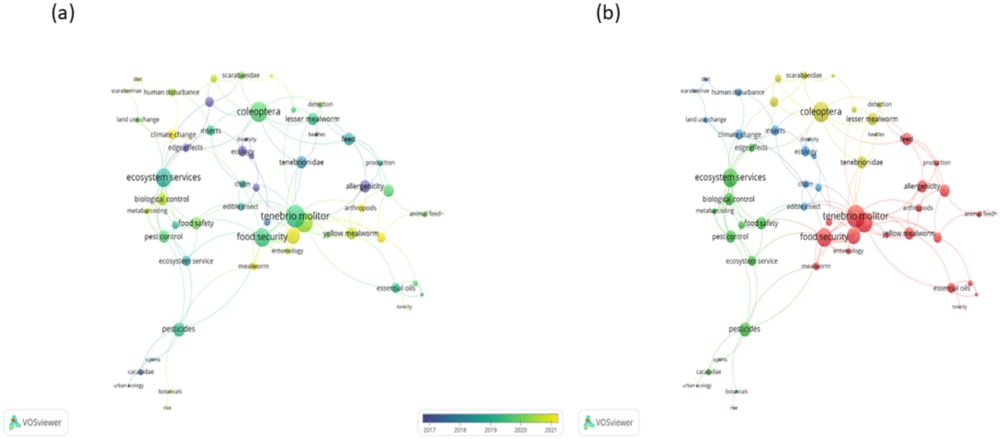
Bibliometric (a) overlay visualization of the researches on Coleoptera as a human food, showing a time period of the occurrence of the keyword from 2017 (blue) to 2023 (yellow), (b) network map of the research on Coleoptera as food for human beings shows the degree of relatedness of the scientific journals. This illustration was generated using VOSviewer (Jan van Eck and Waltman, 2023).
Citation: Journal of Insects as Food and Feed 11, 16 (2025) ; 10.1163/23524588-00001095
In addition, overlay and network visualization diagrams were prepared based on the terms âColeopteraâ, âhumanâ and âfoodâ. The data was extracted from databases of Web of Science Core Collection and Scopus between the years of 2013-2023. In Figure 1a,b, the largest circular areas represent the most widely chosen terms by the authors. Based on this bibliometric mapping, it was possible to classify the terms into four different sets represented by four different colors. The different colors represent the clusters formed by the keywords. The minimum number of keyword occurrences is set to 9. 57 keywords met the limit. The relevancy rating was calculated for 57 keywords. Thus, 57 keywords were chosen to illustrate the connection between source titles and keywords.
This comprehensive review explores the consumption of edible Coleoptera (beetles) as a source of human food. It covers a wide range of topics, including records of beetle consumption, nutritional value (macronutrients and micronutrients) and nutraceutical properties. The review also discusses safety concerns, consumer acceptance, culinary uses, and preparation methods for edible beetles. It explores the environmental benefits of beetle consumption and examines cultural attitudes toward beetles as food in different regions. Additionally, the review delves into the harvesting, rearing, processing, and packaging of edible beetles and considers their potential as a sustainable protein source. It concludes by discussing future prospects, research areas, market potential, and offering overall perspectives on this topic.
2 Records of consumption of edible Coleoptera
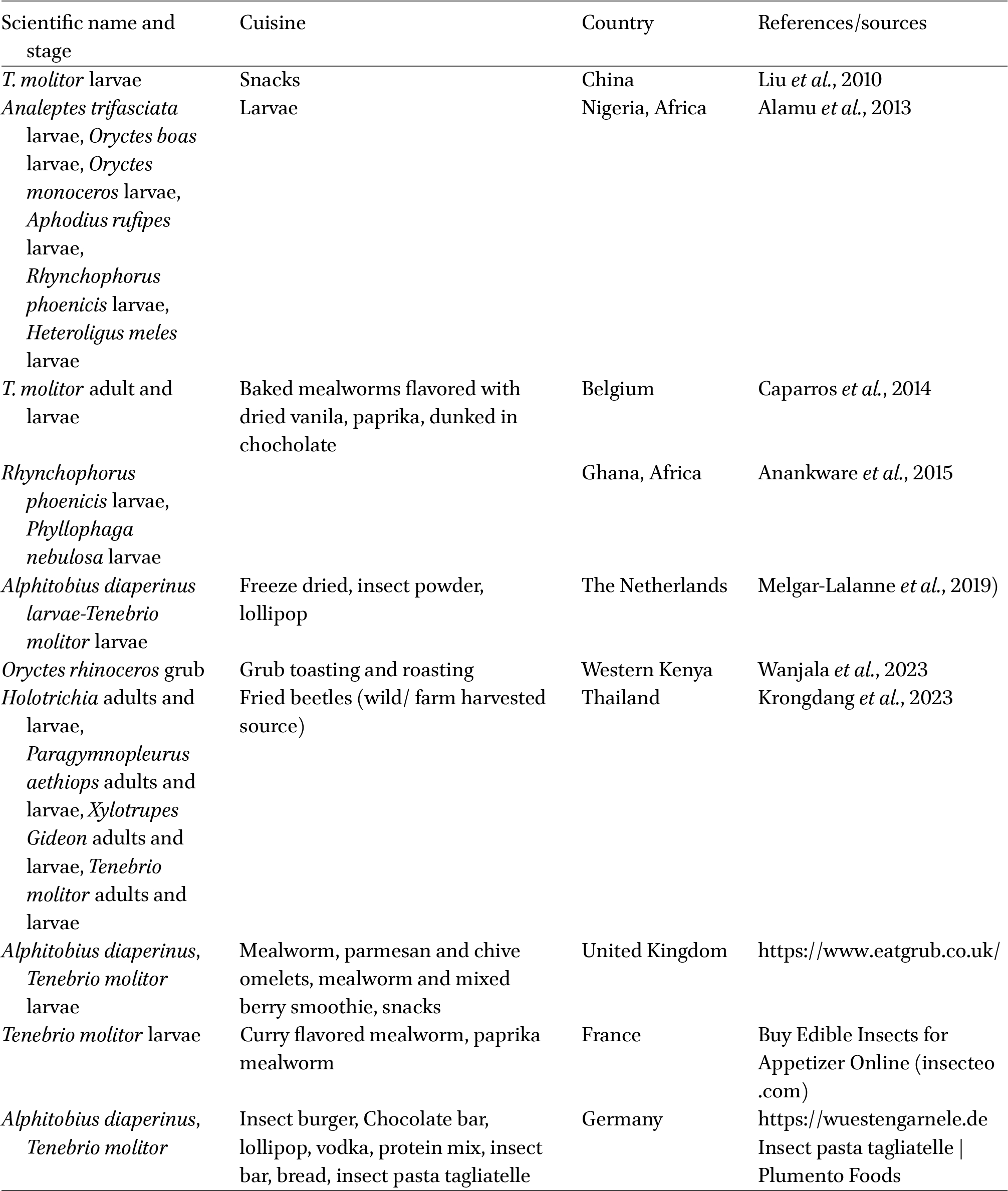
According to the edible insects list of the world, there are more than 700 species belong to Coleoptera order (Jongema, 2017). In Supplementary Table S1, all edible Coleoptera species with their common names, consumption stages (larva, pupa or adult) and countries are given. For consumers, the biggest factor in incorporating edible insects into their diets is that they taste, smell and, if possible, look very similar to conventional foods (Kim et al., 2019). Although there are many people in the world who consume insects unprocessed, for the majority the appearance of insects prevents them from being included in their daily diet (Kim et al., 2022). Today, many companies produce snack bars, insect-based flour, granules and pastes that include edible insects (Gmuer et al., 2016). Also, some upscale restaurants are trying to familiarize the public with edible insects by including them in their menus. There are restaurants in Denmark, Sweden, Finland and the United Kingdom that combine insects with gastronomy (Jansson et al., 2019). In the last couple of years, insect cooking books, television shows, food fairs, and trade shows have attempted to regularize entomophagy, in contrast to earlier strategies that were based on advertising the novelty of products (Shelomi, 2015).
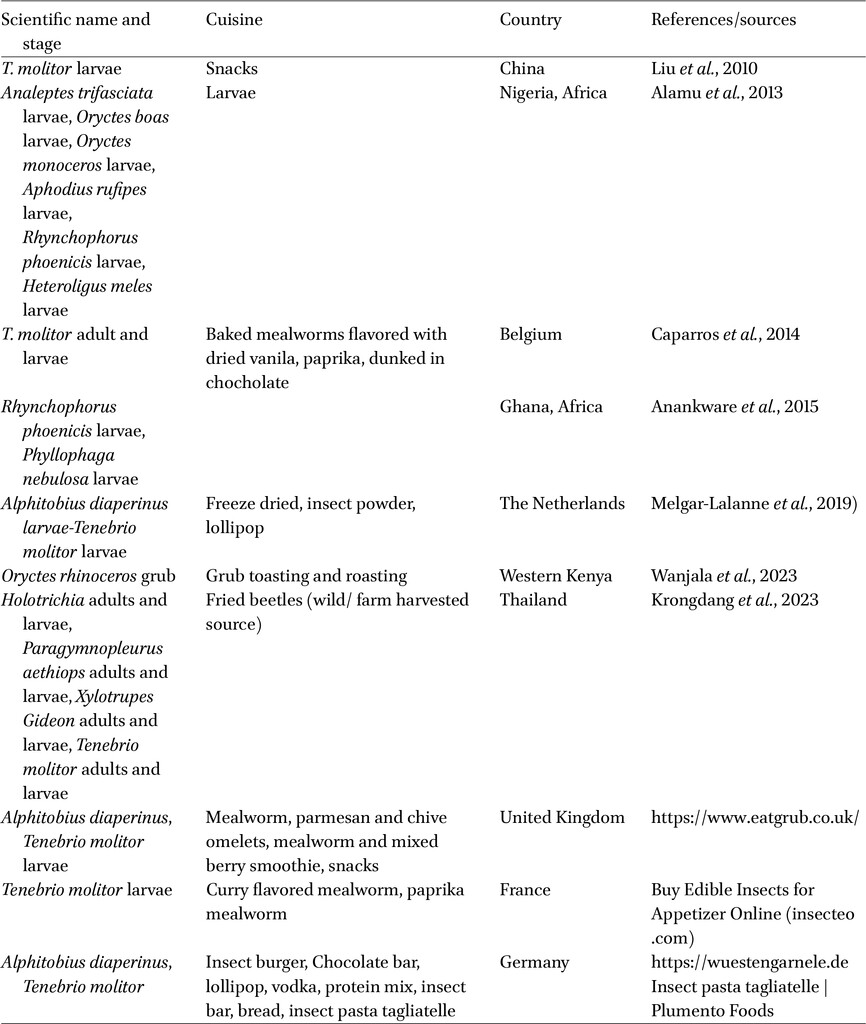
Steaming, roasting, smoking, frying, stewing, and curing are some of the traditional cooking techniques for edible insects (Hong et al., 2018; Melgar-Lalanne et al., 2019; Ojha et al., 2021a). Blanching to reduce the number of food-borne microorganisms and to inactivate enzymes is used prior to these cooking techniques (Marshall et al., 2016). For example, African palm weevil (Rhynchophorus phoenicis Fabricius, 1801)âs larva is roasted in a pan after cleansing and perforating with a sharp knife. Condiments such as tomato, chili, onions are added and after simmering of all ingredients, it is served with rice or pasta which is generally made from corn flour (van Huis, 2003). Edible insects are often promoted as snacks and can be coated with chocolate such as nuts, mixed into baked goods or sprinkled on salads. Weevils of Polyclaeis equestris Boheman and Polyclaeis plumbeus GueÌrin can be consumed after barbecued, roasted or boiled (van Huis, 2003). Moreover, larva of rhinoceros beetles (Oryctes sp.) is parboiled, then fried and served as a meat dish with tomato or other kind of sauce (DeFoliart, 2002). Whether lightly processed, fried, roasted, or fine-ground, they are used to add a unique flavor to foods or to enhance the nutritional profile of foods. Larva of Caryobruchus sp. (palm seed bruchid) is used as an ingredient of the bean flour (Costa Neto and Ramos-Elorduy, 2006). Additionally, in Thailand at least 194 species of edible insects are found (Durst and Hanboonsong, 2015; Köhler et al., 2019; Krongdang et al., 2023). The cooking method varies according to the type of insect such as fried locusts, roasted beetles and crickets. Insects can also be added to salads and chili paste (Krongdang et al., 2023). Food raw material manufacturers produce ingredients such as insect flours. This enables their business partners to produce pasta, ramen noodles, bakery products or protein powder additives for both the global and domestic markets (Raheem et al., 2019a; Krongdang et al., 2023).
Tenebrio molitor (T. molitor) belonging to the Coleoptera:Tenebrioidae family, which has been extensively studied in academia and is commercially produced as bird, reptile and fish feed because it is easy to produce its larva, is a pest especially of stored grain. They usually feed and develop in grains such as wheat flour, corn flour, cake mixtures, cereals, meat residues, and chicken coop residues, which are ground or about to rot in damp and poor conditions (Riaz et al., 2023). Commercially produced and widely consumed in Asian and European countries, mealworms are rich in protein, fat and minerals such as calcium and phosphorus. It contains all amino acids, especially as a protein source (Anusha and Negi, 2023a). T. molitor larva is currently used in the production of protein extracts, oils and flour. Regulation 2015/2283 of the European Union allows the use of this protein source as an innovative food in the production of pasta, biscuits and snack bars (EFSA Scientific Committee, 2015; Turck et al., 2021; Errico et al., 2022). In the study of Djouadi et al. (2022), from 2 to 20% (w/w) of T. molitor flour was added to formulation to produce protein-rich healthy crackers. In terms of sensory properties, panelists liked the crackers with 6% insect meal added. Although there was a decrease in firmness values as the amount of insect meal increased, the crispness value increased due to the increase in the amount of protein. In addition, the brightness values of the crackers decreased depending on the amount of insect flour. In another study, wheat flour and mealworm flour were replaced at different rates in the shortcake biscuit formulations. While an increase was observed in the amount of protein and ash contents with the increase in the amount of mealworm flour, no significant change was observed in the fat and energy values. It was determined that there was an increase in the free radical scavenging activity and the amount of slowly digested starch compared to the control product (ZielinÌska and Pankiewicz, 2020). Three different kinds of insectsâ flour (Hermetica illucens, Acheta domestica and T. molitor) were substituted at 5% of wheat flour in bread doughs in the study of GonzaÌlez et al. (2019). Rheological properties such as water absorption and stability were negatively affected by the addition of insect flour. Moreover, the nutritional value of breads was increased by the incorporation of insectsâ flour. In another study, palm weevil larvae meal and orange-fleshed sweet potato flour were mixed in three different ratios (0, 35 and 70%) and used in biscuit production. It has the highest value in terms of energy value and fat content of biscuits containing 70% of larva flour. In addition, the amount of palm weevil larvae flour and the amount of calcium, iron and zinc increased in direct proportion. Also, the overall acceptability of biscuits was found to be high by pregnant women in Ghana (Ayensu et al., 2019).
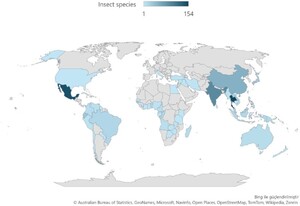
Insects have had a long relationship with humankind, serving as a source of cultural, religious, and economic insight. However, their value as a nutrition source has been crucial to human history, as humans have consumed insects continuously since pre-agricultural times (Jansson et al., 2019). At least two billion people are thought to include edible insects in their diets, and there are currently more than 2,100 insect species recognized as edible worldwide. Beetles are among the most widely consumed insects in the world (Jongema, 2017). In Figure 2, edible Coleoptera species are illustrated in world heat map. The increasing blueness is in relation with the high quantity of species. According to Jongemaâs list (2017) of the edible insects in the world, the most species are found in Thailand, Mexico, India, China, and Ecuador, respectively.
Number indication of edible Coleoptera species through Heat-map. The blueness depth responses to the number of edible Coleoptera species in each country.
Citation: Journal of Insects as Food and Feed 11, 16 (2025) ; 10.1163/23524588-00001095
3 Bioecology of Coleoptera
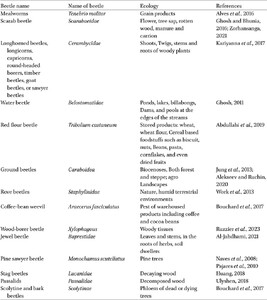
It has been recorded that Coleoptera reached its diversity approximately 155-160 million years ago. Due to the multitude of insect species, identifying a new species is complicated. There has been a dramatic growth of interest in the biology, ecology, and diversity of this group because of several reasons: (1) their importance in altering the land-based environment of an ecosystem; (2) Growing recognition of their economic importance; (3) their important role in forest disturbance, forest biodiversity and organic material degradation; and (4) Their important function in the different food chains, as their larva and hatchlings are a part of the diet of some insect-eating birds (Kritika and Jaimala, 2017). One of the most studied edible Coleoptera is T. Molitor L., a yellow worm larva, which is about 2.5-3.5 cm long and weighs 0.2 g. It is known as a pest of uncontrolled stored grain products and is harvested and consumed in Africa, Australia, and Asia. According to the information reported in the literature, 50% of the grains are lost when infested by worms (Table 1) (Alves et al., 2016; Feng, 2018). The species lays eggs between 4-17 days after mating. A female worm can produce about 500 eggs. Embryonic development of eggs can be increased if the temperature is increased between 25-27 °C. However, this period lasts usually between 4-6 days (Alves et al., 2016). Then the larva is formed, and the larval period lasts about 3 months. During this period, insects can be collected and processed. Larva that are not collected enter the pupal stage and this period until adulthood lasts 5-6 days (Feng, 2018).
Ecology of most consumed Coleoptera species
Citation: Journal of Insects as Food and Feed 11, 16 (2025) ; 10.1163/23524588-00001095
Furthermore, Scarab beetles can be small or large in size. The shape of the antennas makes them easy to identify. The scarab family is harmful to agriculture, forestry and some fruit trees, but feeds on manure and carrion. The properties benefit by reducing parasitic worms and flies in fertilizers (Zorhansanga, 2021). Scarab beetles are an indicator of whether the surrounding ecosystem has changed. The larval form of insects feed on plant roots and rotten wood. Adults feed on flowers, fruits, leaves and tree sap (Ghosh and Bhunia, 2016). Dung beetles make up about 70 percent of the insect population in Africa. They settle in tunnels up to 1Â m deep under dung piles. They use the dung as a feeding and breeding medium. They use dung fluids, or dung, to feed the larvae. Larvae remain in the soil for weeks or months before emerging as adults (Brown et al., 2010).
On the other hand, Cerambycids vary in size from 2.5Â mm to 17Â cm. It can be in different colors, sizes and decorations. Some longhorn breeds have been reported to range in length from 3.5Â mm to about 12Â cm. They are named longhorn because of the long antennae found in the males. While the adults feed by taking nectar or pollen from the flowers, the larvae and pupae feed on the bark of the trees. They mate on flowers or other host plants. Mating ranges from a few seconds to several hours. A female can produce 25-100 eggs in her lifetime. Larvae hatch in 1-3 weeks. The larval period can vary between 1 and 3 years. Larvae usually live in a tunnel they create behind wood dust. Pupal periods range from 1 week to 1 month. According to the breed, the seasons for adults to exit out are different (Kariyanna et al., 2017). Rove beetles are insects found in humid terrestrial environments and are common in nature. It is also important in controlling arthropods such as some plant pests (Work et al., 2013). Adult females lay about 8 eggs a day after maturation, which develop into creamy white larvae in 3-4 days. The larvae live in similar environments but are rarely seen. Some species show parental care to the larvae. In general, it is an agile insect with well-developed wings (Pohl et al., 2008). Although jewel beetles live in tropical regions, they are easily recognized by their bright metallic coloration. Many of these species attack dead trees and use the remains, thus ensuring the decomposition of dead wood. They contribute to ecology with this behavior (Evans et al., 2007; Al-Jahdhami, 2021). Moreover, pine sawyer beetles are a wood-boring insect. It is widely distributed in North Africa and Europe. It got its name from the fact that it generally colonizes in pine trees. The eggs hatch into larvae inside the shell. Then they enter the heartwood part and become pupae. Young adults feed on pine sprout bark. While they require 2 years in northern latitudes, they complete their life cycle in 1 year in Southern Europe (Naves et al., 2008; Pajares et al., 2010). Naves et al. (2008) reported that the sizes of adult insects vary depending on the region of the tree. For example, they noted small insects (about 2.2Â cm) on the upper branches of the tree and larger insects (about 20.6Â cm) on the trunk bolts. Lucanidae beetles (stag beetles) live in decaying wood and feed on cellulosic material. When females find a suitable log to lay eggs, they decide the number of eggs according to the quality of the log. If there are no different species (termites or insects) in the log, it is a potential habitat as a moist and soft area. Larvae usually develop in 3 stages. While the first 2 stages take place within 2-4 weeks, the 3rd period varies between 6 months and 2 years according to the temperatures (Huang, 2018).
Passalidae beetles live in tunnels they dig into moderately rotten wood and are a family of shiny black scarabs ranging from 1-8Â cm in length. The length of the tunnels can exceed one meter. The female or male initiates these tunnels, and then the opposite sex joins them. After mating occurs in the tunnels they dig, the eggs are laid in a nest made of thinly chewed trees. The larvae eat this chewed wood. Adults provide protection to the larvae until they reach the pupa stage. Their transition to adulthood takes weeks or months until they turn red brown to black. Sexually mature adults dig tunnels dug by their parents or migrate to form a different colony. Some species migrate by flying, some by walking (Ulyshen, 2018). Furthermore, the beetles of the Buprestidae family are characterized by a short, upturned head and biting mouthparts, often with oval or elliptical eyes that may protrude slightly beyond the outline of the head. These beetles have medium length antennae and are known for their elytra, which cover the abdomen and have either longitudinal grooves, rows of punctures, or keels. Buprestid larvae are segmented, flattened from top to bottom, and mostly glabrous with an enlarged thoracic area. They can be classified into several morpho-ecological types. Buprestids are often tree-oriented, relying on either weakened or healthy trees as their habitat. During periods of robust tree growth, the larvae may be hindered by tree defenses such as callus formation. However, when trees die, the phloem and xylem remain suitable for larval development for a limited period. The typical life cycle of buprestids is usually one, occasionally two, years. Adult beetles emerge in the spring, leaving distinct D-shaped exit holes in the bark of tree trunks and branches. Adults initially feed on foliage, pollen or nectar before females lay eggs either on the surface of the bark or in crevices. Following hatching, the nymphs move to the phloem where they feed and go through several phases of development (typically four) prior to winter. They pupate in the spring, just before the next emergence of the adult beetles (Evans et al., 2007).
4 Economic importance of edible Coleoptera
Throughout history, people from various cultures worldwide have included insects in their diets, with over 2,000 insect species being consumed across 113 countries (Yen, 2009; Dobermann et al., 2017). Insects such as beetles, caterpillars, and crickets are commonly eaten and provide a substantial source of dietary protein (Raheem et al., 2019a). The Food and Agriculture Organization (FAO) has actively promoted insects as a viable food source, and the global market for edible insects is projected to surpass US $522 million by 2023 (Han et al., 2017). In addition, the market for edible insects in the Asia-Pacific is forecast to grow to US $270 million by 2024 (GuineÌ et al., 2021). Countries in Southeast Asia, such as Thailand, Laos and Cambodia, have seen a substantial increase in insect rearing and processing. Thailand has been a main contributor to insect-based products in the Asia-Pacific market since 2004, and currently holds a 12% of the global market share. Insect farming is widespread in Thailand, mainly in the Northeastern part of the country, where they consume around 7,500 tons of insects annually. This includes species sourced from neighboring nations like Myanmar, Laos, and Cambodia. The logistics and supply chain for the edible insect industry are well-established in Southeast Asia (van Huis, 2016; Krongdang et al., 2023). Insects are usually sold as a cash income in some countries, for example in Netherlands, 50 g of yellow and lesser mealworms are sold for â¬4.85. In Thailand, red palm weevil/Sago palm weevil, dung beetle, scarab beetle/rhinoceros beetles and mealworm are sold for US $7.35-8.82/kg, US $0.30-1.50/each, US $11.76-14.70/kg and US $7.35-8.82/kg, respectively (Krongdang et al., 2023). Trades in developing countries are diverse, but little is known about their establishment and development. Little accurate information is available on the number of insects bought and sold on the market due to the informal nature of this trade. The export of insects as a source of food to the western world is mainly driven by the demand of from Africa and Asia, or by the emergence of market for exotic foods (van Huis et al., 2013). China and Myanmar are the main importers of insects. Their import value is more than US $800,000. Meanwhile, with a value of over US $200,000 in 2022, the United States of America, Japan, and the United Kingdom are the main countries to which insects are exported (Krongdang et al., 2023).
Estimated insect protein market size (a) by country at the end of 2033 (b) global market size (FMI Report, 2023).
Citation: Journal of Insects as Food and Feed 11, 16 (2025) ; 10.1163/23524588-00001095
However, the negative perceptions surrounding insects as food, often stemming from a fear of trying new foods (neophobia), hinder their adoption as mainstream culinary choices (Dobermann et al., 2017). To address this challenge, efforts should focus on highlighting the practical advantages of consuming insects (Sun-Waterhouse et al., 2016), offering information about their nutritional and environmental benefits, organizing events for tasting and education, and creating cookbooks featuring insect-based recipes. Additionally, making insects ingredients in familiar dishes could enhance their acceptance. Furthermore, the edible insect industry faces significant hurdles in ensuring safety, extending shelf life, standardizing insect farming practices, and implementing necessary government regulations (van Huis, 2016; Han et al., 2017; Kim et al., 2019). Estimated insect protein market size by country at the end of 2033 and global market size according to FMI Report (2023) are given in Figure 3a,b.
Insects are becoming an appealing choice for animal feed due to their high nutritional content, efficient use of space, and minimal environmental impact. They are already a natural part of many animalsâ diets (Veldkamp and Bosch, 2015). Using insect-based animal feeds can offer cost advantages compared to traditional feeds, which make up a significant portion of livestock production expenses (van Huis et al., 2013). Promising candidates for large-scale insect-based feed production include black soldier flies, mealworms, silkworms, grasshoppers, and termites (Dobermann et al., 2017). Research has demonstrated that insect meal can replace a portion of commercial feed in diets for broiler chickens and egg-laying poultry without harming their growth and performance (Awoniyi et al., 2003). Additionally, insect-based feeds can even improve the taste of meat products. In regions like Asia and Africa, small-scale farms commonly use insects as fish feed, successfully replacing fish meal in the diets of various fish
species (Dobermann et al., 2017). In summary, insects show substantial potential as a protein source for animal feeds to meet the growing global demand, but addressing health and safety concerns, such as anti-nutrient properties, is essential before mass production can occur (Dobermann et al., 2017; Kim et al., 2019).
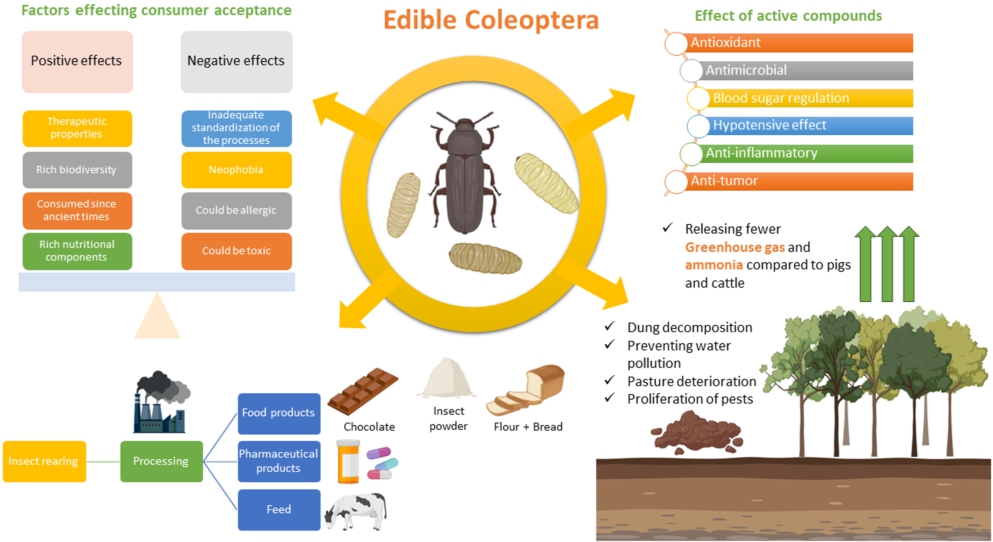
With the worldâs population continuously growing, there is a substantial need for increased food production, which could strain our already limited natural resources, leading to issues like deforestation, environmental degradation, and increased greenhouse gas emissions. The livestock industry, which currently occupies about 70% of global agricultural land, significantly contributes to these problems, often causing environmental concerns such as water contamination and ammonia emissions (Fiala, 2008; Lange and Nakamura, 2021). Producing insects for human consumption offers environmental benefits primarily because of their impressive efficiency in converting plant proteins into insect proteins, a process much more effective than observed in mammals.
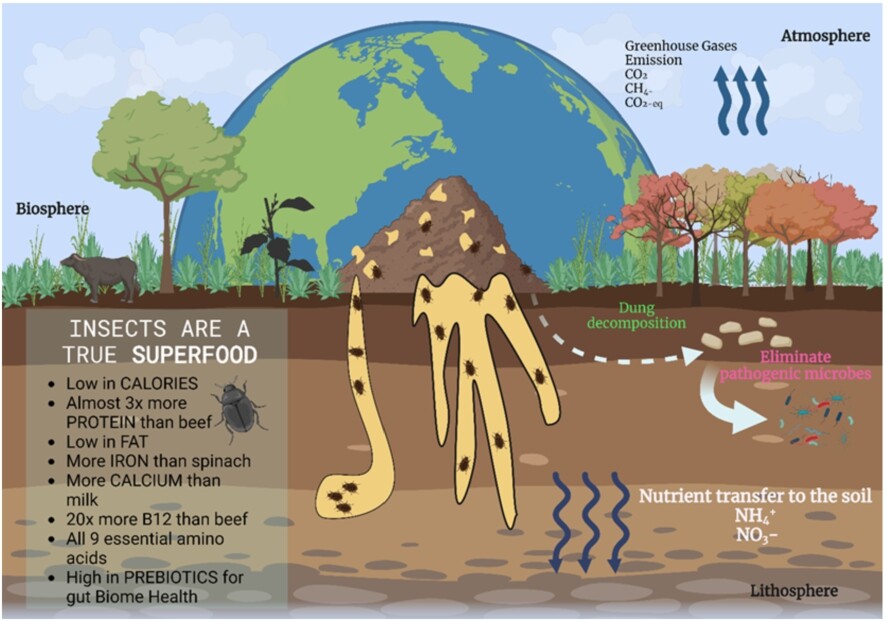
Edible insects offer sustainability benefits because they can be raised on organic waste materials such as manure, compost, and human waste, which helps reduce environmental pollution (Bouchard et al., 2017). This practice of using organic waste as insect feed also increases the profitability of insect farming. When it comes to GHG emissions, insects release far fewer GHG and ammonia into the environment compared to pigs and cattle. Livestock farming is a major contributor to greenhouse gas emissions, accounting for approximately 18% of total emissions, even surpassing the transport sector. Methane and nitrous oxide produced by livestock have a much greater impact on global warming than carbon dioxide (Lange and Nakamura, 2021). In contrast, the GHG emissions associated with breeding edible insects such as grasshoppers, crickets and mealworm larvae are roughly 100 times lower than those from cattle and beef production (Oonincx et al., 2010). In this context, the waste produced by farm animals, including dung and ammonia (urine), contributes to soil nitrification and acidification. With respect to ammonia production, the larvae of locusts, crickets, and mealworms also release significantly less ammonia into the environment compared to pigs, with a tenfold reduction (Oonincx et al., 2010; Lange and Nakamura, 2021).
As a negative effects of Coleoptera, for example, blister beetles can be a threat to animal feed, especially when they are present in hay fields and contain harmful substances. Animals such as cattle, sheep, goats, emu, and horses have gotten sick or even died from consuming hay infected with these insects. This problem has been exacerbated by the practice of conditioning hay, where squashes the beetles inside the bales of hay. Beetles can also serve as carriers of pathogens that harm both crops and livestock. For instance, the striped cucumber beetle is known to transmit a plant bacterium that leads to substantial crop losses. Managing bacterial wilt in crops often involves controlling these beetle vectors. The lesser mealworm beetle is another type commonly found in poultry houses. While it feeds on certain pests, it also transmits disease-causing bacteria and fungi, negating any potential benefits. In the realm of stored products, beetles are a significant concern, with over 600 species worldwide associated with these goods. These beetles can either directly damage and consume the crops being stored, or consume fungi or other animals that are part of the ecosystem of the crops being stored. The red flour beetle, a common stored product pest, is used extensively in genetic research due to its economic significance and ease of culture (Bouchard et al., 2017).
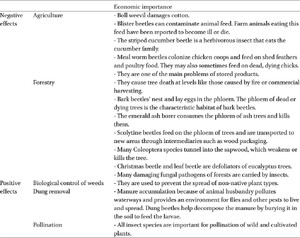
Moreover Coleoptera, have significant impacts on human affairs, particularly as forest pests. The nature and effects of these pests vary depending on the country and region. For example, in Sweden, itâs estimated that as much as 45% of the yearly wood volume is lost due to bark beetles, resulting in substantial economic losses. Some weevils, specifically those in the Scolytinae and Platypodinae subfamilies, are notorious for damaging trees by feeding on their phloem. Phloem-feeding bark beetles are notable for their inadvertent introduction to new regions, often through international trade. Certain countries, such as New Zealand, are particularly susceptible to these introductions. Additionally, there are wood-boring beetles and beetles that tunneling through the sapwood, causing weakening or death to their host trees. Certain beetles exhibit unique behaviors, such as ambrosia weevils that cultivate ambrosia fungi in their burrows. The emerald ash borer, originally from Asia but introduced to North America, has caused extensive ecological and economic damage by causing widespread decline and mortality in ash trees. Beetles can also act as carriers of harmful fungal pathogens in forests, with some outbreaks resulting in significant tree mortality. Understanding the diversity of beetles associated with trees is vital for the global forest industry, as these insects have diverse impacts on forests and ecosystems. However, many beetle species in this context remain inadequately studied and understood (Bouchard et al., 2017; Evans et al., 2007). As a positive effects of Coleoptera, beetles that feed on plants, have been effectively used worldwide to control the expansion of non-native plant populations. The seeds of non-native weeds have been shipped unintentionally around the world for hundreds of years, and the problem is growing with worldwide commerce, resulting in the rapid expansion of weeds in new regions. Biological weed control involves introducing and managing natural enemies to curb weed growth, providing an eco-friendly alternative to pesticides. Dung beetles, such as Scarabaeidae and Geotrupidae, play a crucial role in managing dung, facilitating its decomposition by burying it, which helps prevent water pollution, pasture deterioration, and the proliferation of pests. Their contribution to the economy is significant, as they prevent financial losses caused by the accumulation of livestock waste (Table 2). Beetles also serve as essential pollinators for both cultivated and wild plants, a process known as cantharophily. This mutual relationship between beetles and flowering plants has led to specialized adaptations in both, but the decline in native and non-native pollinators, driven by factors like pesticide use, habitat loss, and poor farming practices, poses a serious threat to global food security and biodiversity (Fenster et al., 2004; Cave, 2005; Bouchard et al., 2017).
Economic importance of edible Coleoptera (Bouchard et al., 2017)
Citation: Journal of Insects as Food and Feed 11, 16 (2025) ; 10.1163/23524588-00001095
5 Nutritional value of edible Coleoptera
Malnutrition is still a big problem over all the world. Some people are starving and some people are well fed but eat nutrient-poor foods. In both cases the body is not getting enough valuable nutrients. Foods containing high amounts of protein, vitamins, fiber, minerals, valuable fatty acid composition are essential for human nutrition. The worldâs growing population and decreasing amount of agricultural land have made it necessary to find new, reliable and renewable sources of protein. Edible insects are a good alternative to existing sources, with a valuable protein and a rich composition of nutritional composition (Figure 4). In fact, the consumption of edible insectâs dates back to ancient times. Interest in edible insects shows an increasing trend regardless of region and culture (Kim et al., 2022; Liceaga, 2022; Zhou et al., 2022).
Heat map for chemical composition (% dry weight) of some Coleoptera species.
Citation: Journal of Insects as Food and Feed 11, 16 (2025) ; 10.1163/23524588-00001095
5.1 Macronutrient content
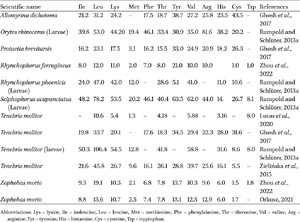
Coleoptera is the most populous insect order. The macronutrient content of edible Coleoptera is given in Supplementary Table S2. Protein and fat are the main components of Coleoptera and it is followed by fiber and ash. All species of Coleoptera contain significant amount of fiber. Even if they come from the same species, their nutritional value varies greatly because of differences in habitat (reared or wild), metamorphic stage, origin and diet of insects. The proximate species distribution of Coleopteran insects varies considerably among species as shown in Supplementary Table S2. (Rumpold and Schlüter, 2013a; ZielinÌska et al., 2015). In terms of nutritional value, Coleoptera species generally contain high amounts of protein and fat (Supplementyary Table S2). Protein content ranges from 71.0 to 16.8%. The ranges of fat, ash, fiber and carbohydrates as follows: 56.06-6.14%, 11.8-1.0%, 32.0-1.96% and 51.6-3.6%, respectively. Hlongwane et al. (2020) were reported the fiber content of Coleopteraâs between 2-28% and fat content of edible insects as 1-67%. Insects are known to be a rich in protein source. However, there is also a reality called protein quality. Proteins are composed of 20 amino acids and 8 of these essential amino acids cannot be synthesized in the human body and must be obtained through food. At the same time, it has been determined that different species of Coleoptera also have rich amino acid composition (Table 3). Again, there is a significant variation between same species. Studies in the literature showed that different species of Coleoptera is rich in lysine as well as other amino acids. In addition, since arginine cannot be synthesized in the body and is essential for growth, especially in children, its requirement becomes more important. It could be seen that species of Coleoptera are rich in argine (Table 3). There are many publications on the functional and nutritional attributes of the protein content of various insect species. Unfortunately, the lack of standardized fractionation process methods is a major shortcoming (Hall et al., 2017; Mishyna et al., 2019; ZielinÌska et al., 2015).
Amino acid profile of Coleoptera species (mg/g protein)
Citation: Journal of Insects as Food and Feed 11, 16 (2025) ; 10.1163/23524588-00001095
Fatty acid composition of Coleoptera is presented in Table 4. By consuming Coleoptera insects, large amounts of fat and valuable essential fatty acids enter the body. The composition of lipid and fatty acid content of insects are affected by sex, diet, species, environmental temperature and stage of life (Oonincx et al., 2015). Linoleic and α-linoleic acids are essential fatty acids and cannot be synthesized in mammals and so that should be taken by diet. They are important for brain function and the nervous excitation system. Coleoptera species have certain amount of linoleic and α-linoleic acids (Table 4). Studies in literature have also reported that insects contain significant amounts of essential fatty acids (Lucas et al., 2020; Zhang et al., 2020; Orkusz, 2021). Saturated fatty acid composition range between 2.32-68.6% and it is highest for Zophobas morio (68.6%). Besides, monounsaturated fatty acid range changes as 2.51-71.4% (Table 4). At room temperature, most insect lipids are liquid. Therefore, they are referred to as insect oil. The fact that insect oils are liquid at room temperature enables their incorporation into many common foodstuffs such as fry oil, food grade lubricants and mayonnaise. At room temperature, some of insect oils are in solid form, so known as insect fats, and contains a significant quantity of saturated fatty acids and it is of interest for margarine, confectionery and pasta production systems (Ushakova et al., 2016; Sosa and Fogliano, 2017).
It is a known fact that unsaturated fatty acids are beneficial for human health. As shown in Table 4, coleopteras are a rich source of unsaturated fatty acid composition. It is also known to be an important source of linoelic and linolenic fatty acid composition. It is also composed of other fatty acids. The diversity of fatty acids indicates the nutritional richness of the product. The fatty acid richness of Coleoptera is shown in Table 4.
Fatty acids composition of Coleoptera species (g/100Â g)
Citation: Journal of Insects as Food and Feed 11, 16 (2025) ; 10.1163/23524588-00001095
5.2 Micronutrient content
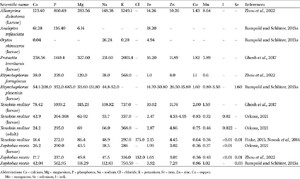
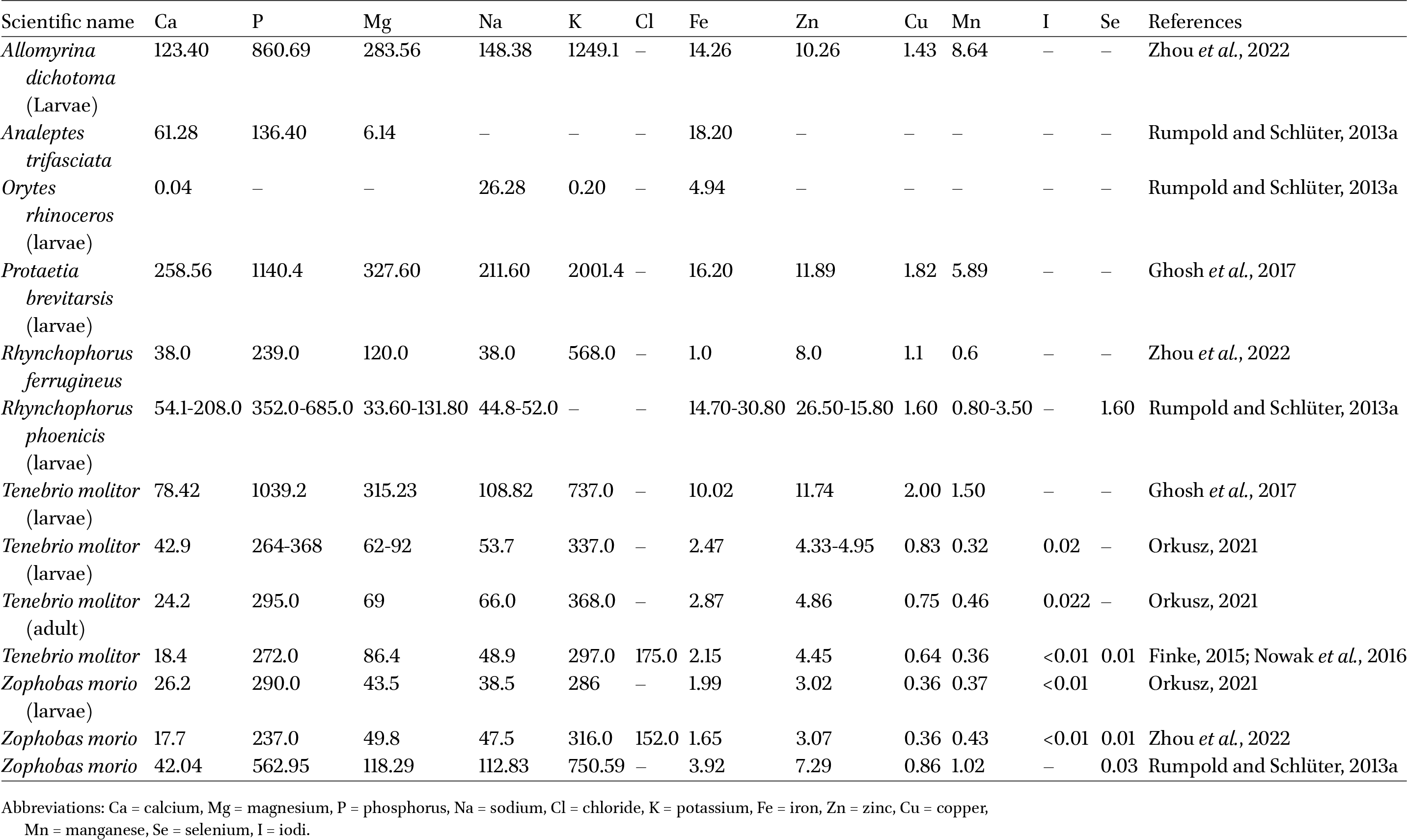
Minerals play an essential role for a healthy and long life. They have many important functional roles in human body such as producing different hormones, building strong bones, regulating heart rate and transmitting nerve impulses. Mineral composition of Coleoptera species are given in Table 5. Coleoptera species are rich in Ca, P, Mg, Na and K. Some species of Coleoptera can full fill the requirements of daily intake of 4,700 mg/day for potassium while some of others cannot be. Maximum daily uptake value of sodium (1,500 mg) cannot be met with any 100 g Coleoptera species. On the other hand, iron is an important mineral for human body and its daily uptake range varies between 7.5-58.5 mg/day with respect to the women, man and premenopausal women (Rumpold and Schlüter, 2013a). Iron composition of Coleoptera species range between 1.0-30.80 mg/100 g sample (Table 5). It shows that about 100-150 mg Coleoptera insect consumption can meet the iron need according to the type of consumer.
Mineral content of Coleoptera species (mg/100Â g)
Citation: Journal of Insects as Food and Feed 11, 16 (2025) ; 10.1163/23524588-00001095
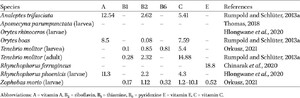
Vitamin contents of Coleoptera species are presented in Table 6. Coleoptera insects contain a significant amount of minerals as well as a certain number of vitamins. Vitamin C intake of 100-200 mg/day will ensure adequate plasma levels (Spoelstra-de Man et al., 2018). Depending on the type of Coleoptera insect, 100 g consumption of any Coleoptera defined in Table 6 covers about 1.2-14.88% of the daily required amount of vitamin C. It was expressed as recommended daily vitamin E intake age dependent and changes as 5-13 mg/day, 13 mg/day, 11 mg/day for for infants/children, men and women, respectively (Galli et al., 2017). Consumption of 100 g of Rhynchophorus ferrugineus is sufficient to supply the suggested daily amount of vitamin E for women, men, children and infants. On the other hand, 100 g of any species of coleoptera does not meet the daily requirement of vitamin A (500-600 mg) (Hlongwane et al., 2020). It was also stated that there are limited reports of vitamin content in insects for human consumption. Also, deviations from the existing results have been identified (Rumpold and Schlüter, 2013a).
Vitamin composition of Coleoptera species (mg/100Â g)
Citation: Journal of Insects as Food and Feed 11, 16 (2025) ; 10.1163/23524588-00001095
5.3 Comparison with other common protein source
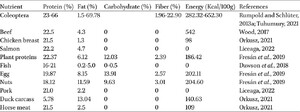
Many nutrients for human diet are found in nature in different proximate composition and some of them presented in Table 7. According to this table, duck carcass contains the least amount of protein, while Coleoptera can contain the highest amount of protein according to the type of species (maximum 66.0%). Similar situation is also observed in the amount of Coleopteran fat that has the highest value depending on the species type. Coleoptera has a significant amount of fiber that ranges between 1.96-22.90% and it is followed by nuts with the highest fiber ratio of 3.01%. Apart from Coleoptera, according to total energy content, chicken breast has the lowest rate (98.0%) and beef has the highest rate (542.0%) per 100 g of edible portion. Coleoptera, on the other hand, has a very high energy range of 282.32-652.30% (Orkusz, 2021; Zhou et al., 2022). Note that the protein levels of plant sources, nuts, and eggs are lower than the protein levels of Coleoptera (Table 7).
Comparison of nutritional composition of different protein sources and Coleoptera insect expressed per 100Â g of edible portion
Citation: Journal of Insects as Food and Feed 11, 16 (2025) ; 10.1163/23524588-00001095
6 Nutraceutical properties and medicinal uses of edible Coleoptera
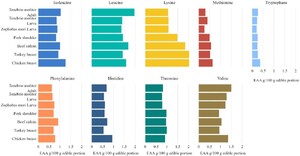
Nutraceutical properties of a source related to health protection or treatment considered effective for the nutrients found in the food component. There are many reports expressing the active compounds of edible insects beneficial to human health. These bioactive substances can exert antioxidant, anti-inflammatory, antimicrobial, hypertensive, immunomodulatory and blood sugar effects (Aguilar-ToalaÌ et al., 2022). Comparison of essential amino acid content of various Coleoptera species with common protein sources can be seen in Figure 5. As well as this, Table 8 summarizes the functional effects of active compounds from Coleopterans.
Comparison of essential amino acids content of Coleoptera species with various animal-based meats (EAAÂ = Essential amino acids) (data obtained from Orkusz, 2021).
Citation: Journal of Insects as Food and Feed 11, 16 (2025) ; 10.1163/23524588-00001095
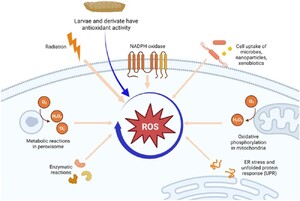
Antioxidant activity was the most commonly evaluated bioactivity in the majority of studies. Antioxidants are known as oxidation inhibitors. Antioxidants can be found in the natural structure of foods or may be added to foods to prolong the durability or lower the risk of health problems. Edible insects are high in protein. They are therefore considered to have great potential as a source of peptides with antioxidant activity (van Huis, 2021a). Yellow mealworms (T. molitor) have also been the focus of most studies. This insect is important for commercial use and large-scale commercial manufacturing and is currently permitted for use in consumer products in Europe (Rumbos et al., 2020). Antioxidant activity was also observed in T. molitor using ultrasonic and pressure-assisted extraction. GC-MS characterization of substances with antioxidative properties primarily by phenolic substances in total extracts (Navarro del Hierro et al., 2020b). The in vitro antioxidant properties of peptides found in T. molitor were found to be enhanced by heat treatments such as baking and boiling prior to digestion compared to raw insects (ZielinÌska et al., 2017). Antioxidant activity of edible insect show in Figure 6.
Insects, as well as insect peptides and proteins, chitosan, insect oils and chitin, have a number of compounds with antimicrobial activity. Antibacterial peptides are the most prominent among them (Zhou et al., 2022). The antimicrobial role of peptides and/or proteins is being studied in detail by researchers. While most of the insect antibacterial peptides and/or proteins have been reported to be effective against bacteria and/or fungi. Besides, some antibacterial peptides and/or proteins have also shown activity against some parasites. Antibacterial peptides/proteins are divided into four groups in the literature. These are: (1) peptides rich in cysteine (drosomycin and insect defensin), (2) peptides rich in proline (drosocin, lebocin and apidaecin), (3) α-helical peptides (moricin and cecropin), and (4) peptides rich in glycine (gloverin and attacin). Certain species of Coleoptera have insect defensins and defensin-like peptides with antimicrobial activity. These species are T. molitor, Holotrichia diomphalia, Copris tripartitus, Zophobas atratus, Anomala cuprea, Oryctes rhinoceros, Allomyrina dichotoma, Acalolepta luxuriosa. In addition, Paederus dermatitis and Acalolepta luxuriosa have cecropins and cecropin-like peptides, which are a family of cationic antimicrobial peptides of 31-39 residues (Yi et al., 2014). It was expressed that antimicrobial peptides and other active compounds from insects have been tested and found that they can inhibit gram-negative bacteria, fungi and gram-positive bacteria. They also increase the number of probiotics, modulate the microbial community structure and regulate intestinal microorganisms (Zhou et al., 2022). An in vitro digestion simulation model was used to determine the impact of flour of T. molitor on the gut microflora of humans, and it was observed that the proliferation of Prevotellaceae and Bacteroidaceae and the formation of short-chain fatty acids in the gut were strongly correlated with human body metabolites (de Carvalho et al., 2019a).
Summarizes the functional effects of different species of Coleopterans
Citation: Journal of Insects as Food and Feed 11, 16 (2025) ; 10.1163/23524588-00001095
Antioxidant activity of edible insect active compounds.
Citation: Journal of Insects as Food and Feed 11, 16 (2025) ; 10.1163/23524588-00001095
Chitin, chitosan, and their derivatives are important products because they are believed to support various activities, including antioxidation, antihypertension, anti-inflammation, anticoagulation, antitumor, anticancer, and antimicrobial effects. The chitin content in the dry matter of T. molitor can be as high as 137.2Â mg/kg. In addition, chitin can be utilized in significant amounts for the production of bioactive chitosan. Therefore, insects can be used as a novel source of chitin and chitosan (Kim et al., 2022). Larvae of T. molitor contain high amount of chitosan and chitin, which are known to lower blood sugar and blood lipid levels. It is also known that chitin and chitosan support cholesterol metabolism, which increases the importance of T. molitor larvae in terms of health (Hahn et al., 2020; Lucas et al., 2021). It is also defined that antimicrobial, anti-obesity, anti-diabetic, antioxidant, anti-inflammatory are the main health benefits of chitin (Riaz Rajoka et al., 2020).
Cell proliferation and unnatural growth of cells are typical features of cancer. Anti-tumor activity is an important property of insect derived functional compounds. Edible insects contain many functional substances with antitumor activity, such as sex attractant hormones, microelements, antimicrobial peptides, cordycepin, steroidal substances, chitosan, interferon, vitamins, etc., Anti-microbial polysaccharides and peptides found in edible insects support the human immune system and have antitumor activity (Qian et al., 2022).
T. molitor is thought to be able to promote the regulation of the human immune system due to the presence of starch, cellulose, glycogen, chitin and pectin. Supporting the immunity of the human body is also considered as direct antitumor activity (Qian et al., 2022). Vitamin B12 in mealworm larvae (T. molitor) was first reported in 2018, at a level of 1.08 g/100Â g dry weight, which is an important vitamin due to its antitumor properties. In addition, studies have shown that T. molitor has effective antitumor activity due to its polysaccharide, trace element and vitamin (Schmidt et al., 2019; Hahn et al., 2020; Qian et al., 2022). Fats and sugars from insects even have anticancer properties. Mealworm larvae oil was found to have inhibitory effects on colon adenocarcinoma (Caco-2) cells and in the treatment of human hepatocyte carcinoma (HepG2). Colon adenocarcinoma cells, with the proposed anticancer activity mediated through activation of the caspase-8, -9, and -3 death-dependent pathway (Wu et al., 2020). Some chitin/chitosan, polypeptides, trace elements, polysaccharides, unsaturated fatty acids, vitamins, alkaloids, flavonoid, fibroin, insect hormones and other functional compounds of T. molitor were reported to be responsible for lowering blood pressure (Belluco et al., 2013; Hahn et al., 2020; Lucas et al., 2021; Schmidt et al., 2019). Besides, it has been reported that hydrolysates obtained from T. molitor exhibited inhibition of cyclooxygenase and lipoxygenase (ZielinÌska et al., 2017). COX-2 and LOX have been implicated in the production of prostaglandins and leukotrienes. The excess levels of these compounds can result in deregulated inflammatory answers (ZielinÌska et al., 2017).
Angiotensin I converting enzyme (ACE) is also responsible for raising pressure of blood. This is achieved by deactivating the bradykinin vasodilator or by transforming the deactive angiotensin I into the powerfull vasoconstrictor angiotensin II. ACE inhibition may have an antihypertensive effect as a result of the decrease in angiotensin II as well as the increase in bradykinin. It is possible that certain bioactive peptides with an aptitude for the adjustment of blood pressure could act as inhibitors of ACE (de Castro et al., 2018). It was found that the purified peptide from T. molitor larvae (Tyr-Ala-Asn) had a successful antihypertensive effect in hypertensive rats by reducing systolic blood pressure (Dai et al., 2013).
The high protein content of mealworm promotes the growth of Prevotellaceae and Bacteroidaceae bacteria, that provide benefits to the host through their saccharolytic and proteolytic functions (Anusha and Negi, 2022). Proteins from mealworms and their meal have been demonstrated to have a probiotic activity, and various pretreatments such as fermentation and hydrolysis have been shown to increase the intestinal health effect (de Carvalho et al., 2019b). In vitro, protein from digested mealworm had a stimulating effect on the growth of Prevotellaceae and Bacteroidaceae, but no stimulating effect was observed on the growth of Desulfuromonadales, Desulfovibrionales or Clostridium histolyticum (de Carvalho et al., 2019b). In another study, whey peptide extracts (1% w/v) from mealworms were used to study Bifidobacterium and Lactobacillus growth and found to stimulate growth (Yu et al., 2016). In addition to the above-mentioned studies about the active constituents of insects on human health in vitro and in vivo, there is also a widespread use of them as medicinal support and medicine in cultural aspects throughout the world. T. molitor is known to be a Coleopteran mega family widely used as a medicinal insect in China. The intended use of T. molitor in China is usually cough, cancer, fever, rheumatism and inflammatory disorders. Blapsol is an active compound obtained from T. molitor (Seabrooks and Hu, 2017).
Cyclooxygenases are known to catalyse the translation of arachidonic acid into prostaglandins, which are essential medians of inflammation pain and fever. Five known dimers of dopamine from Blaps japanensis and Blapsols A-D were tested for activity towards cyclooxygenase (COX) enzymes: COX-2 and COX-1 and their efficacy was observed (Yan et al., 2015). In traditional Argentinian medicine, Tenebrionidae is used for treatment of arthritis, HIV, cancer, diabetes, Parkinsonâs disease and asthma. The Scarabaeidae is a family of Coleoptera and make up 8% of its family and are often used for medicinal purposes (Seabrooks and Hu, 2017). In East Asia and China, Holotrichia parallela (Scarabaeidae), traditionally used as a medicine to cure superficial infections, tetanus, gout and rysipelas, has been studied for antioxidant capacity (Liu et al., 2012). In China, the larvae of Holotrichia diomphalia (Scarabaeidae) are widely used as a crude medicine. The diseases for which it is effective are listed as contusion, edema and apoplexy (Seabrooks and Hu, 2017). The larvae of the beetle have been traditionally used as a medicine for the treatment of various liver diseases in humans (Lee et al., 2015).
The larvae of Protaetia brevitarsis were also found to have liver-protective and antineoplastic properties. Hepatotoxic mice were used to study the effect of oral administration of powdered larvae of Protaetia brevitarsis and found that signs of chronic and acute liver injury were reduced (Lee et al., 2014). The dung beetle Catharsius sp. (Scarabaeidae) is ground into a powder and orally ingested for the prevention of diarrhea, a common practice in northeastern India (Seabrooks and Hu, 2017). In Chinese, Catharsius molossus is a valuable insect with respect to the medicinal treatment. It is used for prevention of convulsions, relaxing the bowels, counteracting toxins and removing blood stasis (Lu et al., 2015). Meloidae is a small family of Coleopterans with only 2,500 species. However, because of their protective excretions, the Meloidae have a very storied medicinal past. It is used for wart and cancer treatment in China and is known to have been used for therapeutic purposes since 1264. Berberomeloe majalis (Meloidae) is used for wart treatment in Spain. In Latin American, Palembus dermestoides (Meloidae) is applied for removel of rheumatism, ophthalmological problems and sexual impotence (Seabrooks and Hu, 2017). Also, macerated Meloidae is used as a head rub for the treatment of baldness in Mexico (Alonso-Castro, 2014).
Antinutritional factors from edible insects are substances that lower the nutrient efficiency of food and have a key role in the use of insects for human nutritions. Data on antinutrients are limited and even controversial compared to data on nutrients in edible insects. Most edible insects are herbivorous and hence feed on plants. The antinutrient content of edible insects varies widely. This is because insects feed on plants with different chemical compositions. The most common antinutrients found in edible insects are oxalates, phytates and tannins. Oxalates combine with magnesium and calcium to produce insoluble Mg and Ca oxalates, which result in kidney damage (stones in kidney) and low serum Mg and Ca levels. Phytate, restrict the taking of some essential minerals such as magnesium, calcium and iron. Tannins combine together with proteins and produce insoluble compounds which affects their bioavailability. High levels of tannin in the diet due to its astringent property, which is a consequence of its ability to bind to proteins in saliva and mucous membranes (Idowu et al., 2019).
Phytate is one of the antinutrient found in edible insects and an important compound because its presence in foods reduces the bio-availability of minerals like iron, calcium, magnesium, copper and manganese. The phytate compositions of yam beetle (Dinoderus porcellus Lesne, Coleoptera: Bostrichidae) and palm weevil larva (Rhynchophorus ferrugineus, Coleoptera: Curculionidae) were expressed as 0.28Â mg/kg and 0.289Â mg/kg, respectively (Oibiokpa, 2017). Antinutrient content of all the growth stages of Oryctes rhinoceros was reported to be very low. The low levels of tannic acid, oxalate, alkaloids, saponins and flavonoids observed in the developmental stages of the palm beetle indicate that all stages are safe for human and animal consumption (Omosoto, 2018). Rhynchophorus pheonicis larvea has been reported to contain 1.4 mg/100Â g, 0.6 mg/100Â g, 1.0 mg/100Â g, 0.9 mg/100Â g and 0.1 mg/100Â g of phytate, lectin, tannin, trypsin inhibitor and oxalate, respectively (Meyer-Rochow et al., 2021). Low hydrogen cyanide (HCN), tannin and phytic acid levels were reported as 2.531, 0.481 and 0.276 mg/100Â g and 2.651, 0.42 and 0.311Â mg/100Â g for palm weevils and yam beetles, respectively (Raheem et al., 2019b). Oxalates are a naturally occurring substance that can be found in plants, animals and humans (Rahman et al., 2013). Some researchers also claimed that amount of antinutrients in edible insects are in low concentrations and also could be similar in other food. However, note that the existence of antinutrients in insects is too important an issue to ignore. Further researches are needed to identification, control and elimination of these antinutrients. Awareness of which insect species contain which antinutrients is fundamental in this respect (Aguilar-ToalaÌ et al., 2022; Imathiu, 2020).
7 Safety aspects and risks related with consuming Coleoptera
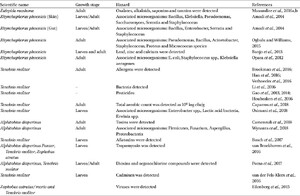
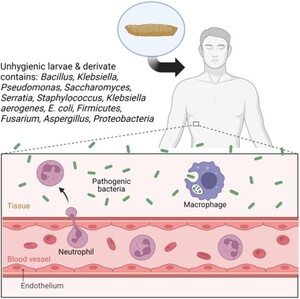
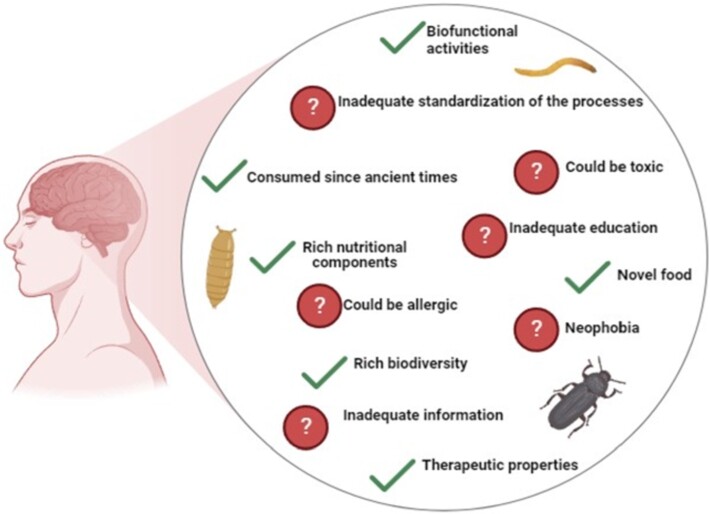
The safety aspects of using insects as a food source continue to be viewed with scepticism by consumers. Some insects are inedible or cause allergic reactions, so all insects are not safe for consumption. The source of safety concerns is due to some common hazards associated with the consumption of insects as food. These hazards are microbiological, allergenic, parasitic, or toxicological (de Castro et al., 2018). Table 9 shows the hazards from different species of Coleoptera. Eating insects could result in two potentially dangerous microbiotas being introduced. These are inextricably linked to insects as part of their lifestyle, and the other comes from cultivating and processing and is then passed on (EFSA Scientific Committee, 2015). Insects have a complex microbial community. Viruses, fungi, bacteria, archaea, and protozoa may be present (Raheem et al., 2019b). These microorganisms may be related to insects in both farming environments and in nature. It is believed that most microbes in or on insects are harmless to humans and are not likely to be a cause of deterioration in foods (Marshall et al., 2016) (Figure 7) and allergen reaction potential of insect consumption show in Figure 8.
Potential hazards from different species of Coleoptera
Citation: Journal of Insects as Food and Feed 11, 16 (2025) ; 10.1163/23524588-00001095
Potential of microbial infection form edible insect consumption.
Citation: Journal of Insects as Food and Feed 11, 16 (2025) ; 10.1163/23524588-00001095
Allergen reaction potential of edible insect consumption.
Citation: Journal of Insects as Food and Feed 11, 16 (2025) ; 10.1163/23524588-00001095
T. molitor, yellow mealworm, commonly contains the following genera of bacteria Propionibacterium, Dermabacter, Actunobacillus, Exiguobcacterium, Brachybacterium, Serratia, Citrobacter and Clavibacter. Definite foodborne pathogens i.e. Listeria monocytogenes and Salmonella spp. have not yet been isolated from the intestines of farmed yellow mealworms. Escherichia coli, Streptococcus spp., Micrococcus spp., Bacillus subtilis Ehrenberg and Citrobacter intermedius Sledak were also found in Alphitobius diaperinus Panzer taken within poultry houses (Raheem et al., 2019b). Bacteria that cause food spoilage have also been detected. Spiroplasma spp. Has been found in larvae of mealworm, which has been linked to neurological disease in humans (Garofalo et al., 2017). An insect study showed that T. molitor can have a high microbial load of 105-106 cfu/g (MeÌzes, 2018). The pathogens of insects are considered to be harmless to human (van Huis et al., 2013). Also, high level of microbial contamination was found in the larvae of T. molitor, with average counts in excess of 7.6-8.8 log cfu/g (Vandeweyer et al., 2017a,b).
Pesticide residue is another potential problem with edible insects. Pesticides are used in farming to protect against pests. It is a threat in insects harvested from the wild, but not for insects harvested in insect farms. In edible insects, various kinds of pesticides were found among herbicides, insecticides and fungicides (Poma et al., 2017; Calatayud-Vernich et al., 2018; De Paepe et al., 2019). Also, it has been reported that yellow mealworms are found to contain pesticides (Gao et al., 2014; Houbraken et al., 2016). In another research, no pesticide residues found in yellow mealworms (De Paepe et al., 2019). One study aimed to assess harmful chemicals in edible insects (including T. molitor) and found that some chemicals may be present in the cultivated insect. However, the contamination levels were comparatively minor and the chemical content was equivalent to or below the content measured in frequently used animal products (fish, eggs and meat) (Poma et al., 2017).
Another serious problem for edible insects is heavy metal contamination. Plants are exposed to heavy metal contamination from soil and air. Edible insects that consume these heavy metal-contaminated plants are also being contaminated with heavy metals. Consumption of high quantities of heavy metals can cause serious health problems. Insect species, food source growth stage and growth environment all contribute to the heavy metal content of insects (Rehman et al., 2018; van der Fels-Klerx et al., 2018; van Huis, 2021a). Rhynchophocus phoenicis and Anapleptes trifaciata were found to contain copper, cadmium, lead and nickel (Aguilar-ToalaÌ et al., 2022). In EFSA Scientific Committee (2015), it was reported that larvaeâs of Rhynchophorus phoenicis, Rhinoceros beetle and Analeptes trifaciata contain 0.02-0.03 mg cadmium/kg dry matter weight and 0.03-0.06 mg lead/kg dry matter weight. Maximum cadmium concentrations in animal products are 0.05 μg/kg wet weight for meat from cattle, pigs, poultry and sheep to 1.0 mg/kg for kidneys, cephalopods and bivalve molluscs. The maximum concentration of lead was defined as a range from 0.1 mg/kg wet weight for meat from sheep, poultry, pigs and cattle to 1.5 mg/kg wet weight for cephalopods and bivalve molluscs (EFSA Scientific Committee, 2015).
It has been reported that Spanish fly (Lytta vesicatoria) can synthesize cantharidin, which is a toxin. Tenebrionidae that are known as Darkling beetles produce alkanes and quinones. On the other hand, there has been a study where rats were fed with T. molitor larvea (dried powder form) for 90 days and no adverse effects were found in terms of toxin poisoning despite being given at the maximum daily recommended dosage of 3,000 mg/kg body weight/day (Schlüter et al., 2017).
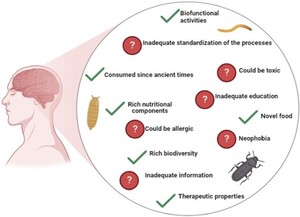
Factors influencing consumer edible insectsâ acceptance.
Citation: Journal of Insects as Food and Feed 11, 16 (2025) ; 10.1163/23524588-00001095
7.1 Consumer acceptance of edible Coleoptera as human food
The consumption of edible insects is also considered a traditional and/or cultural behavior in some countries in Latin America, Asia and Africa (Reed et al., 2021). Although eating insects is considered a cultural practice in tropical countries, some insect species are consumed only in certain communities, regions, and/or by certain ethnic groups (van Huis et al., 2021a). Despite the positive human health impacts of insects and their reputation as an environmentally sustainable food, acceptance of their consumption is low in Western countries (Nowakowski et al., 2022). Lack of knowledge about edible insects and/or opposition to cultural norms are the main factors of neophobia which is a tendency to reject consumption of edible insects. Some survey based on insect neophobia over the past few years have supported these results (Megido et al., 2016; Lambert et al., 2021). Also, it was defined that the main reasons that make the edible insect acceptance difficult for people are: the perception of not consuming an object with a negative preconception in their mind and/or the inability to accept a food they have never encountered before (van Huis, 2021a). There are several opinions that have influenced consumer acceptance of edible insects. These are simply defined in Figure 9. At present, more than 80 countries, more than 2,000 species of insects are under consumption. Coleoptera genera are the most consumed insects, accounting for 31% of total consumption (ZÌuk-GoÅaszewska et al., 2022).
The eating insects as an ingredient is more acceptable than the consumption of the whole insect. All available insect-based foods are high priced because of production limitations. However, they can be made economical by increasing production (Reed et al., 2021). It has been observed that people are more likely to consume edible insects when they are served in different food forms, such as energy bars, sandwich spreads, burgers and cookies, among others (Megido et al., 2018). It was also defined that unrecognizable form of edible insects are more applicable to Europeans and North Americans (Melgar-Lalanne et al., 2019). In one study, lentil and beef burgers and their equivalent versions with 50% insect (mealworm) were prepared and evaluated hedonically. These tests were reported to reduce insect neophobia (Megido et al., 2016). A series of sugary and savory insect-based foods were prepared and actually tasted by consumers and found that sugary preparations (i.e. crispy mealworms coated in chocolate) were more liked than the others (Megido et al., 2014).
Existing studies on consumer acceptance of edible insects have focused on consumersâ attitudes towards general edible insects that are not specific to a species. Therefore, there is not enough information in the literature on consumersâ interest in the consumption of edible insects of the Coleoptera. On the other hand, although there is a community of consumers with food neophobia, there is also a significant community of neophilic consumers (positive towards new foods and open to experimentation). In order to increase consumer acceptance of edible insects, consumers need to be adequately educated and informed. In addition, the neophilic consumer community should be actively engaged to overcome insect neophobia.
7.2 Safety measures to reduce risks
The European Food Safety Authority indicates the presence of biological and chemical contaminants from insects are due to the inappropriate production methods, insect species, harvesting stages, substrate (feed) processing methods, and harvesting steps (EFSA Scientific Committee, 2015). In terms of safe consumption, insects in wild may contain high amounts of heavy metals. This is a risk factor for consumption. In other cases, wild edible insects are highly sensitive to pesticide and other chemical contamination (Zhou et al., 2022). In many parts of Latin America, Africa, and Asia, people eat insects in whole form. Insects are generally roasted, dried, and fried or boiled before being incorporated into various dishes (Melgar-Lalanne et al., 2019). Interest in semi-domestication of insects and farming them indoor is growing among the commercial community. As of today, only a few species of Coleoptera can be regarded as completely domesticated, such as the flour beetle and the flour worm, which are regarded as semi-domesticated (Vantomme, 2015).
While existing regulations have established optimal guidelines for the rearing, processing and storage of insects, itâs important to recognize that many edible insect species have not undergone comprehensive microbiological safety evaluations. These insects carry the potential risk of introducing biological hazards, including bacteria known to cause foodborne illness. Insect-based foods are susceptible to contamination at all stages of production, distribution and consumption. There is also a tendency to overlook other biological risks associated with insect farming, such as the use of organic residues and food wastes to feed insects. Addressing these multiple concerns is critical to ensuring the safety and sustainability of the edible insect industry (Feng et al., 2018; Grabowski and Klein, 2017a; Lähteenmäki-Uutela et al., 2021; Niassy et al., 2022).
Notably, the populations and microbial prevalence may differ between cultivated and wild insects. Production environment of the insects and the type of food they eat largely account for these differences. Therefore, appropriate farming methods need to be used to manage pathogens (Marshall et al., 2016). In addition, some researchers are exploring ways to improve the safety of edible insects and reduce potential risks. Their efforts are focused primarily on refining cooking techniques, optimizing extraction processes, and improving insect rearing methods. The cooking method is a critical step in reducing or eliminating the microbial content of edible insects. For example, researchers conducted a study on T. molitor to evaluate its microbiological quality in fresh, cooked and fried forms. In its fresh state, no pathogenic microorganisms were detected, although spore-forming bacteria and Enterobacteriaceae were found. Boiling the insects for 5 minutes effectively eliminated Enterobacteriaceae, but didnât completely eradicate spore forming bacteria. It was also observed that insects boiled and stored at temperatures between 5-7 °C remained stable for over two weeks. Notably, roasting did not result in the destruction of Enterobacteriaceae. Therefore, it was recommended that insects be boiled for a few minutes prior to roasting to ensure microbiological safety (Klunder et al., 2012). In a study, it was defined that the microbial load of mealworms must be minimized during the food production process in order for them to be eaten whole. The production of mealworms should be carried out in accordance with the general good hygiene and production practice standards and specific hygiene rules for food of animal origin (Osimani et al., 2018). In the context of working with insects, extraction is an essential method. For fractionation or enzyme extraction when processing insects, itâs important to recognize the initial high levels of microbial contamination. This contamination must be effectively reduced to acceptable levels by appropriate processing methods, including heat treatment (Schlüter et al., 2017).
The lack of regulations and legislation on edible insects in international standards poses a significant risk to the safety of consumption. Standards for proper rearing, hygiene and storage should be established. Appropriate processing and decontamination methods against microorganisms during collection and storage should be determined and necessary measures taken to ensure food safety (Meyer-Rochow et al., 2021).
7.3 Regulatory aspects of Coleoptera consumption
It has been proven through research that edible insects are rich in nutrients like minerals, protein and fat, and could be considered as an âalternateâ food source. Food allergy is an important consideration when eating edible insects. It can be a serious problem, especially for sensitive individuals who are allergic to crustaceans. Due to the need at this point in time, a number of legal regulations have been established about edible insects. In a study, the legal regulations on edible insects were examined in various nations such as China, Canada, European Union, Australia, United States of America. Every country has its own legal requirements for edible insects, but each countryâs regulations vary. The fact that different countries have different restrictions on edible insects is an important factor limiting the international consumption of these products (Lähteenmäki-Uutela et al., 2021).
In 2021, the member states of the EU will vote and will be allowed to use the proteins from the lesser mealworm and the yellow mealworm as animal feed. In 2021 and 2022, EU member states will be allowed to use insect products from frozen, dried and powdered forms of the yellow mealworm as food (van Huis, 2022). A list of insect species with potential feed and food uses in Europe has recently been recommended by EFSA, which includes Coleoptera species such as T. molitor, Zophobas atratus and Alphitobius diaperinus (EFSA Scientific Committee, 2015). The European Food Safety Authority completed its assessment of the application for recognition of mealworm larvae as a novel food in November 2020. In the opinion expressed, mealworm larvae can be used whole, dried and ground for snacks. Ground and powdered mealworm larvae can be used in various other foods such as energy bars, baked goods, pasta, etc (Skotnicka et al., 2021).
8 Culinary uses of edible Coleoptera
Numerous applications of edible insects including Coleoptera have been employed in culinary industries. The mealworm has been granted a favorable evaluation by the European Food Safety Authority (EFSA) as a novel food, making it the first insect species to achieve such recognition (Lotta, 2019). Based on the EFSA assessment, it has been determined that the consumption of whole insect larvae, which have undergone thermal drying processes such as blanching or oven-drying, as well as being transformed into powder form through drying and grinding, is deemed suitable for consumption by all demographic groups. Furthermore, these insect larvae can be included in various food products including snacks, pasta, and cookies (Lotta, 2019). According to De Oliveira (2017), the 10% of the enrichment formulation had the best nutrient-rich qualities, including higher protein and fiber levels, as well as an acceptance level exceeding 75%, making edible insects as the best choice in culinary uses (de Oliveira et al., 2017). In addition to Tenebrio Molitor (T. molitor) (Coleoptera: Tenebrionidae), commonly known as mealworms, crickets (Acheta domesticus) and black soldier fly larvae (Hermetia illucens) are among the insects most commonly utilized for human food production. Meat substitutes have used these insects in a variety of proportions (10-60% and even 100%) and ways (ground, defatted, and acid-hydrolysed) (Kim et al., 2017; Pintado and Delgado-Pando, 2020). In these subsequent sections the culinary uses of Coleoptera were discussed in terms of their traditional dishes, modern application as well as the preparation methods.
8.1 Traditional dishes that uses Coleoptera as an ingredient
Traditional foods are those that a community accepts as desirable and suitable food sources via habit and tradition. Traditional foods play a significant role in diets around the world and can be found regionally and within a specific natural setting through farming or wild collecting (Jia et al., 2023). Insect consumption is a common element of the traditional diets of people in Latin America, Asia, and Africa. However, their acceptance as food ingredients is still low in Europe and USA (Raheem et al., 2019b). Due to the scarcity of traditional foods like meat, fish, and chicken, insects are a key source of protein. However, another reason for their capture could be attributed to their high value as food sources, often considered delicacies. (Liceaga, 2022). The larvae of the genus Rhynchophorus (Coleoptera: Curculionidae), commonly known as âpalmwormsâ, have long been recognized as a significant dietary component in tropical regions (RodrıÌguez-Ortega et al., 2022). In the culinary preparation of larvae, the initial step involves making an incision in the body to extract a fatty liquid, followed by the customary method of frying. The larvae can also be prepared using methods such as stewing, grilling, or roasting. The condiments that were incorporated into the dish consisted of onion, pepper, and salt (RodrıÌguez-Ortega et al., 2022). Numerous African culinary publications feature recipes incorporating R. phoenicis, such as the renowned work âLa Cuisine Camerounaiseâ authored by Grimaldi and Bikia (1985). Notably, this cookbook presents a particular culinary creation whereby the aforementioned ingredient is prepared within coconut shells (Aneni, 2022). In order to maintain the integrity of the larvae, a recommended approach involves suspending them and allowing them to desiccate beneath a trellis structure. The practice of incorporating dried larvae into squash seed paste is frequently observed. Many Amerindian cultures rely on significant but undervalued food supplies that are provided by invertebrates that consume leaves and trash. Essential amounts of animal protein can be obtained by eating invertebrates, particularly during times of scarcity for fish and game (Dolganyuk et al., 2023; Ocha et al., 2022). For instance, the Guajibo, who inhabit Alcabala Guajibo in the Amazonas region of Venezuela, rely primarily on the larvae of the palm weevil Rhynchophorus palmarum (Coleoptera: Curculionidae) (Pimentel et al., n.d.; Paoletti et al., 2000b). Over 60% of their animal protein in the period spanning from July to August (raining seasons) comes from insects. Amerindians chose their animal food from the food webs in the rainforest that have maximal energy flow, and which form the most renewable store of readily available nutrients by choosing these little invertebrates. The ingestion of invertebrates that eat leaves and litter by people who live in forests as a source of protein, fat, and vitamins opens new possibilities for the growth of sustainable animal food production (Skotnicka et al., 2021).
8.2 Modern culinary applications
The move toward Western foods poses a danger to entomophagy in cultures where edible insects are common components of traditional diets. Many urban dwellers find it challenging to consume insects as food because they find them unappealing in their natural state (Acosta-Estrada et al., 2021). To combat this, initiatives are being made to combine the ancient practice of consuming insects with more widely consumed meals (Tao and Li, 2018). T. molitor is a species of darkling beetle that is frequently eaten in Asia. Its larvae are known as mealworms (Turck et al., 2021; Khanal et al., 2023). Recent developments have led to the development of street snacks with entomological components, which are often formed of a flour and mealworm meal mix (Kim et al., 2016; GonzaÌlez et al., 2019). Based on report by Hartmann et al. (2018) and Cicatiello et al. (2020), the items taste like insects but are packaged in the form of common snacks, like crisps (Hartmann and Bearth, 2019; Cicatiello et al., 2020). If these treats can be developed further with effective promotion, great profits are anticipated. An earlier study found that a sneakier strategy could be necessary to encourage more individuals to consume mealworms on a regular basis: insects could be concealed inside convenient and easy-to-cook foods as seasonings (Seo et al., 2020). The initial task for the study team was to comprehend the flavor profile of this insect. A comparative analysis was conducted to assess the olfactory characteristics shown by mealworms at different stages of their developmental process. All the stages comprised mostly volatile hydrocarbons, which evaporate and emit odors, despite some variations in the particular molecules. Raw larvae, for instance, smelled like delicious corn, shrimp, and moist soil. Additionally, Zieliska et al.âs research from 2020 showed that using mealworms from T. molitor as a substitute for some of the butter and wheat flour in shortcake biscuits could have positive effects on their quality (ZielinÌska and Pankiewicz, 2020). According to their investigation, mealworm flour enhanced the protein and ash contents of biscuits while lowering the carbohydrate content. On top of that, greater mealworm flour additions improved the antioxidant activity of the biscuits and helped to enhance the amount of slowly absorbed starch while lowering the amount of quickly absorbed starch. Apart from that, yellow mealworm was employed in one of the mouthwatering recipes on the Scoolinary Recipes website, which was Broccoli Pachikay Sauce, Persillade of T. Molitor by Palmiro Ocampo Grey (Palmiro Ocampo Grey, n.d.). More details about the various countriesâ long-standing custom and modern culinary application of eating Coleoptera insects as a delicacy are provided in Table 10.
Modern consumption of Coleoptera insects as edible food cuisine across various countries
Citation: Journal of Insects as Food and Feed 11, 16 (2025) ; 10.1163/23524588-00001095
8.3 Preparation methods
Conducting thorough research is vital to ensure that processing improvements and design approaches function similarly to those employed for conventional proteins. This is crucial for addressing the challenges and limitations connected with the integration of protein from insects into nourishment formulations. In general, edible insects are a very wholesome supply of fats, amino acids, and fibres (Dossey et al., 2016b). The implementation of early education efforts and the adoption of transformative methodologies could facilitate the normalization of insect consumption within contemporary society. Given that insects may be handled by adopting techniques comparable to those employed for conventional proteins, there exists a substantial prospective market for insect-based food products that are suitable, enticing, safe, and possess enduring qualities (Liceaga, 2022). To effectively tackle the issue of food security in the year 2050 and mitigate the scarcity of food observed during worldwide epidemics, it is imperative to devise comprehensive strategies, it is imperative for individuals, scientists, and food service providers to recognize the importance of exploring the utilization of insects as viable protein sources (van Huis, 2020). The impact of various processing techniques on nutritional composition & lifespan of edible Coleoptera is demonstrated in Table 11.
The impact of processing techniques on the nutritional composition and lifespan of edible Coleoptera
Citation: Journal of Insects as Food and Feed 11, 16 (2025) ; 10.1163/23524588-00001095
Commonly employed methods for the preparation of edible insects include traditional cooking techniques such as frying, scalding, baking, grilling, broiling, and stewing. Typically, these items are consumed in their entirety, either in their raw or cooked state, or after undergoing processing, or as extracts (Liceaga, 2022). Other methods of preparing insects require a reliance on processing techniques that transform insects into unrecognizable forms, such as flours or powders, protein hydrolysates, and fermentable substrates, as an effect of the significant increase in attraction to the novel protein source and market expansion targeted toward Western cultures (Melgar-Lalanne et al., 2019; Liceaga, 2022). The most often utilized technique for preserving and preparing edible insects appears to be the use of various drying processes. However, the stability and nutritional content of the insects will be affected differently by each drying technique. For instance, drying methods resulted in minimal modifications in the protein, lipid, and fiber content of yellow mealworms (T. molitor) (Kröncke et al., 2019). However, compared to the other drying techniques, oven drying, microwave drying, fluidized bed drying, and drying with a vacuum lowered the protein solubility, whereas freeze-dried mealworms showed the greatest degree of oxidation of lipid (Kröncke et al., 2019). Overall, it was claimed that vacuum oven and microwave drying techniques may replace traditional oven and freeze drying. The utilization of vacuum conditions throughout the microwave drying procedure did not yield any discernible benefits, as there were no significant alterations seen in the proximal and fatty acid compositions of the mealworms (Kröncke et al., 2019). Lenaerts et al. (2018) and Van Campenhout (2018) conducted a study that revealed a notable disparity between freeze drying and microwave drying methods in terms of their effects on lipid oxidation in T. molitor. Specifically, freeze drying was found to significantly increase lipid oxidation, whereas microwave drying resulted in very minimal alterations to the protein, fat, and ash composition of the mealworms (Lenaerts et al., 2018). To guarantee nutrient quality and product performance, there is still a need for the optimization of the drying process for edible insects.
Furthermore, there exists empirical evidence suggesting that consumers display heightened favorable reactions towards food products incorporating insects that possess a lower level of perceptibility (such as in the form of flour or powder) in contrast to those featuring insects that are readily identifiable (e.g. in a conspicuous form) (Gmuer et al., 2016). According to sensory evaluation studies, a meal containing apparent insects were rated significantly less favorably in terms of their appetizingness and likelihood to be consumed than meals prepared using insect flours or protein (Tranter, 2013; Caparros et al., 2014; Tucker, 2014; Schösler and de Boer, 2018). It is advisable to exercise precaution when employing terms such as âinsect flour,â since they have the potential to create a misconception among consumers regarding its culinary properties, which may not align with those of grain flours often used in cooking and baking (Dossey et al., 2016b). In contrast to authentic flours, such as those derived from wheat, which predominantly consist of starches and fiber, with protein as a secondary component, insects are principally composed of protein, with fat and fiber (specifically chitin) following suit (Dossey et al., 2016b). However, a notable instance of a process that allowed the inclusion of insects as enriching components in baked products and pastas is food extrusion. This technique is frequently employed in the creation of cereal-based meals with different kinds of flour (Carcea, 2020).
By successfully removing the protein from the hydrophobic chitin, the resultant amino acid hydrolyzed products or powdered proteins tend to exert a more pronounced influence on the functional properties of the protein (for example, dissolved state, emulsion, and frothing). The utilization of these amino acid hydrolysates, which possess excellent solubility, can be employed in culinary creation for various purposes such as protein nutritional supplements, emulsification and stabilization, and enhancement of flavor (Liceaga, 2019). The nutritious benefits of edible Coleoptera species, including processing and culinary uses, are shown in Figure 10.
Depicted processing and culinary applications of edible Coleoptera species.
Citation: Journal of Insects as Food and Feed 11, 16 (2025) ; 10.1163/23524588-00001095
9 Environmental benefits of consuming edible Coleoptera
Presently, a sizable portion of the planetâs ice-free land is occupied by the livestock sector. Furthermore, it is considered one of the leading drivers of environmental degradation and global warming because to the harm it produces in soils and the discharge of organic matter, infections, and residues of drugs in products for human consumption (OrdonÌez-Araque and Egas-Montenegro, 2021). For these reasons, it is critical to discover a moderate and perpetual solution to this issue. The ecological impact of conventional livestock systems is significantly influenced by the production of feed, and this holds true for insect production systems as well. The relationship between land usage and mealworm production is evident. For instance, Oonincx and De Boer (2012) found that the production facility for mealworms accounted for a mere 0.2% of the overall land use, whereas the feed utilized in this facility accounted for a substantial 99% of the land use (Oonincx and De Boer, 2012). In a similar vein, the water consumption directly attributed to the facility in question was only a portion of the overall water usage, which encompassed both rainfall and the water required for feed production (Miglietta et al., 2015). According to these researchers, mealworms require two to three times less land and 50% less water per gram of edible protein in comparison to chicken. The production of one gram of edible protein from beef necessitates between 8 and 14 times more land and roughly 5 times more water when compared to mealworms (Oonincx and De Boer, 2012; Miglietta et al., 2015). Apart from that, in relation to GHG emissions, it has been observed that mealworms exhibit a comparatively reduced environmental footprint when compared to conventional livestock systems. There is a significant disparity in emissions between broiler chickens and mealworms when considering edible protein. Broiler chickens are shown to have emissions that are 32-167% higher, whereas beef cattle release CO2 equivalents that are 6-13 times greater than those of mealworms (Oonincx and De Boer, 2012).
On the other hand, meat consumption, which is predicted to rise by 75% between the years 2005-2007 and 2050, is one of the primary contributors of this exploitation (van Huis 2015, 2022). Increasing agricultural productivity, consuming less meat, and finding substitute foods that necessitate minimal land and natural resources to produce them have all been suggested as remedies to this issue. Insects offer a promising alternative food source that may help to mitigate some of the environmental problems arising from the production of meat in Western countries (Lucas et al., 2020). In comparison to traditional livestock agriculture, insect farming has a greater feed conversion efficiency, demands a significantly less financial investment, uses less water and space, and emits fewer greenhouse gases (GHG) (Müller et al., 2016). For instance, producing 1 kilogram of insect protein from various species of mealworm only requires 40 L of water (Abbasi and Abbasi, 2016). Additionally, insects have a large geographic spread and a rapid rate of reproduction (Gjerris et al., 2016). A significant portion of the beetle fauna is represented by the family Scarabaeidae, order Coleoptera, suborder Polyphaga, and class Insecta, which includes scarab beetles (PinÌero and Dudenhoeffer, 2018; Shah and Shah, 2022). Scarab beetles play a fundamental role in the terrestrial ecosystem both structurally and functionally. They act as natural scavengers by bringing in vast amounts of dung, which greatly purifies the earthâs surface. Scarabs could bury human and cow feces into the soil by molding into spherical balls and root nodules (Sullivan et al., 2016).
Since various environmental processes are spatially organized, spatial qualities are particularly crucial since they can be utilized to replace biotic dispersal, interactions, unmeasured ecological factors, and historical events (Tissiani et al., 2017; Shah and Shah, 2022). Therefore, native settings, coupled with climatic and spatial courses, which alter assemblages of grassland and forest dwelling species at middle to wide spatial scales, are necessary for causative populations of environmental driving dung beetles and their purpose (Gotcha et al., 2022). Dung beetles appear to be essential for maintaining ecological integrity in biological systems, specifically secondary seed dispersal and cycles of nutrients. Additionally, eating insects could reduce starvation in societies with little financial resources, which would considerably increase global food security (Lucas et al., 2020). According to the UN and FAO (Perez VaÌzquez et al., 2018), insects could be a viable solution to food insecurity that could result from population growth. Out of more than one million bug species, there are roughly 2,000 edible insect species. The number of edible insects will most certainly continue to grow thanks to ongoing study (Imathiu, 2020).
One of the foundations of food security is sustainability, which relies on existing generationsâ willingness to safeguard the ecological components that contribute to ensuring food security for forthcoming generations (Prosekov and Ivanova, 2018; Mbow et al., 2019). Given that they can satisfy all dietary needs while using fewer resources than most meat-based proteins generated from livestock, insects are a viable and environmentally friendly food source for contemporary society in the 21st century. Despite its apparent simplicity, the process of eating is heavily contingent upon oneâs knowledge, comprehension, and capacity to adapt. The potential exists for a reduction in foodborne illnesses, assured food sovereignty, and improved dietary well-being for individuals lacking access to alternative sources of nourishment, if a greater number of cultures and individuals become aware of the advantages associated with insect-based foods and transition to regulated and monitored entomophagous diets (Matiza Ruzengwe et al., 2022). Insects are commonly regarded as a favorable food source due to their ample supply of macro- and micronutrients necessary for optimal bodily functions, as well as the versatility of consuming different bug species at various stages of their life cycle. However, gaining market acceptance for a food extends beyond its nutritional value or potential environmental advantages. Consequently, a diverse range of Western food products derived from insects, such as grains, calories and protein energy bars, and dressings for salads, have been produced. The aforementioned encompasses the industrial inclination towards the domestication, cultivation, and production of food derived from insects (Baiano, 2020). Figure 11 shows an environmental benefit of consuming Coleoptera.
Environmental benefits of Coleoptera consumption.
Citation: Journal of Insects as Food and Feed 11, 16 (2025) ; 10.1163/23524588-00001095
10 Cultural attitudes toward edible Coleoptera
There has been a spike towards interest in entomophagy within the past few years. The dietary consumption of insects as sustenance for humans is known as entomophagy (Town and Tranter, 2013). The demand to vigorously explore alternate sources of protein has prompted conferences and seminars to be held all over the world. Insect books and articles have been published in an effort to transform western perceptions of this food source, yet many westerners have an unfavorable perception of them. According to Yen (2009), the predominant attitudes about eating insects as food are either fear and disgust or curiosity.
This repulsive sensation leads to the widespread belief in western society that entomophagy is only a form of survival and is linked to famine (FAO, 2013). While being widely accepted and regarded as a delicacy in other regions of the world. The readily available edible insects can be purchased at neighborhood food shops and consumed in daily life. The transition to a western diet has threatened entomophagy in these nations where edible insects are a part of the diet. This scenario might be avoided if the western perceptions towards edible insectsâ changes. The prevalent views across many regions of the world were discussed in these sections, along with the role of cultural factors in Coleoptera consumption.
10.1 Attitudes in different regions of the world
Several challenges associated with edible insects including Coleoptera as an insect-based food or alternative protein source are particularly based on consumer acceptance and commercialization. Highland Quechua people consume Coleoptera on occasion, and it is well-accepted by the local community. These foods are conserved by Amazonian Amerindians primarily as an alternative for food scarcity during the rainy season, as well as an accessible forest resource and year-round agricultural by-product (Manno et al., 2018). Whereas, in New Zealand, more than 60% of participants claimed they would consume insects frequently if they were in a suitable kind, such as a capsule, which is for better wellness (Payne et al., 2023). The participants demonstrated knowledge of the favorable ecological effects associated with the consumption of insects as a protein source compared to other alternatives. However, their awareness regarding the potential health benefits of consuming insects was comparatively lower. Individuals in New Zealand and Australia can legally consume other insects, including beetles, grasshoppers, butterflies, moths, bees, bugs, and dragonflies nevertheless they are not allowed to be sold. Any meals containing insects must be identified, and if an insect is ânovel,â it must undergo a risk-assessment procedure that takes toxicology, nutrition, and consumption patterns into account (Lähteenmäki-Uutela et al., 2021; Payne et al., 2023).
Alhujaili et al. (2023) presented a comprehensive framework that encompasses factors from many geographies, which have an impact on consumersâ willingness to accept insects as a food source. Several characteristics, including unpleasantness, food neophobia, familiarity, sight of insects, and taste, have been identified as significant elements that may contribute to consumersâ reluctance to accept insects as a food source (Alhujaili et al., 2023). Meanwhile according to earlier studies, older people in China and Japan were noticeably more likely than younger people to consume insects because they had more past experience doing so. This highlights the importance of centuries-old traditions (Liu et al., 2019; Payne, 2015). In addition to this, apprehensions pertaining to the ramifications of food consumption on an individualâs overall health and the environment could also impact the level of acceptance. For example, individuals who express concerns regarding the environmental and health implications associated with insect consumption have a higher inclination, around 22% more, towards engaging in the consumption of insects, in comparison to individuals who do not share such concerns (Palmieri et al., 2019).
The phenomenon of food neophobia exerts a detrimental influence on the general populaceâs inclination to embrace insects as a viable food source, in both industrialized and emerging nations, such as Italy (Laureati et al., 2016; Barbera et al., 2018; Sogari et al., 2019; Palmieri et al., 2019; Menozzi et al., 2019; Tuccillo et al., 2020), Germany (Dupont and Fiebelkorn, 2020; Lammers et al., 2019; Orsi et al., 2019; Ruby and Rozin, 2019; Schäufele et al., 2019), Norway (Orkusz et al., 2020), Switzerland (Schlup and Brunner, 2018), Australia (Bogueva et al., 2019), Hungary (Gere et al., 2017), Taiwan (Chang et al., 2019), China (Liu et al., 2019), and Uganda (Olum et al., 2021). Furthermore, the insect species employed in the insect-based product can have an impact on the taste, impacting its acceptance (van Huis, 2020). Tuccillo et al. (2020) discovered that the most desired insects in Italy besides Coleoptera were crickets, bee larvae, grasshoppers, silkworms, and gigantic water bugs. The researchers also examined the impact of insect life cycle stage on consumer acceptance of insect-derived snacks and found that adult insects were perceived as more favourable compared to their larval counterparts. In Romania, consumers who exhibited a willingness to consume insects demonstrated a preference for locusts and ants over several other species-specific food items, such as crickets and worms (Simion et al., 2019).
Few studies concerning substantial aspects of household income and size. In China and Poland, there exists a positive correlation between higher-income households and their propensity to embrace insects as a dietary source (Liu et al., 2019; Orkusz et al., 2020). In China, larger households made insects more edible (Liu et al., 2019), whereas in Kenya, larger household sizes lowered acceptability (Pambo et al., 2018). Tan et al. (2016) demonstrated in the Netherlands that Coleoptera product adoption may depend on consumer perceptions of insect-based food transporters. According to the research, Dutch participants thought meatballs were suitable and dairy drinks were unsuitable. As a result, makers of insect-based products should keep this in mind when selecting food carriers, as different carriers evoked varying levels of readiness to pay.
Ardoin and Prinyawiwatkul (2020) reported that protein bars, chips, snack crackers, and protein beverages were the most acceptable among 30 items, including hamburgers, crab cakes, and cheese, for US participants (Ardoin and Prinyawiwatkul, 2020). Poortvliet et al. (2019) revealed that due to its perceived unhealthiness and nastiness, diners were less likely to try an insect-based burger (Poortvliet et al., 2019).
10.2 Role of cultural factors in Coleoptera consumption
Culture has profound effects on peopleâs food preferences as well as their eating-related attitudes and beliefs (Enriquez and Archila-Godinez, 2022). The cultural background of consumers affects how they view food, which influences how much they would utilize and accept the food (Laaksonen et al., 2020). Prior study has concentrated on the impact of customersâ cultural backgrounds on sensory perception and acceptance when evaluating food samples. The study looked at the effects of cultural differences in familiarity and anticipation, as well as the influence of social values and beliefs on consumer reactions to foods. As an alternative protein source, insect-based meals are popular due to their excellent nutritional content and inexpensive manufacturing costs (Simeone and Scarpato, 2021).
In recent years, there has been a significant amount of interest directed on meals centered around insects as a viable alternative source of protein, mostly because of their cost-effective production methods and rich nutrient composition. Neophobia, also referred to as the aversion and avoidance of novel or unexpected dietary items, (Barrena and SaÌnchez, 2013), is one of the contributing factors to the elevated rate of market failure in the food sector pertains to innovations, and distaste has a far higher explanatory power (La Barbera et al., 2018). The acceptance of cultured meat and insect-based cuisine among German children and teens was explored in the study by Dupont and Fiebelkorn (Dupont and Fiebelkorn, 2020). The findings indicated that the respondents preferred eating the cultured beef burger over the bug burger. The respondents did, however, consider cultured meat and meals based on insects to be quite comparable. When doing individual assessments, insects as a food source garnered superior scores in terms of both disgust and ethics compared to bug burgers. However, insects also obtained greater ratings in relation to health and environmental considerations. Thus, in many countries, it is still quite difficult to get people to eat dishes made from insects. In diverse cultures, acceptance or rejection of insects is mostly influenced by traditions, superstitions, and taboos. Other deciding elements include the kind of edible insects that are available close by, as well as their appearance and taste (Dupont and Fiebelkorn, 2020).
Additionally, motivation based on curiosity, or a dietary requirement may predominate (Ghosh et al., 2018). Consumer approval of insect-based food as a source of nutrition was the subject of consumer opinion. According to Kostecka et al. (2017), interest in insect-based foods is still low in European nations, and Western nationsâ dietary preferences are largely influenced by individual opinion (Kostecka et al., 2017). Consequently, the introduction of insects into Western cuisine will include a transitional period that sees the addition of powdered insects to ready-to-eat dishes because people arenât yet prepared to consume whole insects (Megido et al., 2016). Vegetarian and insect food consumers are viewed as being more educated, intriguing, and environmentally conscious than meat eaters, and they may have a good societal impact (Hartmann et al., 2018). The propensity of individuals to consume meals derived from insects may exhibit a correlation with their social companions and the specific setting in which the consumption occurs, which is linked to pleasurable and stimulating sensations rather than good and soothing emotions. These findings provide potential avenues for augmenting consumer receptiveness towards insect-based food products (Motoki et al., 2020). According to previously published studies, it can be concluded that the strategy ought to address the positive aspects of eating insects due to their nutritional qualities and environmental advantages over current meat products. This has the effect of increasing consciousness and interest among consumers in the use of sustainable proteins. Nevertheless, corporations should focus on market expansion and the drivers that appeal to the most sophisticated and aware consumers. Since these consumers are typically well-informed about new product features and food trends, they may be more likely to try new items. Besides, the possibility of allergies for consumers who are less knowledgeable and who may be interested in eating insects should be considered.
11 Harvesting and rearing of edible Coleoptera
The species of edible insects, local practices, and the time of year all influence the methods of harvesting, processing, and preservation. This strategy represents a viable approach to generating protein-rich food and feed while minimizing the environmental impact. Common techniques for catching insects in entomology were employed throughout the collection of materials. In Lithuania, LekoveckaiteÌ et al. (2023) used modified emergence type traps to present the results of the first comprehensive research of saproxylic beetles. To preserve the environmental conditions inside the trap, translucent, air-permeable polyester material was used to sew the traps. To promote the upward flight of insects exiting from the wood, each trap is designed with one vertical wall that is taller than the other. Every trap was specifically designed to encompass a segment of the wind-felled tree measuring one meter in length. Each trapâs bottom was sealed by affixing contact tape to the cloth. The trunk needs to be lifted off the ground to properly install the traps. To prevent the fabric from developing wrinkles, traps were set in the central sections of these trunks, stretching their walls with the aid of woven ropes. From June through October, every two weeks, a two-piece collecting jar that was filled with >99% propylene glycol and affixed to the trapâs highest point was emptied. 82 samples in total were collected over the course of the four-year study (LekoveckaiteÌ et al., 2023).
Saproxylic beetles are collected using a variety of techniques (Cheong, 2019; MicoÌ et al., 2020; Parisi et al., 2020), the most common of which include window traps, trunk window traps, and emergence or elector traps. In Germany (Müller et al., 2015), France (Bouget et al., 2012), Italy (Parisi et al., 2021), and Sweden (Henneberg et al., 2021; HjälteÌn et al., 2010), closed emergence traps have been used to gather beetles in a similar way. For instance, compared to their study, the number of beetle species collected in Germany (381 species) was lower despite having collected data from half as many tree species and much more trunks than they did (Müller et al., 2015). Beetles were also manually collected from their hiding places and the soilâs surface, by entomological filtering, and at night from an artificial light source. In addition, beetles were captured using pitfall traps (Baulechner et al., 2019; Naccarato et al., 2020).
One can examine ground beetle (carabid) assemblages in several ways. Among these include litter cleaning, handpicking, pitfall traps, window traps, malaise traps, sweep netting, and sticky traps (Nasir et al., 2019). These pitfall traps are the most popular field technique since they can quickly and cheaply capture ground beetles. Pitfall trapping, however, has a variety of disadvantages. Catch rates from pitfall traps depend on the speciesâ activity, which differs depending on the species and the season. Pitfall catches therefore accurately represent the speciesâ actual activity and abundance. Pitfall traps capture larger animals than other techniques, such as litter washing, but hand collecting frequently produces species that are not caught in pitfall traps (Gobbi et al., 2018; Jung et al., 2019; Knapp et al., 2020). It is straightforward to modify pitfall traps to meet the criteria of the investigation. The environmental conditions and purpose of the survey, as well as the types of plants where the collection is taking place, define the appropriate collecting strategy (Gardarin and Valantin-Morison, 2021). 1/3 of a 0.5Â L plastic glass that contains 4% formalin. Ten soil traps were set up between late May and mid-October, each 10 meters away from the agricultural area being researched. Every 7 to 10 days, insects are removed from the trap. Microscopy was used to identify the laboratory-collected samples of the study.
The usage of specialist procedures increases as data collection experience or the target group narrows. Despite the ease and occasional effectiveness of picking beetles by hand, previous studies describe how several types of equipment and unique methods are typically required due to the beetlesâ size, mobility, and risk of being bitten or stung (Kumar et al., 2022; Schauff, 2001). Frequently, a gathering net and several killing bottles will do. A certain fauna can be sampled more thoroughly with the addition of more objects, though. A lot of collectors carry a bag or wear a vest where they keep their gear. The development of the rearing method opens the prospect of employing molecular methods to investigate these alterations in addition to providing a complete system for examining the biology of the beetle. The air potato beetle, Lilioceris cheni Gressitt and Kimoto (Coleoptera: Chrysomelidae), was mass-reared according to Kraus et al.âs (2022), which details its production, dissemination, and developments (Kraus et al., 2022). Adults who consume fresh air potato leaves succeed most. They may do well on a specially formulated diet for weeks and then go starved for several days to several weeks, based on what they consumed before. This makes less leaf tissue, which is needed for populations to survive the winter. Artificial diets are insufficient for larvae to continuously survive. This finding demonstrates that mature beetles possess the ability to endure periods of famine during their dispersal or shortly after being released. This adaptive trait enables mass-rearing programs to effectively control tissue growth in beetles at specific stages of their annual cycle. Additionally, this suggests that a consistent supply of fresh-air potatoes vines is necessary throughout the entire year, preferably in substantial quantities.
In meanwhile, Riddick et al. (2019) showed that it is possible to increase the reproductive potential of mass-produced Ladybird beetles by using cheap, easily accessible bioflavonoids and their breakdown products. Their studyâs results show that 2,4-dihydroxybenzoic acid (DHBA), an efficient chemical stimulant, may cause some C. macuata females to oviposit in cages in particular places, such as DHBA-containing Petri dishes (Riddick et al., 2019). This study implies that before stimulation takes place, females must physically interact with and maybe consume DHBA. Feminine grouping into communal cages would be a space-saving method for effective mass rearing. When there was no tissue substrate present elsewhere in the communal cage experiment, most egg clutches were found in or close to the chemical dish containing DHBA, indicating that DHBA may have served as an oviposition stimulant in part. However, more research is needed to fully understand the physiological process underlying oviposition stimulation. In some mass-rearing methods, DHBA may act as a weak oviposition stimulant for predatory ladybird beetles.
Hasan and Phillips (2010) have described a novel mass-rearing method for the red legged ham beetle, Necrobia rufipes De Geer (Coleoptera: Cleridae), which makes it possible to produce lots of beetles with little handling work (Hasan and Phillips, 2010). On N. rufipes, a culture medium made up of pieces of dried cured ham, dry dog chow, and Dried fish that has been finely pulverized (150 μm) was examined. When considering a range of public and unpublished approaches, this way of rearing yielded noticeably higher population numbers. Over the course of 7-8 weeks, N. rufipes adult populations increased by more than three times raised on this setting with 200 mixed-sex mature beetles at the start. By moving the larvae into glass vials to produce pupal cells, this straightforward approach reduces cannibalism.
Captive breeding of the red-legged ham beetle, Necrobia rufipes De Geer, on a large scale. Hassan and Philips, 2010.
Citation: Journal of Insects as Food and Feed 11, 16 (2025) ; 10.1163/23524588-00001095
Chronological steps in the mass rearing of C. montrouzieri on pumpkin. The image obtained from Gunawardana and Hemachandra, 2020. Copyright 2020 by Tropical Agricultural Research under Creative Commons Attribution 4.0 license. Reprinted with permission.
Citation: Journal of Insects as Food and Feed 11, 16 (2025) ; 10.1163/23524588-00001095
Additionally, recent research has shown that it is simple to mass rear the mealybug predator C. montrouzieri Mulsant (Coleoptera: Coccinellidae) on several types of mealybugs (Gunawardana and Hemachandra, 2020). P. viburni and P. minor were grown on pumpkins. Utilizing indigenous pumpkins, Cucurbita moschata, increased production of C. montrouzieri substantially. The local pumpkin variety C. moschata (surface area 1000 cm2) might be used to produce an average of 300.3 ± 41.8 yield of C. montrouzieri adults. The cost of production for a single predatory beetle, C. montrouzieri, was determined to be lowest (Rs. 24.11), with mealybug species, P. minor, raised on local pumpkin. Figures 12 and 13 depicts the chronological steps in the mass rearing of C. montrouzieri on pumpkin. Prior research has indicated that numerous variables exert an influence on the efficacy of mass-rearing, with special emphasis on the dietary component provided to the insect (Broekhoven et al., 2015). The development of mealworms and their feed conversion efficiency were found to be influenced by diet composition. Diets rich in protein generated from yeast were shown to be more advantageous compared to the diets commonly employed by commercial breeders. These yeast-based diets were seen to result in shorter time for larvae to grow, lower death rates, and more weight gain in mealworms. The chemical makeup of mealworms was similarly influenced by their diet. The larvaeâs fat level and fatty acid makeup were changed by the fat they consumed. Nevertheless, the lipid composition of the larvaeâs fats did not consistently align with the content of their feed in terms of fatty acids. Besides that, limited study investigations have been conducted pertaining to the rearing settings and the impact of various substrates on the growth and chemical-biological attributes of mealworm larvae. The majority of the referenced research has emphasized the adaptability of T. molitor in response to different substrates, resulting in changes in both larval development durations and nutritional content (Broekhoven et al., 2015; Dreassi et al., 2017; Fasel et al., 2017). Nevertheless, the researchers included various combinations of substances as substrates in their investigations, as their primary objective was to ascertain the impacts of different proportions of proteins, lipids, and carbs. Apart from that, temperature is a fundamental abiotic element that influences the growth and productivity of insects. Bjørge et al. (2018) conducted a study to examine the impact of rearing temperature on the developmental rate and performance, along with nutritional composition of two species of edible beetle larvae, namely Alphitobius diaperinus and T. molitor (Bjørge et al., 2018). The study demonstrated that A. diaperinus exhibited reduced growth rates at lower temperatures and increased growth rates at higher temperatures in comparison to T. molitor. However, both species showed an optimal growth rate at a temperature proximate to 31 °C. The growth rates observed at the optimal conditions in this study exhibited a significant level of magnitude, indicating a substantial potential for mealworms as viable candidates for animal production purposes. However, in another study, it has been observed that increased temperatures may have a detrimental impact on the physical dimensions of beetles. In a study conducted by Macagno et al. (2018), it was shown that Onthophagus taurus (Schreber, 1759) specimens exhibited reduced size when exposed to higher temperatures (32 °C) in comparison to lower temperatures (24 °C) (Macagno et al., 2018). The observed phenomenon of diminished growth led to a decrease in both the size and survival rate of progeny in succeeding generations.
Apart from that, there was a notable distinction between the two species in terms of growth. T. molitor exhibited a larger accumulation of lipid compared to A. diaperinus. Conversely, A. diaperinus displayed a faster rate of protein accumulation than T. molitor under optimal temperature conditions. The energy content of the two species, T. molitor and A. diaperinus, was typically equivalent at the completion of the growth experiment, despite the fact that the juvenile T. molitor larvae contained fewer lipids than juvenile A. diaperinus (Bjørge et al., 2018). In summary, the effectiveness of a rearing program hinges upon the thorough understanding and provision of the target speciesâ nesting and habitat requirements, as well as its abiotic need. Once a rearing system has been established, it serves as a valuable resource for the mass expanding of candidate species or as a controlled platform for conducting research. This allows for the acquisition of novel insights into the biology of the target dung beetle, which may not have been attainable through field investigations alone. The effectiveness of mass-rearing across different species can be affected by a number of factors, some of which are summarized in Supplementary Table S3.
12 Processing and packaging of edible Coleoptera as human food
Insect processing is essential for producing safe and superior raw materials, components, and finished goods that are appropriate for use on a wide scale in the food and feed sectors. There has been a notable increase in the food industryâs attention towards this innovative protein source, as indicated by the emergence of numerous startup companies and a significant number of scientific publications over the past decade. Market analysis suggests that there is a growing global demand for edible insects, with projections estimating a market value of approximately US $8 billion within the next decade (Liceaga, 2022). Due to the growing market demand in Western cultures, alternative methods for preparing insects have emerged. These methods involve various processing techniques that transform insects into forms that are no longer recognizable, such as flours, powders, protein hydrolysates, and fermentable substrates (Melgar-Lalanne et al., 2019; Liceaga, 2022). The processing routes employed in food and feed processing are contingent upon the characteristics of the starting material and the intended final result. These pathways may encompass many unit activities that are now utilized in the field. The many steps of insect processing include harvesting, preliminary processing, decontamination, follow-up processing, packaging, and storage. For the treatment of edible insects, a variety of conventional and industrial decontamination procedures have been proposed. These techniques include toasting, drying, blanching/boiling, frying, marinating, and smoking, as well as various combinations thereof. According to the study conducted by Ojha et al. (2021a), additional processing techniques are utilized in order to generate insect meal and flour, and the removed portions derived from insects (Ojha et al., 2021b). The microbiological and chemical characteristics of finished material will be affected differently by each treatment. new techniques for preparing food, such as cold plasma, ultrasonic, pulsed electric field, and high pressure have demonstrated promise in altering, supplementing, or substituting the traditional processing methods employed in insect processing. The aforementioned methods have undergone testing to assess their efficacy in microbial cleansing, enzyme inactivation, extraction and drying (Ojha et al., 2021a). Moreover, these technologies are widely recognized for their environmentally sustainable attributes and can be effectively utilized across several domains to enhance the operational effectiveness, safety, and overall excellence of insect-derived commodities.
The optimal organization of each processing route entails three sequential steps: (1) pre-processing, (2) sanitization, and (3) wrapping with stowing. Numerous cleansing techniques are being suggested for the treatment of edible insects. Numerous combinations of blanching, cooking/boiling, steaming, marinating, drying, smoking, and toasting are included in this category. The various operations will exert distinct effects on microbiological and chemical characteristics of ultimate material. The efficacy of processing technology is contingent upon various factors, including the specific insect species being processed, potential safety issues associated with the process, and the intended nature of the final product. The primary aim of food processing is to guarantee the safety of food products. Nevertheless, it is equally crucial to meet established quality criteria and fulfill consumer demands. In the present setting, it is crucial to consider microbiological safety. Several nations throughout Europe, including Belgium and the Netherlands have established microbiological limitations for the consumption of edible insects (EFSA Scientific Committee, 2015).
Pre-processing technologies are an integral initial stage in the processing of edible insects. These technologies primarily involve the separation and harvesting of insects from substrate residuals, the inactivation or death of insects, the elimination of legs, wings, and washing process (Rumpold and Schlüter 2013b). Upon reaching proper size or a specific age, the insects are collected using either human or automated means. Larvae (mealworms, and smaller mealworms) are typically isolated through the process of sieving. According to the findings of Wynants et al. (2017), the overall viable counts of yellow mealworms did not decrease as a result of the starvation procedure or induce consistent changes in the makeup of the bacterial community.
After the process of harvesting, the insects are subjected to several postharvest treatments before their consumption. The initial action involves the termination of the insects unless they are being marketed as live specimens. Freezing and immersion in warm or steaming water are among the prevailing techniques frequently employed for this objective. According to AdaÌmkovaÌ et al. (2017), mealworms subjected to direct immersion in boiling water had a decreased fat content in comparison to those subjected to freezing.
To mitigate the microbial burden, it is possible to integrate a rinse or washing step with the killing process, a practice already employed in conventional food items such uncooked vegetables and fruits (Yoon and Lee, 2018) as well as animal corpses and meat (Huffman, 2002). Nevertheless, the studies done by Ngâangâa et al. (2020) and Wynants et al. (2016, 2017) pertaining to mealworm larvae demonstrated that the application of a 1-minute cleaning procedure using sterilized or tap water did not result in a decrease in total viable count (TVC), bacterial endospores and molds, yeast, Enterobacteriaceae, mesophilic aerobic count. Crippen and Sheffield (2006) reported that superior outcomes have been achieved in smaller-sized mealworms when utilizing germ-free water supplemented with agents: e.g. H2O2, ethanol, and NaClO. While the aforementioned washing tests were conducted on living larvae, it is worth noting this model may also be applicable to deceased insects. Another study by Klunder et al. (2012) exhibited significant reductions in the levels of TVC, Enterobacteriaceae, and bacterial endospores on T. molitor following boiling or roasting in water for a duration of 10 minutes. Specifically, the reduction levels observed were as follows: TVC decreased from 7.5 to less than 1.7 log cfu/g, Enterobacteriaceae decreased from 6.8 to less than 1 log cfu/g, and bacterial endospores decreased to 1 from 2.1 log cfu/g (Klunder et al., 2012).
Blanching is a widely employed procedure within the food business. The process of blanching facilitates the deactivation of vegetative germs, whereas bacterial spores remain unaffected. The term âblanchingâ denotes a culinary technique involving the immersion of food in boiling water for a brief period, typically ranging from a few seconds to over ten minutes, depending on the specific product, and subsequently, the meal is rapidly chilled in water (Xiao et al., 2014). Vandeweyer et al. (2017b) conducted an experiment to examine the impact of blanching durations of 10, 20, or 40 seconds, whether microwave drying is used or not, on T. molitor larvae, which are edible insects. A noteworthy decrease from 8-1.3 log cfu/g in the overall aerobic amount was found by subjecting the sample to a blanching duration of 40 seconds after microwave treatment lasting a minimum of 16 minutes, resulting in a residual moisture content of 0.6%. The microbial reductions observed were comparatively lower in instances when no microwave procedure was used, or when shorter microwave treatment times were used after blanching (Vandeweyer et al., 2017b). In addition, the researchers demonstrated that the process of blanching shown efficacy in reducing the population of fungi and Enterobacteriaceae, specifically molds, to levels that were undetectable using the designated detection criteria of 2 log cfu/g for fungi and 1 log cfu/g for Enterobacteriaceae. However, it should be noted that a rise in bacterial endospores was detected as a result of this blanching process (Vandeweyer et al., 2017b).
To increase the shelf life of food goods, drying is a common technique used in the food industry. Drying techniques encompass a spectrum of approaches, including both conventional methods, e.g. frying, roasting and sun-drying, besides contemporary technologies like freeze-drying and microwave-assisted drying (Melgar-Lalanne et al., 2019). The process of drying has the potential to decrease the overall water content, reducing its obtainability for degradative processes with enzymatic and reactions brought on by spoilage microorganisms. Microorganisms are multiplying and are influenced by the level of water activity (aw). The growth of the bulk of bacteria ceases when the water activity (aw) falls below 0.65. When the availability of water is limited, microorganisms exhibit a deceleration in their development rate. Conversely, under favorable water circumstances, they are capable of resuming their growth (Grabowski and Klein, 2017b,c). Tenebrio molitor can be subjected to several drying procedures including oven drying, microwave-assisted drying, freeze drying, fluidized bed, hot air and vacuum drying (HernaÌndez-AÌlvarez et al., 2021; Ojha et al., 2021a). The process of hot air drying is generally employed in the food sector. In this particular drying process, the transfer of heat occurs through convection, wherein the hot air conveys thermal energy to the product. Simultaneously, the water undergoing evaporation is moved to the surrounding air (Torki-Harchegani et al., 2016). Various research employs diverse techniques for conducting hot drying in the preparation of mealworms. According to a study conducted by Kröncke (2018), conventional hot air drying was performed using an oven. In the experimental setup, a backing plate with dimensions of 60 à 80 à 2 cm was utilized. A total mass of 800 g of larvae was evenly distributed as a thin layer on the surface of the backing plate. This arrangement was positioned at the center of a rotating convection oven. Apart from that, frozen larvae underwent a drying process for a duration of 1 hour at a temperature of 120 °C during ventilation stage 2. The findings of this experiment revealed a considerable decrease in both water activity and moisture content (Kröncke et al., 2018).
The utilization of microwave technology for the purpose of drying is gaining popularity as a result of its ability to heat materials uniformly throughout their volume and its capacity to significantly decrease drying durations (Kumar and Karim, 2019).The utilization of Microwave-assisted drying, in conjunction with a 40-second blanching process lasting shorter than 16 minutes, was shown to be ineffective in achieving a water activity level below 0.6 (Vandeweyer et al., 2017b). Furthermore, it has been observed that elevated drying temperatures lead to the occurrence of darkening and shrinkage in T. molitor, which can be ascribed to tissue damage and browning reactions (Purschke et al., 2018).
A diagram illustrating the various routes involved in the processing of mealworm powder and the subsequent collecting of samples. Adaptation from Kooh et al., 2020.
Citation: Journal of Insects as Food and Feed 11, 16 (2025) ; 10.1163/23524588-00001095
Freeze-drying is often regarded as a highly effective drying technique for the preservation of premium-grade materials. The process described is predicated upon the dehydration of a frozen product through sublimation (Ratti, 2013). According to Stapley (2009), the product often exhibits a high level of quality as a result of the utilization of low processing temperatures and the elimination of oxygen (Stapley and Rielly, 2009).The freeze-dried mealworm larvae, whether blanched or not, have a significantly low water activity level, measuring below 0.30. The observed decrease in aw is expected to have a concomitant effect on enzymatic activity. Non-enzymatic browning processes may transpire, albeit at a significantly sluggish pace, owing to the prerequisite of a minimum water activity of 0.20 for such reactions to take place. Hence, freeze-drying presents a feasible and commercially significant method for the processing of insect biomass of superior quality suitable for consumption. Figure 14 depicted the mealworm powder processing pathways and collection of samples.
The findings of Lenaerts et al. (2018) indicated that there were no statistically significant proximate protein content differences between mealworms that have been dried using a microwave and those that have been frozen, regardless of whether a blanching step was performed prior to drying (Lenaerts et al., 2018). Nevertheless, it has been found that samples that have been freeze-dried have statistically significant higher quantities of unsaturated fatty acids than samples that have been dried using alternative procedures (Selaledi and Mabelebele, 2021). In contrast, the analysis revealed that microwave-dried mealworms exhibited a statistically significant decrease in monounsaturated fatty acids and a corresponding increase in polyunsaturated fatty acids when compared to freeze-dried mealworms. This disparity renders microwave-dried mealworms more prone to oxidation. In freeze-dried mealworms, the amount of polyunsaturated fatty acids was lower than expected, and it could b be due to an elevated level of lipid oxidation (Kröncke et al., 2019). Furthermore, the application of blanching in conjunction with freeze drying resulted in alterations to the fatty acid composition as compared to fatty acid profile of only freeze-dried mealworms. A disparity observed in levels of saturated fatty acids between freeze-dried and blanched mealworms (Ravi et al., 2021). The main cause of the observed discrepancy is the presence of less myristic, palmitic, and stearic acid. On the other hand, using blanching in addition to microwave-assisted drying had minimal impact on the fatty acid composition in comparison to microwave assisted drying as a standalone method. The investigation focused on examining the impact of different drying techniques on both the fatty acid and fat particles size. Previous studies have shown that thermally dried samples have an upward tendency in fat content as particle size increases, whereas freeze drying results in the opposite trend, with higher fat concentrations observed in the finer particle fractions. The impact of various processing techniques on nutritional composition and lifespan of edible Coleoptera is demonstrated in Table 11.
Historically, edible insects have been commonly available in dried and/or crushed forms, often advertised as heat-dried larvae, flour, pupae, and intact insects. A diverse range of edible insects can be found in the market, offered in various formats such as canned, powdered or flour foodstuffs, nibbles, chocolates and even liquor infusions. According to the study conducted by Melgar-Lalanne et al. (2019), in the past decade, a number of enterprises and emerging ventures have emerged globally, with a primary focus on Europe, South Asia, and North America. These entities have established with the objective of commercializing food products derived from insects, intended for human use (Melgar-Lalanne et al., 2019).
The storage conditions are contingent upon the specific insect species and the form in which the product is marketed, either as whole and ready-to-eat insects or as powder obtained through drying procedure. Every product category has a distinct shelf-life form, which is determined by the cumulative sum of the initial counts of the raw product, along with adjustments resulting from processing and secondary contamination. In addition, the optimal method for long-term storage of yellow mealworm (T. molitor) and lesser mealworm (Alphitobius diaperinus) involved the use of boiling water for killing, followed by drying at a temperature of 103 °C for a duration of 12 hours. Subsequently, the insects were packaged in a hermetic manner (AdaÌmek et al., 2019). In order to retain the microbiological quality of Zophobas atratus, it is recommended to store them at a temperature of â20 °C through freezing, rather than refrigeration at 5 to 7 °C. Furthermore, cooling is the most effective approach for preventing oxidative and microbiological deterioration of dried and powdered superworms (Zophobas atratus) (Grabowski and Klein, 2017b).
T. molitor and Alphitobuous diaperinus larvae were used to make minced meat-like items, which were refrigerated for storage using a modified environment composition of 60% CO2 and 40% N2. A notable decrease in microbial proliferation was reported in comparison to samples maintained under standard air conditions. The aerobic count of T. molitor exhibited a low level (1.0 log cfu/g) after a 28-day storage period under a modified environment. In contrast, samples held under ambient conditions showed a higher total aerobic count of 6.9 log cfu/g. In contrast, A. diaperinus exhibited a limited storage capacity of just 14 days when subjected to modified atmospheric conditions, resulting in a bacterial count of 1.9 log CFU/g. The bacterial community composition exhibited variations between the two stored products, with a notable decrease compared to the bacterial composition observed in raw minced meat obtained from conventional bases. The shelf life of the product is also contingent upon the specific minced species utilized. Prior to keeping this kind of product in altered environments, it is imperative to do an analysis of the particular presence of food pathogens (Flekna et al., 2017; Stoops et al., 2017).
The process of sealing and packing insects is a crucial component of the manufacturing process, as it significantly impacts the quality of the items upon reaching the end-user. In order to ensure the delivery of safe food or feed, it is imperative to adhere to proper hygiene, environmental, security, and quality policies throughout the packing process. In order to achieve this objective, a number of measures are suggested. The company employs packing methods to assure its cleanliness prior to the introduction of insects. Disinfection should be carried out as deemed necessary. The producer ensures that the packaging is promptly sealed following the filling process. In order to prevent the proliferation of unwanted pests, it is imperative to maintain cleanliness in storage rooms and containers. The monitoring and maintenance of humidity and lighting levels are conducted in accordance with the specific requirements of the end-product.
When conducting the sealing process for the final product, the operator takes measures to verify that the sealed bag does not include any external sources of contamination, such as pests or physical risks. In accordance with prevailing legislation, packaging is also appropriately labeled. The sealed product is labeled by the operator based on its intended use. So as to ensure the protection of food and feed, it is necessary for the packaging material, namely food contact materials, to be sourced from a certified supplier. This precautionary measure is taken to minimize the potential risks associated with chemical, physical, and microbiological hazards that may pose a threat to the safety of food or feed (Lähteenmäki-Uutela et al., 2021).
13 Future prospects for edible Coleoptera
The Food and Agriculture Organization of United Nation has forecasted that by 2050, there will be over 9 billion people on the planet, necessitating a 100% increase in food production (Belluco et al., 2015; Fels-Klerx et al., 2018). The need for food is driven by the growing human population, but there is a corresponding decline in the amount of land that can be used to grow that food, which is anticipated to be made worse by global warming. Food insecurity would likely worsen as a result of climate changeâs reduced agricultural land availability (Hasegawa et al., 2018), with low-income nations expected to experience the harshest effects, including an increase in malnutrition and poverty. The gap in food security between countries with higher and lower incomes would widen as a result of this. Therefore, there would be a need for better socioeconomic conditions and food access globally (Chen et al., 2023; Misselhorn et al., 2012). Since edible insects can offer the protein, vitamins, and minerals essential for human health and welfare (Devi et al., 2022; Nowakowski et al., 2022), they have been proposed to be a valuable source of food in areas where people experience malnutrition and food insecurity (Abril et al., 2022). To address the issue of food insecurity, insect producing sectors may be established (Devi et al., 2022; Kipkoech et al., 2023; Lange and Nakamura, 2023).
13.1 Potential as a sustainable protein source
The nutritional composition of edible insects exhibits considerable variability, mostly due to the extensive diversity of species involved. Variations in nutritional composition can be observed among edible insect species, even within the same group. These differences can be attributed to factors such as the metamorphic stage of the insect, particularly for species that undergo complete metamorphosis (known as holometabolous species), including ants, bees, and beetles. Additionally, the habitat and food of these insects also contribute to the variability in their nutritional contents. According to van Huis et al. (2013), similar to other food items, the nutritional makeup of a food can be influenced by various preparation and processing techniques such as drying, boiling, or frying (van Huis et al., 2013). Protein is recognized as a fundamental dietary requirement. Proteins are mostly derived from animal-based sources, such as meat and fish, as well as plant-based sources, with a special emphasis on legumes. Nevertheless, there is an ongoing debate surrounding the production of meat, particularly ruminant meat, due to several concerns related to the environment, food safety, and animal welfare. To ensure the sustainability of protein production, a recommended dietary modification would involve the utilization of alternate protein sources, such as insects. Insects generally exhibit a high protein content and have superior production efficiency when compared to other common sources of protein (Tuhumury, 2021a). Various species of edible beetles exist, such as aquatic beetles, wood-boring larvae, and dung beetles in both their larval and adult stages (Ramos-Elorduy, 2009). Another observation by XiaoMing et al. (2010), Coleoptera, both in the larval and adult stages, has a protein content ranging from 23 to 66 percent. Whereas other researchers reported that Coleoptera in adults stage contains 42.2% of protein and in immature stage it contains 37.3% of protein (Rothman et al., 2014). Edible insects exhibit favorable amino acid compositions that make them viable substitutes for grain proteins. Certain edible bug species have a notable abundance of amino acids, including lysine, tryptophan, and threonine. Cereal proteins, which serve as key staple foods globally, frequently exhibit deficiencies in certain amino acids. The study conducted by Oleen Machona et al. (2022) suggests that Tenebrio Molitor mealworms exhibit promising potential as a viable food source for both animals and humans. The research findings indicate that these mealworms possess a favorable nutritional profile, equivalent to that of protein sources like soybeans. Apart from that, it was observed that a cohort of chickens that were provided with a specially formulated stockfeed containing T. molitor exhibited a marginally higher mean weight compared to another cohort of hens who were fed a standard basal diet consisting of commercially available broiler stockfeed.
13.2 Market potential and challenges
The ability of Coleoptera to transform organic materials into protein allows them to be one of the numerous insects that can address the issue of food loss and waste. Compared to raising other conventional livestock, rearing Coleoptera requires less room, less water, and frequently also less energy (Dobermann et al., 2017; Cadinu et al., 2020). Due to their nutrient profile, insects can also help create diets for humans and animals that are more balanced. Insects effectively convert organic waste and manure into nutrient-rich biomass, acting as a substitute source of minerals and other elements. Insect frass, for example, which is a byproduct of their manufacturing, can be utilized as fertilizer (BarragaÌn-Fonseca et al., 2022; Poveda, 2021). This is the reason why coleoptera serve as a crucial component in the circular economy paradigm, which aims to supplant the traditional notion of âend-of-lifeâ with strategies focused on material reduction, reuse, recycling, and recovery throughout the many stages of production, distribution, and consumption (Moruzzo et al., 2021).
The insect industry has experienced substantial growth in the last decade, garnering increased recognition through widespread media coverage. This attention is often prompted by the introduction of new regulations or the announcement of findings pertaining to its potential in many facets of food chain production. Based on a study conducted by Global Market Insights, the market for edible insects exhibited a valuation above US $112 million in 2019, with a projected growth rate of 47% throughout the period spanning from 2019 to 2026 (Insights, 2018). According to the research conducted by Jongema (2017), Mexico is home to a diverse range of edible insect species, with over 100 varieties available for consumption. Furthermore, the study reveals that there are more than 1,900 edible bug species worldwide. the order Coleoptera, commonly known as beetles, comprises the largest proportion (31%) of commonly consumed insects. Following Coleoptera, the order Lepidoptera, which includes caterpillars, accounts for 18% of consumption. Hymenoptera, consisting of ants, bees, and wasps, ranks third with a consumption rate of 14%. Orthoptera, encompassing grasshoppers, locusts, and crickets, follows closely behind at 13%. Hemiptera, which includes cicadas, planthoppers, scale insects, leafhoppers, and bugs, represents 10% of commonly consumed insects. The orders Isoptera (termites), Odonata (dragonflies), and Diptera (flies) have consumption rates of 3%, 3%, and 2%, respectively (Jongema, 2017). According to a report on the global edible insectsâ market, beetles held the largest market share in terms of revenue in 2019 (CMI, 2020).
According to a study conducted by Ruby et al. (2015), about 4 billion individuals worldwide have expressed their aversion against consuming insects as a source of sustenance (Ruby et al., 2015). Furthermore, it is anticipated that this rejection of insects as a viable food option may persist in numerous regions across the globe (Williams et al., 2016). The promotion of entomophagy faces significant challenges, including legal constraints, safety considerations, and limited consumer acceptance (Rumpold and Schlüter, 2015). The primary obstacles to the acceptability of edible insects among consumers include feelings of disgust, food neophobia, limited awareness, limited availability, and individual personality factors. It is important to acknowledge that insects can serve as etiological causes of disease. Members of the Tenebrionidae family, including T. molitor (yellow mealworms) and Alphitobius diaperinus (lesser mealworms), have been identified as potential causative agents of canthariasis (Krinsky, 2019; Thrastardottir et al., 2021). The acceptance of edible insects as a food source is contingent upon various factors, including geographical location, dietary preferences, previous exposure, age, gender, and religious beliefs of the individual consumer (Abdullahi et al., 2021).
14 Conclusions
Using edible Coleoptera, or beetles, as a food source for humans is a viable way to address several issues with the global food system. Beetles, which make up around 31% of all edible bug species consumed globally and are consumed by an estimated 2 billion people in Africa, Asia, and America, are important for food security and nutrition. In addition to being nutrient-dense, beetles support plant growth and soil fertility, which maintains ecological equilibrium. Beetle consumption has significant environmental benefits since, in comparison to traditional animal production, insect farming produces lower greenhouse gas emissions, uses less land and water, and offers higher feed convertibility rates. In addition, the insect food market is expanding quickly, bringing cutting edge goods like oils, liquids, and powders that are multipurpose and beneficial for both health and nutrition.
Notwithstanding the advantages in terms of nutrition and the environment, issues including consumer acceptance, safety worries, and legal limitations still exist. In order to fully realize beetlesâ potential as a sustainable supply of protein, efforts must be made to overcome these obstacles. In order to preserve requirements for food safety and quality, beetle-based product processing and packaging must be done with great care.
Subsequent investigations ought to concentrate on enhancing beetle cultivation and processing methods, investigating novel culinary uses, and tackling consumer attitudes and inclinations. Cooperation between all parties involved â consumers, companies, governments, and educational institutions â is necessary to encourage beetles to be widely accepted as a useful food source.
In conclusion, edible Coleoptera provide a wholesome and sustainable food supply that can support environmental sustainability, increase global food security, and enhance human health. To fully reap the benefits of beetles as a sustainable food source for future generations, further lobbying and research are required.
Corresponding authors; e-mail:Â s.siddiqui@dil-ev.de; ibrah001@ncat.edu
Supplementary material
Supplementary material is available online at: https://doi.org/10.6084/m9.figshare.25266340
Author contribution statements
S.A.S.: conceptualization, methodology, validation, formal analysis, resources, writing â original draft, review and editing, visualization, data curation, project administration, investigation, supervision. A.N.Y.: writing â original draft, visualization, data curation. S.S.E.: writing â original draft, data curation, investigation. A.S.A.M.: formal analysis, writing â original draft, visualization. S.A.: writing â original draft. Y.S.W.: resources. B.Y.: review and editing, visualization. S.A.I.: validation, funding.
Conflicts of interest
The authors declare no conflict of interest.
Funding
This publication was made possible by grant numbers NC.X-267-5-12-170-1 and NC.X 359-5-24-170-1 from the National Institute of Food and Agriculture (NIFA) and the Department of Family and Consumer Sciences and the Agriculture Research Station at North Carolina Agriculture and Technical State University (Greensboro, NC, USA 27411). This work was also supported, in part, by 1890 Capacity Building Program grant no. (2020-38821-31113/project accession no. 021765).
References
Abbasi, T. and Abbasi, S.A., 2016. Reducing the global environmental impact of livestock production: the minilivestock option. Journal of Cleaner Production 112: 1754-1766.
Abdullahi, G., Muhamad, R. and Sule, H., 2019. Biology, host range and management of red flour beetle Tribolium castaneum (Herbst) (Coleoptera: Tenebrionidae): a review. Taraba Journal of Agricultural Research and Vocational Education 7: 48-64.
Abdullahi, N., Igwe, E.C., Dandago, M.A. and Yunusa, A.K., 2021. Consumption of edible-insects: the challenges and the prospects. Food ScienTech Journal 3: 1-24.
Abril, S., PinzoÌn, M., HernaÌndez-CarrioÌn, M. and del SaÌnchez-Camargo, A.P., 2022. Edible insects in Latin America: a sustainable alternative for our food security. Frontiers in Nutrition Frontiers 9: 904812.
Acosta-Estrada, B.A., Reyes, A., Rosell, C.M., Rodrigo, D. and Ibarra-Herrera, C.C., 2021. Benefits and challenges in the incorporation of insects in food products. Frontiers in Nutrition 8: 687712.
AdaÌmek, M., MlcÌek, J., AdaÌmkovaÌ, A., BorkovcovaÌ, M., BednaÌrÌovaÌ, M., JurıÌkovaÌ, T., MusilovaÌ, Z. and FameÌra, O., 2019. Is edible insect as a novel food digestible? Potravinarstvo Slovak Journal of Food Sciences HACCP Consulting.
AdaÌmkovaÌ, A., AdaÌmek, M., MlcÌek, J., BorkovcovaÌ, M., BednaÌrÌovaÌ, M., KourÌimskaÌ, L., SkaÌcel, J. and VıÌtovaÌ, E., 2017. Welfare of the mealworm (Tenebrio molitor) breeding with regard to nutrition value and food safety. Potravinarstvo Slovak Journal of Food Sciences HACCP Consulting.
Aguilar-ToalaÌ, J.E., Cruz-Monterrosa, R.G. and Liceaga, A.M., 2022. Beyond human nutrition of edible insects: health benefits and safety aspects. Insects 13: 1007.
Aidoo, O.F., Osei-Owusu, J., Asante, K., Dofuor, A.K., Boateng, B.O., Debrah, S.K., Ninsin, K.D., Siddiqui, S.A. and Chia, S.Y., 2023. Insects as food and medicine: a sustainable solution for global health and environmental challenges. Frontiers in Nutrition 10. https://doi.org/10.3389/fnut.2023.1113219
Al-Jahdhami, A.A., 2021. Further records of jewel beetles (Coleoptera: Buprestidae) from Oman. Entomological Communications 3: ec03006.
Alamu, O.T., Amao, A.O., Nwokedi, C.I., Oke, O.A. and Lawa, I.O., 2013. Diversity and nutritional status of edible insects in Nigeria: a review. International Journal of Biodiversity and Conservation 5: 215-222.
Alekseev, S.K. and Ruchin, A.B., 2020. Fauna and abundance of ground beetle (Coleoptera, Carabidae) in pine forests. Entomology and Applied Science Letters 7: 1-9.
Alhujaili, A., Nocella, G. and Macready, A., 2023. Insects as food: consumersâ acceptance and marketing. Foods 12: 886.
Alonso-Castro, A.J., 2014. Use of medicinal fauna in Mexican traditional medicine. Journal of Ethnopharmacology 152: 53-70.
Alves, A.V., Sanjinez-ArgandonÌa, E.J., Linzmeier, A.M., Cardoso, C.A.L. and Macedo, M.L.R., 2016. Food value of mealworm grown on Acrocomia aculeata pulp flour. PLOS ONE 11: e0151275.
Amadi, E.N., Kinn-Kabari, D.B., Kpormon, L.B. and Robinson, V.K., 2014. Microbial flora and nutritional composition of adult palm-wine beetle (Rhynchophorus phoenicis). International Journal of Current Microbiology and Applied Science 3: 189-192.
Anankware, P.J., Fening, K.O., Osekre, E. and Obeng-Ofori, D., 2015. Insects as food and feed: a review. International Journal of Agricultural Research and Review 3: 143-151.
Aneni, T., 2022. Rhynchophorus phoenicis (African palm weevil). African Invertebrates 58: 2.
Anusha, S. and Negi, P.S., 2022. Edible insects and gut health. In: Bagchi, D. and Ohia, S.E. (eds.) Nutrition and functional foods in boosting digestion, metabolism and immune health, pp. 523-539. Academic Press, Cambridge, MA, USA. https://doi.org/10.1016/B978-0-12-821232-5.00015-X
Anusha, S. and Negi, P.S., 2023a. Characterization and techno-functional properties of Tenebrio molitor larvae protein concentrate. Food Bioscience 54: 102882.
Anusha, S. and Negi, P.S., 2023b. Edible insects as innovative ingredients: processing technologies and insect incorporated foods. Journal of Insects as Food and Feed: 1-14.
Ardoin, R. and Prinyawiwatkul, W., 2020. Product appropriateness, willingness to try and perceived risks of foods containing insect protein powder: a survey of US consumers. International Journal of Food Science & Technology 55: 3215-3226.
Awoniyi, T.A.M., Aletor, V.A. and Aina, J.M., 2003. Performance of broiler â chickens fed on maggot meal in place of fishmeal. International Journal of Poultry Science 2: 271-274.
Ayensu, J., Lutterodt, H., Annan, R.A., Edusei, A. and Loh, S.P., 2019. Nutritional composition and acceptability of biscuits fortified with palm weevil larvae (Rhynchophorus phoenicis Fabricius) and orange-fleshed sweet potato among pregnant women. Food Science & Nutrition 7: 1807-1815.
Baiano, A., 2020. Edible insects: an overview on nutritional characteristics, safety, farming, production technologies, regulatory framework, and socio-economic and ethical implications. Trends in Food Science & Technology 100: 35-50.
Banjo, A.D., Aina, S.A. and Salau, A.R., 2013. Shelf life and heavy metals study of two common edible insects in Ijebu Division, Southwestern, Nigeria. Journal of Biology and Life Science 4: 18-23.
BarragaÌn-Fonseca, K.Y., Nurfikari, A., Van De Zande, E.M., Wantulla, M., Van Loon, J.J.A., De Boer, W. and Dicke, M., 2022. Insect frass and exuviae to promote plant growth and health. Trends in Plant Science 27: 646-654.
Barrena, R. and SaÌnchez, M., 2013. Neophobia, personal consumer values and novel food acceptance. Food Quality and Preference 27: 72-84.
Baulechner, D., Diekötter, T., Wolters, V. and Jauker, F., 2019. Converting arable land into flowering fields changes functional and phylogenetic community structure in ground beetles. Biological Conservation 231: 51-58.
Belluco, S., Losasso, C., Maggioletti, M., Alonzi, C., Ricci, A. and Paoletti, M.G., 2015. Edible insects: a food security solution or a food safety concern? Animal Frontiers 5: 25-30.
Belluco, S., Losasso, C., Maggioletti, M., Alonzi, C.C., Paoletti, M.G. and Ricci, A., 2013. Edible insects in a food safety and nutritional perspective: a critical review. Comprehensive Reviews in Food Science and Food Safety 12: 296-313.
Bjørge, J.D., Overgaard, J., Malte, H., Gianotten, N. and Heckmann, L.-H., 2018. Role of temperature on growth and metabolic rate in the tenebrionid beetles Alphitobius diaperinus and Tenebrio molitor. Journal of Insect Physiology 107: 89-96.
Bosch, G., Fels-Klerx, H., Rijk, T. and Oonincx, D., 2017. Aflatoxin B1 tolerance and accumulation in black soldier fly larvae (Hermetia illucens) and yellow mealworms (Tenebrio molitor). Toxins 9: 185.
Bouchard, P., Smith, A.B.T., Douglas, H., Gimmel, M.L., Brunke, A.J. and Kanda, K., 2017. Biodiversity of Coleoptera. In: Foottit, R.G. and Adler, P.H. (eds.) Insect biodiversity, pp. 337-417. Wiley. https://doi.org/10.1002/9781118945568.ch11
Bouget, C., Nusillard, B., Pineau, X. and Ricou, C., 2012. Effect of deadwood position on saproxylic beetles in temperate forests and conservation interest of oak snags. Insect Conservation and Diversity 5: 264-278.
Broekman, H., Verhoeckx, K.C., den Hartog Jager, C.F., Kruizinga, A.G., Pronk-Kleinjan, M., Remington, B.C., Bruijnzeel-Koomen, C.A., Houben, G.F. and Knulst, A.C., 2016. Majority of shrimp-allergic patients are allergic to mealworm. Journal of Allergy and Clinical Immunology 137: 1261-1263.
Brown, J., Scholtz, C.H., Janeau, J.-L., Grellier, S. and Podwojewski, P., 2010. Dung beetles (Coleoptera: Scarabaeidae) can improve soil hydrological properties. Applied Soil Ecology 46: 9-16.
Cadinu, L.A., Barra, P., Torre, F., Delogu, F. and Madau, F.A., 2020. Insect rearing: potential, challenges, and circularity. Sustainability 12: 4567.
Calatayud-Vernich, P., Calatayud, F., SimoÌ, E. and PicoÌ, Y., 2018. Pesticide residues in honey bees, pollen and beeswax: assessing beehive exposure. Environmental Pollution 241: 106-114.
Camenzuli, L., Van Dam, R., de Rijk, T., Andriessen, R., Van Schelt, J. and Van der Fels-Klerx, H., 2018. Tolerance and excretion of the mycotoxins aflatoxin B1, zearalenone, deoxynivalenol, and ochratoxin A by Alphitobius diaperinus and Hermetia illucens from contaminated substrates. Toxins 10: 91.
Caparros Megido, R., Gierts, C., Blecker, C., Brostaux, Y., Haubruge, EÌ., Alabi, T. and Francis, F., 2016. Consumer acceptance of insect-based alternative meat products in Western countries. Food Quality and Preference 52: 237-243.
Caparros Megido, R., Poelaert, C., Ernens, M., Liotta, M., Blecker, C., Danthine, S., Tyteca, E., Haubruge, EÌ., Alabi, T., Bindelle, J. and Francis, F., 2018. Effect of household cooking techniques on the microbiological load and the nutritional quality of mealworms (Tenebrio molitor L. 1758). Food Research International 106: 503-508.
Caparros Megido, R., Sablon, L., Geuens, M., Brostaux, Y., Alabi, T., Blecker, C., Drugmand, D., Haubruge, EÌ. and Francis, F., 2014a. Edible insects acceptance by Belgian consumers: promising attitude for entomophagy development. Journal of Sensory Studies 29: 14-20.
Caparros Megido, R., Sablon, L., Geuens, M., Brostaux, Y., Alabi, T., Blecker, C., Drugmand, D., Haubruge, EÌ. and Francis, F., 2014b. Edible insects acceptance by Belgian consumers: promising attitude for entomophagy development. Journal of Sensory Studies 29: 14-20.
Caparros Megido, R., Sablon, L., Geuens, M., Brostaux, Y., Alabi, T., Blecker, C., Drugmand, D., Haubruge, EÌ. and Francis, F., 2014c. Edible insects acceptance by Belgian consumers: promising attitude for entomophagy development. Journal of Sensory 29: 14-20.
Carcea, M., 2020. Quality and nutritional/textural properties of durum wheat pasta enriched with cricket powder. Foods 9: 1298.
Cave, R.D., 2005. Observations of urban dung beetles utilizing dog feces (Coleoptera: Scarabaeidae). The Coleopterists Bulletin 59: 400-401.
Chang, H.-P., Ma, C.-C. and Chen, H.-S., 2019. Climate change and consumerâs attitude toward insect food. International Journal of Environmental Research and Public Health 16: 1606.
Chen, X., Shuai, C. and Wu, Y., 2023. Global food stability and its socio-economic determinants towards sustainable development goal 2 (zero hunger). Sustainable Development 31: 1768-1780.
Chen, Y., Zhao, J., Zhang, W., Zhao, T., Zhang, Q., Mao, G., Feng, W., Li, Q., Yang, L. and Wu, X., 2022. Purification of novel polypeptides from bee pupae and their immunomodulatory activity in vivo and in vitro. Journal of Insects as Food and Feed 8: 1117-1132.
Cheong, L.F., 2019. Estimating saproxylic beetle (Coleoptera: Cerambycidae and Buprestidae) diversity in Bukit Timah Nature Reserve, Singapore, with a methodological and biological review. Gardenersâ Bulletin Singapore 71: 339-368.
Chinarak, K., Chaijan, M. and Panpipat, W., 2020. Farm-raised sago palm weevil (Rhynchophorus ferrugineus) larvae: potential and challenges for promising source of nutrients. Journal of Food Composition and Analysis 92: 103542.
Cicatiello, C., Vitali, A. and Lacetera, N., 2020. How does it taste? Appreciation of insect-based snacks and its determinants. International Journal of Gastronomy and Food Science 21: 100211.
CMI, 2020. Edible Insects Market to reach US$ 850 Million globally by end of 2027Â â Coherent Market Insights. Coherent Market Insights May 22, 2020.
Costa Neto, E.M. and Ramos-Elorduy, J., 2006. Los insectos comestibles de brasil: etnicidad, diversidad e importancia en la alimentacioÌn. BoletıÌn Sociedad EntomoloÌgica Aragonesa 38: 423-442.
Crippen, T.L. and Sheffield, C., 2006. External surface disinfection of the lesser mealworm (Coleoptera: Tenebrionidae). Journal of Medical Entomology 43: 916-923.
da Silva Lucas, A.J., de Oliveira, L.M., Da Rocha, M. and Prentice, C., 2020. Edible insects: an alternative of nutritional, functional and bioactive compounds. Food Chemistry 311: 126022.
Dai, C., Ma, H., Luo, L. and Yin, X., 2013. Angiotensin I-converting enzyme (ACE) inhibitory peptide derived from Tenebrio molitor (L.) larva protein hydrolysate. European Food Research and Technology 236: 681-689.
Daub, C.-H. and Gerhard, C., 2022. Essento insect food AG: how edible insects evolved from an infringement into a sustainable business model. The International Journal of Entrepreneurship and Innovation 23: 280-290.
Dawson, P., Al-Jeddawi, W. and Remington, N., 2018. Effect of freezing on the shelf life of salmon. International Journal of Food Science 2018: 1-12.
de Carvalho, N.M., Walton, G.E., Poveda, C.G., Silva, S.N., Amorim, M., Madureira, A.R., Pintado, M.E., Gibson, G.R. and Jauregi, P., 2019a. Study of in vitro digestion of Tenebrio molitor flour for evaluation of its impact on the human gut microbiota. Journal of Functional Foods 59: 101-109.
de Carvalho, N.M., Teixeira, F., Silva, S., Madureira, A.R. and Pintado, M.E., 2019b. Potential prebiotic activity of Tenebrio molitor insect flour using an optimized in vitro gut microbiota model. Food & Function 10: 3909-3922.
de Castro, R.J.S., Ohara, A., dos Aguilar, J.G.S. and Domingues, M.A.F., 2018. Nutritional, functional and biological properties of insect proteins: processes for obtaining, consumption and future challenges. Trends in Food Science & Technology 76: 82-89.
De Foliart, G.R., 2002. The human use of insects as a food resource: a bibliographic account in progress. Available at: https://insectsasfood.russell.wisc.edu/the-human-use-of-insects-as-a-food-resource/ [accessed July 24, 2023].
de Oliveira, L.M., da Silva Lucas, A.J., Cadaval, C.L. and Mellado, M.S., 2017. Bread enriched with flour from cinereous cockroach (Nauphoeta cinerea). Innovative Food Science and Emerging Technologies 44. https://doi.org/10.1016/j.ifset.2017.08.015
De Paepe, E., Wauters, J., Van Der Borght, M., Claes, J., Huysman, S., Croubels, S. and Vanhaecke, L., 2019. Ultra-high-performance liquid chromatography coupled to quadrupole orbitrap high-resolution mass spectrometry for multi-residue screening of pesticides, (veterinary) drugs and mycotoxins in edible insects. Food Chemistry 293: 187-196.
de Tissiani, A.S.O., Vaz-de-Mello, F.Z. and Campelo-JuÌnior, J.H., 2017. Dung beetles of Brazilian pastures and key to genera identification (Coleoptera: Scarabaeidae). Pesquisa AgropecuaÌria Brasileira SciELO Brasil 52: 401-418.
Devi, W.D., Bonysana, R., Kapesa, K., Rai, A.K., Mukherjee, P.K. and Rajashekar, Y., 2022. Potential of edible insects as source of functional foods: biotechnological approaches for improving functionality. Systems Microbiology and Biomanufacturing 2: 461-472.
Di Mattia, C., Battista, N., Sacchetti, G. and Serafini, M., 2019. Antioxidant activities in vitro of water and liposoluble extracts obtained by different species of edible insects and invertebrates. Frontiers in Nutrition 6. https://doi.org/10.3389/fnut.2019.00106
Djouadi, A., Sales, J.R., Carvalho, M.O. and Raymundo, A., 2022. Development of healthy protein-rich crackers using Tenebrio molitor flour. Foods 11: 702.
Dobermann, D., Swift, J.A. and Field, L.M., 2017. Opportunities and hurdles of edible insects for food and feed. Nutrition Bulletin 42: 293-308.
Dolganyuk, V., Sukhikh, S., Kalashnikova, O., Ivanova, S., Kashirskikh, E., Prosekov, A., Michaud, P. and Babich, O., 2023. Food proteins: potential resources. Sustainability 15: 5863.
Dossey, A.T., Morales-Ramos, J.A. and Rojas, M.G., 2016a. Insects as sustainable food ingredients: production, processing and food applications. Academic Press, Cambridge, MA, USA.
Dossey, A.T., Tatum, J.T. and McGill, W.L., 2016b. Modern insect-based food industry: current status, insect processing technology, and recommendations moving forward. In: Dossey, A.T., Morales-Ramos, J.A. and Rojas, M.G. (eds.) Insects as sustainable food ingredients. Academic Press, San Diego, CA, USA, pp. 113-152.
Dreassi, E., Cito, A., Zanfini, A., Materozzi, L., Botta, M. and Francardi, V., 2017. Dietary fatty acids influence the growth and fatty acid composition of the yellow mealworm Tenebrio molitor (Coleoptera: Tenebrionidae). Lipids 52: 285-294.
Dupont, J. and Fiebelkorn, F., 2020. Attitudes and acceptance of young people toward the consumption of insects and cultured meat in Germany. Food Quality and Preference 85: 103983.
Durst, P.B. and Hanboonsong, Y., 2015. Small-scale production of edible insects for enhanced food security and rural livelihoods: experience from Thailand and Lao Peopleâs Democratic Republic. Journal of Insects as Food and Feed 1: 25-31.
EFSA Scientific Committee, 2015. Risk profile related to production and consumption of insects as food and feed. EFSA Journal 13: 4257.
Eilenberg, J., Vlak, J.M., Nielsen-LeRoux, C., Cappellozza, S. and Jensen, A.B., 2015. Diseases in insects produced for food and feed. Journal of Insects as Food and Feed 1: 87-102.
Enriquez, J.P. and Archila-Godinez, J.C., 2022. Social and cultural influences on food choices: a review. Critical Reviews in Food Science and Nutrition 62: 3698-3704.
Errico, S., Spagnoletta, A., Verardi, A., Moliterni, S., Dimatteo, S. and Sangiorgio, P., 2022. Tenebrio molitor as a source of interesting natural compounds, their recovery processes, biological effects, and safety aspects. Comprehensive Reviews in Food Science and Food Safety 21: 148-197.
Evans, H.F., Moraal, L.G. and Pajares, J.A., 2007. Biology, ecology and economic importance of Buprestidae and Cerambycidae. In: Bark and wood boring insects in living trees in Europe, a synthesis. Springer, Dordrecht, the Netherlands, pp. 447-474.
Fasel, N.J., MeÌne-SafraneÌ, L., Ruczynski, I., Komar, E. and Christe, P., 2017. Diet induced modifications of fatty-acid composition in mealworm larvae (Tenebrio molitor). Journal of Food Research. https://doi.org/10.5539/jfr.v6n5p22
Feng, S., 2018. Tenebrio molitor L., entomophagy and processing into ready to use therapeutic ingredients: a review. Journal of Nutritional Health & Food Engineering 8: 280-285. https://doi.org/10.15406/jnhfe.2018.08.00283
Feng, Y., Chen, X.-M., Zhao, M., He, Z., Sun, L., Wang, C.-Y. and Ding, W.-F., 2018. Edible insects in China: utilization and prospects. Insect Science 25: 184-198.
Fenster, C.B., Armbruster, W.S., Wilson, P., Dudash, M.R. and Thomson, J.D., 2004. Pollination dyndromes and floral specialization. Annual Review of Ecology, Evolution, and Systematics 35: 375-403.
Fiala, N., 2008. Meeting the demand: an estimation of potential future greenhouse gas emissions from meat production. Ecological Economics 67: 412-419.
Finke, M.D., 2015. Complete nutrient content of four species of commercially available feeder insects fed enhanced diets during growth. Zoo Biology 34: 554-564.
Flekna, G., Mäke, D., Bauer, S. and Bauer, F., 2017. Microbiological and chemical changes during storage of edible insects. In: Book of abstracts, pp. 99.
Flores, D.R., Casados, L.E., Velasco, S.F., RamıÌrez, A.C. and VelaÌzquez, G., 2020. Comparative study of composition, antioxidant and antimicrobial activity of two adult edible insects from Tenebrionidae family. BMC Chemistry 14: 55.
FMI Report, Insect protein market by insect type, form, application & region, forecast 2023 to 2033. Accessed on 18.10.2023 from https://www.futuremarketinsights.com/reports/insect-protein-market?utm_source=adwords&utm_medium=ppc&id=5&gclid=Cj0KCQjwhL6pBhDjARIsAGx8D5_Cy3LEKFPlsf9Wjrt-OgSQ5CVjX3n3nHB9QyZ0SE23X63jM0tBNnUaApNlEALw_wcB
FresaÌn, U., Mejia, M.A., Craig, W.J., Jaceldo-Siegl, K. and SabateÌ, J., 2019. Meat analogs from different protein sources: a comparison of their sustainability and nutritional content. Sustainability 11: 3231.
Galli, F., Azzi, A., Birringer, M., Cook-Mills, J.M., Eggersdorfer, M., Frank, J., Cruciani, G., Lorkowski, S. and Ãzer, N.K., 2017. Vitamin E: emerging aspects and new directions. Free Radical Biology and Medicine 102: 16-36.
Gao, Y., Chen, J., Wang, H., Liu, C., Lv, X., Li, J. and Guo, B., 2013. Enantiomerization and enantioselective bioaccumulation of benalaxyl in Tenebrio molitor larvae from wheat bran. Journal of Agricultural and Food Chemistry 61: 9045-9051.
Gao, Y., Wang, H., Qin, F., Xu, P., Lv, X., Li, J. and Guo, B., 2014. Enantiomerization and enantioselective bioaccumulation of metalaxyl in Tenebrio molitor larvae. Chirality 26: 88-94.
Gardarin, A. and Valantin-Morison, M., 2021. Which pitfall traps and sampling effort to choose to evaluate cropping system effects on spider and carabid assemblages? Environmental Entomology 50: 256-266.
Garofalo, C., Osimani, A., MilanovicÌ, V., Taccari, M., Cardinali, F., Aquilanti, L., Riolo, P., Ruschioni, S., Isidoro, N. and Clementi, F., 2017. The microbiota of marketed processed edible insects as revealed by high-throughput sequencing. Food Microbiology 62: 15-22.
Gere, A., SzeÌkely, G., KovaÌcs, S., KoÌkai, Z. and Sipos, L., 2017. Readiness to adopt insects in Hungary: a case study. Food Quality and Preference 59: 81-86.
Ghosh, J. and Bhunia, D., 2016. Scarab beetles (Coleoptera: Scarabaeidae) from Salt Lake City, Kolkata, West Bengal. Journal of Entomology and Zoology Studies 4: 269-273.
Ghosh, S., Jung, C. and Meyer-Rochow, V.B., 2018. What governs selection and acceptance of edible insect species? In: Halloran, A., Flore, R., Vantomme, P. and Roos, N. (eds.) Edible insects in sustainable food systems. Sprinter Publishing, Cham, Switzerland, pp. 331-351.
Ghosh, S., Lee, S.-M., Jung, C. and Meyer-Rochow, V.B., 2017a. Nutritional composition of five commercial edible insects in South Korea. Journal of Asia-Pacific Entomology 20: 686-694.
Ghosh, S.K., 2011. New record of aquatic beetles from river Ganges in Uttarpradesh. Bionotes 13: 23-24.
Gjerris, M., Gamborg, C. and Röcklinsberg, H., 2016. Ethical aspects of insect production for food and feed. Journal of Insects as Food and Feed 2: 101-110.
Gmuer, A., Guth, J.N., Hartmann, C. and Siegrist, M., 2016. Effects of the degree of processing of insect ingredients in snacks on expected emotional experiences and willingness to eat. Food Quality and Preference 54: 117-127.
Gobbi, M., BarragaÌn, AÌ., Brambilla, M., Moreno, E., Pruna, W. and Moret, P., 2018. Hand searching versus pitfall trapping: how to assess biodiversity of ground beetles (Coleoptera: Carabidae) in high altitude equatorial Andes? Journal of Insect Conservation 22: 533-543.
GonzaÌlez, C.M., GarzoÌn, R. and Rosell, C.M., 2019. Insects as ingredients for bakery goods. A comparison study of H. illucens, A. domestica and T. molitor flours. Innovative Food Science & Emerging Technologies 51: 205-210.
Gotcha, N., Cuthbert, R.N., Machekano, H. and Nyamukondiwa, C., 2022. Density-dependent ecosystem service delivery under shifting temperatures by dung beetles. Science of the Total Environment 807: 150575.
Grabowski, N.T. and Klein, G., 2017a. Bacteria encountered in raw insect, spider, scorpion, and centipede taxa including edible species, and their significance from the food hygiene point of view. Trends in Food Science & Technology 63: 80-90.
Grabowski, N.T. and Klein, G., 2017b. Microbiology of processed edible insect products â results of a preliminary survey. International Journal of Food Microbiology 243: 103-107.
Grabowski, N.T. and Klein, G., 2017c. Microbiology of cooked and dried edible Mediterranean field crickets (Gryllus bimaculatus) and superworms (Zophobas atratus) submitted to four different heating treatments. Food Science and Technology International 23: 17-23.
GuineÌ, R.P.F., Correia, P., Coelho, C. and Costa, C.A., 2021. The role of edible insects to mitigate challenges for sustainability. Open Agriculture 6: 24-36.
Gunawardana, D.U.M. and Hemachandra, K.S., 2020. Mass rearing of mealybug predator, Cryptolaemus montrouzieri mulsant (Coleoptera: Coccinellidae) on two mealybug species, Planococcus minor and Pseudococcus viburni. Postgraduate Institute of Agriculture, University of Peradeniya, Peradeniya.
Hahn, T., Tafi, E., Paul, A., Salvia, R., Falabella, P. and Zibek, S., 2020a. Current state of chitin purification and chitosan production from insects. Journal of Chemical Technology & Biotechnology 95: 2775-2795.
Hall, F.G., Jones, O.G., OâHaire, M.E. and Liceaga, A.M., 2017. Functional properties of tropical banded cricket (Gryllodes sigillatus) protein hydrolysates. Food Chemistry 224: 414-422.
Han, R., Shin, J.T., Kim, J., Choi, Y.S. and Kim, Y.W., 2017. An overview of the South Korean edible insect food industry: challenges and future pricing/promotion strategies. Entomological Research 47: 141-151.
Han, S.-R., Lee, B.-S., Jung, K.-J., Yu, H.-J., Yun, E.-Y., Hwang, J.S. and Moon, K.-S., 2016. Safety assessment of freeze-dried powdered Tenebrio molitor larvae (yellow mealworm) as novel food source: evaluation of 90-day toxicity in Sprague-Dawley rats. Regulatory Toxicology and Pharmacology 77: 206-212.
Hartmann, C. and Bearth, A., 2019. Bugs on the menu: drivers and barriers of consumer acceptance of insects as food. In: Sogari, G., Mora, C. and Menozzi, D. (eds.) Edible insects in the food sector. Springer, Cham, Switzerland, pp. 45-55. https://doi.org/10.1007/978-3-030-22522-3_4
Hartmann, C., Ruby, M.B., Schmidt, P. and Siegrist, M., 2018. Brave, health-conscious, and environmentally friendly: positive impressions of insect food product consumers. Food Quality and Preference 68: 64-71.
Hasan, M.M. and Phillips, T.W., 2010. Mass-rearing of the redlegged ham beetle, Necrobia rufipes De Geer (Coleoptera: Cleridae) for laboratory research. Journal of Stored Products Research 46: 38-42.
Hasegawa, T., Fujimori, S., HavlıÌk, P., Valin, H., Bodirsky, B.L., Doelman, J.C., Fellmann, T., Kyle, P., Koopman, J.F.L. and Lotze-Campen, H., 2018. Risk of increased food insecurity under stringent global climate change mitigation policy. Nature Climate Change 8: 699-703.
Henneberg, B., Bauer, S., Birkenbach, M., Mertl, V., Steinbauer, M.J., Feldhaar, H. and Obermaier, E., 2021. Influence of tree hollow characteristics and forest structure on saproxylic beetle diversity in tree hollows in managed forests in a regional comparison. Ecology and Evolution 11: 17973-17999.
HernaÌndez-AÌlvarez, A.-J., Mondor, M., PinÌa-DomıÌnguez, I.-A., SaÌnchez-VelaÌzquez, O.-A. and Melgar Lalanne, G., 2021. Drying technologies for edible insects and their derived ingredients. Drying Technology 39: 1991-2009.
HjälteÌn, J., Stenbacka, F. and Andersson, J., 2010. Saproxylic beetle assemblages on low stumps, high stumps and logs: implications for environmental effects of stump harvesting. Forest Ecology and Management 260: 1149-1155.
Hlongwane, Z.T., Slotow, R. and Munyai, T.C., 2020. Nutritional composition of edible insects consumed in Africa: a systematic review. Nutrients 12: 2786.
Hong, K.S., Yun, S.M., Cho, J.M., Lee, D.Y., Ji, S.D., Son, J.G. and Kim, E.H., 2018. Silkworm (Bombyx mori) powder supplementation alleviates alcoholic fatty liver disease in rats. Journal of Functional Foods 43: 29-36.
Houbraken, M., Spranghers, T., De Clercq, P., Cooreman-Algoed, M., Couchement, T., De Clercq, G., Verbeke, S. and Spanoghe, P., 2016. Pesticide contamination of Tenebrio molitor (Coleoptera: Tenebrionidae) for human consumption. Food Chemistry 201: 264-269.
Huang, T.-I., 2018. Diversity and ecology of stag beetles (Lucanidae). In: Ulyshen, M. (ed.) Saproxylic insects. Zoological monographs. Springer, Cham, Switzerland, pp. 149-165.
Huffman, R.D., 2002. Current and future technologies for the decontamination of carcasses and fresh meat. Meat Science 62: 285-294.
Idowu, A.B., Oliyide, E.O., Ademolu, K.O. and Bamidele, J.A., 2019. Nutritional and anti-nutritional evaluation of three edible insects consumed by the Abeokuta community in Nigeria. International Journal of Tropical Insect Science 39: 157-163.
Imathiu, S., 2020. Benefits and food safety concerns associated with consumption of edible insects. NFS Journal 18: 1-11.
Insights, G.M., 2018. Edible insects market size by product (beetles, caterpillars, grasshoppers, bees, wasps, ants, scale insects and true bugs), by application (flour, protein bars, snacks), industry analysis report, regional outlook (US, Belgium, Netherlands, UK, France, China, Thailand, Vietnam, Brazil, Mexico), application potential, price trends, competitive market share and forecast, 2018-2024. Summary document.
Jan van Eck, N. and Waltman, L., 2023. VOSviewer manual. Universiteit Leiden. CWTS Meaningful metrics.
Jansson, A., Hunter, D. and Berggren, AÌ., 2019. Insects as food â an option for sustainable food production? In: SLU future food reports 5. Swedish University of Agricultural Sciences, the research platform Future Food, Uppsala.
Jantzen da Silva Lucas, A., Menegon de Oliveira, L., da Rocha, M. and Prentice, C., 2020. Edible insects: an alternative of nutritional, functional and bioactive compounds. Food Chemistry 311: 126022.
Jantzen da Silva Lucas, A., Quadro Oreste, E., LeaÌo Gouveia Costa, H., MartıÌn LoÌpez, H., Dias Medeiros Saad, C. and Prentice, C., 2021. Extraction, physicochemical characterization, and morphological properties of chitin and chitosan from cuticles of edible insects. Food Chemistry 343: 128550.
Jia, Z., Zhang, B., Sharma, A., Kim, N.S., Purohit, S.M., Green, M.M., Roche, M.R., Holliday, E. and Chen, H., 2023. Revelation of the sciences of traditional foods. Food Control 145. https://doi.org/10.1016/j.foodcont.2022.109392
Jongema, Y., 2017. List of edible insects of the world, 2017. Available at: https://www.wur.nl/en/Research-Results/Chairgroups/Plant-Sciences/Laboratory-of-Entomology/Edible-insects/Worldwide-species-list.htm [accessed July 24, 2023].
Jung, J., Jeong, J. and Lee, J., 2019. Effects of pitfall trap size and sampling duration on collection of ground beetles (Coleoptera: Carabidae) in temperate forests. Entomological Research 49: 229-236.
Jung, J.-K., Kim, S.-T., Lee, S.-Y., Yoo, J.-S. and Lee, J.-H., 2013. Comparison of ground beetle communities (Coleoptera: Carabidae) between coniferous and deciduous forests in agricultural landscapes. Journal of Forest Science 29: 211-218.
Kariyanna, B., Mohan, M. and Gupta, R., 2017. Biology, ecology and significance of longhorn beetles (Coleoptera: Cerambycidae). Journal of Entomology and Zoology Studies 5: 1207-1212.
Khanal, P., Pandey, D., Næss, G., Cabrita, A.R.J., Fonseca, A.J.M., Maia, M.R.G., Timilsina, B., Veldkamp, T., Sapkota, R. and Overrein, H., 2023. Yellow mealworms (Tenebrio molitor) as an alternative animal feed source: a comprehensive characterization of nutritional values and the larval gut microbiome. Journal of Cleaner Production 389: 136104.
Kim, H.W., Setyabrata, D., Lee, Y.J., Jones, O.G. and Kim, Y.H.B., 2016. Pre-treated mealworm larvae and silkworm pupae as a novel protein ingredient in emulsion sausages. Innovative Food Science & Emerging Technologies 38: 116-123.
Kim, S.K., Weaver, C.M. and Choi, M.K., 2017. Proximate composition and mineral content of five edible insects consumed in Korea. CyTA-Journal of Food 15: 143-146.
Kim, T.K., Cha, J.Y., Yong, H.I., Jang, H.W., Jung, S. and Choi, Y.S., 2022. Application of edible insects as novel protein sources and strategies for improving their processing. Food Science of Animal Resources 42: 372-388.
Kim, T.K., Yong, H.I., Kim, Y.B., Kim, H.W. and Choi, Y.S., 2019. Edible insects as a protein source: a review of public perception, processing technology, and research trends. Food Science of Animal Resources 39: 521-540.
Kipkoech, C., Jaster-Keller, J., Gottschalk, C., Wesonga, J.M. and Maul, R., 2023. African traditional use of edible insects and challenges towards the future trends of food and feed. Journal of Insects as Food and Feed: 1-24.
Klunder, H.C., Wolkers-Rooijackers, J., Korpela, J.M. and Nout, M.J.R., 2012. Microbiological aspects of processing and storage of edible insects. Food Control 26: 628-631.
Knapp, M., KnappovaÌ, J., Jakubec, P., VonicÌka, P. and Moravec, P., 2020. Incomplete species lists produced by pitfall trapping: how many carabid species and which functional traits are missing? Biological Conservation 245: 108545.
Köhler, R., Kariuki, L., Lambert, C. and Biesalski, H.K., 2019. Protein, amino acid and mineral composition of some edible insects from Thailand. Journal of Asia-Pacific Entomology 22: 372-378.
Kooh, P., Jury, V., Laurent, S., Audiat-Perrin, F., Sanaa, M., Tesson, V., Federighi, M. and BoueÌ, G., 2020. Control of biological hazards in insect processing: application of HACCP method for yellow mealworm (Tenebrio molitor) powders. Foods 9: 1528.
Kostecka, J., Konieczna, K. and Cunha, L.M., 2017. Evaluation of insect-based food acceptance by representatives of Polish consumers in the context of natural resources processing retardation. Journal of Ecological Engineering 18: 166-174.
Kraus, E.C., Murray, R., Kelm, C., Poffenberger, R., Rohrig, E. and Fairbanks, K., 2022. Advancements in mass rearing the air potato beetle Lilioceris cheni. Insects 13: 65.
Krinsky, W.L., 2019. Beetles (Coleoptera). In: Medical and veterinary entomology. Elsevier, Amsterdam, the Netherlands, pp. 129-143.
Kritika, T. and Jaimala, S., 2017. Diversity and ecology of Coleoptera in India: a review. Journal of Entomology and Zoology Studies 5: 1422-1429.
Kröncke, N., Böschen, V., Woyzichovski, J., Demtröder, S. and Benning, R., 2018. Comparison of suitable drying processes for mealworms (Tenebrio molitor). Innovative Food Science & Emerging Technologies 50: 20-25.
Kröncke, N., Grebenteuch, S., Keil, C., Demtröder, S., Kroh, L., Thünemann, A.F., Benning, R. and Haase, H., 2019. Effect of different drying methods on nutrient quality of the yellow mealworm (Tenebrio molitor L.). Insects 10: 84.
Krongdang, S., Phokasem, P., Venkatachalam, K. and Charoenphun, N., 2023. Edible insects in Thailand: an overview of status, properties, processing, and utilization in the food industry. Foods 12: 2162.
Kumar, C. and Karim, M.A., 2019. Microwave-convective drying of food materials: a critical review. Critical Reviews in Food Science and Nutrition 59: 379-394.
Kumar, M., Ranjan, R., Sinha, M.P., Dhan, A., Naaz, F., Khanum, G., Anita, K., Sharma, S. and Raipat, B.S., 2022. A review on insect collection and preservation techniques. European Journal of Pharmaceutical and Medical Research 9: 233-239.
La Barbera, F., Verneau, F., Amato, M. and Grunert, K., 2018. Understanding Westernersâ disgust for the eating of insects: the role of food neophobia and implicit associations. Food Quality and Preference 64: 120-125.
Laaksonen, O., Ma, X., Pasanen, E., Zhou, P., Yang, B. and Linderborg, K.M., 2020. Sensory characteristics contributing to pleasantness of oat product concepts by Finnish and Chinese consumers. Foods 9: 1234.
Lähteenmäki-Uutela, A., Marimuthu, S.B. and Meijer, N., 2021. Regulations on insects as food and feed: a global comparison. Journal of Insects as Food and Feed 7: 849-856.
Lambert, H., Elwin, A. and DâCruze, N., 2021. Wouldnât hurt a fly? A review of insect cognition and sentience in relation to their use as food and feed. Applied Animal Behaviour Science 243: 105432.
Lammers, P., Ullmann, L.M. and Fiebelkorn, F., 2019. Acceptance of insects as food in Germany: is it about sensation seeking, sustainability consciousness, or food disgust? Food Quality and Preference 77: 78-88.
Lange, K.W. and Nakamura, Y., 2021. Edible insects as future food: chances and challenges. Journal of Future Foods 1: 38-46.
Lange, K.W. and Nakamura, Y., 2023. Potential contribution of edible insects to sustainable consumption and production. Frontiers in Sustainability 4: 1112950.
Laureati, M., Proserpio, C., Jucker, C. and Savoldelli, S., 2016. New sustainable protein sources: consumersâ willingness to adopt insects as feed and food. Italian Journal of Food Science 28: 4.
Lee, J.E., Jo, D.E., Lee, A.J., Park, H.K., Youn, K., Yun, E.Y., Hwang, J.S., Jun, M. and Kang, B.H., 2014. Hepatoprotective and antineoplastic properties of Protaetia brevitarsis larvae. Entomological Research 44: 244-253.
Lee, J.E., Jo, D.E., Lee, A.J., Park, H.K., Youn, K., Yun, E.Y., Hwang, J.S., Jun, M. and Kang, B.H., 2015. Hepatoprotective and anticancer activities of Allomyrina dichotoma larvae. Journal of Life Science 25: 307-316.
LekoveckaiteÌ, A., PodeÌnieneÌ, V. and Ferenca, R., 2023. Beetles (Coleoptera) in deciduous dead wood tree species trunks in Lithuania. Biodiversity Data Journal 11.
Lenaerts, S., Van Der Borght, M., Callens, A. and Van Campenhout, L., 2018. Suitability of microwave drying for mealworms (Tenebrio molitor) as alternative to freeze drying: impact on nutritional quality and colour. Food Chemistry 254: 129-136.
Liceaga, A.M., 2019. Approaches for utilizing insect protein for human consumption: effect of enzymatic hydrolysis on protein quality and functionality. Annals of the Entomological Society of America 112: 529-532.
Liceaga, A.M., 2022. Edible insects, a valuable protein source from ancient to modern times. Advances in Food and Nutrition Research 101: 129-152.
Liu, A.-J., Li, J. and GoÌmez, M.I., 2019. Factors influencing consumption of edible insects for Chinese consumers. Insects 11: 10.
Liu, S., Sun, J., Yu, L., Zhang, C., Bi, J., Zhu, F., Qu, M. and Yang, Q., 2012. Antioxidant activity and phenolic compounds of Holotrichia parallela Motschulsky extracts. Food Chemistry 134: 1885-1891.
Liu, Y.S., Wang, F.B., Cui, J.X. and Zhang, L., 2010. Recent status and advances on study and utilization of Tenebrio molitor. Journal of Environmental Entomology 32: 106-114.
Lotta, F., 2019. Insects as food: the legal framework. In: Sogari, G., Mora, C. and Menozzi, D. (eds.) Edible insects in the food sector. Springer, Cham, Switzerland, pp. 105-118. https://doi.org/10.1007/978-3-030-22522-3_8
Lu, J., Sun, Q., Tu, Z.-C., Lv, Q., Shui, P.-X. and Cheng, Y.-X., 2015. Identification of N-acetyldopamine dimers from the dung beetle Catharsius molossus and their COX-1 and COX-2 inhibitory activities. Molecules 20: 15589-15596.
Luna, G.C., Martin-Gonzalez, F.S., Mauer, L.J. and Liceaga, A.M., 2021. Cricket (Acheta domesticus) protein hydrolysatesâ impact on the physicochemical, structural and sensory properties of tortillas and tortilla chips. Journal of Insects as Food and Feed 7: 109-120.
Macagno, A.L.M., Zattara, E.E., Ezeakudo, O., Moczek, A.P. and LedoÌn-Rettig, C.C., 2018. Adaptive maternal behavioral plasticity and developmental programming mitigate the transgenerational effects of temperature in dung beetles. Oikos 127: 1319-1329.
Machona, O., Matongorere, M., Chidzwondo, F. and Mangoyi, R., 2022. Evaluation of nutritional content of the larvae of Tenebrio Molitor, and formulation of broiler stockfeed. Evaluation 9: 4.
Mancini, S., Sogari, G., Diaz, S.E., Menozzi, D., Paci, G. and Moruzzo, R., 2022. Exploring the future of edible insects in Europe. Foods 11: 455.
Mancini, S., Sogari, G., Menozzi, D., Nuvoloni, R., Torracca, B., Moruzzo, R. and Paci, G., 2019. Factors predicting the intention of eating an insect-based product. Foods 8: 270.
Manno, N., Estraver, W.Z., Tafur, C.M., Torres, C.L., Schwarzinger, C., List, M., Schoefberger, W., Coico, F.R.M., Leon, J.M. and Battisti, A., 2018. Edible insects and other chitin-bearing foods in ethnic Peru: accessibility, nutritional acceptance, and food-security implications. Journal of Ethnobiology 38: 424-447.
Marshall, D.L., Dickson, J.S. and Nguyen, N.H., 2016. Ensuring food safety in insect based foods: mitigating microbiological and other foodborne hazards. In: Dossey, A.T., Morales-Ramos, J.A. and Rojas, M.G. (eds.) Insects as sustainable food ingredients. Academic Press, San Diego, CA, USA, pp. 223-253.
Matiza Ruzengwe, F., Nyarugwe, S.P., Manditsera, F.A., Mubaiwa, J., Cottin, S., Matsungo, T.M., Chopera, P., Ranawana, V., Fiore, A. and Macheka, L., 2022. Contribution of edible insects to improved food and nutrition security: a review. International Journal of Food Science & Technology 57: 6257-6269.
Mbow, C., Rosenzweig, C., Barioni, L.G., Benton, T.G., Herrero, M., Krishnapillai, M., Liwenga, E., Pradhan, P., Rivera-Ferre, M.-G. and Sapkota, T., 2019. Food security. PIK: Potsdam-Institut fur Klimafolgenforschung.
Megido, R.C., Gierts, C., Blecker, C., Brostaux, Y., Haubruge, EÌ., Alabi, T. and Francis, F., 2016. Consumer acceptance of insect-based alternative meat products in Western countries. Food Quality and Preference 52: 237-243.
Melgar-Lalanne, G., HernaÌndez-AÌlvarez, A. and Salinas-Castro, A., 2019. Edible insects processing: traditional and innovative technologies. Comprehensive Reviews in Food Science and Food Safety 18: 1166-1191.
Mendoza-Salazar, A., Santiago-LoÌpez, L., Torres-Llanez, M.J., HernaÌndez-Mendoza, A., Vallejo-Cordoba, B., Liceaga, A.M. and GonzaÌlez-CoÌrdova, A.F., 2021. In vitro antioxidant and antihypertensive activity of edible insects flours (mealworm and grasshopper) fermented with Lactococcus lactis strains. Fermentation 7: 153.
Messina, Gaglio, Morghese, Tolone, Arena, Moschetti, Santulli, Francesca and Settanni, 2019. Microbiological profile and bioactive properties of insect powders used in food and feed formulations. Foods 8: 400.
Meyer-Rochow, V.B., Gahukar, R.T., Ghosh, S. and Jung, C., 2021. Chemical composition, nutrient quality and acceptability of edible insects are affected by species, developmental stage, gender, diet, and processing method. Foods 10: 1036.
MeÌzes, M., 2018. Food safety aspect of insects: a review. Acta Alimentaria 47: 513-522.
MicoÌ, E., Ramilo, P., Thorn, S., Müller, J., Galante, E. and Carmona, C.P., 2020. Contrasting functional structure of saproxylic beetle assemblages associated to different microhabitats. Scientific Reports 10: 1520.
Miglietta, P.P., De Leo, F., Ruberti, M. and Massari, S., 2015. Mealworms for food: a water footprint perspective. Water 7: 6190-6203.
Mishyna, M., Martinez, J.J.I., Chen, J. and Benjamin, O., 2019. Extraction, characterization and functional properties of soluble proteins from edible grasshopper (Schistocerca gregaria) and honey bee (Apis mellifera). Food Research International 116: 697-706.
Misselhorn, A., Aggarwal, P., Ericksen, P., Gregory, P., Horn-Phathanothai, L., Ingram, J. and Wiebe, K., 2012. A vision for attaining food security. Current Opinion in Environmental Sustainability 4: 7-17.
Mlcek, J., Borkovcova, M., Rop, O. and Bednarova, M., 2014. Biologically active substances of edible insects and their use in agriculture, veterinary and human medicine â a review. Journal of Central European Agriculture 15: 225-237.
Moruzzo, R., Mancini, S. and Guidi, A., 2021. Edible insects and sustainable development goals. Insects 12: 557.
Motoki, K., Ishikawa, S., Spence, C. and Velasco, C., 2020. Contextual acceptance of insect-based foods. Food Quality and Preference 85: 103982.
Müller, A., Evans, J., Payne, C.L.R. and Roberts, R., 2016. Entomophagy and power. Journal of Insects as Food and Feed 2: 121-136.
Müller, J., Brustel, H., Brin, A., Bussler, H., Bouget, C., Obermaier, E., Heidinger, I.M.M., Lachat, T., Förster, B. and Horak, J., 2015. Increasing temperature may compensate for lower amounts of dead wood in driving richness of saproxylic beetles. Ecography 38: 499-509.
Musundire, R., Osuga, I.M., Cheseto, X., Irungu, J. and Torto, B., 2016a. Aflatoxin contamination detected in nutrient and anti-oxidant rich edible stink bug stored in recycled grain containers. PLOS ONE 11: e0145914.
Musundire, R., Zvidzai, C.J., Chidewe, C., Ngadze, R.T., Macheka, L., Manditsera, F.A., Mubaiwa, J. and Masheka, A., 2016b. Nutritional and bioactive compounds composition of Eulepida mashona, an edible beetle in Zimbabwe. Journal of Insects as Food and Feed 2: 179-187.
Naccarato, A., Tassone, A., Cavaliere, F., Elliani, R., Pirrone, N., Sprovieri, F., Tagarelli, A. and Giglio, A., 2020. Agrochemical treatments as a source of heavy metals and rare Earth elements in agricultural soils and bioaccumulation in ground beetles. Science of the Total Environment 749: 141438.
Nasir, S., Nasir, I., Hafeez, F. and Yousaf, I., 2019. Comparison of attractive and intercept traps for sampling rove beetles (Coleoptera: Staphylinidae). Journal of the Entomological Research Society 21: 257-269.
Navarro del Hierro, J., GutieÌrrez-Docio, A., Otero, P., Reglero, G. and Martin, D., 2020. Characterization, antioxidant activity, and inhibitory effect on pancreatic lipase of extracts from the edible insects Acheta domesticus and Tenebrio molitor. Food Chemistry 309: 125742.
Naves, P.M., Sousa, E. and Rodrigues, J.M., 2008. Biology of Monochamus galloprovincialis (Coleoptera, Cerambycidae) in the pine wilt disease sffected done, Southern Portugal. Silva Lusitana 16: 133-148.
Niassy, S., Omuse, E.R., Roos, N., Halloran, A., Eilenberg, J., Egonyu, J.P., Tanga, C., Meutchieye, F., Mwangi, R., Subramanian, S., Musundire, R., Nkunika, P.O.Y., Anankware, J.P., Kinyuru, J., Yusuf, A. and Ekesi, S., 2022. Safety, regulatory and environmental issues related to breeding and international trade of edible insects in Africa. Revue Scientifique et Technique de lâOIE 41: 117-131.
Nowak, V., Persijn, D., Rittenschober, D. and Charrondiere, U.R., 2016. Review of food composition data for edible insects. Food Chemistry 193: 39-46.
Nowakowski, A.C., Miller, A.C., Miller, M.E., Xiao, H. and Wu, X., 2022. Potential health benefits of edible insects. Critical Reviews in Food Science and Nutrition 62: 3499-3508.
Ocha, I.M., Ujah, M.O., Adeniyi, K.A., Ochuole, J.O. and Yahaya, A.W., 2022. The contribution of insects to sustainable food security, livelihoods and environment: a review. WATARI Multi-disciplinary Journal of Science, Technology and Mathematics Education 6: 100-113.
Ogbalu, O.K. and Janet, O.W., 2015. The edibility, methods of preparation of the Raphia Palm Beetle, Rhyncophorus phoenicis [Coleoptera: Curculionidae] in the Niger Delta and associated microorganisms. Journal of Pharmacy and Biological Sciences 10: 125-129.
Oibiokpa, F.I., 2017. Nutrient and antinutrient compositions of some edible insect species in Northern Nigeria. Fountain Journal of Natural and Applied Sciences 6. https://doi.org/10.53704/fujnas.v6i1.159
Ojha, S., Bekhit, A.E.-D., Grune, T. and Schlüter, O.K., 2021a. Bioavailability of nutrients from edible insects. Current Opinion in Food Science 41: 240-248.
Ojha, S., BuÃler, S., Psarianos, M., Rossi, G. and Schlüter, O.K., 2021b. Edible insect processing pathways and implementation of emerging technologies. Journal of Insects as Food and Feed 7: 877-900.
Olum, S., Wesana, J., Mawadri, J., Nakiranda, J.K. and Odongo, W., 2021. Insects as food: illuminating the food neophobia and socio-cultural dynamics of insect consumption in Uganda. International Journal of Tropical Insect Science 41: 1-10.
Oonincx, D.G.A.B. and De Boer, I.J.M., 2012. Environmental impact of the production of mealworms as a protein source for humans â a life cycle assessment. PLOS ONE 7: e51145.
Oonincx, D.G.A.B., van Broekhoven, S., van Huis, A. and van Loon, J.J.A., 2015. Feed conversion, survival and development, and composition of four insect species on diets composed of food by-products. PLOS ONE 10: e0144601.
Oonincx, D.G.A.B., van Itterbeeck, J., Heetkamp, M.J.W., van den Brand, H., van Loon, J.J.A. and van Huis, A., 2010. An exploration on greenhouse gas and ammonia production by insect species suitable for animal or human consumption. PLOS ONE 5: e14445.
Opara, M.N., Sanyigha, F.T., Ogbuewu, I.P. and Okoli, I.C., 2012. Studies on the production trend and quality characteristics of palm grubs in the tropical rainforest zone of Nigeria. Journal of Agricultural Technology 8: 851-860.
OrdonÌez-Araque, R. and Egas-Montenegro, E., 2021. Edible insects: a food alternative for the sustainable development of the planet. International Journal of Gastronomy and Food Science 23: 100304.
Orkusz, A., 2021. Edible insects versus meat â nutritional comparison: knowledge of their composition is the key to good health. Nutrients 13. https://doi.org/10.3390/nu13041207
Orkusz, A., WolanÌska, W., Harasym, J., Piwowar, A. and Kapelko, M., 2020. Consumersâ attitudes facing entomophagy: Polish case perspectives. International Journal of Environmental Research and Public Health 17: 2427.
Orsi, L., Voege, L.L. and Stranieri, S., 2019. Eating edible insects as sustainable food? Exploring the determinants of consumer acceptance in Germany. Food Research International 125: 108573.
Osimani, A., MilanovicÌ, V., Cardinali, F., Roncolini, A., Garofalo, C., Clementi, F., Pasquini, M., Mozzon, M., Foligni, R., Raffaelli, N., Zamporlini, F. and Aquilanti, L., 2018. Bread enriched with cricket powder (Acheta domesticus): a technological, microbiological and nutritional evaluation. Innovative Food Science & Emerging Technologies 48: 150-163.
Pajares, J.A., AÌlvarez, G., Ibeas, F., Gallego, D., Hall, D.R. and Farman, D.I., 2010. Identification and field activity of a male-produced aggregation pheromone in the pine sawyer beetle, Monochamus galloprovincialis. Journal of Chemical Ecology 36: 570-583.
Palmieri, N., Perito, M.A., MacrıÌ, M.C. and Lupi, C., 2019. Exploring consumersâ willingness to eat insects in Italy. British Food Journal Emerald Publishing Limited 121: 2937-2950.
Palmiro Ocampo Grey, n.d. Broccoli Pachikay sauce, Persillade of Tenebrio Molitor (Yellow Mealworm).
Pambo, K.O., Mbeche, R.M., Okello, J.J., Mose, G.N. and Kinyuru, J.N., 2018. Intentions to consume foods from edible insects and the prospects for transforming the ubiquitous biomass into food. Agriculture and Human Values 35: 885-898.
Paoletti, M.G., Dufour, D.L., Cerda, H., Torres, F., Pizzoferrato, L. and Pimentel, D., 2000. The importance of leaf-and litter-feeding invertebrates as sources of animal protein for the Amazonian Amerindians. Proceedings of the Royal Society of London. Series B: Biological Sciences 267: 2247-2252.
Papastavropoulou, K., Xiao, J. and Proestos, C., 2023. Edible insects: tendency or necessity (a review). eFood 4: e58.
Parisi, F., Innangi, M., Tognetti, R., Lombardi, F., Chirici, G. and Marchetti, M., 2021. Forest stand structure and coarse woody debris determine the biodiversity of beetle communities in Mediterranean mountain beech forests. Global Ecology and Conservation 28: e01637.
Parisi, F., Lombardi, F., Marziliano, P.A., Russo, D., De Cristofaro, A., Marchetti, M. and Tognetti, R., 2020. Diversity of saproxylic beetle communities in chestnut agroforestry systems. iForest-Biogeosciences and Forestry SISEF-Italian Society of Silviculture and Forest Ecology 13: 456.
Park, S.J., Kim, K.-Y., Baik, M.-Y. and Koh, Y.H., 2022. Sericulture and the edible-insect industry can help humanity survive: insects are more than just bugs, food, or feed. Food Science and Biotechnology 31: 657-668.
Payne, C.L.R., 2015. Wild harvesting declines as pesticides and imports rise: the collection and consumption of insects in contemporary rural Japan. Journal of Insects as Food and Feed 1: 57-65.
Payne, P., Ryan, A. and Finlay-Smits, S., 2023. Insects as mini-livestock: New Zealandâs public attitudes toward consuming insects. KÅtuitui: New Zealand Journal of Social Sciences Online 26: 1-17.
PeÌrez VaÌzquez, A., Leyva Trinidad, D.A. and GoÌmez Merino, F.C., 2018. Challenges and proposals to achieve food security by the year 2050. Revista mexicana de ciencias agrıÌcolas Instituto Nacional de Investigaciones Forestales, AgrıÌcolas y Pecuarias 9: 175-189.
Pimentel, D., Paoletti, M.G., Dufour, D.L., Cerda, H., Torres, F. and Pizzoferrato, L., n.d. The importance of leaf-and litter-feeding invertebrates as.
PinÌero, J.C. and Dudenhoeffer, A.P., 2018. Mass trapping designs for organic control of the Japanese beetle, Popillia japonica (Coleoptera: Scarabaeidae). Pest Management Science 74. https://doi.org/10.1002/ps.4862
Pintado, T. and Delgado-Pando, G., 2020. Towards more sustainable meat products: extenders as a way of reducing meat content. Foods 9: 1044.
Pippinato, L., Gasco, L., Di Vita, G. and Mancuso, T., 2020. Current scenario in the European edible-insect industry: a preliminary study. Journal of Insects as Food and Feed 6: 371-381.
Pohl, G., Langor, D., Klimaszewski, J., Work, T. and Paquin, P., 2008. Rove beetles (Coleoptera: Staphylinidae) in northern Nearctic forests. The Canadian Entomologist 140: 415-436.
Poma, G., Cuykx, M., Amato, E., Calaprice, C., Focant, J.F. and Covaci, A., 2017. Evaluation of hazardous chemicals in edible insects and insect-based food intended for human consumption. Food and Chemical Toxicology 100: 70-79.
Poortvliet, P.M., Van der Pas, L., Mulder, B.C. and Fogliano, V., 2019. Healthy, but disgusting: an investigation into consumersâ willingness to try insect meat. Journal of Economic Entomology 112: 1005-1010.
Poveda, J., 2021. Insect frass in the development of sustainable agriculture. A review. Agronomy for Sustainable Development 41: 5.
Prosekov, A.Y. and Ivanova, S.A., 2018. Food security: rhe challenge of the present. Geoforum 91: 73-77.
Purschke, B., Brüggen, H., Scheibelberger, R. and Jäger, H., 2018. Effect of pre-treatment and drying method on physico-chemical properties and dry fractionation behaviour of mealworm larvae (Tenebrio molitor L.). European Food Research and Technology 244: 269-280.
Qian, L., Deng, P., Chen, F., Cao, Y., Sun, H. and Liao, H., 2022. The exploration and utilization of functional substances in edible insects: a review. Food Production, Processing and Nutrition 4: 11.
Raheem, D., Carrascosa, C., Oluwole, O.B., Nieuwland, M., Saraiva, A., MillaÌn, R. and Raposo, A., 2019a. Traditional consumption of and rearing edible insects in Africa, Asia and Europe. Critical Reviews in Food Science and Nutrition 59: 2169-2188.
Raheem, D., Raposo, A., Oluwole, O.B., Nieuwland, M., Saraiva, A. and Carrascosa, C., 2019b. Entomophagy: nutritional, ecological, safety and legislation aspects. Food Research International 126: 108672.
Rahman, M.M., Abdullah, R.B. and Wan Khadijah, W.E., 2013. A review of oxalate poisoning in domestic animals: tolerance and performance aspects. Journal of Animal Physiology and Animal Nutrition 97: 605-614.
Ramos-Elorduy, J., 2009. Anthropo-entomophagy: cultures, evolution and sustainability. Entomological Research 39: 271-288.
Ratti, C., 2013. Freeze drying for food powder production. In: Bhandari, B., Bansal, N., Zhang, M. and Schuck, P. (eds.) Handbook of food powders. Woodhead Publishing, pp. 57-84. https://doi.org/10.1533/9780857098672.1.57
Ravi, H.K., Guidou, C., Costil, J., Trespeuch, C., Chemat, F. and Vian, M.A., 2021. Novel insights on the sustainable wet mode fractionation of black soldier fly larvae (Hermetia illucens) into lipids, proteins and chitin. Processes 9: 1888.
Reed, M., Norwood, B.F., Hoback, W.W. and Riggs, A., 2021. A survey of willingness to consume insects and a measure of college student perceptions of insect consumption using Q methodology. Future Foods 4: 100046.
Rehman, K., Fatima, F., Waheed, I. and Akash, M.S.H., 2018. Prevalence of exposure of heavy metals and their impact on health consequences. Journal of Cellular Biochemistry 119: 157-184.
Riaz, K., Iqbal, T., Khan, S., Usman, A., Al-Ghamdi, M.S., Shami, A., El Hadi Mohamed, R.A., Almadiy, A.A., Al Galil, F.M.A., Alfuhaid, N.A., Ahmed, N. and Alam, P., 2023. Growth optimization and rearing of mealworm (Tenebrio molitor L.) as a sustainable food source. Foods 12: 1891.
Riaz Rajoka, M.S., Mehwish, H.M., Wu, Y., Zhao, L., Arfat, Y., Majeed, K. and Anwaar, S., 2020. Chitin/chitosan derivatives and their interactions with microorganisms: a comprehensive review and future perspectives. Critical Reviews in Biotechnology 40: 365-379.
Riddick, E.W., Wu, Z., Eller, F.J. and Berhow, M.A., 2019. Potential of 2, 4-dihydroxybenzoic acid as an oviposition stimulant for mass-reared ladybird beetles. Journal of Insect Science 19: 9.
RodrıÌguez-Ortega, L.T., Ortega, A.R., HernaÌndez-GuzmaÌn, F.J., Callejas-HernaÌndez, J., GonzaÌlez-CeroÌn, F. and Noguez-Estrada, J., 2022. Nutritional composition of Rhynchophorus palmarum L. 1758 (Coleoptera: Curculionidae) larvae in palm trees of the Mezquital Valley, Hidalgo, Mexico. Agro Productividad.
Rothman, J.M., Raubenheimer, D., Bryer, M.A.H., Takahashi, M. and Gilbert, C.C., 2014. Nutritional contributions of insects to primate diets: implications for primate evolution. Journal of Human Evolution 71: 59-69.
Rovai, D., Michniuk, E., Roseman, E., Amin, S., Lesniauskas, R., Wilke, K., Garza, J. and Lammert, A., 2021. Insects as a sustainable food ingredient: identifying and classifying early adopters of edible insects based on eating behavior, familiarity, and hesitation. Journal of Sensory Studies 36. https://doi.org/10.1111/joss.12681
Ruby, M.B. and Rozin, P., 2019. Disgust, sushi consumption, and other predictors of acceptance of insects as food by Americans and Indians. Food Quality and Preference 74: 155-162.
Ruby, M.B., Rozin, P. and Chan, C., 2015. Determinants of willingness to eat insects in the USA and India. Journal of Insects as Food and Feed 1: 215-225.
Rumpold, B.A. and Schlüter, O., 2015. Insect-based protein sources and their potential for human consumption: nutritional composition and processing. Animal Frontiers 5: 20-24.
Rumpold, B.A. and Schlüter, O.K., 2013. Nutritional composition and safety aspects of edible insects. Molecular Nutrition & Food Research 57: 802-823.
Ruzzier, E., Haack, R.A., Curletti, G., Roques, A., Volkovitsh, M.G. and Battisti, A., 2023. Jewels on the go: exotic buprestids around the world (Coleoptera, Buprestidae). NeoBiota 84: 107-135.
Schäufele, I., Barrier Albores, E. and Hamm, U., 2019. The role of species for the acceptance of edible insects: evidence from a consumer survey. British Food Journal 121: 2190-2204.
Schauff, M.E., 2001. Collecting and preserving insects and mites: techniques and tools. Systematic Entomology Laboratory, USDA.
Schlup, Y. and Brunner, T., 2018. Prospects for insects as food in Switzerland: a Tobit regression. Food Quality and Preference 64: 37-46.
Schlüter, O., Rumpold, B., Holzhauser, T., Roth, A., Vogel, R.F., Quasigroch, W., Vogel, S., Heinz, V., Jäger, H., Bandick, N., Kulling, S., Knorr, D., Steinberg, P. and Engel, K., 2017. Safety aspects of the production of foods and food ingredients from insects. Molecular Nutrition & Food Research 61. https://doi.org/10.1002/mnfr.201600520
Schmidt, A., Call, L.-M., Macheiner, L. and Mayer, H.K., 2019. Determination of vitamin B12 in four edible insect species by immunoaffinity and ultra-high performance liquid chromatography. Food Chemistry 281: 124-129.
Schösler, H. and de Boer, J., 2018. Towards more sustainable diets: insights from the food philosophies of âgourmetsâ and their relevance for policy strategies. Appetite 127: 59-68.
Seabrooks, L. and Hu, L., 2017. Insects: an underrepresented resource for the discovery of biologically active natural products. Acta Pharmaceutica Sinica B 7: 409-426.
Selaledi, L. and Mabelebele, M., 2021. The influence of drying methods on the chemical composition and body color of yellow mealworm (Tenebrio molitor L.). Insects 12: 333.
Seo, H., Kim, H.R. and Cho, I.H., 2020. Aroma characteristics of raw and cooked Tenebrio molitor larvae (mealworms). Food Science of Animal Resources 40. https://doi.org/10.5851/kosfa.2020.e35
Seo, M., Goo, T.W., Chung, M., Baek, M., Hwang, J.S., Kim, M.A. and Yun, E.Y., 2017. Tenebrio molitor larvae inhibit adipogenesis through AMPK and MAPKs signaling in 3T3-L1 adipocytes and obesity in high-fat diet-induced obese mice. International Journal of Molecular Sciences 18: 518.
Shah, N.A. and Shah, N., 2022. Ecological benefits of scarab beetles (Coleoptera: Scarabaeidae) on nutrient cycles: a review article. Advances in Biochemistry and Biotechnology 7: 1-6.
Shapiro-Ilan, D.I. and Mizell, R.F., 2015. An insect pupal cell with antimicrobial properties that suppress an entomopathogenic fungus. Journal of Invertebrate Pathology 124: 114-116.
Shelomi, M., 2015. Why we still donât eat insects: assessing entomophagy promotion through a diffusion of innovations framework. Trends in Food Science & Technology 45: 311-318.
Simeone, M. and Scarpato, D., 2021. Consumer perception and attitude toward insects for a sustainable diet. Insects 13: 39.
Simion, V.E., Bucea-Manea, R., Adriana, A., Martins, O.M.D., Sekovska, B. and DijmaÌrescu, I., 2019. Entomofagy â a viable solution for supporting food security. Amfiteatru Economic 21: 462-479.
Skotnicka, M., Karwowska, K., KÅobukowski, F., Borkowska, A. and Pieszko, M., 2021. Possibilities of the development of edible insect-based foods in Europe. Foods 10: 766.
Sogari, G., Bogueva, D. and Marinova, D., 2019. Australian consumersâ response to insects as food. Agriculture 9: 108.
Sosa, D.A.T. and Fogliano, V., 2017. Potential of insect-derived ingredients for food applications. In: Insect physiology and ecology. InTech. https://doi.org/10.5772/67318
Spoelstra-de Man, A.M.E., Elbers, P.W.G. and Oudemans-Van Straaten, H.M., 2018. Vitamin C: should we supplement? Current Opinion in Critical Care 24: 248-255.
Stapley, A. and Rielly, C., 2009. Developments in fluidised bed freeze drying. Loughborough University.
Stoops, J., Vandeweyer, D., Crauwels, S., Verreth, C., Boeckx, H., Van Der Borght, M., Claes, J., Lievens, B. and Van Campenhout, L., 2017. Minced meat-like products from mealworm larvae (Tenebrio molitor and Alphitobius diaperinus): microbial dynamics during production and storage. Innovative Food Science & Emerging Technologies 41: 1-9.
Suh, H.-J. and Kang, S.C., 2012. Antioxidant activity of aqueous methanol extracts of Protaetia brevitarsis Lewis (Coleoptera: Scarabaedia) at different growth stages. Natural Product Research 26: 510-517.
Sullivan, G.T., Sullivan, S., Lumaret, J.-P., Baxter, G., Zalucki, M. and ZeybekogÌlu, Ã., 2016. Dung beetles (Coleoptera: Scarabaeidae) utilizing water buffalo dungon the Black Sea coast of Turkey. Turkish Journal of Zoology 40: 80-86.
Sun-Waterhouse, D., Waterhouse, G.I.N., You, L., Zhang, J., Liu, Y., Ma, L., Gao, J. and Dong, Y., 2016. Transforming insect biomass into consumer wellness foods: a review. Food Research International 89: 129-151.
Tan, H.S.G., Fischer, A.R.H., van Trijp, H.C.M. and Stieger, M., 2016. Tasty but nasty? Exploring the role of sensory-liking and food appropriateness in the willingness to eat unusual novel foods like insects. Food Quality and Preference 48: 293-302.
Tao, J. and Li, Y.O., 2018. Edible insects as a means to address global malnutrition and food insecurity issues. Food Quality and Safety 2: 17-26.
The Federal Agency for the Safety of the Food Chain (FASFC), 2014. The Federal Agency for the Safety of the Food Chain (FASFC). Annual report.
Thomas, C.N., 2018. Nutritional potentials of edible larvae of longhorned beetle (Apomecyna parumpunctata Chev) (Coleoptera: Cerambycidae) in Niger Delta, Nigeria. International Journal of Agriculture and Earth Science 4: 46-51.
Thrastardottir, R., Olafsdottir, H.T. and Thorarinsdottir, R.I., 2021. Yellow mealworm and black soldier fly larvae for feed and food production in Europe, with emphasis on Iceland. Foods 10: 2744.
Torki-Harchegani, M., Ghanbarian, D., Pirbalouti, A.G. and Sadeghi, M., 2016. Dehydration behaviour, mathematical modelling, energy efficiency and essential oil yield of peppermint leaves undergoing microwave and hot air treatments. Renewable and Sustainable Energy Reviews 58: 407-418.
Tranter, H., 2013. Insects creeping into English diets: introducing entomophagy to school children in a provincial town. University of East Anglia, School of Biological Sciences, Norwich, pp. 19-29.
Tuccillo, F., Marino, M.G. and Torri, L., 2020. Italian consumersâ attitudes towards entomophagy: influence of human factors and properties of insects and insect-based food. Food Research International 137: 109619.
Tucker, C.A., 2014. The significance of sensory appeal for reduced meat consumption. Appetite 81: 168-179.
Tuhumury, H.C.D., 2021. Edible insects: alternative protein for sustainable food and nutritional security. Earth and Environmental Science 883: 012029.
Tukshipa, S.D., Chakravorty, J. and Prveen, 2022. In vivo antioxidant and immunomodulatory effect of the aqueous extract of Mimela sp. on cyclophosphamide induced immunocompromised mice. International Journal of Pharmacognosy and Life Science 3: 13-19.
Turck, D., Bohn, T., Castenmiller, J., De Henauw, S., Hirsch-Ernst, K.I., Maciuk, A., Mangelsdorf, I., McArdle, H.J., Naska, A., Pelaez, C., Pentieva, K., Siani, A., Thies, F., Tsabouri, S., Vinceti, M., Cubadda, F., Frenzel, T., Heinonen, M., Marchelli, R., Neuhäuser-Berthold, M., Poulsen, M., Prieto Maradona, M., Schlatter, J.R., van Loveren, H., Ververis, E. and Knutsen, H.K., 2021. Safety of frozen and dried formulations from whole yellow mealworm (Tenebrio molitor larva) as a novel food pursuant to Regulation (EU) 2015/2283. EFSA Journal 19: e06778. https://doi.org/10.2903/j.efsa.2021.6778
Tzompa-Sosa, D.A., Yi, L., van Valenberg, H.J.F., van Boekel, M.A.J.S. and Lakemond, C.M.M., 2014. Insect lipid profile: aqueous versus organic solvent-based extraction methods. Food Research International 62: 1087-1094.
Ulyshen, M.D., 2018. Ecology and conservation of Passalidae. In: Ulyshen, M. (ed.) Saproxylic insects. Zoological monographs. Springer, Cham, Switzerland, pp. 129-147.
Ushakova, N.A., Brodskii, E.S., Kovalenko, A.A., Bastrakov, A.I., Kozlova, A.A. and Pavlov, D.S., 2016. Characteristics of lipid fractions of larvae of the black soldier fly Hermetia illucens. Doklady Biochemistry and Biophysics 468: 209-212.
van Broekhoven, S., Bastiaan-Net, S., de Jong, N.W. and Wichers, H.J., 2016. Influence of processing and in vitro digestion on the allergic cross-reactivity of three mealworm species. Food Chemistry 196: 1075-1083.
Van Broekhoven, S., Oonincx, D.G.A.B., Van Huis, A. and Van Loon, J.J.A., 2015. Growth performance and feed conversion efficiency of three edible mealworm species (Coleoptera: Tenebrionidae) on diets composed of organic by-products. Journal of Insect Physiology 73: 1-10.
van der Fels-Klerx, H.J., Camenzuli, L., Belluco, S., Meijer, N. and Ricci, A., 2018. Food safety issues related to uses of insects for feeds and fFoods. Comprehensive Reviews in Food Science and Food Safety 17: 1172-1183.
van der Fels-Klerx, H.J., Camenzuli, L., van der Lee, M.K. and Oonincx, D.G.A.B., 2016. Uptake of cadmium, lead and arsenic by Tenebrio molitor and Hermetia illucens from contaminated substrates. PLOS ONE 11: e0166186.
van Huis, A., 2003. Insects as food in sub-Saharan Africa. International Journal of Tropical Insect Science 23: 163-185.
Van Huis, A., 2015. Edible insects contributing to food security? Agriculture & Food Security 4: 1-9.
van Huis, A., 2016. Edible insects are the future? Proceedings of the Nutrition Society 75: 294-305.
Van Huis, A., 2020. Insects as food and feed, a new emerging agricultural sector: a review. Journal of Insects as Food and Feed 6: 27-44.
van Huis, A., 2021. Prospects of insects as food and feed. Organic Agriculture 11: 301-308.
van Huis, A., 2022a. Edible insects: challenges and prospects. Entomological Research 52: 161-177.
van Huis, A., Rumpold, B.A., van der Fels-Klerx, H.J. and Tomberlin, J.K., 2021. Advancing edible insects as food and feed in a circular economy. Journal of Insects as Food and Feed 7: 935-948.
van Huis, A., Van Itterbeeck, J., Klunder, H., Mertens, E., Halloran, A., Muir, G. and Vantomme, P., 2013. Edible insects: future prospects for food and feed security. FAO, Rome, Italy. Available at: https://www.fao.org/3/i3253e/i3253e.pdf.= [accessed July 19, 2023].
Van Huis, A., Van Itterbeeck, J., Klunder, H., Mertens, E., Halloran, A., Muir, G. and Vantomme, P., 2013. Edible insects: future prospects for food and feed security. Food and Agriculture Organization of the United Nations (FAO), Rome, Italy.
Vandeweyer, D., Crauwels, S., Lievens, B. and Van Campenhout, L., 2017a. Microbial counts of mealworm larvae (Tenebrio molitor) and crickets (Acheta domesticus and Gryllodes sigillatus) from different rearing companies and different production batches. International Journal of Food Microbiology 242: 13-18.
Vandeweyer, D., Crauwels, S., Lievens, B. and Van Campenhout, L., 2017b. Metagenetic analysis of the bacterial communities of edible insects from diverse production cycles at industrial rearing companies. International Journal of Food Microbiology 261: 11-18.
Vandeweyer, D., Lenaerts, S., Callens, A. and Van Campenhout, L., 2017c. Effect of blanching followed by refrigerated storage or industrial microwave drying on the microbial load of yellow mealworm larvae (Tenebrio molitor). Food Control 71: 311-314.
Vantomme, P., 2015. Way forward to bring insects in the human food chain. Journal of Insects as Food and Feed 1: 121-129.
Veldkamp, T. and Bosch, G., 2015. Insects: a protein-rich feed ingredient in pig and poultry diets. Animal Frontiers 5: 45-50.
Verhoeckx, K., Broekman, H., Knulst, A. and Houben, G., 2016. Allergenicity assessment strategy for novel food proteins and protein sources. Regulatory Toxicology and Pharmacology 79: 118-124.
Wanjala, M.N., Orinda, M., Nyongesah, J.M., Tanga, C.M., Subramanian, S., Kassie, M. and Egonyu, J.P., 2023. Socio-cultural practices on the use of beetle grubs as food and feed in western Kenya. Scientific Reports 13: 7805.
Williams, C.A., Gu, H., MacLean, R., Masek, J.G. and Collatz, G.J., 2016. Disturbance and the carbon balance of US forests: a quantitative review of impacts from harvests, fires, insects, and droughts. Global and Planetary Change 143: 66-80.
Wood, J.D., 2017. Meat composition and nutritional value. In: Lawrieâs meat science. Woodhead Publishing, pp. 635-659.
Work, T.T., Klimaszewski, J., Thiffault, E., Bourdon, C., PareÌ, D., Bousquet, Y., Venier, L. and Titus, B., 2013. Initial responses of rove and ground beetles (Coleoptera, Staphylinidae, Carabidae) to removal of logging residues following clearcut harvesting in the boreal forest of Quebec, Canada. ZooKeys 258: 31.
Wu, R.A., Ding, Q., Lu, H., Tan, H., Sun, N., Wang, K., He, R., Luo, L., Ma, H. and Li, Z., 2020. Caspase 3-mediated cytotoxicity of mealworm larvae (Tenebrio molitor) oil extract against human hepatocellular carcinoma and colorectal adenocarcinoma. Journal of Ethnopharmacology 250: 112438.
Wynants, E., Crauwels, S., Lievens, B., Luca, S., Claes, J., Borremans, A., Bruyninckx, L. and Van Campenhout, L., 2017. Effect of post-harvest starvation and rinsing on the microbial numbers and the bacterial community composition of mealworm larvae (Tenebrio molitor). Innovative Food Science & Emerging Technologies 42: 8-15.
Wynants, E., Crauwels, S., Verreth, C., Gianotten, N., Lievens, B., Claes, J. and Van Campenhout, L., 2018a. Microbial dynamics during production of lesser mealworms (Alphitobius diaperinus) for human consumption at industrial scale. Food Microbiology 70: 181-191.
Wynants, E., Crauwels, S., Verreth, C., Gianotten, N., Lievens, B., Claes, J. and Van Campenhout, L., 2018b. Microbial dynamics during production of lesser mealworms (Alphitobius diaperinus) for human consumption at industrial scale. Food Microbiology 70: 181-191.
Xiao, H.W., Bai, J.W., Sun, D.W. and Gao, Z.J., 2014. The application of superheated steam impingement blanching (SSIB) in agricultural products processing â a review. Journal of Food Engineering 132: 39-47.
Xiaoming, C., Ying, F., Hong, Z. and Zhiyong, C., 2010. Review of the nutritive value of edible insects. Forest insects as food: humans bite back. FAO, Rome, Italy.
Yan, Y.M., Li, L.J., Qin, X.C., Lu, Q., Tu, Z.C. and Cheng, Y.X., 2015. Compounds from the insect Blaps japanensis with COX-1 and COX-2 inhibitory activities. Bioorganic & Medicinal Chemistry Letters 25: 2469-2472.
Yen, A.L., 2009. Edible insects: traditional knowledge or western phobia? Entomological Research 39: 289-298.
Yi, H.Y., Chowdhury, M., Huang, Y.D. and Yu, X.Q., 2014. Insect antimicrobial peptides and their applications. Applied Microbiology and Biotechnology 98: 5807-5822.
Yoon, J.H. and Lee, S.Y., 2018. Comparison of the effectiveness of decontaminating strategies for fresh fruits and vegetables and related limitations. Critical Reviews in Food Science and Nutrition 58: 3189-3208.
Yu, Y.J., Amorim, M., Marques, C., Calhau, C. and Pintado, M., 2016. Effects of whey peptide extract on the growth of probiotics and gut microbiota. Journal of Functional Foods 21: 507-516.
Zhang, T., Wang, T., Liu, R., Chang, M., Jin, Q. and Wang, X., 2020. Chemical characterization of fourteen kinds of novel edible oils: a comparative study using chemometrics. LWT 118: 108725.
Zhou, Y., Wang, D., Zhou, S., Duan, H., Guo, J. and Yan, W., 2022. Nutritional composition, health benefits, and application value of edible insects: a review. Foods 11: 3961.
ZielinÌska, E., Baraniak, B. and KarasÌ, M., 2017. Antioxidant and anti-inflammatory activities of hydrolysates and peptide fractions obtained by enzymatic hydrolysis of selected heat-treated edible insects. Nutrients 9: 970.
ZielinÌska, E., Baraniak, B., KarasÌ, M., RybczynÌska, K. and Jakubczyk, A., 2015. Selected species of edible insects as a source of nutrient composition. Food Research International 77: 460-466.
ZielinÌska, E. and Pankiewicz, U., 2020. Nutritional, physiochemical, and antioxidative characteristics of shortcake biscuits enriched with Tenebrio molitor flour. Molecules 25: 5629.
Zorhansanga, C., 2021. A review of scarab beetles (Coleoptera: Scarabaeidae) diversity in India. Science Vision 21: 43-49.
ZÌuk-GoÅaszewska, K., GaÅęcki, R., Obremski, K., Smetana, S., Figiel, S. and GoÅaszewski, J., 2022. Edible insect farming in the context of the EU Regulations and marketing â an overview. Insects 13: 446.