


Abstract
Building on the relevant literature, this paper provides an up-to-now missing overarching approach to âoptionalâ wh-in situ questions in Greek, by arguing that some properties of wh-in situ are computed at the interface between syntax and semantics, other properties relate to the syntax-pragmatics interface, and yet others are derived at the interface between PF and pragmatics. Wh-in situ is not semantically (hence, syntactically) equivalent to wh-fronting, with the latter being the default strategy of Greek on empirical grounds. Wh-in situ assumes distinct syntax and semantics, while its pragmatics is computed partly by the way it is associated to the discourse, and partly by intonation.
1 Introduction
As has extensively been discussed in the literature on wh-questions in Modern Greek (henceforth, Greek), a matrix wh-question with a single wh-interrogative phrase may implement one of the two strategies in (1) (see, e.g., Sinopoulou 2009, 2019; Vlachos 2010, 2012, 2014, 2019; Roussou, Vlachos & Papazachariou 2013; Chiou & Vlachos 2017). In passing, notice that, in the English translation of the gloss (1b), the wh-phrase appears in situ with an intended non-echo reading. This is a practice we maintain throughout, and is just for the purposes of presentation, without any implication about English optional wh-in situ questions (for a discussion of these questions in English, see Pires & Taylor 2007).
(1)
a.
Pjon
idhes?
who.ACC
saw.3SG
âWho did you see?â
b.
Idhes
pjon?
saw.3SG
who.ACC
âYou saw who?â
c.
Idha
ton
Jani.
saw.1SG
the.ACC
John.ACC
âI saw John.â
In (1a), the wh-phrase pjon surfaces at the âfrontâ of the rest of the clause, while in (1b), the wh-phrase appears âin situâ, i.e., in its canonical argument position, where a non-interrogative object of the verb would typically appear, as in (1c).
The literature so far has examined several properties of wh-in situ questions like (1b), in comparison with their wh-movement counterparts such as (1a), vis-Ã -vis syntax, semantics, prosody, and discourse. However, none of these accounts has put all these properties together under a single approach. This is the task we take up in the present paper: By putting together several pieces of empirical evidence, most of which is already presented in the literature, we offer an overarching approach to wh-in situ questions like (1b), which distinguishes them from their wh-fronting analogues like (1a), across syntax, semantics, and pragmatics.
The discussion unfolds as follows. In Section 2, we examine various properties of wh-in situ questions, in comparison with their wh-movement counterparts, with respect to distribution, intonation and interpretation. These facts underpin the core part of the analysis elaborated in sections 3 and 4, where we place the various properties of wh-in situ at the syntax-semantics and the syntax-pragmatics interfaces respectively. A supplementary aspect of the analysis is given in Section 5, where we return to an interpretational effect of wh-in situ (already examined in Section 2), which we attribute to the way intonation (PF) affects pragmatics. Section 6 concludes the discussion.
2 The wh-in situ pattern
In this section, we group together a range of empirical evidence, already discussed in the literature cited previously, which exemplifies most vividly the wh-in situ pattern, in comparison with the wh-fronting one. These data span three distinct but interrelated domains of grammar: Distribution (section 2.1), prosody (section 2.2), and interpretation (section 2.3).
2.1 Distribution
To begin with the evidence from distribution, Kotzoglou (2006) (among others; see references cited therein) notes that wh-fronting questions obligatorily trigger inversion of the clausal S(ubject) over the V(erb), leading to a VS order. Consider (2).
(2)
a.
I
Maria
aghapai
ton
Ilia.
the.NOM
Maria.NOM
love.3SG
the.ACC
Ilias.ACC
âMaria loves Ilias.â
b.
Pjon
aghapai
i
Maria?
who.ACC
love.3SG
the.NOM
Maria.ACC
âWho does Maria love?â
c.
*
Pjon
i
Maria
aghapai?
who.ACC
the.NOM
Maria.NOM
love.3SG
âWho does Maria love?â (Kotzoglou 2006: 95, (3a), (3b) & (3d) respectively)
The declarative (2a) features a typical SV order, where the subject i Maria âthe Maryâ surfaces before the verb aghapai âlovesâ. However, in the wh-fronting question (2b), V must precede S, as is obvious by the ungrammatical wh-fronting counterpart (2c), which assumes the declarative SV order of (2a). In short, (2) shows that S must not intervene between the fronted wh-phrase and V.
The wh-in situ pattern is clearly distinct, as (3) shows (see Vlachos 2019 for a recent discussion).
(3)
a.
I
Maria
aghapai
pjon?
the.NOM
Maria.NOM
love.3SG
who.ACC
âMaria loves who?â
b.
(?)
Aghapai
i
Maria
pjon?
love.3SG
the.NOM
Maria.NOM
who.ACC
âMaria loves who?â
The wh-in situ question in (3a) assumes the declarative order of (2a), and not the interrogative order of the wh-fronting question in (2b). In fact, in wh-in situ, S may intervene between V and the wh-phrase, as shown in (3b). Crucially, this intervention may lead to a drop in acceptability (although the jury is still out about this judgement; hence, the question mark within parentheses), but not to a downright ungrammatical result, as is the case with the corresponding wh-fronting question in (2c).
Turning to embedded environments, again, the pattern between the two strategies differs substantially, as is expected after all. More precisely, unlike a wh-fronting question, a wh-in situ one cannot serve as the complement of a rogative predicate; that is, a predicate that selects interrogative complements, such as wonder, ask, etc. (for the typical classification of predicates according to the type of complement they select, see Lahiri 2002):
(4)
a.
Rotisan
ti
ipe.
ask.3PL
what
said.3SG
âThey asked what s/he said.â
b.
*
Rotisan
ipe
ti.
ask.3PL
said.3SG
what
â*They asked said what.â
The wh-fronting question (4a) may satisfy the selectional requirements of rotisan âaskedâ, but the wh-in situ counterpart cannot do so.
In fact, the only way that the wh-in situ question can serve as the complement of a matrix predicate is if the embedded complementizerâthat is, the complementizer introducing the wh-in situ questionâis independently filled by a suitable lexical item (by âindependentlyâ we mean by a lexical item distinct from the wh-in situ phrase). Interestingly, if this requirement is satisfied, a wh-in situ phrase may surface in the complement clause of any type of predicate (provided, of course, that the predicate selects clausal complements) as (5) demonstrates.
(5)
a.
Pistevis
oti
ipe
ti?
believe.2SG
that
said.3SG
what
âYou believe that s/he said what?â
b.
Dhen
kseris
an/oti
ipe
ti?
NEG
know.2SG
if/that
said.3SG
what
âYou donât know if/that s/he said what?â
c.
Rotises
an
ipe
ti?
ask.2SG
if
said.3SG
what
âYou asked if s/he said what?â
In (5a), the predicate is uninterrogative, typically selecting declarative complements. A wh-in situ question is licit as long as the complementizer oti âthatâ is realized. Likewise, kseris âknowâ in (5b) belongs to the responsive class of predicates, which may select either interrogative or declarative complements (for a discussion of this class of predicates in Greek, see Roussou 2010). A wh-in situ question is grammatical with such predicates, provided that the appropriate complementizer an âifâ or oti âthatâ is realized. Compared to (4b), (5c) says that a wh-in situ question is grammatical with rogative predicates, if an interrogative complementizer (here, an âifâ) is present.
Continuing with embedded environments, a long-standing observation about wh-fronting questions in Greek is that a wh-phrase may not escape a strong-island (for discussions of strong-islands, see Ross 1967; Szabolcsi 2006; for the typical islandhood pattern of fronting wh-questions in Greek, see Horrocks & Stavrou 1987; Kotzoglou 2005, among others). This is shown in (6), where ti âwhatâ crosses an adjunct clause, as shown by the relevant bracketing (henceforth, copies of extracted items will be enclosed in angle brackets):
(6)
*
Ti
se
timorise
[epidhi
ipes
â¨tiâ©]
what
you.CL
punish.3SG
because
said.2SG
â*What did s/he punish you because you said?â (Vlachos 2012: 24, (5))
On the other hand, a wh-in situ phrase inside an adjunct clause leads to a grammatical result, as shown in (7), which is comparable to (6) above:
(7)
Se
timorise
[epidhi
ipes
ti]
you.CL
punish.3SG
because
said.2SG
what
âS/he punished you because you said what?â (modelled on Vlachos 2012: 24, (5))
A final piece of evidence from distribution which shows that wh-in situ questions assume a strategy distinct from their wh-fronting counterparts comes from considerations revolving around scope. On grounds independent to Greek wh-questions, Starke (2001) observes that a wh-fronting adjunct in French may facilitate one of two readings: an event-related interpretation which is associated with the clausal predicate only, or a fact-related reading which concerns the entire proposition. Vlachos (2012) shows that Starkeâs (2001) observation extends to Greek wh-fronting questions, as in (8):
(8)
Ke
pos
efijes
toso
noris
apo
to
parti?
and
how
left.2SG
such
early
from
the
party
i. âHow did you leave the party that early?â
ii. âHow come you left the party that early?â (Vlachos 2012: 62, (15a))
The wh-adjunct pos âhowâ in (10) may have two distinct readings. In the reading given in (i), the wh-adjunct is understood as a manner adverb: The question is about âthe wayâ one left the party, in which case the adjunct is associated only with the event denoted by the predicate efijes âleftâ. In the reading shown in (ii), the wh-adjunct translates to a reason adverb: The question is about âthe factâ one left the party, in which case the adjunct is related to the entire proposition. In more structural terms, and anticipating a more elaborate syntactic analysis in section (3), the two readings reflect two distinct scope-talking positions that the wh-adjunct may occupy: the fact-related interpretation arises from the âhighâ, so to speak, scope of the wh-adjunct, presumably encoded in the clausal left periphery. The event-related reading derives from the âlowâ scope of the wh-adjunct, apparently restricted to the area surrounding the predicate.1
On the other hand, unlike wh-fronting, wh-in situ adjuncts may yield only the event-related reading, as in (9i), while the fact-related interpretation is infelicitous to context (hereafter, âinfelicity to contextâ is indicated with the sign â#â):
(9)
Ke
efijes
toso
noris
apo
to
parti
pos?
and
left.2SG
such
early
from
the
party
how
i. âHow did you leave the party that early?â
ii. #âHow come you left the party that early?â (Vlachos 2012: 62, (15b))
In short, while a wh-fronting adjunct may scope either âhighâ or âlowâ in the clause (cf., (8)), a wh-in situ adjunct may scope only âlowâ (cf., (9)).
Corroborating evidence for the âlowâ scope of wh-in situ adjuncts comes from the licensing of P(olarity) I(tems). In particular, while wh-fronting facilitates PI-licensing (Giannakidou 1998), Sinopoulou (2009) shows that wh-in situ does not license PIâ¯s, as exemplified by the minimal pair in (10):
(10)
a.
Pjos
exi
pai
pote
stin
Afriki?
who.NOM
have.3SG
go.3SG
ever
to-the
Afrika.ACC
âWho has ever been to Africa?â
b.
*
Exi
pai
pote
stin
Afriki
pjos?
have.3SG
go.3SG
ever
to-the
Afrika.ACC
who.NOM
âWho has ever been to Africa?â (Sinopoulou 2009, (44a) & (44b) respectively)
In (10a), the fronted pjos âwhoâ licenses the PI pote âeverâ, but in (10b), the in situ counterpart does not; hence, the ungrammaticality. Next, let us turn to evidence from prosody.
2.2 Prosody
Arvaniti (2001) has extensively studied and described the intonation structure of wh-fronting questions in Greek, as a sequence of L*+H L- !H%, where L*+H is the pitch accent, L- is the phrase accent, and !H% is boundary tone. This pitch accent appears on the wh-phrase, at the beginning of the wh-question, and is either high (H*), if the utterance starts immediately with a monosyllabic stressed wh-word, or rising (L+H), if the beginning of the utterance is another word, which is unstressed and surfaces before the wh-element (see also Arvaniti & Ladd 2009). Typical instances of the latter case are prepositional phrases that head wh-phrases, like apo pu âfrom whereâ, whereby the preposition apo âfromâ phonetically precedes the adverb pu. The phrase accent is a L- tone, which is realized either phonetically, if there is not enough segmental material, or on a lexically stressed syllable following the wh-phrase, when the wh-question is not a short one. Finally, there is always a rising at the final syllable of the utterance, therefore a H% boundary tone.
In Vlachosâs (2012) experimental study of the intonation of wh-fronting questions (as well as of wh-in situ ones, which enter the discussion at the end), the relevant findings perfectly replicate Arvanitiâs (2001) pattern. This is shown in (11b), which is the melody of the wh-fronting question in (11a) (see also Roussou, Vlachos & Papazachariou 2013 for a discussion of these patterns along the same line of reasoning).
(11)
a.
Ke
pja
nomizis
oti
idhe?
and
who.ACC
think.2SG
that
saw.3SG
âAnd who do you think that s/he saw?â
b.

As we may observe in (11b), the pitch accent is L*+H (as the rising continues to the next syllable after the stressed one), the phrase accent is L-, which is realized on the next stressed syllable from pja âwhoâ, and the boundary tone is !H%, which falls on the last syllable of the utterance.
In a more recent experimental study on the intonation (and intonational meaning) of wh-fronting questions in Greek, Baltazani, Gryllia & Arvaniti (2019) show that, instead of a high-ending tune, wh-fronting questions may carry a flat-ending melody. The high-ending intonation is typically associated with the âquestionâ meaning, while the flat-ending contour is not (or better, may not be). So, to paraphrase Baltazani, Gryllia and Arvaniti in a way that is consistent with the experimental findings of previous studies, we could say that when a wh-fronting construction yields a âquestionâ reading, the relevant melody is high-ending.
Vlachosâs (2012) study shows that wh-in situ questions fit the same intonational pattern, but with a crucial difference, to which we turn shortly. More in particular, the pattern is that the wh-in situ phrase has the same âquestionâ melody as its wh-fronting counterpart. This is demonstrated in (12b), which is the intonation contour of the wh-in situ question (12a).
(12)
a.
Ke
nomizis
oti
idhe
pja?
and
think.2SG
that
saw.3SG
who.ACC
âAnd you think that s/he saw who?â
b.

As we may observe in (12b), the melody of pja âwhoâ, at the right of the utterance, is typical of wh-fronting questions, that is H* L- H%. Regarding the part of the utterance that precedes pja âwhoâ, i.e., ke nomizis oti idhe âand you think that s/he sawâ, it is reasonable to argue that it constructs as an intermediate intonation phrase with two pitch accents, that is, L*+H & L+H*, and a L-phrase accent. The most important phonetic cue in favour of the hypothesis that the preceding part is an intermediate intonation phrase is the pitch gap of more than 100Hz between the end of the intonation contour of the preceding part and the beginning of the wh-element. It could also be noted that the preceding intermediate intonation phrase presents a typical intonation contour of the pre-focus element (see also Roussou, Vlachos & Papazachariou 2013).
Now, the striking difference between the intonation contour of wh-fronting and in situ questions is the way it manifests on each utterance: in a wh-fronting question (cf., (12b)), the entire utterance is part of the âquestionâ melody, while in a wh-in situ question (cf., (12b)), the âquestionâ tune falls entirely on the wh-phrase, excluding the rest of the utterance (whose melody is described above). This difference becomes important in Section 4, where intonational meaning, and more precisely the interface between PF and pragmatics, is considered in more detail.
Before we end this section, it is worth mentioning that, like a wh-fronting question (see the discussion above), a wh-in situ question may alternatively be associated with a flat-ending intonation, as Alexopoulou & Baltazani (2012) show. Yet, in a way similar to a wh-fronting question with a flat-ending tune, a wh-in situ question with a flat-ending melody yields a âdeclarativeâ (and not a âquestionâ) reading, in Alexopoulou & Baltazaniâs (2012) terms. In other words, we take this evidence to mean that when a wh-in situ construction bears a âquestionâ reading, this reading maps to a high-ending contour.
Finally, let us turn to some aspects of the interpretation of wh-in situ questions, in comparison with that of their wh-fronting counterparts.
2.3 Interpretation
A striking difference in interpretation between wh-fronting and in situ questions concerns so called âout-of-the-blueâ environments, like (13).2
(13)
a.
Ja,
ti
jinete?
Hi
what
is-happening
âHi, whatâs going on?â
b.
#
Ja,
jinete
ti?
Hi
is-happening
what
âHi, whatâs happening?â
As we may observe, the presence of the salutation element ja âhiâ, at the beginning of the utterance, forces an out-of-the-blue context. The wh-fronting question in (13a) is felicitous in this context, but the wh-in situ counterpart is not (cf., (13b)).
Wh-in situ questions become felicitous only if they are anchored to a âdiscourseâ (in the sense intended here, âimmediate linguistic environmentâ). For instance, consider the dialogue between two imaginary speakers A and B (the dialogue is adopted from Uribe-Etxebarria 2002: 222, (14a,b); see Vlachos 2012 for a first adaptation of this dialogue into Greek wh-in situ questions):
(14) a. Speaker A:
My father, my mother and I went to the store to buy eggs, milk and coffee. My mother bought the eggs.
b. Speaker B:
Ke
o
pateras
su
aghorase
ti?
And
the.NOM
father.NOM
yours
bought.3SG
what
âAnd your father bought what?â
In (14a), speaker A describes an event of buying that involves three agents, i.e., the speakerâs father, mother and the speaker herself, as well as, three entities, i.e., eggs, milk and coffee. Speaker B, who is familiarized with the sets of agents and entities, by virtue of (14a), may address the wh-in situ question in (14b). In other words, the value of the in situ ti âwhatâ ranges over the set of entities already present in the discourse (with the exclusion of the entity eggs for obvious reasons).
Corroborating evidence that wh-in situ must be anchored to the discourse in a way that wh-fronting need not be comes from the observation that wh-in situ questions always assume the presence of a conjunctive ke âandâ, while wh-fronting questions may do so (see Vlachos 2019 for a first discussion). Witness (15) and (16).
(15) a. Speaker A:
Pigha
ja
psonia.
Went.1SG
for
shopping
âI went shopping.â
b. Speaker B:
(i)
*
(Ke)
aghorases
ti?
And
bought.2SG
what
â*(And) you bought what?â
(ii)
(Ke)
ti
aghorases?
And
what
bought.2SG
â(And) what did you buy?â
Speaker B may follow speakerâs A statement (cf., (15a)) with a wh-question (cf., (15b)). In case of a wh-in situ question (cf., (15b-i)), ke âandâ must be present, but if the question is a wh-fronting one (cf., (15b-ii)), ke need not be present.
The fact that ke âanchorsâ the wh-question to the discourse comes from the observation that ke renders out-of-the-blue wh-fronting questions, which resist discourse-anchoring (by definition), totally unacceptable, as in (16).
(16)
#
Ke
ti
jinete?
And
what
is-happening
â#And whatâs going on?â
In comparison with the felicitous (15b-ii), (16) says that a wh-fronting question may be introduced by the conjunctive marker ke as long as the utterance is tied to the discourse. On the other hand, the ungrammaticality of (15b-i) suggests that wh-in situ questions are always associated with the discourse, which is why we coincide with Vlachosâ (2019) proposal that ke is always present in wh-in situ questions, either phonetically realized or not.
Considering further the interpretation of ke in wh-in situ questions, Vlachos (2019) draws from Canakisâ (1995) examination of the different senses of ke, and argues that, in wh-in situ questions, ke bears a âwhileâ reading, which may come in two senses: âtemporalâ and/or âadversativeâ. Refining Vlachosâ (2019) observation, we say âand/orâ because, depending on the discourse, the two senses may be distinguished, in that one of the two surfaces while the other is nullified. This is obvious in (17), with the temporal sense prevailing over the adversative one.
(17) a. Speaker A
Fighame
apo
to
spiti.
Left.3PL
from
the
house
âWe left home.â
b. Speaker B:
Ke
pighate
pu?
and
went.3PL
where
âAnd you went where?â (Vlachos 2019: 1018, (16))
The events denoted by the set of (true) propositions discharged by speakerâs B question (cf., (17b)) temporally follow the event denoted by speakerâs A statement (cf., (17a)).
Yet, there are cases where both senses may be available, as in (18) (fashioned from Vlachos 2019: 1019, (17)).
(18) a. Speaker A:
I
Maria
xoreve
me
ton
Kosta.
the.NOM
Maria.NOM
was-dancing.3SG
with
the
Kostas
âMaria was dancing with Kostasâ.
b. Speaker B:
Ke
i
Eleni
xoreve
me
pjon?
and
the.NOM
Helen.NOM
was-dancing
with
whom
âAnd Helen was dancing with whomâ.
In one sense, the set of propositions denoted by speakerâs B question (cf., (18b)) describe an event of dancing that takes place simultaneously with the event of dancing denoted by speaker Aâs statement (cf., (18a)). In another sense, the event denoted by speaker Bâs question is opposed to that of speaker Aâs statement (having an âin contrastâ reading). In the latter sense, the two events need not happen simultaneously, although they may do so. In passing, let us note that it may come as no surprise that the two senses may collapse, as in (18), if we consider the lexical semantics of âwhileâ, which may have either a temporal or an adversative reading (see Vlachos 2019 for discussion).
The discussion about interpretation concludes the examination of the empirical evidence. Before we move on to the next sections, let us draw attention to the properties that the facts allude to, in a way that underpins the distinct stages of the analysis to follow. The evidence from distribution says that the structural position of a wh-in situ phrase is clearly distinct from that of a wh-fronting phrase. In fact, considerations regarding word order, embedding, islandhood and scope suggest that, contrary to wh-fronting, wh-in situ must surface quite âlowâ in the structure. The evidence from intonation supports this pattern: wh-in situ, despite featuring the same âquestionâ melody as wh-fronting, realizes the relevant tune differently, which presumably follows from the different structural positions that the two phrases surface at. The evidence from interpretation completes this pattern by showing that the different structural position of wh-in situ comes with a difference in meaning (along with a difference in intonation): unlike wh-fronting, wh-in situ is always discourse-anchored, necessarily assuming the conjunctive marker ke âandâ; this means that ke must be somehow implicated in the structure of wh-in situ, in a way that need not be present in the structure of wh-fronting.
In what follows, we derive the various properties of wh-in situ questions, in comparison with their wh-fronting counterparts, from the way syntax interacts with semantics and pragmatics. Placing the relevant properties at the interfaces, we begin with the syntax-semantics mapping (Section 3) and then we turn to the association between syntax and pragmatics (Section 4). We end the discussion with an effect we observe that intonation appears to have on the pragmatics of wh-in situ, which we attribute to the PF-pragmatics interface (Section 5).
3 Syntax-semantics interface
As is clear from the evidence presented so far, wh-fronting and wh-in situ are both available in Greek grammar. Our native speakerâs intuition says that wh-fronting is the default, so to speak, strategy of the grammar. But intuition aside, we argue that two empirical observations strongly suggests that wh-fronting is the default strategy. One observation concerns syntax: wh-fronting is the only strategy that satisfies the selectional requirements of interrogative predicates (see Section 2.1).3 In non-technical terms, this observation means that whenever a question is required to complete the meaning of a predicate that selects questions, this question must be in the form of wh-fronting. The other observation is tied to pragmatics: wh-fronting is the only suitable strategy in contexts where no discourse is available (âout-of-the-blueâ; see Section 2.3). In non-technical terms again, this observation means that whenever a âquestionâ begins a discussion from scratch, this âquestionâ must come in the form of wh-fronting. The fact that wh-fronting is the default strategy leads to the conclusion that wh-in situ is not just an âoptionalâ strategy, in that, the latter is not semantically equivalent to the former (or, vice versa, for that matter). On the typical assumption that syntax feeds semantics, the non-optionality of wh-in situ means that its syntax is distinct from the syntax of wh-fronting (see Vlachos 2019 for the same argument, framed within the relevant theoretical background). Let us consider this syntax.
As a first step toward a syntactic analysis of Greek wh-in situ, let us show how wh-fronting is formed, concentrating only on the part of the derivation that is relevant to our discussion. To this end, consider the English example in (19), which is enough to illustrate the relevant syntax.
(19) [C Which student did [T you (did) [v/V see â¨which studentâ©]
The typical treatment of wh-fronting is in Chomsky (2000) and later publications. As in (19), which student (externally) merges in the predicate/V-domain (for simplicity, we collapse the vP-shell), where it acquires a θ-role by being construed as the internal argument of see. The wh-phrase bears an interpretable iQ feature, while C comes with an uninterpretable uQ feature, and a (generalized) EPP feature (not indicated in (19)). C probes for and agrees with the wh-element, which acts as a Goal, valuing Câs uQ. Due to Câs EPP, the wh-phrase moves (internally merges) to [Spec,CP], leaving a copy in its argument position. At LF, the copy (which is deleted at PF, by virtue of being a âcopyâ) translates to a âvariableâ (via Foxâs 1999 Trace Conversion mechanism), while the left-dislocated element is an operator (λ-abstractor) that binds (abstracts over) the variable in the argument position (see Heim & Kratzer 1998 for details). In short, wh-fronting assumes association with an interrogative C, which triggers wh-movement (observed at PF), and operator-variable formation (available at LF).
Within this frame, and specifically on the assumption that EPP triggers dislocation of the wh-phrase, it would be tempting to attribute wh-in situ to the lack of EPP for C.4 However, there are two reasons to disfavour this analysis for Greek. One reason is that such analysis would treat wh-in situ as truly âoptionalâ, tying it to the âoptionalâ presence of EPP on C. But we have seen that wh-in situ in not semantically equivalent to wh-fronting. The second reason, related to the first one, is that such analysis would associate wh-in situ with an interrogative C under long-distance agree. But the empirical evidence we have examined strongly suggests that wh-in situ is not associated with an interrogative C. More precisely, as we may recall from Section 2.1, we have seen that wh-in situ does not satisfy the selectional requirements of an interrogative predicate. In more technical terms, this means that C, which introduces wh-in situ, bears no Q feature, because if it did, selection by an interrogative predicate would lead to a grammatical result (contrary to facts). Supporting evidence that C in wh-in situ is not interrogative comes from the fact that, as we saw, a wh-in situ question can be the complement of both rogative and uninterrogative predicates, as long as C in wh-in situ is phonetically realized with an appropriate complementizer. Another observation that wh-in situ is not associated with C comes from scope considerations. The fact that, unlike wh-fronting, wh-in situ does not take scope over the entire propositionâi.e., its scope is restricted to the event of the clause, and cannot assume the entire factâmeans that wh-in situ is not linked to C, on the typical assumption that association with C is what grants âpropositionalâ scope to a wh-phrase (as in wh-fronting).
In conjunction with the word order and islandhood facts, which show that wh-in situ does not move (at least not as far as C), the most straightforward assumption to make is that a typical wh-in situ question in Greek, like (20a) (repeated from (1b)), is derived as in (20b).
(20)
a.
Idhes
pjon?
saw.3SG
who.ACC
âYou saw who?â
b.
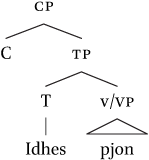
The schema in (20b) says that wh-in situ resides in its argument position, while C lacks both uQ and EPP. Following Vlachos (2019), we maintain that wh-elements in Greek contain an interpretable iQ feature, so (20) translates at LF to a âquestionâ.5
Let us, further, elaborate on the feature-specification of C in wh-in situ. More recently, in discussing English âoptionalâ wh-in situ, Bobaljik & Wurmbrand (2015) argue that C is âdeclarativeâ, an assumption also made by Sinopoulou (2009) for Greek wh-in situ. However, the empirical evidence from embedding we show in Section 2.1 suggests otherwise. Consider again (5), repeated as (21) for convenience.
(21)
a.
Pistevis
oti
ipe
ti?
believe.2SG
that
said.3SG
what
âYou believe that s/he said what?â
b.
Dhen
kseris
an/oti
ipe
ti?
NEG
know.2SG
if/that
said.3SG
what
âYou donât know if/that s/he said what?â
c.
Rotises
an
ipe
ti?
ask.2SG
if
said.3SG
what
âYou asked if s/he said what?â
If C in wh-in situ was âdeclarativeâ, (21b) and (21c) would be ungrammatical, contrary to facts, on the assumption that âdeclarativeâ and âinterrogativeâ properties cannot collapse on the same C-head (see Rizzi 1990). In short, (21) clearly says that wh-in situ does not impose any preference on (the embedded) C, which can turn out to surface in the guise required by the matrix predicate.
By way of summary, let us briefly review the empirical facts from Section 2.1 through the schema in (20). In principle, (20) predicts that wh-in situ does not (and cannot, after all) exhibit the properties induced by wh-movement, i.e., VS word order, satisfaction of selectional properties of a matrix predicate, island violations, and propositional scope. What is more, (20) says that a wh-in situ question can be in the complement of any clause-selecting predicate, as long as selection is encoded on the embedded C with a suitable complementizer.
The schema in (20) does not explain yet the obligatory anchoring of wh-in situ to the discourse. This is the issue we turn to next, delving more deeply into the interface of syntax with pragmatics. This will lead to a slight modification of (20) in relevant respects.
4 Syntax-pragmatics interface
As has been pointed out in the discussion so far (see Section 2.3), wh-in situ questions always assume the presence of a conjunctive ke âandâ, while wh-fronting questions may take that as an option. This empirical fact comes along with the observation that the presence of ke coincides with the need for âD(iscourse)-linkingâ (e.g., Pesetsky 1987) of wh-questions: On the one hand, wh-in situ questions are always D-linked, so they are always accompanied by ke. On the other hand, ke is not available in out-of-the-blue wh-fronting questions. By way of illustration let us construct the following context. Imagine speaker A walking past a bus stop and asking a person waiting there (22).
(22) Speaker A:
Sighnomi,
ti
ora
erxete
to
leoforio?
excuse-me
what
time
comes.3SG
the.NOM
bus.NOM
âExcuse me, what time does the bus arrive?â
Assuming that the interlocutors are not related, question (22) is not linked to anything since there is no discourse constructed, therefore it comes out-of-the-blue. It also follows that questions like these do not presuppose a possible set of answers.
In a setting like the one just described, questions (23) and (24) are not acceptable.
(23) Speaker A:
#
Ke
ti
ora
erxete
to
leoforio?
and
what
time
comes.3SG
the.NOM
bus.NOM
âAnd what time does the bus arrive?â
(24) Speaker A:
#
Ke
to
leoforio
erxete
ti
ora?
and
the.NOM
bus.NOM
comes.3SG
what
time
âAnd what time does the bus arrive?â
The presence of ke requires that these questions must be discourse linked, and therefore in the absence of any particular discourse they are rendered infelicitous.
By contrast, if the question in (23) and (24) are accompanied by preceding discourse, they become perfectly acceptable. Consider the dialogue in (25).
(25) a. Speaker A:
To
leoforio
ksekinise
apo
tin
afetiria
ikosi
lepta
prin.
the
bus
started
from
the
terminal
twenty
minutes
ago
âThe bus left the terminal twenty minutes ago.â
b. Speaker B:
Ke
erxete
ti
ora?
and
comes
what
time
âAnd what time does it arrive?â
In (25), an out-of-the-blue question like the one in (22) is not acceptable since in this case there is some information presupposed between the interlocutors. In passing, notice also that, apart from the wh-in situ, a wh-fronting question with the presence of ke would also be felicitous.
In the light of the above discussion, we argue that ke is not used in the narrow conjunction sense, but receives an enriched discourse-pragmatic interpretation. More accurately, ke functions as a discourse marker (DM) marking the conversational continuity and expressing the relation or relevance of the content of the question to the preceding context. A co-operative conversation normally takes place in a shared context, is highly interactive, is typically being co-constructed by the speaker and the hearer and involves dynamic and unplanned turn-takings as well as addressing questions. The role of DM is to indicate that there is a connection between some aspect of the discourse segment the DM is part of and some aspect of a prior discourse segment (Fraser 1999).
A way forward is to propose that ke, qua DM, establishes the common ground (Ã la Stalnaker 1978; Pires & Taylor 2007) which is shared between interlocutors. Common ground is defined in Pires & Taylor (2007) as information that was previously given in the discourse or the extralinguistic context, and which is shared (or assumed by the speaker to be shared) by speaker and hearer. Therefore, in cases like (25), the utterance made by speaker A constructs an informational context, i.e., a common ground, between the interlocutors, and this makes available a set of possible answers for speaker Bâs question. Ke marks the discourse by indicating that speaker Bâs wh-question is linked to speaker Aâs utterance and can be glossed as in (26) (in italics).
(26) a. Speaker A:
To
leoforio
ksekinise
apo
tin
afetiria
ikosi
lepta
prin.
the
bus
started
from
the
terminal
twenty
minutes
ago
âThe bus left the terminal twenty minutes ago.â
b. Speaker B:
Ke (afou ksekinise apo tin afetiria ikosi lepta prin) erxete ti ora?
âAnd (since the bus left the terminal twenty minutes ago) what time does it arrive?â
The systematic co-relation between the presence of the marker ke and the discourse linking of wh-questions is elegantly explained if we assume that ke projects in the structure of wh-in situ and is thus computed at the syntax-pragmatics interface. More precisely, drawing from approaches that âsyntactisize the discourseâ (e.g., Speas & Tenny 2003; Haegeman & Hill 2013), we propose that the syntax of wh-in situ obligatorily features a speech act layer, as in (27), which completes the schema in (20).
(27)

(27) encodes that a speech act layer projects on top of the C-periphery, and is headed by ke, which is either phonetical realized or not. This speech act layer is present in a wh-fronting question only if the latter is discourse-anchored; hence, optionally.
The schema in (27) captures the fact that ke anchors a wh-in situ question to the discourse. In the following section, we want to elaborate further on how this anchoring takes place, by concentrating on the way the two senses of ke, we observed in Section 2.3, interact with wh-in situ.
5 PF-pragmatics interface
As we may recall from Section 2.3, ke bears a âwhileâ reading, which may come in two senses, âtemporalâ and/or âadversativeâ. While both senses may, in principle, become available (as we have already mentioned), we have the impression as native speakers that there is always a preference for the âadversativeâ reading of wh-in situ. To describe this with an example, consider again the discourse in (14), repeated in (28) for convenience.
(28) a. Speaker A:
My father, my mother and I went to the store to buy eggs, milk and coffee. My mother bought the eggs.
b. Speaker B:
Ke
o
pateras
su
aghorase
ti?
and
the.NOM
father.NOM
yours
bought.3SG
what
âAnd your father bought what?â
The linguistic context in (28a) makes available a set of alternative values. Crucially, the wh-in situ question in (28b), in drawing a value from this set, seems to âexcludeâ the other values of the set. That is, the reading seems to be âbut your father bought what?â (a point first made in Vlachos 2012). So, along with their D-linking, wh-in situ questions appear to prefer an âadversativeâ reading. Drawing from Chiou & Vlachos (2017), we want to tie this preference for the âadversativeâ reading to the way the intonation of wh-in situ, given in Section 2.2, interacts with the pragmatics of ke.
More precisely, Chiou & Vlachos (2017) (see also Vlachos 2014), assuming the analysis of Vergnaud & Zubizarreta (2005), argue that the LF of a wh-question carries both a presupposition and a focus, which is captured as a(n) (iterative) disjunction between alternative propositions. So, the LF of (28b) can be captured as in (29).
(29) (your father bought milk) OR (your father bought coffee)
According to Vergnaud & Zubizarreta (2005), OR may have either an âinclusiveâ (indicated as âORiâ) or an âexclusiveâ (shown as âORcâ) reading, which is disambiguated via the corresponding wh-question melody. Extending this system to Greek wh-questions, and revisiting Vlachosâ (2014) relevant account, Chiou & Vlachos (2017) argue that wh-in situ has an âexclusiveâ interpretation on the grounds of the way the relevant intonation interacts with the pragmatics of wh-in situ. Refining (and simplifying somewhat) Chiou & Vlachosâ (2017) proposal, we want to tie the âadversativeâ reading of wh-in situ to the âexclusiveâ interpretation of OR. To this end, after we briefly consider âdisjunctionâ in natural language (Section 5.1), we turn to Griceâs Maxims (Section 5.2), which we then apply to the intonational meaning of wh-in situ by way of a scalar implicature (Section 5.3).
5.1 Disjunction
In natural languages, the connective OR appears to be different from the semantics of disjunction in logic, in the sense that the former appears ambiguous between two main readings: the inclusive reading (as p or q or both) and the exclusive one (as p or q but not both). By way of illustration consider the examples in (30).
(30) a. An applicant should have a degree in engineering or five years of programming experience.
b. John is a TV presenter or a physicist.
In (30a), an applicant is fine if s/he has both a degree in engineering and five years of programming experience and therefore, the inclusive reading is favoured. By contrast, in (30b), the exclusive reading will be preferred since p and q are usually not both true.
The question whether to interpret OR as lexically ambiguous or not is a longstanding issue in the literature, not only in linguistics but also in logic (see, e.g., Smith 2012). Given the modified Occamâs Razor according to which senses are not to be multiplied beyond necessity, Grice (1978) proposes an alternative to the ambiguity claim. Specifically, the two senses of OR can be accounted for if we assume one basic interpretation and then derive all other readings by means of pragmatic inferences. Following this, the sense of OR is considered univocal and inclusive (p or q or both); so the inclusive interpretation is the basic one. The exclusive reading (p or q but not both) is not part of the propositional content but is derived pragmatically by a conversational implicature. Let us consider the relevant framework in more detail in the following section.
5.2 Gricean maxims and scalar implicature
Grice builds his theory on the supposition that conversation moves along certain guidelines and assumptions. As Grice (1975: 45) states, âour talk exchanges do not normally consist of a succession of disconnected remarks ⦠they are, to some degree at least, co-operative effortsâ. Moreover, this cooperativeness is assumed for both the speaker and the hearer in a reciprocal manner. On these grounds, the theory of conversational implicature includes an overarching principle which Grice dubs the âcooperative principleâ. The cooperative principle of communication is defined in Grice (1975: 45) along the following lines:
The cooperative principle:
Make your conversational contribution such as is required at the stage at which it occurs, by the accepted purpose or direction of the talk exchange in which you are engaged.
Grice 1989: 26
The cooperative principle is further subdivided into four conversational maxims and eight sub-maxims. According to Grice, the maxims along with the cooperative principle regulate efficient language use in communication:
The Gricean maxims of conversation:
Grice 1989: 26â27
Quality: Try to make your contribution one that is true.
Do not say what you believe to be false.
Do not say that for which you lack adequate evidence.
Quantity:
Make your contribution as informative as is required (for the current purposes of the exchange).
Do not make your contribution more informative than is required.
Relation: Be relevant.
Manner: Be perspicuous.
Avoid obscurity of expression.
Avoid ambiguity.
Be brief (avoid unnecessary prolixity).
Be orderly.
The part of the Gricean maxims of conversation that is most relevant for our discussion is quantity implicatures. Quantity implicatures are triggered by the exploitation of the Gricean maxim of quantity and they are negative inferences in the sense that they refer to something that could have been said but was not said. Consider (31).
(31) A: Did Einstein propose General Relativity and the Exclusion Principle?
B: Well, Einstein proposed General Relativity
Implicature: Einstein did not propose the Exclusion Principle
In (31), B implies that the answer to Aâs question is not both. In this way she communicates the negation of Aâs statement implicitly.
A special case of quantity implicatures is scalar implicature. Particular linguistic expressions form entailment scales that are ordered in terms of the informational strength of utterances that contain them. A classic scale of this kind is quantifiers â¨all, someâ©. In such a scale, the semantic entailment has one direction making sure that the item to the left of the scale is informationally stronger than the item to the right (for more, see Horn 1989; Levinson 2000; among others). (32) demonstrates.
(32) Some of Einsteinâs predictions are wrong
Implicature: not all of Einsteinâs predictions are wrong
Given the first maxim of quantity, in (32), the use of an utterance containing the informationally weaker term âsomeâ, where an alternative proposition containing the informationally stronger term âallâ could have used, will trigger a quantity implicature communicating that the stronger claim does not hold. The implicated meaning is based on the negative nature of the inference since if the speaker could have made the stronger claim, she would have done so.
Within this frame, connective âorâ is a typical case of a scalar item. In particular, âorâ forms an informativeness scale with âandâ. âAndâ is semantically stronger and stands for logical conjunction (Î), while âorâ is semantically weaker and stands for logical disjunction (â¨). Following the same rationale as in (32), to say p or q will implicate ¬(p and q). In other words, the use of the informationally weaker term, where the informationally stronger could have been used, will conversationally implicate that the proposition including the stronger one does not hold. So, the apparent ambiguity of connective âorâ between the inclusive and the exclusive readings can be resolved by deriving the latter pragmatically by a conversational implicature. Specifically, the exclusive reading is a combination of the logical disjunction and the scalar implicature, namely, p ⨠q and ¬(p Î q) gives p or q but not both (see, also Levinson 1983, among others).
One last crucial issue relevant to scalar implicatures is that they do not arise in contexts where the implicature would not contribute to making the utterance more informative (Katsos & Breheny 2010). Observe the question-answer pairs in (33) and (34).
(33) A: Who proposed the Exclusion Principle?
B: It was Pauli or Heisenberg.
(34) A: What reading would you suggest for the assignment?
B: Study Pauli or Heisenberg and you will be fine.
(33) introduces an upper-bound context in the sense that interlocutors are interested in the strongest information possible and therefore the inclusive reading (p or q or both) is not enough. By contrast, the implicated exclusive reading (p or q but not both) increases the amount of contextually relevant information communicated by the speaker. The exclusive interpretation of the connective âorâ is an upper-bounded interpretation. On the other hand, in (34), the basic interpretation of the scalar item (i.e. the inclusive one) is sufficient for addressing the discourse goal and consequently, the scalar implicature will not be triggered. Contexts where computing the scalar implicature would be redundant are named lower-bound contexts and the inclusive interpretation of the connective âorâ is a lower-bounded interpretation.
Within this frame, in the next section, we explore the possibility that the prosody âseesâ the pragmatics of the iterative disjunction between alternative propositions in wh-in situ questions.
5.3 The intonational meaning of wh-in situ
Assuming the implicature account on the disjunction between alternative propositions in wh-in situ, we argue that the interpretation of wh-in situ questions can be accounted for by the division of labour between intonation and pragmatics.
By using the relevant intonation when uttering a wh-question, a speaker reveals her communicative intentions in the following way. As one may recall from Section 2.2, while wh-fronting and in situ share the same âquestionâ melody, they differ as to how this melody falls on each utterance: in wh-fronting, the tune includes the entire utterance, but in wh-in situ, it concentrates on the wh-phrase. We argue that the way the âquestionâ tune falls on each utterance has a pragmatic effect: in a wh-fronting intonation, anything goes as an answer; therefore, the semantic interpretation of or (p or q or even both) is relevant. On the contrary, by opting for a wh-in situ melody, the speaker communicates that the wh-element selects a member from a set of alternatives in the context; so, the semantic meaning of or is not informative enough. By assuming cooperative communication, a scalar implicature will be triggered inducing an upper-bounding interpretation (p or q but not both).
Let us illustrate the above pragmatic effect with examples, commencing from (35).
(35)
a.
Pjos
dhiatipose
ti
theoria
tis
Genikis
Sxetikotitas?
who-NOM
proposed-3SG
the
theory
of
General
Relativity
âWho proposed General Relativity?â
b. L*+H (or H*) L-!H%
Given that a wh-question is captured as a(n) (iterative) disjunction between alternative propositions, the LF of (35) can be glossed as in (36):
(36) LF: (the theory was introduced by X) ORi (the theory was introduced by Y)
In (36), the âfrontingâ melody will not trigger the scalar implicature because, in this context, the LF reading of OR (which is inclusive) is more informative. The speaker, by using the relevant melody, intends to communicate that any answer is possible.
By contrast, consider the scenario in which Lucy and Sandra want to go for a city break on the weekend but they have no idea as to where to go. Lucy says that she has been advised by a travel agency to visit Rome, London, and Madrid. Then Sandra asks (37):
(37)
a.
Ke
tha
pame
pu?
and
will
go-3PL
where
âAnd, where are we going?â
b. H* L- H%
Again, the LF of the question above contains an inclusive disjunction as in (38a). Nevertheless, what is actually communicated is the proposition in (38b).
(38) a. LF: (we will go at X) ORi (we will go at Y)
b. LF: (we will go at X) ORc (we will go at Y)
Here, the âin situâ melody triggers the scalar implicature because this implicature-driven interpretation of OR is more informative, bearing context in mind. The speaker, by using the corresponding melody, intends to communicate that the wh-element selects a member from a set of alternatives in the context and hence an âexclusiveâ (âadversativeâ) reading is preferred.
The proposed implicature account, apart from explaining how the speaker reveals her communicative intentions by opting for the relevant intonation when uttering the question, also predicts that the role of context is critical in the interpretation of wh-questions (see also Baltazani, Gryllia & Arvaniti 2019; Gryllia, Baltazani & Arvaniti 2018, 2019). It can be argued that the absence of a potential answer in the context introduces a lower-bound context whereas the presence of a set of possible answers in the discourse introduces an upper-bound context. As mentioned earlier in the discussion, scalar implicatures are generally triggered in upper-bound contexts since they convey the logically strongest information possible by increasing the amount of contextually relevant information communicated by the speaker. By contrast, in lower-bound contexts the semantic meaning is informative enough and hence a scalar implicature reading is not necessary. This, in turn, captures quite nicely the reason why wh-fronting questions are felicitous in aggressively non-D-linked (hence lower-bound) contexts, while wh-in situ questions are preferred in contexts where there are potential answers already established in the discourse.
6 Conclusion
This paper has examined the syntax, semantics and pragmatics of wh-in situ questions in Greek, in comparison with their wh-fronting counterparts. While wh-fronting is the default strategy of question-formation in Greek, wh-in situ is not an âoptionalâ, that is, semantically alternative, strategy of wh-fronting. Specifically, various distributional, prosodic and interpretational facts suggest that wh-in situ surfaces in the position it first merges (be it an argument or adjunct), is not associated with an interrogative Complementizer, and is obligatorily anchored to the discourse via the conjunctive marker ke âandâ. In fact, ke functions as a Discourse Marker, projecting in a Speech Act layer on top of the left periphery of wh-in situ.
Acknowledgments
Part of the discussion in this paper has been presented at the âUnbounded Seminars in Formal Linguisticsâ (University of Genève; June 2019) and part at the 14th International Conference on Greek Linguistics (University of Patras; September 2019). For helpful comments and suggestions, we are grateful to an audience at both venues, and especially to Amalia Arvaniti, Caterina Bonan, Costas Canakis, Renos Georgiou, George Kontzoglou, George Magionos, Vassilios Spyropoulos, and Evangelia Vlachou. Also, we would like to thank two anonymous reviewers for constructive criticism. Christos Vlachos gratefully acknowledges that research for this paper has been funded by the Hellenic Foundation for Research and Innovation (H.F.R.I.), through the University of Patras (Grant No. 23/80602). All remaining errors are ours.
A reviewer correctly points out that if ke follows pos, as in (i), then the high reading is obligatory, while the low reading becomes downright ungrammatical.
(i)
Pos
ke
efijes
toso
noris
apo
to
parti?
how
and
left.2SG
that
early
from
the
parti
a. *How did you leave the party that early?
b. How come you left the party that early?
We agree with the reviewer that pos ke configurations in cases like (i) might involve some kind of ellipsis (e.g. pos etixe/sinevi ke âhow come it happenedâ), and from this perspective would not constitute a minimal pair with the ke pos arrangements presently examined. This is why we do not consider cases like (i) in the present paper, and we refer the interested reader to Vlachos (2012) for a first comparison of the âke pos vs. pos keâ pattern in the context of wh-questions.
For clarity, let us note that with the term âinterpretationâ we refer more broadly to pragmatically induced meaning, which we distinguish from the syntactically computed meaning typically described with the term âsemanticsâ.
This appears to be a pervasive property of wh-in situ across typically wh-fronting languages (see Bobaljik & Wurmbrand 2015). We say âappearsâ because some Northern Italian varieties do not seem to fit this pattern, as they permit wh-in situ without a phonetically realized complementizer in selected contexts (see Manzini & Savoia 2011).
In fact, this analysis has been proposed by Manzini & Savoia (2011) for âoptionalâ wh-in situ in Northern Italian varieties.
To be fair, the âquestionâ semantics of wh-in situ is not as straightforward as we take it to be. The issue is where the meaning of the âquestionâ comes from, if not from C (as is typically the case with wh-fronting). A related problem is how to interpret the wh-quantifier âin situâ. We leave a detail treatment of the âquestionâ semantics of wh-in situ to future research as it requires an in-depth investigation of the semantic type of wh-elements, which is a non-trivial matter, and goes far beyond the scope of the present paper (as it would also require examination of contexts where a wh-phrase does not translate, strictly speaking, to a âquestionâ, as in âechoesâ or âexclamativesâ).
References
Alexopoulou, Theodora & Mary Baltazani. 2012. Focus in Greek wh-questions. In: Contrasts and positions in information structure, ed. by I. Kucerova and A. Neeleman, 206â246. Cambridge: Cambridge University Press.
Arvaniti, Amalia & Robert D. Ladd. 2009. Greek wh-questions and the phonology of intonation. Phonology 26: 43â74.
Arvaniti, Amalia. 2001. The intonation of wh-questions in Greek. Studies in Greek Linguistics 21: 57â68.
Baltazani, Mary, Stella Gryllia & Amalia Arvaniti. 2019. The intonation and pragmatics of Greek wh-questions. Language and Speech, 1â39. [DOI: https://doi.org/10.1177/0023830918823236]
Bobaljik, Jonathan David & Susi Wurmbrand. 2015. Questions with declarative syntax tell us what about selection. In: 50 Years Later: Reflections on Chomskyâs Aspects, ed. by Gallego, J. Ãngel & Dennis Ott, 13â32. MIT Working Papers in Linguistics.
Canakis, Kostas. 1995. Îαι: The story of a conjunction. University of Chicago, doctoral dissertation.
Chiou, Michalis & Christos Vlachos. 2017. The pragmatics of wh-in situ questions in Greek. Studies in Greek Linguistics 37: 201â211.
Chomsky, Noam. 2000. Minimalist inquiries: The framework. In: Step by step: Essays on minimalist syntax in honor of Howard Lasnik, ed. by Roger Martin, David Michaels & Juan Uriagereka, 89â156. Cambridge, MA: MIT Press.
Fox, Danny. 1999. Reconstruction, Binding Theory, and the interpretation of chains. Linguistic Inquiry 30 (2): 157â196.
Fraser, Bruce. 1999. What are discourse markers? Journal of Pragmatics 31: 931â953.
Giannakidou, Anastasia. 1998. Polarity sensitivity as (non)veridicality. Amsterdam: John Benjamins.
Grice, H. Paul. 1975. Logic and conversation. In: Syntax and semantics 3: Speech acts, ed. by Peter Cole & Jerry L. Morgan, 41â58. New York: Academic Press.
Grice, H. Paul. 1978. Further notes on logic and conversation. In: Syntax and semantics 9: Pragmatics, ed. by Peter Cole, 113â128. New York: Academic Press.
Grice, H. Paul. 1989. Studies in the way of words. Cambridge, MA: Harvard University Press.
Gryllia, Stella, Mary Baltazani & Amalia Arvaniti. 2018. The role of pragmatics and politeness in explaining prosodic variability. In: Proceedings of the 9th International Conference on Speech Prosody, ed. by Klessa Katarzyna, Jolanta Bachan, Agnieszka Wagner, Maciej KarpiÅski & Daniel ÅledziÅski, 158â162. [DOI: https://doi.org/10.21437/SpeechProsody.2018-32]
Gryllia, Stella, Mary Baltazani & Amalia Arvaniti. 2019. Evidence for the compositionality of intonational meaning. In: Proceedings of the 19th International Congress of Phonetic Sciences, ed. by Sasha Calhoun, Paola Escudero, Marija Tabain & Paul Warren, 2841â2845. Canberra, Australia: Australasian Speech Science and Technology Association Inc.
Haegeman, Liliane & Virginia Hill. 2013. The syntacticization of discourse. In: Syntax and its limits, ed. by Raffaella Folli, Christina Sevdali & Robert Truswell, 370â390. Oxford: Oxford University Press.
Heim, Irene & Angelika Kratzer. 1998. Semantics in Generative Grammar. Oxford: Blackwell.
Horn, Laurence. 1989. A natural history of negation. Chicago: University of Chicago Press.
Horrocks, Geoffrey & Melita Stavrou. 1987. Bounding theory and Greek syntax: Evidence for wh-movement in NP. Journal of Linguistics 23: 79â108.
Katsos, Napoleon & Richard Breheny. 2010. Two experiments and some conclusions on the meaning of scalars and numerals. In: The role of data at the semantics-pragmatics interface, ed. by E. Nemeth & K. Bibok, 125â160 (Mouton Series in Pragmatics 8). Berlin & New York: De Gruyter Mouton.
Kotzoglou, George. 2005. Wh-extraction and locality. University of Reading, doctoral dissertation.
Kotzoglou, George. 2006. Subject-verb inversion in Greek: Implications for head movement and typology. Journal of Universal Language 7: 91â137.
Lahiri, Utpal. 2002. Questions and answers in embedded contexts. Oxford: Oxford University Press.
Levinson, Stephen C. 1983. Pragmatics. Cambridge: Cambridge University Press.
Levinson, Stephen C. 2000. Presumptive meanings. Cambridge, MA: MIT Press.
Manzini, M. Rita & Leonardo M. Savoia. 2011. Wh-in situ and wh-doubling in Northern Italian varieties: Against Remnant Movement. Linguistics Analysis 37: 1â2.
Pesetsky, David. 1987. Wh-in situ: Movement and unselective binding. In: The representation of (in)definiteness, ed. by E. Reuland & A. ter Meulen, 98â129. Cambridge, MA: MIT Press.
Pires, Acrisio & Heather Taylor. 2007. The syntax of wh-in situ and Common Ground. Papers from the Annual Meeting of the Chicago Linguistic Society 43: 201â215.
Rizzi, Luigi. 1990. Relativized minimality. Cambridge, MA: MIT Press.
Ross, J. Robert. 1967. Constraints on variables in syntax. Cambridge, MA: MIT, doctoral dissertation.
Roussou, Anna, Christos Vlachos & Dimitris Papazachariou. 2013. In situ, ex situ and (non-)echo questions. In: Major trends in theoretical and applied linguistics: Selected papers from the 20th International Symposium on Theoretical and Applied Linguistics, vol. 3, ed. by Nikolaos Lavidas, Thomaï Alexiou & Areti Maria Sougari, 475â494. London: de Gruyter.
Roussou, Anna. 2010. Selecting complementizers. Lingua 120: 582â603.
Sinopoulou, Ourania. 2009. ÎÏÎ»á½³Ï ÎµÏÏÏá½µÏÎµÎ¹Ï Î¼Îµ εÏÏÏημαÏική λέξη in situ: η ÏεÏá½·ÏÏÏÏη ÏÏν Îλληνικών. Proceedings of the 8th International Conference on Greek Linguistics, Ioannina 30 Augustâ2 September 2007, ed. by Mary Baltazani, Georgios Giannakis, George J. Xydopoulos & Anastasios Tsangalidis, University of Ioannina, 1118â1132.
Sinopoulou, Ourania. 2019. ÎÎ¿Î¼á½³Ï ÏολλαÏÎ»á½µÏ ÎºÏ ÏιαÏÏίαÏ: Î ÏύνÏαξη ÏÏν εÏÏÏημαÏικών ÏÏοÏá½±ÏεÏν ÏÎ·Ï ÎλληνικήÏ. National and Kapodistrian University of Athens, doctoral dissertation.
Smith, Nicholas J.J. 2012. Logic: The Laws of Truth. Princeton, NJ: Princeton University Press.
Speas, Peggy & Carol Tenny. 2003. Configurational properties of point of view roles. In: Asymmetry in grammar, Volume 1: Syntax and semantics, ed. by Anna Maria di Sciullo, 315â344. Amsterdam: John Benjamins.
Stalnaker Robert. 1978. Assertion. In: Syntax and semantics 9: Pragmatics, ed. by Peter Cole, 315â322. New York: Academic Press.
Starke, Michael. 2001. Move dissolves into merge: A theory of locality. University of Geneva, doctoral dissertation.
Szabolcsi, Anna. 2006. Strong vs. weak islands. In: The Blackwell companion to syntax, ed. by M. Everaert & H. van Riemsdijk, 479â531. London: Blackwell
Uribe-Etxebarria, Myriam. 2002. In situ questions and masked movement. Linguistic Variation Yearbook 2: 215â255.
Vergnaud, Jean-Roger & Maria-Luisa Zubizarreta. 2005. The representation of focus and its implications: Towards an alternative account of some âintervention effectsâ. Organizing grammar. Studies in honour of Henk van Riemsdijk, ed. by H. Boekhuis, N. Corver, R. Huybregts, U. Kleinhenz & J. Koster, 641â678. Paris: Mouton De Gruyter.
Vlachos, Christos. 2010. Wh-in situ: The case of Greek. In: Movement and clitics: Adult and child grammar, ed. by V. Torrens, L. Escobar, A. Gavarró, and J. Gutiérrez, 84â111. Cambridge: Cambridge Scholars Publishing.
Vlachos, Christos. 2012. Wh-constructions and the division of labour between syntax and the interfaces. University of Patras, doctoral dissertation.
Vlachos, Christos. 2014. Wh-inquiries into Modern Greek and their theoretical import(ance). Journal of Greek Linguistics 14: 212â247.
Vlachos, Christos. 2019. False optionality: When the grammar does mind. Studies in Greek Linguistics 39: 1013â1023.
